by jqm | Sep 24, 2026 | Insurance
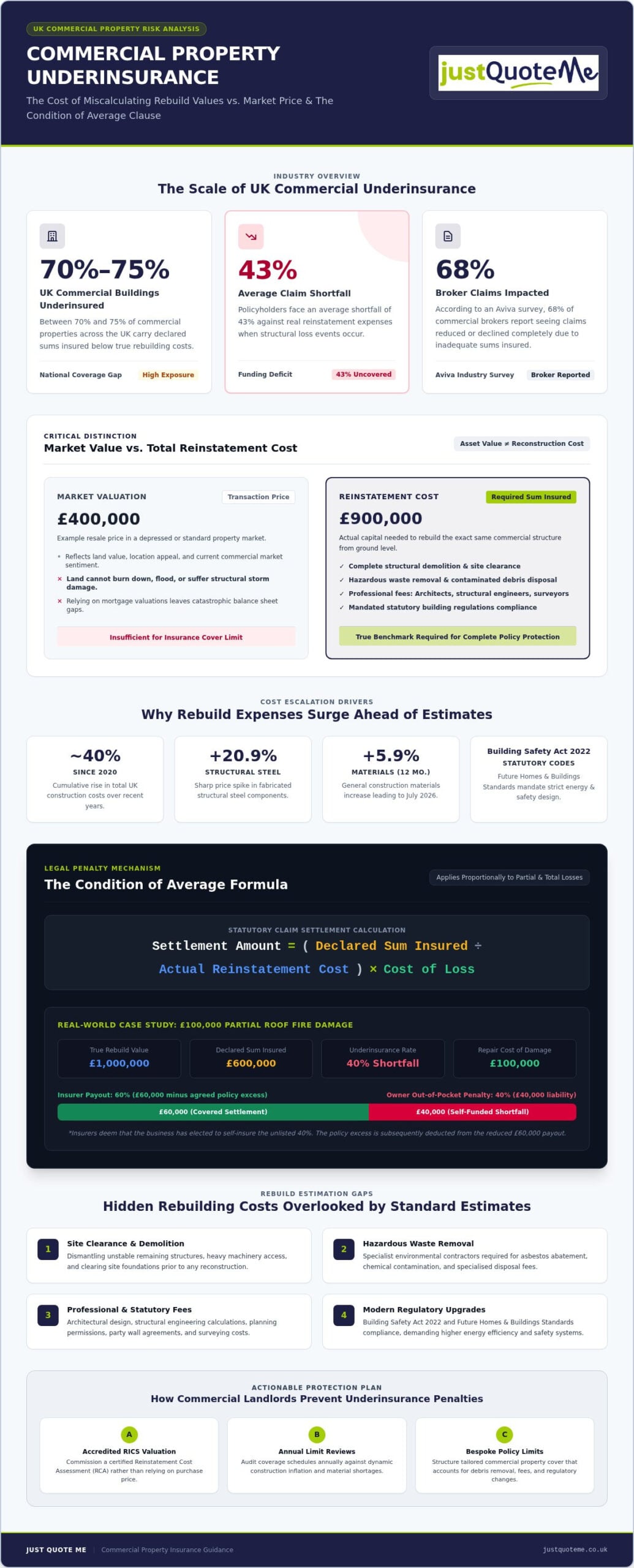
Between 70% and 75% of UK commercial properties are currently underinsured, leaving policyholders facing an average shortfall of 43% against their true rebuild costs. Overlooking the underinsurance risks for commercial property owners can turn an unexpected fire, flood, or structural failure into an immediate financial catastrophe.
It’s understandable why this happens. With cumulative UK construction costs rising nearly 40% since 2020, confusing an asset’s market value with its total reinstatement expense is an easy trap to fall into. Many property owners assume that purchase price or basic index-linking provides sufficient cover, only to discover painful deductions when filing a claim.
This guide explains precisely how commercial property underinsurance develops, how the strict Condition of Average clause penalises partial losses, and how to protect your balance sheet. You’ll learn how to calculate precise reinstatement costs that reflect current material prices and modern building regulations, ensuring your policy limits fully protect your commercial investments.
Key Takeaways
- Distinguish between resale value and true rebuilding costs to mitigate severe underinsurance risks for commercial property owners before filing a claim.
- Understand how the legal Condition of Average clause operates, which allows insurers to reduce partial and total claim settlements proportionally.
- Identify hidden rebuilding expenses that standard estimates overlook, including site clearance, hazardous waste removal, and professional architectural fees.
- Discover why standard policy index-linking often falls short and how an accredited RICS valuation maintains accurate sums insured.
- Learn how an experienced independent commercial broker structures bespoke policy limits to safeguard your commercial assets against regulatory changes and inflation.
What Is Commercial Property Underinsurance & Why It Rises?
Commercial property underinsurance occurs when the declared sum insured on your building is lower than the actual cost required to rebuild it from the ground up. Sums insured frequently lag behind real-world costs because business owners set coverage limits based on historic figures or purchase prices rather than dynamic construction market conditions.
While complete structural destruction represents the worst-case scenario, partial loss events like localised electrical fires or burst water pipes happen far more often. In these situations, insurers apply the legal Condition of average to reduce partial settlements proportionally. This mechanism triggers critical underinsurance risks for commercial property owners, leaving businesses personally liable to fund massive cash shortfalls during repairs. Structuring a tailored commercial property insurance policy ensures your business avoids these sudden financial liabilities.
The Crucial Difference Between Market Value and Rebuild Cost
Market value reflects what a buyer pays for a property, which heavily depends on location and land value. Land cannot burn down or suffer storm damage, meaning market price bears little relation to reconstruction expenses. Reinstatement value represents the total expenditure needed to rebuild the structure from ground level, including demolition, clearing debris, and hiring engineers. A commercial property in a depressed market might sell for £400,000 but require £900,000 to rebuild; relying on mortgage valuations or sales records leaves severe coverage gaps.
Why Commercial Underinsurance Has Surged Across the UK
Rebuilding costs have escalated sharply in recent years. Construction materials rose by 5.9% in the 12 months leading to July 2026, with specific components like fabricated structural steel jumping 20.9%. Supply chain bottlenecks have extended lead times on specialised components, driving up site overheads and labour expenses. Modern regulatory frameworks, including the Building Safety Act 2022 and the Future Homes and Buildings Standards, mandate enhanced energy efficiency and stringent design compliance when rebuilding. These compounding factors rapidly widen underinsurance risks for commercial property owners who fail to update their coverage schedules annually.
The Condition of Average: How Insurers Penalise Underinsurance
The Condition of Average is a standard contractual clause within UK commercial insurance policies. Insurers insert this clause to ensure businesses pay a premium that accurately reflects the true risk profile of the building. When a property is insured for less than its actual rebuilding cost, insurers deem that the owner has chosen to self-insure the remaining percentage. Consequently, any settlement payout is reduced by that exact proportion, regardless of whether the incident involves a total loss or minor structural damage.
Industry research shows that underinsurance remains one of the biggest property risks facing commercial enterprises today. According to an Aviva survey, 68% of brokers have seen claims reduced or declined entirely due to inadequate sums insured. For an organisation managing tight cash reserves, an unexpected settlement deduction creates immediate capital shortfalls that can halt core commercial operations.
Understanding the Mathematical Mechanics of the Average Clause
Loss adjusters calculate claim settlements using a transparent formula:
(Sum Insured ÷ Actual Reinstatement Cost) × Cost of Loss = Settlement Amount
This proportional reduction applies across every aspect of a claim, including debris disposal and professional fees. If your building has a true reinstatement value of £1,000,000 but you declared a sum insured of £600,000, you are underinsured by 40%. Once the insurer calculates the reduced settlement, your agreed policy excess is deducted from that final reduced sum, shrinking your financial recovery even further.
Real-World Impact: Total Loss vs Partial Damage Claims
Many owners assume Average only affects catastrophic events where the entire premises collapses. That is a dangerous misconception. If that same building suffers £100,000 worth of localised roof fire damage, the insurer pays only 60% of the repair bill (£60,000), minus your policy excess. You must fund the remaining £40,000 out of your own cash reserves.
Repair delays quickly lead to tenant disputes, missed commercial milestones, or breach of lease covenants. Mitigating these severe underinsurance risks for commercial property owners requires proactive valuation reviews. Securing an accurately structured commercial property insurance schedule ensures partial losses are covered in full. If you are uncertain whether your existing sums insured reflect current building standards, you can easily speak with a knowledgeable specialist to audit your existing policy terms.
Hidden Factors That Distort Commercial Rebuild Valuations
Rebuilding a damaged premises involves far more than simply replacing bricks, mortar, and steel. According to data from RebuildCostAssessment.com, 94% of UK commercial properties are insured for the wrong amount. This widespread error occurs because property owners often calculate rebuilding limits purely on construction materials, ignoring the substantial secondary costs required to restore a site.
A complete reinstatement valuation must account for several overlooked expenses that quickly inflate project costs:
- Demolition and site clearance: Safely bringing down unstable structures, sorting debris, and transporting waste to licensed landfill sites.
- Professional fees: Essential appointments for structural engineers, planning consultants, party wall surveyors, and architects, which typically add 10% to 15% to total project expenses.
- Statutory and planning compliance: Meeting upgraded local authority requirements, environmental mandates, and accessibility rules during reconstruction.
- External works and infrastructure: Replacing perimeter security fencing, boundary walls, paved car parks, access roads, and underground utility connections.
Overlooking these core items amplifies underinsurance risks for commercial property owners, creating large cash shortfalls when claims adjusters assess the real cost of complete site recovery.
Site Clearance, Demolition, and Environmental Regulations
Clearing a commercial site after a loss involves complex environmental processes. Older premises frequently contain hazardous substances, requiring licensed contractors to handle specialist asbestos removal and toxic waste disposal. Urban properties face additional access hurdles. Bringing heavy lifting gear into tight high-street locations requires road closures and municipal traffic management permits. For high-street retailers, securing tailored shop insurance ensures these expensive logistical line-items are included in your structural schedule.
Listed Buildings and Specialist Commercial Architectural Features
Historic and listed properties present distinct valuation challenges. UK conservation legislation mandates that listed buildings must be restored using traditional methods and authentic materials. Sourcing matching dressed stonework, lime mortars, or bespoke structural timber significantly drives up procurement costs and labour rates. Failing to account for specialist craft trades creates severe coverage gaps, leaving landlords unable to satisfy strict statutory preservation obligations.
Business Interruption and Extended Indemnity Periods
Site clearance delays and rigorous planning requirements directly lengthen rebuilding schedules. If severe structural damage occurs, negotiating permissions and sourcing materials can take months before site works even begin. In this environment, a standard 12-month business interruption indemnity period often expires long before contractors finish reconstruction. This leaves commercial landlords exposed to ongoing mortgage payments and lost rental yields while tenants relocate, compounding the structural underinsurance risks for commercial property owners.
How Commercial Landlords Can Audit and Prevent Underinsurance
Preventing coverage shortfalls requires a structured assessment rather than guesswork at policy renewal. Between 70% and 75% of UK commercial properties face underinsurance, with the average shortfall sitting at roughly 43% below actual rebuild values. Commercial landlords who rely on historic figures or automatic renewals expose their businesses to major balance-sheet disruptions.
A systematic audit process closes these gaps before a loss occurs:
- Schedule an independent assessment: Secure an on-site inspection by a qualified professional to establish a robust baseline figure.
- Track operational modifications: Log every structural enhancement, partition change, and plant addition as it happens.
- Audit policy wording: Review specific underwriter clauses regarding Average, day-one uplift percentages, and declared values.
- Review values annually: Adjust building sums insured every twelve months to reflect real-world material and labour inflation.
Following these steps systematically eliminates the primary underinsurance risks for commercial property owners and establishes clear proof of value for adjusters.
Commissioning a Reinstatement Cost Assessment (RCA)
A formal Reinstatement Cost Assessment carried out by a Royal Institution of Chartered Surveyors (RICS) accredited professional provides the only definitive baseline for your insurance schedule. The surveyor inspects the building framework, foundation requirements, site access constraints, and local authority planning obligations. Property owners should commission a fresh RCA every three years, or immediately following significant structural alterations. A documented RICS assessment provides verifiable evidence to insurers, preventing allegations of misrepresentation or disputes over declared values during a major claim.
The Limitations of Automated Index Linking
Many landlords rely entirely on automated index linking applied by insurers at each renewal. This practice often creates a false sense of security. Index linking applies a broad, national percentage increase based on general building cost metrics. It ignores sharp, localised price surges in specialised labour or sudden spikes in specific materials like structural steel. If your initial baseline figure was incorrect five years ago, compounding percentage uplifts only widen that initial deficit, leaving significant coverage gaps unaddressed.
Adjusting Cover After Property Alterations and Upgrades
Physical modifications alter reinstatement costs immediately. Adding a structural mezzanine floor, upgrading commercial HVAC systems, rewiring plant networks, or replacing double glazing with acoustic panels increases the capital required to rebuild. Landlords must notify their insurance broker during the policy term when completing these improvements rather than waiting for annual renewal.
Building works also introduce third-party liabilities during construction. Managing these dynamic liabilities requires aligning property coverage with appropriate public liability insurance to protect against contractor or visitor incidents on site. To ensure your current sums insured accurately reflect your premises and structural modifications, you can request a commercial policy review with an independent broker today.
Securing Comprehensive Commercial Property Protection with Just Quote Me
Structuring accurate building cover requires a partner who understands the realities of modern UK construction and underwriting. Since 1989, Just Quote Me has provided independent brokerage expertise across Staffordshire, the West Midlands, and nationwide. As an FCA-authorised broker with over 30 years of commercial market experience, we work directly with leading UK underwriters to create tailored policies that systematically eliminate underinsurance risks for commercial property owners.
Rather than leaving policyholders to decipher complex terms alone, an experienced broker acts as a dedicated advocate. This professional representation ensures your policy wording reflects the true cost of rebuilding, protecting your capital against catastrophic settlement deductions.
Why Independent Broker Representation Protects Your Balance Sheet
Automated online aggregators rely on simplified algorithms that treat properties as standard square footage. This rigid approach overlooks non-standard architectural features, listed building obligations, and regional labour rates. Working with an independent broker provides a comprehensive portfolio assessment. Brokers actively negotiate favourable underwriter terms, including day-one uplift provisions, which add an agreed percentage buffer above declared reinstatement values to protect against mid-term inflation.
Streamlining Your Commercial Insurance Portfolio
Managing disparate policies for individual assets creates administrative friction and increases the likelihood of critical coverage gaps. Consolidating your assets under a unified insurance schedule provides complete clarity across all operational risks:
- Core building fabric: Accurate reinstatement limits encompassing professional fees and site clearance.
- Income security: Extended business interruption indemnity periods tailored to realistic reconstruction timetables.
- Property owners liability: Robust legal defence and settlement cover for third-party site claims.
- Loss of rent: Continuous rental income protection while premises undergo structural repairs.
This coordinated approach reduces administrative burdens and ensures full compliance with commercial underwriting conditions. When property damage occurs, having specialist claims guidance ensures loss adjusters receive transparent valuation data from day one. Partnering with an established broker removes guesswork, eliminates underinsurance risks for commercial property owners, and safeguards your investments against volatile market conditions.
Protect Your Commercial Investment Against Policy Shortfalls
Market values fluctuate with property market conditions, but reinstatement expenses are dictated by dynamic material costs, skilled labour, and stringent statutory building codes. Relying on historical valuations or basic index linking exposes your balance sheet to severe Condition of Average penalties, leaving you to fund substantial repair shortfalls out of pocket. Accurately managing underinsurance risks for commercial property owners is essential to keeping your premises and rental income secure.
Since 1989, Just Quote Me has delivered FCA-authorised independent brokerage guidance backed by over 30 years of commercial market experience. By partnering with premier UK underwriters, we structure bespoke commercial property schedules, negotiate protective day-one uplifts, and eliminate hazardous clause ambiguities. Take control of your property portfolio today with Just Quote Me to ensure your assets remain fully protected against unexpected property damage.
Get Your Free Business Insurance Quote now
Request a Call back for free Expert advice
Frequently Asked Questions
What is the Condition of Average in commercial property insurance?
The Condition of Average is a standard policy clause that reduces claim payouts proportionally if a building is insured for less than its full reinstatement value. If you insure a property for 70% of its true rebuild cost, the insurer will pay only 70% of any subsequent claim, even for minor damage. Policyholders must then fund the remaining percentage from their own reserves before the standard policy excess is deducted.
Can my insurer cancel my policy if I am found to be underinsured?
Yes, an insurer can cancel your policy or declare it void if underinsurance stems from deliberate or reckless misrepresentation under the Insurance Act 2015. While honest miscalculations typically trigger proportional claim reductions via Average clauses, severe undervaluation can lead underwriters to conclude that the actual risk profile differs entirely from what was agreed. In extreme cases, they may decline the claim completely and terminate coverage immediately.
How often should commercial property owners arrange a Reinstatement Cost Assessment?
Property owners should commission a professional Reinstatement Cost Assessment (RCA) every three years to keep pace with changing market conditions. Major structural modifications, building extensions, or significant spikes in construction inflation require an immediate off-cycle valuation review. Proactively managing these assessments helps mitigate critical underinsurance risks for commercial property owners, providing documented RICS evidence that prevents underwriter disputes when settling complex building claims.
Does commercial building insurance cover site clearance and demolition costs?
Commercial building insurance typically includes site clearance, shoring up, and debris removal, but only if these expenses are factored into your declared sum insured. If your coverage limit only accounts for baseline construction materials, there may not be enough funds remaining to clear rubble, handle hazardous waste like asbestos, or pay local council road-closure fees. These ancillary expenses must be explicitly calculated within your overall reinstatement assessment.
Why is market value different from the declared reinstatement value?
Market value reflects what a buyer pays for the premises, heavily influenced by land values, economic sentiment, and geographic location. Reinstatement value measures the total expense required to demolish, clear, and rebuild the exact structure to modern regulatory standards. In regions with modest commercial real estate prices, a property’s rebuild cost often vastly exceeds its open market resale value, making sales valuations dangerous guides for insurance schedules.
Does index linking completely prevent underinsurance on commercial premises?
No, index linking does not guarantee total protection against underinsurance. Insurers apply generic national indices that track broad macroeconomic metrics, which often lag behind sharp regional increases in specialised trades or structural materials. If your opening sum insured was inaccurate years ago, percentage uplifts merely compound that error. Auditing underinsurance risks for commercial property owners through professional RICS surveys ensures your baseline figures remain grounded in factual rebuild data.
What happens to rental income coverage if my commercial property is underinsured?
Underinsuring your building can severely compromise your loss of rent protection. If reduced claim payouts stall reconstruction, tenant repairs take far longer than planned. Standard 12-month or 24-month indemnity periods can easily expire before the premises becomes tenantable again, terminating rental payouts prematurely. Commercial landlords are then left without vital rental cash flow while still needing to meet ongoing commercial mortgage obligations out of their own reserves.
Article by
Just Quote Me
JustQuoteMe Ltd is an independent UK insurance brokerage specialising in business and personal insurance solutions. With over 35 years of industry experience, the company provides tailored insurance cover for businesses, landlords, tradespeople, hospitality venues, fleets, and individuals across the UK. Known for its personal service, expert advice, and competitive premiums, JustQuoteMe Ltd works with leading insurers to deliver bespoke policies designed around each client’s unique needs. The company is authorised and regulated by the Financial Conduct Authority (FCA No. 586607) and has built a reputation for trusted, straightforward insurance guidance and long-term client relationships.

by jqm | Sep 23, 2026 | Insurance
As a sole trader, your business assets and personal savings are legally identical, which means a single on-site mishap can put your personal finances directly on the line. While securing public liability insurance for self employed professionals is not a statutory legal requirement in the UK, winning commercial contracts and building credibility with clients almost always demands it.
You shouldn’t have to spend valuable working hours deciphering complex paperwork, guessing whether a project requires a £1 million, £2 million, or £5 million indemnity limit, or worrying that hidden exclusions might void a property damage claim. You simply need reliable protection that reflects your specific trade without paying for irrelevant add-ons. In this 2026 guide, you’ll discover how to assess your actual on-site exposures, satisfy commercial tender standards, and secure bespoke cover through an FCA-authorised independent broker.
Here is your straightforward roadmap to choosing the right policy, safeguarding your personal assets, and operating with total confidence.
Key Takeaways
- Understand how public liability insurance for self employed professionals shields your personal assets from expensive third-party injury and accidental property damage claims.
- Learn how to select the right indemnity limit, from £1 million up to £10 million, to satisfy strict commercial tender requirements and contract terms.
- Identify common exclusions, such as faulty workmanship or damage to items directly being worked upon, so you can avoid unexpected claim disputes.
- Follow a practical step-by-step checklist to accurately declare all your trade activities and prevent accidental non-disclosure.
- Discover the advantages of arranging tailored cover through an FCA-authorised independent broker with access to top UK underwriting panels.
What Is Public Liability Insurance for the Self-Employed?
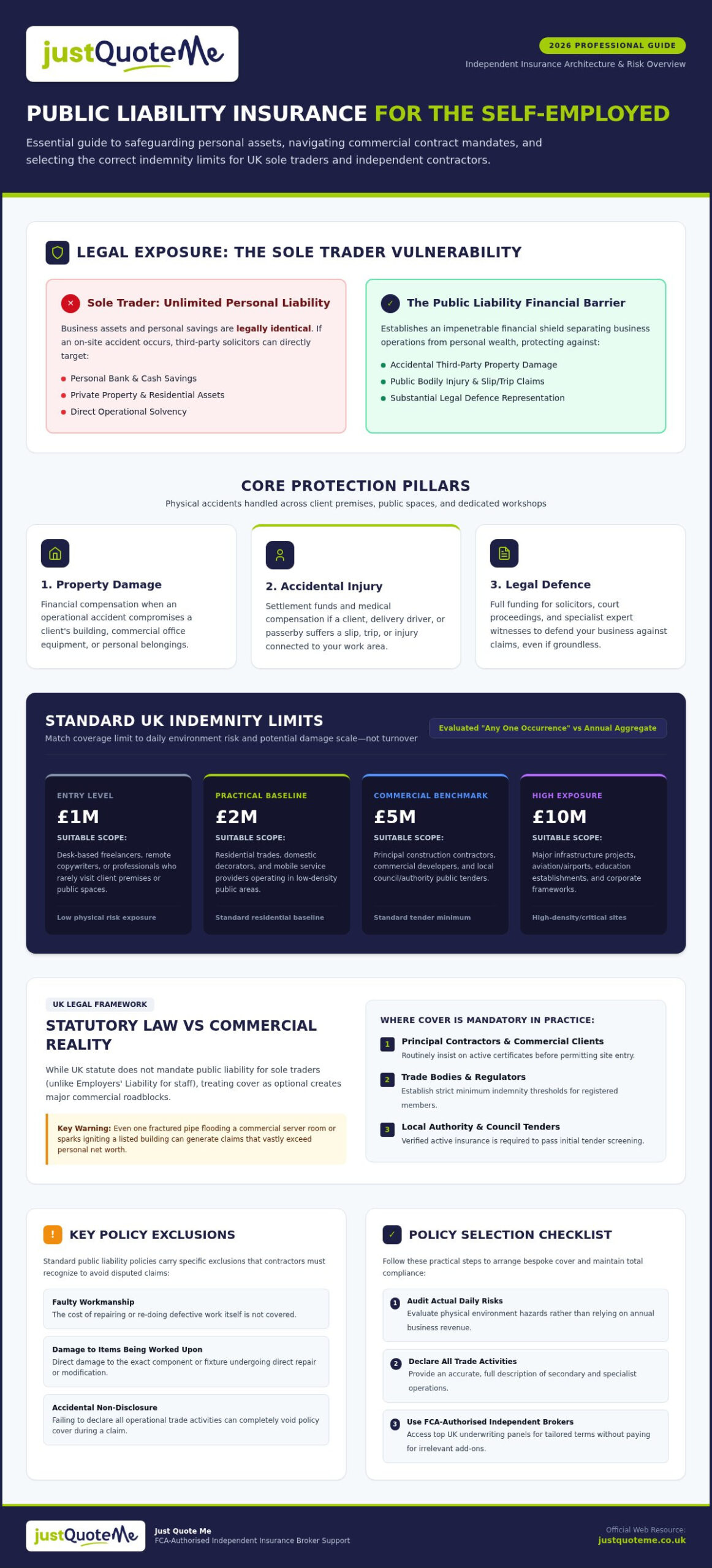
Operating as a sole trader or independent contractor brings complete autonomy, but it also carries direct legal exposure. Broadly defined, liability insurance establishes a financial barrier between your business actions and third-party losses. For solo operators, standard public liability insurance steps in when an external party alleges that your commercial activities caused them accidental bodily injury or damaged their possessions.
Unlike limited company directors who benefit from separate corporate entity status, self-employed sole traders share unlimited personal liability with their enterprise. If a visiting client trips over your equipment or you accidentally damage high-value fixtures while working on-site, claimant solicitors can target your personal savings or private property to settle the dispute. A robust policy covers not only the final compensation award or negotiated settlement, but also the substantial legal defence fees required to dispute contested claims.
Core Incidents Covered Under Self-Employed Public Liability
Public liability insurance for self employed professionals responds to everyday physical accidents across diverse work environments, including client premises, public spaces, and dedicated home workshops. Key incidents handled by these policies include:
- Third-party property damage: Financial protection if an accident during your operations compromises a client’s building, office equipment, or personal belongings.
- Public accidental injury: Settlement funds and medical compensation if a client, delivery driver, or passing bystander suffers a slip, trip, or physical injury connected to your immediate workspace.
- Legal defence representation: Complete funding for solicitors, court proceedings, and specialist expert witnesses to defend your business against disputed claims, even if an allegation proves groundless.
Legal Status vs Contractual Obligations in the UK
UK statute does not legally mandate public liability cover for sole traders in the same way the law enforces employers’ liability for staff. Even so, treating it as optional is a commercial mistake. Principal contractors, commercial clients, and estate managers routinely insist on seeing an active certificate before permitting you on-site. Trade bodies and industry regulators frequently establish minimum indemnity thresholds for registered members. Similarly, securing local council tenders or corporate frameworks requires verified cover, making public liability insurance for self employed trades and consultants a mandatory operational requirement in practice.
Evaluating Coverage Levels: How Much Indemnity Do You Need?
Selecting the right level of indemnity is rarely tied to your annual turnover. Size doesn’t dictate risk. Instead, your coverage limit must match the potential scale of damage in your daily work environment. If a fractured pipe floods a commercial server room or sparks ignite a listed building, the repair costs can quickly overwhelm basic coverage. When evaluating public liability insurance for self employed business owners, you must also check whether limits apply on an “any one occurrence” basis or as an annual aggregate total, which caps the insurer’s total payout across all claims in a single year.
Standard Indemnity Tiers Explained
Indemnity limits define the maximum financial settlement an insurer pays toward an approved claim. UK commercial policies generally align around four main thresholds:
- £1 million limit: Often considered an entry-level tier. This limit typically suits desk-based freelancers, remote copywriters, or professionals who rarely visit client premises or interact with the public.
- £2 million limit: The practical baseline for residential trades, domestic decorators, and mobile service providers operating in low-density public areas.
- £5 million limit: Widely treated as the benchmark requirement for principal construction contractors, commercial developers, and local authority tenders.
- £10 million limit: Routinely demanded for major infrastructure projects, working on airports, education establishments, or active railway corridors.
Securing the right public liability insurance limit guarantees that your certificate satisfies client procurement demands on day one without leaving you exposed to catastrophic losses.
Factors Influencing Your Required Level of Protection
To pinpoint the ideal indemnity tier for your trade, assess three practical factors before binding a policy:
- Surrounding property density: Working near delicate IT networks, high-end residential interiors, or expensive plant machinery requires higher cover limits than operating in an unfinished warehouse.
- Public footfall: Busy retail spaces, pedestrian precincts, and shared commercial premises carry elevated slip, trip, and falling-object risks.
- Contractual stipulations: Always inspect client service agreements before agreeing to site terms. Signing a contract requiring £5 million while carrying £2 million leaves you in breach of contract and personally liable for any shortfall.
If you need help determining how your contracts align with underwriter limits, the team at Just Quote Me can review your operational risks to pinpoint an indemnity tier that keeps your business competitive and fully protected.
Key Policy Exclusions and Common Claim Scenarios
A commercial liability policy serves as an essential safety net, but it doesn’t cover every operational setback. Underwriters design these policies specifically around sudden, accidental third-party losses rather than commercial disputes or business errors. Most claim disputes arise not because an accident was unprovoked, but because the policyholder assumed public liability acted as a blanket warranty for all trade activities.
What Standard Policies Do Not Cover
Public liability insurance for self employed workers maintains clear boundaries regarding what constitutes a valid third-party loss. Standard agreements routinely exclude:
- Defective workmanship: Insurers will not pay to rectify sub-standard craft or replace faulty parts you installed. If a plumber fits a pipe poorly, the policy won’t pay to refit the joint; it only triggers if water escapes and ruins the client’s downstairs ceiling.
- Damage to property worked upon: Direct physical damage caused to the exact fixture, vehicle, or item you are actively modifying or cleaning is commonly excluded unless a specific extension is endorsed.
- Injury to helpers or staff: If you take on temporary assistants or labour-only subcontractors, UK law mandates standalone employers liability insurance to manage bodily injury claims.
- Professional advice errors: Pure financial loss stemming from negligent consulting, architectural designs, or calculations requires dedicated professional indemnity cover.
- Own tools and materials: Your ladders, power tools, and materials in transit are excluded; they demand separate equipment protections.
Real-World Scenarios That Lead to Rejected Claims
Insurers insert strict warranties into policy schedules that require complete compliance. Breaching these operational conditions gives underwriters clear grounds to decline indemnity:
- Hot work conditions: Using blowtorches, angle grinders, or heat guns typically mandates a documented permit system, active fire extinguishers on hand, and a continuous 60-minute fire watch after finishing. Skipping the watch voids fire damage claims.
- Height and depth thresholds: Many standard policies impose strict operational ceilings, such as a 10-metre cap. If you undertake jobs exceeding these limits without reviewing working at height requirements and securing underwriter approval, coverage fails.
- Delayed notification: If a client mentions property damage and you attempt informal repairs without alerting your broker, underwriters can reject subsequent claims due to prejudiced investigation timelines.
Step-by-Step Buying Guide: Selecting the Right Policy
Buying business cover shouldn’t mean guessing which online form checkboxes fit your daily work. Automated price comparison engines often force varied, real-world trades into broad commercial categories. That approach risks leaving critical tasks uninsured. To secure reliable public liability insurance for self employed professionals, you need a methodical approach that aligns your policy schedule with your actual operational liabilities.
Defining Your Business Activities and Risk Profile
Insurers assess your risk strictly on the business activities declared at inception. Omissions can lead to costly claim repudiations. Take these practical steps before requesting underwriting terms:
- Audit every task you perform: If you are primarily an electrician but occasionally handle minor carpentry or plastering to finish a job, you must disclose those secondary trades. Underwriters will not cover incidents arising from undeclared activities.
- Note hazardous equipment and settings: Document whether you operate heavy plant, apply heat, or work within sensitive environments like schools, hospitals, or industrial facilities.
- Select trade-specific policy wording: Explore specialist cover options built specifically for registered tradesman insurance needs, ensuring your schedule matches the physical hazards of your work.
Bundling Essential Covers for Comprehensive Protection
Solo operators rarely face liability in isolation. Packaging complementary protections onto a single policy schedule eliminates administrative headaches, aligns your renewal dates, and closes dangerous coverage gaps:
- Tools and equipment: Add cover for your hand tools and power kits against on-site theft, transit damage, or break-ins.
- Commercial legal expenses: Fund professional representation to pursue unpaid invoices, resolve contractual arguments with main contractors, or handle HMRC tax investigations.
- Contract works: If you work on larger structural projects, review integrated builders insurance arrangements that protect unfinished physical works, temporary buildings, and site materials from fire, storm, or malicious damage.
Before binding your policy, compare mandatory policy excess levels and flexible direct debit options to keep cash flow predictable. If your operations cross multiple disciplines or involve complex on-site conditions, let an independent specialist negotiate terms with underwriters on your behalf. Explore tailored business insurance solutions to ensure your cover matches your real-world contracts from day one.
Why Arrange Your Self-Employed Cover Through Just Quote Me
Securing commercial protection shouldn’t feel like wrestling with an algorithm. Established in 1989 and based in Stone, Staffordshire, Just Quote Me Ltd brings over 30 years of independent brokering experience to sole traders and independent contractors across the UK. Instead of restricting your choices to the underwriting appetite of a single insurer, an independent broker benchmarks your operational risks across a wide panel of leading UK underwriters to secure bespoke terms tailored to your trade.
Independent Broker Advice vs Automated Comparison Tools
Automated price comparison portals rely on generic tick-boxes that frequently overlook the realities of modern sole trader operations. Working with an FCA-authorised broker delivers clear, human-led advantages:
- Policy wording scrutiny: Experienced brokers inspect the fine print, identifying restrictive height clauses, unreasonable tool warranties, or hazardous location exclusions before you purchase.
- Multi-disciplinary flexibility: If your self-employed work evolves into secondary revenue streams or specialist services, your broker negotiates bespoke policy endorsements that keep every activity covered.
- Direct ongoing advocacy: Avoid overseas call centres and automated phone trees. You deal directly with dedicated professionals for mid-term contract changes, annual reviews, and active claims advocacy.
Human-led placement bridges the gap between complex legal policy wording and your day-to-day trade. Having an experienced team handle your paperwork frees up your schedule to focus on delivering work and growing your client base.
Securing Your Tailored Sole Trader Protection Today
Don’t leave your personal finances exposed to accidental on-site damage or third-party injury claims. Aligning your public liability insurance for self employed operations with your live contracts takes just minutes with an established broker on your side.
Ready to protect your livelihood with policy wording that truly fits your business? Get Your Free Business Insurance Quote now to explore competitive terms across top UK underwriters, or Request a Call back for free Expert advice from an experienced specialist today.
Protect Your Trade and Secure Your Business Future
Running a solo enterprise is demanding enough without the lingering anxiety of uninsured claims. Securing the right public liability insurance for self employed operations isn’t just about obtaining a digital certificate; it’s about protecting your personal assets, qualifying for higher-value contracts, and safeguarding your professional reputation against sudden on-site mishaps.
Whether your projects require a baseline tier or a £5 million tender threshold, match your policy limits directly to your daily working risks rather than rough turnover estimates. At Just Quote Me, we bring over 30 years of independent insurance brokerage experience across the UK to sole traders and contractors. As an FCA-authorised firm with direct access to top UK commercial insurance underwriters, we negotiate bespoke policy designs built specifically around your trade disciplines and contract obligations.
Don’t leave your livelihood to chance or rigid algorithms. Speak with our independent UK broking team to arrange dependable cover, and get back to growing your business with total peace of mind.
Frequently Asked Questions
Is public liability insurance legally required for self-employed workers in the UK?
No, UK law does not statutory mandate this cover for sole traders. Unlike employers’ liability cover, which is a legal requirement if you hire staff, public liability is optional under criminal law. However, commercial clients, main contractors, and local authorities almost universally make active cover a mandatory contractual condition before granting site access.
How much public liability cover should a self-employed tradesman carry?
Most domestic trades carry between £1 million and £2 million to manage everyday property damage exposures. If you tender for commercial projects, subcontract on active construction sites, or bid for public authority work, you will typically need at least £5 million to satisfy procurement criteria. High-hazard environments like transport hubs can require up to £10 million.
Does public liability insurance cover my own tools and equipment?
No, standard public liability insurance for self employed professionals strictly covers third-party damage and public injury. It provides no financial protection if your own drills, hand tools, or materials are stolen from a vehicle or broken on-site. You must add dedicated tools and equipment cover to your schedule to protect those physical assets.
Can self-employed individuals claim public liability insurance as a business expense?
Yes, HMRC considers business insurance premiums an allowable commercial expense. Because the policy exists solely for trade purposes, you can deduct the full premium cost from your gross turnover when calculating taxable trading profits on your annual Self Assessment return, effectively reducing your overall tax liability.
What is the difference between public liability and professional indemnity insurance?
Public liability handles physical events, such as accidental injury to a bystander or dropping tools onto a client’s polished floor. Professional indemnity protects against purely financial losses resulting from negligent professional advice, incorrect design specifications, or flawed consulting work. Many freelance contractors who advise and implement work carry both policies simultaneously.
Does my policy cover me if I work from a home office or visit client houses?
Yes, valid policies cover both mobile work at client premises and domestic operations, provided you declare these working habits to your broker. If a delivery courier trips over stock inside your home hallway or you damage property while visiting a customer, underwriters respond. Always confirm that business visitors to your home are included.
What happens if a self-employed contractor causes damage without insurance?
Sole traders operate without limited liability protection, meaning there is no legal separation between commercial debts and private wealth. If you cause significant structural damage or severe bodily injury without an active policy, the claimant can pursue you through civil court. A successful judgment exposes your personal savings, vehicles, and residential property to cover the damages.
Article by
Just Quote Me
JustQuoteMe Ltd is an independent UK insurance brokerage specialising in business and personal insurance solutions. With over 35 years of industry experience, the company provides tailored insurance cover for businesses, landlords, tradespeople, hospitality venues, fleets, and individuals across the UK. Known for its personal service, expert advice, and competitive premiums, JustQuoteMe Ltd works with leading insurers to deliver bespoke policies designed around each client’s unique needs. The company is authorised and regulated by the Financial Conduct Authority (FCA No. 586607) and has built a reputation for trusted, straightforward insurance guidance and long-term client relationships.

by jqm | Sep 22, 2026 | Insurance
Treating your policy excess as nothing more than an unavoidable out-of-pocket penalty is one of the costliest assumptions a business owner can make. If you are wondering what is an insurance excess on a commercial policy, you are likely trying to shield your business from sudden cash flow shocks when disaster strikes. It’s completely understandable to feel cautious; commercial terms operate quite differently from domestic home policies, and setting the wrong threshold can leave your day-to-day liquidity vulnerable after an incident.
You don’t have to leave those figures to chance. In this guide, you’ll discover how a commercial excess functions as an active risk-management lever rather than an arbitrary deduction. We’ll clarify the essential differences between compulsory and voluntary excess, explain exactly how and when settlement amounts are adjusted during a claim, and show you how adjusting these figures directly influences your annual premiums. Here is your roadmap to selecting excess levels that match your risk appetite while keeping your bottom line secure.
Key Takeaways
- Clarify exactly what is an insurance excess on a commercial policy and how underwriters use it to balance shared operational risk.
- Distinguish between non-negotiable compulsory baselines and voluntary excess to lower annual premiums without creating cash flow vulnerabilities.
- Unpack how excess structures differ across commercial property, liability, and fleet covers, including where statutory rules waive excess entirely.
- Understand the precise mechanics of how insurers deduct policy excess during the claims process rather than issuing surprise invoices.
- Discover practical risk mitigation options and standalone protection products designed to shield your business from substantial out-of-pocket costs.
Understanding Commercial Policy Excess: What It Is and Why Insurers Use It
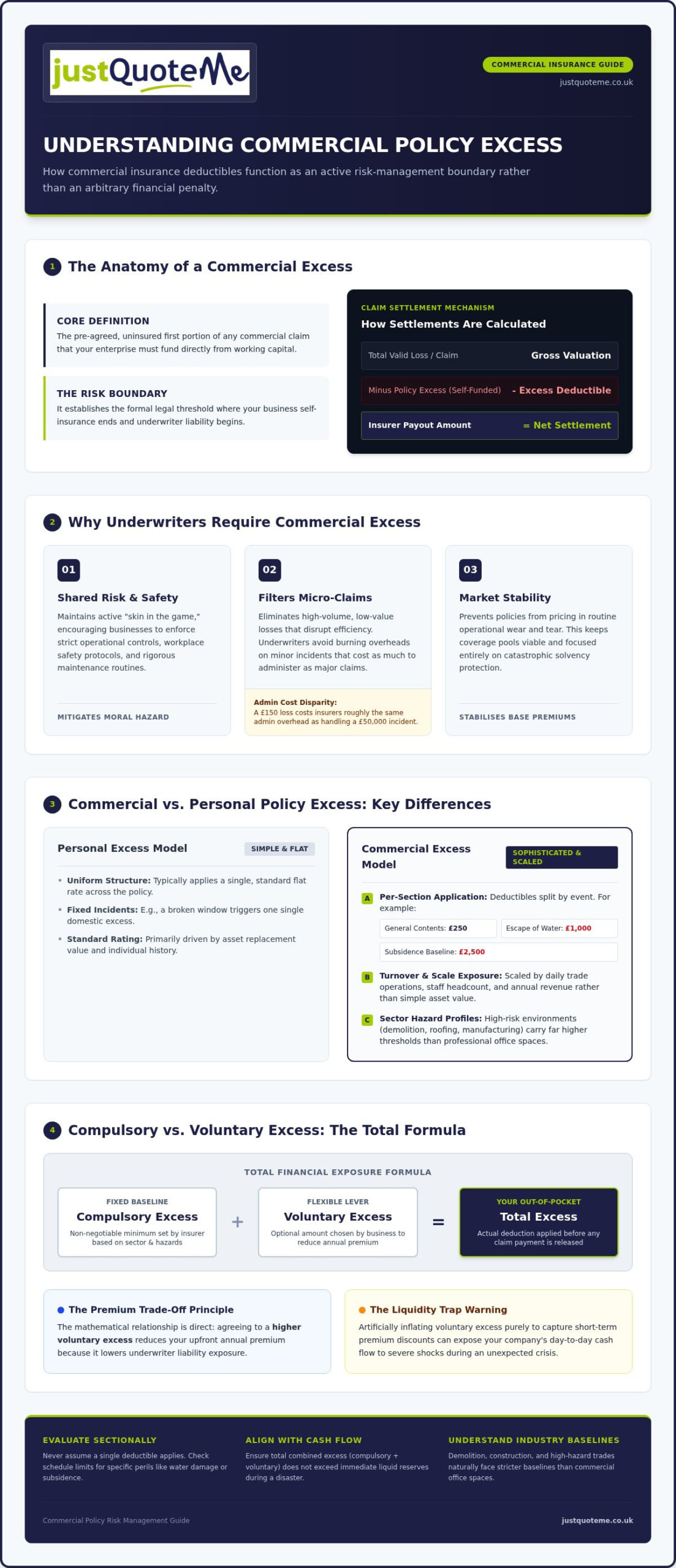
Every commercial insurance policy is an exercise in managed risk. At its core, commercial policy excess is the pre-agreed, uninsured first portion of any claim that your business must cover from its own funds. Underwriters do not view this figure as a punitive hurdle. Instead, it forms an essential financial boundary that defines where your self-insurance ends and the insurer’s liability begins.
To understand what is an insurance excess on a commercial policy, you must look at how risk is shared. Underwriters use excesses to ensure businesses maintain active skin in the game. When a business shoulders a financial stake in minor incidents, it naturally adheres to stronger workplace safety, rigorous maintenance, and tight operational controls. Excesses also filter out high volumes of low-value administrative micro-claims. Processing a £150 loss costs an insurer roughly the same administrative overhead as handling a £50,000 incident. By removing minor losses from the claims pipeline, underwriters keep administrative overheads sustainable, which directly stabilizes commercial premiums across the entire market.
The Core Purpose of an Excess in Business Insurance
An excess serves as a mutual financial agreement between you and your insurer. Without this threshold, underwriters would need to price policies to absorb routine business wear and tear, causing annual premiums to skyrocket. Setting a sensible baseline keeps annual coverage viable. It prevents small operational mishaps from disrupting the underwriting pool, ensuring funds remain focused on shielding your enterprise against catastrophic losses that could otherwise threaten your solvency.
Commercial vs. Personal Policy Excess: Key Differences
Personal insurance policies usually feature simple, uniform excess structures. If you break a window at home, you pay a single, fixed domestic excess. Commercial coverage works under far more sophisticated rules. A comprehensive policy, such as commercial property insurance, often splits deductibles across specific operational sections rather than applying one flat rate:
- Per-section application: Your schedule might apply a £250 excess for general contents damage, but require a £1,000 or £2,500 baseline for escape of water or subsidence.
- Turnover and scale exposure: Underwriters scale commercial thresholds based on annual turnover, staff numbers, and daily trade activities rather than simple asset replacement values.
- Sector volatility: Higher-risk environments, such as construction sites or industrial manufacturing plants, carry substantially higher baseline excesses than professional office environments.
Knowing what is an insurance excess on a commercial policy allows you to evaluate your policy schedule with precision. Rather than accepting generic figures, you can assess how each specific threshold impacts your operational cash flow.
Compulsory vs. Voluntary Excess: How They Affect Your Premium
Balancing insurance costs requires understanding how two distinct figures combine on your policy schedule. When asking what is an insurance excess on a commercial policy, you will encounter both compulsory and voluntary figures. Together, they represent your total financial exposure whenever an insured loss occurs.
The relationship between excess and premium is straightforward: the higher the total excess you agree to shoulder, the lower your upfront annual premium. Underwriters reward businesses willing to take on greater self-insurance because it reduces potential claim payouts. However, adjusting voluntary excess simply to chase short-term savings can expose your working capital to sudden liquidity traps if an incident happens unexpectedly.
Compulsory Excess: Why Insurers Set Non-Negotiable Baselines
Compulsory excess is the mandatory minimum set by underwriters during policy drafting. It cannot be negotiated away. Insurers determine this baseline by evaluating sector-specific risks, trade hazards, premises location, and claims track records. High-hazard activities, such as demolition or roofing, face elevated compulsory thresholds compared to standard retail trades. Similarly, commercial premises located in known flood zones or areas prone to subsidence carry high compulsory baselines to offset environmental exposures.
Voluntary Excess: Calculating the True Cost-Benefit for Your Cash Flow
Voluntary excess is an optional sum you choose to pay on top of the compulsory figure. According to UK broker market benchmarks, increasing your voluntary excess from £500 to £1,000 typically reduces the base premium by approximately 10% to 15%. Even so, you must weigh those annual savings against liquid cash flow:
- Liquid reserve requirement: Never commit to a voluntary excess that your trading accounts cannot liquidate within 24 hours.
- Break-even horizon: If increasing your excess by £1,000 saves you only £80 annually, your business needs over twelve claim-free years to break even on that choice.
Each and Every Claim vs. Aggregate Excess Terms
Most commercial wordings apply deductibles on an “each and every claim” basis. This means if your business suffers three distinct property incidents in a single policy year, you must pay your combined excess three separate times. For growing enterprises, this creates substantial cumulative exposure.
To prevent this compounding burden, policies can sometimes incorporate aggregate excess clauses or stop-loss limits. An aggregate excess caps your cumulative out-of-pocket payments at an agreed annual threshold. Once your combined claim payments reach that ceiling during a 12-month policy term, the insurer covers subsequent qualifying losses in full. If you need help reviewing these complex loss terms, working with an experienced broker like Just Quote Me ensures your thresholds remain aligned with your operational finances.
Understanding what is an insurance excess on a commercial policy across both single-event and aggregate structures ensures you avoid dangerous blind spots during high-frequency claim years.
How Excess Operates Across Different Commercial Policy Types
Excess structures are not uniform across your commercial coverage portfolio. Under UK law, employers’ liability insurance legally carries a £0 excess for employee bodily injury claims under the Employers’ Liability (Compulsory Insurance) Regulations 1998. The law prevents underwriters from applying deductibles to statutory worker compensation. Beyond statutory covers, however, deductibles fluctuate significantly based on the risks insured. Understanding what is an insurance excess on a commercial policy requires looking at how liability, property, and vehicle policies handle claims differently.
Public Liability and Property Damage Excesses
Standard public liability policies treat bodily injury and property damage separately. If a visitor suffers personal injury on your premises, no deductible applies (£0 excess). In contrast, Third-Party Property Damage (TPPD) claims standardly carry an excess between £100 and £500. Higher-risk activities, such as hot works using blowtorches or working at heights, often trigger specialist endorsements with elevated compulsory amounts. Securing robust public liability insurance ensures these operational exclusions and property excess terms are clearly defined upfront.
Commercial Property and Contractors All Risks
Commercial property schedules allocate specific excesses to distinct perils. A standard burst pipe or small theft might carry a baseline excess of £250, while severe flood or subsidence claims can trigger compulsory baselines of £1,000 to £2,500 or more. On active developments, construction equipment and partially built structures face distinct hazards. Arranging tailored builders insurance alongside contractors all risk insurance protects plant, machinery, and contract works against high out-of-pocket losses on active jobsites.
Commercial Fleet and Motor Trade Excess Dynamics
Fleet and commercial motor policies feature sliding excess scales based on vehicle specifications and driver risk profiles. Drivers under 25 or those with recent driving convictions often face substantial compulsory additions. If a third party hits your company vehicle and admits full liability, your insurer can typically recover your paid excess directly from the at-fault driver’s insurer. Consolidating company vehicles under structured motor fleet insurance gives you uniform terms across your business transport rather than managing disparate vehicle policies.
When and How Do You Pay the Commercial Excess During a Claim?
A common source of confusion during a loss is the physical transaction of the excess itself. Rather than receiving a separate bill the moment you file first notice of loss, the process depends entirely on whether your claim involves first-party property, direct repairs, or third-party liabilities. Clarifying what is an insurance excess on a commercial policy in practical terms means looking at how cash actually moves between your enterprise, your insurer, and third-party suppliers.
Deduction from Settlement vs. Direct Payment to Contractors
For first-party property losses, insurers rarely demand payment upfront. Instead, they apply a deduction mechanism:
- Net cash settlements: If storm damage destroys £12,000 of inventory and your policy carries a £1,000 excess, your insurer issues a cash settlement of £11,000. You absorb the remaining £1,000 internally.
- Direct repairer payments: When an insurer dispatches an approved contractor or bodyshop to carry out physical repairs, you pay your excess directly to that contractor upon completion of the work. The insurer settles the remaining balance with the contractor.
- VAT obligations for VAT-registered firms: Under HMRC rules, insurance settlements are VAT-exempt. If your firm is VAT-registered, the insurer pays the repair costs net of VAT and net of your excess; you pay the excess and VAT directly to the contractor, reclaiming the input VAT on your next quarterly return.
- Third-party claims recovery: If a third party claims against your liability cover, your insurer handles the legal defence and compensation payouts directly, then invoices your business to reimburse the policy excess afterwards.
Non-Fault Incidents and Excess Recovery Mechanics
When an incident is entirely the fault of an identifiable third party, you must still pay or absorb your policy excess initially to get repairs underway. Once liability is legally established, your insurer exercises its right of subrogation, demanding full reimbursement of all claim costs, including your excess, from the negligent party’s insurer. While recovery timelines can take anywhere from a few months to over a year depending on liability disputes, commercial legal expenses cover can assist in recovering uninsured losses when negotiations stall.
What Happens When a Commercial Claim Is Below the Excess?
If a burst pipe causes £400 of damage and your property excess sits at £500, your insurer pays nothing. Even though the financial cost falls entirely on your business, your policy terms still require prompt notification. Informing your broker preserves your cover integrity and protects you should hidden damage surface later. For immediate assistance structuring practical deductibles that keep claim settlements seamless, get in touch with Just Quote Me to protect your business.
Mastering these procedures ensures you know exactly when cash leaves your bank accounts, preventing friction when resolving what is an insurance excess on a commercial policy during critical operational emergencies.
How to Manage, Reduce, and Protect Against High Commercial Excesses
Managing operational risk involves more than simply accepting whatever terms an underwriter provides. Knowing what is an insurance excess on a commercial policy gives you the insight needed to actively control your out-of-pocket exposure. By combining targeted protection products, workplace risk management, and independent broking advice, you can protect your working capital from sudden claim deductions.
Evaluating Commercial Excess Protection Insurance
Commercial excess protection is an optional, standalone policy that reimburses the excess you pay following a settled claim on your primary cover. These policies standardly provide annual aggregate reimbursement tiers ranging from £250 up to £2,500, subject to standard 12% Insurance Premium Tax (IPT). While this provides valuable peace of mind, examine the fine print closely. These policies standardly exclude incidents caused by unapproved vehicle drivers, undeclared business activities, or claims where the primary underwriter denies liability.
Proactive Risk Management to Negotiate Better Terms
Insurers price compulsory deductibles based on perceived operational risk. Demonstrating proactive loss prevention gives you strong leverage to negotiate these baselines downward:
- Physical security and monitoring: Installing accredited intruder alarms, fire suppression systems, and CCTV protects commercial premises against forced entry and water leaks.
- Fleet telematics: Equipping commercial vehicles with dashcams and telematics tracking encourages safer driving, reduces fault disputes, and lowers fleet excess penalties.
- Documented health and safety: Maintaining verified risk assessments, staff training logs, and equipment service histories reassures underwriters and keeps compulsory liability terms manageable.
Partnering with an Independent UK Broker
Automated online comparison engines rarely explain the granular terms hidden within policy schedules. An independent, FCA-authorised broker like Just Quote Me reviews policy wordings across top UK insurance panels, bringing over 30 years of brokerage experience to evaluate your specific trading hazards. Independent brokers ensure your excess levels remain practical, preventing surprise liabilities when you make a claim.
Taking control of your commercial risk profile ensures your business remains resilient against unforeseen trading disruptions. Explore your options with our team today:
Get Your Free Business Insurance Quote now
Request a Call back for free Expert advice
Take Control of Your Commercial Risk and Policy Excess
Understanding what is an insurance excess on a commercial policy transforms a potential operational headache into a proactive financial strategy. Setting realistic voluntary thresholds keeps your annual premiums balanced without creating unmanageable cash reserve strain during high-frequency claim periods. Recognizing how specific peril schedules operate and how deductions are processed gives you complete control over your balance sheet when an unexpected incident occurs.
You don’t need to decipher intricate underwriter terms alone. With over 30 years of independent brokerage experience across the UK, Just Quote Me connects your enterprise directly to leading UK underwriting panels. As an FCA-authorised broker, our team provides transparent, jargon-free guidance to ensure your excess levels remain practical and aligned with your operational cash flow. Partner with Just Quote Me today to secure robust coverage that shields your business and keeps your bottom line resilient.
Frequently Asked Questions
What is an insurance excess on a commercial policy?
An insurance excess on a commercial policy is the agreed sum or percentage your business pays towards an insured loss before the underwriter covers the remainder. When assessing what is an insurance excess on a commercial policy, view it as a shared risk boundary. By absorbing minor losses internally, your enterprise secures lower annual premiums while ensuring underwriters remain available to protect you against catastrophic trading interruptions.
Do I have to pay an excess on an employers’ liability insurance claim?
No, UK commercial employers’ liability insurance carries a statutory £0 excess for employee bodily injury or occupational illness claims. Under the Employers’ Liability (Compulsory Insurance) Regulations 1998, underwriters cannot apply deductibles that reduce legal compensation awarded to an injured worker. If an employee successfully claims against your business for a workplace injury, your insurer covers the full settlement and legal defence costs without deducting an excess.
How does voluntary excess affect my commercial insurance premium?
Agreeing to a higher voluntary excess directly reduces your annual insurance premium. By taking on greater financial responsibility during a loss, you lower the underwriter’s potential claim payouts. Across UK commercial sectors, doubling your voluntary excess typically yields a 10% to 15% reduction on your base premium. You must ensure your enterprise maintains sufficient liquid cash reserves to cover that committed sum immediately if an incident occurs.
What is the difference between an each-and-every-claim excess and an aggregate excess?
An each-and-every-claim excess applies to every single incident you report, meaning three separate property losses require three separate excess payments. An aggregate excess establishes a cumulative financial ceiling across your twelve-month policy term. Once your combined excess payments reach that agreed cap during the policy year, your insurer pays 100% of any subsequent covered losses, shielding your working capital against high-frequency claim cycles.
Can my business recover its commercial excess if an incident was not our fault?
Yes, your business can usually recover its excess if an identifiable third party caused the damage and accepts liability. While you initially absorb or pay the excess to begin repairs, your insurer exercises subrogation rights to recoup all claim expenses from the at-fault party’s insurer. If negotiations stall, commercial legal expenses cover helps your enterprise pursue unrecovered uninsured losses without draining administrative resources.
What happens if the repair cost is lower than my commercial policy excess?
If repair costs fall below your agreed excess, your insurer will not issue any payout, and your business must fund the work entirely. You must still formally report the incident to your insurance broker. Most commercial policies include a notification condition requiring businesses to declare all material incidents, protecting your policy validity in case hidden structural issues or secondary liabilities emerge later.
Is commercial excess protection insurance worth buying for a small business?
Commercial excess protection can be highly valuable if your business operates high-risk property, plant, or fleet vehicles carrying substantial compulsory excesses. It functions as a secondary policy that reimburses the excess you pay on settled claims, subject to 12% Insurance Premium Tax. For enterprises with tight cash flow margins, paying a modest supplementary premium to cap unexpected out-of-pocket liabilities protects essential trading liquidity.
Can I negotiate the compulsory excess on my business insurance policy?
Compulsory excesses are set directly by underwriters based on trade risk, claims history, and premises location, making them difficult to modify on standard terms. However, an independent broker can negotiate on your behalf. Demonstrating proactive risk mitigation, such as verified CCTV systems, telematics, or staff safety certifications, often persuades panel underwriters to adjust baseline terms or provide more competitive policy wordings.
Article by
Just Quote Me
JustQuoteMe Ltd is an independent UK insurance brokerage specialising in business and personal insurance solutions. With over 35 years of industry experience, the company provides tailored insurance cover for businesses, landlords, tradespeople, hospitality venues, fleets, and individuals across the UK. Known for its personal service, expert advice, and competitive premiums, JustQuoteMe Ltd works with leading insurers to deliver bespoke policies designed around each client’s unique needs. The company is authorised and regulated by the Financial Conduct Authority (FCA No. 586607) and has built a reputation for trusted, straightforward insurance guidance and long-term client relationships.

by jqm | Sep 21, 2026 | Insurance
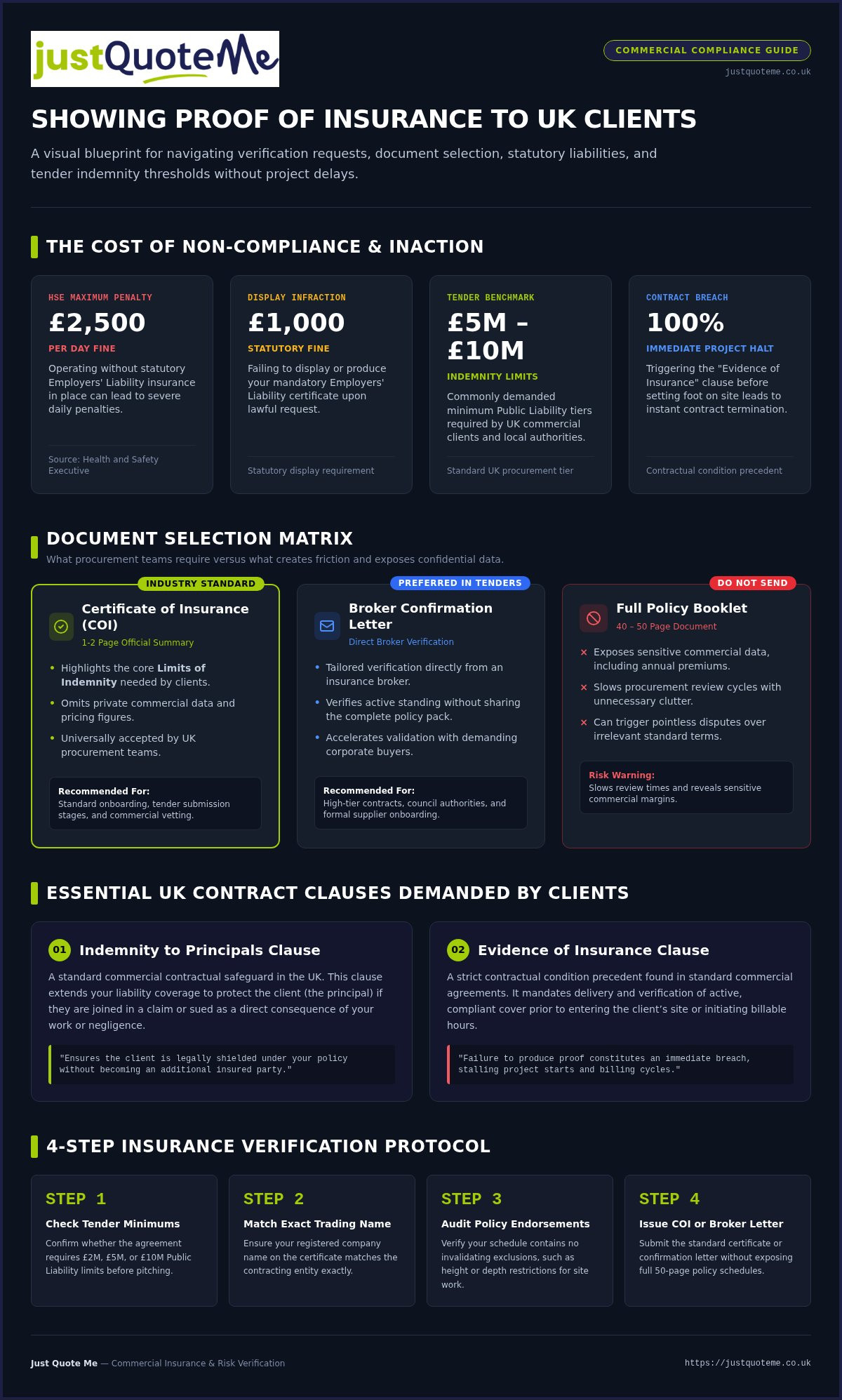
Imagine you’ve spent weeks pitching for a major UK contract, only to have the final signature stall because the procurement team wants “immediate verification” of your cover. It’s a high-pressure moment where showing proof of insurance to clients becomes more than just a box-ticking exercise; it’s a fundamental test of your business’s legitimacy. You might find yourself staring at a forty-page policy booklet, wondering if you should send the entire document or just the one-page Employers’ Liability certificate.
We know that the distinction between a policy schedule and a certificate can be confusing, especially when the threat of a £2,500 per day fine for non-compliance exists. You shouldn’t have to feel anxious about losing a deal because of “wrong” paperwork or slow responses from an insurer. This guide is designed to remove that friction. You’ll learn exactly which documents satisfy professional requirements, how to share them efficiently, and how to use your insurance as a strategic tool to win more business.
We’ll break down the specific tiers of indemnity often required in UK tenders and explain why a simple Broker Confirmation Letter is often preferred over a full policy breakdown. By the end, you’ll have a clear, professional process for handling insurance requests with total confidence.
Key Takeaways
- Identify the specific differences between a Certificate of Insurance and a Policy Schedule to ensure you provide the correct paperwork for every contract.
- Master the professional steps for showing proof of insurance to clients to build immediate trust and prevent administrative delays during the onboarding process.
- Understand how to handle requests for higher indemnity limits and why the “Indemnity to Principals” clause is a standard requirement in UK business agreements.
- Learn how to share your documentation securely while ensuring your trading name and policy details align perfectly with client expectations.
- Discover how to use your insurance coverage as a proactive tool to demonstrate business stability and win more competitive tenders.
Why Showing Proof of Insurance to Clients is Critical for Your Business
Showing proof of insurance to clients isn’t just a hurdle to jump; it’s a foundation for a professional relationship. In the UK, clients aren’t just being difficult when they ask for your documents. They’re protecting their own assets and ensuring that you are a legitimate, responsible partner. Providing these details quickly demonstrates that your business is stable and that you take your professional obligations seriously. It’s a way to validate your standing before a single hour of work is billed.
Winning Trust and Securing Tenders
Large firms and local authorities won’t even look at a bid if it doesn’t meet their minimum requirements. Having public liability insurance ready to go establishes immediate credibility. It tells a procurement officer that you’ve already passed a broker’s vetting process and have the financial backing to handle unforeseen incidents. Instead of waiting for them to ask, include a summary of your cover in your initial pitch. This proactive approach shows you understand commercial risks and are ready to start work without administrative delays. In a competitive market, being the contractor who has their paperwork in order can be the deciding factor that wins the contract.
The Legal and Contractual Necessity
Most commercial contracts in the UK include an “Evidence of Insurance” clause. This requires you to produce valid documents before you even set foot on site. If you can’t provide proof, you’re technically in breach of contract before you’ve started. This can lead to immediate termination of the agreement or, at the very least, a complete halt in your project timeline. It’s a risk most businesses simply can’t afford to take.
Clients often demand specific indemnity limits like £5 million or £10 million. These aren’t random numbers; they reflect the potential cost of a major incident in a public or commercial space. Beyond the contract, there are statutory risks to consider. For example, failing to display a mandatory Employers’ Liability certificate can result in a £1,000 fine from the HSE. Operating without that cover entirely can cost you up to £2,500 per day in penalties. By showing proof of insurance to clients, you mitigate their risk of being held liable for your actions. The “Indemnity to Principals” clause ensures your client is protected if they’re sued because of your negligence. Providing this proof quickly accelerates the onboarding process, getting your team on-site and getting your invoices paid faster.
The Essential Documents: What Counts as Valid Proof of Insurance?
When a client asks for “your insurance,” they aren’t looking for every piece of paper your insurer ever sent you. Providing too much information can actually slow down the onboarding process and reveal sensitive commercial details, such as your annual premium. To maintain professionalism and protect your data, you need to know which specific documents carry the weight required by UK procurement teams.
The Certificate of Insurance (COI)
A Certificate of Insurance (COI) is the industry-standard summary of your active cover. It acts as a snapshot of your policy, designed specifically for the purpose of showing proof of insurance to clients without the clutter of full policy terms. You should never send your full 50-page policy wording to a client; it’s unnecessary and often contains confidential information. Instead, focus on the “Limits of Indemnity” section of the COI. This clearly states the maximum amount your insurer will pay out for a claim, which is exactly what a client needs to verify before they sign a contract. Using the COI is the most efficient way of showing proof of insurance to clients while keeping your private business details secure.
Policy Schedules vs. Summaries of Cover
While the COI is the primary document, some sophisticated clients or local authorities may ask for your Policy Schedule. This document is more detailed and outlines specific endorsements or exclusions that apply to your business. For example, if you’re working in construction, a client might check your schedule to ensure your builders insurance doesn’t have a “height limit” or “depth limit” that would invalidate your cover on their specific site. A Summary of Cover, by contrast, is often too generic for formal vetting as it doesn’t always include your unique policy number or specific business name.
To ensure your proof is valid, always check that the document includes these four key elements:
- The Insurer’s Name: A reputable UK underwriter provides immediate confidence.
- Policy Number: Essential for the client to verify the cover if needed.
- Expiry Date: The document must show the policy is currently in force.
- Trading Name: This must match the name on your contract or invoice exactly.
For complex risks or bespoke contracts, a “Broker Letter” issued on professional headed paper is often used. This letter confirms that your broker has vetted your policies against the client’s specific requirements. If you’re struggling to locate these documents, you can contact an independent broker who can provide a clean PDF version of your certificate within minutes.
How to Share Your Insurance Details Professionally and Securely
Professionalism is defined by how you handle administrative requests. When showing proof of insurance to clients, the method of delivery is just as important as the document itself. A disorganized approach suggests a disorganized business, whereas a streamlined process builds confidence before the project even starts. Following a structured workflow ensures you meet compliance standards without compromising your data security.
To maintain a high standard of professional conduct, follow these five essential steps:
- Request a clean PDF: Never send a photograph of a printed document. Ask your broker for a high-resolution PDF version of your certificate to ensure all text is legible and professional.
- Verify the business name: Ensure the name on the document matches your trading name or the name on your contract exactly. Discrepancies here are a primary cause of onboarding delays.
- Redact sensitive data: If a client insists on seeing a full schedule rather than just a certificate, redact your annual premium and bank details. This information is commercially sensitive and not required for proof of cover.
- Use secure sharing: Avoid sending documents via social media or unsecured messaging apps. Use a professional email attachment or a dedicated file-sharing portal.
- Set a renewal reminder: Don’t wait for the client to ask for updated proof. Set a calendar alert for 30 days before your policy expiry to ensure you have the new documents ready to send.
Digital vs. Physical Documentation
By 2026, the shift toward digital-first verification is absolute. Most UK procurement teams now expect PDF proof sent through vendor portals or company intranets. You should always keep a digital copy of your certificates on your smartphone. This is particularly useful for tradespeople who need to provide immediate evidence of van and tools insurance or public liability when entering restricted commercial sites. Having these files accessible in a cloud folder means you won’t be turned away from a site due to missing paperwork.
Best Practices for Emailing Insurance Proof
When you email your documents, clarity is your best tool. Use a clear file naming convention such as “YourBusinessName_Public_Liability_2026.pdf” so the recipient can file it easily. Include a brief cover note stating the policy limits and the insurer name to save the procurement officer time. If your client uses a third-party compliance platform like Constructionline or CHAS, ensure you upload the documents promptly. These platforms often provide “live” verification, and a delay in your upload can trigger automated warnings that might pause your contract payments. Taking these small steps makes showing proof of insurance to clients a frictionless part of your business operations.
Navigating Specific Client Requests: Indemnity Limits and Named Parties
Showing proof of insurance to clients often leads to follow-up questions about specific contractual clauses. While a standard certificate covers most bases, high-value tenders or public sector contracts frequently demand bespoke adjustments. Understanding these requests prevents you from agreeing to terms that could complicate your cover or increase your costs unnecessarily. It’s about finding a balance between satisfying a client’s risk department and maintaining a cost-effective insurance programme.
A common requirement in UK contracting is the “Indemnity to Principals” clause. This is a standard feature in public liability insurance that extends your policy’s protection to your client, who is the “principal” in the contract. If a third party sues your client because of work you performed, this clause ensures your insurer handles the legal costs and compensation. It’s a vital trust-building tool that most professional brokers can confirm with a single-page letter, making the onboarding process much smoother.
For consultants and service providers, showing proof of insurance to clients usually involves providing evidence of professional indemnity insurance. Clients want to know that if your advice or designs lead to a financial loss, you have the financial backing to make it right. If you need to verify your current limits against a specific tender, you can request a review of your policy to ensure you meet the criteria before you submit your bid.
When the Client Asks for More Cover
If a prospect requires a £10 million limit but your current policy only provides £2 million, don’t panic. You don’t necessarily need a brand-new policy. A broker can often arrange a mid-term adjustment to increase your limits for the duration of that specific project. Before you commit, evaluate the cost-benefit. Is the contract value high enough to justify the additional premium? While you’re reviewing your liability, check your employers liability insurance. UK law mandates a minimum of £5 million for businesses with employees, but many corporate clients expect £10 million as a baseline for their supply chain, regardless of the project size.
Named Parties and Specific Endorsements
Some clients will ask to be added as a “Named Insured” on your policy. This is a significant request that can give the client direct rights to your policy, which many insurers are reluctant to grant. A more common and safer alternative is adding them as an “Interested Party”. This acknowledges their interest in your insurance without giving them the same status as you, the policyholder. Be wary of bespoke insurance clauses in contracts that use non-standard legal language. These can sometimes create gaps where your policy doesn’t align with your contractual promises, leaving you personally liable for the difference. Always have a broker check these clauses before you sign.
How Just Quote Me Simplifies Your Insurance Documentation
When you’re showing proof of insurance to clients, you need more than just a generic PDF. You need a partner who understands that a delay in documentation can mean a lost contract. Just Quote Me is an independent UK broker with over 30 years of experience, founded in 1989. We’ve spent decades helping businesses manage administrative burdens, ensuring that your insurance is a tool for growth rather than a compliance headache. Our status as an FCA-authorised broker gives you the peace of mind that you’re receiving professional, regulated advice.
We specialise in providing tailored solutions that match specific trade requirements. Whether you need robust builders insurance or complex professional indemnity cover, we ensure your documents are accurate and contract-ready. Our rapid response for document requests means you can respond to tenders with total confidence, knowing your paperwork won’t hold you back. We provide access to a broad network of top UK underwriters, ensuring you get the right cover at a competitive price.
Personal Service vs. Automated Platforms
Generic insurance websites often leave you struggling with a chatbot when a client asks for a specific endorsement. We believe in a human-centric approach. Speaking to an expert who understands the Newcastle-under-Lyme and Stafford business landscape makes a significant difference. We don’t just provide a policy; we help you interpret the complex insurance requirements often found in high-value commercial contracts. This personal touch ensures that you aren’t just another policy number in an automated system.
Having a broker who “gets” your industry risks is invaluable. If a client asks for a mid-term adjustment or a Broker Confirmation Letter, you don’t have to navigate a call centre. You have a dedicated team ready to act. This regional expertise ensures that your cover is as local and specialised as your business itself. We manage the complex administrative burdens so you don’t have to, allowing you to focus on your core operations.
Get Your Documentation Ready Today
Don’t wait until you’re in the middle of a high-pressure bid to check your paperwork. Being proactive about your documentation is the best way to ensure you’re always tender-ready. We can review your current cover to identify any gaps that might prevent you from showing proof of insurance to clients in the future. Whether you’re a local tradesperson or a professional services firm, having your insurance details organised is a marker of quality.
Our goal is to make the administrative side of your business frictionless. By managing these complex processes for you, we free up your time to focus on delivering your services. If you want to ensure your business is fully protected and ready for its next big opportunity, take the first step now. Get Your Free Business Insurance Quote now.
Secure Your Next Contract with Confidence
Mastering the process of showing proof of insurance to clients is a simple but effective way to differentiate your business from less organized competitors. By providing clear, professional documentation like a Certificate of Insurance rather than bulky policy wordings, you demonstrate that your business is stable and ready to work. It’s about more than just compliance; it’s about building a foundation of trust that helps you secure higher-value contracts across the UK.
As an FCA-authorised independent broker with 30+ years of industry experience, Just Quote Me is here to handle the administrative heavy lifting for you. We ensure your cover is tailored to your specific trade and provide the rapid documentation you need to satisfy even the most rigorous procurement vetting. Don’t let paperwork be the reason you miss an opportunity.
If you’re ready to streamline your business protection, Get Your Free Business Insurance Quote now. For personalized support and tailored documentation, Request a Call back for free Expert advice. We look forward to helping your business thrive in 2026 and beyond.
Frequently Asked Questions
What is a Certificate of Insurance (COI)?
A Certificate of Insurance (COI) is a concise document that provides a high-level summary of your active business insurance. It acts as official evidence that you have valid coverage without disclosing sensitive financial details like your annual premium. For UK businesses, this includes the insurer’s name, policy number, and the specific limits of indemnity. It is the most professional way of showing proof of insurance to clients during the onboarding process.
Can I show a copy of my policy schedule instead of a certificate?
You can use a policy schedule, but it is often less efficient than a certificate. While a schedule contains the same core information, it also lists specific endorsements, excesses, and confidential pricing data. If a client requests a schedule to verify certain exclusions, it is best to provide a redacted version. Most brokers recommend using the certificate first, as it is designed specifically for external verification and keeps your commercial secrets protected.
Do I need to show proof of insurance before starting work?
Yes, most commercial contracts in the UK require you to provide evidence of cover before you commence work or enter a project site. Failing to do so can lead to a breach of contract or immediate suspension of your services. Beyond the legalities, having your documentation ready demonstrates that you are a responsible and organized professional. It prevents administrative delays and ensures your client’s risk management team is satisfied from day one.
What if my client asks for a higher indemnity limit than I have?
If a client requires a higher limit, such as £10 million when you currently hold £5 million, you should contact your broker immediately. We can often arrange a mid-term adjustment with your insurer to increase your limits for the duration of that specific project or for the remainder of your policy term. This is a common occurrence in UK contracting, and a professional broker can usually provide the updated certificate within a few hours.
How often should I update the proof of insurance I show to clients?
You must provide updated proof every time your policy renews, which is typically every 12 months. It is also necessary to share a new certificate if you make any significant changes to your cover, such as increasing your indemnity limits. Proactively showing proof of insurance to clients 30 days before your current policy expires builds trust and ensures there is no lapse in your approved contractor status.
Is a digital copy of my insurance valid for UK contracts?
Yes, digital PDF copies are now the industry standard for insurance verification in the United Kingdom. Physical paper certificates are rarely required, as most procurement teams and compliance platforms prefer electronic files for their records. You should ensure the PDF is a clean, high-resolution document provided directly by your broker. Keeping a copy on your smartphone allows you to provide immediate evidence if you are asked for proof while working on-site.
What is “Indemnity to Principals” on a certificate?
An “Indemnity to Principals” clause is a standard extension found in many public liability policies. It ensures that if your client is sued by a third party due to your negligence, your insurance policy will cover their legal costs and any compensation awarded. This is a critical requirement for most local authority and large corporate tenders, as it prevents the client from being financially exposed by the actions of their contractors.
Can a client verify my insurance directly with the insurer?
A client can verify your insurance, but they will typically do this through your broker rather than contacting the insurer directly. By providing your broker’s contact details, you allow the client’s compliance team to confirm that your policy is active and meets the contractual requirements. This third-party verification is part of the standard vetting process for many UK firms and provides an additional layer of security and professional transparency for the client.
Article by
Just Quote Me
JustQuoteMe Ltd is an independent UK insurance brokerage specialising in business and personal insurance solutions. With over 35 years of industry experience, the company provides tailored insurance cover for businesses, landlords, tradespeople, hospitality venues, fleets, and individuals across the UK. Known for its personal service, expert advice, and competitive premiums, JustQuoteMe Ltd works with leading insurers to deliver bespoke policies designed around each client’s unique needs. The company is authorised and regulated by the Financial Conduct Authority (FCA No. 586607) and has built a reputation for trusted, straightforward insurance guidance and long-term client relationships.

by jqm | Sep 20, 2026 | Insurance
If your business faced a sudden legal claim tomorrow, would your personal savings, your home, and your family’s future stay protected from the fallout? Many board members and senior managers ask, what does directors and officers insurance cover uk when they realize that a company’s limited liability status doesn’t necessarily shield the individuals making the decisions. It’s a stressful realization, especially with over 1,000 director disqualifications recorded by the Insolvency Service in the last year and the average ban lasting more than eight years.
You’re right to feel that the stakes have never been higher. With the full implementation of mandatory identity verification and the “failure to prevent fraud” offence in 2026, UK authorities now have more power than ever to hold you personally accountable for corporate oversights. This guide provides a clear roadmap to understanding how D&O insurance protects your personal assets and business reputation. We will clarify the vital differences between this and professional indemnity cover, explain the “Three Pillars” of protection, and show you how to maintain compliance in an increasingly scrutinized market.
Key Takeaways
- Learn how D&O insurance acts as a vital safety net for your personal estate when the company is legally or financially unable to indemnify you.
- Gain clarity on what does directors and officers insurance cover uk, from legal defense fees to settlements arising from alleged wrongful acts.
- Master the structure of Side A, B, and C coverage to ensure your policy protects both you as an individual and the corporate entity.
- Identify critical exclusions such as deliberate fraud and professional negligence to avoid dangerous gaps in your professional risk management.
- Stay ahead of 2026 UK regulatory shifts, including the latest identity verification rules and the corporate criminal offence of failure to prevent fraud.
What is Directors and Officers (D&O) Insurance in the UK?
Understanding exactly what does directors and officers insurance cover uk is a priority for anyone holding a senior position in a British business. At its core, D&O insurance is a specialized liability policy designed to protect the personal assets of company directors, officers, and senior managers. It provides financial support for legal defense costs and potential settlements if you are personally sued for decisions made while running the organization. Without this cover, your home, savings, and personal estate are directly on the line.
A common misconception is that the “corporate veil” of a limited company provides total protection. While limited liability shields shareholders from the company’s debts, it doesn’t offer a blanket immunity for the individuals managing the firm. In the UK, Directors and officers liability insurance is essential because directors can be held personally and unlimitedly liable for their actions. This applies not just to board-level directors, but also to “Officers”-a term that typically includes senior managers, company secretaries, and even “shadow directors” who influence board decisions without a formal title.
D&O vs. Professional Indemnity: Clearing the Confusion
It’s easy to confuse these two products, but they serve very different purposes. Professional Indemnity Insurance covers the company against claims arising from errors in the professional advice or services you provide to clients. D&O insurance, however, covers the management and governance of the business itself. If a client sues because a project failed, that’s a PI claim. If a shareholder or regulator sues because they believe you mismanaged the company’s funds or failed in your fiduciary duties, that’s a D&O claim. In the current regulatory climate of 2026, most senior leaders find they need both to be fully protected.
The Legal Landscape for UK Directors in 2026
The Companies Act 2006 remains the foundation of director duties, requiring you to act in good faith and exercise reasonable care and diligence. However, new legislation like the Economic Crime and Corporate Transparency Act has increased the pressure. Since the “failure to prevent fraud” offence became active in late 2025, and with mandatory ID verification now standard, regulators have clearer paths to prosecute individuals for corporate oversights. Even an innocent error in judgment can trigger a claim. For insurance purposes, a “Wrongful Act” is defined as any actual or alleged breach of duty, neglect, error, or omission committed by a director or officer in their professional capacity. Knowing what does directors and officers insurance cover uk ensures you aren’t left funding a complex legal defense out of your own pocket when these allegations arise.
The Three Pillars of D&O Coverage: Side A, B, and C
To fully grasp what does directors and officers insurance cover uk, you need to look at the modular way these policies are built. Most standard wordings use a three-pillar structure known as Sides A, B, and C. These sections work together to create a 360-degree safety net, ensuring that legal defense funding is available regardless of whether the company is solvent or legally permitted to help you. Understanding these distinctions is the only way to ensure you aren’t left with a gap in your personal protection.
Side A: Protecting Your Personal Assets
Side A is the most vital component for any director concerned about personal bankruptcy. It provides direct coverage to the individual when the company cannot or will not indemnify them. This often happens during corporate insolvency, where the business has no funds left to pay for your legal representation. Side A is the ‘last line of defence’ for individuals, protecting your home and private savings from being drained by litigation. For those also looking to secure their personal legacy through estate planning, you can visit Aiker Wills and Trusts to explore protective property trusts. It’s the primary reason many senior leaders refuse to sit on a board without a robust policy in place.
Side B is the “Company Reimbursement” pillar and is the most frequently triggered part of a policy. In this scenario, the business pays for the director’s legal costs first and then claims that money back from the insurer. This keeps the company’s balance sheet stable during a crisis. Under Section 233 of the Companies Act 2006, UK firms are explicitly permitted to purchase this cover to ensure their leadership isn’t left exposed. If you’re unsure if your current policy includes these vital protections, you can speak with a specialist broker for a full review of your current wording.
Side C: Entity Securities Cover
Side C, or “Entity Securities Cover,” shifts the focus from the individuals to the company itself. It protects the organization against claims arising from the offer or sale of its securities. For many private UK SMEs, this is often extended into “Management Liability,” which covers the corporate entity against certain legal actions like shareholder disputes. While Side A protects your house, Side C protects the business’s reputation and financial health, ensuring the entity can survive the cost of a high-stakes legal challenge. Knowing what does directors and officers insurance cover uk across all three sides ensures your management team can lead with confidence.
What Counts as a ‘Wrongful Act’? Common Claim Scenarios
In the context of a legal claim, a ‘wrongful act’ doesn’t necessarily imply criminal intent or deliberate malice. Most D&O claims in the UK arise from management errors, oversights, or failures to act within the best interests of the company. When assessing what does directors and officers insurance cover uk, it’s vital to recognize that the policy triggers based on allegations of breach of duty, neglect, or misleading statements. These claims can come from various parties, including shareholders who feel their investment was mismanaged or creditors who believe they were misled about the company’s financial health.
Negligence in leadership is a frequent trigger for litigation. This might involve a failure to supervise subordinates effectively or making poor strategic decisions that lead to significant corporate loss. Additionally, insolvent trading remains a high-risk area in 2026. If you continue to run a business when there is no reasonable prospect of avoiding insolvent liquidation, you may be held personally liable for wrongful trading. In such cases, liquidators can seek to recover funds directly from your personal estate to satisfy the company’s debts. Adhering to the statutory responsibilities of company directors is your primary duty, but D&O insurance provides the financial backing to defend yourself if those actions are called into question.
Regulatory and Legal Investigations
UK regulators like HMRC and the Health and Safety Executive (HSE) have become increasingly proactive. If your business is targeted by a formal investigation or a sudden dawn raid, the legal costs associated with responding to these information requests can be staggering. While your Public Liability Insurance protects the business against physical injury claims, it won’t fund your personal legal defense during a regulatory probe into management failures. D&O cover ensures you have immediate access to expert legal counsel to navigate these complex administrative processes.
Employment Practice Violations
Senior managers often find themselves personally named in employment tribunals. Claims regarding wrongful dismissal, harassment, or discrimination are common, and claimants frequently target individuals alongside the company to increase their leverage. It’s a common mistake to assume that Employers Liability Insurance covers these personal legal costs. It doesn’t. Employers liability covers the company’s responsibility for workplace injuries, while D&O specifically protects the individual’s personal assets against management-related employment claims. Understanding what does directors and officers insurance cover uk allows you to build a comprehensive defense strategy that guards against these personal financial risks.
What Directors and Officers Insurance Does Not Cover
While it is vital to understand what does directors and officers insurance cover uk, knowing where the protection ends is just as important for your risk management strategy. No insurance policy is a “blank cheque” for all corporate troubles. Exclusions exist to prevent moral hazard and to ensure that the policy focuses on genuine management errors rather than criminal activity or risks that belong under different types of cover. For instance, D&O insurance will not pay for bodily injury or property damage. These physical risks are the domain of Public Liability Insurance or Employers Liability, rather than management liability.
You also cannot insure a “burning house.” This means that any litigation or known circumstances that existed before the policy started will be excluded. Because UK D&O policies are written on a “claims-made” basis, you must have a policy in force at the time the claim is actually made against you. Additionally, certain fines and penalties are legally uninsurable in the UK. If a court imposes a criminal fine or a penalty intended to punish the individual rather than compensate a victim, the insurer is often legally prohibited from paying it on your behalf.
The Fraud and Dishonest Acts Clause
D&O insurance is designed to protect honest directors from the consequences of their mistakes, not to facilitate criminal behaviour. Consequently, policies contain a strict exclusion for proven fraud, dishonesty, or malicious acts. However, most modern wordings include a “severability” provision. This ensures that “innocent” directors remain protected even if one of their colleagues is found to be fraudulent. It’s a vital safety net that prevents the entire board from losing cover due to the actions of one individual. Crucially, legal defence is usually funded until fraud is proven or a final adjudication is reached in court.
Pollution and Environmental Claims
Environmental damage is another common exclusion that surprises many senior leaders. While a D&O policy might cover the legal costs if shareholders sue you for a management failure that led to an environmental disaster, it typically won’t cover the actual cleanup costs or physical pollution damage. These risks require specialist environmental impairment liability insurance. The distinction lies between the physical act of pollution and the management decision that allowed it to happen. To ensure your leadership team has no dangerous gaps in protection, you should speak with an independent broker to review your specific exposures. Understanding exactly what does directors and officers insurance cover uk across these complex scenarios ensures you can lead with absolute clarity.
Securing the Right D&O Protection with Just Quote Me
Selecting a policy based solely on price is a common pitfall. When you ask what does directors and officers insurance cover uk, the answer depends heavily on the quality of the wording and the specific limits you choose. As an independent broker with 30 years of industry experience, Just Quote Me provides access to a broad network of top UK insurers. This independence is crucial. We don’t push a single product; instead, we find the bespoke fit that aligns with your specific risk profile and ensures your board is truly protected.
Determining the right ‘Limit of Indemnity’ is a strategic decision that shouldn’t be left to chance. For many UK SMEs, standard indemnity limits typically range from £1 million to £5 million aggregate. The right choice for your firm depends on your sector’s regulatory scrutiny, your turnover, and the complexity of your shareholder structure. An ‘off the shelf’ policy often lacks the nuance required for high-growth firms, potentially leaving you exposed to gaps in Side A protection or restrictive exclusions. We help you navigate these nuances so your personal assets remain secure regardless of corporate insolvency.
Why Regional Expertise Matters
We believe in a human-centric approach. While big corporate platforms rely on automated algorithms, we rely on professional relationships. Based in Stone, Staffordshire, we’ve spent three decades serving businesses across the West Midlands and the wider UK. This local knowledge allows us to understand the specific pressures facing regional firms in the 2026 market. If you want a partner who manages the complex administrative burden so you don’t have to, our Business Insurance Staffordshire guide offers deeper insight into our regional expertise and pragmatic approach.
Next Steps: Protecting Your Future
Getting started is straightforward. To provide a tailored quote, we typically need your latest company accounts, details of your board members, and a brief overview of your operations. Our role is to simplify this process, acting as a steady hand in a complex market. We strip away the jargon and focus on the practical value of your cover. Once we have your information, we work quickly to secure a solution that meets current UK regulatory expectations and protects your private estate.
Take the first step toward securing your personal and professional reputation today. Get Your Free Business Insurance Quote now to see how a bespoke policy can protect your assets. Knowing exactly what does directors and officers insurance cover uk gives you the confidence to lead your business without the constant fear of personal liability.
Protect Your Personal Legacy and Business Future
The shift toward individual accountability in 2026 means the “corporate veil” is thinner than ever for UK leaders. Evaluating what does directors and officers insurance cover uk is now a critical part of any senior manager’s risk strategy. It’s no longer just about protecting the business; it’s about securing your home, your savings, and your professional reputation against an increasingly complex regulatory landscape.
Managing these high-stakes risks shouldn’t be a solo effort. Just Quote Me brings 30 years of industry expertise and FCA-authorised status to the table, offering a steady hand in a volatile market. We provide access to a broad network of top UK insurers, ensuring your policy is a bespoke fit. You can learn more about our approach or speak to our team directly to see how we manage the complex administrative burdens for you. You’ve worked hard to build your career. Let us help you keep it safe.
Get Your Free Business Insurance Quote now
Request a Call back for free Expert advice
Directors and Officers Insurance FAQs
Is Directors and Officers insurance a legal requirement in the UK?
Directors and Officers insurance isn’t a legal requirement in the UK, unlike Employers Liability insurance. However, Section 233 of the Companies Act 2006 explicitly allows companies to purchase this cover for their leadership. Without it, you’re personally responsible for funding your own legal defence. Given that regulators can pursue individuals for corporate failures, most UK directors consider this cover an essential part of their risk management strategy.
Does D&O insurance cover me if the company goes insolvent?
Yes, D&O insurance provides critical protection during corporate insolvency. When a business fails, the “Side A” portion of the policy directly covers the individual directors. This is necessary because the insolvent company no longer has the funds to indemnify you for legal costs or settlements. It ensures that your personal assets, such as your home and private savings, aren’t used to pay for litigation brought by liquidators or creditors.
What is the difference between D&O and Professional Indemnity?
The main difference lies in the target of the claim. Professional Indemnity (PI) covers the professional services or advice your business provides to clients. In contrast, D&O insurance covers the management and governance decisions made by senior leaders. If a client sues for a failed project, that’s PI. If a shareholder sues for mismanagement of company funds, you need to know what does directors and officers insurance cover uk to stay protected.
Can a small private company benefit from D&O insurance?
Small private companies absolutely benefit from D&O insurance. Personal liability doesn’t depend on the size of your turnover or the number of employees you have. Directors of small firms often have their personal wealth more closely tied to the business, making them more vulnerable to claims from HMRC, creditors, or employees. Having a tailored policy ensures that a single management error doesn’t lead to personal financial ruin for the owner-manager.
Are retired directors still covered by a D&O policy?
Retired directors can remain covered if the policy includes an appropriate “run-off” provision. Claims often arise years after a director has left the board or the company has been sold. Run-off cover ensures that you’re protected for wrongful acts alleged to have occurred while you were still in office. This is a vital consideration for anyone planning their exit strategy or retirement from a senior management position in the UK.
Does D&O insurance cover the company or just the individuals?
A standard policy covers both the individuals and the corporate entity through different “Sides.” Side A protects individual directors when the company can’t. Side B reimburses the company after it has paid to defend its directors. Side C covers the company itself for specific securities-related claims. Understanding what does directors and officers insurance cover uk across these three pillars ensures that both your personal estate and the company balance sheet are insulated.
What is ‘Run-off’ cover in D&O insurance?
Run-off cover is a specific extension of a D&O policy that provides protection for a set period after the company ceases trading or is acquired. Because D&O is a “claims-made” policy, you must have active cover at the time the claim is filed. Run-off cover bridges the gap, protecting past directors from legacy claims that might emerge months or even years after the business has officially closed its doors.
How much D&O insurance cover do I actually need?
The amount of cover you need depends on your business size, sector, and risk profile. For many UK SMEs, a limit of indemnity between £1 million and £5 million aggregate is standard. However, businesses in highly regulated sectors or those with complex shareholder structures may require much higher limits. You should consult an independent broker like Just Quote Me to assess your specific exposures and determine a limit that offers genuine peace of mind.
Article by
Just Quote Me
JustQuoteMe Ltd is an independent UK insurance brokerage specialising in business and personal insurance solutions. With over 35 years of industry experience, the company provides tailored insurance cover for businesses, landlords, tradespeople, hospitality venues, fleets, and individuals across the UK. Known for its personal service, expert advice, and competitive premiums, JustQuoteMe Ltd works with leading insurers to deliver bespoke policies designed around each client’s unique needs. The company is authorised and regulated by the Financial Conduct Authority (FCA No. 586607) and has built a reputation for trusted, straightforward insurance guidance and long-term client relationships.

by jqm | Sep 19, 2026 | Insurance
Slips, trips, and falls on the same level account for 30% of all reported non-fatal injuries in Great Britain, making them the single most common cause of accidents in the retail sector. When a person hits the floor, the immediate rush of adrenaline often makes it hard to think clearly. You’re likely worried about the customer’s wellbeing while simultaneously wondering exactly what to do if a customer slips in my shop to protect your business from a costly legal claim. It’s a stressful situation that every shop owner fears, especially when you’re unsure about RIDDOR reporting or what to say to the injured party without compromising your position.
We understand that you need a steady hand to guide you through these high-pressure moments. This article provides a straightforward, step-by-step risk management checklist to help you handle shop floor accidents professionally and with confidence. We’ll explain how to document evidence correctly, how to communicate with the customer without admitting liability, and when you need to notify your insurance broker. By following this protocol, you’ll minimise the chance of a successful claim and ensure your staff are prepared to manage the situation calmly and effectively.
Key Takeaways
- Prioritise the customer’s safety by providing immediate first aid and calling emergency services if there is any doubt about their condition.
- Learn exactly what to do if a customer slips in my shop by following a strict documentation checklist that includes preserving CCTV and taking detailed photos of the scene.
- Master the balance of being helpful and empathetic without inadvertently admitting legal liability or making damaging statements to the injured party.
- Understand your statutory obligations for RIDDOR reporting and why notifying your insurance broker immediately is vital for protecting your business.
- Implement proactive risk management strategies, such as updated cleaning schedules and regular floor inspections, to prevent future accidents and strengthen your defence.
The first sixty seconds after an accident are the most critical for your business. When you are deciding what to do if a customer slips in my shop, your primary focus must be on immediate safety and scene control. Slips and falls account for 30% of all non-fatal workplace injuries in Great Britain; they are high-stakes events that require a disciplined response. You have a legal duty under the Occupiers’ Liability Act 1957 to ensure your visitors are reasonably safe. Failing to act decisively can escalate a minor tumble into a significant legal issue.
Attend to the customer immediately. Do not move them if they appear to have back or neck injuries; instead, keep them still and comfortable. Assign a specific staff member to stay by their side until they either leave the premises or professional help arrives. This provides emotional support and ensures the customer isn’t left alone while you manage the logistics of the accident. If there is any doubt about the severity of the injury, call for professional medical assistance by dialling 999 or 111. It’s better to over-respond than to overlook a serious internal injury.
Prioritising Customer Welfare
Offer basic first aid if you are trained to do so, but never exceed your level of competency. Your goal is to keep the individual comfortable and warm while waiting for help. Maintaining a calm, professional demeanour is vital for de-escalating tension. High-stress environments often lead to heated exchanges; staying composed helps protect your brand’s reputation. Understanding slip and fall premises liability claims is helpful, but in the heat of the moment, your human-centric response is what the customer will remember most. If you have the right Public Liability Insurance in place, you can focus on the person rather than the potential cost.
Securing the Accident Scene
While one staff member attends to the customer, another must secure the area. Securing the scene is a vital part of knowing what to do if a customer slips in my shop, as it prevents further injuries and preserves the environment for inspection. Identify the source of the slip immediately. Whether it’s a spill, a loose floor tile, or moisture tracked in from the rain, the hazard must be cordoned off to prevent “copycat” accidents. Use bright “Wet Floor” signs or physical barriers to block the area entirely. Crucially, do not clean up the spill or fix the hazard until you have completed the documentation steps mentioned in the next section. Preserving the scene exactly as it was at the time of the fall is essential for a fair investigation. If you remove the evidence too quickly, you may lose the ability to prove that your cleaning protocols were being followed correctly.
The Documentation Checklist: Gathering Vital Evidence
While most online advice focuses on how a victim should build a claim, your priority as a business owner is building a robust defence. Knowing what to do if a customer slips in my shop involves more than just offering a glass of water; it requires a meticulous evidence-gathering process. If a claim arrives months down the line, your memory of the event won’t be sufficient. You need a secure incident file that proves you met your legal duty of care and maintained a safe environment.
Photographic and Video Evidence
Capture high-quality photographs of the scene immediately. Don’t just snap the floor; take shots from multiple angles to show the context of the accident. Photograph the customer’s footwear and any items or bags they were carrying at the time. These details are vital for assessing whether external factors contributed to the fall. Include wide shots to demonstrate the presence of warning signs or entrance matting. Most commercial CCTV systems operate on an automatic 30 to 31-day overwrite cycle. You must isolate and save footage covering the period before, during, and after the fall onto an external drive. This footage can prove how long a hazard was present or highlight the customer’s own actions leading up to the event.
Witness and Staff Statements
Independent witnesses are incredibly valuable in a liability dispute. Ask bystanders for their contact details and a brief account of what they saw in their own words. Don’t coach them or suggest what happened; simply record their honest observations. Similarly, ensure the staff member on duty writes a contemporaneous note of the event. This is a record made at the time of the incident, and it carries significant weight in legal proceedings. This documentation also helps you determine if the event meets the HSE RIDDOR reportable incidents criteria, which is mandatory if a customer is taken directly to hospital for treatment. Keep all these records, including a copy of the accident book entry, in a secure file for future insurance reference.
Finally, check your cleaning and inspection logs. These logs are your best proof that a “reasonable” maintenance regime was being followed. If your records show the floor was inspected and cleared only fifteen minutes before the accident, it strongly supports the argument that you were not negligent. This level of proactive documentation is a hallmark of businesses that carry bespoke shop insurance, as it provides your broker with the ammunition needed to defend your position. Taking these steps now ensures that a single accident doesn’t turn into an undefendable legal headache later.
Communication Etiquette: Avoiding the ‘Admission of Fault’ Trap
When you are managing the immediate aftermath of an accident, your words are just as important as your actions. Many business owners struggle with what to do if a customer slips in my shop because they naturally want to be apologetic and helpful. However, there is a fine line between showing genuine human empathy and making a statement that a solicitor could later use as a formal admission of liability. You must remain professional and calm, ensuring that your desire to provide good customer service doesn’t inadvertently jeopardise your legal protection.
Staff training is vital here. Your team must understand that they should never speculate on the cause of the accident or make self-incriminating remarks. Phrases like “I’m so sorry, we should have cleaned that up” or “this happens all the time with this floor” are extremely damaging. Instead, the focus should remain entirely on the customer’s wellbeing and the facts of the event. Do not offer immediate financial compensation, cash from the till, or free goods as a “settlement” or gesture of goodwill. While it might seem like a quick way to resolve a complaint, it can be interpreted as an attempt to “buy” the customer’s silence or an admission that your business was at fault.
Professional Language vs. Legal Admission
It is a common misconception that saying “sorry” is an automatic admission of guilt. In the UK, Section 2 of the Compensation Act 2006 explicitly states that an apology, an offer of treatment, or other redress does not of itself amount to an admission of negligence or breach of statutory duty. This means you can be kind without being legally vulnerable. Use neutral, helpful language such as “I am sorry you have had an accident” rather than “I am sorry we caused this.” Simply explain that an internal investigation will be conducted as per company policy. This demonstrates that you take the matter seriously while maintaining a professional distance from any immediate blame. Showing empathy is part of being a responsible local business, but it does not equal a legal admission of negligence.
Handling Post-Accident Enquiries
If the customer or a solicitor contacts you directly after they have left the shop, do not engage in detailed discussions or provide a running commentary on your findings. Direct all formal enquiries to your head office or your insurance provider. If you receive a “Letter of Claim” from a legal firm, don’t panic and don’t reply yourself; forward it immediately to your broker. Having robust Public Liability Insurance provides the legal defence you need to handle these situations correctly. Your insurer will manage the correspondence on your behalf, ensuring that all responses are legally sound and that your business interests are protected throughout the process.
Official Reporting: RIDDOR and Your Insurance Broker
Once you have secured the scene and gathered your evidence, you must turn your attention to your statutory and contractual obligations. Many retailers feel overwhelmed by the administrative aftermath of an accident, but knowing what to do if a customer slips in my shop regarding official reporting is vital for staying on the right side of the law. Your first step is to complete your internal Accident Book. Under the Social Security (Claims and Payments) Regulations 1979, any business with ten or more employees must maintain this record. Even if you have fewer staff, keeping a formal log is a best practice that provides a clear, timestamped account of the event for your legal defence.
Understanding RIDDOR Requirements
Not every slip requires a report to the Health and Safety Executive (HSE). Under the Reporting of Injuries, Diseases and Dangerous Occurrences Regulations 2013 (RIDDOR), an incident involving a member of the public is only reportable if the person is taken directly from the scene of the accident to a hospital for treatment. It’s a common mistake to report every precautionary hospital visit. If the customer goes to A&E just to be “checked over” and receives no treatment, it isn’t reportable. However, if they are treated for a specific injury, you must submit an online report via the HSE portal without delay and within 10 days of the incident. Always keep a copy of the HSE submission and the reference number, as your insurer will likely request these documents to verify your compliance with safety regulations.
The Role of Your Insurance Broker
You should notify your insurance broker immediately after an accident, even if the customer insists they are fine and no claim has been made yet. Most commercial policies include “condition precedent” clauses, which require you to report potential claims as soon as they occur. If you wait until a solicitor’s letter arrives months later, your insurer might argue that your late notification has prejudiced their ability to investigate, potentially leading to a rejected claim. An independent broker like Just Quote Me acts as your advocate during this process. We manage the complex administrative burdens so you don’t have to, ensuring your side of the story is presented clearly to the underwriters. If you are unsure about the severity of an incident, you can Contact Just Quote Me for expert advice on incident reporting and next steps.
While you are preparing your report, take a moment to gather your policy documentation and review your Shop Insurance limits. Ensure your Public Liability cover is sufficient for the modern legal landscape, where settlement costs can be substantial. Having a steady hand to guide you through these requirements is the best way to protect your business’s financial future. For a tailored review of your current protections, you can get expert assistance from an independent broker who understands the specific risks of the UK retail sector.
Preventing Future Slips: Risk Assessment and Mitigation
The final stage in knowing what to do if a customer slips in my shop is ensuring it doesn’t happen again. While the immediate response handles the crisis, long-term prevention protects your business from being labelled as negligent in future claims. HSE data indicates that contamination, such as water, grease, or wet cleaning residue, contributes to over 90% of all slip accidents on commercial floors. By addressing these environmental factors, you demonstrate a commitment to the “Clean, Dry, Maintain” principles that courts look for when assessing liability. A proactive approach doesn’t just help manage insurance risks; it builds a safer environment for your customers and staff alike.
Updating Your Risk Assessment
Conduct a fresh risk assessment of the specific area where the fall occurred. You need to determine if the accident was a genuine one-off or indicative of a recurring environmental issue. For instance, if the slip happened near the entrance during rain, your current matting may be insufficient. The HSE standard recommends at least 2 to 3 metres of clean barrier matting to effectively absorb moisture from footwear during wet weather. If the floor surface itself is the problem, consider its Pendulum Test Value (PTV). A safe floor should achieve a PTV of 36 or higher in wet conditions to be classified as low slip potential. Document every change you make, from installing new grip strips to repairing loose tiles. For those managing more complex environments, you can find Builders Insurance insights that offer similar site safety tips for high-risk areas.
Staff Training and Accountability
Your prevention strategy is only as strong as your team’s execution. Implement a strict “clean as you go” policy and ensure hourly floor inspection logs are signed off and stored securely. Digital logs are increasingly preferred as they provide a timestamped audit trail that is harder to challenge in court than traditional paper sheets. Ensure every staff member receives documented health and safety training that covers the specific “Accident Protocol” outlined in this guide. They should know exactly how to identify hazards and how to react if a customer falls. Finally, use this as an opportunity to review your Public Liability Insurance limits with a specialist. As we move through 2026, legal costs and settlement figures continue to rise, making adequate protection more vital than ever for the independent shop owner.
Protecting Your Business with Proactive Planning
Handling a shop floor accident with professionalism ensures the safety of your customers and the long-term security of your livelihood. Knowing exactly what to do if a customer slips in my shop transforms a high-pressure situation into a manageable process. By prioritising immediate welfare, securing vital evidence, and following strict reporting protocols, you build a robust defence against potential liability claims. These steps don’t just protect you legally; they demonstrate that you’re a responsible, human-centric business owner who understands the value of safety.
Don’t wait for an accident to happen before reviewing your coverage. As an FCA-authorised broker with over 30 years of experience, Just Quote Me provides the expert guidance you need to navigate the complexities of retail risk. You can Request a Call back for free Expert advice from our team to ensure your shop is fully protected. When you’re ready to secure your business, Get Your Free Business Insurance Quote now and Get expert advice from Just Quote Me today to move forward with confidence.
Frequently Asked Questions
Do I have to report every customer slip to my insurance company?
Yes, you should notify your broker of any incident that could potentially lead to a claim. Most commercial policies include a “condition precedent” clause, which requires prompt notification of accidents. Even if the customer insists they are uninjured, failing to report the event early can give the insurer grounds to reject a future claim. It is always safer to have a formal record on file with your insurance partner.
What is the difference between Public Liability and Employers’ Liability in a shop accident?
Public Liability covers claims made by members of the public, such as customers or delivery drivers, who are injured on your premises. Employers’ Liability is a legal requirement if you have staff and covers claims made by employees for work-related injuries. If you are wondering what to do if a customer slips in my shop, Public Liability is the specific cover that manages their legal costs and compensation.
Can I be sued if I had a ‘Wet Floor’ sign displayed at the time?
Yes, a customer can still pursue a claim, but displaying a “Wet Floor” sign provides a strong legal defence. Under the Occupiers’ Liability Act 1957, you must take reasonable care to keep visitors safe. A sign demonstrates that you identified the risk and provided a warning. However, courts will also consider how long the hazard existed and if the warning was sufficient for the specific environment.
How long does a customer have to make a claim after slipping in my shop?
In the UK, the standard limitation period for personal injury claims is three years from the date of the accident. If the customer was under 18 at the time of the slip, the three-year limit only begins on their 18th birthday. Because claims can arrive years after the event, keeping your CCTV footage and accident book records for at least three years is a vital part of your strategy.
What should I do if the customer refuses medical help at the scene?
Respect their decision but document the refusal clearly in your accident book. You should still offer to call a relative or arrange a taxi to ensure they get home safely. If they decline all assistance, note their physical appearance and how they left the premises. This detailed record is essential if they later claim their injuries were more severe than they appeared at the time of the incident.
Is it a legal requirement to have an accident book in my shop?
It is a legal requirement under the Social Security (Claims and Payments) Regulations 1979 for any business employing ten or more people. Regardless of staff numbers, keeping one is a health and safety best practice. An accident book provides a formal, contemporaneous record of the event. It is often the first document an insurance company or the HSE will request to see during a liability investigation.
What happens if the slip was caused by a leaked product from a third-party supplier?
You are generally responsible for the safety of your shop floor, regardless of how a spill occurred. However, if a leak resulted from a manufacturing defect in a third-party product, your insurer may attempt to recover costs from that supplier via subrogation. You must still follow the standard protocol for what to do if a customer slips in my shop, as the primary duty of care rests with you.
How can an insurance broker help me if a claim is made against my business?
An independent broker like Just Quote Me acts as your professional advocate throughout the claims process. We handle the complex communication with underwriters, ensuring they have the evidence needed to defend your position. With over 30 years of experience, we simplify the administrative burden and provide expert advice on your policy limits. We ensure you aren’t left navigating complex legal jargon alone during a stressful liability claim.
Article by
Just Quote Me
JustQuoteMe Ltd is an independent UK insurance brokerage specialising in business and personal insurance solutions. With over 35 years of industry experience, the company provides tailored insurance cover for businesses, landlords, tradespeople, hospitality venues, fleets, and individuals across the UK. Known for its personal service, expert advice, and competitive premiums, JustQuoteMe Ltd works with leading insurers to deliver bespoke policies designed around each client’s unique needs. The company is authorised and regulated by the Financial Conduct Authority (FCA No. 586607) and has built a reputation for trusted, straightforward insurance guidance and long-term client relationships.

by jqm | Sep 18, 2026 | Insurance
If you think a flood claim is only about replacing soggy carpets and ruined stock, you’re likely leaving thousands of pounds on the table. When the water recedes, the real challenge begins: identifying the true cost of the disruption to your livelihood. You’re likely asking, “my business has been flooded what do i claim for” while staring at a policy document that feels like it’s written in another language. We understand that the fear of a rejected claim or a lowball settlement can be just as stressful as the flood itself.
You’ve worked too hard to let a disaster end your story, and it’s right to expect your insurance to work as hard as you do. This guide provides a definitive checklist for UK business owners to identify every claimable loss, including hidden operational costs and business interruption. We’ll show you how to document your evidence properly, navigate complex policy wording, and build a clear roadmap for a full financial recovery. To ensure your future is protected by specialists who understand the nuances of your specific sector, Just Quote Me.
Key Takeaways
- Learn why the ‘Golden Rule’ of evidence is critical and how photographing every inch of your premises before the clean-up protects your settlement.
- Identify the full scope of physical asset claims, from structural repairs and professional surveyor fees to fixtures that may look fine but are water-damaged.
- Discover how to recover lost income through Business Interruption, answering the vital question: if my business has been flooded what do i claim for beyond just physical stock?
- Understand the crucial difference between a Loss Adjuster and an independent broker to ensure you have a dedicated advocate managing the complex paperwork on your behalf.
Immediate Post-Flood Action: The Safety & Evidence Checklist
Entering your premises after a flood is a high-stakes moment where adrenaline often overrides caution. Your first priority must be safety. Before you even think about the inventory, check for structural cracks, bulging walls, or sagging ceilings. Floodwater is incredibly heavy and can undermine the foundations of even the sturdiest commercial buildings. Electricity and water are a lethal combination; never enter a flooded building until the power is confirmed off at the mains by a professional.
Once the site is safe, contact your broker immediately. At Just Quote Me, we act as your steady hand during this crisis, helping you log the claim and secure an incident number. Speed is essential, but so is the duty to mitigate loss. This is a standard insurance requirement where you must take reasonable steps to prevent further damage to your property. These steps might include boarding up broken windows or covering a damaged roof. Keep every single receipt for these emergency measures, as they are typically claimable under your commercial property insurance policy.
Securing the Premises and Utilities
Isolate your gas, water, and electricity supplies right away. You must ensure a certified professional signs off on the safety of these systems before you attempt to reconnect them. Beyond the utilities, be wary of what the water has brought inside. Floods often move hazardous materials or sewage into business spaces, creating a biological risk. If you are standing in a foot of water asking, “my business has been flooded what do i claim for”, the answer starts with safety and decontamination. You can often include the cost of professional sanitisation and specialist cleaning in your final settlement.
Creating Your Evidence Log
The Golden Rule of insurance claims is simple: if it isn’t documented, it didn’t happen. Use your phone to take high-resolution video walkthroughs of the entire site. Focus on the height of water marks on the walls, as this helps loss adjusters determine the severity of the surge. In 2026, most smartphones automatically embed metadata; ensure your location services and date settings are active to provide a digital timestamp that insurers cannot dispute.
Do not dispose of any soaked stock, warped furniture, or damaged equipment yet. Even if a piece of machinery looks like scrap, the loss adjuster needs to see it to verify its value. Discarding items too early is one of the most common reasons claims are reduced or rejected. While physical items are obvious, remember that your policy may also cover the financial fallout through business interruption insurance, which handles the income you lose while the doors are closed.
Physical Asset Checklist: What to Claim for Buildings and Contents
When you’re trying to figure out “my business has been flooded what do i claim for”, it’s helpful to categorise your losses into buildings, contents, and stock. Many owners only think of the obvious ruined items. However, a comprehensive claim includes the fabric of the building itself. You can claim for structural repairs, professional drying-out costs, and the fees of architects or surveyors required to oversee the restoration. These professional fees are often overlooked but are essential for ensuring the building is safe to reoccupy.
Stock is another major category. You should calculate the cost price of all damaged goods. This doesn’t just mean finished products ready for sale; it includes raw materials and work-in-progress items that were contaminated. Even if an item looks “okay” on the surface, exposure to floodwater can lead to mould or structural weakness later. List every desk, chair, and shelving unit. If you are unsure about the specifics of your coverage, it’s often best to speak with an independent broker who can review your policy limits.
Commercial Property and Shop Fittings
For retailers and office-based businesses, fixed items represent a significant portion of the value. You can claim for counters, display units, and integrated flooring that has been compromised by water. You should review your Commercial Property Insurance to understand your typical coverage limits for these items. Don’t forget the exterior of your premises. Items like external signage, awnings, and outdoor furniture are frequently overlooked but are fully claimable. If you operate a retail outlet, your Shop Insurance usually provides the framework for these specific retail-related losses.
Specialised Equipment and Tools
Industrial and technical businesses face unique challenges. Water damage to sensitive electronics often requires more than just a wipe down. You can claim for the cost of professional cleaning and the recalibration of machinery to ensure it meets safety standards. For those in heavy industry, Plant and Machinery Insurance is the primary vehicle for recovering the value of heavy equipment. If your business uses mobile equipment or vehicles that were on-site during the flood, check your Van and Tools Insurance. This can cover portable equipment that might not be included under a standard building and contents policy. Every item, from a laptop to a lathe, must be documented to ensure a fair settlement.
Business Interruption: Claiming for Lost Income and Hidden Costs
Equally vital is the Increased Cost of Working (ICOW). This covers the extra expenses you incur to keep your business running during the recovery phase. If you need to rent temporary premises, lease emergency equipment, or pay for additional transport to reach customers, these costs are typically claimable. For example, you can discover JOIN ME flex office for inspiration on the type of modern, flexible workspaces available to keep your operations running smoothly. You should also account for staffing costs. If you’re paying wages to employees who cannot work because the site is closed, or if you’ve reassigned them to the clean-up effort, these payroll expenses are part of your claim. Check your policy for contractual penalties too; some coverage includes fines for missed delivery deadlines directly caused by the flood.
To justify your claim, you’ll need to provide robust data. This involves comparing your projected 2026 revenue against previous years to establish a clear trend. You must account for seasonal peaks, which is particularly relevant for Hotels and Guest Houses that rely on specific holiday windows. Understand your ‘indemnity period’ as well. This is the maximum length of time your insurer will pay out for lost income, which can range from 12 to 36 months. If your repairs take longer than the period specified in your policy, the financial support will stop.
Relocation and Recovery Expenses
The road to recovery involves many small, hidden costs that quickly add up. You can claim for administrative expenses like redirecting mail, moving telephone lines, and updating your website to inform customers of your temporary location. Professional ‘decontamination’ and ‘deodorising’ services are also claimable to ensure your premises are safe for staff and clients. These sector-specific closure costs are a major factor in Nightclub Insurance or Restaurant Insurance, where hygiene and atmosphere are critical to your brand’s survival. When asking “my business has been flooded what do i claim for”, remember that these specialist cleaning services are often essential for meeting health and safety regulations.
The Claims Process: Navigating Loss Adjusters and Paperwork
Understanding the roles of the people who walk through your door is the first step in managing your recovery. While you’re still cataloguing items and asking, “my business has been flooded what do i claim for”, the administrative machine of the insurance company is already moving. The insurer will appoint a Loss Adjuster to visit your premises. It’s vital to remember that the Loss Adjuster is a professional paid by the insurance company to verify the claim and limit their liability. In contrast, an independent broker or a Loss Assessor works specifically for you, acting as your advocate to ensure you receive every penny you’re entitled to.
Maintain a rigorous ‘claims diary’ from the first hour. Log every phone call, save every email, and record the name of every official who visits the site. This log becomes an invaluable piece of evidence if there are disputes later regarding what was said or agreed upon. Don’t wait for the final settlement to address your financial needs. You can, and should, request interim payments. These early funds help maintain your cash flow, allowing you to pay staff and fund emergency repairs while the larger claim is still being processed.
If the flood wasn’t a natural disaster but originated from a third party’s negligence, such as a burst water main on a construction site next door, the situation changes. You should immediately review your Public Liability Insurance and discuss the possibility of subrogation with your broker. This ensures that the responsible party’s insurer is held accountable, which can sometimes simplify your own claims process.
Documentation You Will Need
To support your business interruption claim, you’ll need to gather at least three years of audited accounts and your latest VAT records. This data proves your business’s health before the incident and provides a baseline for lost earnings. Specialist advisory firms like Business Wise can help you maintain the robust financial and payroll records required for such detailed assessments. For physical assets, locate the original purchase invoices for high-value equipment and machinery. Betterment refers to the deduction an insurer makes when a replacement item is of a higher specification or newer condition than the original, effectively improving your position at their expense. Having original invoices helps you argue for a fairer replacement value based on like-for-like quality.
Negotiation is a standard part of the insurance world. Don’t feel pressured to accept the first offer if it doesn’t cover your full loss or if the figures seem arbitrary. Always ask for a detailed breakdown of how the insurer calculated their offer. When negotiating, revisit your original question: my business has been flooded what do i claim for to ensure nothing has been missed in the insurer’s initial assessment. An independent broker with deep regional expertise in Staffordshire can provide the steady hand needed to challenge unfair valuations and push for a fair settlement. To ensure you have a dedicated advocate managing these complexities, contact our expert team today.
How Just Quote Me Helps You Recover Faster
When disaster strikes, having an expert by your side makes the difference between business survival and a permanent closure. Just Quote Me brings over 30 years of experience as an independent broker in the Staffordshire and West Midlands market. We act as your steady hand, navigating the complex administrative hurdles that often overwhelm business owners during a crisis. If you find yourself asking, “my business has been flooded what do i claim for”, we provide the clear, jargon-free answers you need. Our role isn’t just to sell a policy; it’s to manage the entire lifecycle of your insurance, from initial setup to the final settlement of a claim.
We provide access to a broad network of top UK insurers, which means we can find coverage that is truly fit for purpose. Unlike automated online systems, we offer a human-centric approach. We understand that every business is unique, and a generic policy rarely covers the specific risks of your sector. By working with an FCA-authorised advisor, you ensure that your business’s long-term stability is prioritised over a quick, off-the-shelf sale. For a partner who manages the complex administrative burdens so you don’t have to, Just Quote Me.
Bespoke Protection for Every Sector
Our regional expertise allows us to offer tailored solutions for a vast range of industries. Whether you need specialist Builders Insurance to protect tools and materials on site or Nightclub Insurance that accounts for complex licensing and closure risks, we have the knowledge to help. We understand the local landscape in Stone, Stafford, and Newcastle-under-Lyme, giving us a unique perspective that national corporations lack. This local focus ensures your coverage reflects the specific environmental and economic risks of your area.
Take Action Today
You don’t want to wait for the next flood to discover that your current policy limits are insufficient. Many business owners assume they’re covered until they try to file a claim and meet resistance. Reviewing your coverage with an expert today can prevent a financial catastrophe tomorrow. We’ll help you identify gaps in your current protection and ensure that your business is resilient enough to withstand the unexpected. When you review your policy, you should be able to answer the question: if my business has been flooded what do i claim for with absolute certainty. Don’t leave your recovery to chance; secure your future with a professional who understands your needs.
Securing Your Recovery and Future Resilience
Recovering from a flood is a complex process that requires more than just a clean-up crew. Success depends on the quality of your evidence and your ability to account for the total economic impact on your operations. While physical assets like stock and buildings are the most visible losses, the hidden costs of business interruption often represent the largest portion of a fair settlement. If you are currently asking, “my business has been flooded what do i claim for”, remember that the right documentation is the key to unlocking the full value of your policy.
Just Quote Me provides the expert advocacy you need to navigate these administrative hurdles. As an FCA Authorised Broker with 30+ years of industry experience, we act as a steady hand during times of crisis. We ensure your claim is handled fairly and that your future coverage is bespoke to your sector’s specific risks. To protect your livelihood, Get Your Free Business Insurance Quote now. You can also Request a Call back for free Expert advice from our approachable team. Your business has a future; let’s work together to secure it.
Frequently Asked Questions
Can I claim for the time I spent cleaning up my business after the flood?
Yes, you can usually claim for the labour costs associated with the initial clean-up. If you or your employees spend time clearing debris or sanitising the premises, this is considered a cost of mitigating your loss. You must keep a detailed log of the hours worked and the specific tasks completed. Most insurers will reimburse these costs at a standard hourly rate, provided they are reasonable and documented.
What happens if my business is flooded by a burst pipe instead of a river?
Insurers typically treat a burst pipe as an ‘escape of water’ rather than a ‘flood’. While the physical damage might look identical, the policy limits and excess amounts often differ between these two categories. If you are asking, “my business has been flooded what do i claim for” after a plumbing failure, you should specifically check the escape of water section of your policy for any sub-limits on damage or drying-out costs.
Will my insurance cover the cost of moving to a temporary location?
Your insurance will cover relocation costs if your policy includes ‘Increased Cost of Working’ (ICOW) as part of your business interruption cover. This essential feature pays for the extra expenses incurred to keep your business operational while your main site is repaired. This includes the rent for temporary premises, the cost of moving equipment, and the installation of temporary phone lines or internet connections to maintain service for your clients.
How long does a business flood insurance claim usually take to settle?
The settlement timeline varies significantly depending on the severity of the damage. While minor claims might resolve in a few weeks, complex cases involving structural drying and lost revenue often take several months or even over a year to fully settle. It is standard practice to request interim payments from your insurer to maintain cash flow for wages and emergency repairs while the final figures are being calculated by the loss adjusters.
Is my stock covered at its retail price or its cost price?
Stock is almost always covered at its cost price rather than its retail value. The principle of insurance is to return your business to the exact financial position it was in before the flood, not to provide a profit on damaged goods. However, the profit you would have earned from selling that stock is usually claimable under the business interruption section of your policy, provided you have the correct coverage in place.
Does flood insurance cover the loss of customers after I reopen?
This depends entirely on the length of the ‘indemnity period’ in your business interruption cover. If your policy has a 24 or 36-month indemnity period, it can continue to pay out for the shortfall in your turnover while you work to win back customers. Many basic policies only offer a 12-month period, which often expires before a business has fully recovered its pre-flood footfall and revenue levels.
What if I don’t have a specific Business Interruption clause in my policy?
Without a business interruption clause, you will only be able to claim for the physical damage to your building, contents, and stock. You will not receive any compensation for lost revenue, ongoing staff wages, or the extra costs of working from a temporary site. This is a common gap in basic insurance packages. Having a broker like Just Quote Me review your policy ensures these critical protections are never overlooked.
Can I claim for professional fees like surveyors or loss assessors?
Most commercial policies cover the professional fees of surveyors, architects, and structural engineers required to repair your building. These are essential costs for ensuring the premises meet modern building regulations after a flood. However, the fees for a private loss assessor who negotiates on your behalf are typically not covered by the insurer unless your policy specifically includes a ‘claims preparation’ clause. Always consult your broker to verify these specific terms.
Article by
Just Quote Me
JustQuoteMe Ltd is an independent UK insurance brokerage specialising in business and personal insurance solutions. With over 35 years of industry experience, the company provides tailored insurance cover for businesses, landlords, tradespeople, hospitality venues, fleets, and individuals across the UK. Known for its personal service, expert advice, and competitive premiums, JustQuoteMe Ltd works with leading insurers to deliver bespoke policies designed around each client’s unique needs. The company is authorised and regulated by the Financial Conduct Authority (FCA No. 586607) and has built a reputation for trusted, straightforward insurance guidance and long-term client relationships.

by jqm | Sep 17, 2026 | Insurance
What if a “no-win, no-fee” claim isn’t the end of your property business, but simply a procedural hurdle you’re already equipped to clear? For many landlords, receiving a letter of claim feels like a personal attack that threatens years of hard work. It’s completely natural to feel overwhelmed by the prospect of massive legal bills or the complexity of updated housing laws. You aren’t alone in this anxiety. If you’re wondering what happens if a tenant sues me uk, you’ll find that the process is manageable when you have the right information.
This guide provides a clear roadmap through the legal system. You’ll learn how to handle the initial notification, identify the financial risks involved, and implement strategies to protect your assets. We’ll walk you through the 2026 procedural timeline, explore ways to settle disputes before they reach a courtroom, and explain how expert insurance support can simplify these administrative burdens. Knowledge is your best defence. By the end of this article, you’ll have the tools needed to face legal challenges with the confidence of a seasoned professional.
Key Takeaways
- Learn to identify common legal triggers like property disrepair and deposit breaches to resolve issues before they reach the court.
- Understand what happens if a tenant sues me uk by following our breakdown of the legal timeline and Pre-Action Protocols.
- Evaluate the financial risks of a claim, including legal fees and the impact of litigation on your future borrowing capacity.
- Discover the essential documentation you need to protect your business, such as gas safety records and detailed repair logs.
- Find out how specialized Landlord Insurance acts as a steady hand, managing the administrative and financial burden of tenant disputes.
Common Grounds for Tenant Lawsuits in the UK
Most legal disputes between landlords and tenants aren’t random. They usually stem from specific statutory obligations that have become stricter over the last few years. If you’re asking what happens if a tenant sues me uk, you’ll likely find the claim falls into one of four categories: property disrepair, deposit mishandling, personal injury, or allegations of harassment and unlawful eviction. Understanding these triggers is the first step in building a resilient property business.
The Rise of Disrepair Claims
The Homes (Fitness for Human Habitation) Act has significantly changed the landscape for UK property owners. By 2026, housing standards have evolved to place even greater emphasis on energy efficiency, ventilation, and damp prevention. Tenants now have a direct route to sue if a property is deemed “unfit” for habitation at any point during the tenancy. This shift has fueled a surge in “no-win, no-fee” solicitors who actively target landlords for even minor maintenance delays.
Your best defence is a rigorous paper trail. Documentation proves you’ve met your obligations. Without timestamped photos, contractor invoices, and signed inspection logs, a court may find it difficult to side with you, even if you believe the claim is frivolous. Regular maintenance isn’t just about property value; it’s about legal survival. If a claim does arise, having a clear history of your responsiveness can stop a legal action before it gains momentum.
Deposit and Administrative Errors
Administrative mistakes are often the easiest for tenants to win in court. Under Tenancy Deposit Scheme (TDS) regulations, you must protect a tenant’s deposit in a government-approved scheme within 30 days. Failing to do so, or failing to serve the “prescribed information” correctly, carries heavy financial penalties. A judge can order you to pay the tenant up to three times the original deposit amount as compensation, plus the return of the original deposit.
- Prescribed Information: You must provide the tenant with specific details about the scheme and how the deposit is held.
- Strict Deadlines: Missing the 30-day window is an automatic breach; there is very little room for “reasonable excuses” in court.
- Section 21 Restrictions: You cannot serve a valid notice to quit if the deposit wasn’t handled correctly from the start.
Beyond these, personal injury claims are a significant risk. If a tenant or visitor trips on a loose floorboard or suffers an injury due to faulty wiring, they may seek substantial damages. This is where Public Liability Insurance becomes essential. It provides a financial safety net that covers legal defence costs and any compensation awarded, ensuring a single accident doesn’t bankrupt your business. Allegations of harassment or unlawful eviction also remain serious grounds for litigation, often arising from disputes over property access or failed communication during the eviction process.
The Legal Timeline: What Happens After a Claim is Made?
Many landlords mistakenly believe that a dispute goes straight to a judge. In reality, the UK legal system requires several procedural steps designed to encourage settlement before a court date is ever set. Understanding what happens if a tenant sues me uk requires a look at the specific stages mandated by the Ministry of Justice. Following these steps isn’t optional; failing to adhere to the Pre-Action Protocol can result in cost penalties against you, even if you eventually win the case.
The Letter Before Action (LBA)
The Letter Before Action (LBA) is the document that officially signals the start of the litigation process. It outlines the tenant’s grievances, the legal basis for their claim, and what they want you to do to remedy the situation. You’ll typically have between 14 and 21 days to provide a formal response. Ignoring this letter is one of the most expensive mistakes a property owner can make. It often triggers the tenant’s solicitor to escalate the matter immediately to the County Court, which adds significant fees to the total bill.
Once you respond, the discovery phase begins. This is where both parties exchange evidence. You’ll need to provide your repair logs, inspection reports, and any correspondence related to the claim. Before a hearing is scheduled, the court will often expect you to engage in Mediation or Alternative Dispute Resolution (ADR). This is a less formal meeting where a neutral third party helps both sides reach an agreement. Many landlords find that consulting an independent insurance broker early in this timeline provides the clarity needed to handle these administrative hurdles efficiently.
Small Claims vs. County Court
The path your case takes depends largely on the financial value of the claim. When evaluating what happens if a tenant sues me uk, the financial threshold is the primary factor in determining your legal strategy. Most simple disputes under £10,000 are allocated to the Small Claims Track. However, for housing disrepair, the rules are more nuanced. If the cost of repairs is estimated at over £1,000 or the compensation claim is high, the case may move to the Fast Track or Multi-Track in the County Court. These higher tracks involve more complex rules of evidence and significantly higher legal costs; you can learn more about how direct access barristers help landlords navigate these complex legal environments.
By 2026, many of these preliminary hearings and small claims cases are conducted via virtual platforms. If a settlement isn’t reached through ADR, a final hearing will take place where a judge reviews the evidence and issues a judgement. This judgement is legally binding and could include orders for you to carry out specific works, pay compensation, or cover the tenant’s legal expenses. Clear, chronological record-keeping remains your most potent tool throughout this entire timeline.
Receiving a claim is a significant financial event that extends far beyond the immediate dispute. While most landlords focus on potential compensation payouts, the true cost of litigation often lies in the invisible expenses that accumulate over months of legal back-and-forth. If you’re wondering what happens if a tenant sues me uk, you need to look beyond the court’s final order. The direct financial burden includes court filing fees, expert witness costs for disrepair surveys, and the hourly rates of solicitors.
UK civil litigation generally follows the “costs shifting” rule, where the losing party pays the winner’s legal fees. However, this isn’t a guarantee of full reimbursement. Courts often limit the amount of costs that can be recovered, leaving you to bridge the gap from your own pocket. Beyond the money, the drain on your time and mental health can be substantial. Managing a complex claim can take dozens of hours away from your core business or personal life, impacting your ability to manage other properties in your portfolio.
Understanding Legal Fee Exposure
One of the harshest realities of the UK court system is that a “victory” doesn’t always mean you break even. Even if a judge dismisses a tenant’s claim, you might find that your own legal expenses exceed the value of the dispute. This is particularly common in the Small Claims Track, where the ability to recover costs is strictly limited to very specific circumstances. It’s a pragmatic reality that many landlords find frustrating.
Tenant insolvency adds another layer of risk. If a court orders a tenant to pay your legal costs but they have no assets or income, you’re left holding the bill. This is why a pragmatic, early settlement is often a more professional business choice than a principled stand in court. Securing comprehensive Landlord Insurance can help mitigate these exposures by providing access to legal expenses cover, ensuring your personal finances aren’t drained by a single aggressive claim.
Reputational and Portfolio Risks
For professional property owners in the West Midlands and Staffordshire, reputation is a tangible asset. A County Court Judgement (CCJ) against you can be catastrophic for your future growth. Most mortgage lenders view a CCJ as a major red flag, which could lead to significantly higher interest rates or the outright rejection of future buy-to-let finance applications. It’s an indirect cost that can haunt your business for years.
Local authorities and letting agents also keep records of landlord conduct. Being involved in frequent litigation can make it difficult to maintain professional relationships or secure high-quality tenants. In a competitive market, being known as a landlord who handles disputes through the courts rather than through efficient management can devalue your entire portfolio. Protecting your professional standing requires a proactive approach to risk management and a commitment to resolving issues before they ever reach a courtroom.
Receiving a Letter Before Action or a court summons is a high-pressure moment. However, your response in the first 48 hours determines what happens if a tenant sues me uk and whether the case is settled or escalated. Your priority must be to secure your legal and financial position before engaging with the tenant’s allegations. Speed and accuracy are your two most valuable assets during this initial phase.
Notify your insurance broker immediately. Many Landlord Insurance policies include legal expenses cover, but this protection often relies on early notification. Delaying this step can sometimes lead to a “late notification” clause being triggered, which might limit your insurer’s ability to defend the claim or cover the costs. Professional brokers provide a human-centric alternative to automated claims lines, helping you navigate the paperwork with confidence.
Evidence Gathering Checklist
While tenant advocacy groups often suggest that landlords keep poor records, you can dismantle a claim early by presenting a comprehensive evidence pack. Your defence relies on proving you’ve met all statutory and contractual obligations. Collect these documents into a single, organised file:
- Compliance Certificates: Valid Gas Safety, EICR, and EPC certificates for the duration of the tenancy.
- Repair Logs: A chronological record of every maintenance request and the date it was resolved.
- Contractor Invoices: Professional proof from third-party tradespeople that work was completed.
- Check-in and Check-out Reports: Detailed reports with photos are essential for deposit disputes.
- Communication Logs: Save all emails and text messages. Avoid deleting anything, even if it seems irrelevant.
The “No Contact” Rule
Once a legal claim is active, stop all direct, informal communication with the tenant regarding the dispute. Even a well-meaning “off the record” apology can be interpreted as an admission of liability in court. Such admissions can void your insurance policy, leaving you to pay the entire bill yourself. Direct all tenant or solicitor enquiries to your appointed legal representative or broker.
Remember that your statutory duties don’t stop just because a claim is active. You must still carry out emergency repairs or essential maintenance. If you need to enter the property for these reasons, keep the interaction strictly professional and limited to the task at hand. For guidance on how your policy covers these specific legal challenges, you can contact Just Quote Me for expert assistance.
How Landlord Insurance Defends Your Business
While many legal firms suggest hiring a solicitor as your first priority, for most property owners, the insurance policy is actually the primary line of defence. If you find yourself in a position where you need specific legal counsel, you can check out Feltons Solicitors LLP for professional guidance on property matters. Understanding what happens if a tenant sues me uk becomes much less daunting when you realise that a comprehensive policy provides both the financial backing and the legal expertise needed to resolve a dispute. Instead of paying high hourly rates out of your own pocket, your insurance framework manages the complexity for you.
A standard policy usually combines several types of protection. Public Liability Insurance is the cornerstone for injury claims, covering you if a tenant or visitor is hurt on your premises due to alleged negligence. However, the most active component in modern property litigation is Legal Expenses Insurance. This doesn’t just pay for compensation; it pays for the professional defence that keeps your business running while a claim is being processed.
Legal Expenses Insurance (LEI) is designed to cover the costs of solicitors, barristers, and court fees. When you notify your broker of a claim, the insurer evaluates the case based on a “Prospect of Success” clause. This typically requires a 51% or greater chance of winning the case or successfully defending the allegations. If your documentation is in order, as discussed in previous sections, meeting this threshold is usually straightforward.
Once triggered, the policy appoints a legal team to act on your behalf. They handle the filings, the mediation sessions, and any eventual court appearances. This specialized Residential Letting Insurance ensures that you aren’t forced into a disadvantageous settlement simply because you can’t afford to keep fighting. It levels the playing field against “no-win, no-fee” solicitors who rely on landlords being too intimidated by costs to defend themselves.
The Just Quote Me Advantage
Bespoke protection is always superior to “off-the-shelf” policies found on price comparison sites. At Just Quote Me, we bring over 30 years of industry experience to the table, acting as a human-centric alternative to automated systems. We understand the specific risks facing property owners in Staffordshire and the West Midlands, from local court tendencies to regional property standards. Our role is to simplify the administrative burden so you can focus on your portfolio.
We provide access to a broad network of top UK insurers, allowing us to find tailored solutions that match your specific risk profile. Whether you manage a single flat or a large commercial block, we ensure your coverage is robust enough to handle any challenge. For a deeper look at the current market, read our guide on Landlord Insurance in 2026. Having a steady hand to guide you through what happens if a tenant sues me uk is the best way to secure your financial future.
Securing Your Property Business Against Future Claims
Facing a legal claim doesn’t have to be a personal catastrophe for a professional landlord. Success in 2026 relies on procedural discipline and a commitment to high maintenance standards. By following the Pre-Action Protocol and keeping a meticulous paper trail of all property inspections and repairs, you create a robust shield against opportunistic litigation. Understanding what happens if a tenant sues me uk is the first step toward transforming a stressful situation into a manageable administrative task.
Having the right partner makes all the difference when navigating complex housing laws. As an FCA-authorised independent broker with 30+ years of experience, we specialise in protecting your assets from the financial and reputational fallout of court disputes. Our Stone-based team is ready to help you navigate these burdens so you can focus on growing your portfolio. With the right preparation and expert support, you can face the future of the UK rental market with absolute confidence.
Frequently Asked Questions
Can a tenant sue me after they have moved out of the property?
Yes, a tenant can bring a claim against you after the tenancy has ended. Legal obligations regarding deposit protection and property safety don’t expire the moment the keys are returned. If a former tenant discovers a breach of the Homes (Fitness for Human Habitation) Act or a failure to protect their deposit during their stay, they can initiate a claim. Keeping records for several years after a tenant leaves is essential for your long-term legal defence.
How long does a tenant have to sue a landlord in the UK?
Under the Limitation Act 1980, tenants generally have six years to bring a claim for breach of contract or property disrepair. However, if the claim involves personal injury, the time limit is typically reduced to three years from the date of the accident or the date the injury was discovered. Because these windows are quite long, maintaining an organised archive of safety certificates and repair logs is a vital part of your business risk management.
What happens if I don’t have landlord insurance and I am sued?
If you don’t have specialized cover and find yourself asking what happens if a tenant sues me uk, the financial burden falls entirely on you. You’ll be responsible for hiring your own legal representation, paying court filing fees, and settling any compensation awarded by the judge. Without the backing of an independent broker like Just Quote Me, you also lose access to expert claims handling, which often leads to higher settlements and significant personal stress.
Can I evict a tenant if they are currently suing me?
You can still serve an eviction notice, but it’s more complex if a disrepair claim is active. Courts may view a Section 21 notice as a retaliatory eviction if the tenant has recently complained about property standards or started legal action. It’s often safer to rely on Section 8 if there are clear grounds like rent arrears. Always consult your legal representative before serving notice to ensure you don’t compromise your position in the ongoing lawsuit.
Will my landlord insurance cover the cost of a tenant suing for disrepair?
Most comprehensive Landlord Insurance policies include Legal Expenses cover specifically for these scenarios. This typically pays for your solicitor’s fees and court costs, provided the case has a reasonable prospect of success. It’s important to check your policy for specific exclusions regarding pre-existing issues. Having this protection ensures that a single maintenance dispute doesn’t escalate into a financial crisis, allowing you to defend your professional reputation without draining your personal business capital or savings.
What is a “Letter Before Action” and how should I respond?
A Letter Before Action is a formal notification that a tenant intends to start legal proceedings. It outlines their grievances and provides a deadline for you to resolve the issue or provide a defence. You should never ignore this document. Your first step should be to contact your insurance broker to notify them of a potential claim. A prompt, professional response within the 14 to 21-day window can often prevent the case from reaching court.
Is mediation mandatory in tenant disputes?
While mediation isn’t strictly mandatory in all cases, UK courts strongly expect parties to engage in Alternative Dispute Resolution (ADR) before a hearing. Refusing to participate without a valid reason can lead to the judge ordering you to pay the tenant’s legal costs, even if you win. Mediation is often a faster and cheaper way to resolve what happens if a tenant sues me uk, as it focuses on reaching a pragmatic, out-of-court agreement.
Article by
Just Quote Me
JustQuoteMe Ltd is an independent UK insurance brokerage specialising in business and personal insurance solutions. With over 35 years of industry experience, the company provides tailored insurance cover for businesses, landlords, tradespeople, hospitality venues, fleets, and individuals across the UK. Known for its personal service, expert advice, and competitive premiums, JustQuoteMe Ltd works with leading insurers to deliver bespoke policies designed around each client’s unique needs. The company is authorised and regulated by the Financial Conduct Authority (FCA No. 586607) and has built a reputation for trusted, straightforward insurance guidance and long-term client relationships.

by jqm | Sep 16, 2026 | Insurance
Did you know the average insurance claim for a UK fitness professional recently reached £30,995? For many, a single injury claim or a piece of misunderstood advice can lead to a financial burden that threatens their entire career. Finding the right personal trainer insurance uk shouldn’t feel like a workout in itself, yet the confusion between Public Liability and Professional Indemnity often leaves trainers feeling exposed.
We understand that you want to protect your business and satisfy gym requirements without spending hours deciphering legal jargon. You need to know that if a client gets injured or your advice is questioned, your policy will actually pay out. This guide simplifies the complex world of fitness insurance, ensuring you get the protection you need at a price that makes sense for your budget.
We will explore the specific policies required for 2026, including the latest CIMSPA standards and the essential cover needed for online coaching. By the end of this article, you will have a clear roadmap to securing your business. This allows you to get back to what you do best: changing lives through fitness with total peace of mind.
Key Takeaways
- Understand why operating as a sole trader puts your personal assets at risk and how the right cover provides a vital safety net.
- Learn the critical difference between Public Liability for physical accidents and Professional Indemnity for claims involving negligent advice or programming.
- Determine if you are legally required to hold Employers’ Liability insurance or if you need additional protection for your portable fitness equipment.
- Discover how to secure comprehensive personal trainer insurance uk that satisfies gym contracts without overpaying for unnecessary extras.
- Find out how using an independent broker with 30 years of experience helps you find bespoke cover tailored to your specific training niche.
Why Personal Trainer Insurance is Essential in the UK
Securing personal trainer insurance uk is a suite of policies designed to protect fitness professionals from legal and financial claims. Personal trainer insurance is the safety net for your professional advice and physical interactions. Without it, you are exposed to significant risks that could derail your career before it truly gains momentum.
Operating as a sole trader brings specific risks. In this business structure, there’s no legal separation between your personal assets and your professional liabilities. If a client sues you and wins, your home, car, and savings could be at risk to cover the settlement. This makes comprehensive cover a non-negotiable part of your business setup.
UK gym requirements are another major factor. Most commercial facilities and leisure centres won’t grant you access to train clients without seeing a valid insurance certificate. They typically require a minimum of £5 million in Public Liability Insurance to protect their own interests and ensure that any accidents on their premises are covered.
The concept of ‘Duty of Care’ is central to your role. You’re responsible for client safety during every rep and for the accuracy of any nutritional guidance you provide. If a client follows your programme and suffers a health complication or injury, they may seek compensation for negligence. Professional cover ensures you have the resources to defend your expertise.
The Risks of Training Without Cover
The financial impact of a claim is significant. Data shows the average personal trainer claim recently reached £30,995. Even if you haven’t done anything wrong, the cost of a legal defence can run into thousands of pounds. Beyond the money, a single high-profile incident can cause irreparable reputational damage. Alongside this, a lack of insurance can lead to contractual breaches that void your lease or gym agreement, effectively shutting down your business.
Is Personal Trainer Insurance a Legal Requirement?
Strictly speaking, Public Liability is not mandated by UK law for self-employed trainers. However, Employers Liability Insurance is a legal requirement the moment you hire an assistant, apprentice, or even an unpaid helper. Failing to hold this cover can result in fines of up to £2,500 per day. While some policies aren’t “law,” they are a commercial necessity in 2026. Professional bodies like CIMSPA mandate that practitioners hold valid Professional Indemnity Insurance and public liability for all sessions, including online coaching and free taster classes. To qualify for most policies, you’ll also need a recognised Level 3 Diploma in Personal Training.
Public Liability vs. Professional Indemnity: Knowing the Difference
Understanding the nuances of personal trainer insurance uk begins with distinguishing between physical accidents and professional errors. While these two pillars of protection often overlap on the gym floor, they address fundamentally different legal threats. One protects your bank balance when a client trips over a dumbbell; the other protects your reputation when your training programme is blamed for a chronic injury.
Personal trainers uniquely need both because they operate at the intersection of physical space and professional instruction. You aren’t just providing a venue; you’re providing life-altering advice. If you’re unsure which level of cover matches your specific training style, you can consult an independent broker to tailor a policy to your needs.
Public Liability Insurance for Fitness Professionals
This policy covers third-party injury and property damage. If a client slips on a wet floor in your studio or a heavy weight plate damages the gym’s expensive flooring, Public Liability Insurance provides the necessary cover. Historically, many trainers opted for £1 million in coverage. However, in 2026, most major UK gym chains and local authorities require a minimum of £5 million or even £10 million to allow you on-site. This shift reflects the rising costs of legal fees and medical compensation payouts across the fitness industry.
Professional Indemnity: Protecting Your Expertise
While liability covers the ‘where,’ Professional Indemnity Insurance covers the ‘what.’ It protects you against claims of negligence, bad advice, or a breach of professional duty. This is critical for trainers who provide bespoke nutritional plans or specialised rehabilitation programmes. Even the Financial Conduct Authority guidance highlights the importance of indemnity for firms providing professional services, as it ensures clients have recourse if advice leads to a loss or injury.
Consider a real-world scenario. You design a high-intensity deadlift programme for a client. Three weeks in, the client suffers a severe back injury and claims your instructions were technically flawed or the progression was too aggressive for their level. This isn’t a ‘trip or slip’ accident. It is a challenge to your professional expertise and the quality of your programme. Without PI cover, you would be responsible for defending your methodology and paying any resulting damages out of your own pocket.
Key Coverage Extensions for Modern PTs
The fitness industry has evolved beyond the traditional gym floor. Modern trainers often manage hybrid businesses that include mobile sessions, small teams, and digital platforms. Because your business is multifaceted, your personal trainer insurance uk must provide more than just the basic protections. Standard policies often leave gaps when it comes to hiring staff, carrying expensive equipment, or handling sensitive client data.
Specialised extensions ensure that your specific way of working is fully protected. If you provide sports massage or manual therapy alongside your coaching, you must verify that your policy includes “hands-on” treatments. Standard instruction-based cover rarely extends to physical manipulation. Likewise, protecting your digital footprint is no longer optional if you store client health data or progress photos on your devices.
Employers’ Liability: The Legal Must-Have
If you employ anyone to help run your business, Employers’ Liability Insurance is a legal requirement in the UK. This mandate applies even if you only hire part-time admin staff, apprentices, or unpaid helpers. Many trainers believe they are exempt because they use subcontractors. However, the ‘Control Test’ is the deciding factor. If you set their hours, provide the equipment, and direct exactly how the work is done, the law likely views them as employees. Operating without this cover is a massive risk. You can be fined £2,500 for every single day you trade without a valid certificate.
Equipment and Outdoor Training Risks
Mobile trainers often carry thousands of pounds worth of weights, benches, and tech in their vehicles. A common mistake is assuming that home or standard car insurance will cover these items. Most personal policies have strict “business use” exclusions that leave your kit unprotected if it’s stolen from your car or damaged in transit. You need dedicated Van and Tools Insurance to ensure your livelihood isn’t wiped out by a single theft.
Training in public spaces also brings unique challenges. If you use local parks for boot camps or one-on-one sessions, most UK councils require you to hold a permit. To get this permit, you’ll need to prove you have a specific level of liability cover. Councils often demand higher indemnity limits to protect public property and other park users. Having the right extension ensures you can train anywhere with total confidence.
Get Your Free Business Insurance Quote now
Request a Call back for free Expert advice
How Much Does Personal Trainer Insurance Cost in 2026?
Determining the exact price of personal trainer insurance uk involves several variables. While some providers offer generic “from” prices, these rarely reflect the reality of a bespoke fitness business. This is where the ‘Broker Advantage’ becomes clear. Instead of buying a rigid, off-the-shelf policy direct from an insurer, an independent broker searches a broad network of top UK insurers to find the best value for your specific risk profile. We manage the complex administrative burden so you can focus on your clients.
Your location also plays a part in the final calculation. Training clients in high-density urban areas like London or Birmingham can lead to slightly higher premiums due to the increased volume of foot traffic and higher local legal costs. For a broader look at how these variables interact with specific policy types, you can read our guide on How Much Does Public Liability Insurance Cost in the UK?
Factors That Influence Your Premium
The level of cover you choose is the primary driver of cost. As discussed earlier, many gyms now mandate £5 million or £10 million in Public Liability cover, which naturally costs more than a basic £1 million policy. Your specialisms also matter. Insurers view training professional athletes, children, or the elderly as higher risk categories, which can adjust your premium. Your claims history is equally vital; having a clean record over several years demonstrates reliability and often results in lower rates. Finally, your annual turnover and the number of clients you train provide insurers with a scale of your “exposure” to potential claims.
How to Keep Your Insurance Costs Low
You can actively manage your premiums by demonstrating a commitment to safety. Maintaining thorough risk assessments and documenting your safety protocols shows insurers that you are a lower risk. When it comes to payment, choosing an annual lump sum is usually cheaper than monthly instalments. Monthly plans often include interest charges that increase the total cost over the year. However, the biggest mistake is “under-insuring” to save a few pounds. Saving a small amount on your monthly premium is a poor trade-off if a £30,000 claim isn’t fully covered. To ensure you aren’t paying for cover you don’t need, you should get expert advice from a broker who understands the fitness sector.
Get Your Free Business Insurance Quote now
Request a Call back for free Expert advice
How to Get the Right Policy with Just Quote Me
Choosing the right partner to protect your livelihood is a decision that shouldn’t be left to a computer algorithm. Just Quote Me has been a trusted advisor in the industry for over 30 years. Since our founding in 1989, we’ve focused on providing a human-centric alternative to the impersonal world of automated comparison sites. As an FCA-authorised firm, we offer the reliability and security you need to train your clients with total peace of mind.
Our roots are firmly planted in Newcastle-under-Lyme and Staffordshire, but our reach extends across the entire United Kingdom. We combine local service values with the power of a national network. This allows us to offer bespoke personal trainer insurance uk that fits your specific niche, whether you’re a mobile coach or a studio owner. We don’t believe in off-the-shelf solutions because no two training businesses are identical.
Our Simple 3-Step Quote Process
We’ve refined our system to be as efficient as possible. First, you provide your basic business details and any training specialisms, such as pre-natal fitness or rehabilitation coaching. Second, we search our extensive panel of top UK insurers to find the best fit for your specific requirements. Finally, you receive your bespoke quote. You can choose to buy online or speak directly to one of our experts for tailored advice if your business model has unique complexities.
Why Choose an Independent Broker Over a Comparison Site?
The primary advantage of working with an independent broker is human expertise. Automated sites often miss the critical details that make your business unique. If you offer specialized services like sports massage or online programming, a generic policy might leave you exposed. We understand these nuances and ensure your Public Liability Insurance and Professional Indemnity Insurance are watertight. We also stand by you if you ever need to make a claim, acting as your advocate rather than just a middleman.
Finding comprehensive cover doesn’t have to be an administrative burden. We manage the complex fine print so you can get back to the gym floor. Our team is dedicated to finding you cover that doesn’t break the bank while ensuring you are fully protected against the risks of 2026.
Get Your Free Business Insurance Quote now
Request a Call back for free Expert advice
Secure Your Fitness Business Today
Operating as a fitness professional in 2026 requires a proactive approach to risk management. The right personal trainer insurance uk provides a vital safety net that separates your personal assets from professional liabilities. You now understand the critical difference between Public Liability for physical accidents and Professional Indemnity for your expert advice; you also know the legal necessity of Employers’ Liability if you grow your team.
Don’t let the confusion of the fine print hold your business back. Just Quote Me is an FCA-authorised independent broker with over 30 years of industry experience. We are here to simplify the administrative burden so you can focus on your clients. Whether you need a bespoke policy for a unique niche or high-limit cover for a major gym contract, we search the market to find the best value for you.
Get Your Free Business Insurance Quote now
Request a Call back for free Expert advice
Take the final step toward total peace of mind and get back to the gym floor with confidence. Our team is ready to help you secure the protection your business deserves.
Frequently Asked Questions
Is personal trainer insurance a legal requirement in the UK?
Public Liability insurance is not a statutory legal requirement for self-employed trainers, but Employers’ Liability is mandatory if you hire any staff. However, having personal trainer insurance uk is a commercial necessity. Most gyms and local authorities will not permit you to train on their premises without seeing a valid insurance certificate, as it protects both you and the venue from significant financial loss.
What is the difference between Public Liability and Professional Indemnity?
Public Liability covers physical accidents, such as a client tripping over a kettlebell or you damaging a gym’s equipment. Professional Indemnity protects you against claims regarding your professional expertise, such as a client claiming your exercise programme caused a long-term injury. Since personal training involves both physical space and professional instruction, most trainers require a policy that bundles both protections for full security.
Does my insurance cover me for outdoor training in parks?
Most comprehensive policies include cover for outdoor sessions in public spaces, provided you have the necessary permits from the local council. Councils typically require a minimum of £5 million in Public Liability cover before they allow you to run boot camps or one-on-one sessions in parks. It is essential to confirm that your policy does not have a “premises only” restriction that could void your cover outdoors.
Am I covered if I provide nutritional advice to my clients?
Nutritional advice is generally covered under Professional Indemnity, as long as the guidance remains within the scope of your Level 3 qualification. If you provide specialised dietetic advice or specific meal plans for medical conditions, you must ensure your policy includes this specific extension. Just Quote Me can help you verify that your nutritional coaching is fully protected within your bespoke policy wording.
How much Public Liability cover do I actually need (e.g., £1m or £5m)?
While £1 million was once the industry standard, most major UK gym chains and local councils now mandate a minimum of £5 million. Some high-end facilities may even require £10 million to account for rising legal and medical compensation costs. Opting for a higher limit ensures you can accept contracts at any facility without needing to adjust your policy mid-term, providing greater professional flexibility.
What happens if a client gets injured during a session?
If an injury occurs, you should record the incident in an accident book and notify your insurance broker immediately. Even if the client does not suggest they will take legal action, early notification is a requirement of most policies. Your insurer will then provide the legal support needed to investigate the claim and manage any potential compensation, allowing you to continue running your business with minimal disruption.
Does my insurance cover me for online or virtual training sessions?
Online coaching often requires a specific extension to a standard gym-based policy. This covers you for remote programming, live-streamed workouts, and pre-recorded video content. You should also check if your policy has territorial limits, as training clients based outside the UK may require additional cover. Ensuring your digital services are declared to your broker is vital for maintaining a valid policy in 2026.
Article by
Just Quote Me
JustQuoteMe Ltd is an independent UK insurance brokerage specialising in business and personal insurance solutions. With over 35 years of industry experience, the company provides tailored insurance cover for businesses, landlords, tradespeople, hospitality venues, fleets, and individuals across the UK. Known for its personal service, expert advice, and competitive premiums, JustQuoteMe Ltd works with leading insurers to deliver bespoke policies designed around each client’s unique needs. The company is authorised and regulated by the Financial Conduct Authority (FCA No. 586607) and has built a reputation for trusted, straightforward insurance guidance and long-term client relationships.

by jqm | Sep 15, 2026 | Insurance
What if your current policy is effectively worthless the moment your team climbs past the third storey? Many scaffolding contractors in the UK discover too late that their standard coverage includes height restrictions that don’t match their actual work sites. Finding reliable insurance for scaffolding company operations often feels like an uphill battle against exorbitant premiums and brokers who don’t understand the difference between a simple tower and a complex bespoke design.
We understand that you’re looking for more than just a certificate; you need a policy that stands up when things go wrong. You likely feel the pressure of high-risk classifications and the frustration of hidden exclusions regarding heat work or sub-contractors. This specialist 2026 guide is designed to simplify that process. We’ll show you how to secure comprehensive, high-risk coverage while avoiding common pitfalls and securing rates that reflect your true safety standards.
We’ll explore the latest industry requirements, including why the Building Safety Act clarification matters for your business and how to ensure your Employers’ Liability meets the £10 million industry standard. By the end of this guide, you’ll know exactly how to tailor your protection to your specific maximum height and operational needs.
Key Takeaways
- Learn why standard height limits on general policies often fail to protect your business and how to secure a policy that matches your actual working heights.
- Understand the essential coverage requirements for UK scaffolding firms, including the industry-standard £10 million for Employers’ Liability.
- Discover how proactive safety documentation and professional memberships can significantly reduce the cost of insurance for scaffolding company operations.
- Identify the critical “add-on” protections for owned and hired-in plant, ensuring your towers and hoist systems are fully covered against theft or damage.
- Gain expert insights on avoiding hidden policy exclusions that could leave your business exposed during high-risk projects.
Why Scaffolding Insurance Requires a Specialist Approach
Scaffolding isn’t a standard construction trade. While a general builder might spend most of their time on the ground, your team operates in a high-hazard environment defined by height and gravity. To understand the risk, one only needs to look at what is scaffolding in a professional context: a complex, temporary structure designed to support people and materials at significant elevations. Because of the inherent fall potential and the risk of falling objects, UK underwriters classify scaffolding as a high-risk trade. This classification means that finding the right insurance for scaffolding company operations requires a specialist broker who understands these nuances.
Standard tradesman policies are often dangerous for scaffolders. They frequently include “standard height limits” of 10 or 15 metres. If your project involves a high-rise residential block or a historic church steeple, an off-the-shelf policy might leave you completely exposed. In this sector, a single liability claim can easily exceed £1 million, making comprehensive limits a necessity rather than an option. Just Quote Me acts as your expert intermediary, using our 30 years of experience to connect you with specialist underwriters who actually want to cover high-risk construction.
The Reality of High-Risk Underwriting in 2026
Insurers view scaffolding through a different lens than general building work. In 2026, the UK insurance market is tightening. Inflation has driven up the cost of materials and legal fees, which in turn pushes premiums higher. “Off-the-shelf” digital policies often fail during a serious claim because they lack the bespoke endorsements required for complex structures. You need a policy that reflects your actual risk profile, not a generic template. We help you demonstrate your safety standards to underwriters to ensure your premiums remain fair despite the challenging economic climate.
Regulatory Compliance and the HSE
The Health and Safety Executive (HSE) maintains a strict watch on scaffolding sites. Compliance isn’t just about avoiding fines; it’s the foundation of your insurance validity. Your policy is intrinsically linked to the Work at Height Regulations 2005. If a claim arises and it’s found that you weren’t following these statutory duties, your insurer may have grounds to refuse the payout. It’s vital to stay updated on our Working at Height Guide to ensure your operational procedures match your policy requirements. We also keep a close eye on legislative shifts, such as the 2026 clarification that temporary scaffolding remains outside the scope of the Building Safety Act, ensuring your coverage stays relevant to current laws.
Get Your Free Business Insurance Quote now
Request a Call back for free Expert advice
Core Insurance Covers Every Scaffolding Business Needs
Building a robust insurance package is about more than just ticking a box; it’s about ensuring your business survival in a high-stakes industry. For any comprehensive insurance for scaffolding company, four core pillars form the foundation of a secure operation. These covers protect you from the financial fallout of accidents, design errors, and site-specific disasters that could otherwise bankrupt a firm.
Public Liability is your first line of defence against third-party claims. If a component falls and damages a vehicle or injures a pedestrian, this cover handles the legal fees and compensation. Given that UK health and safety guidelines, such as those from the Health and Safety Executive (HSE), frequently highlight falling objects as a primary hazard, having specialist protection is non-negotiable. You can find more detail on our Public Liability Insurance for Scaffolding page. Additionally, Professional Indemnity is essential if your firm provides bespoke designs or safety consultancy, while Contractors All Risk protects works in progress and materials on-site from fire, theft, or accidental damage.
Public Liability: Height Limits and Exclusions
An unrestricted height policy is the gold standard for scaffolders because it removes the risk of a claim being rejected simply because the structure exceeded a standard 15-metre limit. Many “off-the-shelf” policies hide exclusions that can leave you vulnerable. Common traps to watch for include exclusions for heat work, the use of cradles, or work at high-risk locations like airports and railways. If you’re bidding for local authority or large commercial contracts, you’ll often find a £5 million or £10 million limit is a mandatory requirement to even get on the tender list. If you’re unsure which limits apply to your next contract, it’s worth speaking with an independent broker who understands the trade.
Employers’ Liability: Managing Sub-Contractors
In the UK, Employers’ Liability is a statutory requirement under the Employers’ Liability (Compulsory Insurance) Act 1969. While the legal minimum is £5 million, the industry standard for scaffolding is £10 million per occurrence, as major contractors and local authorities rarely accept less. It’s crucial to understand how this applies to your team. You must cover “Labour-Only” sub-contractors under your policy as if they were direct employees. Conversely, “Bona-Fide” sub-contractors should carry their own insurance, but you’re responsible for checking their documents are valid and provide the same level of cover you hold. You can learn more about these legal obligations on our Employers Liability Insurance section.
Get Your Free Business Insurance Quote now
Request a Call back for free Expert advice
Specialist Add-Ons: Protecting Your Assets and Fleet
Scaffolding is a capital-intensive trade. Beyond the liability risks discussed earlier, your physical assets represent a massive investment that requires dedicated protection. Whether it’s your owned inventory of poles and boards or specialized hoist systems you’ve leased for a specific project, a robust insurance for scaffolding company must extend beyond basic liability to cover your hardware. A single incident of theft or site damage can disrupt your entire project schedule and leave you with a significant financial hole to fill.
Your assets are often most vulnerable when they’re on the move. Goods in Transit insurance is a critical addition that covers your poles, boards, and fittings while they’re being transported between your yard and the site. Given that the average claim for a scaffolding business between June 2025 and May 2026 was £12,951, protecting your materials against transit accidents or theft is a sensible precaution that safeguards your bottom line.
Plant, Tools, and Equipment Cover
Scaffolding firms often use a mix of their own equipment and specialized items like complex towers. Our Plant and Machinery Insurance addresses both owned and hired-in equipment. It’s a common misconception that the hire company’s insurance covers you. In reality, you’re usually contractually responsible for the equipment from the moment it leaves their yard. This includes coverage for theft from unattended vehicles, which remains a significant concern for UK contractors. Ensuring your tools are protected overnight is a vital part of your risk management strategy that standard policies might overlook.
Scaffolding Fleet and Van Insurance
If your company operates three or more vehicles, managing individual policies is an administrative headache you don’t need. Switching to Motor Fleet Insurance simplifies your life with a single renewal date and often provides more competitive rates than separate van policies. We find that scaffolding firms benefit significantly from telematics. By monitoring driving behavior, you can demonstrate a lower risk profile to underwriters, which helps drive down premiums over time. It’s a pragmatic way to manage one of your largest overheads while ensuring every driver and van is legally protected across the UK.
Get Your Free Business Insurance Quote now
Request a Call back for free Expert advice
Practical Steps to Lower Your Scaffolding Insurance Premiums
Securing affordable insurance for scaffolding company operations requires a shift in perspective. You aren’t just buying a policy; you’re selling your risk to an underwriter. The more professional your business appears on paper, the more likely you are to secure competitive premiums. Maintaining a clean claims history is your most powerful lever. Insurers see a history of successful, incident-free projects as a sign of a well-managed firm, which directly leads to lower rates over time. In a market where the average claim can exceed £12,000, being a “low-risk” client is a significant financial asset.
Risk Management and Documentation
Robust documentation is your best defence during a claim and a key factor in premium negotiations. Site-specific Risk Assessments and Method Statements (RAMS) shouldn’t be generic templates. They must reflect the actual hazards of the job. Additionally, keeping detailed records of regular equipment inspections via GA3 forms proves your commitment to the Work at Height Regulations 2005. When an underwriter audits your business, seeing a structured health and safety policy can be the difference between a standard quote and a significant discount. These records provide the evidence needed to challenge high-risk classifications and keep your costs manageable.
Choosing the Right Broker for Bespoke Cover
Automated quote engines often struggle with the hazards of high-risk trades, frequently defaulting to the highest possible premium or declining cover altogether. This is where the human element becomes essential. Working with an experienced Commercial Insurance Broker Staffordshire allows you to access niche markets and specialist underwriters that don’t appear on comparison sites.
With over 30 years of experience, Just Quote Me understands how to negotiate on your behalf. We don’t just input data; we present your business as a managed risk. We highlight your staff’s accredited training, such as CISRS cards, and any professional memberships like the National Access & Scaffolding Confederation (NASC). These credentials signal to insurers that your team is elite and less likely to trigger a costly claim. To see how our bespoke approach can benefit your bottom line, you can speak with our specialist team today.
Get Your Free Business Insurance Quote now
Request a Call back for free Expert advice
Conclusion: Securing Your Scaffolding Business with Just Quote Me
Securing the right insurance for scaffolding company operations is a strategic decision that protects your legacy and your workforce. As we’ve explored, the scaffolding sector faces unique hazards that standard construction policies simply aren’t equipped to handle. From the legal requirement of Employers’ Liability to the contractual necessity of high-limit Public Liability, every layer of your coverage must be precisely aligned with your operational reality. Just Quote Me simplifies the process of finding the best insurance for scaffolding company needs by negotiating directly with specialist underwriters on your behalf.
It’s tempting to opt for the cheapest premium found on a comparison site; however, in the scaffolding trade, “cheap” often translates to “restricted.” A policy that excludes work above a certain height or fails to cover bona-fide sub-contractors is effectively a liability in itself. When a claim arises, those hidden exclusions can lead to catastrophic financial losses. We eliminate this risk by acting as your steady hand in a complex market, ensuring your legal protections are robust and your policy is actually fit for purpose. We handle the administrative burden so you can focus on your sites.
Why Just Quote Me is the Trusted Choice
We believe in a human-centric approach to insurance. Unlike automated systems or impersonal call centres, we provide direct access to expert advisors who understand the Staffordshire and West Midlands construction landscape. We take the time to understand your specific projects, whether you’re working on domestic extensions or large-scale commercial developments. This bespoke service ensures your policy grows alongside your business, adapting as your fleet expands or your project complexity increases. You get the authority of an industry expert with the accessibility of a local partner.
Get Your Free Business Insurance Quote now
Request a Consultation Today
If you’re concerned about height limits or unsure how to document your risk management for underwriters, our team is ready to assist. Our call-back process is straightforward and designed to provide clarity without the jargon. We’ll review your current arrangements and identify any gaps that could leave you exposed during a claim. By providing FCA-regulated advice, we ensure you feel fully informed and secure in your choices. Don’t leave your business survival to chance with a generic policy.
Request a Call back for free Expert advice
Secure Your Business Future with Specialist Scaffolding Protection
Navigating the high-risk landscape of the UK construction sector requires more than just a standard policy. You need coverage that specifically acknowledges the unique height risks your team faces every day while meeting the £10 million liability standards demanded by major contractors. By prioritising site-specific RAMS and accredited CISRS training, you can demonstrate your commitment to safety and help drive down your long-term premiums. These proactive steps ensure your business remains both compliant and competitive in a tightening market.
Finding the right insurance for scaffolding company operations shouldn’t be a source of stress or an administrative burden. As an independent, FCA-authorised broker with over 30 years of tradesman insurance expertise, Just Quote Me specialises in bespoke high-risk construction policies. We act as your trusted advisor, negotiating with a broad network of underwriters to find the most robust protection for your specific risk profile. We understand that every project is unique, and your insurance should reflect that individuality.
We’re here to simplify the complex and ensure your business is legally protected for whatever height your next project requires. Your business deserves the security of a specialist partner who understands the trade as well as you do.
Get Your Free Business Insurance Quote now
Request a Call back for free Expert advice
Frequently Asked Questions
Is public liability insurance a legal requirement for scaffolders?
Public liability isn’t a statutory legal requirement in the United Kingdom, but it’s a contractual necessity for almost every project. Most main contractors and local authorities mandate a minimum of £5 million or £10 million in cover before you can step on-site. Without it, your business is personally liable for third-party injuries or property damage, which can lead to catastrophic financial consequences following a single incident.
What is the standard height limit on a scaffolding insurance policy?
Standard tradesman policies often impose height limits of 10 or 15 metres, which are frequently inadequate for professional scaffolding firms. If your structure exceeds the limit stated in your policy document, your insurer is likely to reject any subsequent claim. It is vital to secure a policy with either an unrestricted height endorsement or a limit that specifically matches your most ambitious project elevations.
Do I need insurance for hired-in scaffolding equipment?
You are typically contractually responsible for any equipment you hire from the moment it leaves the rental depot. Plant and machinery insurance is designed to cover these assets, protecting you against the costs of theft or accidental damage. Relying on the hire company’s own insurance is a common mistake; usually, their cover only protects their interests, not your liability for the replacement costs.
How much does insurance for a scaffolding company cost in 2026?
The cost of insurance for scaffolding company operations in 2026 is highly individual, though industry benchmarks suggest a representative cost of £104.65 per month for basic high-risk cover. Your actual premium will depend on your turnover, the number of employees, and your claims history. We find that firms able to demonstrate high safety standards and professional memberships often secure more competitive rates than those with generic setups.
Can I get insurance for a new-start scaffolding business?
New-start businesses can certainly obtain cover, provided they can demonstrate significant industry experience and the correct certifications. Underwriters will look for CISRS qualifications and a clear health and safety policy before offering terms. While premiums for new ventures may be higher initially, maintaining a clean claims record and using a specialist broker will help you access more favourable rates as your business grows.
What happens if my sub-contractor causes an accident?
Your responsibility depends on whether the sub-contractor is “Labour-Only” or “Bona-Fide.” Labour-only sub-contractors must be covered under your Employers’ Liability policy as if they were direct employees. For bona-fide sub-contractors, you must verify they hold their own valid insurance with limits that match your own. If they are under-insured and cause an accident, the legal and financial burden could ultimately fall back on your business.
Do I need professional indemnity insurance for scaffolding design?
Professional indemnity is essential if your company provides bespoke design drawings or technical safety advice. While public liability covers physical damage, professional indemnity protects you against claims for financial loss resulting from design errors or professional negligence. If a structure is designed incorrectly and causes a project delay or requires expensive remedial work, this policy handles the legal defence and any compensation due.
Does scaffolding insurance cover theft of tools from my van?
Standard liability policies don’t usually include tool cover as a default; it is typically an optional add-on. You should check for specific “theft from unattended vehicle” clauses, which often require the vehicle to be fitted with a factory-standard alarm or parked in a secure location overnight. Ensuring your tools and fittings are covered during transit and on-site is a vital step in protecting your daily operational capacity.
Get Your Free Business Insurance Quote now
Request a Call back for free Expert advice
Article by
Just Quote Me
JustQuoteMe Ltd is an independent UK insurance brokerage specialising in business and personal insurance solutions. With over 35 years of industry experience, the company provides tailored insurance cover for businesses, landlords, tradespeople, hospitality venues, fleets, and individuals across the UK. Known for its personal service, expert advice, and competitive premiums, JustQuoteMe Ltd works with leading insurers to deliver bespoke policies designed around each client’s unique needs. The company is authorised and regulated by the Financial Conduct Authority (FCA No. 586607) and has built a reputation for trusted, straightforward insurance guidance and long-term client relationships.

by jqm | Sep 15, 2026 | Insurance
Did you know that as of January 2026, an estimated 39% of small businesses with fewer than ten employees are operating without the insurance they are legally required to hold? It’s a staggering figure when you consider the Health and Safety Executive (HSE) can issue fines of up to £2,500 for every single day you’re not properly covered. When you’re asking “what insurance do i legally need to employ someone uk”, you aren’t just looking for a policy; you’re looking to protect your livelihood from avoidable legal risks.
We understand that hiring your first team member is a proud moment that shouldn’t be overshadowed by the stress of regulatory compliance. It’s natural to feel overwhelmed by industry jargon or the nuances of employee versus contractor status. Our goal is to provide the pragmatic clarity you need to move forward with confidence. We’ll show you exactly how to meet your statutory mandates while protecting your company against employee injury claims.
In this 2026 guide, we’ll break down the mandatory £5 million Employers’ Liability cover, explain how to avoid the £1,000 fine for certificate errors, and help you secure the peace of mind required to focus on your business growth.
Key Takeaways
- Understand the statutory requirement for Employers’ Liability insurance, which mandates a minimum of £5 million in cover for almost all UK businesses.
- Identify what insurance do i legally need to employ someone uk to avoid HSE fines of £2,500 for every day you operate without valid cover.
- Clarify the legal distinction between employees, contractors, and volunteers to ensure every member of your team is protected according to 2026 regulations.
- Explore how adding Public Liability or Professional Indemnity insurance provides essential protection beyond the basic legal minimums.
- Learn the practical steps for conducting a risk assessment and choosing a bespoke policy that simplifies your administrative burden.
The Legal Mandate: Understanding Employers’ Liability Insurance in 2026
Employers’ Liability (EL) insurance is the legal shield against staff injury or illness claims. If you’re asking what insurance do i legally need to employ someone uk, the answer starts with this specific cover. It’s a statutory requirement, not an optional extra. The Employers’ Liability (Compulsory Insurance) Act 1969 mandates that almost every business hiring staff in the UK must hold a valid policy. This law applies the moment you take on your first employee, whether they’re full-time, part-time, or even an apprentice.
Under 2026 regulations, the law requires a minimum cover level of £5 million. While this is the legal floor, it’s rarely the industry standard. Most reputable brokers provide £10 million as a base level of protection. This higher limit accounts for the rising costs of legal fees, medical assessments, and long-term settlement figures. Relying on the bare legal minimum can leave your business vulnerable if a single incident involves multiple claimants or complex health complications. Securing Employers Liability Insurance ensures you meet your legal duties while providing a realistic safety net for your operations.
The Legal Requirement for the EL Certificate
Securing a policy is only half the battle when determining what insurance do i legally need to employ someone uk. You also have a legal duty to display your certificate of insurance so your staff can easily read it. In 2026, the Health and Safety Executive (HSE) permits digital displays. You can host the certificate on a company intranet or a shared network folder, provided every employee knows where to find it. If you prefer a traditional approach, a physical copy in a staff room or communal area works perfectly. You must also keep an archive of expired certificates. Claims for industrial diseases often emerge decades after an individual has left your employment—even if they were only with your firm for a short duration through Blue Recruitment Personnel—and you’ll need to prove cover was in place at the time of the alleged exposure.
Why the Law Exists: Protecting Both Parties
The legal mandate creates a vital safety net for the entire UK workforce. For employees, it guarantees they receive fair compensation for injuries caused by workplace negligence, regardless of your company’s bank balance. For you, the employer, it’s a shield against personal bankruptcy. Without this cover, a single significant claim could easily lead to the total loss of your business assets and personal savings. The HSE enforces these rules through regular spot checks and investigations. Their role is to ensure that the financial burden of workplace accidents never falls solely on the individual worker or an uninsured business owner.
Determining Your Legal Status: Who Counts as an Employee?
Defining who is technically an employee is often where business owners get caught out. The legal requirement for cover isn’t just for those on a permanent salary; it extends to part-time workers, temporary staff, and even some volunteers. When asking what insurance do i legally need to employ someone uk, the answer depends heavily on the “Control Test” used by regulators. If you decide when they work, provide the equipment they use, deduct National Insurance from their pay, and direct how tasks are completed, the law generally views them as an employee. Even if they’re self-employed for tax reasons, they can still be classified as an employee for insurance purposes.
HMRC and the HSE often use different criteria than your accountant might for standard tax filing. According to official government guidance, you must have Employers’ Liability insurance if you have a contract of service or apprenticeship with anyone. This includes oral or implied contracts. If someone is working under your supervision and direction, you likely have a legal duty to protect them. To ensure you’re fully compliant with these 2026 standards, you can request a review of your business structure from an experienced broker.
Are You Exempt? The Family Business Rule
There are very few exemptions to the EL mandate. A notable one is a family business that only employs close relatives, such as a spouse, parent, or sibling. However, this exemption is fragile. If your business is incorporated as a Limited company, the family exemption usually doesn’t apply; the company is a separate legal entity and must protect its directors and staff. Hiring a single person who isn’t a close family member immediately triggers the requirement for full cover. If you’re still questioning what insurance do i legally need to employ someone uk for a small family-run team, remember that incorporation changes the rules entirely. Relying on an exemption that no longer applies can lead to those devastating £2,500 daily fines mentioned earlier.
Subcontractors and Labour-Only Staff
The distinction between subcontractors is a common source of confusion. Bona-fide subcontractors generally work under their own direction, use their own tools, and carry their own insurance. In contrast, labour-only subcontractors work as part of your core team. Because you provide the materials, set the hours, and supervise their specific tasks, the law treats them as employees for insurance purposes. You must include these individuals on your Employers Liability Insurance policy to stay compliant. Failing to distinguish between these two groups is a frequent reason for HSE penalties during audits. It’s always safer to assume cover is needed if you’re directing the work on-site or paying them an hourly rate rather than a fixed fee for a finished project.
The Consequences of Non-Compliance: Fines and Regulatory Penalties
Operating without the correct cover is a high-stakes gamble that few businesses survive. When you ask what insurance do i legally need to employ someone uk, it’s often to avoid the severe penalties enforced by the Health and Safety Executive (HSE). The headline figure is daunting: you can be fined up to £2,500 for every single day you employ staff without the legal requirement for Employers’ Liability (EL) insurance. For a small business, even a week-long lapse in cover could result in a £17,500 penalty, which is enough to cripple most startups before they’ve even gained momentum.
Beyond the daily penalty for a lack of cover, there’s a specific administrative fine of up to £1,000 for failing to display your EL certificate or refusing to show it to an inspector. The HSE conducts regular spot checks, often triggered by a minor workplace accident or even an anonymous tip-off. A prosecution for non-compliance doesn’t just result in an immediate financial loss; it creates a public record that can permanently damage your business reputation. This makes it significantly harder to secure future contracts, attract top talent, or maintain healthy credit lines with lenders.
Historical Claims and Late Compliance
You cannot backdate insurance to cover a period when you were uninsured. Insurers maintain meticulous records of continuous cover, and any gap is a red flag during an audit. This is particularly dangerous for “long-tail” claims. These are illnesses or injuries, such as repetitive strain or industrial deafness, that may only manifest years after the person has left your employment. If you were uninsured during the period of exposure, you’ll be personally liable for the full settlement and legal fees, regardless of how much time has passed since the individual worked for you.
Personal Liability for Company Directors
Many business owners mistakenly believe that the “limited liability” of a company protects their personal assets from HSE fines. However, if a director is found to have been personally negligent or wilfully ignored the law regarding mandatory cover, they can be held personally responsible. This is where the intersection of EL and Directors and Officers Insurance becomes critical. While D&O insurance helps protect your personal assets from legal costs and awards related to management decisions, it doesn’t excuse a failure to meet statutory obligations. Maintaining a valid EL policy is the only way to ensure corporate compliance and safeguard your personal financial future. It’s the foundation of any responsible growth strategy.
Building a Robust Shield: Recommended Covers Beyond the Legal Minimum
While Employers’ Liability is the only statutory answer to what insurance do i legally need to employ someone uk, relying solely on the bare legal minimum is often a mistake. Your team doesn’t just face internal risks; their actions can impact third parties, clients, and your digital assets. Creating a comprehensive protection plan ensures that a mistake by a staff member doesn’t result in a financial catastrophe that your mandatory policy won’t cover.
For service-based businesses, Professional Indemnity Insurance is a critical addition. If an employee provides faulty advice or a design error that causes a client financial loss, this policy manages the legal costs and compensation. Similarly, as staff handle more sensitive customer data, Cyber Insurance protects against the fallout of data breaches or ransomware attacks. These aren’t legally mandated, but they’re vital for maintaining modern business stability.
Public Liability: Protecting the Public
Distinguishing between staff injury and third-party damage is a vital step in your risk management. While EL covers your team, Public Liability Insurance protects you if an employee accidentally injures a customer or damages their property. Most commercial clients and local authorities won’t even sign a contract unless you can prove you have this cover in place. It’s the industry standard for professional credibility. You can find more detail in our simple guide to Public Liability for a clearer picture of how these policies interact.
Specialist Cover for Specific Trades
Every industry has unique demands that a generic policy might miss. Tradespeople often require tools and equipment cover to protect the gear their staff uses daily on-site. For those in the construction sector, Builders Insurance often bundles these essentials together, providing a more efficient way to manage multiple risks. Office-based firms, by contrast, might focus more on contents and business interruption. Tailoring your cover to your specific sector is the most pragmatic way to ensure you aren’t paying for irrelevant protection while leaving major gaps in your shield.
Ready to build a policy that fits your unique business needs? Get a bespoke insurance quote today to ensure your team and your assets are fully protected.
Securing Your Business: How to Choose the Right Employer Policy
Choosing the right policy is the final step in answering what insurance do i legally need to employ someone uk. It requires a logical, staged approach to ensure no gaps remain in your protection. Start by conducting a full risk assessment of your employees’ daily duties. A staff member working from a home office presents entirely different risks than a labour-only subcontractor on a high-risk construction site. Understanding these nuances allows you to tailor your cover rather than paying for a generic policy that might not fully protect your specific operations.
Once you understand your risks, decide whether a standalone EL policy or a comprehensive package suits your business model. Bundling Employers Liability Insurance with other essential covers like Public Liability often reduces administrative overhead. It’s a pragmatic way to manage your requirements. Always verify that your policy limits meet both the legal minimum and any specific contractual requirements from your clients. In 2026, many commercial contracts require £10 million in cover, even though the legal floor remains £5 million. Consulting an FCA-authorised broker ensures you compare the market effectively and secure a policy that satisfies every stakeholder.
The Benefits of Using an Independent Broker
Independent brokers provide access to specialist underwriters that are often unavailable on automated comparison sites. This is vital if your business has a complex employment structure or operates in a niche sector. Unlike automated systems, a broker offers a human-centric alternative. They provide expert advice based on 30 years of industry experience. This personalised service ensures your policy is bespoke to your needs, protecting you from the “one-size-fits-all” trap that often leads to underinsurance. They handle the complex administrative burdens, leaving you free to focus on scaling your business.
Getting Your Quote Today
To secure your cover quickly, have your PAYE reference number and accurate staff numbers ready. In 2026, the speed of getting insured has reached a point where you can transition from an inquiry to full cover in a single afternoon. Having this information prepared allows for a frictionless experience. Taking this step today removes the fear of HSE intervention and replaces it with the confidence of full legal compliance. It’s the most straightforward way to protect your team and your company’s financial future.
Get Your Free Business Insurance Quote now
Protecting Your Business for 2026 and Beyond
Securing your workforce is a significant milestone for any UK business. By now, you should have a clear understanding of what insurance do i legally need to employ someone uk to maintain full compliance. While the statutory £5 million Employers’ Liability cover is your legal baseline, it’s vital to consider whether your specific trade requires higher limits or additional protections like Public Liability. Ensuring you’ve correctly identified everyone under your direction and control is the only way to avoid regulatory penalties and safeguard your personal assets.
As an FCA-authorised independent broker with over 30 years of UK insurance experience, Just Quote Me provides the steady hand you need in a complex market. We specialise in crafting bespoke policies tailored to your specific industry, ensuring you never pay for cover you don’t need while closing dangerous gaps in your protection. You’ve built a business worth protecting; now, let’s make sure it has the robust shield it deserves to flourish.
Get Your Free Business Insurance Quote now
Request a Call back for free Expert advice
We’re here to help you navigate the complexities of 2026 regulations with confidence and clarity.
Frequently Asked Questions
Is Employers’ Liability insurance legally required for one employee?
Yes, Employers’ Liability (EL) insurance is legally mandatory the moment you hire your first employee. This applies whether they’re full-time, part-time, or an apprentice. The law doesn’t distinguish between a small startup and a large corporation in this regard. The Employers’ Liability (Compulsory Insurance) Act 1969 requires you to have a policy in place to protect your workers from the very first day they start working under your direction or control.
What is the fine for not having Employers’ Liability insurance in the UK?
You can be fined up to £2,500 for every single day you operate without the correct cover. This is enforced by the Health and Safety Executive (HSE). Additionally, you face a separate fine of up to £1,000 if you fail to display your insurance certificate or refuse to make it available to inspectors. These penalties accumulate quickly, making the cost of non-compliance significantly higher than the annual premium for a standard policy.
Do I need insurance for freelancers or subcontractors?
It depends on the nature of your working relationship rather than the person’s tax status. If you provide the equipment and direct how tasks are finished, they are likely employees for insurance. When asking what insurance do i legally need to employ someone uk, you must include labour-only subcontractors in your policy. Bona-fide subcontractors who use their own tools and insurance usually don’t require cover from you, but you should always verify their status first.
Are family-run businesses exempt from Employers’ Liability insurance?
Most family-run businesses are only exempt if they are not incorporated as a Limited company and only employ close family members. This includes spouses, parents, siblings, or children. However, as soon as you hire a single person who isn’t a close relative, or if you incorporate your business, the legal requirement for Employers’ Liability insurance immediately applies. Most modern family businesses in the UK operate as Limited companies, meaning they must hold valid cover by law.
Can I display my Employers’ Liability certificate digitally?
Yes, you can display your certificate digitally as long as your staff have easy access to it during their working hours. In 2026, it’s common practice to host the document on a company intranet, a shared network folder, or via a dedicated employee portal. You must ensure all workers know where to find it. If digital access isn’t available to everyone, you should still display a physical copy in a communal area for full compliance.
What happens if an employee makes a claim and I don’t have insurance?
If an employee makes a claim while you’re uninsured, you’ll be personally responsible for paying any compensation and legal fees. Without an insurer to handle the costs, a single significant injury claim can lead to the total loss of your business and personal assets. You’ll also face prosecution from the HSE, resulting in heavy daily fines and a public record of non-compliance that can damage your reputation with future clients and lenders.
How much Employers’ Liability cover do I legally need?
The legal minimum level of cover required by the Employers’ Liability (Compulsory Insurance) Act 1969 is £5 million. However, most insurance providers in 2026 offer £10 million as the standard level of cover. This higher limit is recommended to account for the rising costs of legal representation and medical settlements. Many commercial contracts and local authority tenders will also stipulate a minimum of £10 million before they allow you to begin work on a project.
Does Employers’ Liability cover me as a sole trader with no staff?
No, Employers’ Liability insurance is specifically designed to protect employees. If you’re a sole trader with no staff, you don’t have a legal obligation to hold this cover. However, when you search for what insurance do i legally need to employ someone uk, remember that hiring even one casual helper triggers the mandate. Until then, you should focus on Public Liability insurance to protect yourself against claims from third parties for injury or property damage.
Article by
Just Quote Me
JustQuoteMe Ltd is an independent UK insurance brokerage specialising in business and personal insurance solutions. With over 35 years of industry experience, the company provides tailored insurance cover for businesses, landlords, tradespeople, hospitality venues, fleets, and individuals across the UK. Known for its personal service, expert advice, and competitive premiums, JustQuoteMe Ltd works with leading insurers to deliver bespoke policies designed around each client’s unique needs. The company is authorised and regulated by the Financial Conduct Authority (FCA No. 586607) and has built a reputation for trusted, straightforward insurance guidance and long-term client relationships.

by jqm | Sep 14, 2026 | Insurance
What if a single piece of professional advice you gave today could cost you your entire business’s future five years down the line? Most UK professionals pride themselves on their expertise, yet the constant worry about potential legal fees or a client lawsuit over a simple misunderstanding is a heavy burden to carry. It’s why Professional Indemnity Insurance is no longer just an optional extra; it’s a fundamental pillar of a secure business strategy in 2026.
We understand that insurance jargon often creates more confusion than clarity. You might be struggling to distinguish between your various liability covers or feel overwhelmed by the technical difference between “claims-made” and “occurrence” wording. This guide is designed to strip away the complexity. We’ll help you master the essentials of professional protection so you can feel confident that your specific risks are covered and your reputation remains intact.
In the following sections, we’ll break down your legal obligations, explain the latest regulatory requirements, and show you how to secure a policy that works as hard as you do. By the end of this guide, you’ll have a clear path toward protecting your financial future with the help of an independent, specialised expert who understands the nuances of your professional sector.
Key Takeaways
- Master the fundamental definition of Professional Indemnity Insurance and learn how it shields your expertise from the financial impact of negligence claims.
- Explore the specific protections offered, including cover for errors in your work and omissions in the professional advice you provide.
- Use our “Advice vs. Action” framework to quickly identify when you need indemnity cover versus standard public liability protection.
- Learn how to accurately calculate your necessary coverage limits based on your unique professional risks and specific client contract requirements.
- Understand the advantage of partnering with an independent broker to access a broader range of insurers and secure a more competitive, tailored quote.
What is Professional Indemnity Insurance & Why Is It Essential in 2026?
At its core, What is Professional Indemnity Insurance? It’s a specialised policy designed to protect your business if a client claims that your professional advice or service was inadequate and caused them a financial loss. While many view it as a safety net for errors, it’s actually a vital reputation-management tool. In 2026, the professional landscape is more litigious than ever, and a single allegation of negligence can be devastating without the right backing.
There’s a critical legal distinction between a simple mistake and professional negligence. UK law holds experts to a standard of “reasonable skill and care.” A mistake might be a minor typo in a report, but negligence occurs when your work falls below the standard expected of a competent peer in your field. If that failure results in a client losing money, you’re legally liable for the damages. Professional Indemnity Insurance steps in to cover your legal defence costs and any compensation awarded, ensuring your business stays afloat during a dispute.
The shift toward digital consultancy has introduced new risks that didn’t exist a decade ago. Automated advice, algorithmic errors, and remote project management mean that the potential for “bad advice” has scaled significantly. Most commercial contracts in 2026 now specify a minimum indemnity limit, often starting at £1 million, making this cover a prerequisite for winning and maintaining new business partnerships.
Who Needs Professional Indemnity Cover?
It’s not just for the traditional professions like architects, surveyors, or accountants. Modern sectors are now high-risk areas. IT consultants, SEO specialists, and marketing agencies are frequently held accountable for the performance and ROI of their digital strategies. Additionally, freelancers working under IR35 regulations often find that recruitment agencies or end-clients mandate PII as a condition of their contract to ensure there’s a financial buffer if a project fails to meet specific deliverables.
Is Professional Indemnity Insurance Compulsory in the UK?
For many, the answer is yes. Regulatory bodies set strict rules to protect the public. For instance, the Solicitors Regulation Authority (SRA) mandates that firms carry “qualifying insurance” with minimum limits of £2 million or £3 million. Similarly, the ICAEW requires its chartered accountants to have cover equal to at least 2.5 times their gross fee income. For businesses looking to optimize their professional costs, you can explore Professional Service Fees for Accounting and Compliance as part of your broader financial planning. Even if your industry doesn’t have a governing body that mandates it, operating without cover leaves your personal and business assets exposed to the full weight of a legal claim.
Get Your Free Business Insurance Quote now
Request a Call back for free Expert advice
What Does Professional Indemnity Insurance Cover?
Professional Indemnity Insurance provides a robust shield against the specific financial fallout of professional failure. While we established in Section 1 why you need it, understanding exactly what triggers a claim is vital for managing your risk. Most policies focus on “errors and omissions,” which covers the costs if you give incorrect advice or fail to perform a task to the expected standard. For instance, if an IT consultant provides a software recommendation that causes a client’s system to crash, the resulting financial loss is covered under this policy.
Beyond simple mistakes, your cover addresses broader legal issues like defamation. If you unintentionally make a disparaging remark about a third party in a professional report or email, you could face libel or slander claims. The policy also addresses the unintentional sharing of sensitive client data, known as a breach of confidence. While this overlaps with some cyber insurance protections, PII specifically handles the professional error aspect of the data leak. It also covers the physical or digital loss of documents, providing the funds necessary to replace or restore critical client information, such as property deeds or technical blueprints, that were in your care.
Breach of Professional Duty and Intellectual Property
Intellectual property disputes are a growing concern for modern creatives and consultants. Professional Indemnity Insurance protects you against unintentional copyright infringement or trademark issues, such as accidentally using a protected image in a marketing campaign without a proper license. A Breach of Duty occurs when a surveyor fails to identify structural subsidence in a property report, violating the standard of care expected in their professional contract. Most policies handle these “Breach of Duty” claims by focusing on the contractual promise of expertise you make to your clients.
Legal Defence Costs and Compensation
The most immediate benefit of a policy is the provision of expert legal representation. Even if a claim against you is entirely baseless, the cost of proving your innocence in court can be staggering. Small businesses often find that legal fees alone lead to bankruptcy before a verdict is even reached. PII covers these defence costs from the outset. It also covers the final settlement or award if you are found liable. Adhering to FCA requirements for PII ensures that your firm has the financial resilience to survive these disputes. This protection is critical because a single complex case can involve months of specialist legal work, costing tens of thousands of pounds before a settlement is even discussed.
If you are unsure which specific risks apply to your trade, it’s often best to speak with a specialist broker who can audit your contract requirements and identify potential gaps in your cover.
Get Your Free Business Insurance Quote now
Request a Call back for free Expert advice
Professional Indemnity vs. Public Liability: Key Differences Explained
Understanding the boundary between different liability covers is essential for any UK business owner. A helpful way to distinguish them is the “Advice vs. Action” framework. Public Liability Insurance protects you against physical actions that lead to injury or property damage. In contrast, Professional Indemnity Insurance covers the intellectual output of your business, such as advice, designs, or data handling. Most UK businesses need a bespoke combination of both to ensure they aren’t left exposed by a “grey area” claim.
Consider Scenario A: A client visits your office for a consultation. They trip over your laptop cable, fall, and break their wrist. This is a physical accident resulting in injury, which falls squarely under Public Liability. Now, consider Scenario B: You provide that same client with a detailed financial or technical report. Due to an error in your calculations, the client makes a poor investment and loses £50,000. There is no physical injury, but the financial damage is significant. This second scenario is exactly what Professional Indemnity is designed to handle. Relying on one to cover the other is a common mistake that can lead to rejected claims.
Complementary Covers: Employers Liability and Cyber Insurance
While PII and Public Liability form your core protection, other risks require specific attention. If you have any employees, including part-time staff or contractors, Employers Liability Insurance is a legal requirement in the UK. Modern digital businesses also face overlaps between PII and Cyber Liability. While PII covers the professional error leading to a data breach, Cyber Insurance focuses on the recovery costs, such as hardware restoration and ransomware negotiations. For tradesmen, a “combined liability” policy is often the most efficient way to manage these administrative burdens under one roof.
Professional Indemnity for Specific Industries
Your industry dictates your risk profile. A generic policy might leave dangerous gaps if it doesn’t account for sector-specific challenges. For example, construction professionals often require specialised cover found within Builders Insurance, where PII protects against design flaws or faulty architectural advice. Similarly, IT and media professionals need policies that account for software bugs or unintentional copyright infringement. Tailoring your cover ensures you aren’t paying for irrelevant protections while remaining fully shielded against your actual professional liabilities.
Get Your Free Business Insurance Quote now
Request a Call back for free Expert advice
Calculating Your Coverage: How Much PII Do You Need?
Determining the right level of Professional Indemnity Insurance isn’t as simple as picking a round number from a dropdown menu. You must evaluate the maximum financial damage your advice or service could potentially cause a client. If you’re an architect on a multi-million pound project, a basic limit is likely insufficient. Many UK clients now mandate specific minimums in their service agreements. For example, SRA rules require law firms to hold at least £2 million or £3 million depending on their structure, while ICAEW members must calculate cover based on 2.5 times their gross fee income.
Professional Indemnity Insurance operates on a “claims-made” basis. This means your policy must be active at the time the claim is brought against you, regardless of when the original work was performed. If you did the work in 2024 but the client sues in 2026, you need a 2026 policy to respond. Your premium is influenced by your annual turnover, the inherent risk of your industry, and your history of past claims. Data from 2026 shows that doubling your indemnity limit often only increases your premium by 30-50%, providing significantly more protection for a relatively small additional investment.
The Importance of Run-Off Cover
Liability doesn’t vanish the moment you stop trading or retire. Professional negligence claims can surface years after a project’s completion. This is where run-off cover becomes essential. Under the UK statute of limitations, clients generally have up to six years to bring a claim for breach of contract or negligence. Run-off cover ensures that your personal assets remain protected from these legacy claims long after you’ve closed your doors, preventing a single past error from jeopardising your retirement fund.
Retroactive Dates and Policy Continuity
When you switch insurers, pay close attention to the retroactive date. This is the specific date from which your insurer agrees to cover your past work. Maintaining policy continuity is critical. Any gap in your insurance history could leave you entirely exposed for work completed during that period. To ensure your business is fully protected, you should consult with an independent broker who can review your previous policy dates and ensure a seamless transition between providers without losing your historical protection.
Get Your Free Business Insurance Quote now
Request a Call back for free Expert advice
Finding the Best Professional Indemnity Quote with Just Quote Me
Generic comparison sites often rely on automated algorithms that miss the subtle nuances of specialised professional risks. When you choose Just Quote Me, you’re opting for a human-centric alternative that prioritises your specific business needs. As an independent, FCA-authorised broker with over 30 years of experience, we provide access to a broad network of top UK insurers. This independence means we work for you, not the insurance companies. It allows us to source competitive, bespoke pricing that matches your exact risk profile without the limitations of a single provider’s criteria.
We understand that Professional Indemnity Insurance is a critical investment in your reputation. Our team manages the complex administrative burdens and technical jargon so you don’t have to. We’ve spent three decades refining our service delivery to be fast-paced and logical, ensuring you feel fully informed and secure in your choices. Unlike automated platforms that often push users toward one-size-fits-all policies, we take the time to understand your professional obligations and contractual requirements. This personalised approach ensures you aren’t paying for unnecessary extras while remaining fully shielded against your actual liabilities.
The Local Expertise Advantage
Our roots are firmly planted in Stone, Staffordshire, with deep ties to the business communities in Newcastle-under-Lyme, Stafford, and the wider West Midlands. This regional knowledge is a significant advantage when assessing risks for local UK businesses. We understand the specific economic landscape and the unique challenges facing professionals in our area. For more information on how we support businesses in our region, you can explore our Commercial Insurance Broker Staffordshire guide. This local insight ensures your Professional Indemnity Insurance is as relevant as it is robust.
Get Protected Today
A common objection we hear is that setting up professional cover is too complicated or time-consuming. We’ve designed our process to remove that friction entirely. Our independent team handles the heavy lifting, from auditing your current policy to identifying potential gaps in your history. We believe that securing a tailored quote should be a straightforward, reassuring experience rather than a bureaucratic hurdle. You don’t have to navigate the complexities of the 2026 insurance market alone when you have a steady, expert hand to guide you.
Get Your Free Business Insurance Quote now
Request a Call back for free Expert advice
Securing Your Professional Legacy in 2026
Protecting your business against negligence claims is about more than just legal compliance; it’s about safeguarding your reputation and financial stability. We’ve explored how identifying your “Advice vs. Action” risks and calculating your coverage based on worst-case scenarios creates a resilient foundation. Professional Indemnity Insurance isn’t just a policy; it’s a strategic tool that allows you to focus on your expertise while we manage the complex administrative details for you.
With over 30 years of industry experience, Just Quote Me provides the steady hand you need in an increasingly litigious market. As an FCA-authorised independent broker, we offer bespoke cover tailored to your specific trade, ensuring you never pay for protection you don’t need. You can trust our team to simplify the insurance process so you can move your business forward with confidence. Partner with Just Quote Me today to ensure your hard work remains protected for years to come.
Get Your Free Business Insurance Quote now
Request a Call back for free Expert advice
Frequently Asked Questions
What is the difference between Professional Indemnity and Public Liability?
The primary difference lies in the nature of the claim. Public liability handles physical accidents, such as a visitor tripping in your office or accidental damage to their property. In contrast, Professional Indemnity Insurance covers financial losses resulting from your professional advice, designs, or services. If a mistake in your report costs a client money, PII is the policy that responds. Most UK businesses choose a combination of both to ensure full protection against physical and intellectual risks.
Is Professional Indemnity Insurance a legal requirement in the UK?
Professional indemnity isn’t a universal legal requirement in the UK, unlike employers’ liability. However, it’s compulsory for many professions regulated by bodies such as the SRA for solicitors or the ICAEW for accountants. Even if not mandated by law, most B2B contracts in 2026 require a minimum level of cover before you can begin work. Operating without it leaves your business assets entirely exposed to the high costs of legal litigation and potential compensation awards.
What is “Claims-Made” insurance wording?
Most Professional Indemnity Insurance policies are written on a “claims-made” basis. This means the policy must be active at the time the claim is actually made against you, rather than when the work was originally carried out. If you performed a service three years ago but receive a claim today, your current policy provides the cover. This makes maintaining continuous protection essential, as any gap in your insurance history could invalidate your protection for all past projects.
How much does Professional Indemnity Insurance cost for a small business?
The cost varies based on your industry, annual turnover, and the level of cover required. A sole trader with low risk might pay a relatively modest premium, while a small architectural or IT firm with higher exposure will naturally pay more. Factors like your past claims history and specific contractual requirements also influence the final quote. We recommend speaking with an independent broker to access a broad network of insurers for the most competitive pricing.
Do I need Professional Indemnity Insurance if I am a sole trader?
Yes, sole traders are often at higher personal risk because there’s no limited company structure to shield their personal assets. If a client sues you for professional negligence, your personal savings and property could be at stake. Whether you’re a freelance consultant or a specialised designer, having professional indemnity ensures you have expert legal representation and the funds to pay compensation without facing personal bankruptcy. It also helps you secure contracts with larger organisations; for those looking to further protect their individual wealth, you can explore Personal Tax Services with Davis & Co LLP.
What happens if I retire? Do I still need Professional Indemnity cover?
You still need cover after you retire or stop trading because claims can surface years later. This is known as run-off cover. Under the UK statute of limitations, clients generally have six years to bring a claim for professional negligence. Run-off insurance protects you during this period, ensuring that a mistake made during your final years of work doesn’t jeopardise your retirement funds or personal estate long after you’ve closed the business.
Does PII cover me for work I did in the past?
Yes, PII can cover past work as long as you have a retroactive date on your policy that precedes the work in question. This date marks the point from which your insurer agrees to cover your professional activities. It’s vital to ensure this date is maintained when you switch providers. Any gap in cover could result in losing protection for all work completed before the new policy started, leaving you personally liable for legacy claims.
Article by
Just Quote Me
JustQuoteMe Ltd is an independent UK insurance brokerage specialising in business and personal insurance solutions. With over 35 years of industry experience, the company provides tailored insurance cover for businesses, landlords, tradespeople, hospitality venues, fleets, and individuals across the UK. Known for its personal service, expert advice, and competitive premiums, JustQuoteMe Ltd works with leading insurers to deliver bespoke policies designed around each client’s unique needs. The company is authorised and regulated by the Financial Conduct Authority (FCA No. 586607) and has built a reputation for trusted, straightforward insurance guidance and long-term client relationships.