
Did you know that over 85% of UK professional indemnity premium is now handled through specialist insurance brokers? In a 2026 market where AI-generated errors and shifting regulations create new risks, the human element of Professional Indemnity Insurance has never been more vital. It’s natural to feel a sense of dread at the thought of a simple oversight leading to a costly legal battle. You’ve worked hard to build your reputation, and you shouldn’t have to worry that a single misunderstood contract or a minor omission could jeopardise your financial future.
We understand that policy wording often feels like a maze of jargon designed to confuse rather than clarify. This guide cuts through the noise to help you master the essentials of Professional Indemnity Insurance so you can protect your business with confidence. We’ll explore how to choose the right indemnity limits for your sector, the impact of the 12% Insurance Premium Tax, and why continuous “claims-made” cover is non-negotiable. You will gain a clear roadmap to secure the bespoke protection your business deserves without the administrative headache.
Key Takeaways
- Understand why your professional reputation is your most valuable asset and how to safeguard it against advice-based risks.
- Learn to identify the specific triggers for Professional Indemnity Insurance claims, including negligence, errors, and omissions.
- Discover which UK regulatory bodies mandate specific levels of cover and how to ensure your policy stays compliant with 2026 standards.
- Master the “worst-case scenario” method for calculating your ideal indemnity limit rather than relying on arbitrary industry minimums.
- Find out why a human-centric approach from an independent broker provides more security and better value than generic automated algorithms.
What is Professional Indemnity Insurance and Why Does it Matter?
Professional Indemnity Insurance is the primary safeguard for any business that provides advice, designs, or professional services. You might also hear it referred to as What is Professional Indemnity Insurance?; the terms are interchangeable in the UK market. Essentially, if a client suffers a financial loss because of a mistake you made, this cover steps in to handle the fallout. It’s the safety net that allows you to trade on your expertise without the constant fear that a single error could end your career.
In 2026, your professional reputation is your most valuable asset. Trust is hard won but easily lost. A single allegation of negligence can ripple through your industry, damaging your brand long before a court even hears the case. Having robust cover isn’t just about the money. It’s about having the resources to defend your integrity and show your clients that you take your responsibilities seriously. It provides a sense of security for both parties; your client knows they’re protected, and you know your business is resilient.
PI vs Public Liability: Clearing the Confusion
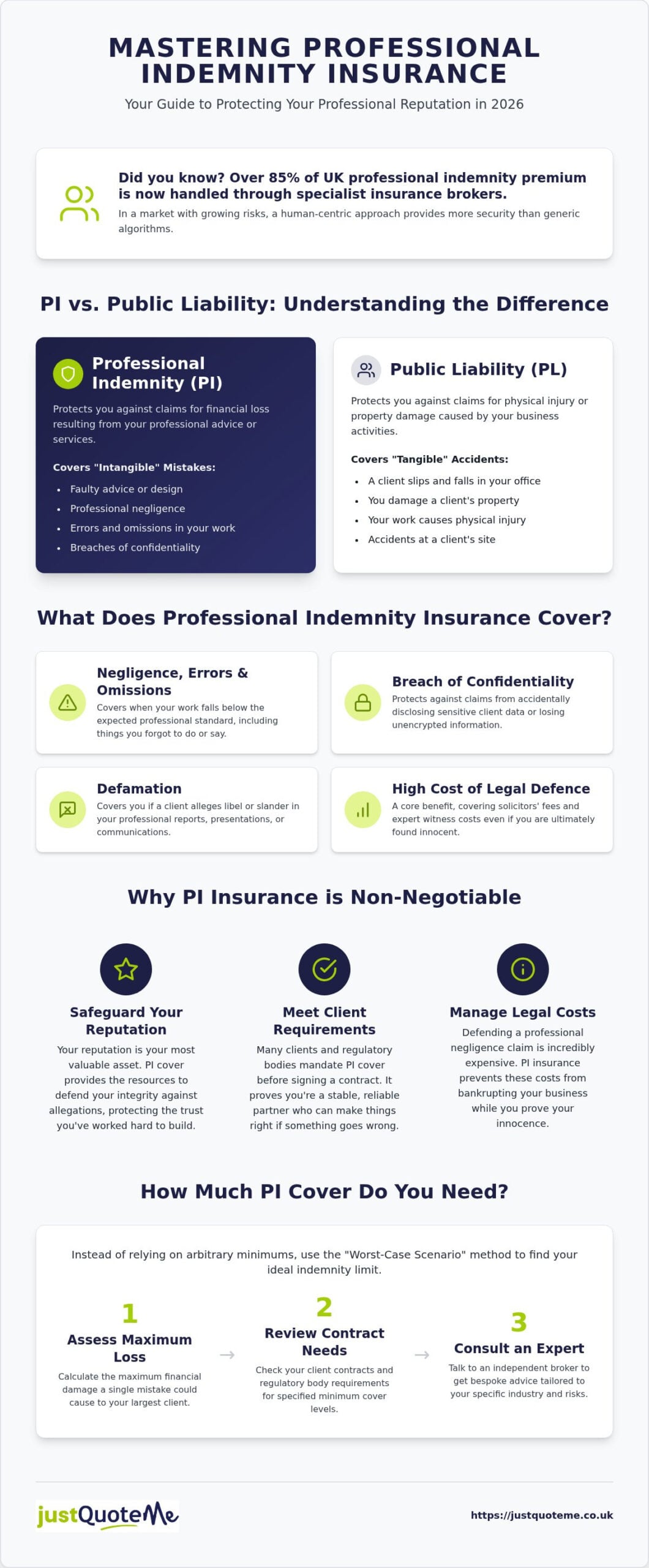
It’s easy to confuse different types of cover, but the distinctions are vital. Public Liability Insurance protects you if your business activities cause physical injury to a person or damage to their property. Think of a slip and fall in your office or a tool dropped on a client’s floor. Professional Indemnity, however, focuses on “intangible” mistakes that lead to financial loss. If you’re an architect and your design leads to a significant budget overrun, or a consultant gives advice that results in a client losing revenue, that’s a PI claim. Many UK businesses find that they actually need both types of cover to be fully protected against the varied risks they face daily.
The Core Purpose of PI Cover in a Litigious Market
The real value of this cover lies in its ability to manage the high cost of legal defence. Even if you’ve done nothing wrong, defending a complex professional negligence claim is incredibly expensive. Solicitors’ fees and expert witness costs can reach five figures very quickly. PI insurance ensures these costs don’t bankrupt your business while you’re proving your innocence. It also provides the financial backing needed to pay compensation if you are found liable. For modern UK clients, seeing that you have this insurance is often a prerequisite for signing a contract. It proves you’re a stable, reliable partner who can make things right if something goes wrong. This allows you to focus on your work while a steady hand manages the administrative and legal burdens in the background.
What Does Professional Indemnity Insurance Cover? (And What It Doesn’t)
Standard 2026 policies are more comprehensive than they used to be. They don’t just cover obvious blunders; they protect against the “intangible” risks of professional life. This cover acts as a buffer between your professional judgement and your personal assets. It ensures that when a client alleges your service wasn’t up to scratch, you have the financial backing to respond appropriately.
Protection Against Negligence, Errors, and Omissions
Negligence is the most frequent trigger for a claim. This happens when your work falls below the standard expected of a professional in your field. For example, a tax consultant might provide incorrect advice that leads to a client facing a massive HMRC penalty. It’s not just about active errors, though. Omissions, things you forgot to do or say, can be just as damaging. Modern policies often use “civil liability” wording. This is broader than “negligence” alone, covering any civil claim unless it is specifically excluded. While you might wonder Is Professional Indemnity Insurance a Legal Requirement?, the practical reality is that most high-value contracts won’t let you start work without it.
Breaches of Confidentiality and Defamation
In our digital age, data is a liability. If you accidentally disclose sensitive client information or lose a laptop containing unencrypted designs, you could face a breach of confidentiality claim. Your policy provides the defence costs and compensation for these slips. Professional Indemnity Insurance also covers defamation, protecting you if a client alleges libel or slander in your reports or presentations. This often overlaps with Cyber Insurance, especially for digital consultants. While PI covers the professional error of losing the data, Cyber Insurance handles the technical recovery and notification costs.
Common Exclusions to Watch For
Every policy has limits. This cover won’t protect you in certain scenarios:
- Deliberate Acts: Criminal fraud or intentional dishonesty is never covered.
- Bodily Injury: This is excluded because it belongs under Public Liability.
- Prior Acts: Claims arising from work done before your “retroactive date” won’t be paid.
One of the most critical things to understand is the “claims-made” nature of the policy. You must have active cover when the claim is made, regardless of when the mistake happened. If you’re unsure which specific risks apply to your sector, speaking with an independent insurance broker can provide the clarity you need. This professional advice ensures you don’t leave gaps in your protection that could prove costly later.
Is Professional Indemnity Insurance a Legal Requirement in the UK?
Unlike Employers’ Liability insurance, which is a statutory requirement for almost any UK business with staff, Professional Indemnity Insurance isn’t a universal legal obligation. You won’t face criminal prosecution just for existing without it. However, for a vast number of professionals, operating without cover is practically impossible. Regulatory bodies and professional associations set strict rules that make PI a condition of your license to practice. If you’re a solicitor, architect, or accountant, your right to trade depends entirely on your insurance status.
Mandatory Cover for Regulated Professions
Certain sectors face rigid mandates from their governing bodies. For instance, the Solicitors Regulation Authority (SRA) requires a minimum of £2 million in cover for unincorporated practices and £3 million for incorporated bodies. Architects must meet the Architects Registration Board (ARB) requirement of £250,000 for each and every claim. Accountants under the ICAEW generally need the greater of £1.5 million or 2.5 times their gross fee income. The FCA requirements for professional indemnity insurance also ensure that firms in the financial sector maintain adequate resources to protect consumers. If you fall into these categories, failing to hold valid cover isn’t just a risk; it’s a breach of your professional conduct rules that could lead to your firm being closed down.
Client Contracts and Industry Standards
Even if your profession isn’t strictly regulated by a body like the SRA or ARB, your clients likely have their own standards. Large corporations, local authorities, and government bodies almost always include a PI clause in their tender documents. They won’t risk their own reputation on an uninsured contractor. You’ll often find a “minimum limit” requirement of £1 million, £2 million, or even £5 million before you can even bid for work. Holding a robust policy isn’t just a defensive move. It’s a competitive advantage. It signals to potential partners that you’re a stable, professional entity capable of backing up your promises. In this context, Professional Indemnity Insurance becomes a “de facto” legal requirement for anyone wanting to win high-value contracts.
Operating without cover in a litigious market is a gamble with your personal assets. If a claim arises and you’re uninsured, you’re personally liable for legal fees and damages. This can lead to insolvency faster than almost any other business setback. While the law might not force every consultant to buy PI, the reality of the 2026 UK market makes it an essential cost of doing business safely. It’s the difference between a minor professional hiccup and a total financial disaster.
Calculating Your Risk: How Much PI Cover Do You Need?
Selecting a limit for your Professional Indemnity Insurance isn’t a decision to take lightly. While professional bodies often set minimum requirements, these are frequently floor levels rather than realistic ceilings for modern risks. You shouldn’t just look at what you’re told to have; you need to look at the potential financial fallout if your advice goes wrong. Under-insurance can be just as damaging as having no cover at all if a claim exceeds your policy limit.
Assessing Potential Financial Impact
Start by identifying your “worst-case scenario” with your largest or most complex client. If a project fails entirely due to your error, what is the total potential loss? You must account for the cost of redoing the work, the client’s lost revenue, and any third-party damages. Legal costs are a massive factor here as they often match or even exceed the actual compensation awarded in a dispute. It’s also vital to check if your legal costs are “in addition” to your limit or “inclusive” of it. An indemnity limit is the maximum amount an insurer will pay for a claim.
You also need to choose between “Any One Claim” and “Aggregate” cover. An “Any One Claim” policy provides the full limit for every individual claim made during the year. In contrast, an “Aggregate” policy provides a total pot for the entire period. If you handle multiple high-value contracts simultaneously, an “Any One Claim” structure offers significantly more security. It ensures that one large claim doesn’t exhaust your entire fund, leaving you exposed for the rest of the year.
Factors Influencing Your Premium
Your 2026 insurance costs depend on several specific variables that define your risk profile. Your annual turnover is a primary driver because it acts as a proxy for the volume of work and the scale of potential errors. High-risk sectors, such as structural engineering or financial services, naturally face higher premiums due to the complexity of their work and the potential for catastrophic financial loss. Your claims history also plays a critical role; insurers view a clean record as a sign of robust internal risk management and quality control.
The UK market is currently in a “soft” phase, which is good news for many businesses. This means there is increased competition among insurers, often leading to more flexible underwriting terms and competitive pricing for firms with strong risk profiles. Even with the 12% Insurance Premium Tax (IPT) applied to your policy, you may find that the market conditions allow for higher limits than in previous years. Don’t simply renew the same old policy. You should consult a specialist insurance broker to ensure your indemnity limit accurately reflects the scale of your current projects and the specific risks of your sector.
The Just Quote Me Advantage: Bespoke PI for Staffordshire Businesses
Choosing the right Professional Indemnity Insurance shouldn’t feel like a digital guessing game. While automated comparison sites offer speed, they often lack the depth required to protect a complex business. Just Quote Me provides a human-centric alternative, acting as a steady hand in a market that’s often cold and impersonal. We manage the heavy administrative burden so you can focus on your professional output, confident that your reputation is in safe hands. Our approach isn’t about one-size-fits-all policies; it’s about bespoke solutions that reflect the actual risks you face every day.
Why an Independent Broker Beats an Algorithm
Algorithms are programmed for the average, but your business isn’t average. An independent broker has access to a much wider panel of top UK insurers than standard comparison sites. This allows us to identify “hidden” risks specific to your niche that a generic online form might miss entirely. If your circumstances change mid-year, you won’t be stuck in an automated phone queue or a chatbot loop. You’ll have direct access to an expert who can handle mid-term adjustments quickly and efficiently. We provide the pragmatic advice you need to ensure your cover evolves alongside your business growth.
Our Staffordshire Roots, Your National Protection
We’ve been an independent, FCA-authorised broker since 1989. Based in Stone, Staffordshire, our regional roots give us a unique perspective on the local economy. We understand the specific pressures and opportunities facing professional firms in Stafford, Newcastle-under-Lyme, and the surrounding areas. This local knowledge is particularly beneficial for West Midlands firms, including those seeking Tradesman Insurance where sector-specific nuances are everything. While we’re proud of our Staffordshire heritage, we provide national protection, combining local accessibility with the power to cover businesses across the UK.
The true test of any policy is the claims process. If an allegation of negligence arises, we don’t just hand you a phone number for an insurer and leave you to it. We act as your trusted advisor, navigating the legal complexities and administrative hurdles on your behalf. This personalized service differentiates us from larger, more impersonal competitors who often treat clients as mere policy numbers. With over 30 years of experience, we have the expertise to ensure your claim is handled fairly and swiftly. It’s this commitment to individualized service that provides the ultimate peace of mind for professionals in an increasingly litigious market.
Securing Your Professional Legacy in 2026
Protecting your business reputation requires more than just ticking a box. It’s about ensuring your Professional Indemnity Insurance actually matches the complexity of your current contracts and the risks of a shifting UK market. You’ve seen how “claims-made” structures and specific industry mandates create a unique set of requirements for your firm. Relying on a generic algorithm often leaves gaps that only become apparent when it’s too late.
Just Quote Me acts as your trusted advisor, drawing on over 30 years of industry experience to simplify the administrative burden. As an FCA-authorised independent broker, we provide direct access to a broad network of top UK insurance underwriters. This expertise ensures you receive a bespoke solution that protects your financial future without unnecessary complexity. Take the next step toward secure, professional protection today.
Get Your Free Business Insurance Quote now
Request a Call back for free Expert advice
Frequently Asked Questions
What is the difference between Professional Indemnity and Public Liability?
Professional Indemnity covers financial losses arising from your professional advice or services, while Public Liability covers physical injury or property damage. If a client slips in your office, it’s a Public Liability claim. If your design error causes a client to lose money, that’s where your indemnity cover steps in. Most UK consultants need both to ensure they’re protected against both physical and intangible risks.
Is Professional Indemnity insurance tax-deductible for UK businesses?
Yes, Professional Indemnity Insurance is a legitimate business expense and is fully tax-deductible for UK corporations, partnerships, and sole traders. You can deduct the full cost of your premiums from your taxable income when calculating your annual tax bill. This reduces your overall liability. It’s vital to keep your policy documents and receipts as evidence for HMRC in case of a future audit or inquiry.
Do sole traders need Professional Indemnity insurance?
Sole traders need this cover because they have unlimited personal liability for any business mistakes they make. If a client sues you for a professional error and you’re uninsured, your personal assets like your home or savings could be at risk. Professional Indemnity Insurance provides a vital barrier between your professional life and your personal finances. It ensures that a single mistake doesn’t result in personal bankruptcy.
What is a ‘Run-off’ cover and why is it important when I retire?
Run-off cover protects you against claims made after your business has ceased trading for work you completed in the past. Since PI is “claims-made,” you must have a policy active at the time a claim is brought, even if you retired years ago. For example, solicitors in England and Wales are mandated by the SRA to maintain run-off cover for at least six years after closing their practice.
Can I get Professional Indemnity insurance if I work from home?
You can certainly obtain cover while working from home; your physical location doesn’t change the nature of your professional advice. Insurers focus on the services you provide and the potential financial impact of your errors rather than your office setup. Whether you’re in a high-street office or a spare bedroom, the legal risks of negligence remain the same. Modern policies are designed to be flexible for remote working.
How much does Professional Indemnity insurance cost on average in 2026?
Average costs in 2026 are determined by your specific risk profile rather than a single industry-wide figure. While the UK market is currently in a “soft” phase with increased competition, your specific profession, turnover, and chosen indemnity limit remain the primary factors. Factors like your claims history and the complexity of your contracts will influence the final premium. It’s best to request a bespoke quote for an accurate figure.
Does PI insurance cover my mistakes if I work for international clients?
Most policies provide cover for international work but often exclude specific jurisdictions like the USA and Canada due to their legal systems. You must check the “territorial limits” and “jurisdiction” clauses in your policy wording. If you trade globally, you need to ensure your policy specifically accounts for the regions where your clients are based. This prevents nasty surprises if a dispute arises with an overseas partner.
What happens if I forget to renew my PI insurance?
You lose protection for all previous work immediately because of the “claims-made” trigger used in these policies. If a client makes a claim during this gap, or even after you renew for work done during the gap, your insurer may not pay out. You lose the protection for all past work unless you can negotiate a “retroactive date” with a new insurer. It’s vital to set reminders or use a broker.
