
What if your kitchen’s usual fryer checks don’t match the conditions in your insurance policy? A deep fat fryer insurance clause may set out safeguards or record-keeping expectations. The wording can be difficult to interpret, and requirements vary between insurers. Rather than assume your current routine is enough, find the clause and check it against how your kitchen operates.
If you’re unsure what your policy asks you to do, start with the exact wording, not general advice about fryer safety. A breach doesn’t automatically mean a claim will be rejected. The effect depends on the policy wording and circumstances, so ask your insurer or broker to clarify any concerns.
This guide explains how to find and read the clause, check for requirements about safeguards and records, and prepare focused questions. You’ll also see how to compare the wording with your procedures for cleaning, servicing and staff practices, without assuming every policy sets the same conditions.
Key Takeaways
- Find the exact deep fat fryer insurance clause in your policy and check its wording rather than relying on general assumptions.
- Look for stated requirements about fryer operation, cleaning, servicing, supervision, training or records.
- A public liability policy label alone won’t confirm whether a specific fryer-related incident is covered. Check the relevant wording and circumstances.
- Compare the clause with your kitchen procedures, note any gaps and ask your insurer or broker to clarify uncertainties.
- A broker can help you discuss business insurance needs and policy questions, but only the insurer can confirm how its terms apply.
Deep Fat Fryer Insurance Clause: Why the Exact Wording Matters
A fryer clause can look technical, but your own policy wording is the place to start. The phrase deep fat fryer insurance clause describes wording that addresses fryer use or related risks. It isn’t a standard clause with identical terms across insurers. Don’t assume a requirement applies unless you can find it in the documents for your policy.
A clause heading doesn’t explain by itself what the insurer has agreed to cover or under what conditions. Your documents may include conditions, exclusions, endorsements and definitions, and their meaning depends on the exact wording and how the sections relate. A clause might set a requirement, restrict cover or clarify its scope. The full policy and the circumstances of an incident matter when deciding how the terms apply.
For general background on how fryers are constructed and operate, see deep fryer safety features. This can help you understand the equipment, but it cannot tell you what your insurer requires.
Where to find the fryer clause in your policy documents
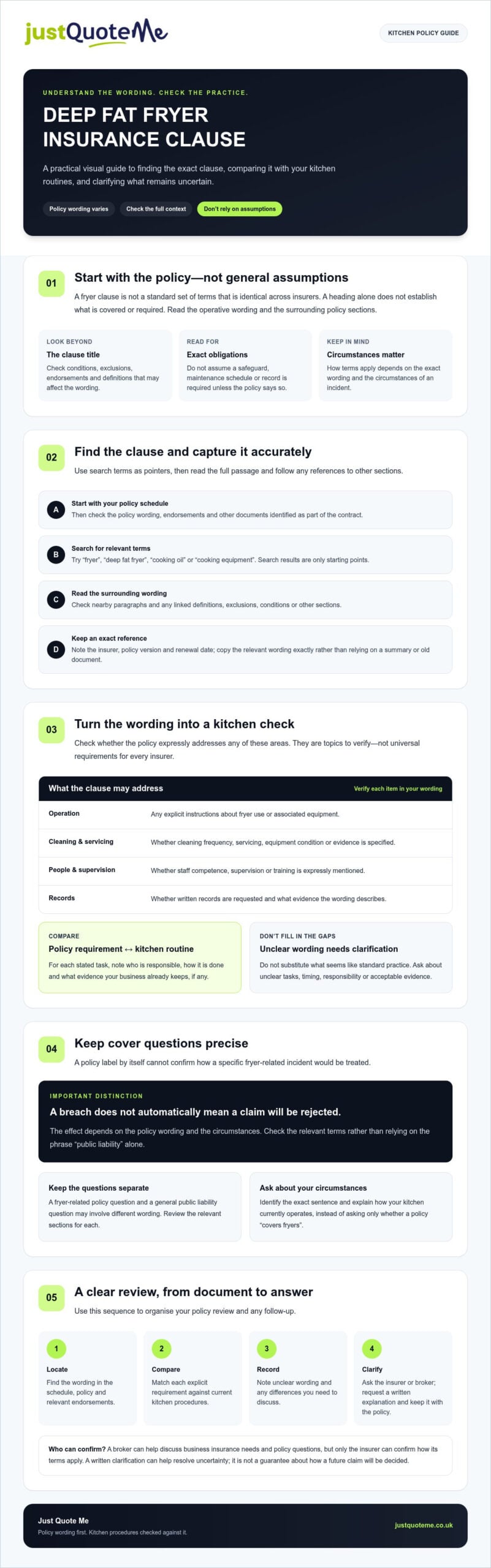
Start with the policy schedule, then check the wording, endorsements and any other documents the policy says form part of the contract. Search for terms such as “fryer”, “deep fat fryer”, “cooking oil” or “cooking equipment”. Treat search results as pointers only. Read the surrounding paragraphs and follow references to definitions, exclusions or other sections.
Note the insurer, policy version and renewal date, then copy the relevant wording exactly. This makes it easier to ask a clear question and helps you avoid relying on a summary or an old document. If you’re also reviewing public liability, keep that question distinct from the fryer wording. You can read more about public liability insurance.
What the clause can and cannot tell you
Read the operative wording, not just the clause title. Check whether the document defines key phrases or links the clause to an exclusion or another condition. Don’t assume a particular safeguard, maintenance schedule or record is required unless the policy says so.
If the wording is unclear, identify the precise sentence and explain how your kitchen currently operates. Ask the insurer or broker to confirm in writing how the term applies to your circumstances, and keep the response with your policy documents. This can help resolve uncertainty, but it isn’t a guarantee about how a future claim will be decided.
What to Check in a Deep Fat Fryer Insurance Clause
Once you’ve found the relevant wording, turn it into a practical checklist. Copy each requirement exactly, including any stated frequency, responsible person, exceptions or cross-references. Don’t replace unclear terms with what you think is standard practice. A process that seems sensible may not match the obligation in your policy.
Check policy obligations against the actual wording.
Look for references to fryer operation, cleaning, servicing, supervision, staff training and record-keeping. Not every policy addresses all of these, and details may appear in another section or an endorsement. Treat each as something to verify, not as a universal insurer requirement.
Fryer operation, cleaning, and maintenance requirements
Check for explicit instructions about safe use, cleaning frequency, servicing or keeping the fryer and associated equipment in condition. Don’t assume a particular schedule applies unless it appears in your documents or the insurer confirms it. For background on practical fryer hazards and precautions, consult the HSE guidance on fryer safety, while keeping it separate from your policy requirements.
Compare each stated task with your kitchen’s routine. Note who is responsible and what evidence exists, such as a cleaning checklist or service record, if your business keeps one. If the wording is unclear about the task, timing or acceptable evidence, ask the insurer or broker to clarify it.
Staff training, supervision, and records
Check whether the clause expressly refers to staff competence, supervision or written training records. Compare those terms with your induction and refresher processes, and note any differences. Don’t assume the policy requires a particular training format unless it says so.
List relevant records your business already holds, such as training logs, cleaning checklists, maintenance documents or supervision procedures. If the clause asks for evidence but doesn’t explain what will satisfy it, request written clarification.
To spot gaps, make a simple table with three columns: the exact policy requirement, the procedure currently followed, and any action or question needed. For example, if the wording specifies a cleaning interval, compare it with your records rather than relying on staff recollection. Mark unclear points for follow-up and keep the insurer’s response with the policy documents.
If you’re reviewing cover for a food business as well as checking a clause, you can discuss your business insurance needs with Just Quote Me. Clarifying the wording is useful, but it doesn’t guarantee how a claim will be assessed.
Does Public Liability Insurance Automatically Cover Fryer Incidents?
No. The name of a policy section alone can’t confirm whether a particular fryer incident is covered. Public liability may be relevant to an injury or damage involving someone else, but the full wording, any applicable exclusions and the circumstances all matter. A fire that damages the business’s own premises raises a different question from an injury to a customer.
Start by describing what happened, whose injury or property is involved, and what loss you’re asking about. Then check the relevant policy section and any linked terms. The public liability insurance guide can explain that type of cover, but it can’t determine how your own policy responds. For wider context on fire precautions in food businesses, see London Fire Brigade’s fire safety advice.
| Question | What to check |
|---|---|
| Was someone else injured or their property damaged? | Review the public liability section, its definitions, exclusions and any fryer-related wording. |
| Was the business’s own building or equipment damaged? | Check the relevant property section and its terms. Don’t assume public liability addresses damage to your own property. |
| Does the policy mention fryer use or safeguards? | Read the exact clause alongside linked conditions or exclusions, then compare it with the incident and your procedures. |
Public liability, property damage, and the wording of your policy
These may be separate insurance questions, not interchangeable labels. Identify who owns the damaged property and whether the loss concerns an injury, damage to someone else’s property, or damage to the business’s own premises or equipment. Then find the policy section that appears relevant and read it in full. A restaurant and takeaway policy may include different sections, so check the documents rather than relying on the policy name.
When a fryer clause may affect a claim
If a requirement wasn’t met, don’t assume the claim will automatically be rejected or paid. The effect depends on the clause, the full policy, the facts and the insurer’s assessment. If your business can’t meet a stated requirement, contact the insurer or broker promptly and ask for written clarification. Keep the response with the policy documents, and don’t treat informal assumptions as confirmation of cover.
A Practical Checklist for Reviewing Fryer Insurance Requirements
A structured review turns policy wording into actions your team can check. Locate the relevant text, copy each requirement exactly, compare it with current procedures, record any gaps, then ask the insurer or broker to clarify anything uncertain. This checklist supports your review, but it doesn’t replace the insurer’s interpretation of the policy.
For example, hypothetical wording only, not a standard requirement: “The fryer must be serviced at the intervals specified by the manufacturer.” You’d need to confirm which intervals apply to your equipment, whether the clause refers to a particular fryer, and what service records are available. Don’t assume this wording appears in your policy.
Create a clause-to-procedure checklist
Set up a simple record for each requirement. Include:
- Exact wording: Copy the relevant sentence and any cross-reference.
- Related procedure: Note the kitchen process that addresses it.
- Responsible person: Identify who oversees the task.
- Available evidence: List records that show what the business does.
- Open questions: Record unclear terms or missing information.
Mark each item as confirmed, unclear or needs action. Don’t mark an item confirmed based on a verbal assurance or informal assumption until it’s checked against the wording or clarified with the insurer. Keep the policy documents and supporting records accessible to whoever manages the insurance, so they can refer to the same current information.
Questions to put to your insurer or broker
Be specific. Ask which fryer activities and equipment a clause applies to, what evidence the insurer expects to see, and whether it can confirm the answer in writing. If you plan to change equipment, cleaning arrangements or staff procedures, ask how and when that change should be disclosed. Keep the response with the policy and note which question it answers.
Review the checklist when the policy changes, at renewal, or when fryer equipment or operating arrangements change. A change in routine can create a gap between the policy documents and what happens in the kitchen, even if the wording itself hasn’t changed. Recheck the relevant details instead of carrying forward last year’s assumptions.
If your review also involves checking cover for a food business, discuss your business insurance needs with Just Quote Me. A clear record of the deep fat fryer insurance clause and your questions can make a conversation with your insurer or broker more focused.
Get Help Interpreting a Deep Fat Fryer Insurance Clause
Before relying on assumptions, read the full clause, compare each requirement with your kitchen’s procedures, and note any gaps. If the wording is unclear or a process doesn’t match, ask the insurer or broker to explain how the policy applies to your circumstances. A heading or brief summary may leave out definitions, conditions or exclusions that affect its meaning.
When to request clarification or review your cover
Ask for clarification if the clause is ambiguous, your current procedures appear different from what it requires, or you plan to change your fryer, equipment or operating arrangements. Share the complete relevant wording, including cross-references, rather than relying on the clause title alone. Explain how the kitchen operates and ask for a written response to keep with the policy documents.
Just Quote Me is an independent UK insurance broker and an FCA-authorised firm with more than 30 years of industry experience. It can help you discuss business insurance needs and policy questions, including how to raise a wording query with an insurer. Any explanation is guidance on the policy terms, not a promise that a policy can be amended or that a future claim will be covered.
Choose a clear next step for your food business
If you’re reviewing cover for a restaurant or takeaway, compare your business needs with the available restaurant and takeaway insurance options. Have your policy schedule, full wording, relevant procedures and questions ready. This gives the insurer or broker a clearer picture of what you need to check, without relying on general assumptions about fryer clauses.
Choose the next step that suits you:
- Get Your Free Business Insurance Quote now to start a quote enquiry.
- Request a Call back for free Expert advice if you’d prefer to discuss your questions with the team.
Use either route to discuss your business insurance needs. The insurer can confirm how the deep fat fryer insurance clause and the rest of the policy apply to your circumstances.
Check the wording, then choose your next step
A careful review starts with the full policy, not just a heading. Find the deep fat fryer insurance clause, copy each requirement exactly, and compare it with your kitchen’s procedures and available records. If the wording is unclear or your arrangements don’t match, ask the insurer or broker for written clarification. A policy label alone can’t confirm whether a particular incident is covered.
Just Quote Me is an independent, FCA-authorised UK insurance broker with more than 30 years of industry experience and access to a broad network of UK insurers. Broker support can help you discuss business insurance needs and policy questions, but the insurer must confirm how its terms apply.
Ready to explore your options? Visit Just Quote Me to take the next step, or Get Your Free Business Insurance Quote now.
Prefer to talk through your questions? Request a Call back for free Expert advice. With the wording and your questions to hand, you can make a more informed decision about cover for your food business.
Frequently Asked Questions
What is a deep fat fryer insurance clause?
A deep fat fryer insurance clause is policy wording that refers to using a fryer or managing risks associated with it. It may set requirements, limit cover or clarify what the policy covers, depending on the exact wording. Check your schedule, policy wording, endorsements and linked terms. Don’t assume a clause applies to every business or includes the same safeguards across insurers.
Does public liability insurance automatically cover deep fat fryer incidents?
No. The policy label alone can’t confirm whether a particular fryer incident is covered. Public liability may be relevant to certain claims involving injury to someone else or damage to their property, but the full policy terms, exclusions and circumstances matter. Damage to your own premises or equipment may raise a separate question under another section. Check the relevant wording and ask your insurer or broker how it applies.
What should I check in a deep fat fryer insurance clause?
Read the complete clause and any definitions, exclusions or cross-references it points to. Note whether it expressly mentions fryer operation, cleaning, servicing, supervision, staff training or records, and copy each requirement accurately. Then compare the wording with your current kitchen procedures. If a term, frequency or expected evidence is unclear, don’t substitute general practice for confirmation. Ask the insurer or broker for an explanation in writing.
Can an insurer refuse a claim if I have not followed a fryer clause?
It’s not possible to predict the outcome from a possible breach alone. The effect depends on the exact clause, the rest of the policy, the incident and the insurer’s assessment. A breach doesn’t automatically establish whether a claim will be accepted or declined. If you’ve identified a requirement your business may not meet, contact the insurer or broker promptly and ask how the wording applies to your situation.
What records should a restaurant keep to show it has followed fryer requirements?
Start with the records your policy expressly requires, if it specifies any. Depending on your procedures, relevant documents might include cleaning checklists, service records, staff training logs or supervision records. These are examples, not a universal list of insurer requirements. Keep records accurate, current and accessible to the person managing the policy. If the clause says evidence is needed but doesn’t specify what counts, ask the insurer for written clarification.
Do I need to tell my insurer if I change my fryer or kitchen procedures?
Check your policy wording for requirements about changes and disclosure, and ask your insurer or broker how a planned change should be reported. This is especially useful if you’re replacing equipment or changing a process related to a stated clause. Don’t assume the existing terms automatically address the new arrangement. Keep a written record of your question and the response, and confirm whether any policy documents or details need updating.
Who can explain a deep fat fryer clause in my business insurance policy?
Your insurer can confirm how its policy wording applies, and your broker can help you raise clear questions about the terms. Just Quote Me is an independent, FCA-authorised UK insurance broker with more than 30 years of industry experience and access to a broad network of UK insurers. Share the full relevant wording, not just the clause heading, and describe the kitchen procedures you want to check. A broker can discuss your questions but can’t guarantee a claim outcome.
