

What if you could trade a stack of separate renewal notices and the constant worry of an outdated Motor Insurance Database for a single, manageable date? Managing individual policies for every van and car in your business is a significant administrative headache. Whether it’s the frustration of high premiums for younger drivers or the risk of missing a renewal date, the burden of a growing vehicle list can quickly distract you from running your company. Securing the right fleet insurance is a strategic move that becomes viable the moment you have as few as two or three business vehicles.
We understand that you need to keep your team on the road without the paperwork holding you back. This guide shows you how to simplify your business motor cover and secure the most competitive rates in the UK. By moving to a single policy, you can consolidate your renewals and significantly reduce your overall costs. We’ll explore how flexible “Any Driver” cover can transform your daily operations and provide the straightforward protection your business deserves. From understanding MID compliance to lowering your total premium, we’ve broken down exactly what you need to know to take control of your business vehicles.
Key Takeaways
- Learn how fleet insurance can consolidate multiple business vehicles into a single policy, starting from as few as two cars or vans.
- Understand the differences between Comprehensive and TPFT cover to select the most appropriate level of protection for your trade.
- Discover how driver-to-vehicle ratios and confirmed claims experience can help reduce your annual insurance spend.
- Stay compliant with the Motor Insurance Database (MID) by understanding your legal obligations as a fleet manager.
- Find out how 30 years of local expertise can help you secure better terms than automated comparison sites.
What is Fleet Insurance and How Does it Benefit Your Business?
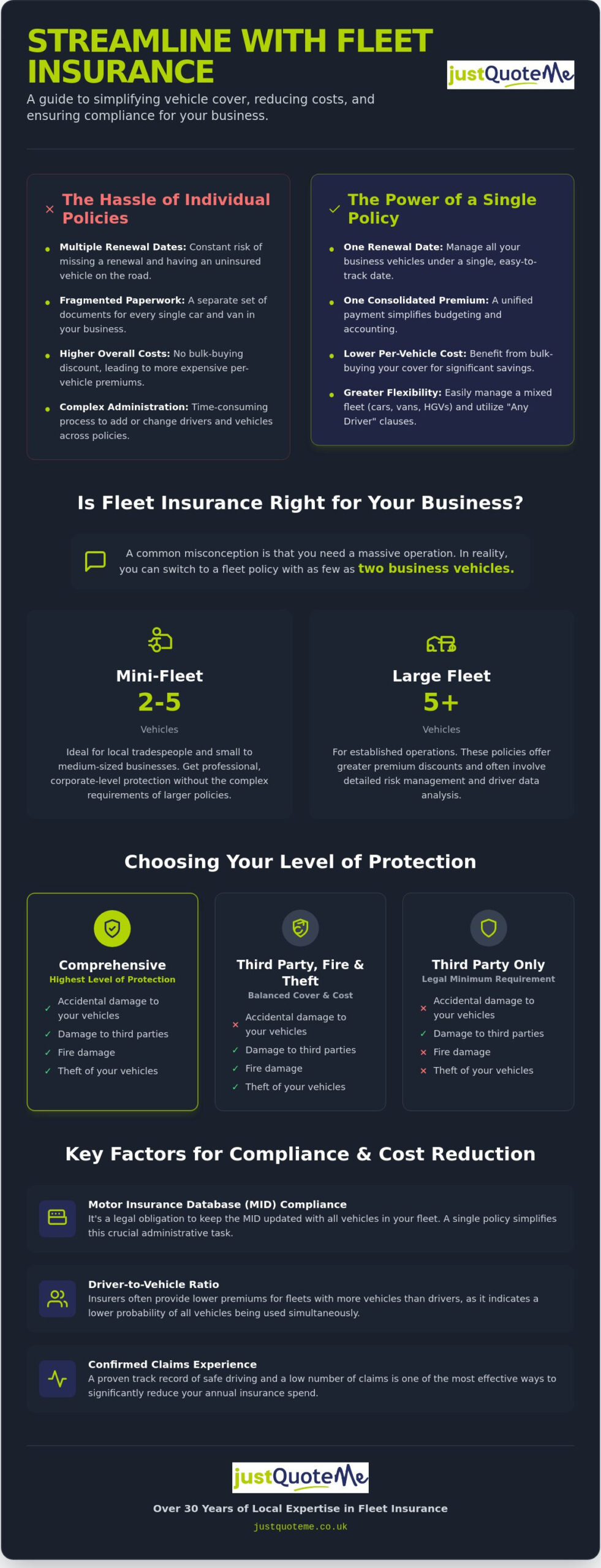
Managing a business is demanding enough without the added stress of juggling multiple insurance renewals for every vehicle you own. At its core, fleet insurance is a single, unified policy that covers a fleet of vehicles under one premium and one renewal date. Instead of tracking separate documents for three vans and two cars, you have a single point of contact and one set of paperwork. This consolidation isn’t just about convenience; it is a strategic administrative tool designed to reduce the time you spend on back-office tasks.
Many business owners believe they need a massive operation to qualify for this type of cover. This is a common misconception. At Just Quote Me, we specialise in the “Power of Two,” meaning you can often move to a motor fleet insurance policy the moment you acquire your second business vehicle. By bulk-buying your cover, you typically benefit from lower per-vehicle premiums compared to individual policies. It allows you to manage your risk more effectively while freeing up capital that would otherwise be tied up in higher, fragmented insurance costs.
The Difference Between Mini-Fleet and Large Fleet
Underwriting requirements shift depending on the size of your operation. A Mini-Fleet policy typically covers between 2 and 5 vehicles. This is an ideal entry point for local tradespeople in Staffordshire, whether you are based in Stone, Stafford, or Newcastle-under-Lyme. It offers the professional protection of a corporate policy without the complex requirements of a national carrier. Once you grow beyond 5 or 15 vehicles, you move into Large Fleet territory. These policies often involve more detailed risk management assessments and data-driven insights into driver behaviour, but they offer even greater opportunities for premium discounts through proven safety records.
Why Your Business Needs a Unified Policy in 2026
The regulatory environment for business transport is becoming increasingly complex. As of July 2026, light goods vehicles (LGVs) between 2.5 and 3.5 tonnes must use tachographs for international goods transport. Additionally, the Benefit-in-Kind (BIK) tax rate for electric vehicles has risen to 4% for the 2026/27 tax year. Keeping track of these changes across multiple individual policies is a recipe for error. A unified policy eliminates the risk of “uninsured” gaps that occur when a single renewal date is overlooked. It also provides the flexibility of “Any Driver” clauses, allowing your team to switch vehicles as needed without the administrative delay of adding named drivers to specific vans. Fleet insurance is a scalable solution for growing UK businesses that simplifies compliance and protects your bottom line.
Types of Motor Fleet Insurance Cover Explained
Selecting the right level of protection for your vehicles involves more than just looking at the bottom line. You need a policy that aligns with your operational risks while meeting the standard commercial vehicle insurance requirements. Most fleet insurance providers offer three primary tiers of cover, each providing a different degree of security for your business assets.
Comprehensive cover remains the most popular choice for modern businesses. It provides the highest level of protection, including accidental damage to your own vehicles regardless of who is at fault. For companies looking to balance cost with essential security, Third Party, Fire and Theft (TPFT) offers a middle ground. It covers damage to others and protects your fleet against fire damage or theft. Third Party Only (TPO) is the legal minimum required to operate on UK roads. While TPO might seem like a cost-saving measure, it leaves your own vehicles unprotected in the event of an accident, which can be a significant financial risk for a growing company.
One of the greatest advantages of a unified policy is the ability to manage a mixed fleet. You don’t need separate providers for your company cars, HGVs, and vans. A single motor fleet insurance policy can wrap all these different vehicle types into one agreement. This is particularly useful for tradespeople who need to include specialized van and tools insurance to protect the equipment they carry between jobs. If you are unsure which level of cover fits your current risk profile, you can speak with our team to explore tailored options.
Key Policy Inclusions You Should Look For
A robust policy should offer more than just basic road cover. Look for breakdown recovery that ensures your team stays mobile across the West Midlands and the wider UK. Legal expenses cover is also vital, as it protects you against the costs of defending or pursuing legal action following an incident. Additionally, many insurers offer new vehicle replacement for cars or vans under 12 or 24 months old, ensuring your investment is fully protected if a nearly new vehicle is written off.
Specialist Extensions for Trades and Services
Standard cover often stops at the vehicle itself, but your business relies on what is inside. Goods in Transit extensions protect the cargo or customer items you are transporting. If your work involves hazardous goods, such as chemicals or fuel, you will need specialist underwriting to ensure you are legally covered. We often recommend integrating your vehicle cover with your public liability insurance to create a seamless safety net for your entire business operation.
How Premiums are Calculated: More Vehicles, Fewer Drivers?
Understanding how your premium is calculated is the first step toward reducing your business overheads. While individual car insurance relies heavily on personal No Claims Bonuses (NCB), fleet insurance underwriting focuses on the collective risk of your operation. This shift in perspective allows for more nuanced pricing that reflects how your business actually functions on a daily basis.
One counterintuitive factor is the driver-to-vehicle ratio. If your business owns ten vans but only employs six full-time drivers, your risk profile is often lower than a one-to-one ratio. Insurers recognise that your entire fleet cannot be on the road at once, which reduces the statistical likelihood of an incident. This “spare vehicle” capacity can lead to more competitive rates because the active risk is capped by the number of people behind the wheel. Additionally, the type of vehicles and their intended use are critical. A fleet of heavy goods vehicles used for long-distance haulage carries a different risk level than a group of small cars used for local commuting between Stone and Stafford.
Rather than managing individual NCBs, which can be a nightmare when staff leave, fleets use Confirmed Claims Experience (CCE). This document provides a three-year or five-year overview of your total claims history. It is a far more efficient way to demonstrate your safety record to underwriters. To further lower costs, many businesses now implement security measures like telematics and AI dashcams. These tools provide objective data on driver behaviour, allowing us to negotiate significant discounts with insurers who value proactive risk management. This proactive approach also extends to vehicle health; for instance, ensuring your fleet undergoes regular servicing and MOTs with a reputable provider like Thurton Auto Centre can significantly reduce the likelihood of mechanical-related claims.
The Role of the “Any Driver” Clause
The “Any Driver” clause is the engine of fleet flexibility. An “Any Driver Over 25” policy is the industry standard for cost-efficiency, as it covers most experienced staff without a massive premium hike. If you need to include younger staff, an “Any Driver Over 21” policy provides that flexibility, though it does come at a higher cost due to the statistically higher accident rates for that age group. For very stable teams, named driver policies can restrict cover to specific individuals to save on premiums. This setup allows you to manage driver turnover efficiently without the need to contact your broker every time a new team member joins, provided they meet your policy’s age and licence criteria.
Regional Factors in Staffordshire and the West Midlands
Your business postcode plays a significant role in your base rate. Postcodes in Stone (ST15) or Stafford (ST16) are assessed based on local traffic density and crime statistics. In Newcastle-under-Lyme, local risk data regarding vehicle theft and accident hotspots directly influences how underwriters price your policy. Overnight storage is another vital factor. Vehicles kept in a secure yard or garaged overnight will almost always attract lower rates than those parked on a public street, as it significantly reduces the risk of theft and vandalism.
Managing Your Fleet: Compliance and the MID
The Motor Insurance Database (MID) is the central record of every insured vehicle in the UK. For business owners, keeping this record accurate is a significant legal responsibility. Ensuring your data is uploaded promptly is not just a matter of good practice; it is a legal mandate that protects your drivers from being stopped and your vehicles from being impounded. Police use the MID to identify uninsured drivers instantly. While some automated systems leave this task entirely to you, we take a more human-centric approach. Let Just Quote Me manage your MID updates to ensure your fleet insurance remains fully compliant without the administrative burden falling on your shoulders.
You must also stay aware of Continuous Insurance Enforcement (CIE) regulations. Under CIE, every vehicle must be insured at all times unless it is officially declared off the road via a SORN. Keeping “laid up” vehicles uninsured while they sit in a yard can lead to automatic fines, even if the vehicle isn’t being driven. This is another area where a consolidated policy provides a safety net. It’s much easier to track the insurance status of your entire inventory when every asset is listed under one agreement. If you are ready to simplify your administration, consolidate your business cover today.
The Process of Switching to a Fleet Policy
Moving from individual policies to a unified fleet structure is straightforward if you follow a logical path. Many competitors fail to explain this transition, but we believe in transparency. Start by following these three steps:
- Step 1: Gather your current individual policy schedules and their respective renewal dates. We can often align these into a single start date.
- Step 2: Request a “Confirmed Claims Experience” letter from each of your current insurers. This replaces individual No Claims Bonuses.
- Step 3: Consult an independent broker like Just Quote Me. We will review your data and approach our panel of underwriters to find the most competitive rate for your specific trade.
Claims Management and Risk Mitigation
Effective management doesn’t end once the policy is active. You need a clear accident reporting procedure that every driver understands. Prompt reporting often leads to lower claims costs, which protects your future premiums. We also recommend using telematics data to identify high-risk driving patterns. This allows you to provide targeted retraining before an incident occurs. Finally, keep detailed vehicle maintenance logs. Most insurers require proof that your vehicles are roadworthy to maintain the validity of your motor fleet insurance. Regular checks on tyre pressure, brakes, and lights are simple steps that protect both your team and your policy.
Why Choose Just Quote Me for Your Fleet Insurance?
Choosing the right partner for your fleet insurance is as important as the policy itself. While many large insurers only offer their own branded products, Just Quote Me operates as an independent broker. This means we search a broad panel of top UK underwriters to find the best fit for your specific trade. We’ve spent 30 years building deep relationships within the industry. This experience gives us the leverage to secure competitive terms that automated comparison sites simply cannot reach. We don’t believe in “one size fits all” packages. Whether you need a policy for a motor trade fleet or a specialized builders insurance solution, we tailor every detail to your operational reality.
Our approach is built on reliability and a desire to simplify your administrative processes. We position ourselves as a human-centric alternative to the faceless, automated systems that dominate the modern market. When you work with us, you speak directly to experts who understand the nuances of different professional sectors. This personality is defined by a pragmatic attitude. We manage the complex burdens so you don’t have to. It’s about providing a steady hand in a complex market, ensuring you feel fully informed and secure in your choices.
Expert Advice for Complex Risks
Managing a business involves balancing multiple legal requirements. We provide expert guidance on integrating your vehicle cover with other essential protections, such as employers liability insurance. This holistic approach ensures there are no gaps in your safety net. We also specialize in “hard to place” risks that other brokers might avoid. If your fleet includes high-performance vehicles or requires cover for younger drivers, we have the expertise to navigate these complex markets. Our team handles mid-term adjustments and policy administration with speed and precision, reflecting our commitment to efficiency.
Get Started with a Local Staffordshire Broker
Based in Stone, we have a deep understanding of the business landscape across Staffordshire and the West Midlands. We know the local roads, the regional risks, and the challenges facing companies in Stafford and Newcastle-under-Lyme. This regional knowledge is a marker of quality that helps us provide more accurate, personalized advice. You won’t be dealing with automated bots or distant call centers. Instead, you’ll have a partner who understands your local operational challenges. We are committed to straightforward, honest communication and pricing that reflects the true value of your business.
Get Your Free Business Insurance Quote now
Secure Your Business Mobility Today
Transitioning to a unified policy eliminates the stress of staggered renewal dates and ensures your team stays compliant with the Motor Insurance Database. By leveraging the expertise of an independent broker, you gain access to a broad panel of insurers and flexible “Any Driver” options that grow with your company. Protecting your vehicles is about more than just a legal requirement; it’s about building a foundation for efficient, uninterrupted growth.
With over 30 years of industry experience, Just Quote Me provides the specialized knowledge needed to navigate complex fleet insurance markets. As an FCA authorised and regulated partner, we act as a steady hand to manage your administrative burdens so you can focus on your core operations. We pride ourselves on being a human-centric alternative to automated systems, offering genuine local expertise across Staffordshire and the West Midlands. Let us help you find a frictionless solution that keeps your business moving forward.
Get Your Free Business Insurance Quote now
Request a Call back for free Expert advice
Frequently Asked Questions
How many vehicles do I need to qualify for fleet insurance?
Most insurers require a minimum of two or three vehicles to start a fleet policy. At Just Quote Me, we specialise in mini-fleets, allowing you to consolidate your cover the moment you add a second vehicle to your business. This entry-level threshold is ideal for local tradespeople who want to simplify their administration without waiting until they have a large number of vans or cars.
Can I include different types of vehicles on the same fleet policy?
Yes, you can insure a diverse mix of vehicles under a single agreement. A standard policy can cover company cars, delivery vans, and even heavy goods vehicles simultaneously. This flexibility is perfect for businesses with varied operational needs—for instance, you can check out GO CAB to see how a professional private hire fleet operates across regional hubs. This allows a construction firm to use both passenger cars for site visits and large trucks for transporting equipment under the same policy.
What is an “Any Driver” policy and is it more expensive?
An “Any Driver” policy allows any employee who meets your age and licence criteria to drive any vehicle in your fleet. While the initial premium is often higher than a named driver policy, it offers significant administrative savings. You won’t need to contact your broker every time you hire a new staff member, provided they fit the policy’s general requirements, such as being over 25.
What happens to my No Claims Bonus when I switch to fleet insurance?
Your individual No Claims Bonus (NCB) is typically replaced by a collective “Confirmed Claims Experience” (CCE). When you switch, we use your existing NCB records to help underwriters calculate a fair starting premium for the whole fleet. Over time, your fleet insurance rate will be determined by the total claims history of the business rather than the records of individual drivers.
Is fleet insurance cheaper than individual car or van insurance?
Consolidating your vehicles into a fleet policy is usually more cost-effective than taking out separate individual covers. Insurers offer discounts for bulk-buying and account for the fact that not all vehicles are on the road at the same time. This lower risk profile, combined with reduced administrative fees, often results in a lower total premium for your business compared to managing multiple separate policies.
Do I need to update the Motor Insurance Database (MID) myself?
Updating the MID is a legal requirement for the policyholder, but we can manage this process for you. It’s vital that any vehicles added or removed are recorded promptly to avoid the risk of police seizure or automatic fines. As your broker, we provide the support needed to keep your records accurate, ensuring your business stays compliant with minimal effort on your part.
Can I add or remove vehicles from my fleet policy mid-term?
You can easily adjust your vehicle list at any point during the policy term. Fleet policies are designed for businesses that are growing or changing their inventory. When you add a new vehicle, we simply update the MID and adjust your premium accordingly. This flexibility ensures that your fleet insurance always matches your current operational needs without the hassle of starting an entirely new policy.
What level of cover is best for a commercial fleet?
Comprehensive cover is generally the best choice for protecting your business assets. It provides the widest safety net, covering accidental damage to your own vehicles even if your driver is at fault. While Third Party Only is the legal minimum, the financial risk of replacing a high-value van or car out of pocket usually makes Comprehensive the more pragmatic and secure investment for most UK fleets.
