Your IT security is working perfectly — and your business still suffers a devastating data breach. That’s not a hypothetical; it’s the reality facing thousands of UK small businesses every year. Cybercriminals don’t just target the unprepared, and when they strike, the fallout goes far beyond fixing a compromised server.
If you’ve ever wondered whether your existing professional indemnity policy has you covered, or felt a knot of anxiety at the thought of an ICO investigation and GDPR fines landing on your desk, you’re not alone. Most small business owners feel exactly the same way, and the confusion is entirely understandable.
This guide cuts through that confusion. We’ll explain precisely what cyber insurance for small business data breach scenarios actually covers, why it functions as far more than a financial safety net, and how it acts as your outsourced emergency response team the moment something goes wrong. By the end, you’ll know exactly what protection you need, what costs a policy can absorb, and how to get bespoke cover that fits your business rather than a generic one-size-fits-all policy.
Key Takeaways
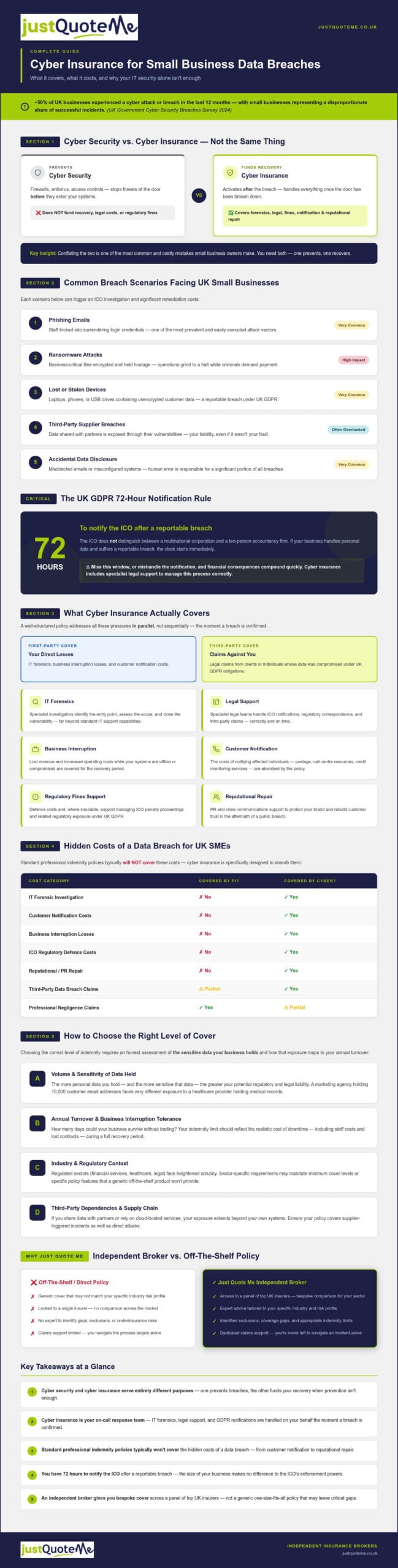
- Cyber security and cyber insurance serve entirely different purposes — one prevents breaches, the other funds your recovery when prevention isn’t enough.
- The right cyber insurance for small business data breach scenarios covers far more than financial losses, acting as an on-call response team that handles IT forensics, legal support, and GDPR notifications on your behalf.
- A data breach carries significant hidden costs — from customer notification expenses to long-term reputational damage — that standard professional indemnity policies typically won’t cover.
- Choosing the correct level of indemnity requires an honest assessment of the sensitive data your business holds and how that exposure maps to your annual turnover.
- Working with an independent broker like Just Quote Me gives you access to a panel of top UK insurers and bespoke advice tailored to your specific industry, rather than a generic off-the-shelf policy.
What is Cyber Insurance for Small Business Data Breaches?
Cyber insurance is a specialist financial and operational product designed to fund your recovery when a digital incident occurs. Think of it as two things working in tandem: a financial backstop that absorbs costs you’d otherwise carry alone, and an on-call response team that activates the moment a breach is confirmed. It doesn’t prevent incidents from happening. That’s the job of your IT security. What it does is ensure that when prevention falls short, your business doesn’t face the aftermath alone and underfunded.
This distinction matters enormously. A firewall stops threats at the door. Cyber insurance for small business data breach scenarios handles everything that happens after the door has already been broken down: the forensic investigation, the regulatory notifications, the legal exposure, and the reputational repair. Conflating the two is one of the most common and costly mistakes small business owners make.
2026 is a particularly significant year for UK SMEs navigating digital risk. The post-Brexit data protection framework continues to evolve, with the ICO maintaining its authority to investigate breaches and issue substantial fines under the UK GDPR. Critically, the ICO doesn’t distinguish between a multinational corporation and a ten-person accountancy firm. If your business handles personal data and suffers a reportable breach, you have 72 hours to notify the ICO. Miss that window, or mishandle the notification, and the financial consequences compound quickly.
Cyber Liability vs. Data Breach Cover
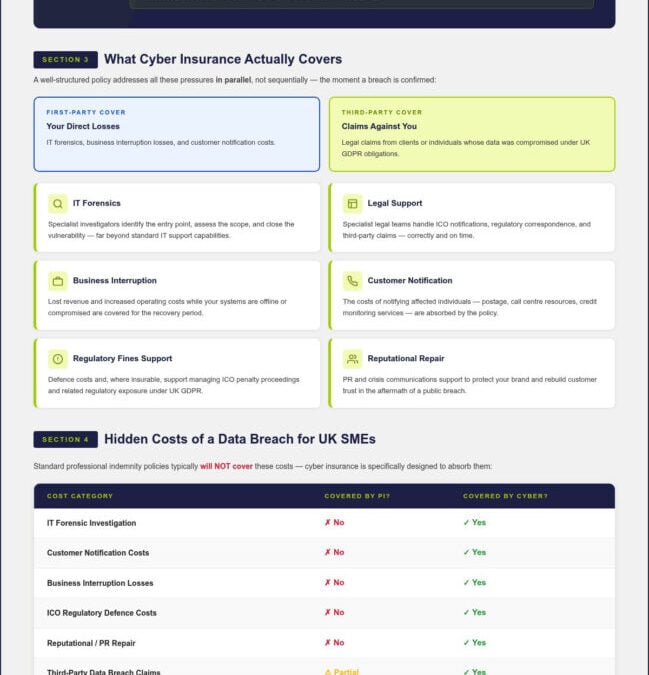
In 2026, cyber liability insurance is broadly defined as protection against the financial and legal consequences of a data security failure, covering both your own losses and claims made against you by affected third parties under UK GDPR obligations. First-party cover addresses your direct costs: IT forensics, business interruption, and customer notification. Third-party cover responds to claims from clients or individuals whose data was compromised. A comprehensive cyber policy typically bundles both, but it’s essential to confirm the scope before you buy.
Why Small Businesses are the Primary Target
Cybercriminals operate on a straightforward logic: smaller businesses typically hold valuable data but invest less in defending it. According to the UK government’s Cyber Security Breaches Survey 2024, around half of UK businesses reported experiencing a cyber attack or breach in the preceding 12 months, with small businesses representing a disproportionate share of successful incidents.
The most common breach scenarios facing small businesses include:
- Phishing emails that trick staff into surrendering login credentials
- Ransomware attacks that encrypt business-critical files and demand payment
- Lost or stolen devices containing unencrypted customer data
- Third-party supplier breaches that expose data you’ve shared with partners
- Accidental data disclosure through misdirected emails or misconfigured systems
Each of these scenarios can trigger an ICO investigation and significant remediation costs. Understanding what cyber insurance for small business data breach events actually covers starts with recognising just how varied the threat landscape is. Explore your options with Just Quote Me’s cyber liability insurance to see how bespoke cover maps to your specific risk profile.
What Does Cyber Insurance Cover in a Data Breach?
When a breach occurs, the clock starts immediately. You’re facing a forensic puzzle, a regulatory deadline, potential legal claims, and a business that may have ground to a halt — all at once. A well-structured cyber insurance for small business data breach policy addresses each of these pressures in parallel, not sequentially. Here’s what that actually looks like in practice.
IT Forensics. Before you can fix anything, you need to understand what happened. Cyber policies fund specialist forensic investigators who identify the entry point, assess the scope of the compromise, and close the vulnerability. This isn’t something your general IT support is equipped to handle. Forensic work is highly specialised, and without it, you risk patching the surface while the underlying weakness remains exploitable.
Legal Support and GDPR Notifications. UK GDPR requires you to notify the ICO within 72 hours of becoming aware of a reportable breach. Miss that window and the regulatory consequences compound. Cyber cover funds specialist data protection solicitors who manage that notification process on your behalf, assess whether affected individuals also need to be contacted, and handle any subsequent ICO correspondence. This alone removes an enormous burden from a business owner who has no prior experience dealing with regulators under pressure.
Data Restoration. Recovering corrupted or encrypted data isn’t simply a matter of restoring a backup. Ransomware attacks, in particular, can compromise backup systems simultaneously. Cyber policies cover the cost of specialist data recovery services, rebuilding databases, and restoring systems to operational condition. The financial exposure here can be substantial, particularly for businesses whose entire operation depends on client records or proprietary files.
Business Interruption. If your systems are offline, your revenue stops. Business interruption cover within a cyber policy compensates for lost income during the period your operations are disrupted, helping you meet fixed costs — payroll, rent, supplier payments — while recovery work is underway.
The Emergency Response Team
One of the most underappreciated features of cyber cover is access to a coordinated incident response from the moment a breach is confirmed. Policies typically provide a dedicated helpline connecting you to IT specialists, legal advisors, and crisis communications professionals simultaneously. Rather than spending critical hours sourcing individual experts, you have a structured response team activated on your behalf. For reputation management, this matters enormously: a well-handled public statement in the first 24 hours can meaningfully reduce the long-term reputational damage that a poorly managed breach inflicts.
Third-Party Claims and Legal Defence
A data breach doesn’t just cost you internally. Clients or individuals whose data was compromised may pursue damages against your business. Cyber liability cover funds your legal defence and, where liability is established, covers the cost of any awarded damages. This is a distinct area of exposure that sits outside the scope of professional indemnity insurance, which responds to claims of professional negligence rather than data security failures. Understanding where one policy ends and another begins is essential to ensuring you’re not left with an uncovered gap.
If you want to understand precisely how these coverage layers map to your specific business, speaking with an independent broker is the most efficient route. Just Quote Me can assess your exposure and match you to a policy that covers the scenarios most relevant to how your business actually operates.
The Hidden Costs of a Data Breach for UK SMEs
Most small business owners, when they think about breach costs, think about the ransom demand or the IT repair bill. Those are real. But they’re often the smallest items on the final invoice. The costs that genuinely threaten business survival tend to arrive weeks and months later, quietly accumulating while you think the crisis is over.
Customer notification alone can be surprisingly expensive. If your business holds personal data for several hundred clients, you’re legally required to contact every individual whose data was compromised. That means drafting legally compliant communications, managing responses, and in some cases, offering credit monitoring services as a goodwill gesture. For a business without dedicated legal or communications support, this process can consume significant staff time and external resource costs simultaneously.
Then there’s the supply chain dimension. Contracts with larger clients, particularly in professional services or public sector supply chains, increasingly include data security clauses. A confirmed breach can trigger a clause review, a temporary suspension, or outright contract termination. Losing a single major client relationship as a direct consequence of a security failure can represent a revenue impact that dwarfs every other breach-related cost combined. This is precisely why cyber insurance for small business data breach scenarios needs to be understood as business continuity protection, not simply a technical expense policy.
GDPR Fines and Penalties
The ICO operates a two-tier fine structure under UK GDPR. The lower tier covers fines of up to £8.7 million or 2% of global annual turnover, whichever is higher. The upper tier, reserved for the most serious infringements, reaches up to £17.5 million or 4% of global annual turnover. For a small business, even a lower-tier fine calibrated to turnover can be existential.
One important legal nuance deserves clarity here: regulatory fines imposed by the ICO are generally not insurable under UK law, as public policy prevents insurance from indemnifying deliberate or reckless regulatory penalties. However, a well-structured cyber policy can cover the legal costs of responding to an ICO investigation, preparing your defence, and managing the notification process that determines whether a fine is issued at all. That distinction matters enormously in practice.
Reputational Damage and Loss of Trade
Reputational damage doesn’t appear on an invoice. It shows up in your pipeline three months later when a prospect quietly chooses a competitor, or a long-standing client doesn’t renew. For businesses operating in tight-knit regional communities across Staffordshire and the West Midlands, where professional reputation travels fast through local networks, this effect is amplified.
One practical step that works in tandem with cyber insurance for small business data breach cover is achieving Cyber Essentials certification, the UK government-backed scheme that demonstrates your business meets a defined baseline of cyber hygiene. Displaying that certification signals to clients and procurement teams that your security posture has been independently verified. Insurance funds your recovery; certification helps rebuild the trust that makes recovery commercially viable.
Understanding the full financial picture of a breach is the first step toward choosing cover that’s genuinely adequate. Just Quote Me’s cyber liability insurance service is built around exactly that assessment, matching your specific exposure to the right level of protection rather than defaulting to a generic policy limit.
Ready to protect your business from the full cost of a data breach?
Get Your Free Business Insurance Quote Now or Request a Callback for Free Expert Advice from one of our specialist brokers.
How to Choose the Right Cyber Policy for Your Business
Picking a cyber policy isn’t a box-ticking exercise. The right cover depends entirely on the specific data your business holds, how your operations are structured, and where your genuine exposure sits. A generic off-the-shelf policy might look adequate on paper and leave you critically underinsured when it actually matters.
Start with an honest data audit. Ask yourself what sensitive information your business actually processes. Customer payment details, employee records, medical information, and commercially confidential data all carry different risk profiles and different regulatory obligations. A business holding financial records for several hundred clients faces a materially different exposure than a sole trader whose only digital asset is a contact list; similarly, a travel provider like The Hajj Company that manages sensitive pilgrim documentation requires a policy tailored to that specific data density. Your indemnity limit needs to reflect that reality, not a default figure chosen for its low premium.
Turnover is a useful but imperfect proxy for the right level of cover. A business generating £500,000 annually but holding data for thousands of individuals may need a higher indemnity limit than a £2 million turnover firm with minimal client data. The calculation should be driven by your notification obligations, your legal defence exposure, and your realistic business interruption costs, not just a percentage of revenue.
Exclusions deserve particular scrutiny. Social engineering attacks, where a criminal impersonates a supplier or executive to trick an employee into transferring funds or sharing credentials, are among the most common and costly breach scenarios facing small businesses. Some policies exclude them entirely or apply a sub-limit that bears no relation to actual losses. Read the exclusions before the headline figures.
Prior acts coverage is another area where policies diverge significantly. A breach can go undetected for months. If your policy only covers incidents that occur after the inception date, you may find a pre-existing compromise falls outside your cover entirely. Policies that include prior acts protection cover incidents that began before the policy start date but were discovered during the policy period. For any business that hasn’t had continuous cyber cover, this is a critical feature to confirm.
Key Questions to Ask Your Broker
Before committing to any cyber insurance for small business data breach cover, put these questions directly to your broker:
- Does the policy cover employee error, or only external attacks? Accidental data disclosure by a staff member is one of the most frequent breach causes. If your policy only responds to external hacking, you have a significant gap.
- Is there a sub-limit for ransomware payments? Some policies apply a separate, lower limit specifically for ransom demands. If your headline limit is £500,000 but the ransomware sub-limit is £25,000, that distinction matters enormously in a real incident.
- How does this interact with my other policies? If your business employs staff, your employers liability insurance covers certain employee-related claims, but it won’t respond to a data breach caused by a member of staff. Understanding where each policy begins and ends prevents costly assumptions.
Risk Mitigation to Lower Your Premiums
Insurers price cyber risk based on the controls you have in place. Implementing multi-factor authentication across your systems is one of the most impactful single steps you can take: it directly reduces the likelihood of credential-based attacks, which underwriters recognise in their pricing. Documented employee training programmes also carry weight. A business that can demonstrate regular phishing awareness training presents a meaningfully lower risk profile than one that cannot.
Be cautious of cheap policies. A low premium is often a reflection of narrow coverage, high excesses, or exclusions that remove protection precisely where you’re most vulnerable. The cost of an inadequate policy isn’t the premium you saved; it’s the uncovered loss you absorb when a claim falls outside the policy’s scope.
Choosing the right cover is where independent broker advice pays for itself. Just Quote Me compares options across a broad panel of top UK insurers, assessing your specific data risk rather than defaulting to a standard template, so the policy you end up with actually fits the business you run.
Want cover that reflects your actual exposure, not a generic limit?
Get Your Free Business Insurance Quote Now or Request a Callback for Free Expert Advice from one of our specialist brokers.
Why Use an Independent Broker Like Just Quote Me?
There’s a fundamental difference between buying a product and getting advice. When you go directly to a single insurer for cyber insurance for small business data breach cover, you’re buying their product. Full stop. They have no incentive to tell you that a competitor’s policy covers social engineering attacks more comprehensively, or that a different insurer’s ransomware sub-limit is three times higher. An independent broker has every incentive to tell you exactly that.
Just Quote Me works across a broad panel of top UK insurers, which means the starting point isn’t a single product looking for a buyer. It’s your business, your data risk, and your specific exposure. From there, the right policy is identified by comparing what the market actually offers rather than what one provider happens to sell. That distinction directly affects the quality of cover you end up with and, over time, the competitiveness of your premium.
The human element matters too. Automated quote platforms are built for speed, not nuance. They ask standardised questions and return standardised outputs. A specialist broker asks different questions: What data do you hold? How do your staff access systems remotely? Do you have contractual obligations to clients around data security? Those answers shape a policy that reflects how your business actually operates, not how an algorithm assumes it does.
Ongoing support is another area where independent brokers earn their place. Your business changes. You take on new contracts, hire staff, move to cloud-based systems, or expand into new markets. Each of those changes can affect your cyber risk profile. Just Quote Me provides mid-term adjustments and renewal reviews as standard, ensuring your cover keeps pace with your business rather than drifting out of alignment until a claim reveals the gap.
Bespoke Protection for Local Businesses
Just Quote Me has built its reputation serving businesses across Staffordshire, Stone, and the West Midlands, where local commercial networks are tight-knit and professional reputation travels fast. Whether you run a hospitality business, a construction firm, or a professional services practice, the risks you face aren’t generic. A hotel in Staffordshire managing guest payment data carries different exposures to a building contractor holding subcontractor records. Bespoke advice accounts for that. Explore Just Quote Me’s cyber liability insurance to see how that tailored approach applies to your sector, and take the administrative burden of finding the right cover off your plate entirely.
While risk profiles vary by location, the need for industry-specific expertise is universal; for those in the building sector, you can learn more about AllCover Insurance Brokers to see how specialized brokers structure protection for construction and trade professionals.
Getting Your Quote Today
The process is straightforward. You provide details about your business and the data you handle, and Just Quote Me does the comparison work across its insurer panel. No chasing multiple providers, no deciphering policy documents in isolation. For businesses that want to understand the broader commercial insurance landscape, the Commercial Insurance Broker Staffordshire 2026 guide offers useful context on how independent brokers deliver long-term value across your entire insurance portfolio.
Get the right cyber cover for your business today, not a generic policy that leaves gaps where they matter most.
Get Your Free Business Insurance Quote Now or Request a Callback for Free Expert Advice from one of our specialist brokers.
Protect Your Business Before the Breach, Not After
A data breach doesn’t announce itself in advance. When it arrives, the businesses that recover quickly are those that had the right cover in place before the incident, not those scrambling to find it afterwards.
The core message of this guide is straightforward: cyber insurance for small business data breach scenarios isn’t a luxury for larger organisations. It’s a practical necessity for any UK business that holds customer data, relies on digital systems, or operates under UK GDPR obligations. The hidden costs, regulatory exposure, and reputational consequences are simply too significant to absorb without specialist protection.
With over 30 years of industry experience, FCA-authorised expert advice, and access to bespoke coverage from a panel of top UK insurers, Just Quote Me removes the complexity from finding cover that genuinely fits your business.
Don’t wait for a 72-hour ICO deadline to find out whether your policy is adequate. Get Your Free Business Insurance Quote now and take the guesswork out of protecting what you’ve built.
Frequently Asked Questions About Cyber Insurance for Small Business Data Breaches
Is cyber insurance worth it for a micro-business?
Yes, and arguably more so than for larger organisations. A micro-business typically has fewer financial reserves to absorb a breach, no in-house legal team to manage ICO notifications, and no dedicated IT resource to handle forensic recovery. A single incident can represent an existential cost rather than a manageable setback. The premium for a small policy is modest relative to the exposure it covers, making it one of the more straightforward value calculations in commercial insurance.
Does my professional indemnity insurance cover data breaches?
No, and this is one of the most common and costly misconceptions in small business insurance. Professional indemnity responds to claims of negligent professional advice or service delivery. A data breach is a security failure, not a professional error, and falls outside that scope entirely. If a client pursues damages because their personal data was compromised in a breach, your PI policy won’t respond. You need standalone cyber cover to address that specific liability.
What is the average cost of cyber insurance for a small business in 2026?
We won’t quote a specific figure here, because premium calculations vary significantly based on your turnover, the volume and sensitivity of data you hold, your existing security controls, and your industry sector. A business holding payment card data faces a different risk profile to one that stores only basic contact information. The most reliable way to understand what cover will cost for your specific circumstances is to speak with an independent broker who can compare options across multiple insurers rather than defaulting to a single provider’s pricing.
What happens if an employee accidentally causes a data breach?
A well-structured cyber insurance for small business data breach scenarios will cover accidental employee-caused incidents, including misdirected emails, misconfigured systems, or unintentional disclosure of client records. However, not all policies treat employee error the same way, and some apply sub-limits or exclusions to this category. Before buying any policy, confirm explicitly that accidental internal breaches are covered, since these are among the most frequent causes of reportable incidents facing UK SMEs.
Will cyber insurance pay a ransomware demand?
Some policies include cover for ransomware payments, but this is an area where the detail matters enormously. Many insurers apply a separate sub-limit specifically for ransom demands that sits well below the headline policy limit. Others require you to obtain their approval before making any payment. The policy will also typically cover the cost of specialist negotiators and the forensic work needed to assess whether paying is even advisable. Always confirm the ransomware terms explicitly before you buy, not after an attack has already begun.
What information do I need to provide for a cyber insurance quote?
Insurers typically ask for your annual turnover, the type and approximate volume of personal or sensitive data you hold, how your staff access systems remotely, what security controls you have in place (such as multi-factor authentication and staff training), and whether you’ve experienced any previous incidents or claims. The more accurately you can describe your data environment, the more precisely the policy can be tailored to your actual risk rather than a generic approximation of it.
Does cyber insurance cover physical theft of laptops or servers?
Cyber insurance covers the data breach consequences that follow a physical theft, such as the forensic investigation, regulatory notifications, and legal costs arising from compromised personal data. The physical replacement cost of the stolen hardware itself is a separate matter, typically addressed under your commercial property or office contents insurance rather than a cyber policy. If your business relies heavily on portable devices, it’s worth confirming that both policies work together to cover all aspects of that scenario without leaving a gap between them.
