by jqm | Oct 18, 2026 | Insurance
What if your income fell after a business interruption, but the insurer needs to know which part of that shortfall the event caused? If you’re asking how to prove loss of income for business interruption claim purposes, the answer is more than a drop in sales. You need to connect the event to the policy wording, then trace its financial impact with clear evidence.
It’s understandable to be unsure which records matter, or how to separate the interruption’s effects from seasonal patterns and ordinary trading changes. A clear, organised claim can help explain both what happened and how you calculated the loss, without hiding assumptions or gaps.
This guide sets out a practical, evidence-based process. You’ll learn how policy wording, incident records and financial documents work together, which operational and accounting records to gather, and how to explain variations in your figures. It also covers how to build a traceable evidence file so the insurer can follow the link between the interruption and the income claimed.
Key Takeaways
- Start with your policy wording: the event and the evidence must fit the cover described, as triggers and calculations can vary between policies.
- Organise records around what happened, what operations were affected and how the business’s finances changed.
- Show how to prove loss of income for business interruption claim purposes by linking each claimed figure to its calculation, source record and explanation.
- Separate actual trading results from your estimate of what might have happened without the interruption, and explain assumptions or unusual fluctuations.
- Follow the policy’s notification requirements and keep an indexed record of submissions, correspondence and documents provided.
How to Prove Loss of Income for a Business Interruption Claim: Start with the Policy
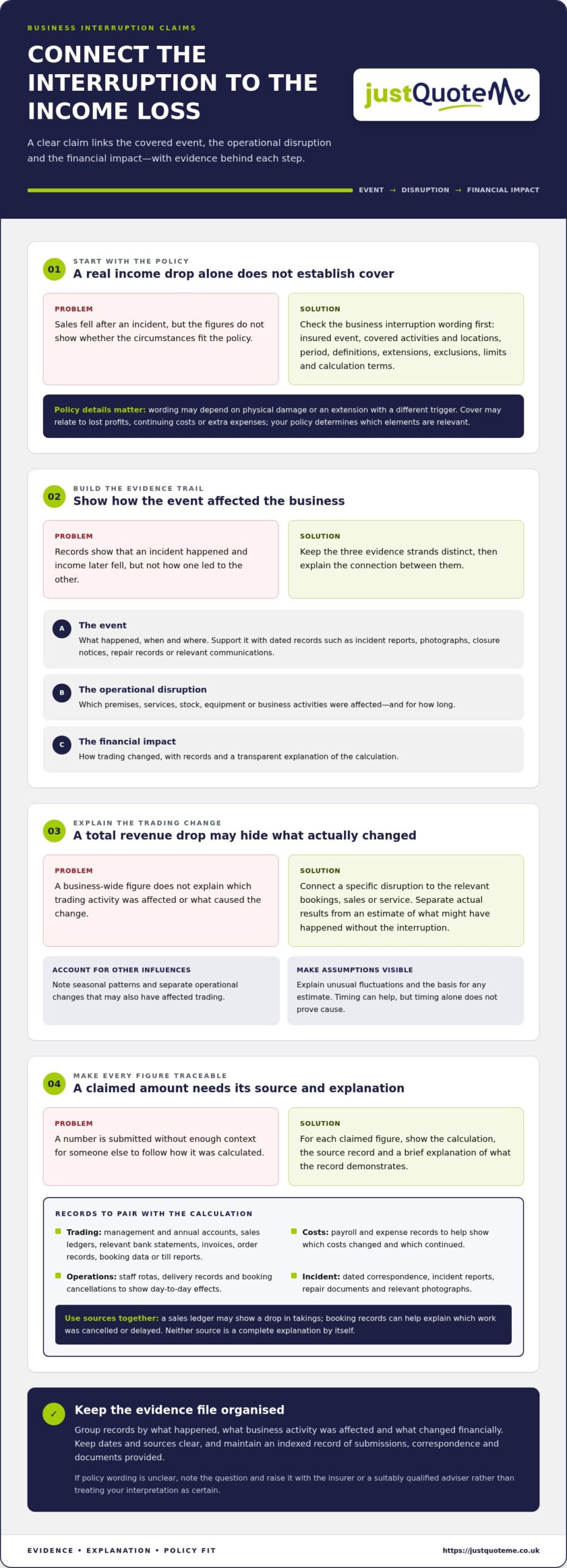
Proof of business interruption loss must connect an interruption covered by the policy to a demonstrable financial loss. That means building a clear trail from the event, to the effect on the insured business activity, to the financial change you’re claiming. The order matters: a fall in income can be real and well documented, but those figures alone can’t establish whether the policy covers the circumstances.
Business interruption wording varies. One policy may depend on physical damage, while another may include an extension with a different trigger. The definitions, exclusions, limits and calculation terms also affect what the policy may respond to. Business interruption insurance can relate to lost profits, continuing costs or extra expenses, but the wording of your own policy determines which elements are relevant to your claim.
A practical way to approach how to prove loss of income for business interruption claim purposes is to keep three evidence strands distinct, then show how they connect:
- The event: what happened, when and where, supported by dated records.
- The operational disruption: which premises, services, stock, equipment or business activities were affected, and for how long.
- The financial impact: how trading changed, supported by records and a transparent explanation of the calculation.
This structure helps avoid a common gap: showing that an incident happened and sales later fell, without explaining how the incident affected the trading figures.
What must the evidence trail establish?
Identify the event and explain its connection to the business activity insured under the policy. Then establish dates, locations and operational effects using records created at the time, where available. Depending on the circumstances, these might include incident reports, dated photographs, closure notices, repair records or communications with staff and customers. Keep the source and date clear so another person can follow the sequence.
Next, connect the disruption to changes in trading. For example, if a particular service could not operate, explain how that affected the relevant bookings or sales, rather than relying only on a total revenue drop. Timing is useful, but it doesn’t prove cause by itself. Note other factors that may have influenced trading, such as a seasonal pattern or a separate change in operations, and distinguish them from the interruption’s effects.
Why the policy wording comes before the calculation
Find the policy schedule and wording, then review the business interruption section alongside its definitions, extensions and exclusions. Check how the policy describes the insured event, which business activities and locations it covers, the applicable period and any stated limits. Don’t assume a term or calculation method applies simply because it appears in another policy or claim example.
Make a short note of the clause you believe is relevant and the evidence that relates to it. If wording is unclear, record the question and raise it with the insurer or a suitably qualified adviser rather than treating your interpretation as certain. Once the policy-and-event link is understood, you can prepare the financial calculation against the relevant circumstances instead of building it on assumptions.
Which Records Help Prove Business Interruption Income Loss?
A useful evidence file answers three questions: what happened, what business activity was affected, and what changed financially. Keep records grouped around those questions rather than sending the insurer an unlabelled collection of documents. This makes it easier to trace a claimed figure back to its source and understand how the operational disruption relates to trading.
A practical approach to how to prove loss of income for business interruption claim purposes is to pair financial records with dated operational evidence. The right documents depend on the business and the event, so gather what directly supports the circumstances and calculation rather than assuming every record will be relevant.
- What happened? Incident reports, dated correspondence, photographs or other records that describe the event.
- What stopped or changed? Closure information, repair documents, staff rotas, delivery records or booking cancellations that show the operational effect.
- What changed financially? Accounts, sales data, invoices, bookings, payroll and expense records that support the figures claimed.
Financial records that can support the calculation
Gather available management and annual accounts, sales ledgers and relevant bank statements. Then use invoices, order records, booking data or till reports to clarify movements in trading. Payroll and expense records can help show which costs changed during the interruption and which continued. Keep the relevant date range clear, and note what each record demonstrates instead of relying on a total alone.
For example, a sales ledger may show a drop in takings, while booking records help explain which work was cancelled or delayed. Each source adds context; neither should be treated as a complete explanation by itself. For small business owners looking to keep day-to-day accounts accurate and readily accessible, working with a dedicated bookkeeping service like Skyplex Management can ensure financial records remain organized and reliable when unexpected disruptions occur.
Operational records that explain what disrupted trading
Collect dated correspondence, incident reports, repair documents and relevant photographs. Staff rotas, delivery records and booking cancellations can help show how the interruption affected day-to-day activity. For property damage, records identifying the affected premises and repair period may help explain the trading impact. A claim involving damage to premises can also relate to commercial property insurance, though the applicable policy wording determines whether the circumstances are covered.
Match each operational record to the financial period or figure it helps explain. If a closure notice covers a specific area, for instance, connect it to records showing which services or sales depended on that area. For a cyber-related disruption, preserve relevant incident communications and records of affected systems or transactions. Cyber insurance is a separate policy area, and its presence alone doesn’t establish that a particular interruption is covered.
Before using a document, check that it’s dated, readable and tied to the relevant business activity. If a record is missing, identify the gap and note whether another source supports the same point. This makes the evidence easier to review and gives you a clear starting point for reconciling records with the amount claimed.
How to Reconcile Trading Records with the Loss You Are Claiming
A claim calculation should be easy to follow from the figure requested back to the records behind it. Keep the observed trading results separate from the counterfactual estimate: actual results show what happened during the interruption, while the estimate explains what might reasonably have happened without it. The estimate is not a recorded fact, so make its basis and assumptions visible.
Start by stating the calculation period and how it relates to the interruption and the relevant policy terms. Then break the calculation into material figures instead of presenting a single headline amount. A reconciliation table gives each figure a source and a plain-English explanation:
| Claimed figure or item |
Calculation or basis |
Source record |
Explanation |
| Actual trading during the affected period |
Recorded sales for the stated dates |
Sales ledger or till reports |
Shows observed results, not the estimated counterfactual |
| Expected trading without the interruption |
Estimate based on a suitable comparison period, adjusted for supported differences |
Previous sales records, bookings or management accounts |
Explains why those records provide a reasonable comparison |
| Cost adjustment |
Documented change in a relevant expense |
Payroll or expense records |
Shows what changed and why it is included |
This layout helps show how to prove loss of income for business interruption claim purposes without blending recorded results, estimates and adjustments together. Label each entry as actual, estimated or adjusted. If a later accounting correction changes a figure, retain the earlier version and explain the correction rather than silently replacing it.
Build a transparent calculation, not a single headline figure
For every material figure, state the date range, calculation method and source beside it. Explain assumptions, adjustments and any exclusions in words a reader can trace back to the records. If the policy wording specifies a particular basis or period, show how your calculation relates to it; don’t present a method as universal. Keep working notes so the figures can be checked or updated.
Explain trading patterns and changes in costs
Choose comparison records that fit the business’s trading pattern and explain why they’re relevant. A seasonal business may need to account for recurring peaks or quieter periods; a recent change in opening hours, capacity or services may also affect a straightforward comparison. Support these explanations with records such as prior-period sales, booking histories or dated business updates, not unsupported assumptions.
Reconcile the final figures to the accounting records, and explain any differences plainly. For example, if a sales report and management accounts cover different dates or record transactions differently, identify the mismatch and show how you handled it. Include expense changes only where the policy wording and available records allow. Don’t assume every saving should be deducted, or every continuing cost should be included. The insurer needs to see the basis for each adjustment, not just the result.
How to Prepare a Business Interruption Claim Evidence File
A well-organised evidence file helps the insurer follow the claim from the relevant policy terms to the supporting records and calculation. Use one indexed set of documents, consistent labels and a short explanation of what each item proves. The aim isn’t to include every business record. It’s to make the relevant evidence easy to find, compare and review.
Work through the file in order:
- Review the policy documents. Save the schedule and wording together. Note the clauses, dates, locations and business activities relevant to the circumstances, along with any notification or document requirements stated in the policy.
- Set up clear folders. Create separate folders for policy documents, incident evidence, operational records and financial records. Use simple labels and consistent date formats so files sort logically.
- Collect and describe the evidence. Record each document’s date, source and the point it supports. For example, label a repair record with the affected premises and the operational period it helps explain, rather than saving it as “document 1”.
- Prepare the calculation and evidence schedule. Link each significant claim point or figure to its source documents. Keep actual results distinct from estimates, and identify the method and assumptions behind each estimate.
- Check the file, then submit it as required. Follow the notification method and requirements set out in the policy. Keep a copy of what you send and record any later additions or corrections.
Keep original documents unchanged. If you need to annotate or redact a copy for review, label it as a working copy and retain the original separately. Name revised calculations clearly and note what changed, when, and why. If information is still outstanding, list it as pending rather than presenting the file as complete.
A concise evidence schedule can be a simple index at the front of the file. For each item, record the claim point, document name, date and relevance. For instance: “Trading impact, cancelled booking report, [date range], shows bookings affected during the disruption.” This gives the reviewer a route from a claim point to its supporting record without repeating the whole calculation.
Before sending, carry out a consistency check. Look for missing dates or trading periods, duplicate entries, estimates presented as actual results and totals that don’t match the underlying records. Check that document dates align with the event period and that each material amount has both a source and a written explanation. If two records differ, flag the difference and explain how you treated it. Clear gaps are easier to discuss than unexplained inconsistencies.
Preparing a claim can also prompt a closer look at how your business insurance fits its activities. For help discussing business insurance options, Request a Call back for free Expert advice.
Submitting or Discussing Business Interruption Claims
Before sending a claim or responding to questions, check the policy for its stated notification method and information requirements. Follow the wording that applies to your policy rather than relying on a general deadline or process. Keep a copy of the notification and each document submitted, along with the date sent and any acknowledgement or response received.
Clear communication helps the insurer connect your explanation to the evidence. Answer each question directly, refer to the relevant document by its file name or schedule reference, and explain what it shows. If you need to correct a figure, identify the earlier version and state what changed and why. This keeps the discussion consistent with the records and calculation already provided.
Respond to information requests with a clear audit trail
Keep a simple log of every request, response date, file supplied and item still outstanding. If a record isn’t available, say so plainly, explain what’s missing and provide relevant alternative evidence where possible. Don’t present a substitute as if it were the original. Label revised calculations clearly and describe the change, its source and any effect on the amount claimed.
For a large request, organise your response by question. A short cover note can identify the answer, point to the supporting document and flag any remaining gap. Save the note and attachments together. This makes it easier to show what information the insurer received and to respond consistently if the issue comes up again.
If the claim is questioned or declined
Ask the insurer to explain its position and identify the policy wording and evidence it relied on. Compare those reasons with the relevant terms and the material you submitted. If the insurer points to a specific gap, answer that point with a document reference or a clear explanation. Separate facts from estimates, and avoid asserting that cover applies unless the wording and circumstances support that conclusion.
If you remain dissatisfied, review the insurer’s complaint response and consult the Financial Ombudsman Service’s current guidance on eligibility and how to complain. Its guidance explains the service’s process and who may be able to bring a complaint. Follow the information there for your circumstances rather than assuming every business or dispute will qualify.
Keep the same organised approach throughout: log correspondence, retain submitted versions and note unanswered questions. That record can help you explain how to prove loss of income for business interruption claim purposes while keeping the discussion focused on the policy, the interruption and the financial evidence. It doesn’t guarantee a claim will be accepted, but it gives each point a traceable basis.
If you’re reviewing business insurance options for your organisation, Get Your Free Business Insurance Quote now. The quote is free and no-obligation.
Take the Next Step with a Clearer Insurance Picture
A well-supported claim depends on the wording and circumstances of the policy, so keep your records and calculations available as questions arise. If you’re reviewing cover for the future, use what you’ve learned about your business’s operations and potential interruptions to guide the conversation. Understanding how to prove loss of income for business interruption claim purposes can also help you identify the policy details you’ll want to understand before an interruption occurs.
Just Quote Me offers free, no-obligation quotes and callbacks, with side-by-side comparisons from leading UK insurers. The average online review rating is 4.6 out of 5. Explore your business insurance options and take a practical next step with Get Your Free Business Insurance Quote now.
A little preparation now can make future decisions clearer. Start when you’re ready.
Frequently Asked Questions
Can bank statements alone prove a business interruption income loss?
No. Bank statements can show money received and paid, but they may not identify which sales generated a deposit or why trading changed. For how to prove loss of income for business interruption claim purposes, use them alongside records such as sales reports, invoices, bookings and operational documents. Check that the dates and amounts reconcile, and explain transfers or unusual payments. Whether the evidence is sufficient depends on the policy wording and circumstances.
What if my business does not have final accounts for the claim period?
You can use the records available for the relevant period, including management accounts, sales ledgers, invoices, booking data and bank statements. Mark figures as provisional and explain how they were prepared, such as whether they use recorded transactions or estimates. If final accounts later change the figures, keep the earlier version and show what was corrected. The insurer may ask for more information, depending on the claim and policy.
Can I use a forecast to prove income I expected to earn?
A forecast can help explain expected trading, but it doesn’t by itself prove actual income or the loss caused by an interruption. Identify who prepared it, when it was made and the assumptions behind it, such as planned orders or confirmed bookings. Compare those assumptions with historical and operational records, then explain any material difference. The policy wording and claim circumstances determine how an estimate may be considered.
How should I explain seasonal trading in a business interruption claim?
Use records from suitable periods to show the business’s normal seasonal pattern, then explain why those periods make a fair comparison. For example, a business with changing demand across the year could use sales, booking or order records to show the pattern rather than relying on an annual average alone. Point out unusual events or operational changes that affect the comparison, and state any limitations in the records.
Can a business claim for interruption across more than one location?
Organise the information by site so the insurer can see which activities were affected, when the disruption occurred and how each location’s trading figures were derived. If accounts combine several locations, explain how you separated or allocated the figures and identify shared costs that can’t be split directly. Keep the supporting basis for any allocation. Whether the policy responds to multiple locations or associated losses depends on its wording and the circumstances.
What should I do if the insurer disputes my loss calculation?
Ask which figures, assumptions or policy terms are disputed, then respond to each point with a clear explanation and source records. If you revise the calculation, reconcile it against the version already submitted and label the changes. Keep the correspondence and attachments together. If you’re still dissatisfied, use the insurer’s complaint process and review the Financial Ombudsman Service guidance to understand its process and whether your complaint may be eligible.
Does business interruption insurance cover every loss of income after a disruption?
No. Cover depends on the specific policy wording, including the events and circumstances it describes, the types of loss addressed, applicable periods and exclusions. A fall in income after an incident doesn’t alone establish that the policy covers it. Read the relevant terms alongside the circumstances, and seek clarification if a clause or its application is unclear. Evidence can support what happened and its financial effect, but it doesn’t determine cover by itself.
Article by
Just Quote Me
JustQuoteMe Ltd is an independent UK insurance brokerage specialising in business and personal insurance solutions. With over 35 years of industry experience, the company provides tailored insurance cover for businesses, landlords, tradespeople, hospitality venues, fleets, and individuals across the UK. Known for its personal service, expert advice, and competitive premiums, JustQuoteMe Ltd works with leading insurers to deliver bespoke policies designed around each client’s unique needs. The company is authorised and regulated by the Financial Conduct Authority (FCA No. 586607) and has built a reputation for trusted, straightforward insurance guidance and long-term client relationships.

by jqm | Oct 17, 2026 | Insurance
A closure doesn’t automatically mean your insurer will cover lost income. Denial of access insurance cover usually depends on a specific event and policy trigger, such as an authority restricting access to your premises, not disruption alone. If your business is intact but customers or staff can’t get in, the wording matters.
It’s understandable to assume business interruption insurance will respond whenever trading stops. Standard cover often relies on physical damage to your property, while denial of access may be a separate non-damage extension with its own conditions, exclusions and limits. A road closure, police cordon or evacuation order could be treated differently under different policies, so the circumstances alone don’t settle whether a claim is covered.
This guide explains the main types of access restriction policies may describe, what wording and evidence to review, and how denial of access differs from general business interruption cover. You’ll also find a straightforward way to assess your income protection needs and compare policy options. Just Quote Me can help you compare business insurance wording, with cover always subject to the relevant insurer’s policy terms.
Key Takeaways
- Denial of access insurance cover depends on the policy’s specific trigger, not simply on your business being disrupted.
- Compare restrictions near your premises with utility interruptions, as policies may treat these situations differently.
- Read the policy schedule, wording and relevant endorsements together to understand conditions, exclusions and limits.
- Keep clear records of the restriction, its cause and its effect on your trading to support a careful review of your position.
- Compare business insurance options and wording to assess whether the cover aligns with your potential income loss.
What does denial of access insurance cover mean for a business?
Denial of access insurance cover is a form of business interruption protection that may help with specified financial losses if access to insured premises is prevented or restricted. The phrase alone doesn’t confirm that a particular closure is covered. The policy must include relevant protection, and the circumstances must meet its stated trigger and conditions.
It’s useful to separate the interruption from the event behind it. The interruption is the effect on your business, such as being unable to open, serve customers or carry out work at the premises. The event is what caused the access problem. A fire nearby, a cordon or a road closure might be relevant examples, but none automatically means a claim will be accepted. The wording determines what causes, locations and forms of restriction count.
Denial of access is connected to business interruption insurance because the potential loss is often trading income or another financial impact following disruption. The underlying purpose of business interruption protection is to help a business manage certain financial consequences of interruption, as outlined in Business Interruption Insurance Explained. The cover available, and how a loss is assessed, depend on the policy. Some policies link business interruption to insured physical damage, while an access-related extension may set out a separate trigger.
That distinction matters. A business that can’t physically reach its premises may face a different issue from one that remains accessible but sees fewer customers because demand has fallen. A quiet trading period, reduced bookings or customers choosing to stay away isn’t necessarily a denial of access. The key question is whether access itself has been prevented in a way the policy describes, not just whether revenue has dropped.
How can restricted access lead to a business interruption loss?
If staff, customers or deliveries can’t reach a site, trading may pause or become harder to carry out. A shop might be unable to open during a cordon, for example, while a service business could lose appointments if clients cannot enter its premises. These examples show possible operational effects, not automatic cover. The restriction is the cause; lost income or additional operating costs are potential consequences, subject to the policy.
What does the term denial of access usually refer to?
The term often concerns restrictions affecting access to insured premises or an area around them. Wording may specify how close the event must be, what type of restriction applies and whether an authority must impose it. Some specialist explanations distinguish an event near the premises from an interruption to a remote public utility. Treat these as different scenarios: a utility failure elsewhere may fall under separate wording, if included.
Read the schedule, policy wording and any applicable endorsements together. Check how each document describes the insured location, access restriction and resulting interruption. That gives you a clearer basis for assessing your business interruption needs without assuming that every closure, utility issue or fall in customer demand is insured.
Which policy triggers can determine denial of access insurance cover?
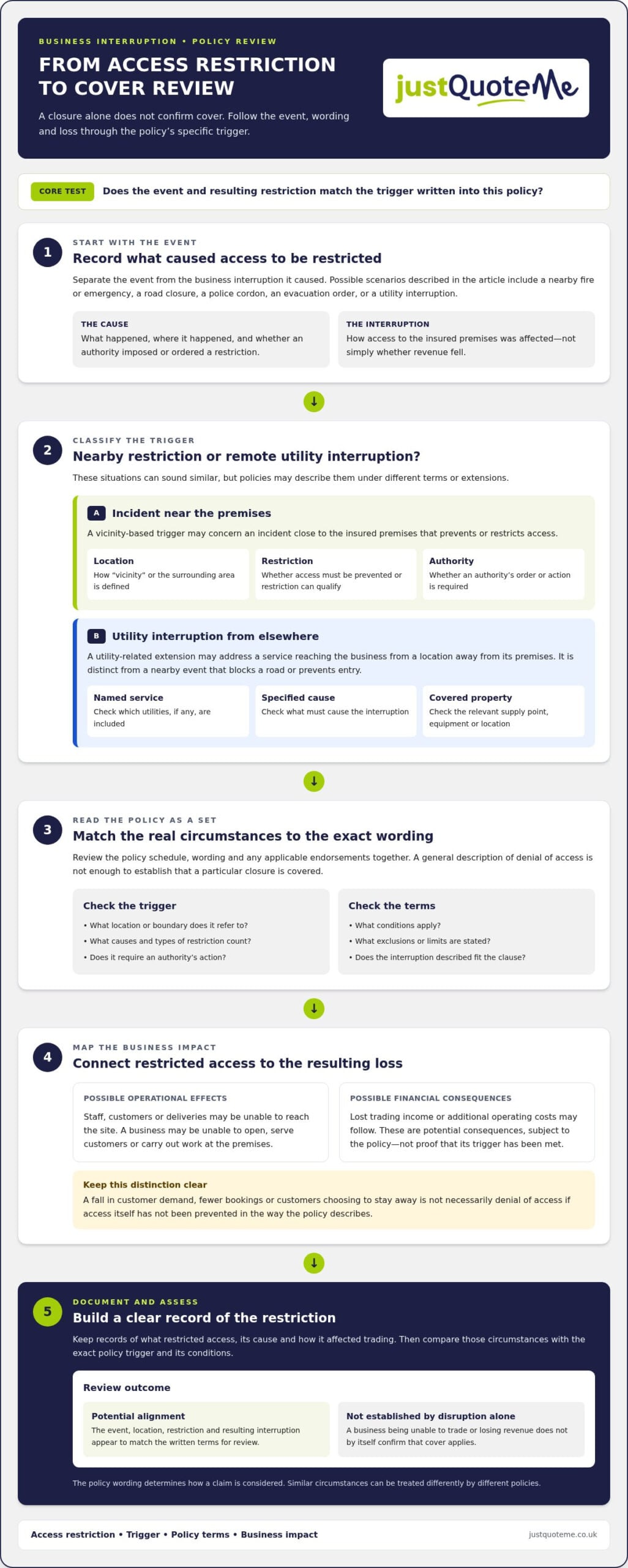
Two situations can sound similar but trigger different policy terms: an incident near your business that restricts access, and a failure affecting a utility serving your premises from elsewhere. Denial of access insurance cover is not a single standardised promise. An extension or endorsement may define exactly which causes, locations and restrictions count, so compare the written trigger with what actually happened.
Keep the cause and the financial impact separate. A cordon, road closure or utility interruption may be the event; inability to trade and resulting financial loss are its consequences. A policy may require both a specified event and a defined interruption before cover can respond. A loss of revenue by itself doesn’t establish that the trigger has been met.
Nearby premises and prevention of access
A vicinity-based trigger generally concerns an incident close to the insured premises that prevents or restricts access. The wording may define “vicinity” by distance, describe what counts as “prevention,” and specify whether an order or action by an authority is required. A nearby emergency might fit the broad scenario, but the distance, cause and authority conditions must match the particular policy.
Look for the exact terms rather than relying on a general description. Does the clause refer to the insured premises, surrounding area, or a particular boundary? Does it require access to be completely prevented, or can a restriction qualify? These details can make similar incidents produce different outcomes under different wordings.
Public utilities and remote premises
A utility-related extension may address interruption to a service reaching the business from a location away from its premises. This is distinct from a nearby incident that blocks a road or prevents entry. The policy wording determines which utilities are named, what event must cause the interruption and whether the affected equipment or location falls within the extension.
Don’t assume every power, water or communications failure qualifies. Check whether the cover applies to a failure at a remote supply point, damage to utility property, or another specified cause. A brief interruption and a prolonged outage may also be treated differently if the wording sets conditions or limits. Bellrock’s distinction between vicinity restrictions and remote public utilities is a useful way to organise the questions, not a substitute for checking your own policy.
For each possible trigger, note the event, its location, who imposed or caused the restriction, how access or service was affected, and the resulting interruption to your business. Then compare those facts with the schedule and relevant extension. The Financial Conduct Authority’s website provides general information about financial services in the UK, but it doesn’t determine how an individual insurer’s clause applies to a claim.
When comparing business insurance, a broker can help you review differences in policy wording across options. Just Quote Me offers an online comparison service and expert advice, so you can assess the wording alongside your business interruption needs without assuming a particular event will be covered.
How does denial of access cover differ from other business interruption protection?
Business interruption protection can respond to different kinds of disruption, but the trigger is not necessarily the same across a policy. Some cover is linked to insured physical damage at the business premises. Access-prevention and utility extensions may describe other events, with their own definitions and conditions. The label alone won’t tell you which scenario is covered.
Access-related cover is determined by its stated trigger and conditions. Use the comparison below to identify what to look for, rather than assuming that one type of interruption protection includes another.
| Type of protection |
Potential trigger |
Location to examine |
Wording questions |
| Access-prevention extension |
A specified restriction preventing or limiting access |
Insured premises or a defined surrounding area |
How are “vicinity” and “prevention of access” defined? Is an authority’s action required? |
| Utility extension |
A specified interruption to a utility service |
Premises, supply route or remote utility property, as stated |
Which services and causes are included? Are there conditions about the source or duration? |
| Wider business interruption cover |
Often an insured event, which may include physical damage |
Insured property or another location specified in the policy |
What event must happen, and how must it cause the interruption and financial loss? |
This is a guide to the kinds of wording questions to ask, not a statement of standard cover. An extension or endorsement can narrow a trigger, define a location, or add conditions. The schedule, main wording and applicable endorsements need to be read together. Also look for any stated limits, exclusions or requirements that affect how the interruption is assessed.
Denial of access versus material damage-related interruption
Some business interruption wording links cover to physical damage at insured property caused by an insured event. An access-related extension may instead set out a trigger involving restricted access, potentially without damage to the business’s own premises. These are different routes through the wording, not interchangeable guarantees. A closure near your site doesn’t automatically meet either trigger.
Check whether the policy requires damage, where that damage must occur, and how it must lead to interruption. For an access extension, focus on the specified restriction and location instead. The relevant clause determines which route, if any, applies to the circumstances.
Denial of access versus utility failure
An access restriction concerns being unable to reach or enter premises; a utility extension concerns interruption to a service. One event might create both problems, but the policy may address them under separate clauses. Compare the wording for the cause, affected location, named service and link to the business interruption loss.
For example, a blocked route and a remote supply failure raise different questions about what happened and where. Check the exact policy schedule, wording and endorsements before relying on either section. Denial of access insurance cover may sit alongside other business interruption protection, but one extension doesn’t automatically broaden the terms of another.
How can a business review denial of access policy wording?
A structured review can help you spot the policy language that matters before you rely on denial of access insurance cover. Read the documents as a set, then compare their terms with the circumstances your business needs to plan for. A policy summary can be a useful starting point, but it may not show every condition or limitation.
Work through these steps:
- Locate the documents. Gather the policy schedule, full wording and any applicable endorsements for the same period of cover.
- Identify the trigger. Find the clause that deals with access restrictions or related interruption, and note the event and location it describes.
- Check the conditions. Look for requirements concerning the cause, authority, extent of restriction, resulting loss, exclusions and limits.
- Record questions. Write down unclear terms and the practical scenario you want to understand, such as a closure near your premises or an interruption to a named service.
This process won’t determine whether a future claim will be accepted. It gives you a clearer way to compare the wording with your operational risks and identify where you need a plain-language explanation.
What wording and documents should a business read together?
Start with the schedule, which identifies the policy details, then read the core wording and any endorsements that amend or add terms. An endorsement may change how an extension applies, so don’t treat the main wording as the whole contract. Keep the documents together and check they relate to the same policy period. Without the full wording, it’s not possible to interpret a specific policy reliably.
As you review, note the answers, or questions, for four areas:
- Premises: Which site or insured location does the clause refer to?
- Cause: What event must lead to the restriction or interruption?
- Access restriction: How does the wording describe prevention or limitation of access?
- Insured loss: What financial impact is addressed, and what conditions apply to it?
Also check whether a clause refers to a particular authority, nearby area or utility source. Use the exact wording, not assumptions based on everyday meanings of terms such as “vicinity” or “closure.”
What information may help when reporting an incident?
If an incident occurs, create a contemporaneous record of when it began and ended, the affected location, the restriction in force and how it affected trading or operations. Keep relevant notices, correspondence and other available communications. Record the financial impact separately from the event itself, and preserve supporting business records in line with your usual processes.
Follow the notification requirements in your policy and any instructions from the insurer. Note when and how you reported the matter, and retain copies of information provided. Don’t wait to assemble a perfect file before following the stated reporting process. The policy wording sets the applicable requirements, so use it as your reference.
Comparing policy wording can make differences easier to see. Get Your Free Business Insurance Quote now to compare business insurance options.
How can Just Quote Me help you compare business insurance options?
Comparing business insurance involves more than looking at policy names or premiums. The wording can differ on what triggers a business interruption extension, which locations it applies to and what conditions must be met. Just Quote Me is an independent UK insurance broker with an online comparison service, helping businesses compare insurance options and understand the differences that matter to their needs.
If you’re assessing denial of access insurance cover, bring your specific wording questions into the comparison. A broker can help you consider differences between policy options, while any cover remains subject to the relevant insurer’s terms. This can make it easier to understand what a policy says before deciding whether it fits your business interruption concerns.
What information can help make an insurance comparison useful?
A clear picture of your business helps focus the comparison. Outline what your business does, where it operates and which premises you use. Then describe the access-related risks you’re concerned about, such as restrictions affecting entry or disruption to a service, and explain how an interruption could affect trading or operations.
Have your current policy documents to hand if you have them. The schedule, full wording and applicable endorsements can help frame questions around a particular clause. You might note terms you want explained, differences you’ve noticed between policies, or situations you want to understand. This helps keep the discussion practical without assuming that a specific incident would be covered.
- Business activities: Explain the work you carry out and any seasonal or location-based considerations.
- Premises: Identify the sites involved and how your business uses them.
- Interruption concerns: Describe the kind of access restriction or operational disruption you want to consider.
- Existing documents: Gather your schedule, policy wording and endorsements for a more focused comparison.
Take the next step with a free, no-obligation quote
A free, no-obligation quote gives you a practical starting point for comparing relevant business insurance options. You can bring your questions about triggers, conditions and policy wording into the process, then consider the available information alongside your business needs. A quote isn’t a promise that a particular extension will respond to a future event; the insurer’s policy terms determine the cover.
Choose the next step that suits you. Get a quote online or request a callback to discuss your questions with an expert.
Get Your Free Business Insurance Quote now
Request a Call back for free Expert advice
Make policy review part of your next business decision
Your business may change over time. A new site, different trading arrangements or greater reliance on a particular location can make it useful to revisit whether your insurance still reflects your needs. Set aside time to review your cover when circumstances change, and keep a note of wording questions for your next comparison.
Understanding denial of access insurance cover starts with the policy terms, but you don’t have to compare them without support. Just Quote Me is an independent UK broker, with an average online review rating of 4.6 out of 5. Cover always depends on the relevant insurer’s policy terms.
Take your next step with Get Your Free Business Insurance Quote now or Request a Call back for free Expert advice, and move forward with greater clarity.
Frequently Asked Questions
Does denial of access insurance cover every type of business closure?
No. A closure by itself doesn’t show that the policy’s trigger has been met. For example, a business choosing to shut temporarily during a quiet period differs from one ordered to close after a specified incident, but the policy wording still determines whether either situation qualifies. Check the schedule, full wording and relevant endorsements, and follow the insurer’s notification instructions if an event disrupts your business.
Can denial of access cover apply when there is no damage to my premises?
It may, if the policy includes an access-related extension whose trigger doesn’t require damage to your own premises. That doesn’t mean every incident without premises damage qualifies. Consider a nearby incident that leaves your building intact but restricts entry: the policy’s wording on cause, location and access restriction is still decisive. Read the relevant clause with the schedule and endorsements before relying on the cover.
Is denial of access insurance the same as business interruption insurance?
No. Denial of access is generally described as a possible extension or trigger within business interruption protection, not a guarantee that every access problem is covered. Other business interruption provisions may respond to different circumstances and carry their own requirements. If you’re comparing policies, check how each one describes the relevant event and resulting loss, rather than treating the phrase “business interruption” as a complete description of cover.
What happens if a road closure prevents customers from reaching my business?
The insurer will assess the circumstances against the policy wording; a road closure isn’t automatically insured. Note which roads or entrances were affected, the dates and any information about the restriction, then record how it changed your trading, such as missed appointments or cancelled deliveries. Keep relevant notices and follow the policy’s notification process. The wording may specify the affected area, cause or other requirements.
How do I make a claim for denial of access?
Start by following the claims route and notification instructions stated in your policy. Keep records of when the restriction began and ended, where it applied, relevant communications and the effect on your business. Provide accurate information and any documents requested by the insurer. The insurer will assess the event and loss against the policy terms, so submitting a claim doesn’t mean it will automatically be accepted.
Article by
Just Quote Me
JustQuoteMe Ltd is an independent UK insurance brokerage specialising in business and personal insurance solutions. With over 35 years of industry experience, the company provides tailored insurance cover for businesses, landlords, tradespeople, hospitality venues, fleets, and individuals across the UK. Known for its personal service, expert advice, and competitive premiums, JustQuoteMe Ltd works with leading insurers to deliver bespoke policies designed around each client’s unique needs. The company is authorised and regulated by the Financial Conduct Authority (FCA No. 586607) and has built a reputation for trusted, straightforward insurance guidance and long-term client relationships.

by jqm | Oct 16, 2026 | Insurance
Could a claim made today relate to work your current policy won’t cover? That’s why having your professional indemnity retroactive date explained matters. The date can set the earliest point in your work history that a policy will consider, while the policy start date marks when the current cover begins. They’re not necessarily the same.
It’s reasonable to expect a renewal or insurer switch to keep protection for past work intact, but continuity depends on the policy wording and dates, not just the new start date. Professional indemnity cover is generally written on a claims-made basis, so the policy in force when a claim is made may respond, subject to its terms and any retroactive date. A changed date or a gap in cover could affect how earlier work is treated.
This guide explains the practical difference between these dates, how specified and unlimited retroactive cover work, and what to review before renewing or changing insurer. You’ll also see why it helps to check policy documents alongside reporting requirements, so you can compare your options with greater confidence.
Key Takeaways
- Get professional indemnity retroactive date explained in plain English, including how policy wording affects the treatment of past work.
- Compare the inception date with the retroactive date to see what each date means for your cover.
- Understand the differences between specified dates, unlimited retroactivity and retroactive date inception.
- Before renewal or a switch, review your policy schedule, endorsements, relevant wording and previous policy records.
- Compare dates alongside reporting conditions to make a more informed decision about your professional indemnity options.
What does a professional indemnity retroactive date mean?
A professional indemnity retroactive date sets a time boundary for the past professional work a policy may consider. It can be relevant when a client alleges that advice or a service caused them a loss, but the date does not decide the claim on its own. The policy wording explains how it applies, including which work falls within scope and what other conditions must be met.
Professional indemnity policies are commonly written on a claims-made basis. In broad terms, this means the policy in force when a claim is made may be the one that responds, subject to its wording. The date the work was done and the date the claim is made are therefore separate points to consider. A general overview of professional indemnity insurance can help explain this claims-made context.
Why the date matters when a client alleges an error
A complaint can arrive after a piece of work is complete, sometimes after a business has renewed or changed its policy. For example, a client might allege in 2026 that advice provided in 2023 was negligent. The work date is 2023; the claim date is 2026. A retroactive date may help determine whether the earlier work is within the policy’s relevant timeframe, while the current policy period and other terms also matter.
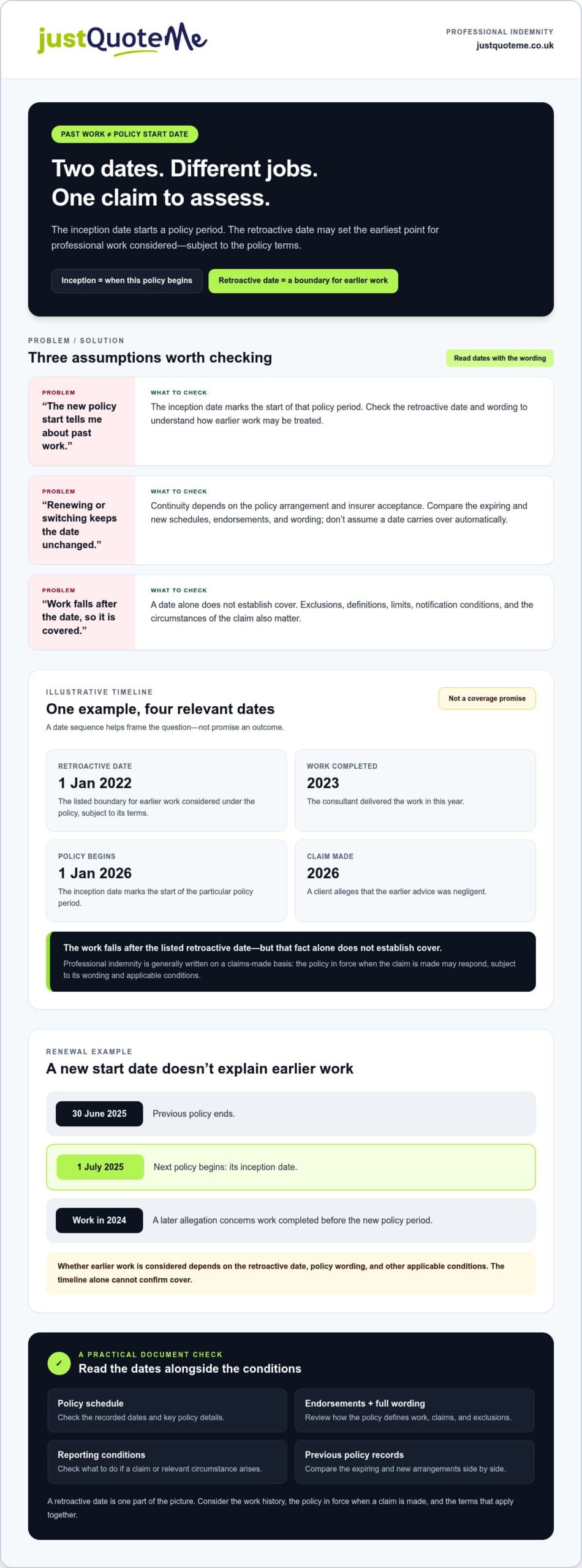
Illustrative timeline, not a coverage promise: A consultant’s policy begins on 1 January 2026 and lists a retroactive date of 1 January 2022. The consultant delivered work in 2023, and a client makes a claim in 2026. The work falls after the listed date, but that fact alone doesn’t establish cover. The insurer’s wording and the circumstances of the claim must also be considered.
What the retroactive date does not tell you by itself
A date is only one part of the policy. Exclusions, definitions, limits and notification conditions may affect how a particular claim is treated. Read the schedule, which records key policy details, alongside any endorsements and the full wording. If you’re comparing professional indemnity insurance options, consider how these terms work together rather than relying on a date in isolation.
In practical terms, “professional indemnity retroactive date explained” means understanding both the boundary and its limits. Check what professional activities the policy defines, how it describes a claim, and what it requires you to do if circumstances arise that might lead to one. A date that appears to include earlier work isn’t a standalone guarantee that an allegation will be covered.
Retroactive date vs inception date: how the two dates work together
The inception date and retroactive date answer different questions. One marks when a particular policy period begins; the other sets a boundary relevant to earlier professional work. Reviewing both helps you understand how a renewal or insurer change relates to your work history. The terms used and their effect can vary between insurers and policy wordings, so read the schedule alongside the full wording.
Inception date
The start date of the specific policy period. It tells you when that policy begins, not automatically which earlier work it may consider.
Retroactive date
A date shown in the policy documents that may set the earliest point in time for professional work considered under the policy, subject to its terms.
What is the policy inception date?
The inception date marks the start of the particular policy period. For example, an existing policy might end on 30 June, and a renewal policy might start on 1 July. The new inception date is 1 July. It doesn’t, by itself, explain how the policy treats work completed before then. For that, look at the retroactive date and the relevant wording in the new schedule.
Illustrative renewal timeline, not a promise of cover: A business’s previous policy ends on 30 June 2025, and its next policy begins on 1 July 2025. A client later makes an allegation about work completed in 2024. The new inception date shows when the current policy period started. Whether the earlier work is considered depends on the retroactive date, policy wording, and other applicable conditions. The timeline alone cannot confirm cover.
How continuous cover can affect the retroactive date
Where cover continues without a break, an earlier retroactive date may be retained, depending on the policy arrangement and insurer acceptance. Don’t assume it carries over automatically when renewing or switching. Check the expiring and new schedules side by side, then read the wording and any endorsements for the dates and terms that apply.
Insurers may use different labels, such as “retroactive start date”, and the same term can’t be interpreted without its policy context. The FCA guidance on Professional Indemnity Insurance discusses retroactive start dates for relevant regulated firms. Its guidance should be considered in its proper context, rather than treated as a rule for every business or profession.
Claims-made policies generally make it important to consider both the work history and the conditions for reporting a claim or relevant circumstances. A date may appear unchanged while other terms differ. For a clearer professional indemnity retroactive date explained, compare the dates, wording and reporting conditions together. You can also review professional indemnity insurance options with those points in mind.
Specified dates, unlimited retroactivity, and gaps in cover explained
Policies can describe the treatment of past work in different ways. A specified date gives a calendar boundary, “unlimited retroactivity” indicates no fixed past-work cut-off in that respect, and “retroactive date inception” generally links the boundary to the policy’s start. These labels are useful clues, not complete explanations. The schedule and full wording determine their effect, including how definitions, exclusions and endorsements apply.
| Date arrangement |
What it may indicate |
| Specified retroactive date |
Work before the stated date may fall outside the policy’s consideration, subject to the wording. |
| Unlimited retroactivity |
No fixed retroactive cut-off is stated, but other policy terms still affect whether a claim is covered. |
| Retroactive date inception |
The policy’s start date may act as the boundary, so earlier work is treated differently under the wording. |
What a specified retroactive date indicates
Imagine a policy schedule gives a particular date as the retroactive boundary. A client later alleges that a service delivered before that date caused a loss. The earlier work may fall outside the policy’s response, but the date alone doesn’t settle the position. Read the policy’s definitions, exclusions and endorsements to understand what work and claims the terms address.
What unlimited retroactivity and retroactive date inception mean
ACCA’s explanation of common arrangements distinguishes unlimited retroactivity from a specified date and retroactive date inception. In broad terms, unlimited retroactivity removes a fixed past-work date boundary, while inception-based wording may use the policy start as the boundary. The insurer’s schedule and wording control the actual effect. Neither label guarantees cover for every historic service, allegation or circumstance.
A break in cover deserves careful review, but it isn’t enough on its own to conclude that a particular claim is covered or excluded. Consider when the work took place, when a claim or relevant circumstance was reported, and which policy was in force at the relevant point. Then compare the dates and reporting conditions across the policies around the gap. A later policy may have terms that treat earlier work differently.
For solicitors, The Law Society’s guidance on PII renewal and run-off cover explains issues that can arise if a firm cannot renew. Its discussion relates to solicitors, so it should not be treated as a general rule for every profession.
To have professional indemnity retroactive date explained in practical terms, compare the policy schedule with the wording and your previous cover records. Check the specific boundary, any conditions affecting past work, and what the policy requires if a claim or relevant circumstance arises. That gives you a clearer basis for reviewing continuity without assuming that a particular date format protects every past service.
How to check your professional indemnity policy dates before renewal
A focused document review can help you spot date differences before renewing or switching insurer. Gather your current policy schedule, any endorsements, the full wording and previous policy records. Compare these with the professional work your business has carried out and the dates you’ve held cover. This checklist is a practical starting point, not a decision about whether a particular claim is insured.
Where to find the retroactive date in policy documents
Start with the policy schedule, which sets out key details such as the policy period and any stated retroactive date. Then check for endorsements that may amend or clarify the schedule. Labels can vary, so read the wording around the date rather than relying on a heading alone. Keep earlier schedules and renewal documents together to make changes in dates easier to identify.
- Schedule: Note the policy period and the retroactive date shown, if one is stated.
- Endorsements: Look for amendments that affect the dates or how terms apply.
- Inception date: Record when the current policy period begins and compare it with the previous policy’s end date.
- Retroactive date: Compare the stated boundary with when your professional practice began and when relevant services were delivered.
- Relevant wording: Review definitions, exclusions and notification conditions that may affect how the dates operate.
Keep a simple record of policy periods, renewal dates and any changes to the retroactive date. That gives you a clear reference when reviewing future documents and helps you identify any apparent gap or difference that needs explanation.
Questions to resolve before renewing or changing insurer
Before a new policy takes effect, check that its schedule records the retroactive date you intend to carry forward. Compare the proposed terms with your previous policy documents, and note any difference in the date or policy period. If there’s a gap in cover or the date has changed, review how the wording treats that situation rather than assuming the effect from the dates alone.
Compare reporting requirements and exclusions as well as dates. A schedule may appear consistent while other terms have changed, so read the relevant wording in full. If you’re unsure how provisions compare, an independent broker can help you review professional indemnity options and understand the differences between policies. Explore professional indemnity insurance as part of that review.
Use this process to organise the documents and identify questions before renewal or a switch. The phrase “professional indemnity retroactive date explained” is only useful in practice when you connect the date to your own work history and the policy terms. The checklist cannot determine whether a claim is insured; that depends on the specific wording and circumstances.
Get Your Free Business Insurance Quote now
Get help reviewing a professional indemnity retroactive date
Before renewing or moving your cover, bring the key details together: the current and proposed inception dates, each policy’s retroactive date, the relevant wording, and the conditions for reporting claims or circumstances. Compare them against your professional work history and previous policy records. This gives you a clearer view of what has changed and which points need careful attention, without treating a date as a decision about whether a claim is insured.
When broker support can help with policy comparisons
Just Quote Me arranges professional indemnity insurance and provides free, no-obligation quotes. As an independent UK insurance broker, it can help you compare available options and understand how policy terms relate to your profession, services and work history. Reviewing the retroactive date alongside reporting conditions and exclusions can make differences between policies easier to identify. No comparison can promise a particular coverage outcome, which depends on the policy wording and circumstances.
For a useful comparison, have your existing schedule and previous renewal documents to hand. Then consider whether the proposed policy records the date you intend, whether any break or changed date affects the terms, and how the reporting requirements compare. Focus on the wording that applies to your work, not just the headline dates. This helps keep the discussion specific to your business rather than relying on a general explanation.
You can review professional indemnity insurance options with those points in mind. A broker can help you understand the choices available and compare policy details, but can’t promise that a particular claim or past service will be covered. The final terms and the circumstances of any claim matter.
Choose a clear next step
Set aside your current and previous schedules, endorsements and wording before requesting a comparison. A concise record of your professional activities and policy dates can help keep the review focused. If you’re considering a switch, compare the proposed terms before the new policy takes effect, and make sure you understand any differences in dates or reporting conditions. This is a practical way to put “professional indemnity retroactive date explained” into action.
Get Your Free Business Insurance Quote now
Request a Call back for free Expert advice
Use your policy review as a chance to look ahead, not just compare this year’s documents with last year’s. If your services, client work or professional practice have changed, consider how those changes sit alongside the dates and terms you’re reviewing. Keeping a clear record can make future renewals easier to assess and help you spot questions before a policy change takes effect. For creative professionals and performers looking to keep their business finances and compliance equally organised, performanceaccountancy.co.uk provides specialist chartered accountancy support.
With professional indemnity retroactive date explained in practical terms, you can approach a comparison with a clearer sense of what to examine. Just Quote Me is an independent UK insurance broker with over 30 years of industry experience. Explore your options with a free, no-obligation quote or request a callback for help understanding the choices available. Any cover remains subject to the relevant policy terms.
Get Your Free Business Insurance Quote now
Request a Call back for free Expert advice
A considered review today can help you move into your next policy period with greater confidence.
Frequently Asked Questions
Can professional indemnity insurance be backdated?
An insurer may agree to a retroactive date earlier than the policy’s start, but that isn’t the same as starting a policy in the past. Don’t assume an application or renewal can create cover retrospectively for work, claims or circumstances already known. If you’re seeking a different date, review the insurer’s written terms and the issued schedule. The effect depends on what the insurer accepts and the policy wording.
What happens if my professional indemnity policy has a gap?
A gap can create uncertainty about which policy, if any, may respond to a claim made during that period, particularly if the claim relates to earlier work. For example, note the dates your old policy ended and any replacement policy began, then check the reporting terms for each. Don’t infer the outcome from the gap alone. Review the documents and get guidance on the specific circumstances.
Can I change my retroactive date when I renew my policy?
A renewal may show a different retroactive date, but a date shouldn’t be assumed to carry forward or change automatically. Compare the proposed schedule with your expiring one before accepting the renewal. If the date differs, consider how that affects work undertaken during your practice and any services that remain relevant. The insurer’s accepted terms and policy wording determine the effect, so keep a record of the final documents.
Does unlimited retroactivity mean every past piece of work is covered?
No. Unlimited retroactivity generally means there’s no fixed retroactive date limiting how far back the work may have taken place. It doesn’t remove other policy conditions. For instance, the professional activity may need to fit the policy’s definitions, and an exclusion or reporting condition may affect the claim. “Professional indemnity retroactive date explained” should never be read as a promise of cover for every historic service or allegation.
What happens if a claim is reported after my policy ends?
With claims-made cover, the policy in force when the claim is made is generally relevant, subject to its terms. A claim first reported after a policy ends may therefore raise questions about whether an active policy can respond or whether an applicable extension of reporting is in place. Check the policy’s reporting provisions and any arrangements that apply after expiry. The timing and circumstances matter, so don’t assume the answer from the expiry date alone.
Can a retroactive date apply differently to different professional services?
It can depend on the policy schedule and wording. A policy may describe insured activities, endorsements or limitations that affect how different services are treated, so don’t rely on one date without checking the scope of cover. For example, if your business has added a new service, compare its description with the activities recorded in the policy documents. The wording and accepted terms determine how the date applies to a particular claim.
Article by
Just Quote Me
JustQuoteMe Ltd is an independent UK insurance brokerage specialising in business and personal insurance solutions. With over 35 years of industry experience, the company provides tailored insurance cover for businesses, landlords, tradespeople, hospitality venues, fleets, and individuals across the UK. Known for its personal service, expert advice, and competitive premiums, JustQuoteMe Ltd works with leading insurers to deliver bespoke policies designed around each client’s unique needs. The company is authorised and regulated by the Financial Conduct Authority (FCA No. 586607) and has built a reputation for trusted, straightforward insurance guidance and long-term client relationships.

by jqm | Oct 15, 2026 | Insurance
Could a loose roof tile make you responsible for an injury, even if a tenant runs the business inside? Understanding commercial property owner liability to public claims starts with what happened, where it happened and who was responsible for that part of the premises. A trip on a damaged path may raise different questions from a customer slipping on a wet shop floor.
It’s understandable to assume that commercial property insurance covers every risk connected with a building. But property owners’ liability and public liability relate to different exposures, and the policy label alone won’t tell you exactly what’s covered. The wording and the circumstances of an incident matter.
This guide explains common claims involving commercial premises, how responsibilities can differ between landlords and tenants, and what to review in your insurance documents. You’ll also learn practical steps to help assess your cover and explore relevant options, including Public Liability Insurance and Commercial Property Insurance, through Just Quote Me. The aim is to make the next steps clearer, without losing sight of the details that can affect a claim.
Key Takeaways
- Commercial property owner liability to public depends on the circumstances of an incident and who was responsible for the relevant area.
- An allegation is not the same as an established legal finding; understand how an incident, investigation and policy response may unfold.
- Compare public liability, property owners’ liability and commercial property insurance by their purpose and wording, rather than relying on policy names alone.
- Use a routine of inspecting, recording, prioritising, acting and reviewing to help manage risks around your premises.
- Gather details about the property, its use, public access and current policies to help compare suitable insurance options.
Commercial property owner liability to the public: how claims can arise
Commercial owners can be unsure where responsibility for an incident begins, especially when tenants, contractors and visitors use different parts of the premises. The key question isn’t simply who owns the building. The circumstances, the location of the hazard and who had control over the relevant area may all matter when responsibility is considered.
Property-related liability concerns an allegation that someone responsible for premises failed to address a danger there, causing injury or damage; it is not the same as cover for physical damage to the building itself. A property-damage policy concerns damage to insured property, while liability insurance addresses claims made against an insured party, subject to the policy wording. A commercial property insurance policy and liability cover therefore have different purposes, even when they relate to the same site.
Who might bring a claim connected with commercial premises?
A customer, supplier, contractor, tenant, other visitor or passer-by might report an injury or damage linked to a commercial site. Their presence alone doesn’t establish that the owner is responsible. The investigation may consider what happened, who controlled the area and whether the reported issue related to the premises or to an activity carried out there.
For example, a claim about loose paving outside a business may raise questions about the condition and management of that area. An incident involving equipment used during a tenant’s work may instead relate more closely to the business activity. These categories can overlap, so the facts and relevant insurance wording matter more than a label attached to the incident.
In England and Wales, the Occupiers’ Liability Act 1957 concerns the duty of care owed to lawful visitors. Which party is responsible in a particular situation still depends on the circumstances and the legal assessment of the facts.
What incidents can put a property owner under scrutiny?
Examples include a visitor tripping on uneven paving, a defective communal door fixture causing injury, or building materials falling and damaging a vehicle. Each may prompt questions about the condition of the premises, who was responsible for that part of the site and what was known about the hazard.
Reports, inspection notes, repair records and the timeline of events can help show how an issue was managed. A hazard reported before an incident may be relevant to understanding what action followed; a sudden fault may present a different picture. These details don’t automatically prove negligence, and a claim or allegation isn’t a finding of legal liability. Nor does every accident lead to an insurance payout. Any policy response depends on the circumstances, the insured party and the terms and conditions of the policy.
A report of an injury or damage is a starting point, not a decision about who is legally responsible. For a commercial property owner, the process may move from an incident to an allegation, then to fact-finding and consideration of any relevant insurance. The commercial property owner liability to public question turns on what happened, who was responsible for the area and what the policy says.
Once an incident is reported, the parties involved may gather details such as the location, timing, accounts from witnesses and any available maintenance records. An insurer may then assess the claim under the policy, taking account of its terms, conditions, exclusions and limits. The process and outcome depend on the particular circumstances and wording, so an allegation should not be treated as proof of fault or confirmation that a policy will respond.
The policy wording determines how an insurer responds to a claim, including whether the circumstances fall within the cover and what terms apply. Public liability policies differ, so avoid assuming that a particular event or type of loss is covered just because it happened at a commercial premises. For the relevant legal framework on occupiers and lawful visitors, see the Occupiers’ Liability Act 1957 on legislation.gov.uk.
Injury and property-damage allegations
Personal injury and damage to someone else’s property are distinct types of allegation. For example, a visitor might claim they were injured after a loose stair handrail gave way. Separately, a supplier might report that a leak from a building pipe damaged equipment they had left in a shared service area. In either case, the cause, control of the area and policy wording need careful consideration.
These examples describe possible allegations, not findings of negligence or promises of an insurance payout. The relevant policy may set out how bodily injury and third-party property damage are treated, along with applicable exclusions and limits. Check the actual wording rather than relying on a general description of public liability cover.
Why maintenance history and incident details matter
Inspection records, repair requests and incident reports can help establish what was known about a hazard and when. Record the date, location, observed condition and action taken, and keep the account factual. Note follow-up work or changes to access where relevant. Clear documentation can help explain the sequence of events, but it doesn’t automatically establish liability or determine whether an insurer will respond.
Keep related records together, such as photographs, correspondence and contractor reports, where available. Avoid presenting assumptions as facts; distinguish what someone observed from what they believe caused the incident. If you’re reviewing how liability cover fits alongside premises risks, compare Public Liability Insurance options and consider the wording against your property’s use and access.
Public liability, property owners’ liability and commercial property insurance compared
These policy names can sound interchangeable, but they describe different insurance questions. Public liability is generally associated with claims connected to business activities, while property owners’ liability concerns allegations linked to ownership or management of premises. Commercial property insurance addresses the insured property itself. The exact structure and terminology can vary between insurers, so compare the wording and schedule rather than relying on the label alone.
Public liability
Purpose: To address specified third-party liability exposures connected with business activities.
Possible exposure: A customer alleges they were injured during a business operation at the premises.
Wording to check: Who is insured, which activities and locations are described, and what exclusions and limits apply.
Property owners’ liability
Purpose: To address specified liability exposures associated with owning or managing premises.
Possible exposure: A visitor alleges an injury caused by a defect in a shared entrance or other building area.
Wording to check: Which premises and responsibilities are covered, and how the policy defines an insured claim.
Commercial property insurance
Purpose: To insure specified commercial property against risks set out in the policy.
Possible exposure: The owner needs to understand how damage to the building is treated under the policy.
Wording to check: The insured property, insured events, conditions, exclusions and any separate liability sections.
This comparison is a starting point, not a coverage decision. A single incident may involve both the condition of a building and the activity taking place there. Public liability and property owners’ liability may therefore overlap in the questions they raise, but one label doesn’t automatically replace the other or establish which policy applies. The commercial property owner liability to public issue should be assessed against the actual event, the parties involved and the relevant policy terms.
What is the difference between public liability and property owners’ liability?
Think first about the source of the alleged risk: was it connected mainly with the business’s work, or with the premises and its management? That distinction can help guide a review, but insurers may use different terms or arrange cover differently. For a broader explanation of public liability, consult the existing guide and compare its general description with your own policy documents.
Could liability cover sit within commercial property insurance?
It may be arranged alongside property insurance, but don’t assume liability cover is included or that a particular incident falls within it. Check the policy schedule for the sections actually selected, then read the wording for definitions, exclusions, conditions and limits. If you hold separate policies, review them together to understand how each describes the insured premises, activities and parties. This helps identify questions to resolve before relying on a policy label.
For a closer review of commercial property insurance cover, compare the schedule and wording with how the building is owned, occupied and used. Keep the relevant documents together, so the property and liability sections can be considered side by side.
Checklist for Reducing Public Liability Risks
A repeatable routine helps property owners spot and address hazards before they become harder to manage. Focus on areas people use, including entrances, shared corridors, paths and access points, as well as visible defects to the building. This practical checklist supports day-to-day risk management; it isn’t a legal compliance checklist, and following it can’t remove the possibility of a claim.
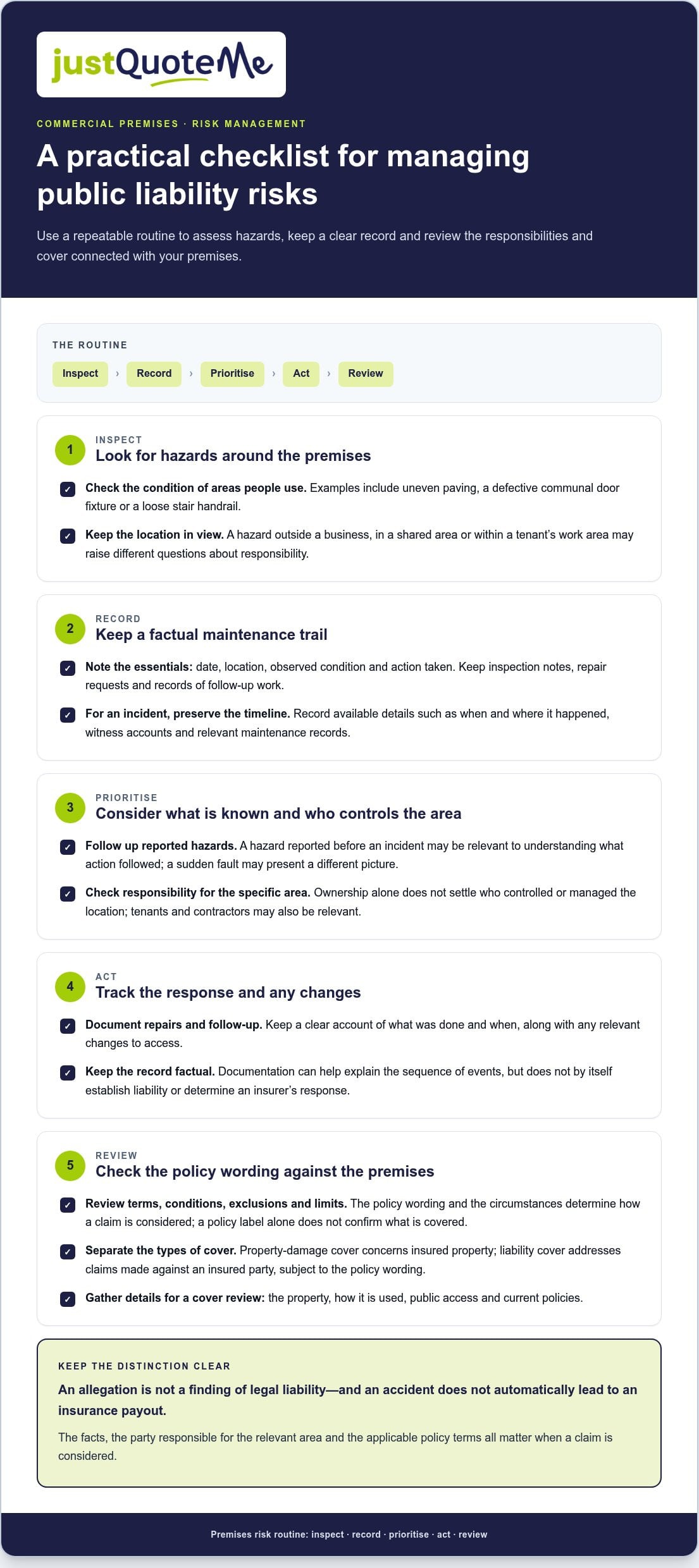
Inspect, record, prioritise, act and review: a consistent process can help you manage premises risks, but it doesn’t determine liability or guarantee an insurance response.
- Inspect. Walk through the areas accessible to visitors and note hazards such as obstructions, poor lighting, loose surfaces or visible damage. Consider shared spaces as well as areas used by your own business.
- Record. Log the date, location and condition observed. Add photographs or other relevant details where appropriate, and note who completed the inspection.
- Prioritise. Consider whether the issue could affect safe access or use of an area, and decide what needs attention first. Record the reason for the priority and who will take the next step.
- Act. Arrange appropriate repairs or other steps to manage the hazard. If work cannot happen immediately, document any interim action taken and who is responsible for follow-up.
- Review. Check whether the issue was resolved and update the record. Use recurring reports or repeat defects to identify where your routine or maintenance process may need attention.
Inspection and maintenance records
Keep records in one consistent place so they’re easy to follow. For each inspection, note the date, observed issue, action taken and any follow-up still required. Give staff and contractors a clear way to report hazards, then track each report through to resolution. Set a process that suits the property and its use, rather than relying on an arbitrary inspection interval.
When a member of the public reports an incident
Capture a factual account, including when and where the incident occurred, what was reported and who received the information. Preserve relevant records, such as inspection logs, maintenance communications and photographs, without altering the original material. Separate direct observations from assumptions. Clear, timely documentation can help establish the sequence of events, but it doesn’t prove fault or guarantee cover. If a claim arises, follow the notification instructions in your policy.
For commercial property owner liability to public concerns, a well-kept log can make it easier to review how a reported hazard was handled. It should complement, not replace, the policy review and any professional advice appropriate to the circumstances.
If you’re reviewing your business insurance alongside your premises-risk routine, Get Your Free Business Insurance Quote now for a free, no-obligation quote.
Reviewing commercial property owner liability cover and choosing your next step
Reviewing commercial property owner liability to public cover starts with the real setup of your premises, not just the name of a policy. Consider who owns and manages the building, how it’s used, which areas the public can access and how your existing insurance describes those risks. This context can help you identify where policies may overlap, where wording differs and what questions to resolve before making a decision.
What information can help when reviewing a policy?
Pull together a clear description of the premises and the activities that take place there. Note whether the building is occupied by your business, tenants or a mix of users, and describe public access to entrances, shared areas and other relevant spaces. There’s no single information checklist that suits every property, but an accurate overview helps make a policy review more focused.
Then locate your current policy documents, including the schedule and relevant liability wording. Check the named insured, premises details, stated business use and any sections dealing with liability. If the property or its use has changed, note what changed and when. This makes it easier to compare the documents with the risks you’re seeking to address, without assuming that a policy label confirms the extent of cover.
A useful review asks whether the documents reflect the current arrangement: who uses the building, what activities happen there, and which areas visitors can reach. Make a note of unclear wording or apparent gaps. The aim is to understand what the policies say, not to infer cover from a summary or assume that separate policies respond in the same way.
Get help comparing relevant business insurance
An independent broker can help you compare relevant options from a network of UK insurers and make sense of how policy wording relates to your circumstances. Just Quote Me is an FCA-authorised independent insurance broker with access to a broad network of UK insurers. It can help you explore Public Liability Insurance and Commercial Property Insurance, with free, no-obligation quotes and callbacks.
When comparing options, focus on the details that matter to your premises and business use. Consider how each policy describes the insured party, property, activities, limits, conditions and exclusions. The wording varies between policies, so a comparison should help you see differences rather than assume that similarly named cover works identically. No quote or general description can guarantee that a particular future claim will be covered.
Once you’ve gathered your property details and existing documents, choose the next step that suits you. You can request a quote online or ask for a callback to discuss your requirements. Both routes offer a practical way to explore business insurance options without an obligation to proceed.
Get Your Free Business Insurance Quote now
Request a Call back for free Expert advice
Make your next policy review a practical one
Use your next review to connect the property’s day-to-day use with the insurance documents you hold. If ownership, occupancy, public access or business activities change, note the change and revisit whether your policy details still reflect the premises. This gives you a clear starting point for discussing commercial property owner liability to public exposures and comparing relevant insurance options.
Just Quote Me can help you explore business insurance options, including Public Liability Insurance and Commercial Property Insurance. It’s an FCA-authorised independent broker, with an average online review rating of 4.6 out of 5. Start with the information you have, then decide whether an online quote or a conversation would be more useful.
Get Your Free Business Insurance Quote now
A considered review can make complex policy details easier to approach. Take the next step at your own pace, with a clearer picture of what you need to discuss.
Frequently Asked Questions
Is public liability insurance a legal requirement for commercial property owners in the UK?
No, public liability insurance isn’t generally a legal requirement for commercial property owners in the UK, and there’s no legal minimum level of cover. However, a lease, contract or other commercial agreement may set its own insurance conditions. Check the documents relevant to your property and business, then compare those requirements with your policy schedule and wording rather than assuming the same rules apply to every owner.
What is the difference between public liability and property owners’ liability insurance?
Public liability insurance is generally associated with claims connected to business activities, while property owners’ liability relates to claims linked to owning or managing premises. For instance, an allegation about a service being provided may raise different policy questions from one about a building feature. Insurers may use these terms differently or arrange cover in different ways, so check how your policy defines the insured activities, premises and parties.
Does commercial property insurance include property owners’ liability cover?
Not necessarily. Some insurance arrangements may place property and liability cover together, while others may address them separately. Check your policy schedule to see which sections you have, then read the wording for the premises, insured parties, exclusions and limits. If you have more than one policy, review the documents together. A policy’s title alone doesn’t establish whether a particular liability claim falls within its terms.
Can a commercial property owner be liable if a visitor is injured on the premises?
Possibly, but an injury doesn’t automatically make the owner legally responsible. The assessment may consider who controlled the area, what caused the injury and what was reasonable in the circumstances. For example, if a visitor reports an injury in a shared stairwell, responsibility may depend on the arrangements for managing that space and the facts surrounding the incident. Assessing commercial property owner liability to public claims requires attention to those individual details.
Does property owners’ liability insurance cover damage to someone else’s property?
It may respond to certain third-party property-damage allegations, but cover depends on the policy wording and the circumstances. For example, a neighbouring business might report damage allegedly caused by an issue at your premises. The insurer would assess the claim against the policy’s definitions, exclusions and limits. Don’t assume all damage involving nearby property is covered; identify which policy applies and follow its claims notification instructions.
Can a tenant, contractor or member of the public make a claim against a commercial property owner?
Yes, any of them may make an allegation if they believe an owner’s actions or omissions caused injury or damage. A tenant could raise an issue involving a communal area, while a contractor might report damage during work at the site. A claim can be investigated without proving that the owner is responsible. The facts, control of the relevant area and any agreements between the parties may all be relevant.
Article by
Just Quote Me
JustQuoteMe Ltd is an independent UK insurance brokerage specialising in business and personal insurance solutions. With over 35 years of industry experience, the company provides tailored insurance cover for businesses, landlords, tradespeople, hospitality venues, fleets, and individuals across the UK. Known for its personal service, expert advice, and competitive premiums, JustQuoteMe Ltd works with leading insurers to deliver bespoke policies designed around each client’s unique needs. The company is authorised and regulated by the Financial Conduct Authority (FCA No. 586607) and has built a reputation for trusted, straightforward insurance guidance and long-term client relationships.

by jqm | Oct 14, 2026 | Insurance
A website doesn’t remove the risks of meeting clients in person. Public liability for an online business that meets clients isn’t a legal requirement in the UK, but it can cover claims for injury to another person or damage to their property if your business is legally responsible. Cover may apply to accidents at your premises or elsewhere.
It’s useful to distinguish the risks of face-to-face meetings from problems caused by your work itself. Public liability insurance generally relates to injury or property damage claims. If a client claims financial loss because of an error in your work, professional indemnity insurance may be relevant instead.
This guide explains when public liability may matter for an online business, what it is designed to cover and how contract requirements can affect your decision. It also shows how public liability differs from other business insurance, helping you separate risks linked to client meetings from those arising from the service you provide.
Key Takeaways
- Being an online business doesn’t remove the risks of meeting clients or visiting their premises; consider where face-to-face work takes place.
- Check client and contract requirements before agreeing to work, as they may specify a minimum level of cover.
- Choose a cover limit that reflects your work and any requirements attached to contracts or client sites.
- Separate claims involving members of the public from claims involving your own employees, as they relate to different types of liability cover.
- Match your insurance to the risks you face: Just Quote Me offers public liability, employers’ liability and professional indemnity insurance.
What is public liability insurance?
Public liability insurance can help with compensation and claim costs when a business is legally responsible for injuring someone or damaging their property. For an online business, this may matter when clients visit its premises or when meetings take place at a client’s site.
Cover for self-employed businesses
Public liability insurance covers claims from members of the public, including clients, who suffer injury or property damage linked to a business. For example, a self-employed online consultant could face a claim if a client trips over equipment during a meeting. The policy is intended for third-party claims, not the business owner’s own injuries. Working from home therefore doesn’t automatically remove the risks of meeting clients.
Legal requirements for cover
UK law doesn’t generally make public liability insurance compulsory for businesses, although a trade association or contract may require it. That distinction matters to a self-employed person deciding whether to buy business insurance: a legal exemption doesn’t prevent a client or organisation from setting cover as a condition of working together. Employers’ liability is different. Under the Employers’ Liability (Compulsory Insurance) Act 1969, businesses with employees must hold it; the UK Government states its minimum cover is £5 million.
Coworking spaces and other venues may require proof of public liability insurance before allowing client meetings. Requirements depend on the venue’s terms. Ask about them when booking, then compare them with the cover limit and activities stated in your policy.
How liability policies differ
Public liability relates to claims from third parties. Employers’ liability relates to claims by employees who believe the business caused their injury. Professional indemnity is typically relevant when a client claims financial or reputational loss caused by the business’s work. Product liability relates to claims involving injury or property damage caused by products. These policies address different relationships and losses, so one doesn’t automatically replace another.
Injury and property damage claims
A public liability claim may involve a client injured at your premises or during a visit to theirs, or property damaged during a meeting. For example, a client could trip over a cable in a home office, or equipment could damage a client’s property. Cover applies only if the business is found legally responsible for compensation and claim costs. Claims can reach tens or hundreds of thousands of pounds.
For public liability for an online business with client meetings, exclusions depend on the policy wording and insured activities. Public liability is intended for third-party injury and property damage, not your own injury, an employee’s claim or a client’s financial loss caused by your work. These situations involve different liability risks and may call for other types of cover.
Premiums depend on the business’s activities, the level of cover and the policy terms. The quote reflects the business’s circumstances rather than a single standard cost.
Choosing a cover limit
Choose a limit that reflects your work, the places you visit and any contract conditions. Even online businesses can face public liability claims when meetings bring clients onto their premises or take their work to client sites.
Assessing the appropriate cover limit
A cover limit is the maximum amount a policy can pay towards an eligible liability claim. Many small businesses choose £1 million or £2 million, while public liability cover can range from £1 million to £10 million depending on the trade and activities. Contractors’ contracts may require £1 million to £5 million. Check each contract’s stated limit, then compare it with the largest plausible claim arising from your work.
Government and local authority work can set a higher benchmark: businesses working with these bodies usually need at least £5 million of cover. Some contracts with councils or large businesses specify a minimum, so a lower limit could prevent you taking on that work. Revisit the figure when your services, client sites or contract terms change.
Cover needs for online and client-facing businesses
A fully remote business with no on-site work and no physical goods may have less reason to consider public liability than a business that meets clients. Face-to-face meetings change the exposure: a client could be injured at your premises, or your work could damage their property. Home-based contractors may also need to consider cover when visiting client premises.
Consider what happens during each client interaction. A video call creates no visit-related accident risk, while an in-person meeting may take place in a home office, coworking space or customer site. A venue or client contract may require proof of insurance before work begins. Include that requirement in your decision rather than choosing a limit solely because your business operates online.
Accidental injury and property damage
Public liability cover is designed for eligible claims involving accidental injury to another person or damage to their property. For example, a consultant carrying equipment into a client’s office might accidentally damage a monitor. If the business is found legally responsible, a claim could involve compensation and associated costs.
Professional indemnity addresses a different risk: a client’s financial loss linked to an alleged mistake in your work. Public liability and professional indemnity therefore relate to different kinds of claims. A combined insurance arrangement may bring both protections together, but compare the wording and limits for each rather than assuming one limit applies to both.
Employers’ liability relates to employee claims, not client visits. If you employ staff, consider that exposure separately. Workplace contents cover is also distinct: a business with laptops, cameras or other equipment on its premises should consider how those items are protected against loss or damage. Assess these covers alongside public liability, rather than treating them as substitutes.
Injury or property claims from members of the public
A client meeting can create public liability exposure, even when your business operates online. The key question is whether someone is injured or their property is damaged because of your business’s actions.
Visits to client premises
A visit to a client’s premises can lead to a claim if your actions cause an accident. For example, a consultant could spill a drink on a client’s laptop while setting up equipment, and the client may claim against the business for the damage. A home-based contractor can face this risk when visiting a customer’s property, so include off-site work in your assessment.
Consider the practical details of each visit: what equipment you carry, where meetings take place and what tasks you perform. Bringing a laptop into a client’s office creates a different situation from a remote video call. If someone is injured or property is damaged, record what happened and who was present. Clear details help explain the circumstances of a claim.
Accidental injury and property damage claims
Public liability claims may involve injury to a member of the public or damage to their property. For instance, a client could trip over a bag left in a meeting room. A claim may seek compensation and claim costs, but insurance responds only if the business is found legally responsible, not simply because an accident happened.
Keep the type of loss clear. A client injured during a visit may make an injury claim; a client whose phone is damaged during a meeting may make a property claim. By contrast, a client alleging financial loss from a mistake in your work raises a different liability issue, typically associated with professional indemnity insurance.
How claims can arise
A claim can arise when a member of the public believes the business’s negligence caused injury or property loss. For an online retailer, for example, a customer might allege that a delivery or business activity damaged their property. The person may claim against the business, but liability depends on whether the business is legally responsible for the loss.
After an incident, note the date, location, people involved and sequence of events. For example, record where a client fell and what was on the floor. Keep relevant correspondence and details of damaged property together. Public liability insurance can address eligible third-party claims, but it does not cover employees or volunteers as members of the public. Separate cover addresses employee claims.
If your business meets clients, map where those interactions happen: your home office, a coworking room or a customer’s premises. Identify possible injury and property risks in each setting, then compare them with the activities described in your policy. A professional indemnity claim concerns a client’s financial loss from your work, not a visitor’s accident.
Public liability protection for client-facing businesses
For UK businesses that meet clients, public liability insurance can cover compensation and claim costs after injury or property damage if the business is legally responsible. It may apply to eligible accidents at business premises or off site, including client locations.
Protection for businesses that meet clients
Public liability protection is designed for claims from third parties who are injured or whose property is damaged through a business’s actions. It can matter to online businesses because client meetings may take place in homes, offices, coworking spaces or other premises. A digital service may have no shopfront, but in-person work still brings people and property into contact with business activities.
Use each contract as a practical reference point. A client or recruiter may specify levels of public liability and professional indemnity cover before work starts. Those requirements are contractual, not a general legal requirement for public liability insurance. Compare the stated limits with the work you’ll perform and where you’ll perform it. A remote appointment and an on-site installation involve different exposures.
Consider who could make a claim. A client, visitor or other member of the public may seek compensation after an incident linked to your work. Employee claims involve a different type of liability. Separating these scenarios helps you assess whether a policy addresses the people and activities involved.
Cover for in-person client meetings
At an in-person meeting, public liability insurance may respond to a third-party injury or property damage claim if the business is found legally responsible. For example, a client could trip over equipment brought into a meeting room, or a business activity could damage an item at the client’s premises. Cover isn’t simply payment for every accident: legal responsibility matters.
Claims can involve compensation and claim costs, so consider the possible consequences of each type of visit. A consultant carrying presentation equipment into client offices has different practical exposures from an online retailer whose customer interactions happen remotely. Record your business locations and activities, then compare them with the policy wording and any limits required by contracts.
Keep the different liability types clear. If a client claims financial loss because your advice or work contained an error, professional indemnity is typically relevant. If they claim injury or property damage during a visit, public liability is the category to assess. Neither label alone confirms that a particular incident is covered: the policy terms and circumstances determine the response.
Review cover options for client-facing work against your meeting locations, activities and contract requirements.
Just Quote Me: Public Liability Insurance
Just Quote Me can help you consider public liability insurance for client meetings, alongside professional indemnity or employers’ liability where relevant. The right cover depends on your work, meeting locations and contract requirements. If you’re reviewing protection for your online business, contact Just Quote Me or visit justquoteme.co.uk to discuss your options.
Make your next cover decision with confidence
Use your next contract renewal or a change in client work as a prompt to review your insurance. For public liability for an online business that meets clients, consider whether your cover reflects where meetings take place and the activities you carry out.
Just Quote Me offers Public Liability Insurance, Employers Liability Insurance and Professional Indemnity Insurance. These address different business risks, so consider which types relate to your work and client relationships.
Get Your Free Business Insurance Quote now, or Request a Call back for free Expert advice.
Frequently Asked Questions
What other covers can I get to protect my business?
Professional indemnity and employers’ liability are two other types of cover to consider, depending on your work and workforce. For example, a web designer may consider professional indemnity for claims involving an alleged mistake in their work. A business with employees should consider employers’ liability for employee-related risks. Just Quote Me offers both alongside public liability insurance, so you can discuss which covers fit your business activities.
Even if I’m working from home?
Yes. Working from home doesn’t automatically remove the need to consider public liability insurance. The key question is whether your business brings people or activities into contact with potential risks. A home-based tutor who welcomes clients faces different exposure from a remote consultant who never hosts visitors or visits customer sites. Include home appointments, client visits and off-site work when assessing how your business operates.
How do I compare cover?
Compare the policy wording, not just the headline limit. Check that your activities, such as client visits or demonstrations, match the policy description. Then review the limit, excess, exclusions and any contract requirements. If a client agreement specifies a particular limit, compare it with the policy’s limit of indemnity. Keep the relevant contract and policy documents together for reference.
How do claims work?
A claim starts when someone seeks compensation for a loss they believe your business caused. Record the incident, including the date, location, people involved and any relevant messages or photographs. If a client reports damage after a meeting, for example, preserve the correspondence and details of the item. The insurer assesses the circumstances against the policy terms and considers whether the business is legally responsible.
How long does it take to process a claim?
There isn’t one timeframe that applies to every claim. The process depends on factors such as how clearly the incident is documented, whether responsibility is disputed and whether the injury or damage needs further assessment. A straightforward property claim may involve different enquiries from a serious injury claim. Keep requested records organised and respond promptly to information requests so the assessment can progress with the available evidence.
How much does it cost?
Costs depend on your business activities, selected cover limit and policy terms. Client visits may affect the risk assessment compared with fully remote work. Just Quote Me provides free, no-obligation quotes. For a quote, choose Get Your Free Business Insurance Quote now, or request advice using Request a Call back for free Expert advice.
Article by
Just Quote Me
JustQuoteMe Ltd is an independent UK insurance brokerage specialising in business and personal insurance solutions. With over 35 years of industry experience, the company provides tailored insurance cover for businesses, landlords, tradespeople, hospitality venues, fleets, and individuals across the UK. Known for its personal service, expert advice, and competitive premiums, JustQuoteMe Ltd works with leading insurers to deliver bespoke policies designed around each client’s unique needs. The company is authorised and regulated by the Financial Conduct Authority (FCA No. 586607) and has built a reputation for trusted, straightforward insurance guidance and long-term client relationships.

by jqm | Oct 13, 2026 | Insurance
Could an unpaid student still need to be considered under your business insurance? If you’re asking “do i need insurance for work experience students”, the answer depends on the placement and your policy wording, not just whether the student is paid. For insurance purposes, work experience students may be treated as employees, so your existing employers’ liability cover could apply, subject to the policy and insurer.
It’s understandable to want a clear answer before agreeing to host a student. Employers’ liability and public liability cover address different risks, and neither should be assumed to cover every activity or placement arrangement. Checking the details early can help you avoid gaps and set up the placement with confidence.
This guide explains which insurance may apply, what to review in your policies, and what to ask your insurer or broker. You’ll also learn how the student’s tasks, age and placement arrangements can affect the questions to consider, so you can prepare before their first day.
Key Takeaways
- To answer “do i need insurance for work experience students”, assess the placement itself rather than relying on whether it’s paid.
- Compare the student’s activities with your employers’ liability and public liability policy wording, including any exclusions or endorsements.
- Prepare the placement details before reviewing cover: tasks, dates, location, supervision and equipment involved.
- Record the insurer’s response before the placement starts, so you have a clear reference for the agreed arrangements.
- A broker can help review your placement details against relevant policy wording and identify questions to resolve.
Do you need insurance for work experience students? Start with the placement
There isn’t a single answer that applies to every student placement. Whether your existing insurance responds depends on the work involved, the circumstances of the placement and the wording of your policies. An unpaid student shouldn’t be assumed to fall outside your cover, or to be covered automatically just because the placement is unpaid. Review your policies before the student starts.
For UK health and safety and insurance purposes, work experience students are considered employees. Existing employers’ liability policies generally cover them where the insurer is a member of the Association of British Insurers or Lloyd’s. That doesn’t remove the need to read your own policy terms and consider what the student will actually do. You can review the scope of your employers’ liability insurance alongside the placement details.
Insurance follows the risks and policy wording, not the label attached to a placement. That’s the key point behind the question, “do i need insurance for work experience students”: first define the placement, then check how your cover applies.
What counts as a work experience placement?
A work experience placement is a temporary opportunity to see or take part in a workplace to support learning or career exploration. It might be arranged through a school or college, or organised through another route. Work experience can take different forms, so the label alone doesn’t establish how a particular insurance policy responds.
A school-arranged placement may come with agreed dates, learning aims and information about the student, but those arrangements don’t by themselves confirm the scope of your insurance. Other placements may have different arrangements. Treat each one on its own facts, and check relevant policy wording rather than assuming all placements receive identical treatment.
Why the student’s tasks matter
Consider the setting, the level of supervision and the tasks the student will perform. An observation-based placement, such as watching staff carry out routine work, presents a different set of activities to review than a placement where the student handles equipment, helps prepare items or interacts with customers. Neither arrangement is automatically covered or excluded: the details matter.
Write down what the student will and won’t do, where they’ll work, who will supervise them and whether they’ll use equipment. This makes it easier to compare the real activities with your policy wording and identify questions before the placement begins. A task that seems minor may still change the risks involved, particularly in a busy workplace or around customers.
Take extra care to check current guidance and the relevant policy terms if the student is under 18. Their age, experience and the nature of the work can affect how the placement should be planned. Don’t rely on assumptions based on a previous student or a similar-sounding arrangement. Review this placement as it is actually proposed.
Which insurance policies should you check for a student placement?
Start by separating risks involving the student from risks involving other people. Employers’ liability and public liability insurance serve different purposes, so one policy shouldn’t be treated as a substitute for the other. The exact protection depends on the wording, including definitions, exclusions and any endorsements that alter how the policy applies.
This distinction matters if you’re asking do i need insurance for work experience students. Rather than relying on the policy name or assuming a placement is included, match the student’s planned activities to the cover you hold. Check the current documents and discuss any uncertainty with your insurer or broker before the placement begins.
Employers’ liability: what to establish
Employers’ liability insurance is generally relevant to claims involving an employee’s injury or illness connected with their work, subject to the policy terms. Since a student’s status and activities can affect how cover applies, describe the specific arrangement to your insurer. Include the tasks, setting and supervision, and ask whether the existing wording responds or whether any policy change is needed.
The employers’ liability insurance you already hold is the starting point for that review, not a reason to assume every placement is covered. The Health and Safety Executive provides HSE guidance on work experience insurance and employer responsibilities. Use current official guidance alongside the policy wording, particularly if you’re unsure how the arrangement should be treated.
Public liability: where third-party risks fit
Public liability insurance is generally relevant to claims by third parties for injury or damage to their property. For example, a visitor might be injured during normal workplace operations involving the student. The policy wording determines whether the circumstances fall within cover, so consider the student’s contact with customers, visitors and other members of the public.
Public liability insurance addresses a different broad category of risk from employers’ liability. A placement could involve both: a student may be exposed to workplace risks, while their activities could also affect visitors or property. That doesn’t mean either policy automatically covers every possible claim. Review each policy separately and describe the planned work accurately.
When you read the documents, focus on the parts that define who is insured and what activities are covered. Look for exclusions that may relate to the student’s duties, the workplace or the use of equipment. Also check endorsements, which can change the standard terms. If the wording isn’t clear, ask the insurer to explain how it applies to the actual placement and keep a record of the response.
For employers asking whether they need insurance for work experience students, the useful next step is to compare the placement with both policies, then resolve any uncertainties before the first day. Just Quote Me can help you review business cover against the placement details and the relevant policy wording.
How placement circumstances can change the insurance questions
The same placement title can describe very different arrangements. A student might spend a short period observing in an office, or attend a longer placement where they move between work areas, speak with customers or take part in supervised tasks. These differences don’t determine the insurance outcome by themselves, but they shape what you need to describe and verify.
Observation-only and practical placements
An observation-based placement may involve following a member of staff, watching a process and asking questions. A practical placement could involve handling tools or equipment, helping with routine tasks or being present where customers and visitors are nearby. The risks to review will depend on what happens in practice, not simply whether the student is described as an observer.
Employers should describe the student’s actual placement duties when checking policy cover. Write down what the student may do, what they must not do, where each activity takes place and who supervises them. If a task might change during the placement, include that possibility in the description rather than relying on a broad label such as “work experience”. Discuss the details with your insurer or broker so the answer relates to the arrangement you’re planning.
Supervision is another detail to set out clearly. Explain whether the student will stay with a named member of staff, work in shared areas or move between locations. Describe any equipment they may encounter, even if they won’t operate it. Clear information helps the insurer understand the setting and the level of involvement, without assuming that supervision alone settles the question of cover.
School-arranged, unpaid and under-18 placements
A school or college may help organise the placement, but its involvement doesn’t by itself establish how your business policy applies. Likewise, unpaid status doesn’t answer the insurance question. If you’re wondering “do i need insurance for work experience students”, include the payment arrangement and who organised the placement in the details you provide, but don’t use either as a substitute for checking the policy.
Age is also relevant information to share, particularly for a student under 18. Include the student’s age, dates, location, planned duties and supervision arrangements when seeking an answer. If the placement involves particular settings or responsibilities, check current official guidance as well as your policy terms. Don’t assume that an arrangement suitable for an adult or a previous student applies in the same way here.
Duration can change the practical questions too. A longer placement may involve different tasks over time, while a student who returns to the workplace may have a changed role or level of involvement. Note any planned changes and agree how they’ll be handled before duties expand. If the actual activities differ from the description given to the insurer, revisit the information rather than relying on the original response.
A useful preparation is a short placement summary that staff can refer to: what the student will do, where they’ll be, who is responsible for supervision and any limits on their tasks. That gives your insurer or broker a clear basis for discussing the arrangement and helps keep the agreed placement consistent with what you’ve described.
A practical insurance check before the student starts
A short, structured review can help you identify what to clarify before the placement begins. If you’re asking “do i need insurance for work experience students”, don’t start by buying a particular policy. First set out the placement, then compare its details with your current cover and get a clear response about any uncertainty.
- Describe the placement. Write down the student’s planned duties, where they’ll work, the dates and how they’ll be supervised. Include any practical tasks, equipment they may use and contact with customers or visitors.
- Review your policy wording. Check the relevant sections, definitions, exclusions and endorsements. Note anything that appears connected to the student’s activities, and mark wording you’d like explained.
- Contact your insurer or broker. Share the placement details and ask whether the existing policy wording applies to this specific arrangement. Avoid relying on a general answer that doesn’t reflect the student’s actual duties.
- Document the outcome. Keep the response with your placement records, along with any relevant policy changes or instructions. If the student’s duties or location change, revisit the details you provided.
What information to have ready
Give the insurer a practical description, not just the placement title. Include the student’s tasks and work environment, the placement dates and location, who will supervise them, whether they may interact with customers or visitors, and any equipment or practical activities involved. If there are limits on what the student may do, state those too. This helps ensure the response relates to the arrangement you intend to run.
Be specific about differences between planned duties. For example, say whether the student will observe a process only or may take part in a supervised task. If the placement spans more than one work area, describe each setting. Clear details make it easier to discuss relevant wording and identify whether any planned activity needs further clarification.
Questions to put to your insurer or broker
Keep your questions direct. Ask whether your existing policy wording extends to this specific work experience arrangement, and which policy sections, exclusions or conditions apply to the duties you’ve described. If the student’s age, dates or supervision arrangements affect the response, ask how those details have been considered.
Where available, request written clarification and retain it with the placement records. If the answer refers to a policy condition or endorsement, ask for the relevant wording or an explanation in plain English. A written record helps you follow the agreed arrangements and spot when a change in duties may require another review.
Just Quote Me can help you consider your placement details against relevant business insurance wording. Discuss your business insurance needs with Just Quote Me.
Get tailored business insurance guidance for your placement
A broker can help you connect the placement details with the wording of your business insurance. This is useful if a policy term is unclear, the student’s planned duties differ from your usual work, or you need to understand which sections of your cover are relevant. The aim is to make the questions easier to resolve, not to assume a particular outcome.
How an insurance broker can help clarify cover
Share a clear description of the arrangement, including the student’s intended activities, dates, location, supervision and any equipment involved. Explain whether they’ll observe, carry out practical tasks or interact with customers and visitors. Accurate details give the broker a sound basis to review relevant policy wording and raise specific questions with insurers where needed.
Just Quote Me is an FCA-authorised independent UK insurance broker with over 30 years of industry experience. It arranges business insurance, including employers’ liability and public liability cover, through a network of UK insurers. A broker can help you understand how policy terms relate to the placement and what points to clarify, but the insurer’s wording and response determine how cover applies. No broker can guarantee an insurer’s decision or the outcome of a future claim.
That distinction matters. A broad description such as “student placement” may leave important details unstated. Explaining that a student will, for example, observe staff in one area but handle equipment in another gives a clearer basis for reviewing the arrangement. If the tasks change, update the information rather than relying on an earlier description that no longer matches the placement.
Choose a clear next step
Before the student starts, bring together the placement details and your current policy documents. Identify any wording you’re unsure about, then seek a response that addresses the actual duties and setting. Keep written clarification and relevant policy changes with your placement records, so the agreed arrangements are clear to the people involved.
If you’re still considering “do i need insurance for work experience students”, focus on getting your particular placement reviewed rather than assuming every student arrangement is treated the same way. A tailored discussion can help you understand the questions to resolve and make an informed decision about your business cover.
Take the next step with Just Quote Me:
- Get Your Free Business Insurance Quote now
- Request a Call back for free Expert advice
Make your placement decision with confidence
The question “do i need insurance for work experience students” is best answered by reviewing the actual placement, not relying on assumptions about its title or whether it’s paid. Before agreeing dates and duties, make sure your insurance review reflects the arrangement you intend to provide. If the student’s role changes, revisit the details so your understanding of the cover stays aligned with the placement.
A clear next step can make the process more straightforward. Explore tailored business insurance support from Just Quote Me, then decide what review or advice would help you proceed with confidence.
Explore business insurance support
Get Your Free Business Insurance Quote now
Request a Call back for free Expert advice
With the right questions addressed before the placement begins, you can welcome a student with greater clarity and peace of mind.
Frequently Asked Questions
Do unpaid work experience students need to be covered by employers’ liability insurance?
Generally, an unpaid student should still be considered when reviewing employers’ liability cover. Payment status alone doesn’t establish whether a policy applies. For example, a student attending to observe staff may still need to be included in the insurer’s assessment of the placement. Give the insurer the arrangement details and check the policy response rather than treating “unpaid” as an exemption.
Does public liability insurance cover work experience students?
Public liability insurance generally relates to claims from third parties for injury or property damage, rather than claims made by the student as someone undertaking work experience. For instance, it may be relevant if a visitor is injured in circumstances connected with the placement. Whether a specific incident is covered depends on the policy wording, so consider public liability separately from cover relating to the student.
Are work experience students classed as employees for insurance purposes?
For health and safety and insurance purposes, work experience students are treated as employees. That means you shouldn’t decide whether your employers’ liability policy applies solely by looking at the student’s job title or whether they receive wages. Tell your insurer how the placement is organised and what the student will do, then check how your policy wording treats that specific arrangement.
Do I need insurance for a student on a one-day work experience placement?
A one-day duration doesn’t, by itself, settle whether your existing cover applies. The practical question, do i need insurance for work experience students, still turns on the activities, setting and policy terms. For a brief visit, explain whether the student will only observe, enter work areas or interact with customers. Share those details with your insurer before the visit rather than assuming a short placement is automatically covered.
What should I tell my insurer before hosting a work experience student?
Describe the student’s duties, placement dates and location, who will supervise them, and any equipment or practical activities involved. Also mention whether they may interact with customers or visitors, their age, and whether a school or college arranged the placement. If the student’s role could change during the placement, explain that too. Clear, complete information helps the insurer respond to the arrangement you’re actually planning.
Does my existing business insurance automatically cover a student placement?
No, don’t assume that every placement is automatically covered by an existing policy. A policy may respond depending on its terms and the placement circumstances, but definitions, exclusions and endorsements can affect the scope. Ask your insurer to address the actual tasks and setting, not just the phrase “work experience”. Keep the response with your policy records, particularly if it identifies conditions or changes relevant to the arrangement.
Article by
Just Quote Me
JustQuoteMe Ltd is an independent UK insurance brokerage specialising in business and personal insurance solutions. With over 35 years of industry experience, the company provides tailored insurance cover for businesses, landlords, tradespeople, hospitality venues, fleets, and individuals across the UK. Known for its personal service, expert advice, and competitive premiums, JustQuoteMe Ltd works with leading insurers to deliver bespoke policies designed around each client’s unique needs. The company is authorised and regulated by the Financial Conduct Authority (FCA No. 586607) and has built a reputation for trusted, straightforward insurance guidance and long-term client relationships.

by jqm | Oct 12, 2026 | Insurance
Could a trainee be treated as an employee for employers’ liability purposes, even when a training provider is involved? It’s a reasonable question, especially when the role combines workplace duties with formal learning. The label alone may not tell you what your insurance needs to cover, which is why employers liability for apprentices and trainees deserves a closer look.
Most UK employers are legally required to have employers’ liability insurance, and apprentices are included in the relevant legislation. But the details of a trainee’s working arrangement and the wording of your policy still matter. A training provider’s involvement doesn’t automatically settle where workplace responsibilities sit.
This guide explains which details of the role to consider, what to review in your policy and insurance records, and how employer responsibilities differ from those of a training provider. It also covers practical steps to take before an apprentice or trainee starts, so you can make more informed decisions about cover and workplace safety.
Key Takeaways
- For employers liability for apprentices and trainees, look beyond the role’s title and consider the actual working arrangement.
- Compare apprenticeships, paid training and work-experience placements by recording duties, supervision and how the placement is structured.
- Review your policy wording and insurance records against the work the apprentice or trainee will do, and resolve any uncertainty before they start.
- Separate your responsibilities as the workplace employer from the training provider’s role, and check authoritative guidance where legal requirements are unclear.
- Use a clear review process: document the arrangement, check current rules, examine your cover and address any gaps.
Employers’ Liability for Apprentices and Trainees: Why Their Status Matters
Will your employers’ liability insurance respond if an apprentice or trainee is injured or becomes ill through their work? That’s the practical concern behind employers liability for apprentices and trainees. The answer can depend on the person’s working arrangement, the applicable legal requirements and the wording of your policy. Calling someone a trainee, or involving a training provider, doesn’t settle the question by itself.
Employers’ liability insurance is generally intended to cover an employer’s legal liability for injury or illness claims made by employees arising from their work. Whether a particular claim falls within cover depends on the policy terms, exclusions and circumstances. It’s different from public liability insurance, which generally relates to claims from third parties for injury or property damage. In short: employers’ liability concerns employee-related claims; public liability concerns claims from other people.
What does employers’ liability insurance generally relate to?
The distinction matters because an incident’s location doesn’t determine which type of claim it is. For example, if an apprentice is hurt while carrying out workplace duties, the employer should consider the employers’ liability policy and the person’s status. If a visitor is injured during the same incident, that may raise a different insurance question. These examples don’t determine whether a claim is covered; the policy wording and facts must be considered.
Review the schedule and wording for the activities, people and circumstances described by the policy, rather than relying on the insurance name alone. Just Quote Me’s employers’ liability insurance information can help you understand the cover in the context of your business. If the arrangement is unusual or the wording is unclear, seek an explanation before relying on an assumption.
Does calling someone a trainee change the insurance question?
A label is only one part of the picture. The Employers’ Liability (Compulsory Insurance) Act 1969 refers to employees working under a contract of service or apprenticeship, but not every training or work-experience arrangement is necessarily identical. Consider what the person actually does, who directs and supervises their work, where they carry it out, and how the placement or agreement is structured. Those details help frame the legal and policy questions without assuming the answer.
An apprenticeship combines employment and structured learning, though arrangements vary. The general Apprenticeship overview offers background, but it can’t determine an individual’s status under UK law or a specific insurance policy. A trainee may also have duties that resemble an employee’s, or may take part in a short placement with a different structure. Don’t decide cover based only on a job title, age or the presence of a training provider.
Instead, record the arrangement and compare it with the policy wording. If the role, supervision or workplace duties change, review whether your insurance records still describe the situation accurately. This gives you a clearer basis for checking applicable requirements and discussing any uncertainty with an insurance broker or seeking authoritative legal guidance.
UK Rules and Policy Wording: What Employers Should Check
The legal starting point is the Employers’ Liability (Compulsory Insurance) Act 1969. It requires most UK employers to hold employers’ liability insurance, and an apprenticeship arrangement can bring the Act into consideration. That does not mean every placement or training arrangement has the same legal status. The details matter, as do any statutory exceptions and the current wording of your policy.
For employers liability for apprentices and trainees, separate two questions: what the law requires for your particular arrangement, and how your insurer’s policy responds to a claim. Don’t rely on a general description of apprentices or trainees to answer either one. Where the legal position is uncertain, consult current guidance from the Health and Safety Executive (HSE) or authoritative legal information. Avoid relying on an exemption or a cover limit unless you’ve checked it against a current authoritative source.
Which UK legal points need careful verification?
Check the Act and current official guidance against the actual arrangement, including whether the person is engaged under an apprenticeship or another type of placement. Consider whether relevant HSE guidance addresses the specific issue you’re reviewing. If the circumstances don’t fit a straightforward employment arrangement, don’t assume that the same rules apply automatically. Record what you’ve checked and seek appropriate advice if the legal position remains unclear.
Legal compliance and insurance documentation are related, but they aren’t interchangeable. A certificate is evidence of insurance; it doesn’t explain every term, exclusion or condition that may affect a claim. Equally, a policy document doesn’t decide a person’s legal status by itself. Assess the arrangement, the relevant law and the policy together rather than treating any one document as the complete answer.
What should the policy documents say about workforce cover?
Read the policy schedule alongside the full wording and certificate. Check how the insurer describes covered employees and whether apprentices, trainees or other relevant worker categories are addressed. Review the declared business activities and work locations, then note any conditions that relate to the work the person will actually perform. A mismatch is a prompt to clarify the records, not proof on its own that a claim would or wouldn’t be covered.
Keep a simple record of the review, including the placement agreement, role description and any relevant correspondence with your insurer or broker. If an apprentice works across different sites or takes on duties beyond the original plan, compare those changes with the declared activities and locations. The facts of an incident, the policy wording and any applicable exclusions all affect how a claim is considered.
Just Quote Me can help you make sense of employers’ liability insurance in light of your business circumstances and policy documents. If you’d like help understanding the wording, speak with Just Quote Me about your insurance questions.
Apprentices, Trainees and Work Experience: Compare the Arrangements
An apprenticeship, a paid trainee role and a short work-experience placement can look similar at the workplace, but their arrangements may differ. For employers liability for apprentices and trainees, compare what has actually been agreed with what the person does day to day. Payment and job titles are useful details, but they don’t replace reviewing the circumstances, applicable law and policy wording.
Identical job titles don’t guarantee identical treatment under an insurance policy. Use the comparison below to identify questions to investigate, not to presume whether a person is covered.
| Arrangement |
Workplace duties |
Supervision |
Questions to verify |
| Apprentice |
May combine practical work with structured learning under an apprenticeship arrangement. |
Establish who assigns and oversees workplace tasks, and how training is supported. |
What does the apprenticeship agreement say? How does the policy describe employees or apprentices? |
| Paid trainee |
May carry out regular work while learning or developing skills; duties depend on the role. |
Identify who directs the work and monitors the trainee’s activities. |
What are the terms of the arrangement? Do the declared activities and workforce details reflect the role? |
| Short-term work-experience placement |
May involve observation, supervised tasks or other activities set for the placement. |
Clarify who provides day-to-day oversight at the workplace and what the placement provider does. |
What does the placement agreement say about duties, supervision and the parties involved? |
How might an employed apprentice differ from a placement student?
An apprentice may work under an apprenticeship arrangement that combines workplace duties and learning. A placement student may attend a workplace as part of an educational programme, with different terms and aims. Don’t infer legal status from these descriptions alone. Record the agreement, the tasks expected and whether workplace managers or education staff direct and supervise the person’s daily activities. Then check how the actual arrangement relates to current legal requirements and the policy.
What changes when a training provider is involved?
A provider’s involvement doesn’t, by itself, establish which insurance arrangements apply to the employer. Read the training or placement agreement alongside the role description and policy documents. Note who sets tasks, provides supervision, and manages changes to the placement. The agreement can clarify the parties’ stated roles, but legal responsibilities and insurance consequences depend on the circumstances, applicable law and policy terms.
For example, a placement might begin with observation and later include practical tasks. That change is a reason to revisit the written arrangement and check whether the description of duties remains accurate. Keep relevant records together so you can explain the setup clearly when reviewing the policy or discussing it with a broker. A broker can help interpret policy wording in light of your circumstances, but the documents and facts remain central to assessing how cover may respond.
Use the comparison as a starting point, then record the details that distinguish your arrangement. Reviewing employers’ liability insurance alongside those details can help you identify what needs clarification before the placement begins or the role changes.
A Practical Employers’ Liability Review Before an Apprentice Starts
A short, documented review before the start date helps you compare the planned role with your insurance records. For employers liability for apprentices and trainees, work through the arrangement, duties, policy and any unanswered questions in sequence. This won’t decide legal status on its own, but it gives you a clear factual basis for checking applicable requirements and discussing the cover.
What details should an employer gather first?
Start with the documents that describe the arrangement, such as an employment or apprenticeship agreement, or a work-experience placement agreement. Record the planned start date, role, expected duties, work locations and who will supervise day-to-day activity. Note how any training provider is involved and what the written arrangement says about each party’s role.
Keep the record focused on details relevant to the role and insurance review. You don’t need to collect unrelated personal information to describe the work arrangement. If duties or locations are still being finalised, identify what remains undecided and update the record once those details are agreed.
How should employers review cover and records?
Compare your notes with the policy schedule, full wording, certificate and declared business activities. Look for relevant descriptions of the workforce, work undertaken and locations. If the documents don’t clearly reflect the planned arrangement, avoid assuming how a claim would be treated. Ask for an explanation of the wording from your broker or insurer, and obtain legal guidance if the person’s status or a statutory requirement remains uncertain.
Use this sequence to keep the review practical:
- Record the arrangement. Keep the relevant agreement, role details, start date, work locations and supervision arrangements together.
- Check the duties. Describe the work the apprentice will actually perform, including any planned changes from observation or training to practical tasks.
- Review the insurance documents. Compare the facts with the schedule, wording, certificate and declared activities. Note any unclear terms or apparent differences.
- Resolve open questions. Seek an explanation of policy wording where needed, and consult authoritative UK guidance, including relevant Health and Safety Executive material, for legal or safety questions.
Keep a dated note of what you reviewed, the questions raised and any explanation or decision received. Retain it with the relevant insurance records. This creates a useful reference if the arrangement changes or you need to revisit the review; it isn’t a substitute for the policy or legal advice.
Review the records again if the apprentice takes on different duties, moves to another workplace, changes supervisor, or follows a revised training or placement arrangement. A change doesn’t automatically mean the cover is inadequate, but it may alter the facts against which the policy should be considered. Record the update and check whether your declarations still reflect the work.
If your review raises questions about how your business circumstances relate to the policy wording, Just Quote Me can help explain tailored employers’ liability insurance options. Discuss employers’ liability cover for your business.
Arrange Employers’ Liability Cover with Clear, Tailored Advice
Before deciding whether your arrangements are in order, follow a clear sequence: establish the apprentice’s or trainee’s working arrangement, check the current rules that apply, compare the details with your policy and address anything unclear. This helps you make a considered decision about employers liability for apprentices and trainees without assuming that a job title alone determines the answer.
What can a broker help an employer clarify?
An insurance broker can help relate your business activities and workforce arrangements to the policy wording. For example, the discussion may cover the apprentice’s duties, work locations and the terms of the training arrangement, alongside the descriptions and conditions in your insurance documents. That context can make policy language easier to understand, but it doesn’t guarantee how an insurer would respond to a future claim.
Just Quote Me is an independent, FCA-authorised UK insurance broker with more than 30 years of industry experience. Its advice is tailored to the employer’s circumstances and relevant policy wording. If you’re reviewing employers’ liability insurance, having the role and agreement details to hand can help make the conversation focused and useful.
What are the next steps for employers?
Prepare a concise summary before requesting a quote or speaking with an adviser. Include the role, expected duties, work locations, supervision arrangements and the relevant apprenticeship, employment or placement documents. Note any details that are still being agreed, and be ready to explain how the person’s work fits your business activities. Clear information helps an insurance discussion reflect the arrangement you intend to put in place.
Then use the information to work through the decision path:
- Establish the arrangement. Identify how the role is structured and which written documents describe it.
- Check current rules. Use authoritative UK guidance for questions about legal requirements or exceptions that may apply.
- Review the policy. Compare the arrangement with the schedule, wording and relevant insurance records.
- Address gaps or uncertainty. Seek an explanation where the policy language or its application to the role isn’t clear.
Keep your records up to date if the apprentice’s duties, workplace or training arrangements change. A review won’t replace legal advice or determine a claim outcome, but it can help you make informed decisions and discuss your circumstances clearly. Just Quote Me can help explain tailored insurance options so you can consider the next step with greater clarity.
Get Your Free Business Insurance Quote now
Request a Call back for free Expert advice
Take the Next Step with Confidence
Bringing an apprentice or trainee into your business is an opportunity to develop skills and strengthen your team. A clear record of the working arrangement can also make insurance discussions more focused. Use it to consider employers liability for apprentices and trainees in the context of the actual duties, locations and policy wording, rather than relying on assumptions about a role’s title.
If you’re ready to explore your options, prepare the relevant role and training details and start a tailored insurance discussion. Just Quote Me can help you consider employers’ liability cover in light of your business circumstances, without promising a particular claim outcome.
Get Your Free Business Insurance Quote now
Prefer to discuss your circumstances first? Request a Call back for free Expert advice.
Frequently Asked Questions
Are apprentices covered by employers’ liability insurance in the UK?
Apprentices are expressly included in the Employers’ Liability (Compulsory Insurance) Act 1969’s definition of an employee when working under a contract of apprenticeship. Most UK employers must hold employers’ liability insurance, but the arrangement and any applicable exception still matter. For employers liability for apprentices and trainees, check the current legal position and your policy rather than assuming a particular claim will be covered. Policy wording and the facts determine how cover responds.
Do I need employers’ liability insurance for an unpaid trainee?
Unpaid status alone doesn’t settle whether employers’ liability insurance is required or how a policy applies. For example, an unpaid trainee who regularly follows your instructions and performs work may have a different arrangement from someone attending briefly to observe. Keep the agreement, duties and supervision details, then check the legal position and policy wording. If you’re unsure whether the arrangement creates relevant responsibilities, use current authoritative UK guidance or seek advice.
Does employers’ liability insurance cover work-experience students?
It depends on the student’s arrangement, the circumstances and the policy terms. A school placement involving observation may differ from one where a student carries out practical tasks as part of the workplace routine. Before the placement starts, record what activities are planned and who will supervise them. Review the placement documents against your policy, and don’t treat a short duration or educational purpose as proof of cover or an exemption.
Can an apprenticeship provider’s insurance replace an employer’s cover?
Don’t assume that a provider’s insurance replaces cover the employer may need. The provider’s policy and your own insurance arrangements can have different purposes, terms and insured parties. Read the apprenticeship agreement to understand each party’s stated role, then consider your obligations under current law and the wording of your policy. If the agreement refers to insurance, identify exactly what it says, and clarify any uncertainty before relying on it.
What happens if an apprentice is injured at work?
First, respond to the immediate situation and follow your workplace procedures for getting appropriate help and recording the incident. Make a factual note of what happened, when and where, who was present, and the work being carried out. Preserve relevant records, such as the task instructions and training information. Then review your policy’s claims-notification process and follow its requirements. Don’t speculate about responsibility; ask your insurer or broker how to proceed.
Do I need to tell my insurer when I take on an apprentice?
Check your policy’s requirements and make sure the information you’ve given your insurer accurately reflects your workforce and business activities. For instance, taking on an apprentice may involve new duties, a different work location or training arrangements that weren’t part of your previous description. If you’re unclear whether an update is needed, contact your insurer or broker with the role details and ask for guidance. Keep a record of the response with your policy documents.
Article by
Just Quote Me
JustQuoteMe Ltd is an independent UK insurance brokerage specialising in business and personal insurance solutions. With over 35 years of industry experience, the company provides tailored insurance cover for businesses, landlords, tradespeople, hospitality venues, fleets, and individuals across the UK. Known for its personal service, expert advice, and competitive premiums, JustQuoteMe Ltd works with leading insurers to deliver bespoke policies designed around each client’s unique needs. The company is authorised and regulated by the Financial Conduct Authority (FCA No. 586607) and has built a reputation for trusted, straightforward insurance guidance and long-term client relationships.

by jqm | Oct 11, 2026 | Insurance
Could a building be insured correctly by describing only its address? Not if it houses residents above a shop, café or other business. The insurance considerations for mixed-use property depend on how each part is used, who occupies it and who is responsible for the building and its contents.
It’s understandable to wonder whether one policy can cover both residential and commercial activity, or whether a tenant’s business could affect protection for the whole property. A specialist mixed-use policy may bring cover together, but the right arrangement depends on the property and insurer assessment. Policy wording matters, and cover isn’t automatic.
This guide explains how residential and commercial use can shape building, contents and liability cover. You’ll learn what details insurers need, including information about business activities, occupants, shared areas and lease responsibilities, and what to review with an insurance adviser. With a clear picture of the property’s current use and ownership, you can make more informed decisions about suitable protection.
Key Takeaways
- Insurance considerations for mixed-use property start with identifying every residential and commercial use in the building.
- Separate the building from contents owned by you, residents or commercial tenants, then consider relevant landlord and commercial property cover.
- Compare policy options by checking how clearly they describe occupancies, responsibilities and renewal arrangements.
- Before arranging or renewing cover, gather details about the layout, occupants, business activities, ownership and shared areas.
- Tell insurers about changes such as a new tenant or a change of use, and use broker advice to present the property’s risks clearly.
What counts as a mixed-use property, and why does its insurance need closer attention?
A mixed-use property combines residential accommodation with one or more commercial activities in the same building or site. It differs from a purely residential or commercial premises because people may live in part of it while another part is used to run a business. The broad idea is reflected in Mixed-use development, but for insurance, the building’s precise layout and use matter.
Flats above a shop are a familiar example. Others include offices with residential units, a home next to business premises, or a building where a commercial unit and rented accommodation share an entrance or facilities. The key insurance considerations for mixed-use property go beyond its appearance: insurers may look at who occupies each area, what happens there, who owns it and how spaces are shared.
Which buildings are commonly treated as mixed-use?
A shop with flats above it is mixed-use, as is an office building with homes within the same development. A property can also combine a residence with a separate business space on the same site. These examples show why physical layout is only part of the picture: two buildings with similar floor plans may have different uses and occupants.
Insurers may assess each arrangement differently. A separate commercial entrance, shared corridors, or facilities used by both residents and business visitors can affect how the premises are described. The number and arrangement of units also help explain how people move through the property. Give a clear account of the whole building, rather than describing only the part you own or occupy.
Why the property’s actual use matters
Occupancy changes the risk picture. Residents may be present throughout the day, while customers, staff or suppliers visit the commercial area at particular times. A business’s activities can also differ from those of a neighbouring unit, so “shop” or “office” alone may not explain what takes place. Insurers use details like these to assess the property and decide what terms may apply.
Describe the building as it is currently used, including any shared areas and the people who use them. If a commercial unit has changed purpose, a new tenant has moved in, or part of the building is now occupied as a home, the information used for insurance may need review. An outdated description can leave uncertainty about how an exposure is treated.
There isn’t one layout or occupancy pattern that tells you exactly how cover will respond. The policy wording sets out how the insured property and its different exposures are treated, while the insurer’s assessment reflects the information provided. Clear, current details make it easier to understand the arrangement and identify questions to discuss before cover is arranged or renewed.
Which insurance covers should owners consider for mixed-use property?
Start by separating the building from the items kept inside it. The owner may have an interest in the structure, while residents and commercial tenants may own their own furniture, equipment, stock or other contents. A landlord’s belongings, such as furnishings supplied for a let, are different again. Who owns each item and what the tenancy or lease says can help clarify whose insurance arrangements need to address it.
Commercial property insurance and landlord insurance are relevant categories for mixed-use owners, but neither label guarantees that every part of a building or every occupant’s belongings are covered. The property’s layout, activities and ownership arrangements all matter. Insurers assess the information provided, and the policy wording explains what the particular arrangement covers and excludes.
Buildings, contents, and rental exposure
Building cover concerns the property itself, while contents cover relates to items within it. For example, a landlord might own the building and supply furniture in a flat, while the shop tenant owns its display equipment and stock. Residents may have their own possessions to insure. Avoid assuming that one party’s policy automatically protects items belonging to another.
Rental arrangements also matter. Review the lease or tenancy terms to understand who is responsible for arranging insurance and which property or interests are included. For landlords managing residential tenancies, working with property management professionals such as Residential Links can help ensure agreements and occupancy details are clearly maintained. If the owner lets residential units and a commercial space, make sure the information given to insurers reflects both uses. Any rental-related protection should be understood through the policy wording, rather than assumed from the property’s landlord status.
Liability cover and business activities
Liability is a separate consideration from damage to the building or contents. Public liability may be relevant where the owner’s business activity brings customers, visitors or other third parties onto the premises, and an incident could involve injury or damage to their property. The activity, areas used and responsibilities involved help shape the assessment. For more detail on this cover, see the public liability insurance guide.
Employers’ liability may also be relevant if the owner employs staff in connection with the business. Professional indemnity is a distinct consideration where the owner provides professional services or advice. These covers address different exposures, so don’t treat one as a substitute for another. The owner’s role, activities and responsibilities should guide the discussion, with the applicable terms set out in the policy wording.
To make the insurance considerations for mixed-use property easier to assess, map out who owns the building and contents, who occupies each area, and what activities take place there. Then compare those details with the proposed cover and wording. This gives you a clearer basis for discussing suitable commercial property, landlord and liability arrangements without assuming that a standard policy automatically fits the whole property.
One policy or separate policies: how should owners compare mixed-use insurance?
There isn’t a universal answer to whether a mixed-use building should be covered under one arrangement or several. The practical test is whether the documents clearly reflect the property’s uses, the parties’ responsibilities and the insurer’s accepted terms. A single arrangement may bring information together, while separate policies may reflect distinct ownership or business responsibilities. Neither structure is automatically broader or more suitable.
Compare the documents themselves, not just their labels. Check whether the schedule describes each residential and commercial part, and whether the wording addresses the actual occupancy and activities. Pay particular attention to shared entrances, corridors or facilities, and to which party is responsible for arranging cover. These details help you understand how the proposed arrangement treats the whole property.
What to compare in a combined insurance arrangement
For a combined arrangement, check that the schedule identifies the residential and commercial uses accurately. Review the policy definitions, exclusions and conditions to understand how those uses are treated. Look for clear descriptions of shared spaces and owner responsibilities, rather than assuming that naming the address means every activity is included. Insurer acceptance of the risk and the wording determine the actual position.
| Comparison point |
Questions to raise |
| Occupancy description |
Are the residential units and commercial activities described accurately? |
| Shared areas |
How are entrances, corridors or facilities used by different occupants treated? |
| Responsibilities |
Do the documents make clear which owner, landlord or business is responsible for each arrangement? |
| Renewal administration |
Can you review the relevant uses and responsibilities together at renewal? |
Use the questions as a comparison framework, not as assumptions about what a policy includes. A clear schedule is helpful, but it doesn’t replace reading the full wording. Check how exclusions and conditions apply to the circumstances you’ve disclosed, and make sure you understand any differences between the schedule and the policy documents.
When separate arrangements may need consideration
Separate policies may enter the discussion where ownership, tenancy or business responsibilities are divided. For example, a freeholder, a commercial tenant and residential leaseholders may have different interests in the same building. Separate documents can reflect those distinctions, but they should still be reviewed together so responsibilities and property descriptions are consistent and understandable.
Renewal administration is another practical point. With multiple policies, note each renewal date and review changes in use or responsibility across the documents. With a combined arrangement, check that every part of the property remains accurately described. In either case, explain the building’s setup to an adviser so the options can be compared against insurer terms. For context on the building-cover category, see commercial property insurance.
These are central insurance considerations for mixed-use property, but the right structure depends on the building and insurer assessment. Compare clarity, not simply the number of policies. Definitions, exclusions, conditions and the insurer’s acceptance determine how the cover applies.
A clear, current picture of the property makes it easier to discuss suitable insurance with an adviser. Gather details for the whole building, not only the part you occupy or manage. This helps describe the different uses, ownership arrangements and responsibilities accurately, and gives you a practical basis for reviewing the insurer’s schedule and policy wording.
Describe every part of the property’s use
Start with a simple floor plan or written layout, then note how each area is used. Record who occupies it, what activities take place there and whether people share access or facilities. Include vacant space and storage areas too. The aim is to give a straightforward account of the property as it stands, rather than rely on a broad label such as “shop with flats”.
- Map the layout. Identify residential, commercial, shared, vacant and storage areas. Note entrances, corridors and facilities used by more than one occupant.
- Record occupancy. List the residential units and commercial tenants, and describe how each area is occupied. Include any changes to access or occupancy since the last review.
- Summarise business activities. Describe what each commercial tenant does on the premises. Be specific about the activity and how the space is used, rather than relying on a general business category.
- Clarify ownership and responsibilities. Note who owns the building, landlord-provided contents, residents’ belongings and business equipment. Keep relevant lease or tenancy information together so responsibilities are easier to explain.
- Gather property and policy records. Have existing schedules and policy documents to hand, along with available rebuilding information, safety records and other relevant property details. For landlords with regional premises, qualified specialists such as Fire Risk Assessment Swansea can carry out the required compliance inspections for shared areas. Use the records you have; don’t assume a market value represents the cost of rebuilding.
Review changes before renewal or a new tenancy
Insurance information can become outdated as the building changes. A new commercial tenant, a vacant unit becoming occupied, altered business activity or a change in how shared spaces are used may affect the details insurers need. Review the information when circumstances change and before renewal, so the account of the property reflects its current use.
Keep copies of policy documents, schedules, property information and relevant tenancy or lease details together. When you receive updated documents, compare the schedule with the information you provided and read the wording for the terms, conditions and exclusions that apply. Raise any unclear descriptions with your adviser before relying on an assumption about how an area or activity is treated.
These practical steps help make insurance considerations for mixed-use property easier to explain and review. For tailored help organising the building’s different occupancies and responsibilities, Request a Call back for free Expert advice.
How can a broker help arrange insurance for a mixed-use property?
A broker can help turn a complicated building description into a clear insurance discussion. For a property with homes and business premises, that means setting out how each area is used, who occupies it, what activities take place and how ownership and responsibilities are divided. The clearer the picture, the easier it is to compare the available insurer terms against the owner’s circumstances.
Just Quote Me is an independent, FCA-authorised UK insurance broker with over 30 years of industry experience. Its role is to help owners present the property’s different occupancies to insurers and understand how proposed terms relate to the risks described. The insurer assesses the information and policy wording sets out the cover, conditions and exclusions. No arrangement should be treated as automatic.
What tailored insurance advice can clarify
An adviser can help organise details about the building, tenancy agreements, shared areas and commercial activities before approaching insurers. This can highlight where responsibilities sit and which points need careful explanation. The discussion may involve commercial property, landlord and liability cover categories, depending on the owner’s role and the property’s circumstances. For broader landlord cover considerations, see the landlord insurance guide.
Advice is most useful when it connects the owner’s situation with the terms insurers are prepared to offer. For example, an owner might need to explain that one part of a building is let as residential accommodation while another is occupied by a business, and that a shared entrance serves both. A broker can help present those details clearly, then help the owner review how the resulting schedule and wording describe the risk.
This doesn’t remove the need to check the documents. Read the proposed terms and make sure the property’s uses and responsibilities are represented accurately. If something is unclear, raise it during the arrangement or renewal discussion so you can understand the insurer’s position before deciding how to proceed.
Get a quote or discuss your circumstances
Preparing a mixed-use insurance review doesn’t have to mean working through every detail alone. Bring together the property information, existing policy documents and details of any changes, then use that material to start a focused discussion. Tailored advice can help make the options easier to understand while keeping the decision grounded in the insurer’s assessment and policy terms.
If you’re ready to take the next step, Get Your Free Business Insurance Quote now. You can also Request a Call back for free Expert advice to discuss your circumstances. Both options can help you move from a general review of the insurance considerations for mixed-use property to a more informed conversation about your building and its uses.
Make your next insurance review count
Your next step is to treat the property’s insurance as something to revisit whenever its use, occupancy or ownership changes. Keep a clear record of those changes and use it to guide a timely review, rather than waiting until renewal to discover that the information no longer reflects the building. That simple habit can make future decisions more considered.
The insurance considerations for mixed-use property are specific to each building, so focus on whether the arrangement reflects your circumstances and whether you understand the insurer’s terms. If you’re ready to discuss your options, Get Your Free Business Insurance Quote now.
A clear conversation is a practical first step towards making a confident decision about your property’s protection.
Frequently Asked Questions
Is mixed-use property insurance a legal requirement in the UK?
There’s no general legal requirement for every owner to insure a mixed-use building, but a mortgage agreement, lease or other contract may require particular insurance. Separate legal obligations can also apply to specific activities or responsibilities, so property insurance isn’t the only consideration. Review the terms that apply to your ownership and occupancy arrangements, and get appropriate advice if you’re unsure what they require.
Can a mixed-use building be insured while part of it is unoccupied?
It may be possible, but the insurer’s terms determine whether and how an unoccupied area is treated. Tell your insurer or adviser which part is empty, why it’s vacant and how long you expect it to remain so. Check the policy wording for any conditions or exclusions linked to vacancy, and ask how a change in occupancy should be recorded before relying on existing terms.
Does insurance cover a mixed-use property during renovation?
Not necessarily. Renovation work can change the property’s circumstances, so explain the planned work before it starts, including which areas will be affected and whether the building will remain occupied. The insurer’s assessment and policy wording determine how the work is treated. Don’t assume existing terms apply unchanged, especially if the project alters the building or affects how residents, tenants or visitors use it.
Are tenants’ contents covered by a landlord’s mixed-use property insurance?
Usually, a landlord’s cover is intended to address the landlord’s own insured interests, not automatically every tenant’s personal possessions or business stock. For example, a resident’s furniture and a shop tenant’s equipment may belong to those tenants rather than the landlord. Check the policy wording and tenancy or lease arrangements to understand what is insured. Tenants should establish how their own belongings are protected.
Does mixed-use property insurance cover lost rental income after damage?
Some policies may include cover for rental income lost after insured damage, but it isn’t automatic. The wording will set out the circumstances that qualify, any conditions and the relevant limits or exclusions. Check how the policy treats each rented part of the building, particularly if residential and commercial units have different tenancy arrangements. Ask your adviser to clarify any terms you’re unsure about.
Do I need to tell my insurer if a commercial tenant changes their business?
Yes, tell your insurer or adviser if a tenant’s business activity changes. A unit changing from a quiet office to food preparation, for example, may present a different risk profile. Share what the new business does and when the change is due to take effect, then review any updated documents. The insurer decides how the revised activity affects its assessment and policy terms.
Article by
Just Quote Me
JustQuoteMe Ltd is an independent UK insurance brokerage specialising in business and personal insurance solutions. With over 35 years of industry experience, the company provides tailored insurance cover for businesses, landlords, tradespeople, hospitality venues, fleets, and individuals across the UK. Known for its personal service, expert advice, and competitive premiums, JustQuoteMe Ltd works with leading insurers to deliver bespoke policies designed around each client’s unique needs. The company is authorised and regulated by the Financial Conduct Authority (FCA No. 586607) and has built a reputation for trusted, straightforward insurance guidance and long-term client relationships.

by jqm | Oct 10, 2026 | Insurance
What if a factory policy that appears comprehensive still leaves a gap around your machinery, stock or time out of production? Factory insurance UK businesses need should reflect how their site actually operates, not just fit a general business template.
It’s reasonable to find the options difficult to compare. Property damage, machinery breakdown, business interruption and liability each address different risks, while limits, exclusions and policy conditions can affect how well the cover fits your operation. Not every factory needs the same combination.
This guide explains the main types of cover manufacturers may want to consider and how to assess whether a policy matches the risks on site. You’ll also find out what details to gather before requesting a quote, from your manufacturing activities and machinery to stock values and staffing. Just Quote Me is an independent UK insurance broker with over 30 years of industry experience, helping businesses work through cover choices and discuss options tailored to their circumstances.
Key Takeaways
- Factory insurance uk should be shaped around your site’s activities, premises, equipment, stock and people, rather than treated as a standard package.
- Separate cover areas address different exposures. Read policy wording to understand how each section defines cover and what it excludes.
- Compare policies side by side, paying attention to limits, excesses, exclusions and conditions, not just the types of cover named.
- Organise details about your premises, manufacturing activities, machinery, stock and interruption concerns before discussing a tailored quote.
- An independent broker can use your factory’s circumstances to explore relevant options through a network of UK insurers.
What is factory insurance in the UK, and which risks can it address?
Factory insurance is a tailored arrangement of business covers designed around a manufacturer’s premises, processes, equipment, stock and people, rather than one universal policy for every factory. The right factory insurance UK arrangement starts with understanding what happens on site and what could be affected if property is damaged, someone makes a claim, or production is disrupted.
A factory may need to consider several different exposure areas. Damage to buildings or machinery is a physical property concern. Injury or damage involving employees, visitors or products raises liability questions. A halt to production can affect income and commitments to customers. These risks may relate to different sections of cover, and one policy label doesn’t establish what is insured.
Policy scope depends on the insurer’s wording, the activities declared and the factory’s individual circumstances. Describe the operation accurately, including processes and how different parts of the site are used. The policy documents set out the applicable definitions, limits, exclusions and conditions.
What makes a factory’s insurance needs different?
Production methods, machinery, building layout and stored materials all shape the risks to consider. A site using heat or chemicals may raise different property and operational questions from one assembling components by hand. Machinery value, how it is used and its role in production can also affect the conversation about equipment cover.
Some premises combine manufacturing with offices, storage or a retail counter. These functions shouldn’t be treated as interchangeable: an office area and a production line have different activities, equipment and visitor patterns. For example, a factory that makes furniture may need to discuss woodworking machinery, timber stock and customer collections, while a site that packs food may need to describe its packaging process and stored ingredients.
Which factory risks should a business map first?
Start by listing what could be damaged, who could be affected and what might interrupt the work. This gives you a practical overview to discuss when considering factory insurance UK cover, without assuming every business needs the same combination.
- Physical property: premises, machinery, tools, stock and materials that could be damaged.
- People and liability: employees, visitors, contractors and potential claims connected with the factory’s activities or products.
- Operational disruption: production delays, unavailable equipment, damaged stock or restricted access to the site.
Keep physical damage concerns separate from liability and interruption concerns. A damaged machine is different from a claim involving an injury, and both differ from lost production following an insured incident. Some businesses may wish to discuss plant and machinery insurance as part of the equipment conversation. The appropriate cover depends on the operation and insurer terms, so map the exposures first, then consider which policy sections may respond.
What can factory insurance cover? Understand the main policy sections
Factory insurance UK cover can bring together different types of business insurance, but no section should be assumed to apply automatically. A business may need to discuss cover for its premises, machinery, stock, interruption to trading and liability as separate questions. The insurer’s policy wording determines what each section covers, how key terms are defined, and which limits, exclusions and conditions apply.
Physical damage cover is concerned with insured damage to property or equipment, while business interruption cover may address certain resulting effects on trading, subject to the policy wording. These covers serve different purposes. A policy that addresses damage to a building or machine doesn’t, by that fact alone, establish what support may apply if production stops.
- Premises and contents: Consider buildings, fixtures, fittings and business contents, and establish which interests the business needs to declare. A leaseholder and a property owner may have different responsibilities for the premises.
- Machinery: Machinery may need to be considered in relation to physical damage and breakdown. Breakdown cover is a separate consideration, and its scope depends on the insurer’s terms.
- Stock: Account for raw materials, work in progress and finished goods. These can differ in value and location as they move through production, so consider how the business records them.
- Interruption: Consider how production and trading might be affected if an insured event disrupts the site or an important piece of equipment. The policy wording sets out which circumstances may trigger cover.
- Liability: Consider claims involving visitors or other third parties separately from claims involving employees. Product-related activities may also raise distinct liability questions.
How can property, machinery and stock cover differ?
Property cover concerns the premises and items insured under the relevant wording. For a leased factory, the business might need to clarify which building elements it is responsible for and which contents belong to it. Machinery cover raises further questions: is the concern physical damage, mechanical or electrical breakdown, or both? These are not necessarily treated the same way.
Stock needs its own careful review. A factory may hold raw materials awaiting production, partly completed goods and finished products ready for dispatch. Think about where each is stored and how its value changes during the production cycle. Accurate information helps ensure the insurance discussion reflects what the business actually holds.
When might interruption and liability cover matter?
If an event covered by the policy interrupts production, interruption cover may help address defined financial effects, subject to the wording, limits and conditions. Consider which processes are essential, whether a damaged machine could halt other work, and how delays might affect customer orders. This helps frame the business’s needs without assuming every stoppage is insured.
Public liability generally concerns claims from third parties in connection with business activities. Employers’ liability concerns claims involving employees. They address different relationships and should be considered separately. A factory can discuss employers’ liability insurance alongside other relevant sections. For every area, compare the actual policy wording rather than relying on a cover name alone.
Compare Factory Insurance: Match Policies to Operations
Factory insurance UK policies can look similar at first glance, but a shared list of cover headings doesn’t mean the protection is equivalent. There’s no single standard package that suits every factory or production process. Compare how each policy responds to your declared activities and the practical details in its wording, not just the headline premium.
Use a table to compare the main sections side by side. Record what each policy says is covered, then note the relevant limits, excesses, exclusions and conditions. If a section isn’t included or the wording is unclear, mark that as a point to discuss rather than assuming it works like another insurer’s version.
| Cover section |
What to compare in the wording |
| Insured property |
Which buildings, fixtures, contents or other property are defined as insured, and what types of damage are addressed? |
| Machinery |
Does the wording distinguish physical damage from breakdown, and what equipment or events fall within the section? |
| Stock |
How are raw materials, work in progress and finished goods treated, including any relevant definitions or limits? |
| Business interruption |
Which insured events may trigger cover, and how does the wording describe interruption and its effects? |
| Liability |
Which activities, people or products are relevant to the section, and what exclusions or conditions apply? |
Then check the excess for each section, the limits that apply and any conditions that could affect a claim. A lower premium alone can’t establish equivalent protection. One policy may differ in its definitions, exclusions or limits, so compare the wording against the risks you’ve identified rather than judging by price alone.
Which policy wording details deserve close attention?
Look closely at how the policy defines insured property, damage and business interruption. Read exclusions and conditions alongside the cover description, and note the excess that would apply to a claim. Check that the business activities declared to the insurer still describe the operation accurately, especially if processes or site use have changed. These details can materially affect how a section responds.
How do factory activities change the comparison?
Production methods, machinery use, storage arrangements and subcontracted work can all shape the underwriting questions. A site that stores materials for longer periods or uses specialist equipment may need a different discussion from one with limited storage and simpler production. Also describe each use of the premises, including manufacturing, office, storage or customer-facing areas.
If machinery is central to production, include its role and use in your comparison and discuss plant and machinery insurance as a relevant cover area. A clear, current description of the operation helps make comparisons more meaningful and supports a conversation about policy fit.
A clear picture of your site and day-to-day work helps make a factory insurance UK discussion more focused. You don’t need to guess at figures or decide in advance which policy sections you need. Gather reliable records, note any gaps, and be ready to explain how the business operates. This gives a broker useful context to explore relevant options, rather than relying on assumptions about a typical factory.
Use this sequence to organise the information:
- Describe the premises. Record the site address, how each area is used, and whether the business owns or leases the property. Include separate activities such as offices, storage, production or customer visits.
- Explain the work. Summarise what the factory makes and the main production processes. Note any materially different activities at the premises, changes to operations, or work carried out by subcontractors.
- Gather asset records. Use business records to describe machinery and equipment, including their role in production. Prepare stock information that distinguishes raw materials, work in progress and finished goods. Avoid presenting estimates as confirmed values.
- Outline interruption concerns. Identify equipment, processes, suppliers or site areas that production depends on. Describe what a disruption could mean for operations and trading, without assuming a particular event would be insured.
- Collect existing insurance details. If relevant, have current policy schedules and wording available, along with the renewal date you’re working towards. Prior claims information may also be useful when it applies to the quote discussion.
How to describe your site, production and assets
Be specific about how the premises are occupied and used. If one building includes a production floor, a separate warehouse and an office, describe each function rather than labelling the whole site simply as a factory. Accurate machinery inventories and stock records can help clarify what the business wants to discuss and where it may need to check its figures.
Include project or contract work if it forms part of the operation. For example, if the factory undertakes work at a customer’s site, explain what that involves and whether it differs from activity at the factory. Contractors all risks insurance may be relevant to discuss for certain projects, depending on the work and policy terms.
How to explain interruption concerns and existing cover
Think through the practical dependencies behind production. Which equipment or process would be difficult to work around? Could a delay affect fulfilment or other trading commitments? These details help frame an interruption discussion without treating every disruption as insured.
Keep current schedules and policy documents together so existing cover can be compared with the operation you’ve described. If details have changed, flag them rather than relying on old paperwork. Just Quote Me can use your factory information to discuss tailored business insurance options. Discuss factory insurance options based on your operation and the records you’ve gathered.
Arrange factory insurance through a broker: tailored advice and next steps
A broker can help turn your factory’s operational details into a focused discussion about insurance. Rather than treating every manufacturer as the same risk, an independent broker can clarify how your premises are used, what your business produces, which assets matter to production and what cover areas you want to consider. Access to a network of UK insurers can also help explore options suited to your circumstances.
Just Quote Me arranges bespoke business insurance and uses the information you provide to discuss relevant factory insurance UK options. As an FCA-authorised independent broker with over 30 years of industry experience, Just Quote Me can help explain differences between policy sections and wording in straightforward terms. The aim is to make the choices clearer, not to assume a particular policy will suit every operation.
What to expect when discussing factory insurance with a broker
Be ready to talk through your production processes, site use, machinery, stock and any interruption concerns. A broker can use these details to clarify which areas deserve attention and help you compare how insurers describe cover, limits, exclusions and conditions. If liability is part of the discussion, distinguish claims involving members of the public from other liability concerns. The public liability insurance page offers further context on that cover area.
Any options discussed remain subject to the insurer’s underwriting, terms and the details of the specific proposal. A quote is a route to exploring relevant cover, not a guarantee that a particular policy or set of terms will be available or appropriate. Review the documents carefully before deciding whether the proposed cover fits your business.
Choose a clear next step for your factory
If you’ve organised your factory details and are ready to start an enquiry, use the online route to share them and explore a tailored business insurance quote. This can give the discussion a practical starting point, especially if you have current policy documents or renewal information to hand.
Get Your Free Business Insurance Quote now
Prefer to explain your operation in conversation? You can request a callback for free expert advice and discuss the cover questions that matter to your factory.
Request a Call back for free Expert advice
Take the next step towards cover that fits your factory
The most useful next step is to turn your operational details into a clear insurance conversation. Think about what has changed since your current cover was arranged, what matters most to keep production moving, and which policy terms you’d like explained. That gives you a practical starting point for exploring factory insurance UK options shaped around your business, rather than choosing by a policy label alone.
Just Quote Me can help you discuss your requirements and explore options through its network of UK insurers. Any quote and final cover will depend on the information provided, insurer underwriting and the terms offered.
Get Your Free Business Insurance Quote now
Prepare the details that best describe your operation, then take the next step with confidence. A clear discussion can help you make a more informed decision for your factory.
Frequently Asked Questions
What does factory insurance cover in the UK?
Factory insurance can be arranged to address selected business risks, but the policy schedule and wording determine what’s actually covered. One practical point to check is whether the insured premises and business activities are described accurately, including any changes since the policy began. For example, adding a packing or dispatch operation could affect the information insurers need. Review each section’s insured events and exclusions rather than relying on the overall policy name.
Is factory insurance a legal requirement in the UK?
There isn’t one universal legal requirement to buy a policy called factory insurance. However, almost every UK employer with one or more employees must have employers’ liability insurance under the Employers’ Liability (Compulsory Insurance) Act 1969. Other cover needs depend on the business and its circumstances. Separate the question of legally required employers’ liability from decisions about property, machinery, stock or interruption cover.
Does factory insurance cover machinery breakdown?
Not necessarily. Machinery breakdown may be addressed by a separate section or arrangement, and a factory policy’s name alone doesn’t confirm that it’s included. Check whether the wording refers to breakdown as well as physical damage, and which equipment and causes are described. For instance, accidental external damage and an internal mechanical failure may be treated differently. Compare the policy schedule with the machinery you rely on for production.
Can factory insurance cover business interruption?
It may, if the policy includes a relevant section and the circumstances meet its terms. Check what event must happen before interruption cover can respond, how the wording defines interruption, and what limits or conditions apply. A production delay caused by an insured incident may raise different questions from a delay caused by a supplier issue. Don’t assume every cause of lost trading or missed orders is insured.
What insurance does a small factory need?
A small factory should consider cover based on its actual activities, assets, staffing and premises, rather than its size alone. If it employs people, employers’ liability requirements are particularly important. A business that owns its building may have different property concerns from one that leases it; a factory with valuable equipment may also want to examine machinery cover. Set priorities by mapping the exposures and reviewing existing insurance.
How do insurers assess factory insurance risks?
Insurers may assess details such as the manufacturing activity, business size, turnover, employee numbers, values of machinery and stock, claims history and the risks involved. Be precise about what happens at the site, not just the product made. For example, explain how materials are processed and whether other activities take place there. Accurate, current information gives insurers a clearer basis for considering a proposal and setting terms.
How can I get a factory insurance quote in the UK?
Gather accurate information about your premises, activities, machinery, stock, employees and existing cover, then use it to request a tailored quote. Include relevant policy documents and renewal details if available, and flag any recent operational changes. A quote is an opportunity to explore options, not a guarantee of a particular policy or terms. Get Your Free Business Insurance Quote now.
Article by
Just Quote Me
JustQuoteMe Ltd is an independent UK insurance brokerage specialising in business and personal insurance solutions. With over 35 years of industry experience, the company provides tailored insurance cover for businesses, landlords, tradespeople, hospitality venues, fleets, and individuals across the UK. Known for its personal service, expert advice, and competitive premiums, JustQuoteMe Ltd works with leading insurers to deliver bespoke policies designed around each client’s unique needs. The company is authorised and regulated by the Financial Conduct Authority (FCA No. 586607) and has built a reputation for trusted, straightforward insurance guidance and long-term client relationships.

by jqm | Oct 9, 2026 | Insurance
The most flexible-sounding option may not be the right fit for your fleet. Choosing between named drivers vs any driver on fleet policy depends on who actually uses each vehicle, how often assignments change, and the conditions attached to the cover. “Any driver” can still come with eligibility limits, so the label alone won’t tell you who’s insured to drive.
If you’re weighing flexibility against cost and administration, that uncertainty is understandable. A named-driver arrangement may suit predictable vehicle use, while broader driver access could work better when staff regularly share vehicles or assignments change. The right choice depends on your business’s drivers and vehicles, along with the policy wording, including any age, licence or other eligibility conditions.
This guide explains how the two arrangements differ, what to look for in exclusions and conditions, and how staff or vehicle changes can affect administration. You’ll be better placed to identify which setup matches your operations and make a clear, informed enquiry about fleet insurance.
Key Takeaways
- Compare named drivers vs any driver on fleet policy by looking at who uses each vehicle and how often driver assignments change.
- Read the policy schedule and wording to understand which drivers and vehicles are covered, including eligibility conditions.
- Weigh the flexibility of a wider eligible-driver group against the record-keeping involved in keeping named drivers up to date.
- List your fleet vehicles, regular and occasional drivers, and vehicle-sharing patterns before deciding which arrangement suits your operations.
- Use those details to make a more informed fleet insurance enquiry and explore cover that reflects how your business works.
Named drivers vs any driver on a fleet policy: what is the difference?
A fleet manager’s central choice is whether to specify the drivers who can use insured vehicles or allow a wider group of eligible employees to drive them. The distinction affects how permissions are recorded and how easily vehicles can be shared, but the policy wording sets the actual terms.
On a fleet policy, driver arrangements apply within a business policy covering its insured vehicles; personal named-driver cover relates to a particular private motor policy. This difference in scope matters: don’t assume that personal car-insurance rules or terminology describe how your fleet policy works.
What does named-driver cover mean on a fleet policy?
A named-driver arrangement identifies the drivers authorised to use insured fleet vehicles. It can suit a business where the same employees regularly use the same vehicles, because the expected drivers are known and permissions can be recorded clearly. The business still needs to keep its driver information aligned with its actual operations.
Being named doesn’t automatically mean an employee can drive every vehicle in the fleet. The policy wording and schedule determine how drivers are linked to vehicles and what use is permitted. For example, a business might allocate particular vans to regular drivers, while another vehicle has a different authorised user. The documents should make clear how that allocation works.
What does any-driver fleet cover mean?
Any-driver cover can allow a broader group of eligible people to use the insured fleet, giving a business more room to share vehicles without listing each regular user in the same way. The term describes a wider arrangement, not unrestricted access for every employee or every person who might have a driving licence.
Eligibility conditions can still apply, and they vary by insurer and policy. The wording may set boundaries around who can drive, which vehicles they can use, or the circumstances in which they can use them. Read the schedule and policy wording together rather than relying on the label “any driver” alone.
Consider a workplace where staff collect whichever pool vehicle is available for a day’s appointments. A broader driver arrangement may better reflect that shared use than a fixed list tied to each vehicle. But a staff member’s access still depends on the policy’s eligibility rules and the vehicle’s permitted use. If only a small, consistent team drives, specifying drivers may reflect the operation more closely.
For a useful comparison of business fleet insurance arrangements, start with the real pattern of vehicle use, then check how the policy records authorised drivers and vehicle permissions. That gives you a clearer basis for deciding which setup fits your business.
How fleet-policy driver cover works: eligibility, vehicles, and conditions
A driver arrangement is only one part of the cover. The policy schedule and wording set out which vehicles are insured, who may drive them, and any conditions that apply. Read both documents together: the schedule may summarise the cover, while the wording explains its terms, restrictions and exclusions.
The policy wording, not the label alone, defines permitted drivers. This is the practical point to keep in mind when comparing named drivers vs any driver on fleet policy. A driver might meet the policy’s eligibility criteria, but that does not automatically mean every vehicle or journey is covered.
Which driver eligibility conditions should a business check?
Look for the policy’s specific requirements for drivers. Depending on the insurer and arrangement, these may relate to age, driving-licence status, experience or driving history. Don’t assume one insurer’s conditions apply to another policy, or that a broad “any driver” description means there are no restrictions.
For example, Insurance Revolution references drivers aged 25 and over in its material. Treat that as an example, not a universal fleet-policy rule. The applicable requirements are those in your own schedule and wording. If the documents use a term you’re unsure about, resolve its meaning before relying on it to authorise a journey.
How do vehicle assignments and business use affect cover?
Driver eligibility and vehicle use are separate checks. A person may fit the stated driver criteria, while the vehicle, assignment or purpose of a particular trip still falls outside the policy’s terms. Review the wording for how it describes permitted use and any limits on which drivers can use which vehicles.
A simple vehicle-and-driver map can make the review more practical. Record each vehicle, its regular driver or drivers, whether it’s shared, and when staff swap vehicles. Then compare that picture with the policy documents. Pay particular attention to:
- Regular assignments: Do the listed drivers and vehicles match the usual arrangement?
- Shared vehicles: Does the wording explain who can use pool vehicles?
- Occasional swaps: Are temporary changes addressed by the policy terms?
- Business use: Does the stated use fit the work journeys employees actually make?
Review new starters, temporary cover and occasional drivers before they take a vehicle. A change in staff or vehicle allocation can alter the facts the policy needs to reflect, so keep your records current and check the relevant terms when arrangements change. This doesn’t mean every change requires the same action; follow the process set out in your policy documents.
If you’re reviewing driver permissions alongside your fleet details, explore fleet insurance guidance to help prepare a more informed enquiry.
Named drivers vs any driver: compare flexibility, administration, and fit
The choice between named drivers vs any driver on fleet policy is best judged against how your vehicles are actually allocated. A fixed list can make permissions easier to track when the team rarely changes. A wider eligible-driver arrangement may fit operations where staff share vehicles or assignments shift, but it still depends on the policy’s conditions. Neither option is automatically cheaper or more suitable for every business.
| Consideration |
Named-driver arrangement |
Any-driver arrangement |
| Flexibility |
More structured around specified drivers and their authorised vehicle use. |
Can provide more flexibility for eligible staff to share vehicles, subject to policy terms. |
| Driver administration |
Driver details or allocations may need updating when the team or assignments change. |
May reduce the need to record each driver in the same way, though eligibility and policy records still need attention. |
| Potential fit |
A small, predictable group with established vehicle assignments. |
A changing or shared-use arrangement where several authorised employees may use the fleet. |
| Key consideration |
Keep the named-driver information aligned with actual use. |
Check which employees qualify and any conditions on vehicle use. |
When might named-driver arrangements suit a fleet?
Consider this arrangement if a small, stable team uses the vehicles in a predictable way. Knowing who is authorised for each vehicle can make internal allocation and record-keeping clearer. It also gives the business a defined driver list to compare with day-to-day use. If a regular driver leaves, joins, or moves to a different vehicle, review whether the policy details need updating.
When might any-driver arrangements suit a fleet?
A broader arrangement may be useful where eligible employees share vehicles across shifts, sites or changing work assignments. It can offer operational flexibility, but the actual driver pool still needs to fit the policy’s eligibility conditions. Consider whether staff who occasionally need a vehicle are included in the permitted group, rather than assuming the label allows unrestricted use.
For example, a maintenance team might allocate vehicles based on which staff are attending jobs that day. That pattern may make a wider arrangement worth considering, while a business with fixed driver-vehicle pairings may have less need for it. Compare each option against fleet insurance cover as a whole, including the policy schedule, permitted use and driver conditions.
Before deciding, note how frequently drivers change, whether vehicles are shared, and how much time your team can dedicate to keeping information current. Then weigh the administrative fit against the conditions attached to each arrangement. A clear match between actual operations and the policy terms matters more than choosing the option that sounds most flexible.
How to choose the right driver arrangement for your fleet
Base your decision on the way staff use vehicles in practice, then compare that pattern with the policy terms. A short review of your fleet and driver arrangements can reveal whether a defined list reflects your operations or whether a wider eligible group may fit better.
Build a clear picture of your fleet’s driver use
Start with an up-to-date list of vehicles and the people who use them. Note regular assignments, shared vehicles, occasional access and how often staff switch vehicles. Separate routine arrangements from temporary cover or unusual trips, so you can explain both the normal pattern and exceptions clearly.
Use this five-step process to organise the decision:
- List the vehicles. Record each fleet vehicle and its usual work purpose.
- Map regular drivers. Note who typically uses each vehicle and whether any assignments are shared.
- Add occasional users. Identify employees who may need access to pool vehicles or cover for a colleague.
- Describe changes. Record how often drivers or vehicle assignments change, and distinguish routine swaps from temporary ones.
- Compare the picture with the policy. Check whether the driver arrangement and vehicle use you need fit the wording and schedule.
Check policy wording before changing driver arrangements
Review the schedule alongside the wording. Look for driver definitions, eligibility criteria, exclusions, permitted-use terms and any conditions that could affect the journeys your staff make. Don’t rely on a policy label or an old driver list as a substitute for reading the documents that apply to your fleet.
Pay particular attention to differences between what happens every day and what happens only occasionally. For instance, a planned vehicle swap to cover a regular shift is different from an unexpected temporary change. Describe the situation accurately when comparing it with the policy terms, rather than assuming every change is treated the same way.
Before relying on a new driver or vehicle arrangement, review the change with your broker or insurer. Working with an experienced agency such as All Insurance LLC can help clarify how different providers assess these updates. Ask how the policy requires changes to drivers, vehicle assignments or business use to be reported, and follow the process they set out. Keep a note of the advice and update your internal vehicle records so staff responsible for allocating keys have current information.
These details also help make a motor fleet insurance enquiry more focused. Share your vehicle list, regular and occasional driver groups, and how assignments change to discuss an arrangement that reflects your business and the relevant policy conditions.
Arrange fleet insurance with driver cover that fits your business
The decision is practical: match driver permissions to the way your vehicles are used, then make sure the arrangement is reflected in the policy wording. Comparing named drivers vs any driver on fleet policy is more useful when you can describe your real driver group, vehicle assignments and expected changes, rather than relying on a policy label alone.
Just Quote Me is an independent, FCA-authorised UK insurance broker with fleet insurance expertise. It can help businesses explore cover through its insurer network and consider how their fleet and driver details relate to the available policy arrangements.
What information helps with a fleet insurance enquiry?
Gather a straightforward picture of your fleet before making an enquiry. It helps explain both the vehicles you need to insure and the people who may use them, including where routine assignments differ from occasional access or shared use.
- Vehicles: Note how many vehicles you have and their types, such as cars or vans.
- Business use: Describe the work each vehicle supports and the journeys staff make.
- Drivers: Identify regular drivers and employees who may occasionally need access.
- Sharing and changes: Explain how vehicles are shared, how often assignments change, and whether you expect the driver group to change.
Keep your current schedule and policy wording available. They can help you identify existing driver conditions, vehicle-use terms and exclusions, as well as any questions about reporting changes. If an arrangement is unclear, note the relevant wording and ask about it as part of the enquiry. That makes it easier to discuss the specific point rather than relying on assumptions.
Get a quote or request expert guidance
A useful enquiry starts with accurate details, not a preferred label. Share how your fleet operates and what you want the driver arrangement to accommodate. Just Quote Me can use that information to help you explore fleet insurance options and understand relevant policy conditions. The terms of any cover depend on the policy offered, so review the wording before relying on a driver arrangement.
Choose the next step that suits you. Get Your Free Business Insurance Quote now to begin an enquiry, or Request a Call back for free Expert advice to discuss your fleet and driver details. A clear account of how vehicles are used gives the conversation a practical starting point.
Make your next fleet insurance enquiry count
Your next step is to turn your day-to-day vehicle arrangements into a clear picture of who needs to drive, which vehicles they’ll use and how assignments may change. That gives you a practical basis for discussing named drivers vs any driver on fleet policy and comparing the arrangement with the applicable policy wording.
Before you begin, gather your vehicle details and current policy documents, along with any questions about driver eligibility or reporting changes. A focused enquiry can help you explore options that reflect how your business operates, without relying on assumptions about what a policy label means.
Explore your fleet insurance options, or take the next step with Get Your Free Business Insurance Quote now. If you’d prefer to discuss your circumstances, Request a Call back for free Expert advice. With your details prepared, you can move forward with greater clarity and confidence.
Frequently Asked Questions
What is the difference between named drivers and any driver on a fleet policy?
Named-driver cover identifies specific drivers for the fleet, while an any-driver arrangement can permit a wider group who meet the policy’s eligibility and authorisation conditions. The distinction isn’t simply “listed” versus “everyone”: the schedule and wording determine how permissions apply to vehicles and journeys. For example, a named driver on the policy may not automatically be permitted to use every vehicle, so check the relevant allocation terms.
Does any-driver fleet insurance mean anyone can drive a company vehicle?
No. “Any driver” doesn’t automatically mean every employee, contractor or visitor can take a company vehicle. The policy may restrict the eligible group through stated conditions, and the business should follow its own authorisation process. Before handing over the keys, check that the person meets the policy requirements and that the vehicle’s use fits the cover. If you’re unsure, clarify the position with your broker or insurer before the journey.
Is any-driver fleet insurance available to drivers of any age?
Not necessarily. Any-driver cover may include an age limit, but there isn’t one age threshold that applies to every fleet policy. Insurers can set different eligibility terms, and other criteria may apply alongside age. Check the current schedule and wording for the minimum age and any related conditions, especially before a younger employee uses a vehicle. Don’t infer eligibility from the phrase “any driver” alone.
Can employees drive any vehicle on a named-driver fleet policy?
Not automatically. Permission depends on which employees are named, how the policy treats vehicle access, and any allocation details in the schedule. A driver authorised to use one vehicle may not be permitted to use another. For example, if a staff member needs to borrow a colleague’s van, check the wording and schedule rather than assuming that being named gives fleet-wide access.
Does adding named drivers to a fleet policy affect the premium?
It can affect how an insurer assesses the fleet, but the impact depends on the details of the risk and the insurer’s terms. Driver information, vehicle use and the wider fleet circumstances may all be relevant to its assessment. There’s no reliable way to predict the effect from the number of names alone. Give accurate details when discussing a change and review any revised terms provided.
Can a business change from named drivers to any-driver fleet cover?
You can discuss changing the arrangement with your broker or insurer, but whether and how it can be changed depends on the insurer and policy terms. Explain how driver sharing has changed and who may need access, then review the available options and any revised eligibility conditions. Arrange the change through the appropriate policy process, and don’t rely on a new driver arrangement until its terms are clear.
What happens if an unauthorised employee drives a fleet vehicle?
The outcome depends on the specific policy wording and circumstances, so there isn’t one claims result that applies to every fleet. Check the driver definitions, exclusions and conditions in your documents, and contact your broker or insurer promptly for guidance about the situation. To reduce uncertainty, make sure staff who allocate vehicles know how to check driver permissions before a vehicle is used.
Article by
Just Quote Me
JustQuoteMe Ltd is an independent UK insurance brokerage specialising in business and personal insurance solutions. With over 35 years of industry experience, the company provides tailored insurance cover for businesses, landlords, tradespeople, hospitality venues, fleets, and individuals across the UK. Known for its personal service, expert advice, and competitive premiums, JustQuoteMe Ltd works with leading insurers to deliver bespoke policies designed around each client’s unique needs. The company is authorised and regulated by the Financial Conduct Authority (FCA No. 586607) and has built a reputation for trusted, straightforward insurance guidance and long-term client relationships.

by jqm | Oct 8, 2026 | Insurance
What if the biggest risk in managing insurance for a property portfolio is a change no one recorded? A property’s use, occupancy or condition can shift, while its policy details and renewal date remain in a separate file. When information is spread across several properties, it’s easy to lose sight of what needs reviewing.
It’s understandable to want one straightforward arrangement, but properties in the same portfolio may have different risks and insurance needs. A clear, consistent process can help you keep track of each property without assuming the same cover suits them all.
This guide sets out how to build a reliable record of your properties, risks and policy details, what to revisit when circumstances change, and how to prepare for renewals and broker discussions. Just Quote Me is an independent UK insurance broker with over 30 years of industry experience, arranging landlord and commercial property insurance with tailored advice. The aim is simple: make portfolio insurance easier to review and keep up to date.
Key Takeaways
- Make a single property register your working source for property details, policy information and renewal dates, while clearly separating confirmed policy facts from your own notes.
- Managing insurance for a property portfolio starts with comparing each property’s use, occupancy, construction and activities rather than assuming similar properties need identical cover.
- Use a consistent renewal routine to refresh property information, gather relevant documents and record the questions and decisions discussed with your broker or insurer.
- Review insurance information when a property’s use, occupancy or condition changes, and discuss the change promptly in line with the policy terms.
- A tailored broker review can help you organise property-specific details and consider suitable options across a mixed portfolio.
Why managing insurance for a property portfolio needs a system
Several properties can mean several sets of risks, records, policy details and renewal dates. Information may sit in emails, insurer documents, spreadsheets or property management files. Without a consistent way to bring it together, it can be hard to see which details are current and what needs attention before renewal.
Managing insurance for a property portfolio means coordinating property information, cover decisions and renewal actions. It’s an organisational approach, not a promise that every property can be insured under one policy. The right arrangement depends on the properties and the relevant policy terms. A broker review can help owners organise property-specific information and discuss options for residential lets and commercial premises.
A property register is an administrative tool, not proof of cover: “The register helps you manage the policies; the policy documents determine the cover.” Use the register to find information and spot changes, then refer to each property’s schedule and wording for the actual terms. For background, Property insurance describes the broad category of cover concerned with property and its risks.
What makes a property portfolio different from a single let?
Each property has its own profile. One may be a residential let, another a commercial unit, and a third a mixed-use premises. Location, construction, occupancy and day-to-day use can all vary. A feature or activity that matters for one property may not apply to another, so information gathered for a single let shouldn’t automatically be copied across the portfolio.
For example, a change from residential letting to business use could make the old description inaccurate. Record the change and raise it with the broker or insurer, referring to the policy terms. For a property used for business, commercial property insurance is one area to discuss as part of considering appropriate cover.
Which records belong in a portfolio insurance overview?
Create one entry for each property and capture the information that helps you identify it, understand its current use and locate its insurance documents. Keep confirmed policy information separate from owner notes, reminders and questions. That distinction makes it easier to avoid treating an assumption as a policy fact.
- Property address and ownership details.
- Use and occupancy, plus relevant features such as construction details.
- Insurer and policy reference, where available.
- Cover period and renewal date, where available.
- Links or file locations for the policy schedule and wording.
Keep the register current when a property is bought, sold, altered or used differently. Add a date to updates and note who provided the information, so you can distinguish a recent confirmation from an older record. The overview then becomes a practical index for review conversations, not a substitute for reading the policy documents or confirming what they say.
Build a property-by-property insurance register and review routine
A dependable register makes insurance administration repeatable. Keep it in one central, access-controlled location, such as a secure business system, and name a person responsible for updates. If others need to contribute, agree who can edit the record and how changes are logged. This reduces the chance of relying on separate inboxes or someone’s memory when a renewal approaches.
Each portfolio record should point to the current policy documents, not try to replace them. The register is an index for administration; the policy schedule and wording remain the reference for cover. Keep confirmed details from those documents separate from owner notes, assumptions and questions. If an implication is unclear, record it for discussion rather than treating a guess as a policy fact.
Create a usable property and policy schedule
Use a consistent identifier for each property, such as a short reference that also appears in its digital folder. Record its address, ownership details, current use and occupancy, then connect the entry to the relevant insurer, policy reference, renewal date and document location. For residential lets, a residential letting insurance discussion can help frame property-specific cover questions.
Build the schedule in a format the person responsible can update without specialist software. Include a last-reviewed date and a clear status for items that need follow-up. For example, note “occupancy changed, discuss with broker” rather than deciding yourself how that change affects cover. Keep the supporting documents together, using filenames that make the property and document type easy to identify.
Set a review rhythm that catches changes
Use a repeatable sequence for each property, then apply it across the portfolio:
- List: confirm every property has an entry and a consistent identifier.
- Capture: update ownership, use, occupancy and relevant property details.
- Map: connect the entry to its policy reference and current documents.
- Schedule: add a reminder ahead of each relevant renewal date.
- Review: log changes, questions, discussions and decisions, then update the record.
Run the review ahead of each renewal, leaving time to gather documents and resolve outstanding questions. Start an additional review when ownership, occupancy, renovation or property use changes. Discuss material changes promptly with the broker or insurer, guided by the policy terms, and note when the discussion took place and what was agreed. For broader landlord cover context, see this landlord insurance guide.
Keep insurance records distinct from paperwork about financial products. GOV.UK’s guidance on property categories for personal portfolio bonds addresses a separate subject, not property insurance cover. A tidy register helps keep the relevant insurance documents and follow-up actions together without confusing them with other property-related records.
Compare property risks before deciding how cover should be arranged
Properties in one portfolio can have different uses, occupants, construction features and activities. Compare those details before deciding how cover should be arranged. A shared owner or address book doesn’t mean the same insurance arrangement will suit every building. The appropriate options depend on the information provided and the insurer’s terms, so avoid treating a familiar property type as a guarantee of standard cover.
Use a comparison to identify what needs individual consideration. It’s a discussion tool, not a substitute for the policy schedule or wording. Record what is known about each property, flag gaps and describe changes accurately. This gives you and your broker a clearer basis for considering suitable cover without assuming that one policy structure applies across the portfolio.
When a portfolio contains different property types
Residential lets and commercial premises may call for different questions about occupancy and use. For a mixed-use building, describe which parts are let as homes, which are used for business and what activities take place there. Don’t rely on a broad label such as “rental property” if it leaves out a relevant use. Residential letting insurance and commercial property insurance are useful topics to discuss when comparing residential and business premises within a portfolio.
What to compare when reviewing policy arrangements
Review each property against the same practical categories, then follow up on differences. The table helps organise that comparison; the policy wording remains the reference for the actual scope, exclusions and requirements.
| Property type |
Details to compare |
Questions to resolve |
| Residential let |
Occupancy, use, construction details and known changes |
Does the information provided still describe how the property is occupied and used? |
| Mixed-use premises |
Residential and business areas, occupants, activities and alterations |
Are each part’s use and relevant activities clearly described? |
| Commercial property |
Business use, activities, construction details and policy period |
Do the recorded details reflect the current premises and declared activities? |
For every arrangement, compare the properties insured, declared activities, policy period and any relevant conditions. Check that the details provided still match current circumstances, especially after a change in use, occupancy or construction. If a schedule or wording is unclear, note the point for discussion rather than assuming what it means.
Managing insurance for a property portfolio becomes more dependable when each property is assessed on its own facts, then reviewed alongside the rest. That approach helps reveal where information differs, where questions remain and which policy documents need closer attention before you make or renew an insurance arrangement.
Prepare for renewals and property changes without missing key details
Renewal preparation works best as a short, repeatable sequence rather than a last-minute search through emails and folders. Start early enough to check the information, identify unanswered questions and discuss changes. This helps make the conversation more organised, but it can’t guarantee renewal acceptance, uninterrupted cover or a particular outcome. Decisions depend on the circumstances and the insurer’s terms.
Changes that should trigger an insurance review
Ownership, occupancy, property use and renovation can all change the information on which an insurance arrangement is based. Add newly acquired properties to your records and mark disposed properties clearly, including the date of the transaction. For alterations or a shift in use, record what changed and when. Check the relevant policy wording for notification requirements, and discuss changes promptly with your broker or insurer in line with those terms.
Keep a change log alongside the property record. Include the date, property identifier, brief description, person who updated the information and any follow-up still outstanding. If you later need to understand why a record changed, this creates a simple history rather than leaving you to rely on memory. Record the outcome of any discussion separately from your own notes, so it’s clear what was confirmed and by whom.
What to prepare before discussing renewal
Before a renewal conversation, gather the current policy schedule and wording for each property, plus an updated property list. Then work through this sequence:
- Refresh: check each property’s ownership, use, occupancy and relevant details against current circumstances.
- Note changes: list acquisitions, disposals, renovations or other changes, with dates where known.
- Gather documents: bring together the current policy documents and any relevant property information.
- Raise questions: group unclear points by property and distinguish them from confirmed policy facts.
- Record decisions: note who discussed each point, when it was discussed and any agreed next action.
Clear preparation helps an adviser understand the portfolio without having to piece together separate records. Explain the property’s current circumstances accurately, including what has changed and what remains uncertain. An adviser can discuss options based on the information provided and available insurer terms; refer to the policy wording for the scope of cover, conditions and notification requirements.
For managing insurance for a property portfolio, treat a change as a prompt to review the relevant record, not as proof that cover has automatically changed. Keep the date and outcome of each discussion together with the property’s documents, then revisit any open questions before renewal. Organise a property portfolio insurance review to discuss property-specific information and suitable options.
Get tailored help managing insurance for your property portfolio
A broker review may be useful when your properties have different uses, occupants or insurance arrangements, or when changes have made existing records difficult to assess. An independent broker can review the information you provide and discuss relevant options for landlord and commercial property insurance. This gives you a structured conversation about the portfolio without assuming every property belongs under the same policy or that a particular outcome is guaranteed.
Just Quote Me is an FCA-authorised independent UK insurance broker with over 30 years of industry experience. It has access to a broad network of UK insurers and offers tailored advice, helping property owners consider differences across their portfolio. Any discussion of suitable options depends on the details supplied and the terms available from insurers.
How a broker can help bring the portfolio into focus
Share the property list and explain how each building is occupied and used. An adviser can use this information to identify points that may need separate consideration, clarify questions about current arrangements and discuss options for individual properties or groups of properties. The aim is to make the review more focused, not to assume one arrangement fits every risk.
For a mixed portfolio, make differences clear. A residential let, a commercial premises and a building with both residential and business use may each require a different conversation about their circumstances. A broker can discuss relevant insurance options using the information provided and available insurer terms. The policy documents remain the reference for the cover, conditions and exclusions that apply.
Choose a clear next step
Before starting a quote or advice conversation, bring together a current property list, policy schedules and renewal dates. Include any known changes, such as a new acquisition, a change in occupancy or work carried out to a building. You don’t need to resolve every uncertainty first. A clear note of what changed, when it happened and what you want to clarify can help keep the discussion organised.
- For a quote, choose Get Your Free Business Insurance Quote now.
- To discuss your circumstances with an adviser, choose Request a Call back for free Expert advice.
Managing insurance for a property portfolio is easier to approach when property details and policy records are ready to review together. Start with the information you have, highlight any gaps or changes, and use the conversation to discuss options that reflect your properties and circumstances.
Make portfolio reviews part of your routine
A useful next step is to turn your insurance records into a living process. Choose a regular point in your property management calendar to check that the information is still accurate, note anything that needs attention and keep a record of decisions. That way, managing insurance for a property portfolio becomes an ongoing part of looking after your properties, rather than a task left until renewal is close.
Start with one property if a full review feels like too much at once. Confirm its details, locate the current policy documents and note any questions. Then use the same approach across the rest of the portfolio. Small, consistent updates can make future reviews more focused and help you spot where a conversation is needed.
Ready to take the next step? Explore property insurance options for your portfolio and move forward with a clearer plan. A more organised review starts with the information you already have.
Frequently Asked Questions
Can one insurance policy cover an entire property portfolio?
A single policy may suit some portfolios, but don’t assume it will cover every property. Arrangements depend on the properties, their uses, insurer appetite and policy terms. Compare the properties and check that the policy documents identify the insured locations and activities accurately. If you’re unsure how an arrangement could apply across your portfolio, a broker can discuss suitable options using accurate information about each property.
What information should I keep for each property in my portfolio?
Keep a record of each property’s address, ownership, use, occupancy, relevant features and known changes. Where available, add the insurer, policy reference, cover dates, renewal date and location of the policy documents. A central record can help you spot missing or outdated details, but it doesn’t determine the cover. Keep it current and use the schedule and wording to check the terms that apply.
How often should I review insurance for a property portfolio?
Review the portfolio ahead of relevant renewal dates and whenever circumstances change. For managing insurance for a property portfolio, useful review prompts include acquiring or selling a building, a change in occupancy or use, and renovation work. Don’t assume a review guarantees cover or a particular outcome. Check the policy conditions for notification requirements, and discuss relevant changes promptly with your broker or insurer.
Do I need different insurance for residential and commercial properties?
Residential lets and commercial premises can involve different activities and insurance considerations, so assess each property on its circumstances. The appropriate cover depends on the building, how it’s used and the insurer’s terms. This doesn’t mean every property type needs a separate policy. Record the use accurately, then check the policy documents to see which locations and activities are insured and discuss any unclear points with a broker.
What should I do if a property’s use or occupancy changes?
Record the change, check the policy wording for notification requirements and promptly discuss the updated circumstances with your broker or insurer. A new occupant, a shift from residential to business use, or planned renovation may make existing information inaccurate. Don’t assume the current arrangement remains suitable or that a change automatically alters cover. Share what changed and when, then keep a note of the discussion and any agreed next steps.
How much does insurance for a property portfolio cost?
There’s no single price that applies to every portfolio. Insurers may assess the properties, their uses, occupancy, declared information and requested cover under their own terms. Avoid relying on a figure that doesn’t reflect your individual circumstances. An accurate property schedule can support a tailored discussion and quote by helping explain what needs insuring and how each building is used.
Is landlord insurance the same as commercial property insurance?
No, landlord insurance and commercial property insurance are distinct categories, and the relevant option depends on the property and its use. Don’t infer the scope of cover from a policy label alone. Compare the actual circumstances of each building with the insured locations and activities shown in the documents. If the wording or fit is unclear, discuss the question with a broker using accurate property details.
Ready to take the next step? Get Your Free Business Insurance Quote now or Request a Call back for free Expert advice.
Article by
Just Quote Me
JustQuoteMe Ltd is an independent UK insurance brokerage specialising in business and personal insurance solutions. With over 35 years of industry experience, the company provides tailored insurance cover for businesses, landlords, tradespeople, hospitality venues, fleets, and individuals across the UK. Known for its personal service, expert advice, and competitive premiums, JustQuoteMe Ltd works with leading insurers to deliver bespoke policies designed around each client’s unique needs. The company is authorised and regulated by the Financial Conduct Authority (FCA No. 586607) and has built a reputation for trusted, straightforward insurance guidance and long-term client relationships.

by jqm | Oct 7, 2026 | Insurance
Can your private-car discount follow you onto a commercial vehicle policy? It may, but the no claims bonus for commercial vehicle insurance isn’t automatically the same as a private-car bonus. Recognition depends on the insurer, so assuming your discount will transfer could leave you with an inaccurate quote.
It helps to separate your no-claims bonus from your wider claims history. A bonus records qualifying claim-free insurance years, while your claims history gives insurers a broader picture of previous incidents. With several vehicles or drivers, the details can become more complex, particularly if you’re considering fleet cover.
This guide explains how insurers may assess private and commercial no-claims records, how claims could affect a bonus, and what evidence may help support your history. You’ll also learn what information to gather before requesting a quote, including previous policy documents and, where relevant, confirmation of company-vehicle claims experience. Just Quote Me is an independent UK insurance broker with over 30 years of industry experience, and can help present your vehicle, driver and claims details clearly as you compare tailored cover options.
Key Takeaways
- No claims bonus for commercial vehicle insurance depends on insurer criteria and policy terms, so private-car NCB recognition isn’t automatic.
- An existing NCB and a broader claim-free driving history are different; insurers may assess them separately.
- Single-vehicle, fleet and motor trade cover can consider claims experience differently, making the policy structure important.
- Gather your current and previous policy details, vehicle-use information and claims history before requesting a quote.
- A broker can help organise your vehicle, business-use and claims details for comparison across tailored insurance options.
What does no claims bonus mean for commercial vehicle insurance?
Recognition of a no-claims bonus for commercial vehicle insurance depends on the insurer and the policy terms. A no-claims bonus (NCB), sometimes called a no-claims discount, is a policy-related reward for a qualifying period without claims. It may affect the premium, but it isn’t a complete account of someone’s driving or insurance history, and its treatment can differ between commercial policies.
Commercial cover is shaped by how a vehicle is used, what type of vehicle it is and how the policy is arranged. A van used for business deliveries, for example, may be assessed differently from a privately used car. Insurers may also distinguish between cover for one vehicle and cover arranged for several vehicles. For businesses insuring multiple vehicles, motor fleet insurance is a relevant option, but its claims assessment may not work like an individual vehicle’s NCB.
Is a private car no-claims bonus the same as commercial NCB?
No. Private and commercial policies can have different eligibility and recognition rules, so a private car NCB won’t automatically transfer to a van or another business vehicle. An insurer may consider a private NCB under its own criteria, or assess your previous driving and claims history separately. Treat these as related but distinct pieces of information when preparing for a quote.
What does an insurer mean by a claims-free period?
Generally, it means a qualifying period of insurance during which the policyholder has not made a claim that affects their NCB. The exact period, what counts as a qualifying claim and how a claim changes the bonus depend on the insurer’s wording. Don’t assume every claim has the same effect, or that every insurer applies the same rules. Review the relevant policy documents for the terms that apply.
It also helps to separate three things when describing your history:
- NCB: a bonus or discount recorded under a particular policy.
- Claims history: information about claims made, which may include claims that did not earn or reduce an NCB in the same way.
- Driving experience: the time and context in which you’ve driven, including business or company vehicles.
These details can provide different information to an insurer. If you drove a company vehicle and don’t hold an NCB in your own name, your experience may still be relevant, but it shouldn’t be presented as a personal bonus. Give a clear account of the vehicle use, policy history and any claims, then let the insurer assess them under its terms.
Can you transfer a no-claims bonus to a commercial vehicle policy?
Sometimes an insurer may recognise an existing no-claims bonus on a commercial vehicle policy, but acceptance isn’t guaranteed. Each insurer sets its own criteria. A private car NCB, a van policy and a policy held in a business’s name may not be treated alike, so the answer depends on the details and the terms of the cover being quoted.
It’s also useful to distinguish transferring an NCB from having an insurer consider your wider record. A bonus is attached to a qualifying insurance history under a policy; previous claim-free driving can be relevant even if there’s no transferable bonus in your name. For example, a driver who has used a company vehicle may be able to describe that experience, but it shouldn’t be presented as a personal NCB unless an insurer recognises it as such.
Can private car NCB be used for a business van?
This is an insurer-specific question, not a universal yes or no. The change from private to business use, the vehicle being insured and the identity of the policyholder can all affect how an insurer assesses the history. Provide accurate details of both private and business insurance, including who held each policy and what vehicles it covered. The insurer can then assess the information against its acceptance criteria.
Changing the policyholder can matter too. A bonus earned by an individual may not be treated in the same way if the new policy is arranged in a company’s name. Don’t assume that changing the vehicle or its use leaves the NCB unaffected. Check the relevant policy wording and make sure the quote information describes the arrangement correctly.
Does a commercial fleet policy build NCB for every vehicle?
Not necessarily. A fleet policy may assess claims experience across the business’s vehicles rather than applying an individual NCB to each one, but the approach depends on the policy and insurer. Don’t assume that every vehicle or driver earns a separate transferable discount. Businesses insuring several vehicles can explore motor fleet insurance as a route to tailored cover.
In short, never assume an NCB carries across without checking the policy terms. The Competition and Markets Authority’s GOV.UK reminder on No Claims Bonus Requirements provides useful context on NCB information. For a commercial quote, focus on giving a clear account of the policyholder, vehicle use, existing bonus and claims history. That helps insurers assess each part on its own terms.
Commercial vehicle NCB, fleet history and motor trade cover compared
The way claims experience is assessed can depend on whether you insure one business vehicle, several vehicles under a fleet policy, or vehicles in connection with a motor trade business. There isn’t one NCB rule for every arrangement. The table shows the kinds of details that may matter, but insurers’ criteria and policy wording determine how each is treated.
| Cover type |
Policy structure |
Claims history considered |
Potentially relevant information |
| Single commercial vehicle |
Cover arranged for an individual business vehicle. |
The insurer may assess the policyholder’s eligible NCB and wider claims or driving history. |
Vehicle details, business use, policyholder and previous insurance history. |
| Fleet cover |
Several vehicles insured under a fleet arrangement. |
The insurer may consider the fleet’s overall claims experience; treatment varies by policy. |
Vehicle and driver details, business use and relevant fleet claims information. |
| Motor trade cover |
Cover for risks connected with a motor trade business. |
The insurer’s approach to claims history and any NCB differs by policy and acceptance criteria. |
Business activities, vehicle use and available policy or claims history. |
Single commercial vehicle versus fleet insurance
Insuring one van for business use is a different arrangement from covering several vehicles together. With a fleet policy, an insurer may assess the business’s collective claims experience rather than apply an individual NCB to each vehicle. If your business runs multiple vehicles, motor fleet insurance is a relevant option to explore. Give a complete account of vehicles, drivers, use and claims so the insurer can assess the arrangement accurately.
How motor trade insurance can differ
Motor trade cover is designed around a distinct business context, so its claims-history assessment shouldn’t be assumed to work like private car or single-van insurance. Personal NCB may be considered only if the insurer’s criteria allow it; it isn’t automatically applicable. Describe the business and vehicle use clearly, and provide relevant history for the insurer to assess under the policy terms.
The right comparison goes beyond the headline premium. Check how the cover fits your business, what its terms say about NCB or claims experience, and whether the insurer’s assessment reflects your circumstances. A lower quoted premium may not be the best fit if the policy structure or cover doesn’t suit how your vehicles are used. That’s especially important when comparing the no claims bonus for commercial vehicle insurance across different types of policy.
A clear information pack makes it easier to describe your vehicles, business use and insurance history consistently. For a quote involving a no claims bonus for commercial vehicle insurance, separate the details you can gather now from evidence an insurer may later request. Evidence rules vary, so don’t assume a particular document or format is compulsory for every quote.
Use this preparation sequence:
- 1. Note the policyholder and business details. Record who needs the cover, such as you personally or your business, and have the relevant business information to hand.
- 2. List the vehicles and how they’re used. Gather vehicle details and describe their work use clearly, such as carrying tools or making business deliveries. Include all vehicles if you’re seeking fleet cover.
- 3. Review current and previous policy details. Note the insurer, policy dates, policyholder and vehicle covered. Check policy documents for the NCB wording and the claims-free period recorded.
- 4. Write down your claims history. Provide a clear account of claims and relevant policy changes. Don’t assume that every claim removes NCB; the policy wording explains how claims are treated.
- 5. Keep potentially useful records together. Renewal documents, policy schedules and insurer correspondence may help explain your history. Insurers decide what evidence they accept and whether they need it in a particular format.
Which records may help explain your insurance history?
Documents that show policy dates, the named policyholder, vehicle details or recorded NCB can help you give a consistent account. Previous insurer correspondence may also clarify changes or claims. These records are useful preparation, not a universal list of mandatory proof. Acceptance and format requirements depend on the insurer, so distinguish what you have available from what an insurer specifically asks you to provide.
How to compare quotes beyond the NCB figure
An indicated NCB or discount is only one part of a quote. Compare the cover against the way your business actually uses its vehicles, and review the policy terms as well as the premium.
- Does the cover reflect the stated vehicle and business use?
- Are the excesses manageable for your circumstances?
- Are any exclusions relevant to your work or vehicle use?
- How does the policy describe NCB and the treatment of claims?
Accurate, complete details make comparisons more meaningful. If vehicle use, policyholder information or claims history is missing or inconsistent, the quote may not reflect the arrangement you need. Just Quote Me can help organise these details for comparison across tailored commercial vehicle options. Start preparing for a commercial vehicle quote with Just Quote Me.
How a broker can help you explore commercial vehicle insurance options
Commercial vehicle quotes can involve more than an NCB figure. A broker can help organise your vehicle details, business use, drivers and insurance history so insurers receive a clear, consistent picture. This is particularly useful if your history includes both private and business policies, or if the cover is for several vehicles.
As an independent UK insurance broker, Just Quote Me works with a network of insurers to explore tailored cover options. Insurers set their own criteria for recognising a no claims bonus for commercial vehicle insurance, so a broker can help present your information clearly without promising that a particular bonus will be accepted or produce a specific outcome. Comparing the policy terms alongside the quote helps you assess how well each option fits your business.
When fleet insurance may suit a business
If your business uses several vehicles, it may be worth exploring cover arranged under a fleet policy. The way claims experience is assessed can differ from single-vehicle cover, and NCB treatment depends on the insurer and policy terms. Explore fleet insurance as an option for insuring multiple business vehicles, and compare the structure and terms against your requirements.
Take the next step with clear, complete information
Before requesting a quote, bring together the details that help explain your circumstances:
- Vehicles: which vehicles need cover and how they’re used for work.
- Drivers: who will drive them and any relevant driving-history details.
- Insurance history: current and previous policy information, NCB records and a clear account of claims or policy changes.
- Business use: the activities the vehicles support, described as accurately as possible.
Insurers may have different evidence requirements, so keep useful records to hand and provide any further evidence in the format requested. Complete information makes it easier to compare options on their terms, rather than focusing only on the size of a stated discount.
Ready to explore cover? Get Your Free Business Insurance Quote now.
If you’d prefer to discuss your circumstances, Request a Call back for free Expert advice.
Make your next commercial vehicle quote count
The key point is simple: no claims bonus for commercial vehicle insurance is assessed under insurer-specific criteria, so a private-car bonus won’t automatically carry across. Your NCB is also different from your wider claims and driving history, which may still help explain your experience.
Before comparing quotes, gather details of your vehicles, business use, drivers and previous policies. Then compare the cover itself, including its terms, excesses and exclusions, rather than choosing on the headline discount alone. For businesses with several vehicles, fleet cover may be worth exploring, but NCB treatment still depends on the insurer and policy.
Just Quote Me is an independent, FCA-authorised UK insurance broker with over 30 years of industry experience. Its network of UK insurers helps it explore tailored options and present your vehicle and claims-history details clearly, without assuming a particular bonus will be accepted.
Ready to take the next step? Get Your Free Business Insurance Quote now and explore cover options for your business. With clear information prepared, you can compare with confidence and find an option that fits your needs.
Frequently Asked Questions
Can I transfer my private car no-claims bonus to commercial vehicle insurance?
Possibly, but it depends on the commercial insurer’s criteria and isn’t automatic. The insurer may consider the bonus, the vehicle being insured, its business use and who held the previous policy. Share your private policy details accurately, but keep your NCB separate from your wider driving and claims history. The insurer will decide how each part is treated under its terms.
Does a commercial van insurance policy build no-claims bonus?
A commercial van policy may build an NCB if its terms provide for one and you complete a qualifying claims-free period. Eligibility and how the bonus is recorded depend on the insurer and policy. Check the policy wording rather than assuming every commercial van policy works like private car cover. Keep renewal records so you can explain your insurance history when seeking another quote.
Can I use my no-claims bonus on a fleet insurance policy?
Possibly, but a personal NCB isn’t automatically applied to fleet cover. Fleet policies may assess the claims experience of the vehicles insured together, while treatment of an individual’s NCB depends on the insurer and policy terms. Give accurate information about the fleet, drivers and claims history. This helps the insurer assess the arrangement without assuming each vehicle earns an individual bonus.
What happens to my commercial vehicle no-claims bonus after a claim?
The effect depends on the policy wording and how the insurer treats that type of claim. A claim may affect the bonus, but don’t assume every claim removes it or changes it in the same way. Check your policy documents for the NCB terms and ask the insurer to explain how the claim has been recorded. Keep the response with your policy records for future quotes.
How do I prove my no-claims bonus for commercial vehicle insurance?
Start with documents from your current or previous insurer that show your policy details and recorded bonus. Renewal or cancellation notices, policy schedules and insurer correspondence may help explain your history. The evidence accepted and any required format vary by insurer, so these records aren’t guaranteed proof for every application. Keep them available and provide the specific information requested for your quote.
Is no-claims bonus the same as a claims history?
No. An NCB is a bonus or discount recorded under a policy for a qualifying claims-free period. Claims history is a broader record of claims, while driving experience can include time spent driving a company vehicle. Insurers may consider these details separately. If you don’t have an NCB in your own name, explain your previous driving and insurance history accurately rather than describing it as a personal bonus.
Article by
Just Quote Me
JustQuoteMe Ltd is an independent UK insurance brokerage specialising in business and personal insurance solutions. With over 35 years of industry experience, the company provides tailored insurance cover for businesses, landlords, tradespeople, hospitality venues, fleets, and individuals across the UK. Known for its personal service, expert advice, and competitive premiums, JustQuoteMe Ltd works with leading insurers to deliver bespoke policies designed around each client’s unique needs. The company is authorised and regulated by the Financial Conduct Authority (FCA No. 586607) and has built a reputation for trusted, straightforward insurance guidance and long-term client relationships.