

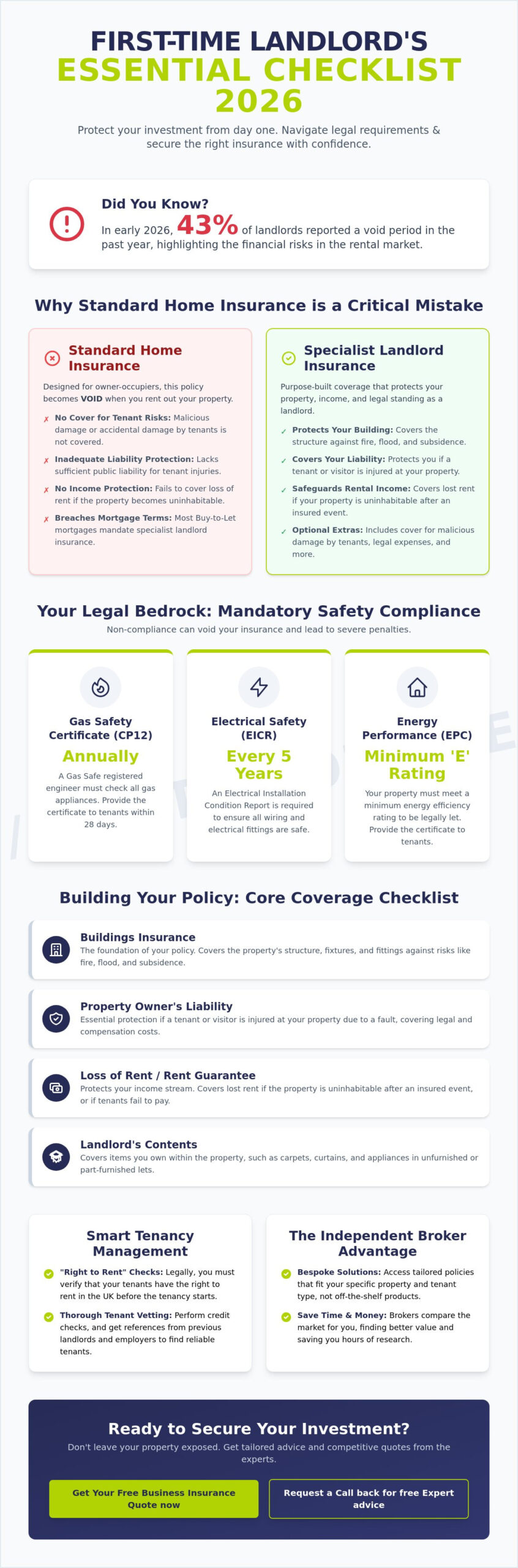
Did you know that in early 2026, 43% of landlords reported a void period in the past year? It’s a sobering statistic for anyone entering the rental market, especially following the abolition of “no-fault” evictions on May 1st. You likely want to focus on your new venture, but relying on standard home insurance is a common mistake that leaves many properties unprotected. This is why a comprehensive first time landlord insurance checklist is your most valuable tool for protecting your property and your peace of mind from day one.
We’ll show you exactly how to secure your property by clarifying which requirements are legal necessities and which are optional protections. You’ll gain a clear understanding of mandatory safety certificates like the EICR and Gas Safety checks, the differences between buildings and liability cover, and how to safeguard your rental income in a changing market. Simply Just Quote Me to streamline your insurance process and ensure your investment is fully compliant with the latest 2026 regulations.
Key Takeaways
- Identify why standard home insurance leaves your rental property exposed and how to avoid the common trap of voided policies.
- Navigate the mandatory 2026 legal landscape, including the essential requirements for Gas Safety Certificates and five-year EICR reports.
- Utilise our detailed first time landlord insurance checklist to distinguish between buildings, contents, and liability cover for full protection.
- Master the fundamentals of tenancy management, from performing “Right to Rent” checks to vetting tenants effectively in a post-no-fault eviction market.
- Understand the benefits of using an independent broker to access bespoke insurance solutions that offer better value than off-the-shelf alternatives.
Why Standard Home Insurance Won’t Protect Your Rental Property
Many new landlords assume their existing home insurance policy is sufficient to cover their rental property. This is a dangerous misconception. Standard home insurance is built on the assumption that the property owner lives in the building and takes personal care of it. When you introduce a tenant, the risk profile shifts significantly. For anyone building a first time landlord insurance checklist, understanding this distinction is the first step toward securing your investment.
If you continue to use a standard residential policy while renting out the property, you risk your insurer voiding the policy entirely. This means if a fire or flood occurs, you could face total claim rejection. Specialist landlord insurance is designed for the unique challenges of 2026, offering protections that standard policies simply do not provide. These policies account for the fact that you aren’t on-site every day to spot a leak or a maintenance issue before it becomes a catastrophe.
The Legal Distinction of a “Let” Property
The relationship between a landlord and a tenant is a commercial one. It carries different legal weight than living with family members or friends. When a third party pays to reside in your property, your liability risks increase. If a tenant is injured due to a fault in the property, you are legally responsible. Standard policies usually lack the Public Liability limits required for rental scenarios. They also won’t help you recover lost income. By understanding rent insurance, you can see how specialist policies protect your cash flow if the property becomes uninhabitable. This is a feature standard home insurance never includes, yet it’s a vital part of any first time landlord insurance checklist.
Mortgage Lender Requirements
Transitioning from a homeowner to a landlord often involves moving from a residential mortgage to a Buy-to-Let (BTL) mortgage. You must obtain “consent to let” from your lender before any tenant moves in. Failing to inform them of a change in occupancy can be considered mortgage fraud. Most lenders make landlord insurance a mandatory condition of the mortgage agreement. They want to ensure their collateral is protected by a policy that accounts for the specific risks of a let property. Without the right coverage, you are not only exposed to financial loss but also in breach of your mortgage contract. This transition is a critical regulatory step that separates professional landlords from casual homeowners.
Get Your Free Business Insurance Quote now.
Request a Call back for free Expert advice.
The Regulatory Foundation: Legal Safety Checks and Certificates
Before a tenant ever turns a key, your property must meet strict legal benchmarks. These aren’t mere suggestions; they are the bedrock of your legal standing as a housing provider. Failing to meet these standards doesn’t just invite local authority fines. It can also lead to your insurer rejecting a claim entirely. Any comprehensive first time landlord insurance checklist starts with verifying that your safety certificates are current, valid, and properly documented.
As of 2026, properties must maintain a minimum Energy Performance Certificate (EPC) rating of E to be legally let. While many landlords are proactively upgrading to higher ratings to future-proof their investments, E remains the current legal floor. You should verify your specific landlord safety responsibilities via official government resources to ensure your property remains compliant with the latest energy and safety standards. If you need help understanding how these regulations affect your policy, you can consult an expert broker for tailored advice.
Gas and Electrical Safety Obligations
You must arrange an annual gas safety check conducted by a Gas Safe registered engineer. This results in a Gas Safety Certificate (CP12), which you must provide to your tenants within 28 days of the inspection. For electricity, the Electrical Installation Condition Report (EICR) is required every five years. It’s best practice to keep digital copies of these documents as part of your permanent records. Most insurers view a missing or expired safety certificate as a material breach of policy conditions. If a fire or accident is caused by faulty utilities and you don’t have the proper certification, your insurance policy will likely be invalidated.
Fire and Carbon Monoxide Prevention
Fire safety rules are precise and non-negotiable. You must install a smoke alarm on every habitable storey of the property. Additionally, carbon monoxide alarms are mandatory in any room containing a fuel-burning appliance, such as a gas boiler or a wood-burning stove. For furnished lets, all upholstered furniture must comply with the Furniture and Furnishings (Fire Safety) Regulations. This includes items like sofas, mattresses, and even headboards. Documenting your “start of tenancy” alarm tests provides vital evidence if a dispute or claim arises later. Including these verification steps in your first time landlord insurance checklist ensures you aren’t just paying for a policy, but actually maintaining the protection you need.
Get Your Free Business Insurance Quote now.
Request a Call back for free Expert advice.
The Essential First-Time Landlord Insurance Checklist
Selecting the right insurance isn’t just about finding the lowest premium. It’s about building a safety net that survives real-world challenges. In a market where 43% of landlords reported a void period in early 2026, your first time landlord insurance checklist must account for both physical damage and financial disruption. A well-structured policy ensures that a single burst pipe or a tenant dispute doesn’t derail your entire investment strategy. By focusing on the specific risks associated with rental properties, you can move forward with the confidence that your assets are professionally protected.
Protecting the Physical Asset
Buildings insurance is the foundation of your coverage. It protects the structure against major perils such as fire, flood, and subsidence. One common mistake for new landlords is insuring the property for its market value. You must calculate the “rebuild cost” instead, which is the actual cost of labour and materials required to reconstruct the property from scratch. Our Residential Letting Insurance options are designed to help you navigate these specific valuations. Don’t overlook contents cover, even for unfurnished lets. You’ll likely still own carpets, curtains, and white goods that need protection. Keep in mind that insurers generally exclude general wear and tear, so regular maintenance remains your responsibility.
Liability and Income Protection
Liability and income protection are where you mitigate the most significant financial risks. Property Owners Liability is a standard inclusion and serves as a specialized form of Public Liability Insurance. It shields you if a tenant or visitor suffers an injury on your property and brings a legal claim against you. Equally vital is Loss of Rent cover. If a fire or flood makes the building uninhabitable, this cover replaces your lost income so you can continue meeting mortgage obligations during repairs. While setting up these protections, ensure you’re compliant with wider regulations, such as using a tenancy deposit protection (TDP) scheme. Compliance with these legal standards is often a prerequisite for your insurance to remain valid during a claim.
You should also consider optional extras to fill potential gaps. Accidental damage cover is useful if a tenant stains a carpet or breaks a window. Malicious damage cover provides a deeper layer of security against intentional harm to the property. Finally, legal expenses cover has become increasingly important in 2026. With the abolition of “no-fault” evictions, legal disputes can be more complex and costly to resolve. Having professional legal support built into your policy ensures you aren’t facing these administrative burdens alone.
Get Your Free Business Insurance Quote now.
Request a Call back for free Expert advice.
Managing Your Tenancy: Vetting, Deposits, and Right to Rent
Managing your tenancy effectively is about more than just being a good host. It is a critical part of your risk management strategy. For those following a first time landlord insurance checklist, the vetting and administrative phase is where you ensure your policy remains enforceable. Insurers often set specific conditions regarding how you select and manage tenants. If you fail to meet these operational standards, you might find your cover compromised exactly when you need it most.
One of your primary legal duties is the “Right to Rent” check. You are required to verify the immigration status of every adult tenant before they move in. This is a statutory obligation that carries significant penalties for non-compliance. Beyond legal requirements, thorough vetting acts as your first line of defence against future claims. This process should include comprehensive credit checks, employment references to confirm income, and history from previous landlords to identify potential red flags. Following these steps helps you build a stable rental business from the start.
The Vetting Process as Risk Mitigation
Thoroughly checking a tenant’s background significantly reduces the likelihood of facing malicious damage or unpaid rent. For tenants with lower credit scores or students, requiring a UK-based guarantor provides an extra layer of financial security. It is important to remember that some Rent Guarantee policies require specific vetting evidence, like a formal reference from a previous landlord, to remain valid in the event of a claim. This vetting process is a core element of your first time landlord insurance checklist because it demonstrates to your insurer that you are acting with professional due diligence.
Deposit Protection and Inventories
Once you accept a deposit, the clock starts ticking. You must protect the funds in one of the three government-approved schemes within 30 days. You are also legally required to provide the tenant with “Prescribed Information” detailing where their money is held. Failing to do this can prevent you from using a Section 8 notice if you ever need to regain possession of the property. Alongside this, a professional inventory and schedule of condition are essential. Detailed notes and high-resolution photos are the only way to prove damage at the end of a tenancy and successfully claim against a deposit.
If your property is part of a mixed-use building, such as a flat above a retail unit, your insurance needs will differ. In these cases, you should look into Commercial Property Insurance to ensure the entire structure is correctly covered. To make sure your specific setup meets all legal and insurance requirements, you can speak with our team today for a professional assessment.
Get Your Free Business Insurance Quote now.
Request a Call back for free Expert advice.
Why Using an Independent Broker Saves New Landlords Time and Money
Completing your first time landlord insurance checklist is a major milestone, but the final hurdle is securing the policy itself. While big banks and automated platforms offer convenience, they often provide rigid, “one-size-fits-all” products. These policies might seem cheaper initially, yet they frequently contain restrictive clauses that don’t account for the specific nuances of your property or tenant type. Working with an independent broker provides a human-centric alternative to these automated systems, ensuring you receive a policy that is actually fit for purpose.
Bespoke Solutions vs. Direct Policies
First-time landlords benefit immensely from a professional risk assessment that looks beyond the basic rebuild cost. An independent broker has access to a wide panel of UK insurers, many of whom don’t sell directly to the public. This allows them to find hidden savings by matching cover exactly to your needs, rather than upselling unnecessary add-ons. With Just Quote Me’s 30 years of experience in the UK market, we understand how to navigate complex risks that automated sites often reject. Whether you’re managing a standard let, a House in Multiple Occupation (HMO), or even a property with specialist features covered under thatched insurance, a broker acts as your expert advisor.
This support becomes most valuable during the claims process. If a tenant causes significant damage or a legal dispute arises, you won’t be left dealing with a generic call centre. Your broker understands your history and the specifics of your policy, providing a steady hand to manage administrative burdens while you focus on your investment. This personalised service ensures that you aren’t just another policy number in a database.
Taking the Next Step with Confidence
Securing the right protection doesn’t have to be a slow or complicated process. By using a broker, you can compare multiple providers at once through a single point of contact. This efficiency is vital when you’re trying to coordinate a tenant move-in date alongside your legal obligations. Before you finalise your first time landlord insurance checklist, ensure you’ve ticked off these essential steps:
- Obtained formal consent to let from your mortgage lender.
- Verified all safety certificates (Gas Safety, EICR, and EPC) are valid.
- Completed thorough tenant vetting and secured the deposit in a government-approved scheme.
- Selected a bespoke insurance policy that includes Property Owners Liability.
By following this structured approach, you transition from a property owner to a professional landlord with your financial interests fully protected. You can Get Your Free Business Insurance Quote now to see how a tailored policy can secure your future rental income.
Get Your Free Business Insurance Quote now.
Request a Call back for free Expert advice.
Secure Your Future as a Professional Landlord
Transitioning into the rental market is a significant step that requires a shift toward a professional risk management mindset. You’ve learned that standard home insurance is insufficient for let properties and that meeting legal safety standards, such as the annual gas check and five-year EICR, is non-negotiable for your policy’s validity. By following this first time landlord insurance checklist, you’ve built a foundation of compliance and protection that guards against the specific risks of the 2026 property market.
Just Quote Me is here to simplify these administrative burdens. As an FCA-authorised independent broker with over 30 years of industry experience, we provide access to top UK insurers and bespoke advice tailored to your unique property needs. Whether you are managing a single flat or a complex mixed-use building, we ensure your investment remains secure and your liability is fully covered. Partner with Just Quote Me today to move forward with the confidence that your new venture is built on the strongest possible footing.
Get Your Free Business Insurance Quote now.
Request a Call back for free Expert advice.
Frequently Asked Questions
Do I legally need landlord insurance in the UK?
Landlord insurance isn’t a legal requirement in the same way as motor insurance, but it’s often a mandatory condition of your mortgage agreement. Most Buy-to-Let lenders require proof of specialist cover before they’ll approve your loan. Without it, you’re personally liable for any structural damage or legal claims, which can be financially devastating for a new investor. It’s the only way to ensure your asset is protected against rental-specific risks.
Can I use standard home insurance if I am only renting out one room?
You shouldn’t rely on standard home insurance even if you only have a single lodger. Most residential policies are voided the moment you take in a paying tenant without notifying the insurer. Specialist cover accounts for the increased liability and property risks associated with third-party occupants, ensuring you stay protected if an accident occurs in the rented space. Always disclose your rental arrangements to keep your coverage valid.
What happens if I don’t have a Gas Safety Certificate as a landlord?
Failing to provide a valid Gas Safety Certificate can lead to unlimited fines or criminal prosecution. Beyond the legal penalties, your insurer will likely reject any claims related to fire, explosions, or carbon monoxide poisoning if you haven’t met your annual inspection duties. Maintaining these records is a vital part of your first time landlord insurance checklist to keep your policy valid and your tenants safe.
Does landlord insurance cover me if my tenant stops paying rent?
Standard landlord policies don’t typically cover unpaid rent unless you’ve added Rent Guarantee Insurance as an optional extra. This specific cover is designed to protect your income if a tenant defaults on their payments. Since the abolition of “no-fault” evictions on May 1, 2026, many landlords now view this as an essential protection during lengthy legal proceedings. It provides a vital safety net for your monthly mortgage obligations.
What is Property Owners Liability and why is it included in my policy?
Property Owners Liability protects you against legal claims if someone is injured on your property. If a tenant trips on a loose floorboard or a visitor is hurt by a falling roof tile, you could be held liable for significant compensation. This cover is a standard inclusion because it manages the high cost of legal fees and court-awarded damages. It’s a critical layer of protection for your personal finances.
How much does landlord insurance cost for a first-time landlord?
The cost of your policy depends on several factors, including the property’s location, the rebuild value, and your tenant’s occupation. While first-time landlords don’t have a specific track record in the sector, insurers look at the safety measures you’ve implemented and the level of cover you choose. Using a broker helps you compare various providers to find a rate that fits your budget while maintaining high standards of protection.
Is accidental damage by a tenant covered by a standard landlord policy?
Accidental damage isn’t usually covered by a basic policy and must be added as an optional extra. Standard insurance focuses on major events like floods or fires rather than smaller mishaps. If you’re worried about tenants damaging worktops or breaking windows, you should check that your first time landlord insurance checklist includes this specific type of protection. It’s an affordable way to avoid paying for frequent, minor repairs yourself.
What is the difference between a residential mortgage and a Buy-to-Let mortgage for insurance?
Residential mortgages are for homes you occupy, whereas Buy-to-Let mortgages are for investment properties. Your insurance must reflect this difference because let properties have a higher risk profile for liability and damage. If you have a BTL mortgage but only have residential insurance, your lender may consider you in breach of contract and your insurer could void your policy. Always match your insurance to your specific mortgage type.
Get Your Free Business Insurance Quote now.
Request a Call back for free Expert advice.
