

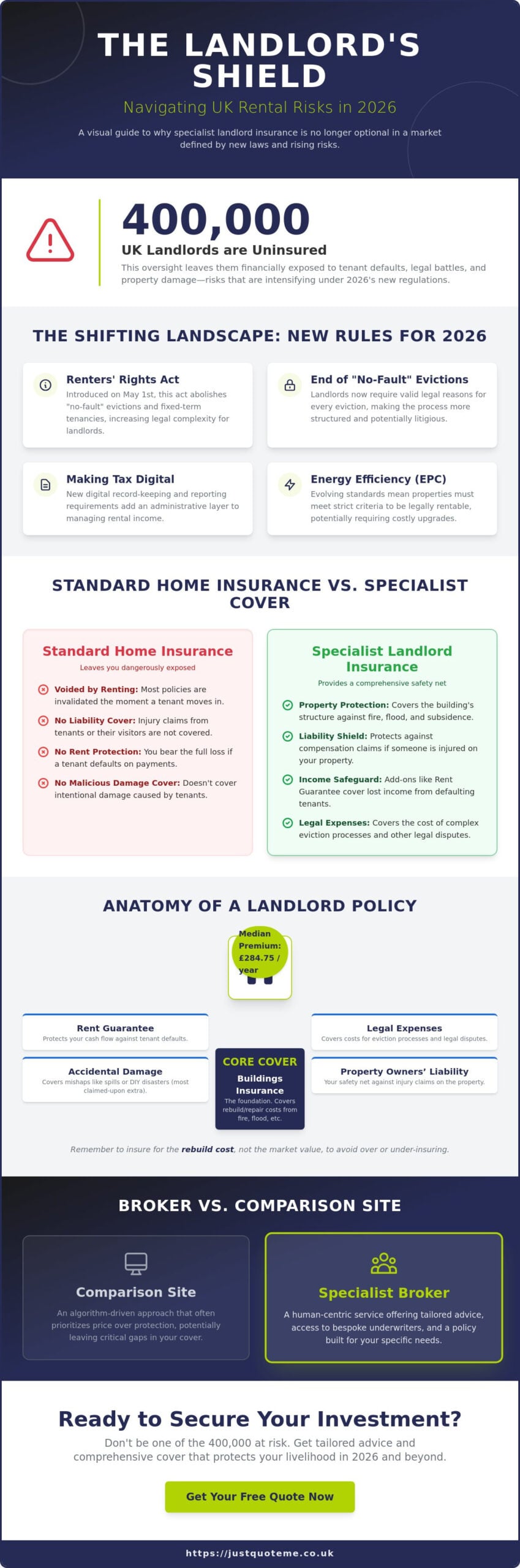
An estimated 400,000 UK landlords are currently operating without specialist landlord insurance, leaving themselves exposed to significant financial risk. In a year defined by the most sweeping regulatory shifts in decades, skipping tailored cover isn’t just a gamble; it’s a threat to your livelihood. We know that managing property in 2026 feels like a constant balancing act. Between the Renters’ Rights Act changes that took effect on May 1 and the new Making Tax Digital requirements, the legal landscape has never been more complex.
You’re likely feeling the squeeze from rising costs while navigating the end of “no-fault” evictions and fixed-term tenancies. This guide simplifies that complexity. You’ll learn exactly how to secure a policy that ensures full legal compliance and protects your rental income when disaster strikes. We will break down everything from the median £284.75 annual premium to the essential add-ons, like rent guarantee cover, that keep your investment profitable in a changing market.
Get Your Free Business Insurance Quote now.
Request a Call back for free Expert advice.
Key Takeaways
- Understand why standard home insurance leaves you exposed and how a specialist landlord insurance policy provides the specific liability and property protection required for rentals.
- Identify the essential add-ons like rent guarantee and legal expenses cover that safeguard your cash flow against tenant defaults and the costs of complex eviction processes.
- Learn the critical difference between market value and rebuild cost to ensure your property is adequately covered without overpaying on your premiums.
- Discover why a human-centric specialist broker offers better protection than a comparison site algorithm by accessing bespoke underwriters and tailored advice.
What is Landlord Insurance and Why is it Essential in 2026?
Many property owners mistakenly believe their standard home insurance provides adequate cover. In reality, letting a property usually voids a standard residential policy. Landlord insurance is a specialist product designed to protect property owners from the unique financial losses linked to rental activities, such as malicious damage or loss of rent. For a foundational overview of the different types of protection, you can read more about What is Landlord Insurance? and how it functions. Essentially, landlord insurance acts as a multi-layered shield against property damage, liability, and loss of income. The Financial Conduct Authority (FCA) plays a vital role here, ensuring UK landlords receive fair value and transparent policy terms through their Consumer Duty regulations.
The 2026 Rental Landscape: New Risks for Landlords
The rental market changed fundamentally on May 1, 2026, with the full implementation of the Renters’ Rights Act. With “no-fault” evictions now abolished and all tenancies becoming periodic, the legal risks you face as a property owner are higher than ever. You’re now operating in a world where valid legal reasons are required for every eviction, making the process more structured but potentially more litigious. Evolving energy efficiency standards (EPC) also mean your property must meet strict criteria to remain legally rentable. These shifts make legal expenses cover a necessity rather than an optional extra. A “cheap” policy from a comparison site might save you a few pounds today, but the gaps in coverage could bankrupt a small-scale landlord if a complex legal dispute arises or a major repair is required to meet new standards. It’s about protecting your investment from the unknown.
Is Landlord Insurance a Legal Requirement?
Strictly speaking, there’s no UK law that mandates landlord insurance for all owners. However, if you have a buy-to-let mortgage, your lender will almost certainly make it a mandatory requirement of your loan agreement. Failing to inform your insurer that a property is being let is a form of non-disclosure that can lead to claims being rejected entirely. Beyond the mortgage, professional property management firms often refuse to represent you unless you have valid, specialist insurance in place. It’s also worth noting that by May 31, 2026, you’re legally required to provide all existing tenants with the government-produced information sheet regarding their rights. Without the right insurance in place, you lack the professional support needed to navigate these administrative and legal hurdles efficiently.
Get Your Free Business Insurance Quote now.
Request a Call back for free Expert advice.
Decoding Your Policy: Standard Cover vs. Essential Add-ons
A standard home insurance policy won’t cut it when you’re letting out a property. To truly protect your investment, you need a policy that’s built for the job. Most landlord insurance starts with buildings insurance as the foundation. This covers the cost of repairing or rebuilding the structure if it’s damaged by fire, flood, or subsidence. However, in 2026, a “basic” policy is rarely enough to navigate the financial pressures of the modern rental market. You need to look at the specific components that turn a standard policy into a comprehensive safety net.
Accidental damage is frequently the most-claimed-upon part of any property policy. Whether it’s a tenant’s guest spilling wine on a brand-new carpet or a DIY mishap that leads to a burst pipe, these incidents happen. While some landlords try to save money by omitting this, the out-of-pocket costs for repairs in 2026 have risen significantly. For a detailed breakdown of how these different layers of protection work together, you can consult this guide to landlord insurance cover from a risk-management perspective.
Property Owners’ Liability: Your Safety Net
Property Owners’ Liability is often confused with general public liability insurance, but there’s a key distinction. While public liability covers your business activities, property liability specifically covers risks arising from the building itself. If a tenant trips on a loose floorboard you failed to fix, or a delivery driver is injured by a falling roof tile, you could face a massive compensation claim. This cover handles the legal fees and the eventual payout, ensuring a single accident doesn’t wipe out your rental profits for the year.
Contents Insurance for Furnished vs Unfurnished
Don’t assume that an “unfurnished” property needs no contents cover. Even if you aren’t providing sofas and beds, you likely still own the white goods, carpets, and curtains. Replacing an integrated fridge-freezer and oven after a kitchen fire can cost thousands. It’s also vital to understand the difference between maintenance and insurance. Insurance is for sudden, unforeseen events. It won’t cover “wear and tear,” which remains the landlord’s responsibility to manage through regular maintenance. If your property is part of a mixed-use building with a shop or office downstairs, you might actually require commercial property insurance to ensure the entire structure is correctly protected.
If you’re unsure which add-ons are necessary for your specific postcode or tenant type, you can speak with a specialist broker who understands the local market.
Get Your Free Business Insurance Quote now.
Request a Call back for free Expert advice.
Protecting Your Revenue: Rent Guarantee and Legal Expenses
The abolition of “no-fault” evictions on May 1, 2026, has fundamentally changed how you manage tenant defaults. It’s no longer a simple administrative task to regain possession of your property. Rent guarantee insurance ensures you still get paid if a tenant stops meeting their financial obligations. This specific type of landlord insurance typically costs approximately £195 per year when added to a policy. Legal expenses cover is equally critical, funding the cost of evictions, squatter removals, or complex contract disputes. Rent guarantee is the difference between a minor setback and a mortgage default.
Beyond income protection, you must consider the physical state of the building. If a major incident like a fire or flood makes your property uninhabitable, alternative accommodation cover is vital. This part of your policy pays for your tenants to stay in a hotel or temporary rental while your property is being repaired. It keeps you compliant with your duties as a landlord without you having to foot the bill for their relocation out of your own pocket.
Navigating Tenant Default in a Changing Economy
Current economic factors make rent protection more vital than ever. Statistics from the first quarter of 2026 show that 30% of landlords experienced rental arrears in the past year. With the average monthly private rent in the UK reaching £1,374 as of February 2026, a single month of missing payments can cause a significant deficit. To make a successful claim, most insurers require proof of professional tenant referencing. This ensures you’ve performed due diligence before the tenancy began. If you employ staff to handle property maintenance or admin, you’ll also need to integrate employers liability insurance to meet your legal obligations as an employer.
Legal Expenses and the Eviction Process
The high cost of legal representation in UK courts can be staggering. Since landlords must now use a Section 8 notice and provide a valid legal reason for every eviction, the paperwork must be flawless. Insurance providers handle the heavy lifting of legal documentation and court filings, which saves you hours of administrative stress. Having expert advice from a broker like Just Quote Me during a dispute ensures you don’t make a procedural error that could restart the entire eviction clock. Navigating these new regulations requires a steady hand and a policy that actually pays out when you need to defend your rights in court.
Get Your Free Business Insurance Quote now.
Request a Call back for free Expert advice.
How Much Does Landlord Insurance Cost in 2026?
Understanding the price of landlord insurance is essential for maintaining your margins in a high-regulation market. As of May 2026, the median cost for a standard policy in the UK is £284.75 per year. While you might find basic, buildings-only cover for as low as £170 to £185, these entry-level prices often lack the comprehensive protection needed for modern risks. Your premium is calculated based on several core factors: your property’s location, the specific tenant profile, and the rebuild value of the structure.
A common mistake is insuring a property for its market value. Insurers only care about the rebuild cost, which covers the labour and materials required to reconstruct the property from scratch after a total loss. In 2026, with construction costs remaining high, getting this figure wrong can lead to “under-insurance,” where a claim is only partially paid out. You can often lower your annual premium by increasing your voluntary excess, but ensure you have the cash reserves to cover that higher amount if you need to claim.
Factors That Influence Your Quote
The type of tenant you choose significantly impacts your risk profile. Professionals are often viewed as lower risk compared to students or those on housing benefits, though many specialist insurers now offer competitive rates across all profiles. Property age also plays a role. Period features or non-standard construction, such as those requiring thatched pub insurance or listed building protection, will naturally command higher premiums due to the specialist skills needed for repairs. Providing accurate data during the quote process is non-negotiable; even a small error regarding property history can lead to a rejected claim later.
Portfolio Insurance: The Multi-Property Discount
For landlords managing multiple properties, individual policies are rarely the most efficient choice. Portfolio insurance allows you to group all your properties under a single policy with one renewal date. This reduces your administrative burden and often triggers bulk-buy discounts that aren’t available for single-property lets. At Just Quote Me, we take a bespoke approach to portfolio management, ensuring each property has the specific level of cover it needs while keeping your total costs as low as possible.
Ready to see how much you could save? Just Quote Me for a tailored insurance premium that fits your specific portfolio needs.
Get Your Free Business Insurance Quote now.
Request a Call back for free Expert advice.
Why a Specialist Broker Beats a Comparison Site
Comparison sites are built for speed, but they aren’t always built for the complexities of property management in 2026. They rely on faceless algorithms that often fail to account for the unique character of your building or the specific risks of your tenant profile. A specialist broker provides a human-centric alternative for landlord insurance. We look beyond the simple tick-boxes to find cover that actually fits your needs. Unlike comparison sites that only show you a limited range of standard products, we have access to a panel of specialist underwriters. These professionals offer bespoke terms that automated systems simply cannot reach.
Having a steady hand when things go wrong is the ultimate benefit of using a broker. When you need to make a claim on your landlord insurance, you don’t want to be stuck in an automated phone queue or dealing with a generic call centre. We handle the heavy lifting, acting as your advocate to ensure the process is as smooth as possible. Our “No-Nonsense” philosophy at Just Quote Me means we’re here to do the hard work so you don’t have to. We understand the pressure of maintaining a profitable portfolio, and we’re committed to protecting it through every step of the journey.
The Just Quote Me Personal Touch
We bring over 30 years of experience to the UK insurance market. While our roots are firmly in Staffordshire, our expertise has a national reach that allows us to support landlords across the country. We take pride in being a human alternative to an algorithm. Whether you have a single buy-to-let or a diverse range of properties, we offer tailored solutions. This includes specialist cover for those in the hospitality sector, such as hotel and guest house insurance, where risks are more varied than a standard residential let.
Tailored Solutions for Complex Property Risks
Mixed-use properties, such as a high-street shop with a flat above, often fall through the cracks of automated quoting systems. These buildings need a bespoke touch to ensure both the commercial and residential elements are correctly insured. We specialise in finding residential letting insurance that integrates perfectly with your wider business needs. Our goal is to find the cover that fits your specific situation, rather than forcing you into a generic template that might leave you under-insured when you need it most.
Get Your Free Business Insurance Quote now.
Request a Call back for free Expert advice.
Securing Your Rental Future in a Changing Market
The rental landscape in 2026 requires more than just a passive approach to property management. With the Renters’ Rights Act now in full effect, having the right landlord insurance is your best defence against legal and financial instability. You’ve seen how essential it’s to distinguish between basic buildings cover and the comprehensive protection offered by rent guarantee and legal expenses. You also know that accurate rebuild costs and professional tenant referencing are the keys to a policy that actually pays out when you need it most.
As an independent UK broker with over 30 years of experience, Just Quote Me provides FCA-authorised expert advice that comparison sites simply can’t match. We work with a wide panel of top UK insurers to find the bespoke cover your portfolio deserves, whether you own a single flat or a diverse commercial mix. Secure your investment today and gain the peace of mind that comes from professional, local expertise. Protecting your property shouldn’t be a source of stress; it should be a source of confidence.
Get Your Free Business Insurance Quote now.
Request a Call back for free Expert advice.
Frequently Asked Questions
Do I need landlord insurance if I am only renting to a family member?
Yes, you still need a specialist policy even when letting to a family member. Standard residential insurance is designed specifically for owner-occupiers; any arrangement where someone else lives in the property independently can invalidate your cover. Even if you aren’t charging market rent, the liability risks remain the same. A family member can still experience an accident on the premises, and your mortgage lender will likely require a professional policy to protect their interest in the building.
Is landlord insurance more expensive than standard home insurance?
Landlord insurance typically costs more than standard home insurance because the risks associated with a rental are fundamentally higher. You aren’t just protecting the physical structure; you’re covering public liability for tenants, potential loss of rent, and a higher statistical likelihood of accidental damage. While the median annual cost in the UK is £284.75, this extra expense provides the specific legal and financial protection that a domestic policy lacks. It ensures you have a safety net for scenarios that standard insurance simply won’t touch.
Does landlord insurance cover me if the property is vacant for a long period?
Most standard policies only provide full cover for vacancies up to 30 consecutive days. If your property is empty for longer due to extensive renovations or a difficult void period, you’ll need specific unoccupied property insurance. Statistics from early 2026 show that 43% of landlords reported a void period in the past year. It’s vital to check your policy’s “days unoccupied” limit to ensure you don’t lose coverage during a tenant changeover, as an empty building faces higher risks of theft, vandalism, and undetected water damage.
Can I get landlord insurance for a property with a thatched roof?
Yes, you can get cover for thatched properties, but it requires a specialist underwriter rather than a general provider. Thatched roofs carry a significantly higher fire risk, which means insurers will often require specific safety measures like professional chimney inspections or the installation of spark arrestors. We provide bespoke solutions for non-standard construction. This ensures these unique buildings have the comprehensive protection they need without the generic exclusions often found on automated comparison sites.
What happens if my tenant causes malicious damage to the property?
Malicious damage by tenants is not typically covered under standard accidental damage and usually requires a specific add-on. If a tenant intentionally damages your property, this cover helps pay for repairs and can even include the cost of replacing items like smashed windows or kicked-in doors. It’s an essential consideration for properties in high-turnover areas. Having this protection in place ensures that a single bad experience with a tenant doesn’t result in a massive repair bill that wipes out your annual profit.
How does Property Owners Liability differ from Public Liability?
Property Owners Liability covers injuries or damage caused specifically by the building itself, such as a falling roof tile or a trip on a loose floorboard. Public Liability is a broader term that covers your actions as a business owner or any services you provide to the public. For most individual property owners, the liability included in a landlord insurance policy is specifically tied to the premises. If you run a larger property management firm with multiple employees, you might need additional business-specific liability cover to protect your wider operations.
Is rent guarantee insurance worth the extra cost in 2026?
Rent guarantee insurance is increasingly valuable in 2026 due to the abolition of “no-fault” evictions and the shift to periodic tenancies. With the eviction process now requiring a Section 8 notice and a valid legal reason, disputes can become more complex and time-consuming. Paying approximately £195 per year for this add-on protects your mortgage payments and provides a financial cushion while legal proceedings are underway. It’s a small price to pay for ensuring your cash flow remains stable during a tenant default.
What information do I need to provide for a landlord insurance quote?
To get an accurate landlord insurance quote, you’ll need the rebuild cost of the property, the year it was built, and the specific tenant profile. You should also have information on the security measures in place, such as five-lever mortice deadlocks on external doors or a maintained alarm system. Providing precise data about the property’s history and any previous claims ensures your policy is valid. This attention to detail prevents claims from being rejected later due to non-disclosure or inaccurate information provided at the start.
Get Your Free Business Insurance Quote now.
Request a Call back for free Expert advice.
