
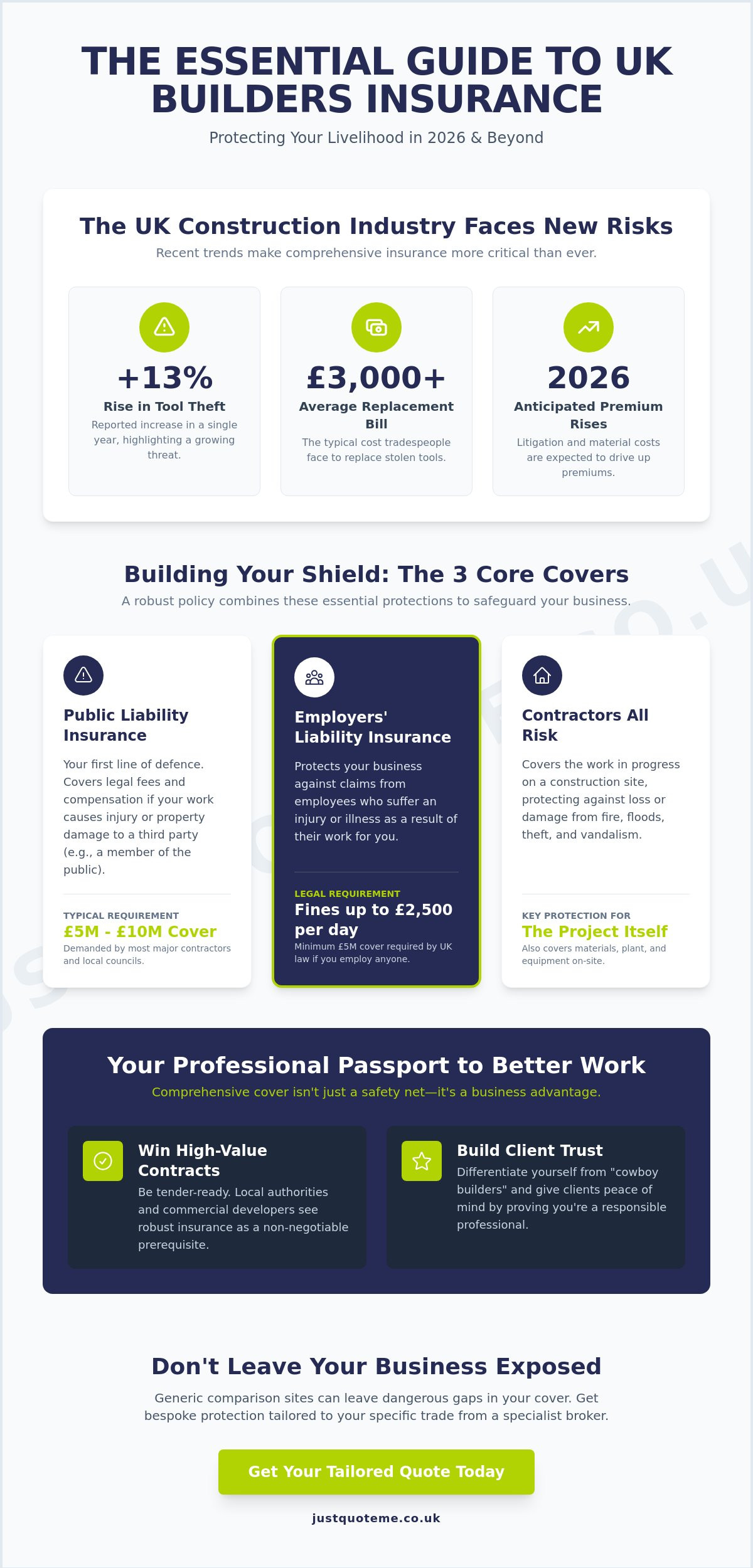
In the UK, a 2024 industry report revealed that tool theft incidents have risen by 13% in a single year, often leaving tradespeople with replacement bills exceeding £3,000. You already know that your tools and your reputation are the lifeblood of your trade, but the rising premium costs expected in 2026 make finding the right builders insurance feel more urgent than ever. It’s a common worry that the fine print might hide exclusions that could lead to a rejected claim just when you need support the most.
We want to simplify this process and help you secure bespoke protection that safeguards your business, your employees, and your hard-earned professional standing. This guide will teach you how to achieve full legal compliance and avoid common pitfalls in construction coverage. We’ll also show you how to prepare contract-ready insurance documents so you can confidently bid for local authority tenders and secure your next big project.
Key Takeaways
- Understand why rising litigation and material costs in 2026 make a multi-layered safety net essential for every UK construction firm.
- Discover how to build a bespoke builders insurance policy by combining the “Big Three” core covers to safeguard your business from site incidents.
- Learn how to identify and close common gaps in standard policies to protect your expensive tools and plant against the growing threat of theft.
- Master the “Principle of Indemnity” to ensure accurate site valuations and avoid the financial trap of being underinsured.
- Find out why the personal touch of a specialist broker provides more reliable protection for trade-specific risks than generic comparison site algorithms.
What is Builders Insurance and Why is it Non-Negotiable in 2026?
Builders insurance isn’t a single product. It’s a multi-layered safety net designed to protect your livelihood from the unique risks of the UK construction industry. In 2026, the stakes are higher than ever. With material costs remaining volatile and litigation rates for site accidents increasing, a standard policy is no longer enough. You need a comprehensive shield that covers your tools, your team, and your reputation.
Think of your insurance policy as a professional passport. Without it, you’re effectively barred from high-value contracts. Local authorities and commercial developers now view robust coverage as a prerequisite for any tender. If you can’t prove you’re protected, you’re invisible to the best clients in the market. Builders insurance ensures that a single mistake or an unforeseen site accident doesn’t lead to bankruptcy.
The Legal Requirements: What You Must Have
The Employers’ Liability Act 1969 remains the most critical piece of legislation for UK builders. If you employ anyone, even on a casual or temporary basis, you’re legally required to hold Employers’ Liability Insurance with a minimum cover of £5 million. The Health and Safety Executive (HSE) takes non-compliance seriously. You can face fines of up to £2,500 for every single day you operate without the correct cover. Beyond the financial hit, a lack of insurance can lead to criminal prosecution and the permanent closure of your firm. It’s a legal obligation that protects both your staff and your business assets.
Commercial Benefits: Winning More Work
While some cover is a legal mandate, other types are commercial essentials. Most major contractors and local councils now demand a minimum of £5 million or even £10 million in Public Liability Insurance before they’ll let you on-site. This protects you if a member of the public is injured or their property is damaged due to your work. In a market where trust is the primary currency, being able to produce these documents instantly is a major advantage.
Having these certificates ready doesn’t just tick a box. It builds immediate trust with residential clients who are increasingly savvy about checking credentials. Using your comprehensive builders insurance as a marketing tool proves you’re a professional who takes responsibility. It differentiates you from “cowboy” builders and gives your clients the peace of mind they need to sign on the dotted line. At JustQuoteMe, we simplify this process, ensuring you have the right documents to win that next big project without the stress of complex paperwork.
The Core Components of a Comprehensive Builders Policy
A solid builders insurance policy acts as a safety net for your livelihood. It’s rarely a single cover. Instead, it’s a combination of protections that shield you from various financial risks. For most UK firms, this starts with the “Big Three”: Public Liability, Employers’ Liability, and Contractors All Risk. These components work in tandem during a major site incident. For example, if a fire breaks out on a new build, your policy covers the cost to rebuild the structure, the damage caused to neighbouring properties, and any injuries sustained by your crew.
If you employ anyone, Employers’ Liability (EL) insurance is a legal necessity. Under the Employers’ Liability (Compulsory Insurance) Act 1969, you can face fines of £2,500 per day if you’re not covered. Beyond the basics, you should consider Products Liability. This is vital because it covers you for work you’ve already finished. If a faulty installation causes a ceiling to collapse 12 months after you’ve left the site, Products Liability steps in to handle the claim.
Choosing between an annual policy and project-specific cover depends on your workflow. Annual policies provide steady protection for multiple jobs throughout the year, which is usually more cost-effective for established firms. Project-specific cover is often better for large-scale developments or one-off high-value builds where the risks exceed your standard limits. If you’re unsure which limits you need, it’s easy to get a tailored quote that fits your specific trade.
Public Liability Insurance for Builders
Public Liability is your first line of defence against claims from the public. It covers legal fees and compensation if your work causes injury or property damage to a third party. Common scenarios include a scaffold pole falling onto a parked car or a burst pipe flooding a neighbouring property. Most contractors find that a minimum of £2 million in cover is required by local authorities or main contractors. For a detailed breakdown of how to satisfy strict tender requirements and manage your 2026 costs, our public liability insurance for builders UK complete 2026 guide covers everything you need to know. You can also find tailored protection through our Public Liability Insurance page.
Contractors All Risk (CAR) Explained
While Public Liability covers others, Contractors All Risk Insurance covers the actual work you’re doing. It protects the “work in progress” against perils like fire, flood, theft, or vandalism. This is essential for new builds and major extensions where the financial loss of a destroyed structure would be devastating. It ensures you have the funds to start over without draining your business capital or personal savings.
Optional Extras: Protecting Your Tools, Plant, and Expertise
Standard builders insurance policies provide a vital foundation for your business, yet they often leave your most valuable physical assets exposed. Many contractors assume their public liability cover automatically protects their equipment, but this is a common misconception. Liability insurance protects your bank balance against claims from third parties; it doesn’t buy you a new chop saw if yours is stolen from a site cabin. To build a truly resilient business, you must look at the specific gaps where your equipment and expertise are vulnerable.
The risk profile for UK tradespeople is shifting rapidly. Data from 2023 indicates that tool theft from vehicles occurs approximately every 12 minutes across the country. Relying on a generic policy means you might face significant out-of-pocket expenses when you can least afford them. When you consult a guide to construction insurance, the distinction between protecting the “works” and protecting your “means of working” becomes clear. For those involved in “Design and Build” contracts, the risk extends beyond physical tools to your professional advice. If a design error leads to a structural issue, you’ll need Professional Indemnity Insurance to cover the legal and remedial costs that standard liability won’t touch.
Van and Tool Insurance: Your Livelihood in a Box
Your tools are the lifeblood of your trade. It’s vital to understand the difference between “goods in transit” and “overnight tool cover.” Goods in transit typically protects items while you’re moving between jobs, whereas overnight cover is a specific extension. Insurers usually demand strict security measures for claims to be valid. This often includes requirements for Thatcham-approved alarms or specific deadlocks on van doors. If you leave tools in a vehicle overnight without the specified security, your claim will likely be rejected. You can find tailored protection through our Van and Tools Insurance options.
Plant and Machinery: Owned vs. Hired-in
Whether you own a fleet of excavators or hire a telehandler for a specific week, the financial risks are high. When you hire equipment, you sign a contract that usually makes you responsible for the machine from the moment it’s dropped off. If a hired excavator is damaged or stolen, you aren’t just liable for the replacement cost. You’re often contractually bound to pay “continuing hire charges” while the plant owner replaces the machine. This can add thousands of pounds to an already expensive situation. Our Plant and Machinery Insurance covers these ongoing costs and protects specialist equipment, ensuring a breakdown or theft doesn’t halt your project’s progress or drain your profits.
Calculating Your Coverage: Avoiding the Underinsurance Trap
The “Principle of Indemnity” is the backbone of any builders insurance policy. It ensures that, following a loss, you’re returned to the exact financial position you were in before the incident. You shouldn’t profit from a claim, but you certainly shouldn’t be left out of pocket. Many UK tradespeople fall into the trap of underinsurance by providing outdated valuations. If you undervalue a project by 25%, an insurer may apply the “Condition of Average,” meaning they only pay out 75% of any claim, regardless of its size.
To get your figures right, you must assess the Maximum Probable Loss (MPL). This isn’t just the cost of the bricks and mortar. It includes debris removal, professional fees, and the inflated cost of materials at the time of the rebuild. With BCIS (Building Cost Information Service) data indicating that construction material costs have remained volatile into 2026, using 2023 price points for a new contract is a recipe for disaster. Always factor in a 5-10% buffer for inflationary spikes during the project lifecycle.
A common pitfall is failing to notify your broker when you move from small domestic extensions to high-value commercial contracts. If your policy is capped at £250,000 per project and you sign a deal for a £1 million build, you’re effectively uninsured for that site. Keep your broker in the loop every time your contract value exceeds your current policy limits. The same principle applies across the trades sector — for example, if your business also operates vehicles or works alongside automotive contractors, understanding how rising premiums affect related industries is equally important, as explored in our ultimate guide to motor trade insurance in the UK for 2026.
Setting Your Liability Limits
While £1 million in public liability was once the standard, many local authorities and Tier 1 contractors now require a minimum of £5 million or even £10 million for 2026 tenders. Your trade’s risk profile dictates this need. A joiner working on ground-floor shop fits faces lower third-party risks than a specialist involved in Working at Height Insurance. If a tool falls from a three-storey scaffold, the potential for a life-changing injury claim is massive, making higher limits essential for your builders insurance package.
The Claims Process: Why Documentation is King
If an accident occurs, your immediate actions determine the success of a future claim. Follow these steps:
- Secure the area to prevent further injury or damage.
- Take high-resolution photos and videos of the scene before anything is moved.
- Record witness statements and log the exact time and weather conditions.
Site logs and RIDDOR (Reporting of Injuries, Diseases and Dangerous Occurrences Regulations 2013) reports are your primary defence against liability claims. Without a clear paper trail, it’s your word against a claimant’s. At JustQuoteMe, we act as your advocate, using your documentation to negotiate directly with underwriters. We handle the heavy lifting so you can focus on getting the site back on track.
Don’t risk your livelihood on guesswork. For a policy tailored to your specific project values, Just Quote Me today.
Why a Specialist Broker Beats a Comparison Site
Speed often comes at the cost of accuracy on comparison sites. While an algorithm can generate a price in seconds, it lacks the context to understand the complexities of a modern construction site. These “faceless” platforms often overlook specific trade risks, such as depth restrictions or hazardous material handling, leaving you with a policy that’s cheap but ultimately useless when a claim arises. In 2026, the building industry faces tighter regulations and shifting safety standards. A generic site won’t tell you if your public liability covers the latest environmental requirements or if your tools have adequate protection during overnight storage.
Just Quote Me brings 30 years of experience in the Staffordshire insurance market to your business. We don’t just rely on automated data; we use our long-standing relationships with underwriters to secure “broker-only” rates. These exclusive premiums are rarely available on public aggregators. By choosing a specialist, you’re gaining a human advocate. If you need to make a claim, you won’t be stuck in a phone queue talking to a chatbot. You’ll speak to an expert who understands your trade and fights your corner with the insurer to ensure a fair and fast settlement.
Bespoke Coverage for Staffordshire Builders
Local knowledge matters in the construction industry. Our team understands the specific regional challenges faced by tradesmen in Stone, Stafford, and Newcastle-under-Lyme. Whether you’re working on Victorian terrace renovations in the town centre or new-build developments on the outskirts, we know which insurers have an appetite for Staffordshire projects. This expertise allows us to build a tradesman insurance package that reflects the actual risks you face on-site every day, rather than a generic one-size-fits-all policy.
Get Your Quote: The Just Quote Me Process
We’ve designed our process to be as straightforward as our name suggests. You don’t have time for endless forms or jargon-heavy consultations. Our approach focuses on three key pillars to get your builders insurance sorted quickly:
- Efficiency: We collect the essential details and do the heavy lifting to find the best market rates.
- Authority: As an FCA-authorised broker, we provide advice you can trust, backed by three decades of industry knowledge.
- Transparency: We’re clear about fees, exclusions, and coverage limits from the very first conversation.
Don’t leave your livelihood to a generic algorithm that doesn’t know a joist from a jack-plane. Get your tailored builders insurance quote today and ensure your business is protected by experts who know the UK trade inside out.
Future-Proof Your Business Today
Navigating the complexities of the UK construction market in 2026 requires a proactive approach to risk management. You now understand that builders insurance isn’t just a box-ticking exercise; it’s a vital safety net that keeps your projects moving and your reputation intact. By identifying the right mix of public liability and tool cover while avoiding the common trap of underinsurance, you position your firm for sustainable growth. Choosing a specialist broker provides the security that a standard comparison site simply can’t match.
Just Quote Me offers a human-centric alternative to automated algorithms. With over 30 years of industry experience, our team acts as a steady hand in a complex market. We are an FCA-authorised independent broker with direct access to a broad network of top UK insurers. This means we do the heavy lifting to find you the most reliable protection at a fair price. It’s time to stop worrying about the “what ifs” and focus on the job at hand.
Get a Bespoke Builders Insurance Quote from Just Quote Me
Protecting your business is the smartest investment you’ll make this year. We look forward to helping you secure your trade with confidence.
Frequently Asked Questions
Is builders insurance a legal requirement for sole traders in the UK?
Builders insurance isn’t a legal requirement for sole traders without employees, but it’s often a contractual necessity. Most main contractors and local authorities won’t allow you on-site without proof of public liability cover. If you decide to hire anyone, the Employers’ Liability (Compulsory Insurance) Act 1969 makes employers liability insurance a legal obligation with fines of up to £2,500 per day for non-compliance. For a comprehensive overview of all the covers self-employed tradespeople need, our guide to sole trader insurance explains exactly how to align your policy with client requirements and growth ambitions.
Does builders insurance cover my tools if they are stolen from my van overnight?
Standard builders insurance doesn’t usually include tool cover unless you specifically add it to your policy. Even with the add-on, many insurers apply “overnight storage” clauses that require the vehicle to be parked in a locked garage or a secure compound between 9 pm and 6 am. Always check your policy wording to see if you’re covered for theft from a van left on a public road overnight.
What is the difference between Public Liability and Employers Liability?
Public liability covers claims made by third parties, such as clients or members of the public, for accidental injury or property damage caused by your work. Employers liability is a legal requirement if you have staff, protecting you if an employee falls ill or is injured while working for your business. One protects your interactions with the outside world, while the other protects your internal team and satisfies UK law.
Can I get builders insurance for a single, one-off project?
You can purchase short-term builders insurance or project-specific cover designed for one-off jobs or self-build developments. These policies are ideal for tradespeople who don’t work year-round or for homeowners managing their own renovation projects. We can help you arrange cover that lasts for the duration of the build, ensuring you don’t pay for a full year of protection when you only need three months.
How much does builders insurance typically cost in 2026?
The cost of your premium depends on your annual turnover, the number of staff you employ, and the specific nature of your trade. While basic public liability for a low-risk sole trader started at roughly £70 per year in 2024 industry reports, prices in 2026 reflect current inflation and market risks. High-risk activities like working at height or with heat will naturally result in higher costs, so getting a tailored quote is the only way to find an accurate price.
Does my policy cover subcontractors working on my site?
Your policy generally covers labour-only subcontractors because they work under your direct supervision and use your materials. However, bona-fide subcontractors usually need their own separate insurance and you’re responsible for checking their certificates annually. If you fail to verify their cover, your insurer might reject a claim if the subcontractor causes damage or an injury while on your project.
What happens if I under-declare my business turnover to the insurer?
Under-declaring your turnover can lead to your insurer applying the “average clause,” which reduces your claim payout in proportion to the under-declaration. Under the Insurance Act 2015, if you only declare 50% of your actual turnover, the insurer may only pay 50% of any claim you make. It’s much safer to provide accurate figures from the start so your business remains fully protected during a crisis.
Is professional indemnity insurance necessary for a general builder?
Professional indemnity insurance is essential if you provide designs, technical advice, or formal specifications to your clients. While standard builders insurance handles physical accidents, indemnity cover protects you against financial losses caused by professional negligence or errors in your plans. If you’re involved in design-and-build projects, this cover is a vital safeguard against costly legal disputes and rectification works.
