by jqm | Oct 6, 2026 | Insurance
Could the insurance protecting a landlord’s property leave the letting agency exposed? It can. If you’re asking what insurance does a letting agent require, the answer depends on the work you do, where in the UK you operate, whether you employ staff and whether you handle client money.
It’s easy to confuse landlord insurance with cover for the agency itself. Landlord insurance is designed for the property owner’s risks; it won’t automatically protect your business if a client alleges negligent advice, someone is injured during a viewing or an employee makes a claim. Client Money Protection is separate from insurance and may apply depending on where you operate and whether you hold client money.
This guide separates legal obligations from scheme, membership and contractual conditions, as well as cover that may be prudent for your operation. You’ll see how Employers’ Liability, Professional Indemnity and Public Liability can fit different agencies, and what to review before arranging or renewing cover. Just Quote Me is an FCA-authorised independent broker with over 30 years of industry experience, helping property businesses match insurance to their activities and contractual obligations.
Key Takeaways
- To assess what insurance does a letting agent require, distinguish legal duties from scheme rules, contract terms and prudent business protection.
- Match potential cover to your agency’s activities, including advice, property access, staffing and handling client money.
- Keep letting-agent cover separate from the landlord’s protection: an agency policy does not automatically insure the property or rental income.
- Before arranging or renewing cover, map your services, staff, premises, client money, contracts and data handling, then check current requirements for your UK jurisdiction.
- A specialist broker can help align insurance with your agency’s operations and contractual obligations.
What insurance does a UK letting agent require? Start with the three types of requirement
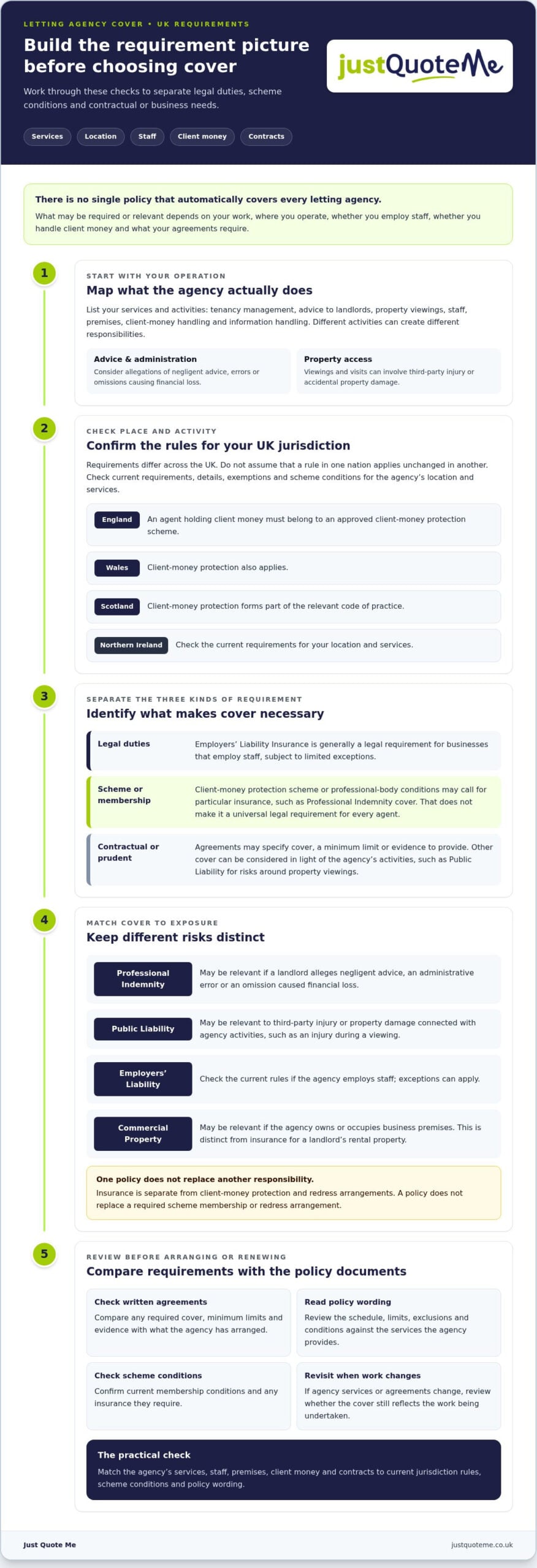
No single policy automatically covers every letting agency or every UK jurisdiction. The answer to what insurance does a letting agent require depends on its services, staff, premises, handling of client money and contractual commitments. A letting agent may find that different parts of its work create different responsibilities, so start by separating three kinds of requirement:
- Legal requirements: duties imposed by law. For example, Employers’ Liability Insurance is generally a legal requirement for businesses that employ staff, subject to limited exceptions.
- Scheme or membership requirements: conditions attached to a client-money protection scheme or professional-body membership. These may require particular insurance, such as Professional Indemnity cover, without making that cover a universal legal requirement for every agent.
- Contractual conditions and prudent protection: cover specified in an agreement, or protection selected to address risks arising from the agency’s work. Public Liability Insurance may be relevant to activities such as property viewings. Public Liability Insurance can be considered as part of a tailored business insurance review.
Insurance is not the same as client-money protection or a property redress arrangement. These are separate compliance matters. A policy may help respond to certain insured claims, subject to its terms, but it does not replace a required scheme membership or redress arrangement.
What can make insurance a legal or scheme requirement?
Location and activity both matter. In England, an agent holding client money must belong to an approved client-money protection scheme. The requirements differ across the UK: client-money protection also applies in Wales, while in Scotland it forms part of the relevant code of practice. Details, exemptions and scheme conditions can change, so check current rules separately for England, Wales, Scotland and Northern Ireland. Don’t assume a requirement in one nation applies unchanged in another.
Redress arrangements should also be checked as a separate obligation rather than treated as insurance. Confirm which rules apply to the agency’s location and services, and review any scheme’s current membership conditions. Those conditions may affect the cover the agency needs to maintain.
When can a contract or client require specific cover?
A landlord, property-management client or supplier may set insurance conditions in a written agreement. It could specify a type of cover, a minimum limit or evidence the agency must provide. These are contractual conditions, not automatically legal requirements. Read the wording carefully and compare it with the policy schedule, limits, exclusions and conditions. If the agency’s services or agreements change, review the cover so it continues to reflect the work being undertaken.
Which insurance policies can protect a letting agency’s day-to-day work?
The right cover depends on what your agency actually does. Managing tenancies, giving landlords advice, arranging viewings, employing staff and holding tenant information can each create different exposures. No policy should be assumed to cover every risk: check the wording, limits, exclusions and conditions against your agency’s activities.
When might professional indemnity or public liability be relevant?
Professional Indemnity Insurance may be relevant if a landlord alleges that negligent advice, an administrative error or an omission caused financial loss. For example, a client might claim that an agency failed to pass on important tenancy information or made an error while handling a management task. Whether a claim is covered depends on the policy’s terms and circumstances.
Public Liability Insurance addresses a different type of allegation: third-party injury or property damage connected with the agency’s activities. If a prospective tenant is injured during a viewing, or an agent accidentally damages a client’s property while attending a home, this cover may be relevant. It doesn’t replace Professional Indemnity Insurance, because an injury or damage claim differs from an allegation of professional error. Explore Professional Indemnity Insurance as part of assessing your agency’s professional risks.
These examples illustrate possible exposures, not guaranteed claims outcomes. Policy definitions, exclusions and limits vary, so read the documents carefully and consider how they apply to the services you provide.
Do staff, premises or tenant data change the insurance picture?
Yes. If your agency employs staff, Employers’ Liability Insurance is generally a legal requirement for almost all UK employers, although exceptions can apply. Check the current rules for your circumstances and jurisdiction. Employee numbers and working arrangements also help describe the agency’s operations when assessing insurance needs.
Consider your premises and information handling too. Commercial Property Insurance may be relevant if the agency owns or occupies business premises, with the appropriate cover depending on the property and what the business needs to protect. It’s distinct from insurance for a landlord’s rental property.
Letting agencies may store or process personal and financial information about landlords and tenants. Cyber Liability Insurance could be relevant to those operations, particularly where the business relies on digital systems to manage records or communicate with clients. Review what information you hold, how it is handled and the policy terms rather than assuming cyber cover responds to every data-related incident.
To make the assessment practical, list your services, staff arrangements, premises and data handling, then match each exposure to the cover under consideration. Just Quote Me can help you consider insurance options in light of your agency’s activities and contractual obligations.
Letting-agent insurance versus landlord insurance: what is the difference?
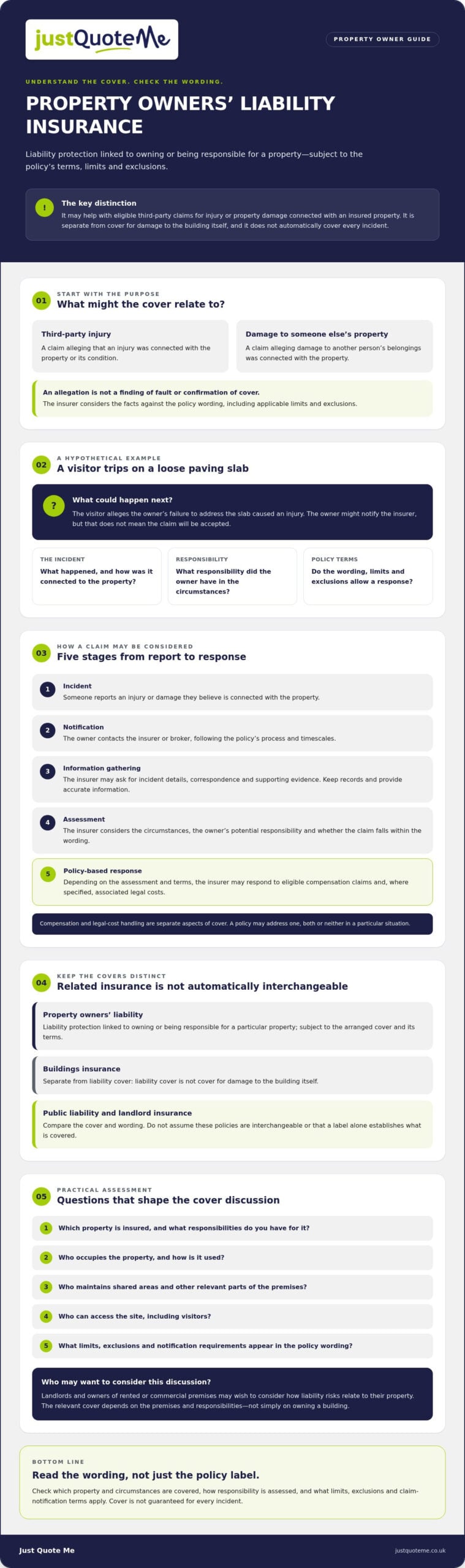
Letting-agent insurance protects the agency’s business risks. Landlord insurance is arranged for the property owner’s interests. They serve different purposes, and one policy shouldn’t be assumed to protect both parties. The agency’s cover won’t automatically insure a landlord’s building or rental income, while the landlord’s policy shouldn’t be treated as cover for the agent’s professional or operational liabilities.
Who insures the building, rental income and agency operations?
The key question is whose interest is being insured. A landlord may need cover relating to a rental property and their own financial exposure. The agency may need cover for its professional services, staff, premises or other business activities. The policyholder, insured parties and insured interests should reflect the actual arrangement. Review the policy documents and management agreement together so responsibilities are clear.
| Area |
Letting agency |
Property owner |
| Who arranges the cover? |
The agency arranges insurance for its business risks. |
The owner arranges insurance for their property interests. |
| What is insured? |
Depending on the policy, the agency’s professional or operational exposures. |
Depending on the policy, the rental property and the owner’s relevant interests. |
| Examples of exposure |
Alleged errors in management or administration, or incidents connected with agency activities. |
Risks associated with owning and letting the property, including the building or rental income where the policy provides for them. |
This distinction matters even when the agent handles much of the day-to-day work. The owner’s property insurance remains separate from insurance for the agency’s business. For property-owner cover, see Just Quote Me’s residential letting insurance.
How do property-management services affect cover?
An agency that only introduces tenants may have a different risk profile from one that collects rent, manages ongoing tenant communication or arranges maintenance. These activities describe the work the agency actually performs and should be disclosed accurately when arranging or renewing its business insurance. If the service changes, review the insurance details too.
For example, coordinating a repair involves different tasks from collecting rent or handling tenancy administration. Describing the agency’s full role helps assess relevant cover, but it doesn’t mean a policy will respond to every claim. The wording, exclusions and limits still determine what’s insured. Keeping the owner’s property arrangements distinct from the agency’s business cover makes it easier to identify gaps and avoid relying on the wrong policy when considering what insurance does a letting agent require.
How should a letting agent check insurance requirements before arranging cover?
A clear review starts with the agency’s actual work, not a standard package. To decide what insurance does a letting agent require, separate legal and scheme checks from the process of choosing insurance. Requirements can vary by UK nation and by whether the agency employs staff or handles client money, so verify the current rules that apply to your circumstances before relying on a policy to meet them.
What information should an agency prepare?
Use this checklist to build a practical picture of the business before arranging or renewing cover:
- Map your services. Record whether you find tenants, manage properties, collect rent, arrange maintenance or provide other services, along with the types of property you handle.
- Review staffing. Note your employees and working arrangements, then check current Employers’ Liability duties and any exceptions relevant to your business.
- Describe your premises. Identify business premises you own or occupy and the property or business assets you may need to insure.
- Set out client-money arrangements. Record whether you handle money belonging to landlords or tenants. Separately verify current client-money protection rules and scheme conditions for each relevant UK nation.
- Gather contracts and membership terms. Check agreements with landlords, suppliers and property-management clients, as well as any applicable scheme or professional-body requirements. Note insurance types, limits and evidence they specify.
- Review data handling. Consider the personal and financial information you store or process, and how your agency uses it.
This information helps distinguish what the agency must do under applicable law or scheme rules from cover selected to protect its business. Don’t assume that meeting one obligation automatically satisfies another.
How can a broker help assess the right cover?
A broker can use the agency’s declared activities and contractual conditions to help assess relevant policy options. Be accurate and specific: if you collect rent or arrange repairs as part of property management, include those tasks in the description of your work. Just Quote Me is a UK independent insurance broker with over 30 years of industry experience, offering tailored guidance for property-related businesses.
Before accepting or renewing a policy, read its definitions, exclusions, excesses, limits and claim-notification conditions. Check that the wording reflects the work you described, and compare any limits with written contract or scheme requirements. There isn’t one standard limit or policy that suits every agency, and cover remains subject to the policy terms.
If professional advice or administration is part of your work, explore Professional Indemnity Insurance options as part of your review.
Get tailored letting-agent insurance guidance from Just Quote Me
There isn’t one insurance answer for every agency. What insurance does a letting agent require depends on its UK jurisdiction, the services it provides, its staff and premises, how it handles client money, and the conditions in its contracts or scheme memberships. Keep those details together when reviewing cover, so the discussion reflects how your business operates rather than a generic agency profile.
What to expect when discussing cover
A useful insurance discussion starts with the practical details: whether you arrange tenancies, manage properties, collect rent or coordinate maintenance; whether you employ staff; what premises you use; and what written agreements or scheme rules say about cover. Sharing these details helps relate potential policy options to your actual activities and obligations.
Just Quote Me is a UK independent insurance broker with over 30 years of industry experience and FCA authorisation. Its tailored approach can help you consider relevant business insurance in light of your agency’s work and contractual requirements. The final cover depends on the policy wording and insurer’s terms, including definitions, exclusions, limits and conditions. Review those documents carefully before deciding whether the cover meets your needs.
Choose a practical next step
Prepare a short summary of your services, staffing, premises, client-money arrangements and contractual requirements. Then choose the route that suits you: start with an online quote, or request a callback if you’d prefer to discuss your questions.
Take the next step towards suitable agency cover
There’s no single answer to what insurance does a letting agent require. Your needs depend on the services you provide, your UK jurisdiction, staff and premises, client-money arrangements and any scheme or contract conditions. Keep legal and scheme checks separate from policy selection, and make sure the cover reflects your agency’s actual work. Landlord insurance is also distinct: it protects the property owner’s interests, not automatically the agency’s operations.
Just Quote Me is an FCA-authorised independent UK insurance brokerage with over 30 years of industry experience. Its tailored approach and access to a network of UK insurers can help you consider options that fit your business activities and contractual obligations. Prepare a summary of your services and requirements, then take a practical next step.
Get Your Free Business Insurance Quote now, or Request a Call back for free Expert advice. With a clear picture of your risks and obligations, you can move forward with greater confidence.
Frequently Asked Questions
What insurance is legally required for a letting agent in the UK?
There isn’t one insurance requirement that applies to every letting agent across the UK. Employers’ Liability Insurance is generally legally required for almost all employers, subject to limited exceptions. Client-money protection and property redress arrangements are separate from insurance, and their rules can differ between England, Wales, Scotland and Northern Ireland. Check current requirements for each relevant nation and your agency’s activities before treating a policy or scheme as legally mandatory.
Do letting agents need Professional Indemnity Insurance?
Professional Indemnity Insurance can be relevant if a client alleges that negligent advice, an error or an omission caused financial loss. Whether it’s required depends on the agency’s circumstances, any applicable scheme or membership conditions, contracts and current rules. Even if it isn’t mandatory for your agency, consider it in light of the services you provide. Review the policy definitions, exclusions and conditions, as the policy name alone doesn’t establish what’s covered.
Do letting agents need Public Liability Insurance?
Public Liability Insurance may be useful if agency activities could cause injury to a third party or damage their property. For example, an accident during a property viewing could lead to an injury allegation. This differs from Professional Indemnity Insurance, which relates to allegations such as negligent advice or errors causing financial loss. A client or contract may specify Public Liability cover, so consider your activities and review the policy terms and conditions.
Is client-money protection the same as insurance?
No. Client-money protection and insurance are separate arrangements. Whether your agency must join a client-money protection scheme depends on its location, activities and the current rules that apply. Insurance does not automatically satisfy a scheme requirement, and scheme membership doesn’t remove the need to assess the agency’s other business risks. Check the relevant nation’s current requirements and scheme conditions, particularly if your agency holds money for landlords or tenants.
Does a letting agent need Employers’ Liability Insurance?
Employers’ Liability Insurance is generally a legal requirement for almost all UK employers, so a letting agency that employs staff should check how the duty applies to its circumstances. Limited exceptions may apply, and staffing arrangements can affect the assessment. This cover is distinct from Public Liability and Professional Indemnity Insurance. Review the current requirements and any applicable exceptions, then make sure the policy reflects the agency’s employment arrangements.
Does a letting agent need landlord insurance?
A letting agent’s business insurance and a landlord’s insurance protect different interests. An agency policy doesn’t automatically insure the landlord’s building, rental income or other property-owner risks. The landlord should assess cover for their property and circumstances, while the agency considers its professional and operational exposures. If an agent manages a property, clearly describe those activities when arranging agency cover, but don’t assume either party’s policy automatically protects the other.
Are letting-agent insurance requirements the same across the UK?
Not necessarily. Insurance duties and related property-management rules may differ between England, Wales, Scotland and Northern Ireland. Client-money protection and redress arrangements should be checked separately for each nation where the agency operates. If your business works across borders, don’t assume that meeting requirements in one part of the UK covers all operations. Verify current legal duties, scheme rules and any relevant membership conditions for each area.
Article by
Just Quote Me
JustQuoteMe Ltd is an independent UK insurance brokerage specialising in business and personal insurance solutions. With over 35 years of industry experience, the company provides tailored insurance cover for businesses, landlords, tradespeople, hospitality venues, fleets, and individuals across the UK. Known for its personal service, expert advice, and competitive premiums, JustQuoteMe Ltd works with leading insurers to deliver bespoke policies designed around each client’s unique needs. The company is authorised and regulated by the Financial Conduct Authority (FCA No. 586607) and has built a reputation for trusted, straightforward insurance guidance and long-term client relationships.

by jqm | Oct 5, 2026 | Insurance
Could a crack in your commercial property lead to a claim shortfall rather than a straightforward repair? The answer may depend on the cause of the movement and the wording of your policy. Subsidence cover for commercial property isn’t something to assume: exclusions, excesses and how damage is assessed can all affect what happens if you make a claim.
It’s understandable to want clear answers before damage appears or an insurance renewal comes around. Subsidence, heave and landslip describe different types of ground movement, and policy terms may treat them differently. Knowing what to review can help you explain your concerns and property history clearly when discussing cover.
This guide outlines how subsidence cover may work, which policy details and property information deserve attention, and what to have ready for an insurance conversation. You’ll also find practical ways to think about evidence requirements and potential claim shortfalls without assuming that every policy offers the same protection. Just Quote Me is an independent UK insurance broker with over 30 years of industry experience, helping businesses make sense of commercial property insurance and discuss cover tailored to their needs.
Key Takeaways
- Learn how subsidence differs from heave and landslip, and why identifying the type of movement matters when discussing cover.
- Compare the insured property, policy wording, exclusions, excess and claim conditions before deciding whether subsidence cover for commercial property fits your needs.
- Record signs such as cracks or sticking doors as observations, not proof of subsidence, and follow your policy’s notification requirements.
- Gather details of the building’s history, previous movement, repairs, inspections and existing insurance to support a clearer review.
- See how a broker can use your property’s details and insurance priorities to help shape a tailored commercial property insurance conversation.
What does subsidence cover for commercial property mean in the UK?
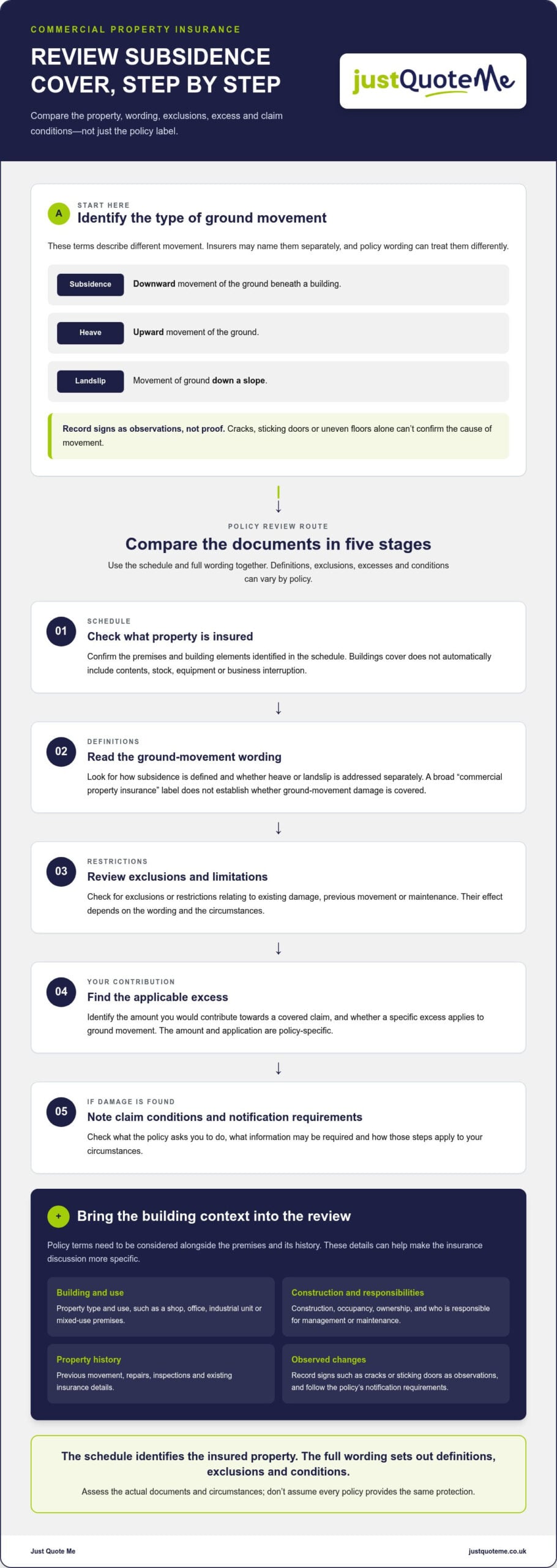
Cracks or other signs of movement can raise urgent questions about how a commercial building is protected. Subsidence means downward movement of the ground supporting a building, which may cause damage to the structure. The definition of subsidence helps distinguish this from other forms of ground movement, but visible signs alone can’t confirm the cause.
Subsidence cover for commercial property refers to protection for insured damage caused by ground movement, where the policy wording and circumstances allow a claim. The exact terms matter: cover may have specific definitions, exclusions, excesses or conditions. Buildings cover relates to the insured premises. It doesn’t automatically mean that contents, stock, equipment or business interruption losses are included; those protections depend on the policy arrangements.
How does subsidence differ from heave and landslip?
These terms describe different types of movement. Subsidence is downward movement of the ground beneath a building. Heave is upward movement of the ground, while landslip is the movement of ground down a slope. Insurers may name these risks separately because each describes a different movement and policy wording can set out how they’re treated. A crack, sticking door or uneven floor is an observation to record, not proof of any one cause.
Which commercial property details shape the cover discussion?
A useful review starts with the building and how it’s used. A shop, office, industrial unit or premises with mixed uses may present different details for an insurer to consider. Construction, occupancy, ownership and the division of management or maintenance responsibilities can also affect the conversation. For example, an owner who leases a building may need to clarify which parts of the premises they’re responsible for maintaining.
That context helps avoid relying on a generic answer. The policy schedule identifies the insured property and selected cover, while the full wording explains definitions, exclusions and conditions. A broad label such as “commercial property insurance” doesn’t, by itself, establish whether damage linked to subsidence is covered. Review the schedule and wording together, and relate them to the building’s use and history. Just Quote Me arranges commercial property insurance and can help bring those details into a tailored insurance discussion.
Which commercial property policy terms should you compare for subsidence?
A policy’s headline description won’t tell you exactly how a subsidence claim would be treated. Compare the schedule and full wording side by side, paying attention to what is insured, how ground movement is described, and what conditions apply. Definitions and exclusions can differ between insurers, so there’s no single answer that applies to every commercial building.
| Policy detail |
What to compare |
| Insured property |
Check the premises and building elements identified in the schedule. Don’t assume contents, stock, equipment or business interruption are included in buildings cover. |
| Subsidence wording |
Look for how subsidence is defined and whether the wording addresses heave or landslip separately. |
| Exclusions |
Review exclusions or restrictions that may relate to existing damage, previous movement or maintenance. |
| Excess |
Find the amount that you would contribute towards a covered claim, and whether a specific excess applies to ground movement. |
| Claim conditions |
Note any requirements about notification, information or other steps, and how they apply to your circumstances. |
Do commercial property policies automatically cover subsidence?
No. Don’t assume it’s covered because a policy provides general property damage protection or is described broadly as commercial property insurance. The schedule, policy wording, conditions and circumstances of the damage all matter. A restriction or exclusion may affect how a claim is considered. Compare the actual documents, rather than relying on a summary or headline description. The specific terms establish the protection, not the label alone.
For an overview of commercial property insurance cover, consider how the policy addresses the building and its particular use. Public liability insurance is separate: it concerns liability to third parties, not damage to the insured premises itself. Don’t treat one as a substitute for the other.
Which exclusions, excesses, and conditions deserve attention?
Read carefully for wording about previous movement, existing damage and maintenance. These details may be relevant to how an insurer assesses a claim, but their effect depends on the policy. Check notification requirements too, so you know what the wording asks you to do if you discover possible damage. An excess is your specified contribution towards a claim that falls within cover; the amount and application are policy-specific, not a universal market rule.
For wider background on land stability in planning and development, see Official UK government guidance on land stability. It provides context, but it doesn’t determine the terms of an insurance policy.
What should you do if a commercial building shows signs of movement?
Possible movement can be concerning, but a visible sign doesn’t establish its cause or confirm that a claim will be covered. Take a measured approach: record what you’ve observed, keep relevant property documents together, review your policy, then follow its notification instructions. This gives you a clearer account to share when discussing subsidence cover for commercial property.
What signs and records can help explain the situation?
Make a dated record of changes without trying to diagnose them. Note where a crack appears, its visible pattern and whether you’ve observed any change over time. Sticking doors or windows can also be logged as observations, not proof of subsidence. If you take photographs, include enough context to identify the location, and keep them with your notes.
A simple timeline can help explain when signs first appeared and what has happened since. Gather relevant repair records, inspection reports and other documents about the building’s condition or previous movement. Keep copies accessible, and avoid presenting an assumption about the cause as an established fact.
Assessment may require input from an appropriate property professional, depending on what is observed and the circumstances. A surveyor or structural engineer may be involved, but there isn’t one investigation that suits every building. Professional assessment can help distinguish between possible causes and establish what further information is useful.
How should a policyholder approach a potential claim?
Read the policy’s instructions for reporting possible damage, including any stated timeframes, and follow them. If you’re unsure which part applies, use the policy contact details to ask about the relevant notification process. Don’t assume that recording the issue or arranging an inspection alone fulfils any policy requirement.
Once notified, the insurer can explain what evidence or assessment steps are relevant to that particular case. These may depend on the policy wording, the reported damage and the information available. Keep a note of communications and retain copies of anything you send. The insurer’s assessment will determine how the policy applies; an initial notification doesn’t guarantee claim acceptance, a particular repair or a fixed timetable.
Clear records can support a more informed discussion, but they don’t replace the policy terms or a professional assessment. Keep the account factual, share relevant documents as requested, and let the insurer explain what applies to your circumstances.
How can you prepare your commercial property for a subsidence insurance review?
A well-organised record helps an insurer understand the building and the cover you’re seeking. Before a renewal or a new insurance discussion, gather the information you have about the premises, its history and any previous movement. Accurate disclosure supports an informed assessment of subsidence cover for commercial property, but it can’t guarantee a particular policy decision or prevent future damage.
What information should a commercial property owner organise?
Keep a practical file of relevant details and documents. You may not have every item, but clear records make it easier to explain the property and respond to case-specific questions.
- Property details: the premises’ use, construction information, occupancy and your ownership or management responsibilities.
- Movement history: notes about known signs of movement, when they were observed and any related assessments.
- Repairs and inspections: inspection reports, repair invoices, photographs and available records of work carried out.
- Insurance documents: the current and previous policy schedules and wording, plus relevant correspondence about the property or earlier claims.
If you’re acquiring a building, organise the property information and insurance documents available to you. For a renewal, update the file with changes to the building, its use, occupancy, repairs or inspections since the last review. An insurer or broker may need more detail depending on the property and its circumstances.
How can property history affect an insurance discussion?
Disclose known previous movement and repairs accurately, including what was observed, what work was completed and any assessment records you hold. Avoid describing a suspected cause as confirmed unless a professional assessment established it. Insurers may consider the building’s history when assessing requested cover and setting individual terms. Previous movement doesn’t automatically mean the same outcome for every property; the decision depends on the information, policy terms and circumstances.
Useful maintenance and inspection records can provide context about how the property has been managed. They aren’t a guarantee that damage or a claim will be avoided. Keep the information factual and distinguish documented findings from assumptions. That gives the insurance conversation a clear starting point and helps relate the building’s details to the cover being considered.
Prepare for a tailored review of your premises and insurance needs with Just Quote Me’s commercial property insurance guidance.
How can a broker help arrange commercial subsidence cover?
Ground movement can make commercial property insurance feel difficult to assess, particularly if the building has a history of repairs or previous concerns. An insurance broker can help organise the discussion around the premises, how it’s used, its history and the protection you’re looking for. That creates a clearer basis for considering subsidence cover for commercial property, without assuming that every insurer will offer the same terms or reach the same decision.
Just Quote Me is an independent, FCA-authorised UK insurance broker with over 30 years of industry experience. It arranges commercial property insurance and has access to a broad network of UK insurers. The broker can help make specialist policy wording easier to understand and connect the property’s circumstances with an individually tailored insurance conversation. Cover, terms and insurer decisions depend on the information provided and the individual risk.
What happens during a tailored commercial property insurance discussion?
The conversation starts with the building and your priorities. Useful context can include the premises’ use, construction, occupancy, ownership or management responsibilities, and any known movement or repairs. You can also explain what you want the insurance to protect and raise questions about how subsidence, heave or landslip appear in policy wording.
With those details in view, a broker can help consider relevant insurance options and explain the terms to review. Insurers assess each property using its specific information, so terms and decisions aren’t guaranteed in advance. A straightforward discussion helps identify what is known, what documents are available and which points need careful attention.
What are the next steps for a commercial property owner?
Before starting, gather the property details, relevant inspection or repair records, existing insurance documents and any available history of movement. Make a short list of questions, such as which premises are insured, what exclusions or excesses apply, and what the policy says about notification. Clear information helps keep the conversation focused and supports a more tailored review.
Ready to discuss your business insurance needs? Get Your Free Business Insurance Quote now.
If you’d prefer to talk through the property’s circumstances and policy questions, Request a Call back for free Expert advice.
Take the next step towards clearer property cover
Subsidence cover for commercial property depends on the policy wording, the building’s history and the circumstances of any damage. Compare the schedule, exclusions, excess and claim conditions, and keep factual records of movement, inspections and repairs. If signs appear, follow the notification instructions in your policy rather than assuming what caused them or what a claim will cover.
A clear insurance conversation starts with accurate details about your premises and the protection you need. Just Quote Me is an FCA-authorised UK insurance broker, founded in 1989, with over 30 years of industry experience and access to a broad network of UK insurers. The team can help you discuss commercial property insurance in light of your individual circumstances, without assuming a particular insurer decision or outcome.
Ready to take action? Get Your Free Business Insurance Quote now, or Request a Call back for free Expert advice. You can also explore insurance support from Just Quote Me. A well-prepared conversation is a practical next step towards understanding your options.
Frequently Asked Questions
Is subsidence covered by commercial property insurance in the UK?
It may be, but you shouldn’t assume subsidence is automatically covered. The policy schedule and full wording determine which premises and damage are insured, and whether exclusions, excesses or conditions affect a claim. Review the documents together, including any terms that refer specifically to subsidence, heave or landslip. The circumstances and evidence for a particular claim also matter, so a general policy description can’t confirm the outcome.
What is the difference between subsidence, heave, and landslip?
Subsidence is downward movement of the ground supporting a building. Heave is upward ground movement, while landslip describes ground moving down a slope. Insurers may use these terms separately because they describe different types of movement and may be addressed differently in policy wording. Visible damage alone can’t establish which type has occurred. A suitable professional assessment may be needed to identify the cause and explain the building’s condition.
What signs might indicate subsidence in a commercial building?
Possible signs to record include cracks in walls, changes in existing cracks, doors or windows that begin sticking, and uneven floors. These observations can have different causes, so they don’t prove subsidence on their own. Note where and when you noticed each change, and take dated photographs if useful. A clear timeline can help explain the situation, while a property professional may be needed to assess what is causing it.
Does a previous subsidence claim affect commercial property cover?
A previous claim or known movement may be relevant to an insurer’s assessment, but it doesn’t automatically determine the outcome. Insurers may consider the building’s history, any investigation or repairs, and the information available when assessing requested cover and terms. Disclose the history accurately and provide relevant reports, invoices or insurance correspondence. Avoid assuming that previous movement always prevents cover or leads to the same terms for every property.
What information should I provide when arranging subsidence cover?
Provide accurate details about the premises, including its use, construction, occupancy and your ownership or management responsibilities. Share known movement history, previous inspections, repair records and relevant photographs. Existing policy schedules, wording and correspondence can also help explain the property’s insurance background. The insurer or broker may need further details based on the building and its circumstances. Clear records help support a tailored discussion, but don’t guarantee a particular decision or policy term.
What should I do if I suspect subsidence at my business premises?
Record what you’ve observed, including dates, locations and any changes over time. Keep photographs and relevant inspection or repair documents together, then review your policy and follow its notification instructions and timeframes. Don’t treat cracks or sticking doors as proof of subsidence, and don’t assume a claim will be accepted. The insurer can explain what information or assessment steps are relevant to your specific circumstances and policy.
Can commercial property insurance cover subsidence damage to a rented building?
It can depend on who owns or insures the building, the responsibilities set out in the rental arrangements and the policy terms. A property owner should review the insured premises and schedule, while a tenant should understand which property and interests their own policy covers. Don’t assume that a tenant’s contents or business cover also protects the building, or that the owner’s policy covers every tenant loss. Check the relevant documents and responsibilities.
Article by
Just Quote Me
JustQuoteMe Ltd is an independent UK insurance brokerage specialising in business and personal insurance solutions. With over 35 years of industry experience, the company provides tailored insurance cover for businesses, landlords, tradespeople, hospitality venues, fleets, and individuals across the UK. Known for its personal service, expert advice, and competitive premiums, JustQuoteMe Ltd works with leading insurers to deliver bespoke policies designed around each client’s unique needs. The company is authorised and regulated by the Financial Conduct Authority (FCA No. 586607) and has built a reputation for trusted, straightforward insurance guidance and long-term client relationships.

by jqm | Oct 4, 2026 | Insurance
Could your insurance reflect the work your business actually does, not just the vehicles it owns? A haulage and logistics insurance policy may involve separate cover for vehicles, goods in transit and liability. If your routes, cargo or day-to-day activities don’t match what’s declared, the policy wording may not respond as you expect.
It’s understandable to find policies difficult to compare. Limits, exclusions, excesses and conditions can vary, and similar-sounding covers may protect against different risks. The key is to consider how each part of the insurance fits your operations.
This guide explains the main cover categories relevant to haulage and logistics businesses, including vehicle, cargo and liability insurance. You’ll learn what to check in policy wording against your vehicles, routes, loads and business activities, and what information to prepare before requesting a tailored quote. That gives you a clearer starting point for discussing your needs with an independent insurance broker.
Key Takeaways
- A haulage and logistics insurance policy should reflect the work you do, not just the vehicles you own.
- Vehicle, goods-in-transit and liability covers address different exposures; policy limits, exclusions and conditions depend on the wording.
- Compare policies against your activities, vehicles, cargo and routes, as similar policy names don’t guarantee identical protection.
- Prepare accurate details about drivers, staff, occasional work and subcontracting before requesting a tailored quote.
- An independent broker can help organise your business information and approach insurers with relevant details.
What does a haulage and logistics insurance policy mean for your business?
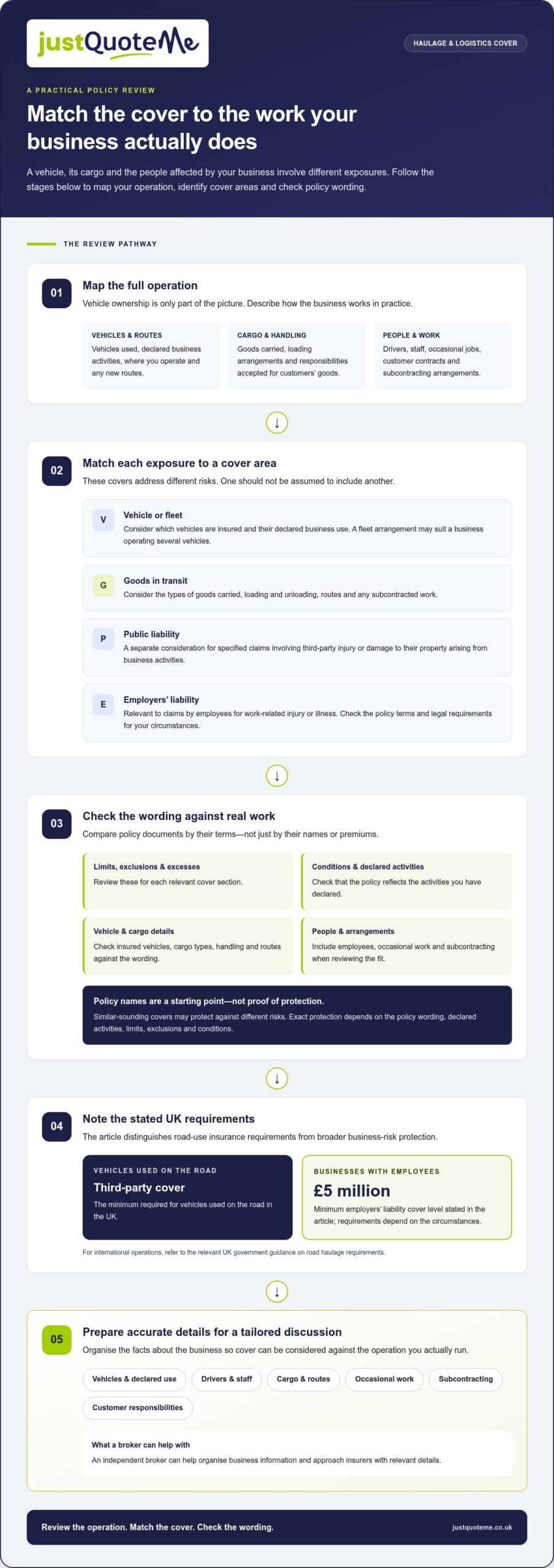
A haulage and logistics insurance policy is a tailored arrangement of relevant business covers, not one universal policy that automatically protects every part of a transport operation. Vehicle cover concerns the insured vehicle; goods-in-transit cover relates to cargo being carried; and liability covers may address claims involving other people, their property or employees. These are distinct areas, and one doesn’t automatically include the others.
Owning a van or lorry tells only part of the story. The goods you carry, where and how you operate, who employs or engages the drivers, and the responsibilities you accept under customer contracts can all affect the cover to consider. The exact protection depends on the policy wording, declared activities, limits, exclusions and conditions.
Which haulage and logistics businesses should review their cover?
Owner-operators, courier firms, fleet operators and businesses transporting goods for others can all have different insurance needs. A company delivering its own products may face different cargo and contractual exposures from a haulier carrying customers’ goods for payment. The vehicles may be similar, but the work is not.
Be clear about the full operation, including occasional jobs, new routes, changes in cargo and subcontracting arrangements. If another business carries loads on your behalf, or you take on subcontracted work, describe that arrangement accurately when discussing cover.
Why one policy label does not explain the protection
A policy name is a starting point, not proof that every operational risk is covered. A motor section concerns the vehicle and its insured use. Goods-in-transit cover relates to the load, while liability cover addresses specified claims connected with business activities. These protections may sit in separate sections or arrangements, each with its own terms.
For a quick sense of the vehicle-cover basics, read this overview of vehicle insurance. Then consider your operation through three practical lenses:
- Vehicle: Which vehicles are used, and for what declared business activities?
- Cargo: What goods do you carry, and what responsibilities do you accept for them?
- People: Who works for or with the business, and what third-party or employee exposures may arise?
These categories help you identify what to compare in the wording rather than relying on a broad label. If your operation uses several vehicles, motor fleet insurance is one relevant area to explore as you assess how vehicle cover fits your business.
What cover areas can a haulage and logistics insurance policy involve?
A haulage and logistics insurance policy can bring together several distinct areas of cover. Vehicle insurance concerns the insured vehicles and their declared business use; goods-in-transit cover relates to cargo being carried; and liability covers address specified claims involving other people, property or employees. These protections aren’t interchangeable, and one shouldn’t be assumed to include another.
Road-use insurance requirements are separate from broader business-risk protection. In the UK, third-party cover is the minimum required for vehicles used on the road. Businesses with employees generally need employers’ liability insurance, with a minimum cover level of £5 million. For international operations, refer to the relevant UK government guidance on road haulage requirements.
How do vehicle, fleet, and goods-in-transit cover differ?
Vehicle cover should reflect which vehicles are insured and how they’re used for work. A fleet arrangement may suit a business operating several vehicles, while goods-in-transit cover is a separate consideration for the load itself. Review wording for the cargo types, loading arrangements, routes and any subcontracted work involved in your operations.
| Cover area |
What to consider |
| Vehicle or fleet |
Vehicles insured, declared business use, limits, excesses and applicable conditions. |
| Goods in transit |
Types of goods carried, loading and unloading, routes, and subcontracting arrangements. |
| Public liability |
Specified claims for injury to third parties or damage to their property arising from business activities. |
| Employers’ liability |
Cover relevant to claims by employees for work-related injury or illness; check the policy terms and legal requirements for your circumstances. |
When should liability covers enter the discussion?
Liability cover deserves attention alongside vehicle and cargo protection. Public liability is a separate consideration if business activities could lead to a third-party injury or property damage claim. Employers’ liability is relevant if you employ staff, including drivers or warehouse personnel. The covers have different purposes, so assess each against your workforce and daily operations rather than treating liability as one broad category.
Availability, limits, exclusions and conditions depend on the specific policy wording. Compare the terms against the work you actually do, not just the cover labels. If your operation uses multiple vehicles, explore commercial fleet insurance as part of reviewing how vehicle cover may fit your business.
How can you compare haulage and logistics insurance policies fairly?
A fair comparison looks beyond the premium and policy name. Two documents may use similar labels but set different limits, exclusions, conditions and requirements. Declared operations and policy wording determine how cover responds. A lower price alone can’t show whether the cover fits your vehicles, cargo, contracts and day-to-day work.
Compare the details side by side, using your current proposal information and business contracts as a reference. The Road Haulage Association (RHA) insurance-services site is one example of the specialist categories hauliers may encounter, including goods in transit and liability. The policy documents themselves remain the basis for understanding the terms being offered.
Which policy details should you compare side by side?
Use a checklist or table to make differences visible. Check limits and any sub-limits against the responsibilities and potential exposures set out in your customer contracts. Then read the conditions that could affect a claim, not just the headline benefits.
| Detail |
What to check |
| Insured activities |
Do the declared services reflect your actual haulage, courier or delivery work? |
| Vehicles and drivers |
Are the vehicles, their business use and driver details accurately represented? |
| Cargo and routes |
Do the goods carried and intended journeys match the proposal and wording? |
| Limits and sub-limits |
Are the amounts relevant to the loads and contractual responsibilities involved? |
| Excesses and exclusions |
What costs may remain with your business, and which situations or goods are excluded? |
| Conditions and claims |
Review warranties, security requirements and claim-notification procedures. |
Small details matter. For example, a proposal describing routine local deliveries may not reflect a new cross-border route or a change in the types of goods carried. Keep the information consistent with your current operations, and update it when those operations change.
How can you spot gaps before a claim?
Walk through a typical job from collection to delivery. Consider loading and unloading, overnight parking, subcontractors, and changes in cargo or routes. Check the wording for how it treats these activities, rather than assuming they’re included. If work crosses borders, compare the policy’s territorial limits with the journeys you intend to make.
For a focused explanation of third-party injury and property damage considerations, read the guide to Public Liability Insurance. Reviewing each exposure this way helps you identify questions and differences before choosing between quotations.
A clear, accurate picture of your operation helps a broker assess relevant options from its insurer network. For a haulage and logistics insurance policy, the details should describe the work you do now, not just the business as it looked when you last arranged cover. Include occasional jobs, subcontracting and recent operational changes so the information is consistent from the outset.
What operational details help describe your haulage business?
Gather the information in a simple sequence. If you don’t have every detail to hand, note what needs checking rather than guessing.
- Business activities: Describe your services, including deliveries of your own goods and carrying goods for customers.
- Vehicles: List vehicle types, how many you operate, whether they’re owned or leased, and their business use.
- Drivers: Record relevant driver details and explain who drives each vehicle or vehicle type.
- Cargo and delivery patterns: Note the types of goods carried, typical loading arrangements and how often or where deliveries take place.
- Routes and territories: Describe regular journeys and any cross-border work, including routes you undertake only occasionally.
- People and contracts: Include employee numbers, subcontractor arrangements and relevant customer or contractual insurance requirements.
Accuracy matters. For example, disclose a change from delivering your own stock to carrying customers’ goods, or a new subcontracting arrangement. These details help frame the enquiry around your real activities rather than assumptions based on the business name or vehicle type.
How should you review a quote and policy documents?
Once you receive proposed terms, compare the cover schedule with the information you provided. Check that the listed activities, vehicles, drivers, goods and routes reflect the operation you described. If anything is missing or inaccurate, raise it before accepting cover so the documents can be considered against the correct details.
Read the limits, exclusions, excesses and conditions carefully. Pay particular attention to requirements that affect how you operate, along with the instructions and timeframes for reporting a claim. Employee-related cover deserves a separate review. For more detail, see the guide to Employers’ Liability Insurance.
With more than 30 years of industry experience, Just Quote Me can help organise the information for a tailored business insurance enquiry and approach insurers with relevant details. Get Your Free Business Insurance Quote now.
How can a broker help arrange tailored haulage and logistics insurance?
Haulage businesses can have very different insurance needs, even when they operate similar vehicles. An independent broker helps turn your business activities and risk details into a clear enquiry for insurers, then helps you understand the options and their terms. Just Quote Me is an independent, FCA-authorised UK insurance broker with access to a broad network of UK insurers and more than 30 years of industry experience.
The broker’s role is to make the process easier to follow, not to promise a particular premium, acceptance or level of cover. Accurate information gives insurers a clearer picture of your operation and helps the discussion focus on relevant options for your business.
What happens during a tailored insurance enquiry?
The enquiry starts with how your business works: the activities you undertake, vehicles and drivers, cargo, routes, employees and subcontracting arrangements. Those details help inform which insurer options may be relevant. A broker can then help you review the proposed wording, limits, exclusions and conditions, and explain how they relate to the risks you’ve described. The final terms depend on the insurer and policy documents.
Be open about occasional jobs and recent changes, too. If you’ve added a new delivery route or begun carrying a different type of cargo, include that information rather than relying on an old description of the business.
What is the next step for your haulage business?
Before starting an enquiry, gather a concise summary of your business activities, vehicles, drivers, goods, routes and workforce. Include cross-border journeys, subcontracting arrangements and any relevant contractual requirements. This gives the broker a practical basis for discussing your needs and approaching insurers with consistent information.
As an insurance broker, Just Quote Me can help you consider a tailored haulage and logistics insurance policy by matching the details of your operation with relevant insurer options. Review any proposed documents carefully, including the cover schedule and the terms that apply, before deciding whether they meet your needs.
Get Your Free Business Insurance Quote now
If you’d prefer to discuss your requirements with the team, request a callback for guidance.
Request a Call back for free Expert advice
Build cover around the work you do
A suitable haulage and logistics insurance policy should reflect your real operations, from vehicles and cargo to routes, staff and contractual responsibilities. Compare the wording, limits, exclusions and conditions, and keep the information you provide accurate as your business changes.
Preparing those details gives a broker a clearer basis for discussing relevant options. Just Quote Me is an independent, FCA-authorised UK insurance broker with more than 30 years of industry experience and access to a broad network of UK insurers.
Take the next step with a clear picture of your business. Get Your Free Business Insurance Quote now, or explore tailored business insurance with Just Quote Me. With accurate information and careful policy review, you can move forward with greater confidence.
Frequently Asked Questions
Is haulage insurance a single policy?
No, haulage insurance isn’t necessarily one standard policy. It can involve separate cover areas for vehicles, goods in transit and liabilities, arranged to reflect the business’s operations. A policy label alone doesn’t establish what’s protected. Check the schedule and wording for insured activities, limits, exclusions and conditions, and make sure the details match the work you actually do, including cargo, routes and subcontracting.
Is haulage insurance legally required in the UK?
Insurance for road use and wider business cover are separate considerations. Vehicles used on UK roads must have at least third-party motor insurance. Employers’ liability insurance is generally legally required for businesses with employees, with a minimum cover of £5 million. Requirements can depend on the circumstances, so check current official guidance for your situation. Goods-in-transit and public liability cover address different risks and shouldn’t be assumed to be included in motor insurance.
Does haulage insurance include goods in transit?
Not automatically. Goods-in-transit cover is a distinct consideration from insurance for the vehicle carrying the load. Review the wording for the types of goods, loading arrangements, routes and any subcontracting involved. Also compare limits, exclusions and conditions with your contracts and responsibilities for customer cargo. A haulage and logistics insurance policy should be assessed by its documents, not just its name.
What is the difference between haulage insurance and fleet insurance?
Haulage insurance describes cover considerations related to transport work, which may include vehicles, cargo and liabilities. Fleet insurance is an arrangement for insuring multiple vehicles under a fleet policy. It focuses on the vehicles and doesn’t automatically provide goods-in-transit or liability protection. Review each section of the wording to see which vehicles and uses are insured and what separate business covers may be relevant.
Can a courier or small operator get haulage insurance?
Couriers and small operators can discuss their business activities and insurance needs with a broker. The relevant options depend on factors such as vehicle use, whether you carry your own goods or customers’ goods, delivery routes, cargo and any subcontracting. Describe occasional work as well as regular jobs. An independent broker can use those details to approach insurers, but cover terms and acceptance depend on the insurer.
What details do I need to get a haulage insurance quote?
Prepare a clear outline of your business activities, vehicles and their use, driver details, types of goods carried, delivery patterns and routes. Include cross-border journeys, staff, subcontracting arrangements and any relevant customer contract requirements. Be accurate about occasional work and recent changes, too. Consistent information helps a broker present your operation to insurers and assess options against the work you actually do.
How much does haulage and logistics insurance cost?
There isn’t one standard price for haulage and logistics insurance. The premium depends on the business and the cover being considered, including its activities, vehicles, cargo, routes, selected limits and claims history. To make a useful comparison, look beyond the premium and review excesses, exclusions and conditions alongside the cover schedule. Provide accurate operational details when requesting a tailored quote, as incomplete information may affect the assessment.
Article by
Just Quote Me
JustQuoteMe Ltd is an independent UK insurance brokerage specialising in business and personal insurance solutions. With over 35 years of industry experience, the company provides tailored insurance cover for businesses, landlords, tradespeople, hospitality venues, fleets, and individuals across the UK. Known for its personal service, expert advice, and competitive premiums, JustQuoteMe Ltd works with leading insurers to deliver bespoke policies designed around each client’s unique needs. The company is authorised and regulated by the Financial Conduct Authority (FCA No. 586607) and has built a reputation for trusted, straightforward insurance guidance and long-term client relationships.

by jqm | Oct 3, 2026 | Insurance
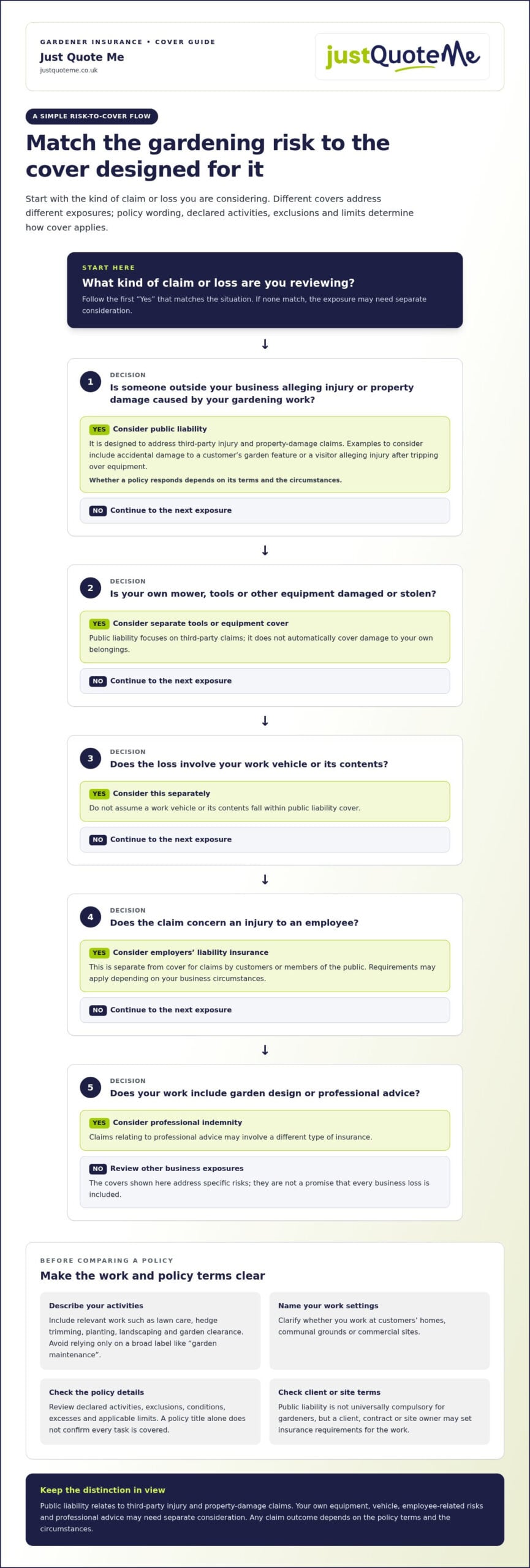
What if a customer trips over your hose, or a stone thrown up by a mower damages a nearby window? For gardeners, the right cover depends on the work you do and who or what could be affected. This guide to gardener public liability insurance UK explains how public liability may respond to third-party injury or property damage, and why the details of your work matter.
It’s reasonable to want clear answers before choosing a policy. Gardening can involve very different activities, from routine lawn care to planting, maintenance and garden design, and policy wording may treat them differently. A vague or incomplete description of your work could also create uncertainty if you need to make a claim.
We’ll outline what to check in a policy, including how public liability differs from employers’ liability, tools cover and professional indemnity. You’ll also see why it helps to consider your staff, equipment and any advice or design work you provide. Just Quote Me is an independent UK insurance broker with over 30 years of industry experience, offering tailored advice to help relate your gardening activities to suitable cover.
Key Takeaways
- Gardener public liability insurance uk relates to third-party injury and property damage, but the policy wording, declared activities, exclusions and limits shape how cover applies.
- Use hypothetical incidents, such as accidental damage to a customer’s property, to understand the risks to consider. Whether a claim is covered depends on the policy terms and circumstances.
- Compare public liability with employers’ liability, tools cover and professional indemnity by the type of risk each is designed to address.
- Prepare a clear list of your gardening activities, work sites, staff, equipment and contract requirements to support a more accurate review.
- Just Quote Me can help relate your business details to policy wording, drawing on its FCA-authorised independent broking experience and over 30 years in the industry.
What Does Gardener Public Liability Insurance in the UK Do?
Public liability insurance is designed to address claims from other people who say your business caused them injury or damaged their property. For example, a customer might claim that a garden wall was accidentally damaged during maintenance. Whether a policy responds depends on its wording and the circumstances of the incident.
This cover is different from protection for your own mower, tools or other equipment. Public liability focuses on third-party claims, while damage to your own belongings is a separate exposure. The broad principles of liability insurance can help explain the distinction, but the policy documents determine what a specific policy covers.
For a closer look at the cover, read Just Quote Me’s public liability insurance overview. As you compare gardener public liability insurance uk, pay attention to the activities declared, exclusions, applicable limits and any conditions. A policy’s title alone won’t tell you whether every task you undertake falls within its terms.
Which gardening jobs should you describe when arranging cover?
Give a clear picture of your day-to-day work and where you carry it out. Depending on your business, this could include:
- Lawn care and hedge trimming
- Planting, landscaping and garden clearance
- Work at customers’ homes, communal grounds or commercial sites
Describe unusual or higher-risk tasks accurately, rather than relying on a broad label such as “garden maintenance”. The more clearly your activities are presented, the easier it is to relate them to policy wording and identify questions about exclusions or limits before work begins.
Is public liability insurance a legal requirement for gardeners?
Public liability insurance isn’t universally compulsory for gardeners in the UK. That doesn’t mean you can assume a client will accept a job without evidence of cover. A contract, client or site owner may set insurance requirements as a condition of the work, so review those terms before agreeing to a project.
Check what evidence is requested and whether any stated limit or scope matches the work you’ve agreed to do. Clear documentation can help avoid uncertainty when arranging a contract, but it doesn’t change the policy’s terms. For employers’ liability, which relates to staff rather than third-party claims, consider the separate obligations that may apply to your business and seek advice based on your circumstances.
Gardening Risks and Incidents a Public Liability Policy May Address
Gardening work takes place around customers’ homes, shared spaces and members of the public. A mistake or accident could lead to a third party claiming that your work caused injury or damaged their property. These examples show the kinds of situations to consider, not guaranteed outcomes: how a claim is handled depends on the policy terms and the circumstances.
Examples involving customer property and members of the public
- Hypothetical, damage to a garden feature: While trimming a hedge or clearing a border, you accidentally damage a customer’s fence, paving or other garden feature. The customer may claim that your work caused the damage.
- Hypothetical, visitor trips over equipment: A visitor to a property trips over equipment left in a work area and alleges they were injured. They may bring a claim against your business.
In both scenarios, the insurer would assess the circumstances against the policy wording. The activity involved, the cover’s scope, exclusions and limits may all be relevant. Describing your work accurately when arranging cover can help the insurer assess the risks associated with your business.
What public liability may not include
Public liability is intended for third-party claims, not every loss your gardening business could face. If your own mower or other equipment is stolen or damaged, that’s a separate business exposure. Your work vehicle and its contents also shouldn’t be assumed to fall within public liability cover.
Injuries to employees are a different matter from claims by customers or members of the public. Employers’ Liability (EL) insurance is a separate cover, and GOV.UK explains the requirements for businesses with employees. If your work includes garden design or professional advice, claims relating to that advice may also involve a different type of insurance, such as professional indemnity.
In short, public liability addresses third-party liability, while your own equipment, vehicle and other business losses need separate consideration.
Read the policy wording carefully for exclusions, excesses, conditions and applicable limits. Don’t assume that an activity or incident is covered simply because it happened during a gardening job. If you want help relating your work to policy terms, explore tailored insurance support from Just Quote Me.
Different policies address different exposures. Comparing them by what they’re designed to cover can help you spot gaps without assuming one policy protects every part of your gardening business.
| Type of cover |
Exposure it is designed to address |
Gardening example |
| Public liability |
Claims from third parties involving injury or property damage allegedly caused by your business. |
A customer claims your work damaged their garden feature. |
| Employers’ liability |
Claims relating to employees’ injury or illness connected with their work. |
A member of staff is injured while carrying out a gardening task. |
| Tools and equipment cover |
Loss of or damage to the business’s own tools and equipment, subject to the policy. |
Your mower or hedge trimmer is stolen or damaged. |
| Professional indemnity |
Claims connected with professional advice, designs or recommendations, depending on the wording. |
A client alleges that a garden plan or recommendation caused them a loss. |
This comparison can help you assess gardener public liability insurance uk against the work your business actually does. Availability, terms, exclusions and limits vary by policy and insurer, so read the wording rather than relying on a cover name alone.
Public liability versus employers’ liability for gardening businesses
Public liability concerns claims from customers or other third parties. Employers’ liability relates to employees’ injury or illness connected with work. Whether employer insurance obligations apply depends on your circumstances and current UK rules. For more detail on this separate cover, read the employers’ liability insurance guide.
When tools cover or professional indemnity may be relevant
Consider tools cover if loss of or damage to your own equipment could disrupt your work. Professional indemnity may be relevant if you provide garden designs, advice or recommendations as part of your service. Neither is automatically necessary for every gardener; the decision depends on your activities, assets and appetite for risk.
Review each policy’s exclusions, conditions, excesses and limits alongside your contracts and work details. A broker can help relate those details to policy wording, so you can compare cover based on your actual business rather than generic assumptions.
A clear picture of your business makes it easier to compare cover against the work you actually undertake. Before discussing gardener public liability insurance uk, gather details about your activities, work locations, staff, equipment and any insurance requirements set by clients or site managers. Accurate information helps a broker and insurer assess your business’s risk profile and relate it to policy terms.
Describe your work, clients and work locations accurately
Start with a practical list of your services. Include routine jobs such as lawn care and planting, along with specialist tasks, clearance or subcontracted work where relevant. Note where you work: for example, at domestic properties, communal grounds or commercial premises. Include how many people work in the business and whether you use employees or subcontractors. Record the equipment you rely on, too.
Be specific about work that differs from your usual maintenance jobs. A broad description may not convey the range of activities you carry out. Clear details give the broker and insurer a better basis for discussing how the policy wording relates to your work.
Review policy wording, limits and evidence of cover
Once you have your business details together, compare the proposed cover against them. Check that the activities and locations described align with your work, then review relevant exclusions, conditions, excesses and policy limits. No single limit suits every gardener; consider the nature of your jobs and any requirements attached to the contracts you take on.
- Contract terms: Note insurance requirements stated by customers, clients or site managers, including any specified cover limits.
- Documents: Check that certificates and other evidence of cover meet the applicable client or contract requirements.
- Changes in your work: Keep new services, locations or staffing arrangements in view when reviewing whether your policy details remain accurate.
For a broader look at business cover for trades, read Just Quote Me’s tradesman insurance information. Policy terms and exclusions vary, so focus on the wording that applies to your activities rather than relying on a generic description of gardening work.
Ready to put your details to use? Share your gardening business information with Just Quote Me for tailored insurance advice.
Get Tailored Gardener Public Liability Insurance Advice from Just Quote Me
Choosing gardener public liability insurance uk starts with a clear description of your business, not a generic assumption about what every gardener needs. Share the gardening activities you carry out, where you work, whether you employ staff or use subcontractors, and any insurance requirements set out in customer contracts. These details help create a more useful basis for reviewing cover.
How broker support can help you review your cover
Just Quote Me is an FCA-authorised independent UK insurance broker with over 30 years of industry experience. It arranges public liability and related business insurance through a broad network of UK insurers, with tailored advice to help connect your declared gardening work to policy wording.
A review can consider the tasks you undertake, the sites where you work and any specific contract requirements. It can also consider related covers where they fit your circumstances, such as employers’ liability if you have staff, tools cover for your equipment or professional indemnity if you provide garden design advice. These covers address different exposures, and their terms, exclusions and suitability depend on your business and the relevant policy wording.
Before requesting a quote, gather a concise record of your activities, staffing arrangements, work locations and any contract conditions. Include specialist tasks and changes to the work you normally do. Clear information helps Just Quote Me discuss your requirements and consider options from its network of UK insurers without relying on assumptions about your business.
Take the next step towards a suitable policy
Choose the route that suits you. You can request a free business insurance quote online or ask for a callback to discuss your circumstances with an expert. Both options give you a way to start a tailored review of your gardening work and cover needs.
Get Your Free Business Insurance Quote now
Request a Call back for free Expert advice
Choose cover that fits your gardening work
The right gardener public liability insurance uk starts with an accurate picture of your activities, work locations, staff and contract requirements. Public liability is designed for third-party injury or property damage claims, while equipment, employee and professional advice risks may call for separate consideration. Always compare the policy wording, exclusions and limits against the work you actually do.
Just Quote Me is an FCA-authorised independent UK insurance broker with over 30 years of industry experience and access to a broad network of UK insurers. Tailored advice can help relate your declared gardening activities to policy terms and consider related cover in light of your business circumstances.
Take the next step in the way that suits you: Get Your Free Business Insurance Quote now or Request a Call back for free Expert advice. To learn more about Just Quote Me, explore our insurance support. A clear review of your work details can help you move forward with greater confidence.
Frequently Asked Questions
Is public liability insurance compulsory for gardeners in the UK?
No, public liability insurance isn’t generally a legal requirement for gardeners in the UK. However, a client, contract or site owner may require you to hold it before agreeing to work. Check any insurance conditions alongside your policy documents, including required limits and evidence of cover. Even where it isn’t a legal obligation, consider how a third-party injury or property damage claim could affect your business.
What does gardener public liability insurance cover?
Gardener public liability insurance is designed to cover claims from third parties who allege your business caused injury or property damage. For instance, someone might claim they were hurt in a work area, or that gardening work damaged their property. Whether a particular claim is covered depends on the policy wording and circumstances. Check which activities you’ve declared, the exclusions, conditions and limits. It doesn’t automatically cover your own tools or employee injuries.
Does public liability insurance cover damage to a customer’s garden?
It may respond to a claim alleging that your work accidentally damaged a customer’s garden, but cover isn’t automatic. The insurer will consider the circumstances and the policy terms, including relevant exclusions and conditions. For example, accidental damage to paving during an agreed job may be assessed differently from a dispute about the quality of the work. Describe your gardening activities clearly and read the wording to understand what applies.
Do self-employed gardeners need public liability insurance?
Self-employed gardeners aren’t generally required by law to hold public liability insurance, but clients or site owners may make it a condition of the work. It can also help address the financial exposure of claims from third parties alleging injury or property damage caused by your business. Consider the jobs you undertake, where you work and any contract requirements. The right cover and terms depend on your business activities and policy wording.
Do gardeners need employers’ liability insurance as well?
Employers’ liability is separate from public liability. It relates to claims involving employees who are injured or become ill because of their work, rather than claims from customers or other third parties. UK rules generally require businesses with employees to hold employers’ liability insurance, although circumstances and exemptions can matter. If you employ staff or use subcontractors, check current guidance and get advice relevant to your working arrangements.
Article by
Just Quote Me
JustQuoteMe Ltd is an independent UK insurance brokerage specialising in business and personal insurance solutions. With over 35 years of industry experience, the company provides tailored insurance cover for businesses, landlords, tradespeople, hospitality venues, fleets, and individuals across the UK. Known for its personal service, expert advice, and competitive premiums, JustQuoteMe Ltd works with leading insurers to deliver bespoke policies designed around each client’s unique needs. The company is authorised and regulated by the Financial Conduct Authority (FCA No. 586607) and has built a reputation for trusted, straightforward insurance guidance and long-term client relationships.

by jqm | Oct 2, 2026 | Insurance
A visitor trips on a loose paving slab outside your rental property. Which policy might respond, and could you be held responsible? If you’re asking “what is property owners liability insurance”, the key is understanding how it relates to your responsibility for the property, not relying on a policy label alone.
It’s easy to confuse liability cover with buildings insurance or landlord insurance. In general, property owners’ liability may help with claims involving injury or property damage connected to owning or maintaining a property, subject to the policy’s terms, limits and exclusions. It won’t automatically cover every incident, and the right cover can depend on how the property is used.
This guide explains the usual purpose of the cover, how it differs from related insurance, and what to check in the wording before choosing a policy. You’ll also find practical questions to consider about visitors, tenants, maintenance and liability limits. If you’re unsure which cover fits your circumstances, a conversation with an independent broker can help clarify your options.
Key Takeaways
- Understand what property owners’ liability insurance may cover and why the policy wording matters.
- Learn what is property owners liability insurance and how a claim may be assessed against the facts and cover terms.
- Compare property owners’ liability with public liability and landlord insurance without assuming the policies are interchangeable.
- Use a practical checklist to consider ownership, occupancy, property use, access and who may visit.
- See how Just Quote Me, an independent UK broker, can help you explore cover suited to your property and its use.
What Is Property Owners’ Liability Insurance and Its Use?
Property owners’ liability insurance may help with eligible third-party claims for injury or property damage connected with an insured property, subject to the policy’s terms. The cover isn’t automatic: the property insured, what happened, the owner’s responsibilities, policy limits and exclusions can all affect whether a claim is covered.
If you’re searching for what is property owners liability insurance, think of it as liability protection linked to owning or being responsible for a particular property. It’s separate from cover for damage to the building itself. To understand the legal context around responsibility to visitors and non-visitors in England, see this overview of Occupiers’ liability in English law.
Hypothetical visitor incident: A visitor trips on a loose paving slab at a rented property and alleges that the owner’s failure to address it caused an injury. The owner might notify their insurer, but that doesn’t mean the claim will be accepted. The insurer would consider the circumstances and the policy wording, including any applicable limit or exclusion.
Who might consider property owners’ liability cover?
Landlords and owners of rented or commercial premises may want to consider how liability risks relate to their property. The right insurance discussion depends on the specific premises and responsibilities, not simply on whether someone owns a building. Consider who occupies it, how it’s used, who maintains shared areas and who can access the site. Owners exploring landlord cover can also review residential letting insurance as part of assessing their needs.
What kinds of third-party claims may be relevant?
A claim may allege that an injury or damage to someone else’s belongings resulted from a condition or issue connected with the property. Examples could include an injury following a fall or a visitor’s possessions being damaged. These are examples of allegations, not confirmation that a policy covers them. The insurer assesses the facts against the wording, limits and exclusions before deciding how the policy responds.
Liability exposure can arise when someone alleges that a property owner’s responsibility for premises contributed to injury or damage. An allegation alone doesn’t establish fault or guarantee insurance cover, so check which property and circumstances the policy applies to, along with its limits and exclusions.
How does property owners’ liability insurance respond to a claim?
A claim usually moves through several stages, but the policy doesn’t guarantee payment. If you’re asking what is property owners liability insurance in practice, the key is that the insurer considers the reported incident against the particular cover arranged and the evidence available.
- Incident: Someone reports an injury or damage they believe is connected with the property.
- Notification: The owner contacts the insurer or broker promptly, using the notification process and timescales set out in the policy.
- Information gathering: The insurer may request details of what happened, relevant correspondence and supporting evidence. Keep copies of records and provide accurate information.
- Assessment: The insurer considers the circumstances, the owner’s potential responsibility and whether the claim falls within the policy wording.
- Policy-based response: Depending on the assessment, wording, limits and exclusions, the insurer may respond to eligible compensation claims and, where specified, associated legal costs.
Compensation and legal-cost handling are separate aspects of cover. A policy may address one, both or neither in a particular situation, so check the terms rather than assuming either is included. For background on the legal context for visitors in England, the Occupiers’ Liability Act 1957 sets out a common duty of care. Insurance cover and legal responsibility are related, but they aren’t the same thing.
What should an owner check after an incident?
Follow the policy’s notification instructions and contact the insurer or broker promptly. Record what you know, keep relevant correspondence and preserve available supporting evidence, such as photographs or maintenance records. Don’t admit liability or promise payment before checking the insurer’s guidance. If you’re unsure how to report an incident, ask the insurer or broker what steps the policy requires.
What affects whether a claim is covered?
Check which property is insured, how the policy defines that property, which events it covers and what exclusions or conditions apply. Limits set the maximum available under the relevant cover, while an excess may affect how much is payable in a claim. The insurer’s decision depends on the facts and the applicable terms.
The policy wording, not the product label, determines how an insurer responds to a claim. For that reason, don’t rely on a general description or another owner’s experience as confirmation that your circumstances are covered. If you need help understanding how cover relates to your property and its use, a broker can help you review the options; Just Quote Me arranges insurance through UK insurers rather than underwriting policies directly.
Property owners’ liability vs public liability and landlord insurance
These policy names describe different insurance purposes, even where their scope may overlap. If you’re researching what is property owners liability insurance, compare the property and activities insured, the types of claims considered and the wording that applies. A policy’s title alone won’t tell you whether a particular incident is covered.
| Cover type |
Purpose and typical exposure |
Wording to check |
| Property owners’ liability |
May address eligible third-party claims connected with owning or being responsible for a property. |
Which premises are insured, what responsibilities and circumstances are covered, and what limits and exclusions apply. |
| Public liability |
Generally concerns third-party claims connected with business activities. Some incidents at a property could involve both the premises and business activity. |
Which business activities and locations are insured, plus relevant exclusions, limits and conditions. See this public liability insurance guide for more detail. |
| Landlord insurance |
A broader policy arrangement for a rental property. Its components vary by provider and policy, and may include liability cover alongside other types of protection. |
Which sections are included, whether liability cover applies to the insured property and use, and what each section excludes. |
| Buildings insurance |
Concerned with damage to the building itself, rather than eligible claims made by third parties against the owner. |
Which property and types of damage are insured, along with limits, exclusions and conditions. |
Is property owners’ liability the same as public liability insurance?
Not necessarily. Property owners’ liability focuses on exposure connected with ownership or responsibility for premises. Public liability generally relates to third-party claims arising from business activity. If a customer is injured at a business premises, the circumstances could involve both the condition of the property and the activity taking place there. Don’t assume one policy automatically covers both; check how each defines insured activities, premises and claims.
Is liability cover the same as buildings or landlord insurance?
No. Buildings insurance relates to the physical property, while liability cover concerns eligible third-party claims. Landlord insurance is a broader category whose included protections vary between policies, so check whether liability cover is included and what it applies to. For a rented home, compare the terms of residential letting insurance; for business premises, review commercial property insurance. Choose based on the property’s use, then confirm the relevant wording with the insurer.
How to assess your property owners’ liability insurance needs
Start with the property and how it’s used, rather than choosing cover based on a policy name. The right questions for a rented flat may differ from those for commercial premises with customers, contractors or shared areas. This checklist can help you prepare for a policy review, but it isn’t a legal assessment or a guarantee that particular cover is suitable.
What details should you gather before reviewing cover?
Write down who owns or manages the premises, who occupies it and what happens there. Include how people access the property and which areas they can use. These details help make a discussion about cover more specific.
- Ownership and responsibility: Note who owns, manages and maintains the premises, including any shared or external areas.
- Occupancy and use: Record whether the property is occupied, let, vacant or used commercially, and describe the activities that take place there.
- People on site: Consider tenants, visitors, customers, contractors and anyone else who may access the premises.
- Documents and changes: Gather your current policy schedule and wording. Note changes to the property’s use, occupancy, access or management since the cover began.
Then compare those details with the schedule and policy wording. Check the insured-property definition, applicable limits, exclusions, conditions and any information the insurer requires you to disclose. Ask the insurer or broker to clarify terms you don’t understand, and confirm whether a change in use or responsibility needs to be reported.
How can owners reduce avoidable liability risks?
Keep the premises in suitable condition through sensible inspection and maintenance for its use. Record relevant checks, work completed and issues identified, along with any action taken. Follow professional advice where appropriate and comply with the conditions set out in your policy. These practical steps aren’t a complete legal duty checklist, and they don’t guarantee that a claim will be covered.
Review cover when circumstances change. For example, letting a previously owner-occupied property or opening a commercial space to visitors may affect the information an insurer needs and the wording that fits. Your policy terms and exclusions still determine how cover applies.
If you’re unsure how your ownership, occupancy or property use affects the options, a broker conversation can help clarify what to check. Speak with Just Quote Me about reviewing cover for your property. Just Quote Me is an independent UK broker that arranges insurance through UK insurers; the insurer’s policy wording sets out the cover.
Get tailored property owners’ liability insurance guidance from Just Quote Me
The right cover depends on the property, how it’s used and the responsibilities attached to owning or managing it. A rented home, a shop and a mixed-use premises can present different questions about access, occupancy and potential third-party claims. If you’re still asking what is property owners liability insurance, the practical next step is to compare your circumstances with the policy wording, rather than assume a policy label tells the whole story.
Just Quote Me is an independent, FCA-authorised UK insurance broker with over 30 years of industry experience. It arranges cover through a broad network of UK insurers, including landlord and commercial property insurance. Just Quote Me doesn’t underwrite policies directly. A broker can help clarify what information to provide and which cover options may be relevant; the insurer’s terms determine the final cover.
What to prepare when requesting a quote
Having clear details ready can make it easier to explain your situation and identify questions to resolve. Gather the following before requesting a quote or discussing your existing cover:
- Property details: Address, use and occupancy, such as whether the premises are let, owner-occupied or used commercially.
- Ownership and management: Who owns or manages the property, and who is responsible for relevant areas?
- Access and visitors: Note who may visit, including tenants, customers or contractors, and which shared or external areas they can access.
- Changes and documents: Describe changes to the property’s use, occupancy, access or management. Keep your current policy schedule and wording nearby so you can check existing cover and raise specific questions.
These details help frame the conversation, but they don’t guarantee that an insurer will offer cover or accept a particular risk. Check the insurer’s requirements and confirm any relevant policy terms, limits, conditions and exclusions.
How to take the next step
If you’re ready to explore your options, request a quote using the details you’ve gathered. If you’d rather talk through how the property is used or who is responsible for it, you can ask for a callback. Both are straightforward ways to take the next step, without assuming a particular policy is right before your circumstances have been considered.
Get Your Free Business Insurance Quote now
Request a Call back for free Expert advice
Make your property cover fit your responsibilities
Understanding what is property owners liability insurance starts with the property itself: how it’s used, who can access it and what responsibilities you have. Liability cover, buildings insurance and landlord insurance serve different purposes, so check the policy wording, limits and exclusions rather than relying on the name alone. If circumstances change, review whether your existing cover still reflects the property.
Just Quote Me is an FCA-authorised independent UK insurance broker with over 30 years of industry experience and access to a broad network of UK insurers. It arranges cover rather than underwriting policies, and can help you explore options suited to your circumstances.
Explore your property insurance options with Just Quote Me, or take the next step with a quote or callback:
Get Your Free Business Insurance Quote now
Request a Call back for free Expert advice
A clear review now can help you move forward with greater confidence.
Frequently Asked Questions
What is property owners’ liability insurance?
Property owners’ liability insurance may help with eligible third-party claims for injury or damage to someone else’s property connected with an insured property. If you’re asking “what is property owners liability insurance”, the answer depends on the specific policy: the insured premises, circumstances, limits, exclusions and conditions all matter. An allegation doesn’t automatically mean the insurer will accept a claim, and this cover isn’t the same as insurance for damage to the building itself.
Does property owners’ liability insurance cover tenant injuries?
It may respond to an eligible claim involving a tenant’s injury, but cover isn’t automatic. The insurer will consider what happened, the owner’s responsibilities and whether the property and circumstances fall within the policy wording. Check for applicable exclusions, limits and conditions, and follow the insurer’s instructions if an incident occurs. A tenant making a claim doesn’t by itself establish liability or guarantee that the insurer will pay compensation or legal costs.
Is property owners’ liability insurance the same as public liability insurance?
No, they generally focus on different sources of liability. Property owners’ liability relates to claims connected with owning or being responsible for premises, while public liability generally concerns third-party claims connected with business activities. A situation at business premises could involve both the property and the activity taking place there. Don’t assume the policies are interchangeable; check which properties, activities and circumstances each policy covers, along with exclusions and limits.
Is property owners’ liability insurance included in landlord insurance?
Property owners’ liability cover is often included in a comprehensive landlord insurance policy, but inclusions vary by provider and policy. Check the schedule and wording to confirm whether a liability section is included, which property and circumstances it applies to, and what limits, exclusions or conditions apply. Landlord insurance may also include other types of cover, but don’t assume a particular component is present just because the policy is described as landlord insurance.
Do I legally need property owners’ liability insurance in the UK?
There’s no legal minimum for property owners’ liability insurance in the UK, according to the information used for this guide. That doesn’t rule out a contract or premises agreement specifying insurance requirements, so check any relevant terms. This cover is distinct from employers’ liability insurance, which has a statutory minimum requirement. If you’re unsure whether a requirement applies to your situation, check the relevant contract and seek appropriate advice.
What is not covered by property owners’ liability insurance?
There isn’t one exclusion list that applies to every policy. A claim may fall outside cover if the property, event or circumstances aren’t included, or if an exclusion or condition applies. The policy may also set a limit or excess that affects its response. Read the schedule and full wording, paying attention to definitions, exclusions and conditions. Ask the insurer or broker to explain any terms that could affect your circumstances.
How do I choose property owners’ liability insurance?
Match the cover to the property, its use and your responsibilities. Before comparing options, note whether it’s let, occupied or used commercially, who can visit, and which areas they can access. Then check the insured-property definition, limits, exclusions, conditions and any information the insurer requires you to disclose. Just Quote Me is an FCA-authorised independent broker with over 30 years of experience, arranging cover through a broad network of UK insurers.
Article by
Just Quote Me
JustQuoteMe Ltd is an independent UK insurance brokerage specialising in business and personal insurance solutions. With over 35 years of industry experience, the company provides tailored insurance cover for businesses, landlords, tradespeople, hospitality venues, fleets, and individuals across the UK. Known for its personal service, expert advice, and competitive premiums, JustQuoteMe Ltd works with leading insurers to deliver bespoke policies designed around each client’s unique needs. The company is authorised and regulated by the Financial Conduct Authority (FCA No. 586607) and has built a reputation for trusted, straightforward insurance guidance and long-term client relationships.

by jqm | Oct 1, 2026 | Insurance
What if the cover limit that looks generous still falls short of a client contract or the cost of putting a mistake right? If you’re asking “how much professional indemnity cover do i need”, start with the work you do and the financial loss a client could claim, rather than choosing a standard figure.
A professional body’s minimum, where one applies, may not reflect your full exposure. Equally, paying for a higher limit without checking your requirements may not be the right answer.
This guide explains how to assess potential claims, contract requirements and relevant professional or regulatory minimums. It also highlights policy details to check, including how claims-made cover and run-off protection may affect your decision. By the end, you’ll have a practical basis for comparing cover limits or seeking advice tailored to your profession and obligations.
Key Takeaways
- There’s no single limit that suits every profession; how much professional indemnity cover do i need depends on your work and potential claim exposure.
- Review client contracts for required limits and indemnity clauses before choosing a policy.
- A higher limit isn’t automatically better. Consider whether the policy scope matches the risks and obligations you need to cover.
- Use a practical checklist to assess your services, plausible client losses, professional requirements and policy wording.
- Keep a record of changing client demands and higher-consequence work, then compare cover options against your needs.
How much professional indemnity cover do you need? Start with your exposure
There’s no single professional indemnity limit that suits every professional. To answer “how much professional indemnity cover do i need”, start with the work you do, the terms you agree to and the financial consequences a client might claim if your work caused them a loss.
Your policy limit is the maximum amount available for covered claims, subject to the policy wording. The amount and circumstances covered depend on the policy, including its exclusions and any applicable conditions. A limit isn’t a promise that every claim will be paid in full, so check the wording rather than comparing figures alone. The Professional indemnity insurance overview provides general background; your own policy documents determine the cover you have.
A contract’s value is not the same as the cover limit you need: assess the plausible financial loss a claim could involve, not just the fee you charge. A modest project could still lead to a substantial claim if a client says an error had wider consequences. Equally, a high-value contract doesn’t automatically mean you need an identical limit. Consider your responsibilities and what the agreement requires.
What does a professional indemnity limit actually protect against?
Professional indemnity insurance may respond to claims alleging professional error, an omission or negligent advice that caused a client financial loss. Whether a particular allegation is covered depends on the circumstances and the policy’s wording and exclusions. Review the schedule and policy documents carefully, and don’t assume every dispute connected with your work will be covered.
For example, a client might allege that advice you provided led to a financial loss. That differs from a visitor being injured after tripping at your workplace, which is the kind of situation public liability insurance is designed to address. The two covers respond to different types of risk.
Is there a standard professional indemnity cover amount in the UK?
No universal figure reliably suits every profession or client arrangement. The work, potential consequences of an alleged mistake and contractual obligations can vary widely, so a limit suitable for one business may be inadequate or unnecessary for another.
Check each client contract for required insurance limits and relevant indemnity clauses. If you belong to a professional body or work in a regulated profession, confirm any applicable requirements directly with the current authority. Treat a stated minimum as a requirement to verify, not as automatic proof that the limit matches your full exposure. A broker can help you review your profession-specific risks and policy terms.
What determines how much professional indemnity insurance you need?
To decide how much professional indemnity cover do i need, look beyond annual turnover. Ask what financial loss could plausibly follow if a client alleges that your advice or work was incorrect, incomplete or unsuitable. The answer depends on your services, your clients and the obligations you accept.
Map the potential impact of your work. A small mistake in a report, design or recommendation could have wider consequences if a client relies on it to make decisions, or if the same deliverable is used across several projects. Consider whether one alleged error could affect multiple clients, projects or outputs. That concentration of exposure may matter as much as the size of an individual engagement.
Professional indemnity needs follow your exposure and contractual obligations, not turnover alone. Turnover can provide context, but it doesn’t show the full consequences of a claim or what a client agreement requires.
How do client contracts affect your indemnity limit?
Check each contract for a required insurance limit, liability cap, indemnity clause and any obligation to provide evidence of cover. Note whether requirements apply to a single claim or across a period, and whether the wording appears to require more than your proposed policy provides. Compare the contract with the policy before signing or renewing. If a clause is ambiguous or unusually broad, seek qualified legal or insurance advice rather than assuming it’s covered.
How does your profession change the risk assessment?
Assess what clients rely on you to deliver and the likely impact if it’s alleged to be wrong or incomplete. Advice, reports, recommendations and designs can carry different consequences depending on how clients use them. Ask what decisions or costs might follow from a mistake, and whether one issue could affect several deliverables. If you work in a regulated profession or belong to a professional body, confirm current requirements directly with the relevant authority. For regulated firms, the FCA’s PII requirements explain the regulator’s expectations where applicable.
Before choosing a limit, gather your contracts, list your main services and identify work with the greatest potential consequences. Compare the requirements you’ve found with the proposed policy limit and wording. Keep track of new clients, changed contract terms and services that could increase your exposure. An independent broker can help review those details against insurer options. You can also explore professional indemnity insurance options as you assess what may fit your work.
Is a higher professional indemnity limit always better?
No. A larger limit may provide more headroom if a covered claim is made, but it isn’t automatically the right choice. Aim to match the limit to plausible claim exposure and contractual requirements, while checking that the policy covers the work and circumstances that matter to your business.
A high headline limit cannot make excluded work covered or compensate for an unmet policy condition. Nor does it tell you how much would be available after applying the policy’s terms. Review the scope of cover, exclusions, excesses and any sub-limits alongside the main limit. If you’re weighing up how much professional indemnity cover do i need, compare the full policy structure, not just the largest figure on a quote.
What can a higher limit solve, and what can it not solve?
A higher limit can provide more financial headroom for a claim that falls within the policy’s cover. It won’t remove exclusions, extend cover to services you haven’t declared or resolve a condition you haven’t met. Check whether a sub-limit applies to a particular type of loss, and understand how the excess affects a claim. The wording matters as much as the headline amount.
How can you compare limits without choosing on price alone?
Compare each option against the same client requirements and plausible claim scenarios. Check whether the stated limit applies per claim, in aggregate across the policy period, or under another definition. Don’t assume two policies with the same headline limit work the same way. Ask the insurer or broker to clarify differences you can’t resolve from the documents.
Use a comparison like this to identify what still needs checking:
| Comparison point |
What to record |
Question to resolve |
| Policy limit |
The limit and how it applies |
Is it per claim, aggregate or defined another way? |
| Contract requirement |
Required limit and relevant clauses |
Does the proposed policy meet the contract terms? |
| Key wording |
Exclusions, excesses, sub-limits and conditions |
Could any term restrict cover for the work or scenario considered? |
| Unresolved points |
Gaps or unclear definitions |
Who can confirm how the wording applies? |
Test the options against realistic situations, such as an allegation about one piece of advice or an error affecting several related deliverables. Record which options appear to meet the contract, what wording could affect the outcome and what needs clarification. This helps distinguish a useful increase in protection from a higher figure that doesn’t address the exposure you’re concerned about.
How to work out a suitable professional indemnity limit: a practical checklist
A consistent review helps you explain why a limit fits your work and spot gaps before comparing policies. Use this checklist to gather the relevant details, then confirm unclear policy terms with an insurer or broker.
- List your services and deliverables. Describe the advice, reports, designs or other work you provide, the client sectors you serve and how clients use your output. Flag services where an alleged mistake could have unusually serious consequences.
- Review contracts and client demands. Collect current agreements and note required insurance limits, indemnity clauses, liability caps and requests for evidence of cover. Record differences between clients, and flag unclear wording for qualified advice.
- Map plausible financial losses. Consider what a client might claim if your work were alleged to be wrong or incomplete. Ask whether one error could affect several projects, deliverables or clients. This is a practical exposure assessment, not a prediction of a claim.
- Check professional requirements. If a regulator or professional body applies to your work, verify its current requirements directly. Don’t assume a minimum automatically reflects your contracts or wider exposure.
- Compare policy wording, not just limits. Check how the limit applies and review relevant exclusions, excesses and conditions. Note questions about claims-made wording, the retroactive date and run-off cover, and confirm how they apply to the policy being considered.
Keep a simple record of your assessment: services, contract requirements, plausible loss scenarios, required limits and unresolved wording questions. This gives you a clear basis for deciding how much professional indemnity cover do i need, and helps make comparisons more consistent.
What information should you gather before comparing cover?
Prepare a concise description of your work, client sectors and key deliverables. Add relevant contracts and summarise each insurance or indemnity requirement. Then list questions about claims-made terms, retroactive dates and run-off cover so you can check the exact wording rather than relying on assumptions.
When should you review your professional indemnity cover?
Review your assessment when you enter a new client sector, take on materially different work or accept contracts with changed insurance terms. Revisit it if your responsibilities or potential financial exposure shift. At renewal, read the new documents and check for changes to limits, wording, exclusions and conditions instead of assuming the cover remains identical.
Getting Tailored Professional Indemnity Cover: Next Steps
You’ve assessed your services, client contracts and potential claim exposure. The next step is to compare those findings with the policy limit and wording, rather than selecting a figure in isolation. If you’re still asking “how much professional indemnity cover do i need”, a broker can help you consider your requirements alongside available insurer options.
What should you ask a broker before choosing a limit?
Take your service descriptions, relevant contracts and list of potential risks to the conversation. Ask how the proposed limit relates to your professional work and any contractual insurance requirements. Then clarify which exclusions, sub-limits, excesses and policy definitions need particular attention. These details can affect how cover responds, even where the headline limit appears suitable.
Ask specifically how the policy’s claims-made terms apply and whether its retroactive date is appropriate for your circumstances. Don’t rely on assumptions about how a term works; ask the broker or insurer to explain the wording that applies to the proposed cover. If a contract clause is unclear, consider getting qualified legal advice as well.
How can Just Quote Me help you compare your options?
Just Quote Me is an independent, FCA-authorised UK insurance broker with over 30 years of industry experience. It arranges professional indemnity insurance through a broad network of UK insurers and can provide tailored advice to help you review profession-specific exposure and policy terms.
A focused discussion can help clarify what you need to compare, including whether an option appears to address the requirements you’ve identified. It can’t guarantee a particular limit, policy wording or outcome. Be ready to explain your services, the types of clients you work with, relevant contract terms and the questions you still need answered.
Before proceeding, check that the proposed cover aligns with your work and contractual obligations, and make sure you understand the relevant policy terms. Then request a quote based on the information you’ve gathered.
Get Your Free Business Insurance Quote now
Take the next step towards a suitable limit
There’s no one-size-fits-all answer to “how much professional indemnity cover do i need”. Start with the work you do, the potential impact of an alleged error and the insurance terms your clients require. Then compare limits alongside exclusions, excesses, sub-limits and other policy wording. A higher figure alone won’t resolve a gap in cover.
Just Quote Me is an independent, FCA-authorised UK insurance broker with over 30 years of industry experience and access to a broad network of UK insurers. It arranges professional indemnity insurance and can help you consider options against your stated requirements.
Explore your insurance options, or request a business insurance quote to discuss cover against your work and contract details.
Frequently Asked Questions
How much professional indemnity cover do I need as a sole trader?
There’s no standard limit for every sole trader; how much professional indemnity cover do i need depends on your services, client contracts and the potential financial impact of an alleged error. List your work and deliverables, check clients’ insurance requirements, then consider what losses a client might claim if your work were incorrect or incomplete. Compare policy wording as well as limits, and verify any applicable professional-body requirements directly.
Is there a minimum amount of professional indemnity insurance required in the UK?
There isn’t one universal minimum that applies to every UK professional. A minimum may apply to a particular regulated profession, professional body or contractual arrangement, so check current requirements with the relevant authority or organisation. Treat any minimum as a requirement to confirm, not automatic proof that the cover is sufficient for your work. Your contracts and potential claim exposure may call for a separate assessment.
Can a client require me to have a specific professional indemnity limit?
Yes, a client may make a specified level of professional indemnity cover a condition of working with them. Read the contract for the required limit, indemnity clauses, liability caps and any request for evidence of insurance. Check how the policy limit applies and whether its wording meets the contract terms before signing or renewing. If a clause is unclear or unusually broad, seek qualified legal or insurance advice.
How much professional indemnity cover do consultants need?
Consultants should assess the type of advice they provide, how clients use it and the plausible financial consequences if it’s alleged to be wrong or incomplete. A consultant whose recommendations inform high-impact decisions may face different potential exposure from one providing lower-consequence work. Review client contracts and any relevant professional-body requirements, then compare policy limits, exclusions and conditions. There’s no single limit that suits every consultancy.
What happens if a professional indemnity claim exceeds my policy limit?
If a covered claim is greater than the applicable policy limit, the policy generally won’t pay beyond that limit, subject to its wording and how the limit applies. You may be responsible for amounts not covered by the policy, but the outcome depends on the claim, contract and circumstances. Check whether the limit applies per claim or in aggregate, and ask your insurer or broker how defence costs and any sub-limits are treated.
Does professional indemnity insurance cover past work?
It may cover claims relating to past work, but don’t assume all previous services are included. Professional indemnity policies are commonly written on a claims-made basis, so the policy in force when a claim is notified may be relevant. Check the wording, retroactive date and any continuity requirements with your insurer or broker. If you stop trading, ask whether run-off cover is available and how its terms apply to your circumstances.
Article by
Just Quote Me
JustQuoteMe Ltd is an independent UK insurance brokerage specialising in business and personal insurance solutions. With over 35 years of industry experience, the company provides tailored insurance cover for businesses, landlords, tradespeople, hospitality venues, fleets, and individuals across the UK. Known for its personal service, expert advice, and competitive premiums, JustQuoteMe Ltd works with leading insurers to deliver bespoke policies designed around each client’s unique needs. The company is authorised and regulated by the Financial Conduct Authority (FCA No. 586607) and has built a reputation for trusted, straightforward insurance guidance and long-term client relationships.

by jqm | Sep 30, 2026 | Insurance
Choosing insurance for a portfolio of buy-to-let properties means looking at the portfolio as a whole while checking the risks of each address. Construction, location, use and occupancy can all be relevant, so don’t assume one arrangement or set of terms will suit every property.
Combining properties may make administration easier, while separate policies may be worth considering when properties have different needs. The right approach depends on the details of your portfolio and what insurers are willing to cover.
This guide explains what information an insurer or broker may need, how to compare a portfolio arrangement with separate policies, and why changes to tenants, occupancy or property details matter. It also offers a practical way to organise your information before discussing a quote. Just Quote Me is an independent UK insurance broker with access to a network of UK insurers, and can help you discuss options for a varied portfolio.
Key Takeaways
- Assess the portfolio as a whole, then record each property’s use, occupancy and individual characteristics.
- When discussing insurance for a portfolio of buy-to-let properties, ask what cover areas may be available and check the policy wording for terms, exclusions and limits.
- Compare portfolio and separate-policy arrangements for administration, renewal coordination and clarity about cover at each address.
- Gather property addresses, occupancy details and existing policy documents before speaking with an insurer or broker.
- An independent broker can help present your portfolio details and discuss available insurer options. The insurer’s terms determine the cover.
Insurance for a buy-to-let portfolio: why assess the properties together?
Several rental properties may form one investment portfolio, but they won’t necessarily have the same insurance needs. Assessing them together gives you a clearer overview and helps you ask whether an insurer can consider them under one arrangement or whether separate policies may be more suitable. The buy-to-let market in the UK includes a range of property investments, so the number of properties alone won’t tell an insurer what needs assessing.
Consider how each property is used, who occupies it and what makes its circumstances distinct. For broader cover information, explore residential letting insurance.
What does portfolio insurance for landlords mean?
Portfolio insurance is a way to discuss cover for multiple rental properties. It doesn’t guarantee that one policy can include them all. Ask whether an insurer can consider the properties together or whether separate policies are needed. Availability, eligibility, terms and underwriting decisions depend on the insurer and your circumstances. Check the policy schedule and wording to confirm which properties are insured and what applies to each one.
Which properties and landlord circumstances should be considered?
Start by distinguishing standard residential lets from any properties with a different use. For each address, record its location, construction and occupancy, as these details may affect an insurer’s assessment. Don’t assume a change in tenants or occupancy is covered in the same way across the portfolio. Confirm what information the insurer needs and check the relevant policy wording.
For example, a portfolio might include a house occupied by tenants and a flat between tenancies. Both are rental properties, but their current occupancy differs. Recording that difference gives an insurer or broker a clearer picture and helps you check that each property is accurately represented.
Create a simple record for every address, including its use, construction details and occupancy. If circumstances change, ask whether the insurer needs updated information and whether the schedule or policy terms should be reviewed. This makes it easier to compare options without assuming a portfolio arrangement means identical cover for every property.
What can insurance for a buy-to-let portfolio include?
Insurance for a portfolio of buy-to-let properties may involve several cover areas, but don’t assume they are automatically included or arranged on identical terms for every address. Treat each as a point to discuss with the insurer or broker, then check what the policy provides for each property.
Which cover areas should landlords ask about?
Ask whether buildings cover is available for the insured structure of each property and whether the proposed cover reflects its relevant details. Landlord liability is another area to ask about, with its scope and conditions set out in the policy wording. Loss of rent may also be available, but whether it applies depends on the policy’s terms, limits and insured events.
These are options to check, not guaranteed features. GOV.UK provides official government guidance for landlords on renting out a property. Use it for information about landlord responsibilities, and review insurance separately to understand the protection being offered. For broader policy context, read about landlord insurance.
How do exclusions, limits and property schedules affect cover?
The policy wording determines the cover for each property. The schedule identifies the insured property and records details that apply to it. Check that every address and its relevant occupancy information are accurate. Don’t rely on a general portfolio description if the documents list properties individually.
Review the terms and ask for clarification where needed:
- Insured events: Which events can lead to a claim under the stated cover?
- Limits: What is the maximum amount payable for a particular cover area, as stated in the policy?
- Excesses: What amount would you need to contribute towards a claim?
- Exclusions: Which circumstances or losses are not covered?
Check these details property by property. A limit or exclusion may matter differently depending on a building’s characteristics or occupancy. The schedule and wording show what applies. If a detail is unclear, ask the broker or insurer to explain it before relying on the cover.
If you’d like help organising property details and discussing available options, Just Quote Me can help you explore landlord insurance.
Portfolio policy or separate policies: how should landlords compare them?
There isn’t one arrangement that suits every landlord. A portfolio policy may bring properties together for administration, while separate policies may make it easier to review each property independently. Both approaches depend on insurer availability and eligibility. Compare the documents and practical responsibilities, not just the policy label.
The right arrangement depends on insurer terms and the properties being insured. Use this comparison to identify questions for an insurer or broker:
| What to compare |
Portfolio arrangement |
Separate policies |
| Administration |
May bring property information together, but check how updates and claims are handled across the arrangement. |
Each policy may need its own records and updates, so track them consistently. |
| Renewal coordination |
Ask whether properties share renewal dates and how changes to one address are managed. |
Renewals may fall on different dates, requiring separate reminders and reviews. |
| Property-level clarity |
Check that schedules clearly identify each insured property and show the terms that apply. |
Each property has its own policy documents to review, though you’ll need to compare them individually. |
When might a joined-up arrangement be worth exploring?
If coordinating paperwork and renewal dates across several addresses is difficult, ask whether an insurer can consider them together. Confirm that it can accommodate the different property types and circumstances. Before choosing this route, check whether a change affecting one property could alter the terms, administration or renewal of the wider arrangement.
When might separate policies be easier to assess?
Separate cover may be worth discussing if properties differ substantially in use, occupancy or insurance requirements. Review each policy’s schedule, wording, limits and renewal date rather than relying on a headline summary. Don’t assume separate policies are safer, cheaper or more comprehensive. The documents and insurer terms are what matter.
For a property in a multi-occupancy leasehold building, the FCA information on multi-occupancy leasehold insurance reforms may provide useful context. Check whether it’s relevant to the particular property and arrangement rather than assuming it applies to every buy-to-let portfolio.
When comparing insurance for a portfolio of buy-to-let properties, create a side-by-side record of renewal dates, property schedules, cover limits and key differences in wording. This helps you weigh administrative convenience against clear, property-specific information before discussing the options available for your circumstances.
How to prepare and review cover across multiple rental properties
A clear record for each address makes it easier to discuss insurance for a portfolio of buy-to-let properties and spot missing information. Use a repeatable process, then check the details property by property rather than relying on one general description of the portfolio.
What information should landlords gather before requesting terms?
Start with a property schedule. Record each address, its use and occupancy, then note any other details the insurer or broker asks you to provide. Collect current policy documents, schedules, renewal dates and relevant correspondence so you can compare existing cover with any options discussed. To explore cover for rental homes, see residential letting insurance.
Before requesting terms, work through these steps:
- List every property. Use the full address and keep each property identifiable in your records.
- Confirm the details. Check the use and occupancy information against what is recorded in your current policy documents.
- Note questions and changes. Flag anything you’re unsure about, such as a planned renovation, a change in occupancy or a recent acquisition.
- Compare the documents. Review schedules and wording, not only summaries, to understand what applies at each address.
- Keep the record current. Update your portfolio notes when information changes and check with the insurer or broker what needs to be disclosed.
Insurers may request different information, so confirm what they need instead of assuming one checklist fits every application. An independent broker can help organise the details and present a varied portfolio clearly when discussing available options.
What should landlords check at renewal or after a change?
At renewal, compare the revised documents with your current cover. Check that the property details remain accurate, then review insured limits, excesses and exclusions in the wording. Don’t assume the terms will continue unchanged. Confirm what the insurer is offering for the new period and whether each property remains eligible.
Renovations, occupancy changes and adding a property can affect how an insurer assesses the risk. Ask how and when to report a change, and follow the requirements set out by the insurer and in your policy. Keep a note of what you reported and any response so your records match the information provided.
For help preparing your property information and discussing landlord cover, talk to Just Quote Me about your portfolio.
Arrange portfolio insurance with a broker: practical next steps
An independent broker can help organise information about your properties and discuss insurer options that may be available. When arranging insurance for a portfolio of buy-to-let properties, ask whether an insurer will consider the properties together or whether separate arrangements may be more appropriate. Availability and eligibility depend on the insurer and your circumstances.
Just Quote Me is an independent broker, not the policy underwriter. The insurer sets the policy terms and decides what cover is offered, so review the documents carefully before proceeding. Provide accurate details, raise anything you’re unsure about and ask for explanations in plain English.
What should landlords ask an insurance broker?
Use the discussion to clarify how your properties might be assessed and what the proposed terms mean for each address. Consider asking:
- Which insurers may consider the properties, and could they be covered together or need separate arrangements?
- What exclusions, limits, excesses or property-specific conditions should I understand?
- Are there broker fees or commission, and what service arrangements apply?
Ask for answers based on your property schedule and policy documents, not only general descriptions of cover. If an option is discussed, check its availability and eligibility with the insurer, and confirm that the schedule accurately records the properties concerned.
How can landlords take the next step?
Before asking for a review, gather your property schedule, current policy documents, renewal dates and relevant insurer correspondence. Note changes to property use, occupancy or condition, along with questions you want answered. This gives the broker a clearer basis for discussing options and helps you check the details against any terms offered.
Before proceeding, compare the proposed schedule and wording with your current cover. Check the limits, exclusions and excesses, and ask the broker or insurer to explain anything that isn’t clear. A quote request is a starting point, not confirmation that a particular arrangement or cover is available.
Choose the route that suits your next step:
- Get Your Free Business Insurance Quote now
- Request a Call back for free Expert advice
Take a clear next step with your property cover
Good portfolio cover starts with a clear picture of each property. Compare joined-up and separate arrangements without assuming one is automatically better, and check the schedule, wording, limits and exclusions for every address. Keep your property details and policy documents organised so you can ask focused questions when circumstances change or renewal approaches.
For insurance for a portfolio of buy-to-let properties, an independent broker can help you present the risks and discuss available insurer options. Just Quote Me is an FCA-authorised independent insurance broker, with over 30 years of industry experience and access to a broad network of UK insurers. The insurer sets the policy terms and decides what cover is offered.
Ready to discuss your requirements? Get Your Free Business Insurance Quote now. With accurate information and careful comparison, you can take an informed next step for your portfolio.
Frequently Asked Questions
Can one insurance policy cover a portfolio of buy-to-let properties?
It may be possible, but a single policy isn’t available or suitable for every portfolio. Ask an insurer or broker whether they can consider your properties together, based on their uses, characteristics and occupancy. Eligibility and terms depend on the insurer and your circumstances. Check the policy schedule and wording to confirm which properties are insured and what cover applies at each address.
Is portfolio insurance always better than separate landlord policies?
No. A portfolio arrangement may help coordinate administration, while separate policies can make individual property terms easier to review. Neither approach is automatically better, cheaper or more comprehensive. Compare the schedules, wording, limits, exclusions and renewal dates for the options available to you. Consider how changes to one property are handled, and choose based on the properties’ requirements and the insurer’s terms.
What does insurance for a portfolio of buy-to-let properties cover?
Insurance for a portfolio of buy-to-let properties may include options such as buildings cover, landlord liability or loss of rent, but these aren’t guaranteed inclusions. What’s offered depends on eligibility and the selected policy wording. Check each property’s schedule, insured events, limits, excesses and exclusions. Ask the insurer or broker to explain how the terms apply to each address before deciding whether the cover meets your needs.
Does buy-to-let portfolio insurance include loss of rent?
Not necessarily. Loss of rent may be available as a cover feature, but whether it’s included and when it applies depend on the policy wording, eligibility, limits and insured events. Check the schedule for each property and ask what circumstances could trigger this cover, how long it may apply and which exclusions or conditions are relevant. Don’t assume loss of rent applies across the whole portfolio simply because properties are insured together.
Can I add another rental property to my insurance portfolio?
You may be able to add a property, subject to the insurer’s agreement and eligibility requirements. Contact the insurer or broker before relying on cover for the new address, and provide accurate details about its use, construction and occupancy. Ask whether adding it changes the existing arrangement or requires separate cover. Once agreed, review the updated schedule and wording to confirm the property and applicable terms are recorded correctly.
Do all properties in a portfolio need the same type of cover?
No. Cover can depend on each property’s use, occupancy, characteristics and the insurer’s assessment. For example, a residential let and a property with a different use may need separate consideration. Even within one portfolio arrangement, don’t assume every address has identical limits, exclusions or conditions. Review each property’s schedule and wording, and ask the insurer or broker to clarify any differences.
What information do I need to get a quote for a property portfolio?
Prepare a property list with each address, use and occupancy details, along with current policy schedules, wording and renewal dates. Note relevant changes, such as renovations or a new acquisition, and gather insurer correspondence that may help explain the current cover. Insurers may ask for additional information depending on the properties. Provide accurate details and confirm what’s required with the insurer or broker before requesting terms.
Article by
Just Quote Me
JustQuoteMe Ltd is an independent UK insurance brokerage specialising in business and personal insurance solutions. With over 35 years of industry experience, the company provides tailored insurance cover for businesses, landlords, tradespeople, hospitality venues, fleets, and individuals across the UK. Known for its personal service, expert advice, and competitive premiums, JustQuoteMe Ltd works with leading insurers to deliver bespoke policies designed around each client’s unique needs. The company is authorised and regulated by the Financial Conduct Authority (FCA No. 586607) and has built a reputation for trusted, straightforward insurance guidance and long-term client relationships.

by jqm | Sep 29, 2026 | Insurance
A craft fair may require insurance even when the law doesn’t. If you’re asking, “do i need insurance to sell at a craft fair?”, the answer depends on your circumstances and the organiser’s terms. Public liability insurance isn’t generally a legal requirement for stallholders in the UK, but an organiser may make it a condition of booking.
It’s easy to confuse the different requirements. Public liability relates to incidents connected with your stall and business activities, while product liability concerns alleged injury or damage caused by something you’ve sold.
This guide explains what to check before booking, how legal obligations differ from an organiser’s conditions, and what to ask about cover for your stall and products. It also sets out how to compare your activities and the event requirements with a policy, so you can take practical next steps with more confidence.
Key Takeaways
- To answer “do i need insurance to sell at a craft fair”, separate legal obligations from the conditions set by the event organiser.
- Public liability and product liability relate to different types of risk. Consider both your stall activities and the items you sell.
- Your cover needs may depend on what you do at the fair, from selling finished crafts to demonstrating a process or taking custom orders.
- Before booking, check the trader terms, required insurance documents, submission deadlines and any restrictions on your activities.
- Have details of your products, activities, event requirements and existing cover ready when discussing options with an insurance broker.
Do I need insurance to sell at a craft fair in the UK?
There isn’t a general legal requirement for every UK craft fair seller to have public liability insurance, but an organiser can make it a condition of taking part. If you’re asking “do i need insurance to sell at a craft fair?”, check both the rules that apply to your circumstances and the specific event’s terms before you book.
These are separate questions. A legal obligation applies under the relevant law, while an event condition is a requirement you agree to meet if you want to trade at that fair. Organisers may ask stallholders to provide evidence of insurance, even where that type of cover isn’t generally required by law. For background on liability cover, see this overview of Liability insurance.
Is craft fair insurance a legal requirement for every seller?
Public liability insurance isn’t a universal legal requirement for all craft fair sellers. However, your legal structure, the work you do and whether you have staff can affect other obligations. Employers’ liability insurance, for example, may be a separate legal consideration if you employ people. Check current UK guidance or seek appropriate advice if you’re unsure what applies to your business.
Don’t assume that selling occasionally, working from home or trading as a sole seller settles the question. Those details may help determine what cover is suitable, but they don’t override an organiser’s entry conditions. The right option depends on your activities and the event requirements.
Why might a craft fair organiser ask for proof of insurance?
Organisers set terms for their own events and may ask stallholders to show they have considered risks connected with trading. A certificate or other evidence of cover may be requested as part of the application or before the event. Requirements are set by each event, rather than applying identically to every UK fair.
Conditions can vary between indoor, outdoor and specialist events. A fair involving demonstrations, particular products or different stall arrangements may set requirements that differ from another event. If the organiser asks for public liability insurance, confirm the required cover level and what proof they’ll accept. Just Quote Me can discuss Public Liability Insurance in relation to your activities and the event’s stated requirements.
Before paying or committing, read the application form and trader terms. Ask the organiser directly about any unclear conditions. Check both the law that applies to your circumstances and the fair’s own terms, because meeting one doesn’t necessarily meet the other.
What risks can public liability and product liability insurance address?
These covers relate to different parts of selling at a craft fair. Public liability insurance generally concerns claims involving injury to another person or damage to their property connected with your business activities. Product liability insurance relates to alleged injury or damage caused by a product you’ve made or sold. Neither should be treated as a promise that every incident or claim will be covered.
When might public liability be relevant at a craft stall?
For example, a visitor might trip over an item beside your display, or a stand might fall and damage another trader’s property. These are situations where a third party injury or property damage claim might arise. Whether a policy responds depends on its wording and the circumstances, including exclusions, cover limits and the activities declared to the insurer.
A policy may not automatically cover every activity you carry out at an event. Setting up a display and giving a live demonstration, for instance, may involve different risks. Describe what you actually do rather than assuming the policy covers every stall related situation. You can read more about Public Liability Insurance and discuss whether it fits your craft fair activities.
Could handmade products raise product liability questions?
Yes. A claim about an item causing injury or damaging someone’s property is different from an incident involving your stall or event space. For instance, a customer might allege that a handmade product caused an injury after purchase. This is an illustrative situation, not a guarantee that a particular claim would be covered.
When seeking advice, explain what you make and sell, and whether you demonstrate how products are made or used. Be specific about materials, product types and activities, then check that the policy wording reflects them. Exclusions and limits matter too. If your work changes or you add new products, ask whether the information held for your cover needs reviewing.
If you’re wondering “do i need insurance to sell at a craft fair” and what type may suit your stall, focus on the risks and activities involved, not just how often you trade. An independent broker can discuss Public Liability Insurance and Product Liability Insurance against those details, without guaranteeing acceptance or a particular claims outcome. For broader market stall planning, see this guide to starting a market stall.
Do occasional sellers, home-based makers, and demonstrators need the same cover?
Not necessarily. How often you trade is only one part of the picture. Your products, what you do at the stall, the event’s conditions and any existing insurance all matter. If you’re asking “do i need insurance to sell at a craft fair”, consider your actual activities instead of assuming that occasional selling or working from home settles the question.
A seller displaying finished goods may do different activities from someone making items in front of visitors. Taking custom orders can also involve different business arrangements from selling ready made stock. Describe each part of your work when checking insurance, including whether you take payments, offer demonstrations or agree to make items after the fair.
Does selling at only one craft fair change the insurance question?
One event doesn’t automatically remove an organiser’s insurance conditions. Check the trader terms for that fair, even if you don’t sell elsewhere. Review any existing policies and ask the insurer whether they include your business activity and participation in an event. Don’t assume personal or home insurance extends to selling stock, business related liability or market activity. Ask what your policy actually covers.
The number of events alone doesn’t establish what cover is suitable. A single stall can still involve particular products, equipment or activities, while a regular seller’s needs can depend on their own circumstances. Focus on the details rather than treating frequency as a complete measure of risk.
What if you demonstrate or make products at the event?
Explain the demonstration clearly when checking whether cover is appropriate. Consider the tools and materials involved, whether you use heat or sharp objects, and how visitors may interact with the activity. Sewing, jewellery making or working with heated materials, for example, could involve different practical considerations. These examples don’t indicate that a claim would be covered.
Be clear about what you’ll bring and do, not just what you sell. If you only display finished goods at some fairs but demonstrate your process at others, tell the insurer and check the policy wording for each activity. Ask about relevant exclusions and limits, and confirm whether the event’s conditions align with the cover being considered.
Suitable cover should reflect your actual products and activities, as well as the specific event’s conditions. Before booking, prepare a short description of what you sell, how you make it, whether you demonstrate, and any custom order arrangements. That gives an insurer or broker a clearer basis for discussing relevant options.
What should you check before booking a UK craft fair stall?
Before you pay a deposit or confirm your place, compare the fair’s requirements with your planned activities and the wording of any insurance you already have. If you’re asking “do i need insurance to sell at a craft fair”, this checklist can help you get clear answers before committing.
- 1. Read the trader terms. Check whether insurance is required, what type is specified, and whether there’s a stated minimum level of cover. Don’t assume the same conditions apply at every event.
- 2. Ask what proof is accepted. Find out whether the organiser wants a certificate or other documents, how to submit them, and the deadline. Check whether evidence is required with your application or later.
- 3. Describe your activities accurately. Tell the organiser if you’ll demonstrate your craft, use tools or materials at the stall, take custom orders, or do anything beyond displaying finished products.
- 4. Confirm product specific conditions. Ask whether the fair has extra requirements or restrictions for products such as food, candles or cosmetics. Confirm any relevant rules directly with the organiser before applying.
- 5. Compare the event with your policy. Check that your cover describes your products, sales activities and event locations, and review its exclusions, conditions and limits. Ask the insurer or broker to clarify anything that doesn’t match your plans.
- 6. Check deadlines and restrictions. Note application and document submission dates, plus any conditions on demonstrations, stall set up or products. Get unclear requirements confirmed in writing before you commit.
A policy that sounds relevant by name may not reflect every activity you plan to carry out. For example, a policy may describe selling finished goods but not address a public demonstration. Review the wording and declared business activities together, rather than relying on assumptions. You can also explore information about Public Liability Insurance when considering cover for your stall activities.
If an organiser’s requirement is unclear, ask them directly. For policy questions, contact your insurer or broker and share the event terms alongside details of what you sell and do. Check the fair’s conditions and your policy against your actual activities before booking.
For information about insurance options, visit Just Quote Me and consider what details to discuss about your craft fair activities and the organiser’s requirements.
How can a broker help you arrange suitable craft fair insurance?
A broker can help you discuss insurance options in light of your products, activities and the fair’s requirements. This may be useful if you’re still asking “do i need insurance to sell at a craft fair”, or if you’re unsure whether existing cover reflects what you’ll do at the event. A broker can explain relevant options, but can’t guarantee that an organiser will accept a policy or that a particular claim will be covered.
Just Quote Me is an independent UK insurance broker with over 30 years of industry experience. It arranges Public Liability Insurance and Product Liability Insurance through a network of UK insurers, and can offer tailored advice based on the information you provide. Its FCA authorised status is a further point to check when choosing an insurance broker.
What information should you prepare for an insurance enquiry?
Clear details make it easier to discuss whether potential cover fits your circumstances. Gather the following before making an enquiry:
- Your products: List what you make and sell, including any new or custom made items.
- Your activities: Explain how products are made, whether you demonstrate at the stall, and what tools or materials you use.
- Event details: Note the fair dates, venue, organiser’s terms and any insurance evidence or cover requirements they’ve requested.
- Existing policy information: Have your policy documents available so you can check declared activities, exclusions, conditions and limits.
Share the organiser’s exact wording if possible. That helps distinguish a general question about insurance from a specific event condition, such as a requested document or a restriction on demonstrations.
When should you request tailored advice?
Ask for help if you can’t tell whether your policy includes the products or activities you’ve declared, or if an organiser’s requirement is unclear. This is especially relevant if you’ll demonstrate a process, take custom orders or sell products that aren’t listed in your existing policy. A broker can discuss options against those details, while the insurer’s policy wording sets out the terms, exclusions and limits that apply.
Once you’ve gathered your product details, activity description and fair requirements, you can discuss them with Just Quote Me:
Contact Just Quote Me about business insurance
Speak with Just Quote Me about your insurance enquiry
Check your cover before you book your next fair
If you’re asking “do i need insurance to sell at a craft fair”, remember to check both the organiser’s conditions and any obligations that apply to your circumstances. Suitable cover depends on what you make, sell or demonstrate, while public liability and product liability relate to different types of risk. Before booking, compare the event’s requirements with your policy wording and the activities you’ve declared.
Just Quote Me is an independent UK insurance broker founded in 1989, with over 30 years of industry experience. As an FCA authorised firm with access to a network of UK insurers, it can discuss relevant options based on your products and event requirements, without guaranteeing acceptance or claims outcomes.
Prepare your product details, planned activities, event terms and existing policy documents before asking for guidance. A clear picture of your stall can help you take a more informed next step.
Discuss your craft fair insurance requirements
Contact Just Quote Me about your cover
Or learn more about Just Quote Me and the insurance options it arranges.
Frequently Asked Questions
Is public liability insurance a legal requirement for selling at a craft fair?
Public liability insurance isn’t generally a legal requirement for every craft fair seller in the UK. However, an organiser may make it a condition of taking a stall, and separate legal obligations can apply depending on your business circumstances, such as whether you employ staff. Check current guidance for your situation, then read the organiser’s terms. A legal requirement and an event entry condition are different things.
Can I sell at a craft fair without insurance?
Possibly, if the organiser’s terms don’t require insurance and no separate legal obligation applies to your circumstances. Check before booking, since an organiser may ask for proof of cover as a condition of taking part. You can also discuss risks connected with your products or stall activities with an insurer or broker. Don’t rely on assumptions about what an existing policy includes.
What insurance do I need to sell handmade products at a craft fair?
There isn’t one answer that applies to every maker. Public liability insurance may be relevant to incidents involving your stall, while product liability insurance concerns alleged injury or damage caused by a product you sell. Suitable cover depends on your products, how you make or demonstrate them, and the fair’s terms. Check policy wording, exclusions and limits, and describe your activities accurately when asking about options.
Does public liability insurance cover the products I sell?
Public liability insurance and product liability insurance address different types of claims. Public liability relates to third party injury or property damage connected with your business activities, while product liability relates to alleged harm or damage caused by a product after sale. Don’t assume public liability automatically covers product related claims. Check the policy wording and ask your insurer or broker whether your specific products and activities are included.
Can a craft fair organiser require stallholders to have insurance?
Yes. An organiser can set insurance conditions for participation in its event, including asking stallholders to provide evidence of cover. Requirements can differ between fairs, so check the application form and trader terms rather than assuming another event’s rules apply. Ask what type of insurance is required, what evidence is accepted, whether there’s a minimum cover level, and when documents must be submitted.
Do I need insurance if I only sell at one craft fair?
Selling at one event doesn’t automatically remove an organiser’s insurance conditions or settle what cover may suit you. Check the fair’s terms and review any existing policy to see whether it includes your products, sales activity and event participation. If you demonstrate your craft or take custom orders, mention that too. Ask your insurer or broker to clarify any uncertainty before you commit to the stall.
Article by
Just Quote Me
JustQuoteMe Ltd is an independent UK insurance brokerage specialising in business and personal insurance solutions. With over 35 years of industry experience, the company provides tailored insurance cover for businesses, landlords, tradespeople, hospitality venues, fleets, and individuals across the UK. Known for its personal service, expert advice, and competitive premiums, JustQuoteMe Ltd works with leading insurers to deliver bespoke policies designed around each client’s unique needs. The company is authorised and regulated by the Financial Conduct Authority (FCA No. 586607) and has built a reputation for trusted, straightforward insurance guidance and long-term client relationships.

by jqm | Sep 28, 2026 | Insurance
What if your stock, fixtures and equipment aren’t covered in the way you expect? A shop’s contents can include several types of business assets, and policy wording may treat them differently. Choosing stock and contents insurance for shopkeepers means checking more than the headline limit: the values, cover sections and conditions need to reflect how your business trades.
It’s understandable to want clear answers before you buy. This guide explains the distinction between stock and other shop contents, what values to consider, and which limits, exclusions and optional covers to review. You’ll also learn why seasonal stock levels and replacement costs matter when assessing whether your declared values are adequate.
We’ll outline practical questions to ask when comparing policies, so you can look beyond similar-sounding summaries and check the wording that applies to your shop. Just Quote Me is an FCA-authorised independent UK broker with over 30 years of industry experience, arranging tailored Shop Insurance through a network of UK insurers. If a policy detail is unclear, tailored advice can help you understand your options.
Key Takeaways
- Stock and contents insurance for shopkeepers can involve different categories of business property, so check how each is defined in the policy.
- Compare insured property, sums insured, limits, excesses and exclusions side by side; cover varies between insurers.
- Build a clear asset list and review your records before confirming stock, fixtures and equipment values.
- Consider how your products, premises, staff and trading model affect your wider insurance needs, including liability and loss of income.
- Gather your business details, compare policy wording and ask for clarification where needed; an independent broker can help you review insurer options.
What stock and contents insurance for shopkeepers is designed to protect
Stock is the goods your shop holds for sale; business contents are other items used to run it, such as shop fittings and equipment. Stock and contents insurance for shopkeepers may cover these assets against insured events, but the exact protection depends on the policy wording, declared values, limits and conditions. The name of a policy alone doesn’t confirm what’s included.
What counts as shop stock and business contents?
Stock could include clothing in a fashion shop, packaged food in a grocery shop or books in a bookshop. Contents may include display units, counters, shelving, tills and business equipment. These are examples, not a guarantee of cover: insurers may define property differently, and particular items may have separate limits or conditions. Check how the policy describes goods held for sale, fixtures, equipment and any customers’ property in your care. If a definition is unclear, ask the insurer or broker before relying on it.
How does contents cover differ from buildings insurance?
Contents cover concerns business property inside the shop; buildings insurance concerns the premises’ structure. They’re distinct types of protection, and contents cover doesn’t automatically include buildings or liability cover. A general Business insurance overview can help place these protections in context, but your own policy wording determines what applies.
If you lease your shop, check your agreement and confirm who arranges cover for the building, as well as which fixtures or improvements are your responsibility. If you own the premises, confirm whether building protection is arranged separately or included in a wider arrangement, and check the relevant terms. Don’t assume that ownership or tenancy alone makes the responsibility clear.
Just Quote Me arranges Shop Insurance and Commercial Property Insurance through a network of UK insurers. Comparing the relevant policy sections can help you identify whether your stock, contents and premises have been addressed without assuming they’re covered together.
Which policy details should shopkeepers compare before choosing cover?
Policy summaries can use similar language while defining cover differently. Compare the schedule and full wording side by side, focusing on what property is insured, how it’s defined, the sums insured, any specific limits, excesses, exclusions and conditions. For stock and contents insurance for shopkeepers, a clear match between your business assets and the policy definitions matters as much as the headline sum insured.
A declared value only helps protect the property you intend to insure if it fits the policy’s definitions and limits. Check whether a limit applies to all contents together or to a particular category of property. Don’t assume a feature is included because another insurer offers it. Ask for clarification if the wording doesn’t make clear which section applies to an item or situation.
Which limits, excesses, and exclusions need attention?
Look for limits that could cap payment for stock, contents or particular items, and check whether they sit within or alongside the overall sum insured. An excess is the amount you’re responsible for paying towards a claim when it applies. Confirm the amount and when it applies under the policy, including whether different sections have different excesses. Read exclusions and conditions carefully, and ask how they affect your shop rather than assuming particular wording is standard across insurers.
Does the policy match how and where your shop trades?
Check that the information provided about your products, premises and trading arrangements remains accurate. If you store stock elsewhere, move goods between sites or transport them, ask specifically whether and how the policy covers stock away from the insured premises or in transit. The answer depends on the insurer’s wording.
Consider seasonal peaks, temporary displays, markets or other trading arrangements if they apply to your business. Ask whether these need to be declared and whether any limits or conditions change. Cover suited to your usual shop setup may not automatically account for a change in where or how you trade.
To discuss how your requirements fit into shop insurance cover, you can review options with Just Quote Me, an independent UK broker that arranges tailored Shop Insurance through a network of UK insurers. Ask for help clarifying policy wording or comparing available options, then check the final schedule and terms against your needs.
How should you calculate the stock and contents values to declare?
Start with a clear inventory, then check how the policy asks you to value each category. Stock for sale should be listed separately from fixtures, fittings, equipment and other business contents. The right basis can differ by policy, so don’t rely on a rough estimate or assume the figures on your accounts are automatically suitable.
Use this sequence to prepare your figures:
- List the property: Separate saleable stock from shop fittings, equipment and other contents.
- Check the values: Estimate stock levels and the cost of replacing contents, then confirm the valuation basis the insurer requires.
- Review records: Use purchase invoices, stock records and asset lists to support your calculations.
- Confirm the figures: Discuss your valuations with the insurer or broker and check they match the policy definitions and sums insured.
Account for the highest stock levels you may hold, not just a typical quiet week. Seasonal peaks, new product lines or changes in how you trade can alter the amount at risk. Raise these details when arranging cover and review them at renewal.
How can you build a usable stock and contents inventory?
Record each item or suitable group of items with a description, quantity, value and location. Keep supporting purchase records for stock and asset documents for equipment or fittings. Update the list when you buy new equipment, change shop fittings or adjust stock ranges. Documentation helps you explain what you own and how you calculated its value, but it doesn’t guarantee a claim outcome. The policy wording and claim assessment still apply.
What can lead to a mismatch between values and cover?
Old estimates can become unreliable as stock, equipment and the shop’s trading profile change. A new display unit, additional stock stored elsewhere or a seasonal increase may not be reflected in figures carried forward from a previous renewal. Underinsurance may be a concern if declared amounts fall short of the value calculated under the policy’s terms. Ask the insurer or broker how any valuation conditions affect your cover.
Declared values should reflect the valuation basis set out in the policy. For stock, ask whether the insurer expects a figure based on its cost, replacement cost or another stated method, and how it treats VAT if your business can reclaim it. For contents, confirm whether values should reflect replacement as new or another basis. Don’t assume one method applies to every policy.
Before finalising your stock and contents insurance for shopkeepers, check that your inventory, declared figures and policy wording all refer to the same property and valuation basis. If anything remains unclear, ask for an explanation and keep a record of the confirmed figures.
Protecting stock and contents addresses property risks, but it doesn’t automatically cover every financial impact of an incident. Liability cover concerns claims made against your business, while loss-of-income protection may help with certain interruptions to trading, subject to the policy terms. Buildings risks are another separate consideration. Check each policy’s scope rather than assuming these protections come with stock and contents insurance for shopkeepers.
Think through the risks created by your products, premises, staff and trading model. A shop selling goods that customers handle may have different liability concerns from one with little customer interaction. Staff, delivery arrangements, online sales and the way your premises are used can also affect which questions to raise. Related policies may address different exposures, but check for gaps or overlap with your insurer or broker.
When might shop insurance need more than stock and contents cover?
Consider these areas separately, then ask how they fit with your policy:
- Liability: Could a customer or another third party be injured or have their property damaged in connection with your business? Ask whether public liability cover is relevant and what its wording includes.
- Staff: Review whether employers liability insurance is appropriate for your circumstances and confirm its scope with the insurer or broker.
- Trading interruption: Ask whether cover for loss of income is available and what events, limits and conditions apply.
- Premises: Check who arranges buildings cover and whether your responsibilities as owner or tenant are clear.
Availability and scope vary by insurer and the policy selected. For a focused next step, read the public liability insurance guide and consider what questions apply to your shop.
What should you disclose when your shop’s risks change?
A new product range, a rise in stock volumes, a move or alteration to your premises, changed security arrangements or a new business activity may affect the information on which your cover is based. Contact your insurer or broker to explain relevant changes, ask whether they affect your policy and follow the instructions in your documents. Check the policy for any notification requirements and timing; don’t assume these are identical across insurers.
Keep a note of what you’ve told them and any response or change to your documents. If you’re unsure whether an adjustment matters, ask rather than guessing. This helps you check that the cover still reflects how your shop operates without assuming a related policy is automatically included.
How can shopkeepers arrange suitable stock and contents cover?
A clear buying process makes it easier to explain your needs and check whether the proposed policy fits. Start by gathering your shop’s details, then prepare an asset list, compare the wording, ask about anything uncertain and review the final documents before relying on the cover.
What information should you prepare for a quote?
Bring together information about your shop’s activities and premises, the types of stock you hold, and the values you intend to declare. Note relevant changes, such as new products, additional storage locations or changes to how you trade. A current inventory and supporting records can help you explain how you arrived at your figures.
Prepare questions about policy definitions, limits, exclusions, excesses and valuation terms. If a phrase in the wording could affect a particular item or trading arrangement, ask how it applies to your circumstances. The insurer’s terms determine what is covered, so don’t rely on assumptions or a brief summary alone.
How can a broker help you compare options?
An independent broker can discuss your requirements and help you compare options available through insurers. That can be useful if you’re unsure how a policy treats a type of stock, equipment or a change in your business. Just Quote Me is an FCA-authorised independent UK insurance broker with over 30 years of industry experience, arranging tailored Shop Insurance through a network of UK insurers. It doesn’t underwrite policies directly.
Before relying on cover, check the final schedule and policy wording against the information you supplied. Confirm that the declared values, insured property and relevant conditions reflect your shop, and ask for clarification if anything is unclear. Keep the documents available so you can refer back to the agreed terms.
When you’re ready to explore your options, Get Your Free Business Insurance Quote now. If you’d like to discuss your requirements, Request a Call back for free Expert advice.
Take the next step towards cover that fits your shop
Choosing stock and contents insurance for shopkeepers starts with knowing what you need to protect and checking that your declared values match the policy’s definitions. Compare limits, excesses and exclusions, and consider related risks such as liability, buildings and interruption to trading separately. Review your details when stock levels or your business change.
An independent broker can help you discuss your requirements and compare options from insurers. Just Quote Me is an FCA-authorised independent insurance broker with over 30 years of industry experience and access to a network of UK insurers. Learn more about Just Quote Me and the support available as you consider your shop’s insurance needs.
Ready to explore your options? Get Your Free Business Insurance Quote now.
Frequently Asked Questions
Is stock automatically included in shop contents insurance?
Stock may be included, but it depends on the policy’s definitions, limits, exclusions and declared values. Check whether the wording covers the goods your shop holds, such as clothing, food or specialist products, and whether any sub-limits apply. Don’t assume every insurer treats stock in the same way. If the terms are unclear, ask the insurer or broker to explain how they apply to your business before choosing cover.
What is the difference between stock insurance and contents insurance for a shop?
Stock generally means goods held for sale, while business contents may refer to other property used in your shop, such as fixtures, fittings or equipment. The policy defines what falls into each category and how it’s valued. Check how it classifies items that could be unclear, including display goods or equipment used in selling. Describe specialist, seasonal or changing stock accurately when seeking a quote, then confirm the relevant terms.
Can I insure shop stock kept away from my premises?
Cover for stock away from your insured premises isn’t something to assume. The policy may set conditions or limits based on where goods are kept, and stock in transit may be treated differently. Tell your insurer or broker about off-site storage, temporary locations and goods being transported. Ask what cover applies to each arrangement, then check the schedule and policy wording to confirm the terms, limits and any conditions relevant to your circumstances.
How do I calculate the value of stock and shop contents for insurance?
Make separate records for goods held for sale and other business property, such as equipment and fittings. Note descriptions, quantities and locations, and use purchase or asset records to support your figures. Then check the valuation basis specified by the insurer, as accepted methods can differ between policies. Review your estimates when stock or equipment changes, and discuss seasonal peaks or other fluctuations with your insurer or broker before confirming the values.
Does shop contents insurance cover the building and loss of income?
Don’t assume contents cover includes the building or loss of income. These are separate insurance considerations, and any protection depends on the products selected and their wording. If you own or lease the premises, establish who arranges insurance for the structure and check what responsibilities remain with you. Ask separately about cover for interruption to trading, including its scope, limits and conditions, and confirm the details in the relevant policy documents.
What should I check before buying stock and contents insurance for my shop?
When comparing stock and contents insurance for shopkeepers, check the definitions of insured property, declared values, limits, excesses, exclusions and conditions. Confirm that the policy reflects your stock types, premises, storage arrangements and current business activity. Ask how values should be calculated and what records may be relevant if you make a claim. Read the schedule alongside the full policy wording, and ask the insurer or broker to clarify anything you don’t understand.
Article by
Just Quote Me
JustQuoteMe Ltd is an independent UK insurance brokerage specialising in business and personal insurance solutions. With over 35 years of industry experience, the company provides tailored insurance cover for businesses, landlords, tradespeople, hospitality venues, fleets, and individuals across the UK. Known for its personal service, expert advice, and competitive premiums, JustQuoteMe Ltd works with leading insurers to deliver bespoke policies designed around each client’s unique needs. The company is authorised and regulated by the Financial Conduct Authority (FCA No. 586607) and has built a reputation for trusted, straightforward insurance guidance and long-term client relationships.

by jqm | Sep 27, 2026 | Insurance
What if your kitchen’s usual fryer checks don’t match the conditions in your insurance policy? A deep fat fryer insurance clause may set out safeguards or record-keeping expectations. The wording can be difficult to interpret, and requirements vary between insurers. Rather than assume your current routine is enough, find the clause and check it against how your kitchen operates.
If you’re unsure what your policy asks you to do, start with the exact wording, not general advice about fryer safety. A breach doesn’t automatically mean a claim will be rejected. The effect depends on the policy wording and circumstances, so ask your insurer or broker to clarify any concerns.
This guide explains how to find and read the clause, check for requirements about safeguards and records, and prepare focused questions. You’ll also see how to compare the wording with your procedures for cleaning, servicing and staff practices, without assuming every policy sets the same conditions.
Key Takeaways
- Find the exact deep fat fryer insurance clause in your policy and check its wording rather than relying on general assumptions.
- Look for stated requirements about fryer operation, cleaning, servicing, supervision, training or records.
- A public liability policy label alone won’t confirm whether a specific fryer-related incident is covered. Check the relevant wording and circumstances.
- Compare the clause with your kitchen procedures, note any gaps and ask your insurer or broker to clarify uncertainties.
- A broker can help you discuss business insurance needs and policy questions, but only the insurer can confirm how its terms apply.
Deep Fat Fryer Insurance Clause: Why the Exact Wording Matters
A fryer clause can look technical, but your own policy wording is the place to start. The phrase deep fat fryer insurance clause describes wording that addresses fryer use or related risks. It isn’t a standard clause with identical terms across insurers. Don’t assume a requirement applies unless you can find it in the documents for your policy.
A clause heading doesn’t explain by itself what the insurer has agreed to cover or under what conditions. Your documents may include conditions, exclusions, endorsements and definitions, and their meaning depends on the exact wording and how the sections relate. A clause might set a requirement, restrict cover or clarify its scope. The full policy and the circumstances of an incident matter when deciding how the terms apply.
For general background on how fryers are constructed and operate, see deep fryer safety features. This can help you understand the equipment, but it cannot tell you what your insurer requires.
Where to find the fryer clause in your policy documents
Start with the policy schedule, then check the wording, endorsements and any other documents the policy says form part of the contract. Search for terms such as “fryer”, “deep fat fryer”, “cooking oil” or “cooking equipment”. Treat search results as pointers only. Read the surrounding paragraphs and follow references to definitions, exclusions or other sections.
Note the insurer, policy version and renewal date, then copy the relevant wording exactly. This makes it easier to ask a clear question and helps you avoid relying on a summary or an old document. If you’re also reviewing public liability, keep that question distinct from the fryer wording. You can read more about public liability insurance.
What the clause can and cannot tell you
Read the operative wording, not just the clause title. Check whether the document defines key phrases or links the clause to an exclusion or another condition. Don’t assume a particular safeguard, maintenance schedule or record is required unless the policy says so.
If the wording is unclear, identify the precise sentence and explain how your kitchen currently operates. Ask the insurer or broker to confirm in writing how the term applies to your circumstances, and keep the response with your policy documents. This can help resolve uncertainty, but it isn’t a guarantee about how a future claim will be decided.
What to Check in a Deep Fat Fryer Insurance Clause
Once you’ve found the relevant wording, turn it into a practical checklist. Copy each requirement exactly, including any stated frequency, responsible person, exceptions or cross-references. Don’t replace unclear terms with what you think is standard practice. A process that seems sensible may not match the obligation in your policy.
Check policy obligations against the actual wording.
Look for references to fryer operation, cleaning, servicing, supervision, staff training and record-keeping. Not every policy addresses all of these, and details may appear in another section or an endorsement. Treat each as something to verify, not as a universal insurer requirement.
Fryer operation, cleaning, and maintenance requirements
Check for explicit instructions about safe use, cleaning frequency, servicing or keeping the fryer and associated equipment in condition. Don’t assume a particular schedule applies unless it appears in your documents or the insurer confirms it. For background on practical fryer hazards and precautions, consult the HSE guidance on fryer safety, while keeping it separate from your policy requirements.
Compare each stated task with your kitchen’s routine. Note who is responsible and what evidence exists, such as a cleaning checklist or service record, if your business keeps one. If the wording is unclear about the task, timing or acceptable evidence, ask the insurer or broker to clarify it.
Staff training, supervision, and records
Check whether the clause expressly refers to staff competence, supervision or written training records. Compare those terms with your induction and refresher processes, and note any differences. Don’t assume the policy requires a particular training format unless it says so.
List relevant records your business already holds, such as training logs, cleaning checklists, maintenance documents or supervision procedures. If the clause asks for evidence but doesn’t explain what will satisfy it, request written clarification.
To spot gaps, make a simple table with three columns: the exact policy requirement, the procedure currently followed, and any action or question needed. For example, if the wording specifies a cleaning interval, compare it with your records rather than relying on staff recollection. Mark unclear points for follow-up and keep the insurer’s response with the policy documents.
If you’re reviewing cover for a food business as well as checking a clause, you can discuss your business insurance needs with Just Quote Me. Clarifying the wording is useful, but it doesn’t guarantee how a claim will be assessed.
Does Public Liability Insurance Automatically Cover Fryer Incidents?
No. The name of a policy section alone can’t confirm whether a particular fryer incident is covered. Public liability may be relevant to an injury or damage involving someone else, but the full wording, any applicable exclusions and the circumstances all matter. A fire that damages the business’s own premises raises a different question from an injury to a customer.
Start by describing what happened, whose injury or property is involved, and what loss you’re asking about. Then check the relevant policy section and any linked terms. The public liability insurance guide can explain that type of cover, but it can’t determine how your own policy responds. For wider context on fire precautions in food businesses, see London Fire Brigade’s fire safety advice.
| Question |
What to check |
| Was someone else injured or their property damaged? |
Review the public liability section, its definitions, exclusions and any fryer-related wording. |
| Was the business’s own building or equipment damaged? |
Check the relevant property section and its terms. Don’t assume public liability addresses damage to your own property. |
| Does the policy mention fryer use or safeguards? |
Read the exact clause alongside linked conditions or exclusions, then compare it with the incident and your procedures. |
Public liability, property damage, and the wording of your policy
These may be separate insurance questions, not interchangeable labels. Identify who owns the damaged property and whether the loss concerns an injury, damage to someone else’s property, or damage to the business’s own premises or equipment. Then find the policy section that appears relevant and read it in full. A restaurant and takeaway policy may include different sections, so check the documents rather than relying on the policy name.
When a fryer clause may affect a claim
If a requirement wasn’t met, don’t assume the claim will automatically be rejected or paid. The effect depends on the clause, the full policy, the facts and the insurer’s assessment. If your business can’t meet a stated requirement, contact the insurer or broker promptly and ask for written clarification. Keep the response with the policy documents, and don’t treat informal assumptions as confirmation of cover.
A Practical Checklist for Reviewing Fryer Insurance Requirements
A structured review turns policy wording into actions your team can check. Locate the relevant text, copy each requirement exactly, compare it with current procedures, record any gaps, then ask the insurer or broker to clarify anything uncertain. This checklist supports your review, but it doesn’t replace the insurer’s interpretation of the policy.
For example, hypothetical wording only, not a standard requirement: “The fryer must be serviced at the intervals specified by the manufacturer.” You’d need to confirm which intervals apply to your equipment, whether the clause refers to a particular fryer, and what service records are available. Don’t assume this wording appears in your policy.
Create a clause-to-procedure checklist
Set up a simple record for each requirement. Include:
- Exact wording: Copy the relevant sentence and any cross-reference.
- Related procedure: Note the kitchen process that addresses it.
- Responsible person: Identify who oversees the task.
- Available evidence: List records that show what the business does.
- Open questions: Record unclear terms or missing information.
Mark each item as confirmed, unclear or needs action. Don’t mark an item confirmed based on a verbal assurance or informal assumption until it’s checked against the wording or clarified with the insurer. Keep the policy documents and supporting records accessible to whoever manages the insurance, so they can refer to the same current information.
Questions to put to your insurer or broker
Be specific. Ask which fryer activities and equipment a clause applies to, what evidence the insurer expects to see, and whether it can confirm the answer in writing. If you plan to change equipment, cleaning arrangements or staff procedures, ask how and when that change should be disclosed. Keep the response with the policy and note which question it answers.
Review the checklist when the policy changes, at renewal, or when fryer equipment or operating arrangements change. A change in routine can create a gap between the policy documents and what happens in the kitchen, even if the wording itself hasn’t changed. Recheck the relevant details instead of carrying forward last year’s assumptions.
If your review also involves checking cover for a food business, discuss your business insurance needs with Just Quote Me. A clear record of the deep fat fryer insurance clause and your questions can make a conversation with your insurer or broker more focused.
Get Help Interpreting a Deep Fat Fryer Insurance Clause
Before relying on assumptions, read the full clause, compare each requirement with your kitchen’s procedures, and note any gaps. If the wording is unclear or a process doesn’t match, ask the insurer or broker to explain how the policy applies to your circumstances. A heading or brief summary may leave out definitions, conditions or exclusions that affect its meaning.
When to request clarification or review your cover
Ask for clarification if the clause is ambiguous, your current procedures appear different from what it requires, or you plan to change your fryer, equipment or operating arrangements. Share the complete relevant wording, including cross-references, rather than relying on the clause title alone. Explain how the kitchen operates and ask for a written response to keep with the policy documents.
Just Quote Me is an independent UK insurance broker and an FCA-authorised firm with more than 30 years of industry experience. It can help you discuss business insurance needs and policy questions, including how to raise a wording query with an insurer. Any explanation is guidance on the policy terms, not a promise that a policy can be amended or that a future claim will be covered.
Choose a clear next step for your food business
If you’re reviewing cover for a restaurant or takeaway, compare your business needs with the available restaurant and takeaway insurance options. Have your policy schedule, full wording, relevant procedures and questions ready. This gives the insurer or broker a clearer picture of what you need to check, without relying on general assumptions about fryer clauses.
Choose the next step that suits you:
- Get Your Free Business Insurance Quote now to start a quote enquiry.
- Request a Call back for free Expert advice if you’d prefer to discuss your questions with the team.
Use either route to discuss your business insurance needs. The insurer can confirm how the deep fat fryer insurance clause and the rest of the policy apply to your circumstances.
Check the wording, then choose your next step
A careful review starts with the full policy, not just a heading. Find the deep fat fryer insurance clause, copy each requirement exactly, and compare it with your kitchen’s procedures and available records. If the wording is unclear or your arrangements don’t match, ask the insurer or broker for written clarification. A policy label alone can’t confirm whether a particular incident is covered.
Just Quote Me is an independent, FCA-authorised UK insurance broker with more than 30 years of industry experience and access to a broad network of UK insurers. Broker support can help you discuss business insurance needs and policy questions, but the insurer must confirm how its terms apply.
Ready to explore your options? Visit Just Quote Me to take the next step, or Get Your Free Business Insurance Quote now.
Prefer to talk through your questions? Request a Call back for free Expert advice. With the wording and your questions to hand, you can make a more informed decision about cover for your food business.
Frequently Asked Questions
What is a deep fat fryer insurance clause?
A deep fat fryer insurance clause is policy wording that refers to using a fryer or managing risks associated with it. It may set requirements, limit cover or clarify what the policy covers, depending on the exact wording. Check your schedule, policy wording, endorsements and linked terms. Don’t assume a clause applies to every business or includes the same safeguards across insurers.
Does public liability insurance automatically cover deep fat fryer incidents?
No. The policy label alone can’t confirm whether a particular fryer incident is covered. Public liability may be relevant to certain claims involving injury to someone else or damage to their property, but the full policy terms, exclusions and circumstances matter. Damage to your own premises or equipment may raise a separate question under another section. Check the relevant wording and ask your insurer or broker how it applies.
What should I check in a deep fat fryer insurance clause?
Read the complete clause and any definitions, exclusions or cross-references it points to. Note whether it expressly mentions fryer operation, cleaning, servicing, supervision, staff training or records, and copy each requirement accurately. Then compare the wording with your current kitchen procedures. If a term, frequency or expected evidence is unclear, don’t substitute general practice for confirmation. Ask the insurer or broker for an explanation in writing.
Can an insurer refuse a claim if I have not followed a fryer clause?
It’s not possible to predict the outcome from a possible breach alone. The effect depends on the exact clause, the rest of the policy, the incident and the insurer’s assessment. A breach doesn’t automatically establish whether a claim will be accepted or declined. If you’ve identified a requirement your business may not meet, contact the insurer or broker promptly and ask how the wording applies to your situation.
What records should a restaurant keep to show it has followed fryer requirements?
Start with the records your policy expressly requires, if it specifies any. Depending on your procedures, relevant documents might include cleaning checklists, service records, staff training logs or supervision records. These are examples, not a universal list of insurer requirements. Keep records accurate, current and accessible to the person managing the policy. If the clause says evidence is needed but doesn’t specify what counts, ask the insurer for written clarification.
Do I need to tell my insurer if I change my fryer or kitchen procedures?
Check your policy wording for requirements about changes and disclosure, and ask your insurer or broker how a planned change should be reported. This is especially useful if you’re replacing equipment or changing a process related to a stated clause. Don’t assume the existing terms automatically address the new arrangement. Keep a written record of your question and the response, and confirm whether any policy documents or details need updating.
Who can explain a deep fat fryer clause in my business insurance policy?
Your insurer can confirm how its policy wording applies, and your broker can help you raise clear questions about the terms. Just Quote Me is an independent, FCA-authorised UK insurance broker with more than 30 years of industry experience and access to a broad network of UK insurers. Share the full relevant wording, not just the clause heading, and describe the kitchen procedures you want to check. A broker can discuss your questions but can’t guarantee a claim outcome.
Article by
Just Quote Me
JustQuoteMe Ltd is an independent UK insurance brokerage specialising in business and personal insurance solutions. With over 35 years of industry experience, the company provides tailored insurance cover for businesses, landlords, tradespeople, hospitality venues, fleets, and individuals across the UK. Known for its personal service, expert advice, and competitive premiums, JustQuoteMe Ltd works with leading insurers to deliver bespoke policies designed around each client’s unique needs. The company is authorised and regulated by the Financial Conduct Authority (FCA No. 586607) and has built a reputation for trusted, straightforward insurance guidance and long-term client relationships.

by jqm | Sep 26, 2026 | Insurance
A high goods in transit limit can still leave a gap if the policy doesn’t match the parcels you carry or the way you deliver them. Choosing goods in transit insurance for couriers means looking beyond the headline figure. Check whether the wording fits your work, from the goods you handle to the stages of each delivery.
It’s also easy to confuse goods in transit cover with insurance for your vehicle or liability to other people. These policies address different risks, so don’t assume one replaces another. This guide explains what courier goods in transit insurance may cover, which limits, exclusions and security conditions to review, and how to compare options against your delivery work. It also sets out what information to prepare before seeking advice, so you can ask focused questions and assess whether a policy may suit your needs.
Key Takeaways
- Check whether goods in transit insurance for couriers matches the parcels and delivery activities you handle.
- Compare policy wording on insured goods, limits, exclusions, territory, excesses and conditions, not just the headline limit.
- Consider how your routes, vehicle use and operating arrangements may affect which cover is suitable.
- Prepare clear details about your goods and delivery work before approaching an insurer or broker.
- A broker may help clarify your requirements and check options with insurers, subject to availability and policy terms.
What does goods in transit insurance for couriers protect?
As a courier, you need to know who is responsible for parcels while you’re carrying them. Goods in transit insurance covers goods while they are being transported, subject to the policy’s terms, limits and exclusions. The property and journey stages covered vary between insurers, so read the wording as well as checking the cover name. For a general introduction to the concept, see Shipping insurance.
Goods in transit insurance for couriers concerns the cargo, not every risk connected with a delivery. It shouldn’t be confused with vehicle insurance, which relates to your van and its insured use, or public liability insurance, which addresses a different type of risk and shouldn’t be assumed to cover parcels.
Which goods and delivery activities should couriers check?
Start with the work you actually do. List the parcels and cargo types you carry, then compare that list with the policy wording. Check whether cover applies during collection, loading, transport, unloading and any temporary storage between stages. Don’t assume every part of a delivery is included.
Tell the insurer or broker about high-value, unusual, fragile or restricted goods. Ask whether those items and your handling arrangements can be covered, and check for relevant limits, exclusions or conditions in the wording. A general description such as “parcels” may not be enough to establish whether a specific load is insured.
How does goods in transit cover differ from other insurance?
Each policy addresses a different exposure. Vehicle insurance concerns the van and the use declared for it. Public liability insurance relates to liability to other people, not loss of or damage to cargo. For more on that separate type of cover, read Just Quote Me’s public liability insurance guide.
Tools carried in a van are another distinct consideration. Don’t assume a policy for tools protects customers’ parcels, or that goods in transit cover protects your tools. Check each policy’s purpose and wording against what you carry and why.
Which courier risks and policy terms should you check?
Review the policy against your everyday work, not just its title or headline limit. Check the goods insured, how each limit applies, exclusions, territorial scope, excesses, security requirements and any conditions tied to your vehicle or working pattern. Cover depends on the policy wording and the courier activity you’ve declared.
A van may carry parcels for several customers, with different values and handling needs. The limit shown on a schedule won’t tell you on its own whether each consignment, or the full load, is adequately covered. Check how the insurer applies the limit, and ask for clarification if the wording isn’t clear.
Do policy limits match the value of the goods?
Compare the stated limit with the value of a typical load and the highest-value load you might carry. Check what the limit applies to: it may be expressed per vehicle, load, event or on another basis, so don’t assume how it works. If you carry multiple consignments together, ask whether one incident could affect how the limit is shared across them.
Check the excess too, meaning the amount you may need to pay towards a claim. A limit that looks suitable may be less useful if the excess or another condition doesn’t fit your business’s needs.
Which exclusions, conditions, and routes need attention?
Read the exclusions for goods you handle and check requirements for unattended vehicles, overnight parking and security measures. Confirm whether collection, loading, temporary storage and unloading are covered where relevant to your operation. If a condition is unclear, ask the insurer or broker how it applies to your routine.
Check the policy’s territorial limits against your regular routes, including journeys that cross borders. If you use employees, subcontracted drivers or more than one vehicle, confirm that the wording accounts for those arrangements. Your client or contract terms may also set out responsibilities for goods in your care. Compare those responsibilities with the cover you’re considering. The RHA Conditions of Carriage may be a useful reference when reviewing carriage terms.
Keep a short list of your goods, routes, vehicle use and delivery arrangements beside the policy documents. This gives you a practical checklist for identifying gaps and asking focused questions before choosing goods in transit insurance for couriers.
How can you compare courier goods in transit insurance?
Compare quotes using the same description of your work, then decide whether each policy fits before weighing the premium. A lower price isn’t a useful comparison if the insured goods, delivery activities or conditions don’t match your needs. For broader logistics-sector information, Logistics UK is a useful industry resource, but check insurance details in the insurer’s own documents.
What information should you compare across quotes?
Check who or what is insured, which courier activities and vehicles you’ve declared, and whether the wording reflects your routes and operating arrangements. Use the policy documents, not just a quote summary, to compare limits, excesses, exclusions and security requirements.
This table can help you organise the details:
| Compare |
What to check |
| Insured goods |
Are the parcels and cargo types you carry included? |
| Limits |
What is the stated limit, and how does it apply to a load or event? |
| Exclusions |
Which goods, causes of loss or situations are excluded? |
| Territory |
Do the stated boundaries include your regular routes? |
| Excess |
What amount may you need to pay towards a claim? |
| Conditions |
What security, vehicle or operating requirements apply? |
Keep two columns in your notes: confirmed in the wording and needs clarification. Similar labels don’t necessarily mean two policies offer the same protection. Ask the insurer or broker to resolve unanswered questions before deciding.
When might a courier need additional business cover?
Goods, vehicles, tools and liability to other people are separate risks. Assess them individually rather than assuming one policy covers everything. If you operate multiple vehicles, compare your needs with the scope of motor fleet insurance and confirm which vehicles and uses would be included.
If you carry tools as well as parcels, consider whether they need separate protection. Van tools insurance concerns tools, not customers’ cargo, so check the relevant wording for each. Likewise, don’t treat goods cover as a substitute for vehicle insurance or public liability insurance.
When comparing goods in transit insurance for couriers, give each insurer or broker consistent information about your goods, routes, vehicles and delivery activities. This makes it easier to separate confirmed cover from points that still need an answer.
What should couriers prepare before requesting a quote?
Clear, accurate information helps an insurer or broker assess whether an option may suit your courier work. Before enquiring about goods in transit insurance for couriers, gather details that show what you carry, how deliveries operate and where you travel. Include unusual work too, and ask what needs to be declared if you’re unsure.
What details help describe your courier business?
Use this checklist to prepare information an insurer or broker may request:
- Goods: List the types of parcels or cargo you carry, including high-value, fragile or unusual items.
- Load values: Note the value of a typical load and your highest likely load. Include how multiple consignments may travel together.
- Delivery activities: Describe collections, loading, transport, unloading and any temporary storage involved.
- Routes and destinations: Record your usual collection points and delivery areas, along with routes outside your normal pattern.
- Work arrangements: Explain whether you work directly for clients, through a subcontractor, occasionally or for multiple clients.
- Vehicles and drivers: Keep the details requested about your vehicles and drivers to hand. Describe any employees, subcontracted drivers or additional vehicles rather than assuming they’ll be included.
- Security: Be ready to explain how goods are secured during stops or overnight parking, if relevant to your work.
Tell the insurer or broker if your work changes, for example if you carry new types of goods, add routes or change who makes deliveries. Ask whether the change affects the cover and whether your policy details need updating.
What should you confirm before accepting a policy?
Check that the policy description reflects the work you actually do. Review the schedule and wording for insured goods, limits, exclusions, territory, excesses and conditions. Ask for unclear terms to be explained in writing, especially if they could affect the goods, routes, drivers or delivery stages you’ve described.
Keep the schedule and full wording accessible, and note the renewal date and any requirements for reporting changes. Just Quote Me is an independent broker with access to a panel of UK insurers, but goods in transit cover for couriers is not confirmed as available. Ask specifically whether suitable cover can be sourced before relying on a quote.
Get Your Free Business Insurance Quote now
How can a broker help arrange courier goods in transit cover?
A broker may help you describe your courier requirements clearly and approach insurers to check whether suitable cover is available. Requesting a quote doesn’t confirm availability, so ask specifically whether an insurer can consider goods in transit cover for your type of delivery work. Check any quote against the policy wording before relying on it.
What can a broker clarify during the quotation process?
Share a clear picture of the goods you carry, your routes, delivery arrangements and vehicle use. A broker can help identify questions to put to insurers, including how the wording treats your declared activities, which exclusions apply and how limits work. If an answer is unclear, ask for clarification before deciding.
Just Quote Me is an independent, FCA-authorised UK insurance broker with access to a panel of UK insurers and over 30 years of industry experience. That background may be useful when discussing your requirements, but it doesn’t guarantee that goods in transit cover for couriers will be available, or that a particular price or policy will suit your business. Cover is provided by insurers, and the terms need to be confirmed in their documents.
What are the next steps to explore cover?
Before getting in touch, gather the details you’ve prepared about your business, goods and load values, routes, vehicles, drivers and security arrangements. This gives the broker or insurer a clearer basis for checking options. If a quote is offered, verify that the insured activity and goods match what you actually do, then review the limits, exclusions and conditions in the schedule and wording.
To explore your options, use the online quote route or request a callback. These are enquiry options, not confirmation that goods in transit cover is available.
Get Your Free Business Insurance Quote now
Request a Call back for free Expert advice
Make your cover decision with confidence
Choosing goods in transit insurance for couriers starts with the work you actually do, not just a headline limit. Compare the goods and activities covered, limits, exclusions, routes and policy conditions. Before relying on a quote, confirm that the insurer can cover your courier work and check the full wording.
Just Quote Me is an independent, FCA-authorised UK insurance broker founded in 1989, with over 30 years of industry experience and access to a panel of UK insurers. The broker may be able to help clarify your requirements and check options, but availability, terms and price must be confirmed for your circumstances.
Prepare your business and load details, then get in touch to explore your options. A clear description of your work can help make the discussion more focused.
Get Your Free Business Insurance Quote now
Request a Call back for free Expert advice
With focused questions and the policy wording in hand, you can make a more informed choice for your delivery work.
Frequently Asked Questions
What is goods in transit insurance for couriers?
Goods in transit insurance for couriers can protect goods while they’re being transported, subject to the policy terms. The wording determines which goods and delivery activities are covered, what limits apply and which exclusions or conditions may affect a claim. It’s separate from vehicle insurance, which concerns the vehicle and its insured use. Check the schedule and full policy wording rather than assuming every courier policy covers the same risks.
Does courier van insurance cover parcels and customer goods?
Not necessarily. Vehicle insurance and cover for parcels address different risks, so don’t assume a van policy protects customer goods or that goods cover insures the vehicle. Check your motor policy for the vehicle and its declared use, then review any separate goods in transit wording for covered items, limits and exclusions. If either document is unclear, ask the insurer or broker to confirm what applies to your delivery work.
What does goods in transit insurance usually exclude?
There isn’t one standard list of exclusions that applies to every policy. Terms vary by insurer and cover, so check the actual wording for excluded goods, security conditions, territorial limits and requirements relating to the vehicle or how it’s used. Pay particular attention to conditions that affect your regular deliveries, such as where goods are left during a stop. Ask the insurer or broker to explain anything unclear before relying on the cover.
How much goods in transit cover does a courier need?
Compare the policy limit and how it applies with the value of the goods you carry, including your highest likely load. Check whether the limit applies per load, vehicle, event or on another basis, and ask how multiple consignments are treated. The appropriate limit depends on your goods, delivery work and the insurer’s terms. A headline figure alone can’t confirm that a particular load is adequately covered, so seek clarification for your circumstances.
Does goods in transit insurance cover goods left in a van overnight?
It depends on the policy wording and any security conditions. Before leaving goods in a vehicle overnight, check the terms for unattended vehicles, permitted parking arrangements and circumstances that may affect cover. Don’t rely on an assumption based on the policy name or a headline limit. If the wording doesn’t clearly address your situation, ask the insurer or broker to confirm the requirements in writing before leaving goods in the van.
Can self-employed couriers get goods in transit insurance?
Whether cover is available depends on the insurer’s criteria and the courier work you declare. Prepare a clear description of the goods you carry, your routes, vehicle use and delivery arrangements, including whether you work directly for clients or through another business. Then ask an insurer or broker to confirm availability and explain the terms that would apply. Don’t assume a policy is suitable until its wording reflects your actual activities.
Article by
Just Quote Me
JustQuoteMe Ltd is an independent UK insurance brokerage specialising in business and personal insurance solutions. With over 35 years of industry experience, the company provides tailored insurance cover for businesses, landlords, tradespeople, hospitality venues, fleets, and individuals across the UK. Known for its personal service, expert advice, and competitive premiums, JustQuoteMe Ltd works with leading insurers to deliver bespoke policies designed around each client’s unique needs. The company is authorised and regulated by the Financial Conduct Authority (FCA No. 586607) and has built a reputation for trusted, straightforward insurance guidance and long-term client relationships.

by jqm | Sep 25, 2026 | Insurance
If you think your standard public liability policy has you fully covered, a single alcohol-related incident could prove to be a £22,837 mistake. With public liability claims across the UK rising by 10.35% in the last reporting period, the margin for error for hospitality owners has never been thinner. Finding the right insurance for serving alcohol in a restaurant is no longer just a box-ticking exercise; it’s a vital safeguard against rising premiums and increasingly litigious third-party claims.
It’s frustrating to see your overheads climb while you’re left wondering if your premises licence is truly protected. You shouldn’t have to choose between affordable premiums and comprehensive security. This 2026 guide will show you how to navigate the hardening insurance market, secure specific licence protection, and ensure your business remains compliant with the latest UK regulations. We’ll break down exactly what you need to look for in a bespoke policy so you can focus on service, not paperwork.
Key Takeaways
- Understand your specific duty of care under the Licensing Act 2003 and how alcohol-related injury claims can impact your bottom line.
- Learn why standard public liability often falls short and how specialized insurance for serving alcohol in a restaurant fills critical coverage gaps.
- Discover how Loss of Licence extensions protect your business value and revenue if your premises licence is suspended or revoked.
- Use our 2026 buying checklist to assess your risk profile based on alcohol volume and operating hours to secure more competitive quotes.
- Identify the benefits of working with an independent broker to access bespoke solutions that automated, one-size-fits-all systems often miss.
The Legal and Financial Risks of Serving Alcohol in a UK Restaurant
Serving alcohol transforms your restaurant’s risk profile instantly. Under the Licensing Act 2003, you have a non-delegable duty of care to your patrons and the public. If a customer is over-served and later injures themselves or a third party, the financial repercussions can be devastating. While you might assume your general policy covers these events, specific Public Liability Insurance is required to handle the nuances of licensed premises. Many standard policies contain strict exclusions for “intoxication-related” incidents, leaving a massive gap in your protection.
The legal framework is clear. You must adhere to UK alcohol licensing laws to remain operational. Local authorities and the police conduct regular risk assessments, and any failure to meet their standards can lead to immediate licence reviews. This isn’t just a legal headache; it’s a financial one. With the average cost of a fracture claim reaching £22,837, one slip-up can wipe out your annual profit. This makes specialized insurance for serving alcohol in a restaurant a necessity rather than a luxury.
Licensing Objectives and Your Insurance
Your insurance policy needs to align with the four licensing objectives. The prevention of crime and disorder is a primary concern for insurers, as it covers risks like physical altercations on your premises. Public safety requirements have become more stringent in 2026, particularly regarding crowd control and glass usage. Finally, protection against “Prevention of Public Nuisance” claims is vital if neighbours complain about noise or antisocial behaviour linked to your alcohol service.
The Cost of Non-Compliance
Breaching licensing conditions carries heavy penalties. Beyond statutory fines, which vary based on your NDRV band, the hidden cost lies in legal fees. If the police trigger a licence review, you’ll face substantial costs to defend your right to trade. Insurers also track these incidents. If you’ve had a previous licensing “slip,” your premiums could rise by 50% or more. A suspended licence doesn’t just stop alcohol sales; it often results in a total loss of footfall, creating a ripple effect that standard business interruption might not cover without specific extensions.
Managing these risks requires a proactive approach. You need to ensure your staff are fully trained in age verification and that you have robust systems for monitoring intoxication levels. By demonstrating a commitment to these licensing objectives, you not only protect your business from legal action but also position yourself as a lower risk to insurers, which can help keep your premiums manageable.
Core Insurance Covers for Licensed Restaurants
While understanding legal risks is the first step, building a robust insurance portfolio is what keeps your doors open when things go wrong. A standard policy might cover a quiet café, but the moment you introduce spirits, craft beers, or wine, your requirements shift. The right insurance for serving alcohol in a restaurant creates a multi-layered safety net that protects your assets, your staff, and your reputation from the unique volatility of the hospitality sector.
Public Liability for Licensed Premises
This is the bedrock of your protection. In a busy restaurant environment, spills are inevitable. When alcohol is involved, the risk of a customer slipping or falling increases significantly. You need Public Liability Insurance that specifically acknowledges your licensed status. In 2026, we recommend that restaurant owners maintain an indemnity limit of at least £5 million. This reflects the rising costs of legal settlements and the fact that 12.8% of all restaurant claims now stem from slip-and-fall incidents. Without adequate limits, a major injury claim could exceed your coverage, leaving your personal assets vulnerable.
Employers Liability for Bar and Floor Staff
If you employ anyone, Employers’ Liability (EL) insurance is a legal requirement in the UK. This isn’t just about administrative compliance; it’s about protecting your team. Bar and floor staff face specific hazards, from handling heavy kegs to managing intoxicated or aggressive guests. If a staff member is injured while performing their duties, your Employers Liability Insurance covers the resulting legal costs and compensation. Failing to have this cover in place can result in fines of up to £2,500 per day from the Health and Safety Executive.
Beyond these liability covers, you must account for your physical assets. Product liability is essential for protecting against claims of drink-related illness, such as allergic reactions to undeclared ingredients or contamination. Additionally, your buildings and contents insurance should be tailored to reflect the high value of modern bar equipment and your liquid stock. Spirits and fine wines are high-theft items and represent a significant capital investment that requires specific protection within your policy.
Securing the right balance of these covers doesn’t have to be complicated. Working with a specialist who understands the nuances of bespoke hospitality insurance ensures you aren’t paying for redundant features while remaining fully protected against the most common industry risks.
Specialised Alcohol Liability and Loss of Licence Extensions
Core covers protect against everyday accidents, but alcohol service introduces risks that can completely halt your business operations. A standard package covers physical slip-and-trip hazards, but it won’t protect the underlying value of your business if your right to sell alcohol is stripped away. Securing comprehensive insurance for serving alcohol in a restaurant requires specific extensions designed to protect your revenue, your licence, and your specialist stock from unique hospitality threats.
What is Loss of Licence Insurance?
Losing your premises licence can destroy your restaurant’s market value overnight. Loss of licence insurance provides indemnity for the reduction in property value if your licence is suspended or revoked through no fault of your own. It also steps in to cover the steep legal costs incurred during a licence appeal process with local authorities. You must review the exclusions carefully; underwriters will not pay out if the revocation stems from gross negligence, direct criminal acts, or failing to maintain basic statutory standards.
Business Interruption for Hospitality
While standard commercial property insurance handles physical damage from fires or floods, it rarely triggers during licensing disputes. You need a specific “non-damage” extension within your business interruption policy to cover revenue losses caused by a forced closure due to licensing issues. This cover keeps your business afloat by protecting your fixed costs, including rent and ongoing staff commitments, while your bar remains legally closed.
While mandatory protections like the Employers’ Liability (Compulsory Insurance) Act 1969 focus entirely on staff welfare, your physical storefront requires specialised attention too. Street-facing licensed venues face a higher risk of late-night vandalism, making dedicated glass and signage cover an essential addition to your policy. Finally, you must safeguard your liquid assets with accurate stock cover. Premium spirit inventories and extensive wine cellars represent thousands of pounds in upfront capital. Ensuring this stock is insured at current replacement cost, rather than original purchase price, protects your business from the severe financial strain of theft or cellar flooding.
How to Choose the Right Policy: A Buying Checklist
Selecting the right policy requires looking beyond the cheapest annual premium. With general liability rates rising by up to 25% in recent hardening markets, finding competitive insurance for serving alcohol in a restaurant means presenting a clean, well-managed risk profile to underwriters. You need an organized approach to evaluate your specific liabilities before speaking with a provider, ensuring you buy exactly what you need without paying for duplicate covers.
Step 1: Risk Assessment
Your risk exposure changes depending on your operating model. A venue serving wine with dinner at 7:00 PM has a vastly different risk profile than a restaurant running a busy late-night bar until 2:00 AM on weekends. You must identify these high-risk windows and document your mitigation strategies. Showing that your floor staff hold formal qualifications, such as BIIAB personal licences or structured age-verification training, can directly lower your premiums. For businesses operating in major metropolitan hubs, securing specialized Restaurant Insurance ensures your policy accounts for high footfall and urban liability trends.
Step 2: Comparing Broker Quotes
Automated comparison websites often fail to capture the nuances of licensed hospitality premises. Independent brokers offer a distinct advantage over direct insurers because they can access niche markets and tailor policies to your exact footprint. When evaluating a broker, ensure they are an FCA-authorised firm with demonstrable experience in the hospitality sector. Regional expertise is equally valuable. A broker who understands the specific commercial landscapes of Newcastle-under-Lyme, Stafford, and the wider West Midlands can negotiate better terms based on local risk data rather than generic national averages.
Before finalizing your coverage, use this quick checklist to audit your current position:
- Audit exclusions: Check your existing public liability policy for hidden restrictions regarding alcohol-related customer injuries.
- Value your assets: Calculate the accurate replacement cost of your current wine cellars, premium spirit lines, and specialized bar equipment.
- Review service hours: Ensure your stated operating hours match your local authority premises licence exactly.
Taking these steps ensures your business remains fully protected while keeping overheads under control. If you are ready to secure a policy tailored to your specific venue, Just Quote Me can manage the administrative burden and find the right coverage for your licensed restaurant.
Securing Your Restaurant with Just Quote Me
Arranging the right insurance for serving alcohol in a restaurant shouldn’t feel like an administrative burden. With over 30 years of experience in the UK hospitality insurance market, Just Quote Me provides a human-centric alternative to automated underwriting systems. We understand that a licensed venue in Staffordshire or the West Midlands faces distinct challenges that a generic corporate framework will miss. Our independent status means we answer directly to you, not a single parent insurer.
Our deep industry relationships give you direct access to a broad network of top UK underwriters. This positioning allows us to build highly competitive, bespoke coverage structures that match your exact operational risks. We cut through the complex terminology to deliver straightforward, pragmatic advice so you can make informed decisions quickly. Your focus should remain on delivering excellent service to your guests, while we manage the background complexities of your legal protections.
Why Choose an Independent Broker?
Corporate call centres rely on rigid algorithms that often misclassify complex hospitality businesses, leading to inflated premiums or severe coverage gaps. As an independent broker, we design flexible policies that adapt as your business expands, whether you are extending your floor space or adjusting your operating hours. We offer dedicated support throughout your policy term, providing expert claims handling and efficient administration. When you call our office, you speak directly with an experienced professional who understands your sector, completely eliminating automated phone queues.
Get Protected Today
Protecting your livelihood from third-party injury claims and licence suspension is a straightforward process. Our experienced team can assess your risk profile and build a comprehensive policy structure within minutes. By choosing a tailored approach, you secure reliable protection for your premises licence while maintaining competitive overheads in a challenging market. Take control of your business administration and secure your venue’s future today.
Get Your Free Business Insurance Quote now to explore our bespoke coverage options, or Request a Call back for free Expert advice from our specialist hospitality team.
Protecting Your Licensed Venue for the Future
Managing a hospitality business in 2026 involves more than just great food; it requires a proactive approach to risk management. We’ve explored why standard public liability policies often leave critical gaps and how specialized extensions like Loss of Licence cover act as a vital financial safety net. Securing the right insurance for serving alcohol in a restaurant means you can trade with confidence, knowing your premises and staff are protected from the unique pressures of the UK market.
As an FCA-authorised independent broker with 30+ years of industry expertise, Just Quote Me provides bespoke UK-wide coverage that automated systems simply can’t match. We’re here to help you navigate the administrative burden and secure competitive rates through our network of top underwriters. You’ve built a successful business; don’t let an unforeseen liability incident take it away. We’re ready to help you safeguard your future today.
Get Your Free Business Insurance Quote now
Request a Call back for free Expert advice
Frequently Asked Questions
Is insurance for serving alcohol mandatory for UK restaurants?
While not a statutory requirement like Employers’ Liability, having specialized insurance for serving alcohol in a restaurant is often a mandatory condition of your commercial lease or mortgage agreement. Without it, you’re personally liable for legal costs and compensation claims. Most UK local authorities also expect to see proof of adequate public liability cover during the premises licence application process to ensure you meet public safety objectives.
Does standard Public Liability cover alcohol-related fights?
Standard public liability policies frequently exclude incidents involving “intoxication” or “deliberate acts of violence.” This means if a fight breaks out, you could be left without cover for third-party injuries or property damage. You need a policy that specifically includes an extension for licensed premises. This ensures that incidents arising from the sale of alcohol are fully covered, provided you haven’t breached your specific licensing conditions or statutory duties.
How much does Loss of Licence insurance typically cost?
The cost of Loss of Licence insurance varies based on your restaurant’s non-domestic rateable value (NDRV) and your annual alcohol turnover. Higher-risk bands, such as Band D and E premises primarily used for on-site consumption, generally face higher premiums. Factors like your claims history and operating hours also influence the final figure. Because this is a bespoke extension, we recommend requesting a tailored quote to get an accurate reflection of your specific business needs.
Can I get insurance if my restaurant has had a licence review before?
Yes, you can still secure cover, but you’ll likely need the help of an independent broker who can access specialist underwriters. A previous licence review signals a higher risk to standard insurers, which often results in increased premiums or stricter policy terms for insurance for serving alcohol in a restaurant. You’ll need to demonstrate that you’ve implemented robust remedial measures, such as improved staff training, to reassure insurers that the underlying issues have been resolved.
Do I need extra cover for outdoor seating areas where alcohol is served?
You must declare all outdoor seating areas to your insurer to ensure your public liability extends beyond the building’s walls. Alcohol service in pavement cafes or beer gardens increases the risk of slips, trips, and glass-related injuries in public spaces. If these areas aren’t explicitly included in your policy schedule, any claims arising from them could be rejected. It’s also vital to check if your stock cover includes outdoor furniture and specialist heating equipment.
What happens to my insurance if I change my opening hours?
You must notify your broker immediately if you intend to change your opening hours, especially if you’re extending into late-night service. Insurers calculate premiums based on the risk profile of your stated hours; trading outside these times without approval can invalidate your cover. Late-night alcohol service carries a higher probability of liability claims, so your underwriter may need to adjust your premium or add specific conditions to your policy to maintain full protection.
Is my staff covered if they are injured by an intoxicated customer?
Your staff are protected through your Employers’ Liability Insurance, which is a legal requirement under the Employers’ Liability (Compulsory Insurance) Act 1969. This cover applies if an employee is injured by an intoxicated guest while performing their duties. It handles the legal costs and any compensation awarded if the business is found liable for failing to provide a safe working environment. Maintaining clear intoxication policies and conflict management training helps demonstrate that you’ve taken reasonable steps to protect your team.
Does restaurant insurance cover stolen or broken stock?
Stolen or broken stock is typically covered under a specific “Stock” section of your policy, but you must ensure the indemnity limits are accurate. For licensed restaurants, this should include high-value spirits and wine cellars. Most policies cover theft following forcible entry and damage caused by insured perils like fire or flooding. However, regular breakages during service are usually considered a standard business cost and are often excluded unless you’ve opted for specific accidental damage extensions.
Article by
Just Quote Me
JustQuoteMe Ltd is an independent UK insurance brokerage specialising in business and personal insurance solutions. With over 35 years of industry experience, the company provides tailored insurance cover for businesses, landlords, tradespeople, hospitality venues, fleets, and individuals across the UK. Known for its personal service, expert advice, and competitive premiums, JustQuoteMe Ltd works with leading insurers to deliver bespoke policies designed around each client’s unique needs. The company is authorised and regulated by the Financial Conduct Authority (FCA No. 586607) and has built a reputation for trusted, straightforward insurance guidance and long-term client relationships.