

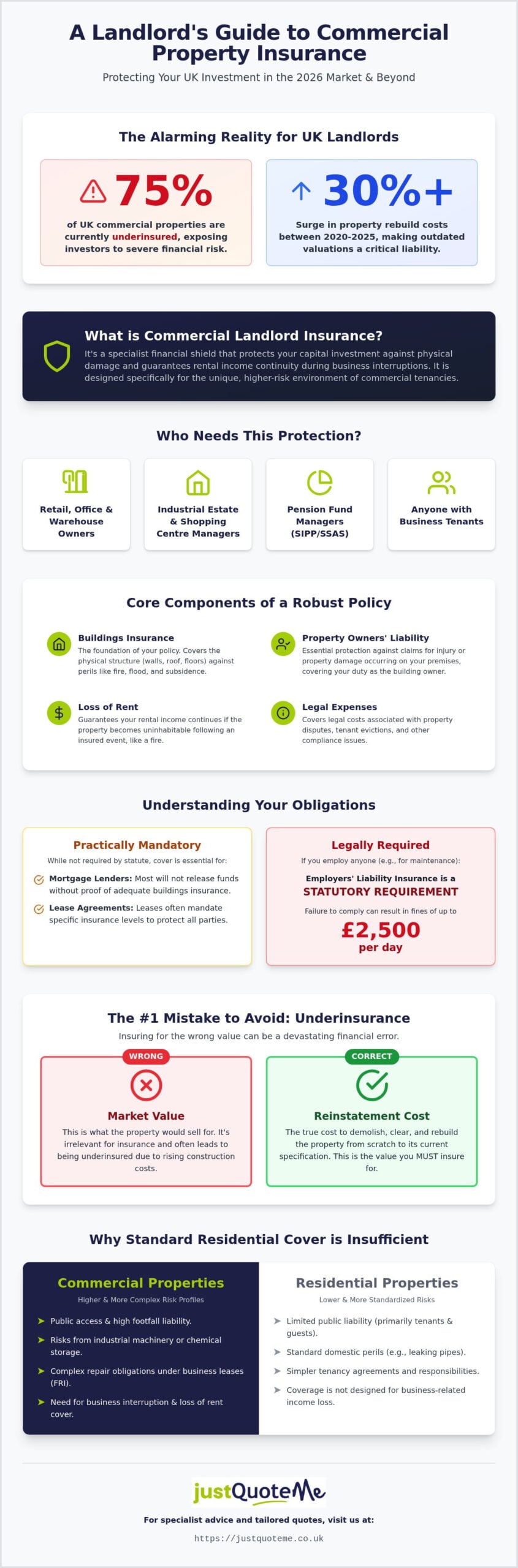
An estimated 75% of UK commercial properties are currently underinsured, leaving thousands of investors exposed to devastating financial gaps if a claim arises. With rebuild costs having surged by over 30% between 2020 and 2025, many landlords are unknowingly risking their entire portfolio on outdated valuations. Securing the right commercial landlord insurance uk is no longer just a box-ticking exercise for your mortgage lender; it’s a critical shield against the evolving risks of the 2026 property market.
We understand that the complexities of modern lease agreements and the recent Renters’ Rights Act can feel overwhelming. You want to ensure your income remains uninterrupted, even during tenant failures or long void periods, without getting lost in corporate jargon. This guide provides a straightforward roadmap to full legal compliance and asset protection. You’ll discover how to structure your coverage to mitigate tenant risks, satisfy strict lender requirements, and safeguard your yield against unforeseen accidents. Just Quote Me to simplify your administrative burden and gain the expert regional insight your investment deserves.
Key Takeaways
- Understand the essential core components of commercial landlord insurance uk, including protection for the building fabric and critical property owners’ liability.
- Learn how “Full Repairing and Insuring” (FRI) leases impact your legal obligations and how to align your policy with your tenant’s specific responsibilities.
- Discover why you must insure based on a professional reinstatement cost assessment rather than market value to avoid the financial penalties of underinsurance.
- Identify the unique risk profiles associated with different business sectors and why standard residential cover is insufficient for commercial tenancies.
- Find out how specialist brokers provide access to exclusive underwriters and bespoke coverage options for complex or multi-tenant property investments.
What is Commercial Landlord Insurance in the UK?
A commercial landlord policy is a specialist insurance framework designed for owners of buildings let for business purposes. It isn’t just a standard property policy; it’s a targeted solution that addresses the unique risks inherent in commercial tenancies. Commercial Landlord Insurance is a specialist financial framework that secures a property owner’s capital investment against physical damage while guaranteeing rental income continuity during periods of business interruption. While a residential landlord might worry about a leaking tap, a commercial landlord must consider the implications of industrial machinery, high-footfall retail spaces, or chemical storage on their premises.
Standard residential landlord insurance is insufficient for commercial tenancies because the risk profiles are fundamentally different. Residential insurers don’t account for the liability risks associated with public access or the complex repair obligations found in business leases. A key distinction exists between basic Property Owners’ insurance and comprehensive commercial landlord packages. While Property Owners’ cover primarily focuses on public liability, a full commercial package integrates buildings insurance, loss of rent, and legal expenses. These Core Components of a Commercial Landlord Policy follow the basic principles of indemnity, ensuring you’re returned to the same financial position after a loss as you were before it.
Who needs this type of cover?
Is it a legal requirement in the UK?
Commercial landlord insurance uk isn’t a statutory legal requirement like motor insurance, but it’s practically mandatory in the professional world. Most mortgage lenders won’t release funds without proof of adequate buildings insurance. Your lease agreement often mandates specific insurance levels to protect both parties’ interests. If you employ anyone to manage or maintain your properties, you’re legally required to have employers liability insurance. Failing to have this statutory cover can result in fines of up to £2,500 per day. Just Quote Me to ensure your policy meets every legal and contractual obligation without unnecessary complexity.
Core Components of a Commercial Landlord Policy
A robust policy for a business property isn’t a single product but a combination of specific protections tailored to your asset. When building your framework for commercial landlord insurance uk, you must prioritize the physical structure while accounting for the complex legal obligations that come with business tenancies. Understanding these Commercial vs. Residential Landlord Insurance: Key Differences is vital, especially since commercial tenants often make significant modifications to the premises. Buildings insurance serves as the foundation, protecting the fabric of the property against fire, flood, and subsidence. You must also clarify who is responsible for tenant improvements, such as bespoke shop fit-outs or specialized mezzanine floors, to avoid expensive gaps in coverage.
Rebuild costs in the UK increased by approximately 30-35% between 2020 and 2025. This inflation means that insuring for market value instead of actual reinstatement costs is a dangerous mistake. If you’re unsure which limit is right for your portfolio, you can speak with a specialist broker to review your current exposure and ensure your valuations are accurate for 2026.
Understanding Property Owners Liability
Property owners liability is a non-negotiable component that protects you against claims for injury or damage occurring on your premises. While it shares similarities with standard public liability insurance, it specifically covers your responsibilities as the building owner rather than the business operations of the tenant. This is critical for common areas like stairwells, car parks, and the external structural elements of the building. In 2026, standard indemnity limits for UK commercial landlords typically range from £2 million to £10 million, depending on the footfall and nature of the business occupying the space.
The ‘Loss of Rent’ safety net
Loss of rent cover is your primary cash flow protection. If a fire or major flood makes the property untenantable, your tenant will likely stop paying rent under a standard lease cessation clause. This cover replaces that lost income, helping you maintain mortgage payments and ongoing management costs during repairs. Choosing the right indemnity period is a strategic decision. While 12 months might seem sufficient, major rebuilds in the UK often face planning delays and material shortages. Opting for a 24 or 36-month period provides a more realistic safety net for significant structural restorations, ensuring your investment remains viable even during a total loss scenario.
Commercial vs. Residential Landlord Insurance: Key Differences
The risk profile of a business property is fundamentally different from a domestic home. While a residential claim might involve a burst pipe or minor kitchen fire, a commercial claim often involves high-footfall public access, industrial machinery, or hazardous materials. A restaurant, for instance, carries significantly higher fire and liability risks than a three-bedroom semi-detached house. This increased complexity is why a standard commercial landlord insurance uk policy is structured around the specific trade of the occupant rather than just the building’s size. If your tenant changes from a quiet accounting office to a high-heat catering business, your insurer must know immediately to ensure your protection remains valid.
Lease structures also create a major divide in how insurance is managed. In the commercial sector, the ‘Full Repairing and Insuring’ (FRI) lease is the industry standard. FRI leases shift the financial burden of the premium to the tenant, but the ultimate legal risk of underinsurance remains with the landlord. Under this arrangement, you as the landlord typically source and manage the policy to ensure your asset is fully protected, then recharge the premium cost to the tenant. When recharging these costs, you should consult official government guidance on insurance to ensure you’re following the latest transparency and fee regulations.
The FRI Lease: What landlords must know
In an FRI lease, the tenant is responsible for all repairs and the cost of insurance. However, you must maintain control over the policy selection. Relying on a tenant to insure your building is a dangerous gamble; if they let the policy lapse, your capital investment is completely exposed. You must also ensure the lease contains a robust ‘Loss of Rent’ clause. This allows you to recover lost income if the building becomes unusable. It’s vital to remember that a standard residential letting insurance policy won’t cover these commercial lease obligations and will likely be voided if used for a business unit.
Tenant activity and its impact on premiums
Every tenant trade carries a unique risk rating. High-risk activities, such as chemical storage or woodworking, will naturally drive up the premium for the entire building. You have a ‘Duty of Disclosure’ to inform your insurer about any change in your tenant’s business operations. Even if your tenant has their own shop insurance, that policy only covers their stock, contents, and specific business liabilities. It does not protect the building’s structure or your liability as the property owner. Mixed-use properties, such as high-street shops with residential flats above, require even more specialized handling to ensure both the commercial and residential elements are correctly rated within a single, cohesive policy.
How to Choose the Right Policy for Your Investment
Selecting the right commercial landlord insurance uk requires a systematic approach that looks beyond the annual premium. Start by conducting a full rebuild cost assessment. This figure represents the actual cost to reconstruct your building from the ground up and is entirely separate from its market value. Next, review every active lease agreement to identify specific insurance obligations. While you likely use an FRI lease, the exact wording regarding premium recovery and loss of rent indemnity must be mirrored in your policy. You should also analyze location-specific risks, such as flood history or local crime rates, and factor in the specific trade of your tenants. Finally, consult an independent broker who can access the whole of the market rather than relying on the limited options provided by automated quote engines.
A specialist broker understands that a warehouse in Staffordshire has different risk requirements than a retail unit in the West Midlands. You can speak with our team for a tailored portfolio review to ensure your coverage is as efficient as it is comprehensive.
Calculating the ‘Reinstatement Value’
Using the purchase price or current market value for your sum insured is a common path to underinsurance. The average underinsured commercial building in the UK is currently covered for only 67% of its actual rebuild cost. To avoid this, you should engage a RICS surveyor to provide a professional reinstatement valuation. This assessment must include the cost of modern construction materials, which were 2% higher in January 2026 than the previous year, as well as professional fees for architects and the substantial costs of debris removal after a total loss.
Evaluating ‘Unoccupied Property’ risks
Most standard policies include a 30-day rule, meaning coverage significantly reduces or ceases if a property remains empty for more than a month. If a tenant moves out, you must notify your insurer immediately to arrange specialist unoccupied property cover. This protects you against the increased risks of arson, vandalism, and squatting during void periods. For a deeper look at protecting your physical assets during transitions, see our dedicated guide to commercial property insurance. Just Quote Me to manage these complex transitions so your investment is never left vulnerable between tenancies.
Why Use a Specialist Broker for Commercial Landlord Cover?
Choosing a specialist broker for your commercial landlord insurance uk provides a layer of security that automated comparison sites simply cannot replicate. Algorithms often struggle with the nuances of business tenancies, leading to generic policies that may contain restrictive exclusions. By contrast, an independent broker offers direct access to ‘broker-only’ underwriters. These specialist insurers don’t deal with the general public and often provide more flexible terms and competitive pricing for complex or high-value assets. We manage the administrative heavy lifting, from conducting initial risk assessments to finalizing policy documents, ensuring your protection remains seamless as your portfolio grows.
Our role extends far beyond the initial transaction. When you face a claim, having a dedicated advisor who understands your property’s history is invaluable. We act as your advocate, managing communication with insurers and streamlining the settlement process to minimize your downtime. This regional expertise, particularly across Staffordshire and the West Midlands, allows us to provide pragmatic advice based on local market conditions and specific construction trends. Just Quote Me to simplify your management process and gain the peace of mind that comes from professional, human-led oversight.
Bespoke vs. Off-the-shelf policies
Generic policies often fail to account for the specific risks associated with certain commercial uses, such as high-heat catering or industrial manufacturing. If your building is listed or features non-standard construction, an off-the-shelf policy might leave you dangerously exposed. The Just Quote Me approach leverages over 30 years of experience to build bespoke frameworks. We ensure every endorsement is tailored to your specific building and tenant profile, eliminating the gaps that often plague standard insurance products.
Next Steps: Securing your quote
Securing a quote that actually protects your investment is a straightforward process. You’ll need to gather your latest rebuild values, tenant trade history, and the insurance clauses from your active lease agreements. Having this information ready allows us to move quickly and find the most efficient coverage for your needs. For complex portfolios or multi-use sites, a personalized consultation is often the most effective way to ensure every risk is addressed.
Future-Proofing Your Commercial Property Portfolio
Protecting a commercial asset in 2026 requires a proactive stance on risk management. We’ve detailed how aligning your policy with the specific trade of your tenants and the precise obligations of your lease prevents costly legal and financial gaps. By moving away from generic valuations and embracing professional reinstatement assessments, you safeguard not just the bricks and mortar, but the long-term viability of your rental income. A robust commercial landlord insurance uk framework is the foundation of a resilient investment strategy, allowing you to manage market fluctuations with confidence.
Just Quote Me acts as your strategic partner, bringing over 30 years of independent brokerage experience to your portfolio. We bridge the gap between complex underwriting requirements and your need for straightforward, efficient protection. Our FCA-authorised team provides the human-centric advice that automated systems lack, ensuring your assets are covered by top UK insurers under terms that make sense for your business. Take the next step in securing your property’s future with our direct support.
Frequently Asked Questions
Is commercial landlord insurance tax-deductible in the UK?
Yes, the premiums you pay for your commercial property are a fully allowable business expense. You can deduct the total cost of your policy from your rental income before calculating your final tax liability. This applies to buildings cover, property owners liability, and even the specialized legal expenses extensions required for commercial landlord insurance uk compliance.
What happens to my insurance if my commercial property becomes vacant?
Standard cover typically reduces to “Fire, Lightning, Explosion, and Aircraft” (FLEA) perils after a property has been empty for 30 consecutive days. You must notify your broker as soon as a tenant vacates to ensure you maintain adequate protection. We can often arrange extensions that cover a broader range of risks during these void periods, provided specific security measures are met.
Does the tenant’s insurance cover damage to my building?
No, a tenant’s policy only protects their own business assets, stock, and specific liabilities. They do not have an “insurable interest” in the building’s structure itself. As the landlord, you must maintain your own buildings insurance to protect your capital investment, regardless of what business insurance your tenant holds for their daily operations.
How is the rebuild cost different from the market value of the property?
Rebuild cost is the total price of labor, materials, and professional fees required to reconstruct the building from the foundations up. Market value includes the land value and the desirability of the location, which are irrelevant for insurance purposes. Insuring for market value is a common mistake that leads to significant underinsurance, especially in areas where property prices have stagnated but construction costs have risen.
Can I have one policy for a portfolio of commercial properties?
Yes, consolidating your assets into a single portfolio policy is an efficient way to manage multiple properties. This approach provides a common renewal date and often qualifies for bulk discounts from underwriters. Whether you own high-street shops or industrial units, we can build a cohesive commercial landlord insurance uk framework that covers every location under one administrative umbrella.
What is ‘Loss of Rent’ cover and is it essential?
Loss of rent cover replaces the income you lose if a major insured event, like a flood or fire, makes the property unusable. Since most commercial leases include a “rent cessation” clause that relieves the tenant of payment during repairs, this cover is essential for maintaining your cash flow. It ensures you can continue to meet mortgage payments and management fees while the building is being restored.
Do I need terrorism cover for my commercial property?
While not a statutory requirement, terrorism cover is a common mandate from commercial mortgage lenders. Standard property policies almost always exclude damage resulting from acts of terrorism, which could leave you with a total loss and a remaining mortgage debt. We can provide this as a specific extension to ensure your asset is fully protected against all potential threats.
