

What if your income fell after a business interruption, but the insurer needs to know which part of that shortfall the event caused? If you’re asking how to prove loss of income for business interruption claim purposes, the answer is more than a drop in sales. You need to connect the event to the policy wording, then trace its financial impact with clear evidence.
It’s understandable to be unsure which records matter, or how to separate the interruption’s effects from seasonal patterns and ordinary trading changes. A clear, organised claim can help explain both what happened and how you calculated the loss, without hiding assumptions or gaps.
This guide sets out a practical, evidence-based process. You’ll learn how policy wording, incident records and financial documents work together, which operational and accounting records to gather, and how to explain variations in your figures. It also covers how to build a traceable evidence file so the insurer can follow the link between the interruption and the income claimed.
Key Takeaways
- Start with your policy wording: the event and the evidence must fit the cover described, as triggers and calculations can vary between policies.
- Organise records around what happened, what operations were affected and how the business’s finances changed.
- Show how to prove loss of income for business interruption claim purposes by linking each claimed figure to its calculation, source record and explanation.
- Separate actual trading results from your estimate of what might have happened without the interruption, and explain assumptions or unusual fluctuations.
- Follow the policy’s notification requirements and keep an indexed record of submissions, correspondence and documents provided.
How to Prove Loss of Income for a Business Interruption Claim: Start with the Policy
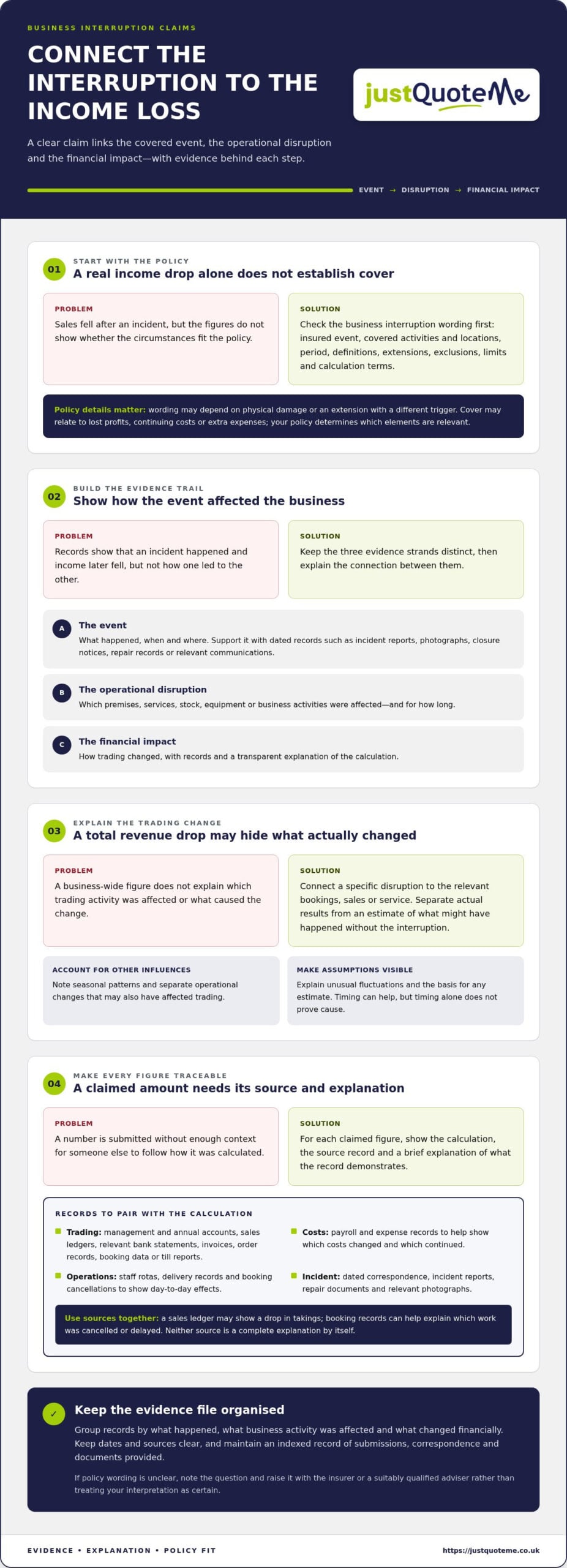
Proof of business interruption loss must connect an interruption covered by the policy to a demonstrable financial loss. That means building a clear trail from the event, to the effect on the insured business activity, to the financial change you’re claiming. The order matters: a fall in income can be real and well documented, but those figures alone can’t establish whether the policy covers the circumstances.
Business interruption wording varies. One policy may depend on physical damage, while another may include an extension with a different trigger. The definitions, exclusions, limits and calculation terms also affect what the policy may respond to. Business interruption insurance can relate to lost profits, continuing costs or extra expenses, but the wording of your own policy determines which elements are relevant to your claim.
A practical way to approach how to prove loss of income for business interruption claim purposes is to keep three evidence strands distinct, then show how they connect:
- The event: what happened, when and where, supported by dated records.
- The operational disruption: which premises, services, stock, equipment or business activities were affected, and for how long.
- The financial impact: how trading changed, supported by records and a transparent explanation of the calculation.
This structure helps avoid a common gap: showing that an incident happened and sales later fell, without explaining how the incident affected the trading figures.
What must the evidence trail establish?
Identify the event and explain its connection to the business activity insured under the policy. Then establish dates, locations and operational effects using records created at the time, where available. Depending on the circumstances, these might include incident reports, dated photographs, closure notices, repair records or communications with staff and customers. Keep the source and date clear so another person can follow the sequence.
Next, connect the disruption to changes in trading. For example, if a particular service could not operate, explain how that affected the relevant bookings or sales, rather than relying only on a total revenue drop. Timing is useful, but it doesn’t prove cause by itself. Note other factors that may have influenced trading, such as a seasonal pattern or a separate change in operations, and distinguish them from the interruption’s effects.
Why the policy wording comes before the calculation
Find the policy schedule and wording, then review the business interruption section alongside its definitions, extensions and exclusions. Check how the policy describes the insured event, which business activities and locations it covers, the applicable period and any stated limits. Don’t assume a term or calculation method applies simply because it appears in another policy or claim example.
Make a short note of the clause you believe is relevant and the evidence that relates to it. If wording is unclear, record the question and raise it with the insurer or a suitably qualified adviser rather than treating your interpretation as certain. Once the policy-and-event link is understood, you can prepare the financial calculation against the relevant circumstances instead of building it on assumptions.
Which Records Help Prove Business Interruption Income Loss?
A useful evidence file answers three questions: what happened, what business activity was affected, and what changed financially. Keep records grouped around those questions rather than sending the insurer an unlabelled collection of documents. This makes it easier to trace a claimed figure back to its source and understand how the operational disruption relates to trading.
A practical approach to how to prove loss of income for business interruption claim purposes is to pair financial records with dated operational evidence. The right documents depend on the business and the event, so gather what directly supports the circumstances and calculation rather than assuming every record will be relevant.
- What happened? Incident reports, dated correspondence, photographs or other records that describe the event.
- What stopped or changed? Closure information, repair documents, staff rotas, delivery records or booking cancellations that show the operational effect.
- What changed financially? Accounts, sales data, invoices, bookings, payroll and expense records that support the figures claimed.
Financial records that can support the calculation
Gather available management and annual accounts, sales ledgers and relevant bank statements. Then use invoices, order records, booking data or till reports to clarify movements in trading. Payroll and expense records can help show which costs changed during the interruption and which continued. Keep the relevant date range clear, and note what each record demonstrates instead of relying on a total alone.
For example, a sales ledger may show a drop in takings, while booking records help explain which work was cancelled or delayed. Each source adds context; neither should be treated as a complete explanation by itself. For small business owners looking to keep day-to-day accounts accurate and readily accessible, working with a dedicated bookkeeping service like Skyplex Management can ensure financial records remain organized and reliable when unexpected disruptions occur.
Operational records that explain what disrupted trading
Collect dated correspondence, incident reports, repair documents and relevant photographs. Staff rotas, delivery records and booking cancellations can help show how the interruption affected day-to-day activity. For property damage, records identifying the affected premises and repair period may help explain the trading impact. A claim involving damage to premises can also relate to commercial property insurance, though the applicable policy wording determines whether the circumstances are covered.
Match each operational record to the financial period or figure it helps explain. If a closure notice covers a specific area, for instance, connect it to records showing which services or sales depended on that area. For a cyber-related disruption, preserve relevant incident communications and records of affected systems or transactions. Cyber insurance is a separate policy area, and its presence alone doesn’t establish that a particular interruption is covered.
Before using a document, check that it’s dated, readable and tied to the relevant business activity. If a record is missing, identify the gap and note whether another source supports the same point. This makes the evidence easier to review and gives you a clear starting point for reconciling records with the amount claimed.
How to Reconcile Trading Records with the Loss You Are Claiming
A claim calculation should be easy to follow from the figure requested back to the records behind it. Keep the observed trading results separate from the counterfactual estimate: actual results show what happened during the interruption, while the estimate explains what might reasonably have happened without it. The estimate is not a recorded fact, so make its basis and assumptions visible.
Start by stating the calculation period and how it relates to the interruption and the relevant policy terms. Then break the calculation into material figures instead of presenting a single headline amount. A reconciliation table gives each figure a source and a plain-English explanation:
| Claimed figure or item | Calculation or basis | Source record | Explanation |
|---|---|---|---|
| Actual trading during the affected period | Recorded sales for the stated dates | Sales ledger or till reports | Shows observed results, not the estimated counterfactual |
| Expected trading without the interruption | Estimate based on a suitable comparison period, adjusted for supported differences | Previous sales records, bookings or management accounts | Explains why those records provide a reasonable comparison |
| Cost adjustment | Documented change in a relevant expense | Payroll or expense records | Shows what changed and why it is included |
This layout helps show how to prove loss of income for business interruption claim purposes without blending recorded results, estimates and adjustments together. Label each entry as actual, estimated or adjusted. If a later accounting correction changes a figure, retain the earlier version and explain the correction rather than silently replacing it.
Build a transparent calculation, not a single headline figure
For every material figure, state the date range, calculation method and source beside it. Explain assumptions, adjustments and any exclusions in words a reader can trace back to the records. If the policy wording specifies a particular basis or period, show how your calculation relates to it; don’t present a method as universal. Keep working notes so the figures can be checked or updated.
Explain trading patterns and changes in costs
Choose comparison records that fit the business’s trading pattern and explain why they’re relevant. A seasonal business may need to account for recurring peaks or quieter periods; a recent change in opening hours, capacity or services may also affect a straightforward comparison. Support these explanations with records such as prior-period sales, booking histories or dated business updates, not unsupported assumptions.
Reconcile the final figures to the accounting records, and explain any differences plainly. For example, if a sales report and management accounts cover different dates or record transactions differently, identify the mismatch and show how you handled it. Include expense changes only where the policy wording and available records allow. Don’t assume every saving should be deducted, or every continuing cost should be included. The insurer needs to see the basis for each adjustment, not just the result.
How to Prepare a Business Interruption Claim Evidence File
A well-organised evidence file helps the insurer follow the claim from the relevant policy terms to the supporting records and calculation. Use one indexed set of documents, consistent labels and a short explanation of what each item proves. The aim isn’t to include every business record. It’s to make the relevant evidence easy to find, compare and review.
Work through the file in order:
- Review the policy documents. Save the schedule and wording together. Note the clauses, dates, locations and business activities relevant to the circumstances, along with any notification or document requirements stated in the policy.
- Set up clear folders. Create separate folders for policy documents, incident evidence, operational records and financial records. Use simple labels and consistent date formats so files sort logically.
- Collect and describe the evidence. Record each document’s date, source and the point it supports. For example, label a repair record with the affected premises and the operational period it helps explain, rather than saving it as “document 1”.
- Prepare the calculation and evidence schedule. Link each significant claim point or figure to its source documents. Keep actual results distinct from estimates, and identify the method and assumptions behind each estimate.
- Check the file, then submit it as required. Follow the notification method and requirements set out in the policy. Keep a copy of what you send and record any later additions or corrections.
Keep original documents unchanged. If you need to annotate or redact a copy for review, label it as a working copy and retain the original separately. Name revised calculations clearly and note what changed, when, and why. If information is still outstanding, list it as pending rather than presenting the file as complete.
A concise evidence schedule can be a simple index at the front of the file. For each item, record the claim point, document name, date and relevance. For instance: “Trading impact, cancelled booking report, [date range], shows bookings affected during the disruption.” This gives the reviewer a route from a claim point to its supporting record without repeating the whole calculation.
Before sending, carry out a consistency check. Look for missing dates or trading periods, duplicate entries, estimates presented as actual results and totals that don’t match the underlying records. Check that document dates align with the event period and that each material amount has both a source and a written explanation. If two records differ, flag the difference and explain how you treated it. Clear gaps are easier to discuss than unexplained inconsistencies.
Preparing a claim can also prompt a closer look at how your business insurance fits its activities. For help discussing business insurance options, Request a Call back for free Expert advice.
Submitting or Discussing Business Interruption Claims
Before sending a claim or responding to questions, check the policy for its stated notification method and information requirements. Follow the wording that applies to your policy rather than relying on a general deadline or process. Keep a copy of the notification and each document submitted, along with the date sent and any acknowledgement or response received.
Clear communication helps the insurer connect your explanation to the evidence. Answer each question directly, refer to the relevant document by its file name or schedule reference, and explain what it shows. If you need to correct a figure, identify the earlier version and state what changed and why. This keeps the discussion consistent with the records and calculation already provided.
Respond to information requests with a clear audit trail
Keep a simple log of every request, response date, file supplied and item still outstanding. If a record isn’t available, say so plainly, explain what’s missing and provide relevant alternative evidence where possible. Don’t present a substitute as if it were the original. Label revised calculations clearly and describe the change, its source and any effect on the amount claimed.
For a large request, organise your response by question. A short cover note can identify the answer, point to the supporting document and flag any remaining gap. Save the note and attachments together. This makes it easier to show what information the insurer received and to respond consistently if the issue comes up again.
If the claim is questioned or declined
Ask the insurer to explain its position and identify the policy wording and evidence it relied on. Compare those reasons with the relevant terms and the material you submitted. If the insurer points to a specific gap, answer that point with a document reference or a clear explanation. Separate facts from estimates, and avoid asserting that cover applies unless the wording and circumstances support that conclusion.
If you remain dissatisfied, review the insurer’s complaint response and consult the Financial Ombudsman Service’s current guidance on eligibility and how to complain. Its guidance explains the service’s process and who may be able to bring a complaint. Follow the information there for your circumstances rather than assuming every business or dispute will qualify.
Keep the same organised approach throughout: log correspondence, retain submitted versions and note unanswered questions. That record can help you explain how to prove loss of income for business interruption claim purposes while keeping the discussion focused on the policy, the interruption and the financial evidence. It doesn’t guarantee a claim will be accepted, but it gives each point a traceable basis.
If you’re reviewing business insurance options for your organisation, Get Your Free Business Insurance Quote now. The quote is free and no-obligation.
Take the Next Step with a Clearer Insurance Picture
A well-supported claim depends on the wording and circumstances of the policy, so keep your records and calculations available as questions arise. If you’re reviewing cover for the future, use what you’ve learned about your business’s operations and potential interruptions to guide the conversation. Understanding how to prove loss of income for business interruption claim purposes can also help you identify the policy details you’ll want to understand before an interruption occurs.
Just Quote Me offers free, no-obligation quotes and callbacks, with side-by-side comparisons from leading UK insurers. The average online review rating is 4.6 out of 5. Explore your business insurance options and take a practical next step with Get Your Free Business Insurance Quote now.
A little preparation now can make future decisions clearer. Start when you’re ready.
Frequently Asked Questions
Can bank statements alone prove a business interruption income loss?
No. Bank statements can show money received and paid, but they may not identify which sales generated a deposit or why trading changed. For how to prove loss of income for business interruption claim purposes, use them alongside records such as sales reports, invoices, bookings and operational documents. Check that the dates and amounts reconcile, and explain transfers or unusual payments. Whether the evidence is sufficient depends on the policy wording and circumstances.
What if my business does not have final accounts for the claim period?
You can use the records available for the relevant period, including management accounts, sales ledgers, invoices, booking data and bank statements. Mark figures as provisional and explain how they were prepared, such as whether they use recorded transactions or estimates. If final accounts later change the figures, keep the earlier version and show what was corrected. The insurer may ask for more information, depending on the claim and policy.
Can I use a forecast to prove income I expected to earn?
A forecast can help explain expected trading, but it doesn’t by itself prove actual income or the loss caused by an interruption. Identify who prepared it, when it was made and the assumptions behind it, such as planned orders or confirmed bookings. Compare those assumptions with historical and operational records, then explain any material difference. The policy wording and claim circumstances determine how an estimate may be considered.
How should I explain seasonal trading in a business interruption claim?
Use records from suitable periods to show the business’s normal seasonal pattern, then explain why those periods make a fair comparison. For example, a business with changing demand across the year could use sales, booking or order records to show the pattern rather than relying on an annual average alone. Point out unusual events or operational changes that affect the comparison, and state any limitations in the records.
Can a business claim for interruption across more than one location?
Organise the information by site so the insurer can see which activities were affected, when the disruption occurred and how each location’s trading figures were derived. If accounts combine several locations, explain how you separated or allocated the figures and identify shared costs that can’t be split directly. Keep the supporting basis for any allocation. Whether the policy responds to multiple locations or associated losses depends on its wording and the circumstances.
What should I do if the insurer disputes my loss calculation?
Ask which figures, assumptions or policy terms are disputed, then respond to each point with a clear explanation and source records. If you revise the calculation, reconcile it against the version already submitted and label the changes. Keep the correspondence and attachments together. If you’re still dissatisfied, use the insurer’s complaint process and review the Financial Ombudsman Service guidance to understand its process and whether your complaint may be eligible.
Does business interruption insurance cover every loss of income after a disruption?
No. Cover depends on the specific policy wording, including the events and circumstances it describes, the types of loss addressed, applicable periods and exclusions. A fall in income after an incident doesn’t alone establish that the policy covers it. Read the relevant terms alongside the circumstances, and seek clarification if a clause or its application is unclear. Evidence can support what happened and its financial effect, but it doesn’t determine cover by itself.
