
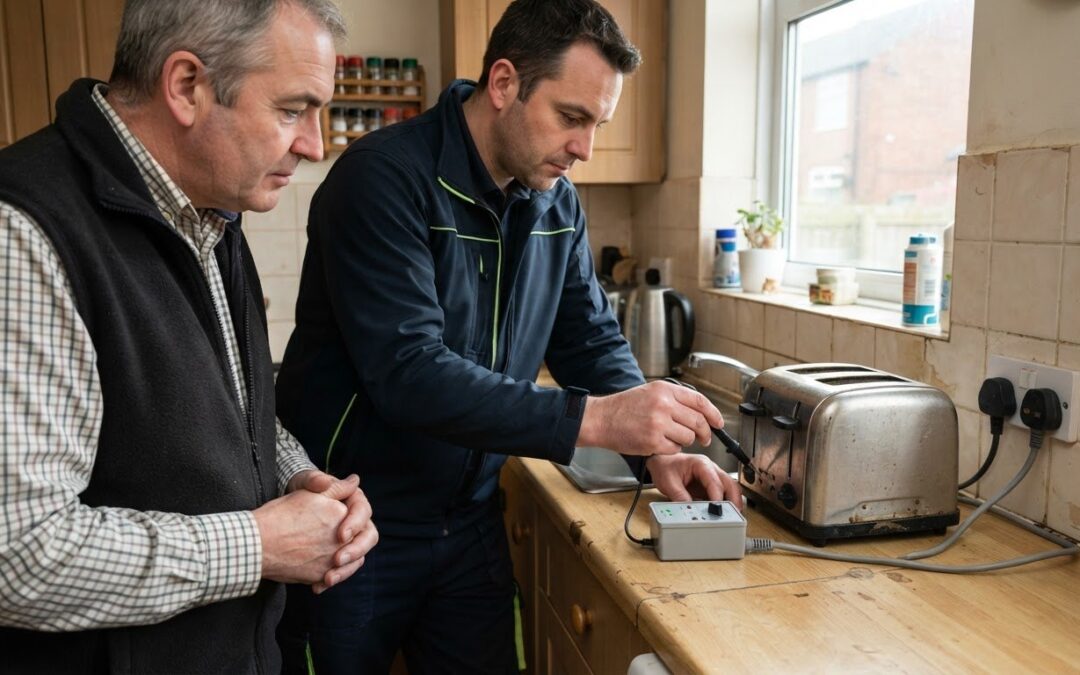
Annual PAT testing is not a blanket legal requirement in the UK. The Electricity at Work Regulations 1989 require workplace electrical equipment to be maintained to prevent danger, but don’t set a fixed testing schedule, according to the UK legislation register. The Health and Safety Executive says annual appliance testing isn’t legally required. That distinction is central to understanding PAT testing and insurance requirements.
PAT testing, more accurately called in-service inspection and testing, helps identify damage or faults in portable electrical equipment. It’s understandable to wonder whether a missed test could affect your insurance. The answer depends on your policy wording, the circumstances of a claim and the maintenance evidence available, not on a universal annual testing rule.
This article explains what inspection and testing involve, how UK legal duties shape a suitable maintenance approach, and what insurers may consider when assessing claims or setting cover. It also explains how records and policy conditions fit into the picture, helping you make informed decisions about electrical safety and insurance.
Key Takeaways
- Set inspection intervals around the equipment, how it’s used and the risks involved, rather than assuming every appliance needs the same schedule.
- Keep clear maintenance records and test results as useful evidence of your safety approach, even though records and labels aren’t legal requirements.
- An overdue test doesn’t automatically determine an insurance claim; policy wording and the circumstances of the loss matter.
- When arranging cover for PAT testing work, match the protection to your services and customer contracts, including any professional indemnity requirements.
Electrical equipment maintenance duties under UK law
What are the UK legal requirements for portable appliance testing (PAT)? The Electricity at Work Regulations 1989 require equipment maintenance to prevent danger, but don’t set a PAT method or schedule.
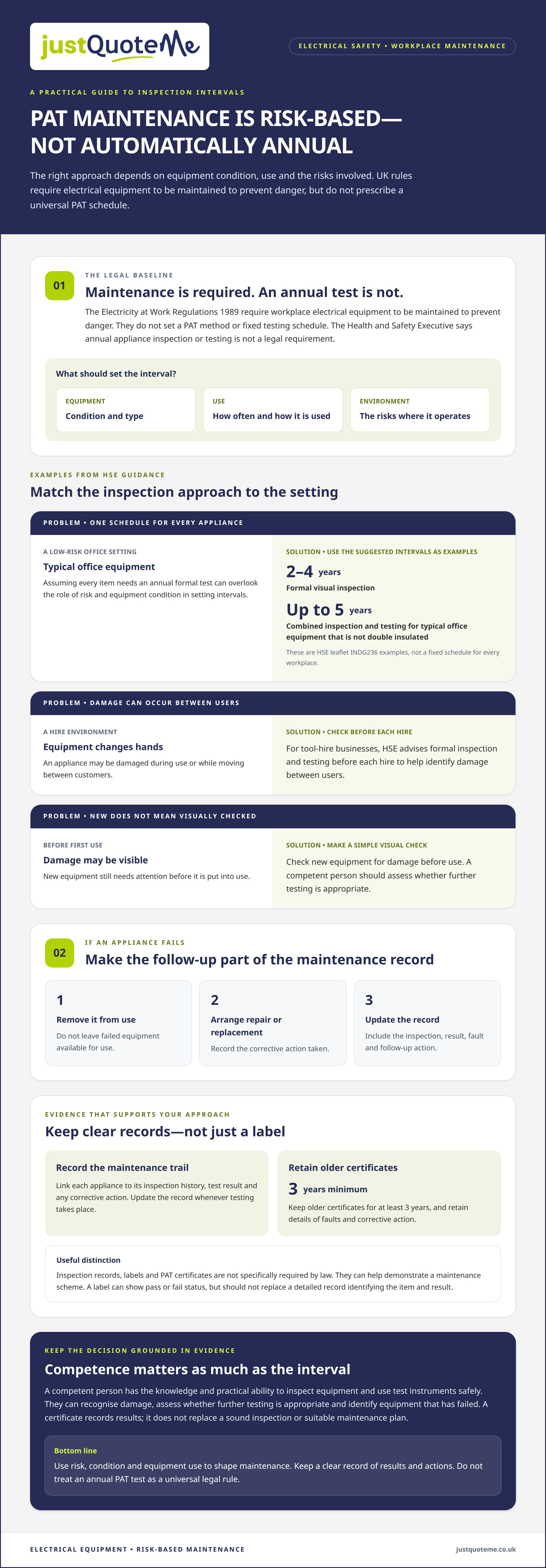
The UK legislation register confirms that the Electricity at Work Regulations 1989 require UK workplaces to maintain electrical equipment to prevent danger, but do not prescribe how or how often maintenance must be done. The Health and Safety Executive says annual inspection or testing of appliances isn’t a legal requirement. Instead, the workplace’s risks and equipment condition guide the maintenance approach.
Competence for Inspection and Testing
Competence means having the knowledge and practical ability to inspect equipment and use test instruments safely. This matters because an unsuitable test or missed defect can leave a hazard undetected. A competent person can recognise damage, assess whether further testing is appropriate and identify equipment that has failed. A certificate can record results, but it doesn’t replace a sound inspection or suitable maintenance plan.
PAT for Commercial Equipment
Commercial PAT is a risk-based way to inspect and, where appropriate, test portable appliances used at work. For typical office equipment in low-risk environments, the Health and Safety Executive’s leaflet INDG236 suggests formal visual inspections every 2-4 years. For typical office equipment that is not double insulated, it suggests combined inspection and testing at intervals of up to 5 years. These are examples, not a fixed schedule for every workplace.
For tool-hire businesses, the Health and Safety Executive advises formal inspection and testing before each hire. This helps identify damage between users. If an appliance fails, remove it from use, arrange repair or replacement, and record the action taken. New equipment still needs a simple visual check for damage before use.
Separate from PAT, employers’ liability insurance is legally required for most businesses with employees. The Health and Safety Executive says failing to hold required cover can lead to a fine of up to £2,500 per day without cover. Employers can learn more about Employers Liability Insurance.
What is portable appliance testing?
Portable appliance testing, or PAT, combines visual inspection with electrical tests where appropriate. It helps identify damage or faults in workplace appliances.
Employers’ liability insurance is compulsory for most businesses with employees, but it doesn’t set a universal PAT schedule. Policy terms and an employer’s electrical maintenance arrangements are separate considerations.
Missing records can make it harder to show that equipment was maintained, particularly after an incident. However, the Health and Safety Executive says inspection records and labels aren’t legal requirements. Both can help demonstrate a maintenance scheme.
Testing Intervals and Record Updates
A testing interval is the planned gap between inspections or tests of an appliance. A record update documents each completed inspection, test result and follow-up action. Keeping entries current links each appliance to its maintenance history. If a tester finds a fault, record the failure and note whether the appliance was removed from use, repaired or replaced.
Appliance Labels and Testing Records
An appliance label gives a visible indication of its test status, while the record provides fuller evidence. According to the Health and Safety Executive, labels aren’t compulsory under UK law. A pass or fail label can help staff identify an appliance’s status, but it shouldn’t replace a detailed record identifying the item and result.
A PAT certificate isn’t a specifically named legal document, but it’s commonly used as evidence of inspection and testing. Keep older certificates for at least 3 years, update the record whenever testing takes place, and retain details of faults and corrective action. That trail can help explain what happened if an insurer asks about an appliance after a loss.
Clear records can also support discussions about business insurance options, alongside the maintenance arrangements relevant to your work.
Can an insurer refuse a claim because my PAT testing is out of date?
An overdue PAT test doesn’t automatically invalidate an insurance claim. The policy wording, cause of the loss and any relevant maintenance condition matter. For example, an electrical fire linked to a known appliance fault may raise different questions from an unrelated loss. A missed inspection alone doesn’t prove that a breach caused the damage.
For non-consumer insurance contracts, section 10 of the Insurance Act 2015 addresses warranty breaches. Section 11 may prevent an insurer relying on a breached risk-reducing term if the policyholder shows the breach couldn’t have increased the risk of the loss that occurred. These provisions make the connection between the breach and the incident important.
Landlords should also distinguish portable-appliance testing from inspection of a fixed electrical installation. In England, the Electrical Safety Standards in the Private Rented Sector and Social Rented Sector Regulations 2020 require private landlords to obtain an EICR for fixed installations every five years, according to the UK legislation register. That inspection is not a PAT test, and local licensing conditions may involve separate requirements.
Inspection frequency should reflect an appliance’s condition, use and environment, rather than applying one annual interval to every item. A heavily used appliance or one with a repaired cable needs different attention from an office printer in a low-risk setting. The IET Code of Practice for In-Service Inspection and Testing of Electrical Equipment takes a risk-based approach.
For contractors undertaking periodic inspection and testing, professional indemnity insurance can address financial loss arising from professional advice or services. NICEIC-registered electrical contractors carrying out this work must have at least £250,000 of professional indemnity cover. A PAT tester’s policy should match the actual inspection work and customer contract requirements. Explore Professional Indemnity Insurance for cover relevant to professional services.
Effect of PAT testing on insurance premiums
PAT testing can inform an insurer’s view of how electrical risks are managed, but it doesn’t set a standard premium discount. Maintenance records may help explain controls at premises where employees use portable equipment. An insurer’s assessment also depends on the work, locations, equipment and people included in the application.
For non-consumer insurance contracts, section 3 of the Insurance Act 2015 sets out the insured’s duty to make a fair presentation of the risk before the contract is made. Describe the business’s actual activities and electrical maintenance arrangements accurately. A PAT certificate can support that account, while gaps or unclear details may leave the risk harder to assess.
Testing isn’t a universal legal requirement at one fixed interval, so an annual test alone doesn’t establish compliance in every situation. The equipment, its condition and how it’s used help shape a suitable inspection plan. For example, an office printer and an appliance used heavily in a workshop present different maintenance considerations. Clear records help show the approach taken for each.
Premium is only one part of a policy decision. Compare cover limits, excesses, exclusions and claims-made terms as well as price. A lower premium may come with different conditions or less suitable protection. Public liability and professional indemnity address different exposures: injury or damage to others differs from a client’s financial loss linked to professional advice or services.
Before cover is arranged or renewed, set out the premises, employees, equipment, subcontractors and testing work accurately. Under the Insurance Act 2015, section 8 allows an insurer a remedy for an incorrect presentation only if it shows it would not have entered the contract or would have done so on different terms. Understanding PAT testing and insurance requirements helps frame that disclosure. Review business cover options alongside your maintenance records and declared activities.
Just Quote Me
Just Quote Me can help you consider how your PAT testing work, business activities and premises relate to your insurance needs. As an independent broker, it provides tailored advice on suitable cover, including Public Liability Insurance, Employers Liability Insurance, Professional Indemnity Insurance and Landlord Insurance. The right combination depends on the work you do and the risks you need to address.
If you’re reviewing existing cover, starting a PAT testing business or clarifying what protection may suit you, discuss your circumstances with an adviser. Share details of your services, employees and working arrangements so the advice can reflect your business. Request a callback for free expert advice from Just Quote Me.
Keep your cover aligned as your work changes
Start your next review with a clear picture of the work you do today. As your equipment, premises, staff or contracts change, revisit whether your documented maintenance approach still reflects the risks involved. Keeping PAT testing and insurance requirements aligned means treating electrical safety as part of ongoing business planning, not as an isolated administrative task.
Bring together the nature of your work, key operational changes and existing cover for one review. This gives you a clearer basis for discussing policy limits, exclusions and conditions, rather than focusing on premium alone. The right arrangement depends on your activities and the protection you need. Just Quote Me can help you consider relevant business cover, including Public Liability Insurance, Employers Liability Insurance and Professional Indemnity Insurance. Get Your Free Business Insurance Quote now from Just Quote Me and take your next step with a clearer view of the questions that matter.
Frequently Asked Questions
Does not having PAT testing invalidate my whole policy?
No. An overdue PAT test doesn’t, by itself, invalidate an entire insurance policy. If a claim follows an electrical incident, the insurer considers the policy terms, what caused the loss and whether relevant conditions were met. A missed test may be relevant if the claim involves that appliance, but it doesn’t automatically determine the outcome of unrelated claims.
How frequently do I need to test my electrical appliances?
Set intervals according to the appliance, its condition, how often it’s used and its working environment. For an earthed Class I appliance such as a kettle, suggested formal visual inspection intervals are 6 months to 1 year, with combined inspection and testing every 1-2 years. A heavily used or previously damaged appliance may need closer attention than lightly used equipment.
How much will it cost?
The actual amount depends on the number and type of appliances, access to them, and the inspection and testing required. A large, varied site or equipment spread across separate premises may involve different work from a small office with similar appliances.
How often should the paperwork be updated?
Update the record whenever an appliance is inspected or tested, and add the result and any action taken. For example, if a portable heater fails, record its identity, the failed result and whether it was removed, repaired or replaced. Tying each entry to the correct appliance makes its maintenance history easier to trace when circumstances change.
I’m an electrical contractor, what type of insurance do I need?
Consider cover for third-party injury or property damage, and for financial loss linked to professional advice or services. Public Liability Insurance and Professional Indemnity Insurance address different exposures. If you employ staff, Employers Liability Insurance is legally required for most businesses; the Employers’ Liability (Compulsory Insurance) Act 1969 requires at least £5 million of cover. Customer contracts may also specify insurance conditions.
Is PAT testing a legal requirement that an insurer can point to?
UK law requires workplace electrical equipment to be maintained to prevent danger, but it doesn’t prescribe PAT testing as the only method or set a universal testing timetable. The Health and Safety Executive says annual appliance testing isn’t legally required. An insurer may still consider relevant policy conditions and the circumstances of a claim, so legal duties and insurance terms are separate questions.
