
What if an asbestos incident leaves you facing costs your insurance will not cover? Policies may exclude asbestos-related work or restrict cover. UK home insurance generally does not pay for removal unless asbestos is disturbed by an insured event, such as fire or storm damage. Understanding asbestos awareness and its impact on insurance means looking beyond whether asbestos is present: policy wording, planned work and the cause of damage all matter.
It is reasonable to expect insurance to help when something goes wrong, but asbestos exclusions and restricted cover can affect what a policy responds to. Understanding the material and its risks helps you identify where cover may fall short.
This article explains how liability exclusions and limited write-back cover work, when insurance may respond to historical exposure claims, and why asbestos in a building can affect premiums. It also outlines the health risks of disturbing asbestos and the roles of business insurance, including public liability, employers’ liability and commercial property cover.
Key Takeaways
- Read asbestos exclusions alongside any limited write-back wording; restricted cover may leave important claims outside the policy.
- Historical exposure claims can involve illnesses that emerge long after exposure, making past employment and insurance records relevant.
- Asbestos in a building does not automatically determine the premium; its condition, management and potential disturbance all matter to risk assessment.
- Damaged or disturbed asbestos can create serious health risks, so understanding the material and the limits of your cover is important.
Insurance market exclusions and limited write-back cover
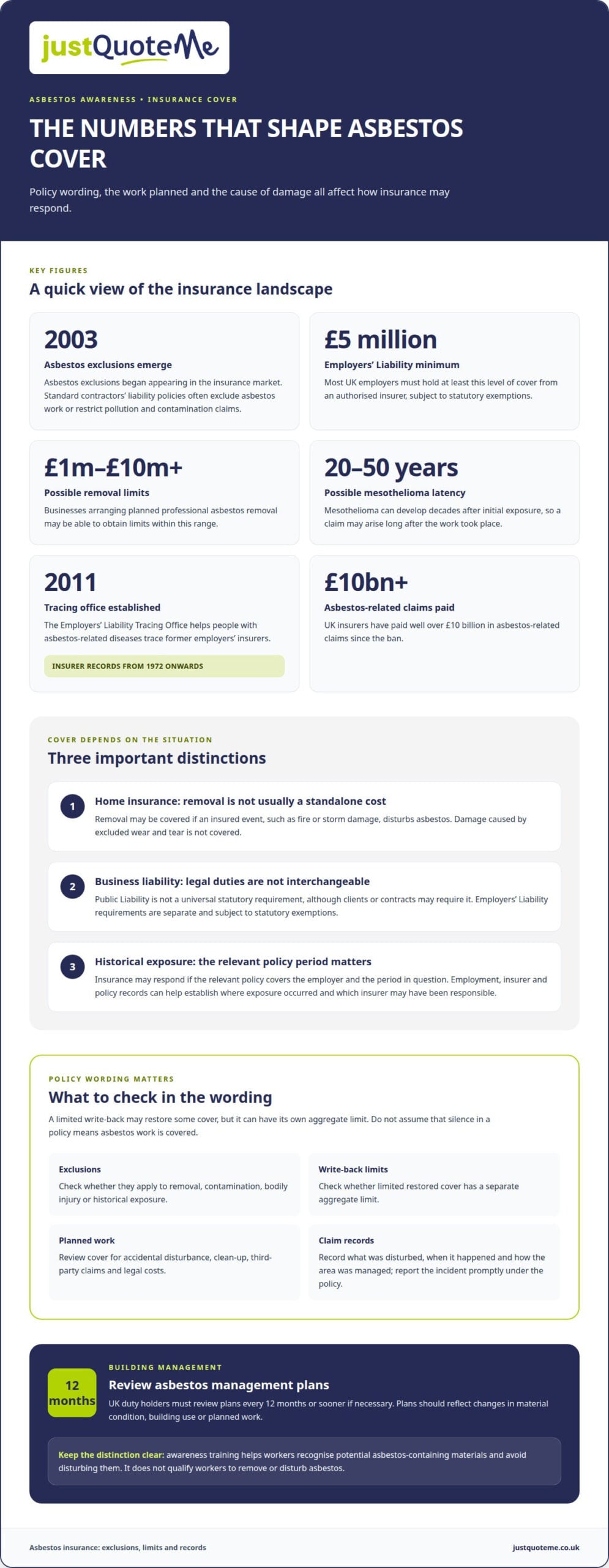
Asbestos exclusions began appearing in the insurance market in 2003. Standard contractors’ liability policies often exclude asbestos work or restrict pollution and contamination claims. Asbestos awareness and its impact on insurance become especially relevant when assessing whether a policy addresses property damage, clean-up costs or illness claims. Never assume silence in a policy means asbestos work is covered.
Legal duties and insurance requirements are related, but they are not interchangeable. Regulation 10 of the Control of Asbestos Regulations 2012 requires employers to provide adequate asbestos information, instruction and training at regular intervals, according to UK legislation. Most UK employers must hold Employers’ Liability insurance with at least £5 million of cover from an authorised insurer, subject to statutory exemptions, according to the Health and Safety Executive. Public Liability insurance is not a universal statutory requirement, although contracts or clients may require it. Businesses arranging planned professional asbestos removal may be able to obtain limits from £1,000,000 to £10,000,000+.
Home insurance generally does not cover asbestos removal as a standalone expense. Removal may be covered if an insured event, such as fire or storm damage, disturbs asbestos; damage caused by excluded wear and tear is not covered. Before planned removal, establish whether the policy covers accidental disturbance, clean-up, third-party claims and legal costs. These details can determine how costly an incident becomes.
How should UK businesses manage asbestos risks when claiming or renewing insurance? Disclose known asbestos, describe the work and controls in place, and provide relevant training or risk-management records. At renewal, consider asbestos awareness and its impact on insurance alongside policy exclusions and limits. Ask whether exclusions apply to removal, contamination, bodily injury and historical exposure, and whether any write-back has a separate aggregate limit. For a claim, report the incident promptly under the policy and record what was disturbed, when it happened and how the area was managed.
Can this insurance cover historical exposure claims?
Insurance may respond to historical asbestos exposure claims if the relevant policy covers the employer and the period in question. Because illness can occur long after exposure, employment and insurer records are important.
Historical Exposure Claims
A historical exposure claim alleges that someone encountered asbestos during past work and later developed an illness linked to that exposure. Mesothelioma can develop 20 to 50 years after initial exposure, so a claim may arise long after the work took place. Former employers, job duties, work locations and policy records can help establish where exposure occurred and which insurer may have been responsible. The employer’s sector and the controls used at the time can also inform the evidence and risk assessment.
Illness and Contamination Claims
These claims may involve personal injury from exposure or costs and losses following asbestos contamination. Employers’ Liability Insurance can respond to eligible employee claims for work-related injury or illness, subject to the policy’s terms and exclusions. The example shows why the alleged exposure period and the policy in force at the time matter. Contamination claims require a separate review of cover for clean-up, damage and third-party losses.
Mesothelioma and Insurer Liabilities
Mesothelioma claims may involve former employers and insurers whose policies were active when exposure allegedly happened. The Employers’ Liability Tracing Office, established in 2011, helps people with asbestos-related diseases trace former employers’ insurers; its database holds insurer records from 1972 onwards. UK insurers have paid well over £10 billion in asbestos-related claims since the ban. Government compensation routes are separate from an insurer’s liability under an employer’s policy, and each has its own eligibility basis. Retaining employment and policy records can help clarify which route applies and whether cover is suitable. For support with considering business cover, explore insurance options.
Does having asbestos in my building automatically increase my insurance premiums?
An asbestos-containing building does not automatically mean a higher premium. Insurers assess the material’s condition, the likelihood it will be disturbed, planned work and management arrangements. Asbestos in sound condition and left undisturbed presents a different risk from damaged material near renovation work. Insurers may set conditions, exclusions or different terms based on that assessment. Clear records can help explain how the building is managed.
The Control of Asbestos Regulations 2012 sets responsibilities for those carrying out asbestos-related work in the UK, according to UK legislation. Duty holders must manage asbestos risks in relevant buildings. The duty holder may be an owner, occupier or managing agent with control of maintenance and repair. UK duty holders must review asbestos management plans every 12 months or sooner if necessary, according to the Health and Safety Executive. Plans should reflect changes in the material’s condition, building use or planned work.
Asbestos awareness training explains how to recognise potential asbestos-containing materials and avoid disturbing them. It is relevant to workers whose tasks could bring them into contact with asbestos, including maintenance staff and contractors. Awareness training does not qualify workers to remove or disturb asbestos; the work requires appropriate training and competence for the activity. Refresher training for licensed or non-licensed asbestos work is required yearly, or sooner if work methods, equipment or the type of work change significantly.
Keep useful evidence together: the asbestos survey, management plan, review dates, training attendance and course details, plus insurance schedules and correspondence about exclusions. These records can show how risks were assessed and communicated, and help explain the position during renewal or a claim. A poorly managed risk can also have enforcement consequences: an asbestos contractor sentenced in March 2025 received a 12-month community order and 200 hours of unpaid work.
Health risks from damaged or disturbed asbestos
Asbestos becomes a health hazard when damaged material releases fibres into the air. People can inhale these fibres without seeing or smelling them. The risk depends on exposure, including how the material is disturbed and whether fibres become airborne. Intact asbestos left undisturbed is different from damaged insulation or debris after building work. Avoid drilling, sanding, breaking or sweeping suspected asbestos-containing materials.
Asbestos-related diseases can take 15 to 60 years after exposure to produce symptoms. The delay means a person may not connect a later illness with an earlier job or building. Great Britain recorded 2,146 mesothelioma deaths in 2024, while mesothelioma diagnoses have reached approximately 2,500 cases annually in recent years. The Health and Safety Executive projects annual mesothelioma deaths will remain at or near 2,500 for at least another decade before gradually declining.
Refurbishment can disturb asbestos and expose workers, occupants and people nearby. If an Artex ceiling collapses, leave the debris alone, keep people and pets out, and do not sweep or vacuum it. Arrange an appropriate assessment before work that could disturb suspected material. A licensed professional may be needed for removal, depending on the material and work involved.
Health risks and insurance risks are connected, but policies respond according to their wording. A liability policy may exclude asbestos, restrict contamination claims or set limits that do not cover bodily injury. Cover for legal costs or clean-up does not necessarily include an illness claim. If property is damaged, record the incident without disturbing debris, then report it through the relevant insurance claims process. Keep survey findings and work records to help explain what happened.
More than 5,000 asbestos-related deaths occur in the UK each year. That continuing toll makes prevention essential: keep people away from damaged areas and prevent unplanned work until the material has been assessed. Explore insurance options for your property or business to consider how policy exclusions relate to asbestos risks.
Just Quote Me
Just Quote Me can help you consider how asbestos-related risks fit with your business or property insurance needs. If you are reviewing a renewal, planning work on a building or unsure how exclusions affect potential claims, an adviser can help clarify relevant cover and policy wording. Depending on your circumstances, this may include Public Liability Insurance, Employers Liability Insurance, Professional Indemnity Insurance or Landlord Insurance.
Useful details to discuss include the building’s asbestos records, planned activities and any concerns about liability or damage. This keeps the conversation focused on the risks that matter to you. Request a callback for free expert advice about your insurance needs.
Make your next insurance review count
Use your next renewal or property review to connect asbestos information with planned work and the people responsible for the building. Understanding asbestos awareness and its impact on insurance can help you have a clearer discussion about risk, liability and the cover your circumstances require.
Before the discussion, gather relevant property records, details of planned activities and questions about policy wording. Consider how the building is used, who may be affected by the work and what protection you expect if a claim arises. These details provide a practical starting point, rather than relying on assumptions about what a standard policy includes.
Just Quote Me can help you explore insurance options for your business or property. Get your free business insurance quote and take a considered next step towards cover that reflects your circumstances.
Frequently Asked Questions
When asbestos work goes wrong: Will your insurance do what you expect?
Not necessarily; the policy wording and circumstances determine what responds. For example, a site incident could involve separate property damage, clean-up and injury claims, each treated differently under the policy. Report the incident promptly and keep contracts, site records and communications together. These details help establish what happened, who was involved and which parts of the cover may apply.
Is asbestos insurance a legal requirement?
There is no universal legal requirement for a standalone asbestos insurance policy. Most employers must hold Employers’ Liability insurance, subject to statutory exemptions, while Public Liability insurance is not universally required by law. A client or contract may still require public liability cover, including for specific site work. Legal insurance duties and a project’s cover requirements are separate matters.
How has the ban on asbestos affected the insurance industry in the UK?
The UK’s prohibition ended new legal supply and use, but it did not remove asbestos from older buildings or resolve past exposure claims. Asbestos exclusions began appearing in the insurance market in 2003. Insurers also use actuarial models to estimate mesothelioma cases over the next 20 to 30 years. That long claims horizon helps explain continuing attention to historical liabilities and policy wording.
How does asbestos awareness affect employers’ liability insurance in the UK?
Awareness helps employers identify tasks that could expose workers and put suitable controls in place. This context matters if an employee later alleges a work-related illness, particularly where job duties or supervision have changed. Keep dated records of roles, training and work locations. They can help clarify the circumstances behind a claim, including for apprentices, temporary workers or labour-only subcontractors under an employer’s direction.
How does asbestos awareness affect public liability and contractors’ insurance?
Awareness helps contractors recognise when a job could disturb asbestos and plan accordingly. Insurers assess the activity and its risks, while standard contractors’ liability policies often exclude asbestos or restrict contamination and pollution claims. Before working at an occupied property, clarify how the policy treats third-party injury, property damage and contamination arising from the specific activity. Contract requirements may also set the cover limits expected for a project.
Can insurers refuse or limit cover if asbestos training or management rules are not followed?
An asbestos exclusion or limit can restrict cover, but a training or management failure does not automatically mean every claim will be rejected. The policy wording, disclosed risk and incident details matter. Keep management records, training evidence and incident reports, and accurately describe asbestos-related activities at renewal. This gives the insurer relevant information to assess the risk and any claim.
