

Could switching commercial insurance brokers in the UK change what you pay, even if your policy stays broadly similar? A broker may earn commission from an insurer, charge you a fee, or use a combination of both. You can ask your broker to explain any commission or fees, so you know how the service is paid for.
When changing who handles your business insurance, it is reasonable to want clear costs and continuous cover. Switching brokers does not automatically replace your policy. Keep your existing cover in place until replacement arrangements and their start date are confirmed.
This guide explains how brokers are paid, how they differ from tied agents, direct insurers and comparison websites, and what can affect switching costs. It also sets out the practical steps for transferring your account without leaving a gap in cover.
Key Takeaways
- Ask how your broker is paid and request details of any commission or fees to understand the cost structure.
- Coordinate the changeover so your new cover starts before your existing policy ends, avoiding a gap in protection.
- Understand how brokers differ from tied agents, direct insurers and comparison websites before deciding who should arrange your cover.
- Have your current policy information, business details and relevant changes ready to help a new broker assess your needs.
Switching commercial insurance broker without a gap in cover: how a broker manages the process
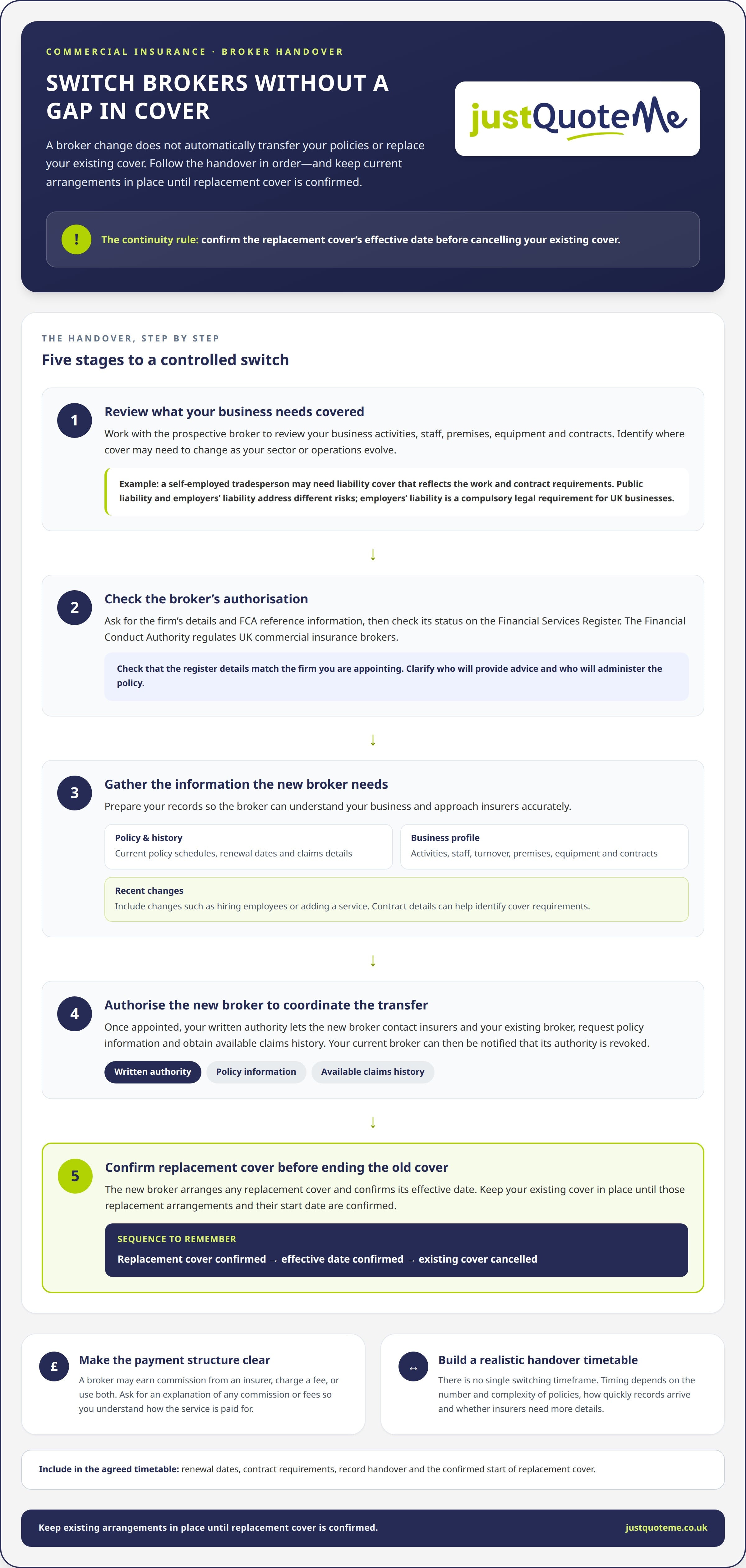
A broker can coordinate the change, review your risks and confirm the start date of any new cover. Keep your existing arrangements in place until replacement cover is confirmed.
Reviewing your business cover needs with a broker
The broker reviews your activities, staff, premises, equipment and contracts, then identifies where cover may need to change. A self-employed tradesperson, for example, may need liability cover that reflects the work and contract requirements. Public liability insurance and employers’ liability cover address different risks; employers’ liability is a compulsory legal requirement for UK businesses. As your sector or operations change, the broker can adjust the proposed cover to suit.
Confirming a prospective broker’s authorisation
Ask the broker for its firm details and FCA reference information, then check its status on the Financial Services Register. The Financial Conduct Authority (FCA) regulates UK commercial insurance brokers. Make sure the details match the firm you are appointing, and clarify who will handle advice and policy administration. This helps establish the broker’s authority to act on your behalf.
Preparing to appoint a new broker: what your broker will ask you to provide
The new broker needs enough information to understand your business and approach insurers accurately. Prepare your current policy schedules, renewal dates and claims details, along with information about your activities, staff, turnover, premises, equipment and contracts. Include recent changes, such as hiring employees or adding a service. These details help the broker present your risk and identify cover requirements in your contracts.
How a new broker transfers your policies and claims history
Policies don’t automatically move to a new broker. Once you appoint one, your written authority lets the broker contact insurers and your existing broker, request policy information and obtain available claims history. Your current broker can then be notified that its authority is revoked. The new broker arranges any replacement cover and confirms its effective date before you cancel existing cover.
There is no single timeframe for switching. The work depends on the number and complexity of your policies, how quickly records arrive and whether insurers need more details. Agree a handover timetable that accounts for renewal dates, contract requirements and the confirmed start of replacement cover.
Describing insurance brokerage services
A regulated broker can arrange business insurance and help manage policy changes. The service includes advice, communication and support if a claim arises.
Personal service and communication
A brokerage service can involve understanding your operations, arranging cover and explaining how policy terms relate to your risks. Brokers may approach a range of insurers, including specialist markets, and discuss premiums, exclusions and endorsements with you. The right fit depends on your sector and the risks insurers need to assess.
Service can also extend beyond arranging a policy. A broker may negotiate endorsements or seek to remove exclusions so wording better reflects your operations. If you claim, the broker can help interpret policy conditions and negotiate with loss adjusters. Ask how updates, renewal discussions and claims queries are handled, and whether commission or fees can be explained on request. This makes the scope of support clearer.
Service area and availability
If your business operates in Sussex, consider whether the broker can support the locations and activities involved, not just whether its office is nearby. A business with a workshop in one town and contract work across the county may need the broker to understand both its premises and work locations. Agree how you will share information and who will manage your account.
Customer service availability varies by brokerage. Clarify the usual contact channels, response arrangements and how urgent policy changes or claims are handled. These details matter if a contract changes, a new site opens or your business activities shift. A broker’s registered details and service arrangements help you understand who is responsible and how to reach them. For tailored business cover, explore brokerage support for business insurance.
How brokers, tied agents, direct insurers and comparison websites differ
The main difference is who arranges your cover and how many insurers they can approach. For a UK business, this affects the policies presented, how advice is provided and who can help if you make a claim.
A commercial insurance broker acts for its business client and is regulated by the Financial Conduct Authority (FCA). Brokers may approach a range of insurers, including specialist underwriters and Lloyd’s of London syndicates that do not deal directly with the public. They can help tailor cover to your operations, explain policy terms and present options from different markets. For example, a business with unusual activities may need specialist terms that a standard online quote does not address.
A tied agent represents one insurer or a limited panel, rather than searching across the wider market. The agent can explain and arrange products available through that relationship. This gives you a direct route to those policies, but the options depend on which insurers the agent represents. Ask how the agent is paid and which insurers it can approach.
A direct insurer sells its own policies to customers. You deal with that insurer for a quote and policy, rather than using a broker to approach multiple insurers. If you need to make a claim, you contact the insurer through its claims process. The policy wording determines what is covered, so compare limits, exclusions and conditions, not just the premium.
A comparison website collects information and displays quotes from participating insurers or intermediaries. It can help you compare prices and headline cover, but results depend on which providers and products are included. A displayed quote is not a substitute for checking whether the policy fits your contracts, activities and specific risks.
Choose the route that suits your business’s complexity. A straightforward risk may suit a direct policy, while a business with several activities or specialist requirements may benefit from a broker’s wider search and tailored advice. Before appointing a broker, establish its FCA status, market access, remuneration and role in claims support. This clarifies the service you will receive, who will act for you and how policy choices will be presented.
What information and documents are needed to appoint a new commercial insurance broker?
A new broker needs a clear picture of your business, existing policies and upcoming deadlines. Complete records help the broker present your risk accurately and identify questions before approaching insurers.
Prepare a handover pack with documents that explain your current arrangements and operations:
- Current policies: schedules, wording, endorsements, renewal dates and insurer details for each policy.
- Claims information: known claims, open claims and available claims history, including dates and current status.
- Business description: activities, services, premises, locations, equipment and any changes to how the business operates.
- People and contracts: staff details, relevant subcontracting arrangements and contracts specifying insurance requirements.
- Financial and risk details: the financial information requested for the relevant cover, plus security, fire-protection or risk-management details where applicable.
The information needed depends on your trade and the policies being arranged. For example, a contractor working at different sites may need to describe each type of work and provide contracts with specific liability limits or evidence requirements. A property-owning business may need to provide details about its buildings, occupancy and use. The broker can identify relevant records based on your activities and existing policy terms.
Include changes since the last proposal or renewal, such as new services, staff, premises or equipment. The Insurance Act 2015 requires a fair presentation of the risk at proposal and renewal. Clear, up-to-date information helps the broker describe your risk consistently and reduces the chance of material details being overlooked.
The broker will also request your written authority to act, allowing it to approach insurers and obtain policy information from your current broker. Keep the handover focused on business records, not passwords or unrelated personal documents. If a document is unavailable, explain what it covers and when it was last updated. This gives the broker a practical basis for progressing the appointment and identifying any remaining information it needs.
Prepare your commercial insurance broker handover with your current policy and business records.
Just Quote Me: Commercial Property Insurance
Just Quote Me can help if you are changing brokers and need to review insurance for business premises. Its Commercial Property Insurance is relevant if your business owns or occupies property. The suitable arrangement depends on details such as the building and how it is used.
A broker can also consider how property cover fits alongside Public Liability Insurance, Employers Liability Insurance or Professional Indemnity Insurance, where relevant. Share your current policy details, renewal date and any changes to your premises or business activities. This helps the broker discuss suitable cover and coordinate the handover without cancelling existing protection too soon.
Contact Just Quote Me to discuss your commercial property insurance and broker switch.
Plan your next insurance review with confidence
Changing brokers can be a useful opportunity to consider how your insurance should support your business as it develops. Rather than treating renewal as a routine handover, use the conversation to identify what you want from the new relationship and how it should fit your plans. A clear purpose keeps the discussion focused on your priorities.
Consider changes ahead, such as new premises, different contracts or evolving business activities. Set out which areas need attention and what you expect from the broker’s service. This gives the discussion a practical starting point and helps you decide whether a new arrangement suits your business.
For your next step, get a free business insurance quote or request a callback for free expert advice from Just Quote Me. Choose the option that suits how you would like to discuss your insurance, then move forward with a clear view of your requirements.
Frequently Asked Questions
How are brokers paid?
Commercial insurance brokers can earn commission from insurers when they arrange a policy and may charge clients administration or arrangement fees. Some remuneration may also relate to renewals. Ask for a clear explanation of how the broker is paid and which charges apply to your account. UK brokers must disclose commission or fees to commercial clients who request that information.
How can a broker manage a commercial insurance switch in the UK?
A broker can coordinate the handover by obtaining your authority to act, gathering policy and claims records, and contacting insurers about your requirements. It can then arrange new cover around your renewal date or another agreed start date. For example, a business with separate property and liability policies can move each arrangement on a planned timetable, rather than treating them as one automatic transfer.
When can a UK business change its commercial insurance broker?
A business can appoint a different broker if it decides the relationship no longer meets its needs. The practical timing depends on policy renewal dates, the current broker’s terms and the work involved in arranging replacement cover. If your business faces a major change, such as adding an activity or premises, start the discussion before renewal so the new broker has time to understand the revised risk.
Will switching commercial insurance brokers affect existing cover or policy terms?
Changing brokers does not itself rewrite an insurance contract. Your insurer and existing policy terms remain relevant unless the policy is changed, replaced or cancelled. After reviewing your needs, a new broker may recommend different wording, limits or exclusions. Compare the proposed schedule and terms with your current documents. For instance, a new activity could require an endorsement or a different policy arrangement.
Are there fees, commission charges or cancellation costs when changing brokers?
Costs depend on the broker’s disclosed remuneration, its service terms and the policy arrangements being changed. A broker may receive insurer commission or charge administration fees; cancellation or adjustment charges can also depend on the relevant terms. Before authorising the switch, ask for a breakdown of broker charges and any costs associated with cancelling, changing or financing a policy. Do not assume appointing a new broker removes existing charges.
How do I compare UK commercial insurance brokers, services and fees?
Compare what each broker will do, which insurers it can approach, how it is paid and what support it provides after arranging cover. Check FCA authorisation and ask how claims assistance works. Compare policy wording as well as the premium: a lower quote may have different limits, exclusions or conditions. For example, confirm that the proposed terms reflect any liability cover required by a contract.
Get Your Free Business Insurance Quote now, or Request a Call back for free Expert advice.
