
A closure doesn’t automatically mean your insurer will cover lost income. Denial of access insurance cover usually depends on a specific event and policy trigger, such as an authority restricting access to your premises, not disruption alone. If your business is intact but customers or staff can’t get in, the wording matters.
It’s understandable to assume business interruption insurance will respond whenever trading stops. Standard cover often relies on physical damage to your property, while denial of access may be a separate non-damage extension with its own conditions, exclusions and limits. A road closure, police cordon or evacuation order could be treated differently under different policies, so the circumstances alone don’t settle whether a claim is covered.
This guide explains the main types of access restriction policies may describe, what wording and evidence to review, and how denial of access differs from general business interruption cover. You’ll also find a straightforward way to assess your income protection needs and compare policy options. Just Quote Me can help you compare business insurance wording, with cover always subject to the relevant insurer’s policy terms.
Key Takeaways
- Denial of access insurance cover depends on the policy’s specific trigger, not simply on your business being disrupted.
- Compare restrictions near your premises with utility interruptions, as policies may treat these situations differently.
- Read the policy schedule, wording and relevant endorsements together to understand conditions, exclusions and limits.
- Keep clear records of the restriction, its cause and its effect on your trading to support a careful review of your position.
- Compare business insurance options and wording to assess whether the cover aligns with your potential income loss.
What does denial of access insurance cover mean for a business?
Denial of access insurance cover is a form of business interruption protection that may help with specified financial losses if access to insured premises is prevented or restricted. The phrase alone doesn’t confirm that a particular closure is covered. The policy must include relevant protection, and the circumstances must meet its stated trigger and conditions.
It’s useful to separate the interruption from the event behind it. The interruption is the effect on your business, such as being unable to open, serve customers or carry out work at the premises. The event is what caused the access problem. A fire nearby, a cordon or a road closure might be relevant examples, but none automatically means a claim will be accepted. The wording determines what causes, locations and forms of restriction count.
Denial of access is connected to business interruption insurance because the potential loss is often trading income or another financial impact following disruption. The underlying purpose of business interruption protection is to help a business manage certain financial consequences of interruption, as outlined in Business Interruption Insurance Explained. The cover available, and how a loss is assessed, depend on the policy. Some policies link business interruption to insured physical damage, while an access-related extension may set out a separate trigger.
That distinction matters. A business that can’t physically reach its premises may face a different issue from one that remains accessible but sees fewer customers because demand has fallen. A quiet trading period, reduced bookings or customers choosing to stay away isn’t necessarily a denial of access. The key question is whether access itself has been prevented in a way the policy describes, not just whether revenue has dropped.
How can restricted access lead to a business interruption loss?
If staff, customers or deliveries can’t reach a site, trading may pause or become harder to carry out. A shop might be unable to open during a cordon, for example, while a service business could lose appointments if clients cannot enter its premises. These examples show possible operational effects, not automatic cover. The restriction is the cause; lost income or additional operating costs are potential consequences, subject to the policy.
What does the term denial of access usually refer to?
The term often concerns restrictions affecting access to insured premises or an area around them. Wording may specify how close the event must be, what type of restriction applies and whether an authority must impose it. Some specialist explanations distinguish an event near the premises from an interruption to a remote public utility. Treat these as different scenarios: a utility failure elsewhere may fall under separate wording, if included.
Read the schedule, policy wording and any applicable endorsements together. Check how each document describes the insured location, access restriction and resulting interruption. That gives you a clearer basis for assessing your business interruption needs without assuming that every closure, utility issue or fall in customer demand is insured.
Which policy triggers can determine denial of access insurance cover?
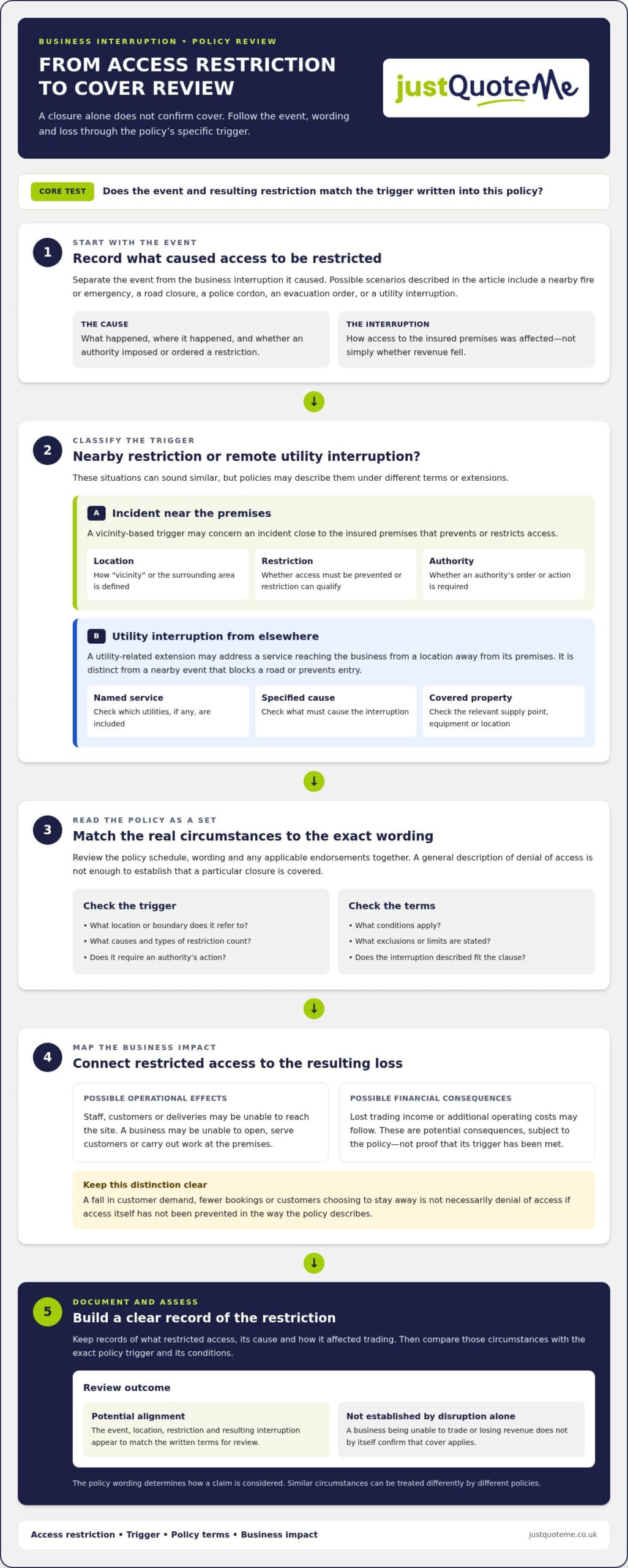
Two situations can sound similar but trigger different policy terms: an incident near your business that restricts access, and a failure affecting a utility serving your premises from elsewhere. Denial of access insurance cover is not a single standardised promise. An extension or endorsement may define exactly which causes, locations and restrictions count, so compare the written trigger with what actually happened.
Keep the cause and the financial impact separate. A cordon, road closure or utility interruption may be the event; inability to trade and resulting financial loss are its consequences. A policy may require both a specified event and a defined interruption before cover can respond. A loss of revenue by itself doesn’t establish that the trigger has been met.
Nearby premises and prevention of access
A vicinity-based trigger generally concerns an incident close to the insured premises that prevents or restricts access. The wording may define “vicinity” by distance, describe what counts as “prevention,” and specify whether an order or action by an authority is required. A nearby emergency might fit the broad scenario, but the distance, cause and authority conditions must match the particular policy.
Look for the exact terms rather than relying on a general description. Does the clause refer to the insured premises, surrounding area, or a particular boundary? Does it require access to be completely prevented, or can a restriction qualify? These details can make similar incidents produce different outcomes under different wordings.
Public utilities and remote premises
A utility-related extension may address interruption to a service reaching the business from a location away from its premises. This is distinct from a nearby incident that blocks a road or prevents entry. The policy wording determines which utilities are named, what event must cause the interruption and whether the affected equipment or location falls within the extension.
Don’t assume every power, water or communications failure qualifies. Check whether the cover applies to a failure at a remote supply point, damage to utility property, or another specified cause. A brief interruption and a prolonged outage may also be treated differently if the wording sets conditions or limits. Bellrock’s distinction between vicinity restrictions and remote public utilities is a useful way to organise the questions, not a substitute for checking your own policy.
For each possible trigger, note the event, its location, who imposed or caused the restriction, how access or service was affected, and the resulting interruption to your business. Then compare those facts with the schedule and relevant extension. The Financial Conduct Authority’s website provides general information about financial services in the UK, but it doesn’t determine how an individual insurer’s clause applies to a claim.
When comparing business insurance, a broker can help you review differences in policy wording across options. Just Quote Me offers an online comparison service and expert advice, so you can assess the wording alongside your business interruption needs without assuming a particular event will be covered.
How does denial of access cover differ from other business interruption protection?
Business interruption protection can respond to different kinds of disruption, but the trigger is not necessarily the same across a policy. Some cover is linked to insured physical damage at the business premises. Access-prevention and utility extensions may describe other events, with their own definitions and conditions. The label alone won’t tell you which scenario is covered.
Access-related cover is determined by its stated trigger and conditions. Use the comparison below to identify what to look for, rather than assuming that one type of interruption protection includes another.
| Type of protection | Potential trigger | Location to examine | Wording questions |
|---|---|---|---|
| Access-prevention extension | A specified restriction preventing or limiting access | Insured premises or a defined surrounding area | How are “vicinity” and “prevention of access” defined? Is an authority’s action required? |
| Utility extension | A specified interruption to a utility service | Premises, supply route or remote utility property, as stated | Which services and causes are included? Are there conditions about the source or duration? |
| Wider business interruption cover | Often an insured event, which may include physical damage | Insured property or another location specified in the policy | What event must happen, and how must it cause the interruption and financial loss? |
This is a guide to the kinds of wording questions to ask, not a statement of standard cover. An extension or endorsement can narrow a trigger, define a location, or add conditions. The schedule, main wording and applicable endorsements need to be read together. Also look for any stated limits, exclusions or requirements that affect how the interruption is assessed.
Denial of access versus material damage-related interruption
Some business interruption wording links cover to physical damage at insured property caused by an insured event. An access-related extension may instead set out a trigger involving restricted access, potentially without damage to the business’s own premises. These are different routes through the wording, not interchangeable guarantees. A closure near your site doesn’t automatically meet either trigger.
Check whether the policy requires damage, where that damage must occur, and how it must lead to interruption. For an access extension, focus on the specified restriction and location instead. The relevant clause determines which route, if any, applies to the circumstances.
Denial of access versus utility failure
An access restriction concerns being unable to reach or enter premises; a utility extension concerns interruption to a service. One event might create both problems, but the policy may address them under separate clauses. Compare the wording for the cause, affected location, named service and link to the business interruption loss.
For example, a blocked route and a remote supply failure raise different questions about what happened and where. Check the exact policy schedule, wording and endorsements before relying on either section. Denial of access insurance cover may sit alongside other business interruption protection, but one extension doesn’t automatically broaden the terms of another.
How can a business review denial of access policy wording?
A structured review can help you spot the policy language that matters before you rely on denial of access insurance cover. Read the documents as a set, then compare their terms with the circumstances your business needs to plan for. A policy summary can be a useful starting point, but it may not show every condition or limitation.
Work through these steps:
- Locate the documents. Gather the policy schedule, full wording and any applicable endorsements for the same period of cover.
- Identify the trigger. Find the clause that deals with access restrictions or related interruption, and note the event and location it describes.
- Check the conditions. Look for requirements concerning the cause, authority, extent of restriction, resulting loss, exclusions and limits.
- Record questions. Write down unclear terms and the practical scenario you want to understand, such as a closure near your premises or an interruption to a named service.
This process won’t determine whether a future claim will be accepted. It gives you a clearer way to compare the wording with your operational risks and identify where you need a plain-language explanation.
What wording and documents should a business read together?
Start with the schedule, which identifies the policy details, then read the core wording and any endorsements that amend or add terms. An endorsement may change how an extension applies, so don’t treat the main wording as the whole contract. Keep the documents together and check they relate to the same policy period. Without the full wording, it’s not possible to interpret a specific policy reliably.
As you review, note the answers, or questions, for four areas:
- Premises: Which site or insured location does the clause refer to?
- Cause: What event must lead to the restriction or interruption?
- Access restriction: How does the wording describe prevention or limitation of access?
- Insured loss: What financial impact is addressed, and what conditions apply to it?
Also check whether a clause refers to a particular authority, nearby area or utility source. Use the exact wording, not assumptions based on everyday meanings of terms such as “vicinity” or “closure.”
What information may help when reporting an incident?
If an incident occurs, create a contemporaneous record of when it began and ended, the affected location, the restriction in force and how it affected trading or operations. Keep relevant notices, correspondence and other available communications. Record the financial impact separately from the event itself, and preserve supporting business records in line with your usual processes.
Follow the notification requirements in your policy and any instructions from the insurer. Note when and how you reported the matter, and retain copies of information provided. Don’t wait to assemble a perfect file before following the stated reporting process. The policy wording sets the applicable requirements, so use it as your reference.
Comparing policy wording can make differences easier to see. Get Your Free Business Insurance Quote now to compare business insurance options.
How can Just Quote Me help you compare business insurance options?
Comparing business insurance involves more than looking at policy names or premiums. The wording can differ on what triggers a business interruption extension, which locations it applies to and what conditions must be met. Just Quote Me is an independent UK insurance broker with an online comparison service, helping businesses compare insurance options and understand the differences that matter to their needs.
If you’re assessing denial of access insurance cover, bring your specific wording questions into the comparison. A broker can help you consider differences between policy options, while any cover remains subject to the relevant insurer’s terms. This can make it easier to understand what a policy says before deciding whether it fits your business interruption concerns.
What information can help make an insurance comparison useful?
A clear picture of your business helps focus the comparison. Outline what your business does, where it operates and which premises you use. Then describe the access-related risks you’re concerned about, such as restrictions affecting entry or disruption to a service, and explain how an interruption could affect trading or operations.
Have your current policy documents to hand if you have them. The schedule, full wording and applicable endorsements can help frame questions around a particular clause. You might note terms you want explained, differences you’ve noticed between policies, or situations you want to understand. This helps keep the discussion practical without assuming that a specific incident would be covered.
- Business activities: Explain the work you carry out and any seasonal or location-based considerations.
- Premises: Identify the sites involved and how your business uses them.
- Interruption concerns: Describe the kind of access restriction or operational disruption you want to consider.
- Existing documents: Gather your schedule, policy wording and endorsements for a more focused comparison.
Take the next step with a free, no-obligation quote
A free, no-obligation quote gives you a practical starting point for comparing relevant business insurance options. You can bring your questions about triggers, conditions and policy wording into the process, then consider the available information alongside your business needs. A quote isn’t a promise that a particular extension will respond to a future event; the insurer’s policy terms determine the cover.
Choose the next step that suits you. Get a quote online or request a callback to discuss your questions with an expert.
Get Your Free Business Insurance Quote now
Request a Call back for free Expert advice
Make policy review part of your next business decision
Your business may change over time. A new site, different trading arrangements or greater reliance on a particular location can make it useful to revisit whether your insurance still reflects your needs. Set aside time to review your cover when circumstances change, and keep a note of wording questions for your next comparison.
Understanding denial of access insurance cover starts with the policy terms, but you don’t have to compare them without support. Just Quote Me is an independent UK broker, with an average online review rating of 4.6 out of 5. Cover always depends on the relevant insurer’s policy terms.
Take your next step with Get Your Free Business Insurance Quote now or Request a Call back for free Expert advice, and move forward with greater clarity.
Frequently Asked Questions
Does denial of access insurance cover every type of business closure?
No. A closure by itself doesn’t show that the policy’s trigger has been met. For example, a business choosing to shut temporarily during a quiet period differs from one ordered to close after a specified incident, but the policy wording still determines whether either situation qualifies. Check the schedule, full wording and relevant endorsements, and follow the insurer’s notification instructions if an event disrupts your business.
Can denial of access cover apply when there is no damage to my premises?
It may, if the policy includes an access-related extension whose trigger doesn’t require damage to your own premises. That doesn’t mean every incident without premises damage qualifies. Consider a nearby incident that leaves your building intact but restricts entry: the policy’s wording on cause, location and access restriction is still decisive. Read the relevant clause with the schedule and endorsements before relying on the cover.
Is denial of access insurance the same as business interruption insurance?
No. Denial of access is generally described as a possible extension or trigger within business interruption protection, not a guarantee that every access problem is covered. Other business interruption provisions may respond to different circumstances and carry their own requirements. If you’re comparing policies, check how each one describes the relevant event and resulting loss, rather than treating the phrase “business interruption” as a complete description of cover.
What happens if a road closure prevents customers from reaching my business?
The insurer will assess the circumstances against the policy wording; a road closure isn’t automatically insured. Note which roads or entrances were affected, the dates and any information about the restriction, then record how it changed your trading, such as missed appointments or cancelled deliveries. Keep relevant notices and follow the policy’s notification process. The wording may specify the affected area, cause or other requirements.
How do I make a claim for denial of access?
Start by following the claims route and notification instructions stated in your policy. Keep records of when the restriction began and ended, where it applied, relevant communications and the effect on your business. Provide accurate information and any documents requested by the insurer. The insurer will assess the event and loss against the policy terms, so submitting a claim doesn’t mean it will automatically be accepted.
