

A SafeContractor certificate can support a tender, but it doesn’t automatically satisfy every client’s insurance checks. The SafeContractor insurance requirements you need to meet depend on more than accreditation alone: the scheme’s assessment, your contract’s stated limits and the work your business actually carries out can all matter.
It’s understandable to want one clear answer, especially when a tender asks for specific policy documents or levels of cover. SafeContractor checks insurance evidence, while a client may set additional requirements for a particular contract. The right cover also depends on your activities, such as whether you employ staff or provide design, advice or consultancy.
This guide explains how to separate scheme requirements from client contract conditions, identify insurance relevant to your work and prepare accurate evidence for an assessment, renewal or tender. You’ll also learn why a certificate alone may not be enough, and how to compare your policy documents with the limits and details requested before you submit them.
Key Takeaways
- Check current SafeContractor guidance and written client or tender terms separately; requirements can differ between the assessment and a specific job.
- Map your activities, workforce and contract duties to the cover you may need, then review policy wording rather than relying on insurance names alone.
- For SafeContractor insurance requirements, prepare clear policy evidence and compare each requested limit and detail with the relevant document.
- Keep business details, insured activities and policy dates consistent across your documents before assessment, renewal or tender submission.
- Compare contractor insurance options against your work and stated requirements to make it easier to identify and address any gaps.
SafeContractor insurance requirements: what contractors need to understand
Being ready for assessment means more than having an insurance certificate to hand. Your evidence needs to fit the assessment criteria, the terms of the job you’re bidding for and the work your business actually carries out. These are related checks, but they don’t necessarily ask the same questions.
SafeContractor approval reflects an assessment of a contractor’s health and safety arrangements. A hiring client may use that accreditation as part of its supply-chain checks, then set separate insurance conditions in a tender or contract. Those conditions can vary with the work and the client’s expectations. There isn’t one insurance limit that should be treated as universal; use the current written assessment guidance and the relevant contract documents to establish what applies to you.
Certification assesses your safety arrangements; insurance provides financial protection only within the terms, conditions and exclusions of your policy. Treating the two as interchangeable can leave an important gap: accreditation doesn’t change what your insurance covers, and a policy doesn’t itself demonstrate that you meet every assessment criterion.
Is SafeContractor approval the same as insurance?
No. SafeContractor is a health and safety assessment scheme, not an insurance policy. Insurance can help protect a business against covered liabilities, but the response to a claim depends on the policy wording and its limits, conditions and exclusions. The assessment information also includes insurance details, which may be visible to prospective clients, so accurate evidence matters as well as holding suitable cover.
The distinction helps clarify what to check. Scheme guidance sets out the evidence for the assessment; a client’s contract or tender may set additional conditions for a particular engagement. A maintenance contractor, for example, should compare the stated work with the activities recorded on its policy, rather than assume that accreditation alone confirms the insurance is suitable. The relevance of liability insurance depends on the exposures the policy is intended to address and its actual wording.
Which documents might a contractor need to review?
Depending on the assessment or client request, useful documents to review may include your insurance certificate, policy schedule and full wording. A certificate provides evidence of cover, while the schedule records key policy details; the wording explains the scope, conditions and exclusions. A requested evidence list tells you what to submit, but doesn’t replace the policy terms that define the cover.
- Check the insured business: Compare the named insured and business details on each document with the entity carrying out the work.
- Check the activities: Make sure the work described in the contract aligns with the activities shown in the policy documents.
- Check dates and limits: Compare the policy period and any stated limits with the specific assessment or contract request.
- Read relevant wording: Look for conditions or exclusions that could affect the work being undertaken.
For example, a contractor taking on design or consultancy alongside practical work should consider whether the policy evidence reflects those activities, not just the physical tasks. If a document appears inconsistent or a requested limit differs from the policy evidence, resolve the discrepancy before submitting it. That gives you a clearer basis for meeting the particular assessment or contract requirements without assuming one certificate answers every question.
How to check SafeContractor insurance requirements before applying or renewing
Use a repeatable check rather than relying on a generic online summary or last year’s paperwork. SafeContractor guidance, a tender and a contract can set different evidence or cover expectations. Keep those requirements separate so you can see which applies to the assessment and which belongs to a particular client or project.
Start with current scheme guidance and client contract wording
Download the current assessment instructions, then review each relevant tender, framework or contract clause. Record the requested cover type, limit, evidence and any renewal date exactly as stated. If a clause is unclear or two documents appear to conflict, raise the point with the relevant contracting party and keep its written response with your records.
Work through the checks in order:
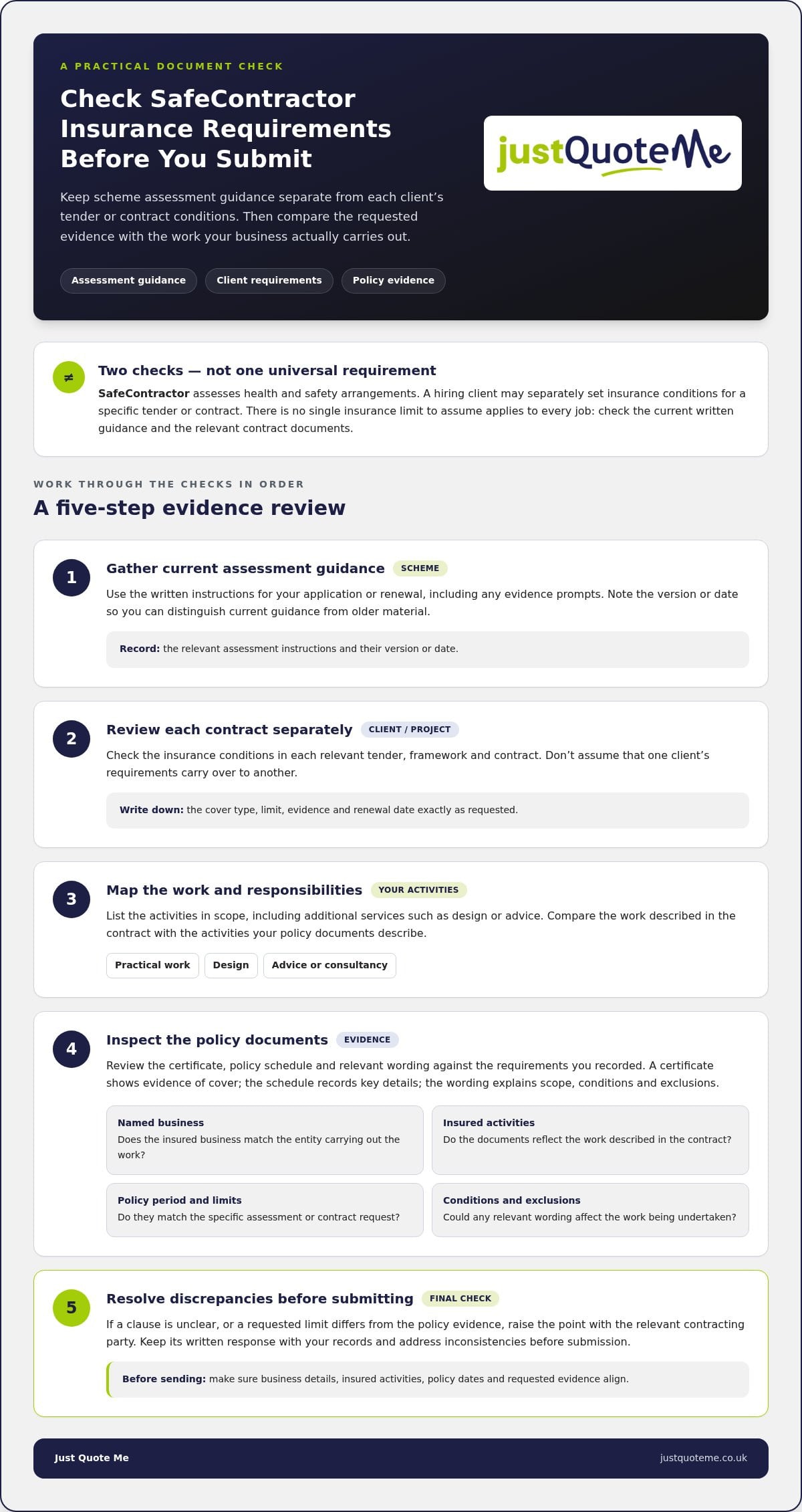
- Gather the assessment guidance. Use the current written instructions for your application or renewal, including any evidence prompts in the assessment process. Note the version or date so you can distinguish it from older material.
- Review each contract separately. Identify insurance conditions in the tender, framework and contract. Don’t assume a requirement from one client carries over to another.
- Map the work. Write down the activities and responsibilities in scope, including any additional services such as design or advice. Compare these with the activities your policy describes.
- Inspect your documents. Check the certificate, schedule and relevant policy wording against the recorded requirements. Confirm the named business, insured activities, policy period and any limits requested.
- Resolve gaps before submission. Mark missing, inconsistent or unclear evidence. Seek clarification from the relevant client or scheme where a requirement is ambiguous, and address policy discrepancies before sending your application or tender response.
First check the named business, insured activities, policy dates and stated limits against the written request. This quick comparison can catch straightforward mismatches, such as a trading name on a tender that differs from the insured entity, or project dates that extend beyond the policy period.
Match the requested evidence to your business details
Keep a simple record for each client or project: the requirement, its source, the document that answers it, its status and any clarification still outstanding. This makes renewal easier and helps prevent one client’s requested limit from being mistaken for a universal scheme rule. For Employers’ Liability questions, consult GOV.UK guidance on Employers’ Liability insurance alongside the specific assessment and contract wording.
Check that the business named on the policy matches the entity applying or contracting, and that the activities accurately describe the work being undertaken. Then compare policy dates with assessment deadlines, renewal dates and project timelines. If the contract uses an unclear term or its requirement appears inconsistent with the policy evidence, keep a note of the issue and the response received. A clear document trail makes it easier to show what you submitted and identify what remains to be resolved.
Which contractor insurance types may relate to SafeContractor work?
There isn’t a single package that suits every contractor. The SafeContractor insurance requirements relevant to your business depend on the activities you carry out, whether you employ staff, your contracts and the terms of each policy. Use the table as a starting point, then compare the wording with the work and the written requirements for each project.
Choose cover by matching the work you do and the written requirements you’ve been given, not by assuming every contractor needs the same policies.
| Cover type | Typical purpose | Questions to check in policy wording |
|---|---|---|
| Public Liability | May cover claims from third parties for injury or property damage connected with business activities, subject to the policy. | Are the activities and work locations relevant to the contract described? Does the limit meet the client’s written requirement? |
| Employers’ Liability | A separate cover to review where the business has employees, for claims connected with employee injury or illness arising from work, subject to policy terms. | Does the insured business match the employer, and are the policy dates current for the work? |
| Professional Indemnity | May be relevant if you provide advice, design or other professional services that could cause a client financial loss. | Does the wording reflect the services you provide, and are any relevant exclusions or conditions clear? |
| Contractors All Risks | A category to consider in relation to project work and the contract’s stated responsibilities. | What project activities and property are addressed, and what limits, conditions or exclusions apply? |
Liability cover for third-party claims and employees
Public Liability and Employers’ Liability address different exposures. Public Liability may be relevant where your work could lead to a third-party injury or damage to their property. For example, a contractor working at a client’s premises can compare the contract’s requested limit with the policy schedule and check that the work is described accurately. The public liability insurance guide can help you understand this cover category.
Employers’ Liability is a separate policy to review if you employ staff. Don’t treat a Public Liability certificate as evidence of Employers’ Liability cover; check the relevant certificate and schedule for the insured business and policy period. The wording and the circumstances of the work matter, so avoid assuming a policy responds to every claim.
Cover for project work, advice, tools, and equipment
Contractors All Risks may be worth assessing against the specific project and contract wording. A builder, for instance, should compare the responsibilities set out for a job with the activities and scope described in the policy. Contractors carrying tools or using plant should also check how their arrangements address those exposures rather than assuming project cover automatically includes them.
Professional Indemnity is relevant to consider where the contractor provides advice, design or consultancy, not simply because the business holds SafeContractor approval. Across each category, read the schedule and wording together, then match the evidence to the work and client request.
How to prepare insurance evidence for assessment, tenders, and renewals
A well-organised evidence pack makes it easier to show how your policy documents relate to the work and requirements in front of you. It also helps you spot a mismatch before submitting an assessment or tender. The SafeContractor insurance requirements and a client’s contract conditions may ask for different evidence, so keep the source of each request clear.
Build an insurance evidence pack for client checks
Keep current policy documents together in a clearly labelled folder for the insured business. Include the documents requested for that specific assessment or contract, rather than sending a generic pack and assuming it covers every question. A certificate can evidence policy details, but it doesn’t replace reviewing the schedule and wording for scope, conditions and exclusions.
Before submitting, use this checklist:
- Policy evidence: Gather the certificate, schedule and relevant wording requested for each cover type.
- Business details: Check the named insured and business information against the entity applying or tendering.
- Activities: Compare the work described in the policy with the activities and responsibilities in the contract.
- Dates: Confirm the policy period against the assessment deadline and project timeline.
- Requested limits: Record each stated limit and compare it with the corresponding policy evidence.
- Exceptions or gaps: Note relevant exclusions, differences in wording, missing documents or unclear requirements.
For a tender, create a simple cross-reference: put each insurance clause beside the document or policy detail that addresses it. For example, if a client specifies a particular cover type and limit, identify the relevant schedule entry and check that the policy period covers the project dates. If the certificate shows a limit but the wording excludes an activity in the scope, flag the discrepancy. Don’t treat the certificate by itself as proof that every condition is met.
Review changes before renewal or taking on new work
Renewal is a useful point to compare your current policy information with how the business operates now. Note changes to activities, workforce, subcontracting arrangements, equipment or project scope. These details may affect the information given to insurers and the evidence needed for a new assessment or contract.
Keep a record of the documents supplied, the client or scheme they were sent to, and any requirement still outstanding. If the requested wording is unclear, or policy evidence appears not to match the contract, record the issue and seek clarification from the relevant party before submission. Update the pack when policies renew or business details change, rather than reusing outdated files.
If you’re reviewing contractor cover against your work and evidence needs, Get Your Free Business Insurance Quote now.
Choose a SafeContractor approved insurance broker for your contractor business
Finding cover that fits your work and the requirements in front of you can take more than comparing policy names. An insurance broker can help you set out your business activities and contract needs, then compare relevant options and policy details. This can make it easier to see what each option is designed to cover and what wording or exclusions need closer attention.
Just Quote Me is an independent UK insurance broker. Its online comparison engine lets contractors compare quotes side by side from leading UK insurers. Sharing the written assessment or tender requirements alongside your business details can help keep the comparison focused on your actual work, rather than a generic description of contracting.
What to share when requesting a contractor insurance quote
Prepare a clear picture of the business before requesting a quote. Include the work you undertake, your business structure, whether you employ staff, and any relevant project responsibilities. If a client or assessment has specified cover types, limits or evidence, have that wording ready too. Clear information helps the broker consider relevant insurance options, but it doesn’t determine whether a client or SafeContractor will accept your evidence.
- Work activities: Describe the practical tasks you carry out and any advice, design or consultancy services you provide.
- Business details: Have the insured business name and structure to hand, along with information about your workforce.
- Project requirements: Share relevant tender or contract clauses, including the cover requested and any stated limits.
- Existing policy information: Keep current policy documents available so you can compare the existing cover with the work and written requirements.
For example, a contractor who has taken on a new type of work can explain what has changed and provide the relevant contract clause. This gives the comparison a more useful starting point and helps identify where policy wording deserves attention. The aim is to make an informed choice, not to assume that buying a policy guarantees accreditation or satisfies every client check.
Get a free, no-obligation insurance quote
Use the online comparison process to review available insurance options against your business information and stated requirements. Quotes are free and no-obligation, so you can consider the details before deciding. If you purchase a policy, its documents are emailed instantly after purchase.
Review the policy documents against the work and contract before submitting evidence. For practical help comparing contractor insurance options, choose the route that suits you:
- Get Your Free Business Insurance Quote now
- Request a Call back for free Expert advice
Make your next insurance review count
Use your next application, renewal or tender as a chance to make your insurance records work harder for your business. Keep the requirements that apply to each client clear, and make sure the cover you consider reflects the activities you actually undertake. That way, the SafeContractor insurance requirements become a practical reference for your decision-making, not just another set of documents to file.
If you want to compare options with support from an insurance broker, Just Quote Me can help you consider cover in light of your work and stated needs. Its average online review rating is 4.6 out of 5.
Get Your Free Business Insurance Quote now or Request a Call back for free Expert advice, and take your next step with confidence.
Frequently Asked Questions
Is SafeContractor an insurance provider?
No. SafeContractor is a health and safety contractor certification scheme, not an insurer. Insurance is arranged through an insurer or an insurance intermediary, such as a broker. Approval relates to assessment against scheme criteria; a policy responds only within its own wording. If a client requests evidence, review the scheme guidance and client contract separately, since neither document replaces the other or performs the other’s role.
Does SafeContractor require public liability insurance?
Just Quote Me’s SafeContractor insurance page says applicants include insurance details as part of their assessment, but this doesn’t establish one public liability limit for every applicant or job. For example, one facilities contract may request a different limit from another client’s tender. Check the latest assessment instructions and the relevant written terms, then compare the requested amount and work description with your policy schedule and wording.
Can SafeContractor approval replace contractor insurance?
No. Accreditation doesn’t insure your business or extend an existing policy. A client could ask for proof of approval and separate insurance documents during its own procurement checks, so prepare for both requests. If your policy is changed after an assessment, don’t assume the certificate or approval record reflects the new details. Use the current policy documents when responding to a client’s request and check that the evidence relates to the business tendering.
Do subcontractors need their own insurance for SafeContractor work?
It depends on the subcontracting arrangement, the task and the written requirements for the project. The SafeContractor contractors guide raises whether bona-fide subcontractors need their own insurance, but the available information doesn’t give a universal answer. If a tender asks for subcontractor evidence, identify which subcontractors and activities it covers, then clarify how the requirement applies to your arrangement before submitting documents.
What happens if my insurance expires before my SafeContractor renewal?
An expired policy may mean your previous documents no longer show current cover, and there could be a gap in protection. Check the expiry date against both your assessment timetable and upcoming work; don’t rely on an old certificate as evidence of a renewed policy. Accreditation and policy periods are separate, so review each date independently and make sure any replacement documents relate to the period being assessed or contracted.
Is an insurance certificate enough for a contractor tender?
Not always. A certificate can show key policy details, but a tender may also ask about specific limits, activities or supporting documents. For instance, if the scope includes a task that isn’t clearly described on the certificate, compare it with the schedule and relevant wording. Match each tender clause to evidence that addresses it, and flag exclusions or unclear terms rather than treating the certificate as proof that every condition is met.
