

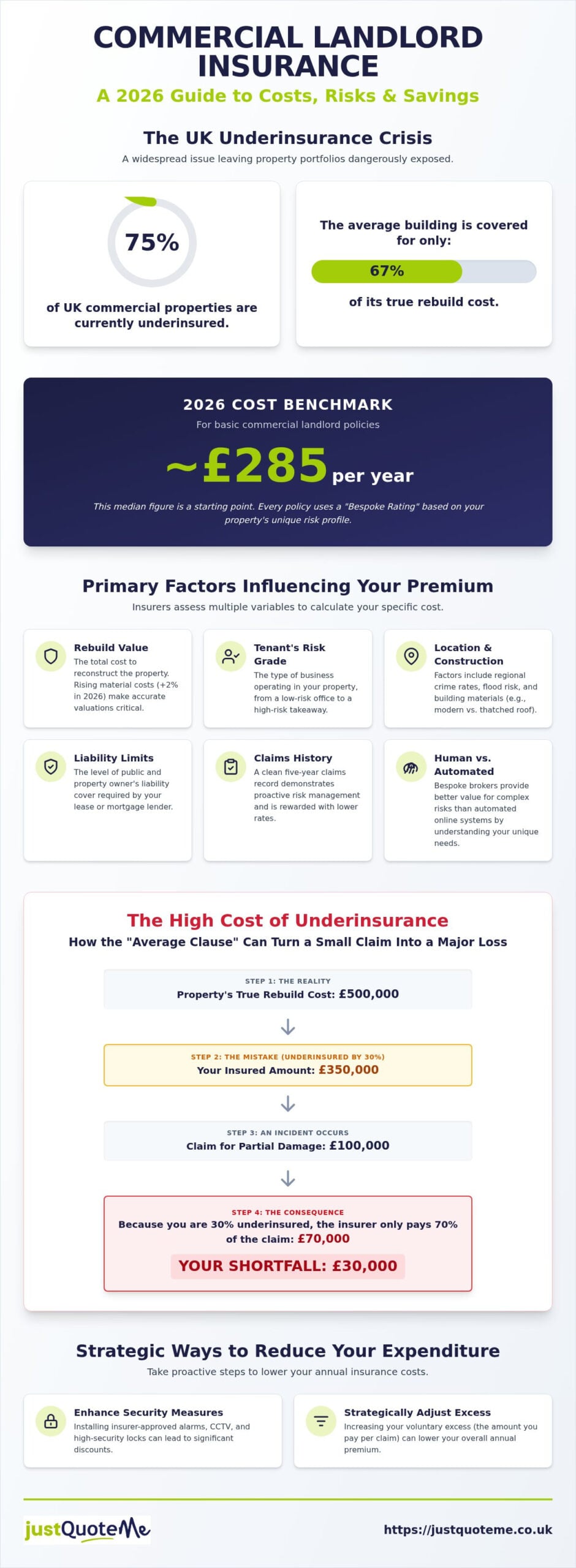
Did you know that an estimated 75% of UK commercial properties are currently underinsured, with the average building covered for only 67% of its true rebuild cost? In a landscape where construction material prices remain volatile and the Renters’ Rights Act 2025 has introduced new complexities for property owners, managing your commercial landlord insurance cost requires more than just a quick comparison search. You’ve likely felt the pressure of rising premiums and the confusion that comes when a simple change in tenant type, like moving from a retail unit to a takeaway, drastically alters your risk profile.
It’s a challenge to maintain a profitable portfolio while ensuring you aren’t left vulnerable to a significant financial shortfall. This guide provides a straightforward look at the factors driving 2026 pricing and offers pragmatic advice on how to secure bespoke coverage. We’ll examine the impact of current legislative changes, explain why accurate reinstatement values are vital, and show you how to find an expert broker who understands the nuances of your specific sector without relying on automated, impersonal systems. By the end of this article, you’ll have a clear strategy for protecting your investment while keeping your overheads under control.
Key Takeaways
- Understand the 2026 price benchmarks and why commercial premiums are structured differently than standard residential policies.
- Identify how specific tenant activities and property construction types, such as thatched roofs or takeaways, influence your commercial landlord insurance cost.
- Learn to balance essential buildings cover with appropriate liability limits to protect your portfolio against evolving legal requirements.
- Discover actionable methods to reduce your annual expenditure through enhanced security measures and strategic excess adjustments.
- Explore why a human-centric, bespoke brokerage approach provides better value for complex property risks than automated online systems.
Understanding Commercial Landlord Insurance & 2026 Cost Benchmarks
Commercial landlord insurance acts as a bespoke shield for non-residential assets, protecting your investment from risks that standard policies simply aren’t built to handle. Unlike residential cover, these policies are tailored to the specific operational demands of business premises. When calculating the commercial landlord insurance cost, insurers move away from generic formulas. Instead, they apply a “Bespoke Rating” where every property is treated as a unique risk profile based on its use, construction, and location. In 2026, the median cost for a basic policy with no optional extras is averaging approximately £285 per year. However, this figure is a broad benchmark; your actual premium depends heavily on your sector and the specific activities occurring within your property.
Understanding property insurance fundamentals is essential for any portfolio owner. While some basic policies start as low as £14.25 per month for simple building and liability cover, most professional landlords require more comprehensive protection. If you are managing a diverse portfolio, exploring commercial property insurance options with an independent broker helps clarify these bespoke ratings.
While the £285 median sits as a general guide, several factors shift this benchmark for 2026:
- The total rebuild value of the structure.
- The specific trade or “Risk Grade” of the tenant.
- The regional crime rate and environmental risks like flooding.
- The level of property owner’s liability required by your mortgage lender or lease.
Commercial vs. Residential: The Pricing Gap
The price difference between residential and commercial cover is driven primarily by risk exposure. A private home has predictable, low footfall. A retail shop or office block, however, sees a constant stream of employees, customers, and delivery drivers, which significantly increases liability risks. Commercial leases are also more complex, often involving Full Repairing and Insuring (FRI) terms. While these terms allow you to recover premiums from tenants, the legal responsibility for the structure remains with you. It’s also vital to remember that standard residential policies strictly exclude any commercial activity. Using the wrong policy won’t just lead to a rejected claim; it leaves your entire asset exposed.
The Cost of Underinsurance in 2026
The Primary Factors Influencing Your 2026 Premiums
While industry benchmarks provide a starting point, your specific commercial landlord insurance cost is determined by a combination of physical and operational variables. Insurers don’t just look at the building; they evaluate the likelihood of a claim based on how the property is constructed and who occupies it. For example, a modern office block built with fire-resistant materials presents a much lower risk than a thatched pub. In regions like Staffordshire, Victorian period features are common. While these add character and value, they often require specialist materials and heritage-skilled labour for repairs, which naturally increases the premium. A “clean” five-year claims record is your strongest asset here; it demonstrates a proactive approach to maintenance and risk management that underwriters reward with lower rates.
The relationship between landlord and tenant also dictates how costs are allocated. The RICS Code for Leasing Business Premises outlines best practices for these negotiations, including insurance responsibilities. Even if you recover the premium from your tenant, the “Risk Grade” assigned to their specific trade remains the primary pricing driver. If you’re managing multiple units, you can consolidate your risks into a single portfolio policy to simplify administration and potentially secure bulk discounts.
Tenant Profiles: From Low to High Risk
Insurers categorise tenants based on “Hazard Grades.” An accountancy firm or a low-footfall office is a low hazard. Conversely, “High Hazard” tenants like restaurants, workshops, or businesses using heavy machinery carry higher premiums due to fire and liability risks. Shop Insurance rates reflect high public footfall, which increases the chance of a liability claim. Additionally, unoccupancy is a major factor. If a property sits empty for more than 30 to 60 consecutive days, standard cover is often restricted, and premiums can rise by 30% to 80% to account for the increased risk of vandalism or undetected damage.
Regional Insights: Staffordshire and the West Midlands
Local geography and economic factors in Stafford, Stone, or Newcastle-under-Lyme directly influence your quote. Insurers analyse regional crime statistics and flood maps to determine the baseline risk for your postcode. In the West Midlands, rebuild labour costs are currently influenced by a 2% rise in construction material prices as of early 2026. Using a Commercial Insurance Broker in Staffordshire gives you an advantage, as local experts understand these regional price fluctuations better than a generic online aggregator. This regional knowledge ensures your rebuild value is accurate, protecting you from the “Average Clause” penalties mentioned earlier.
Essential vs. Optional Cover: Building Your Policy
Constructing a robust policy starts with buildings insurance, which covers the physical structure and permanent fixtures against risks like fire, flood, and subsidence. Given that construction material costs were 2% higher in early 2026 compared to the previous year, ensuring your sum insured reflects current prices is vital. Beyond the bricks and mortar, you should consider contents insurance if you provide furniture or equipment within the premises. While your tenants are responsible for their own stock, your assets remain your financial burden. Property owners’ liability is another cornerstone, providing a safety net if a third party is injured on your premises. While £2 million or £5 million limits are common, many modern commercial contracts now require £10 million to meet corporate compliance standards.
If you employ anyone directly to manage your portfolio, such as cleaners, gardeners, or maintenance contractors, employers liability insurance is a strict legal requirement. The statutory minimum is £5 million, though most policies provide £10 million as standard. Failing to have this cover in place can result in fines of up to £2,500 for every single day you operate without it. These core protections form the basis of your commercial landlord insurance cost, but the true value of a policy often lies in the optional extensions that safeguard your cash flow.
Loss of Rent and Business Interruption
Loss of rent cover is essential if a claim makes your building untenantable. It ensures you continue to receive income while repairs are underway. In 2026, the “Indemnity Period”—the duration the insurer will pay out—is more critical than ever. With ongoing labour shortages and planning delays, a standard 12-month period is often insufficient for major reconstructions. Opting for 24 or 36 months provides the necessary breathing room to restore your asset without losing your primary revenue stream. You can find more detail on these financial safeguards within our guide to commercial property insurance.
Specialist Add-ons: Cyber and Legal Expenses
Modern risks require modern solutions. Many landlords now include cyber insurance to protect sensitive digital records and rental payment systems from data breaches. Furthermore, the Renters’ Rights Act 2025, which took effect in May 2026, has abolished “no-fault” evictions. This makes legal expenses cover a pragmatic addition to handle the increased complexity of tenant disputes or eviction proceedings. While these add-ons increase your initial premium, they prevent catastrophic out-of-pocket expenses that far outweigh the modest increase in your annual outlay.
Strategic Ways to Reduce Your Commercial Insurance Expenditure
Controlling your commercial landlord insurance cost doesn’t have to be a passive process. While market rates fluctuate, you have several practical levers to pull that can significantly lower your annual premiums. One of the most effective methods is improving physical security. Installing locks that meet British Standard BS3621 or fitting LPCB-approved alarm systems reduces your risk rating in the eyes of underwriters. Another immediate tactic is adjusting your voluntary excess. By agreeing to pay a larger share of a smaller claim, you reduce the insurer’s potential payout and administrative burden, which they often reward with a lower base rate. It’s a simple trade-off that benefits landlords with a strong cash reserve.
Accuracy in your property data also prevents wasted expenditure. Professional rebuild valuations should be conducted every three years to ensure your sum insured matches current market realities. This prevents you from over-insuring and paying for coverage you don’t need, while also protecting you from the underinsurance penalties discussed in earlier sections. If you manage several units, consolidating your portfolio into a single “Multi-Property” policy is often more cost-effective than holding individual contracts. This approach triggers bulk discounts and significantly reduces the time you spend on administrative tasks. To find the most competitive rates for your specific property mix, get a bespoke quote from our specialist team today.
Proactive Risk Management
Insurers prefer “quality risks” that demonstrate active management. Documenting your regular maintenance schedules, such as annual roof inspections or gutter cleaning, proves you are preventing minor issues from escalating into major claims. Partnering with a professional team like Shellmar Construction Ltd for routine maintenance and structural repairs ensures your property remains in peak condition. Documented health and safety checks make your property much more attractive to underwriters during the negotiation phase. Rigorous fire safety compliance and up-to-date electrical testing certificates directly lead to lower insurance costs by minimising the probability of a total loss. A well-maintained property isn’t just a better asset; it’s a cheaper one to protect.
The Power of Choice: Reviewing Your Renewal
Auto-renewal is often the most expensive way to insure a commercial property. It’s a passive choice that rarely accounts for new market entries or changing risk appetites among insurers. You should start the quote process at least 30 days before your current policy expires. This window gives a broker enough time to “market” your risk to a broad network of underwriters, creating competition for your business. Unlike automated systems that use rigid algorithms, a human broker can highlight the specific improvements you’ve made to your property, ensuring you aren’t penalised by generic sector ratings. This personalised approach is the most reliable way to secure a deal that reflects the true value of your portfolio in 2026.
Finding the Best Value with a Bespoke Broker Quote
Automated quote engines are built for speed, not nuance. While they provide a quick number for a standard house, they often struggle to calculate a precise commercial landlord insurance cost for complex business assets. If your property features a non-standard construction or houses a high-hazard tenant, an algorithm will often default to a higher premium to cover its own uncertainty. An independent broker can present your risk directly to specialist underwriters who don’t deal with the general public. These “broker-only” markets are where the most competitive rates are found, as they allow for manual adjustments based on the specific risk-management steps you have taken.
Just Quote Me brings 30 years of industry experience to your property portfolio. We don’t just input data into a system; we advocate for your investment. By managing the complex administrative burdens, we ensure you’re protected without being overcharged by generic pricing models. This human-centric approach is vital in a market where 75% of properties are currently underinsured. We help you verify your data so that your policy is accurate and your claims are paid in full. Having a steady hand to manage these nuances means you can focus on managing your tenants while we handle the fine print.
The Just Quote Me Difference
Being an independent broker means we work for you, not the insurance companies. We have deep roots in Staffordshire, providing regional expertise across Stone, Stafford, and Newcastle-under-Lyme. This local knowledge is a mark of quality that national call centres can’t replicate. As an FCA-authorised firm, we maintain the highest professional standards, ensuring your commercial property insurance is handled with integrity and precision. We understand the local economy and the specific challenges facing West Midlands landlords in 2026, from fluctuating rebuild costs to evolving tenant demands.
Next Steps: Securing Your 2026 Protection
Securing your portfolio doesn’t have to be a slow or frustrating process. To get started, gather your most recent rebuild valuations and details of your current tenant activities. Knowing exactly what your tenants do on-site allows us to categorise your “Risk Grade” accurately, which is the most effective way to lower your commercial landlord insurance cost from the outset. Once you have this information, our specialist team can quickly market your risk to our broad network of top UK insurers. This proactive approach ensures you’re ready for renewal well before your current policy expires.
Get Your Free Business Insurance Quote now
Securing Your Portfolio for 2026 and Beyond
Managing your commercial property assets involves balancing robust protection with sustainable profitability. Achieving a competitive commercial landlord insurance cost depends on precise risk assessment and proactive maintenance. Whether you’re navigating the complexities of the Renters’ Rights Act 2025 or accounting for the 2% rise in material costs seen in early 2026, accuracy remains your best defense against financial shortfall. Relying on automated systems often leads to generic pricing; a bespoke approach ensures you pay only for the protection you actually need.
Just Quote Me provides the human-centric expertise required to navigate these market shifts. With over 30 years of industry experience, we act as your dedicated advisor in Staffordshire and beyond. Our independent status allows us to access a broad network of top UK insurers to find the specific cover your portfolio requires. We manage the administrative heavy lifting so you can focus on your business. Protecting your investment with reliable, FCA-authorised advice ensures your long-term success in an evolving market. Take the first step toward better protection by choosing Just Quote Me for your insurance needs.
Get Your Free Business Insurance Quote now
Request a Call back for free Expert advice
Frequently Asked Questions
Is commercial landlord insurance a legal requirement in the UK?
No, commercial landlord insurance isn’t a statutory legal requirement in the UK, but it’s almost always a contractual necessity. Most commercial mortgage lenders insist on comprehensive cover as a condition of your loan to protect their financial interest. Additionally, standard Full Repairing and Insuring (FRI) leases usually require the landlord to maintain buildings insurance for the protection of the asset.
How is the rebuild cost of a commercial property calculated in 2026?
The rebuild cost is calculated by estimating the total expense of reconstructing the building from scratch using current labour rates and material prices. In early 2026, this must account for a 2% rise in construction material costs compared to the previous year. This figure must include debris removal, professional fees, and compliance with modern building regulations rather than the market value of the property.
Does commercial landlord insurance cover my tenants’ belongings?
No, your policy won’t cover the furniture, stock, or equipment owned by your tenants. Tenants are responsible for securing their own contents insurance to protect their business assets. Your policy focuses on the building structure, landlord-owned fixtures, and your specific liability as a property owner.
What happens if my commercial property is left unoccupied?
Standard cover is usually restricted after a property has been empty for 30 to 60 consecutive days. During this period, you may need specialist unoccupied property insurance, which can increase your commercial landlord insurance cost by 30% to 80%. These policies often require regular inspections and specific security measures to manage the increased risk of vandalism or undetected damage.
How much does property owners’ liability insurance cost on its own?
Liability insurance is rarely sold as a standalone product for commercial landlords and is typically bundled into a comprehensive policy. The price is influenced by the required indemnity limit, which usually ranges from £2 million to £10 million. Higher limits are often mandated by corporate tenants or specific local authority contracts to meet their compliance standards.
Can I get a discount for insuring multiple commercial properties?
Yes, consolidating your portfolio into a single multi-property policy often results in significant discounts. Insurers prefer the reduced administrative burden of a single contract and often apply bulk rate reductions. This approach also simplifies your renewals and ensures there are no gaps in coverage across your different assets.
Does landlord insurance cover legal fees for tenant evictions?
Legal expenses cover can be added to your policy to handle the costs of eviction proceedings. This has become increasingly important following the Renters’ Rights Act 2025, which abolished “no-fault” evictions in May 2026. Having this protection helps manage the complex legal requirements and potential court costs associated with modern tenant disputes.
Why has my commercial insurance premium increased so much this year?
Several economic factors are driving up the commercial landlord insurance cost in 2026. Claims inflation, driven by higher labour costs and a 2% increase in construction materials, means insurers must charge more to cover potential rebuilds. Additionally, the new regulatory landscape and the high rate of underinsurance across the UK have led underwriters to adjust their pricing models to reflect increased risk.
