Could a single trip over a loose cable or a spilled coffee really cost your business £50,000 in legal fees and compensation? It’s a sobering thought for any UK business owner looking ahead to the economic landscape of 2026. You likely understand that accidents happen, but the anxiety of rising operational costs and the fear of a claim being rejected due to hidden fine print can make choosing public liability insurance feel like a minefield.
We agree that insurance should be a safety net, not a source of stress. This guide will show you exactly what your policy must cover to stay protected against third-party injury or property damage claims. You’ll learn how to distinguish between different liability types and gain the confidence to choose a level of cover that fits your specific trade. We’ll wrap up with a straightforward look at how to get a quick, specialist quote from our UK-based team, ensuring your business stays resilient throughout 2026.
Key Takeaways
- Learn how to safeguard your business against claims for third-party injury and property damage, including coverage for essential legal defence costs.
- Understand why public liability insurance remains a critical necessity for UK businesses in 2026, despite not being a statutory legal requirement.
- Determine the most appropriate indemnity limit for your specific risk profile, from standard £1 million cover to more comprehensive £5 million policies.
- Discover the benefits of working with a specialist UK broker to secure tailored, no-nonsense protection that avoids the pitfalls of automated algorithms.
What is Public Liability Insurance and Why Does it Matter?
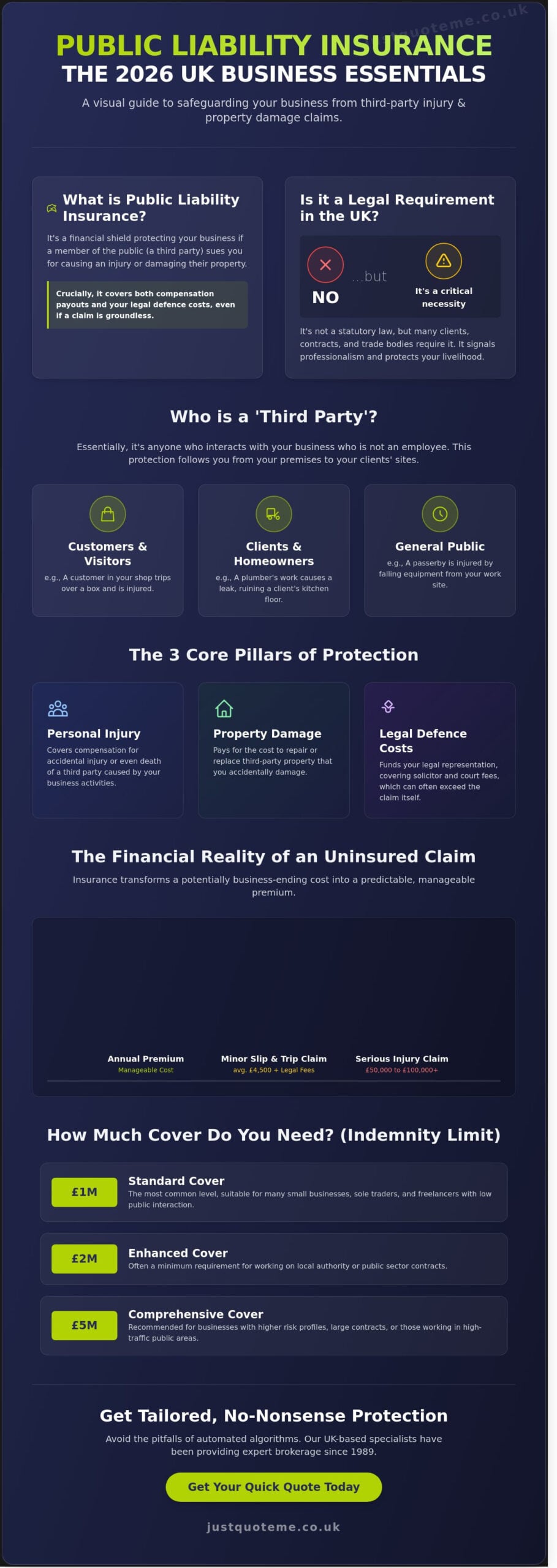
Public liability insurance acts as a financial shield for your business. It protects you if a member of the public sues your company for causing an injury or damaging their property. In legal terms, Public liability refers to the duty of care you owe to anyone who interacts with your business, excluding your own staff. This coverage pays for your legal defence and any compensation awards if you’re found at fault.
Running a business in 2026 involves navigating a complex legal environment where litigation is common. Without this cover, a single mistake could lead to a debt that lasts for years. Beyond the financial safety net, having public liability insurance signals to your clients that you’re a professional who takes responsibility seriously. It provides a sense of security that allows you to focus on growth rather than worrying about potential accidents.
The ‘Third Party’ Explained: Who is Covered?
A third party is essentially anyone who isn’t you or one of your employees. If you have staff, you’ll need Employers Liability insurance by law, but public liability handles everyone else. This includes a wide range of people you might encounter during a normal working day.
- A delivery driver dropping off supplies at your Stafford office who trips on a loose carpet tile.
- A customer browsing the aisles of your shop in Stone who is injured by a falling display.
- A homeowner whose kitchen floor is ruined by a leak caused by a tradesman’s work.
The cover isn’t limited to your physical premises. If you’re a mobile hairdresser or a plumber, the protection follows you to every site where you work. It ensures you’re covered whether the incident happens in a public space or inside a client’s private residence.
The Financial Reality of Uninsured Claims
Legal costs and compensation payouts in the UK have continued to rise. Relying on luck is no longer a viable business strategy. According to 2025/2026 industry benchmarks, the average compensation for a minor slip or trip claim involving a soft tissue injury is approximately £4,500, excluding legal fees which can easily double that figure. If the injury is more severe, such as a broken bone or long-term disability, the payout can reach six figures.
Insurance transforms these unpredictable, potentially infinite liabilities into a manageable, fixed monthly or annual cost. You can budget for a premium. You can’t budget for a £50,000 court order. This predictability is vital for maintaining a healthy cash flow and ensuring your business survives an unexpected accident. When you choose public liability insurance, you’re choosing to protect your livelihood from the cost of human error.
What Does a Public Liability Policy Actually Cover?
Public liability insurance acts as a financial safety net for your business. It focuses on three core pillars: accidental injury to third parties, damage to their property, and the legal expenses required to defend your case. Whether you operate from a fixed shopfront or travel to different sites, the protection follows you. Your policy applies to incidents that occur at your business premises or anywhere within the UK while you are carrying out your work.
One of the most vital features of this cover is the provision for legal defense. If a member of the public makes a claim against you, your insurer pays for the legal representation needed to handle the dispute. This protection applies even if the claim is eventually found to be groundless. According to industry insights on What Is Public Liability Insurance?, the costs of defending a single case can often exceed the value of the actual compensation. Your policy also covers specific statutory costs, such as hospital treatment charges and ambulance fees claimed back by the NHS under the Injury Cost Recovery scheme.
Personal Injury and Accidental Death
Slips, trips, and falls are the most frequent causes of liability claims in the UK. If a customer trips over a loose carpet edge in a Newcastle-under-Lyme retail unit, they could suffer a serious injury or lost earnings. Compensation is not a fixed sum; it is calculated based on the severity of the physical damage and the long-term financial impact on the claimant’s life. Public liability insurance ensures that these payouts do not come directly from your business cash flow.
Property Damage and Repair Costs
This section of the policy handles accidental damage to physical assets belonging to your clients or the public. For example, a plumber working on a boiler in Stafford might accidentally cause a major flood that ruins a homeowner’s flooring and furniture. Your policy covers the cost of professional repairs or the full replacement value of the damaged items. This allows you to resolve the issue quickly and maintain your professional reputation without facing a massive bill.
Common Exclusions: Avoiding the Claim Rejection Trap
Insurers include specific “fine print” that you must understand to ensure your claim is successful. Many policies contain “unattended vehicle” clauses, meaning tools or equipment left in an unlocked van may not be covered. It is also important to remember that public liability insurance does not cover professional advice. If a mistake in your consultancy work leads to a financial loss for a client, you would need professional indemnity insurance instead. Always provide an accurate business description to your broker. If your daily activities change, you should update your policy details immediately to keep your coverage valid.
Is Public Liability Insurance a Legal Requirement in the UK?
Unlike motor insurance or Employers’ Liability insurance, public liability insurance isn’t a statutory legal requirement for most UK businesses. You won’t face a fine from the government simply for not having a policy in place. However, viewing it as optional is a mistake that could end your business before it truly begins. While the law doesn’t usually force your hand, the market certainly does. One notable exception is the Riding Establishments Act 1970. This specific law mandates that horse riding businesses must carry public liability insurance to protect the public. For everyone else, it’s about risk management and staying competitive.
If a claim is made against you for an injury or property damage and you aren’t covered, you’ll be personally responsible for all legal fees and compensation. These costs can easily reach six figures, which is enough to bankrupt a small firm or a sole trader. We see it as a “commercial necessity” rather than a “legal luxury.”
Contractual Mandates and Tendering
If you want to work with public bodies like Staffordshire County Council or other local authorities, you’ll find that proof of cover is a non-negotiable part of the tender process. They typically won’t look at your bid without it. Trade associations also set high bars; many professional bodies make membership contingent on holding valid cover to maintain industry standards. Similarly, digital platforms like Checkatrade require verification of your policy before they allow you to list your services. They know that customers feel more secure hiring a professional with visible insurance credentials. Without it, you’re effectively locked out of these lucrative opportunities.
Industry Standards for Tradesmen and Professionals
In the construction and electrical sectors, a basic policy often isn’t enough to satisfy clients. Many main contractors require subcontractors to hold indemnity limits of at least £2 million or £5 million before they can step onto a site. Being unable to produce a certificate when asked doesn’t just lose you the job; it damages your reputation. Clients view insurance as a sign of a professional, stable business. For those in the building trade, you can find more specific insights in this comprehensive builders insurance guide. It details why specific trades need higher limits to cover the high-risk nature of their work, such as working at height or using heat. Having the right certificate ready shows you’re a serious partner who understands the risks of your trade.
Calculating Your Coverage: How Much Do You Need?
Choosing the right level of public liability insurance isn’t about picking the cheapest option. It’s about ensuring your business survives a worst-case scenario. In the UK, standard indemnity limits usually start at £1 million, with options for £2 million or £5 million. While £1 million sounds like a large sum, a single serious injury claim involving long-term care costs or significant property damage can quickly exhaust this amount. If a claim exceeds your limit, your business is responsible for the shortfall, which can lead to insolvency.
Your premium is primarily influenced by your trade type and annual turnover. A sole trader with a £40,000 turnover represents a lower statistical risk than a company turning over £2 million, simply because the latter has more “touchpoints” with the public. Insurers also look at your claims history over the last 3 to 5 years. Under-insuring to save a small amount on monthly premiums is a common mistake. The cost to jump from a £1 million limit to a £2 million limit is often less than the price of a coffee per month. If you’re looking to balance affordability with adequate protection, our guide on cheap public liability insurance and how to reduce costs without sacrificing cover explains exactly how to achieve that balance in 2026.
Evaluating Your Business Risk Profile
You need to look closely at where and how you work. Does your business involve high-risk activities like welding, using heat guns, or working at heights above 10 metres? These factors increase the likelihood of a high-value claim. Similarly, if you operate in high-footfall areas or sensitive environments such as schools, care homes, or hospitals, your exposure is much higher. For an example of how high-traffic hospitality destinations manage their public environment, check out Quob Park Estate, Hotel & Spa. Higher risk doesn’t always mean unaffordable premiums when you use a specialist broker to navigate the market. If your business operates in the automotive sector, it’s also worth understanding how motor trade insurance requirements for 2026 interact with your broader liability obligations.
Comparing the £1m vs. £5m Limit
The difference in premium between these two limits is often surprisingly small. For many small businesses, upgrading to £5 million costs an additional £40 to £80 per year. By 2026, a £5 million limit has become the standard requirement for most UK commercial contracts and local authority tenders. If you’re looking to grow your business, a lower limit might actually prevent you from winning lucrative work.
Consider upgrading your cover if any of the following apply to your current situation:
- You’re bidding for contracts with local councils or government bodies.
- You’ve started working in shopping centres or major transport hubs.
- Your clients have updated their terms of business to require higher indemnity.
- You’ve hired new staff, increasing the volume of work performed.
- Your business equipment or the property you work on has significantly increased in value.
Not sure which limit fits your trade? Our team can help you find the right balance of protection and price. Just Quote Me for a tailored assessment of your business needs.
The Just Quote Me Advantage: Expert Brokerage Since 1989
Just Quote Me isn’t just another website with a hidden algorithm. Since 1989, we’ve provided a human alternative to the faceless insurance platforms that often dominate the market. As an FCA-authorised broker, we don’t just pick the first option we see; we use our 35 years of industry relationships to access a broad panel of specialist underwriters. This means we find coverage that fits your specific risks rather than forcing you into a generic policy. Our no-nonsense approach prioritises your time. We skip the jargon and get straight to the facts, ensuring you understand exactly what you’re paying for.
Local Expertise with National Reach
Our headquarters remain in Stone, Staffordshire. This local base gives us a unique perspective on the challenges facing businesses across the West Midlands. Whether you’re a bricklayer in Stoke-on-Trent or a consultant in Birmingham, we understand the regional market conditions that impact your public liability insurance needs. Automated sites can’t replicate the personal touch of a broker who knows your area. We combine this regional insight with national reach, sourcing deals from the UK’s leading insurers to ensure your business stays protected. You get the benefit of a local partner who has the clout to negotiate with the biggest names in the industry.
How to Get Your Bespoke Quote Today
Securing the right policy shouldn’t be a chore. We’ve refined our process into three clear steps to save you time. First, you get in touch. Second, we have a brief consultation to understand your trade. Finally, we provide a tailored quote. Our team does the heavy lifting by comparing the market and negotiating with underwriters on your behalf. You won’t have to spend hours filling out repetitive forms on multiple sites. We handle the technical details so you can focus on running your business. It’s simple, efficient, and built around your needs.
Ready to protect your livelihood? You can Just Quote Me for your public liability insurance today and see the difference a specialist broker makes. We provide a steady hand in a complex market, ensuring your business is ready for whatever 2026 brings.
Secure Your Business Future Today
Navigating the risks of 2026 requires more than just basic awareness. It demands a robust safety net. public liability insurance remains the cornerstone of a responsible business strategy, shielding you from the potentially devastating costs of legal fees and compensation claims. By understanding your specific risks and calculating the correct level of cover, you’re not just buying a policy; you’re securing your professional reputation and financial stability for years to come.
Since 1989, Just Quote Me has helped thousands of UK business owners find the right protection without the unnecessary jargon. As an FCA-authorised independent broker with over 30 years of insurance expertise, we provide direct access to a broad panel of top UK insurers. We focus on a straightforward, human-centric approach that saves you time and removes the stress of comparing complex policies. Our team does the heavy lifting so you can focus on what you do best.
Get a bespoke Public Liability quote from our UK experts
Don’t leave your hard work to chance when expert protection is just a few clicks away. It’s time to get the peace of mind you deserve.
Frequently Asked Questions
Is public liability insurance tax deductible for UK businesses?
Yes, public liability insurance is a tax-deductible business expense in the United Kingdom. HMRC guidelines state that you can deduct the full cost of your premiums from your annual turnover when calculating your taxable profit. This reduces your overall Corporation Tax or Income Tax liability. It’s important to keep your insurance certificates and payment receipts for at least six years to comply with standard UK financial record-keeping requirements.
Can I get public liability insurance as a sole trader?
You can definitely secure public liability insurance as a sole trader, and it’s often a requirement for many trade associations. Whether you’re a mobile hairdresser or a local plumber, this cover protects your personal assets if a third party makes a claim against you. Most policies for the self-employed start with a £1 million limit of indemnity. This ensures that a single accident doesn’t lead to personal financial ruin.
What is the difference between public liability and professional indemnity?
Public liability covers physical mishaps like injury or property damage, while professional indemnity insurance protects against financial losses caused by your advice. For example, if a consultant spills coffee on a client’s £1,500 laptop, public liability handles the claim. If that same consultant provides a report with a 12% data error that causes the client to lose money, professional indemnity is the relevant cover. Both are essential for comprehensive business protection.
Does public liability insurance cover my employees?
No, public liability insurance doesn’t cover your employees if they’re injured at work. You’re legally required to have Employers’ Liability insurance under the Employers’ Liability (Compulsory Insurance) Act 1969 if you have any staff members. Public liability is strictly for claims made by third parties, such as customers or members of the public. If you employ even one person, you must hold a separate policy with at least £5 million in cover.
This principle of protecting your workforce is universal. For instance, while businesses in Norway might use a platform like LetME to source quality-assured personnel for retail or catering, they must still ensure their insurance coverage scales alongside their growing team.
What happens if I don’t have public liability insurance?
You’ll be personally responsible for all legal fees and compensation costs if an accident occurs, which can be devastating. In 2024, the average cost of a minor personal injury claim can exceed £11,000 in legal expenses alone. Additionally, 85% of local authorities and many large contractors won’t allow you on-site without proof of cover. You’ll likely miss out on high-value contracts and professional opportunities without a valid policy. If you work in construction or the trades, understanding your full builders insurance requirements for 2026 is essential to staying compliant and competitive. Similarly, if your work involves vehicles or automotive services, reviewing the latest motor trade insurance guidance for 2026 will help ensure you have the right specialist cover in place.
How long does it take to get a public liability insurance quote?
You can typically get a public liability insurance quote in less than five minutes using our streamlined online system. We’ve simplified the process so you only need to provide basic details about your trade and annual turnover. Once you’ve accepted the quote, your policy documents are usually delivered to your inbox instantly. This efficient approach means you can secure your business protection and get back to work without any unnecessary delays.
Does public liability cover me for work carried out in the past?
Most policies operate on a “claims occurring” basis, meaning the insurance must have been active on the date the incident happened. If you completed a project in 2023 and the injury occurred during that period, your 2023 policy would handle the claim. It’s vital to maintain continuous cover to avoid gaps. If you cancel your policy, you might not be protected for incidents that happened while the policy was live but haven’t been reported yet.
Can I change my level of cover mid-way through the year?
Yes, you can adjust your level of cover at any point during your policy term to reflect changes in your business. If you win a new contract that requires £5 million in cover instead of your current £2 million, just let us know and we’ll update your certificate. Your premium will be adjusted pro-rata for the remainder of the year. This flexibility ensures you’re always properly protected without paying for more cover than you currently need.
