
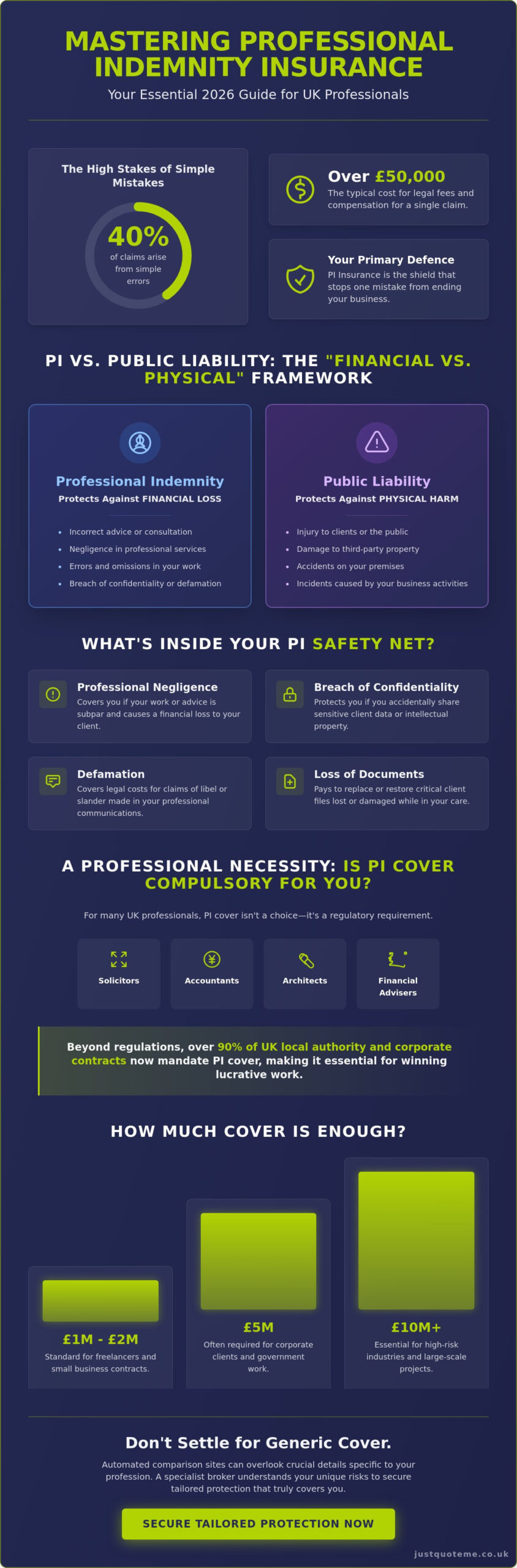
According to 2023 industry reports from UK insurers, nearly 40% of professional claims arise from simple errors or omissions rather than direct negligence. A single miscalculation or a piece of misunderstood advice can lead to legal costs and compensation payouts that often exceed £50,000. This is why professional indemnity insurance is no longer just a “nice to have” for consultants and contractors. It’s the primary line of defence that keeps a simple mistake from becoming a business-ending event.
You probably already feel the pressure from clients who demand high levels of cover before they’ll even sign a contract. It’s frustrating to handle the jargon, especially when you’re trying to distinguish between different types of liability. We understand that you want to focus on your work, not on the fear that one bad day could ruin your reputation. This guide will help you master the essentials of professional indemnity insurance to protect your expertise and your bank balance. We’ll show you how to calculate the right level of cover and explain the legal requirements you need to meet for 2026.
Key Takeaways
- Master the essentials of protecting your expertise and finances against claims of professional negligence or errors in your advice.
- Clear up the confusion between professional indemnity insurance and public liability with our simple “Physical vs. Financial” framework.
- Learn how to determine the ideal limit of cover for your business, whether you need £1 million, £5 million, or a bespoke amount.
- Discover the benefits of choosing a specialist UK broker to secure tailored protection that automated comparison sites often overlook.
Understanding Professional Indemnity Insurance: Why Every Expert Needs a Safety Net
Professional indemnity insurance provides a critical financial shield for businesses that provide advice, designs, or professional services. It’s designed to protect you if a client claims your work was negligent or caused them a financial loss. While other policies cover physical accidents, this insurance focuses on your intellectual output. If you give advice that leads to a loss, or if you make a mistake in a technical drawing, this is the policy that steps in.
As we move through 2026, the UK business environment has become increasingly litigious. Clients now have higher expectations and are more likely to seek legal redress if a project doesn’t deliver the expected ROI. Professional liability insurance serves as a necessary buffer against these rising risks. Even if you’ve done nothing wrong, the cost of proving your innocence can be devastating. Defending a professional negligence claim in the UK can easily cost upwards of £15,000 in legal fees alone, regardless of the final outcome.
The “Mistake” Reality: Why Even Experts Get It Wrong
No matter how much experience you have, human error is unavoidable. A simple data entry error or a misread of a new HMRC regulation can trigger a massive claim. These aren’t always acts of gross incompetence; they’re often honest mistakes made under pressure. Professional indemnity insurance is vital because it covers the defence costs that often bankrupt small businesses. Since 2024, legal service fees in major UK hubs have risen by approximately 8%, making the cost of a private defence unaffordable for most independent consultants.
Is Professional Indemnity Insurance Compulsory in the UK?
For many UK professionals, carrying PI cover isn’t a choice but a regulatory requirement. The following bodies mandate specific levels of indemnity cover:
- Solicitors: Must meet strict SRA requirements to practice.
- Accountants: Mandated by professional bodies like the ICAEW or ACCA.
- Architects: Required by the Architects Registration Board (ARB).
- Financial Advisers: Regulated by the FCA with specific minimum limits.
Even if your industry doesn’t legally require it, you’ll likely find it’s a contractual necessity. Over 90% of local authority contracts in the UK now stipulate a minimum PI cover of £1 million or £2 million. Without it, you’re effectively locked out of the most lucrative sectors of the economy. Large corporate clients view your insurance status as a benchmark of your professionalism and reliability.
What Does Professional Indemnity Insurance Actually Cover?
Professional indemnity insurance acts as a financial safety net when your expert advice or services don’t go to plan. It’s built around the “Duty of Care,” which is the legal obligation to provide services to a standard expected of a competent professional in your field. If a client suffers a financial loss because you breached this duty, your policy responds by covering legal defence costs and any court-awarded compensation. According to 2024 industry findings, negligence claims account for approximately 40% of all PI payouts in the UK service sector.
It’s vital to understand that PI is a “claims-made” policy. In 2026, this remains the standard industry structure. It means your insurance must be active at the time a claim is brought against you, regardless of when the actual mistake happened. For example, if you performed work in August 2024 but the client only files a lawsuit in February 2026, your 2026 policy handles the claim. If you retire or close your business, you’ll need “run-off” cover to maintain this protection for past projects.
Core Coverage Areas: From Negligence to Defamation
- Professional Negligence: This covers you if you give incorrect advice or make a mistake in your work that leads to a client losing money.
- Breach of Confidentiality: This protects you if you accidentally share sensitive client data or intellectual property without permission.
- Defamation: Your policy covers the legal costs of defending against claims of libel or slander arising from your professional communications.
- Loss of Documents: This pays for the costs involved in replacing or restoring critical client files that are lost or damaged while in your care.
Emerging Risks for 2026: AI and Digital Errors
By 2026, the risk landscape has shifted significantly. A 2025 study found that 35% of UK SMEs now integrate AI into their client deliverables. If an AI tool you use produces a “hallucination” or incorrect data that you pass on as professional advice, you’re still legally liable for that error. This creates a complex crossover with cyber liability insurance. While PI covers the professional failure, you may need a separate cyber policy to handle the technical recovery and notification costs following a data breach.
What is Typically Excluded?
PI isn’t a catch-all solution for every business problem. It won’t cover deliberate fraud, dishonesty, or criminal acts committed by you or your directors. It’s also distinct from other forms of protection; physical injuries to the public or damage to their property are handled by public liability insurance. Internal disputes, such as employer-employee disagreements or general business debts, are also excluded from standard PI terms.
Certain regulated sectors must follow specific FCA requirements for PII to ensure they hold enough cover to protect their clients adequately. If you’re unsure if your current limits meet these standards, you can get a tailored quote to see how these protections apply to your specific trade.
Professional Indemnity vs. Public Liability: Which One Do You Really Need?
Sole traders and small business owners often view insurance as a single box to tick. It’s common to see these two essential covers confused, but they serve entirely different purposes. To get your protection right, you should use a physical vs. financial framework. Public liability is your shield against physical mishaps. In contrast, professional indemnity insurance is your defense against financial or intangible losses caused by your work or advice. Most UK businesses find they actually need both to be fully protected from every angle of risk.
The Key Differences at a Glance
Public liability focuses on the world around you. It covers claims if you cause physical injury to a third party or damage their property. If a client trips over a loose cable in your office, that’s a public liability claim. Professional indemnity insurance focuses on the quality of your professional output. It covers you if a client loses money because you made a mistake, provided poor advice, or were negligent in your duties.
- Public Liability Scenario: A management consultant visits a client’s office and accidentally knocks a cup of coffee over a high-end server. The insurer pays for the hardware replacement and data recovery.
- Professional Indemnity Scenario: The same consultant provides a strategic report with a mathematical error. The client follows the advice and loses £50,000 in projected revenue. The insurer covers the legal defense and the compensation payout.
For a deeper dive into the physical side of business risk, you can explore our What Is Public Liability Insurance? guide. Understanding these boundaries ensures you don’t leave your business exposed to a claim that falls between the cracks. If you’re also looking to manage your budget effectively, our guide on cheap public liability insurance and how to reduce costs without sacrificing cover explains how to secure robust protection at a competitive price.
When the Lines Blur: Hybrid Risks
In certain sectors, the distinction between a physical error and a professional one is less clear. This is especially true in construction and design. A contractor might need builders insurance to cover site accidents, but if they also provide design specifications, they face unique professional risks. If a wall collapses because of a physical building error, it’s a public liability matter. If it collapses because the structural calculations were fundamentally flawed, it becomes a professional indemnity claim.
The Law Society PII guidance demonstrates how vital this protection is for professionals who provide specialized expertise. Even if you aren’t a solicitor, the principle remains the same. Any business providing a “design and build” service or technical consultancy faces hybrid risks. We often advise clients to look at combined policies. These packages simplify your coverage by putting both elements under one roof. It reduces the chance of gaps in your protection and makes the claims process significantly more straightforward if a complex incident occurs. Businesses that also supply or recommend physical products to clients should be aware that a separate product liability insurance policy may be required to cover claims arising from those goods, which falls outside the scope of both PI and public liability cover.
Determining the Right Level of Cover for Your Business
Choosing the correct limit for your professional indemnity insurance isn’t a guessing game. There is no “one size fits all” figure because the risks faced by a freelance copywriter differ vastly from those of a civil engineer. You need to balance the cost of your premium with the potential magnitude of a claim against you.
In the UK market, cover typically starts at £50,000 or £100,000 for very small micro-businesses. However, most professional bodies and commercial clients expect to see increments of £250,000, £1 million, £2 million, or £5 million. These figures represent the maximum amount the insurer will pay out for legal costs and compensation during the policy period. If you provide advice that leads to a project failing, your cover needs to be high enough to pay for the total financial loss, not just the fee you charged.
To calculate your “worst-case scenario,” look at your largest contract. Consider the cost if your work had to be completely redone by a third party. Add potential legal fees, which can easily exceed £50,000 in complex UK professional negligence cases. You must also check your “Retroactive Date.” This is a specific date in your policy that confirms you’re covered for work completed in the past, provided you’ve held continuous cover since then. Without a proper retroactive date, you’re exposed to claims arising from old projects.
Factors That Influence Your PI Premium
- Industry Risk: An architect designing a stadium pays more than a marketing consultant because a structural mistake carries a higher financial and safety risk.
- Annual Turnover: High-turnover businesses usually handle more projects or larger contracts, increasing the statistical likelihood of a claim.
- Claims History: If you’ve faced professional disputes in the last five years, insurers view you as a higher risk, which often increases premiums.
- Subcontractor Usage: If you hire external help, you are often liable for their mistakes. Insurers will want to know if your subcontractors carry their own professional indemnity insurance.
Evaluating Your Contractual Obligations
Before signing a new contract, scrutinize the “Limit of Liability” clause. Clients often demand a specific level of cover, such as £2 million, regardless of the contract’s actual value. You should never accept a contract requiring cover you cannot realistically obtain or afford. Doing so puts your entire business at risk if a claim exceeds your policy limit.
Be aware of under-insurance and the “Average Clause” found in many UK policies. If you under-report your turnover or the scale of your work to save on premiums, the insurer may only pay a proportion of your claim. For example, if you are 50% under-insured, they might only pay 50% of your legal costs. This can leave a devastating financial gap that you must fill personally.
Not sure which limit is right for your specific trade? We can help you find the right balance of protection and price.
Securing Your Reputation: Why Choosing a Broker Like Just Quote Me Makes the Difference
Choosing insurance shouldn’t feel like a gamble with a computer program. Many comparison sites rely on rigid algorithms that often miss the specific risks your business faces in 2026. These automated systems categorise businesses into broad boxes, often leading to gaps in cover or inflated premiums. Just Quote Me brings a different approach. We’ve spent over 30 years building relationships within the UK insurance market to provide a human-centric alternative to faceless tech. We don’t just tick boxes; we understand the context of your work.
When you choose a broker, you’re gaining a dedicated advocate. If a client alleges professional negligence, you aren’t stuck in an automated phone queue or left to decipher complex legal jargon alone. We handle the heavy lifting during the claims process. Our team ensures your reputation remains intact while you focus on your daily operations. It’s a partnership that prioritises your stability. You should view professional indemnity insurance as a strategic investment in your growth. It provides the financial backing needed to pitch for high-value contracts that require proof of robust, professional protection.
The Just Quote Me Advantage
We provide access to a broad network of top UK insurers. Many of these specialist providers don’t list their products on standard comparison sites, meaning we find bespoke solutions others simply can’t see. Our expertise spans a wide range of industries, allowing us to offer expert advice on tailoring cover for specific niches. This includes everything from high-risk security companies to independent tradesmen. We offer:
- Bespoke Policy Drafting: We match your specific service delivery to the right policy wording.
- Market Access: Exclusive deals with insurers who understand complex UK business risks.
- Efficiency: A quick, no-nonsense quoting process that respects your time and your bottom line.
Next Steps: Protecting Your Professional Future
Securing your business for the year ahead is a straightforward process. To get started, you’ll need to gather your projected annual turnover figures and details of your largest active contracts. Having these figures ready allows us to provide a more accurate assessment of your risk profile. We don’t believe in generic estimates; we believe in precision.
Getting a tailored quote is easy and ensures you aren’t paying for cover you don’t need, or worse, lacking cover where it matters most. Your professional standing is your most valuable asset. Don’t leave it to an algorithm. Take the next step today to see how 30 years of brokerage experience can simplify your protection. Click below to start your journey with a partner who understands the UK business landscape inside and out.
Protect Your Professional Reputation for 2026
Building a successful business takes years of dedication. It’s vital that you protect that hard work from the financial impact of negligence claims or advice-based disputes. By now, you’ll understand that professional indemnity insurance isn’t just another overhead; it’s a critical safety net that distinguishes between a minor setback and a business-ending legal bill. Making sure you have the right level of cover tailored to your specific trade ensures you’re ready for the regulatory landscape of 2026.
Navigating the UK insurance market doesn’t have to be a struggle. Just Quote Me offers over 30 years of UK insurance expertise to help you find the right fit. As an FCA Authorised Independent Broker, we provide access to the UK’s leading underwriters, cutting through the noise to deliver straightforward protection. We handle the heavy lifting so you can focus on delivering excellence to your clients. It’s time to trade with confidence and secure your professional future.
Get a Tailored Professional Indemnity Quote in Minutes
Your business deserves a partner that understands the local market and your unique risks. We’re here to help you get it right today.
Frequently Asked Questions
Do I need professional indemnity insurance if I work from home?
Yes, you still need professional indemnity insurance if you work from home because your liability is based on the service you provide, not your physical location. Whether you’re at a kitchen table or a London office, a client can still claim for financial loss caused by your professional mistake. ONS data shows that 44% of UK workers now work remotely, but risks like data breaches or negligent advice remain identical regardless of your workspace.
Is professional indemnity insurance tax deductible for UK businesses?
Yes, professional indemnity insurance is an allowable business expense according to HMRC guidelines for UK businesses. You can deduct the full cost of your premiums from your taxable income when filing your Self Assessment or Corporation Tax return. It’s a standard business cost that helps reduce your overall tax bill while protecting your firm from potential legal claims. This makes the cover even more cost-effective for small business owners.
What is a retroactive date in a professional indemnity policy?
A retroactive date is the specific point in time from which your insurer agrees to cover your past work. If you started trading in January 2022 and your policy lists that as the retroactive date, you’re covered for claims arising from any work done since then. It’s vital to maintain this date when switching providers to ensure there are no gaps in your protection for previous projects or advice.
Can I take out professional indemnity insurance for a single project?
Yes, you can secure coverage for a single project, though most UK brokers recommend an annual policy for better value and continuous protection. Single project insurance covers a specific contract, but remember that claims can arise years after a project ends. You’ll need run-off cover or a continuous policy to stay protected against future claims related to that one-off job. Most annual policies start at a lower proportional cost.
What happens if I cancel my PI insurance and then a claim is made for past work?
If you cancel your policy without arranging run-off cover, you won’t be protected against claims made after the cancellation date. This applies even if the work was done while you were insured. Professional indemnity insurance operates on a claims-made basis. This means the policy must be active at the moment the claim is filed, not just when the error originally occurred. Always consider run-off cover when retiring or closing.
How much does professional indemnity insurance typically cost in 2026?
Costs vary by industry, but 2024 industry data showed that low-risk UK consultants often pay starting premiums of around £120 per year. Your specific price depends on your turnover, the level of indemnity you choose, and your sector’s risk profile. High-risk professions like architecture or structural engineering will naturally face higher premiums than a marketing consultant because the potential size of financial claims is significantly larger. If your business also involves supplying or recommending physical goods, you may want to review our guide to product liability insurance in the UK to understand the additional cover you might need.
