
Did you know the average insurance claim for a plasterer last year reached £2,507? For a sole trader, an unexpected cost of that size could stall your momentum or wipe out months of hard-earned profit. Finding a reliable self-employed plasterer insurance quote shouldn’t feel like a gamble against fine print or the rising premiums we’ve seen heading into 2026.
We understand that you’d rather be on-site than buried in paperwork. It’s frustrating when you aren’t sure if your policy covers high-level work or if your tools are actually protected against the theft that occurs every 21 minutes in the UK. This article will show you how to secure comprehensive, tailored protection that satisfies main contractors and gives you peace of mind. We’ll break down the essential covers, explain the legal requirements for employers’ liability, and help you navigate the complexities of the trade with straightforward, expert advice. Just Quote Me to simplify your protection today.
Get Your Free Business Insurance Quote now
Request a Call back for free Expert advice
Key Takeaways
- Identify the critical differences between legal requirements and the contractual obligations required by main contractors to ensure you are never turned away from a site.
- Learn how to build a self-employed plasterer insurance quote that balances essential Public Liability with protection for your tools and specialized trade activities.
- Understand how your annual turnover and the use of sub-contractors directly impact your premium calculations and risk profile.
- Discover the advantages of using an FCA-regulated broker to access a panel of specialist underwriters that standard comparison sites often overlook.
- Prepare for your application by defining your specific trade tasks, such as screeding or rendering, to ensure your policy is fully tailored to your daily work.
Why Every Self-Employed Plasterer Needs a Tailored Insurance Quote
Plastering is a high-precision trade that carries physical and financial risks a standard DIY enthusiast never sees. For a professional, a self-employed plasterer insurance quote is more than just a monthly expense; it’s a strategic bundle of protections designed to safeguard your livelihood. While many general tradesman policies offer a broad umbrella, they often miss the nuances of plastering, such as the specific risks involved in skimming near expensive fixtures or the liabilities of working at height on scaffolding. A generic policy might leave you under-insured when a specific trade accident occurs.
There’s a significant difference between what the law requires and what your clients demand. Legally, you only need certain covers if you hire staff, but contractually, you won’t step foot on a modern construction site without proof of robust liability insurance. Just Quote Me draws on 30 years of industry experience to filter out irrelevant “filler” covers. This helps us ensure you only pay for the protections that actually apply to your day-to-day work, keeping your overheads manageable while your protection remains airtight.
The Financial Risks of the Plastering Trade
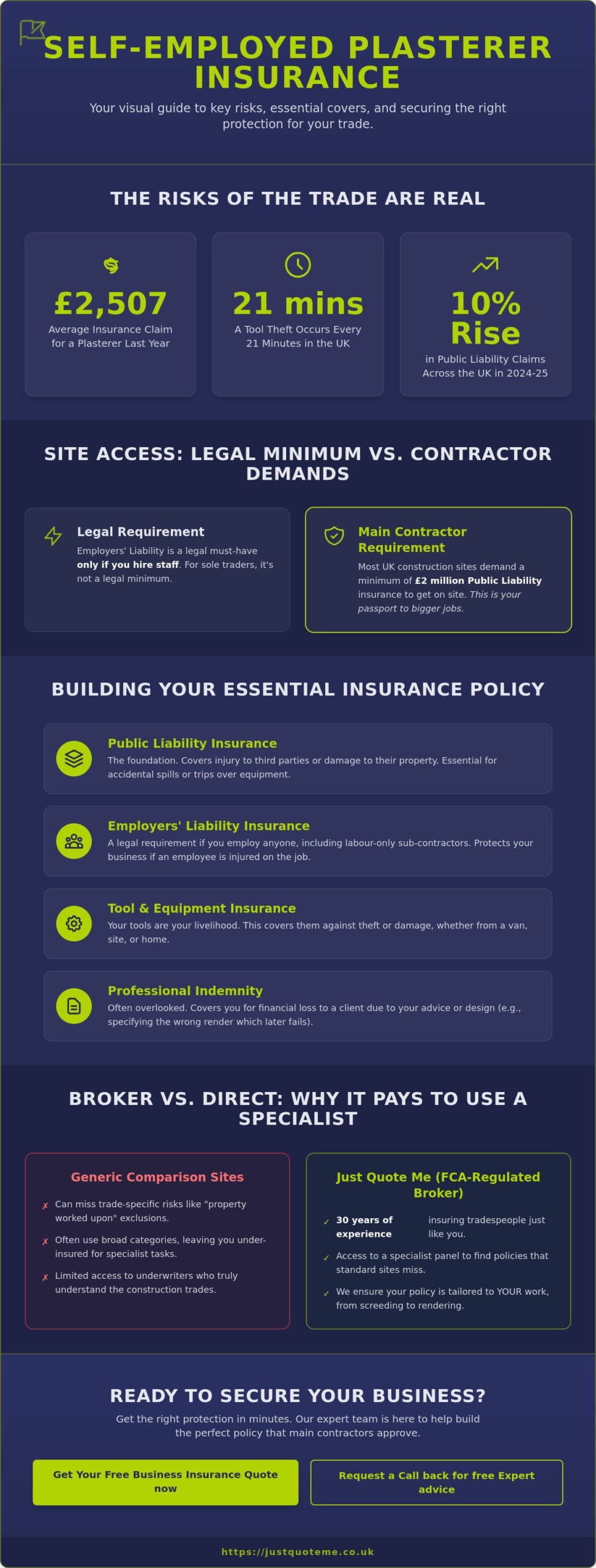
Plastering involves wet materials and heavy tools in environments that are often already finished or mid-renovation. A simple slip while skimming can lead to accidental damage to a client’s property, resulting in repair costs that far exceed a week’s wages. In the UK, the average insurance claim for a plasterer in the last year reached £2,507. For a sole trader, this financial hit, combined with the 10% increase in public liability claims seen across the country in 2024-25, makes a tailored policy a necessity rather than an option. If you’re injured and unable to work, the financial impact on a sole trader business can be devastating without the right backup.
Meeting Site and Main Contractor Requirements
If you want to scale your business or move into commercial subcontracting, your insurance certificate acts as your “passport” to bigger contracts. Most UK construction sites now demand a minimum of £2 million in public liability insurance before they allow you to sign in. Being able to provide immediate proof of cover shows main contractors that you’re a professional who manages risk responsibly. This level of preparation prevents delays and ensures you’re always ready to seize new opportunities as they arise, particularly as site safety standards continue to tighten in 2026.
Get Your Free Business Insurance Quote now
Request a Call back for free Expert advice
Essential Components of a Plasterers Insurance Policy
Building a robust self-employed plasterer insurance quote involves more than ticking a single box. To truly protect your trade, you must assemble a policy that addresses the specific risks you face every time you mix a bag or set up a hawk. Public liability is the foundation, but a comprehensive package should also account for your workforce, your expensive equipment, and even the advice you provide to clients.
Public Liability for Plastering and Dry Lining
Public liability is non-negotiable for anyone working in a client’s home or on a busy site. It protects you if a third party is injured or their property is damaged because of your work. For example, if a visitor trips over your lead or wet plaster ruins an expensive carpet, this cover handles the legal costs and compensation. It’s vital to distinguish between general property damage and damage to the “property worked upon.” Many basic policies exclude the latter, meaning if you damage the very wall you’re skimming, you might not be covered. If you’re expanding your business, you’ll also need to consider employers liability insurance to stay compliant.
Professional indemnity is another layer often overlooked. If you specify a particular type of waterproof rendering for an external project and that specification fails, causing water ingress, your client could sue for professional negligence. Having this cover ensures that a simple error in judgment doesn’t bankrupt your business. Finding the right balance of these covers is easier when you compare options with a specialist broker who understands the trade.
Specialist Covers: Working at Height and Tool Theft
Standard tradesman policies often contain “working at height” restrictions that can act as a trap. If your policy has a five-meter limit but you’re working on a three-story scaffold, your cover is effectively void. At Just Quote Me, we help you secure working at height insurance that matches your actual job requirements. We also prioritize protecting your livelihood from the UK’s rising tool theft rates. With an offense occurring every 21 minutes on average, your mixers, trowels, and stilts are constant targets.
When reviewing your quote, pay close attention to van and tool insurance clauses. Many insurers include “overnight storage” requirements, stating that tools must be removed from the vehicle or the van must be parked in a locked garage. If you can’t meet these terms, we’ll help you find a policy that fits your actual storage situation. You should also remember that if you hire anyone, even on a casual basis, it’s a legal requirement for Employers’ Liability insurance to have at least £5 million in cover. Failure to do so can result in fines of up to £2,500 for every day you’re uninsured. Link your protection together with van and tools insurance to ensure you’re never left unable to work.
Get Your Free Business Insurance Quote now
Request a Call back for free Expert advice
How Your Self-Employed Plasterer Insurance Quote is Calculated
Understanding the variables that influence your self-employed plasterer insurance quote helps you manage your business overheads more effectively. Insurers don’t pull numbers out of thin air; they use a specific set of data points to assess the likelihood of you making a claim. Your annual turnover is one of the first things they look at. A higher turnover usually indicates a higher volume of work and more time spent on-site, which statistically increases the chances of an incident occurring. It’s a direct reflection of your business’s scale and exposure to risk.
The size of your team is another critical factor. Whether you hire permanent staff or use labor-only sub-contractors, each person working under your direction adds to the risk profile. If you’re based in areas like Staffordshire or the West Midlands, local factors such as equipment theft rates and regional claim histories will also play a role in your premium calculation. Your personal claims history remains a powerful influence in 2026. With public liability claims across the UK rising by 10% in the 2024-25 period, maintaining a clean record is the best way to secure competitive rates.
The Impact of Your Business Activities
The type of environments you work in significantly shifts your risk level. Residential skimming in a single-story bungalow carries far less risk than commercial plastering on a large-scale construction project. If your work involves external rendering or dry lining at significant heights, your premium will reflect the increased danger. Many plasterers also handle related tasks like basic partitioning or floor screeding. If you find yourself taking on a wider variety of construction tasks, you might want to look into builders insurance to ensure every aspect of your multi-trade work is fully protected.
Choosing Your Indemnity Limits
When requesting your quote, you’ll need to choose a limit of indemnity, typically ranging from £1 million to £5 million. While £1 million might suffice for small domestic jobs, most local authorities and main contractors now require at least £5 million to even let you on-site. The limit of indemnity acts as the maximum ceiling your insurer will pay out for a single event, and selecting a higher limit will naturally lead to a higher premium because the insurer is taking on more potential debt. It’s also vital to check if your cover is “per claim” or “in the aggregate.” A “per claim” policy is often superior as it provides the full limit for every individual incident during the year, rather than a total cap for the entire policy term.
Get Your Free Business Insurance Quote now
Request a Call back for free Expert advice
Broker vs. Direct: Why Just Quote Me is the Better Choice
Aggregators promise speed and “cheap” results, but they often lack the depth required for a trade as specialized as yours. When you search for a self-employed plasterer insurance quote on a general comparison site, you’re usually seeing a stripped-back version of a policy. These “budget” options often hide high excesses or exclude critical risks like working at height. At Just Quote Me, we believe your protection should be built on value and security, not just the lowest headline price. A low premium is worthless if the policy doesn’t pay out when you need it most.
We provide access to a panel of top UK underwriters that aggregators simply miss. These specialist insurers understand the construction sector and are often more flexible with their terms for experienced tradesmen. Having a human broker to explain the 2026 policy changes ensures you don’t fall foul of new regulations or fine print that an automated bot would overlook. If you ever need to make a claim, having a dedicated partner in your corner is the difference between a quick resolution and a stressful administrative battle. We manage the complex paperwork so you can stay focused on the job at hand.
Independent Brokerage Explained
We work for you, not the insurance company. This independence is the core of our service. With 30 years of industry relationships cultivated in Stone and Stafford, we have the leverage to negotiate better terms for our clients. We understand the local landscape and the specific challenges faced by businesses in the region. Our role is to act as your trusted advisor, filtering out the jargon and presenting you with clear, actionable choices. You can learn more about how we support local firms in our Commercial Insurance Broker Staffordshire guide.
Tailored Solutions for Local Tradesmen
Local knowledge of the West Midlands construction market is a significant advantage when building your quote. We understand the site requirements in Birmingham, the contractor standards in Stoke, and the specific risks prevalent in our area. This human-centric approach is a direct alternative to automated insurance bots that treat every business the same. We offer specialized tradesman insurance that reflects your actual daily tasks rather than a generic industry average. If you want a policy that actually works when you need it, you should speak with a specialist broker today to ensure your livelihood is properly protected.
Get Your Free Business Insurance Quote now
Request a Call back for free Expert advice
How to Secure Your Plasterer Insurance Quote Today
Securing a reliable self-employed plasterer insurance quote is a logical step-by-step process that moves you from uncertainty to total protection. It doesn’t have to be a time-consuming burden. Start by gathering your basic business details, specifically your projected annual turnover and an accurate count of any employees. Having this data ready allows for a much smoother experience when you’re looking for a price that reflects your actual risk profile.
Next, you should clearly define your specific trade activities. Plastering is a broad term; insurers need to know if you specialize in dry lining, external rendering, or floor screeding. Each activity carries different risks, and being precise ensures you aren’t paying for cover you don’t need or, worse, lacking cover for a job you do every day. Once you have these details, use the Just Quote Me online tool to generate an instant preliminary figure. This gives you a baseline to work from before you consult with an expert to refine the policy and ensure no gaps remain.
Information You Need for an Accurate Quote
To get the most accurate self-employed plasterer insurance quote, you’ll need a few specific documents and figures to hand. Insurers typically look for your claims history over the last five years. Even if you haven’t made a claim, this “clean” history helps secure more competitive rates. You also need to disclose if you work in high-risk locations. Projects at airports, power stations, or large-scale industrial sites require specialized indemnity considerations that a standard domestic policy might not include. Finally, ensure you have your estimated annual wage roll ready for any employees or labour-only sub-contractors, as this is a primary driver for liability costs.
Next Steps: Free Quotes and Expert Advice
Moving from a digital estimate to a fully bespoke policy is where the value of a broker becomes clear. We take your initial information and cross-reference it with our panel of specialist underwriters to find the best fit. It’s also vital to remember that insurance isn’t a “set and forget” task. You should review your cover at least once a year. As your business grows, your turnover increases, or you invest in more expensive plant and machinery, your policy must evolve to keep your livelihood safe. This proactive approach ensures you’re always site-ready for the next big contract.
Get Your Free Business Insurance Quote now
Request a Call back for free Expert advice
Secure Your Livelihood for 2026 and Beyond
Your business deserves a foundation as solid as the surfaces you finish. We’ve detailed why accurate trade definitions and appropriate indemnity limits are essential for navigating the construction landscape in 2026. By avoiding generic “one size fits all” policies, you protect your tools and your reputation from the gaps left by automated systems. Finding a tailored self-employed plasterer insurance quote is the most effective way to ensure you’re never turned away from a site or left vulnerable to rising claim costs.
Just Quote Me is an FCA-authorised independent broker based in Staffordshire with over 30 years of experience in the UK insurance market. We provide direct access to a wide network of top-tier UK underwriters, giving you the security of a major insurer with the personal touch of a local partner. It’s time to partner with a broker who understands the nuances of your trade. We manage the complex paperwork so you can stay focused on delivering high-quality results for your clients. We look forward to helping you grow your business with confidence.
Get Your Free Business Insurance Quote now
Request a Call back for free Expert advice
Frequently Asked Questions
Is public liability insurance a legal requirement for self-employed plasterers?
Public liability insurance is not a legal requirement under UK law, but it is almost always a contractual necessity. Most main contractors and local authorities will not allow you onto a site without proof of at least £2 million or £5 million in cover. Without this protection, you are personally liable for any third-party injury or property damage claims, which averaged over £2,500 for plasterers in the last year.
Does my plastering insurance cover my tools if they are stolen from my van?
Your tools are only covered if you have specifically added tool and equipment insurance to your policy. With tool theft occurring every 21 minutes in the UK, this is a vital addition for any tradesman. You must check your policy for “overnight storage” clauses, as many insurers require tools to be removed from the van or for the vehicle to be parked in a secure, locked location for the cover to remain valid.
What is the difference between a labour-only and a bona-fide sub-contractor?
Labour-only sub-contractors work under your direct supervision and use your materials, meaning they are treated as employees for insurance purposes. Bona-fide sub-contractors work independently, provide their own materials, and should carry their own public liability insurance. If you use labour-only help, you have a legal requirement to hold Employers’ Liability insurance with a minimum limit of £5 million to avoid significant daily fines.
Can I get an insurance quote that covers both plastering and dry lining?
You can and should ensure that all your trade activities are listed on your self-employed plasterer insurance quote to avoid any gaps in protection. Many plasterers handle dry lining, screeding, and rendering as part of their daily work. If these aren’t explicitly mentioned in your policy, an insurer might reject a claim involving an activity they haven’t officially agreed to cover.
How much does public liability insurance for a plasterer typically cost in 2026?
The cost of your premium depends on several variables, including your annual turnover, your claims history, and the indemnity limits you choose. While van insurance premiums have seen a 4.7% drop leading into May 2026, liability rates are influenced by the 10% increase in public liability claims seen across the UK. Maintaining a clean claims record and choosing accurate turnover figures is the best way to manage your costs.
What happens if I work at heights above the standard 5-metre limit?
Working above a standard height limit without a specific extension will likely void your insurance policy. Many basic tradesman policies include a 5-metre or 10-metre height restriction as standard. If your work involves external rendering on multi-storey buildings or high-level commercial ceilings, you must disclose this during your self-employed plasterer insurance quote to ensure your policy is extended to cover these risks.
Do I need professional indemnity insurance for my plastering business?
Professional indemnity is recommended if you provide technical advice or specifications, such as recommending a specific external wall insulation or rendering system. If your advice leads to a financial loss for the client, such as a system failure that causes dampness, they could sue for professional negligence. This cover protects you against the legal costs and compensation associated with these specific types of claims.
Can I pay for my self-employed plasterer insurance in monthly instalments?
Most insurers allow you to spread the cost of your premium through monthly direct debit payments. This is a common choice for sole traders who want to manage their cash flow more effectively throughout the year. You should check the terms of the finance agreement, as there is often a small interest charge or a fixed fee applied for the convenience of paying monthly rather than in one lump sum.
Get Your Free Business Insurance Quote now
Request a Call back for free Expert advice
