

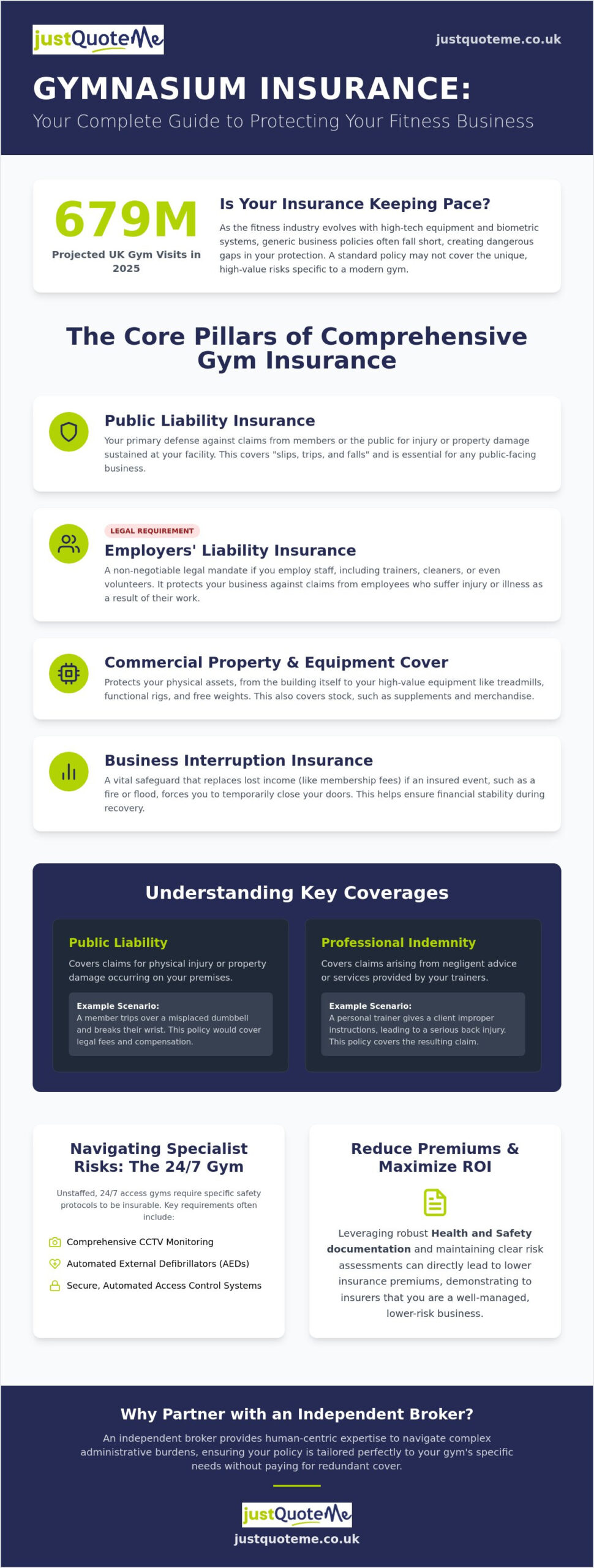
With UK gym visits surging to 679 million in 2025, the physical and financial pressure on fitness facilities has reached an all-time high. It’s a reality that every owner understands; you’ve invested heavily in high-end equipment and community trust, but the fear of a high-payout liability claim or a sudden theft remains a constant background noise. Managing these risks shouldn’t feel like a workout in itself, yet the complexity of modern Gymnasium Insurance often leaves even the most experienced operators feeling uncertain about their actual level of cover.
We understand that you need clear, pragmatic solutions that ensure full legal compliance without overcomplicating your administrative workload. This article provides expert insights on securing bespoke, cost-effective protection tailored to the specific needs of your fitness centre. We’ll clarify the often-confusing distinction between gym cover and personal trainer requirements, while showing you how to protect your high-value equipment and revenue during unforeseen closures. By the end, you’ll have a straightforward roadmap to total peace of mind, allowing you to focus on your members’ performance rather than your policy’s fine print.
Key Takeaways
- Understand how the evolution of high-tech fitness equipment and biometric systems impacts your specific risk profile in 2026.
- Identify the core pillars of comprehensive Gymnasium Insurance, from mandatory Employers’ Liability to essential Public Liability protections.
- Navigate the specialist requirements for unstaffed 24/7 studios, including the necessary safety protocols for CCTV and automated external defibrillators.
- Learn how to leverage robust Health and Safety documentation to reduce your insurance premiums and maximise your business’s return on investment.
- See why partnering with an independent broker provides the human-centric expertise needed to navigate complex administrative burdens.
What is Gymnasium Insurance and Why is it Essential in 2026?
Gymnasium Insurance isn’t a one size fits all product. It’s a strategic framework of covers designed to protect fitness facilities against a broad spectrum of risks. While traditional business policies might cover a generic office or shop, they rarely account for the high intensity environment of a gym. By 2026, the industry has shifted toward high value digital equipment and sophisticated biometric access systems. These technologies introduce new liabilities, from expensive hardware breakdowns to sensitive data protection concerns. When your business relies on AI driven performance tracking and automated entry, a standard policy simply won’t suffice.
Relying on generic commercial insurance is often a mistake for gym owners. Most standard policies fail to provide the necessary limits for specialist equipment like high end treadmills, functional training rigs, or recovery tech. This is where the expertise of an independent broker becomes invaluable. We help you navigate these sector nuances to ensure you aren’t paying for redundant cover while leaving significant gaps in your protection. A bespoke approach ensures that your specific layout, equipment list, and member volume are all factored into your premium, providing a safety net that actually works when you need it.
The Legal Landscape for UK Fitness Businesses
The Health and Safety Executive (HSE) maintains strict expectations for gyms to ensure a safe environment for both staff and members. Beyond general safety protocols, Employers Liability Insurance is a legal requirement if you have trainers, cleaners, or even volunteers on site. This mandatory cover protects your business against claims from employees who suffer injury or illness due to their work. To ensure gym owners receive fair and transparent advice, the Financial Conduct Authority (FCA) regulates brokers, holding us to high standards of professional conduct and ensuring our advice remains in your best interest.
Protecting Your Investment Against Unforeseen Risks
A single major liability claim can be financially devastating for an uninsured fitness centre. Whether it’s a member injury or property damage, the costs often spiral into tens of thousands of pounds. A robust policy includes Commercial General Liability (CGL) components to handle these third party claims effectively. You also need to protect your material damage. This covers everything from the structural integrity of your premises to the weights and machines that drive your revenue. Understanding what is public liability insurance and how it integrates with your property cover is the first step toward securing your business’s future.
Core Components of a Comprehensive Gym Insurance Policy
Building a robust safety net for your fitness business requires more than a single certificate. A comprehensive policy for Gymnasium Insurance functions as a bundle of specific protections, each addressing a different facet of your operational risk. From the heavy lifting of liability claims to the technical nuances of equipment breakdown, your cover must be as versatile as the workouts your members perform. If you’re unsure which specific limits apply to your floor space, speaking with an independent advisor can clarify your requirements.
- Public Liability: Your primary defence against claims arising from member injuries or property damage.
- Employers’ Liability: A non-negotiable legal requirement for gyms with any form of staff.
- Commercial Property and Equipment: Protection for your cardio machines, free weights, and even your retail protein stock.
- Business Interruption: A vital safeguard that replaces lost membership income if an insured event, like a fire or flood, forces you to close temporarily.
Public Liability vs. Professional Indemnity
One of the most common points of confusion for gym owners is the difference between Public Liability and Professional Indemnity. Public Liability handles “slips and trips” on your premises. For example, if a member trips over a loose floor mat, this cover manages the legal costs and compensation. However, it doesn’t typically cover injuries resulting from bad advice. This is where professional indemnity insurance becomes essential. It protects you if a trainer provides a flawed workout plan that leads to a chronic injury. Following the IDEA Health & Fitness Association guidelines on risk management can help you implement safety protocols that reduce the likelihood of either claim occurring.
Employers’ Liability for Gym Staff and Contractors
If you employ anyone, the Employers’ Liability (Compulsory Insurance) Act 1969 makes this cover a legal necessity. This isn’t just for full-time employees; it often extends to freelance personal trainers or cleaners working under your direction. If a staff member is injured while spotting a lift or moving heavy equipment, you are liable for their safety. Failing to hold this cover can result in significant daily fines from the HSE. You can find more detail on the specific legal thresholds on our employers liability insurance page. Ensuring your contractors also carry their own separate policies is a smart move, but your primary policy remains the ultimate backstop for your facility.
Navigating Specialist Risks: 24/7 Access and Boutique Studios
The rise of unstaffed, 24-hour access facilities has transformed the fitness sector, yet it has also fundamentally rewritten the risk profile for Gymnasium Insurance. Operating without on-site supervision means your liability shifts from direct oversight to technical reliability. Insurers now look for specific, high-tech risk mitigation strategies that weren’t standard a decade ago. When your doors are open at 3:00 AM, your policy’s validity often hinges on the presence of functional CCTV, accessible panic buttons, and automated external defibrillators (AEDs). These tools are your silent partners in safety, providing a documented trail of events that protects your business from fraudulent or negligent claims.
Boutique studios present a different but equally complex set of challenges. Whether you’re running high-density HIIT classes or specialized Reformer Pilates sessions, the concentration of risk in a smaller footprint is significant. Many modern studios have also invested heavily in integrated audio-visual systems and smart lighting to enhance the member experience. Your ‘Material Damage’ cover must scale to reflect these high-tech assets. Standard commercial policies often treat gym equipment as generic ‘contents’, which can lead to significant shortfalls if your specialized AV rack or Pilates machines are damaged. Organizations like the IDEA Health & Fitness Association provide essential frameworks for these safety protocols, helping owners understand the industry-standard expectations for modern facility management.
Insurance Requirements for Unstaffed Gyms
For 24/7 facilities, insurers demand stringent security protocols that go beyond a simple lock and key. This typically includes remote monitoring systems and a robust member vetting process to ensure only authorised individuals gain entry. It’s also vital to display clear, prominent signage stating that members ‘train at their own risk’ during unstaffed hours. While this doesn’t absolve the business of all liability, it establishes a clear operational protocol that supports your legal standing during a claim investigation. High-quality remote monitoring can even help lower your premiums by demonstrating a proactive approach to member safety.
Cover for Specialised Fitness Equipment and Stock
Standard contents insurance is rarely sufficient for the high-intensity use seen in commercial gyms. Heavy lifting kit, resistance machines, and advanced cardio equipment require specific plant and machinery insurance to account for the unique wear and breakdown risks they face. Furthermore, modern gyms are increasingly becoming multi-functional spaces. If you sell supplements, branded apparel, or operate an on-site juice bar, your policy must include these stock items. Protecting your inventory is just as important as protecting your treadmills, as a single theft or fire could otherwise wipe out a significant secondary revenue stream.
Calculating Gymnasium Insurance Costs and Maximising ROI
Insurance premiums are never arbitrary. They represent a calculated assessment of the risks your facility presents to an underwriter. To get the best value from your Gymnasium Insurance, you need to understand the variables that drive these costs. While you can’t change your turnover or membership volume, you can influence how insurers perceive your management of those risks. A well managed facility with documented safety protocols will always command better rates than one with a reactive approach to maintenance and safety.
One critical area where gym owners often lose out is through under-insurance. When valuing your fit-out and equipment, it’s vital to use replacement costs rather than current market value. If you’ve spent significant capital on specialized flooring, lighting, and high end machines, ensure your policy reflects the full cost of rebuilding that environment from scratch. Failing to do so can lead to “average” being applied during a claim, where the insurer reduces your payout in proportion to the level of under-insurance. If you need help assessing your specific risk profile, you can speak with our expert team today.
Factors That Influence Your Gym Premium
Your postcode is one of the primary drivers of cost. High crime areas or regions prone to flooding will naturally attract higher premiums. The construction of your building also plays a role; modern, purpose built units are generally cheaper to insure than older, converted structures that might have outdated electrical systems. Your claim history is equally influential. A clean record over several years demonstrates a low risk profile, whereas frequent small claims suggest a lack of oversight. Additionally, the ratio of freelance trainers to PAYE staff changes your liability profile. While freelancers should have their own cover, your policy must still account for the overall volume of activity on your gym floor.
How to Reduce Your Gym Insurance Costs
The most effective way to lower your premiums is to prove you are a low risk client. Implementing rigorous equipment maintenance logs is a great start. When you can show a documented history of weekly inspections and prompt repairs, you demonstrate a proactive commitment to risk mitigation. Robust Health and Safety documentation, including clear Emergency Action Plans and staff training records, further reinforces this image. Finally, don’t rely on automated comparison sites that use generic algorithms. An independent broker can compare the whole market and negotiate bespoke terms that reflect your specific operation.
Ready to secure a policy that fits your budget and your business? Get Your Free Business Insurance Quote now.
Why Choose Just Quote Me for Your Gym Protection?
Selecting the right insurance partner is as critical as selecting the right location for your fitness centre. At Just Quote Me, we bring over 30 years of industry experience as an FCA authorised independent broker. We don’t believe in faceless algorithms or generic automated systems that treat every business like a data point. Instead, we offer a human-centric approach where you speak directly to a knowledgeable advisor who understands the specific pressures of running a gym. This personal touch ensures that your Gymnasium Insurance is built on a foundation of genuine understanding rather than a best guess from a computer program.
Our regional expertise in Staffordshire and the West Midlands provides a distinct advantage for local operators. We know the local market conditions and the specific risks associated with different postcodes in the area. By focusing on bespoke policies, we help you avoid paying for “unnecessary frills” that don’t apply to your specific setup. We strip away the jargon and the redundant covers, focusing entirely on the protections that matter most to your facility. This pragmatic attitude allows us to secure high quality cover while keeping your premiums as cost effective as possible.
Expert Advice Tailored to the UK Fitness Sector
Generic comparison sites often miss the subtle gaps in cover that can lead to rejected claims. We help you identify these hidden vulnerabilities, whether it’s an oversight in your professional indemnity limits or a lack of specific protection for your biometric access systems. As an independent broker, we aren’t tied to a single provider. We have access to a broad network of top tier UK insurers, allowing us to negotiate terms that aren’t available to the general public. If you are looking for localized support, our role as a commercial insurance broker staffordshire specialist ensures you receive advice that is relevant to your community and your business goals.
Seamless Claims Support and Administration
Managing the administrative burden of insurance can be a significant drain on your time. We take that weight off your shoulders by handling the setup, renewals, and any necessary mid-term adjustments as your gym grows. Our most vital role, however, begins when you need to make a claim. We act as your dedicated advocate throughout the entire process, liaising with the insurers to ensure a fair and prompt outcome. You don’t have to navigate the complexities of a claim alone; we are there to protect your interests and get your facility back to full operation as quickly as possible.
Ready to secure a policy that reflects the unique needs of your fitness centre? Request a Call back for free Expert advice.
Secure Your Fitness Centre’s Future Today
Protecting a modern fitness facility requires a proactive approach to Gymnasium Insurance that evolves alongside your business. By implementing robust health and safety protocols and ensuring your high-tech equipment is valued at full replacement cost, you move beyond simple legal compliance to true operational resilience. Whether you manage a boutique Pilates studio or a 24/7 unstaffed gym, the key to long-term success lies in identifying specific risk gaps before they become costly liabilities.
Just Quote Me acts as your trusted advisor, offering the steady hand needed to navigate the complexities of the UK insurance market. As an FCA-authorised independent broker with 30 years of experience, we provide expert advice and access to a broad network of top UK insurers. We handle the administrative burdens and advocate for your interests, ensuring you receive a bespoke policy without unnecessary costs. Protecting your investment is the smartest lift you’ll make for your business this year.
Get Your Free Business Insurance Quote now
Request a Call back for free Expert advice
Frequently Asked Questions
Is gymnasium insurance a legal requirement in the UK?
Employers’ Liability is a legal requirement under the Employers’ Liability (Compulsory Insurance) Act 1969 if you employ any staff, including part-time workers or cleaners. While Public Liability isn’t strictly mandated by UK law for every business, it’s virtually impossible to lease a commercial space or operate safely without it. Most landlords will insist on a minimum level of cover before you can open your doors to the public.
How much does public liability insurance cost for a gym?
The cost depends on several variables including your gym’s location, annual turnover, and the volume of members you serve. A small boutique studio will have different requirements than a large multi-site franchise. We recommend getting a bespoke quote to ensure you’re paying for the specific risks your facility faces rather than a generic estimate that might not provide adequate protection.
Do my freelance personal trainers need their own insurance?
Freelance personal trainers should always maintain their own individual insurance policies for public liability and professional indemnity. While your facility cover protects the premises and the equipment, it doesn’t typically cover the specific professional advice or one-on-one instruction provided by an independent contractor. You should keep copies of their current insurance certificates on file to ensure there are no gaps in protection during their sessions.
Can I get insurance for a 24-hour unstaffed gym?
Specialist Gymnasium Insurance is available for 24-hour unstaffed facilities, provided you meet specific security and safety criteria. Insurers will typically require integrated CCTV, remote monitoring, and accessible panic buttons to mitigate the risks of operating without on-site supervision. These measures demonstrate to underwriters that you’ve taken proactive steps to ensure member safety at all hours, even when no staff are present.
Does gym insurance cover equipment breakdown or just theft?
Standard policies usually cover theft and accidental damage, but mechanical breakdown often requires a specific add-on known as engineering insurance or plant and machinery cover. This protects your cardio and resistance machines against internal failure or electrical faults that aren’t caused by external damage. Including this in your policy ensures that a sudden equipment malfunction won’t result in a significant and unexpected repair bill for your business.
What is business interruption insurance for gyms and do I need it?
Business interruption insurance compensates you for lost membership revenue if an insured event, such as a fire or flood, forces your gym to close. It’s an essential safeguard for gyms that rely on consistent subscription income to meet their monthly overheads. This cover helps you pay your rent and maintain your business obligations while your facility is being repaired and brought back to operational status.
How do I value my gym equipment for insurance purposes?
You should value your equipment based on its current “New for Old” replacement cost. This means calculating exactly what it would cost to buy a brand new equivalent of each machine today, rather than what you originally paid or what it’s worth on the second-hand market. Keeping an up-to-date inventory with serial numbers and purchase dates will simplify the process if you ever need to make a claim for damaged or stolen items.
Can I pay my gymnasium insurance in monthly instalments?
Many providers offer the flexibility to pay your Gymnasium Insurance via monthly instalments through premium finance arrangements. This helps manage your business cash flow by spreading the annual cost into manageable payments throughout the year. We can discuss these finance options with you during the quoting process to find a payment structure that suits your specific budget and operational needs.
