
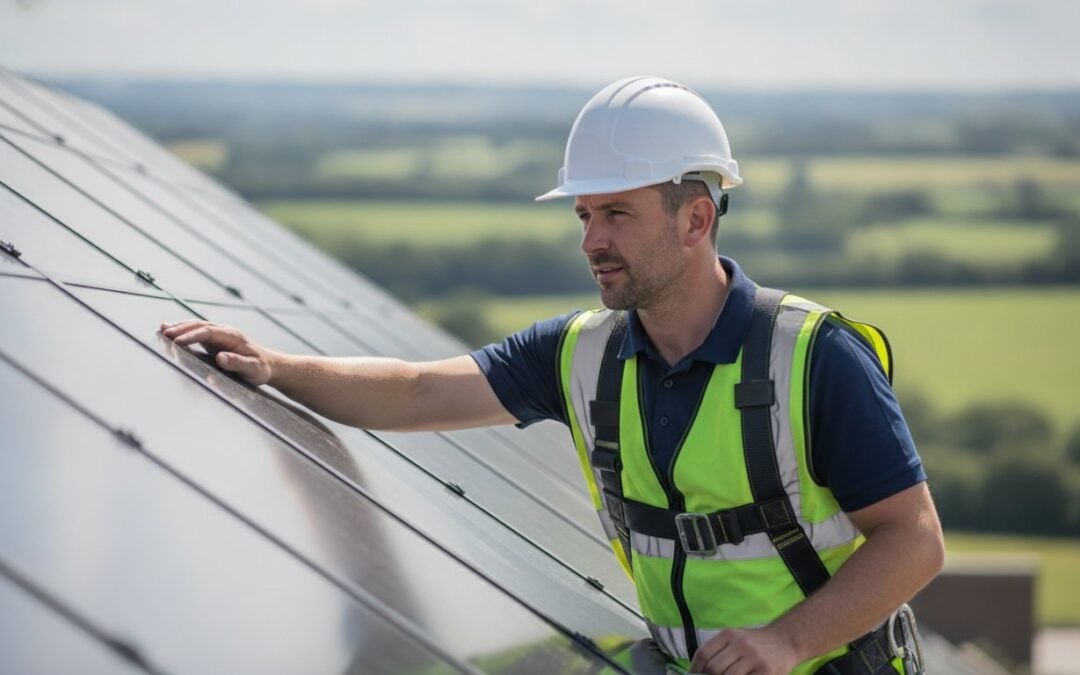
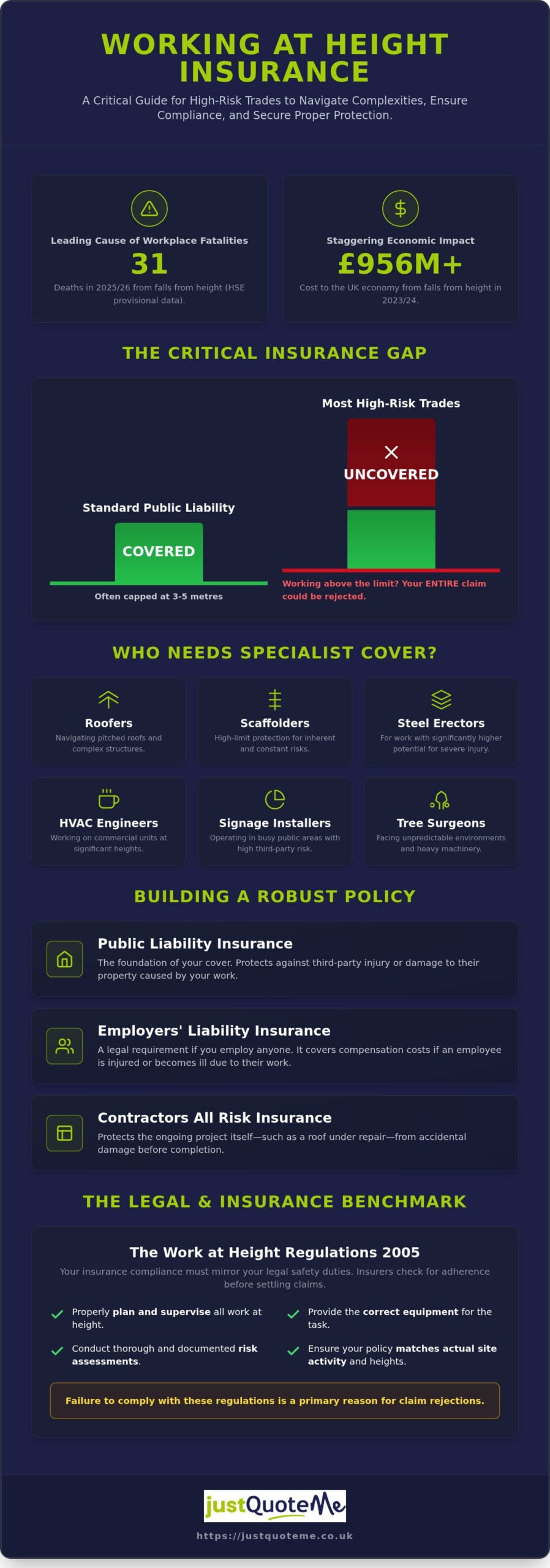
Did you know that falls from height remained the leading cause of workplace fatalities in 2025/26, accounting for 31 deaths according to provisional HSE data? It’s a sobering statistic that explains why finding the right Working At Height insurance often feels like an uphill struggle. You likely already know the frustration of seeing premiums climb or feeling confused by “height limits” that seem to change from one policy to the next. It’s stressful to work when you’re worried that a single compliance oversight or a misunderstood clause could lead to a rejected claim.
This expert guide helps you navigate the complexities of high-risk liability to secure tailored protection for your business. We’ll show you how to manage your specific risks while ensuring you remain fully compliant with the Work at Height Regulations 2005. We’ll break down exactly what “height” triggers specialist requirements and explain how to find affordable cover that offers total peace of mind, so you can focus on the job at hand without the administrative headache.
Key Takeaways
- Understand why standard Public Liability often falls short and how Working At Height insurance acts as a critical extension for high-risk trades.
- Learn why exceeding your policy’s specified height limit by even one metre can lead to a rejected claim and total loss of cover.
- Identify how to accurately assess your maximum working height and equipment needs to ensure your policy matches your actual site activity.
- Discover the specific insurance requirements for high-level trades like roofing, scaffolding, and commercial maintenance crews.
- Find out how to secure bespoke protection that ensures full compliance with the Work at Height Regulations 2005.
What is Working At Height Insurance and Why is it Essential?
Working At Height insurance isn’t a standalone policy you buy off a shelf. It’s a specialist extension designed to bridge the gap left by standard tradesman cover. Many business owners assume their basic Public Liability insurance covers every task they perform. However, many “off-the-shelf” policies contain restrictive height limits, often capping out at just 3 or 5 metres. If you’re working on a roof or scaffolding above these limits, your insurer might refuse to pay out entirely. This makes specialized Working At Height insurance a necessity rather than an optional extra.
The financial stakes are high. Falls from height cost the UK economy over £956 million in 2023/24 according to the No Falls Foundation. For a small business, a single claim without the right cover isn’t just a setback; it’s a potential bankruptcy. Beyond safety, having the correct documentation is vital for growth. Larger contractors and local authorities won’t let you on site without proof that your insurance specifically covers the heights you’ll be reaching. It’s about more than just a certificate; it’s about securing your company’s future contracts.
The Core Components of a Robust Policy
A reliable Working At Height policy combines several layers of protection. Public Liability remains the foundation, protecting against third-party injury or damage to property. If you employ anyone, Employers’ Liability insurance is a legal requirement. It’s essential because falls are the leading cause of fatal injuries in the workplace. You should also consider Contractors All Risk insurance. This protects the ongoing project itself, such as a roof under repair, from accidental damage before completion.
Legal Requirements: The Work at Height Regulations 2005
Your insurance compliance should mirror your legal safety compliance. Under the broader framework of UK Health and Safety Regulations, you have a statutory duty to ensure all work is properly planned and supervised. Insurers will often check if you’ve followed these rules before settling a claim. If you haven’t performed a risk assessment or provided the right equipment, you’re at risk of claim rejection. The Work at Height Regulations 2005 serve as the primary legal benchmark for safety and compliance for any UK business performing tasks off the ground.
Who Needs Specialist Cover for High-Level Work?
Many tradespeople assume that specialist cover is only for those working on skyscrapers or major infrastructure projects. In reality, the need for Working At Height insurance extends to any professional whose work involves a risk of falling a distance liable to cause personal injury. This includes a wide array of sectors, from traditional construction to niche maintenance roles. If your daily tasks involve ladders, scaffolding, or mobile elevating work platforms (MEWPs), you must verify that your policy actually accounts for these specific activities and the heights involved.
Construction and Maintenance Specialists
For scaffolders and steel erectors, the risks are inherent and constant. These trades require high-limit protection because the potential for severe injury or property damage is significantly higher than in ground-level work. Similarly, HVAC engineers and roofers often find themselves navigating complex structures or pitched roofs where a standard liability policy might contain restrictive clauses. It’s vital to review your builders insurance to ensure it doesn’t include a “height limit” that leaves you vulnerable during a commercial contract. If you’re unsure about your current limits, seeking bespoke insurance solutions can clarify your position and fill any gaps in your cover.
Niche High-Risk Sectors
Beyond the building site, several niche sectors face unique challenges. Tree surgeons and arborists, for instance, deal with unpredictable natural environments and heavy machinery at height, necessitating specialized liability terms. Signage installation and billboard maintenance teams often work in busy public areas, where the risk to third parties is just as significant as the risk to the worker. Even security firms installing CCTV systems or alarms often work at heights that exceed the standard 3-metre or 5-metre limits found in basic policies. These professionals must ensure their insurance reflects the reality of their on-site duties.
Telecommunications and solar panel engineers also fall into this high-risk category. As the UK continues its push toward greener energy solutions, the number of engineers working on residential and commercial rooftops has surged. These roles require a deep understanding of safety protocols, and consulting HSE’s Guide to Working at Height is an excellent way to align your operational safety with legal expectations. Even in the hospitality and events sector, stage builders and lighting technicians often operate at height to create complex structures, proving that Working At Height insurance is a cross-industry essential for modern businesses.
The Critical ‘Height Limit’ Clause: What You Must Know
Standard policies are often built for ground-level trades. They frequently include a “hidden” height limit, usually set at 10 metres. This is the single biggest reason claims fail in high-risk sectors. If you’re working at 11 metres on a policy capped at 10, you aren’t just “partially” covered; you’re often not covered at all. Insurance companies view these limits as absolute. Exceeding them by a single metre can void your entire Working At Height insurance claim, leaving you to face the full financial burden of any accident.
Choosing between limited and unlimited cover depends on your typical contract. Limited cover is more affordable but requires you to be precise about your maximum reach. You must measure from the ground to the highest point of your work, not just where your feet are standing. If your projects vary in scale, unlimited height cover offers the security of knowing you’re protected regardless of the building’s size. To ensure your business is never left exposed during a complex project, Just Quote Me.
Negotiating Limits with a Broker
Automated quote engines are designed for simple, low-risk scenarios. They often fail to capture the nuance of high-level work, leading to policy wording that doesn’t actually fit your business. With over 30 years of experience, an independent broker understands how to structure bespoke policies that reflect your actual site activities. You can adjust your cover as your business grows. If you take on a taller project next month, it’s a simple matter of updating your policy rather than starting from scratch.
The Impact of Risk Assessments on Premiums
Documented safety protocols are your best tool for reducing insurance costs. When you provide detailed method statements that align with international principles like OSHA Fall Protection Standards, you demonstrate a commitment to safety that underwriters value. This isn’t just about ticking boxes; it’s about proving you manage risk effectively. A broker uses your risk assessment to prove your competence to underwriters. This professional validation often leads to better terms and lower premiums for your Public Liability insurance. It’s a pragmatic way to lower overheads while maintaining high safety standards.
How to Choose the Right Policy for Your Trade
Selecting the right Working At Height insurance requires a pragmatic approach that matches your daily site reality. A generic policy often leaves dangerous gaps in cover that only become apparent when you try to make a claim. To avoid this, follow a structured process to evaluate your specific needs. First, identify your maximum working height across all current and upcoming contracts. Don’t just estimate; check your project specifications. A solar panel installer working on commercial warehouses needs significantly different limits than a residential decorator. Second, evaluate your equipment. Whether you use ladders, scaffolding, or cherry pickers, your insurer needs to know the exact methods you use to access your workspace.
Third, check for Contractors All Risk insurance requirements. Larger builds often mandate this to protect the project itself, including materials and temporary structures, from damage during construction. Finally, consult an independent broker. Specialist markets for high-risk trades are complex, and a broker can compare options that automated sites simply cannot access. These experts understand the nuances of regional trade requirements, ensuring your policy wording is ironclad and compliant with the latest safety standards.
Tailoring Cover to Your Equipment
Your choice of access equipment dictates your risk profile and your premium. If you operate heavy machinery, you must distinguish between owned and hired-in plant. Standard liability often excludes damage to the machines themselves. You can secure specific plant and machinery insurance to cover these expensive assets against theft or accidental damage. Special considerations also apply to niche methods like rope access or cradles. These activities require bespoke policy wording to ensure your Working At Height insurance remains valid during specialized maneuvers. Don’t assume your equipment is covered by default; always declare it clearly to your broker.
Additional Protections to Consider
Liability is only one part of the puzzle for a modern trade business. If you provide design advice, site surveys, or consultancy as part of your high-level work, you likely need Professional Indemnity insurance. This protects you if a design flaw or professional error leads to a client’s financial loss. For sole traders, personal accident cover is a vital safety net. If an injury at height prevents you from working for weeks or months, this provides essential financial support to cover your bills. Additionally, high-level equipment is costly and often targeted by thieves. Ensure your van and tools insurance is sufficient to replace specialized gear if it’s stolen from your vehicle or a secure site.
To get a policy that actually fits your trade and provides real security, compare specialist insurance quotes with an expert today.
Why Just Quote Me is the Trusted Partner for High-Risk Trades
Choosing an insurance partner is as critical as choosing your safety gear. With over 30 years of industry experience, we understand that high-risk trades require more than just a standard policy document. We’ve built our legacy as an independent UK broker by focusing on bespoke solutions for those who work where others won’t. You won’t deal with anonymous call centres or automated scripts here. Instead, you get direct access to expert advice from our teams in Stone and Stafford. This human-centric approach ensures your Working At Height insurance is handled by someone who actually understands the nuances of your specific trade.
Our independence is your greatest asset. We aren’t tied to a single provider; instead, we have access to a broad network of top UK insurers who specialise in high-risk construction. This panel allows us to find cover for complex scenarios that mainstream insurers often decline. We manage the complex administrative burdens and provide efficient claims support, so you can focus on your projects. If the worst happens, you have a steady hand to guide you through the process, ensuring your business remains resilient. Our team acts as your advocate, dealing with underwriters directly to resolve issues quickly and fairly.
The Advantage of an Independent Broker
We leverage our 30-year history to find competitive pricing without compromising the depth of your cover. While automated engines might offer a lower headline price, they often hide exclusions that leave you vulnerable. We focus on regional expertise, serving the whole UK from our heartland in Staffordshire and the West Midlands. This local knowledge allows us to provide a level of service that larger, impersonal competitors simply can’t match. Whether you need comprehensive tradesman insurance or a specific height extension, we tailor every policy to your unique risk profile. Our Stafford and Stone offices are staffed by professionals who know the local industry inside out.
Get Started with a Specialist Quote
Securing the right protection doesn’t have to be a slow or frustrating process. We’ve streamlined our system to move you quickly from inquiry to action. Our name is more than just a brand; it’s a commitment to efficiency. When you need to secure a new contract or renew your existing cover, Just Quote Me. We provide the expert guidance you need to navigate high-risk liability with confidence. You can start by following our simple process to Get Your Free Business Insurance Quote now. We’ll help you secure the tailored Working At Height insurance your business deserves, backed by three decades of specialist knowledge.
Protect Your Business with Expert High-Risk Cover
Securing the right Working At Height insurance is about more than just legal compliance; it’s about protecting the long-term longevity of your business and your professional reputation. We’ve explored how standard policy height limits can leave you dangerously exposed and why accurate equipment declarations are essential for ensuring a valid claim. By understanding these critical nuances, you move from a state of administrative uncertainty to one of total operational confidence on every site you visit.
As an FCA Authorised Independent Broker with over 30 years of industry experience, Just Quote Me specialises in these complex, bespoke high-risk liability requirements. We provide a pragmatic, human alternative to impersonal automated systems, ensuring your policy wording is as robust as your own on-site safety protocols. You don’t have to manage these complex burdens alone.
You can secure your business with our expertise today and let our specialists build the specific cover your trade demands. We’re here to ensure you can reach the heights your projects require with the peace of mind you deserve.
Frequently Asked Questions
What is the standard height limit for tradesman insurance?
Standard tradesman policies often cap height limits at 3 or 5 metres by default. Some mid-range policies might extend this to 10 metres, but it’s rarely a standard feature for every trade. You must check your policy schedule specifically for a “Height Limit” clause to avoid gaps. If your work exceeds these standard markers, you’ll need a specialist extension to ensure your liability remains valid during the project.
Is Working at Height insurance a legal requirement in the UK?
There’s no specific law requiring a product named “Working at Height insurance,” but Employers’ Liability is a legal necessity for any business with staff or subcontractors. Additionally, the Work at Height Regulations 2005 mandate that you manage risks effectively. Most commercial clients and local authorities will refuse to hire you unless you can prove your Public Liability specifically covers the heights you’re working at.
Does my policy cover me if I use a ladder instead of scaffolding?
Your cover depends on the equipment you declared when setting up the policy. Some insurers have strict “ladder exclusions” for certain heights, preferring the use of more stable access like scaffolding or MEWPs. If your risk assessment justifies a ladder and your policy doesn’t explicitly forbid it, you’re usually covered. Always ensure your equipment choice aligns with the safety protocols your insurer expects for your specific trade.
Can I get one-off insurance for a single high-level project?
Yes, it’s possible to secure short-term cover or a temporary extension to your existing annual policy for a specific project. This is a practical solution if you typically work at ground level but have secured a one-off contract for high-level maintenance or roofing. Contacting a broker is the fastest way to arrange this “top-up” cover without renegotiating your entire yearly premium or switching providers entirely.
What happens if I work above the height limit specified in my policy?
Working even one metre above your policy limit can lead to a total claim rejection. Insurers treat height limits as absolute conditions of the contract. If an accident occurs at 12 metres on a 10-metre limited policy, you’ll likely be responsible for all legal costs and compensation payments yourself. It’s a high-stakes risk that can easily lead to business bankruptcy if a major incident occurs.
Does working at height insurance cover my tools if they fall?
Working At Height insurance primarily focuses on liability for injury to people or damage to third-party property. While it covers you if a dropped tool hits a car or a pedestrian, it won’t pay to replace your own damaged equipment. For that, you need a specific tool insurance extension. This ensures that expensive high-level gear is protected against accidental damage or theft from the site or your vehicle.
How much does working at height insurance cost for a sole trader?
Costs vary based on your specific trade, the maximum heights you reach, and your previous claims history. A sole trader performing minor gutter repairs at 5 metres will pay a different rate than a roofer working at 15 metres. Because high-risk work is assessed on an individual basis, the most efficient way to find an accurate price is to request a tailored quote based on your actual contract needs.
Can a broker help if I’ve been refused cover elsewhere due to high-risk work?
Absolutely. Independent brokers have access to specialist underwriting panels that automated quote engines simply can’t reach. If a mainstream insurer has refused you due to “high-risk” activities like rope access or scaffolding, a specialist broker can often find a bespoke solution. They understand the nuances of the industry and can present your risk assessments to insurers to prove your competence and safety standards.
