

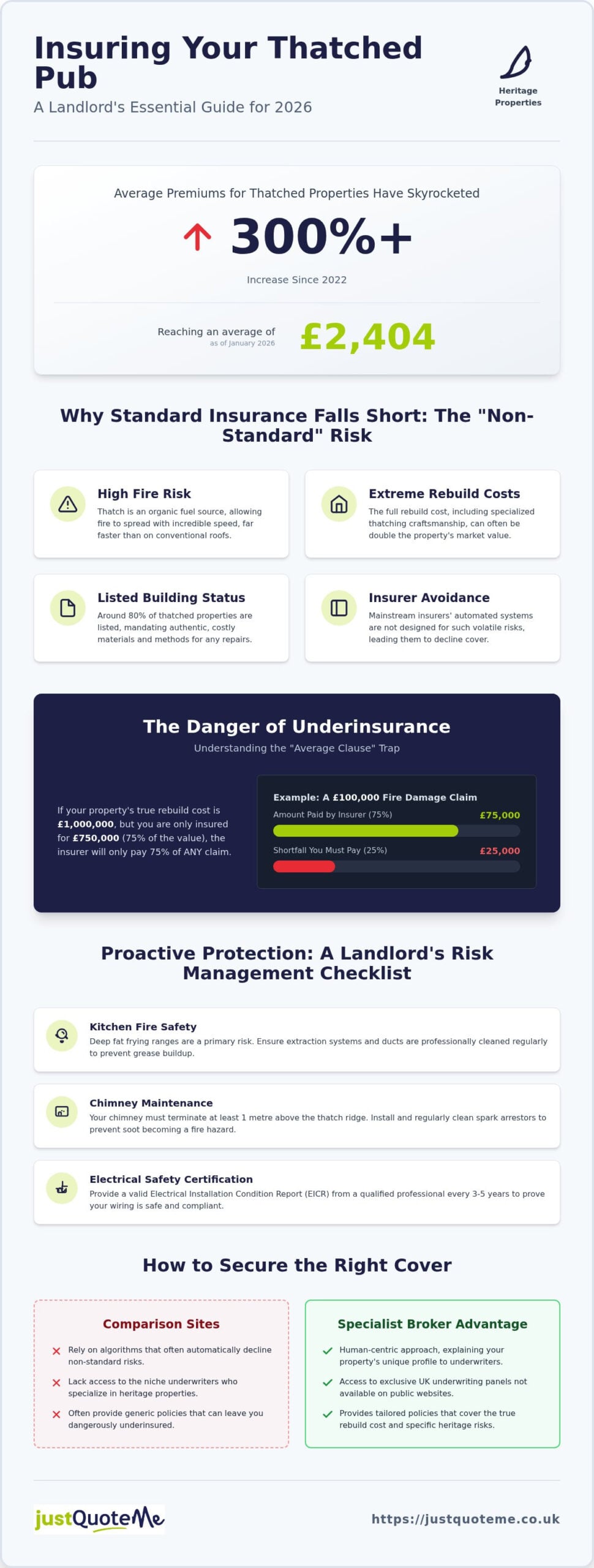
Did you know that average insurance premiums for thatched properties in the UK have surged by over 300% since 2022, reaching an average of £2,404 as of January 2026? For a landlord, this isn’t just a statistic; it’s a direct hit to your bottom line. We understand that finding reliable Thatched pubs insurance is becoming increasingly difficult as many standard insurers pull out of the market. You’re likely concerned about high costs, strict warranty conditions, and the fear that a claim might be rejected because of a minor technicality. It’s a stressful position to be in when you’re responsible for a precious piece of local heritage.
The good news is that you don’t have to manage these complex administrative burdens alone. This article explains how to secure comprehensive, competitive cover that accounts for the full rebuild cost of your thatch, which can often be double the property’s market value. We’ll show you how to master specialist risk management and stay compliant with the new 2026 fire safety regulations. You’ll learn how a tailored policy protects your staff and customers while giving you the peace of mind that comes from working with an FCA-authorised expert. Just Quote Me to simplify your protection and focus on what you do best: running a successful pub.
Key Takeaways
- Understand why mainstream insurers frequently decline thatched roofs and why these heritage properties require a specialist, non-standard approach to coverage.
- Identify the core perils underwriters focus on, including chimney maintenance and the specific risks associated with deep fat frying ranges.
- Learn how to secure Thatched pubs insurance that covers the unique craft of thatching alongside essential Public and Products Liability protection.
- Discover actionable steps from our risk management checklist to improve your property’s profile and potentially lower your insurance premiums.
- Gain access to specialist UK underwriting panels and bespoke quotes that are not available through automated comparison websites.
Why Thatched Pubs Insurance Requires a Specialist Approach in 2026
Most business owners assume a standard commercial policy will suffice until they face the reality of a thatched roof. In the eyes of an underwriter, a thatched pub represents a “non-standard” risk. This classification isn’t just about the roof material; it’s about the speed at which fire can spread and the extreme cost of restoration. Mainstream insurers often decline these risks because their automated systems aren’t designed to calculate the volatility of organic roofing materials. They prefer predictable, brick-and-tile structures where fire risks are easily quantified.
This is where a specialist broker becomes essential. With over 30 years of experience, Just Quote Me understands how to present your risk to niche underwriting panels that don’t appear on comparison sites. We focus on a human-centric approach, explaining the specifics of your property to underwriters rather than letting an algorithm make the decision. Standard pub policies are insufficient for thatched structures because they lack the specific clauses needed to cover specialized heritage craftsmanship and the unique fire risks inherent in traditional building methods.
The “Non-Standard” Risk Factor Explained
The type of material used in Thatching significantly influences your premium. Insurers distinguish between water reed, which is generally more durable, and wheat reed or long straw. These materials have different burn rates and maintenance requirements. Additionally, approximately 80% of thatched properties in the UK are listed buildings. This status means any repairs must use authentic materials and methods, which drives up rebuild costs far beyond standard market valuations. New fire safety regulations coming into force in April 2026 place even more emphasis on proactive risk management and sustainable heritage preservation. Your policy must reflect these legal shifts to ensure you remain fully compliant.
The Consequences of Underinsurance
Underinsurance is a growing threat in the hospitality sector. If your sum insured is lower than the actual cost to rebuild the property from scratch, insurers may apply the “Average Clause.” This means if you’re insured for only 75% of the total value, the insurer will only pay 75% of any claim, even for a minor fire. Because thatched pubs often have rebuild costs that are double their market value, a generic Commercial Property Insurance policy without a specialist valuation is a recipe for financial disaster. You need a policy that reflects the reality of 2026 construction costs and the scarcity of skilled thatchers. Securing accurate Thatched pubs insurance requires a broker who understands these nuances.
Managing the Core Perils: Fire, Chimneys, and Electrics
Fire remains the single most significant concern for any underwriter assessing a thatched property. Unlike a slate or tile roof, where a small fire might be contained, a thatched roof acts as a fuel source that allows flames to spread horizontally with incredible speed. For pub owners, this risk is amplified by the presence of commercial kitchens. Deep fat frying ranges are a particular focal point in policy wording. The accumulation of grease in extraction systems creates a high-intensity fire risk that can easily migrate to the roof timbers. If your business offers a full food menu, your premium will reflect the quality of your fire suppression systems and the frequency of your duct cleaning.
To mitigate these risks, insurers enforce strict physical requirements. One such standard is the 1-metre rule; your chimney must terminate at least one metre above the ridge of the thatch to ensure sparks are dispersed safely by the wind. Many underwriters also insist on the installation of spark arrestors, though these must be cleaned regularly to prevent soot buildup from becoming a secondary fire hazard. Using thermal imaging to check for heat transfer through chimney stacks is becoming a common request during the survey process.
Electrical Safety and Thatch Warranties
Electrical faults are a silent threat that often start in hard-to-reach areas. To maintain your cover, you must provide an Electrical Installation Condition Report (EICR) conducted by a qualified professional every three to five years. Insurers look for specific preventative measures, such as ensuring all wiring within the roof void is enclosed in fire-resistant metal conduit. This protects the cables from rodent damage and contains any heat generated by a short circuit. Installing linked smoke detectors within the thatch void itself is another proactive step that demonstrates a commitment to risk management.
Chimney Maintenance and Log Burner Risks
The charm of a roaring log fire is a major draw for customers, but it requires rigorous maintenance to remain insurable. Most Thatched pubs insurance providers mandate that chimneys are swept at least twice a year during the burning season. You must also be prepared to prove you only burn seasoned wood or approved smokeless fuels. Utilizing CCTV flue inspections or thermal imaging can identify cracks in the chimney lining before they lead to a disaster. If you’re unsure if your current setup meets these stringent criteria, you can consult with our team for a detailed review. Ensuring your flue is safe is a vital part of obtaining robust Pub and Bar Insurance for heritage buildings.
The Essential Components of a Comprehensive Thatched Policy
A robust policy for a thatched pub isn’t a one-size-fits-all document. It needs to account for the physical structure and the operational risks of a busy hospitality venue. Buildings insurance is the foundation of your cover. It must account for the full cost of heritage materials and the specialist labor required for traditional thatching. If you rely on a standard valuation, you’ll likely find yourself underinsured. Restoration requires master craftsmen whose fees and lead times are significantly higher than those of general contractors. When you secure Thatched pubs insurance, you’re investing in the survival of a historic landmark, not just a commercial building.
Beyond the physical roof, you have people and reputation to protect. Public and Products Liability covers accidents involving customers or issues with the food and drink you serve. This is vital for any business that interacts with the public daily. Additionally, Employers Liability is a non-negotiable legal requirement if you have even one part-time staff member. It protects you against claims arising from employee injuries or illnesses sustained while working. These components form a safety net that allows you to focus on your patrons rather than legal liabilities.
Public Liability for Hospitality
Managing a historic venue brings specific challenges that modern buildings don’t face. Low beams, uneven flagstone floors, and steep, narrow staircases are part of the charm, but they increase the risk of slips and trips. As we move through 2026, liability limits are trending higher because legal costs and compensation awards for injuries in heritage settings are rising. Your Public Liability Insurance must be sufficient to protect your business assets if a guest is injured on your premises. We ensure your policy accounts for these specific environmental risks so a single accident doesn’t jeopardize your future.
Business Interruption and Heritage Rebuilds
This is where most standard commercial policies fail thatched property owners. If a fire occurs, you’ll encounter the “Heritage Gap.” It isn’t just about the money; it’s about the time. Finding master thatchers and sourcing specific materials can take months of searching and planning. While a 12-month indemnity period might work for a modern pub, thatched properties often require 24-month or even 36-month periods. This ensures your business remains financially viable during a prolonged rebuild process. We also recommend including Loss of Licence cover. This protects your income if you lose your legal right to sell alcohol due to circumstances beyond your control, providing an extra layer of security for your livelihood.
Reducing Your Premiums: A Landlord’s Risk Management Checklist
Proactive risk management is your most powerful tool for negotiating lower premiums. Insurers don’t just look at the thatched roof; they look at the person managing it. By demonstrating a meticulous approach to safety, you can access more competitive rates for your Thatched pubs insurance. A central part of this is having an up-to-date Fire Risk Assessment (FRA). This document shouldn’t just sit in a drawer. It needs to be a living document that reflects current 2026 safety standards and shows underwriters you’ve addressed every potential hazard. Underwriters are far more likely to offer favorable terms to a landlord who can prove they are ahead of the regulatory curve.
Installing physical protections like Thatch Fireboard or Fire Barriers between the rafters and the thatch can significantly reduce your premium by slowing the spread of fire and protecting the building’s core structure. These passive fire protection measures are highly valued by specialist insurers because they provide an extra layer of defense that traditional methods lack. When you combine these physical upgrades with documented procedures, you create a compelling case for a lower-cost policy. It’s about shifting the narrative from a high-risk property to a well-managed heritage business.
Maintenance and Documentation
Consistency is key. We recommend keeping a “Thatch Log” that records every inspection, repair, and sweep. This should include certificates from members of the Master Thatchers Association, as their expertise is recognized as the industry gold standard. Showing that your fire extinguishers and blankets are serviced annually isn’t just a legal requirement; it’s proof of your reliability. If you can present a tidy folder of maintenance records, you remove the guesswork for the insurer. This transparency often leads to “no-claims” discounts and lower excesses on your Thatched pubs insurance policy because it proves the property is cared for by a professional.
Modern Security for Traditional Pubs
While the building is historic, your security shouldn’t be. Installing CCTV and alarm systems that meet insurer-approved standards protects your property from arson and theft. If your venue employs door staff for events or weekend trade, you should also consider how this integrates with your Security Insurance requirements. Additionally, ensure your policy includes Safe and Money cover to protect cash held on-site, which is a common target for burglary. A well-secured pub is a lower risk, and lower risk always equals better rates. To see how these improvements can impact your specific policy, speak with our specialist team for an expert assessment of your risk profile.
Securing Your Quote with Just Quote Me: The Broker Advantage
Standard comparison sites are built for standard risks. When you deal with a property as unique as a thatched public house, the automated logic of a computer algorithm often results in a “computer says no” response or an inflated premium that doesn’t reflect your actual risk management efforts. This is why you should Just Quote Me to gain access to specialist underwriting panels that simply don’t appear on mainstream platforms. We’ve spent over 30 years building relationships with niche UK insurers who understand the hospitality sector’s heritage requirements. Our team acts as your advocate, presenting the specific details of your property to ensure you aren’t penalized for the beauty of your building.
Our deep roots in Staffordshire and the West Midlands provide us with a unique perspective on the regional challenges faced by local landlords. We know that a thatched pub in a rural village requires a different approach than a modern bar in a city center. By choosing an independent, FCA-authorised broker, you’re opting for a human-centric service that prioritizes clarity over corporate jargon. We manage the complex administrative burdens and technical negotiations so you can focus on your staff and customers, confident that your livelihood is protected by a steady, experienced hand.
Tailored Solutions, Not Template Policies
We don’t believe in off-the-shelf products for non-standard risks. Every thatched property has a different story, from the age of the rafters to the specific type of reed used on the roof. Our experts negotiate bespoke terms based on your individual risk profile, often securing lower excesses or more flexible warranty conditions than you’d find elsewhere. This personalized approach extends to our claims support. If the worst happens, our team is here to guide you through the process, ensuring your heritage restoration stays on track. You can explore our wider Business Insurance options to see how we provide comprehensive protection across all commercial sectors.
Next Steps for Your Pub
Securing an accurate quote for Thatched pubs insurance requires a bit of preparation, but it pays off in the long run. Before you get in touch, try to have your latest Electrical Installation Condition Report (EICR), your Fire Risk Assessment, and an up-to-date rebuild valuation ready. While online forms are convenient for simple risks, we’ve found that a direct conversation is far more effective for thatched properties. It allows us to capture the nuances that a form might miss, leading to a more competitive and accurate quote. We’re committed to providing a frictionless experience that combines professional restraint with honest, straightforward communication.
Get Your Free Business Insurance Quote now
Request a Call back for free Expert advice
Protect Your Heritage with Expert Coverage
Owning a thatched public house is a commitment to preserving history, but it requires a strategic approach to insurance. By focusing on electrical safety, rigorous chimney maintenance, and accurate rebuild valuations, you can navigate the challenges of a hardening market. Securing the right Thatched pubs insurance ensures your business is protected against the unique fire risks and heritage restoration costs associated with traditional structures. You’ve worked hard to build your reputation; it’s vital that your policy reflects the true value of your property.
As an FCA-authorised independent broker with over 30 years of experience, we specialize in non-standard hospitality risks. We’ll help you access specialist UK insurers that don’t appear on comparison sites, providing bespoke terms that reflect your proactive safety measures. Don’t let complex administrative burdens or rising premiums threaten your livelihood. Just Quote Me to simplify your insurance and gain the peace of mind you deserve. We look forward to helping you secure the future of your business.
Get Your Free Business Insurance Quote now
Request a Call back for free Expert advice
Frequently Asked Questions
Is thatched pub insurance more expensive than standard pub insurance?
Yes, premiums are generally higher because the specialist materials and labor required for heritage restoration are significantly more costly than modern alternatives. While standard buildings use mass-produced tiles, a thatched roof requires organic materials and master craftsmanship, which increases the total sum insured. We work to mitigate these costs by highlighting your proactive maintenance to our specialist underwriting panels.
Do I need a specific type of fire alarm for a thatched roof?
Most insurers mandate a linked smoke detection system that includes sensors within the thatch void itself. This setup ensures that if heat or smoke is detected in the roof structure, alarms sound throughout the entire building immediately. It’s a critical safety requirement that provides the early warning necessary to prevent a localized incident from becoming a total loss.
Can I get insurance if my pub has a deep fat fryer and a thatched roof?
You can secure coverage for a pub with a deep fat fryer, but it requires strict adherence to extraction cleaning and fire suppression protocols. Insurers will look for evidence of professional duct cleaning and may specify the type of fire extinguishers required in the kitchen area. Managing these commercial kitchen risks is a standard part of a bespoke Thatched pubs insurance policy.
What is the “Average Clause” in thatched property insurance?
The Average Clause is a condition that reduces your claim payout if the property is found to be underinsured at the time of a loss. If you insure your building for only 75% of its actual rebuild value, the insurer is entitled to pay out only 75% of any claim, even for partial damage. This makes accurate, professional valuations essential for protecting your business assets.
Does my policy cover the cost of a specialist Master Thatcher?
A comprehensive policy should cover the fees of a Master Thatcher, provided your buildings insurance sum insured accurately reflects heritage labor rates. Because thatching is a specialist craft, these costs are significantly higher than general building work. We ensure your policy wording includes the necessary provisions to hire the right experts for any required restoration or repair work.
How often do I need to have my chimneys swept for insurance purposes?
Insurers typically require chimneys to be swept at least twice a year, usually once before the winter burning season and once during it. You must maintain a log of these sweeps and keep the certificates provided by the professional sweep as evidence for your insurer. Failure to document this maintenance can lead to a claim being rejected if a chimney fire occurs.
Is Employers Liability insurance legal required for my pub staff?
Employers Liability is a legal requirement for any business with employees, including part-time bar staff, cleaners, or seasonal workers. This cover protects you against claims if a member of your team is injured or falls ill as a result of their work. Even in a historic setting, you must maintain this protection to remain compliant with UK law and avoid heavy daily fines.
Can a broker help if I have been refused insurance elsewhere?
A specialist broker is your best resource if you’ve been declined by mainstream insurers or comparison sites. Automated systems often reject non-standard risks like thatch without considering the specific safety measures you’ve implemented. Just Quote Me uses a human-centric approach to manually review your risk profile and present it to niche underwriters who specialize in heritage hospitality venues.
