
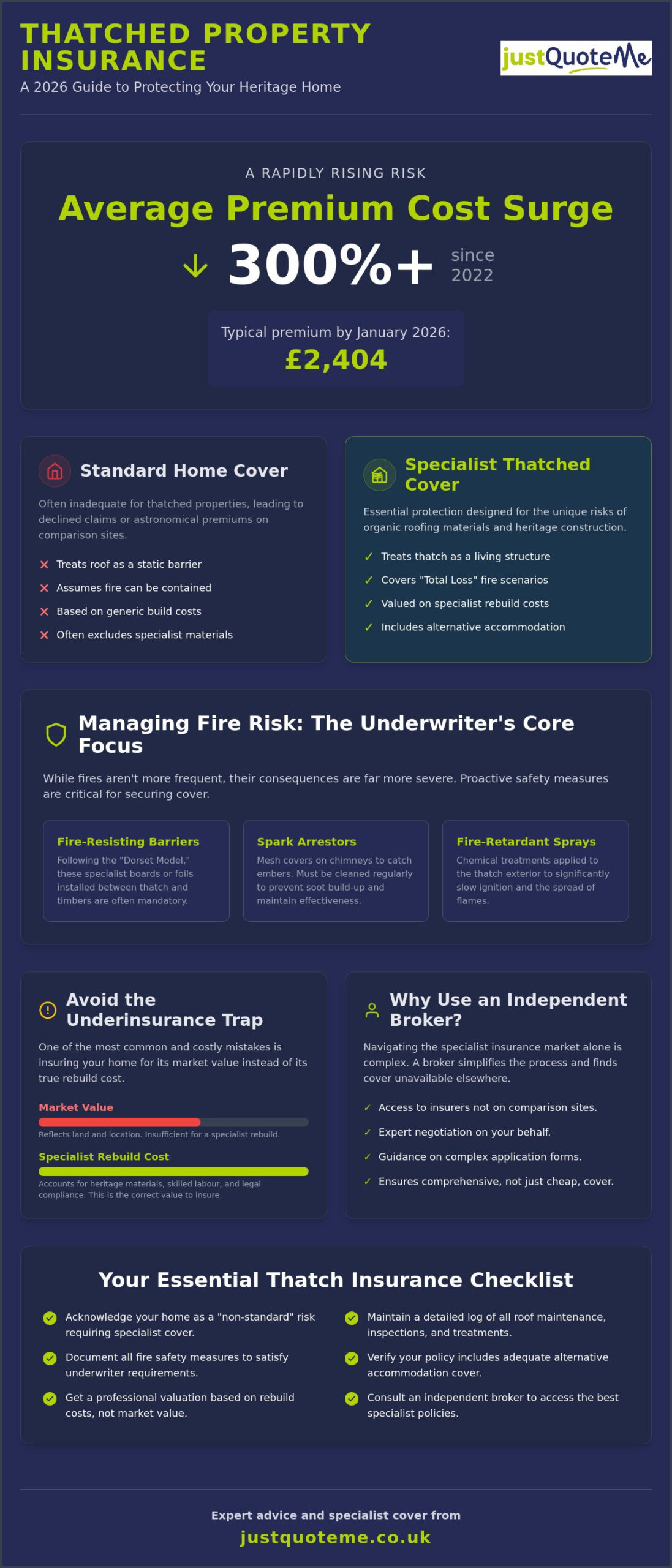
Did you know that the average cost of Thatched Property insurance has surged by over 300% since 2022? By January 2026, typical premiums reached £2,404, driven by rising material costs and a shrinking pool of specialist insurers willing to take on the risk. It is a staggering figure that leaves many heritage homeowners feeling penalised for simply preserving a piece of British history.
You likely already know how difficult it’s to find a provider who understands the difference between water reed and combed wheat, let alone one who offers fair terms. It’s exhausting to navigate confusing requirements for chimney linings and fire retardant sprays while worrying if your rebuild valuation is actually accurate. We promise to simplify this process by helping you master the complexities of specialist cover and manage your premium costs effectively. This guide provides a practical checklist to satisfy underwriters, explains the latest 2026 safety regulations, and shows you how an independent broker secures the comprehensive protection your home deserves.
Key Takeaways
- Understand why thatched homes are classified as non-standard risks and why it’s essential to have specialist cover to protect against total loss scenarios.
- Learn why underwriters focus on fire management and how documented safety measures can improve your eligibility for Thatched Property insurance.
- Discover how to value your heritage home based on specialized rebuild costs rather than market value to avoid the common underinsurance trap.
- Identify proven strategies to manage premium costs, including the importance of material choice and maintaining a detailed maintenance log.
- See how an independent broker simplifies the application process by negotiating directly with specialist insurers who aren’t on standard comparison sites.
What is Thatched Property Insurance and Why is it “Non-Standard”?
Thatched Property insurance is a specialist form of cover designed for homes where the primary roofing material is organic, such as water reed, long straw, or combed wheat reed. While a standard home insurance policy treats a roof as a static barrier, a thatch policy treats it as a living component of the building’s structure. These policies cover the unique risks associated with heritage materials that mainstream providers often avoid. Securing Thatched Property insurance ensures that your rebuild valuation reflects the true cost of specialist labour and materials rather than just generic construction rates.
Most high-street insurers decline these properties because they classify them as “non-standard” risks. The primary reason is the potential for a “total loss” claim. While a fire in a tiled home might be contained to one room, a fire in a thatched roof can spread rapidly through the layers of vegetation. The craft of Thatching creates a beautiful aesthetic, but the density of the material makes it incredibly difficult for fire services to extinguish once it takes hold. This statistical risk of a complete rebuild, rather than a simple repair, is why you need a dedicated policy rather than a generic one.
By 2026, regulatory compliance has become even more critical for heritage homeowners. With amendments to UK fire safety standards, such as those taking effect on September 30, 2026, and rising material costs, insurers now require proof that your property meets specific safety benchmarks. This includes both the physical structure and the contents within, which are often of higher value in historic homes and require separate, detailed assessment.
The Distinction Between Standard and Non-Standard Home Cover
Comparison sites operate on “tick-box” algorithms that don’t account for the nuances of organic roofing. They often fail thatched homeowners by either quoting astronomical premiums or providing “standard” cover that contains restrictive exclusions. Specialist underwriters, however, understand the materials. When you apply for Thatched Property insurance, they look at the age of the roof and the specific type of reed used. If your home is a Grade I or Grade II listed building, the insurance picture becomes even more complex. You aren’t just insuring a house; you’re insuring a legal obligation to rebuild using historically accurate materials and methods, which standard policies simply don’t cover.
Key Components of a Comprehensive Thatch Policy
A robust policy goes beyond simple fire protection. Alternative accommodation cover is vital because a thatch rebuild can take significantly longer than a modern home repair. You need to know you’ll have a place to live for months if the worst happens. Additionally, you should look for specialist thatch liability to protect against third-party risks and accidental damage cover tailored to heritage materials. For those who own commercial heritage properties, such as a local hostelry, securing Thatched Pub insurance involves even more rigorous risk assessments regarding kitchen safety, chimney maintenance, and public access.
Managing Fire Risk: The Core of Thatched House Insurance
Fire remains the primary concern for underwriters in 2026. While statistics show that thatched homes don’t catch fire more frequently than properties with slate or tile roofs, the consequences of an ignition are far more severe. A fire in a thatched roof is often deep-seated and incredibly difficult to extinguish, frequently leading to the high “total loss” risk mentioned earlier. For this reason, securing a specialist policy requires a proactive approach to risk management rather than just paying a premium.
The “Dorset Model” has emerged as the gold standard for thatch fire safety across the UK. Originally developed by local authorities in Dorset, these guidelines focus on structural measures to prevent fire spread. This includes installing fire-resisting barriers, such as specialist boards or foils, between the thatch and the roof timbers. Many insurers now insist on these standards for new builds or major renovations. Beyond structural changes, underwriters often require specific preventative tools to be maintained:
- Spark Arrestors: These mesh covers sit over the chimney pot to catch stray embers before they land on the dry thatch. They must be cleaned regularly to prevent soot build-up.
- Fire-Retardant Sprays: Chemical treatments applied to the external surface of the roof can significantly slow the ignition process and are a common requirement in modern Thatched Property insurance policies.
Chimney Safety and Multi-Fuel Burners
The most common cause of thatch fires is heat transfer through the chimney brickwork. Over time, mortar can degrade, allowing intense heat from multi-fuel burners to ignite the surrounding thatch layers. To mitigate this, many 2026 insurance policies mandate a CCTV chimney survey to confirm the integrity of the flue and lining. Additionally, underwriters look for a minimum chimney height, typically at least 1.8 metres above the ridge, to ensure sparks are carried safely away from the roof surface. Regular sweeping, often twice a year, is a non-negotiable policy condition.
Electrical Inspections and Fire Detection
Faulty wiring is a silent threat in older heritage homes. A valid Electrical Installation Condition Report (EICR), updated every five years, is now a standard requirement for Thatched Property insurance. In 2026, many providers also insist on interlinked smoke alarms specifically located in the loft space. These alarms ensure that if a fire starts within the roof structure, you’re alerted immediately. Interestingly, installing external floodlights can also help. While primarily for security, they provide better visibility for fire crews during a night-time emergency, which can lead to lower premiums from certain specialist insurers.
Avoiding the Underinsurance Trap: Valuing Your Heritage Home
One of the most common mistakes homeowners make when seeking Thatched Property insurance is confusing market value with rebuild cost. Your property’s market value reflects what a buyer might pay in the current climate. However, your insurance policy must reflect the actual cost of clearing the site and rebuilding the structure from scratch using identical materials. For a thatched home, these costs are significantly higher than for a standard brick and slate property. If your sum insured is too low, you fall into the underinsurance trap.
The scarcity of specialist labour is a major factor driving up these costs in 2026. Master thatchers are in high demand, and their expertise comes at a premium. Combine this with the rising price of materials like water reed or long straw, and it’s easy to see why a full roof replacement averaged approximately £20,000 in early 2026. If you underestimate these figures, insurers may apply the “Average Clause” during a claim. This means if you’ve only insured your home for 80% of its true rebuild value, the insurer can reduce your payout by 20%, even for a partial loss like minor storm damage.
Professional Appraisals vs. Online Calculators
Standard online calculators often fail heritage homeowners. They typically use generic data that doesn’t account for the unique requirements of organic roofing. For example, the cost of specialist scaffolding required for thatching work is often overlooked, yet it’s a significant expense. The Royal Institution of Chartered Surveyors (RICS) “Red Book Global Standards” provide the definitive framework for property valuation, but you need a surveyor who understands heritage assets specifically. At Just Quote Me, we help you identify surveyors with the right expertise to ensure your valuation is accurate and your cover is robust.
Specialist Cover for Thatched Pubs and Commercial Assets
Commercial properties face even greater complexities. If you run a business from a heritage building, you need thatched pub insurance that accounts for both the structure and the operational risks. A fire doesn’t just damage the building; it stops your income. This is why business interruption cover is essential for any commercial thatched asset. For mixed-use sites or larger estates, integrating your thatch cover into a broader Commercial Property Insurance policy ensures there are no gaps in protection. We handle the complex paperwork so you can focus on running your business with confidence.
Proven Strategies to Lower Your Thatched Insurance Premiums
Managing the costs of Thatched Property insurance doesn’t have to be an uphill battle. While premiums have risen significantly across the UK, you can take specific, documented steps to make your home more attractive to specialist underwriters. Insurance is ultimately a calculation of risk. If you can prove that you’re a proactive homeowner, you’ll find it much easier to negotiate better rates. It pays to be organized.
One of the most effective tools at your disposal is a “Thatch Log.” This is a comprehensive record of every professional intervention on your roof, from minor patching to full ridge replacement. When you provide an underwriter with a documented history of work carried out by a master thatcher, you remove the guesswork from their assessment. Similarly, the material of your roof plays a role. Water Reed is often viewed more favourably than Combed Wheat due to its superior durability and longer lifespan. If you’re planning a re-thatch, choosing more resilient materials can lead to long-term savings on your Thatched Property insurance.
Strategic financial choices also make a difference. Increasing your voluntary excess is a direct way to lower your annual premium. It signals to the insurer that you’re committed to the property’s upkeep and won’t be making small, frequent claims. However, the biggest advantage comes from working with an independent broker. We have access to specialist schemes and niche insurers that simply don’t appear on standard comparison websites. You can request a bespoke quote today to see how these exclusive schemes can reduce your costs.
Physical Protective Measures
Installing physical barriers is a high-impact way to lower risk. If you’re undergoing a re-thatch, consider adding fire-resisting barriers, often called thatch batts, between the rafters and the thatch. These can prevent a fire from reaching the structural timbers of your home. Additionally, using approved fire-retardant chemical treatments provides an extra layer of security. Don’t overlook your garden, either. Underwriters typically require that trees and overhanging branches are kept at a minimum distance of 1 metre from the thatch to prevent moisture build-up and fire spread.
Maintenance Schedules that Underwriters Love
Consistency is key when it comes to maintenance. Insurers often mandate an annual chimney sweep by a NACS-registered professional to prevent soot fires. You should also plan for a ridge replacement every 10 to 15 years, as this is the most vulnerable part of the roof. Keeping your claims history clean is exceptionally valuable in the thatch market. Unlike standard homes where a single claim might have a minor impact, a clean record for a thatched property is a powerful bargaining chip that proves your commitment to heritage preservation.
Why Use an Independent Broker for Thatched Property Insurance?
Choosing Thatched Property insurance isn’t a simple transaction. It’s a partnership. While comparison sites rely on rigid algorithms, the complexity of heritage homes requires a “human-in-the-loop” approach. An independent broker understands that your 18th-century cottage doesn’t fit into a standard risk category. We look beyond the surface to find a policy that covers the specific nuances of your home, ensuring that you aren’t left with generic cover that fails when you need it most.
With average premiums reaching £2,404 in January 2026, the market has become increasingly restrictive. This “hardening” market means fewer insurers are willing to take on the risk of organic roofing. Just Quote Me leverages over 30 years of industry experience to navigate these challenges. We negotiate directly with specialist underwriters who don’t list their products on public comparison platforms. This direct access allows us to secure comprehensive cover that balances robust protection with manageable costs, even as material prices continue to rise.
Our regional expertise in Staffordshire and the West Midlands gives us a unique perspective on local thatching styles and regional fire safety requirements. We don’t just provide a policy; we simplify the entire administrative burden. From verifying your 2026 chimney survey requirements to ensuring your electrical certifications meet current standards, we manage the complex paperwork so you don’t have to. This steady hand in a complex market ensures your heritage asset remains protected without the administrative headache.
Bespoke Solutions for Unique Properties
Many thatched homes serve as more than just primary residences. Whether you operate a holiday let, a B&B, or own an unoccupied heritage building, we provide tailored solutions that standard providers often decline. If you’re a landlord, integrating Residential Letting Insurance into your specialist thatch cover ensures your investment is fully protected against tenant-related risks and loss of rent. We also handle properties with other non-standard construction elements, such as timber frames or historic cob walls, which often further complicate the insurance picture for generalist brokers.
Expert Advice and a Stress-Free Quote Process
Completing a “Thatch Questionnaire” can be a daunting task. One wrong answer about your ridge maintenance or the height of your chimney can lead to an immediate rejection from automated systems. We provide professional guidance through this process, helping you avoid the pitfalls of “computer says no” insurance. Our goal is to provide a frictionless experience that prioritises your home’s security and your peace of mind. You can Get Your Free Business Insurance Quote now and let our experts handle the complexities for you.
Secure Your Heritage Home with Expert Protection
Preserving a thatched property is a commitment to history, but it doesn’t have to be a financial burden. By implementing proactive fire safety measures and keeping documented maintenance records, you can significantly influence the terms of your Thatched Property insurance. It’s essential to focus on accurate rebuild valuations to avoid the underinsurance trap, especially as material and specialist labour costs continue to rise in 2026.
Just Quote Me brings over 30 years of industry experience as an FCA Authorised Broker. We provide bespoke access to specialist heritage underwriting that’s often unavailable on standard comparison sites. Our team understands the nuances of organic roofing and the specific regulatory requirements of heritage assets. We manage the complex administrative details so you can enjoy the beauty of your home with complete peace of mind. To get started with a personalised approach, Request a Call back for free Expert advice today. Your home’s future is in safe hands.
Frequently Asked Questions
Is thatched roof insurance more expensive than standard home insurance?
Yes, premiums for thatched properties are typically higher than those for standard homes because insurers view them as a non-standard risk. This is primarily due to the total loss potential if a fire occurs. The cost also reflects the specialized materials and skilled labor required for repairs. Using a specialist broker for Thatched Property insurance helps you access niche markets that offer more competitive rates than generalist insurers.
Do I need a special survey to get thatched property insurance?
Most specialist insurers require specific documentation rather than a single general survey. You’ll likely need a recent Electrical Installation Condition Report (EICR) and a CCTV chimney survey to confirm the integrity of the flue. Underwriters also often ask for a Thatch Questionnaire completed by a master thatcher to assess the roof’s condition. These requirements ensure the property meets 2026 safety standards before cover is granted.
Does the type of thatch material affect my insurance premium?
The material used for your roof significantly impacts your premium and your eligibility for cover. Water reed is generally viewed most favorably by underwriters because of its durability and longer lifespan compared to combed wheat reed or long straw. Insurers consider the risk of rot and the frequency of necessary ridge replacements. Documenting your material type in a Thatch Log helps brokers negotiate better terms with specialist underwriters.
Can I have a wood-burning stove in a thatched property?
You can have a wood-burning stove, but it is the most scrutinised feature of a thatched home. Insurers usually mandate that the chimney is lined with a twin-wall insulated flue and reaches a minimum height above the thatch ridge. You’ll also need to install spark arrestors and follow strict temperature monitoring protocols. Failure to meet these specific 2026 policy conditions can void your fire cover entirely.
What is the “Dorset Model” in thatched insurance?
The Dorset Model is a set of building specifications designed to reduce fire risk in thatched properties. It involves installing a fire-resisting barrier, such as a specialist board or foil, between the thatch and the roof timbers. While originally a local initiative, it has become a national benchmark for safety. Many insurers offer better terms or lower premiums for properties that strictly adhere to these construction standards.
How often do I need to have my chimney swept for insurance purposes?
Most Thatched Property insurance policies require you to have your chimney swept at least twice a year if you use a wood-burning or multi-fuel stove. If you only use an open fire or gas, an annual sweep by a NACS-registered professional is often sufficient. You must keep all certificates and receipts as proof of maintenance, as insurers will request these documents in the event of a fire claim.
Will my insurance cover the cost of a master thatcher?
A comprehensive specialist policy will cover the costs of a master thatcher, provided your rebuild valuation is accurate. This is why you must insure for the rebuild cost rather than market value. Specialist policies account for the scarcity of skilled labor and the high cost of materials like water reed. We work with you to ensure your sum insured reflects these professional fees to avoid the underinsurance trap.
What happens if my thatched property is a listed building?
If your property is Grade I or Grade II listed, your insurance must cover the legal obligation to rebuild using historically accurate materials and methods. This significantly increases the rebuild cost compared to a non-listed property. Specialist insurers understand these heritage requirements and tailor their policies to include the additional time and expense required by conservation officers. We help navigate these complexities to ensure your legal obligations are fully protected.
