

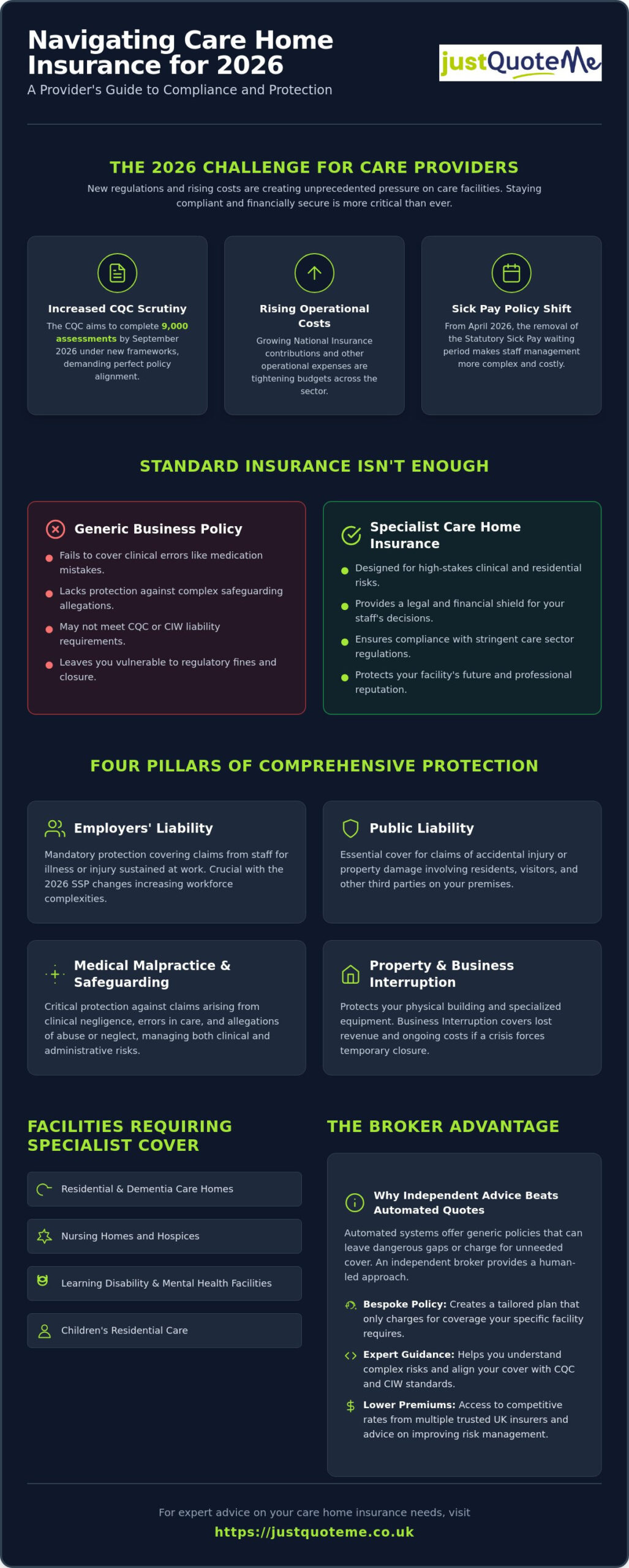
Could your facility withstand the scrutiny of the CQC’s target to complete 9,000 assessments by September 2026 if your care home insurance isn’t perfectly aligned with the new sector-specific frameworks? Most providers feel the pressure of rising operational costs, especially with the removal of the Statutory Sick Pay waiting period in April 2026 and increasing National Insurance contributions. It’s a difficult balance to maintain high standards of care while managing a tightening bottom line.
We understand that you need more than just a policy; you need a steady hand to help manage these heavy administrative burdens. This guide provides the expert insights you need to secure comprehensive protection that satisfies regulators and protects your residents. We’ll walk you through the complexities of medical malpractice, the nuances of the 2026 CQC framework, and practical ways to access competitive rates from trusted UK brokers. By the end, you’ll have a clear roadmap to simplifying your insurance process so you can focus on what matters most: delivering exceptional care.
Key Takeaways
- Understand how to align your coverage with the 2026 CQC and CIW standards to ensure your facility remains fully compliant during regulatory inspections.
- Identify the differences between mandatory Employers’ Liability and essential Public Liability to protect your business from claims involving staff, residents, and visitors.
- Discover the critical role of medical malpractice and safeguarding cover within a comprehensive Care home insurance policy to manage clinical and administrative risks.
- Learn why independent, human-led advice beats automated systems by creating a bespoke policy that only charges for the coverage your specific facility requires.
- Prepare for your renewal by gathering essential data on staff ratios and resident types to help lower your insurance premiums through improved risk management.
What is Care Home Insurance and Why is it Essential in 2026?
Care home insurance is a specialized commercial policy designed to protect the unique operational risks of residential care facilities, nursing homes, and hospices. Unlike a standard business policy, it accounts for the complex intersection of hospitality, property management, and clinical care. In the context of Social care in England, this coverage acts as a vital safety net for providers responsible for vulnerable individuals. It doesn’t just cover the building; it protects the professional decisions made by your staff every day.
Standard business insurance is simply insufficient for this environment. A generic policy might cover a slip and trip in a lobby, but it won’t address a clinical error during medication administration or a safeguarding allegation. Specialist Care home insurance provides the specific legal and financial frameworks required to manage these high-stakes scenarios. Without it, a single claim could jeopardize your facility’s future and your professional reputation.
The 2026 care market has introduced new pressures that make robust coverage more critical than ever. With the CQC transitioning to four sector-specific frameworks and aiming for 9,000 assessments by September 2026, regulatory scrutiny is at an all-time high. Additionally, staffing challenges have intensified following the April 2026 changes to Statutory Sick Pay, which is now payable from the first day of illness. These shifts mean your Employers Liability Insurance must be precise, reflecting a workforce that is more expensive to maintain and more complex to manage.
Who Needs Specialist Care Home Insurance?
Any facility providing 24-hour care or supervised residency requires a tailored policy. This includes residential care homes for the elderly, particularly those specializing in dementia care where resident vulnerability is high. Nursing homes and hospices also need this coverage to manage clinical liability risks. Furthermore, specialized facilities catering to learning disabilities, mental health support, and children’s residential care must have bespoke policies that reflect their specific safeguarding requirements and higher liability expectations.
The Consequences of Underinsurance in the Care Sector
Choosing inadequate cover is a gamble that rarely pays off. If your liability limits don’t meet CQC or CIW standards, you face potential regulatory fines or even the forced closure of your facility. Beyond the regulators, the financial impact of an unpaid safeguarding claim or a medical malpractice lawsuit can be ruinous. In 2026, a comprehensive insurance policy serves as the primary regulatory shield that preserves your right to operate while protecting your residents from the consequences of institutional financial failure.
Core Coverage: Protecting Your Residents, Staff, and Property
Foundational protection for any facility starts with four specific pillars. These aren’t just administrative boxes to tick; they’re the financial safeguards that keep your doors open when the unexpected happens. The legal basis for many of these requirements stems from the Health and Social Care Act 2008, which sets the standards for safety and quality that your Care home insurance must support. By securing the right core coverage, you ensure that a single accident doesn’t lead to a catastrophic financial loss.
Your property and business continuity are equally vital. Commercial Property Insurance protects the physical structure and your specialized medical equipment, such as hoists, hospital beds, and monitoring systems. If a fire or flood forces a temporary closure, Business Interruption cover provides a financial bridge. It helps cover ongoing costs like staff wages and lost revenue while the facility is restored. If you’re unsure if your current limits are sufficient, it’s a good idea to speak with a specialist broker who understands the care sector’s unique assets.
Public Liability for the Care Environment
In a residential setting, Public Liability Insurance is essential for managing risks involving residents, visitors, and families. It covers claims for accidental injury or property damage occurring within your facility. For example, if a visitor slips on a freshly mopped floor or a resident is injured during a communal event, this cover handles the legal fees and compensation. Crucially, your policy should also extend to “trips out,” protecting your business during community-based activities or medical appointments outside the home.
Employers’ Liability: Protecting Your Care Team
If you employ staff, Employers Liability Insurance is a strict legal requirement in the UK. You must have a minimum of £5 million in coverage from an authorized insurer, though many care providers opt for higher limits. This protects your care and administrative team if they’re injured or fall ill due to their work. In the care sector, this often involves claims related to manual handling injuries sustained while assisting residents. Given the 25% staff turnover rate in the industry, having robust protection helps maintain a stable and secure working environment for your remaining team.
Managing these risks requires more than a generic policy. It requires a deep understanding of how your staff interacts with residents and the specific equipment used daily. Ensuring these core elements are correctly valued is the first step toward a resilient business model.
Specialist Care Risks: Medical Malpractice and Safeguarding
Operating a facility in 2026 requires more than just protecting the physical building. While core coverage handles slips and trips, specialist care risks involve the clinical decisions and personal welfare of your residents. Care home insurance must bridge the gap between standard business liability and the professional accountability inherent in social care. These risks are increasingly scrutinized under the CQC’s new sector-specific frameworks, where clinical negligence or a single safeguarding failure can lead to immediate regulatory intervention.
Medical malpractice and professional indemnity are the cornerstones of this clinical protection. These covers address errors in medication, clinical negligence, or failures in care planning. The legal requirement for this protection is established through UK legislation on professional indemnity, which mandates that health and social care professionals maintain appropriate indemnity cover. For a care home provider, this means ensuring your policy protects not just the entity, but the nurses, carers, and therapists acting under your direction.
The Critical Need for Medical Malpractice Insurance
Clinical duties carry a weight that standard business advice does not. If a staff member incorrectly administers a complex medication regime or fails to notice a resident’s deteriorating condition, the resulting claim falls under medical malpractice. Unlike generic Professional Indemnity Insurance, which covers administrative or advisory errors, medical malpractice focuses on physical harm resulting from clinical negligence. It provides the legal defense and compensation funds necessary to manage these life-altering claims without bankrupting your business.
Safeguarding and abuse liability represent perhaps the most sensitive area of care sector insurance. Allegations against staff or the facility itself require a delicate, professional response. A specialist policy doesn’t just pay out for legal fees; it often provides access to crisis management experts who help protect your facility’s reputation during an investigation. This is particularly vital in 2026, as the CQC has increased its focus on safeguarding data and resident vulnerability during its target of 9,000 assessments.
Safeguarding and Abuse Liability
Allegations of abuse or neglect are devastating for any provider. Specialist cover ensures that legal defense costs are met and that the facility can navigate the complex reporting requirements to local authorities and regulators. In an era of digital dependency, safeguarding also extends to resident data. Protecting sensitive health records from breaches is now a core requirement. Integrating Cyber Insurance into your specialist risk strategy ensures that digital care plans and resident history remain secure, satisfying both GDPR and CQC expectations for data integrity.
The Broker Advantage: Why Independent Advice Beats Automated Quotes
Aggregators and price comparison sites are built for speed, not for the complexities of adult social care. A computer algorithm doesn’t understand the difference between a high-dependency nursing unit and a low-risk residential home. This leads to generic coverage that often leaves dangerous gaps in clinical indemnity or safeguarding cover. Choosing an independent, FCA-authorised broker gives you access to a broad network of top UK insurers who specifically cater to the care sector. These specialist insurers often don’t appear on standard comparison sites, meaning you could miss out on the most robust protection for your business.
Working with a broker who has over 30 years of experience in the Staffordshire and West Midlands markets provides a unique advantage. Regional expertise matters when you’re dealing with local regulatory expectations and specific staffing challenges. We understand the local landscape, from the pressures on West Midlands providers to the specific needs of facilities in Staffordshire. This depth of knowledge allows us to position your risk to insurers in a way that secures the most competitive rates. If you want to see how a local expert can refine your coverage, you can get a specialist insurance review today.
Customisation vs. One-Size-Fits-All
Bespoke policy building ensures you only pay for the coverage your specific facility requires. An automated quote might include unnecessary extras or, more likely, omit critical protections like medical malpractice or cyber liability. A dedicated broker takes the time to understand your resident numbers, care types, and staff ratios. This nuanced approach is essential for maintaining CQC and CIW standards. For a deeper look at how local expertise benefits your business, see our Commercial Insurance Broker Staffordshire guide.
Expert Advice and Claims Support
The true value of a broker is most apparent when you need to make a claim. Instead of dealing with an anonymous call centre, you have a dedicated advocate who understands your business and acts as your liaison with the insurer. This simplifies the administrative burden and ensures you receive a fair settlement. Just Quote Me acts as a human-centric alternative to automated systems, providing a steady hand when administrative burdens feel overwhelming. We manage the complex paperwork and simplify the renewal process, ensuring your Care home insurance remains continuous and comprehensive without the stress of managing it alone.
Securing Your Quote: How to Prepare Your Care Home for 2026
Securing a competitive rate for Care home insurance in 2026 requires more than a simple phone call. Insurers have become increasingly selective, focusing heavily on clinical excellence and operational stability. To get the best results, you need to present a clear picture of your facility’s daily operations. This starts with accurate data on your resident numbers, the specific types of care you provide, and your current staff-to-resident ratios. Being precise about whether you offer specialized dementia care or end-of-life nursing helps brokers match you with the right insurer who understands those specific risks.
Your documentation is your best leverage during the quote process. Insurers view a well-documented facility as a lower risk, which can lead to more favorable premiums. You should have your most recent CQC or CIW reports ready for review. If you have already undergone an assessment under the new 2026 sector-specific frameworks, these results are particularly valuable. Beyond regulatory reports, keep your internal health and safety audits and staff training records organized. Proving that your team is up to date on manual handling and safeguarding certifications demonstrates a proactive approach to risk management that automated systems simply cannot account for.
Timing is just as important as your paperwork. The UK care insurance market is currently tight, and insurers are taking longer to review complex clinical risks. Starting your renewal or quote process at least 60 days in advance is vital. This lead time allows your broker to approach multiple specialist providers and negotiate the best possible terms on your behalf. It also prevents the stress of a last-minute rush, ensuring you never face a gap in your essential coverage.
Checklist for a Faster Quote
- Claims History: Provide a detailed report of any claims from the last three to five years, including the resolutions.
- Risk Management Strategy: Outline your protocols for medication management, fall prevention, and infection control.
- Building and Security: Have details on construction materials, fire alarm maintenance contracts, and CCTV coverage. For expert gas safety and boiler maintenance, you can discover Blueflame Boilers Ltd to ensure your facility’s heating systems are fully compliant and documented for insurers.
- Staffing Details: Include qualifications for your management team and evidence of ongoing professional development for all carers.
Taking Action: Protect Your Care Home Today
Managing the complexities of specialist care risks is a heavy administrative burden that you don’t have to carry alone. To find support for other aspects of your facility management, you can visit 78+ Services to access a professional directory of service providers. Expert consultation is the most effective way to ensure your facility remains compliant while keeping your costs manageable. A steady hand can guide you through the nuances of clinical liability and property protection, providing the peace of mind you need to focus on resident well-being. Don’t leave your protection to an algorithm when you can access decades of industry expertise.
Future-Proof Your Facility with Specialist Protection
Managing a care home in 2026 involves balancing rigorous CQC standards with rising operational costs. We’ve explored how a tailored policy protects your residents from clinical negligence and safeguards your business against the financial impact of property damage or business interruption. Securing the right Care home insurance is no longer just about meeting a legal requirement; it’s about building a resilient foundation for your facility’s long-term success.
As an FCA-authorised independent broker with over 30 years of industry experience, Just Quote Me provides the steady hand you need. Our human-centric team moves beyond the limitations of automated quotes to build solutions that fit your specific facility and staffing model. We manage the complex administrative burdens so you don’t have to, ensuring your coverage remains as precise as the care you provide.
Get Your Free Business Insurance Quote now or request expert advice to ensure your home is fully protected. You’ve built a business based on compassion and excellence. Let us handle the complexities of your coverage so you can focus on delivering the care your residents deserve.
Frequently Asked Questions
Is care home insurance a legal requirement in the UK?
Employers’ Liability insurance is a legal requirement for any care home that employs staff, and you must have a minimum limit of £5 million. While other covers like Public Liability aren’t strictly mandated by law, they are effectively mandatory because the Care Quality Commission and local authorities require them for registration and contracts. Operating without these protections leaves your facility vulnerable to both regulatory action and personal financial liability.
Does care home insurance cover medical malpractice?
Specialist Care home insurance can include medical malpractice cover, but it isn’t always standard in basic commercial policies. This protection is vital for nursing homes as it covers clinical negligence, medication errors, and mistakes made during medical treatments. It ensures that your staff are protected against claims resulting from their professional duties, which standard public liability usually excludes.
How much does care home insurance cost in 2026?
The cost of your policy depends entirely on your facility’s specific risk profile, including resident numbers and the types of care provided. Factors like your location, the age of your building, and your previous claims history all play a role in determining the premium. Because every care home is unique, an independent broker will compare multiple specialist insurers to find a price that reflects your actual requirements.
What is the difference between residential care and nursing home insurance?
Nursing home insurance includes higher limits for clinical risks and medical malpractice because the staff perform regulated medical procedures. Residential care insurance focuses more on personal care, daily living support, and public liability for accidental injuries. If your facility offers both types of care, your policy must be carefully structured to reflect the different levels of risk associated with each service.
Can I include cyber liability in my care home policy?
Yes, adding cyber liability is highly recommended as care homes increasingly rely on digital health records and electronic care plans. This cover protects your business if resident data is breached or if your systems are compromised by a cyberattack. Given the sensitive nature of health data, insurers now offer bespoke cyber extensions specifically designed for the social care sector’s digital needs.
Does insurance cover safeguarding and abuse claims?
Specialist policies can provide coverage for safeguarding and abuse allegations made against the facility or its employees. This protection handles the legal defense costs and potential compensation awards, which are often excluded from standard liability policies. Having this cover in place is a critical part of your risk management strategy, especially given the increased regulatory focus on resident welfare.
How does my CQC rating affect my insurance premiums?
Insurers use your CQC rating as a benchmark for how well your facility is managed and the level of risk it presents. An “Outstanding” or “Good” rating signals to underwriters that your home is a lower risk, which often leads to more competitive premiums. Conversely, if your rating drops, you might find that fewer insurers are willing to offer cover, and those that do may charge higher rates.
Can an independent broker find cheaper care home insurance than an aggregator?
Independent brokers often find better value because they have access to specialist insurers that don’t list on automated comparison sites. Aggregators use generic algorithms that don’t always understand the nuances of the care sector, which can lead to you paying for cover you don’t need. A broker builds a bespoke policy around your specific staff ratios and care types, ensuring your Care home insurance is both cost-effective and comprehensive.
