by jqm | Sep 13, 2026 | Insurance
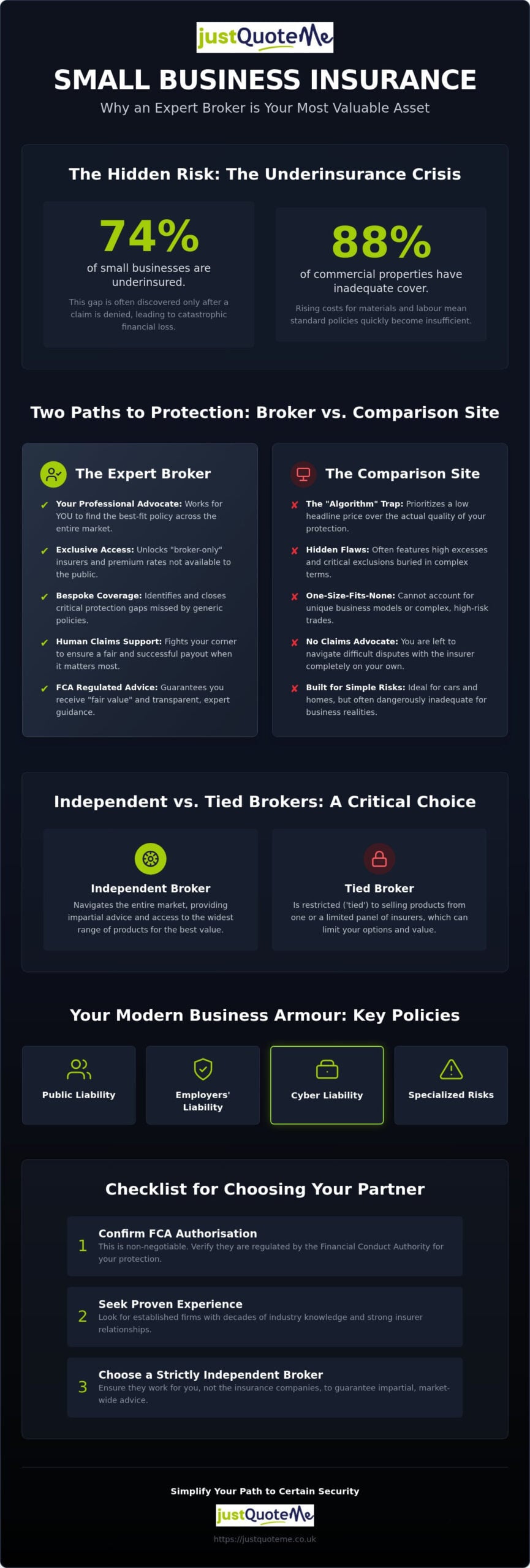
Did you know that 74% of small business owners were found to be underinsured in 2025, often only discovering the gap when a claim was declined? It’s a sobering reality, especially as rising costs for materials and labour continue to shift the goalposts for adequate protection. You’ve likely felt the frustration of navigating confusing jargon and rising 2026 premiums, only to worry that hidden exclusions might leave you vulnerable. Finding a dedicated commercial insurance broker for small business uk shouldn’t feel like an endless administrative burden that takes you away from your daily operations.
We understand that you need comprehensive cover that actually pays out when it matters most. This 2026 guide explains how an independent broker secures better protection and more competitive premiums than automated comparison sites. You’ll learn how to navigate the latest FCA Consumer Duty outcomes and new Cyber Essentials requirements with total confidence. We’ll preview the essential policies your business needs to stay resilient, from public liability to specialized cyber risks, and show you how a single point of contact can manage your entire portfolio. It’s time to Just Quote Me and simplify your path to certain security.
Key Takeaways
- Understand why an independent broker acts as your professional advocate, accessing exclusive insurer panels that are often unavailable through standard comparison sites.
- Discover how a commercial insurance broker for small business uk helps you avoid the trap of low headline prices that hide high excesses and critical policy exclusions.
- Identify the essential 2026 cover requirements for your sector, including why Cyber Liability is now as vital as Public and Employers’ Liability insurance.
- Learn the vital verification steps for choosing a reliable partner, such as confirming FCA authorisation and seeking out firms with decades of industry experience.
- Master the streamlined information-gathering process needed to secure a bespoke risk assessment and a quote that balances comprehensive protection with competitive pricing.
What Does a Commercial Insurance Broker for Small Business UK Actually Do?
A What is an Insurance Broker? is essentially a risk architect who acts as your professional advocate in a complex marketplace. Unlike an agent who represents a specific insurance company, a commercial insurance broker for small business uk works directly for you. Their primary responsibility is to understand your specific operational risks and match them with the right coverage from a broad panel of insurers. In 2026, this role is more critical than ever. Brokers are now heavily regulated by the FCA to ensure they provide “fair value” and transparent advice, moving away from the transactional nature of automated systems.
Brokers provide access to “broker-only” rates and insurers that don’t deal with the general public. This is vital because a standard off-the-shelf policy often misses industry-specific liabilities. For instance, if you run a construction firm, you need tradesman insurance that covers your specific tools and site risks, rather than a generic business plan. A broker identifies these gaps before they become costly claim denials.
The Difference Between Independent and Tied Brokers
Choosing an independent broker gives you the benefit of impartial advice and a wider range of pricing options. Tied brokers are restricted; they can only sell products from one or a few insurance companies, which often limits your protection and increases your costs. Just Quote Me remains strictly independent, drawing on 30+ years of experience to scan the entire market for you. This ensures you aren’t forced into a “one size fits all” policy that lacks the nuance your business requires.
Administrative Peace of Mind
Beyond the initial purchase, your broker manages the heavy lifting of insurance administration. This includes handling mid-term adjustments (MTAs) when your business grows and managing the annual renewal process so you never drift into overpaying. Managing your portfolio through a commercial insurance broker for small business uk means you don’t have to spend hours on hold with call centres. Most importantly, they provide human-led support during the claims process. When things go wrong, having an expert who knows the nuances of employers liability insurance or public liability insurance can be the difference between a successful payout and a significant financial loss.
Get Your Free Business Insurance Quote now
Request a Call back for free Expert advice
Broker vs. Comparison Site: Why Small Businesses Need Expert Advice
While price comparison websites offer speed and consumer rewards, they are fundamentally designed for simple, high-volume products like home or travel cover. For a UK SME, relying on an algorithm often leads to the “Simples” trap. This occurs when a platform presents a low headline premium by stripping out essential protections or quietly inflating the policy excess. A commercial insurance broker for small business uk provides the technical scrutiny these sites lack, ensuring you don’t find out your policy is hollow only after a disaster occurs.
Algorithms cannot account for unique business models or high-risk trades. If your operations involve complex manual work or specialized advice, a generic policy from a comparison site may contain hidden exclusions that invalidate your cover. Brokers act as human advocates. If an insurer disputes a claim, your broker fights your corner using their industry leverage and technical knowledge. This level of service is governed by FCA rules for insurance brokers, which mandate that professionals act in your best interest to deliver fair value.
When an Algorithm Isn’t Enough
Complex risk profiles in sectors like construction, the motor trade, or hospitality require a level of nuance that a drop-down menu cannot provide. Without expert guidance, many businesses fall into the trap of under-insurance. Under-insurance is a primary cause of claim rejection. A 2025 report found that 88% of UK commercial sites were underinsured on building values, largely due to rising material costs that off-the-shelf policies failed to track. You can speak with a human advisor to ensure your limits reflect current market realities rather than outdated estimates.
The Myth of the “Middleman Fee”
Many business owners worry that using a broker adds an unnecessary layer of cost. In reality, brokers often secure lower premiums than comparison sites by accessing exclusive, “broker-only” rates from a network of top UK insurers. These insurers prefer working through brokers because the risk is accurately assessed and presented professionally. This results in better pricing and more transparent policy administration fees. The long-term ROI is found in the peace of mind that comes from a policy that actually pays out, rather than a cheap certificate that offers no real protection. If you are specifically evaluating property risks, you can explore Insurance Brokerage and Lead Generation to see how targeted comparison tools can identify the most robust landlord cover available.
Get Your Free Business Insurance Quote now
Request a Call back for free Expert advice
Essential Small Business Covers Your Broker Should Navigate
Building a robust insurance portfolio requires more than just picking a few policies from a list. A professional commercial insurance broker for small business uk views your cover as a cohesive shield rather than a collection of separate certificates. While some protections are optional, others are mandated by UK law; missing these can lead to severe fines or business closure. Your broker ensures that every statutory requirement is met while tailoring optional covers to your specific sector nuances. To see how an expert can help secure your premises, you can discover WS Insurance Brokers and their dedicated property cover options.
For most businesses, the core trio starts with Public Liability Insurance. This is essential if your work involves contact with clients or members of the public, protecting you against claims for accidental injury or property damage. If your business provides advice, designs, or professional services, Professional Indemnity Insurance is equally vital. It covers the legal costs and compensation if a client suffers a financial loss due to your professional negligence.
The most critical statutory requirement is Employers’ Liability Insurance. If you have even one employee, this is a legal mandate in the UK. Research from 2026 indicates that 39% of businesses with one to nine employees still lack this required cover, leaving them open to daily fines from the Health and Safety Executive (HSE). A broker verifies your headcount and contract types to ensure you remain fully compliant.
Protecting Assets and Data
Physical assets require a steady hand to manage, especially with inflation affecting rebuild costs. Commercial Property Insurance secures your premises, while specialized Van and Tools Insurance protects the mobile equipment tradespeople rely on daily. However, the risk landscape in 2026 has shifted significantly toward digital threats. Updates to the Cyber Essentials scheme in April 2026 now require multi-factor authentication (MFA) and strict 14-day patching protocols to maintain security standards.
Adopting Cyber Insurance is no longer optional for digital-first SMEs. With the average cost of an SME cyber claim reaching £40,000 in 2025, a breach can be terminal for a small firm. Your broker helps you navigate these modern threats, ensuring your policy aligns with the latest Cyber Security and Resilience Bill requirements. This comprehensive approach ensures that whether the threat is a burst pipe or a ransomware attack, your business is prepared to recover quickly.
Get Your Free Business Insurance Quote now
Request a Call back for free Expert advice
How to Choose the Right Commercial Insurance Broker in 2026
Selecting the right partner is about more than just a quick transaction. The first step in any verification process is checking for FCA authorisation. This baseline ensures the firm adheres to strict standards of conduct and professional financial security. Beyond basic compliance, look for longevity. A commercial insurance broker for small business uk with 30+ years of experience, like Just Quote Me, has navigated multiple market cycles and understands how to protect clients during periods of economic volatility.
Industry-specific knowledge is also non-negotiable. A broker who understands the nuances of restaurant insurance or the complexities of contractors all risk insurance will provide far better protection than a generalist. This specialized insight prevents you from paying for irrelevant clauses while ensuring your actual daily risks are fully covered.
Questions to Ask Your Potential Broker
Before committing, ask which insurers are on their panel. A broad network of top UK insurers usually results in more competitive pricing. You should also confirm if they have specific experience acting as a commercial insurance broker for small business uk in your niche. Most importantly, ask how they assist during a claim. You need a partner who manages the administrative burden and advocates for you, rather than simply passing you to an insurer’s automated hotline.
The Value of Local Knowledge
While national brands offer scale, they often lack regional context. Staffordshire and West Midlands businesses benefit significantly from a local Commercial Insurance Broker. Regional experts understand local property values and specific area risk factors that influence your premiums. A local phone call or a face-to-face meeting provides a level of clarity that distant call centres cannot match. This human-centric approach ensures your policy is rooted in the reality of your local market.
Choosing the right advisor removes the complex administrative burdens from your shoulders, allowing you to focus on growth. If you’re ready to move away from impersonal automated systems and secure professional, expert-led protection, you can start your journey with Just Quote Me today.
Get Your Free Business Insurance Quote now
Request a Call back for free Expert advice
Securing Your Bespoke Small Business Insurance Quote
The process of securing protection shouldn’t be a source of stress. When you partner with an established commercial insurance broker for small business uk, the transition from identifying risks to active coverage is handled with professional efficiency. Just Quote Me has refined this process over 30 years, removing the friction often associated with traditional insurance procurement. We act as a steady hand, managing the administrative weight so you can return to your core business activities without delay.
To ensure your risk assessment is accurate, gather a few key details before starting. This preparation allows us to scan our panel of top UK insurers for the most competitive rates. You’ll need your projected annual turnover, current employee headcount, and details of any previous claims history. If your business operates in a specialized sector like construction or hospitality, specific details about your equipment or premises will help us tailor your liability limits with precision. This level of detail ensures your policy is a perfect fit for your actual operations.
Getting Your Free Quote Today
Our online quote tool is designed for speed without sacrificing depth. It provides a rapid starting point for your business insurance needs. Unlike standard comparison sites that leave you with an automated result, a commercial insurance broker for small business uk like Just Quote Me ensures a human expert reviews your details before any policy is finalized. This step is vital for catching potential exclusions that an algorithm might miss. You can Get Your Free Business Insurance Quote now to begin the process immediately.
Requesting Expert Advice
Online forms aren’t always enough to capture the nuances of a complex operation. If you manage a large fleet, a multi-site property portfolio, or high-risk trade activities, a direct conversation is often more efficient. During a free expert consultation, we’ll discuss your specific sector challenges and identify gaps in your current protection. This human-centric approach is what differentiates us from impersonal digital platforms. If you prefer a tailored discussion over a digital form, you can Request a Call back for free Expert advice. Our Staffordshire-based team will guide you through the 2026 insurance market with clarity and professional restraint.
Get Your Free Business Insurance Quote now
Request a Call back for free Expert advice
Future-Proofing Your Business with Expert Guidance
Choosing a commercial insurance broker for small business uk is the most effective way to move beyond the limitations of generic comparison sites. By opting for independent advice, you ensure your policy is built on a foundation of 30+ years of industry experience rather than a basic algorithm. You’ve seen how expert navigation can prevent under-insurance penalties and ensure you meet every statutory requirement for 2026. It’s about building a shield that actually holds up when challenged.
As an FCA Authorised and Regulated firm, we provide the reassurance that your protection is handled with professional integrity and transparency. We bridge the gap between complex insurer panels and your daily operational needs, offering a single point of contact for everything from mid-term adjustments to claims advocacy. This human-centric approach ensures your business remains resilient against both traditional liabilities and modern digital threats. You don’t have to manage these administrative burdens alone.
Take the next step toward certain security by choosing to Just Quote Me today. We’re ready to help you thrive in an evolving market with confidence and clarity.
Get Your Free Business Insurance Quote now
Request a Call back for free Expert advice
Frequently Asked Questions
Is it cheaper to go through an insurance broker for small business?
Yes, it often is. Brokers access “broker-only” rates and exclusive insurer panels that aren’t available on public comparison sites. By accurately assessing your risk, a broker prevents you from paying for unnecessary clauses or falling into the trap of high excesses that hide behind low headline premiums. This expert navigation ensures you receive the best possible value and comprehensive protection for your specific budget.
What is the most important insurance for a small business in the UK?
Employers’ Liability is the most critical because it’s a legal mandate for any business with staff. However, the “core trio” also includes Public Liability and Professional Indemnity. In 2026, Cyber Liability has also become essential. Since the average cost of an SME cyber claim reached £40,000 in 2025, having a policy that covers digital breaches is now as vital as protecting your physical premises.
Do I legally need insurance for my UK small business?
If you have even one employee, you are legally required to have Employers’ Liability insurance. Failure to hold this cover can result in significant daily fines from the Health and Safety Executive. While other policies like Public Liability or Professional Indemnity aren’t always statutory requirements, they are often contractually necessary to work with certain clients or to protect your business from terminal financial losses during a claim.
How much does a commercial insurance broker charge?
Brokers primarily earn revenue through commissions paid by insurance underwriters upon the successful placement or renewal of a policy. At Just Quote Me, we also apply transparent policy administration and arrangement fees. These charges cover the professional documentation, mid-term adjustments, and specialized risk assessment consultations we provide. This structure ensures you receive expert, human-led advice and ongoing support throughout the entire life of your policy.
Can a broker help me if my insurance claim is rejected?
Yes, an independent broker acts as your professional advocate. If an insurer disputes a claim, your broker uses their technical knowledge and industry leverage to fight your corner. They understand the nuances of policy wording and can identify if an insurer has incorrectly applied an exclusion. This human-led support is a significant advantage over automated systems, which offer no assistance once a policy is sold.
How often should I review my small business insurance with a broker?
You should review your cover at least annually during the renewal process. However, a commercial insurance broker for small business uk recommends an immediate review if your turnover, headcount, or business activities change. With inflation affecting rebuild costs and material prices, regular reviews prevent the risk of under-insurance. Staying in close contact ensures your protection always reflects the current reality of your operational risks.
What is the difference between a broker and an insurance company?
An insurance company is the underwriter that provides the financial payout for a claim. A broker, like Just Quote Me, is an independent expert who represents you. We don’t provide direct underwriting; instead, we scan a broad network of top UK insurers to find the best match for your needs. This independence allows us to provide impartial advice and more competitive pricing than a single insurance company.
How do I check if an insurance broker is FCA authorised?
You can verify any professional by searching the Financial Services Register on the official FCA website. Every legitimate commercial insurance broker for small business uk must be listed there to operate legally. Authorisation confirms that the firm adheres to strict conduct rules regarding fair value and honest advice. Just Quote Me is a fully FCA-authorised firm, providing you with the security of 30+ years of regulated expertise.
Get Your Free Business Insurance Quote now
Request a Call back for free Expert advice
Article by
Just Quote Me
JustQuoteMe Ltd is an independent UK insurance brokerage specialising in business and personal insurance solutions. With over 35 years of industry experience, the company provides tailored insurance cover for businesses, landlords, tradespeople, hospitality venues, fleets, and individuals across the UK. Known for its personal service, expert advice, and competitive premiums, JustQuoteMe Ltd works with leading insurers to deliver bespoke policies designed around each client’s unique needs. The company is authorised and regulated by the Financial Conduct Authority (FCA No. 586607) and has built a reputation for trusted, straightforward insurance guidance and long-term client relationships.

by jqm | Sep 12, 2026 | Insurance
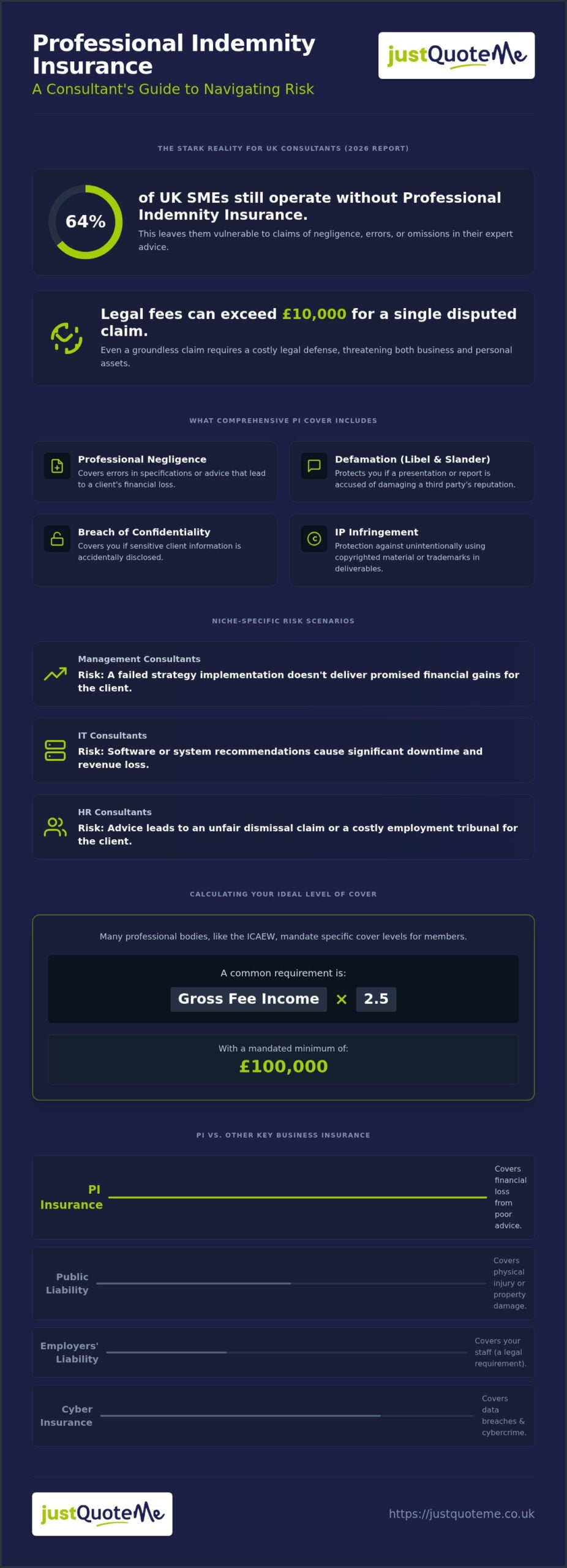
A 2026 report from the Association of British Insurers reveals that 64% of UK SMEs still operate without professional indemnity insurance. For a consultant, your expertise is your most valuable asset, yet a single piece of disputed advice can lead to legal fees exceeding £10,000. We understand the pressure of staring at a new contract that demands specific indemnity levels you aren’t sure you have. It’s common to feel caught between the fear of a costly court battle and the confusion of determining exactly how much cover is “enough” for your specific niche.
This guide will help you secure the right professional indemnity insurance for consultants, ensuring you meet every contractual obligation while protecting your personal assets. We’ll break down the latest 2026 market trends, from the importance of “claims-made” wording to the necessity of run-off cover. You will discover how to navigate the current soft market to find tailored protection that doesn’t slow your business down. By the end of this article, you’ll have a clear roadmap to achieving full compliance and total peace of mind. To simplify your search, Just Quote Me.
Key Takeaways
- Understand how professional indemnity insurance for consultants protects your practice against claims of negligence, errors, or omissions in your expert advice.
- Identify the specific risks included in comprehensive policies, such as defamation and professional mistakes, to ensure no gaps in your defensive strategy.
- Determine the correct level of indemnity by assessing your maximum potential liability and aligning with standard UK contractual requirements.
- Discover the advantages of using an independent, FCA-authorised broker to access bespoke cover from a broad network of top UK insurers.
- Learn how to simplify the administrative burden of insurance by using a human-centric approach that prioritises speed and reliability.
Understanding Professional Indemnity Insurance for UK Consultants
Professional indemnity insurance for consultants is a specialized form of Professional liability insurance designed to protect your business if a client claims your advice or services caused them financial loss. Unlike a manufacturer who risks physical product defects, your primary exposure lies in the intellectual delivery of your expertise. If a client alleges negligence, error, or omission in your reports or strategies, you face significant legal and financial repercussions. This cover acts as a financial safety net, managing the costs of legal defense and any settlements awarded against you.
The 2026 UK market has shifted significantly. Clients are more risk-aware than ever; almost every corporate contract now includes professional indemnity as a non-negotiable prerequisite. Consultants are uniquely exposed because their “product” is intangible. If a strategy fails to deliver expected ROI or a specification leads to a project delay, the client looks for someone to blame. This differs from product-based businesses where physical failures are often easier to define and quantify. You often cannot even step through the door of a new project without proving you have adequate cover in place.
Why Consultants Cannot Afford to Ignore PI Cover
Even if a claim is entirely groundless, the cost of a legal defense can be crippling. Research indicates that legal fees for defending a professional indemnity claim often exceed £10,000. To help manage these risks through expert commercial legal advice, you can visit MAR Legal. As a consultant, you hold a “duty of care” toward your clients. If they believe you failed that duty, they have a legal right to seek compensation. Many professional bodies, such as the ICAEW, mandate specific levels of cover for their members. They require coverage equal to 2.5 times gross fee income, with a minimum of £100,000. This isn’t just about protecting your bank account; it’s about maintaining your professional standing and license to operate.
It is vital to distinguish PI from other common protections. While Public Liability Insurance covers physical injury or property damage, it does not cover financial losses resulting from poor advice. Similarly, Employers Liability Insurance is a legal requirement if you have staff, but it protects them, not your professional work. For digital advisors, Cyber Liability Insurance acts as a necessary partner to PI, covering data breaches that your indemnity policy might exclude. When searching for professional indemnity insurance for consultants, remember that bespoke packages provide better value than generic, standalone policies. To ensure your coverage is seamless and your administrative burden is minimal, Just Quote Me.
What Does Consultant Professional Indemnity Insurance Actually Cover?
Consultant professional indemnity insurance isn’t just about paying legal fees. It’s a comprehensive shield against the specific risks inherent in providing expert advice. Most policies center on professional negligence, which covers errors in specifications or advice that lead to a client’s financial loss. However, modern policies for professional indemnity insurance for consultants extend much further. They include protection against defamation, covering you if a presentation or report is accused of libel or slander. Breach of confidentiality is another critical component, protecting you if sensitive client data is accidentally disclosed. Finally, intellectual property infringement cover ensures you aren’t left vulnerable if you unintentionally use copyrighted material or trademarks in your deliverables.
Niche-Specific Risk Scenarios
Different consulting fields face unique threats that generic policies might miss. For management consultants, a claim might arise from a failed strategy implementation that doesn’t deliver the promised financial gains. IT consultants often face liability if their software recommendations cause significant system downtime, leading to lost revenue for their clients. HR consultants carry risks related to advice that leads to unfair dismissal claims or employment tribunals. Understanding these nuances is why we recommend a professional indemnity insurance policy tailored to your specific sector rather than a one-size-fits-all solution.
Standard Exclusions to Watch Out For
While the cover is broad, it isn’t infinite. Policies won’t cover deliberate acts of dishonesty, fraud, or criminal behavior. You also cannot claim for circumstances you were already aware of before the policy started. It’s vital to understand the “claims-made” nature of these policies. This means the policy active at the time the claim is filed is the one that responds, not the policy you had when the work was originally performed. This is why continuous cover is so important. Professional bodies, such as the Chartered Institute of Taxation (CIOT) requirements, emphasize this continuity to ensure members remain compliant with their standards even after a project ends. If you’re unsure if your current policy covers these specific gaps, you can speak with a specialist to review your unique risks and find a more robust solution.
Calculating Your Risk: How Much PI Cover Does a Consultant Need?
Choosing the right level of professional indemnity insurance for consultants requires a pragmatic assessment of your worst-case scenario. It isn’t just about the fees you charge; it’s about the financial damage your advice could potentially cause. If you’re advising a small business, a mistake might cost a few thousand pounds. However, if you’re consulting for a multinational corporation, that same error could lead to millions in lost revenue or project delays. You must evaluate the scale of your clients and the complexity of the projects you handle to determine a safe limit.
Contractual obligations often dictate your starting point. In the current 2026 UK market, it’s standard for corporate clients to mandate a minimum indemnity limit of £1 million, with many larger contracts pushing this requirement to £5 million or more. This is a common requirement when securing high-level IT and accountancy placements through specialist agencies like HT Recruit Ltd, where the financial stakes of a project are significant. Signing a contract without the corresponding insurance level can leave you in breach of your agreement before you’ve even started work. Beyond the potential compensation, you have to factor in the legal costs of defending a claim in the UK court system. With legal fees for even groundless claims frequently exceeding £10,000, your cover needs to be robust enough to handle high-end solicitor fees alongside any eventual settlement.
Factors That Influence Your Premium
Your industry sector plays a significant role in determining your premium. High-risk fields like structural engineering or financial services naturally attract higher rates than general administrative consulting. Your annual turnover is another key metric; insurers view higher revenue as an indicator of higher risk exposure. Finally, your claims history is scrutinized. A clean record helps you secure more competitive 2026 rates, while previous incidents can lead to higher premiums or more restrictive terms.
The “Any One Claim” vs. “Aggregate” Limit Debate
Understanding how your limit applies is just as important as the amount itself. Any One Claim cover is the maximum the insurer will pay for each individual claim made during the policy period. This is generally the preferred option for consultants because it ensures that if you face multiple separate claims, your pot of insurance doesn’t run dry. In contrast, an “Aggregate” limit is the total amount available for all claims combined during the policy year. If one large claim exhausts an aggregate limit, you’re left unprotected for the remainder of the term. To ensure your policy structure matches your risk profile and provides the best value, professional indemnity insurance should be sourced through a specialist who understands these nuances. Just Quote Me.
Beyond the Premium: Choosing the Right Policy and Broker
Buying professional indemnity insurance for consultants shouldn’t be a transaction with a faceless website. While direct insurers often promote their own platforms, they’re limited to their own products. This approach restricts your choices and might leave you with a policy that doesn’t quite fit your niche. An independent broker acts as your advocate, scanning a broad network of top UK insurers to find the most competitive and comprehensive cover. Dealing with an FCA-authorised firm is non-negotiable; it ensures you’re protected by strict industry regulations and that the advice you receive is both professional and transparent.
Off-the-shelf policies often use generic language that might not align with your specific “scope of works.” If your consultancy involves specialized advice, you need a bespoke policy that mirrors your actual daily risks. The real value of your insurance appears when you need to make a claim. Accessing an award-winning claims service means you have a steady hand to guide you through complex legal disputes. This support is vital for maintaining your business reputation while the administrative burden of a claim is managed on your behalf. To find a policy that truly protects your practice, Just Quote Me.
The Local Broker Advantage in Staffordshire and the West Midlands
Regional expertise provides a level of service that automated systems can’t match. For consultants in Staffordshire and the West Midlands, working with a broker who understands the local business landscape is a distinct advantage. You have the accessibility of being able to visit an office in Stone or Stafford to discuss your requirements face-to-face. This human-centric approach builds trust and ensures your insurance partner understands the specific challenges of operating within our region.
How to Compare Professional Indemnity Quotes Effectively
When comparing quotes, it’s essential to look beyond the premium. Check the excess levels carefully; a lower price might hide a prohibitively high excess that you’d have to pay in the event of a claim. Evaluate the reputation and financial strength of the underlying underwriter to ensure they’re reliable. You should also check for “Run-off” cover options. Because PI is a claims-made policy, you’ll need this protection for several years after you retire or close your business to cover any late-surfacing claims. If you’re ready to see how a bespoke approach can benefit your practice, you can get a professional indemnity insurance quote that addresses your unique needs today.
Securing Your Practice with Just Quote Me: Expert Advice for Consultants
Just Quote Me has spent over 30 years helping advisors navigate the complexities of the UK insurance market. As an independent, FCA-authorised broker based in Stone, Staffordshire, we provide a human-centric alternative to faceless automated systems. We understand that your expertise is your business. That’s why we access a broad network of top UK insurers to source professional indemnity insurance for consultants that actually reflects your daily operations. We don’t just sell policies; we provide a steady hand to manage your administrative burdens. This allows you to focus on your clients while we handle the technical details of your professional indemnity insurance.
Our process is designed for maximum efficiency. We do the heavy lifting of comparing the market, ensuring you get bespoke cover without the stress of manual searching. In 2026, speed is essential for satisfying client contracts. We provide proof of insurance quickly, helping you clear compliance hurdles and start work on new projects without delay. By speaking directly to a human expert at our Stone headquarters, you get the benefit of regional expertise and professional restraint that larger, impersonal firms can’t offer. We pride ourselves on being accessible, meaning you can reach a specialist who knows the West Midlands business landscape inside out.
How to Get Your Quote Today
- Step 1: Gather your business details, including your projected annual turnover and any specific indemnity limits required by your current contracts.
- Step 2: Visit our online portal for a fast, free quote that matches your sector-specific risks.
- Step 3: Consult with our experts if you have unique or high-risk requirements that need a more tailored approach than a standard policy offers.
Ready to Protect Your Consulting Business?
Securing your practice with the right professional indemnity insurance for consultants provides more than just a certificate; it gives you the peace of mind that your personal assets and professional reputation are protected. We remain committed to providing straightforward, pragmatic advice that simplifies the insurance process. Whether you’re a management consultant in Stafford or an IT advisor in the West Midlands, we’re here to ensure your practice is resilient against claims of negligence or error. Our focus on individualized service and specialist knowledge ensures you’re never just another number in our system.
Get Your Free Business Insurance Quote now
Request a Call back for free Expert advice
Secure the Future of Your Consulting Practice
Your expertise drives your business; don’t let a single disputed piece of advice put your assets at risk. This guide has shown that the 2026 UK market demands more than just basic compliance. You need a policy that accounts for the nuances of your specific niche and the “claims-made” nature of the industry. Choosing the right professional indemnity insurance for consultants is about finding a partner who understands your duty of care. With over 30 years of industry experience, Just Quote Me provides the human-centric expertise you need to navigate this complex market.
As an FCA-authorised independent broker, we access a broad network of top UK insurers to find bespoke solutions that direct platforms simply can’t offer. We handle the administrative burden so you can focus on delivering value to your clients. Whether you’re satisfying a new contract or reviewing existing cover, our team is ready to help. Protecting your livelihood is straightforward when you have a steady hand to guide you. For professional advice tailored to your practice, Just Quote Me.
Get Your Free Business Insurance Quote now
Request a Call back for free Expert advice
Frequently Asked Questions
Is professional indemnity insurance a legal requirement for consultants in the UK?
It isn’t a universal legal mandate for all consultants, but it’s a regulatory requirement for specific professions such as solicitors, architects, and accountants. For most other advisors, it’s a practical and contractual necessity. Most corporate clients in 2026 won’t allow you to begin work without proof of cover. Even if not required by law, it’s the only way to protect yourself from the costs of negligence claims.
What is the difference between professional indemnity and public liability insurance?
Professional indemnity covers financial losses caused by your expert advice, whereas public liability protects against physical injury or property damage. If you provide a strategy that leads to a client’s financial loss, your indemnity policy responds. If a client trips over your equipment during a meeting, public liability applies. Most consultants need both to ensure they’re fully protected against the different risks they face during their daily operations.
How much does professional indemnity insurance for consultants cost?
The cost of professional indemnity insurance for consultants depends on several factors, including your industry sector, annual turnover, and the level of cover required. High-risk fields like financial services or engineering usually attract higher premiums than general administrative consulting. Your claims history and the complexity of your contracts also play a role. To get an accurate price for your specific practice, it’s best to request a bespoke quote from a specialist broker.
What is “claims-made” insurance and why does it matter for my policy?
Claims-made means the policy in force at the time a claim is reported is the one that handles the case, regardless of when the work was done. This is vital for consultants because a client might not discover a mistake in your advice until years later. You must maintain continuous cover to ensure you’re protected. If you cancel your policy or have a gap in cover, you lose protection for all your previous projects.
Do I need professional indemnity insurance if I am a sole trader?
Yes, sole traders definitely need professional indemnity insurance for consultants because there’s no legal separation between your business and personal assets. If a client sues you for a professional error, your personal savings and property could be at risk to cover legal fees and settlements. A robust policy ensures that the insurer manages these costs, protecting your livelihood and your personal financial stability from the impact of a claim.
What happens if I retire? Do I still need insurance for past consulting work?
You should maintain “run-off” cover for at least six years after you retire or stop trading. Since professional indemnity is a claims-made policy, you need an active policy to handle any claims that arise from work you did in the past. UK law allows clients to bring negligence claims long after a project has finished. Run-off cover provides peace of mind that your historical liabilities remain protected throughout your retirement.
Can I get professional indemnity insurance for a single project?
While it’s possible to find cover for a specific assignment, an annual policy is usually more cost-effective and provides more consistent protection. Single project insurance can be more difficult to arrange and often carries higher relative costs. Most consultants find that an annual policy, which can be updated as their client list grows, offers better value and ensures they aren’t left with dangerous gaps in their coverage between different project start dates.
Will my PI insurance cover me for work I do for international clients?
Most UK policies provide worldwide cover, but there are often specific exclusions or higher premiums for work involving the USA or Canada. You must check the “territorial limits” and “jurisdiction” clauses in your policy documents. Always disclose the location of your clients to your broker during the quote process. This ensures your policy is tailored to cover the specific legal systems and regions where your advice is being delivered.
Article by
Just Quote Me
JustQuoteMe Ltd is an independent UK insurance brokerage specialising in business and personal insurance solutions. With over 35 years of industry experience, the company provides tailored insurance cover for businesses, landlords, tradespeople, hospitality venues, fleets, and individuals across the UK. Known for its personal service, expert advice, and competitive premiums, JustQuoteMe Ltd works with leading insurers to deliver bespoke policies designed around each client’s unique needs. The company is authorised and regulated by the Financial Conduct Authority (FCA No. 586607) and has built a reputation for trusted, straightforward insurance guidance and long-term client relationships.

by jqm | Sep 11, 2026 | Insurance
In the first quarter of 2026 alone, UK pubs closed at a rate of nearly two per day, leaving many venue owners questioning how to balance rising operational costs with essential protection. You’re likely feeling the pressure of building cost inflation, which grew by 3.8% this year, alongside the administrative headache of new regulations like Martyn’s Law. It’s frustrating when premiums climb while your net profit margin on a pint remains as thin as 2.4%. Finding the right Pub and Bar Insurance shouldn’t feel like another drain on your resources.
We understand that managing these risks feels like a full-time job you didn’t sign up for. This guide shows you how to secure bespoke cover that protects your livelihood without overstretching your budget. You’ll learn exactly which covers are mandatory to stay legal, how to manage complex liability claims involving intoxicated guests, and how expert support can strip away the administrative burden of renewals. Whether you manage a community hub in Stafford or a high-volume city centre bar, we provide a pragmatic approach to securing your venue. We’ll move from the basics of public liability to the specifics of loss of licence, ensuring you have the clarity needed to make informed choices for your business.
Key Takeaways
- Understand the non-negotiable legal requirements for UK hospitality venues, including the mandatory £5 million Employers’ Liability minimum.
- Discover how to secure bespoke Pub and Bar Insurance that addresses unique risks like thatched roofs or city-centre nightclub requirements.
- Learn practical strategies to lower your annual premiums through robust risk assessments and proactive staff training protocols.
- Navigate complex liability claims involving guest injuries and intoxicated patrons with specific coverage designed for the hospitality sector.
- Find out why an independent broker with 30 years of experience provides better protection than automated systems for high-risk venues.
Why Pub and Bar Insurance is Essential in 2026
Pub and Bar Insurance is a specialised multi-risk policy designed to protect licensed premises from the specific dangers of the hospitality industry. It combines several layers of protection into one manageable package. In the current economic climate, where the average net profit on a pint is just 2.4%, a single legal claim can be devastating. This coverage isn’t just a safety net; it’s a legal requirement for many. For example, the Employers’ Liability (Compulsory Insurance) Act 1969 mandates that any venue with staff must hold at least £5 million in cover. Most insurers provide £10 million as a standard to ensure you’re fully protected against workplace injury claims. Pub and bar insurance serves as the financial foundation of a safe hospitality business, ensuring a single incident doesn’t lead to permanent closure. To further strengthen your business’s financial resilience, you might also consider upgrading your transaction infrastructure with a provider like Dojo.
The Core Risks of the Licensed Trade
Operating a bar involves managing a unique cocktail of risks that standard commercial policies often fail to address. High volumes of footfall combined with alcohol consumption increase the likelihood of accidental injury and property damage. Whether it’s a spill on a dance floor or a late-night altercation, your venue needs protection that understands these specific dynamics. To better understand the basics of third-party claims, you might ask What is Liability Insurance? and how it applies to your specific floor plan. Beyond physical injuries, property damage can halt your operations and tarnish your brand reputation. A bespoke policy ensures that if your cellar floods or your bar is damaged, you have the support to reopen quickly.
The Risk of Under-Insurance
Under-insurance is a growing threat in 2026 due to significant building cost inflation, which reached 3.8% earlier this year. If your property is insured for older values, you’re likely exposed. Inadequate cover can lead to financial ruin if a major public liability insurance claim exceeds your policy limits. Failing to maintain accurate cover levels can also lead to complications with the FCA, as you’re required to manage your risks responsibly. Regular policy reviews are essential to ensure your limits match current reconstruction costs and guest expectations. Without this diligence, you risk losing everything you’ve built to a single unpredicted event. Ensuring you have robust employers’ liability is equally critical for maintaining a compliant and safe working environment for your team.
Essential Coverage: Protecting Your Staff, Guests, and Property
Securing the right Pub and Bar Insurance means looking beyond the front door to every corner of your operation. Your venue’s success relies on the safety of its environment and the reliability of its equipment. A comprehensive policy acts as a shield, ensuring that an accidental spill or a broken oven doesn’t derail your business. It’s about more than just meeting basic legal requirements; it’s about building a resilient business that can survive the unexpected. If you’re unsure which limits are right for your specific floor plan, speaking with an independent broker can clarify your requirements.
Liability Protection for Hospitality
Public liability is often the most critical component of your policy. It protects your business if a guest is injured or their property is damaged while on your premises. While not a legal requirement by statute, most licensing authorities and landlords insist on it. You can find more details on how this works via our public liability insurance page. For your team, you must comply with UK law on Employers’ Liability Insurance, which mandates a minimum of £5 million in cover. Failure to have a valid policy can lead to fines of up to £2,500 for every day you’re uninsured. We also recommend specialised cover for door staff. Security personnel face unique risks, and standard policies often exclude incidents involving physical intervention or conflict management.
Product liability cover provides a vital defence against claims of food poisoning or allergic reactions, covering legal fees and compensation if a guest falls ill after consuming food or drink served on your premises. With the strict requirements of Natasha’s Law regarding allergen labelling, this protection is non-negotiable for any venue serving food or pre-packaged snacks. It ensures that a simple kitchen error doesn’t lead to a bankrupting legal battle. You can manage these complex requirements through our tailored employers’ liability and product liability solutions.
Asset and Revenue Protection
Your physical assets are the lifeblood of your venue. From high-value commercial ovens to expensive sound systems and lighting rigs, the cost of replacement is rising. Our commercial property insurance options ensure your building and its contents are protected against fire, flood, and theft. Building cost inflation is a significant factor in 2026, so your sums insured must reflect current market rates rather than historical purchase prices.
Stock cover is another essential element. A cellar full of craft beer and a back bar stocked with premium spirits represent a significant investment. A bespoke policy protects this inventory against spoilage if your refrigeration fails or loss due to a break-in. By protecting your assets and your revenue stream, you ensure your bar remains a staple of the local community for years to come.
Tailored Policies: From Boutique Bars to Historic Thatched Pubs
Every venue has a unique personality. A modern boutique bar in Newcastle-under-Lyme faces different operational hurdles than a rural village pub. Generic Pub and Bar Insurance often misses these nuances. Whether you’re managing high-volume footfall or maintaining a Grade II listed building, your policy must reflect your specific reality. It’s not just about having cover; it’s about having the right cover for your specific postcode and business model.
Specialist Cover for Unique Venues
Historic properties carry prestige but also significant risk. For owners of traditional buildings, Thatched Pub Insurance is essential due to high fire risks and the specialised materials required for repairs. These venues often require specific chimney sweep certifications and electrical inspections to remain valid. Beyond the structure, you must protect your right to trade. Loss of licence cover provides financial support if your alcohol licence is revoked through no fault of your own. This protection is critical for venues hosting live music or late-night entertainment, where noise complaints or local authority reviews are more common. If your business relies on events, ensure your policy explicitly covers live performances and equipment hire.
Bespoke vs. Off-the-Shelf Policies
Off-the-shelf policies are designed for the average business, but the hospitality sector is rarely average. A generic policy might not account for the Employers’ Liability (Compulsory Insurance) Act 1969 correctly if you use temporary event staff or contractors. It’s vital to tailor your limits to your actual guest capacity and annual turnover rather than relying on industry averages. For modern venues, integrating Cyber Insurance is now a necessity. As you move toward digital booking systems and cloud-based POS terminals, the risk of a data breach or system ransom increases.
If you operate a late-night venue, standard bar cover won’t suffice. You need dedicated Nightclub Insurance to handle the specific liability risks associated with dancing, larger crowds, and security teams. Your location in Staffordshire or the West Midlands also plays a role in your risk profile. Local crime rates, emergency service response times, and historical flood data in areas like Stafford or Stone influence how underwriters view your venue. We use our 30 years of regional expertise to ensure your policy isn’t just a document, but a tailored shield for your specific operation. This human-led approach ensures you don’t pay for covers you don’t need while securing the ones you do.
How to Reduce Your Pub Insurance Premiums in 2026
Managing overheads is a priority for every landlord, especially when the average net profit on a pint is just 2.4%. To help protect these margins, you can explore Payment processing and financial brokerage for more competitive transaction rates. While you can’t control market inflation, you can influence how underwriters perceive your risk profile. Lowering your Pub and Bar Insurance premiums starts with proving that your venue is a lower than average risk. Insurers reward proactive management with more competitive rates. It’s about demonstrating that you have a firm grip on your operations, from the cellar to the front door.
Insurance companies look for evidence of robust safety protocols. Implementing strict guest safety measures, such as regular floor checks for spills and maintaining clear exits, reduces the likelihood of public liability insurance claims. Fire is another major concern for underwriters. You should maintain your kitchen extract systems and ductwork according to TR19 standards. Documenting these cleanings and your regular fire alarm tests creates a paper trail of safety that a broker can use to negotiate better terms. When you train your staff on allergen awareness and conflict resolution, you aren’t just improving service; you’re actively lowering your liability risk. Keep these training records updated and accessible for your annual review.
The Value of Local Broker Advice
Using automated comparison sites often leads to generic quotes that don’t account for your specific efforts. A bespoke broker like Just Quote Me tells your business story to a wide panel of specialist underwriters. We understand the nuances of the West Midlands and Staffordshire markets, from the busy nightlife in Newcastle-under-Lyme to the historic charm of venues in Stafford and Stone. This regional expertise allows us to find niche providers that national call centres might overlook. We can help you navigate the employers’ liability requirements while ensuring your commercial property insurance reflects current values.
Don’t fall into the trap of renewing the same policy every year without a second look. With building cost inflation rising by 3.8% as of March 2026, your previous sums insured might leave you under insured. We recommend an annual deep dive into your coverage to ensure it matches your current turnover and asset values. If you’re looking for ways to trim costs without sacrificing protection, you can speak with our expert team for a tailored review of your current policy. This hands on approach ensures your protection evolves as fast as the hospitality industry itself.
Why a Bespoke Broker Like Just Quote Me is Your Best Asset
Choosing the right Pub and Bar Insurance shouldn’t feel like a gamble. While automated comparison sites offer speed, they often lack the depth of understanding required for the complex UK hospitality sector. Just Quote Me brings over 30 years of independent brokerage experience to the table, acting as your steady hand in a volatile market. We don’t just sell policies; we build long-term partnerships with venue owners across Staffordshire and the West Midlands. Our human-centric approach ensures you aren’t just another policy number in a database. Instead, you get a dedicated advisor who understands that a village pub in Stone has very different needs than a high-volume bar in Newcastle-under-Lyme.
Our Bespoke Process
We’ve refined our process to be as efficient and frictionless as possible. It begins with a straightforward consultation where we listen to your specific business story. We look at your guest capacity, your entertainment schedule, and your structural risks to build a profile that underwriters can trust. Because we’re an independent broker, we have access to a broad network of top UK underwriters, allowing us to find coverage that generic direct insurers might miss. Just Quote Me to simplify your administration and ensure your policy grows alongside your business. If the worst happens and you need to make a claim, we manage the entire process on your behalf. We act as your advocate, removing the administrative stress so you can focus on running your venue.
Our regional expertise is a core part of our service. Having deep roots in Stafford and the surrounding areas means we understand local market conditions and specific regional risks. This specialized knowledge allows us to secure more competitive pricing without sacrificing the quality of your protection. Whether you’re dealing with the complexities of thatched pub insurance or need robust public liability insurance for a city-centre venue, our team provides the expert support you need to trade with confidence.
Secure Your Venue Today
In 2026, professional brokerage beats automated systems every time. We offer the authority of an industry expert with the accessibility of a local partner. You don’t have to manage the burden of complex insurance jargon alone. Let us handle the technical details while you focus on delivering an exceptional guest experience. We’re ready to help you find a policy that’s as unique as your venue.
Get Your Free Business Insurance Quote now
Request a Call back for free Expert advice
Future-Proof Your Hospitality Venue with Expert Protection
Protecting your venue in 2026 requires a strategic approach to risk. By prioritising proactive safety protocols and ensuring your asset valuations reflect current market realities, you position your business for long-term stability. Bespoke coverage tailored to your specific venue type is the only way to avoid the pitfalls of under-insurance that many generic policies overlook.
As an FCA Authorised Independent Broker with over 30 years of industry experience, we provide the expert local advice you need across Staffordshire. We handle the administrative complexities and advocate for you during claims, so you don’t have to manage these burdens alone. Securing the right Pub and Bar Insurance shouldn’t be a source of stress; it’s a pragmatic investment in your business’s future.
We’re ready to help you navigate this complex market with clarity and confidence. Get your venue protected with Just Quote Me today and focus on what you do best: delivering a great experience for your guests.
Frequently Asked Questions
Is pub insurance a legal requirement in the UK?
Employers’ Liability Insurance is the only legal requirement by statute under the Employers’ Liability (Compulsory Insurance) Act 1969. If you employ anyone, even part-time or temporary staff, you must hold at least £5 million in cover. While Public Liability isn’t a legal requirement by law, most local licensing authorities and landlords won’t allow you to trade without it. It’s a fundamental part of any Pub and Bar Insurance policy to protect your livelihood.
What does loss of licence insurance actually cover?
Loss of licence insurance provides financial protection if your alcohol licence is suspended or revoked through no fault of your own. It covers the resulting reduction in your business’s value and the loss of gross profit while you’re unable to trade. This is particularly important for venues where noise complaints or local authority reviews pose a threat. It doesn’t cover revocations caused by criminal activity, misconduct, or failure to maintain the premises.
How much does pub and bar insurance cost in 2026?
The cost of protection varies based on your venue’s size, location, and annual turnover. Industry data for 2026 suggests a small community pub might pay between £2,000 and £3,000 annually, while larger city-centre venues could face premiums ranging from £5,000 to £15,000 or more. Factors like building cost inflation, which grew by 3.8% this year, also influence premiums. We recommend a bespoke assessment to ensure you aren’t overpaying for unnecessary cover.
Does my policy cover me for business interruption?
Business interruption cover is typically an optional addition to your policy, but it’s highly recommended for the hospitality trade. It compensates you for lost income if you’re forced to close due to an insured event, such as a fire, flood, or significant equipment failure. This ensures you can still meet fixed costs like rent and payroll while your doors are closed. It’s vital to check that your indemnity period is long enough to cover a full recovery.
What is the difference between public and product liability for bars?
Public liability covers injuries to guests or damage to their property that occurs on your premises, such as a slip on a wet floor. Product liability specifically covers claims related to the food and drink you serve. If a customer suffers an allergic reaction or food-borne illness, product liability handles the legal costs and compensation. Both are essential components of Pub and Bar Insurance to ensure your venue is protected from every angle.
Do I need specialist insurance for a thatched pub?
You absolutely need specialist Thatched Pub insurance for historic or thatched properties. Standard insurers often decline these risks due to the high fire danger and the specialised craftsmanship required for repairs. These policies often include specific requirements, such as regular chimney sweeping by a certified professional and electrical inspections every five years. Just Quote Me has over 30 years of experience helping pub owners find underwriters who understand the unique heritage of their building.
Can I get insurance for a nightclub with live music?
You can certainly get cover for nightclubs that feature live music or DJ sets. These venues require Nightclub Insurance because they involve higher risks than a standard pub, such as larger crowds, late-night hours, and the use of security teams. Your policy will need to account for your specific entertainment schedule and any high-value sound or lighting equipment. Just Quote Me specialises in placing these complex risks with underwriters who understand the late-night economy.
Why should I use a broker instead of a comparison site?
Using a broker provides a level of advocacy and expertise that automated comparison sites can’t match. We don’t just find a price; we build a policy that fits your specific venue. Comparison sites often miss crucial hospitality clauses, leaving you under-insured during a claim. As an independent broker, we have access to niche underwriters and provide personal support if you need to make a claim. We manage the administrative burden so you can focus on running your venue.
Article by
Just Quote Me
JustQuoteMe Ltd is an independent UK insurance brokerage specialising in business and personal insurance solutions. With over 35 years of industry experience, the company provides tailored insurance cover for businesses, landlords, tradespeople, hospitality venues, fleets, and individuals across the UK. Known for its personal service, expert advice, and competitive premiums, JustQuoteMe Ltd works with leading insurers to deliver bespoke policies designed around each client’s unique needs. The company is authorised and regulated by the Financial Conduct Authority (FCA No. 586607) and has built a reputation for trusted, straightforward insurance guidance and long-term client relationships.

by jqm | Sep 10, 2026 | Insurance
Could a single visitor’s trip or a resident’s accidental fall jeopardize the future of your entire care facility? Managing a care home in 2026 involves more than just oversight; it’s about balancing rising operational costs with the constant pressure of regulatory scrutiny. You’re likely feeling the strain of increasing insurance premiums and the weight of CQC expectations. Finding the right public liability insurance for care homes is no longer just a box-ticking exercise. It’s a strategic shield for the human interactions that define your care quality.
We understand the anxiety that comes with complex liability claims and the confusion between medical malpractice and general public liability. This guide provides the clarity you need to protect your facility, residents, and reputation within the current 2026 regulatory landscape. You’ll discover how to secure CQC-compliant documentation and learn practical risk management steps that can actually help lower your premiums. We’ll explore the essential coverage levels required today, explain why a tailored approach is the only way to manage the administrative burden, and show you how to navigate a market where claim severity continues to rise.
Key Takeaways
- Understand which third parties are covered, from residents to delivery drivers, to ensure your liability protection is truly comprehensive.
- Distinguish between clinical medical malpractice and general accidents, such as slips in communal areas, to maintain the right coverage for non-medical incidents.
- Assess whether your bed capacity and local authority contracts require a £2 million, £5 million, or £10 million limit for your public liability insurance for care homes.
- Use our 2026 risk management checklist to maintain rigorous health and safety documentation, which helps satisfy CQC inspections and can lower your insurance costs.
- Partner with an independent broker to access specialist care underwriters and bespoke policy wording that automated systems often miss.
What is Public Liability Insurance for Care Homes?
To understand What is Public Liability, you need to view it through the lens of your duty of care. For providers, public liability insurance for care homes covers legal costs and compensation payouts if a third party claims they were injured or their property was damaged because of your business activities. It acts as a financial buffer between your facility’s assets and the high costs of litigation.
In a care setting, a “third party” isn’t just a random member of the public. It includes a wide range of individuals who interact with your home daily, such as:
- Residents (specifically for non-clinical accidents)
- Family members and visitors
- Maintenance contractors and gardeners
- Delivery drivers and medical couriers
Standard business policies often fall short because they don’t account for the specific vulnerabilities of residents. If a resident trips over a loose carpet in a communal lounge, that’s a public liability issue. A generic policy might not understand the heightened risk profile or the specific safety standards required in a residential facility. While this insurance isn’t a strict legal requirement in the same way as motor insurance, it’s a commercial necessity. Most local authorities and commissioning groups won’t award contracts to a home that doesn’t have at least £5 million or £10 million in cover.
Public Liability vs. Employers Liability: The Crucial Difference
It’s easy to confuse these two, but they protect different groups. Public liability focuses on outsiders and residents. Conversely, Employers Liability Insurance is a legal requirement if you have even one staff member. It covers claims made by employees for work-related illnesses or injuries. Together, they create a 360-degree safety net, protecting both the people you serve and those who work for you.
Residential Care vs. Domiciliary Care Requirements
Your insurance needs to align perfectly with your CQC registration category. Residential care homes face fixed-premises risks, like slips in hallways or building safety issues. Domiciliary care providers face different challenges, as staff enter private homes where they don’t control the environment. Ensuring your public liability insurance for care homes matches your specific operational model is vital for avoiding claim denials. If your registration changes, your policy must reflect that immediately.
What Does Care Home Public Liability Actually Cover?
Your policy acts as a financial safeguard for everyday accidents that occur within your facility. Meeting the Regulatory requirements for care home insurance is essential for maintaining your CQC registration, as it proves you have the funds to cover potential liabilities. This protection isn’t just about the residents; it extends to anyone who interacts with your business environment.
The “Medical Malpractice” Boundary
Distinguishing between a general accident and a clinical error is vital for your protection. If a resident falls in the dining room because the floor was wet, that’s a public liability claim. However, if they fall because a staff member used an incorrect lifting technique or failed to follow a specific care plan, it likely falls under Professional Indemnity Insurance or a specialist medical malpractice extension. Falling through the cracks between these policies is a common risk for care managers. If an insurer disputes whether a claim is “clinical” or “public,” you could be left without a payout while they argue. Most providers need both covers to ensure there are no gaps where one policy ends and another begins.
Visitor and Guest Protection
Care homes are communal hubs with constant footfall. Whether you’re hosting a summer garden party, a Christmas event, or a simple open day, your liability risks increase with every guest. Coverage also extends to visiting professionals who aren’t on your payroll, such as entertainers, mobile hairdressers, or private physiotherapists. Managing this 24/7 environment requires a policy that understands the nuances of residential care. If you’re unsure if your current policy covers these specific events or external contractors, it’s a good idea to speak with a specialist broker who can review your terms and provide peace of mind. Ensuring every visitor is accounted for in your risk assessment and insurance policy is a hallmark of a well-run facility.
How Much Public Liability Coverage Does Your Care Home Need?
Determining the appropriate indemnity limit is a critical business decision that affects your long-term stability. In the UK insurance market, most providers choose between £2 million, £5 million, or £10 million in cover. While a smaller facility might consider the lower end of that scale, the reality of 2026 litigation costs means £2 million is often insufficient for the care sector. A single serious injury claim involving long-term care needs can easily exceed several million pounds in compensation and legal fees.
You must consider the “worst-case scenario” when setting your limits. This isn’t just about one visitor slipping on a wet floor. Think about a multi-resident incident, such as a localized fire or a significant structural failure, where several people are injured simultaneously. In these high-stakes situations, a lower limit would be exhausted almost instantly. This would leave your personal or business assets exposed to the remaining balance of the claim. As specialist firms like Scotland Claims Injury Lawyers work to ensure injured parties receive appropriate settlements, most established providers now view £5 million as the absolute baseline for public liability insurance for care homes.
Assessing Your Risk Profile
Your specific risk profile isn’t static; it evolves with your business. It’s built on your bed capacity and the turnover rate of your residents. High turnover means more families, medical professionals, and visitors entering the building daily, which statistically increases the likelihood of a third-party incident. You also need to account for the physical state of your premises. Older buildings may present more hidden hazards compared to modern, purpose-built facilities. Your historical claims data will also influence how insurers view your risk and determine your 2026 premiums.
Contractual Obligations and Tenders
Commercial reality often dictates your coverage more than your own risk assessment. Most NHS frameworks and Local Authority contracts mandate a minimum of £10 million in cover. If you don’t meet these requirements, you’ll be disqualified from lucrative tenders and funding streams. This aligns with the expectations of CQC Regulation 13, which requires providers to maintain adequate financial resources and indemnity arrangements to cover their liabilities.
Securing the right Public Liability Insurance is about more than just current compliance. If you’re planning to expand or bid for new local authority contracts, you need a policy that can scale quickly. An independent broker can help you navigate these framework requirements, ensuring your documentation is ready for the next audit or tender process without you having to manage the administrative burden alone.
Reducing Liability Risk: A 2026 Care Home Checklist
Managing your risk profile is the most effective way to control the cost of public liability insurance for care homes. While your policy provides a financial safety net, active risk management prevents accidents from occurring in the first place. This proactive approach doesn’t just save money on premiums; it protects the very people you care for. You can use the following checklist to ensure your facility meets the high standards expected by both regulators and insurers in 2026. These steps are essential for any provider seeking public liability insurance for care homes at a sustainable rate.
- Maintain rigorous health and safety documentation, including “near-miss” logs that track potential hazards before they cause injury. These logs allow you to identify patterns, such as a specific area where residents often stumble, allowing for physical intervention before a serious fall occurs.
- Conduct regular premises audits focusing on slip-resistant flooring, adequate lighting in corridors, and clear accessibility standards. Lighting is often overlooked, but ensuring communal areas are bright enough for those with visual impairments is a key factor in reducing trip claims.
- Implement staff training that aligns with the 2026 CQC “Quality Statements,” ensuring every team member understands their role in maintaining a safe environment. These statements focus on evidence-based outcomes in resident safety rather than simple tick-box exercises.
- Establish effective visitor management protocols, including clear safety signage and a digital sign-in system to track footfall. High visibility of safety warnings can significantly reduce your liability if a visitor chooses to ignore established protocols.
Documentation as a Defence
The legal principle “if it isn’t written down, it didn’t happen” is the cornerstone of any liability defence. If a visitor claims they slipped on a spill, your ability to produce a timestamped cleaning log or a digital inspection record is vital. Digital record-keeping provides an immutable trail that is difficult to dispute in court. Data doesn’t lie. Robust audit trails serve as the definitive evidence required by 2026 insurers to validate your adherence to safety protocols.
CQC Alignment and Insurance
Insurance underwriters view your CQC rating as a direct reflection of your liability risk. Facilities that excel in the “Safe” and “Well-led” domains typically secure lower premiums because they demonstrate a proactive culture of care. High ratings suggest that your management has a firm grip on operational risks, making you a “preferred risk” for specialist insurers. You should also consider Cyber Insurance to protect sensitive resident data alongside physical safety measures.
If you’re looking to align your coverage with your latest risk assessment, you can get expert advice from our team to ensure your policy reflects your home’s high standards.
Why Use an Independent Broker for Care Home Insurance?
Price comparison websites are effective for standard car or home policies, but they often fail to address the specific complexities of public liability insurance for care homes. Most specialist care underwriters don’t list their products on these public platforms; they work exclusively through independent brokers. This means that by working with a broker, you gain access to a broader network of insurers who truly understand the nuances of the care sector, from dementia-specific risks to the challenges of nursing care.
A broker does more than just find a policy; they craft bespoke wording that addresses the unique layout and operational model of your facility. Generic insurance often contains hidden exclusions that could leave you vulnerable during a claim. An independent advocate ensures your policy is fit for purpose. If an incident occurs, you benefit from expert claims advocacy. Instead of navigating a complex legal process alone or dealing with automated call centres, you have a steady hand to manage the administrative burden and fight for a fair resolution. Brokers also provide cost-efficiency by “shopping the market” to find the best value, ensuring you aren’t overpaying for unnecessary add-ons or under-insuring your business.
The Just Quote Me Advantage
With over 30 years of industry experience, Just Quote Me acts as a trusted advisor for care providers across Staffordshire and the West Midlands. We pride ourselves on a human-centric approach that differentiates us from large, impersonal national corporations. We understand that care home managers are under immense pressure, so we focus on simplifying the insurance process. Our regional expertise allows us to provide personalised service that considers the local regulatory environment and specific community needs. We’re an FCA-authorised partner dedicated to protecting your reputation through reliable, straightforward advice.
Getting Your 2026 Quote
Get Your Free Business Insurance Quote now
Securing Your Facility’s Future in 2026
Managing a modern care home requires a strategic approach to risk that goes beyond simple compliance. We’ve explored how public liability insurance for care homes serves as a critical shield against the rising severity of third-party claims. By aligning your coverage with CQC expectations and maintaining rigorous audit trails, you protect both your financial stability and your professional reputation. This proactive stance ensures your facility remains competitive and resilient within the 2026 regulatory landscape.
Choosing the right partner is essential for navigating this complex market. With over 30 years of industry experience and an FCA-authorised panel of leading UK insurers, Just Quote Me provides the steady hand needed to simplify your administrative burdens. We ensure your facility is not just covered, but truly protected with bespoke solutions that reflect your high standards of care. Take the next step in securing your facility’s future with our expert support.
Get Your Free Business Insurance Quote now
Request a Call back for free Expert advice
Frequently Asked Questions
Is public liability insurance a legal requirement for UK care homes?
Public liability insurance isn’t a strict legal requirement in the UK, unlike Employers Liability. However, it’s a practical necessity for every facility. Most local authorities and NHS commissioning groups require a minimum level of cover before awarding contracts. Additionally, the CQC expects you to have appropriate financial protections in place to cover potential liabilities. Operating without it leaves your personal and business assets exposed to devastating compensation claims.
How much does public liability insurance for a care home cost in 2026?
The cost of public liability insurance for care homes depends on several specific factors rather than a flat rate. Insurers look at your bed capacity, the turnover of residents, and the specialized nature of the care you provide, such as dementia or nursing support. Your historical claims data and CQC rating also play a significant role in determining your 2026 premiums. Working with a broker allows you to access a wide panel of insurers to find competitive value.
Does public liability cover claims made by my staff?
Public liability does not cover injuries or illnesses sustained by your employees. For staff-related claims, you must have Employers Liability Insurance, which is a legal requirement if you employ anyone. While public liability protects you against claims from residents, visitors, and contractors, Employers Liability specifically handles the risks faced by your workforce. Most providers bundle these into a single care home policy to ensure there are no gaps in your protection.
What happens if a resident falls and blames the care home environment?
If a resident falls due to a hazard like a loose rug or poor lighting, it typically triggers a public liability claim. Your insurer will investigate the incident and provide a legal defense if the claim is disputed. If your facility is found responsible, the policy covers the compensation awarded to the resident. Maintaining detailed “near-miss” logs and cleaning records is vital for repudiating unfair claims and proving you’ve met your duty of care.
Can I combine public liability with professional indemnity in one policy?
You can certainly combine these protections into a single, comprehensive care home policy. This approach is often safer because it prevents disputes between different insurers over whether a claim is “clinical” or “environmental.” Combining public liability insurance for care homes with professional indemnity ensures that whether a fall happens due to a wet floor or a lifting error, you have a single point of contact and consistent coverage across all your operational risks.
Will my insurance cover me if the CQC gives us an “Inadequate” rating?
An “Inadequate” rating doesn’t automatically cancel your insurance, but it will significantly impact your premiums and renewal options. Insurers view poor ratings as an indicator of higher risk, which may lead to stricter terms or higher excesses. It’s vital to communicate openly with your broker if your rating changes. We can help you present your improvement plan to underwriters to maintain your cover while you work toward a better inspection outcome.
Does public liability cover the theft of a resident’s personal belongings?
Public liability primarily focuses on injury and property damage rather than theft. While it might cover damage to a visitor’s property, resident belongings are typically covered under a separate “Contents” or “All Risks” section of your policy. You should check your specific policy limits for “residents’ effects” to ensure you have enough cover for high-value items like hearing aids, jewelry, or electronics. A broker can help tailor these limits to match your residents’ needs.
How quickly can I get a care home insurance quote through a broker?
You can often receive an initial quote within 24 to 48 hours if you have your documentation ready. To speed up the process, ensure you have your CQC registration details, bed capacity, and three years of claims history available. As an independent broker with over 30 years of experience, we focus on efficiency to ensure your facility remains protected without unnecessary delays. We manage the administrative burden so you can focus on your residents.
Article by
Just Quote Me
JustQuoteMe Ltd is an independent UK insurance brokerage specialising in business and personal insurance solutions. With over 35 years of industry experience, the company provides tailored insurance cover for businesses, landlords, tradespeople, hospitality venues, fleets, and individuals across the UK. Known for its personal service, expert advice, and competitive premiums, JustQuoteMe Ltd works with leading insurers to deliver bespoke policies designed around each client’s unique needs. The company is authorised and regulated by the Financial Conduct Authority (FCA No. 586607) and has built a reputation for trusted, straightforward insurance guidance and long-term client relationships.

by jqm | Sep 9, 2026 | Insurance
Did you know that UK insurers paid out a record £3.2 billion in motor claims during the second quarter of 2026 alone? This surge, driven by the rising costs of electric vehicle repairs and advanced driver assistance systems, is pushing motor trade insurance premiums to new heights. You probably feel the weight of these increasing overheads, especially when trying to differentiate between simple road risk and complex combined cover. It’s frustrating to manage the Motor Insurance Database (MID) while worrying about the high costs associated with younger drivers or high-risk stock.
We understand that you need reliability and clarity rather than automated responses. This guide will help you master the complexities of motor trade insurance with expert insights on road risks, combined policies, and how to secure the best coverage for your business. We’ll explore how to achieve comprehensive protection for customer vehicles, maintain legal compliance, and lower your annual premiums through pragmatic, expert advice. From the impact of the Automated Vehicles Act 2024 to the latest Euro 7 emissions standards, we’ll provide the structured information you need to stay protected and profitable in 2026.
Key Takeaways
- Understand the legal requirements for anyone trading in vehicles and how to maintain strict compliance with the Motor Insurance Database.
- Learn the essential differences between road risks and combined motor trade insurance to ensure your tools, premises, and stock are fully protected.
- Discover how to tailor your coverage to specific sub-trades, such as mobile mechanics or valeters, to avoid common gaps in protection.
- Identify practical strategies to lower your premiums by implementing enhanced security measures and managing driver selection more effectively.
- Find out how a bespoke, broker-led approach provides a more reliable alternative to automated systems for managing complex business risks.
What is Motor Trade Insurance and Who Needs It?
Motor trade insurance is a multi-faceted business policy designed for anyone who handles customer vehicles or operates a business centered around the automotive industry. It’s not just about driving cars; it’s about protecting your livelihood. While standard Vehicle Insurance Basics apply to private motorists, they are legally insufficient for commercial activities. If you’re moving, repairing, or selling vehicles as a business, you’re “trading,” and that requires a dedicated motor trade insurance policy to stay compliant.
The Motor Insurance Database (MID) plays a central role in this ecosystem. It’s the central record that the police and the DVLA use to verify that a vehicle is insured. As a motor trader, you’re responsible for keeping this database current. Failing to update the MID promptly can lead to significant legal headaches, including vehicle impoundment and heavy fines. We act as a steady hand, helping you understand these administrative burdens so you can focus on your work.
Who Qualifies for a Motor Trade Policy?
This insurance isn’t reserved for large dealerships. It’s essential for a wide range of professionals who handle vehicles they don’t own. Core trades that typically require this cover include:
- Mechanics and MOT testers
- Car dealers, whether operating from a forecourt or home
- Valeters and professional detailers
- Breakdown and recovery agents
The Legal Framework in 2026
Under the Road Traffic Act, you must have at least third-party insurance to operate on public highways. In 2026, the shift toward electric vehicles and autonomous technology has only made these obligations more complex. Failing to keep the Motor Insurance Database updated can result in immediate fixed penalty notices, vehicle seizure by the police, and a potential court prosecution.
Legal compliance is about more than just the vehicles themselves. For businesses that also provide technical advice or safety reports, such as vehicle inspectors, adding professional indemnity insurance can provide a vital extra layer of security against claims of professional negligence. Balancing these different legal requirements ensures your business remains robust against both road accidents and administrative errors.
Road Risks vs. Combined Motor Trade Insurance
Determining the right structure for your motor trade insurance depends entirely on your business model. It’s the difference between covering just the vehicles you drive and protecting your entire physical operation. For many, the choice boils down to whether you operate as a mobile service or from a dedicated workshop. We provide the steady hand you need to make these choices without the confusion of automated systems.
Deep Dive into Road Risks Only
Road Risk cover is the foundational level of protection. It allows you to legally drive customer vehicles and those owned by your business on public highways. You can choose from three tiers: Third Party, Third Party Fire & Theft, or Comprehensive. Comprehensive is often the wisest choice given that the average value of claims has risen by 23.8% since 2020. This increase is largely due to expensive ADAS components and electric vehicle technologies that make even minor bumps costly.
This setup suits mobile mechanics, valeters, and small-scale traders who don’t have a business premises. Since you’re likely operating out of a vehicle, you should also consider van tools insurance to protect the equipment you carry between jobs. It ensures that if your van is broken into, your livelihood isn’t put on hold while you replace expensive kit.
The Benefits of a Combined Policy
If you operate out of a garage, showroom, or workshop, a combined policy is usually the better fit. It merges road risk cover with protection for your physical assets. This includes the building itself, your office equipment, and your stock-in-trade. With insurers paying out record amounts for motor claims in 2026, having robust commercial property insurance integrated into your motor trade policy provides peace of mind against fire, theft, and flood.
Beyond physical assets, your policy must address liability. Public liability insurance is a non-negotiable addition. It protects you if a member of the public is injured or their property is damaged due to your business activities. Additionally, if you have even one part-time staff member, there is a legal requirement for employers’ liability insurance. Failing to have employers liability insurance can lead to daily fines of up to £2,500. If you’re unsure which path fits your current business model, speak to a specialist at Just Quote Me for a tailored assessment.
Tailoring Coverage to Your Specific Motor Sub-Trade
Motor trade insurance is often marketed as a broad category, but the risks faced by a mobile mechanic are vastly different from those of a high-end showroom. A generic policy can leave you dangerously exposed. For mobile mechanics, the challenge is balancing road risk with the liability of working on-site. You aren’t just driving the vehicle; you’re performing complex repairs in varied environments. Under the UK Road Traffic Act 1988, you must have insurance to drive on public roads, but that doesn’t cover the engine you’re stripping down or the brakes you’re replacing.
Valeting and Detailing Risks
Car valeters often assume that a standard liability policy covers every mishap. It doesn’t. Most basic policies exclude damage to the specific item you are working on. If a chemical spill ruins a bespoke leather interior, you could be facing a massive bill. This is why public liability insurance needs to be augmented with a “Damage to Property Being Worked On” clause. It’s a small detail that makes a huge difference when an accident happens during a deep clean or machine polish.
Dealership and Showroom Essentials
For those in vehicle sales, the focus shifts to inventory and demonstration. You need “Any Driver” cover to allow potential buyers to test drive vehicles legally. Without this, your sales process grinds to a halt. Protecting your stock-in-trade is equally vital. Whether you have five cars on a driveway or fifty in a showroom, you need protection against theft, vandalism, and accidental damage. You can find more detailed sales insights in our Ultimate Guide to Motor Trade Insurance, which covers the nuances of managing high-value stock and forecourt security.
Recovery agents face a unique set of transit risks. Towing a vehicle introduces variables that standard road risk policies simply don’t account for. You need specialist cover that protects both your recovery truck and the vehicle being transported. If a car slips from a winch or is damaged during a long-distance haul, you need to know your policy is robust enough to handle the claim. We pride ourselves on understanding these sub-sector nuances. We don’t just sell motor trade insurance; we provide the specific legal and financial safeguards your particular trade demands.
How to Lower Your Motor Trade Insurance Premiums in 2026
With motor insurance premiums forecasted to rise by 4% in 2026, finding ways to reduce your overheads is more critical than ever. Underwriters look for evidence that you are actively reducing risk rather than just reacting to accidents. Enhancing your physical security is the most direct way to influence your quote. Installing Thatcham-approved alarms, integrated CCTV systems, and ensuring vehicles are kept in secure, gated storage overnight can lead to meaningful discounts. Additionally, managing your business capital through resources like v8loans.com can help you navigate these rising costs by leveraging your existing vehicle assets. These measures don’t just lower your premium; they protect your reputation and your customer’s assets.
Driver selection is another pivotal factor in the cost of motor trade insurance. While it’s tempting to hire younger staff, drivers under the age of 25 often carry significantly higher premiums due to perceived risk. Prioritising experienced drivers with clean records is a proven strategy for keeping costs down. You can further bolster your profile by adopting technology. Dashcams and telematics provide objective proof of safe driving habits, which can be invaluable if you need to defend against a “cash for crash” claim or prove a clean driving history to a new insurer.
Risk Management and Documentation
Meticulous record-keeping is a hallmark of a low-risk business. You should maintain an updated file of all driver licences and check for penalty points at least once every six months. Accurate vehicle valuations are equally vital. If you overvalue your stock-in-trade, you are paying for cover you don’t need; if you undervalue it, you risk a reduced payout during a claim. As your business moves toward digital booking systems, remember that your liability extends beyond the road. Integrating cyber insurance into your business strategy protects you from the growing threat of data breaches and digital disruptions that could halt your operations.
The Value of an Independent Broker
Automated comparison sites are designed for simple, high-volume policies. They often struggle with the nuances of specialist trades, leading to “computer says no” results or inflated prices. Working with an independent broker gives you access to “broker-only” insurers who offer bespoke terms you won’t find on aggregators. We provide an annual policy review to ensure your cover still matches your business growth, preventing you from paying for obsolete protections. For a deeper look at how local expertise can benefit your firm, see our Commercial Insurance Broker Staffordshire guide. If you are ready to see how much you could save, contact Just Quote Me for a personalized assessment of your needs.
Why Choose Just Quote Me for Your Motor Trade Cover?
Our service is human-led. We’ve intentionally positioned ourselves as a human-centric alternative to the impersonal, automated menus used by national call centres. When you call our Stone-based team, you speak to an expert who understands the nuances of the automotive sector. We manage the complex administrative burdens, such as Motor Insurance Database (MID) updates and compliance checks, so you can focus on running your business. This pragmatic attitude toward the industry defines our relationship with our clients: we handle the paperwork, you handle the cars.
Our regional expertise in Staffordshire and the West Midlands is a significant marker of quality. We know the local business landscape, from regional crime statistics that affect premiums to the specific needs of tradespeople in our area. However, our local roots are backed by national reach. As an independent broker, we have access to a broad network of top UK insurers. This allows us to secure competitive pricing that often isn’t available on comparison sites or through direct insurers. If you operate a larger business, we can also provide specialized motor fleet insurance to streamline your cover under a single policy.
Beyond securing your policy, we act as your dedicated advocate during the claims process. If the unthinkable happens, you don’t have to face a faceless insurance giant alone. We provide the expert advice needed to ensure a fair and efficient outcome, helping you get back on the road as quickly as possible. This personalized support is a core part of our commitment to being a steady hand in a complex market.
Ready to Protect Your Trade?
The transition from an initial inquiry to comprehensive protection should be frictionless. As an independent, FCA-authorised firm, we provide reliable advice that prioritizes your business’s security. We understand that your vehicles and tools are your livelihood, and we treat them with the professional restraint they deserve. Don’t leave your legal compliance and financial stability to chance or an algorithm. Request a Call back for free Expert advice today and experience the difference that 30 years of specialized knowledge can make for your business.
Secure Your Business Future with Expert Protection
Operating a business in the automotive sector requires constant attention to detail, especially as vehicle technology and legal requirements evolve throughout 2026. We’ve explored how distinguishing between simple road risks and combined policies protects your assets, and how proactive risk management helps mitigate rising costs. Whether you’re a mobile mechanic or a large dealership, having a policy that mirrors your specific operations is the only way to ensure full compliance and financial security.
With over 30 years of expert insurance brokerage experience, Just Quote Me provides independent access to a wide panel of top UK insurers. We act as your steady hand, simplifying the administrative burden of motor trade insurance so you can focus on your customers. Our Stone-based team is ready to provide the human-led service you deserve, moving you quickly from a state of inquiry to complete peace of mind.
Get Your Free Business Insurance Quote now
Request a Call back for free Expert advice
Take the next step in safeguarding your livelihood with a partner who understands your trade’s unique demands.
Frequently Asked Questions
Who is eligible for a motor trade insurance policy?
Eligibility for motor trade insurance extends to anyone operating a legitimate business that involves handling vehicles they don’t own. This includes full-time and part-time mechanics, car dealers, valeters, and recovery agents. You must be able to prove your intent to trade, typically through business records or invoices. We specialize in tailoring these policies for diverse sectors, ensuring that whether you’re a mobile repairer or a showroom owner, you meet the legal criteria for coverage.
What is the difference between Road Risk and Combined motor trade insurance?
Road Risk is the foundational level of cover, allowing you to legally drive customer vehicles on public highways for business purposes. It’s the standard choice for mobile mechanics. Combined motor trade insurance is more comprehensive, protecting your physical business premises, tools, and stock-in-trade against risks like fire, theft, or flood. While Road Risk handles the driving aspect, a Combined policy acts as a total business safeguard for those operating from a garage, workshop, or forecourt.
How do I update the Motor Insurance Database (MID)?
You update the MID through your insurance provider’s online portal or a dedicated app. It’s a legal requirement to ensure the database reflects every vehicle currently in your possession for trade purposes. In 2026, the police use automated systems to scan plates, so delays in updating can lead to vehicle seizures. We help our clients manage these administrative burdens, ensuring your records stay compliant without disrupting your daily business operations or sales.
Can I include my own personal vehicles on a motor trade policy?
Yes, most underwriters allow you to include personal vehicles owned by you or your spouse, provided they are disclosed during the setup. This consolidates your insurance and can simplify your administrative tasks significantly. However, these vehicles must be registered to the policyholder or a named director. It’s important to clarify that high-performance or classic cars might require specific approval from the insurer to ensure they are fully protected under the broader business policy terms.
Does motor trade insurance cover me for part-time work?
Professional motor trade insurance is absolutely available for part-time traders. Whether you sell a few cars a month from home or perform weekend repairs, you still face the same legal liabilities as a large garage. Standard car insurance won’t cover these commercial activities, leaving you exposed to personal financial loss. We provide bespoke solutions that reflect your actual trading volume, ensuring you only pay for the level of protection your part-time business truly needs to stay legal.
What is “Damage to Property Being Worked On” cover?
This is a specific clause that protects you if a vehicle is damaged while you are actively repairing or cleaning it. Standard liability policies often exclude damage to the item in your care, custody, or control. For example, if a mechanic accidentally damages an engine during a strip-down, this cover triggers. It’s an essential addition for valeters and technicians who want to avoid paying for expensive customer repairs out of their own pocket after a mishap.
How much does motor trade insurance cost in 2026?
The cost of your policy depends on several variables, including your specific sub-trade, location, and the value of the vehicles you handle. While general motor insurance premiums are forecasted to rise in 2026, rates are also being influenced by the higher repair costs associated with electric vehicles and ADAS technology. Instead of providing a generic price, we focus on bespoke tailoring to ensure you aren’t overpaying for unnecessary cover while managing these market-wide inflationary pressures.
Article by
Just Quote Me
JustQuoteMe Ltd is an independent UK insurance brokerage specialising in business and personal insurance solutions. With over 35 years of industry experience, the company provides tailored insurance cover for businesses, landlords, tradespeople, hospitality venues, fleets, and individuals across the UK. Known for its personal service, expert advice, and competitive premiums, JustQuoteMe Ltd works with leading insurers to deliver bespoke policies designed around each client’s unique needs. The company is authorised and regulated by the Financial Conduct Authority (FCA No. 586607) and has built a reputation for trusted, straightforward insurance guidance and long-term client relationships.
by jqm | Sep 8, 2026 | Insurance
Did you know that 92% of UK construction companies have experienced site theft, contributing to an industry-wide loss of over £1 billion every year? It’s a sobering figure. This data highlights why securing the right plant and machinery insurance is a strategic necessity rather than just a box-ticking exercise. Whether you’re struggling to understand complex CPA contract obligations or facing high premiums for specialized equipment, the pressure to protect your assets while keeping projects on track is immense.
We agree that navigating these administrative burdens shouldn’t take you away from the job at hand. This guide will help you master the nuances of both own plant and hired-in equipment cover, ensuring you gain comprehensive “All Risks” protection. We will explore the latest 2026 safety regulations, explain how to ensure contract compliance, and show you how to access competitive premiums. Simply Just Quote Me to move from confusion to complete site security with expert, human-led advice tailored to your specific fleet and regional requirements.
Key Takeaways
- Learn how specialist plant and machinery insurance provides the specific “All Risks” protection that standard liability policies often exclude for heavy equipment.
- Differentiate between own plant and hired-in cover to ensure you meet strict CPA contract requirements and avoid personal liability for rented machinery.
- Discover how to reduce your annual premiums by integrating CESAR markings and advanced immobilisers into your site security strategy.
- Gain expert insight into navigating geographical limits, ensuring your assets are protected whether they are on-site, in transit, or in secure storage.
- Understand the advantage of using an FCA-authorised broker to interpret complex insurance terms and secure bespoke terms for high-value or niche machinery.
Understanding Plant and Machinery Insurance: A 2026 Overview
Plant and machinery insurance is a specialist form of protection designed to cover the high-value assets that drive the UK construction and industrial sectors. While standard policies might cover small hand tools, this specific insurance is built for heavy equipment such as excavators, cranes, generators, and site dumpers. It provides the financial safety net required to repair or replace vital hardware when accidents, theft, or mechanical failures occur.
A common misconception among contractors is that their public liability insurance provides sufficient protection for their equipment; in reality, liability insurance only covers your legal responsibility for damage to third-party property or injury to the public. It won’t pay a penny if your own bulldozer is vandalised or your hired-in crane collapses. For comprehensive protection, “All Risks” plant and machinery insurance is the industry gold standard in 2026, offering a much broader scope of cover that includes accidental damage and theft.
In the UK, having this cover isn’t just a matter of good practice; it’s often a commercial necessity. Most main contractors and local authorities won’t allow a sub-contractor on-site without proof of plant insurance. This type of cover is closely related to Boiler and machinery insurance, which specifically addresses the risks of equipment breakdown and the subsequent business interruption that follows.
Who Needs Specialist Machinery Cover?
Any business that relies on heavy equipment to complete their work requires this specialist protection. This includes:
- Construction firms: Companies managing large-scale projects where heavy plant is stationed on-site for months.
- Tradespeople: Landscapers, groundworkers, or builders using mini-diggers and small excavators.
- Manufacturing businesses: Facilities with heavy, fixed machinery installations that are essential for production.
Beyond securing your equipment, efficient project management also involves accurate logistics. For example, when estimating the waste removal needs for a construction site, using a resource like skiphirecalculator.com can help you determine the most appropriate skip size for your project’s debris.
Fixed vs. Mobile Plant: What is the Difference?
Own Plant vs. Hired-In Plant: Which Cover Do You Need?
Deciding between owning your equipment or hiring it in depends on your project frequency and available capital. If you are looking to purchase new equipment, TMS Finance provides the tailored commercial funding required to grow your fleet. For many UK firms, the answer is often “both.” Understanding the distinction is vital because the legal liabilities differ significantly. Plant and machinery insurance must be structured to reflect these different ownership models to avoid gaps in protection that could lead to devastating financial losses.
Own plant refers to any machinery your business legally owns. This is an asset on your balance sheet. Hired-in plant is equipment you rent from a third party for a specific duration. While hiring offers flexibility, it comes with strict contractual obligations. A combined policy is frequently the most efficient route for growing firms. It simplifies administration by covering your entire fleet and any temporary rentals under a single annual premium, often proving more cost-effective than arranging separate short-term covers for every hire.
Owning your machinery means you bear the full brunt of depreciation and maintenance costs. The most significant threat, however, is the high cost of replacement following theft or vandalism. With recovery rates for stolen equipment often sitting below 10% if trackers aren’t fitted, insurers in 2026 have made specific security measures mandatory. To maintain valid plant and machinery insurance, you’ll likely need to demonstrate the use of GPS trackers, immobilisers, and CESAR markings. These aren’t just suggestions; they’re essential requirements to protect your capital investment.
The Reality of Hiring Under CPA Conditions
Many contractors mistakenly believe the hire company’s insurance covers them. In reality, most agreements are signed under the CPA Model Conditions for the Hiring of Plant. These terms state that you, the hirer, are responsible for the machine from the moment it’s delivered until the moment it’s collected. If a mini-digger is stolen from your site overnight, you’re liable for its total replacement value and potentially the hire company’s loss of revenue while they source a replacement.
While some hire firms offer “insurance waivers,” these often have high excesses or restrictive exclusions. Arranging your own independent cover ensures the policy matches the specific value of the equipment you’re using. If you aren’t sure which ownership model fits your upcoming project, you can speak with a specialist broker to compare the costs of annual versus short-term protection.
What Does “All Risks” Plant Insurance Cover?
“All Risks” is a term often misunderstood in the industry. It doesn’t literally mean every possible event is covered, but it’s the most comprehensive level of plant and machinery insurance available. It functions on an “exclusion basis,” meaning any damage is covered unless the policy specifically lists it as an exclusion. Common covered events include accidental damage on-site, fire, theft, and malicious damage. This provides a robust safety net for the unpredictable nature of UK construction sites.
Geographical limits are a critical part of this coverage. Your policy should protect your equipment in three main scenarios: while it’s active on the project site, while it’s being moved between locations, and while it’s resting in off-site storage during the off-season or between contracts. Without these extensions, a machine stolen from a storage yard or damaged on a trailer might leave you facing a total loss.
However, even “All Risks” has its boundaries. Standard policies exclude wear and tear, gradual rust, and internal mechanical or electrical breakdowns. If a hydraulic pump simply fails due to age or poor maintenance, that’s considered a business running cost rather than an insurance claim. Distinguishing between a sudden accident and gradual deterioration is key to managing your expectations during the claims process.
Protecting Your Cash Flow: Continuing Hire Charges
You are still required to pay daily hire fees to the rental company even while a machine is sitting idle in a workshop being repaired. This hidden cost can bankrupt a small project without the right insurance. If an expensive piece of plant is out of action for six weeks, the continuing hire charges can often exceed the actual cost of the repair itself. We help you negotiate higher limits for these charges, ensuring your cash flow remains stable even during a lengthy claim process.
Goods In Transit and Site Recovery
Machinery is often at its most vulnerable when it’s being transported. Whether you’re moving a mini-digger on a trailer or driving a telehandler between local sites, you need to ensure your plant and machinery insurance extends to cover these movements. Additionally, site recovery costs are a vital inclusion. If a machine becomes “bogged down” in soft ground or overturns, the specialist recovery fees to right the vehicle can cost thousands. For many firms, integrating this into a broader Contractors All Risk insurance policy provides the most robust level of project-wide protection.
Get Your Free Business Insurance Quote now
Request a Call back for free Expert advice
How to Minimise Your Machinery Insurance Premiums
Securing competitive rates for plant and machinery insurance requires a proactive approach to risk management. Underwriters in 2026 don’t just look at the value of your equipment; they scrutinise how likely it is to be stolen or damaged. By implementing robust physical and digital security measures, you demonstrate to insurers that your business is a lower risk, which directly translates to lower annual premiums. This is especially true for businesses operating under strict CPA conditions, where the liability for hired-in assets is total and immediate.
Physical site security remains the foundation of premium reduction. High-quality perimeter fencing, motion-activated CCTV, and secure overnight storage are basic requirements that many insurers reward with reduced rates. Additionally, choosing a higher voluntary excess can significantly cut your upfront costs. If your business is financially stable enough to cover a higher excess in the event of a claim, your annual premium will drop accordingly. You might also consider bundling your cover with other products like builders insurance or commercial fleet policies to unlock multi-policy discounts.
Security and Technology for 2026
Modern insurers increasingly value telematics data. GPS trackers don’t just help with recovery; they provide usage data that can prove your machines aren’t being used in high-risk environments or during unauthorised hours. Using Thatcham-approved security devices and CESAR markings is often a mandatory condition for high-value plant. However, the most effective deterrent is still “out of sight” storage. Keeping machinery in a locked, indoor facility rather than an open site overnight is the single biggest factor in lowering theft-related premiums.
The Broker Advantage
Generic online quote forms often fail to capture the nuances of your specific operation. We bypass the automated algorithms to access “broker-only” rates from a dedicated panel of UK underwriters. A professional risk assessment allows us to highlight your specific security investments, which a standard bot would ignore. This human-centric approach ensures you aren’t overpaying for generic cover that doesn’t fit your actual site conditions. You can compare plant insurance rates with our expert team to find a bespoke solution that protects your bottom line.
Get Your Free Business Insurance Quote now
Request a Call back for free Expert advice
Why a Bespoke Broker Approach is Best for Plant Insurance
Automated systems are efficient for simple, high-volume insurance, but they often struggle with the technicalities of heavy industry. When you’re managing a fleet worth hundreds of thousands of pounds, a “one-size-fits-all” algorithm isn’t enough. Just Quote Me brings over 30 years of human expertise to the table, providing a level of scrutiny that automated quote bots simply can’t match. We don’t just look at the machine; we look at the environment it operates in and the contracts that govern its use.
One of the primary benefits of working with an independent broker is our ability to interpret complex contract terms. Whether you’re navigating CPA hire conditions or specific JCT project requirements, we ensure your plant and machinery insurance is fully compliant with your legal obligations. We handle the ongoing policy administration and mid-term adjustments, allowing your cover to flex as you add new equipment or take on larger projects. This proactive management prevents the risk of “under-insurance,” which is a common pitfall when businesses grow faster than their paperwork.
Tailored Protection for Complex Projects
Managing insurance for specialized machinery like piling rigs or heavy cranes requires a deep understanding of niche markets. These assets often have unique risk profiles that standard insurers avoid. We work with a broad network of UK underwriters to secure bespoke terms for high-value equipment that automated systems would typically reject. As your business evolves from a sole trader to a large firm, we ensure your policy remains fit for purpose. Get Your Free Business Insurance Quote now to secure your 2026 equipment with a policy that actually fits your operational reality.
Claims Advocacy and Support
A broker’s role is most critical when things go wrong on-site. If a machine is damaged or stolen, we act as your dedicated claims advocate. We fight your corner with insurers to ensure the process moves quickly and the settlement is fair. By managing the administrative burden of a claim, we help minimize your business downtime and protect your project timelines. Having a local Staffordshire partner means you have a steady hand nearby who knows your industry and understands the specific regional challenges facing West Midlands firms. This human-centric approach turns a complex administrative burden into a manageable, reliable process.
Get Your Free Business Insurance Quote now
Request a Call back for free Expert advice
Securing Your Assets for a Productive 2026
Protecting your heavy equipment requires more than a standard policy; it demands a strategy that accounts for CPA hire conditions and the rising risks of site theft. By choosing “All Risks” protection and implementing modern security standards like CESAR markings, you safeguard your cash flow against unexpected downtime and hidden costs like continuing hire charges. Managing these complexities shouldn’t be your burden to carry alone.
Just Quote Me acts as your steady hand in the market, drawing on over 30 years of industry experience to provide expert advice on contractual liability. As an independent, FCA-authorised broker, we provide access to a broad network of top UK insurers, ensuring you get bespoke plant and machinery insurance that fits your specific project needs in Staffordshire and the West Midlands. You can learn more about our independent broker services or speak directly with our team to review your current site risks. It’s time to build with confidence knowing your machinery is in safe hands.
Get Your Free Business Insurance Quote now
Request a Call back for free Expert advice
Frequently Asked Questions
Is plant and machinery insurance a legal requirement in the UK?
It isn’t a legal statutory requirement like road insurance, but it is a commercial must for the modern contractor. Contracts for major projects or local authority works usually mandate proof of cover before you are permitted on-site. Without it, your business is exposed to the full cost of replacing heavy assets, which can easily exceed £50,000 for a single machine, creating a risk that few firms can afford to carry.
What is the difference between “Own Plant” and “Hired-In Plant” cover?
Own plant cover protects machinery that belongs to your business and is listed on your balance sheet. Hired-in plant cover is specifically for equipment rented from a third party for a set duration. This distinction is vital because hire agreements usually hold you liable for the machine’s full replacement value from delivery to collection, making you responsible for its safety even when it is not in use.
Does my policy cover me if I hire out my own machinery to others?
Standard policies usually exclude machinery when it is hired out for reward to other companies. If you lend or rent your equipment to other firms, you need a specific extension to ensure your assets remain protected while under someone else’s control. We can help you adjust your policy to include this specific type of commercial activity, ensuring your equipment is covered regardless of whose site it is currently located on.
What are CPA conditions and how do they affect my insurance?
The Construction Plant-hire Association (CPA) sets standard terms that legally transfer the risk of loss or damage from the owner to the hirer. Under these conditions, you are responsible for the machine 24/7 from the moment it arrives on your site. Your insurance must be specifically aligned with these terms to prevent significant out-of-pocket expenses if a rented machine is vandalised or stolen while under your care.
Are continuing hire charges included in a standard policy?
These charges aren’t always standard, so checking your policy schedule for this specific extension is essential. If a hired machine is damaged, you still have to pay the daily rental fees until it’s repaired or replaced. We recommend including a specific limit for continuing hire charges to ensure your project’s cash flow isn’t drained by the high costs of equipment that is sitting idle in a workshop.
Does plant insurance cover tools and equipment left in a van overnight?
No, these policies focus on heavy plant like excavators, cranes, or dumpers rather than small handheld items. Hand tools left in a van usually require “tools in transit” cover as a separate policy or add-on. Most insurers also demand specific security measures, such as Thatcham-approved locks or secure overnight parking, before they will provide protection for smaller equipment and handheld tools kept in a vehicle.
Can I get short-term plant hire insurance for a single week?
You can certainly secure cover for a single week or a specific short-term project. This is a common choice for sole traders or small businesses with infrequent rental needs. However, if you hire machinery more than three times a year, an annual plant and machinery insurance policy is typically more cost-effective and reduces the administrative burden of arranging separate cover and documentation for every individual job.
Article by
Just Quote Me
JustQuoteMe Ltd is an independent UK insurance brokerage specialising in business and personal insurance solutions. With over 35 years of industry experience, the company provides tailored insurance cover for businesses, landlords, tradespeople, hospitality venues, fleets, and individuals across the UK. Known for its personal service, expert advice, and competitive premiums, JustQuoteMe Ltd works with leading insurers to deliver bespoke policies designed around each client’s unique needs. The company is authorised and regulated by the Financial Conduct Authority (FCA No. 586607) and has built a reputation for trusted, straightforward insurance guidance and long-term client relationships.

by jqm | Sep 7, 2026 | Insurance
What if a sudden storm destroys your half-finished residential site, but your Public Liability policy doesn’t pay a penny because the damage wasn’t caused by your negligence? It’s a frustrating reality for many in the trade who realize too late that their standard cover stops where the project begins. We understand that deciphering the jargon in the new JCT 2024 contracts is a headache you’d rather avoid, especially with the added pressure of the Building Safety Act’s latest staircase and levy regulations. You need a steady hand to ensure your financial security isn’t left to chance.
This comprehensive guide will help you master the essentials of contractors all risks insurance to protect your construction projects, plant, and materials from unforeseen loss. We’ll clarify exactly how this cover differs from Public Liability and how it fits into your specific legal obligations. By the end, you’ll have the knowledge to explain your policy clearly to any bank or client. We’ll also explore why the current softening market in 2026 offers a prime opportunity to secure bespoke protection without the high premiums of generic insurers, giving you the confidence to focus on the build instead of the paperwork.
Key Takeaways
- Learn how to safeguard the physical structure of your build, known as “the Works,” from the moment you break ground until the final handover.
- Understand the comprehensive scope of contractors all risks insurance and why it serves as a vital safety net for materials and plant on site.
- Discover the critical difference between project-specific protection and Public Liability to ensure your business isn’t exposed to massive uninsured losses.
- Master the requirements of JCT contract clauses, including how “Joint Names” status protects both the contractor and the employer from legal disputes.
- Find out how to leverage 30 years of industry expertise to secure a bespoke policy that satisfies both your bank’s requirements and your project’s unique risks.
What is Contractors All Risks Insurance and Why Need It?
Contractors all risks insurance is a specialized policy designed to provide a physical safety net for construction projects from the moment ground is broken until the final handover. While many tradespeople start with liability cover, those managing larger developments quickly find that standard policies have a significant gap: they don’t cover the cost of rebuilding your own work if it’s destroyed by fire, flood, or theft. This is where CAR steps in. It is often referred to as Builder’s risk insurance in international contexts, and its primary role is to protect the financial investment embedded in the physical structure, known in the industry as “the Works.”
Relying solely on public liability insurance is a common mistake. PL is designed to protect you if your work causes injury to a third party or damages their property. However, if a fire levels a house you are building, PL won’t pay for the bricks, mortar, and labor required to start again. For high-value projects, especially those involving bank lending or external stakeholders, having a robust contractors all risks insurance policy is usually a non-negotiable requirement. It ensures that the project can continue even after a catastrophic event, protecting the interests of everyone from the lead contractor to the project’s financiers.
The Scope of Protection: Works, Plant, and Materials
A CAR policy covers the permanent structure being built and any temporary works, such as scaffolding or site offices. It extends to materials destined for the project, whether they are stored on-site, held in a secure off-site location, or currently in transit. Crucially, it also includes plant and machinery insurance. This covers your owned equipment and, perhaps more importantly, your legal liability for hired-in plant. This includes the ongoing hire charges you might owe while a machine is being repaired or replaced, a cost that can quickly spiral without the right protection.
Who Needs a CAR Policy in 2026?
Main contractors typically take out this policy to cover the entire site under a single contract, ensuring there are no gaps between different trades. Property developers also frequently purchase CAR to protect their capital investment from the ground up, providing peace of mind that their assets are secure. Managing the financial structure of a build is just as critical as its physical protection; for instance, paloo gmbh provides a modern, AI-driven platform to compare construction and follow-up financing options. With the 2024 JCT contract updates now standard, sub-contractors may also find themselves contractually obligated to insure their specific portion of the works or their own equipment. Whether you’re a local builder or a large-scale developer, this cover is the backbone of site risk management.
In the insurance world, “All Risks” is a technical term that provides a broad umbrella of protection. Rather than listing every single event that is covered, a Contractors’ all-risk insurance policy covers any physical loss or damage unless the cause is specifically excluded in the policy wording. This approach is much more comprehensive than “named perils” insurance. For a site manager, this means the burden of proof often shifts; the insurer must show why a claim shouldn’t be paid, rather than you having to prove that a specific event was included.
The primary coverage includes traditional heavy hitters like fire, lightning, and explosions. However, the risks on a modern site are evolving. In 2026, industry data shows that “escape of water” has officially surpassed fire as the primary driver of claims under CAR policies. Whether it’s a burst pipe in a high-rise or a faulty valve in a residential development, water damage can be just as devastating as a blaze. Your policy also acts as a shield against natural disasters such as storms, floods, and subsidence, alongside human-led risks like theft, malicious damage, and vandalism.
Protecting Your Tools and Plant
Equipment is the lifeblood of any project. A robust contractors all risks insurance policy integrates plant and machinery insurance to cover both your owned assets and equipment you’ve brought on-site temporarily. Hired-in plant cover is particularly critical because it handles your legal liability for the machine itself and covers “continuing hire charges.” This ensures you aren’t paying daily rental fees out of your own pocket while a damaged excavator sits idle in a repair yard. If you’re unsure about your current equipment limits, it’s always wise to speak with a specialist broker who understands the nuances of site machinery.
Materials and Transit Coverage
Protection doesn’t start when a brick is laid; it starts much earlier. CAR policies cover materials from the moment they leave the supplier, protecting them during transit and while they are stored in off-site facilities. This is essential for high-value components, such as bespoke glazing or HVAC units, that might be delivered weeks before installation. The policy also covers accidental damage during the construction process, providing a safety net for those inevitable site mishaps that can otherwise derail a project’s budget.
Contractors All Risks vs. Public Liability: Clearing the Confusion
Understanding the difference between liability and property protection is the first step in robust site management. While many builders assume their liability cover is a catch-all safety net, the reality is quite different. The fundamental distinction is simple: Public Liability (PL) protects people and third-party property, while contractors all risks insurance protects the project itself. One covers your legal mistakes; the other covers your physical assets.
To see how this works in practice, imagine a fire breaks out on a residential site at midnight. If the fire destroys the timber frame you just erected, your CAR policy covers the cost of the materials and the labor required to rebuild it from scratch. However, if that same fire spreads and damages the neighboring property, your PL policy handles the neighbor’s claim for damages. Without both, you could be left paying for either the rebuild or the neighbor’s repairs out of your own pocket.
These policies interact during major incidents to provide a 360-degree shield. In the event of a site collapse, securing a bespoke contractors all risks insurance policy ensures the works are protected, while PL addresses any injuries to passers-by or damage to the pavement. Most UK lenders and commercial clients won’t allow a project to start without proof of both, as a gap in either could lead to total project insolvency. Each policy serves a distinct purpose, and relying on one to do the job of the other is a risk no contractor should take.
Understanding Public Liability for Builders
A standard public liability insurance for builders policy is often the first requirement mentioned in UK construction contracts. It’s essential for protecting against injury claims from the public or damage to property you don’t own. However, PL has a significant limitation: it typically excludes “damage to the property worked upon.” This means if you drop a tool and crack a bespoke floor you’re installing, your PL policy likely won’t pay for the replacement. This is why CAR is vital for the physical build.
Contract Works Insurance: Is it the Same Thing?
Contract Works is the primary component of a CAR policy, specifically covering the materials and the structure being built. While some firms might opt for a standalone Contract Works policy, a full CAR package is usually more efficient because it includes plant and tools. For smaller firms or individual contractors, a tradesman insurance bundle often provides a cost-effective way to combine these essential protections into one manageable renewal, ensuring you don’t have to navigate complex administrative burdens alone.
Contractual Requirements: Joint Names and JCT Clauses
JCT 2024 is now the industry standard for UK construction. If you’re working under these contracts, you’ll likely encounter the “Joint Names” requirement. This isn’t just an administrative box to tick. By naming both the employer and the contractor on your contractors all risks insurance policy, you create a mutual shield. The most significant benefit is the waiver of subrogation. This legal principle prevents an insurer from paying a claim to one party and then attempting to sue the other to recover the costs. It keeps the project moving without the threat of internal litigation between partners.
Banks and lenders are equally firm about these requirements. If a development is financed, the building itself is the lender’s security. They won’t risk that security being uninsured during the high-risk construction phase. They need to know that if the site is leveled by a storm, the funds to rebuild are guaranteed. This is why a bespoke policy is often a prerequisite for releasing project funds. It provides the financial certainty required to protect high-value investments from the ground up, a standard also prioritized by private money brokers like JGL Capital LLC when arranging asset-backed loans.
Common Exclusions to Watch For
Understanding what isn’t covered is just as important as knowing what is. Most policies use “DE” or Design Exclusion clauses to define the boundaries of coverage for defects. DE3 is the market standard; it excludes the cost of replacing the defective part itself but covers any resulting damage to the rest of the works. If you want the broadest protection, DE5 covers both the defect and the resulting damage, though it usually carries a higher premium. Standard exclusions also apply to gradual damage, wear and tear, and atmospheric conditions. While faulty workmanship itself is typically excluded, a fire or flood caused by that workmanship is usually covered.
Specialist Risks: Working at Height and Depth
Construction projects often involve high-risk activities that require specific disclosure. If your team is working at height, your broker needs to know the exact heights involved to ensure your CAR policy remains valid. Similarly, depth restrictions for excavations and strict heat work permits for welding or torch-on roofing are standard features of modern policies. Failing to disclose these details can lead to a rejected claim at the worst possible time. You can get professional help with your policy to ensure every specialist risk is fully accounted for before you start work.
Choosing the Right CAR Policy with Just Quote Me
Selecting the right contractors all risks insurance shouldn’t feel like a gamble. While online aggregators offer speed, they often lack the deep industry insight required to navigate complex construction risks. As an independent, FCA-authorised broker with over 30 years of experience, we act as a steady hand in a complex market. We don’t just provide a policy; we provide a partnership. Our team leverages a broad network of top UK underwriters to find bespoke coverage that fits your project’s specific needs, ensuring you aren’t paying for features you don’t need or leaving dangerous gaps in your protection.
Regional expertise is our hallmark. We understand the specific challenges facing contractors in Stafford, Stone, and across the West Midlands. This local perspective allows us to offer a level of service that impersonal national firms simply can’t match. We’re here to manage the administrative burdens so you can focus on the build. Whether you are a local tradesman or a large-scale developer, our goal is to make the insurance process as frictionless as possible.
Bespoke Advice for Staffordshire Businesses
Local knowledge is invaluable when securing business insurance in Staffordshire. We know the area, the risks, and the underwriters who have the strongest appetite for West Midlands construction projects. Unlike the “one-size-fits-all” approach of digital comparison sites, we provide personalised service that evolves with your business. If your project scope changes or timelines shift, we handle mid-term adjustments quickly and efficiently. You won’t be stuck in an automated phone queue; you’ll speak to an expert who understands your specific contract requirements.
Securing Your Quote Today
To get an accurate contractors all risks insurance quote, you’ll need to provide a few key details. Have your estimated project value, duration, and the specific type of contract, such as JCT 2024 or NEC4, ready for our team. We’ll also need details about the construction methods and any specialist risks like deep excavations or high-altitude work. Our team ensures your policy meets the exact requirements of your lenders and stakeholders, providing the financial security needed to break ground with confidence. Protecting your livelihood is our priority, and we’re ready to help you secure the best possible terms in the 2026 market.
Get Your Free Business Insurance Quote now
Request a Call back for free Expert advice
Build With Confidence and Financial Security
Securing your construction project requires more than just standard liability. You’ve now seen how contractors all risks insurance provides the essential safety net for your materials, plant, and the physical structure itself. By aligning your coverage with the latest JCT 2024 standards and ensuring “Joint Names” are correctly listed, you protect your investment and satisfy lenders. This clarity allows you to move from a state of uncertainty to complete site security.
Just Quote Me has provided expert advice since 1989. As an FCA-authorised independent broker, we offer access to a broad network of top UK insurers to create a policy that fits your specific project. We manage the complex administrative burdens so you can stay focused on the build. Take the next step toward a secure site and secure your bespoke coverage today. Your project deserves a steady hand and the peace of mind that comes with professional protection.
Get Your Free Business Insurance Quote now
Request a Call back for free Expert advice
Frequently Asked Questions
What does Contractors All Risks insurance actually cover?
CAR covers physical damage to “the Works,” which refers to the structure being built, site materials, and construction plant. It includes protection against fire, flood, theft, and accidental damage. Unlike named-peril policies, it covers any physical loss unless specifically excluded. This ensures that if a storm destroys a project mid-build, you have the funds to restart without depleting your capital or relying on third-party liability claims, providing total site-wide security.
Is Contractors All Risks insurance a legal requirement in the UK?
While not a statutory legal requirement like Employers Liability, it is almost always a contractual obligation. Most JCT or NEC contracts require contractors all risks insurance to protect the project. Banks and lenders also mandate this cover as a condition of financing to protect their security. Without it, you’ll likely be unable to secure high-value contracts or the necessary funding to break ground on a new development.
What is the difference between Contract Works and Contractors All Risks?
Contract Works is a specific component of a CAR policy that covers the permanent and temporary works and materials. Contractors All Risks is a broader package that typically bundles Contract Works with additional protections like plant and machinery insurance for owned or hired-in equipment. While the terms are sometimes used interchangeably, a full CAR policy provides more comprehensive site-wide protection for all your physical assets, including your tools and machinery.
What does “Joint Names” mean in a construction insurance policy?
Joint Names means that both the contractor and the employer are named as the insured parties on the policy. This arrangement creates a mutual benefit by preventing the insurer from using “subrogation” to sue one party for damage caused to the other. It’s a standard requirement in JCT contracts to ensure that if a claim occurs, the project can continue smoothly without internal legal disputes between the project partners.
How much does Contractors All Risks insurance cost for a standard build?
The cost of a policy depends on several variables, including the total project value, the build duration, and the specific construction methods used. Factors like the location of the site and the experience of the contractor also influence the final premium. Because every project has unique risks, we recommend speaking with an independent broker to get a bespoke quote that accurately reflects your specific contractual requirements and project scope.
Does CAR insurance cover my tools and hired-in plant?
Yes, a comprehensive contractors all risks insurance policy can be tailored to include both your owned tools and any hired-in plant. Hired-in plant cover is particularly important as it handles your legal liability for the equipment and covers continuing hire charges while the machinery is being repaired. This prevents you from facing significant out-of-pocket expenses if a rented excavator or crane is damaged on your site during the build.
Can I get a Contractors All Risks policy for a single project?
You can choose between a single-project policy or an annual “blanket” policy depending on your business needs. A single-project policy is ideal for developers or contractors focusing on one specific build with a set completion date. Conversely, an annual policy covers all projects undertaken within the year up to a specified maximum value. This flexibility allows you to align your insurance costs directly with your project pipeline and business growth.
What are the most common exclusions in a CAR policy?
Common exclusions include wear and tear, atmospheric conditions, and gradual deterioration of materials. Faulty workmanship is typically excluded, though the resulting damage to other parts of the project might be covered depending on your specific “DE” clause. Other standard exclusions include war, nuclear risks, and professional negligence, which would instead be covered under a professional indemnity insurance policy. Always check your policy wording for specific site-based restrictions.
Article by
Just Quote Me
JustQuoteMe Ltd is an independent UK insurance brokerage specialising in business and personal insurance solutions. With over 35 years of industry experience, the company provides tailored insurance cover for businesses, landlords, tradespeople, hospitality venues, fleets, and individuals across the UK. Known for its personal service, expert advice, and competitive premiums, JustQuoteMe Ltd works with leading insurers to deliver bespoke policies designed around each client’s unique needs. The company is authorised and regulated by the Financial Conduct Authority (FCA No. 586607) and has built a reputation for trusted, straightforward insurance guidance and long-term client relationships.

by jqm | Sep 6, 2026 | Insurance
Would your current policy hold up if a split-second decision in a high-pressure environment led to a complex legal claim? Securing the right close protection insurance isn’t just a box-ticking exercise; it’s the foundation of your professional survival. You’ve likely noticed that many providers offer generic policies that fail to account for the specific nuances of your daily operations. Whether it’s the confusion over international versus domestic coverage limits or the frustration of paying high-risk premiums for cover that doesn’t actually fit, the administrative side of the job can feel as volatile as the field itself.
We understand that your focus should be on the safety of your principal, not on decoding insurance jargon. This 2026 guide helps you discover how to secure bespoke insurance that protects your professional reputation and financial stability in the high-stakes world of close protection. We’ll examine the impact of the April 2026 mandatory refresher training requirements and the vital role of valid first aid qualifications in maintaining your cover. By the end of this article, you’ll know exactly how to obtain comprehensive protection, including Professional Indemnity and Public Liability, so you can operate with genuine peace of mind in any environment.
Key Takeaways
- Understand why generic security policies often fail to cover the specific legal and physical risks unique to personal protection.
- Identify the “Big Three” essential covers and learn why “Use of Force” clauses are critical for your liability framework.
- Learn how to tailor your close protection insurance to match specific operational risks, from domestic celebrity details to international diplomatic taskings.
- Discover the advantages of using an independent broker with three decades of experience to access niche underwriters and specialist Lloyd’s syndicates.
- Prepare for your next renewal by reviewing current policy exclusions and gathering the operational data needed for a bespoke quote.
Understanding Close Protection Insurance: Why Specialist Cover is Vital
Close protection insurance functions as a multi-layered shield, specifically designed for the unique pressures of personal security. It’s a common mistake to assume that a standard security insurance policy for door supervision or static guarding offers enough protection. In reality, those generic policies often exclude the proactive intervention and high-stakes decision-making inherent in your role. While a door supervisor manages a venue, a Close Protection Officer (CPO) manages a life. This distinction is critical when a claim arises from a “use of force” incident or a breach of professional duty.
Beyond personal peace of mind, specialist cover is a commercial necessity. High-value corporate or private contracts almost always require proof of bespoke insurance before you’re even considered for a detail. If you enlist sub-contractors, you face specific legal requirements to ensure your policy extends to their actions. Understanding the Role of a Bodyguard in 2026 requires acknowledging that protection now covers a client’s legal and reputational standing just as much as their physical safety. Without the right framework, a single incident could bankrupt your business or end your career.
The Evolution of Protection Risks in 2026
The threat landscape has changed significantly, with 2026 seeing a complete convergence of digital and physical risks. Modern CPOs are no longer just “bodyguards” in the traditional sense; they’re providers of holistic lifestyle protection. This shift means your liability now includes potential privacy breaches or data protection failures. If a principal’s location is leaked through a security lapse, the financial and reputational fallout is immense. Your insurance must reflect these modern realities, covering the digital footprint you manage alongside the physical perimeter.
Who Needs a Bespoke Policy?
Bespoke policies aren’t just for large agencies. They’re essential for anyone operating in sensitive or high-risk environments. You need a tailored solution if you fall into these categories:
- Independent CPOs: Operatives working on a sub-contract basis need portable cover that remains valid across various contracts and clients.
- Specialist Security Firms: Agencies like Q-Winn Security managing teams for HNWIs or celebrities require policies that scale and cover specific high-risk activities.
- Integrated Protection Services: Security chauffeurs and surveillance experts often find that standard motor or PI policies don’t cover the tactical nature of their work.
Just Quote Me brings over 30 years of experience to this complex market. We act as a steady hand, ensuring your administrative burdens are managed so you can focus on the mission. Our team helps you identify hidden exclusions in generic policies that could leave you exposed during a critical incident.
Core Components of a Comprehensive CPO Policy
A robust close protection insurance policy is built on three essential pillars. These components don’t just protect your bank account; they validate your professional standing and reassure high-net-worth clients. In 2026, the complexity of these covers has increased as physical threats often intertwine with digital vulnerabilities. A failure to secure a digital perimeter can be just as damaging as a physical breach, and your policy must reflect this modern reality. Relying on a generic security policy leaves you exposed to gaps that specialist underwriters understand and address.
Public Liability vs. Professional Indemnity
Public Liability addresses physical incidents. If a third party is injured or property is damaged during a detail, this cover manages the legal costs and compensation. Conversely, Professional Indemnity Insurance protects you against claims of professional negligence. This includes failure in your Duty of Care in Executive Protection, such as providing flawed security advice or failing to prevent a predictable threat. While Public Liability covers the “what happened,” Professional Indemnity covers the “why it happened” regarding your professional judgment.
Employers Liability for Security Firms
If you hire sub-contractors or direct staff, Employers Liability Insurance is a legal requirement in the UK. It protects your business if an operative is injured or falls ill while working under your direction. Many CPOs mistakenly believe sub-contractors carry their own risk, but the legal reality often places the burden on the primary contractor. Having this cover in place is a non-negotiable part of managing a legitimate security team and protecting your firm from devastating injury claims.
One of the most critical elements for any CPO is the “Use of Force” clause. Standard liability policies often exclude intentional acts of violence. However, a specialist policy understands that reasonable force is sometimes necessary to protect a principal. Without this specific wording, you could find yourself personally liable for legal fees following a defensive intervention. We ensure these clauses are explicit, providing a steady hand when the administrative burden of a claim arises.
You should also consider Legal Expenses cover and Personal Accident protection. The former is vital for handling regulatory enquiries or criminal investigations that may follow an incident. The latter provides financial support if you are injured and unable to work. If you’re unsure about your current limits, you can speak with a specialist broker to identify any gaps in your framework. Personal Accident protection is equally important; in a high-risk sector, your ability to earn is tied to your physical health.
Tailoring Your Cover to the Operational Environment
Risk isn’t a static concept. The environment you operate in and the profile of your principal directly influence the scope of your close protection insurance. A CPO protecting a corporate executive in Birmingham faces different liabilities than one managing a diplomatic detail in a high-risk territory. Underwriters assess these variables with precision, meaning a generic policy often fails to address the specific hazards of your assignment. Accurately disclosing your operational activities is the only way to ensure your cover remains valid when you need it most.
Domestic UK Protection
Operating within the UK requires a deep understanding of the UK Security Industry Authority (SIA) regulatory framework. Your policy must align with current standards, including the mandatory refresher qualifications introduced on April 1, 2026. For domestic taskings, the primary focus is often on Public Liability. This protects you against third-party claims during transit or while managing crowds at public events. You can learn more about these fundamentals in our guide: What Is Public Liability Insurance? A Simple Guide for 2026. Ensuring your security insurance reflects your specific SIA-licensed activities is non-negotiable for compliance.
International and Maritime Considerations
Once you cross borders, the complexity of your risk profile shifts significantly. Standard policies usually have strict territory limits, often restricted to the UK or EU. If your tasking takes you to “Rest of World” locations, you need specific extensions to maintain protection. This is especially true for maritime security, where risks like piracy or international jurisdiction issues require specialist endorsements. International taskings also demand repatriation and emergency medical cover for the CPO. If an incident occurs in a remote or hostile environment, the cost of medical evacuation can be astronomical without the correct provision in your policy.
The profile of your client also dictates your risk rating. Celebrity protection often involves higher risks of intrusive fans, while corporate details might focus more on travel safety. If you’re operating in conflict zones or “High Risk” environments, you’ll need specialist underwriting for your close protection insurance. These environments are often excluded from standard business policies due to political volatility. Just Quote Me provides a human-centric approach, drawing on our regional expertise in Staffordshire to help you navigate these global complexities. Honest communication with your broker about these details prevents the devastating scenario of a claim rejection due to non-disclosure.
Why Using an Independent Broker is Essential for CPOs
Choosing an “off-the-shelf” insurance product is a gamble that few security professionals can afford. In a sector where risks are highly individualised, generic policies often contain restrictive clauses that only surface when you attempt to make a claim. This is where the value of an independent broker becomes clear. With over 30 years of experience in the Staffordshire and wider UK market, Just Quote Me understands that close protection insurance requires a precision fit. We don’t just sell policies; we build frameworks that protect your livelihood.
Our independence is your greatest asset. Unlike direct insurers who are limited to their own products, we have established relationships with specialist Lloyd’s syndicates and niche underwriters who understand the security industry. These markets aren’t accessible to the general public or through standard comparison sites. By tapping into these networks, we can secure cover for high-risk activities that mainstream providers simply won’t touch. If you ever need to make a claim, we act as your professional advocate. We handle the complex negotiations with insurers, ensuring your side of the story is heard and the process moves quickly.
Navigating the FCA and Regulatory Compliance
Professional standards shouldn’t be optional. Choosing an FCA-authorised firm like Just Quote Me ensures you receive advice based on transparency and integrity. We prioritise finding the right protection over simply chasing the lowest price, as a cheap policy is worthless if it fails during a crisis. Our team helps you stay compliant with evolving UK insurance laws, ensuring your documentation stands up to scrutiny from corporate clients or regulatory bodies. We manage the complex administrative burdens so you can stay focused on your principal’s safety.
The Human Element in a Digital World
Automated quote engines are designed for simple risks like home or car insurance. They aren’t equipped to assess the nuances of celebrity protection or international taskings. We believe in a human-centric approach that moves beyond algorithms. Our regional expertise in Newcastle-under-Lyme, Stone, and Stafford allows us to provide a level of service that impersonal national firms can’t match. This local knowledge, combined with 30 years of industry experience, makes us a steady hand in a complex market.
We offer personalised risk assessment consultations to understand your specific operational footprint. Whether you’re based in the West Midlands or operating globally, having a trusted advisor is invaluable. You can specialise your cover with an expert broker to ensure every aspect of your professional risk is accounted for. This pragmatic approach saves you time and provides the confidence needed to operate in sensitive environments.
Securing Your Professional Future: Next Steps
The final stage of securing your career involves moving from theory to implementation. You must audit your current operational footprint to ensure your close protection insurance remains aligned with your 2026 activities. Many CPOs discover too late that their policies contain “hidden” exclusions, such as restricted coverage for specific high-profile clients or domestic limits that fail to cover short-term international taskings. Reviewing your indemnity limits now prevents a catastrophic financial gap later, ensuring your professional reputation remains intact even if a complex claim arises.
Risk management is your most effective tool for controlling costs. By demonstrating robust operational procedures and maintaining up-to-date professional training, you present a lower risk profile to underwriters. For instance, holding a Level 3 First Aid qualification is now a prerequisite for the mandatory SIA refresher training introduced in April 2026. This commitment to professional standards doesn’t just improve safety; it makes you a more attractive prospect for niche insurers. Proving your expertise in these sensitive environments can lead to more competitive terms over the long term.
How to Prepare for Your Insurance Quote
Gathering the right information before speaking to a broker ensures you receive an accurate, bespoke quote. Follow these three steps to prepare:
- Step 1: Define your primary services. Be specific about whether your work involves physical protection, surveillance, or secure transit.
- Step 2: Determine your required limits of indemnity. Consider the requirements of your highest-value contracts. You may need specific levels of Professional Indemnity Insurance to satisfy corporate clients.
- Step 3: Contact a specialist broker. Reach out to an expert who understands the 2026 regulatory landscape to compare the market on your behalf.
Get the Expert Support You Need
Just Quote Me acts as more than just a service provider; we are a partner in your long-term professional growth. Our 30 years of experience in the UK security market allows us to navigate the complexities of security insurance with ease. We pride ourselves on a human-centric approach that replaces automated systems with honest, expert advice tailored to the West Midlands and Staffordshire. By managing the administrative burdens and complex paperwork, we allow you to focus on the mission at hand. Our straightforward process ensures you get the protection you need without unnecessary delays or jargon. Trusting a steady hand in this complex market provides the peace of mind required to operate at the highest level.
Protect Your Reputation with Specialist Cover
Operating in high-stakes security environments requires more than just technical skill; it demands a robust legal and financial safety net. As we have explored, a generic policy often fails to address the specific “Use of Force” clauses and professional indemnity risks inherent in your role. By aligning your close protection insurance with the latest 2026 regulatory standards, you ensure that your business remains resilient against both physical and digital threats. Whether you’re managing a domestic detail in Staffordshire or an international tasking, the right framework is your most valuable asset.
Just Quote Me brings over 30 years of experience as an FCA-authorised independent broker to help you navigate these complexities. We move beyond automated systems to provide straightforward, expert advice that puts your professional stability first. Don’t leave your livelihood to chance with an off-the-shelf product that doesn’t understand your unique operational footprint. Secure your professional future today and operate with the confidence that only a bespoke policy can provide. We’re here to manage the administrative burdens so you can stay focused on the mission.
Get Your Free Business Insurance Quote now
Request a Call back for free Expert advice
Frequently Asked Questions
Do I need Close Protection Insurance if I work as a sub-contractor?
Yes, independent operatives should carry their own close protection insurance to ensure personal liability is covered. While some primary contractors might suggest you’re under their umbrella, their policy often prioritises the firm’s interests over your individual legal defence. Having your own bespoke cover ensures you’re protected across multiple contracts and provides the proof of professional indemnity that high-end clients demand before awarding a detail.
Does standard Public Liability cover Close Protection activities?
Standard public liability often excludes the high-risk activities inherent in personal security. Most generic policies for small businesses specifically omit “use of force” or protection of individuals, leaving you exposed during a physical intervention. Specialist cover is specifically underwritten to include these scenarios. It bridges the gap between general property damage and the complex physical risks you face while safeguarding a principal in public or private spaces.
What is the difference between Security Guard insurance and Close Protection insurance?
Security guard insurance typically covers static roles like retail guarding or door supervision at licensed venues. In contrast, close protection insurance is designed for the mobile, proactive nature of personal safeguarding. The risk profile for a CPO involves different use-of-force legalities and professional advice liabilities that a static guard simply doesn’t encounter. Specialist policies ensure your cover matches the specific SIA category on your licence.
Can I get cover for Close Protection work outside of the UK?
You can obtain international cover, but it requires a specific extension to your policy. Standard UK policies usually limit operations to domestic soil or the European Union. If your tasking involves travel to the United States or higher-risk territories, you must disclose these locations to your broker. We can then arrange appropriate extensions for close protection insurance, including vital repatriation and emergency medical support for overseas taskings.
How much Professional Indemnity cover do I need as a CPO?
The amount of professional indemnity cover you need is usually dictated by your client’s contract requirements. While £1 million is a common baseline for independent operatives, corporate or diplomatic details often require limits of £5 million or £10 million. This cover is vital because it protects you against claims of negligent security advice or a breach of your duty of care that results in financial or reputational loss for your principal.
What happens if I need to make a claim on my Close Protection policy?
If an incident occurs, you should notify Just Quote Me immediately to begin the claims process. As your independent broker, we act as your advocate, managing the complex administrative burdens and communicating directly with the underwriters. We help you compile necessary evidence, such as incident logs and witness statements, to ensure the claim is handled efficiently. Fast reporting is particularly critical for any event involving physical intervention or potential legal action.
Is Employers Liability insurance mandatory for a small security team?
Employers liability is a legal mandate in the UK if you have any employees or use sub-contractors who work under your direct supervision. Even a small team of two or three operatives requires this cover to protect against claims of bodily injury or illness sustained while on duty. Operating without it can result in significant daily fines and leaves your business financially vulnerable if a team member is injured during a high-risk assignment.
Article by
Just Quote Me
JustQuoteMe Ltd is an independent UK insurance brokerage specialising in business and personal insurance solutions. With over 35 years of industry experience, the company provides tailored insurance cover for businesses, landlords, tradespeople, hospitality venues, fleets, and individuals across the UK. Known for its personal service, expert advice, and competitive premiums, JustQuoteMe Ltd works with leading insurers to deliver bespoke policies designed around each client’s unique needs. The company is authorised and regulated by the Financial Conduct Authority (FCA No. 586607) and has built a reputation for trusted, straightforward insurance guidance and long-term client relationships.

by jqm | Sep 5, 2026 | Insurance
Did you know that the UK events industry is now worth a staggering £68.7 billion? While that growth is exciting, the risks are just as substantial. By mid-June 2026, twenty independent festivals had already announced cancellations or postponements. For any organiser, the fear of losing everything to a single weather event or a legal claim is a heavy burden to carry. Securing the right events insurance isn’t just a box-ticking exercise; it’s the foundation of a successful, stress-free occasion.
We understand that the administrative side of planning can feel like a minefield. You’re likely juggling confusion over what the law requires versus what your venue demands, all while worrying about the financial fallout of an unexpected accident. This guide offers expert-led advice tailored to your specific risks and budget, giving you the clarity needed to protect your hard work. We’ll explore exactly which covers are essential, how to satisfy venue contracts, and how to manage your financial risks with confidence.
Key Takeaways
- Distinguish between legal mandates and the contractual requirements set by your venue to avoid critical gaps in your protection.
- Build a bespoke events insurance framework using a tailored menu of cover options designed for your specific risks and budget.
- Evaluate the cost-efficiency of one-off policies versus annual cover based on your event frequency throughout 2026.
- Learn to navigate indemnity limits by aligning your policy with the specific demands of your venue contracts and guest numbers.
- Discover the benefits of human-led advice and how an independent broker manages the complex administrative side of your insurance.
What is Events Insurance and Why is it Essential?
Events insurance is a bespoke package of protections designed to shield organisers from the financial fallout of accidents, damage, or legal claims. It isn’t a single policy but a combination of covers tailored to your specific occasion. As a form of Niche and specialist insurance, it addresses the unique risks that come with gathering people in a specific space for a limited time. Whether you’re hosting a small garden party or a national conference, having this safety net ensures that one mishap doesn’t lead to total financial ruin.
Understanding the difference between legal and contractual requirements is vital for any organiser. Employers Liability Insurance is a legal mandate if you have any staff, including volunteers or temporary helpers. Failing to have this cover can result in fines of up to £2,500 for each day you’re uninsured. Conversely, Public Liability Insurance is usually a contractual requirement. Venue owners almost always insist on seeing a valid insurance certificate before they’ll let you on-site. They need to know that if a guest is injured or the property is damaged, your policy will handle the costs rather than theirs.
The financial reality of event planning is that things can go wrong despite your best efforts. Data shows the average claim for event organisers between June 2025 and May 2026 was £2,408. While that might sound manageable for a large corporation, it can be devastating for a small community group or a private individual. Securing events insurance early in the planning process mitigates these risks, allowing you to focus on the logistics of the day rather than the “what-ifs.”
The Core Risks Covered by a Standard Policy
A standard policy focuses on three primary areas of concern that could otherwise derail your budget. It’s about protecting your liability and your assets simultaneously. Most policies include:
- Accidental injury: Coverage for legal fees and compensation if a guest or member of the public is injured during your event.
- Venue damage: Protection if you or your attendees accidentally damage the building, fixtures, or hired equipment.
- Theft of funds: Security against the loss of money or event funds through theft or accidental loss.
Who Needs This Cover?
If you’re responsible for the safety of others or the condition of a venue, you likely need protection. We help a wide range of organisers, including:
- Private individuals: Those planning significant life events like weddings, milestone birthday parties, or anniversaries.
- Community groups: Volunteers running local fetes, street parties, or charity fundraisers.
- Business owners: Professionals managing conferences, exhibitions, or pop-up retail stalls.
The complexity of these risks is why a human-led approach is so valuable. We manage the administrative burden so you don’t have to, ensuring your policy satisfies every venue requirement while staying within your budget. As you finalise your plans, you can discover Marquis Lane for luxury chauffeur services that ensure your guests or executives travel in style and comfort.
To further streamline your planning, using a tool like QRkite to generate QR codes for digital programs or guest check-ins can significantly reduce your physical paperwork and administrative load.
Essential Cover Types: Building Your Protection Framework
Think of events insurance as a menu rather than a fixed meal. While every organiser needs a base level of protection, the specific “ingredients” of your policy change depending on the nature of your gathering. A corporate conference in a city hotel faces different hazards than a regional sporting competition held on a public field. The key is ensuring you have the right insurance for your specific risks, rather than just a generic certificate that might fail you when a claim arises.
A sporting event might prioritise medical malpractice or participant injury cover, whereas a high-tech trade show will focus heavily on expensive AV equipment. Regardless of the format, public liability insurance remains the foundation. It provides the essential legal and financial buffer that allows you to operate in professional venues with confidence.
Public Liability: The Foundation of Every Event
This cover protects you against claims for third-party injury or property damage. Common incidents include a guest tripping over an unsecured cable or a heavy speaker cabinet falling and damaging a venue’s heritage flooring. While a standard limit might suffice for a local party with 50 guests, high-footfall events require more. For gatherings with 500 to 5,000 attendees, venues typically mandate a minimum of £5 million to £10 million in cover. Large-scale events exceeding 5,000 attendees often push these requirements beyond £10 million to account for the increased risk of a multi-person accident.
Employers’ Liability for Staff and Volunteers
If you use any staff to run your event, employers liability insurance is a legal requirement. It’s a common misconception that this only applies to full-time, paid employees. In the eyes of the law, volunteers, temporary helpers, and even students on work experience are often classified as employees. If a volunteer is injured while lifting heavy staging during the setup phase, you could be held liable. The legal minimum is £5 million, though most policies provide £10 million as standard. Operating without it is a serious risk; the government can issue fines of up to £2,500 for every single day you remain uninsured.
Event Equipment and Property Cover
Organisers are often responsible for thousands of pounds worth of hired-in equipment. This includes marquees, lighting rigs, stages, and sound systems. Standard liability doesn’t usually cover damage to items in your care, custody, or control. Securing the right events insurance ensures that hired-in equipment is protected against loss, theft, or accidental damage while on-site or in transit. If your event involves heavy lifting or earth-moving gear, you may also need to consider plant and machinery insurance to cover specific technical risks.
Managing these different layers of protection can be complex, but you don’t have to do it alone. You can speak with a specialist broker to ensure every gap is closed before your first guest arrives.
One-Off vs. Multiple Event Insurance: Choosing the Right Policy
Deciding between a single-event policy and annual cover depends almost entirely on your calendar. If you’re a professional organiser running a series of workshops or a business attending several trade shows, an annual policy is the pragmatic choice. It simplifies your administration by providing one renewal date and consistent protection across various UK venues. However, if you’re planning a unique celebration, one-off events insurance offers the flexibility to protect that specific window of time without the commitment of a year-long contract.
Cost-effectiveness is a major factor here. For those hosting more than three or four events a year, the total cost of individual policies often exceeds the price of a single annual premium. Professional organisers also benefit from the ability to handle variations in scale. A multi-event policy can be structured to cover different attendee numbers or venue types under one umbrella; this removes the need to re-apply for cover every time you book a new space.
Single Event Cover for Private Celebrations
For trainers, exhibitors, and frequent conference organisers, annual cover is a significant time-saver. Instead of managing dozens of individual certificates, you have one steady safety net. This is particularly useful when venues demand proof of insurance at short notice. Having a policy already in place allows you to secure bookings faster and focus on your event delivery rather than administrative paperwork. It provides a level of professional readiness that automated, single-transaction systems often struggle to match.
Specialist Cover for Stallholders and Performers
Street food vendors, market stallholders, and pop-up shop owners have specific needs that standard event policies might overlook. If you’re selling goods, product liability becomes just as important as public liability. This protects you if a customer is injured or falls ill due to a product you’ve sold at an event. For those with a more permanent physical presence, integrating this with shop insurance can provide a more comprehensive shield for your business assets, both on and off the event site.
Whether you’re a one-time host or a seasoned professional, we manage the complex administrative burdens so you don’t have to. Our 30 years of experience helps us identify which frequency and scale of cover actually fits your business model.
How Much Cover Do You Need? A Practical Planning Guide
Choosing the right level of indemnity isn’t a matter of guesswork; it’s a strategic calculation based on your audience size, activities, and contractual obligations. While it’s tempting to opt for the lowest possible limit to save on premiums, underinsurance can be a fatal mistake for your business or project. Your required level of events insurance is usually dictated by the parties you’re working with, specifically your venue and any local authorities involved in the licensing process.
Most UK venues mandate proof of public liability insurance before they’ll allow you to step on-site. If you’re using public land or council-owned spaces, the requirements are often even stricter. Local authorities frequently set higher minimums to account for the increased complexity of managing public spaces. Before you seek a quote, conduct a thorough risk assessment to identify potential “worst-case scenarios” that could lead to a multi-person claim.
Determining Your Public Liability Limits
While some small, private gatherings might find a £2 million limit acceptable, the industry standard has shifted. For small events with fewer than 500 attendees, venues typically require between £2 million and £5 million in cover. Medium-sized events with 500 to 5,000 guests usually see this requirement jump to a minimum of £5 million or £10 million. If you’re hosting a large-scale occasion with over 5,000 people, you’ll almost certainly need £10 million or more. Staffordshire venues, for instance, often have specific regional requirements for public land use that align with these higher tiers to ensure full protection against complex legal claims.
The Role of Cancellation and Adverse Weather Cover
If your event involves high-cost venues or significant non-refundable deposits, cancellation cover is essential. The 2026 season has already proven how volatile the industry can be; by mid-June, twenty independent UK festivals had already announced cancellations or postponements. This type of protection typically costs between 1% and 3% of your total event budget and covers unforeseen circumstances like venue damage or extreme weather. However, you must read the fine print. Cancellation cover specifically excludes commercial risks like “lack of interest” or poor ticket sales. It also frequently excludes pre-existing conditions or losses related to communicable diseases unless specified.
Getting your limits right the first time prevents last-minute administrative scrambles. You can get tailored advice on your indemnity levels from our team to ensure your policy meets every contractual demand without overstretching your budget.
Securing Bespoke Events Insurance with Just Quote Me
Securing events insurance through an independent broker offers a strategic advantage that direct insurers and automated platforms cannot replicate. While a direct insurer can only offer you their own products, we operate with an independent status. This means we scan a wide network of the UK’s leading insurers to find the underwriter best suited to your specific risks. With 30 years of industry experience, we’ve seen how the market has evolved, and we use that knowledge to ensure you aren’t just buying a policy, but a safety net that actually works when you need it.
Our human-led approach is designed to contrast with the faceless nature of online quote engines. We act as your trusted advisor, managing the complex administrative burdens so you can focus on the logistics of your occasion. This support doesn’t end once you’ve paid your premium. If your event scale changes or you need mid-term adjustments to your cover, we’re here to handle those updates quickly and professionally. We pride ourselves on being a steady hand in a complex market, providing reliability you can count on as an FCA-authorised firm.
Why an Independent Broker Beats an Online Algorithm
Comparison sites often prioritise the lowest price, but they frequently overlook the nuances of your specific event. This can lead to dangerous gaps in cover. By working with an independent broker, you gain access to a wider panel of insurers, many of whom don’t list their products on public comparison tools. This is essential for complex or high-risk events that require a more tailored approach than a standard algorithm can provide.
Our regional expertise is another key differentiator. Being Staffordshire-based with a national reach, we understand the specific requirements of venues across the West Midlands and beyond. We know what local authorities expect to see on an insurance certificate, which helps you avoid delays in securing your event licences. We combine this local knowledge with three decades of professional experience to deliver a service that is both personal and highly expert. When you need to protect your financial interests and satisfy venue requirements, Just Quote Me for a bespoke solution that manages the administrative burden for you.
Get Your Professional Event Quote Today
The transition from inquiring to being fully protected is designed to be fast and efficient. We understand that event organisers are often working against tight deadlines, so we’ve streamlined our process to provide bespoke protection without the wait. You can rely on our team to provide clear, straightforward advice that helps you make an informed choice for your budget and your risks. We manage the complex details so you don’t have to, ensuring your event is backed by a policy that satisfies every contractual demand.
Get Your Free Business Insurance Quote now
Request a Call back for free Expert advice
Securing Your Event’s Future with Expert Protection
Planning a successful occasion in 2026 requires balancing creative vision with pragmatic risk management. The right events insurance does more than satisfy a venue contract; it protects your financial investment against the unpredictable nature of live gatherings. From meeting the legal mandates of employers’ liability to calculating the necessary indemnity for a high-footfall festival, having a tailored policy ensures your hard work isn’t undone by a single accident or unforeseen weather event.
You don’t have to manage these administrative burdens alone. Just Quote Me provides a human-centric alternative to faceless algorithms. As an independent broker with access to top UK insurers and over 30 years of industry experience, we offer FCA-authorised expert advice that’s bespoke to your needs. Our team manages the complex details, from policy adjustments to underwriter negotiations, so you can focus on delivering an unforgettable experience. Get started with our expert team today and move forward with the confidence that your occasion is fully protected.
Get Your Free Business Insurance Quote now
Request a Call back for free Expert advice
Frequently Asked Questions
Is events insurance a legal requirement in the UK?
Employers liability is a legal mandate if you employ staff or volunteers, with a minimum legal requirement of £5 million cover. While public liability isn’t a universal law, it’s almost always a contractual requirement. Most UK venues won’t allow you to operate without a valid certificate. Failing to have the correct employers’ cover can lead to government fines of up to £2,500 for every day you remain uninsured.
Does events insurance cover my venue if I accidentally damage it?
Yes, protecting the venue against accidental damage is a core component of public liability. If you or your guests damage the building’s structure, fixtures, or flooring, your policy handles the repair costs and legal fees. Without this protection, you would be personally responsible for expensive restoration bills. Most venues set a minimum indemnity limit, often £5 million, to ensure their assets are fully protected during your hire period.
Can I get insurance for a one-day event?
Absolutely, one-off policies are a standard offering within the industry. These are designed for unique celebrations like weddings, anniversaries, or community fetes. A single-day policy typically covers the duration of the event plus the essential setup and breakdown days. This ensures you’re protected while heavy equipment is being moved or marquees are being erected, providing a cost-effective solution without the need for an annual commitment.
What is the difference between public liability and event insurance?
Public liability is a specific type of cover, whereas events insurance refers to the entire package of protections. While public liability focuses on third-party injury and property damage, a full event policy can include employers’ liability, equipment cover, and cancellation protection. Think of public liability as the foundation and the broader event policy as the complete structure tailored to your specific risks and budget requirements.
Does event insurance cover cancellation due to bad weather?
Cancellation and abandonment cover can be added to protect against adverse weather that makes the event impossible or dangerous to hold. This is particularly vital for outdoor festivals and winter gatherings. However, it’s important to remember that these policies don’t cover commercial failure. You won’t be protected if you cancel due to poor ticket sales or a lack of interest; the cause must be an unforeseen circumstance beyond your control.
Am I covered if a guest gets food poisoning from the catering?
Product liability, which is frequently bundled with your public liability cover, protects you against claims related to food and drink. If a guest falls ill because of the catering you’ve provided, this cover manages the legal and compensation costs. Even if you’re using external caterers who have their own insurance, as the organiser, you still face a secondary risk that requires your own professional safety net.
Do I need employers liability if my staff are all volunteers?
Yes, the law generally treats volunteers with the same status as paid employees regarding your duty of care. If a volunteer is injured while helping with your event, you can be held liable for their medical costs and loss of earnings. Having employers’ liability is a legal necessity in these cases. Operating without it puts your organisation at risk of significant daily fines and leaves your helpers without essential financial protection.
Article by
Just Quote Me
JustQuoteMe Ltd is an independent UK insurance brokerage specialising in business and personal insurance solutions. With over 35 years of industry experience, the company provides tailored insurance cover for businesses, landlords, tradespeople, hospitality venues, fleets, and individuals across the UK. Known for its personal service, expert advice, and competitive premiums, JustQuoteMe Ltd works with leading insurers to deliver bespoke policies designed around each client’s unique needs. The company is authorised and regulated by the Financial Conduct Authority (FCA No. 586607) and has built a reputation for trusted, straightforward insurance guidance and long-term client relationships.

by jqm | Sep 4, 2026 | Insurance
In 2026, treating your haulage cover as a simple box-ticking exercise is the fastest way to erode your profit margins. With the mandatory rollout of Smart Tachograph Version 2 for international transport and stricter Direct Vision Standards, securing HGV insurance UK is no longer just about finding the lowest number on a comparison site. You likely feel the pressure of rising premiums and the constant worry that a minor technicality could lead to a rejected claim. It’s a frustrating reality for many operators who want to keep their wheels turning without the administrative headache.
We’re here to help you regain control. This guide shows you how to master the complexities of specialist haulage cover by accessing expert advice and bespoke policies that actually protect your bottom line. You’ll learn how to navigate the latest regulatory shifts, leverage risk management to lower your rates, and find a partner who understands the nuances of multi-vehicle fleet management. We’ll break down everything from high-limit compliance to the benefits of working with specialist underwriters who value human expertise over automated systems. By the end, you’ll have a clear roadmap to securing reliable, high-limit cover that simplifies your business instead of complicating it.
Key Takeaways
- Understand why vehicles over 3.5 tonnes require specialised protection and how standard commercial van policies can leave your business exposed.
- Navigate the 2026 landscape for HGV insurance UK by choosing bespoke, broker-led cover that prioritises your specific operational risks over generic automated quotes.
- Access a wide network of industry-leading insurers not found on standard aggregators, leveraging decades of expertise to secure the most reliable terms.
- Implement proactive risk management and driver training protocols to demonstrate high standards to underwriters and reduce your annual premium costs.
- Reduce your administrative burden by partnering with a steady advisor who handles the complexities of policy management and compliance on your behalf.
Understanding HGV Insurance in the UK: More Than Just a Legal Requirement
HGV insurance UK is a specialised protection package designed for vehicles with a gross weight exceeding 3.5 tonnes. While Understanding Vehicle Insurance basics is a good starting point, heavy goods vehicles operate under a completely different regulatory framework than standard cars or light vans. Standard commercial van insurance doesn’t have the capacity to handle the weight limits, longer stopping distances, or the intense regulatory scrutiny that comes with heavy haulage. If you try to use a standard policy for an HGV, you’ll likely find your claims rejected and your business exposed to massive financial risk.
Maintaining an Operator’s Licence (O-Licence) is non-negotiable for anyone running HGVs in the UK. A critical part of keeping that licence in good standing is proving you have adequate, compliant cover. Insurers don’t just look at your driving history; they look at your commitment to safety and maintenance. For example, international operators often look to specialized services like mécanique mobile Québec to maintain their fleet on-site, a practice that insurers globally recognize as a commitment to safety. If you fail to maintain proper cover, you risk losing your licence and your livelihood. It’s a strategic asset that keeps your wheels turning and ensures you remain on the right side of the DVSA.
The Core Components of a Haulage Policy
Modern haulage fleets are diverse, and your insurance must reflect the specific vehicles you operate. We provide bespoke solutions for a wide range of trucks and specialised units. A generic policy often fails to account for the unique risks associated with different vehicle types. Our coverage includes:
- Standard trucks: Flatbeds, box vans, lutons, and curtain-siders.
- Specialised vehicles: Tippers, cement mixers, and tankers.
- Temperature-controlled units: Refrigerated trucks that require specific cover for cooling system failure.
Whether you’re running a single 7.5t truck for local deliveries or a fleet of 44t articulated lorries for international logistics, each vehicle requires a policy tailored to its specific use case and risk profile.
Get Your Free Business Insurance Quote now
Request a Call back for free Expert advice
Comparing HGV Insurance Tiers: Bespoke vs. Off-the-Shelf
Comparison sites rely on algorithm-first logic. This works for standard cars but often fails when you’re securing HGV insurance UK. A generic form can’t distinguish between a truck doing local site deliveries and one doing long-haul motorway routes. Specialist underwriters look at the human element, such as your driver’s specific experience and your safety record. They understand that a haulier with 20 years of clean driving on specific routes is a lower risk than a rigid algorithm might suggest. By opting for a human-centric approach, you ensure your policy reflects the reality of your daily operations rather than a best-guess estimate.
The danger of under-insurance is a significant threat to your O-Licence. If you miss a minor detail on an automated form, you might save a small amount on your premium today but face a rejected claim tomorrow. Staying compliant with Goods Vehicle Operator Licensing requires an accurate representation of your business operations. Working with a human broker ensures these technicalities are handled correctly from the start. This protects you from technicalities that automated systems often overlook, giving you the confidence that your cover is actually valid when you need it most.
Owner-Driver Insurance vs. Fleet Policies
Independent operators often start with single-vehicle policies tailored to their specific niche. These provide the focused protection a one-person business needs without unnecessary extras. However, as your business expands, Fleet Insurance Solutions offer much better administrative efficiency by putting all vehicles under one renewal date. “Any Driver” policies are particularly popular for growing fleets. They allow any qualified driver over a certain age to operate any vehicle in the fleet. This flexibility is vital for maintaining delivery schedules and managing staff turnover without needing to update your insurer every time a new driver joins your team.
The Role of Excess and Voluntary Contributions
Your voluntary excess is a powerful lever for controlling costs. Increasing your excess will lower your annual premium, but it requires you to have enough cash on hand to cover those costs if an incident occurs. For high-mileage HGVs, the statistical likelihood of a minor claim is higher than for standard commercial vehicles. Balancing your risk retention with your monthly cash flow is a delicate calculation. Getting bespoke advice from a specialist ensures you don’t set an excess so high that a single accident disrupts your entire operation’s liquidity.
Get Your Free Business Insurance Quote now
Request a Call back for free Expert advice
Why Use an Independent Insurance Broker in 2026?
Just Quote Me acts as a steady hand in an increasingly volatile market. With over 30 years of industry experience, we understand that the haulage sector requires more than just a standard policy. One of the primary advantages of working with an independent broker is our access to a broad network of top UK insurers. Many of these specialist underwriters don’t list their products on comparison sites, preferring to work with trusted partners who can accurately assess a firm’s risk profile. This gives you access to rates and terms for HGV insurance UK that simply aren’t available to the general public.
When you’re dealing with a complex claim, the last thing you need is an automated bot or a scripted response from a national call centre. We provide personalised support throughout the entire claims process. You speak to real people who understand your business and are committed to resolving issues quickly. This human-centric approach is a core part of our service, ensuring you feel secure and informed at every stage. Reliability is our priority, and we focus on simplifying administrative processes so you can focus on your deliveries.
The Local Advantage: Staffordshire Expertise
Regional knowledge is a powerful tool in logistics. Our deep roots in Staffordshire mean we understand the specific challenges faced by hauliers in Newcastle-under-Lyme, Stone, and Stafford. Whether it’s the local road networks or the regional logistics hubs, this expertise allows us to provide more accurate advice than a distant national provider. If you’re looking for a Commercial Insurance Broker Staffordshire businesses can rely on, we offer a level of familiarity that large corporations can’t match. We also stay aligned with standards set by the Road Haulage Association, ensuring your business remains compliant with the latest industry best practices.
Bespoke Policy Administration
Administrative burdens can slow your business down. We manage the complex tasks so you don’t have to, including mid-term adjustments (MTAs) when you add new vehicles to your fleet. Navigating the regulatory shifts of 2026 requires precise, professional advice. FCA authorisation is the gold standard for UK insurance consumer protection. As an FCA-authorised firm, we ensure that every piece of advice we give is grounded in legal compliance and professional integrity. This level of oversight provides the reassurance you need when making critical choices about your haulage cover and risk management strategy.
Get Your Free Business Insurance Quote now
Request a Call back for free Expert advice
How to Lower Your HGV Insurance Premiums: Proactive Risk Management
Proactive risk management is the most effective way to secure lower rates for HGV insurance UK in 2026. Instead of reacting to premium hikes, successful operators build a profile that underwriters find attractive. This starts with a clear understanding of your fleet’s vulnerabilities. Security is a major factor. Vehicles stored in gated, CCTV-monitored depots or secure overnight locations carry significantly less risk than those parked on public roads. When you demonstrate a commitment to physical security, you provide insurers with the reassurance they need to offer more competitive terms. Additionally, choosing to pay your premiums annually rather than monthly can result in savings of up to 25%, providing an immediate boost to your cash flow.
Technology and Safety Integration
Advanced telematics and route-tracking software are no longer optional extras. They provide real-time data that proves your commitment to safe operation. Following the 1 July 2026 mandate for Smart Tachograph Version 2 in international transport, insurers are looking for firms that embrace data-driven compliance. Dashboard cameras are equally vital. They provide objective evidence during incident investigations, which helps accelerate claim resolution and protects your hard-earned No Claims Discount (NCD). Underwriters in 2026 view factory-fitted speed limiters and lane-departure warnings as essential risk-reduction tools that justify lower base premiums. By meeting the stricter 2026 Direct Vision Standard (DVS) requirements, you also signal to insurers that your fleet is equipped with the latest safety technology.
Driver Management and Recruitment
Your drivers are your biggest risk or your best asset. Hiring drivers with existing points or convictions can lead to immediate premium increases. Conversely, maintaining meticulous CPC (Certificate of Professional Competence) records shows a commitment to professional standards. The updated CPC categories introduced in January 2026 mean training is more rigorous than ever. Implementing a formal driver handbook that outlines safety protocols and emergency procedures further lowers your perceived risk. For those managing multiple vehicles, centralising your NCD through a fleet insurance policy can often lead to better long-term savings than managing individual discounts. We can help you build this profile through a bespoke risk assessment that highlights your safety investments to our panel of insurers.
Get Your Free Business Insurance Quote now
Request a Call back for free Expert advice
Securing Your Bespoke HGV Quote with Just Quote Me
Securing HGV insurance UK is the final step in protecting your haulage business from the regulatory and financial risks of 2026. We don’t just provide a policy; we act as a dedicated partner that manages the administrative burdens so you don’t have to. Our process is designed for efficiency and clarity. It begins with an initial consultation where we learn the specifics of your operation, from the types of cargo you carry to the routes your drivers frequent. Once we have a clear picture, we move into bespoke underwriter negotiation. We use our established relationships with a broad network of insurers to present your risk profile in the best possible light. This human-led approach often secures terms that automated systems simply cannot offer. For smaller operators in the construction sector, we also provide specialised Tradesman Insurance that scales with your business as you transition from light commercial vehicles to heavy trucks.
Comprehensive Protection for Hauliers
A truly robust insurance strategy looks beyond the vehicle itself. If you employ drivers, warehouse staff, or administrative teams, you must integrate Employers Liability Insurance to meet your legal obligations. We also provide Professional Indemnity cover for logistics consultants and managers who provide expert advice or supply chain coordination. Centralising these covers under one broker reduces your administrative workload and ensures there are no gaps in your protection. Our regional expertise in Staffordshire, specifically across Stone, Stafford, and Newcastle-under-Lyme, makes us the preferred choice for local business owners. We understand the regional logistics hubs and the local road networks, allowing us to provide advice that is both practical and authoritative.
Next Steps: Get Your Expert Quote
To ensure your quote process is as fast as possible, it’s helpful to gather your vehicle details, driver records, and claims history before getting in touch. Having this information ready allows us to move quickly into the negotiation phase with underwriters. We pride ourselves on being a human-centric alternative to the impersonal nature of online aggregators. If you prefer an expert conversation over filling out endless digital forms, our “Request a Call back” feature is the ideal solution. You’ll speak with a knowledgeable advisor who can answer your questions and guide you through the complexities of the 2026 insurance market. We offer a reliable, straightforward, and professional service that lets you focus on what you do best: keeping your fleet moving and your customers satisfied.
Get Your Free Business Insurance Quote now
Request a Call back for free Expert advice
Secure Your Haulage Future in 2026
Navigating the 2026 logistics landscape requires more than just meeting minimum legal standards. The mandatory shift toward Smart Tachograph Version 2 and stricter safety requirements means your HGV insurance UK must be as precise as your operations. Moving away from algorithm-driven aggregator sites toward bespoke, broker-led policies ensures you aren’t just covered on paper, but fully protected during a claim. Proactive risk management remains your strongest tool for keeping premiums affordable in a high-cost market.
Just Quote Me brings over 30 years of industry experience as an FCA-authorised independent broker to help you manage these complexities. We focus on the human side of insurance, providing regional expertise across Staffordshire and the West Midlands that national call centres can’t replicate. We’re here to take the administrative weight off your shoulders so you can focus on your fleet. Let’s work together to keep your business moving forward with confidence.
Get Your Free Business Insurance Quote now
Request a Call back for free Expert advice
Frequently Asked Questions
Is HGV insurance more expensive than standard van insurance?
Yes, HGV insurance is typically more expensive because the vehicles are heavier, carry higher-value cargo, and pose a greater risk on the road. Standard commercial van insurance covers vehicles up to 3.5 tonnes, whereas HGVs require specialised cover for their specific weight classes and regulatory requirements. Factors like longer stopping distances and the potential for greater damage in an accident contribute to the higher premium costs associated with heavy haulage operations.
What is the minimum level of HGV insurance I need by law in the UK?
The minimum legal requirement for HGV insurance UK is Third-Party Only (TPO) cover, as mandated by the Road Traffic Act 1988. This covers your liability for injury to others or damage to their property. However, most professional operators choose Comprehensive cover to protect their own assets. Additionally, if you employ any staff, you’re legally required to have Employers’ Liability Insurance to comply with UK law and protect your workforce from workplace injuries.
Can I include Goods in Transit cover within my HGV insurance policy?
You can certainly include Goods in Transit (GIT) cover as part of a bespoke haulage package. While standard vehicle insurance protects the truck, GIT specifically covers the cargo against theft, loss, or damage while it’s being moved. Many brokers recommend combining these covers to ensure there are no gaps in your protection; for instance, you can discover Cargo Insure Online to find specialized insurance for global logistics and trucking freight. It’s an essential component for any business responsible for delivering high-value or sensitive items to clients across the country.
Does HGV insurance cover me for driving in Europe in 2026?
Yes, HGV insurance can cover European driving, but you must ensure your policy includes specific territorial extensions for 2026. From 1 July 2026, all goods vehicles over 2.5 tonnes used for international transport must have a Smart Tachograph Version 2 fitted. Your insurer will likely require proof of this compliance before extending cover for cross-border operations. Always check your policy’s territorial limits to confirm you’re protected outside the UK before starting a journey.
How does a No Claims Discount (NCD) work for HGV fleets?
No Claims Discounts for fleets work differently than for individual vehicles. Instead of a discount per truck, insurers often look at the overall claims experience of the entire fleet. This is known as “Claims Experience Rated” insurance. Maintaining a low frequency of incidents across all vehicles allows a broker to negotiate a lower overall premium for the entire fleet. We help you manage this data to prove your safety record to specialist underwriters during renewals.
What information do I need to provide for an HGV insurance quote?
To get an accurate HGV insurance UK quote, you’ll need to provide your vehicle registration, gross vehicle weight, and details of any specialised equipment like tail lifts. You also need to share your drivers’ experience, ages, and any motoring convictions. Additionally, insurers require information about the goods you carry, your annual mileage, and your operating radius. Providing a full claims history for the last three to five years is also essential for securing the best rates.
Can I insure an HGV for personal use only?
While insuring an HGV for personal use is possible, it’s a highly specialised request that most standard commercial policies don’t cover. Personal use might include driving a horsebox or a vintage truck for non-commercial purposes. However, if the vehicle is over 3.5 tonnes, you still need to meet specific licensing and safety requirements. Most brokers focus on commercial haulage, so you’ll need to specify that no “hire or reward” work is being undertaken.
How do telematics systems affect my HGV insurance premiums?
Telematics systems significantly influence your premiums by providing objective data on driving behaviour. Insurers view the use of route-tracking and speed-monitoring software as a proactive approach to risk management. By demonstrating consistent safety standards and adherence to speed limits, you prove to underwriters that your fleet is a lower risk. In 2026, this data is increasingly used to reward safe operators with more competitive rates and faster claim resolutions after an incident.
Get Your Free Business Insurance Quote now
Request a Call back for free Expert advice
Article by
Just Quote Me
JustQuoteMe Ltd is an independent UK insurance brokerage specialising in business and personal insurance solutions. With over 35 years of industry experience, the company provides tailored insurance cover for businesses, landlords, tradespeople, hospitality venues, fleets, and individuals across the UK. Known for its personal service, expert advice, and competitive premiums, JustQuoteMe Ltd works with leading insurers to deliver bespoke policies designed around each client’s unique needs. The company is authorised and regulated by the Financial Conduct Authority (FCA No. 586607) and has built a reputation for trusted, straightforward insurance guidance and long-term client relationships.

by jqm | Sep 3, 2026 | Insurance
Did you know that the UK late-night sector has contracted by nearly 30% since 2020, with an average of three venues closing their doors every single week? If you operate a venue in 2026, you already know that the “perfect storm” of rising business rates and increased alcohol duties makes every penny count. It’s frustrating when you’re trying to provide a safe space for guests but find that nightclub liability insurance costs uk continue to climb, often because insurers view late-night venues as high-risk territory.
We understand that you’re looking for more than just a policy; you need a way to manage your overheads while staying fully compliant with complex laws like the 2025 Terrorism Act. This guide promises to demystify the factors that dictate your premiums and show you how a robust safety culture can actually drive your costs down. We will explore the mandatory cover levels for your staff, the impact of the new Martyn’s Law tiers, and practical strategies to secure competitive rates from specialist providers who actually understand the hospitality industry.
Key Takeaways
- Identify the statutory requirements for Employers’ Liability and why £5 million to £10 million is the industry standard for Public Liability cover.
- Discover how venue capacity and city-centre locations directly influence nightclub liability insurance costs uk and your overall risk assessment.
- Learn practical ways to reduce your annual premiums by implementing robust risk management protocols and high-quality CCTV systems.
- Understand the strategic advantage of using a specialist broker to access exclusive underwriters who understand the complexities of the late-night sector.
- Ensure your venue remains legally compliant with the latest 2026 safety standards, including the implementation of Martyn’s Law requirements.
Understanding Nightclub Liability Insurance in the UK
Nightclub liability insurance is the essential shield against third-party injury and property claims. It’s not a single policy but a multi-layered protection package designed to safeguard your business from the unique risks of the late-night economy. Unlike a standard shop or office policy, nightclub insurance accounts for the specific challenges of operating after dark. Liability insurance in this sector must be robust enough to handle high-footfall environments where the potential for accidents is significantly higher. Relying on generic cover often leaves operators vulnerable to gaps in protection. Understanding nightclub liability insurance costs uk starts with identifying the specific layers of risk your venue faces.
Standard business insurance often falls short because it doesn’t account for the volatility of a nightclub environment. Most general insurers avoid the late-night sector entirely. They view the combination of music, alcohol, and large crowds as an unpredictable liability. This makes it difficult to find cover through automated systems. You need a specialist who can articulate your safety protocols to underwriters. Just Quote Me provides this human-centric approach, ensuring your venue isn’t just another number on a spreadsheet. To secure your venue without the stress, Just Quote Me.
The Core Components of a Nightclub Policy
A comprehensive policy isn’t just about one type of risk. It’s a combination of different protections that work together to secure your financial future. Each component addresses a different stakeholder in your business.
- Public Liability: This protects you if a guest or visitor is injured or their property is damaged while on your premises. For most UK venues, licensing authorities expect a minimum of £5 million in cover, though £10 million is increasingly common.
- Employers’ Liability: This is a statutory requirement if you employ anyone, including part-time glass collectors, bar staff, or door security. The legal minimum is £5 million, but most policies provide £10 million as standard to ensure full compliance.
- Product Liability: This covers claims related to the food and drink you serve. If a customer suffers from food poisoning or an allergic reaction, this layer of the policy manages the resulting legal and compensation costs.
Why Nightclubs are Classified as “High Risk”
Insurers don’t view a nightclub the same way they view a café. The “high risk” classification is a major driver of nightclub liability insurance costs uk. Several factors contribute to this status:
- Alcohol Consumption: Increased alcohol intake can lead to impaired judgment among guests, which naturally raises the frequency of accidental slips, trips, and falls.
- Operational Hours: Operating into the early hours of the morning presents higher security risks and different safety challenges compared to daytime businesses.
- Venue Features: The presence of crowded dance floors, stages, and complex lighting rigs creates more opportunities for equipment-related incidents or crowd-control issues.
Managing these variables is where Just Quote Me excels. As an independent broker with over 30 years of experience, we help you navigate these classifications to find fair pricing from specialist underwriters who understand the hospitality sector’s nuances.
Key Factors Affecting Nightclub Liability Insurance Costs
Underwriters don’t just guess your premium. They look at hard data. Your nightclub liability insurance costs uk depend heavily on your specific operational footprint. Your claims history is a primary factor. If you’ve had incidents in the past three to five years, insurers see a pattern of risk. This “long-tail” effect means a single slip-and-fall from 2023 can still inflate your 2026 quote. Location also plays a part. A city-centre venue in a high-crime area faces higher premiums than a rural club because the statistical likelihood of an incident is simply higher.
Licensing conditions act as a roadmap for insurers. If your license allows you to stay open until 6 AM, your risk profile is vastly different from a venue closing at 1 AM. Longer hours mean more alcohol consumption and a higher chance of fatigue-related accidents. Understanding what essential business insurance covers is the first step in managing these variables. It helps you distinguish between legal obligations and the elective protections that keep your business solvent.
The Role of Venue Capacity and Turnover
Insurers use “headcount” as a primary rating factor. The more people you have in the building, the higher the mathematical probability of a claim. This is why your maximum capacity, as stated on your fire certificate, is so important. Projected annual turnover also matters. It’s used as a proxy for how busy you are. If you have seasonal peaks, like Christmas or Freshers’ Week, you should discuss these with a broker to ensure your cover is flexible. You can compare options with an expert to find a policy that scales with your business needs.
Operational Risks and Security Arrangements
Security is a double-edged sword for insurance. Having a high ratio of door staff to guests reduces the risk of violence, which insurers like. However, how you hire those staff matters. Using a contracted, SIA-approved security company often results in better rates because the security firm carries its own liability. If you employ them directly, you’re responsible for their actions under your own policy. Even the music you play can influence nightclub liability insurance costs uk. Certain genres or events are statistically linked to higher claim rates, and underwriters adjust their appetite accordingly. A clear, documented security plan is your best tool for negotiation.
Breaking Down the Bill: Public vs. Employers’ Liability
While we’ve discussed how capacity and location influence nightclub liability insurance costs uk, the specific split between Public and Employers’ Liability is the foundation of your quote. Public Liability is usually required by local licensing authorities at a £5 million limit, though many modern contracts and councils now push for £10 million. Employers’ Liability, however, is a non-negotiable legal duty. You must also account for “vicarious liability.” This legal principle means you are responsible for the actions of your staff during their working hours. If a member of your security team uses excessive force or a bartender’s negligence leads to a guest’s injury, the financial burden of the claim falls on your venue. When coordinating with external services for VIP events, such as when you check out Limo Time for luxury guest transport, always ensure that your liability agreements clearly define where the venue’s responsibility ends and the contractor’s begins.
Nightclubs are high-traffic areas where spills, broken glass, and low lighting create a high risk for slips and trips. These are the most common claims in the industry. Even if you aren’t at fault, the legal fees to defend a claim can be devastating. A robust Public Liability Insurance policy covers these defense costs. It ensures that a single fraudulent or exaggerated claim doesn’t drain your cash reserves. Insurers look for venues that have a clear policy for handling incidents, including logged floor checks and immediate cleaning of spillages, as these records are your first line of defense in court.
Employers’ Liability: Protecting Your Team
Understanding how these statutory requirements affect nightclub liability insurance costs uk is vital for accurate budgeting. Under the Employers’ Liability (Compulsory Insurance) Act 1969, almost every nightclub operator must have cover. It doesn’t matter if your staff are full-time, part-time, or casual glass collectors; they are all legally your employees. This even extends to some self-employed promoters or “trial” staff if they are under your direct supervision. Operating without valid Employers’ Liability Insurance can lead to fines of up to £2,500 for every single day you’re uninsured.
In the hospitality sector, this cover handles work-related injuries like back strains from heavy lifting or hearing damage from prolonged exposure to high decibel levels. It’s not just about accidents; it covers work-related illnesses too. Providing this protection is a mark of a professional operator. It gives your team the financial peace of mind that they’re looked after if something goes wrong on shift. Just Quote Me can help you navigate these legal requirements with a human-centric approach that avoids the confusion of automated systems.
How to Reduce Your Nightclub Insurance Premiums
While factors like capacity are fixed, your approach to safety is a variable you can control to influence nightclub liability insurance costs uk. Insurers aren’t just looking at your turnover; they’re looking for evidence that you’re a responsible operator. High-quality CCTV systems that cover all entry points and dance floors provide the visual evidence needed to shut down fraudulent claims quickly. Similarly, ID scanning technology doesn’t just prevent underage entry; it creates a digital audit trail that underwriters find reassuring. When you can prove exactly who was in your venue and when, you reduce the “unknown” variables that usually drive premiums higher.
Another practical lever is your voluntary excess. By agreeing to pay a higher amount toward any claim, you demonstrate a commitment to your own risk management and immediately lower your annual premium. It’s a calculated trade-off that works well for venues with a clean claims history. You can also use staff training records as a powerful negotiation tool. Documenting that every team member has completed fire safety, conflict resolution, and first aid training proves that your venue is run by professionals, not just casual workers.
Proactive Risk Mitigation Strategies
Meticulous record-keeping is your best defense against rising costs. The “Incident Log Book” should be more than a formality; it needs to be a detailed account of every minor occurrence, from a spilled drink to a refused entry. Transparency in your door policy also builds insurer confidence. Insurers view a well-documented safety policy as a sign of a lower-probability claim. This documentation acts as your shield during the annual renewal process, showing that you manage risks before they escalate into expensive legal battles.
The Value of Regular Safety Audits
Safety audits help you identify “blind spots” like poorly lit stairwells or loose floorboards before an incident occurs. Aligning with local authority schemes such as Best Bar None can also signal to insurers that you operate at a higher standard than the market average. If you use a third-party firm, ensure they have specialized Security Insurance to prevent their risks from bleeding into your policy. Regular reviews of your operational procedures keep your risk profile lean and your premiums competitive. To see how these improvements could lower your rates, get an expert review of your current cover.
Why Use a Specialist Broker for Nightclub Insurance?
Nightclubs are often classified as “hard-to-place” risks by standard insurance companies. This is where an independent broker becomes your most valuable asset. We have direct access to specialist underwriters who don’t deal with the general public. These experts understand the nuances of the late-night levy and the specific licensing laws that impact nightclub liability insurance costs uk. By working with an independent broker like Just Quote Me, you benefit from over 30 years of industry experience. We leverage our regional expertise across the West Midlands and Staffordshire to provide a personalized service that larger, impersonal competitors simply can’t match. We work for you, not the insurer, which means our loyalty lies in finding you the best possible protection at a fair price.
Bespoke Solutions vs. Online Calculators
Automated online systems are designed for standard, low-risk businesses like shops or offices. When you enter “nightclub” into a generic calculator, the algorithm often defaults to the highest possible risk rating, which leads to unnecessarily inflated quotes. A bespoke Nightclub Insurance policy avoids this “one-size-fits-all” trap. We take the time to understand your specific safety protocols, such as the ID scanning and staff training discussed earlier, to negotiate a price that reflects your actual risk level. Our human-centric approach means we talk directly to the people making the underwriting decisions, rather than relying on a rigid computer program that doesn’t understand the hospitality sector.
Ongoing Support and Claims Management
The value of a specialist broker doesn’t end once you’ve signed the policy. If you need to make a claim, we manage the entire administrative burden for you. We provide a steady hand during stressful situations, acting as the primary liaison between you and the insurer to ensure a fair resolution. As your business grows or your licensing hours change, we review your cover to ensure it stays relevant. This proactive management prevents expensive gaps in your protection and keeps your nightclub liability insurance costs uk as low as possible over the long term. We position ourselves as a partner who manages the complex administrative burdens so you can focus on running your venue. If you want to move away from automated systems and speak to a real person who understands your industry, you can Request a Call back for free Expert advice today.
Securing Your Venue’s Future
Managing a nightclub in 2026 involves balancing high operational costs with strict legal safety standards. We’ve explored how documenting your safety culture through CCTV, ID scanning, and staff training can directly influence nightclub liability insurance costs uk. Instead of settling for an automated quote that doesn’t understand the nuances of your specific venue, you can leverage professional expertise to find a policy that truly fits your risk profile. Proactive risk management isn’t just about reducing premiums; it’s about building a sustainable business that can withstand the pressures of a changing hospitality landscape.
Just Quote Me is an FCA-authorised independent broker with over 30 years of industry experience. We provide direct access to a broad network of top UK insurers, ensuring you receive bespoke cover rather than a generic package. Our human-centric approach manages the administrative burden so you can focus on providing a safe and vibrant experience for your guests. It’s about more than just compliance; it’s about peace of mind for your business and your team. When you’re ready to protect your investment with expert support, Get Your Free Business Insurance Quote now or Request a Call back for free Expert advice. We look forward to helping your venue thrive in a competitive market.
Frequently Asked Questions
Is nightclub liability insurance a legal requirement in the UK?
Employers’ Liability is a legal requirement for any club with staff, as mandated by the Employers’ Liability (Compulsory Insurance) Act 1969. While Public Liability isn’t a nationwide statutory law, your local licensing authority will almost certainly require it before granting your premises licence. Operating without these essential covers leaves you vulnerable to massive fines and immediate closure by local councils who prioritize public safety above all else.
Does my policy cover freelance security staff or bouncers?
Freelance security staff aren’t automatically covered by standard public liability. If you hire bouncers directly, they must be included on your Employers’ Liability policy. However, if you use a contracted security firm, they should carry their own specialist security insurance. You must verify their documents annually to ensure there are no gaps in protection that could leave your venue liable for their actions during a physical intervention.
What happens if I don’t have enough public liability cover?
If a claim exceeds your cover limit, your business is responsible for paying the remaining balance from its own assets. For instance, if you have £2 million in cover but a court awards £3 million for a serious injury, you must find that £1 million difference yourself. This often leads to insolvency. Most UK licensing boards now expect a minimum of £5 million to prevent such catastrophic financial failures.
Can I get insurance for one-off nightclub events?
Yes, you can secure specific cover for one-off events through specialized Events insurance. This is ideal for promoters who don’t own a permanent venue but need to satisfy the requirements of a host space. These policies provide short-term public liability and can include cover for equipment or event cancellation, ensuring you aren’t personally liable for accidents or financial losses during that specific night.
How much does nightclub insurance cost for a small venue?
Nightclub liability insurance costs uk for small venues vary based on your specific risk profile rather than a flat rate. Factors like your maximum capacity, the music genres played, and your claims history over the last five years dictate the final premium. Small venues with early closing times and no history of violence generally see lower rates than those operating into the early morning with high-energy dance events.
Will my premium go down if I have ID scanning technology?
Implementing ID scanning technology is a proven way to lower your insurance costs over time. Insurers value the digital audit trail it provides, as it helps prevent underage entry and assists in identifying individuals if an incident occurs. While it might not result in an immediate discount today, it significantly reduces the likelihood of successful claims, which keeps your long-term nightclub liability insurance costs uk competitive and stable.
Does nightclub insurance cover loss of licence?
Many specialist nightclub policies include “Loss of Licence” cover as an optional or integrated feature. This protects your business’s market value and income if your premises licence is suspended or revoked due to circumstances beyond your control. It doesn’t cover losses resulting from your own negligence or criminal activity, but it provides a vital safety net for regulatory challenges that could otherwise end your business’s ability to trade.
What is the difference between public liability and professional indemnity for clubs?
Public liability covers physical injury or property damage to guests, such as a slip on a wet dance floor. Professional indemnity is different as it protects against claims of professional negligence or bad advice. While every club needs public liability, professional indemnity is usually only necessary if you provide specialized services, like event planning or security consultancy, where a mistake in your professional advice could cause a client significant financial loss.
Article by
Just Quote Me
JustQuoteMe Ltd is an independent UK insurance brokerage specialising in business and personal insurance solutions. With over 35 years of industry experience, the company provides tailored insurance cover for businesses, landlords, tradespeople, hospitality venues, fleets, and individuals across the UK. Known for its personal service, expert advice, and competitive premiums, JustQuoteMe Ltd works with leading insurers to deliver bespoke policies designed around each client’s unique needs. The company is authorised and regulated by the Financial Conduct Authority (FCA No. 586607) and has built a reputation for trusted, straightforward insurance guidance and long-term client relationships.

by jqm | Sep 2, 2026 | Insurance
Did you know that 12% of UK retail businesses reported a significant insurance-related claim in 2025? For many shop owners, the reality of rising premium costs and the 5% year-on-year increase in shoplifting makes finding the right shop insurance feel like an uphill battle. It’s frustrating to deal with the confusion of legal requirements or the nagging fear that a claim might be rejected because of policy small print you didn’t quite understand. You need a solution that protects your livelihood without the administrative headache.
We understand that your business is unique, and a generic, automated policy rarely provides the security you deserve. This guide will help you discover how to protect your retail business with bespoke cover that handles everything from public liability to business interruption. We promise to simplify the complex and ensure you achieve full legal compliance while gaining expert support during the claims process. We will explore the latest 2026 FCA rule simplifications, clarify your mandatory obligations under the Employers’ Liability Act, and show you how to build a flexible policy that scales as your shop grows.
Key Takeaways
- Learn the legal essentials of shop insurance, including why Employers’ Liability is a non-negotiable requirement for any UK retailer with employees.
- Discover how to distinguish between standard business policies and bespoke retail cover to protect against specific risks like stock damage and business interruption.
- Explore niche-specific protections for boutiques and cafes that address unique challenges like high-value window displays and product liability.
- Gain practical insights into lowering your insurance costs by implementing robust risk assessments and physical security upgrades.
- Understand the benefits of partnering with an independent broker to secure expert, human-centric support that automated quote engines lack.
Understanding Shop Insurance: Why Your Retail Business Needs a Safety Net
Running a retail business in the UK involves balancing daily operations with long-term security. Shop insurance is more than a line item on your balance sheet; it’s a strategic safety net that protects your livelihood. This cover serves a dual role by ensuring legal compliance and providing the financial buffer needed for survival. A single incident, like a customer slipping on a wet floor or a break-in during the night, can trigger a ripple effect. Without the right protection, the legal fees and repair costs from one event could be enough to close your doors for good.
Generic business policies or standard home insurance often fail to address the specific needs of a high-street shop. These broad products might lack the depth required to cover high-value stock or the unique liability risks of constant footfall. Many savvy retailers opt for a structure similar to a Business Owner’s Policy (BOP), which integrates property and liability protections into a cohesive package. In 2026, with the FCA introducing more flexible digital rules for insurance providers, it’s easier than ever to find a policy that fits your specific niche rather than settling for a “one size fits all” solution.
Legal Obligations: Employers Liability and Beyond
If you employ anyone, employers liability insurance is a non-negotiable legal requirement. The Employers’ Liability (Compulsory Insurance) Act 1969 mandates that you hold at least £5 million in cover. This isn’t just for large corporations. It applies to independent boutiques with part-time staff and even family-run shops with seasonal help. Fines for non-compliance are severe, reaching up to £2,500 for each day you operate without a valid policy. We help Staffordshire retailers navigate these regulations to avoid penalties and ensure their team stays protected.
Protecting Your Reputation and Assets
Your shop’s reputation is built on trust, and public liability insurance is the essential shield for that trust. In a customer-facing environment, the risk of third-party injury or property damage is a daily reality. This cover provides peace of mind that you won’t be personally liable for expensive legal claims. Having a robust policy also serves as a vital signal to landlords and suppliers. Most commercial lease agreements in Newcastle-under-Lyme and Stafford require proof of liability cover before you can move in. By safeguarding the physical heart of your business, you ensure your premises remain a secure environment for both your staff and your customers.
The Anatomy of a Comprehensive Shop Insurance Policy
Building a robust shop insurance policy requires more than just picking a few options from a list. It’s about creating a cohesive structure where each element supports the others. While the previous section highlighted why you need cover, understanding the specific components ensures you aren’t paying for what you don’t need or leaving dangerous gaps in your protection. A standard policy typically bundles several key covers into one manageable package, often referred to as a comprehensive retail solution. This trend toward integrated digital protection is gaining traction globally; for example, platforms like insure.az demonstrate how online portals can simplify property and asset coverage for a variety of needs.
The foundation of any retail policy starts with public liability and employers liability. While public liability protects you if a customer is injured on your premises, employers liability is a legally required business insurance for anyone with a team. These two work together to shield your financial assets from legal claims that could otherwise bankrupt a small shop. Without this dual layer of protection, even a minor accident could result in devastating legal costs.
Safeguarding Your Inventory and Equipment
Distinguishing between stock and contents is vital for accurate valuation. Stock refers to the items you sell, while contents include your till systems and shelving. If you own a boutique in Stone, your stock levels likely fluctuate. You must account for seasonal peaks to avoid being underinsured during your busiest periods. To ensure your financial reporting remains accurate throughout these fluctuations, you can visit Mazuma for professional accountancy support. Many policies also include cover for shop front glass and goods in transit, protecting your assets from the moment they leave the supplier until they reach the customer.
Business interruption pays for lost income and ongoing bills like rent if you’re forced to close for repairs after a fire or flood. The key is choosing the right indemnity period. This is the timeframe your policy will support your recovery. We suggest a minimum of 12 months, though 24 months is safer for major refits. If you’re unsure about your specific risks, you can speak with a specialist broker to calculate your needs accurately.
Additional Options: Cyber and Legal Expenses
Modern shops rely on digital POS systems, making cyber insurance a critical addition for 2026. It protects you if customer data is breached or your payment systems are hacked. Additionally, legal expenses cover provides support for employment disputes or tax enquiries. You might also consider protection for money kept on the premises or cover against employee dishonesty, providing a final layer of security against internal and external threats.
Tailoring Cover for Your Specific Retail Niche
Retail isn’t a one-size-fits-all sector. A high-street boutique has different risks than a suburban deli. While a beginners’ guide to business insurance provides a good starting point, 2026 retailers need more granular detail. High-street boutiques deal with massive footfall and often have expensive, vulnerable window displays. Managing these risks requires precise shop insurance that covers accidental damage and glass breakage. For cafes and deli-shops, the focus shifts to food hygiene and product liability. It’s not just about the premises; it’s about what you serve to the public.
Some retail models cross into high-risk territory. If your retail brand includes late-night entertainment or physical security services, you’ll need specific nightclub insurance or security company insurance. Pop-up shops and market stalls also require flexibility. Short-term policies allow you to trade at events without committing to a full annual premium. This adaptability is essential for modern retailers who test new locations or seasonal markets.
The High Street Challenge: Premises and Public Access
Many UK retailers operate out of unique spaces. If you own the building, commercial property insurance is essential. This becomes more complex if there are residential flats above your shop or if you occupy a listed building. These scenarios require specialized underwriting to ensure the structure is protected against fire or subsidence while meeting strict heritage regulations. We help owners in Newcastle-under-Lyme and Stafford navigate these property nuances to ensure no part of the building is left vulnerable.
Specialist Sectors: From Pubs to Security
Some retail businesses are deeply traditional yet carry modern risks. For instance, thatched pub insurance requires an understanding of specialist materials and fire risks. Even service-based shops like hairdressers must adapt their shop insurance to include treatment liability for their clients. This level of detail is why working with an expert commercial insurance broker in Staffordshire is so valuable. We understand the local landscape in towns like Stafford and Stone, ensuring your specific niche is covered correctly from day one.
Practical Tips: How to Reduce Your Shop Insurance Premiums
Reducing the cost of your shop insurance doesn’t mean you have to compromise on the quality of your protection. In fact, the most effective way to lower premiums is by demonstrating to insurers that you’re a lower risk. This starts with a proactive approach to safety and security. While many retailers look for the lowest price, the “cheapest” option often contains hidden exclusions that can lead to expensive claim rejections later. A balanced policy provides the right level of cover at a price that reflects your commitment to risk management.
Risk Management for Retailers
Slips, trips, and falls are the most common public liability claims in retail. By conducting regular risk assessments and documenting floor checks, you create a paper trail that proves your commitment to safety. Staff training is another powerful tool. When your team knows how to handle spillages or manage crowds during sales, the likelihood of an accident drops significantly. Insurers often reward this diligence with lower liability premiums. Fire safety protocols, including regular alarm testing and clear exit routes, also play a crucial role in protecting your property and lowering building insurance costs.
Physical security is a major factor in premium calculation. Installing high-quality alarms, shutters, and CCTV systems can lead to a significant reduction in your annual costs. Research from early 2026 suggests that businesses implementing these proactive risk mitigation measures can see premium reductions of up to 15%. These upgrades protect your stock and act as a deterrent to the rising rates of shoplifting mentioned earlier in this guide. Investing in security doesn’t just lower your insurance bills; it protects your daily trade.
Optimising Your Policy Structure
Your policy should reflect the current state of your business. Over-insurance is a common mistake where retailers pay for cover they don’t need, such as stock levels that have long since decreased. Conversely, under-insurance is a dangerous gamble that can leave you out of pocket during a claim. Choosing a higher voluntary excess can lower your monthly payments, but you must ensure this amount remains affordable if you need to claim. We recommend annual policy reviews to adjust for changes in turnover or equipment.
Navigating these choices alone is difficult. An independent broker has the advantage of comparing the whole market to find competitive prices that automated systems often miss. With over 30 years of experience, we provide the human-centric advice needed to balance cost with comprehensive cover. To start saving on your premiums today, compare shop insurance quotes that fit your specific business needs.
Securing Bespoke Shop Insurance with Just Quote Me
Choosing the right shop insurance shouldn’t feel like a digital lottery. Many automated platforms prioritize speed over accuracy, leaving you with gaps in cover that only appear when you try to claim. Just Quote Me offers a human-centric alternative. With over 30 years of industry experience, we act as a steady hand in a complex market. We manage the administrative burdens so you can focus on your customers. Our status as an independent broker means we work for you, not the insurance companies. We compare options across a broad network to find the best value for your specific needs. This eliminates the frustration of dealing with rigid, automated systems that don’t understand the nuances of your trade.
Every business has its own set of risks. You might be a single high-street unit or part of a larger group that requires tradesman insurance alongside your retail cover. We specialize in creating tailored packages that address these complexities. Our access to a wide range of top UK insurers ensures competitive pricing without sacrificing the quality of your protection. Our support doesn’t end once you sign the policy. We provide ongoing assistance for mid-term adjustments and renewals, ensuring your cover always reflects your current operations and stock levels.
Get Started with Your Quote Today
We’ve designed our process to be as efficient as possible for busy shop owners. You don’t have time to fill out endless forms or wait on hold for hours. We provide direct access to professional advice, especially for non-standard risks that automated systems often reject. Our goal is to give you financial peace of mind and full legal compliance with minimal fuss. We handle the paperwork and the negotiations with insurers, acting as your partner throughout the life of your policy. Just Quote Me to simplify your administrative burdens and secure your future. Take the first step toward securing your shop insurance today.
Secure Your Retail Future Today
Protecting your high-street presence in 2026 requires more than a generic policy. Throughout this guide, we’ve explored how understanding your mandatory legal duties and implementing proactive risk management can significantly lower your overheads. Whether you’re managing a boutique in Stone or a busy deli in Stafford, the right shop insurance provides the financial safety net your hard work deserves. It’s about moving from a state of uncertainty to one of total business resilience.
Just Quote Me brings 30+ years of industry expertise to your doorstep. As an independent, FCA-authorised broker, we don’t rely on automated bots. Instead, we offer bespoke policies tailored to your specific retail niche, ensuring you never pay for cover you don’t need. We handle the complex administration and policy fine print so you can stay focused on serving your customers. Secure your retail business with expert guidance today and trade with the confidence that your livelihood is fully protected by professionals who understand your local market.
Get Your Free Business Insurance Quote now
Request a Call back for free Expert advice
Common Questions About Retail Protection
Is shop insurance a legal requirement in the UK?
Employers’ Liability insurance is the only component of shop insurance that is a strict legal requirement if you employ any staff. Under the Employers’ Liability (Compulsory Insurance) Act 1969, you must have at least £5 million in cover. While public liability and buildings cover aren’t mandated by UK law, most commercial landlords and local authorities will require proof of these before you can trade from a physical premises.
What is the difference between shop insurance and public liability insurance?
Public liability insurance is a specific type of protection, whereas shop insurance is a comprehensive package that includes multiple covers. Think of public liability as the shield against claims for injury or property damage from customers. A full shop policy goes much further by including protection for your stock, business interruption, and the building itself. We help you bundle these into one efficient contract that fits your specific retail niche.
Does my policy cover me for shoplifting and theft?
Most comprehensive policies provide cover for theft, but the specific terms depend on your security measures. Standard cover usually requires evidence of forcible or violent entry to the premises. However, many retailers add specific shoplifting extensions to their policy to account for losses during trading hours. It’s essential to check your policy small print regarding minimum security requirements like alarm systems or specific lock types to ensure your claim isn’t rejected.
How much does shop insurance cost on average?
The cost of shop insurance depends on your location, stock value, and security measures. Insurers calculate premiums based on the specific risks associated with your trade and premises. A high-end boutique in a city centre carries a different risk profile than a small village newsagent. We use our 30 years of industry experience to compare the whole market and find competitive prices that reflect your actual needs rather than using generic demographic assumptions.
Do I need insurance for a pop-up shop or market stall?
You absolutely need insurance for temporary trading, as you face the same liability risks as permanent retailers. Most pop-up organisers and market operators will insist on seeing proof of public liability cover before allowing you to set up. We provide flexible, short-term solutions that protect your stock and your legal liability without forcing you into a long-term annual commitment. This allows you to test new markets with full financial peace of mind.
What happens if I have a flat above my shop?
Having a residential flat above your shop changes your risk profile and requires a specialized commercial property policy. Insurers consider the increased risk of fire or water damage coming from the residential area. It’s vital to disclose this detail during your quote process to ensure your building cover remains valid. We specialize in these complex property arrangements, ensuring both the commercial and structural elements of your building are correctly protected.
Can I get insurance for a shop that is currently vacant?
You can secure insurance for a vacant shop, but it falls under unoccupied property terms. These policies focus on protecting the structure from vandalism, fire, and weather damage while the unit is empty. Be aware that insurers often set strict conditions for vacant units, such as regular site inspections and turning off the water supply. We help you navigate these requirements so your asset remains protected until you find a new tenant.
How do I make a claim on my shop insurance policy?
To make a claim, you should contact our expert advisors as soon as an incident occurs. We act as your advocate, handling the complex negotiations with the insurance underwriters so you don’t have to. You’ll need to provide evidence like photos of damage or a police crime reference number for thefts. Our human-centric approach ensures you receive personal support throughout the process, moving your claim from initial notification to a successful settlement quickly.
Article by
Just Quote Me
JustQuoteMe Ltd is an independent UK insurance brokerage specialising in business and personal insurance solutions. With over 35 years of industry experience, the company provides tailored insurance cover for businesses, landlords, tradespeople, hospitality venues, fleets, and individuals across the UK. Known for its personal service, expert advice, and competitive premiums, JustQuoteMe Ltd works with leading insurers to deliver bespoke policies designed around each client’s unique needs. The company is authorised and regulated by the Financial Conduct Authority (FCA No. 586607) and has built a reputation for trusted, straightforward insurance guidance and long-term client relationships.