

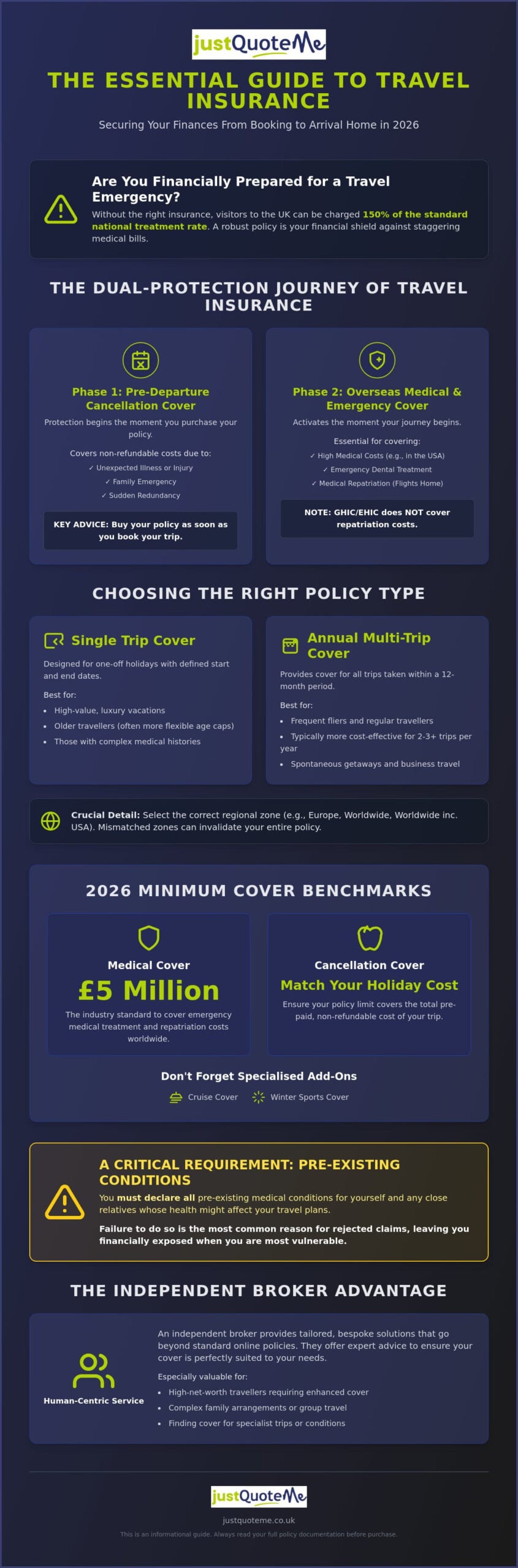
Would you be prepared to pay 150% of the standard national treatment rate if you were hospitalized during your trip? Many visitors to the UK mistakenly believe the NHS provides free care to everyone, but without the right travel insurance, a sudden medical emergency can lead to staggering financial bills. Even for UK residents heading abroad, the confusion between the GHIC and private protection often leads to gaps in coverage that only become apparent when it’s too late to fix them.
We understand that finding reliable cover feels like a balancing act between rising premiums and the fear of a rejected claim. You deserve a policy that offers genuine peace of mind without the administrative headache. This guide shows you how to secure comprehensive medical and cancellation protection tailored to your specific needs. We’ll examine the new £16 Electronic Travel Authorisation (ETA) requirements, explain why £5 million in medical cover is the industry benchmark, and help you manage the nuances of declaring pre-existing conditions so your claims process remains fast and fair.
Key Takeaways
- Understand the dual-protection nature of travel insurance, which secures your finances from the point of booking through to your arrival home.
- Evaluate the cost-efficiency of annual multi-trip policies versus the flexibility of single-trip cover for one-off holidays.
- Learn why £5 million in medical cover is the 2026 minimum standard and how to match cancellation limits to your total holiday investment.
- Recognize the importance of declaring pre-existing medical conditions to avoid rejected claims and ensure full protection.
- Discover how an independent broker provides human-centric, bespoke solutions for high-net-worth travellers or complex family arrangements.
What is Travel Insurance and Why is it Essential in 2026?
At its core, What is Travel Insurance is a legally binding contract designed to protect you against specific financial losses occurring before or during a trip. It is more than just a document; it’s a financial buffer between you and the unpredictable nature of international travel. This protection works in two distinct phases. The first phase begins the moment you purchase the policy, while the second phase activates the minute you step out of your door to start your journey.
In 2026, the risks associated with travel have evolved. We see a higher frequency of airline insolvencies and disruptions caused by extreme climate events. These factors make a robust travel insurance policy essential for anyone leaving the UK. Every UK policy is regulated by the Financial Conduct Authority (FCA), which mandates that firms deliver good outcomes for their customers. This regulatory oversight provides a level of security you won’t find with unregulated or offshore providers. It ensures that the Consumer Duty is at the heart of your policy, protecting you from hidden clauses or unfair treatment during a claim.
The Pre-Departure Benefit: Cancellation Protection
Many travellers wait until their departure date to secure cover, but this logic is flawed. You should buy your policy the moment you commit to a booking. If you suffer an illness, a family emergency, or a sudden redundancy weeks before your flight, your policy is there to recover your expenses. Valid claims typically include these unforeseen life events that prevent you from travelling. Cancellation cover is the protection of your non-refundable deposit costs.
The Overseas Safety Net: Medical and Emergency Cover
Medical costs abroad are often significantly higher than people expect. In destinations like the USA, a simple hospital stay can result in a bill that exceeds the cost of the holiday itself; those looking for deeper insights into US medical plans for seniors can check out The Modern Medicare Agency. While the GHIC or EHIC schemes are useful for basic state-level care in Europe, they aren’t a replacement for private insurance. They don’t cover repatriation, which is the process of transporting you back to the UK via a medical flight. This is the most expensive part of most claims; it requires specialized aircraft and medical personnel to ensure your safety during transit. Without private travel insurance, these costs fall entirely on you or your family.
Choosing the Right Policy Type: Single Trip vs. Annual Multi-Trip
Selecting the correct travel insurance policy depends entirely on your planned frequency of travel and your specific destination. Insurers categorize risk using regional rating zones to ensure premiums are calculated accurately. These zones are typically divided into the UK, Europe, Worldwide (excluding the USA, Canada, and the Caribbean), and Worldwide. If you’re heading to a region with exceptionally high healthcare costs, such as the United States, you must ensure your regional selection matches your itinerary. Failure to do so can lead to a rejected claim at a time when you’re most vulnerable.
Beyond destination, you should consider the nature of your trip. Standard policies often exclude specialized activities that carry higher risks. For example, if you’re planning a voyage, cruise cover is necessary to protect against cabin confinement or missed port departures. Winter sports cover is another essential add-on for those hitting the slopes, providing protection for expensive equipment and piste closures. It’s vital to review Essential Cover Limits to ensure these specialized additions provide sufficient financial protection for your specific gear and activities.
When to Opt for Single Trip Insurance
Single trip cover is designed for one-off holidays with a defined start and end date. It’s often the most pragmatic choice for high-value, luxury vacations where the cancellation risk is significant. It also caters well to older travellers or those with complex medical histories, as the insurer only assesses the risk for a specific window of time. While annual policies often have stricter age caps, single trip options can be more flexible for senior travellers. To ensure your entire lifestyle is protected, many travellers choose to review their Personal Home Insurance alongside their travel policy. This ensures that while you’re away, your property remains as secure as your health.
The Threshold for Annual Multi-Trip Value
For frequent fliers, annual multi-trip insurance is almost always the more cost-effective route. We often apply the “rule of three” here. If you plan to take three or more short breaks within a twelve-month period, the annual premium usually costs less than buying three separate policies. This type of cover is ideal for spontaneous travellers and business professionals who need to move at a moment’s notice without the administrative delay of buying new cover each time.
There’s often a crossover between personal travel and professional duties that many travellers overlook. For business owners, managing staff travel can be complex. While you might already have Motor Fleet Insurance for your company vehicles, ensuring your team has consistent travel protection for overseas meetings is equally important. An annual policy removes the administrative burden of buying cover for every individual business trip. If you’re unsure which structure fits your upcoming plans, you can speak with a specialist to find a tailored solution that manages these professional risks alongside your personal needs.
Essential Cover Limits: The 2026 Minimum Criteria
Once you’ve decided on the structure of your policy, you must look closely at the financial limits of the contract. These figures aren’t just arbitrary numbers; they are the maximum protection you have against financial ruin. Under-insurance is a common mistake that often leaves travellers footing a significant portion of a claim themselves. Understanding Why Travel Insurance is Essential involves recognizing that these limits must reflect the real-world costs of medical care and personal assets in 2026.
Medical and Repatriation Requirements
Medical expenses remain the most critical component of any travel insurance policy. For trips to Europe, a limit of £5 million is the bare minimum to cover hospital fees and emergency treatments. However, if your destination is the USA or the Caribbean, we recommend a standard of at least £10 million. These regions have some of the highest medical costs globally, where a single day in intensive care can cost tens of thousands of pounds. Your policy must also include 24/7 emergency assistance, providing you with a direct line to experts who can coordinate care and guarantee payments to foreign hospitals. In 2026, a standard UK travel policy should provide no less than £2 million in personal liability cover.
Baggage, Cash, and Gadget Limits
Many travellers assume their total baggage limit covers everything in their suitcase, but this is rarely the case. Most policies enforce a ‘single item limit’, which is the maximum payout for any one possession. If you’re carrying a high-end smartphone or a laptop, a standard £250 single item limit won’t be enough. You may need a specific gadget add-on or a valuables extension to protect these items. Similarly, if you’re travelling with professional equipment for work, standard personal possession cover might not apply. Just as tradespeople rely on Van and Tools Insurance to protect their livelihood at home, you should ensure your professional gear is specifically declared or covered under a business-travel extension. This prevents your claim from being rejected because the item was used for professional purposes rather than leisure.
Finally, don’t forget to match your cancellation cover to the actual cost of your holiday. If you’ve booked a £4,000 cruise but your policy only offers £2,000 in cancellation protection, you’re effectively self-insuring half the risk. Always calculate the total cost per person, including flights, hotels such as The Corner House Hotel, and pre-paid excursions, to ensure your travel insurance provides the safety net you expect.
Navigating Pre-existing Medical Conditions and Policy Exclusions
A pre-existing medical condition is generally defined as any health issue for which you’ve received treatment, surgery, or medication within a specific timeframe, usually the last two to five years. This includes chronic conditions like asthma or high blood pressure, but it also covers historical events like a past heart procedure or a course of physiotherapy. Honesty is the only viable policy here. If you fail to disclose a condition, you risk having your entire travel insurance claim rejected, even if the claim is unrelated to the undeclared illness. Insurers view non-disclosure as a breach of contract, which can leave you facing massive medical bills alone.
Declaring Conditions Correctly
The medical screening process is a standard part of securing cover. You’ll be asked a series of questions about your medical history to determine the level of risk. While online aggregators often use rigid algorithms that reject travellers with complex or terminal conditions, an independent broker offers a more human-centric approach. We can navigate the nuances of your health history to find specialists who provide cover where automated systems say “no”. If you have a complex medical history and need a tailored solution, you can get expert help with your travel policy today.
Understanding General Exclusions
Even the most comprehensive travel insurance has limits. One of the most significant exclusions involves advice from the Foreign, Commonwealth & Development Office (FCDO). If the FCDO advises against “all travel” or “all but essential travel” to a destination, your policy will likely be invalidated if you choose to go anyway. You must also pay close attention to activity exclusions. While a standard policy covers low-risk activities, adventure sports like paragliding or off-piste skiing usually require a specific add-on to ensure you are protected on the slopes or in the air.
Finally, insurers expect you to exercise “reasonable care” at all times. This means incidents involving excessive alcohol consumption or leaving your baggage unattended in a public place are common grounds for a rejected claim. The goal of insurance is to protect you against the unforeseen, not to cover avoidable risks or negligence. By understanding these boundaries, you ensure that your safety net remains intact when you actually need it. Taking the time to read the fine print now prevents a stressful and expensive surprise during your holiday.
Why Use an Independent Broker for Your 2026 Holiday Cover?
While automated comparison sites offer speed, they often lack the depth required for complex travel needs. Just Quote Me brings over 30 years of experience in the UK insurance market to every consultation. This longevity means we understand how policies have shifted over decades and how to navigate the current 2026 regulatory environment. We move beyond the “computer says no” response common with automated algorithms. Instead, we focus on finding a path to coverage that fits your specific circumstances, ensuring you aren’t left vulnerable by a generic policy that doesn’t account for your unique risks.
Personalized Support vs. Automated Algorithms
For business owners who travel for work, expert advice is vital. Your professional risks don’t stop at the boarding gate. If you already hold Professional Indemnity Insurance to protect your business advice, it makes sense to apply that same level of scrutiny to your travel protection. Having one dedicated contact for all your personal and business insurance needs creates a streamlined, efficient process. You save time and ensure there are no gaps between your various policies. This human-centric approach is particularly beneficial for high-net-worth travellers or multi-generational family groups where standard online forms simply can’t accommodate the complexity of the requirements.
The true value of a broker becomes clearest during a claim. If an underwriter disputes a detail or the process feels stalled, we act as your advocate. We use our industry knowledge and established relationships to fight your corner and ensure the process remains fast and fair. We manage the administrative burdens so you don’t have to, providing a steady hand in a market that can often feel impersonal and rigid.
Getting Your 2026 Quote
To get the most out of our service, prepare your details in advance. Have your exact travel dates, all planned destinations, and a comprehensive medical history ready for every traveller. This allows us to provide a fast, accurate travel insurance quote that reflects your actual needs. Navigating complex policy wording is much simpler when you have access to free expert advice. We help you understand the exclusions and limits discussed earlier in this guide, ensuring your safety net is exactly as strong as you expect it to be. Don’t leave your holiday peace of mind to a faceless algorithm when you can have a professional advisor ensuring every detail is covered.
Ready to secure your next trip with confidence? You can request a tailored travel insurance quote from our team today and experience the difference that 30 years of expertise makes.
Secure Your Journey with Confidence
Your holiday should be a time for relaxation, not administrative stress. By securing your policy the moment you book, you ensure your investment is protected from the start. Matching your cover limits to your actual trip costs and being transparent about your medical history are the most important steps toward a successful claim. While automated systems offer a quick fix, they often lack the nuance required for high-value trips or complex health conditions.
Just Quote Me is an FCA-authorised independent broker with over 30 years of industry experience. We specialize in bespoke personal and business solutions that prioritize your security over simple algorithms. Choosing the right Travel insurance is the final piece of the puzzle for a worry-free trip. Secure your 2026 travel plans with a partner who understands the nuances of the market. We’re here to ensure you travel with total peace of mind.
Get Your Free Business Insurance Quote now
Request a Call back for free Expert advice
Frequently Asked Questions
When is the best time to buy travel insurance for my 2026 trip?
You should purchase your policy the moment you confirm your booking and pay a deposit. This ensures your cancellation protection is active immediately, covering you for unforeseen events like illness or redundancy that occur before your departure date. Waiting until the day you fly leaves your financial investment entirely unprotected during the weeks or months leading up to your holiday.
Does travel insurance cover me if the airline goes bust?
Standard policies don’t always include Scheduled Airline Failure Insurance (SAFI), so you must check your specific policy wording. If you’ve booked a package holiday, you’re likely protected by the ATOL scheme; however, for flight-only bookings, SAFI is the only way to recover costs if an airline becomes insolvent. We recommend choosing a policy that explicitly includes this protection to manage the risks of the current aviation market.
What is the difference between GHIC and private travel insurance?
The Global Health Insurance Card (GHIC) provides access to state-level healthcare in EU countries at the same cost as a local resident, but it doesn’t cover private medical costs or repatriation to the UK. Private travel insurance is essential because it covers the cost of medical flights and 24/7 emergency support. Visitors to the UK should also be aware that the NHS charges non-residents 150% of the standard national treatment rate if they’re hospitalized without valid cover.
Do I need special insurance for a cruise or skiing holiday?
Yes, standard policies typically exclude high-risk activities and the unique logistical challenges of cruises. Cruise-specific cover protects you against cabin confinement, missed port departures, and airlifting from a ship, which is exceptionally expensive. Similarly, winter sports cover is necessary to protect your equipment and provide liability on the slopes, as most basic policies won’t pay out for accidents that happen while skiing or snowboarding.
Can I get travel insurance if I have a pre-existing medical condition?
You can certainly get cover, provided you’re completely honest during the medical screening process. While some automated websites might reject complex cases, a specialist broker can often find a tailored solution for chronic or historical conditions. Failing to declare a condition like high blood pressure or a past surgery can lead to your entire policy being voided when you attempt to make a claim.
How do I make a claim on my travel insurance policy?
Contact your insurer’s 24/7 emergency assistance line as soon as an incident occurs. You’ll need to provide your policy number and keep all original receipts, medical reports, or police statements to support your case. For theft claims, most insurers require a police report filed within 24 hours of the incident to prove you’ve taken reasonable care of your possessions.
Is business travel covered under a standard personal travel insurance policy?
Most personal policies are designed for leisure and don’t provide adequate protection for professional activities or expensive business equipment. If you’re travelling for work, you need a business extension or a dedicated commercial policy to cover professional liability and company-owned assets like laptops. This ensures your travel insurance aligns with your professional responsibilities and protects your business interests abroad.
What should I do if the FCDO advises against travel to my destination?
If the Foreign, Commonwealth & Development Office (FCDO) advises against “all travel” or “all but essential travel,” you should contact your travel provider for a refund or a change of dates. Travelling against this official advice will almost certainly invalidate your insurance policy, meaning you won’t be covered for any medical emergencies or losses. Always check the latest FCDO updates before you depart to ensure your destination is still considered safe for travel.
