
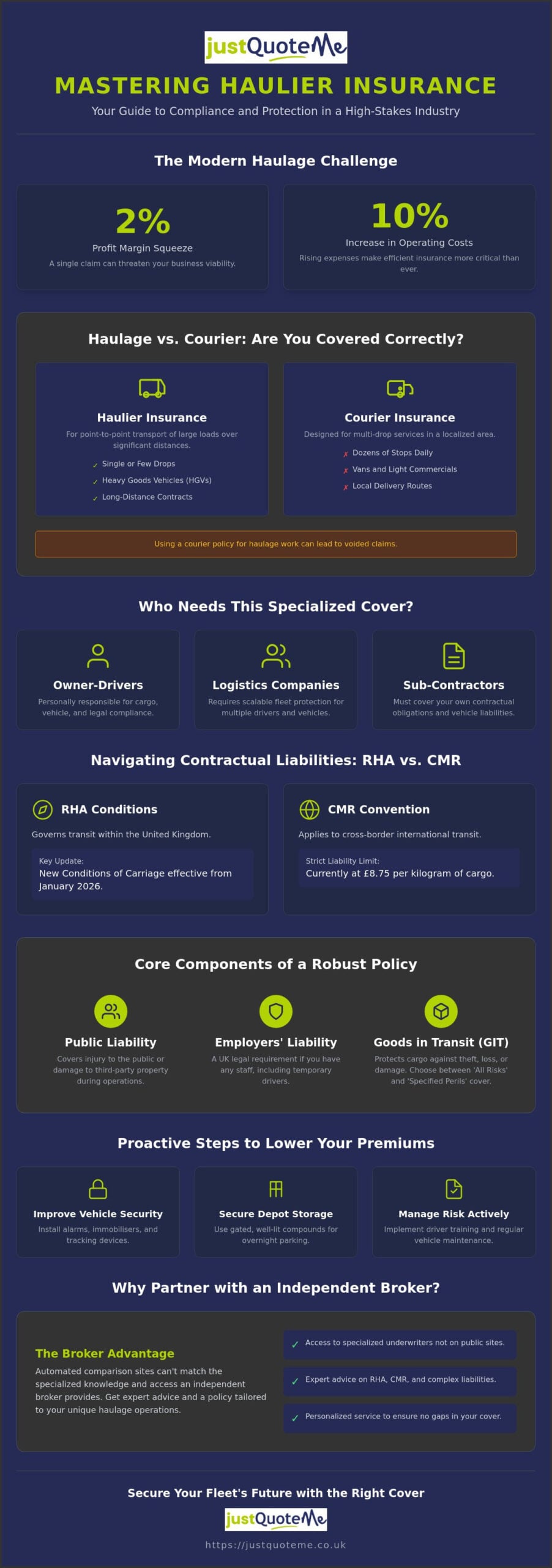
With UK haulage profit margins squeezed to just 2% in 2026, a single miscalculated cargo claim under the updated RHA conditions could be enough to park your entire fleet for good. You already know that keeping your trucks on the road is harder than ever as operating costs climbed by 10% this past year. It’s frustrating to face rising premiums while trying to decipher the technical differences between Goods in Transit and Haulier insurance. You need a policy that acts as a contractual shield, but the industry jargon often makes it feel like an administrative burden instead of a business asset.
This guide will show you how to master the complexities of haulage cover to ensure your business remains fully compliant and protected without overpaying for protection you don’t need. We’ll break down the January 2026 RHA updates, explain the current £8.75 per kilogram CMR liability limits, and provide actionable steps to secure the most competitive rates for your fleet. We’ll provide the expert insight you need to Just Quote Me for a more efficient business, moving you quickly from confusion to a state of total operational security through specialized regional knowledge and individualized service.
Key Takeaways
- Understand how specialized haulier insurance differs from standard van cover to ensure your vehicles, cargo, and liabilities are fully protected under hire and reward terms.
- Learn the critical differences between RHA and CMR conditions to ensure your contracts remain compliant during both domestic and international transit.
- Identify the essential policy components, including Public Liability and the legally required Employers’ Liability, needed to safeguard your fleet against third-party claims.
- Discover how proactive risk management, such as improved vehicle security and gated depot storage, can help lower your annual premiums.
- Find out why partnering with an independent broker provides access to specialized underwriters and expert advice that automated comparison sites cannot offer.
What is Haulier Insurance and Why is it Essential in 2026?
Haulier insurance serves as the foundational safety net for any business transporting goods for hire and reward. It isn’t just a single policy; it’s a combined protection suite that covers your heavy goods vehicles, the cargo you’re responsible for, and your legal liabilities as an operator. In 2026, the UK transport sector faces tighter safety standards and increased operational costs, with haulage costs having risen by approximately 10% recently. Operating with generic cover rather than specialized haulage protection is no longer a viable risk. If you carry third-party goods, standard van insurance won’t suffice because it lacks the specific provisions for the heavy weights and long distances inherent in professional logistics.
The Difference Between Haulage and Courier Insurance
Many operators confuse haulage with courier work, yet insurers treat them very differently. Courier insurance is designed for “multi-drop” services where a driver makes dozens of stops in a localized area. Haulage is typically “point-to-point,” involving larger loads moved over significant distances. Using a courier policy for haulage work often leads to voided claims. Just Quote Me helps you verify your specific trade category to ensure your policy reflects your actual daily operations. This precision prevents administrative headaches when you need to make a claim and ensures you aren’t paying for the wrong type of risk profile.
Who Needs Haulier Insurance?
- Owner-drivers: If you operate a single HGV, you’re personally responsible for the cargo and the vehicle’s legal compliance.
- Logistics companies: Businesses managing a diverse motor fleet require scalable protection that covers multiple drivers and vehicle types under one manageable policy.
- Sub-contractors: Even if you work for a major 3PL provider, their insurance rarely covers your specific liabilities or vehicle damage. You remain responsible for your own contractual obligations.
The 2026 regulatory environment demands higher transparency regarding carrier responsibilities. With the updated RHA Conditions of Carriage now in effect, hauliers must be certain their insurance aligns with these specific contractual obligations. For those crossing borders, understanding the CMR Convention is vital. This international agreement dictates strict liability limits for transit, and your policy must be structured to meet these requirements. Failing to secure the right haulier insurance doesn’t just result in a fine; it can lead to total financial ruin if a high-value consignment is lost or damaged while under your care.
A robust haulier insurance policy is more than just a legal tick-box; it’s a modular toolkit designed to protect every facet of your operation. While your vehicle cover handles the hardware, the liability and cargo sections protect your cash flow from the unpredictable nature of road transport. These components work together to ensure that an accident at a loading bay doesn’t become a business-ending event.
Public and Employers Liability for Transport
Operating within busy depots and delivery sites exposes your business to significant third-party risks. This is why public liability insurance is critical. It covers you if a member of the public is injured or their property is damaged during loading or unloading. For example, if a pallet falls and damages a customer’s warehouse floor, this cover manages the resulting claim.
Equally important is your obligation to your team. If you employ anyone, including relief drivers or temporary yard staff, employers liability insurance is a strict legal mandate in the UK. The Road Haulage Association (RHA) emphasizes that even small fleets must maintain this cover to avoid heavy daily fines. Public and employers’ liability policies form the indispensable foundation of your business safety, shielding you from the high costs of legal defense and compensation payouts.
Goods in Transit: Beyond the Basics
The cargo you carry is the lifeblood of your business, but it’s also your greatest liability. Goods in Transit (GIT) cover protects against theft, loss, or damage while items are under your care. You should understand the difference between “All Risks” cover and “Specified Perils.” All Risks provides much broader protection, whereas Specified Perils only covers specific events like fire or theft.
If you specialize in hazardous materials or temperature-controlled goods, your haulier insurance needs additional endorsements. Standard policies often exclude these risks by default. You must also ensure your sum-insured values are accurate. If you under-insure your cargo, insurers may apply “average” clauses. This means they’ll only pay a percentage of your claim based on the level of under-insurance. To avoid these technical pitfalls, you can speak with a specialist advisor who understands the nuances of cargo valuation.
Finally, don’t overlook legal expenses cover. In a sector where contract disputes and employment tribunals are common, having access to professional legal support is invaluable. It provides the financial backing needed to defend driving prosecutions or resolve disagreements with suppliers, keeping your focus on the road rather than the courtroom.
Navigating Contractual Liabilities: RHA vs. CMR Conditions
Your haulier insurance must be a precise reflection of your contracts. If there’s a mismatch between the liability limits in your policy and the conditions of carriage you’ve agreed to, you’re essentially driving without a safety net. In the current market, where profit margins are tight, a single unrecovered claim could be catastrophic for your business. Aligning your cover with your contractual obligations ensures that when a claim arises, the insurer pays out according to the terms you’ve promised your clients.
Why RHA Limits Matter to Your Bottom Line
For UK domestic transport, the Road Haulage Association (RHA) conditions are the industry standard. These were significantly updated on 1st January 2026 to address modern logistics challenges, including carrier responsibilities during automated loading and updated force majeure clauses. The standard RHA liability limit is £1,300 per tonne. However, many customers now demand higher limits for high-value goods like pharmaceuticals or electronics. It’s vital to provide your terms to customers before starting a job, as failing to do so can make your liability limits unenforceable in court. If you’re unsure about your current exposure, commercial insurance broker Staffordshire experts can provide a detailed contract review to ensure your cover is watertight. They’ll help you decide when it’s necessary to increase your “per tonne” limit to satisfy specific client requirements.
International Haulage and CMR Requirements
International work operates under a different set of rules entirely. The CMR Convention applies automatically to cross-border journeys, regardless of whether it’s mentioned in your contract. This framework sets a liability limit of 8.33 Special Drawing Rights (SDR) per kilogram, which currently equates to approximately £8.75 per kilogram. You can find more detail on these specific protections in this comprehensive guide to haulage insurance.
In 2026, new customs and border regulations have increased the risk of transit delays and associated costs. Your international cargo cover should specifically account for these delays, as standard policies often exclude losses caused solely by border congestion or administrative holdups. Watch out for exclusions related to “gross negligence,” as these can sometimes be triggered if drivers don’t follow strict security protocols at port facilities. Ensuring your policy explicitly aligns with these CMR requirements is the only way to guarantee a smooth claims process after an international incident. To protect your business from these technical pitfalls, you should Just Quote Me for a policy that bridges the gap between domestic and international liabilities.
Factors Affecting Your Haulier Insurance Premiums in 2026
Your haulier insurance premiums aren’t set in stone. While the UK motor fleet market remains competitive in early 2026, underwriters are looking closer than ever at your specific data before offering their best rates. Operators in logistics hubs like the West Midlands or Staffordshire often face different risk profiles compared to rural fleets, primarily due to traffic density and theft statistics. However, regional location is just one part of the puzzle. Insurers now prioritize your active commitment to safety and how well you manage your daily operational risks. With industry costs having risen by 10% recently, finding ways to offset premium increases is a financial necessity for staying profitable.
Risk Management and Safety Tech
The biggest shift in securing haulier insurance in 2026 is the widespread adoption of AI-driven driver monitoring. These systems provide real-time data on driver fatigue, distraction, and harsh braking, allowing you to intervene before an accident happens. Integrating these tools with high-definition dashcams often results in significant premium discounts because they provide indisputable evidence during “crash for cash” scams.
You must also pay close attention to vehicle security protocols. One of the most common reasons for claim rejection is the “theft from un-attended vehicle” clause. If a driver leaves a vehicle unlocked or parked in an unsecure location overnight, your cargo cover may be voided. Insurers prefer gated depots with 24-hour security and CCTV. Proactive risk management is the most effective way to lower premiums.
Choosing the Right Excess and Indemnity Levels
Balancing your monthly costs against your potential out-of-pocket expenses requires a pragmatic approach. Opting for a higher voluntary excess can lower your premiums, but you must ensure your business has the cash flow to cover that amount if multiple claims occur in a short period. It’s a calculated trade-off that works best for fleets with strong safety records.
Indemnity levels are usually dictated by your contracts. While a £2 million public liability insurance limit might suffice for some small-scale work, major 3PL providers and local authorities often demand £5 million or £10 million. Don’t fall into the trap of choosing “cheap” policies that leave gaps in your contractual compliance. If your policy doesn’t meet the minimum requirements of your client agreements, you risk losing the contract entirely. To see how these factors impact your specific fleet, you can request a tailored premium review today. We focus on specialized knowledge to ensure your motor fleet is protected without unnecessary administrative burdens.
Why Use an Independent Broker for Your Haulage Cover?
Choosing the right haulier insurance shouldn’t feel like a gamble with a search engine. While online aggregators offer speed, they often lack the depth required to understand the specific risks of the logistics sector. At Just Quote Me, we bring over 30 years of industry experience to the table, acting as a steady hand in a complex 2026 market. We don’t rely on one-size-fits-all algorithms. Instead, we use our established relationships with a broad panel of UK underwriters to find specialized protection that automated sites simply cannot access. This human-centric approach ensures your policy is a precise fit for your operational reality.
Bespoke Solutions for Unique Logistics Risks
Every fleet has its own set of challenges, whether you’re moving standard freight or require tradesman insurance for specialized heavy haulage. We have a deep understanding of the Staffordshire and West Midlands logistics corridor, recognizing the specific regional risks that national providers often overlook. Our FCA-authorised status serves as a hallmark of reliability, giving you the confidence that your business is in professional hands. We manage the complex administrative burdens so you can focus on meeting your delivery deadlines. This individualized service is what differentiates us from impersonal competitors.
Our commitment to your business doesn’t end when you sign the policy. We provide ongoing support for mid-term adjustments, such as adding new vehicles to your fleet or updating driver details. If the worst happens, our dedicated claims assistance ensures you aren’t left navigating the process alone. We work to keep your fleet moving, minimizing downtime and protecting your reputation. Reliability is the cornerstone of our service delivery.
Get Your Haulage Business Protected Today
In a year where haulage costs have seen a 10% increase, you can’t afford a policy that fails when you need it most. Matching your insurance to your contractual obligations under RHA or CMR conditions is the only way to safeguard your profit margins. Expert advice is no longer a luxury; it’s an operational necessity. We provide the clarity and security you need to navigate the 2026 insurance market with confidence. You should Just Quote Me to secure a partner who understands the nuances of your professional sector.
Get Your Free Business Insurance Quote now
Request a Call back for free Expert advice
Secure Your Fleet’s Future
Protecting your business in 2026 requires a strategy that goes beyond standard vehicle cover. It’s about ensuring your haulier insurance acts as a robust shield against the specific liabilities found in your carriage agreements. You’ve learned that proactive steps, from adopting AI-driven monitoring to choosing the right indemnity levels, are the most effective ways to manage your premiums while maintaining total compliance. By aligning your protection with the actual risks of your specific logistics corridor, you stay ahead of a shifting market.
Just Quote Me brings over 30 years of industry experience as an FCA-authorised independent broker to simplify this process for you. We use our access to a broad network of top UK insurers to build bespoke policies that automated platforms can’t match. We take care of the technical details so you can keep your fleet moving with confidence. We’re here to help you navigate the complexities of the industry with ease.
Get Your Free Business Insurance Quote now
Request a Call back for free Expert advice
Frequently Asked Questions
What is the difference between haulage and freight forwarding insurance?
Haulier insurance protects the physical movement of goods using your own assets, while freight forwarding insurance covers the liability of agents who arrange transport via third parties. If you own the trucks and employ the drivers, you’re the haulier. Freight forwarders take on the contractual responsibility for the move but don’t typically manage the physical transit themselves.
Does haulier insurance cover theft of the vehicle and the cargo?
A standard policy covers the theft of both the vehicle and its cargo, but you must adhere to strict security conditions. Most insurers include “unattended vehicle” clauses that require drivers to lock all doors and park in secure, well-lit areas. If a theft occurs while these safety measures are ignored, your claim could be rejected by the underwriter.
Is Employers’ Liability insurance compulsory for hauliers with sub-contracted drivers?
Employers’ Liability is a legal requirement if your sub-contracted drivers are classed as labour-only. Even if they’re self-employed for tax, the law often views them as employees if they use your equipment or work under your direction. Failing to provide this cover can result in significant daily fines from the Health and Safety Executive.
How much public liability cover do I need for haulage?
While a £1 million limit is the entry level, most major logistics contracts now require £5 million or £10 million in public liability cover. Your specific limit should match the requirements of the sites where you deliver. Checking your contracts before you Just Quote Me ensures you select a limit that keeps you compliant with your biggest clients.
Can I get haulier insurance for a single trip?
You can find cover for a single trip, but it’s often more cost-effective to hold an annual policy if you work regularly. Single-trip insurance is useful for one-off high-value moves or for owner-drivers testing a new route. For most established businesses, an annual policy provides more stable protection and professional credibility in the logistics market.
What are RHA conditions of carriage and why do I need them?
RHA conditions are industry-standard terms that limit your liability to £1,300 per tonne for domestic UK transit. Without these terms, you might be liable for the full value of the goods, which could easily exceed your policy limits. They provide a predictable framework for both you and your customers during the claims process.
How does telematics affect my haulage insurance premium?
Telematics systems track driver behaviour and can lead to lower premiums by proving you’re a low-risk operator. Insurers value the data provided by these systems, such as average speed and harsh braking incidents. Using this technology helps you secure the best rates for your haulier insurance by demonstrating a proactive commitment to fleet safety.
Does my policy cover me for European haulage (CMR)?
Your policy will cover European transit only if it includes a CMR endorsement. This international convention sets mandatory liability limits for cross-border journeys, currently around £8.75 per kilogram. You must ensure your broker is aware of any international work so your policy remains valid and compliant once you leave the UK.
