

What if the secret to lowering your premium isn’t just about your fee income, but how you present your firm’s internal risk hygiene to underwriters? It’s a common frustration for many practitioners who find the accountants professional indemnity insurance cost rising despite a clean claims history. You’ve likely spent hours trying to decode the latest ICAEW minimum indemnity requirements or worrying if your current cover actually protects your specific tax or probate work.
We understand that you’re looking for full compliance without the administrative burden or the “hard” market price tag. This guide explores the key factors driving premiums in 2026 and explains how to secure bespoke, compliant cover at a competitive price. We’ll examine the shifting regulatory landscape from the ACCA and ICAEW, and show you how to Just Quote Me to simplify your application while ensuring you meet every professional body standard. By focusing on specialized knowledge rather than generalist appeal, you can protect your practice with confidence.
Key Takeaways
- Understand why professional indemnity insurance is a mandatory regulatory requirement for ICAEW, ACCA, and CIMA members to maintain their practice licenses.
- Learn how underwriters calculate the accountants professional indemnity insurance cost based on your gross fee income and high-risk activities like audit or insolvency.
- Stay compliant with the latest 2026 minimum indemnity limits and ensure your policy is issued by a regulatory-approved participating insurer.
- Discover how implementing documented risk management procedures and providing full disclosure can help reduce your annual premiums.
- Find out why partnering with an experienced independent broker like Just Quote Me provides the specialized sector knowledge needed to navigate a complex market.
What is Accountants Professional Indemnity Insurance?
Accountants professional indemnity insurance serves as a mandatory shield designed to protect practitioners against claims of professional negligence, errors, or omissions. While many business owners view insurance as a discretionary expense, for those in the accountancy sector, it’s a regulatory lifeline. Professional bodies like the ICAEW and ACCA mandate specific levels of cover to ensure that both the firm and its clients are protected from financial loss. Without this protection, the accountants professional indemnity insurance cost would be the least of your worries; you could face the loss of your practicing certificate or personal bankruptcy.
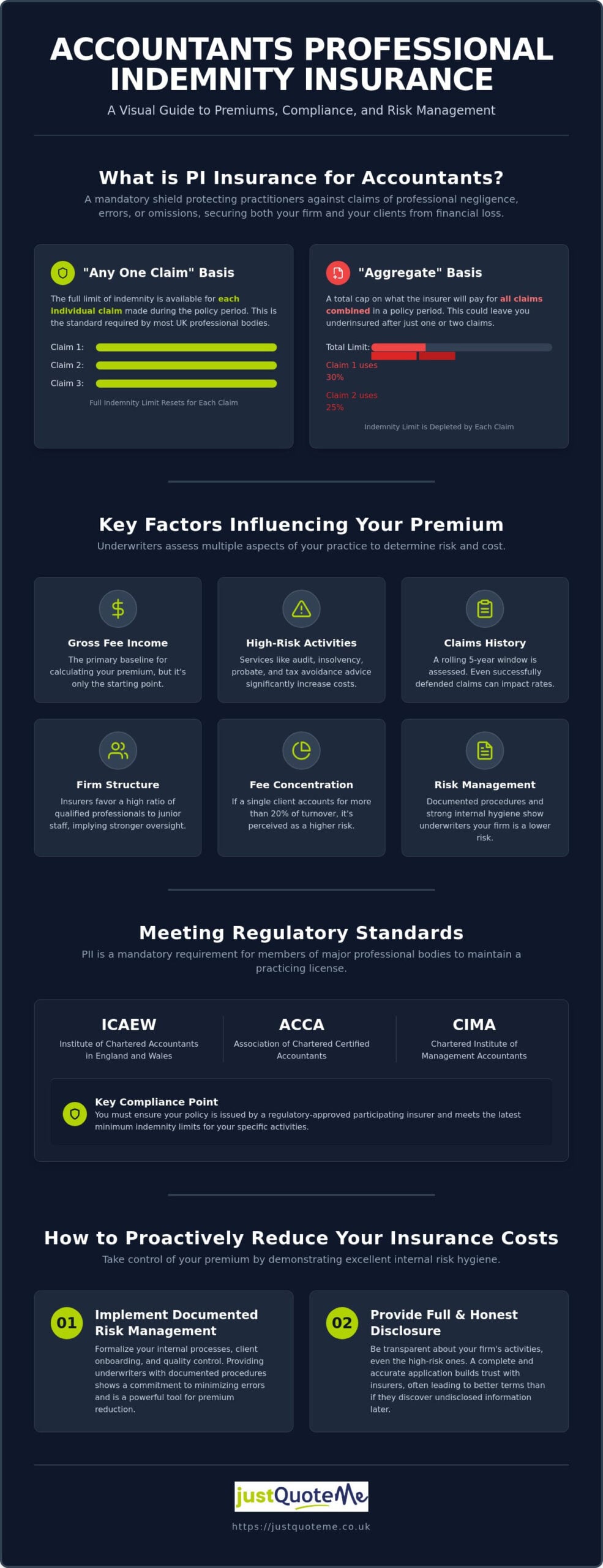
When selecting a policy, you must understand the difference between “any one claim” and “aggregate” limits. Most UK professional bodies require “any one claim” wording. This means the full limit of indemnity is available for every individual claim made during the policy period. In contrast, an aggregate limit is a total cap on what the insurer will pay for all claims combined. Choosing the wrong structure could leave you underinsured if multiple clients bring actions against you in a single year. Professional liability insurance is the bedrock of a secure practice, shielding your personal assets and the long-term viability of your business.
Why Accountants Need Specific PI Cover
Accountants face unique risks that generic policies often overlook. Whether you’re providing complex tax advice, conducting statutory audits, or managing probate, the potential for a high-value error is constant. Even if you’ve done nothing wrong, defending yourself against a frivolous claim is incredibly expensive. Data shows the average accountants’ insurance claim was £4,314 between June 2025 and May 2026, but this figure doesn’t account for the much higher legal fees involved in complex disputes. A robust Professional Indemnity Insurance policy covers these legal defense costs, ensuring your cash flow remains stable while experts handle the dispute.
The ‘Claims-Made’ Nature of the Policy
It’s vital to remember that PI insurance operates on a “claims-made” basis. This means the policy must be active at the time a claim is formally made against you, regardless of when the work was actually performed. If you performed a tax return in 2023 but the client sues you in 2026, your 2026 policy handles the claim. This is why “retroactive dates” are so important; they tell the insurer how far back into your firm’s history the coverage extends. Additionally, if you decide to retire or close your practice, you must maintain “run-off” cover. This protects you against claims that emerge years after you’ve stopped working, which is a key factor in the total accountants professional indemnity insurance cost over the lifetime of a firm.
Key Factors Influencing Your PI Insurance Premium
Underwriters in 2026 take a granular approach to assessing your practice, moving far beyond simple turnover figures. While your gross fee income remains the primary baseline for calculating the accountants professional indemnity insurance cost, it’s the specific nature of your work that dictates the final rate. An underwriter views £100,000 in fees from basic bookkeeping very differently than £100,000 generated from statutory audits or insolvency appointments. This “activity split” is perhaps the most significant variable you can control through your business strategy.
Your claims history also carries immense weight, specifically within a rolling five-year window. Even if a claim was successfully defended, the legal costs incurred stay on your record. Insurers also look closely at your firm’s structure; they generally favor practices with a high ratio of qualified professionals to junior staff. This preference stems from the belief that rigorous oversight reduces the likelihood of the simple clerical errors that often lead to negligence claims.
Niche Services and High-Risk Areas
Certain areas of practice act as red flags in the current market. Advice regarding tax avoidance schemes, for instance, often results in a “declined to quote” from many standard insurers. Similarly, providing probate or investment advice requires specialized wording and often attracts a higher premium. You should also be aware of fee concentration. If a single client accounts for more than 20% of your annual turnover, underwriters perceive a higher risk of independence issues or pressure that could lead to errors. For more detailed regulatory context, you can consult the FCA guidance on Professional Indemnity Insurance to see how they view these professional risks.
The Impact of 2026 Technology Risks
In 2026, technology has fundamentally changed the risk landscape for accounting firms. Underwriters are now specifically asking about AI integration in accounting processes. While AI can improve accuracy, it also introduces risks related to algorithmic bias or data mishandling that a traditional PI policy might not fully cover. This creates a complex overlap between professional liability and Cyber Insurance. If an AI tool causes a data breach that leads to a professional error, you need to be certain which policy responds.
These technological shifts directly influence the accountants professional indemnity insurance cost, as insurers adjust their models to account for potential software-driven failures. Balancing these modern threats requires a partner who understands the nuances of the sector. You can explore our approach to specialist cover to see how we address these emerging risks while keeping your practice fully protected.
Regulatory Minimums: ICAEW, ACCA, and CIMA Requirements
Your professional body doesn’t just offer suggestions; it sets the legal floor for your coverage. To practice legally in the UK, your policy must be issued by a firm on the “Participating Insurer” list. This list represents an agreement between the regulatory body and the insurer to provide a minimum level of wording that meets strict professional standards. If you secure a policy from a non-approved provider, you aren’t just underinsured; you’re in breach of your professional regulations, which can lead to the immediate suspension of your practicing certificate.
The most common calculation used by bodies like the ICAEW and ACCA is the “2.5 times gross fee income” rule. For ICAEW firms with a gross fee income under £800,000, the minimum indemnity is 2.5 times that income, with an absolute floor of £250,000 as of the September 2024 updates. For larger firms, the requirement jumps to £2 million for any one claim. These mandates directly influence the accountants professional indemnity insurance cost, as they dictate the baseline risk an underwriter must accept regardless of your firm’s specific history.
Excess rules are equally strict to prevent firms from taking on more financial risk than they can handle. The ICAEW, for instance, limits the maximum permitted excess to the higher of £3,000 or 3% of your firm’s gross fee income. This ensures that you don’t artificially lower your premium by choosing an excess you can’t actually afford to pay out of pocket if a claim arises.
ICAEW vs. ACCA PI Standards
While both bodies prioritize protection, their specifics differ significantly. ACCA members with a total income over £600,000 must hold at least £1.5 million in cover on an “any one claim” basis. ACCA also mandates the inclusion of a fidelity guarantee, which protects the firm against losses arising from employee dishonesty. Failing to meet these standards doesn’t just create a coverage gap; it triggers disciplinary proceedings that can damage your reputation permanently.
CIMA and AAT: What Smaller Practices Need to Know
CIMA and AAT don’t always specify a hard minimum limit in the same way the ICAEW does, but they still mandate that all members in practice hold qualifying insurance. For smaller bookkeeping or management accounting firms, it’s tempting to opt for the lowest possible limit to minimize the accountants professional indemnity insurance cost. However, we always recommend a “safety buffer.” If you expect to grow or take on a high-value client mid-year, a higher limit prevents you from falling out of compliance. For a broader look at how these policies function across different sectors, see our What is Professional Indemnity Insurance? A Guide.
How to Manage and Reduce Your Insurance Costs
Managing your accountants professional indemnity insurance cost effectively requires a shift in perspective. You should view your proposal form as a marketing document rather than a simple administrative task. By demonstrating robust internal risk management procedures, you provide underwriters with the confidence needed to offer a more competitive rate. Documented peer reviews, strict diary systems for deadlines, and regular staff training are all indicators of a practice that is less likely to trigger a claim.
Transparency is your best tool during the application process. Full disclosure of your firm’s activities and history prevents future claims from being rejected and builds a rapport with insurers. While it’s tempting to select a high excess to reduce the immediate premium, you must balance these savings against the potential out-of-pocket costs of a claim. Remember to stay within the ICAEW or ACCA permitted excess limits discussed in the previous section. Consolidating your various covers with a single broker can also unlock multi-policy discounts that further optimize your annual spend.
Presenting Your Firm to Underwriters
When completing your proposal form, highlight your strengths like low staff turnover and the consistent use of robust engagement letters. These letters are your first line of defense in mitigating negligence claims because they clearly define the scope of your work and the limits of your liability. In 2026, a clean claims record is worth its weight in gold. If you’ve had past issues, provide a detailed explanation of the remedial actions you’ve taken to prevent a recurrence. This proactive approach often results in a more favorable assessment than simply leaving the underwriter to guess about your risk profile.
Why Cheap Isn’t Always Cheaper
It’s vital to avoid the trap of budget policies that appear attractive but fail to meet the standards of your professional body. Non-compliant policies can leave you exposed to significant regulatory fines and may not cover the specific risks of your practice. Many low-cost options contain hidden exclusions for high-value services like tax advice or probate, which could cost you thousands if a claim arises. For a broader view of what your practice needs to stay protected, you can review our Small Business Insurance Checklist.
Securing the right protection at the right price doesn’t have to be a complex or solo effort. You can speak with our specialist team to navigate these cost-saving strategies while ensuring your firm remains in total compliance with your regulatory body.
Why Use Just Quote Me for Your Accountants PI Insurance?
With over 30 years of experience as an independent broker, we’ve built a reputation for providing reliable, expert guidance to firms across Staffordshire and the West Midlands. We understand that your practice is unique, which is why we don’t rely on rigid algorithms or one-size-fits-all automated systems. Instead, we take the time to talk to you directly. This human-centric approach allows us to understand the nuances of your services, whether you specialize in high-stakes forensic accounting or complex insolvency cases. By presenting your specific “risk story” to our broad network of UK underwriters, we ensure the accountants professional indemnity insurance cost reflects your actual practice profile rather than a generic industry average.
This tailored approach is particularly beneficial for dedicated firms like small business accountants Alloa, where a clear presentation of their professional standards can lead to more accurate and competitive premium assessments.
Our status as an independent broker gives us access to a wide range of insurers, including those on the essential ICAEW participating list. This is critical for maintaining your regulatory compliance. We also provide expert advice on creating a comprehensive protection package by combining your PI with Public Liability and Employers Liability insurance. Consolidating these policies with a single, trusted partner simplifies your administration and often leads to more competitive overall premiums. We manage the complex paperwork and regulatory checks so you can focus on delivering value to your clients.
The Local Broker Advantage in Stafford and Stone
Regional expertise matters when you’re navigating a complex insurance market. For firms based in Stafford, Stone, and the wider West Midlands, having a local partner means you aren’t just a policy number in a distant database. We provide personalized support throughout the lifetime of your policy, which is especially vital during the claims process. You won’t be directed to a generic call center; you’ll speak with experts who understand the local business landscape and the specific pressures facing UK accountancy practices today. We handle the heavy lifting of insurance management, ensuring your firm remains protected and compliant without the usual administrative headaches.
Get Your Quote Today
It’s time to see how much you could save on your accountants professional indemnity insurance cost without compromising on the quality or compliance of your cover. Our team is ready to provide the bespoke service and specialized knowledge your practice deserves.
Get Your Free Business Insurance Quote now
Request a Call back for free Expert advice
Securing a Compliant and Cost-Effective Practice
Staying ahead of regulatory shifts from the ICAEW and ACCA is no longer just about meeting a mandate; it’s about the long-term stability of your firm. By focusing on documented risk management and clear engagement letters, you can actively influence the accountants professional indemnity insurance cost while ensuring your personal assets remain shielded. The shift toward risk-based underwriting in 2026 means that your practice’s specific internal “hygiene” is more valuable than ever before.
At Just Quote Me, we bring over 30 years of industry experience and bespoke UK underwriter access to every policy we handle. As an FCA Authorised and Regulated broker, we move beyond automated systems to provide the straightforward, expert advice your practice requires. Whether you’re managing a small bookkeeping firm or a large multi-partner practice, we’re here to simplify the administrative burden and secure the most competitive terms available. You can explore our professional indemnity solutions to find a policy that fits your specific needs.
Ready to protect your practice?
Get Your Free Business Insurance Quote now
Request a Call back for free Expert advice
Take the next step toward a more secure and cost-effective future for your practice today. We look forward to helping you navigate the market with confidence.
Frequently Asked Questions
Is professional indemnity insurance tax-deductible for UK accountants?
Yes, professional indemnity insurance is considered a “wholly and exclusively” business expense by HMRC. This means you can deduct the full premium from your taxable income to reduce your overall tax liability. It’s one of the few ways to offset the necessary accountants professional indemnity insurance cost against your practice’s bottom line while ensuring you stay compliant with your regulatory body.
What is the minimum PI cover required for an ICAEW member in 2026?
For firms with a gross fee income under £800,000, the ICAEW requires a minimum indemnity of two and a half times that income, with an absolute floor of £250,000. For most other firms, the mandatory limit is £2 million for any one claim and in aggregate. These regulations, which were updated in September 2024, ensure practitioners maintain adequate protection tailored to their specific risk level.
How much does professional indemnity insurance cost for a sole trader accountant?
The premium for a sole trader is typically calculated as a percentage of your annual fee income, which often ranges from 0.3% to 1.5%. While minimum premiums apply, your specific rate depends on the high-risk services you offer and your past claims history. Seeking a bespoke quote from a specialist broker ensures you don’t pay for unnecessary cover while meeting all mandatory professional requirements.
Can I change my PI insurance broker mid-policy if costs are too high?
You can technically change brokers at any time, but it’s often more efficient to wait until your renewal date. Cancelling a policy mid-term may result in short-period cancellation rates or the loss of pro-rata refunds from your insurer. If you’re unhappy with your current service or costs, it’s best to start the quoting process with a new broker roughly 60 days before your policy expires.
Does PI insurance cover claims related to tax investigation fees?
Standard professional indemnity insurance covers you if a client sues for negligence regarding tax advice you provided. However, it doesn’t typically cover the professional fees incurred during a routine HMRC tax investigation into a client’s affairs. For that specific protection, you’ll need “Tax Fee Protection” insurance, which is often available as a separate add-on or a standalone policy.
What happens if I stop practicing? Do I still need to pay for insurance?
Yes, you must maintain “run-off” cover once you stop practicing to protect against claims arising from work done in the past. The ICAEW requires a minimum of two years of run-off cover, while the ACCA mandates a full six years. This is essential because PI insurance is “claims-made,” meaning the policy must be active when the claim is filed, regardless of when the error occurred.
Is cyber insurance included in a standard accountants professional indemnity policy?
Cyber insurance is usually not included in a standard PI policy and must be purchased as a separate product. While some PI policies offer limited extensions for data loss, they rarely cover the full costs of ransomware, data breach notifications, or business interruption. Given the sensitivity of financial data, many firms now combine their PI with a dedicated cyber policy for total security.
How do I calculate my gross fee income for the insurance proposal form?
You should calculate your gross fee income by totaling all fees billed to clients during your last full financial year, excluding VAT and disbursements. If you’re a new practice, you’ll need to provide a realistic estimate for the coming 12 months. Accuracy is vital during this process, as under-reporting your income can lead to the accountants professional indemnity insurance cost being miscalculated and claims being rejected.
