by jqm | Sep 1, 2026 | Insurance
The cheapest policy on a comparison site often becomes the most expensive mistake your company will ever make. In 2026, the search for the best business insurance isn’t about finding the lowest premium; it’s about securing a safety net that actually holds when you need it most. You’ve likely felt the frustration of generic forms that don’t understand your specific trade, or the worry that a hidden exclusion might leave you exposed during a claim. It’s a common struggle for UK business owners who want to protect their livelihoods without being drained by unnecessary costs.
We understand that you want more than just a digital certificate. You need the peace of mind that comes from being legally compliant and the confidence that a human expert is ready to handle the administrative heavy lifting. This guide reveals how to move beyond automated algorithms to find bespoke coverage tailored to your industry’s unique vulnerabilities. We’ll explore how to identify your legal requirements, avoid the trap of generic policies, and explain why having a steady hand from an independent broker makes all the difference. To protect what you’ve built, Just Quote Me.
Key Takeaways
- Understand why the best business insurance isn’t simply the cheapest option, but a calculated balance of legal compliance and industry-specific risk mitigation.
- Discover why automated comparison sites often lead to hidden exclusions and why an independent broker provides a more reliable safety net for your company.
- Learn about the core pillars of protection, from Public Liability to Employers Liability, and how to tailor them to sectors like hospitality or construction.
- Identify the specific information you need to gather to secure a bespoke quote that fits your budget without sacrificing essential coverage.
- Gain a clear action plan for evaluating policy limits and excesses to ensure your business is fully protected against real-world claims.
Defining the Best Business Insurance for Your UK Company in 2026
The best business insurance isn’t a static product you pull off a shelf. In 2026, it’s defined by a precise intersection of legal compliance, specific risk mitigation, and long term cost efficiency. For many SMEs, the temptation to use a generic algorithm is high, yet a one-size-fits-all policy is often the most expensive mistake a business can make. These automated systems frequently miss the nuances of your daily operations, leaving you with expensive overlaps or, worse, critical gaps in your protection. A quick overview of the UK insurance market shows that while capacity is growing, the complexity of risks is also increasing. Bespoke business insurance is a policy built from the ground up to match a specific risk profile.
Legal Requirements vs. Optional Protections
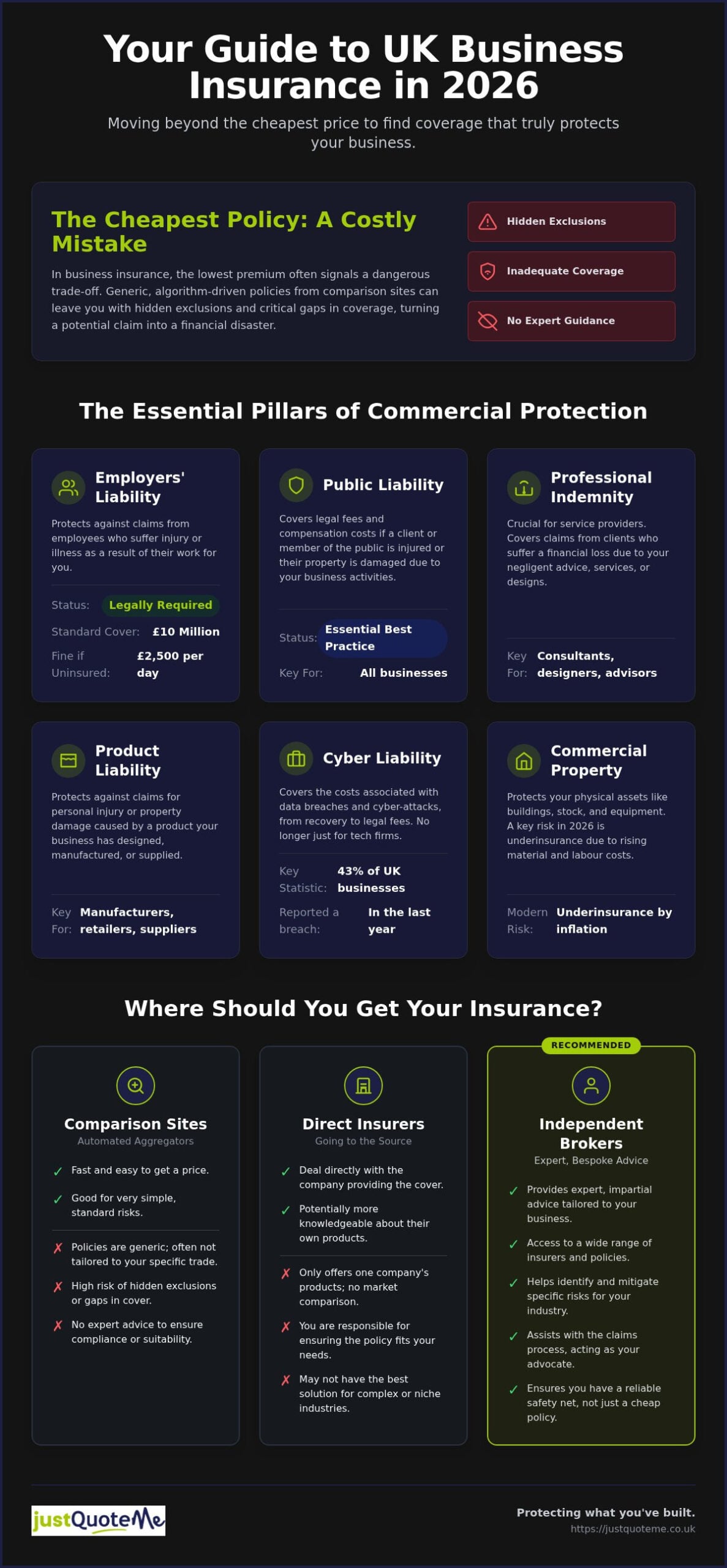
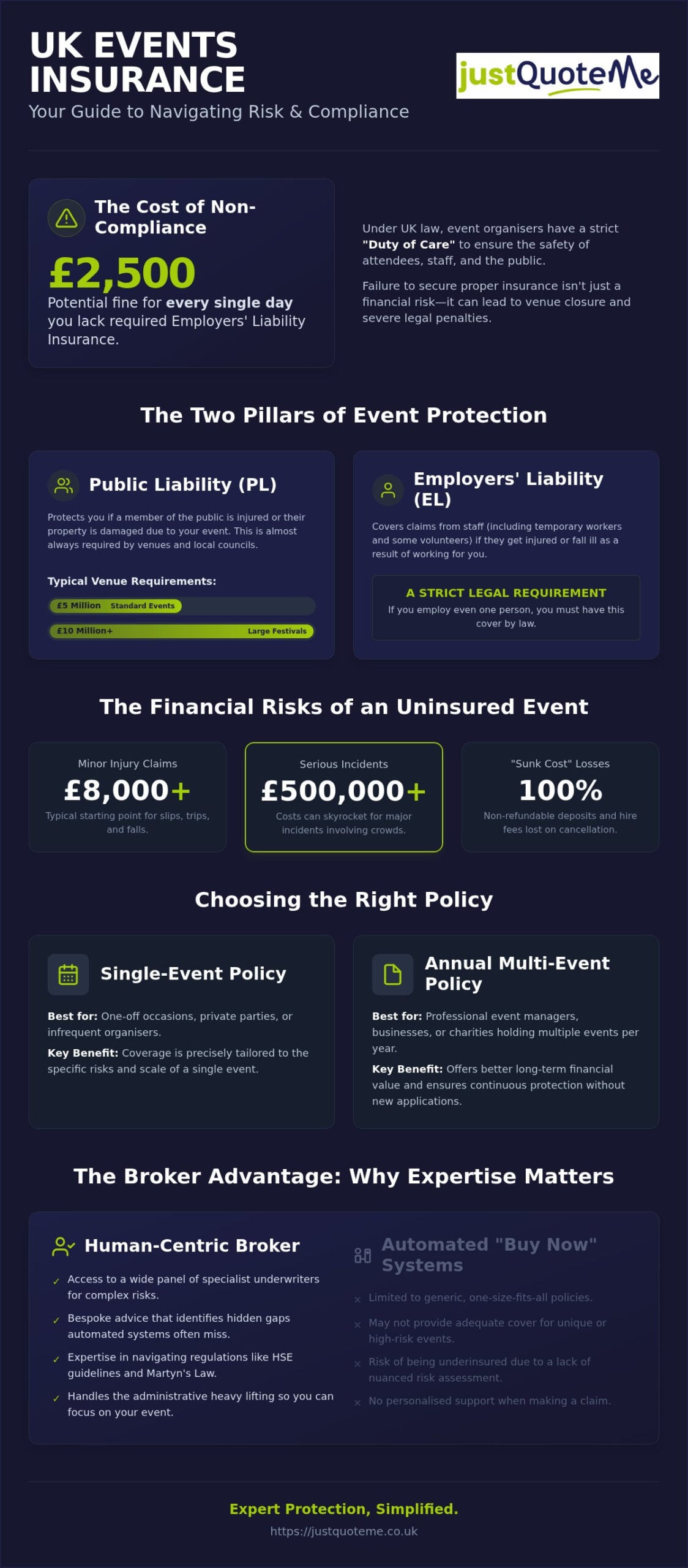
Identifying what you must have versus what you should have is the first step toward efficiency. Employers Liability Insurance is a strict legal requirement for almost any UK business with staff, including contractors and casual workers. By law, you must carry at least £5 million in cover, though most insurers provide £10 million as a standard. Failing to meet this requirement can result in fines from the Health and Safety Executive of up to £2,500 for every single day you’re uninsured.
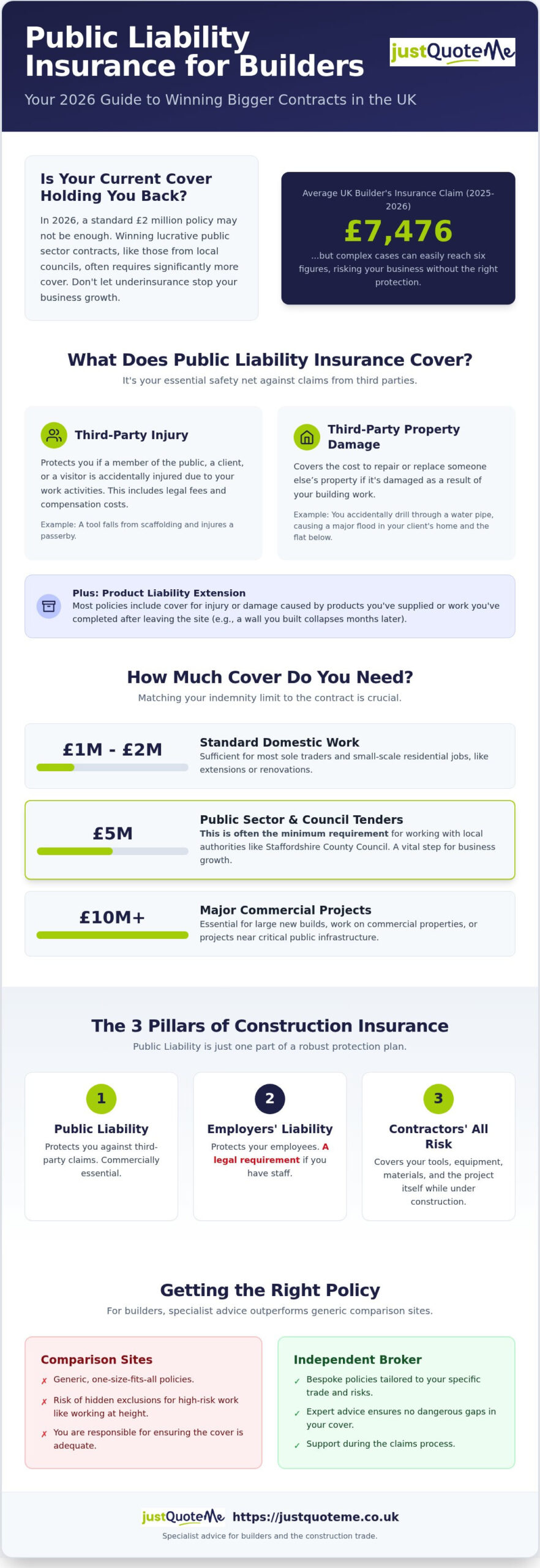
While Public Liability Insurance isn’t mandated by UK law, it’s considered an essential best practice. If a client or member of the public suffers an injury or property damage due to your business activities, the resulting legal fees and compensation could easily bankrupt an unprotected company. The best business insurance strategies treat these “optional” covers as foundational pillars rather than afterthoughts.
The 2026 Landscape: New Risks to Consider
The UK economic climate in 2026 presents unique challenges that didn’t exist a few years ago. Inflation has significantly increased the costs of materials and labour, which means many businesses are now underinsured on their Commercial Property Insurance. If your sum insured hasn’t been updated recently to reflect current rebuilding costs, you risk a “pro-rata” reduction in any claim payout.
Digital threats have also moved from the periphery to the centre of risk management. With 43% of UK businesses reporting a breach in the last year, Cyber Liability Insurance is no longer just for tech firms. Modern policies are shifting toward modular designs, allowing hybrid businesses to toggle protections as they scale. This flexibility ensures you don’t pay for office based risks if your team is largely remote, keeping your premiums aligned with your actual exposure.
The Essential Pillars of Comprehensive Commercial Protection
Building the best business insurance portfolio requires understanding that different risks require different anchors. While some covers are mandatory, others act as the structural support that keeps your business standing after a catastrophic event. Successful UK business policies are never accidental; they are a calculated assembly of covers that address both immediate liabilities and long term asset protection. Identifying these core pillars is the first step toward moving away from generic, high risk policies.
Liability Covers: Public, Product, and Employers
Liability insurance is the most significant segment of the UK market for a reason. It protects you from the financial fallout of legal claims. While Public Liability Insurance handles claims related to third party injury or property damage on your premises, it doesn’t cover everything. Manufacturers and retailers must also consider Product Liability. If a product you supply causes illness or injury after it leaves your hands, Product Liability is the specific protection that manages the legal defence and compensation costs.
Professional Indemnity is a separate but equally vital pillar for consultants and service providers. If a client suffers a financial loss because of your expert advice or a mistake in your work, this cover is essential. Claim scenarios in 2026 often involve high indemnity limits because legal costs have risen. A single slip and fall claim or a professional error can easily reach six or seven figures. Ensuring your limits are high enough to cover these “worst case” scenarios is a hallmark of a high quality policy. If you feel your current limits are lagging behind, it’s a good idea to speak with a specialist broker for a professional review.
Asset and Revenue Protection
Physical assets often represent your largest capital investment. Commercial Property Insurance covers the building itself and the equipment inside, but the truly best business insurance policies go a step further by including Business Interruption (BI) cover. Many businesses focus only on the cost of replacing a damaged roof or stolen tools. They forget that the real threat is the weeks or months of lost income while repairs take place.
BI cover replaces that lost revenue, ensuring you can still pay your staff and overheads even when you can’t trade. For those in the retail sector, Shop Insurance packages often integrate these protections into a single, manageable policy. For a broader perspective on how these pillars fit together, you can consult this guide to choosing business insurance from the Association of British Insurers. This structured approach ensures your business isn’t just insured, but truly protected against the specific realities of your sector.
Comparison: Direct Insurers, Aggregators, or Independent Brokers?
Choosing the right path to your policy is as important as the policy itself. Most UK business owners take one of three routes: buying directly from an insurer, using an automated aggregator, or partnering with an independent broker. While direct insurers offer brand familiarity, they limit your options to their specific underwriting appetite. Aggregators offer speed but often sacrifice the detail required to build the best business insurance for a professional company. Brokers provide the middle ground, combining a broad market search with expert scrutiny.
The Aggregator Trap: Why Price Isn’t Everything
Automated algorithms are designed for high volume, low complexity risks. They work well for a standard home office, but they often struggle with non standard requirements. If your business operates in a high risk sector, such as Nightclub Insurance or Thatched Pub insurance, a generic dropdown menu simply cannot capture the nuances of your property or operations.
The danger of selecting the lowest priced option on a comparison site is “under insurance.” You might save a small amount on your annual premium, but you face a massive financial shortfall during a claim because the algorithm missed a critical industry exclusion. These sites frequently struggle to identify specific legal requirements for niche sectors, leaving you vulnerable to fines or rejected claims. When you prioritise price over precision, the “cheap” policy often becomes the most expensive document you’ve ever signed.
The Broker Advantage: Bespoke Advice and Market Access
An FCA authorised broker acts as your professional advocate. At Just Quote Me, we use 30 years of industry experience to perform a comprehensive risk assessment that a computer script cannot replicate. We navigate a broad panel of top UK underwriters to find “broker only” rates that are never published on public comparison sites. This access allows us to secure the best business insurance pricing without cutting corners on your protection.
The true value of a broker appears during the claims process. Instead of navigating a faceless corporate call centre, you have a human point of contact who understands your history. We handle the administrative burdens and push for a fair resolution with the insurer, acting as a steady hand in a complex market. This human centric approach ensures you aren’t just a policy number; you’re a partner whose business continuity is our primary objective. Whether you need a simple adjustment or a total policy overhaul, having a single expert to call ensures your coverage remains efficient and compliant.
Industry-Specific Guidance: Finding the Best Fit for Your Sector
The best business insurance is never a generalist product. It’s a precise tool designed to handle the specific hazards of your trade. While a florist and a scaffolder both need liability cover, the underlying risk profiles are worlds apart. Generic insurers often lack the appetite for high risk sectors, leading to premiums that are either artificially high or riddled with restrictive exclusions that render the policy useless when a claim arises. This is why sector specific knowledge is the most valuable asset when brokering a policy. To see how these principles of specialist brokering are applied elsewhere, you can explore Business Insurance through MyGen Insurance Brokers.
In the building trades, your insurance needs to move as fast as your projects. Standard Builders Insurance covers the basics, but larger or more complex developments often require Contractors All Risk Insurance. This provides a comprehensive umbrella over the works in progress, your own plant, and hired in machinery. It ensures that if a site is vandalised or a storm destroys a half finished structure, your capital investment is protected.
Specialist trades, particularly those working at height, face even stricter scrutiny from underwriters. Many off the shelf policies include height limits that are often too low for modern construction needs. A bespoke policy through an independent broker ensures these limits are negotiated to match your actual operational reality, rather than a computer generated average. This level of detail prevents the “hidden exclusions” that frequently plague generic trade policies.
Hospitality and Niche Property Risks
The hospitality sector requires a nuanced approach to property and liability. For instance, Thatched Pub Insurance is a highly specialised field. The unique fire risks associated with thatch and the significant costs of traditional rebuilding materials mean you need a broker who can access specialist underwriters. Without this regional and sector specific expertise, you risk being significantly underinsured if the worst happens.
Higher risk venues have different priorities. Nightclub Insurance must address complex security requirements and late night liability issues that standard pub policies won’t touch. Meanwhile, those managing Hotels and Guest Houses need to balance property protection with guest liability and business interruption covers. Each of these sectors demands a tailored assembly of protections to ensure long term viability. To secure a policy that fits your specific trade, get an industry-specific quote from our expert team today.
Securing Your Bespoke Quote: A Practical Action Plan
Securing the best business insurance for your company is a strategic process that requires more than just a few clicks on a comparison site. You’ve already seen how generic policies leave gaps in your protection. Now, you need a clear roadmap to transition from a basic policy to a bespoke managed service. This plan ensures you aren’t just buying a certificate, but building a safety net that adapts as your business grows throughout 2026.
Preparation Checklist for 2026
This level of adaptability is essential as you invest in your brand identity with custom products from The CEO Creative, ensuring all physical assets are included in your insurance valuations.
Before you request a professional quote, gathering accurate data is essential for an efficient risk assessment. Insurers in 2026 require precision to offer the most competitive rates. You should prepare your accurate revenue projections and a detailed headcount of all employees, including any casual staff or contractors.
Beyond the basics, you must provide a full inventory of your physical assets. This includes specialised equipment and Plant and Machinery. Having your previous three to five years of claims history ready, along with documentation of your current risk management protocols, allows a broker to present your business in the best possible light to underwriters. This transparency often leads to better terms and lower excesses because it proves you’re a responsible risk.
Requesting Your Quote and Expert Consultation
While many competitors rely on AI chatbots to provide answers in seconds, these automated systems cannot replace a professional consultation. When you request a “Free Business Insurance Quote,” you’re doing more than just benchmarking your current costs. You’re starting a conversation with a human expert who can spot the industry specific exclusions that an algorithm might miss. Expert advice is the final safeguard that ensures your policy is truly the best business insurance for your specific needs.
Evaluating a quote requires looking far beyond the annual premium. You must scrutinise the limits of indemnity and both the voluntary and compulsory excesses. A low premium is often a mask for a high excess that could damage your cash flow during a claim. At Just Quote Me, we simplify this entire process. We manage the administrative burdens of your commercial contracts and perform annual reviews to ensure your cover keeps pace with your expansion. Transitioning your existing policies to a managed brokerage service provides a steady hand in a fluctuating market, giving you the freedom to focus on your operations while we handle the complexities of your protection.
Protecting Your Business Legacy in 2026
Finding the best business insurance isn’t just about ticking a box or choosing the first option on a comparison site. It’s about building a robust framework that protects your unique risks, from specialized plant machinery to complex liability needs. You’ve learned that a generic policy often hides exclusions that only surface when it’s too late. By prioritizing bespoke coverage and expert advocacy, you’re ensuring your company isn’t just surviving, but thriving in an evolving economic landscape.
As an FCA-authorised independent broker with 30+ years of UK industry experience, we specialize in simplifying the complex. We don’t just provide a policy; we provide a partnership that manages your administrative burdens. To see the difference that tailored coverage makes, start your journey toward better protection today. You can also request a call back for free expert advice to ensure your company remains fully compliant. We’re ready to help you build a more secure future.
Get Your Free Business Insurance Quote now
Request a Call back for free Expert advice
Frequently Asked Questions
What is the most important type of business insurance for a UK startup?
Public Liability is usually the first priority for startups as it covers legal costs if your business causes injury or property damage to a third party. However, if you’ve already hired your first employee, Employers’ Liability becomes a mandatory legal requirement immediately. Many tech or service based startups also find Professional Indemnity essential for meeting the contractual terms required by larger corporate clients during the onboarding process.
Is business insurance a legal requirement for sole traders?
While most insurance isn’t a legal requirement for sole traders without staff, it’s often a commercial necessity. You won’t be legally forced to have Public Liability, but you’ll find that many local authorities and private clients won’t allow you on site without proof of cover. If you employ anyone, even a temporary assistant, you must carry Employers’ Liability insurance to comply with UK law and avoid significant daily penalties.
How much does the best business insurance typically cost?
The cost of the best business insurance is determined by your specific risk profile rather than a flat industry rate. Factors such as your annual turnover, the nature of your trade, and your location in the UK all influence the premium. While a consultant might pay a few hundred pounds, a high risk construction firm will face higher costs. The goal is to find a policy that balances a competitive price with comprehensive indemnity limits.
Can I combine multiple covers into a single business insurance policy?
You can easily combine various protections into one “package” policy. This is common for retailers, office based firms, and hospitality businesses. By grouping Public Liability, Employers’ Liability, and Business Interruption cover under one renewal date, you reduce your administrative workload and often benefit from a multi cover discount. This integrated approach ensures there are no overlaps or gaps between different policies, providing a more seamless safety net for your operations.
What is the difference between a direct insurer and an insurance broker?
A direct insurer only sells their own specific products, meaning they can’t offer you a comparison or alternative if their criteria don’t fit your needs. An independent broker like Just Quote Me acts as your personal advisor, searching a broad panel of underwriters to find the most suitable terms. We provide a human centric service, helping you navigate complex jargon and acting as your advocate if you ever need to make a claim.
How often should I review my business insurance coverage?
You should review your coverage at least once a year, but significant business changes require an immediate check. If you’ve purchased new machinery, increased your staff numbers, or expanded your service offerings, your current limits might no longer be sufficient. Regular reviews prevent the danger of under insurance, which occurs when your policy payout doesn’t cover the full cost of a loss due to outdated asset valuations or revenue figures.
What happens if I don’t have the legally required Employers’ Liability insurance?
Failing to hold valid Employers’ Liability insurance is a serious breach of UK law that can result in fines of up to £2,500 for every single day you are uninsured. The Health and Safety Executive actively monitors compliance across all sectors. Beyond these statutory fines, your business would be held personally liable for any compensation claims arising from employee injuries or illnesses, which could lead to total financial ruin for an unprotected company.
Article by
Just Quote Me
JustQuoteMe Ltd is an independent UK insurance brokerage specialising in business and personal insurance solutions. With over 35 years of industry experience, the company provides tailored insurance cover for businesses, landlords, tradespeople, hospitality venues, fleets, and individuals across the UK. Known for its personal service, expert advice, and competitive premiums, JustQuoteMe Ltd works with leading insurers to deliver bespoke policies designed around each client’s unique needs. The company is authorised and regulated by the Financial Conduct Authority (FCA No. 586607) and has built a reputation for trusted, straightforward insurance guidance and long-term client relationships.

by jqm | Aug 31, 2026 | Insurance
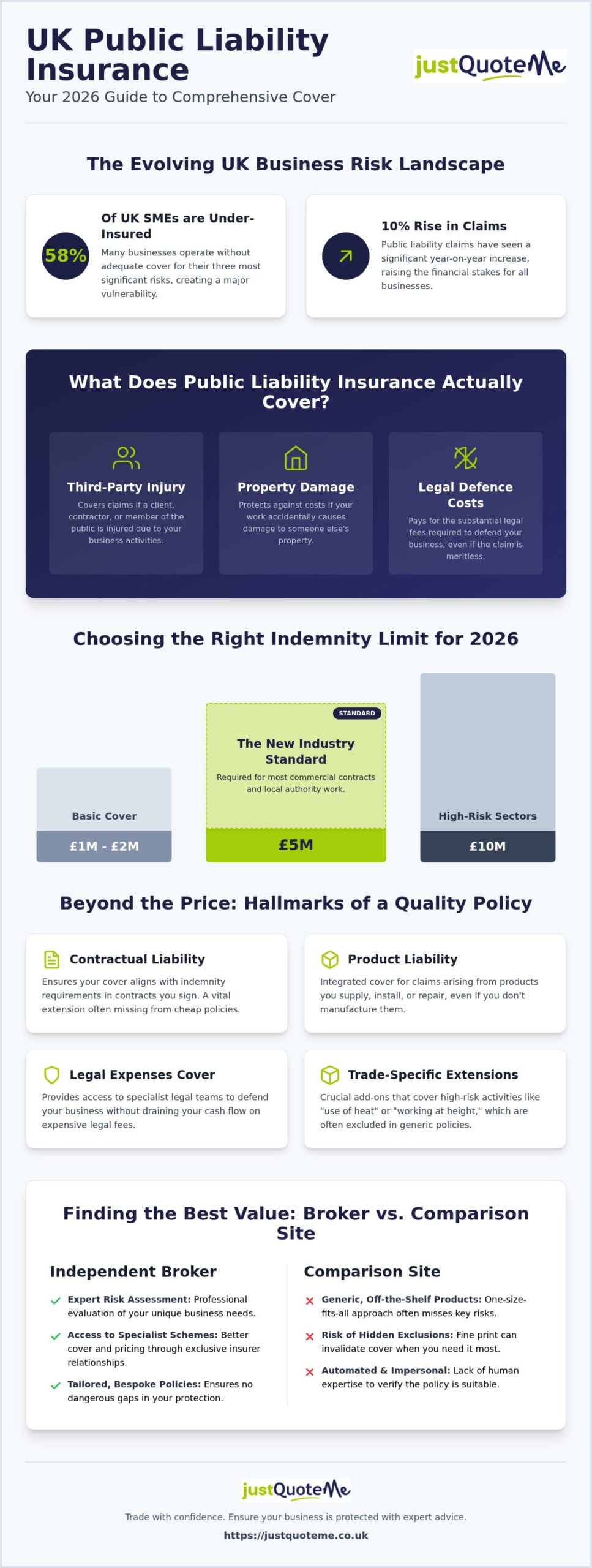
Did you know that 58% of UK SMEs are currently operating without insurance for their three most significant risks? In a 2026 economy where public liability claims have risen by 10% year-on-year, finding the best public liability insurance uk is no longer just a box-ticking exercise; it’s a critical survival strategy. You’re likely feeling the pressure of rising premiums and worrying about those hidden exclusions that turn a cheap policy into a rejected claim. It’s frustrating when you just want to get on with your work without the constant fear of being under-insured or caught in a time-consuming application process.
This guide will show you how to cut through the noise of automated bots and find a policy that matches your specific trade risks while maintaining a frictionless quote process. We’ll explore why £5 million has become the new industry standard for commercial contracts; we’ll also examine how to meet your legal duties under the Insurance Act 2015. You’ll learn how to secure comprehensive, reliable cover that protects your reputation and your bottom line, ensuring you have the expert validation you need to trade with confidence.
Key Takeaways
- Learn how to balance indemnity limits and trade-specific exclusions to find the best public liability insurance uk for your unique business needs.
- Identify the essential policy components, such as contractual liability extensions, that distinguish comprehensive protection from basic, high-risk cover.
- Understand why independent brokers provide better value than comparison sites through access to specialist schemes and expert risk assessment.
- Discover the “fine print” traps and common exclusions that often lead to rejected claims in the UK’s current insurance market.
- Find out how a bespoke quote process can save you time while ensuring your business is never left under-insured.
What Defines the ‘Best’ Public Liability Insurance in the UK for 2026?
Public Liability (PL) insurance in 2026 is far more than a simple administrative requirement; it’s a vital safeguard against the financial volatility of a litigious business environment. This cover protects your business if a member of the public, a client, or a contractor suffers accidental injury or property damage because of your work. While many business owners focus purely on the lowest price, the best public liability insurance uk is actually a strategic balance between a sufficient limit of indemnity, transparent exclusions, and a competitive premium. It’s a bespoke shield designed to address your specific industry risks rather than a generic, off-the-shelf product.
Establishing the baseline for quality starts with regulation. Any provider you consider must be an FCA-authorised firm. This authorisation ensures the broker or insurer adheres to strict codes of conduct and financial standards, providing you with essential security. Working with an established broker like Just Quote Me offers the human-centric expertise needed to verify that your policy isn’t just a piece of paper, but a reliable commitment to your business’s continuity. Ultimately, the best policy is one that offers tailored protection for your specific industry risks.
The Core Purpose of Public Liability Cover
The primary function of this insurance is to handle the costs associated with third-party bodily injury and property damage claims. This includes not only the final compensation award but also the substantial legal defense costs that often accompany these cases. In 2026, legal fees can frequently exceed the actual settlement amount, making robust legal support a cornerstone of any quality policy. By understanding liability insurance as a broader framework of risk management, it becomes clear why public liability insurance is the non-negotiable foundation of a professional insurance portfolio.
Standard Limits of Indemnity in 2026
Choosing an appropriate limit of indemnity is a decision that requires careful thought. While £1 million or £2 million limits are still available, 2026 market trends show that £5 million has become the standard requirement for most commercial contracts and local authority tenders. For businesses working in high-risk sectors or within the public sector, a £10 million limit is increasingly common. This shift is largely driven by wage inflation and the rising costs of medical care, which have significantly increased the value of personal injury claims. If your cover doesn’t meet these contractual minimums, you risk losing valuable work or being left under-insured in the event of a major incident. The best public liability insurance uk for your trade will always align with the specific demands of your clients and the current economic reality.
Key Features to Look for in a Top-Tier Policy
Identifying the best public liability insurance uk requires looking past the monthly premium to the specific protections included. A high-quality policy includes “Contractual Liability” extensions as standard. These are vital for tradesmen who sign agreements with larger firms or local councils, as they ensure your cover aligns with the specific indemnity requirements of your clients. Cheap policies often strip these out to lower the price, leaving you personally liable for contract breaches. You should also look for integrated Product Liability insurance. Even if you don’t manufacture goods, simply supplying a faulty part or a defective piece of equipment can trigger a massive claim. Selecting the best public liability insurance uk means ensuring comprehensive small business public liability insurance bundles these elements to prevent dangerous gaps in your protection.
Legal expenses cover is another hallmark of a top-tier policy. It provides access to specialist legal teams who defend your business against meritless claims. In 2026, the complexity of legal proceedings means these costs can escalate rapidly. Having this as a standard inclusion, rather than an expensive add-on, is a key indicator of a superior provider. It ensures that your defense is handled by experts without draining your company’s cash flow.
Industry-Specific Extensions
Generic policies often contain restrictive clauses that exclude your most common risks. For builders, this might mean exclusions for “working at height” or the “use of heat” such as blowtorches and grinders. Without these extensions, your policy may fail when you need it most. Similarly, those in the security industry require “efficacy cover” to protect against claims arising from a failure to prevent a loss. Hospitality owners should seek specific restaurant insurance features, such as cover for food poisoning or guest property damage. Choosing a bespoke insurance solution ensures these nuances are addressed from day one.
Claims Handling Reputation
The true value of a policy is only revealed during a claim. The best insurers demonstrate a high claims-to-premiums ratio and a history of fair, efficient settlements. While automated platforms often leave you to deal with a faceless claims department, an independent broker acts as your personal advocate. We manage the administrative burden and push for a swift resolution, allowing you to focus on running your business. Researching an insurer’s reputation for support is just as important as comparing their limits of indemnity. A steady hand during a difficult claim can be the difference between business survival and closure.
Insurance Brokers vs. Comparison Sites: Which Offers the Best Value?
When searching for the best public liability insurance uk, many business owners gravitate toward automated comparison sites. These platforms offer immediate gratification and the appearance of a bargain, but they often function as blunt instruments in a complex market. An aggregator’s algorithm is designed to find the lowest price based on a generic set of data points; it isn’t built to understand the unique operational risks of your specific trade. In contrast, an independent broker provides a human-centric approach that prioritises the quality of your protection over the speed of the transaction.
Just Quote Me brings over 30 years of industry experience to this process. We understand that “value” isn’t just the number on your invoice. It’s the assurance that your policy will actually perform when a claim is filed. There’s a common misconception that brokers are more expensive because of their expertise, yet the reality is often the opposite. We have the authority to negotiate directly with a broad network of top UK underwriters, frequently accessing specialist schemes that aren’t listed on public search engines. This bespoke access allows us to strip away unnecessary “filler” cover, often resulting in a more competitive premium for a far superior product.
The Limitations of Comparison Sites
The primary danger of using an automated site is the “tick-box” trap. These generic forms often simplify complex risk details to fit a standard template. Under the Insurance Act 2015, you have a legal duty to make a “fair presentation of risk.” If an automated form misses a crucial detail about your business activities, your insurer could void the policy entirely, leaving you to face claims alone. Furthermore, these sites offer almost no post-purchase support. If you need to make a mid-term adjustment because your business has grown, you’re often left stuck in an endless loop of automated phone menus rather than speaking to a professional who knows your account.
The Broker Advantage: Expert Advice and Access
A broker acts as your personal advocate, ensuring you aren’t paying for cover you don’t need while validating that you aren’t dangerously under-insured. Our consultations involve a deep dive into your daily operations to identify specific vulnerabilities that a computer program would overlook. This level of scrutiny is why 58% of UK SMEs are currently under-insured; they simply haven’t had an expert review their risks. Whether you’re a sole trader or managing a large firm, our Business Insurance packages are built on a foundation of regional expertise and a commitment to your long-term security. We manage the administrative burdens and the technical jargon, so you can focus on your work with total peace of mind.
Avoiding the ‘Cheap Cover’ Trap: Why Claims Get Rejected
Many business owners equate the best public liability insurance uk with the lowest monthly cost. This is a dangerous assumption. In 2026, where over 64,000 public liability claims are recorded annually, a policy that fails at the moment of crisis is a total loss. The best public liability insurance uk isn’t defined by the premium you pay today, but by the payout you receive tomorrow. Cheap policies often contain restrictive “unattended vehicle” clauses within van and tools insurance sections that can void a claim if equipment is stolen while you aren’t physically in the vehicle. These hidden details are exactly what an automated comparison site will overlook.
The Insurance Act 2015 remains a cornerstone of the UK market. It mandates a “Duty of Fair Presentation,” requiring you to disclose every material fact about your business operations. If you use a generic online form that glosses over the nuances of your work, you risk breaching this duty. In 2026, insurers are using more sophisticated data to verify claims; any discrepancy in your original application can lead to a rejected settlement. It’s vital to speak with a human expert who can validate your risk profile before you sign.
A policy that doesn’t pay out is the most expensive one you can buy.
Common Pitfalls for Tradespeople
Tradespeople often face specific “Height Limit” and “Depth Limit” traps. If your policy covers work up to five metres and you sustain a claim at six metres, your insurer will likely walk away. This is why Contractors All Risk Insurance is a necessary companion to Public Liability for builders, as it covers the physical work and materials rather than just the third-party liability. Even your trade description matters. Describing yourself as a “handyman” when you primarily do “carpentry” can lead to a rejected claim because the risk profiles and associated premiums differ significantly. To avoid these errors, you can get a professional assessment of your trade risks.
Ensuring Your Policy is Claim-Ready
Being claim-ready requires more than just paying a premium. You must maintain accurate records, up-to-date risk assessments, and proof of any required certifications. As your business grows or pivots into new sectors, your cover must evolve alongside it. For foundational details on what this cover actually entails, refer to our guide on What Is Public Liability Insurance? A Simple Guide for 2026. Regularly updating your broker on changes to your turnover or staff numbers ensures your protection remains valid and comprehensive.
Securing Your Bespoke Quote with Just Quote Me
The journey from your initial inquiry to a final policy is designed to be entirely frictionless. We begin by understanding your daily operations, identifying the specific risks that a generic algorithm would miss. Once we’ve established your unique risk profile, we leverage our status as an independent broker to select the most appropriate underwriters from our extensive network. This ensures that the best public liability insurance uk for your business isn’t just the one with the lowest price, but the one that offers the most robust protection for your specific sector. We manage the technical details so you don’t have to.
Our independence is our greatest asset because it allows us to put your interests first. We aren’t tied to a single provider, which means we can shop the entire market to find the right fit. This is particularly crucial for high-risk or niche sectors. For example, accessing specialized policies for Nightclubs or Thatched Pubs requires a level of underwriter relationships that automated systems lack. With 30 years of industry experience, we know which insurers have the appetite for your specific risks and which ones offer the most reliable claims support. It’s about peace of mind.
Next Steps for Your Business
If you’re currently relying on a generic policy, the first step is a free expert consultation to audit your current cover. We’ll identify any dangerous gaps, such as the height or depth limits discussed in previous sections, and show you how to transition to a bespoke solution. This process is about moving beyond “good enough” to secure protection that actually performs when you need it. You can start this journey today by using our straightforward online system. Get Your Free Business Insurance Quote now and discover the difference that specialized, human-centric advice makes for your business’s future.
Future-Proofing Your Business Protection
Securing the best public liability insurance uk requires a shift in mindset from finding the lowest price to identifying the most resilient protection. We’ve examined how 2026 economic conditions make robust indemnity limits a commercial necessity; we also highlighted the specific extensions needed for high-risk trades. By moving away from generic, automated systems, you ensure your policy is built to withstand the scrutiny of a major claim.
Just Quote Me provides the expertise of an FCA-authorised firm with over 30 years of experience in the UK market. Our focus on bespoke solutions means your business won’t be left vulnerable to the “cheap cover” traps that lead to rejected claims. We manage the complex administrative burdens so you can focus on growth, backed by the security of a policy that truly fits your operations.
Get Your Free Business Insurance Quote now
Request a Call back for free Expert advice
Frequently Asked Questions
Is public liability insurance a legal requirement in the UK?
Public liability insurance is not a general legal requirement for most UK businesses. The main exception is for horse riding establishments under the Riding Establishments Act 1970. However, it’s often a contractual necessity. Many local authorities and private clients won’t hire you without seeing proof of cover. While not mandated by law, operating without it leaves your personal and business assets exposed to significant financial risk from third-party claims.
How much does the best public liability insurance cost in 2026?
The cost of the best public liability insurance uk varies based on your industry and risk level. In 2026, annual premiums for £2 million of cover typically range from £80 for low-risk consultants to £600 for higher-risk tradespeople. Your specific premium depends on factors like turnover, previous claims history, and the level of indemnity required. Upgrading from £2 million to £5 million usually adds 15% to 30% to the total cost.
What is the difference between public liability and employers’ liability insurance?
Public liability covers claims from third parties, such as clients or passersby, for accidental injury or property damage. Employers’ liability is a legal requirement if you have one or more employees. Under the Employers’ Liability Act 1969, you must have at least £5 million in cover to protect staff against work-related illness or injury. Most businesses bundle these together to ensure full protection for both the public and their workforce.
Can I get public liability insurance for a one-day event?
Yes, you can secure specialized cover for short-term needs through events insurance. This is ideal for organizers or exhibitors who only require protection for a single day or a weekend. If you are planning an occasion and hiring a professional service like Partineez Events for luxury styling, ensuring you have the right event insurance is a key part of the planning process. These policies provide the same level of indemnity as annual cover but are tailored to the specific duration of your function, ensuring you meet venue requirements without the commitment of a full yearly contract.
Does public liability insurance cover my own tools and equipment?
Standard public liability insurance does not cover your own property, tools, or equipment. Its primary purpose is to protect you against claims made by others. To protect your own assets, you need to add specific extensions such as plant and machinery insurance or van and tools insurance. These additions cover theft or damage to your essential gear, ensuring your business can continue operating even if your equipment is lost or stolen.
How do I know if my public liability limit is high enough?
Determining the correct limit depends on your contractual obligations and the potential scale of a claim. In 2026, £5 million has become the standard requirement for most local authority and commercial contracts. If you work in high-risk environments or public spaces, you should consider if a lower limit would cover legal fees and compensation for a major incident. Reviewing your specific trade risks with an expert broker helps validate your chosen indemnity level.
What happens if I don’t have public liability insurance?
Without this insurance, your business is personally liable for any compensation awards and legal defense costs. These expenses can easily reach tens of thousands of pounds, even for minor incidents. Beyond the financial risk, you’ll likely find it impossible to secure work with reputable clients or local councils. Many venues and professional bodies require proof of cover as a condition of entry, effectively locking uninsured businesses out of the market.
Can a broker really get me a better deal than a comparison site?
A broker often secures the best public liability insurance uk by accessing specialist schemes that aren’t available on automated comparison sites. We use our 30 years of experience to negotiate directly with underwriters, ensuring you don’t pay for unnecessary filler cover. Unlike aggregators, we provide human advocacy during the claims process and ensure your policy meets the “Duty of Fair Presentation.” This bespoke approach prevents the costly trap of being under-insured.
Article by
Just Quote Me
JustQuoteMe Ltd is an independent UK insurance brokerage specialising in business and personal insurance solutions. With over 35 years of industry experience, the company provides tailored insurance cover for businesses, landlords, tradespeople, hospitality venues, fleets, and individuals across the UK. Known for its personal service, expert advice, and competitive premiums, JustQuoteMe Ltd works with leading insurers to deliver bespoke policies designed around each client’s unique needs. The company is authorised and regulated by the Financial Conduct Authority (FCA No. 586607) and has built a reputation for trusted, straightforward insurance guidance and long-term client relationships.

by jqm | Aug 30, 2026 | Insurance
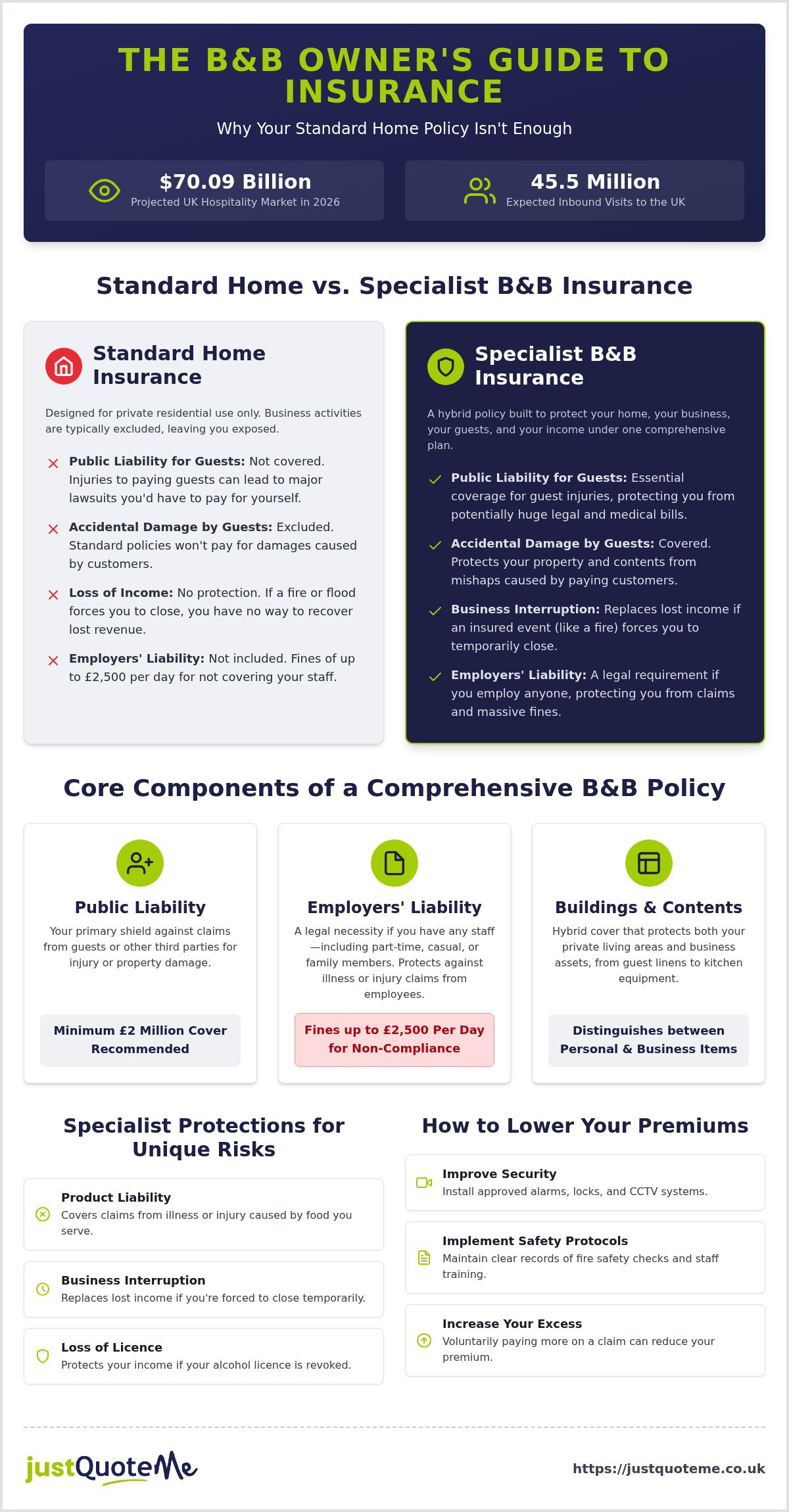
What if the very insurance policy you rely on to protect your home actually leaves you completely exposed the moment you welcome a paying guest? Many owners mistakenly believe their standard residential cover extends to their business, but the reality is that without specialist b&b insurance, you could face catastrophic financial losses from a single accident or legal claim. With the UK hospitality market projected to reach $70.09 billion in 2026 and inbound visits expected to hit 45.5 million, the risks of operating without professional protection have never been higher.
We understand that managing the administrative side of a guest house feels overwhelming, especially when you’re trying to balance domestic comfort with commercial regulations. It’s natural to feel anxious about liability claims or the impact of a sudden loss of income on your livelihood. This guide provides the clarity you need to safeguard your property and stay compliant with UK law. We’ll explore bespoke cover options, explain legal requirements like employers’ liability, and show you how to secure total peace of mind for both your personal assets and your business future.
Key Takeaways
- Learn why standard home policies are insufficient and how specialist b&b insurance provides the hybrid protection your guest house needs.
- Identify essential legal requirements, including Employers’ Liability, to ensure your business stays compliant with UK employment regulations.
- Discover how to protect against niche hospitality risks such as food-related product liability and the sudden loss of your alcohol licence.
- Explore actionable ways to lower your insurance costs by implementing smart security upgrades and rigorous safety protocols.
- Understand the value of a human-centric broker in securing off-market rates and bespoke coverage tailored to your specific property.
Why Standard Home Insurance Isn’t Enough for Your B&B
Running a bed and breakfast is a rewarding venture, but it represents a fundamental shift in how your property is viewed by underwriters. Standard home insurance is designed for private residential use, where risks are predictable and limited to family or occasional social visitors. Once you enter the hospitality industry, your risk profile changes entirely. Insurers view “paying guests” as a significant commercial exposure because their presence increases the likelihood of accidental damage, theft, and personal injury claims. Unlike friends or family, guests expect a professional standard of care, and your liability for their safety is legally much higher.
Most residential policies contain strict exclusions for business activities, meaning a standard provider will likely void a claim if an incident involves your guest house operations. In 2026, the legal distinction between a private lodger and a commercial guest is sharper than ever. While a lodger shares your home under a license to occupy, a B&B guest is a consumer of a professional service. This triggers a wide array of safety regulations and liability requirements that residential policies aren’t built to handle. Common pitfalls that lead to rejected claims include:
- Accidental damage: Damage caused specifically by paying guests is rarely covered under domestic plans.
- Public liability: Standard home insurance doesn’t cover injuries sustained by guests on your premises.
- Theft: Policies often exclude theft if there’s no evidence of forced entry, which is common in guest house settings.
The “Change of Use” Clause Explained
Insurers use “change of use” clauses to define the primary purpose of your property. If you transition from a private dwelling to a place of business without informing your provider, you’ve breached the insurance contract. This non-disclosure can lead to total policy cancellation. For owners of heritage or unique properties, accurate descriptions are vital. A standard algorithm might miss the nuances of a Grade II listed building, but a specialist hotel and guest house insurance policy ensures every architectural detail is protected under the correct commercial classification.
Protecting Your Personal Space and Business Assets
One of the biggest challenges for owners is separating their personal lives from their professional ones. Specialized b&b insurance solves this by offering a hybrid structure that protects both. It provides contents cover that distinguishes between your private belongings and business assets, such as guest linens or industrial kitchen equipment. Crucially, it also protects your private living quarters during business hours. b&b insurance acts as the bridge between landlord insurance and standard home cover. This ensures that whether a pipe bursts in your private bathroom or a guest suite, your entire property remains secure.
The Core Components of a Comprehensive B&B Policy
A robust b&b insurance policy isn’t a single product; it’s a collection of safeguards designed to protect different parts of your operation. While your property is your home, it’s also a commercial venue, which means you need specific layers of protection that go beyond residential limits. These components work together to ensure that a single accident or unforeseen event doesn’t lead to financial ruin.
Public Liability: Your Primary Shield
Public liability acts as your primary defense against claims from third parties. If a guest slips on a wet floor in the hallway or trips over a loose rug in the dining area, you could be held responsible for their medical costs and legal fees. Real-world incidents like these are common in high-traffic common areas. Many industry experts recommend a minimum of £2 million in cover to handle these potential costs. This is similar to requirements seen globally, where authorities often mandate special insurance to rent out your property to ensure guest safety is prioritized. You can find more details on how this works on our public liability insurance page.
Employers’ Liability for Small Teams
If you employ anyone, even on a casual basis, UK law is very clear. Employers’ liability is a legal requirement. This applies to part-time cleaners, seasonal breakfast staff, or even family members who aren’t on a formal contract. The consequences of non-compliance are severe. Operating without valid cover can result in a fine of up to £2,500 for every single day you’re uninsured. Our employers liability insurance section breaks down these legal obligations in detail to help you stay protected.
Beyond liability, your policy must address the physical and financial health of your business. Buildings and contents cover protects the physical structure and your inventory, from high-end mattresses to commercial kitchen equipment. Finally, business interruption cover serves as your financial safety net. If a fire or flood makes your guest house uninhabitable, this cover replaces the lost income you would have earned while the property is being repaired. Choosing a bespoke hospitality insurance policy ensures these components are weighted correctly for your specific property and risk level.
Specialist Protections for Unique Guest House Risks
Beyond the standard building and liability covers, guest house owners face specific operational challenges that generic policies often overlook. Whether you’re serving a locally sourced breakfast or hosting guests in a centuries-old manor, your insurance needs to account for these niche exposures. Implementing robust risk management practices is essential to identify these gaps before they result in a claim.
Catering and Food Safety Risks
The “breakfast” element of your b&b insurance isn’t just a marketing tool; it’s a potential legal liability. Product liability insurance is vital for any guest house that prepares food. Even a simple continental spread carries risks related to food poisoning or undisclosed allergens. If a guest suffers an allergic reaction to an unlabelled ingredient, the legal and compensatory costs can be staggering. Integrating strict food hygiene standards into your daily routine helps, but product liability provides the financial safety net if something goes wrong despite your best efforts.
Many owners also choose to offer an “honesty bar” or serve alcohol with evening meals. If your business model relies on these sales, loss of licence cover is indispensable. This protection compensates you for the loss of income or the reduction in property value if your alcohol permit is revoked through no fault of your own. It ensures that a regulatory hurdle doesn’t end your business’s profitability overnight.
Insurance for Thatched and Heritage B&Bs
If your property is a historic building or features a traditional thatched roof, you already know that standard insurers are often hesitant to offer cover. The unique fire risks associated with thatch and the high cost of specialist repairs for Grade II listed buildings require a bespoke approach. We draw on our experience in thatched pub insurance to help guest house owners find underwriters who understand these heritage risks. Specialist cover ensures that if a fire or structural issue occurs, you have access to the right craftsmen and materials to restore your property to its original state. For heritage properties requiring specific expertise, firms like Avon Peak Roofing Bristol can provide the necessary skills for intricate leadwork and slate repairs that insurers expect.
Finally, don’t overlook guest effects cover. While guests are usually responsible for their own travel insurance, providing a level of protection for their belongings while they’re on your premises builds significant trust. It covers theft or damage to guest property within the guest house, providing an extra layer of service that differentiates your business from larger, more impersonal hotels. Managing these specialist risks ensures your b&b insurance is as unique as the property you run.
Reducing your b&b insurance costs requires a shift from passive price comparison to active risk reduction. In a market where the UK hospitality sector is projected to grow to over $70 billion in 2026, underwriters are increasingly rewarding owners who demonstrate a commitment to safety through technology and rigorous documentation. You can secure more competitive rates by proving that your property is a lower risk than the industry average.
One of the most effective ways to influence your quote is through security upgrades. Installing high-definition CCTV in common areas and fitting smart locks on guest rooms provides a digital audit trail that traditional keys cannot match. These systems reduce the likelihood of unauthorized access and help resolve disputes quickly. Additionally, choosing the right excess level is a practical way to balance your monthly outgoings. While a higher voluntary excess lowers your premium, you must ensure it remains an amount you can comfortably afford if you need to make a claim. Bundling your various protections into a single bespoke policy is also more cost-effective than managing separate domestic and commercial covers.
Proactive Risk Management
Insurers look for evidence of a managed environment. This means staying on top of regular fire risk assessments and ensuring all electrical equipment undergoes annual PAT testing. Maintaining accurate guest registers and utilizing digital check-in systems also improves your risk profile by ensuring you always know exactly who is on the premises. A documented safety history can significantly lower annual premiums by providing insurers with clear evidence that you prioritize guest welfare and property maintenance. This proactive approach shows underwriters that you’re a responsible operator, which often unlocks “off-market” rates not available to the general public.
Evaluating Your Rebuild Costs
Under-insurance remains a critical threat to guest house owners, especially during periods of rising construction costs. Many owners base their building cover on the market value of their property, but insurance is concerned with the “reinstatement value”—the total cost to rebuild from scratch. If you’re under-insured, providers may apply the “condition of average,” which reduces your claim payout proportionally. Using professional appraisals to satisfy underwriter requirements ensures your cover is accurate and prevents you from overpaying for unnecessary protection or being left short during a disaster. To ensure you aren’t paying more than necessary for your protection, Just Quote Me on your next renewal for a tailored assessment of your needs.
Choosing a Bespoke Policy with Just Quote Me
While automated comparison sites offer speed, they often fail to grasp the nuances of the hospitality sector. A generic algorithm doesn’t understand the difference between a modern guest house and a 17th-century thatched property. Choosing the right b&b insurance requires a human-centric approach that balances domestic comfort with commercial liability. At Just Quote Me, we act as your advocate, navigating the complexities of the market so you can focus on your guests.
The Advantage of Independent Brokerage
As an independent broker, we aren’t tied to a single provider. This independence allows us to evaluate your specific guest house needs without bias. We compare the market on your behalf, looking beyond the headline price to find the best value-to-protection ratio. This often involves accessing “off-market” rates from a broad panel of top UK underwriters that aren’t available on standard comparison engines. By tailoring a policy to your unique risk profile, we ensure you aren’t paying for redundant cover. You can explore our specific hotel and guest house insurance options to see how we structure these bespoke solutions.
Expert Advice and Regional Knowledge
With over 30 years of industry experience, we have a deep understanding of the local landscape in Staffordshire and the West Midlands. Whether your property is in Newcastle-under-Lyme, Stone, or Stafford, we understand the regional factors that influence your risk. This local expertise allows us to provide more accurate advice than a distant, automated system. We don’t just sell you a policy; we develop a long-term partnership. We’re here for your annual renewals, policy adjustments as your business grows, and, most importantly, personalized claims support. If something goes wrong, you have a steady hand and a knowledgeable partner to manage the administrative burden and fight your corner.
Securing the Future of Your Guest House
Protecting your bed and breakfast in 2026 requires more than just a generic policy. It’s about understanding the unique risks of the hospitality sector and ensuring your personal home and business assets are correctly separated. By prioritizing essential covers like public liability and implementing proactive risk management, you can lower your premiums while staying fully compliant with UK law.
As an FCA Authorised Independent Broker with over 30 years of hospitality expertise, we simplify the complex administrative burden of b&b insurance. We provide the steady hand you need to navigate this market, offering access to off-market rates and personalized support that automated systems simply cannot match. Our team is dedicated to providing a human-centric alternative to the industry’s digital noise.
If you’re ready to protect your livelihood with a policy tailored to your specific property, we are here to help. Host with confidence knowing your assets are secure.
Get Your Free Business Insurance Quote now
Request a Call back for free Expert advice
Frequently Asked Questions
Is B&B insurance a legal requirement in the UK?
Employers’ liability insurance is the only component that is strictly a legal requirement if you employ any staff, including casual cleaners or seasonal help. While other covers like public liability aren’t mandated by law, they are often required by mortgage lenders and booking platforms. Operating without these protections leaves you personally liable for legal fees and compensation costs that could easily bankrupt a small business.
Does standard home insurance cover my bed and breakfast?
Standard home insurance doesn’t cover commercial activities or paying guests. Welcoming guests for profit changes your property’s risk profile, which usually voids a domestic policy immediately. You need specialized b&b insurance to bridge the gap between your private life and your business. This ensures that both your residential dwelling and your commercial hospitality operations are fully protected under one comprehensive, hybrid agreement.
How much does B&B insurance cost on average in 2026?
Premiums vary based on the number of guest rooms, your property’s location, and your previous claims history. Factors like building reinstatement values and chosen liability limits also play a significant role in determining the final price. Because every guest house is unique, we don’t provide generic averages. Instead, we offer bespoke quotes that reflect the actual risks of your specific operation and property type.
What is the difference between guest house insurance and hotel insurance?
The main difference lies in the scale of the operation and the owner’s living arrangements. Guest house insurance is tailored for smaller properties where the owner often lives on-site. Hotel insurance is designed for larger, commercial-only buildings that may feature extensive facilities like gyms, spas, or large-scale public restaurants. These larger venues, such as the nature-oriented Tanjung Inn, require higher liability limits and more complex business interruption structures than a typical B&B.
Do I need insurance if I only have one guest room?
Yes, you need protection even if you only host one guest at a time. A single accident involving a paying guest can lead to a substantial liability claim that a standard home policy will not cover. Specialized b&b insurance protects you from the moment a guest enters your property. It ensures your home remains secure and your personal finances stay protected regardless of your business’s size.
Can I get insurance for a B&B with a thatched roof?
You can certainly get cover, but it requires a specialist broker who understands heritage risks. Many high-street insurers refuse to cover thatched properties due to the perceived fire risk and the high cost of traditional repairs. We use our extensive experience with thatched buildings to find underwriters who provide comprehensive protection. This ensures your historic property is insured for its true rebuild value using authentic materials.
What happens if a guest sues me for food poisoning?
This situation is handled under the product liability section of your policy. Your insurer will manage the legal defense and cover any awarded compensation, provided you’ve maintained required food safety standards. This protection is vital for anyone serving food, as even a minor incident can result in a complex legal battle. It provides the financial security needed to keep your business running while the claim is resolved.
Article by
Just Quote Me
JustQuoteMe Ltd is an independent UK insurance brokerage specialising in business and personal insurance solutions. With over 35 years of industry experience, the company provides tailored insurance cover for businesses, landlords, tradespeople, hospitality venues, fleets, and individuals across the UK. Known for its personal service, expert advice, and competitive premiums, JustQuoteMe Ltd works with leading insurers to deliver bespoke policies designed around each client’s unique needs. The company is authorised and regulated by the Financial Conduct Authority (FCA No. 586607) and has built a reputation for trusted, straightforward insurance guidance and long-term client relationships.

by jqm | Aug 29, 2026 | Insurance
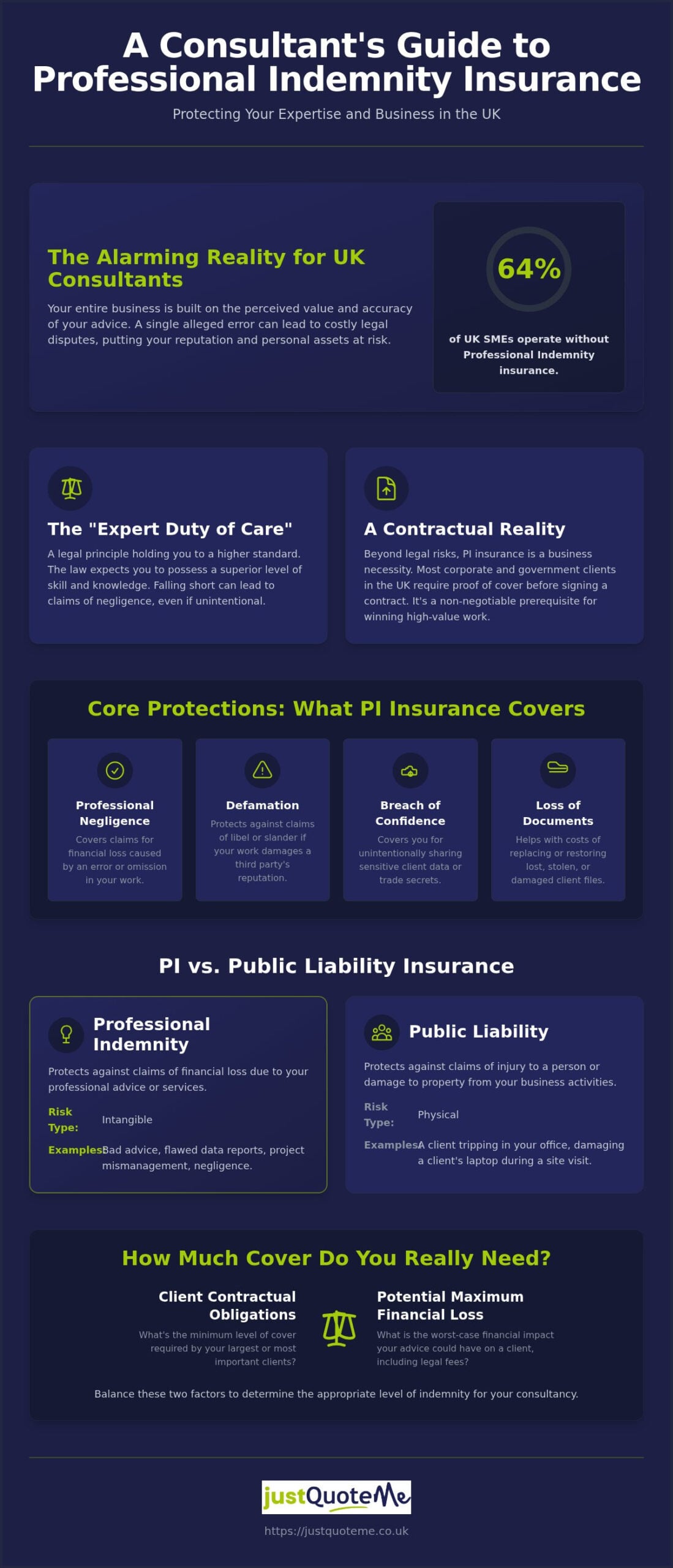
Did you know that 64% of UK SMEs currently operate without professional indemnity insurance? For a consultant, this statistic is particularly alarming because your entire business relies on the perceived value and accuracy of your advice. A single misunderstood clause or an alleged error in a project can lead to a costly legal dispute that puts your personal assets at risk. We know that trying to decode complex legal jargon while meeting strict contractual requirements often feels like an administrative headache you would rather avoid.
Securing the right professional indemnity insurance for consultants uk shouldn’t be a source of constant worry. You’ve spent years building your reputation; you need protection that’s as specialised as the expertise you provide. This 2026 guide offers a pragmatic look at protecting your consultancy against negligence claims and fulfilling the insurance requirements needed to win high-value contracts. We’ll explain how “claims-made” policies work and help you determine the exact level of cover required for your specific sector. You will gain the clarity needed to manage your risks and focus on delivering results for your clients with total peace of mind.
Key Takeaways
- Learn why the “Expert Duty of Care” places a higher legal responsibility on consultants for the financial impact of their professional advice.
- Discover the core protections offered by PI insurance, from defending against negligence claims to managing complex defamation risks.
- Understand the vital differences between intangible advice risks and physical damage to ensure you select the right professional indemnity insurance for consultants uk.
- Gain a clear framework for calculating your cover levels by balancing client contractual obligations against your potential maximum financial loss.
- Explore the advantages of using an expert broker to secure bespoke protection that accounts for the unique nuances of your specific consultancy sector.
Why Consultants Need Professional Indemnity Insurance in 2026
Consultants are hired for their expertise, but this specialized knowledge carries a significant legal burden. Professional Indemnity (PI) insurance covers legal costs and compensation payments if a client alleges that your advice or services caused them a financial loss. In the UK, this is often referred to as Professional liability insurance (PLI). It acts as a shield between your business assets and the high costs of legal disputes, providing a safety net when projects don’t go as planned.
The legal landscape for professionals is defined by an “Expert Duty of Care.” This principle means the law expects you to possess a higher level of skill and knowledge than a general business owner. If your advice falls short of these professional standards, you’re vulnerable to claims of negligence, misrepresentation, or inaccurate feasibility studies. Beyond the legal risks, holding professional indemnity insurance for consultants uk is a contractual reality. Most corporate and government entities won’t sign a contract without seeing proof of cover; it’s a prerequisite for doing business in the modern UK market.
The Financial Impact of Advice-Based Risks
A single miscalculation in a data report or a flawed strategic recommendation can ripple through a client’s organization, causing substantial third-party financial damage. For a UK consultant in 2026, the duty of care is a legal obligation to provide advice and services with the level of skill and care reasonably expected from a competent professional in your specific field. This obligation remains a constant factor even if your contract attempts to limit your total liability.
The true danger often lies in the cost of defense. Even if you are ultimately found not liable, the legal fees required to prove your innocence can be financially devastating. Professional indemnity insurance manages these administrative and financial burdens so you don’t have to face them alone. It covers everything from specialist solicitor fees to court costs, ensuring a single dispute doesn’t bankrupt your consultancy.
Who is Classified as a Consultant for Insurance Purposes?
Insurers look at the nature of your advice to determine your risk profile. While many roles fall under the “consultant” umbrella, specific sectors face unique challenges:
- Management and Business Consultants: Those providing strategic direction, operational restructuring, or efficiency advice.
- IT and Software Consultants: Professionals advising on infrastructure, cybersecurity, or large-scale software implementations where downtime equals lost revenue.
- Marketing, HR, and Education Consultants: Specialists providing industry-specific knowledge where errors could lead to regulatory fines, employment disputes, or brand damage.
Regardless of your specific niche, having tailored professional indemnity insurance for consultants uk ensures that your unique risks are covered without paying for unnecessary extras.
Core Coverage: What Does PI Insurance Protect Against?
Professional indemnity insurance for consultants uk provides a broad safety net that extends far beyond simple mistakes. At its heart is coverage for professional negligence. This triggers when an error or omission in your work leads to a tangible loss for your client. For instance, if a management consultant provides a financial model with a broken formula that results in a client over-investing, PI insurance covers the resulting claim and associated legal fees.
The policy also addresses civil liabilities like defamation. If a report you produce contains statements that damage a third party’s reputation, you could face libel or slander claims. Similarly, a breach of confidence occurs if you unintentionally share sensitive client data or trade secrets. These protections align with FCA requirements for PII, which emphasize the need for firms to have adequate resources to meet their professional liabilities and protect client interests.
Loss of documents is another critical feature often overlooked. If physical or digital files belonging to a client are lost, stolen, or damaged while in your care, the policy covers the costs of replacing or restoring them. While modern consultants often rely on cloud storage, the administrative burden and technical cost of reconstructing lost project data can be significant without insurance support.
Intellectual Property and Copyright Infringement
Consultancy presentations and reports often involve complex data and visual aids. Unintentional copyright infringement can happen if third-party images or proprietary data are used without the correct licensing. Your PI cover handles disputes over creative or strategic ownership, defending you against infringement claims. For those handling particularly large or sensitive datasets, it’s often wise to pair this with Cyber Insurance to address data breach response costs and digital extortion risks.
Negligent Misstatement and Misrepresentation
Negligent misstatement and misrepresentation are common pitfalls for advisors. These arise when a consultant over-promises specific results or misrepresents the benefits of a proposed strategy during the sales process. Even if the claim is meritless, legal defense costs are covered during the investigation phase. Maintaining accurate record-keeping is essential to support any insurance claim, as it provides the evidence needed to refute allegations of misconduct. If you aren’t sure which specific risks apply to your niche, you can speak with a specialist broker to refine your professional indemnity insurance for consultants uk and ensure no gaps remain.
Professional Indemnity vs. Public Liability: Key Differences for Consultants
Choosing the right professional indemnity insurance for consultants uk involves understanding exactly where one policy ends and another begins. While both protect your business, they address entirely different categories of risk. Professional Indemnity (PI) focuses on the “intangible” output of your work. This includes your strategic advice, technical designs, or professional services. If a client suffers a financial loss because your advice was flawed, PI is the policy that responds to the legal challenge.
In contrast, Public Liability (PL) insurance covers “tangible” risks. These are physical events involving injury to people or damage to physical property. To illustrate the difference, consider a management consultant. If they recommend a restructuring plan that fails and causes the client to lose £100,000, that is a PI claim. However, if that same consultant visits the client’s office and the client trips over their laptop cable, resulting in a broken wrist, that is a Public Liability claim. Most consultants require both to ensure comprehensive protection across all aspects of their operations.
When is Public Liability Essential for Consultants?
Even if your work is primarily desk-based, you likely interact with the physical world in ways that create liability. Public Liability is essential for consultants who work from client offices or visit third-party sites for meetings and audits. It is equally important if you host clients at your own business premises in Staffordshire or the West Midlands. A simple coffee spill over a client’s high-end laptop or a slip on a wet floor can lead to significant compensation claims. For detailed guidance on these physical risks, you can review our dedicated page on Public Liability Insurance.
The Concept of Civil Liability
Modern PI policies often use “Civil Liability” wording, which is a broader and more protective standard than older “Negligence Only” policies. While a negligence policy only triggers if you make an error, a civil liability policy covers any civil claim arising from your professional conduct, unless specifically excluded. This includes things like breach of contract or unintentional intellectual property theft. We always recommend Professional Indemnity Insurance with civil liability wording as the primary shield for advice-based work. It provides the widest possible safety net for your reputation and personal assets, ensuring that your professional indemnity insurance for consultants uk stays robust even in complex legal disputes.
Calculating Your Cover: How Much Indemnity Do You Really Need?
Determining the correct level of professional indemnity insurance for consultants uk starts with a thorough review of your client contracts. Most corporate or public sector agreements specify a minimum limit of cover, which typically ranges from £1 million to £5 million depending on the project’s scale. However, you shouldn’t rely solely on these contractual minimums. You also need to estimate your “Potential Maximum Loss.” This is the total financial damage a client could realistically suffer if your advice is entirely incorrect. If you’re providing strategic direction for a multi-million pound acquisition, a standard £1 million policy might leave you dangerously underinsured.
Retroactive dates are another vital consideration for any established advisor. Professional indemnity is a “claims-made” insurance, meaning the policy must be active when the claim is filed, not necessarily when the work was performed. A retroactive date ensures you stay protected for projects completed months or years before your current policy started. Without this specific provision, you could face a significant gap in cover that exposes your personal assets to historic errors. Most UK consultants opt for a standard limit of at least £2 million to remain competitive for larger tenders while maintaining a robust safety net.
Understanding “Any One Claim” vs “Aggregate” Limits
The structure of your limit is just as important as the total amount. An “Any One Claim” policy provides the full limit for every separate claim made during the policy year. If you have a £1 million limit and face two separate £800,000 claims, you’re covered for both. In contrast, an “Aggregate” limit is the total amount the insurer will pay for all claims combined in a year. If multiple disputes arise, an aggregate limit can be exhausted quickly, leaving you to pay any remaining costs out of pocket. You should consult with an expert to determine which structure fits your consultancy risk profile.
The Role of Run-Off Cover
Professional liability doesn’t end the day you stop trading or enter retirement. The UK legal system allows for a “long tail” of claims, meaning a client could allege negligence years after a project is finished. Run-off cover provides essential protection after you close your business, ensuring that if a historic error comes to light, you still have the financial backing to defend yourself. Managing the cost of run-off cover is much simpler through a specialist broker who can negotiate terms based on your tapering risks. If you’re unsure about your current liability levels, you can get a bespoke assessment from our team to ensure your protection is accurate and cost-effective.
Securing Bespoke Protection with a UK Insurance Broker
While automated quote engines promise speed, they often lack the professional nuance required for specialized consulting. “One-size-fits-all” online policies frequently fail consultants with unique niches because they don’t account for the specific legal and contractual complexities of your advice. Choosing an independent, FCA-authorised broker offers a human-centric alternative to these rigid systems. Expert advisors take the time to understand your sector, ensuring your professional indemnity insurance for consultants uk provides genuine security rather than just a certificate for your files.
Industry data shows that over 85% of all UK professional indemnity premium is placed through insurance brokers. This dominance exists because brokers can access a broad network of top UK insurers to find competitive, non-standard rates that direct insurers often ignore. In the “soft” market phase of 2026, where insurer competition is high, a specialist broker is essential for negotiating the most flexible terms and robust coverage levels for your specific risk profile. This expert-led approach handles the complex administrative burdens so you don’t have to.
Expert Advice vs. Automated Quote Engines
Automated systems rely on “tick-box” logic that can leave you dangerously exposed. This rigid approach often misses critical professional exposures, such as specific contractual liabilities or unique industry risks that don’t fit into a standard drop-down menu. Just Quote Me uses over 30 years of industry experience to identify these hidden gaps before they lead to a claim. If you need a Commercial Insurance Broker Staffordshire professionals can trust, our team provides the regional expertise and steady hand needed to navigate a complex market.
Streamlining Your Business Administration
Securing a policy is only the first step; managing it effectively is where the real value lies. We handle the administrative tasks of mid-term adjustments and policy renewals, ensuring your cover keeps pace as your consultancy evolves. If a dispute arises, we act as your advocate, managing the communication with underwriters and providing professional support throughout the claims process. This personalized service is a vital part of a comprehensive Business Insurance strategy. It ensures that when you face an administrative or legal challenge, you aren’t dealing with an automated phone line, but a dedicated partner who understands your business. To further enhance your professional success by optimizing business and investment performance, you can discover KHT Accounting & Wealth.
Providing expert advice in 2026 requires more than just industry knowledge; it demands a robust shield against the specific risks of your sector. We have addressed the “Expert Duty of Care” and the critical difference between intangible advice risks and physical property damage. Securing professional indemnity insurance for consultants uk isn’t just about ticking a box; it’s about ensuring your personal assets and professional reputation remain intact if a project goes off course.
As an FCA-authorised independent broker with over 30 years of industry experience, Just Quote Me provides a human-centric alternative to automated systems. We access a broad network of top UK insurers to find bespoke rates that reflect your unique consultancy niche. You don’t have to manage complex administrative burdens alone. Our team provides the expert-led support you need to secure the peace of mind you deserve.
Get Your Free Business Insurance Quote now
Request a Call back for free Expert advice
Frequently Asked Questions
Is professional indemnity insurance a legal requirement for UK consultants?
Professional indemnity insurance isn’t a legal requirement for most UK consultants in the same way that employers’ liability is. However, it’s often a mandatory requirement for members of professional bodies. Most corporate and government contracts won’t allow you to start work without proof of cover. It’s a commercial necessity that protects your personal assets from the high costs of negligence claims while ensuring you remain eligible for high-value tenders and corporate projects.
What is a retroactive date in professional indemnity insurance?
A retroactive date is the specific point in time from which your insurer agrees to cover your professional activities. Since professional indemnity insurance for consultants uk is written on a claims-made basis, you need this date to cover work completed before your current policy started. If you’ve been consulting for years but only started this policy today, you’ll need a retroactive date that goes back to your original start date to avoid dangerous coverage gaps.
Does professional indemnity insurance cover work done by subcontractors?
Most policies cover the work you do through subcontractors, but you must check the specific terms of your agreement. Usually, you are legally responsible for the advice or designs provided by anyone you hire to assist on a project. We recommend ensuring your subcontractors have their own professional indemnity insurance. This allows your insurer to pursue them for costs if their specific error leads to a claim against your consultancy, protecting your own claims history.
What happens if I forget to renew my professional indemnity insurance?
Forgetting to renew is a serious risk because professional indemnity operates on a claims-made basis. If your policy lapses, you lose protection for all work completed in the past, even if you had cover at the time. A claim must be notified while a policy is active to be valid. To avoid this, our team at Just Quote Me manages your renewals and provides professional support to ensure your protection remains continuous and robust.
Can I cancel my professional indemnity insurance if I stop consulting?
You can cancel your policy when you stop consulting, but doing so without run-off cover leaves you exposed to future claims. In the UK legal system, clients can often bring a claim several years after a project ends. Run-off cover provides a safety net for your past advice after you’ve retired or closed your business. It’s a pragmatic way to protect your savings and personal assets from the long tail of professional liability.
Is professional indemnity insurance tax-deductible for sole traders?
Yes, professional indemnity insurance is generally considered a wholly and exclusively business expense by HMRC. This means you can deduct the full cost of your premiums from your taxable income when filing your self-assessment. This tax efficiency helps offset the cost of maintaining high-quality professional indemnity insurance for consultants uk. To ensure you are claiming all eligible business costs correctly, especially if you provide your services through digital platforms, you can check out Fair View Accounting Services for guidance on selecting the right financial expert. Always keep your policy documents and payment receipts safe to support your annual tax returns.
Any One Claim means the full limit of indemnity is available for every separate claim made during the policy period. If you have a £1 million limit, the insurer will pay up to that amount for each individual dispute. In the Aggregate is different; it’s the total amount the insurer will pay for all claims combined in one year. Once that pot is empty, you’re responsible for any further legal costs or compensation payments yourself.
How do I make a claim on my professional indemnity policy?
You should notify your broker as soon as you become aware of a potential claim or a circumstance that might lead to one. Don’t wait for a formal legal letter to arrive. Early notification allows the insurer’s legal team to manage the situation before it escalates into a full dispute. At Just Quote Me, we act as your advocate throughout the process. We manage the complex administrative communications with underwriters so you don’t have to.
Article by
Just Quote Me
JustQuoteMe Ltd is an independent UK insurance brokerage specialising in business and personal insurance solutions. With over 35 years of industry experience, the company provides tailored insurance cover for businesses, landlords, tradespeople, hospitality venues, fleets, and individuals across the UK. Known for its personal service, expert advice, and competitive premiums, JustQuoteMe Ltd works with leading insurers to deliver bespoke policies designed around each client’s unique needs. The company is authorised and regulated by the Financial Conduct Authority (FCA No. 586607) and has built a reputation for trusted, straightforward insurance guidance and long-term client relationships.

by jqm | Aug 28, 2026 | Insurance
An estimated 14% of UK landlords, which accounts for around 400,000 individuals, currently operate without specialist insurance despite the significant risks involved. In a market where premiums have risen by 17% annually, finding a competitive landlord insurance quote uk has become a complex task that requires more than just a quick search on a comparison site. You’ve likely noticed that generic policies often ignore the nuances of your specific property or tenant type, leaving you frustrated by the fear of claim rejection.
We understand that your time is valuable and the 2026 rental market feels increasingly restrictive. This article provides a clear roadmap to securing bespoke cover that actually protects your investment without overstretching your budget. We’ll examine the impact of the Renters’ Rights Act on your risk profile, explain why the standard for liability is shifting to £5 million, and show why you should Just Quote Me for your next renewal to ensure you aren’t left under-insured by an automated system.
Key Takeaways
- Learn why standard residential policies are insufficient and how specialist cover protects against malicious damage and legal fees.
- Understand the key factors affecting your landlord insurance quote uk, including how tenant demographics and local crime statistics influence your premium.
- Discover the “Speed vs. Accuracy” trade-off and why independent brokers provide a more reliable alternative to automated comparison sites.
- Follow our checklist to gather essential information, such as accurate rebuild costs, to ensure your policy is valid when you need it most.
- Explore the streamlined process of expert review that balances competitive pricing with the bespoke protection your property requires.
Understanding Landlord Insurance Quotes: More Than Just a Number
A landlord insurance quote uk is far more than a simple expense to be minimized. It is a critical risk assessment that acknowledges the commercial nature of your property investment. Many new investors mistakenly believe that a standard residential policy provides enough cover. However, residential insurance is designed for owner-occupiers and fails to address the unique obligations defined by Landlord-tenant law. In 2026, the UK property market is more regulated than ever, making the distinction between personal and professional protection a matter of legal survival.
Why Standard Home Insurance Is Not Enough
The primary failure of standard home insurance in a rental context is the “change of use” clause. Once you accept rent, the property becomes a business asset. Standard insurers often view this as an undisclosed risk, which can lead to the immediate voiding of a policy during a claim. Specialist residential letting insurance provides the necessary public liability cover, which protects you if a tenant or visitor is injured on the premises. It also accounts for periods where the property might sit empty between tenancies, a scenario that standard home insurance usually limits to 30 days.
The Legal and Financial Risks of Underinsurance
Underinsurance is a growing threat in 2026. The “average clause” is a standard insurance term that many landlords overlook. If you insure your property for £200,000 but the actual rebuild cost is £400,000, the insurer may only pay out 50% of any claim, even for minor damage. Because building material and repair costs have risen by 17% annually, valuations from just a few years ago are likely inaccurate. You must ensure your rebuild figures are updated to reflect current market realities to avoid being left with a significant financial shortfall.
Generic quotes also frequently exclude malicious damage by tenants or legal expenses. With the Renters’ Rights Act shifting the landscape of evictions and tenancy agreements, legal disputes are becoming more complex and costly to resolve. An independent broker like Just Quote Me validates these risks on your behalf. We ensure your landlord insurance quote uk includes the specific legal protections required for the 2026 market, preventing a “cheap” policy from becoming an expensive mistake. Just Quote Me for your next renewal to ensure your investment is handled with the professional scrutiny it deserves.
Key Factors That Affect Your Landlord Insurance Premium
Location is a primary driver for any landlord insurance quote uk. Insurers look at postcode-specific crime data and environmental risks to determine your base rate. For instance, a terraced house in a high-crime urban area will naturally see a higher premium than a similar property in a rural setting. Building age also plays a massive role in 2026. Data shows that Victorian properties are 81% more expensive to insure than those built in the 1990s. This is often due to the higher cost of specialized repairs and traditional materials required for older structures.
Tenant Profiles and Occupancy Risks
Not all tenants are viewed equally by underwriters. Professional lets are generally seen as lower risk. Conversely, student housing or Houses in Multiple Occupation (HMOs) typically cost 20-40% more to insure. This reflects the increased wear and tear and higher turnover rates associated with these demographics. For landlords operating in this space, observing the standards of established providers like Easy Living Property Limited, who manage house shares in Swindon and Manchester, can provide a benchmark for the professional management that insurers often look for. If you house tenants via local authority placements, you must disclose this, as it changes the liability profile. Understanding how to get landlord insurance that matches your specific tenant demographic is vital for policy validity. Unoccupied periods of over 30 days also trigger higher premiums or restricted cover, as empty buildings are vulnerable to undetected leaks or vandalism.
The physical structure of your investment dictates your premium. Standard brick-and-tile builds are straightforward, but listed buildings or those with non-standard construction require bespoke handling. If you own a mixed-use building, you may need commercial property insurance rather than a standard residential landlord policy. For unique properties like traditional inns, specialized thatched pub insurance is necessary to cover the fire risks associated with reed or straw roofing.
Your past behavior as a policyholder influences future costs. A history of frequent claims, particularly for “escape of water” which averages £7,501 per payout, will lead to higher quotes. To manage these costs, consider adjusting your voluntary excess. Choosing a higher excess can significantly lower your annual premium. However, you must ensure you have the cash reserves to cover that amount if a disaster occurs. If you’re unsure which factors are weighing most heavily on your costs, you can speak with a specialist broker who can explain the nuances of the 2026 market.
Aggregators vs. Independent Brokers: Which Is Best for Your Quote?
When you search for a landlord insurance quote uk, you’re immediately met with two distinct paths: the high-speed world of automated comparison sites or the tailored expertise of an independent broker. While aggregators promise a quote in seconds, they often rely on a “one size fits all” approach. This speed comes at the cost of accuracy. These algorithms often fail to capture whether a policy aligns with the official government guidance for landlords, which details the strict legal obligations regarding property safety and tenant rights. A computer program simply cannot interrogate the nuances of your specific property portfolio the way a human expert can.
The Problem with Automated Price Comparison
The “cheapest” quote at the top of a comparison table is often a hollow victory. To achieve those low prices, automated systems frequently strip out essential covers like rent guarantee or legal expenses. Even more dangerous is the reliance on “assumed facts.” Many online forms pre-fill answers, assuming your property is in perfect repair or has no history of minor issues. If these assumptions are incorrect, your policy could be void when you attempt to claim. Choosing a policy based on a 30-second algorithm is a gamble that risks your entire investment. 30 years of industry experience provides a level of scrutiny that no software can replicate.
The Just Quote Me Advantage
Just Quote Me offers a human-centric alternative to the impersonal nature of direct insurers and aggregators. As an independent, Staffordshire-based team with national reach, we don’t just sell you a product; we provide a service. We have access to a broad panel of top UK underwriters, including “broker-only” rates that are never published on public comparison sites. This allows us to find competitive pricing without sacrificing the depth of your protection.
Our role is to manage the administrative burden and provide expert validation of your choices. We understand the professional sectors and the specific risks associated with different property types. Having a dedicated expert to manage your landlord insurance renewals means you aren’t just a policy number in a database. We act as your advocate, ensuring your cover remains robust as market conditions and regulations change. Just Quote Me for your next renewal and experience the difference that independent, professional advice makes to your peace of mind.
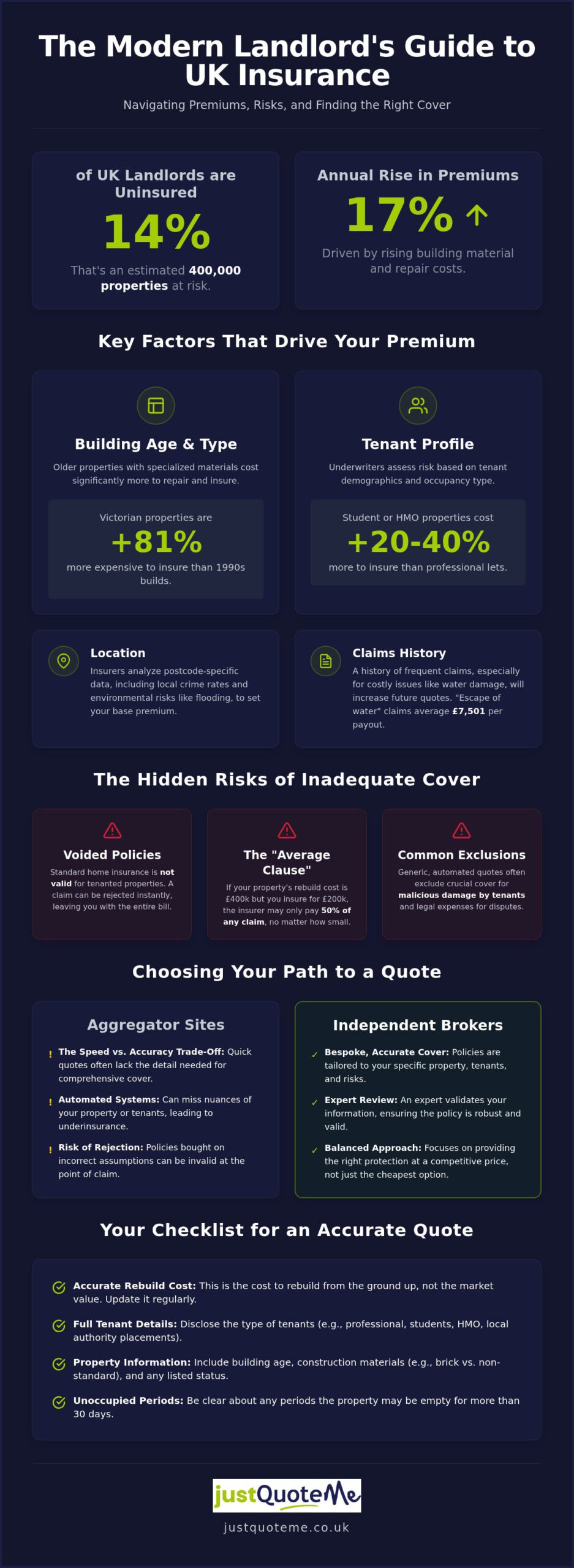
Preparation is the most effective way to ensure your landlord insurance quote uk is both accurate and valid. When you provide precise data, you eliminate the “assumed facts” that often lead to rejected claims. Many landlords make the mistake of using the market value of their property when seeking cover. However, insurers require the rebuild cost, which is the actual expense of labor and materials needed to reconstruct the building from scratch. This figure is often significantly different from what the property would sell for on the open market.
Property and Rebuild Details
To find an accurate rebuild figure, we recommend using the BCIS Rebuild Cost Calculator. This professional tool accounts for the current inflationary pressures in the UK construction industry. You must also identify any non-standard construction materials. If your property features timber frames, a thatched roof, or a flat roof covering more than 25% of the total area, these details must be disclosed. Similarly, if you’ve recently added structural renovations or extensions, have the square footage and cost of these improvements ready. These factors directly influence the “sum insured” and prevent the risk of the average clause reducing your payout.
Compliance and Liability Information
Your status as a responsible landlord is reflected in your safety documentation. Before requesting a quote, ensure your gas safety records and electrical installation condition reports (EICR) are up to date. If you’re managing a House in Multiple Occupation (HMO), you’ll need your specific license details to hand. Most policies include public liability insurance as standard, but you should verify if the limit meets the 2026 recommendation of £5 million. This protects you against the rising costs of legal claims if a tenant or visitor is injured on your property.
Finally, gather your administrative history. You’ll need your previous insurance schedule and a detailed record of any claims made over the last 3 to 5 years. If you employ anyone to assist with property maintenance, such as a regular cleaner or gardener, you must include employers liability insurance to remain legally compliant. Having this data organized allows us to skip the guesswork and move straight to securing your protection. To get started with a professional review of your requirements, get a bespoke quote from our expert team today.
How to Get Your Bespoke Landlord Insurance Quote Today
Securing a landlord insurance quote uk shouldn’t be a stressful administrative burden. We’ve refined our process to balance digital efficiency with the professional oversight that automated systems lack. By combining a streamlined data capture portal with a human-led review, we ensure your cover is both competitively priced and technically sound. This approach removes the guesswork and provides you with a policy that’s ready to perform if you ever need to make a claim.
Step 1: Just Quote Me Online
The process begins with our streamlined online portal. This tool is designed to capture the essential details about your property, tenant types, and required cover levels without the repetitive data entry found on multiple comparison sites. Once you submit your information, our system queries a broad network of top-tier UK insurers. Unlike generic aggregators, our portal is built to handle the nuances of the 2026 market. It flags specific risks that require a more tailored approach, ensuring that your initial data submission serves as a solid foundation for a bespoke policy.
Step 2: Expert Consultation and Finalisation
What happens after you submit your details is what truly sets us apart. A member of our Staffordshire-based team personally reviews your information. We don’t just rely on an algorithm to generate a final price. If your property has non-standard features or a complex tenant profile, we’ll often reach out to clarify specific details. This human intervention ensures that the final quote is transparent and comprehensive. We use this stage to help you customise your protection, whether that’s adding rent guarantee cover to mitigate the risks of the Renters’ Rights Act or including emergency home cover for rapid repairs.
Once the details are finalised, you receive a quote that’s been validated by an expert. Our role doesn’t end when the policy starts. We provide ongoing support, managing your mid-term adjustments and renewals so you don’t have to navigate the market alone every year. This professional, FCA-authorised advice provides the peace of mind that your investment is fully protected. Just Quote Me for your next renewal to secure a policy that actually stands up to professional scrutiny. We handle the complex administrative heavy lifting, allowing you to focus on the day-to-day management of your rental portfolio with total confidence.
Secure Your Property Investment with Expert Oversight
As an FCA-authorised independent broker, we access a broad network of top UK insurers to find bespoke cover that fits your specific risks. We manage the administrative burden so you can focus on your property management. Whether you’re insuring a single professional let or a mixed-use commercial unit, professional validation ensures your policy is more than just a piece of paper. You deserve the peace of mind that comes from working with a trusted advisor who understands your sector. Just Quote Me for your next renewal to ensure your investment remains protected against the unexpected.
Get Your Free Business Insurance Quote now
Request a Call back for free Expert advice
How much does landlord insurance cost in the UK for 2026?
Costs vary significantly based on property type and risk profile. The average cost for a standard policy in 2026 is approximately £285, but this increases for older Victorian properties or Houses in Multiple Occupation (HMOs). Basic buildings-only cover might start around £200, while comprehensive policies with rent guarantee often exceed £600. Factors like location and rebuild value are the primary drivers of the final price.
Can I get a landlord insurance quote for a property with multiple tenants?
Yes, you can secure a quote for properties with multiple tenants, commonly known as HMOs. These properties typically carry a 20% to 40% higher premium due to increased wear and tear and higher turnover rates. You must disclose the exact tenant demographic, such as students or professionals, to ensure your policy remains valid and provides the adequate liability protection required for communal living environments.
What is the difference between buildings and contents insurance for landlords?
Buildings insurance covers the physical structure and permanent fixtures, such as walls, roofs, and fitted kitchens, against risks like fire or flood. Contents insurance protects the items you provide for tenant use, including furniture, appliances, and carpets. While buildings cover is usually required by mortgage lenders, contents insurance is vital if you are letting a furnished property to avoid significant out-of-pocket replacement costs after a loss. If you are currently evaluating your property financing, you can discover Lee Tonks: Mortgage Guru for independent advice across the whole UK market.
Do I need employers liability insurance if I only have one rental property?
You are legally required to have employers liability insurance if you employ anyone to help manage or maintain your property. This applies even if you only have one rental unit and hire a regular cleaner, gardener, or maintenance person. Failure to have this cover can result in significant daily fines from the Health and Safety Executive, as it protects you against claims if an employee is injured.
Is landlord insurance a legal requirement in the UK?
How quickly can I get a landlord insurance quote from a broker?
You can receive an initial indication very quickly through our online portal, but a fully validated bespoke quote typically takes a few hours. This allows our Staffordshire-based team to review your specific risks and negotiate with our panel of underwriters. This human-led process ensures your cover is accurate, whereas automated systems might provide an instant price that misses critical protections your specific property requires.
What happens if my property becomes unoccupied for a long period?
Most standard policies limit unoccupancy to 30 or 60 days. If your property remains empty beyond this period, you must notify your broker to adjust your cover. Unoccupied buildings face higher risks of undetected leaks, squatting, or vandalism. We can arrange specialist unoccupied property terms that maintain protection while you are between tenancies or undergoing structural renovations, ensuring your investment remains secure during the transition.
Can I combine multiple properties into one landlord insurance quote?
Yes, combining multiple properties into a single portfolio policy is an efficient way to manage your insurance. This approach simplifies your administration by aligning renewal dates and often results in a discount from underwriters. Whether you own two properties or a large commercial portfolio, we can consolidate your requirements into one comprehensive landlord insurance quote uk that covers all your assets under a single, manageable schedule.
Article by
Just Quote Me
JustQuoteMe Ltd is an independent UK insurance brokerage specialising in business and personal insurance solutions. With over 35 years of industry experience, the company provides tailored insurance cover for businesses, landlords, tradespeople, hospitality venues, fleets, and individuals across the UK. Known for its personal service, expert advice, and competitive premiums, JustQuoteMe Ltd works with leading insurers to deliver bespoke policies designed around each client’s unique needs. The company is authorised and regulated by the Financial Conduct Authority (FCA No. 586607) and has built a reputation for trusted, straightforward insurance guidance and long-term client relationships.

by jqm | Aug 27, 2026 | Insurance
Did you know that the average payout for an ‘escape of water’ claim has reached £7,501? For many property owners, the real shock isn’t the leak itself, but the discovery that their basic policy doesn’t cover the expensive carpets or integrated appliances they’ve provided. If you’re unsure where your building cover ends and your landlord contents insurance begins, you aren’t alone. It’s a common source of anxiety, especially when you’re worried that a tenant’s negligence might lead to a rejected claim or that you’re overpaying for a policy full of loopholes.
We understand that you want a straightforward way to protect your investment without the headache of complex jargon. This guide will help you identify exactly what needs covering while ensuring you meet your legal and financial liabilities under the 2026 Renters’ Rights Act. We’ll clarify the confusing distinction between fixtures and contents, explain how to protect your white goods effectively, and show you how to move away from impersonal call centres toward expert, bespoke advice. By the end, you’ll have a clear roadmap to a policy that offers genuine security for your rental property’s furnishings and appliances.
Key Takeaways
- Define the clear line between building structures and your rental furnishings to eliminate expensive coverage gaps.
- Navigate the higher replacement costs of 2026 by securing landlord contents insurance that specifically includes smart white goods and soft furnishings.
- Apply the “Golden Rule” of property ownership to distinguish your insurance liabilities from your tenant’s personal responsibilities.
- Protect your financial interests by learning how to calculate an accurate sum insured and avoid the pitfalls of the “Condition of Average.”
- Gain the advantage of bespoke, human-centric advice that tailors your policy to your specific property portfolio instead of relying on a generic algorithm.
What is Landlord Contents Insurance and Why is it Essential in 2026?
Landlord contents insurance is a specialist policy that safeguards the furniture and appliances you provide while acting as a critical liability shield for the essential items that make a property habitable. It’s designed to repair or replace items you supply for a tenant’s use that aren’t part of the building’s fabric. While the law doesn’t strictly require you to have this cover, it’s a non-negotiable condition for almost all buy-to-let mortgage lenders in the UK. If you’re renting out a property with even a few basic appliances, this insurance serves as your primary financial safety net.
In 2026, the risks facing property owners have shifted significantly. Modern furnishing trends lean towards higher-quality “smart” appliances and integrated technology which are far more expensive to replace than traditional models. With material and repair costs rising by 17% over the last year, an out-of-pocket replacement for a high-spec washing machine or a touch-screen fridge can instantly wipe out your monthly rental yield. Understanding What is Insurance? in a professional context means recognizing that you’re transferring these high-stakes financial risks to a provider who understands the current market volatility.
The Difference Between Landlord and Standard Home Insurance
Standard home insurance is built for owner-occupiers and is typically voided the moment a tenant moves in. These domestic policies don’t account for the unique risks of third-party occupancy, such as accidental damage by tenants or the specific liability issues that arise in a rental environment. A dedicated landlord policy ensures your professional “letting” status is recognized in the contract. This distinction is vital; it ensures you’re covered for the specific wear and tear and legal risks that occur when you aren’t living on the premises yourself.
Regulatory Context: Renters’ Rights and Landlord Liabilities
The implementation of the Renters’ Rights Act on May 1, 2026, has professionalised the sector and increased the duty of care you owe to your tenants. You’re now more accountable for the safety and functionality of every appliance you provide. If a faulty item you’ve supplied causes a fire or flood, the financial repercussions extend far beyond the cost of the item itself. You could face significant liability claims. Working with an expert broker ensures your residential letting insurance is robust enough to handle these evolving legal landscapes, protecting you from modern regulatory pitfalls that automated comparison sites often overlook.
What Does Landlord Contents Insurance Cover? A Detailed Breakdown
A standard landlord contents insurance policy protects the items you provide that would fall out if you turned the house upside down. This includes high-value white goods like fridges, freezers, dishwashers, and washing machines. In 2026, these are often smart appliances with complex electronics, making them significantly more costly to replace than older, purely mechanical models. Soft furnishings such as curtains, carpets, and blinds are also covered. These are statistically the most claimed-for items because they’re highly susceptible to stains, tears, and physical damage during a tenancy.
For those offering fully or part-furnished lets, the policy extends to beds, sofas, and dining sets. If you manage a House in Multiple Occupation (HMO) or a block of flats, you can also secure cover for communal area contents, such as furniture in shared hallways or residents’ lounges. Ensuring every item is accounted for prevents significant out-of-pocket expenses when a mishap occurs. If you’re managing multiple units or a large building, you might find that commercial property insurance offers a more comprehensive solution for the entire structure and its internal assets.
Accidental Damage vs. Wear and Tear
The distinction between accidental damage and wear and tear is where many claims fail. Accidental damage covers sudden, unforeseen mishaps like a tenant spilling red wine on a new carpet or dropping a heavy object on a glass hob. Conversely, wear and tear is the expected deterioration of an item over time. This includes a carpet becoming thin in high-traffic areas or a sofa cushion losing its shape after years of use. Insurers never cover wear and tear. You can manage tenant expectations and streamline the claims process by maintaining a detailed property inventory. A professional inventory provides the evidence needed to prove that damage was sudden rather than gradual.
Specialist Add-ons: Loss of Rent and Alternative Accommodation
If a major event like a fire or significant “escape of water” makes the property uninhabitable, your contents cover can do more than just replace a sofa. The average payout for an escape of water claim is currently £7,501, which highlights the financial risk. Specialist add-ons like “Loss of Rent” protect your cash flow by replacing the income you lose while the property is under repair. Some policies also cover the cost of alternative accommodation for your tenants if you’re legally obligated to provide it. This level of protection ensures a single disaster doesn’t derail your entire investment strategy. To see how these options fit your specific needs, you can compare bespoke policy features with our expert team.
Landlord vs. Tenant Insurance: Clearing the Confusion
The Golden Rule of property insurance is simple: you cannot insure items you don’t own. This principle defines the boundary between your responsibilities and those of your tenant. While your landlord contents insurance protects the furniture, appliances, and floor coverings you provide, it offers zero protection for the tenant’s personal belongings. If a burst pipe destroys a tenant’s laptop or expensive clothing, your policy won’t pay out for their loss. Clear communication is essential here. You should explicitly state in the tenancy agreement that your insurance only covers the landlord’s inventory, and advise tenants to secure their own contents cover or “Tenant Liability” insurance to protect their interests.
Disputes often arise when boundaries aren’t clearly defined before a claim occurs. By providing a comprehensive inventory at the start of the tenancy, you establish a documented list of exactly what your policy covers. This transparency helps avoid the common misconception that a landlord’s policy is a catch-all for every item inside the building. Ultimately, a landlord contents insurance policy serves as a protective shield specifically for the items you’ve supplied to make the property habitable, leaving the tenant responsible for their own possessions. For those currently purchasing or selling property to grow their portfolios, Eagle Haus Conveyancing Consultants provides the specialist legal support needed for smooth residential transactions across England and Wales.
The “Grey Areas”: Carpets, Laminate, and Fixtures
One of the most frequent points of confusion is how insurers categorise flooring. Most providers view carpets as “contents” because they can be removed and replaced without damaging the building’s structure. However, laminate, vinyl, or tiled flooring is often classified under buildings insurance because it’s considered a permanent fixture. Similarly, a fitted kitchen with integrated cupboards is a building element, but a freestanding washing machine or microwave falls under contents. At Just Quote Me, we help clarify these technical definitions during the quote process, ensuring you don’t accidentally leave high-value items uninsured or pay twice for the same coverage.
Liability Protection for Landlords
Contents insurance isn’t just about physical objects; it’s about the risks those objects carry. If a faulty kettle or a poorly maintained sofa you provided causes an injury to a tenant, you could be held legally liable for damages. Many policies include “Property Owners Liability” as a standard or optional feature. This is distinct from public liability insurance, which focuses on your broader business interactions. Having this specific protection within your contents policy ensures that if an item in your inventory leads to a legal claim, your financial interests and professional reputation remain secure.
How Much Cover Do You Need? Calculating Your Sum Insured
Calculating your sum insured correctly is the difference between a full payout and a significant financial shortfall. Many property owners fall into the trap of under-insurance, which triggers the “Condition of Average” clause. If you insure your contents for £5,000 but the true replacement value is £10,000, you’re 50% under-insured. In the event of a £2,000 claim for a flooded carpet, the insurer may only pay out £1,000. You must value every item based on its current replacement price to ensure your landlord contents insurance provides the protection you expect. Utilizing a professional data resource like Property Deals Insight can offer the unified UK property data and AI intelligence required to maintain precise asset valuations across your portfolio.
The type of settlement you choose is equally critical for your 2026 strategy. “New for Old” cover ensures you receive the current market value for a brand-new equivalent item. With the 17% rise in material and appliance costs seen over the last year, this is usually the safer choice. The alternative is “Indemnity Value,” which deducts for wear and tear. While indemnity policies might have slightly lower premiums, they often leave you with a significant bill when it’s time to actually replace high-spec smart appliances or quality furnishings.
Valuing Part-Furnished Properties
A common mistake is assuming that a part-furnished property requires minimal landlord contents insurance. Even if you don’t provide beds or sofas, the cost of replacing all carpets, curtains, and blinds simultaneously can be staggering. Walk through each room and record every item you own, from the integrated fridge to the hallway runner. A digital inventory, including photos and serial numbers for white goods, is the best way to maintain an accurate valuation. This document acts as your primary evidence should you ever need to file a claim after a tenant moves out.
Security Requirements and Premium Impact
Your property’s security features directly influence your premium and your eligibility for certain types of cover. Insurers often require specific lock types, such as five-lever mortice deadlocks complying with BS3621, on all external doors. Having a monitored alarm system can also reduce your risk profile and lower your costs. Because these requirements vary significantly between providers, getting expert advice on your landlord policy helps you navigate these technicalities. For a broader look at protecting your investment beyond just your contents, read our Landlord Insurance in 2026: The Ultimate UK Guide. Our team can help you find a bespoke solution that balances high-level security with competitive premiums.
Securing Your Rental Property with Just Quote Me
Just Quote Me isn’t just another name on a screen. We’re an independent UK broker with 30 years of industry experience. Based in Stone, Staffordshire, our team provides a human-centric alternative to the impersonal algorithms found on most comparison sites. When you’re looking for landlord contents insurance, you shouldn’t have to settle for a one-size-fits-all policy that leaves you vulnerable to the coverage gaps we’ve discussed. Our approach is built on reliability and a desire to simplify the complex administrative processes that often overwhelm property owners.
Our status as an FCA-authorised firm gives us access to a broad network of top UK insurers. This allows us to find competitive, bespoke pricing that reflects the actual risks of your property rather than a generic average. You won’t be directed to an impersonal call centre. Instead, you’ll speak directly with experts who understand the nuances of the 2026 rental market. We take pride in being a steady hand in a complex market, managing the heavy lifting so you can focus on your tenants and your yields.
Bespoke Policies for Every Type of Landlord
Whether you own a single studio flat or manage an extensive commercial portfolio, we tailor the cover to your specific needs. We understand that every landlord’s situation is unique. For example, some property owners prefer to handle their own repairs and maintenance to keep costs down. If this sounds like you, we can also discuss tradesman insurance to ensure your tools and liability are protected while you’re working on-site. We handle the technical details and policy comparisons, providing you with clear, honest communication throughout.
Our professional restraint means we focus on value and security rather than hyperbolic marketing. By choosing a partner with three decades of regional expertise, you’re securing more than just a policy; you’re gaining a trusted advisor who understands the local landscape. We move you quickly from a state of inquiry to a state of protection, ensuring your furnishings and appliances are shielded against the unexpected.
Get Your Quote Today
Securing your investment shouldn’t be a frictionless experience only in theory. We’ve streamlined our process to provide immediate value. You can start the process online or speak with us directly to get the expert guidance your portfolio deserves. Don’t leave your assets to chance when professional, bespoke advice is just a click away.
Protect Your Investment with Professional Certainty
Navigating the complexities of the 2026 rental market requires more than just a generic policy; it demands a clear understanding of where your buildings cover ends and your contents protection begins. By accurately valuing your inventory and recognizing the liability risks associated with provided appliances, you safeguard your long-term yields from sudden, expensive mishaps. Specialist landlord contents insurance ensures that whether you’re dealing with a minor spill or a major flood, your financial recovery is swift and supported by expert guidance.
As an FCA-authorised independent broker with over 30 years of industry experience, we provide access to a broad network of top UK insurers. We handle the administrative burdens so you don’t have to, offering a steady hand in an evolving regulatory landscape. You can secure your property assets today with a partner who prioritizes human-centric service over automated systems. Taking the time to professionalise your insurance now provides the peace of mind you need to grow your rental business with confidence.
Frequently Asked Questions
Is landlord contents insurance a legal requirement in the UK?
No, there’s no UK law mandating this cover. However, it’s almost always a strict requirement for buy-to-let mortgage lenders. Failing to maintain a policy could put you in breach of your loan agreement. Beyond lending rules, it’s a vital financial safeguard. Without it, you’re personally liable for replacing expensive items like carpets and appliances if they’re damaged by fire, flood, or specific tenant mishaps.
Does landlord contents insurance cover my tenants belongings?
No, your policy only covers items you own and provide for the tenant’s use. Tenants are responsible for insuring their own personal possessions, such as laptops, clothes, and jewellery. It’s best practice to explain this boundary clearly in your tenancy agreement. You should encourage tenants to take out their own contents or “Tenant Liability” insurance to ensure they’re protected against loss or accidental damage to your property.
Will my buildings insurance cover the carpets in my rental property?
Typically, buildings insurance excludes carpets because they’re considered removable contents rather than permanent fixtures. While laminate or tiled flooring is often part of the building structure, carpets require specific landlord contents insurance. If a leak or fire ruins the flooring across your entire property, the replacement costs can be substantial. Including contents cover ensures these soft furnishings are protected under a professional policy tailored for rental risks.
What is accidental damage cover for landlords and is it worth it?
Accidental damage cover protects you against sudden, one-off mishaps like a tenant spilling red wine on a carpet or smashing a ceramic hob. It doesn’t cover gradual wear and tear or deliberate damage. Given that the average payout for escape of water is currently £7,501, and soft furnishings are the most claimed-for items, this add-on is usually considered essential for maintaining your property’s standards without dipping into your monthly profits.
Can I get contents insurance for an unoccupied rental property?
Yes, but you’ll need a policy that specifically accounts for unoccupancy. Most standard landlord policies limit or remove cover if a property is empty for more than 30 or 60 consecutive days. During void periods, risks like theft or undetected leaks increase significantly. Specialist unoccupied property cover ensures your furnishings remain protected while you’re between tenancies or carrying out renovations, providing continuous security for your internal assets.
How much does landlord contents insurance typically cost in 2026?
Costs vary based on your property’s location, the total value of the items provided, and your previous claims history. In 2026, premiums have been influenced by a 17% rise in material and appliance replacement costs. While general market ranges exist, your specific premium will depend on whether you choose “New for Old” cover or more basic indemnity options. Speaking with an independent broker allows you to compare bespoke quotes from a broad network of insurers.
What happens if a tenant steals my furniture?
Theft by a tenant is a specific risk that isn’t always included in basic policies. You must check that your policy includes “theft by person legally on the premises.” If a tenant leaves with your furniture, you’ll typically need to provide a police crime reference number to process the claim. A robust inventory and professional tenant referencing are your best defences against these rare but costly incidents occurring during a tenancy.
Article by
Just Quote Me
JustQuoteMe Ltd is an independent UK insurance brokerage specialising in business and personal insurance solutions. With over 35 years of industry experience, the company provides tailored insurance cover for businesses, landlords, tradespeople, hospitality venues, fleets, and individuals across the UK. Known for its personal service, expert advice, and competitive premiums, JustQuoteMe Ltd works with leading insurers to deliver bespoke policies designed around each client’s unique needs. The company is authorised and regulated by the Financial Conduct Authority (FCA No. 586607) and has built a reputation for trusted, straightforward insurance guidance and long-term client relationships.

by jqm | Aug 26, 2026 | Insurance
A standard landlord policy is often a ticking time bomb the moment a group of students moves into your property. Many providers see the word “student” and immediately hike premiums or, worse, offer generic cover that doesn’t actually protect a multi-occupancy setup. Finding reliable landlord insurance for student properties shouldn’t feel like a gamble against fine print. It requires a specialist approach that understands the unique risks of high-turnover, shared living environments while keeping your overheads manageable.
You’ve probably noticed that the rental market feels more restrictive than ever, with new 2026 licensing thresholds and the abolition of Section 21 making the administrative burden feel overwhelming. We’re here to show you how to secure bespoke protection that balances the speed of an online quote with the deep insight of a broker with 30 years of industry experience. This guide explores how to manage the 2026 legal landscape, ensure your HMO is fully compliant, and find cover that actually pays out when it matters most.
Key Takeaways
- Understand why standard policies often fail multi-occupancy rentals and how to secure specialist landlord insurance for student properties that fits your specific risk profile.
- Navigate the updated 2026 HMO licensing requirements and the latest safety thresholds to ensure your student rental remains legally compliant and fully covered.
- Learn how to accurately calculate rebuild costs in the 2026 market to avoid underinsurance while protecting communal assets against high-turnover wear.
- Discover the essential property and tenant details needed to transition from a generic quote to a bespoke insurance solution that reflects your actual rental situation.
- Leverage 30 years of expert brokerage insight to bridge the gap between digital speed and the personalized advice required for complex student portfolios.
Understanding Student Landlord Insurance: Why Standard Cover Fails
Student landlord insurance isn’t a luxury; it’s a structural requirement for any property housing three or more unrelated individuals. While a standard buy-to-let policy works for a single family, the legal shift to a House in Multiple Occupation (HMO) changes your risk profile in the eyes of an underwriter. Most standard insurers view students as a high-risk category. If you don’t declare the tenant type accurately, you risk having your entire policy voided when you need it most. Specialist landlord insurance for student properties is designed to bridge this gap, offering protection that accounts for the specific dynamics of shared student living.
The “household” rule is often where landlords get caught out. Under UK law, if three or more tenants form more than one household and share facilities, the property is classified differently. This classification triggers specific safety regulations and a different insurance category. Failing to secure landlord insurance for student properties specifically means you’re likely paying for a policy that offers zero protection for your investment. Specialist cover treats your property as a high-turnover business asset, providing the robust liability and damage protection that a standard residential policy simply isn’t built to handle.
The Risk Profile of Student Tenants in 2026
Students bring a unique set of challenges that differ from long-term professional tenants. In 2026, landlords face higher accidental damage risks because student properties often house more people per square metre than a typical family home. Frequent move-in and move-out cycles at the start and end of academic years accelerate wear and tear on carpets, walls, and communal fixtures. There’s also the matter of liability. With multiple tenants using shared kitchens and bathrooms, the chance of a small mishap turning into a major liability claim increases significantly. You need a policy that anticipates these frequent interactions and the potential for increased maintenance.
Standard BTL vs. Specialist Student Cover
Standard BTL policies often contain strict exclusions regarding malicious damage by tenants or unoccupied periods. Student properties are notorious for being empty during summer months or Christmas breaks. A specialist policy accounts for these void periods, ensuring you remain covered even when the students are home for the holidays. While residential letting insurance provides a solid foundation for many landlords, student-specific cover adds layers of protection for communal white goods and furniture that standard policies ignore. Key advantages of specialist cover include:
- Malicious Damage: Protection against intentional damage caused by tenants or their guests.
- Unoccupancy Terms: Flexible rules for properties left empty during university holidays.
- Communal Contents: Specific cover for shared appliances and furniture provided by the landlord.
- Loss of Rent: Compensation if a property becomes uninhabitable due to an insured event, which is vital for maintaining cash flow during term time.
Choosing the right cover means looking beyond the cheapest premium. It’s about ensuring your policy remains valid regardless of how many students share the kitchen or how long the house sits empty in August. For landlords aiming to provide premium housing, you can learn more about Unipad and their approach to luxury student accommodation.
Securing the right buildings insurance remains the foundation of your policy, but 2026 presents specific challenges regarding valuation. Rebuild costs have shifted significantly due to inflation in material prices and specialist labour rates. If your sum insured hasn’t been updated recently, you risk being underinsured in the event of a total loss. Beyond the structure, subsidence protection is a critical component, especially for older properties often converted into student housing. Ensuring your landlord insurance for student properties reflects current market rebuild values is the only way to fully protect your equity.
Your contents cover needs to be equally robust. In a student rental, you aren’t just covering a sofa; you’re protecting communal white goods, integrated appliances, and “student-proof” furniture designed for heavy use. While students are responsible for their own belongings, you’re responsible for the items that make the house habitable. If a fire or flood renders the property unlivable, your legal duty to provide alternative accommodation for your tenants can be financially devastating. A specialist policy handles these relocation costs, alongside protecting your loss of rent during term-time, ensuring your cash flow remains steady even when the property is empty for repairs.
Compliance with official HMO licensing requirements often dictates the level of safety equipment you must maintain, such as fire doors and industrial-grade alarm systems. Your insurance should align with these standards to ensure a claim isn’t rejected on the grounds of non-compliance. If you’re unsure if your current setup meets these benchmarks, you can speak with a broker to review your specific portfolio requirements.
Public Liability for Student HMOs
Shared facilities like communal kitchens and steep staircases in older conversions naturally increase the likelihood of third-party injury claims. Students often have guests over, which further raises your liability profile. While some basic policies offer £2 million in cover, this is often insufficient for student blocks in 2026. Rising legal settlement costs and the complexity of multi-tenant claims mean that a £5 million limit is now the recommended standard for many providers. You can find more detail on these protections through our dedicated Public Liability Insurance page.
Essential Extras for Student Landlords
Accidental damage is a non-negotiable addition for any student let. Whether it’s a red wine stain on a carpet or a smashed window, these incidents happen more frequently in high-occupancy homes. Legal expenses cover is also vital in 2026, especially with the complexities of the Renters’ Rights Act. This cover supports the costs of tenant disputes or necessary eviction proceedings. Finally, emergency home cover provides 24/7 support for boiler breakdowns and plumbing issues. It keeps your tenants happy and prevents small leaks from turning into major structural claims while you’re off-site.
HMO Licensing and 2026 Regulatory Compliance
Local councils have significant power in 2026, and their specific rules can dictate whether your insurance remains valid. While mandatory licensing applies nationwide to properties with five or more tenants, many university towns have introduced “Additional Licensing” schemes for smaller groups. If you’re renting to three or four students, you must check your local authority’s rules before securing cover. For insurers, a valid license is a binary condition. If the council requires a license and you haven’t secured one, your landlord insurance for student properties is effectively void from the moment the tenants move in.
The Renters’ Rights Act, which came into force on May 1, 2026, has fundamentally changed the landlord-tenant relationship by abolishing Section 21 “no-fault” evictions. This shift makes legal expenses and rent guarantee cover more critical than ever, as landlords must now rely on specific legal grounds to regain possession of a property. Insurers now look closely at how you manage these new legal obligations. A specialist broker helps you navigate these changes, ensuring your policy accounts for the potentially longer and more complex repossession timelines introduced by the 2026 legislation.
Fire Safety and Health Standards
In student lets, fire safety isn’t just about a few smoke alarms. You need mains-wired, interconnected systems and specific fire door ratings that meet the 2026 “Large HMO” safety thresholds. Insurers require up-to-date documentation, including a valid Electrical Installation Condition Report (EICR) and an annual Gas Safety Certificate. Maintaining these isn’t just a legal duty; it’s a core insurance requirement. Brokers often view landlords who perform termly inspections more favourably, as this proactive approach reduces the likelihood of catastrophic claims and demonstrates a commitment to property maintenance.
Insurance Implications of Non-Compliance
An unlicensed HMO is essentially uninsurable in the UK market. If a fire occurs and the property is found to be unlicensed or non-compliant with room size standards, such as the national minimum of 6.51m² for a single person, the insurer will likely reject the claim in its entirety. In insurance terms, your Statement of Fact is a legally binding declaration where you confirm that you are fully compliant with all local and national licensing laws. Falsifying this information, even unintentionally, constitutes a breach of your duty of fair presentation and leaves your high-value asset completely unprotected.
How to Secure a Bespoke Student Property Quote Online
Securing a quote for landlord insurance for student properties requires more precision than a standard home policy. While aggregator sites offer speed, they often fail to capture the nuances of multi-occupancy risks. To get an accurate price that actually protects your investment, you need to follow a structured approach that moves from basic data to specialist underwriting. A generic quote might save time today, but it could leave you with significant coverage gaps if a claim arises later.
Step 1 involves gathering specific property details. In 2026, rebuild values are more volatile than ever, so don’t rely on figures from two years ago. You’ll also need to specify construction details, such as whether the roof is standard slate or a flat felt design, as this heavily affects the subsidence and fire risk profile. Step 2 focuses on your tenants. Undergraduates often carry a different risk weight than postgraduates or international students due to perceived lifestyle differences and turnover rates. Be prepared to document the exact mix of your occupancy to ensure you get the right landlord insurance for student properties.
Step 3 is about defining your limits. Don’t just tick the minimum boxes. Ensure your contents cover accounts for high-wear communal items and your liability limit is sufficient for the number of residents. Finally, Step 4 is the most critical: consult an expert. Many specialist HMO underwriters don’t appear on price comparison websites. An independent broker can access these niche markets to find bespoke terms that match your specific portfolio requirements.
Information You Need Ready
To streamline your application and ensure your policy remains valid, have these details at hand before you start:
- Full property address and your current HMO license number.
- A detailed claims history for the last five years, including any previous insurance rejections or special terms imposed.
- An accurate sum insured for the structure and all landlord-owned contents, reflecting 2026 material costs.
- Details of fire safety equipment, such as interconnected alarm systems and fire door specifications.
The Broker Advantage vs. Standard Algorithms
Standard algorithms are designed for simple, low-risk residential lets. When you deal with student properties, you’re managing complex legal and structural variables that automated systems often misinterpret. Brokers like Just Quote Me provide a human-centric alternative to these rigid systems. We review each case manually, which is especially important for properties with non-standard construction or those requiring commercial property insurance for larger purpose-built blocks.
Our 30 years of experience allows us to present your risk to underwriters in the best possible light, often securing better rates than an impersonal algorithm could. If you’re ready to protect your rental with a policy that actually fits your needs, you can start your bespoke quote today.
Why Choose Just Quote Me for Your Student Property Insurance?
Securing landlord insurance for student properties involves more than just comparing prices. It requires a partner who understands the structural and legal nuances of the 2026 rental market. With over 30 years of industry experience, Just Quote Me has evolved alongside the UK’s shifting property regulations. We aren’t a faceless aggregator relying on rigid algorithms. Instead, we operate as an independent, FCA-authorised broker that prioritises long-term property protection over a quick, automated sale.
Our Staffordshire-based team serves landlords across the entire UK, providing a bridge between digital efficiency and human expertise. We know that a student HMO in a city centre has a completely different risk profile than a suburban professional let. By treating every client as an individual, we avoid the “one-size-fits-all” traps that often lead to rejected claims or voided policies. This bespoke approach ensures that your landlord insurance for student properties remains valid even as your tenant mix or property usage changes.
Expert Advice and Administrative Ease
Managing a student portfolio is a demanding administrative job. Between ensuring gas safety compliance and tracking the latest 2026 licensing thresholds, insurance often feels like another complex burden. We take that weight off your shoulders. Similarly, for managing other essential business costs like energy and telecom, HughesHub offers a specialist comparison service to help landlords streamline their utility overheads. Our brokers have access to a broad network of top-tier UK insurers, many of whom don’t list on comparison sites. We manage the complex underwriting conversations so you don’t have to. For landlords who employ their own maintenance staff or contractors to handle high-turnover repairs, we can also integrate Tradesman Insurance into your broader business protection plan.
Don’t leave your investment to chance with a standard policy that might not hold up during a major claim. Whether you own a single student house or a large multi-city portfolio, expert advice is only a click away. Our team is ready to help you find a policy that balances cost with comprehensive coverage.
For a deeper dive into general property protection and upcoming legislative shifts, read our comprehensive Landlord Insurance 2026 Guide.
Secure Your Student Rental Portfolio for 2026
Managing multi-occupancy rentals in the current market requires more than just regular property maintenance; it demands a robust financial safety net. We’ve explored how landlord insurance for student properties must align with 2026 regulatory standards to remain valid, ensuring your investment is protected against unique high-turnover risks. Relying on generic algorithms often leads to dangerous coverage gaps, whereas a specialist broker provides the bespoke underwriting needed for complex HMO setups.
As an independent UK broker with over 30 years of experience, Just Quote Me offers FCA-authorised advice and direct access to top UK underwriters. We bridge the gap between digital speed and expert human consultation to help you navigate the complexities of student letting with confidence. Protecting your asset shouldn’t be a source of stress; it should be a straightforward part of your business strategy.
Get Your Free Business Insurance Quote now
Request a Call back for free Expert advice
Frequently Asked Questions
Is landlord insurance for student properties a legal requirement?
UK law doesn’t strictly mandate insurance, but your mortgage lender certainly will. Most buy-to-let agreements include a clause requiring specialist cover to protect the lender’s financial interest in the asset. Beyond the contract, the high occupancy levels in student homes significantly increase your liability exposure. Choosing not to have cover means you’re personally responsible for all structural repairs and legal settlements if a tenant is injured on your property.
Does standard buy-to-let insurance cover student tenants?
Standard policies almost always exclude students because they’re classified as a higher risk category than professional families. If you move students into a property without notifying your insurer, your policy is likely invalid. Securing specialist landlord insurance for student properties ensures your underwriters understand the exact nature of the tenancy. This prevents a situation where a major claim is rejected due to a breach of the agreed tenant type conditions.
What happens if I don’t have a valid HMO license for my student property?
Operating without a required license is a criminal offence and will void your insurance immediately. Insurers view a valid license as a prerequisite for any cover to remain in force. If you make a claim for fire or flood damage and the property is found to be unlicensed, the insurer has the right to refuse payment. You could also face heavy fines from your local council and be forced to repay rent to your tenants.
Does student landlord insurance cover malicious damage by tenants?
Specialist student policies often include malicious damage as a core feature or an affordable add-on. Standard landlord insurance typically only covers accidental damage, which leaves a gap if a tenant intentionally breaks fixtures or defaces the property. Given the higher turnover in student lets, this protection is vital for maintaining your profit margins. Always check your policy schedule to confirm that damage caused by tenants and their guests is fully included.
How much does student property insurance typically cost in 2026?
Premiums are calculated based on the specific risks associated with your property’s postcode, rebuild value, and the number of residents. In 2026, rebuild costs have risen significantly, which has a direct impact on the base premium. While you might find cheaper generic quotes, they often lack the essential liability limits required for multi-occupancy homes. A broker can help you find a balance between a competitive price and comprehensive coverage that actually pays out.
Can I get insurance for a property let to a mix of students and professionals?
Yes, this is a common scenario in many UK university towns. You must declare the exact tenant mix to your broker so the policy accurately reflects the risk. Generally, the policy will be rated based on the student element as they’re considered the higher risk group. Declaring a mixed tenancy ensures you don’t fall foul of non-disclosure rules, which could otherwise lead to a rejected claim during the policy term.
What is the difference between an HMO and a student block policy?
An HMO policy is designed for standard residential houses that have been converted to house multiple unrelated sharers. A student block policy is a commercial product for larger, purpose-built accommodation complexes with many units. The safety requirements and liability limits for blocks are much higher than for a standard house. Choosing the correct classification is essential for ensuring your buildings and communal contents are protected under the right legal framework.
Article by
Just Quote Me
JustQuoteMe Ltd is an independent UK insurance brokerage specialising in business and personal insurance solutions. With over 35 years of industry experience, the company provides tailored insurance cover for businesses, landlords, tradespeople, hospitality venues, fleets, and individuals across the UK. Known for its personal service, expert advice, and competitive premiums, JustQuoteMe Ltd works with leading insurers to deliver bespoke policies designed around each client’s unique needs. The company is authorised and regulated by the Financial Conduct Authority (FCA No. 586607) and has built a reputation for trusted, straightforward insurance guidance and long-term client relationships.

by jqm | Aug 25, 2026 | Insurance
Did you know that an estimated 400,000 UK landlords are currently operating without any specialist insurance, leaving their largest assets exposed to a record-breaking £6.1 billion in annual property claims? When you are weighing up landlord contents insurance vs buildings insurance, it’s easy to feel overwhelmed by technical jargon and the fear of being under-insured. Many property owners mistakenly assume that buildings cover includes everything within the four walls, while others accidentally pay to insure their tenants’ laptops and furniture.
You want your investment to be a source of steady income, not a financial sinkhole after a burst pipe or storm damage. We understand that distinguishing between a permanent fixture and a movable content can be confusing, especially with the new regulatory landscape following the Renters’ Rights Act 2025. This guide provides a clear roadmap to ensure your rental property is fully protected. We will explain the critical differences between structural and internal cover, help you avoid common overpayment traps, and show you how to build a bespoke policy that provides genuine peace of mind in 2026.
Key Takeaways
- Understand the fundamental distinction between landlord contents insurance vs buildings insurance to ensure you aren’t paying for tenant belongings while leaving your own assets exposed.
- Learn why insuring for the actual rebuild cost, rather than the market value, is the only way to safeguard your property against major perils like fire or subsidence.
- Identify the “grey area” items like carpets and curtains that often fall between policies, ensuring your furnished or unfurnished rental has seamless protection.
- Discover why a combined policy is often the most efficient way to manage administrative burdens while securing essential Property Owners Liability cover.
- Find out how a bespoke broker approach in 2026 identifies hidden gaps in standard comparison site policies to provide a personalized safety net for your investment.
Understanding the Basics: Landlord Buildings vs. Contents Insurance
Landlord insurance isn’t just a single product; it’s a strategic combination of protections designed to safeguard your investment. When you compare landlord contents insurance vs buildings insurance, the differences might seem subtle, but they are financially significant. In 2026, relying on a standard homeowner’s policy is a critical mistake that could leave you without any cover at all. Standard policies are typically voided the moment a tenant moves into the property because they don’t account for the specific risks associated with renting, such as property owner’s liability or loss of rent. Gaining a foundational understanding property insurance principles is essential for any serious investor looking to protect their portfolio.
If you have a buy-to-let mortgage, your lender will almost certainly mandate buildings cover as a condition of the loan. For investors who want to explore Home Loans and specialized financing for residential property, aligning your mortgage terms with the right insurance coverage is a key step in risk management. However, contents insurance remains an optional but vital extra depending on how you let the property. It’s also important to clarify that your policy only covers items you provide. Your tenants are entirely responsible for insuring their own personal belongings, such as laptops, clothes, and gadgets. Making this clear in the tenancy agreement helps avoid confusion when a claim arises.
What is Landlord Buildings Insurance?
This cover focuses on the “shell” of your property. It protects the physical structure, including the roof, walls, windows, and floors. Beyond the bricks and mortar, it also includes permanent fixtures. These are items that cannot be easily removed without damaging the property, such as fitted kitchens, bathroom suites, and built-in wardrobes. Because reconstruction costs have risen due to material price hikes throughout 2025 and 2026, having accurate buildings cover ensures you aren’t left with a massive financial shortfall after a major event like a fire, flood, or subsidence. It provides the security needed to rebuild your investment from the ground up if the worst happens.
What is Landlord Contents Insurance?
If you could pick up the house and shake it, everything that falls out would generally fall under contents. This insurance covers movable items you provide for the tenant’s use. Common examples include white goods like fridges and washing machines, free-standing furniture, and even smaller items like kettles or microwaves in a fully furnished let. Choosing the right level of cover depends on your specific rental strategy. For a furnished flat in the West Midlands, contents cover is indispensable. For an unfurnished house, you might only need minimal cover for items like carpets and blinds. To get the right balance for your specific portfolio, Just Quote Me for a policy that reflects your actual risk rather than a generic estimate. We focus on bespoke solutions that handle the administrative burden so you don’t have to.
Landlord Buildings Insurance: Protecting the Fabric of Your Investment
Landlord buildings insurance is the bedrock of your protection strategy. One of the most dangerous mistakes a property owner can make is confusing market value with the actual rebuild cost. In 2026, the cost of labor and materials remains a primary driver of insurance premiums. If a fire destroys your rental, your policy needs to cover the full expense of clearing the site and rebuilding the structure from scratch. Market fluctuations don’t affect this cost, so an accurate professional valuation is essential to avoid the trap of under-insurance, which can lead to reduced payouts during a claim.
Standard policies cover a range of “perils” including fire, flood, subsidence, and vehicle impact. It’s also vital to ensure your cover extends to the boundary of your property. This means including external structures like garages, fences, and gates, which are often the first items damaged during high-winds or vehicle collisions. When evaluating landlord contents insurance vs buildings insurance, remember that the buildings portion is there to restore the physical asset and its permanent attachments to their original state.
What Counts as a Permanent Fixture?
Fixtures are the elements of the home that are physically attached to the structure. This category includes fitted wardrobes, central heating systems, boiler units, and bathroom tiling. These are not considered “contents” because removing them would cause structural or cosmetic damage to the building. A fixture is any item that cannot be removed without damaging the property. This distinction is critical because it ensures these high-value installations are protected under the structural sum insured rather than a smaller contents limit, which might not cover the full replacement cost of a modern heating system.
Specialist Cover: Subsidence and Accidental Damage
Subsidence cover is a non-negotiable for many landlords in Staffordshire and the West Midlands, where local geology and historic mining can pose specific risks to older foundations. While standard buildings cover handles sudden events like fire, it doesn’t always include damage caused by tenants. Adding Accidental Damage cover is a pragmatic choice for landlords who want protection against mishaps like a tenant accidentally drilling through a pipe or damaging a permanent floor. To ensure your specific property risks are addressed, you can get a tailored commercial property quote that accounts for these regional variables and provides the steady hand you need in a complex market.
Landlord Contents Insurance: Navigating the Grey Areas
Many landlords struggle with the furnished vs unfurnished distinction. Even if you let a property “unfurnished,” you likely still own the carpets, curtains, and blinds. These are classic grey area items. When comparing landlord contents insurance vs buildings insurance, these items usually sit on the contents side because they aren’t part of the physical structure. Malicious damage cover is also a vital consideration here. It protects your internal assets if a tenant intentionally damages your property, providing a safety net that standard accidental damage cover might miss.
The median insurance cost for landlords in 2026 is approximately £285 per year, but this can rise quickly if you miscalculate the value of your internal assets. It’s essential to understand that you are not insuring the tenant’s lifestyle. You are insuring the tools that make your rental functional. Focusing on your specific liabilities ensures you don’t overpay for cover you can’t actually claim on.
The Landlord vs. Tenant Possessions Trap
You are only responsible for the items you provide. It’s a common mistake to think your policy covers a tenant’s expensive electronics or furniture. It doesn’t. If you try to claim for a tenant’s stolen laptop, the insurer will likely reject the entire claim. Clearly stating responsibilities in the tenancy agreement protects both parties. To ensure your specific arrangement is correctly covered, exploring Residential Letting Insurance is a pragmatic step. This specialized cover helps you avoid the administrative burden of sorting through these traps alone.
White Goods and Integrated Appliances
The distinction between buildings and contents often comes down to how an appliance is installed. An integrated dishwasher behind a cupboard door is usually classified under buildings because it’s a permanent fixture. A free-standing unit is almost always a content. White goods are the most frequent source of contents claims due to electrical faults or leaks. Landlords should keep a detailed inventory of all insured contents, including serial numbers and purchase dates, to streamline the claims process. This simple administrative task can save days of back-and-forth with insurers if a kitchen flood occurs in 2026. Because “escape of water” accounts for 29.3% of all claims, knowing exactly which appliance caused the issue is vital for a successful payout.
Strategic Coverage: Why a Combined Policy is Often Best
Managing a property portfolio involves enough paperwork without doubling your insurance renewals. Opting for a combined policy brings administrative efficiency that automated systems often lack. When you look at landlord contents insurance vs buildings insurance, treating them as a single strategic unit ensures that no “grey area” item falls through the cracks. Most brokers also offer multi-cover discounts when you bundle these risks, providing a financial incentive alongside the reduced workload of managing a single renewal date.
Beyond the physical assets, there is a hidden third essential: Property Owners Liability. In 2026, the recommended standard for this cover has risen to £5 million to account for increasing legal costs. If a tenant or visitor is injured due to a fault in the property, you could face a life-altering claim. A combined policy typically integrates this protection seamlessly, ensuring you aren’t just protecting bricks and mortar, but also your personal financial future. This holistic approach prevents the finger-pointing that can occur between different insurers when a claim involves both the structure and its contents.
Liability: Protecting Your Legal Position
Every landlord needs Public Liability Insurance to protect against injury claims. Whether it’s a loose floorboard or a faulty handrail, the legal burden falls on you. Just Quote Me specializes in bespoke liability solutions that go beyond the generic limits found on comparison sites. We assess the specific profile of your tenants and the age of your property to ensure your legal position is robust. Consult with our experts to verify your current liability limits and ensure they meet 2026 standards.
Loss of Rent and Alternative Accommodation
What happens if a major buildings claim, like a significant flood, makes your property uninhabitable? While buildings insurance covers the repairs, your rental income stops immediately. Loss of Rent cover is a critical add-on that bridges this financial gap. For landlords who rely on monthly rent to pay a buy-to-let mortgage, this protection is a lifeline. It can also cover the cost of alternative accommodation for your tenants, helping you fulfill your legal obligations under the Renters’ Rights Act 2025 without draining your savings. When balancing landlord contents insurance vs buildings insurance, this strategic layer provides the total security you need to manage your investment with confidence.
Expert Guidance: Why a Broker Beats a Comparison Site in 2026
Automated comparison sites promise speed, but they often lack the depth required for complex rental investments. In 2026, the real danger isn’t just the price of the premium; it’s the fine print that leaves you exposed. When you are deciding between landlord contents insurance vs buildings insurance, a generic algorithm won’t tell you if your specific property in the West Midlands needs extra subsidence cover or if your “furnished” status is correctly defined. These platforms rely on a one-size-fits-all approach that frequently misses the nuances of modern property management.
We’ve spent 30 years acting as a human-centric alternative to these faceless systems. Our experience allows us to spot the gaps that automated engines ignore. Whether it’s ensuring your rebuild cost is accurately calculated or verifying that your malicious damage cover is robust, we handle the administrative burden so you don’t have to. Using a broker means you get a partner who understands the local landscape in Staffordshire, providing a steady hand in an increasingly complex insurance market.
The Just Quote Me Difference
Our personalized service is rooted in our offices in Stone. We don’t just provide a list of quotes; we provide expert advice tailored to your specific portfolio. Being an independent, FCA-authorised firm gives us access to a broad network of top UK insurers, many of whom don’t appear on standard comparison sites. This allows us to build a bespoke policy that offers genuine value and security. For a deep dive into the evolving regulations of the year, see our Landlord Insurance Pillar. We focus on specialized knowledge to ensure your investment is protected from every angle.
Secure Your Investment for 2026
Complex properties require more than a digital tick-box. If you manage an HMO, a listed building, or a property with a thatched roof, the standard rules of landlord contents insurance vs buildings insurance change. These assets carry unique risks that demand a tailored approach to prevent claim rejection. We pride ourselves on being approachable advisors who simplify these processes for you. Don’t leave your largest assets to chance with a generic policy. Start your journey toward a more secure rental portfolio today by engaging with experts who prioritize your protection over simple automation. For further insights into maximizing the value of your property assets, check out Dr. Zakk Varughese, Real Estate Broker – HomesRX.
Get Your Free Business Insurance Quote now
Request a Call back for free Expert advice
Secure Your Rental Legacy in 2026
Protecting your rental investment requires more than just ticking boxes on a screen. By mastering the nuances of landlord contents insurance vs buildings insurance, you ensure that every brick, boiler, and blind is accounted for under the correct policy limit. Remember that structural integrity is only half the battle; the strategic layers of Liability and Loss of Rent are what truly safeguard your income if the property becomes uninhabitable.
As an independent, FCA-authorised broker with over 30 years of industry experience, Just Quote Me provides the specialized oversight that automated sites simply can’t match. We have access to top UK insurers to build a bespoke policy that fits your specific portfolio perfectly. Don’t leave your financial future to chance in a complex market. You can protect your investment today by speaking with a partner who understands the local landscape. We are here to handle the administrative burden so you can focus on growing your business with confidence.
Frequently Asked Questions
Is landlord buildings insurance a legal requirement in the UK?
No, landlord insurance is not a legal requirement in the UK, but it is a standard condition for most buy-to-let mortgage lenders. If you have a mortgage, your lender will mandate buildings cover to protect their interest in the asset. Even if you own the property outright, operating without it leaves you personally liable for the full rebuild cost after a disaster. Most professionals consider it a non-negotiable part of responsible property management.
Do I need contents insurance if I let my property unfurnished?
You should still consider it because even an “unfurnished” property usually contains expensive items like carpets, curtains, and white goods. When you are looking at landlord contents insurance vs buildings insurance, remember that structural cover won’t replace a ruined floor or a broken washing machine. Minimal contents cover is often very affordable and ensures these essential internal assets are protected against common perils like fire, theft, or escape of water damage.
Does buildings insurance cover a leaking boiler or burst pipes?
It covers the damage caused by a leak, such as ruined plasterwork or flooring, but it doesn’t typically cover the repair of the boiler itself. Boiler breakdowns are usually considered maintenance issues rather than insurance claims. However, escape of water from burst pipes is a standard covered peril. You should check your policy for specific excesses, as many insurers in 2026 apply a higher compulsory excess for water damage claims compared to standard perils.
Can I use standard home insurance for a buy-to-let property?
No, you cannot use standard home insurance as it is almost always invalid once a tenant moves into the property. Homeowner policies don’t account for the specific risks of renting, such as property owner’s liability or loss of rent. If you try to claim on a standard policy for a buy-to-let investment, the insurer will likely reject the claim entirely. You need a specialist policy to ensure your legal and financial protections remain robust.
Who is responsible for insuring the tenant’s furniture and electronics?
The tenant is entirely responsible for insuring their own personal possessions, including furniture, gadgets, and clothes. Your landlord policy only covers items that you own and provide for their use. It’s a wise move to include a clause in your tenancy agreement advising tenants to take out their own cover. This prevents any confusion or financial disputes if their high-value electronics are damaged or stolen during an event like a fire or break-in.
What is the difference between fixtures and contents for insurance purposes?
Fixtures are permanent parts of the building that cannot be removed without causing damage, such as fitted kitchens, bathroom suites, and tiled floors. Contents are movable items like free-standing sofas, fridges, or washing machines. Correcting this distinction is vital when comparing landlord contents insurance vs buildings insurance. It ensures your structural sum insured is high enough to rebuild the shell and fixtures, while your contents limit covers the movable items you’ve provided for tenants.
Does landlord insurance cover malicious damage by a tenant?
It is typically available as an optional extra rather than a standard feature in basic policies. While standard cover handles accidental damage, malicious damage is a deliberate act by a tenant or their guests. Given that UK property insurers paid out a record £6.1 billion in claims during 2025, adding this protection is a pragmatic choice for many landlords. It provides a strategic shield for your internal assets against intentional harm or vandalism.
How much does landlord buildings and contents insurance cost in 2026?
The cost of your policy depends on several variables, including the property type, location, and the level of cover you choose. Factors like the postcode, the tenant’s profile, and your previous claims history will all influence the final premium. Because every rental investment is unique, we recommend getting a tailored quote rather than relying on general averages. This ensures you are protected without overpaying for unnecessary extras while still meeting your lender’s specific requirements.
Article by
Just Quote Me
JustQuoteMe Ltd is an independent UK insurance brokerage specialising in business and personal insurance solutions. With over 35 years of industry experience, the company provides tailored insurance cover for businesses, landlords, tradespeople, hospitality venues, fleets, and individuals across the UK. Known for its personal service, expert advice, and competitive premiums, JustQuoteMe Ltd works with leading insurers to deliver bespoke policies designed around each client’s unique needs. The company is authorised and regulated by the Financial Conduct Authority (FCA No. 586607) and has built a reputation for trusted, straightforward insurance guidance and long-term client relationships.

by jqm | Aug 24, 2026 | Insurance
What if the £2 million cover you’ve carried for years is the very thing stopping you from winning your next big local council contract? In 2026, the UK construction landscape is more demanding than ever, and securing the right public liability insurance for builders is no longer just about basic protection; it’s a strategic tool for growth. You likely feel that insurance is an escalating cost that complicates your admin without offering clear value. It’s frustrating to see premiums rise while you’re left worrying if the fine print will actually protect your business during a major claim.
We understand that you want to get on with the job, not get bogged down in paperwork. This guide is designed to help you master the essentials of your coverage, ensuring you satisfy legal requirements and win more lucrative contracts. We’ll examine the latest 2026 standards, including specific tender requirements for regions like Staffordshire where minimums are strictly enforced. You’ll learn how to find policies that cover high-risk activities like working at height, how to avoid common claim rejections, and the most efficient way to get your certificate so you can start your next project without delay.
Key Takeaways
- Understand the core distinction between third-party injury and property damage to ensure your business stays protected against devastating legal fees.
- Discover why public liability insurance for builders is essential for winning Staffordshire County Council tenders, which frequently require a minimum of £5 million in cover.
- Learn how to structure your protection using the three pillars of construction insurance, including the legal necessity of Employers’ Liability.
- Identify why bespoke policies from an independent broker outperform generic comparison sites for high-risk work like working at height.
- Master the indemnity limits required for different contract sizes to ensure you’re never underinsured on a new job site.
Understanding Public Liability Insurance for Builders in the UK
In the construction trade, your workspace isn’t a controlled office; it’s a dynamic environment where risks change by the hour. Liability insurance serves as the foundational safety net for this volatility. For a builder, this specific coverage addresses the unique duty of care you owe to the public, visitors, and neighbouring property owners. Public Liability insurance protects builders from the financial fallout of accidental damage or injury caused to a third party during construction activities. Whether you’re a sole trader or managing a large firm, public liability insurance for builders ensures that a single mishap doesn’t end your career.
Why Builders Public Liability is Essential in 2026
The UK construction sector has seen a steady rise in the cost of legal litigation. Data from the industry shows that the average builders’ insurance claim reached £7,476 between June 2025 and May 2026. While that figure might seem manageable, complex cases involving structural damage or long term injuries can easily escalate into six figures. Without a robust policy, these costs fall directly on your shoulders.
For many small businesses, a single successful claim for accidental injury can lead to immediate bankruptcy. Beyond the financial shield, there’s the peace of mind factor. Having professional cover allows you to focus on the build, knowing that legal fees and compensation costs are handled by experts who understand the nuances of the construction industry.
Legal Requirements vs. Client Expectations
It’s a common misconception that all insurance is legally mandated. Unlike Employers’ Liability, public liability insurance for builders isn’t a statutory requirement under UK law. However, it’s rarely optional in a commercial sense. Most reputable trade associations require proof of cover for membership, and you’ll find it nearly impossible to secure work as a subcontractor without it.
Main contractors and local authorities demand a valid certificate before you’re even allowed on site. This oversight aligns with the Health and Safety Executive (HSE) guidelines, which emphasise rigorous risk management. If you can’t prove you’re insured, you simply can’t compete for the best jobs in the market. In 2026, being uninsured is a fast track to being excluded from the most profitable tenders.
What Does Builder’s Public Liability Actually Cover?
A policy for public liability insurance for builders is designed to handle the fallout when things go wrong on site. While the previous section touched on its necessity, understanding the specific mechanics of your cover helps you avoid nasty surprises during a claim. This insurance primarily addresses two areas: third-party injury and third-party property damage. It also provides a vital legal shield, covering your defence costs even if a claim against you is fraudulent or wildly exaggerated.
Most comprehensive policies include “Product Liability” as an extension. This is critical for builders because it covers injuries or damage caused by materials you’ve installed or work you’ve completed after you’ve left the site. If a wall you built collapses six months later due to a perceived defect, this extension is what protects you. Following the Health and Safety Executive (HSE) guidelines helps prevent these incidents, but insurance is your fail-safe when human error or equipment failure occurs.
Common Claim Scenarios for UK Builders
To see how this works in practice, consider these frequent industry scenarios:
- Scaffolding Accidents: A passerby is struck by a falling bracket or a piece of timber that slips from a scaffold lift.
- Accidental Pipe Strikes: During a kitchen renovation, a drill bit hits an unmapped water pipe, causing significant flooding to the client’s home and the flat below.
- Excavation Issues: While digging foundations for an extension, the ground shifts, causing structural cracks in the neighbouring property’s boundary wall.
In each case, your policy manages the communication with the claimant and settles the compensation and legal fees. If you’re unsure if your current work fits these categories, you can speak with a specialist broker to review your risks.
Key Exclusions: What Is Typically Not Covered?
You shouldn’t assume your public liability policy is a “catch-all” for every business problem. It specifically excludes damage to your own property, such as your tools, plant, or materials stored on site. If your van is broken into or a digger is stolen, you’ll need separate plant and machinery insurance. It also won’t cover injuries to your own staff, which requires Employers’ Liability, or mistakes in your architectural drawings, which falls under Professional Indemnity.
The Importance of “Working at Height” Clauses
Height limits are one of the most common reasons for claim rejection. Many standard policies have a “height limit” clause, often capping work at 10 metres. If you’re working on a multi-storey project or a steep roofing job that exceeds this limit without a specific endorsement, your cover is effectively void. Always check your schedule for these restrictions. For more detailed advice on managing these risks, read our working at height guide to ensure your policy matches the scale of your projects.
Public Liability vs. Employers’ Liability and Contractors All Risk
Construction insurance isn’t a single policy but a combination of protections. While public liability insurance for builders is your primary shield against third-party claims, it leaves significant gaps in other areas of your operation. To build a robust business, you need to understand how these three pillars work together to cover your people, your projects, and the public.
Imagine a scenario where a scaffold collapses during a storm. Public liability handles the claim from an injured passerby. Employers’ Liability covers your injured worker. Contractors All Risk pays to replace the damaged structure and materials. This integrated approach is what separates a professional trade business from a high-risk gamble. Relying on just one element leaves your business exposed to the others.
Why You Need Employers’ Liability Insurance
If you employ even one person, Employers’ Liability is a legal requirement under the Employers’ Liability (Compulsory Insurance) Act 1969. The law is strict on this; the standard required coverage level is £10 million. This isn’t just for full-time staff. It extends to casual labour, apprentices, and even labour-only subcontractors who work under your supervision. Failing to carry this cover can result in heavy fines for every day you are uninsured. For a detailed breakdown of your legal obligations, visit our employers liability insurance page.
Protecting the Project with Contractors All Risk
One of the most dangerous gaps in a builder’s portfolio is the “works in progress” gap. Public liability covers damage to a client’s existing property, but it doesn’t cover the new extension you’re currently building if it burns down or is flooded. While Public Liability covers people, Contractors All Risk protects the project itself from fire, flood, or theft.
This policy covers both permanent and temporary works, including the materials you have stored on-site waiting for installation. It is particularly valuable for handling “Acts of God” such as severe storms or sudden subsidence that could otherwise leave you with a total financial loss. You can find out more on our contractors all risk insurance page.
The Role of Plant and Machinery Insurance
Your tools and equipment are the lifeblood of your trade. Whether you own your excavators and mixers or rely on hired-in kit, plant and machinery insurance provides the necessary protection against theft or breakdown. Many hire agreements mandate that you insure the equipment for its full replacement value. This ensures you aren’t paying out of pocket for expensive repairs or replacements while a job is at a standstill.
How Much Cover Do You Need to Win Staffordshire Tenders?
While £1 million might cover a minor domestic repair, it’s increasingly seen as the bare minimum in the UK construction industry. Most policies for public liability insurance for builders offer indemnity limits in fixed tiers: £1 million, £2 million, £5 million, or £10 million. Choosing the right level isn’t just about risk management; it’s a commercial decision that dictates which jobs you can actually pitch for. If you’re aiming to grow your business, carrying a higher limit is often the most cost effective way to open doors to larger contracts.
For those looking to secure public sector work, the bar is set high. Staffordshire County Council typically requires a minimum of £5 million in public liability insurance and £10 million in employers’ liability insurance for most works type agreements. If you don’t meet these thresholds, your bid is often rejected before the technical assessment even begins. High level insurance acts as a vital pre qualification tool, proving to procurement officers and main contractors that your business is stable, professional, and fully accountable.
Regional Requirements: Staffordshire and the West Midlands
Local tender processes in Newcastle under Lyme, Stone, and Stafford are highly competitive. Being a local, fully insured builder builds immediate trust with both commercial clients and Staffordshire homeowners. Residents in the West Midlands are becoming more savvy; they often check for robust insurance credentials before allowing a builder onto their property. Just Quote Me has been a local Staffordshire broker since 1989, helping tradespeople navigate these regional expectations with bespoke policies that satisfy both local authority rules and private client demands.
How to Calculate Your Ideal Indemnity Limit
To find your ideal limit, you must look beyond the contract value. A small project in a busy city centre carries a higher risk of third party injury than a large build on a rural site. You should factor in the scale and environment of your projects. While residential extensions might only require £2 million, commercial builds usually demand at least £5 million. Always evaluate the maximum potential “worst case scenario” for a single site. If a structural failure affected a neighbouring building or caused a serious injury, would your current limit cover the rebuild, compensation, and escalating legal fees?
If you’re a domestic builder taking on a one off commercial contract that requires £10 million, you don’t necessarily need to overhaul your entire annual policy. You can often use “excess layer” insurance to top up your existing cover for the duration of that specific project. This flexibility allows you to scale your business without committing to permanent overheads you don’t yet need. Get expert advice on your indemnity limits from our local team today to ensure you’re ready for your next big tender.
The Just Quote Me Difference: Tailored Advice for Builders
In an industry where a single error can lead to a claim worth thousands, relying on a generic algorithm is a risk few can afford. Just Quote Me stands as the human alternative to faceless comparison sites. As an independent, FCA-authorised broker with over 30 years of experience, we don’t just sell policies; we build protections. Our deep roots in the construction sector mean we understand the specific challenges you face on site, from the first dig to the final sign-off. By working with a panel of top UK insurers, we ensure your public liability insurance for builders isn’t just a certificate, but a robust financial shield tailored to your specific trade.
We pride ourselves on being a steady hand in a complex market. While automated systems treat your business as a data point, we treat you as a partner. Our team manages the complex administrative burdens so you don’t have to, providing a pragmatic and helpful service that speaks directly to your needs. This individualized approach is what has defined our reputation in Staffordshire and across the West Midlands since 1989.
Why a Bespoke Policy Beats a “Cheap” Online Quote
Many builders are lured in by the lowest price on a comparison screen, only to find the fine print excludes their most common activities. Generic policies often carry hidden exclusions for specific trades or high-risk tasks. If you’re a roofer or working on multi-storey projects, a “one size fits all” policy might leave you completely exposed when you need it most. We’ve seen many tradespeople struggle with claim rejections because their online policy didn’t account for the reality of their work.
We take a different approach by looking at your specific risk profile to ensure there are no gaps in your cover. If you ever need to make a claim, you won’t be dealing with an automated phone menu or a chatbot. You’ll have an expert advocate who knows your business and will fight your corner with the insurer. This level of personal service and professional restraint is why thousands of tradespeople trust us to manage their risk. For a wider look at how we protect different sectors, see our tradesman insurance guide.
Get Started with Just Quote Me Today
Securing the right public liability insurance for builders shouldn’t be a headache that keeps you from the job site. Whether you’re based in Stafford, Stone, or anywhere across the UK, our process is designed for maximum efficiency. You can use our online system for a quick indication or request a callback to speak with a specialist who understands the nuances of 2026 tender requirements. We’re committed to providing a frictionless experience that gets you the cover you need at a price that makes sense for your business.
Get Your Free Business Insurance Quote now
Secure Your Trade and Win Your Next Contract
Mastering your insurance requirements is a strategic move that sets your business apart from the competition. Having the correct level of public liability insurance for builders is more than a safety net; it’s a prerequisite for high-value tenders and local authority work in Staffordshire. By aligning your indemnity limits with client expectations and understanding how your coverage integrates with Employers’ Liability and Contractors All Risk, you eliminate the risk of underinsurance and project delays.
Don’t leave your business’s future to a generic online algorithm that might miss the nuances of your trade. Just Quote Me offers the human-centric expertise you need to navigate a complex market. As an independent, FCA-authorised broker with over 30 years of experience, we provide the steady hand and local Staffordshire service required to protect your livelihood. We’re here to manage the administrative burden so you can focus on the build. Get your trade protected today and step onto your next site with complete confidence.
Frequently Asked Questions
Is public liability insurance a legal requirement for builders in the UK?
Public liability insurance is not a legal requirement under UK law, but it’s almost always a contractual mandate. Most trade associations, main contractors, and local authorities like Staffordshire County Council won’t allow you on site without a valid policy. While you won’t be fined by the government for not having it, you’ll find it nearly impossible to win professional work or join reputable industry bodies without proof of cover.
How much does public liability insurance for builders cost in 2026?
The cost of public liability insurance for builders depends on several variables, including your annual turnover, the number of employees, and the specific risks of your trade. Working at height or using heat can increase premiums, as can your claims history. While basic policies are accessible, the most accurate way to find a price that reflects your specific business needs is to request a tailored quote from an independent broker.
Does builders public liability cover my tools and equipment?
A standard public liability policy does not cover your own tools or equipment. It is designed specifically to protect you against claims from third parties for injury or property damage. To protect your mixers, excavators, or hand tools, you should add a specific tools or plant and machinery extension to your policy. This ensures that if your gear is stolen or damaged on site, you can replace it quickly.
What is the difference between public liability and employers’ liability?
The main difference lies in who is being protected. Public liability insurance for builders covers claims made by the general public, clients, or other third parties for accidents caused by your work. Employers’ liability insurance is a legal requirement if you have staff and covers claims made by your own employees or labour only subcontractors for work related injuries. Most builders carry both as part of a comprehensive insurance package.
Can I get public liability insurance for a single building project?
Yes, you can obtain short term cover for a single project, though this is often less cost effective than an annual policy if you work regularly. Single project insurance is useful for specific high risk jobs that exceed your standard policy limits or for builders who only take on occasional contracts. However, most active tradespeople find that a rolling annual policy provides better value and ensures they are always ready to start new work.
Do I need insurance if I am a self-employed builder or sole trader?
Self employed builders and sole traders definitely need this insurance. Even if you work alone, you still owe a duty of care to your clients and the public. A single accident, such as dropping a tool on a passerby or striking a water pipe, could result in a massive compensation claim that you’d have to pay personally. Having a policy in place protects your personal assets from the fallout of business related accidents.
What happens if I work without public liability insurance?
Working without insurance exposes you to total financial ruin. If a claim is made against you for a serious injury or structural damage, you’ll be responsible for all legal defence fees and compensation payouts. Beyond the financial risk, many commercial clients and local councils will immediately terminate your contract if they discover you’re uninsured. It can also lead to long term damage to your professional reputation and exclusion from future tenders.
Article by
Just Quote Me
JustQuoteMe Ltd is an independent UK insurance brokerage specialising in business and personal insurance solutions. With over 35 years of industry experience, the company provides tailored insurance cover for businesses, landlords, tradespeople, hospitality venues, fleets, and individuals across the UK. Known for its personal service, expert advice, and competitive premiums, JustQuoteMe Ltd works with leading insurers to deliver bespoke policies designed around each client’s unique needs. The company is authorised and regulated by the Financial Conduct Authority (FCA No. 586607) and has built a reputation for trusted, straightforward insurance guidance and long-term client relationships.

by jqm | Aug 23, 2026 | Insurance
What if your most complex administrative headache could be solved with a single signature and one annual renewal date? For many landlords, the reality of managing a growing portfolio involves drowning in paperwork, juggling staggered deadlines, and paying multiple admin fees across different insurers. It’s an inefficient way to protect your investments, especially when you need specialized landlord insurance for multiple properties that accounts for varying building types and tenant profiles. We understand the frustration of feeling like an administrator rather than an investor, worrying that a single oversight could leave a gap in your legal protection.
This 2026 portfolio guide will show you how to simplify your property management by consolidating your assets under a single, bespoke policy. We’ll explore how a unified approach provides comprehensive protection for diverse property types while ensuring you stay compliant with the latest regulations, such as the Renters’ Rights Act 2025 and the mandatory PRS Database. You’ll learn how expert advice can eliminate legal gaps and streamline your renewals into one manageable event. This allows you to regain control of your time and focus on your portfolio’s growth rather than its paperwork.
Key Takeaways
- Learn how to eliminate “renewal fatigue” by consolidating your entire portfolio into a single schedule with one annual renewal date.
- Understand the operational flexibility of adding or removing properties mid-term to ensure your insurance keeps pace with your portfolio’s evolution.
- Discover how landlord insurance for multiple properties can lower administrative burdens and reduce the total time spent on policy management.
- Identify the essential coverage requirements for mixed portfolios to ensure no legal gaps exist between your residential and commercial units.
- See why a bespoke broker approach provides more robust protection than off-the-shelf policies through access to specialized UK insurance markets.
The Challenges of Managing Insurance for Multiple Rental Properties in 2026
Managing a growing portfolio requires a shift in mindset. Landlord insurance for multiple properties is a specialized product designed to consolidate several buildings under a single policy schedule. It replaces the fragmented approach of holding individual policies for every house or flat you own. By 2026, the administrative burden of tracking separate renewal dates has become a significant risk factor. This “renewal fatigue” often leads to accidental lapses in cover, leaving your assets exposed to total loss or legal claims if you miss a single notification.
Administrative errors are more than just a nuisance. When you manage separate policies, you often deal with different insurers, each with their own set of exclusions and requirements. A gap in liability coverage on one property can jeopardize your entire business. In the current landscape, regulatory pressure is at an all-time high. With the mandatory Private Rented Sector (PRS) Database launching in late 2026, landlords must demonstrate consistent compliance across their entire portfolio. Inconsistent insurance records make this digital reporting much harder than it needs to be.
Why Portfolio Growth Requires a New Insurance Strategy
Many owners start as “accidental landlords” with a single buy-to-let property. As you transition into a professional property manager, standard individual policies often fall short. These basic products are frequently rigid, struggling to accommodate a mix of tenant types like students, professionals, or those receiving housing support. Professional landlord insurance for multiple properties allows you to house different risks under one roof. It provides a unified framework that scales as you acquire new assets, ensuring that your protection grows alongside your investments without the need for dozens of separate contracts.
The Legal Risks of Inconsistent Coverage
The legal environment for landlords has shifted dramatically. The Renters’ Rights Act 2025, which became fully operational on May 1, 2026, abolished Section 21 “no-fault” evictions. This change makes Public Liability Insurance and legal expenses cover more critical than ever. Possession proceedings now require specific grounds under Section 8, increasing the likelihood of protracted legal disputes. Additionally, the recommended standard for Property Owners’ Liability has risen to £5 million to account for escalating court awards. A bespoke portfolio policy ensures this high level of protection is applied uniformly across every location you own, leaving no room for dangerous gaps in your defense.
How Multi-Property Landlord Insurance Works
A portfolio policy operates as a single administrative umbrella. Rather than managing ten different policies with ten different insurers, landlord insurance for multiple properties consolidates every asset into a single schedule. This structure means you have one premium payment and one common renewal date. It’s a highly efficient way to manage risk, especially as your business grows beyond a few units. Instead of managing separate contracts with various end dates, a portfolio or blanket policy brings everything into one place for easier oversight.
Flexibility is a hallmark of this approach. If you acquire a new property in June or sell a flat in November, you don’t need to cancel or start a whole new policy. You simply update the existing schedule. Insurers calculate the pro-rata premium based on the time remaining on the master policy. This streamlined process removes the friction of constant re-application and ensures you never have a gap in cover during an acquisition. It’s a pragmatic solution for landlords who are actively scaling their investments.
Risk assessment also changes at this scale. When insuring a single dwelling, a claim for a burst pipe represents a total loss for that specific policy. With a portfolio, insurers see a diversified risk spread across different postcodes and building types. This diversification often leads to more favorable terms than you’d find by shopping for individual policies. You can also standardize “Loss of Rent” cover across the entire portfolio. This ensures your total annual yield is protected against major incidents that make a property uninhabitable. If you aren’t sure how to structure your schedule, you can speak with a professional advisor to review your current holdings.
The Core Components of a Portfolio Policy
A robust policy centers on three pillars. Buildings insurance covers the full rebuild cost, which is vital as construction prices fluctuate in 2026. For those managing HMOs or serviced apartments, landlord contents cover protects your furniture and appliances. Finally, Residential Letting Insurance includes property owners’ liability. This protects you against claims if a tenant or visitor is injured on your premises, a risk that grows with every new door in your portfolio.
Optional Extras for Growing Landlords
Professional landlords often need more than the basics. Legal expenses cover is now essential for managing Section 8 proceedings under the 2026 Renter’s Rights Act. Home emergency cover provides 24/7 support for boiler breakdowns or electrical failures across all locations, reducing the stress of middle-of-the-night maintenance calls. You should also consider malicious damage by tenants, which offers a higher level of security than standard accidental damage cover, protecting your investment from intentional harm.
Portfolio vs. Individual Policies: Which Strategy Saves More?
Comparing the math between individual policies and a consolidated schedule reveals more than just premium differences. Individual policies often carry hidden costs in the form of separate administration fees and higher base rates. While many direct insurers cap their portfolio offerings at 10 properties, a broker-led approach to landlord insurance for multiple properties allows for unlimited scaling. This is a vital distinction for professional landlords who find themselves outgrowing the rigid structures of automated systems. A bespoke policy doesn’t just match your current needs; it anticipates your next acquisition.
Time is a currency in property management. Managing individual renewals for a 15-property portfolio can consume dozens of hours every year. A single policy consolidates this into one interaction, freeing you to focus on high-level strategy. It also eliminates the risk of “Double Insurance.” This occurs when different policies overlap on shared structures, like roofs or communal hallways in a block of flats. If a claim arises in these areas, having separate insurers can lead to protracted disputes over who pays. A single portfolio insurer removes this friction entirely.
Your No Claims Discount (NCD) also works differently under this model. In a portfolio, a single claim on one unit won’t necessarily reset the progress for your entire business. Insurers look at the overall performance of the portfolio, which often results in more stable pricing over the long term. This pragmatic view of risk helps you avoid the sharp premium spikes that often follow a single isolated incident on a standalone policy.
The Financial Benefits of Consolidation
Insurers view a larger, managed portfolio as a more predictable risk than a scattered collection of individual dwellings. This preference translates into bulk discounts that aren’t available on the retail market. You also benefit from simplified accounting. Instead of tracking dozens of transactions, you receive one tax-deductible invoice and make one annual payment. This reduces your bookkeeper’s workload and ensures your records for HMRC’s Making Tax Digital (MTD) requirements are clean and easy to manage.
The Claim Advantage
When disaster strikes, you don’t want to be stuck in a phone queue for three different call centers. A portfolio policy provides a single point of contact for every property in your care. This is especially useful for mixed-use buildings where a leak in a residential flat might damage a commercial shop below. Having one insurer for both prevents the “blame game” that often stalls repairs. For a deeper look at managing these risks, read our Landlord Insurance Pillar to see how the market has evolved.
Essential Coverages for Diverse and Mixed Portfolios
Managing a diverse portfolio often means owning a variety of building types within the same street or postcode. You might own a standard terraced house, a block of flats, and a commercial unit simultaneously. Standard off-the-shelf policies frequently struggle with this level of diversity. They often exclude specific business types in commercial units, such as takeaways or hair salons, because the perceived fire risk is higher. When you seek landlord insurance for multiple properties through a broker, you gain the ability to include these varied risks under one cohesive agreement. This ensures that a single commercial tenant’s trade doesn’t invalidate the cover for the residential units above or adjacent to it.
Unoccupied properties represent another significant hurdle for professional landlords. Whether a building is between tenants or undergoing a major renovation, standard insurance usually limits cover after 30 or 60 days of vacancy. A bespoke portfolio policy can be structured to provide continuous protection for unoccupied buildings, albeit sometimes with specific security requirements. This prevents you from having to take out expensive, short-term “unoccupied” policies every time a tenancy ends. It’s a pragmatic way to maintain protection during those inevitable transition periods.
Houses in Multiple Occupation (HMOs) require even more specialized attention within a larger portfolio. Due to the higher density of tenants, HMOs face stricter fire safety regulations and higher liability risks. In 2026, insurers are particularly focused on ensuring that HMOs meet all local authority licensing requirements before providing full cover. By including your HMOs in a wider portfolio policy, you can often secure better terms than by insuring them as standalone high-risk units. If you are managing a complex mix of assets, you can get a tailored insurance review to ensure every unit is correctly classified.
Navigating Mixed-Use Property Insurance
Insuring the “flat above the shop” is a classic challenge for growing landlords. Many providers will ask you to buy two separate policies, one for the shop and one for the flat, which doubles your admin fees. A unified Commercial Property Insurance schedule allows you to protect the entire building as a single entity. This is especially vital if you have hospitality or retail tenants, as their specific business activities directly impact the insurance requirements for the residential spaces above them.
Specialist Risks: From Thatch to High-Rise
Standard insurers often shy away from non-standard construction. If your portfolio includes heritage buildings or high-rise blocks, you need wording that specifically addresses these risks. For instance, if you own a rural property, you might need Thatched Pub Insurance or specialized thatch cover to account for the unique fire risks of the material. Similarly, for high-rise assets, your policy must reflect current cladding and fire safety compliance to ensure your liability protection remains valid in the event of a claim.
Why a Bespoke Broker Approach Beats Off-the-Shelf Policies
Direct insurers often present their products as the only option, but they’re limited by their own narrow underwriting criteria. When you’re managing a growing business, you need an advocate, not just a provider. Just Quote Me acts as an independent broker with over 30 years of industry experience. We don’t just offer one product; we provide access to a broad network of the UK’s top insurers. This ensures your landlord insurance for multiple properties is placed with the insurer best suited to your specific risk profile, whether you own a row of terraces or a complex mixed-use block.
Our service is human-centric. Based in Stone, Staffordshire, our advisors understand the regional nuances of the UK property market better than any automated algorithm. We focus on customizing the fine print. In 2026, building material costs and labor rates remain volatile, making accurate rebuild limits essential. We help you adjust these limits to match your asset values precisely, ensuring you aren’t overpaying for cover you don’t need or, worse, leaving yourself under-insured. This pragmatic approach removes the guesswork that often plagues automated online forms.
Moving Beyond the “10 Property Cap”
Scaling a portfolio often leads to a common roadblock: the 10-property cap enforced by many direct insurers. If you’re moving from a small collection to a professional-scale operation, these rigid limits become a significant hindrance to your growth. Just Quote Me is the logical choice for landlords who need professional oversight without arbitrary caps. We manage large-scale portfolios with ease, providing the administrative support needed to keep your business compliant and protected as you acquire new assets.
Request a Call back for free Expert advice.
Your Next Steps: Get Your Portfolio Quote
Transitioning from multiple individual policies to a single schedule doesn’t have to be complicated. We guide you through the process to ensure you don’t lose cover during the switch. To get started, you’ll need basic details for each property, including rebuild costs, tenant types, and current renewal dates. We then consolidate this information to find the most competitive terms from our extensive panel of insurers, creating a bespoke policy that fits your business model perfectly.
Get Your Free Business Insurance Quote now.
Secure Your Growing Property Portfolio Today
Consolidating your assets into a single policy is a strategic move that eliminates the stress of “renewal fatigue” while ensuring your legal protections remain robust. By switching to specialized landlord insurance for multiple properties, you replace fragmented paperwork with a streamlined schedule that covers everything from residential flats to complex commercial units. This approach doesn’t just save you administrative time; it provides the flexibility to scale your investments without the rigid caps often found in automated systems. It’s about moving from an accidental landlord to a professional property manager with total confidence.
As an FCA Authorised Independent Broker with over 30 years of industry experience, Just Quote Me provides a human-centric alternative to faceless algorithms. We use our access to a broad network of top UK insurers to find the bespoke terms your portfolio deserves. You don’t have to manage these complex administrative burdens alone. Partner with a trusted advisor today to simplify your property management and secure your future yields. We’re here to help you protect your investments with clarity and long-term reliability.
Frequently Asked Questions
Can I include residential and commercial properties on the same landlord policy?
Yes, you can include residential and commercial units on a single portfolio policy. This unified approach, often called a mixed-use schedule, protects a high-street shop and the flats above under one agreement. It eliminates the administrative burden of managing separate contracts with different insurers. By consolidating, you ensure consistent liability protection across all property types, preventing the coverage gaps that frequently occur when using multiple individual providers.
Is there a limit to how many properties I can have on one portfolio policy?
There is no fixed limit to the number of properties you can include when using a bespoke broker. While many direct insurers cap automated policies at 10 properties, our independent market access allows us to scale with your business indefinitely. Whether you manage 15 houses or a large-scale commercial estate, we can structure a single policy that accommodates your entire portfolio, providing professional oversight that grows alongside your investments.
What happens if I buy a new property mid-way through my policy term?
You can add new properties to your portfolio policy at any time during the term. When you acquire a new asset, simply notify your advisor to add it to your existing schedule. The insurer calculates a pro-rata premium for the time remaining until your annual renewal date. This flexibility ensures continuous protection during acquisitions and keeps all your properties aligned to a single, manageable renewal event for easier accounting and professional management.
How does a multi-property policy affect my No Claims Discount?
A multi-property policy assesses your No Claims Discount by looking at the overall performance of your entire portfolio. On standard individual policies, a single claim might reset your discount for that specific property. With landlord insurance for multiple properties, insurers take a pragmatic view of risk spread across multiple locations. This often prevents the sharp premium spikes that follow isolated incidents, rewarding professional landlords for their overall risk management strategy.
Do I need separate Employers’ Liability if I employ a gardener or cleaner for my properties?
You legally require Employers’ Liability insurance if you employ staff like gardeners or cleaners, even on a part-time or casual basis. This cover protects you against claims if an employee is injured while working at your properties. While some portfolio policies include this protection, it’s vital to verify that every specific staff role is correctly covered. Failing to hold this insurance can result in significant daily fines from the Health and Safety Executive.
Can I pay for my multi-property landlord insurance in monthly instalments?
Most insurers offer the option to pay your premium in monthly instalments through a premium finance arrangement. This helps you manage cash flow by spreading the cost of your landlord insurance for multiple properties over the year. While paying annually is the most cost-effective method, monthly payments provide a predictable outgoing that aligns with your rental income, making it a pragmatic choice for many professional property managers and investors in 2026.
Is landlord insurance for multiple properties a legal requirement in the UK?
Landlord insurance isn’t a legal requirement in the UK, but it’s a standard condition for most buy-to-let mortgages. Operating without specialized cover is extremely high-risk, as standard home insurance is typically voided once a property is tenanted. Without a dedicated policy, you’d be personally liable for rebuilding costs and third-party injury claims. This makes specialized insurance a practical necessity for anyone looking to protect their financial future and property assets.
Article by
Just Quote Me
JustQuoteMe Ltd is an independent UK insurance brokerage specialising in business and personal insurance solutions. With over 35 years of industry experience, the company provides tailored insurance cover for businesses, landlords, tradespeople, hospitality venues, fleets, and individuals across the UK. Known for its personal service, expert advice, and competitive premiums, JustQuoteMe Ltd works with leading insurers to deliver bespoke policies designed around each client’s unique needs. The company is authorised and regulated by the Financial Conduct Authority (FCA No. 586607) and has built a reputation for trusted, straightforward insurance guidance and long-term client relationships.

by jqm | Aug 21, 2026 | Insurance
Could a single oversight in your security plan lead to a £2,500 daily fine or the immediate closure of your venue? With the 2026 regulatory environment now in full swing, many organisers are finding that what used to be “best practice” is now a strict legal requirement. Whether you’re planning a local charity gala in Staffordshire or a national conference, securing the right events insurance UK is no longer just a box-ticking exercise; it’s the foundation of your financial survival. We understand that the pressure to satisfy venue owners while managing a web of contractors and volunteers can feel overwhelming.
This guide will help you master the complexities of event risk management and secure the perfect UK-specific coverage for any occasion. You’ll gain a clear understanding of mandatory versus optional cover, from the nuances of Martyn’s Law attendance thresholds to the vital distinction between public liability and cancellation policies. We’ll break down how to satisfy demanding venue requirements and protect your budget from unpredictable British weather. By the end, you’ll have the peace of mind needed to focus on your attendees while we handle the administrative heavy lifting. If you want to simplify the process, just quote me to see how straightforward expert protection can be.
Key Takeaways
- Understand why events insurance UK is a bespoke bundle of protections designed to meet your legal duty of care to attendees, staff, and contractors.
- Learn to distinguish between essential Public Liability cover and mandatory Employers’ Liability to ensure all venue contracts and legal obligations are fully met.
- Master the risk assessment process using HSE guidelines and the Purple Guide to satisfy 2026 regulatory standards and insurer requirements.
- Evaluate whether a single-event policy or an annual multi-event plan offers the best financial value for your specific organising schedule.
- Discover why a human-centric broker provides better security than automated systems by accessing a wider panel of specialist underwriters for complex risks.
Understanding Events Insurance in the UK: Why It Matters
Events insurance UK is much more than a simple contract; it’s a bespoke bundle of liabilities and financial protections designed to safeguard your investment. It serves as a tactical safety net against the unpredictable nature of live gatherings. Whether you’re coordinating a local village fete or a national conference, this coverage ensures that a single accident doesn’t lead to total financial ruin. By grouping various covers together, you protect against third-party injuries, damage to hired equipment, and the devastating impact of forced cancellations.
Under UK law, organisers have a strict “Duty of Care” toward everyone involved in their project. This means you’re legally responsible for the safety of the public, your staff, and your attendees. If a guest trips over an unsecured cable or a stage structure fails, the liability rests squarely on your shoulders. Identifying hidden risks is where an independent broker adds immense value. We look beyond the obvious to find gaps in your protection that automated systems often miss. To secure your event without the headache of complex administration, just quote me for a tailored solution.
Many different types of organisers require this specialized protection, including:
- Wedding and private party planners
- Festival and concert organisers
- Corporate hosts and trade show managers
- Charity and community fete committees
- Sports club and tournament coordinators
Is Events Insurance a Legal Requirement in the UK?
While Key Types of Event Cover like public liability aren’t always a statutory requirement by central government, they’re almost always mandated by local councils and venue owners. You’ll struggle to secure a professional space or a license for a public gathering without proving you have adequate cover. However, employers liability insurance is a different matter. Under the Employers’ Liability (Compulsory Insurance) Act 1969, it’s a legal requirement if you employ even one person, including temporary staff or certain volunteers. Failing to have this can result in Health and Safety Executive (HSE) fines of £2,500 for every single day you’re uninsured.
The Financial Risks of Uninsured Occasions
The costs of third-party injury claims can be staggering. Without public liability insurance, you’re personally liable for legal fees and compensation. In the UK festival circuit, claims for minor injuries often start around £8,000, while serious incidents involving crowds can exceed £500,000. Beyond injuries, you face significant “sunk cost” risks. Non-refundable venue deposits and equipment hire fees can vanish if an event is cancelled due to circumstances beyond your control, such as extreme weather or supplier failure. Protecting your reputation as a reliable organiser is just as vital as protecting your bank account. A single uninsured disaster can end a career in event management before it truly begins.
Key Types of Event Cover: From Public Liability to Cancellation
Selecting the right events insurance UK requires a modular approach. No two occasions are identical; a local craft fair has a vastly different risk profile compared to a multi-day music festival. The cornerstone of any policy is Public Liability (PL). This protects you if a member of the public is injured or their property is damaged during your event. Most UK venues and local authorities now mandate a minimum of £5 million in PL cover, though larger commercial festivals often require £10 million or more to satisfy their contracts.
Public Liability: The Venue Requirement
Venues demand high indemnity limits because claim values for public incidents can escalate quickly. A typical PL claim might involve a guest tripping over poorly secured flooring or a piece of heavy signage falling due to high winds. If you’re hiring external contractors to set up stages or lighting, ensure they have their own tradesman insurance. This prevents their negligence from becoming your financial burden. Effective Event Risk Management starts with identifying these physical hazards before the first guest arrives.
Employers’ Liability for Volunteers and Temp Staff
There’s a common misconception that volunteers don’t require formal protection. In the eyes of UK law, if you have “control” over someone’s work, they may be classified as an employee for insurance purposes. This includes temporary staff, students on work placements, and community volunteers. Having employers liability insurance is a legal necessity if these individuals are under your direction. Volunteer-led community events carry unique risks, as helpers may lack professional training. If an accident occurs while they’re working for you, you’re responsible for their welfare and any subsequent legal claims.
Cancellation, Weather, and Non-Appearance
Standard events insurance UK doesn’t always include cancellation by default. You must specifically add “Adverse Weather” cover if your event is outdoors, as standard cancellation often excludes rain or wind unless it poses a direct safety threat. “Non-Appearance” cover is equally vital if your event relies on a specific keynote speaker or headline artist; it protects your outlays if they can’t attend due to illness or travel disruption. For those hosting competitions, Prize Indemnity provides cover for high-value rewards, such as “hole-in-one” contests, allowing you to offer major prizes without the risk of paying them out of pocket. If you’re unsure which modules your specific occasion requires, you can consult with an independent specialist to build a bespoke policy.
UK Regulatory Compliance and Event Risk Management
Compliance in the UK event sector has evolved into a rigorous, evidence-based process. To secure competitive events insurance UK, you must demonstrate that your planning aligns with Health and Safety Executive (HSE) guidelines and, where applicable, the “Purple Guide” for larger gatherings. These resources are the benchmarks insurers use to assess your professional competence. Documenting your adherence to these standards shows underwriters that you’re proactive about safety rather than reactive to accidents. It’s the difference between a standard policy and one tailored to your specific operational risks.
Conducting a Robust Risk Assessment
A documented risk assessment is the most important piece of evidence in your planning folder. Insurers view a thorough assessment as a clear signal of a “good risk,” which can lead to more favourable terms. Your assessment must cover three essential elements: hazard identification, identifying persons at risk, and detailed mitigation measures. For example, you should pinpoint potential trip hazards, identify vulnerable groups like children or the elderly, and explain exactly how you’ll manage these risks through signage or stewarding.
Setup and breakdown phases are particularly high-risk periods that many organisers overlook. You must ensure all technical staff follow working at height safety protocols when installing lighting rigs, stage canopies, or PA systems. Insurers often look for proof that contractors have been vetted for these specific competencies. If your risk assessment lacks detail on these high-stakes activities, it could lead to higher premiums or even a refusal of cover for the build phase of your event.
Licensing and Local Authority Liaison
If your event involves alcohol, live music, or late-night entertainment, you’ll likely need to submit a Temporary Event Notice (TEN) to your local council. Most authorities require proof of Public Liability insurance before they’ll approve a TEN or a street party permit. This is especially true for public space use where the council’s own liability must be protected from third-party claims. Without a valid policy, your license may be revoked just days before the event begins.
Organisers in Staffordshire and the West Midlands benefit from specific regional frameworks and safety advisory groups (SAGs). These groups often include police and fire services who review your event management plan before the council grants permission. Presenting a plan that has already been vetted by a local SAG can significantly streamline your insurance application. It shows you’ve engaged with the community to manage public safety effectively. When the regulatory paperwork feels heavy, just quote me to find a partner who understands these regional nuances and manages the administrative burden for you.
Single vs. Multiple Event Insurance: Choosing the Right Policy
Deciding between a one-off policy and an annual plan is a critical financial decision for any organiser. Events insurance UK is highly adaptable, but the right choice depends on your frequency of work and the specific risks involved in each project. If you’re managing a single, high-stakes occasion, a one-off policy provides targeted protection for that specific date. For those with a busy calendar of markets or trade shows, an annual multi-event policy often offers better value and less administrative friction. Choosing correctly prevents you from overpaying for redundant cover or leaving gaps in your liability.
One-Off Event Insurance: For Weddings and Festivals
One-off cover is designed for organisers focusing on a single major project. A key feature to understand is the “consecutive days” rule. Most insurers allow a single policy to cover up to four consecutive days of activity, which is ideal for weekend festivals or exhibitions. This includes the necessary setup and breakdown periods. If your event involves late-night entertainment or complex liquor licensing, you might require specialized extensions. For example, organisers running late-night venues or pop-up events can benefit from nightclub insurance to cover specific risks like security and late-hour liabilities.
Multi-Event Insurance: For Stallholders and Promoters
If you plan to host or attend more than three events in a twelve-month period, an annual policy usually becomes the more cost-effective option. These plans are popular with promoters, stallholders, and exhibition organisers. However, you must be aware of attendee limits. Insurers often cap the number of attendees per event on an annual policy, sometimes at 500 or 1,000 people. If one of your events exceeds this limit, you’ll need a mid-term adjustment. This is where a broker outshines automated systems; we can adjust your cover as your business grows without requiring a completely new policy.
Your event protection shouldn’t exist in a vacuum. It often interacts with your existing business cover. For instance, if you operate a physical retail space, your shop insurance might cover your stock while in transit, but not the public liability for a stall at an external fair. Similarly, if you host events on your own premises, commercial property insurance provides the foundation, but events insurance UK fills the gaps for specific attendee risks.
Niche risks like fireworks displays, high-risk sports, or large-scale pyrotechnics require even deeper scrutiny. These aren’t typically covered by “buy now” button policies found on comparison sites. They demand bespoke underwriting to ensure you aren’t left exposed during a claim. To ensure your specific schedule is fully protected, you can consult with an independent broker to build a policy that grows with your business.
Automated comparison sites are built for speed, but they often sacrifice security in the process. When you rely on a “buy now” button, you’re trusting a rigid algorithm to interpret the complexities of your specific gathering. Events insurance UK is rarely a one-size-fits-all product; it requires a nuanced understanding of venue contracts and local regulations. Independent brokers provide a human-centric alternative to these automated systems. We access a wider panel of specialist UK underwriters who offer bespoke terms that standard algorithms simply can’t process.
Having a human advocate is most critical when you need to make a claim. Instead of navigating a faceless call centre, you have a partner who understands your business and fights your corner with the insurer. Our 30+ years of experience allows us to spot “under-insurance” traps that lead to rejected claims. We ensure your indemnity limits aren’t just high enough to satisfy a venue, but robust enough to protect your personal assets if the worst happens. This proactive approach identifies gaps before they become expensive mistakes.
Tailored Solutions for Complex Risks
High-risk activities like pyrotechnics, inflatables, or specialized sporting contests often trigger automatic exclusions on standard policies. We negotiate directly with underwriters to include these risks under clear, fair terms. For large-scale projects involving significant logistics, we can streamline your protection by grouping your event cover with motor fleet insurance for transport vehicles or plant and machinery insurance for hired equipment. Just Quote Me manages the administrative burden of these multiple layers so you can focus on delivering a successful event.
Reliability and Trust in the Staffordshire Region
Our deep roots in the Staffordshire region provide a level of accessibility that national platforms lack. Whether you’re based in Stone, Stafford, or Newcastle-under-Lyme, you can speak directly to an expert who understands the local landscape. This regional expertise, combined with our FCA-authorised status, serves as a mark of professional integrity and reliability. We don’t just sell policies; we build long-term partnerships based on honest communication and pragmatic advice. To secure your next project with a steady hand in a complex market, Get Your Free Business Insurance Quote now.
Secure Your Event’s Future with Expert Protection
Organising a successful gathering in 2026 requires more than just a great venue and a solid plan; it demands a proactive approach to risk. By mastering regulatory compliance and understanding the nuances of different policy structures, you’ve already taken the most important step toward financial security. Whether you’re managing a single local fair or a complex series of national conferences, having the right events insurance UK in place provides the peace of mind to focus on your attendees. You’ve learned to identify hidden liability gaps and distinguish between mandatory covers.
You don’t have to manage these administrative burdens alone. As an FCA-authorised independent broker with 30+ years of industry experience, we offer bespoke advice from UK experts to ensure your protection is as unique as your event. We help you navigate complex liability and cancellation covers with a human-centric approach that automated systems can’t match. If you’re ready to simplify your planning process, you can secure expert support today. We’re committed to being the steady hand that protects your budget and your reputation. Good luck with your upcoming event.
Get Your Free Business Insurance Quote now
Request a Call back for free Expert advice
Frequently Asked Questions
How much does events insurance cost in the UK?
Costs vary significantly based on the scale of your gathering and the specific risks involved. A small indoor seminar requires different indemnity limits than a large outdoor music festival. Factors such as the total number of attendees, the nature of your activities, and the value of hired equipment all play a role. To get an accurate price that reflects your specific needs without paying for unnecessary extras, it’s best to request a bespoke quote.
Do I need insurance for a small community street party?
Yes, most UK local authorities mandate public liability cover before they’ll authorise a street closure or grant a license. Even for small, non-profit gatherings, you owe a legal duty of care to everyone present. If an attendee is injured by a faulty gazebo or trips over an unsecured cable, the organising committee could be held liable. Securing a policy ensures that these community-led projects don’t end in personal financial hardship for the organisers.
What is the difference between Public Liability and Event Cancellation cover?
Public liability covers your legal responsibility for third-party injuries or property damage, while cancellation cover protects your financial investment if the event cannot proceed. While public liability is often a venue requirement, cancellation cover is a tactical choice to protect your budget from unforeseen disruptions like venue damage or artist illness. Together, they form a robust events insurance UK package that covers both physical incidents and the financial risks of non-appearance or abandonment.
Does events insurance cover volunteers or just paid employees?
Standard policies can cover both, but you must ensure you have employers’ liability included if you use volunteers. Under UK law, if you’re directing the work of volunteers, they’re often treated as employees for insurance purposes. This means you’re responsible for their safety during the event. Including this cover ensures your legal fees and any compensation payouts are handled, protecting both your volunteers and your organisation’s financial stability.
Can I get insurance for a one-day event?
One-day policies are a standard offering for organisers hosting weddings, charity galas, or single-day conferences. These policies are designed to be efficient and cost-effective, providing full liability protection for the duration of your event. Most one-day covers also include the setup and breakdown periods, ensuring you’re protected from the moment you arrive at the venue until the last piece of equipment is removed. It’s the ideal solution for organisers with a one-off project.
Is adverse weather automatically included in my event policy?
Adverse weather is typically an optional extension rather than an automatic inclusion in a standard policy. Basic cancellation cover usually only applies to extreme circumstances that make the event physically impossible or dangerous. If you’re worried about rain or wind affecting an outdoor festival, you’ll need to add specific weather protection. Be aware that insurers often require you to purchase this extension at least 14 days in advance to prevent claims based on short-term forecasts.
What information do I need to provide for an events insurance quote?
You’ll need to provide the event type, expected attendance, and the venue’s location to get an accurate quote. Insurers also require details on any high-risk activities, such as the use of pyrotechnics or temporary staging. Providing a clear summary of your health and safety protocols helps underwriters assess your risk profile. This detailed information ensures that your events insurance UK policy is valid and that you have the correct indemnity limits to satisfy your venue’s contract.
Article by
Just Quote Me
JustQuoteMe Ltd is an independent UK insurance brokerage specialising in business and personal insurance solutions. With over 35 years of industry experience, the company provides tailored insurance cover for businesses, landlords, tradespeople, hospitality venues, fleets, and individuals across the UK. Known for its personal service, expert advice, and competitive premiums, JustQuoteMe Ltd works with leading insurers to deliver bespoke policies designed around each client’s unique needs. The company is authorised and regulated by the Financial Conduct Authority (FCA No. 586607) and has built a reputation for trusted, straightforward insurance guidance and long-term client relationships.

by jqm | Aug 20, 2026 | Insurance
Did you know the UK events industry is now valued at a staggering £68.7 billion? With over 85 million attendances recorded annually, the scale of modern gatherings is immense, but so are the potential risks for organisers. Whether you’re planning a small community festival in Staffordshire or a major corporate conference, securing the right events insurance is no longer just a “nice to have.” It’s a critical requirement for venue compliance and your own financial survival in an increasingly litigious environment.
It’s completely natural to feel overwhelmed by the prospect of legal liabilities or the threat of unpredictable British weather ruining months of hard work. You want to focus on the guest experience, not the constant worry of a lawsuit or a flooded marquee. This comprehensive 2026 guide simplifies the complex world of bespoke cover. We’ll walk you through everything from current public liability limits to the immediate impact of the Terrorism (Protection of Premises) Act 2025 on your planning. You’ll discover how to protect your investment and gain the peace of mind needed to run a successful, compliant event.
Key Takeaways
- Understand how a multi-layered policy shields your occasion from financial loss and specific 2026 liability risks that standard plans might miss.
- Identify the essential protections you need, including why employers’ liability is a legal must-have for anyone using staff or volunteers.
- Determine whether a one-off policy or annual multi-event cover provides the best value for your specific planning schedule.
- Learn how to accurately assess your guest count and activities to meet the strict liability limits often mandated by UK venues.
- See why bespoke Events insurance through an independent broker offers more flexibility and better security than automated online systems.
What is Events Insurance and Why is it Essential in 2026?
Organising a successful gathering in 2026 involves more than just logistics and guest lists. It requires a robust safety net. Events insurance is a multi-layered policy designed to protect against legal liability and sudden financial loss. In the broader market, this falls under the category of Niche insurance, providing tailored protections that a standard business policy might lack. Put simply, events insurance is the primary financial shield for organisers against third-party claims and property damage.
You might already hold public liability insurance for your daily business operations. However, these general policies often contain exclusions for specific event-related risks. For instance, they might not cover temporary staging, hired equipment, or the unique security obligations now required under Martyn’s Law. UK venues have become increasingly stringent in recent years. Most now require proof of dedicated event cover with specific indemnity limits, often starting at £5 million or £10 million, before they’ll even allow you on-site to begin your setup.
The Core Purpose of Event Coverage
The primary goal is to keep your personal or business assets safe from litigation. If an attendee suffers an injury or their property is damaged during your event, the resulting legal fees and compensation claims can be devastating. A bespoke policy ensures that attendees are compensated fairly without you having to foot the bill personally. Beyond accidents, it provides a vital financial buffer for your investment. If a key supplier fails or the venue becomes unusable due to fire or flood, you can recover non-refundable deposits and venue costs that would otherwise be lost. This protection allows you to focus on the event itself rather than the “what-ifs.”
Who Needs a Dedicated Policy?
Dedicated cover isn’t just for massive festivals. It’s essential for anyone taking on the responsibility of hosting others. Some common scenarios include:
- Charity fundraisers: Small community street parties or bake sales still carry risks involving volunteers and the public.
- Corporate events: Trade exhibitions and conferences involve high footfall and expensive equipment that needs protection.
- Private celebrations: Large-scale weddings or milestone parties represent a significant financial investment that deserves a safeguard.
Whether the event is for profit or a local cause, the legal expectations for safety remain the same. Having a dedicated policy shows your partners and attendees that you take your responsibilities seriously. It demonstrates a professional approach to risk management that automated systems simply cannot match.
Understanding the Different Types of Event Cover
Events insurance isn’t a single product but a combination of protections tailored to your specific risks. Most organisers start with a foundation known as the “Big Three”: Public Liability, Employers’ Liability, and Cancellation cover. While these form the core, an effective policy must be bespoke to the occasion. For example, if your event runs into the early hours with music and alcohol, you may require elements of nightclub insurance to address specific late-night risks. You should also consider protecting physical assets through equipment cover for hired tech and “event money” cover to protect cash held on-site.
If you use any staff or volunteers, employers liability insurance is a legal requirement in the UK. Even if your helpers are unpaid, you’re responsible for their safety while they work. Failing to hold this cover can result in significant daily fines from regulators. Following the Health and Safety Executive (HSE) guidance helps you document these risks and fulfill your legal duties as an organiser.
Public Liability: The Non-Negotiable
Public liability is the most frequent area for claims. It protects you if a member of the public suffers an accidental injury or if their property is damaged during your event. In 2026, UK venues rarely accept anything less than £5 million in cover; many large-scale or local authority sites now mandate a minimum of £10 million. Common claims involve simple accidents like a guest tripping over an unsecured power cable or a display stand collapsing. Without this protection, you’re personally responsible for both the legal fees and the eventual compensation costs.
Event Cancellation and Abandonment
This cover protects your financial outlays. If your venue closes unexpectedly or extreme weather makes the site unsafe, you could lose your entire investment. Modern 2026 insurance contracts place heavy emphasis on “Force Majeure” clauses, which define exactly what counts as an uncontrollable event. Cancellation cover reimburses your non-refundable costs for marketing, catering, and entertainment. This ensures that a single unforeseen disaster doesn’t lead to total financial ruin. If you’re unsure which specific protections your contract requires, seeking bespoke insurance advice is the most efficient way to identify potential gaps in your cover.
One-Off vs. Multiple Event Insurance: Which is Right for You?
Deciding between a one-off policy and annual cover depends entirely on your calendar and long-term strategy. Regardless of how often you host gatherings, as an organiser, you’re legally responsible for ensuring a safe environment for every attendee and staff member. For those building complex exhibition stands or temporary structures, the risks often mirror those found in the construction trade. This is where builders insurance logic becomes relevant; you must protect the build phase and the structural integrity of your installation as much as the live event itself.
Single Event Insurance for One-Off Occasions
If you’re planning a single wedding, a community street party, or a one-time charity fundraiser, a one-off policy is the most logical choice. These policies are designed for simplicity and immediate protection. They typically cover the specific duration of your event plus the necessary days for set-up and take-down. This ensures you’re protected from the moment the first equipment arrives until the last contractor leaves the site. It’s a straightforward solution for infrequent gatherings where an annual commitment doesn’t make financial sense.
Annual Multi-Event Policies for Professionals
Professional event planners, regular exhibitors, and market stallholders often find that Events insurance on an annual basis offers far superior value. These “multiple event” policies typically cover organisers running up to 45 events a year under a single premium. This approach eliminates the administrative burden of arranging separate cover for every single booking. You benefit from one renewal date and one set of core documents, which makes proving compliance to venue managers much faster and more efficient.
For stallholders attending various markets across the UK, annual cover provides a vital “blanket” protection. You don’t have to worry if a last-minute opportunity arises at a new location; your policy stays active and ready. It’s an efficient way to manage risk while maintaining the flexibility needed in a competitive industry. By choosing an annual policy, you often secure more competitive pricing than buying dozens of separate one-off plans. It’s a pragmatic choice for anyone making a living through regular public engagements.
How to Assess Your Event Risk and Choose Your Limits
Calculating the correct level of Events insurance requires a methodical look at your specific operational risks. You can’t rely on a “one size fits all” approach because every gathering has a unique risk profile. Start by evaluating your guest count and the nature of the activities. A quiet corporate seminar involves far less risk than a community firework display or a festival with live music. Understanding these nuances helps you avoid paying for unnecessary cover while ensuring you aren’t left exposed.
Follow these four steps to build your risk profile:
- Evaluate scale and activity: Higher attendance levels and physical activities naturally increase the likelihood of an accident.
- Review venue contracts: Most UK venues specify exactly how much public liability insurance you must hold. This is often the non-negotiable starting point for your limits.
- Identify high-risk elements: Temporary staging, marquee structures, and alcohol service all add layers of complexity. These require specific scrutiny as they are frequent sources of claims.
- Consult a professional: Automated systems often miss the nuances of your specific plan. Speaking with a broker ensures your bespoke policy has no hidden gaps.
Choosing the Right Liability Limit
While £1 million in cover might suffice for small, low-attendance indoor meetings, it’s rarely enough for anything public-facing. In 2026, £5 million has become the standard requirement for most UK local authority venues and community halls. If you’re hosting high-attendance public events, especially those with over 800 people, venues and local councils frequently demand a minimum of £10 million. This higher limit accounts for the increased scale of potential claims and aligns with the security tiers now seen in UK safety legislation.
Common Exclusions to Watch Out For
Even the best policies have boundaries. You’ll typically find that dangerous activities like bungee jumping, professional motor racing, or high-risk pyrotechnics are excluded from standard cover and require a specialist rider. Similarly, cancellation cover often excludes issues caused by pre-existing medical conditions of key speakers or performers. If your event relies on digital streaming to reach a global audience, you should also check for exclusions regarding cyber-related disruptions. To ensure your specific risks are fully accounted for, you can get expert advice on your event risks from our team of specialists.
The Advantage of Using an Independent Broker for Events Insurance
While instant online platforms promise speed, they often lack the nuance required for complex event planning. Just Quote Me brings over 30 years of industry experience to the table, acting as a human-centric alternative to automated systems. We don’t rely on a single algorithm. Instead, we access a broad panel of top UK insurers to negotiate competitive, bespoke pricing on your behalf. This ensures you get the most robust protection for your specific budget. Our regional expertise in Staffordshire and the West Midlands provides better local context for event risks, ensuring your cover aligns with specific venue expectations in our area.
Bespoke Solutions vs. One-Size-Fits-All
Automated quote engines often fail when an event involves multiple locations or unique activities. They tend to offer rigid packages that might include cover you don’t need while missing critical risks. We take a different approach. By tailoring your policy to include only the coverages you actually need, such as public liability insurance or specific cancellation cover, we ensure you aren’t overpaying for generic protection. This bespoke method simplifies the administrative burden, as we handle the complex paperwork and insurer negotiations so you don’t have to. It’s a pragmatic way to manage risk without the headache of DIY insurance management.
Expert Support During a Claim
The real test of any Events insurance policy comes when you need to make a claim. In these stressful moments, having an independent broker is a significant advantage. We act as your advocate, managing the communication with the insurer to ensure a fast and fair settlement. This level of support protects your event’s future reputation and your financial standing. You’ll have direct access to expert advice without having to navigate frustrating automated phone menus or generic help centres. Our status as an FCA-authorised firm means we operate with professional restraint and honesty, providing a steady hand when you need it most.
We understand that event organisers work under tight deadlines. Our goal is to provide a frictionless experience that moves you quickly from an initial inquiry to full protection. This efficiency is the result of three decades spent refining our processes and building relationships with underwriters who trust our expertise. When things go wrong, the value of a knowledgeable partner cannot be overstated. We provide the pragmatic solutions you need to navigate the legal and administrative hurdles of the insurance market.
Securing the Future of Your 2026 Events
Hosting a successful gathering in 2026 requires a shift from managing administrative burdens to focusing on the guest experience. Throughout this guide, we’ve explored how identifying specific liability limits and understanding the nuances of modern “Force Majeure” clauses provides the foundation for a safe event. Securing the right Events insurance ensures that unforeseen weather shifts or supplier failures don’t derail your financial investment or professional reputation. It’s about moving from a state of uncertainty to a position of total operational confidence.
Just Quote Me offers the steady hand and regional expertise needed to navigate this complex market. With over 30 years of experience as an independent, FCA-authorised broker, we match your unique risks with bespoke coverage from a broad panel of UK insurers. Instead of struggling with automated systems, you gain a human partner who handles the paperwork and advocates for you if a claim arises. We manage the technical details so you can focus on delivering an unforgettable occasion.
Frequently Asked Questions
Do I legally need events insurance in the UK?
No, there is no single law requiring events insurance for every occasion, but you’ll find it nearly impossible to book a venue without it. Most venue contracts and local council permits mandate a minimum level of public liability cover. Crucially, if you employ anyone, including volunteers, you are legally required to hold employers’ liability insurance. Failing to meet these contractual or legal obligations can lead to immediate event closure or heavy fines.
How much does events insurance cost for a one-day event?
The cost depends on several variables including your guest count, the nature of the activities, and the required indemnity limits. A small indoor seminar will naturally attract a lower premium than a large outdoor festival with high-risk elements like fireworks. Because every gathering has a unique risk profile, we provide bespoke quotes for Events insurance rather than fixed rates. This ensures you only pay for the specific protections your individual event requires without any unnecessary overhead.
Does my standard business insurance cover me for an exhibition?
Most standard business policies are designed for your primary premises and everyday operations, often excluding off-site exhibitions or large public gatherings. While you might have some general liability cover, it may not meet the specific indemnity limits demanded by exhibition hall managers. It is vital to check your existing policy for geographical limits and event exclusions before assuming you’re protected. A dedicated policy fills these gaps, ensuring your equipment and liability are covered on-site.
What happens if my event is cancelled due to bad weather?
If you have included cancellation and abandonment cover, your policy can reimburse non-refundable expenses if extreme weather makes the event unsafe or impossible to hold. This typically covers scenarios where a venue becomes inaccessible or a local authority issues a safety warning. However, it doesn’t usually cover disappointing weather that merely reduces attendance. The policy focuses on uncontrollable circumstances that force a total cancellation, protecting your marketing, catering, and venue deposits from total loss.
Can I get events insurance for a private party at my home?
Yes, you can secure protection for private celebrations held on your own property, such as large weddings or milestone birthday parties. Standard home insurance often has low limits for public liability and may exclude risks associated with marquee hire or external caterers. Dedicated Events insurance provides much higher indemnity limits and covers accidental damage to hired equipment. This ensures that a private celebration doesn’t lead to a personal financial crisis if an accident occurs on your land.
What is the difference between public liability and event cancellation insurance?
Public liability protects you against legal claims if a guest is injured or their property is damaged during your event. In contrast, event cancellation insurance is a financial safeguard for your out-of-pocket expenses if the occasion cannot go ahead. While public liability deals with accidents involving people, cancellation cover deals with the loss of your investment due to venue failure, supplier bankruptcy, or extreme weather. Both are essential components of a robust, bespoke insurance strategy.
Is equipment cover included in a standard event policy?
Equipment cover is typically an optional addition to a basic policy rather than a standard inclusion. This protection is vital if you’re hiring expensive lighting, sound systems, or marquees that you’re contractually responsible for. It covers the cost of repair or replacement if the items are stolen or accidentally damaged while in your care. We recommend listing high-value items separately to ensure your bespoke policy provides the exact level of protection needed for your technical setup.
Article by
Just Quote Me
JustQuoteMe Ltd is an independent UK insurance brokerage specialising in business and personal insurance solutions. With over 35 years of industry experience, the company provides tailored insurance cover for businesses, landlords, tradespeople, hospitality venues, fleets, and individuals across the UK. Known for its personal service, expert advice, and competitive premiums, JustQuoteMe Ltd works with leading insurers to deliver bespoke policies designed around each client’s unique needs. The company is authorised and regulated by the Financial Conduct Authority (FCA No. 586607) and has built a reputation for trusted, straightforward insurance guidance and long-term client relationships.