

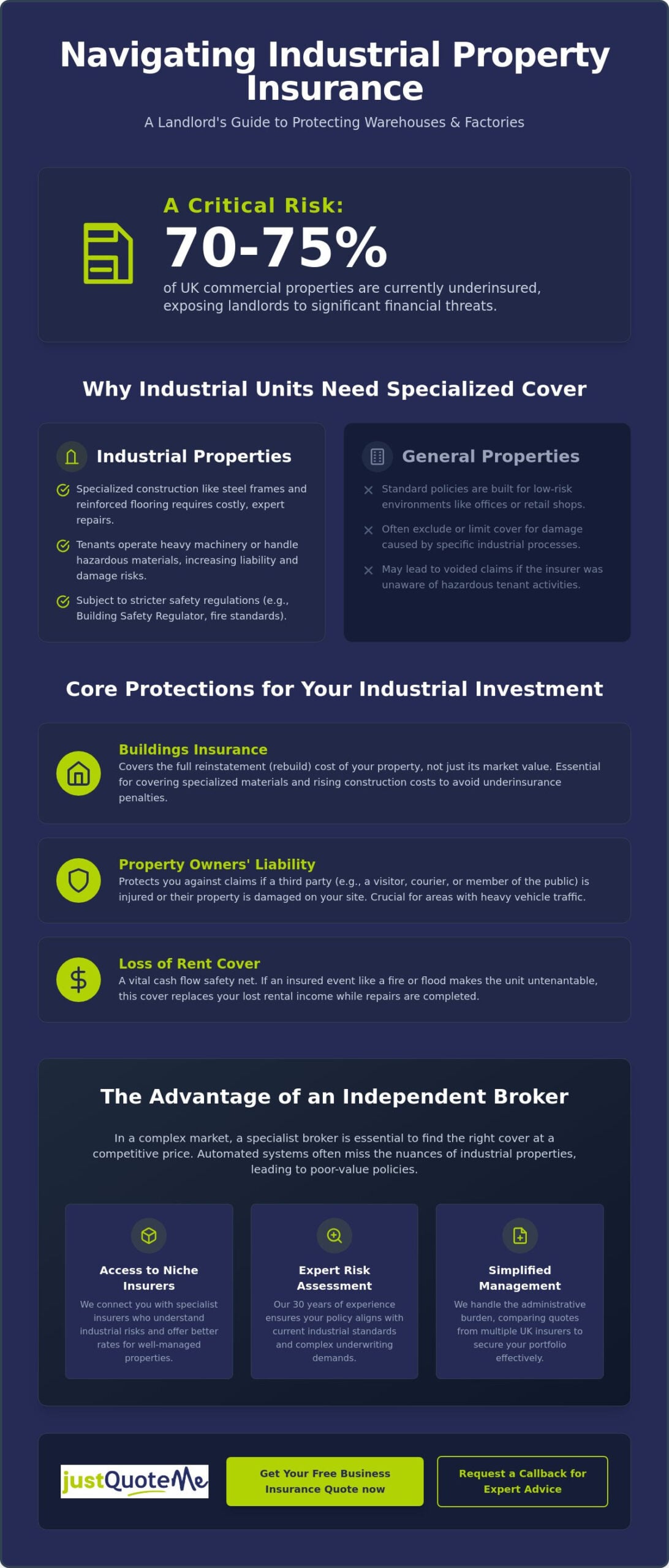
Did you know that an estimated 70-75% of UK commercial properties are currently underinsured? For owners of warehouses and factories, this isn’t just a statistic; it’s a significant financial threat. Managing commercial landlord insurance for industrial unit properties requires a unique approach because your risks are dictated by more than just bricks and mortar. Whether your tenants are handling hazardous chemicals or operating heavy machinery, the potential for high-value claims is much greater than in a standard office block.
You likely feel the pressure of rising rebuild costs and the weight of new 2026 safety regulations, such as the independent Building Safety Regulator and updated fire door standards. We understand that keeping track of these changes while trying to protect your investment is a complex task. This guide promises to simplify that process by providing expert brokerage advice on securing comprehensive cover for your buildings and loss of rent.
We will examine how to navigate tenant-specific liabilities, the intricacies of plant and machinery insurance, and your evolving legal obligations. To secure your investment without the hassle, Just Quote Me for tailored advice that keeps your industrial assets secure in a shifting market. By the end of this article, you’ll have a clear path to obtaining competitive quotes from multiple UK insurers.
Get Your Free Business Insurance Quote now
Request a Call back for free Expert advice
Key Takeaways
- Understand why specialized industrial policies are necessary to cover the unique structural risks of warehouses and factories.
- Discover how to properly value your property using reinstatement costs to avoid the widespread issue of underinsurance in 2026.
- Identify the core protections required for commercial landlord insurance for industrial unit properties, including property owners liability and environmental cover.
- Find out how an independent broker simplifies the process of managing complex industrial portfolios and securing competitive rates from UK insurers.
What is Commercial Landlord Insurance for Industrial Units?
A specialized policy for commercial landlord insurance for industrial unit properties is designed to protect owners of warehouses, factories, and workshops. Unlike a standard shop or office, an industrial site faces unique structural and operational pressures. These policies provide a safety net for the building itself, the loss of rental income, and the significant liability risks associated with industrial tenants.
Standard commercial property insurance often falls short for these sites. Many general policies are built for low-risk environments like retail, meaning they might exclude damage caused by heavy machinery or specific manufacturing processes. In the UK for 2026, while this insurance isn’t a legal requirement in the same way as motor insurance, it’s a practical necessity. Most commercial mortgage lenders will mandate a comprehensive policy before releasing funds. Given that UK Fire & Rescue Services respond to over 22,000 workplace fires annually, going without cover is a risk few landlords can afford.
Industrial Units vs. General Commercial Property
The core difference lies in the heavy nature of the assets. Industrial units often feature steel frames, composite cladding, and reinforced flooring. These elements require specialist contractors for repairs, which drives up reinstatement costs. Tenant activities are also more volatile. While a residential tenant might accidentally start a kitchen fire, an industrial tenant could be managing chemical storage or high-voltage equipment. Property insurance for industrial units must explicitly cover these hazardous trades to ensure the policy remains valid if an incident occurs.
The Role of the Independent Broker
Finding the right cover in a market where 70-75% of properties are underinsured is difficult. High-street insurers often use automated systems that struggle with the nuances of a factory or workshop. This is where an independent broker becomes essential. We access niche insurance panels that are selectively soft, offering better rates to landlords who can prove high maintenance standards and robust risk management. This is especially vital as AI and data analytics are now heavily used in 2026 underwriting to demand more detailed evidence of fire and water controls.
Just Quote Me brings 30 years of experience to the table. We don’t just find a price; we help you understand the complexities of your specific site to align with current industrial standards. This human-centric approach ensures you aren’t just buying a piece of paper, but a reliable shield for your investment. Just Quote Me for a straightforward way to manage your administrative burdens while securing your portfolio.
Get Your Free Business Insurance Quote now
Request a Call back for free Expert advice
Core Covers: Protecting Your Industrial Investment
Securely managing a commercial landlord insurance for industrial unit policy starts with identifying the specific pillars of protection your site requires. Unlike residential lets, industrial buildings are often high-value structures with specialized cladding, steel frames, and reinforced flooring. Buildings insurance must cover the full reinstatement cost. In 2026, with construction material prices approximately 2% higher than the previous year, ensuring your sum insured reflects the actual cost to rebuild is vital. If your building is underinsured, you may only receive a fraction of a claim’s value due to the “average” clause in insurance contracts.
Property Owners Liability is equally critical. This covers you if a third party is injured or their property is damaged on your premises. For industrial sites, where heavy vehicles and machinery are common, the risk of a significant claim is elevated. Alongside this, Loss of Rent cover protects your cash flow. If a fire or flood makes the unit untenantable, this cover replaces the income you would have received while repairs are underway. It’s a vital safety net for landlords who rely on consistent rental yields to service mortgages or fund further investments.
Understanding FRI Leases and Insurance
Most industrial units operate under a Full Repairing and Insuring (FRI) lease. This structure shifts the responsibility for repairs and insurance premiums onto the tenant. A common pitfall occurs when landlords assume this means they don’t need to oversee the policy. Usually, the landlord arranges the commercial landlord insurance for industrial unit to ensure the cover meets their standards, then recharges the premium to the tenant. You can find more details on how these structures work in this Commercial Insurance Guide. Failing to clearly define these obligations in the lease can lead to legal disputes if the property is damaged and the cover is found lacking.
Liability Limits for 2026
In 2026, a standard £1 million liability limit is rarely sufficient for industrial environments. The complexity of manufacturing activities means accidents can involve multiple parties or significant environmental damage. We often recommend looking at limits of £5 million or £10 million to provide a robust safety net. This is particularly important if your tenants work with chemicals or high-heat processes. For a deeper look at managing these risks, explore our dedicated Public Liability Insurance page. Choosing the right limits doesn’t have to be a headache. Just Quote Me for a pragmatic assessment of your portfolio’s needs.
Get Your Free Business Insurance Quote now
Request a Call back for free Expert advice
Industrial-Specific Risks: Beyond Bricks and Mortar
While the physical shell of your property is a significant asset, the activities conducted within its walls dictate your true risk exposure. A standard policy might cover a fire, but it often fails to address the specific fallout from industrial operations. If your tenant handles hazardous materials or specialized manufacturing, your commercial landlord insurance for industrial unit must be tailored to these high-risk environments. This includes accounting for industrial processes that standard property policies usually exclude, such as the use of high-heat equipment or chemical processing.
Unoccupied property cover is another vital consideration. Industrial units often sit empty between tenancies, and these vacant periods introduce new threats. Empty warehouses are prime targets for metal theft and arson. Most insurers require specific security measures, such as draining water systems or boarding up windows, to maintain cover during these gaps. Managing these transitions is a complex administrative task, but getting it right ensures your investment remains protected even when it isn’t generating rent.
Plant and Machinery Considerations
If you provide essential infrastructure like lifts, boilers, or heavy HVAC systems, you face unique maintenance and legal obligations. Statutory inspections are a requirement for many types of industrial plant. If you fail to keep up with these inspections, your insurance validity could be at risk. We recommend securing specialized Plant and Machinery Insurance to cover the breakdown of landlord-owned equipment. This protection goes beyond simple damage; it often includes the costs of specialized repairs and the replacement of components that are essential for your tenant’s business continuity.
Environmental and Pollution Risks
Environmental liability is a major gap in many generic commercial policies. Most standard contracts only cover “sudden and accidental” pollution, such as a pipe bursting and leaking oil. They often exclude “gradual pollution,” which occurs when a substance leaks slowly over months or years. In 2026, the Building Safety Regulator’s independent status means enforcement is stricter than ever. If a tenant’s activity leads to ground contamination, the clean-up costs can be astronomical. Just Quote Me to ensure your policy includes specific environmental headers that protect you from the financial ruin of a pollution incident. We help you navigate these technical terms so you feel secure in your choices.
Get Your Free Business Insurance Quote now
Request a Call back for free Expert advice
Calculating Rebuild Costs and Policy Value
Getting the valuation wrong is one of the most common mistakes when securing commercial landlord insurance for industrial unit properties. Many landlords confuse market value with reinstatement cost. While market value is what a buyer might pay for the property, the reinstatement cost is the total amount required to rebuild the structure from scratch. This figure must include more than just bricks and mortar. You must account for site clearance, the removal of debris, and professional fees for architects and surveyors, which can add significant costs to a major claim.
Tenant improvements often complicate this calculation. If your tenant installs a mezzanine floor, specialized office pods, or bespoke racking that becomes a permanent fixture, the rebuild value of the building changes. If these additions aren’t reflected in your sum insured, you risk being underinsured. In 2026, with construction material prices rising by approximately 2% year on year, a valuation that is even twelve months old might already be out of date. Accurate data is your best defense against the “average” clause, which insurers use to reduce payouts if the sum insured is too low.
The Revaluation Checklist
We recommend a formal RICS (Royal Institution of Chartered Surveyors) valuation every three to five years to ensure your policy remains accurate. For industrial units in Staffordshire and the West Midlands, local labor rates and specific site access can influence these costs. Pay close attention to specialized features that are expensive to replace, such as reinforced flooring designed for heavy machinery or high-spec loading bays. These elements distinguish industrial sites from standard commercial property and require precise assessment to ensure your commercial landlord insurance for industrial unit provides full protection.
Reducing Your Premiums Without Reducing Cover
Lowering your insurance costs doesn’t have to mean cutting corners on protection. Investing in robust security measures is a pragmatic way to demonstrate lower risk to underwriters. Consider the following improvements:
- Installing high-definition CCTV with remote monitoring.
- Securing the perimeter with heavy-duty fencing and gated access.
- Fitting Grade 3 alarm systems that alert a central station.
Choosing a higher voluntary excess can also lead to a more competitive premium, provided you have the cash flow to cover that amount in the event of a claim. While automated comparison sites might offer a quick price, they often miss the nuances of industrial risk management. A broker led search ensures you access insurers who value these proactive steps. Just Quote Me for a professional review of your industrial unit’s valuation and to find a policy that matches your specific site requirements.
Get Your Free Business Insurance Quote now
Request a Call back for free Expert advice
Securing Your Industrial Unit with Just Quote Me
Managing a complex industrial portfolio requires more than just a standard insurance policy; it demands a partnership with a broker who understands the structural and operational nuances of the sector. An independent broker is essential for navigating commercial landlord insurance for industrial unit requirements because we look beyond the basic postcode data used by automated systems. With a 30 year history serving landlords in Stone, Stafford, and across the UK, we provide the steady hand needed in a market where underinsurance and regulatory shifts are constant challenges.
Our role extends far beyond the initial placement of your policy. We provide ongoing support that simplifies the administrative burden of being a landlord. From adjusting your cover as tenancies change to providing dedicated assistance during a claim, we act as your advocate. This human centric approach ensures that you aren’t left dealing with call centres or rigid algorithms when you need professional clarity the most. Just Quote Me for a service that prioritises your specific investment needs over generic templates.
Bespoke Solutions for Every Industrial Sector
Every industrial site has a different risk profile based on its use. We provide tailored insurance solutions across various sectors, including:
- Warehousing and Logistics Hubs: Focusing on high reinstatement values and the risks of large scale distribution.
- Light Industrial Workshops: Protecting “starter units” where tenant turnover and small scale manufacturing require flexible terms.
- Heavy Manufacturing Plants: Managing the complex liabilities associated with high heat processes, chemical storage, and heavy machinery.
Next Steps for Industrial Landlords
Securing the right protection starts with gathering accurate property and tenant information. Before you seek a quote, ensure you have details regarding the building’s construction, current fire safety measures, and the specific trades your tenants perform. This data allows us to build a risk profile that insurers value. While “click and buy” policies might seem efficient, they often contain exclusions that leave industrial landlords exposed to significant financial loss. Choosing expert advice ensures your policy is fit for purpose from day one.
In addition to seeking specialist advice, you might also explore Insurance Comparison and Lead Generation options to better understand the range of quotes available for your specific property type.
For those managing a mix of assets, our broader commercial property insurance expertise provides a unified approach to your entire portfolio. We help you move from a state of inquiry to a position of total security. Just Quote Me to manage the complexities of your insurance so you can focus on managing your business.
Get Your Free Business Insurance Quote now
Request a Call back for free Expert advice
Protect Your Industrial Assets with Confidence
Protecting your industrial assets in 2026 requires a proactive stance against underinsurance and evolving safety regulations. You now understand how specialized structural features and specific tenant activities dictate your unique risk profile. Ensuring your commercial landlord insurance for industrial unit policy accurately reflects current reinstatement costs is the most effective way to safeguard your cash flow and long-term investment. Relying on outdated valuations in a market with rising material costs leaves your portfolio exposed to unnecessary financial risk.
Just Quote Me brings over 30 years of industry experience to help you navigate these complexities. As an FCA-authorised independent broker, we provide direct access to top-tier UK insurance panels. This ensures you receive a policy that is both comprehensive and competitively priced. We manage the heavy administrative burdens and technical jargon so you can focus on growing your business. Just Quote Me for a straightforward, expert approach to securing your industrial properties. We look forward to helping you protect your portfolio with confidence.
Get Your Free Business Insurance Quote now
Request a Call back for free Expert advice
Frequently Asked Questions
Is commercial landlord insurance a legal requirement for industrial units?
Commercial landlord insurance is not a statutory legal requirement in the UK, but it is almost always a contractual necessity. Most commercial mortgage lenders won’t release funds without a valid policy in place to protect their security. Additionally, while the law doesn’t force you to buy it, your lease agreements usually require you to maintain cover to protect the interests of both parties against major perils like fire or flood.
Does my policy cover damage caused by the tenant’s machinery?
A standard commercial landlord insurance for industrial unit policy typically covers damage to the building structure rather than the tenant’s own equipment. If a tenant’s machine malfunctions and causes a fire that damages your walls or roof, your buildings insurance should respond. However, the repair or replacement of the machinery itself is the tenant’s responsibility, and they must secure their own contents or plant insurance for those assets.
What happens to my insurance if my industrial unit becomes vacant?
If your industrial unit becomes vacant, you must notify your insurer immediately to avoid voiding your policy. Most standard policies reduce cover to basic perils after the property has been empty for 30 consecutive days. You will likely need specialized unoccupied property cover, which requires stricter security measures like regular site inspections and draining the water systems to mitigate the risks of vandalism, theft, or escape of water.
How is the rebuild cost of an industrial unit calculated?
The rebuild cost is calculated based on the reinstatement value, which is the total cost to rebuild the unit from scratch using modern materials. This calculation includes current labor rates, site clearance costs, and professional fees for architects or surveyors. In 2026, it’s vital to use a RICS-qualified surveyor for this assessment, as underinsurance remains a significant problem for an estimated 70-75% of UK commercial property owners.
Are environmental clean-up costs included in standard landlord policies?
Environmental clean-up costs are rarely included in basic landlord policies and often require a specific endorsement or separate cover. Standard contracts usually exclude gradual pollution, only covering sudden and accidental incidents. For industrial units where chemicals or oils are stored, you need specific environmental liability protection to cover the potentially astronomical costs of ground decontamination or third-party claims resulting from a leak on your premises.
Can I include multiple industrial units on a single portfolio policy?
Yes, you can include multiple industrial units on a single portfolio policy. This approach is often more efficient than managing separate renewals for every property. Consolidating your units into one policy can simplify your administration and often leads to more competitive premiums. It also ensures consistent cover levels across your entire investment, making it easier to track your liabilities and manage your annual insurance budget effectively.
Who is responsible for the insurance premium, the landlord or the tenant?
The landlord usually pays the insurance premium upfront and then recharges the cost to the tenant as part of the service charge. This is a standard feature of Full Repairing and Insuring (FRI) leases common in the industrial sector. It allows the landlord to maintain control over the quality and scope of the cover while ensuring the tenant, who benefits from the business use of the space, ultimately bears the financial cost.
What information do I need to provide for an industrial insurance quote?
To obtain an accurate commercial landlord insurance for industrial unit quote, you need to provide the property’s construction details, the exact nature of the tenant’s trade, and your claims history. Insurers also require information about security measures like CCTV or fencing and the current rebuild valuation. Having a copy of the lease and any recent RICS valuation reports to hand will help speed up the process and ensure your quote is precise.
