
What if the real threat to your 2026 rental yield isn’t a vacant property, but a single burst pipe at 2 AM? You’ve likely felt the dread of a late-night phone call or the frustration of being quoted extortionate emergency call-out fees by tradesmen you’ve never met. With the Renters’ Rights Act 2026 now in full effect as of May 1, maintaining a habitable home is no longer just a courtesy; it’s a legal imperative that directly impacts your ability to manage a successful portfolio. Securing the right emergency landlord home cover ensures you aren’t just reacting to crises, but managing them with the professional efficiency your tenants now expect.
We understand that navigating the complexities of property management can feel like a constant administrative burden. This guide will show you how to protect your yields and maintain positive tenant relationships by choosing cover tailored for the modern UK market. We’ll examine why standard buildings insurance often falls short during a midnight boiler failure and provide a clear roadmap for selecting a policy that offers genuine security in this new legislative era. By the end, you’ll know exactly how to safeguard your investment against the unexpected.
Key Takeaways
- Understand how the Renters’ Rights Act 2026 has transformed landlord obligations regarding property habitability and emergency response times.
- Identify the “Big Three” core protections—plumbing, internal electrics, and primary heating—that are essential for any comprehensive policy.
- Learn the critical distinction between standard buildings insurance and emergency landlord home cover to ensure you aren’t left paying for expensive call-out fees.
- Discover how to evaluate call-out limits and property system conditions to secure a policy that covers both parts and labour during a crisis.
- Protect your long-term rental yields and tenant relationships by using professional cover as a proactive shield against unforeseen repair costs.
What is Emergency Landlord Home Cover and Why is it Essential in 2026?
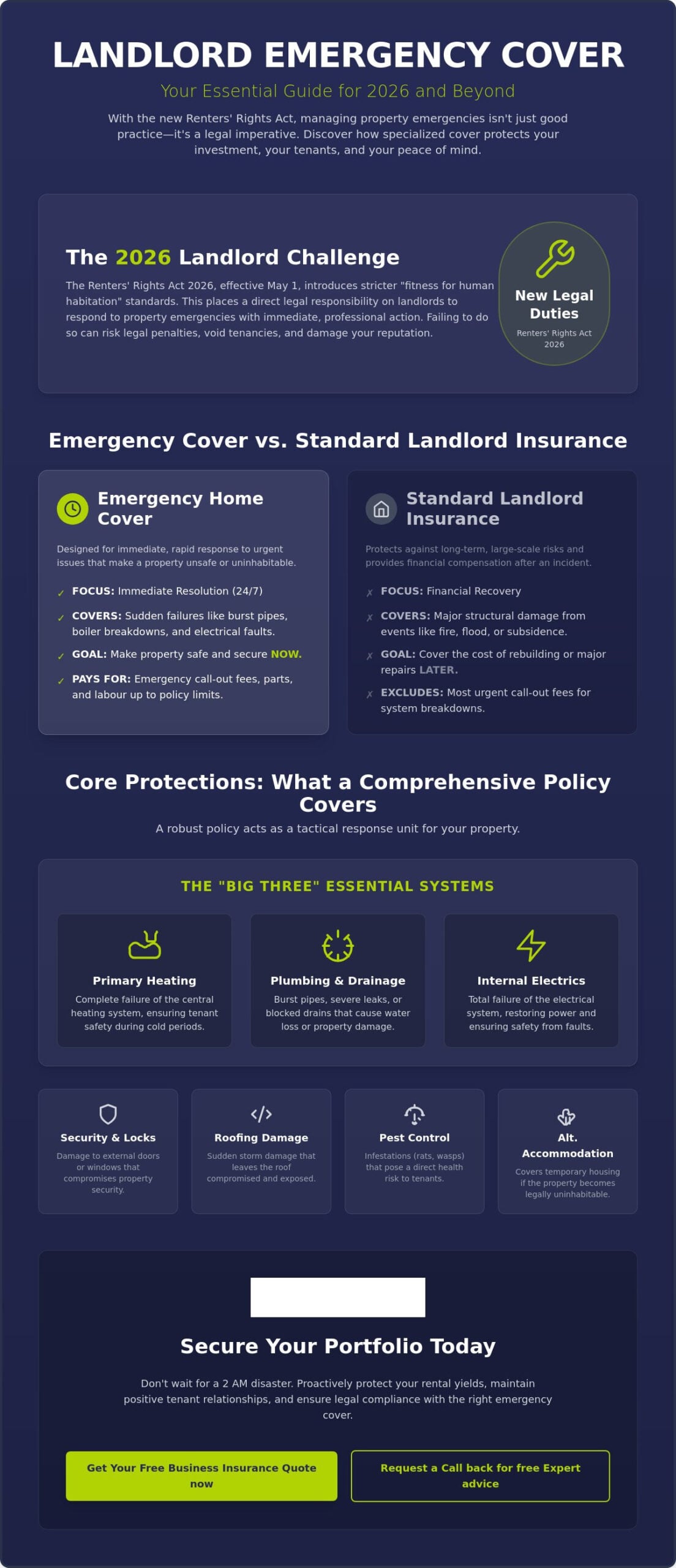
Managing a rental property in 2026 requires more than just collecting rent; it demands a proactive approach to property standards. Emergency landlord home cover is a specialized protection designed to address sudden, unforeseen events that render a property unsafe, insecure, or uninhabitable. Unlike a standard Residential Letting Insurance policy that might focus on long-term structural damage, this cover prioritizes immediate resolution. With the Renters’ Rights Act 2026 coming into force on May 1, 2026, the legal definition of “fitness for human habitation” has become a central pillar of tenancy management. Landlords are now under increased scrutiny to ensure their properties meet strict safety standards at all times.
It’s vital to distinguish between a genuine home emergency and routine property maintenance. A dripping faucet or a stiff door handle is maintenance. A burst pipe flooding a kitchen or a snapped key in the only entrance door is an emergency. The primary goal of this cover is to provide 24/7 access to qualified tradesmen. This removes you, the landlord, from acting as a middleman during a midnight crisis. Instead of searching for a reliable plumber at 3 AM, the tenant or landlord can trigger a response from a pre-vetted network of professionals. It ensures that a professional is dispatched immediately to make the property safe, protecting both your tenant and your investment.
The 2026 Definition of a Property Emergency
In the current UK insurance market, an emergency is defined by the impact it has on the tenant’s ability to live safely in the property. Common scenarios include:
- Heating Failure: The total failure of the primary heating system, particularly during the colder months when a lack of warmth poses a health risk.
- Plumbing and Drainage: Internal issues that result in a total loss of water facilities or cause significant water damage to the property structure.
- Security Breaches: Failures in external doors, windows, or locks that leave the property vulnerable to intruders or the elements.
Why Standard Maintenance Contracts Aren’t Enough
While an annual gas safety check or boiler service is essential, these contracts rarely provide the rapid response needed during an unexpected breakdown. Emergency landlord home cover fills the critical gap between scheduled servicing and accidental damage claims. Speed is the priority here. A fast response prevents secondary damage, such as mould growth from a persistent leak or structural rot. Relying solely on a local handyman might lead to delays if they are unavailable or overbooked. In 2026, the habitability threshold for UK rentals is defined by the property’s immediate safety and the continuous provision of essential services like heat and water.
Core Protections: What Does a Comprehensive Policy Cover?
A robust policy acts as a tactical response unit for your property. While standard insurance handles the long-term financial recovery after a disaster, emergency landlord home cover focuses on the immediate “Big Three”: plumbing and drainage, internal electrics, and primary heating. These systems are the lifeblood of a habitable home. Under UK law, the landlord is always responsible for repairs involving the structure, exterior, and essential supply of water, gas, and electricity. Comprehensive cover ensures these obligations are met within hours, not days.
Beyond the primary utilities, a high-quality policy includes security and roofing protections. This covers the cost of securing a property after a break-in or repairing sudden storm damage that leaves the roof compromised. You’ll also find pest control elements designed to tackle infestations of rats, mice, wasps, or hornets that pose a genuine health risk. If a crisis is so severe that the property becomes genuinely uninhabitable, an alternative accommodation clause provides your tenants with a temporary place to stay, protecting your reputation and your legal standing. If you’re unsure which level of protection fits your portfolio, it’s often best to consult with an insurance specialist who understands the local market.
Heating and Power Failures
Total failure of the primary heating system is one of the most common claims. It’s critical to understand the difference between “Total Failure” and “Partial Loss” in your policy wording. Most insurers only trigger an emergency response if the entire system is down, rather than a single radiator failing. To keep this cover valid, you must maintain your Gas Safety Certificates and provide evidence of annual boiler servicing. This integration ensures that the hardware is well-maintained while the insurance stands ready for unforeseen mechanical breakdowns.
Plumbing, Drainage, and Pest Infestations
Blocked toilets and burst pipes can lead to rapid structural damage and mould growth if they aren’t addressed immediately. Emergency cover provides the tradesmen needed to stop the flow of water and clear major blockages. For those managing larger portfolios or mixed-use buildings, you may need to look at Commercial Property Insurance to ensure that shared drainage systems and larger infrastructure are fully protected. Whether it’s a wasp nest in the eaves or a collapsed drain, having a pre-vetted professional on call is the most efficient way to manage your 2026 landlord liabilities.
Emergency Cover vs. Standard Landlord Insurance: Clearing the Confusion
Many property owners assume their standard buildings policy is a catch-all solution for every maintenance crisis. It isn’t. Buildings insurance is designed to protect against major perils like fire, flood, or subsidence. It typically covers the result of a disaster, such as replacing floorboards ruined by a massive leak. However, it rarely covers the fix itself, such as the emergency plumber’s bill to stop that leak. This is where emergency landlord home cover becomes vital. It acts as a first-response service, addressing the root cause of a problem before it escalates into a massive, expensive claim on your main policy.
Financial efficiency is another key differentiator between these two types of protection. Most buildings insurance policies carry an excess ranging from £250 to £500. If an emergency repair costs £300, claiming on your main policy is financially illogical. Conversely, many emergency policies feature a £0 excess. This allows you to call out a professional for urgent issues without a heavy financial penalty. By using a separate emergency policy, you also protect your No Claims Bonus on your primary buildings insurance, which helps keep your long-term premiums stable and manageable.
The Problem with Relying on Buildings Insurance
Standard policies often require you to prove “sudden and accidental” damage, which involves a lengthy claims process. In 2026, your responsibilities for repairs are strictly enforced, and waiting days for a loss adjuster isn’t an option. Emergency cover targets a rapid response, often within 2-4 hours, to stabilize the situation. High excesses on standard buildings insurance make small emergency repairs uneconomical to claim, often leaving landlords to pay out-of-pocket if they lack specific emergency protection.
Synergy Between Policies
These policies don’t compete; they collaborate to protect your rental yield. While emergency cover handles the immediate repair, your Public Liability Insurance provides protection if an emergency, such as a faulty electrical circuit, leads to tenant injury. Having both creates a comprehensive safety net that covers both the immediate crisis and the long-term liability. Just Quote Me can bundle these essential protections into a single bespoke package, simplifying your administration and ensuring there are no gaps in your property coverage.
The Broker Advantage: How to Evaluate and Choose a Policy
Selecting the right emergency landlord home cover requires more than a quick comparison of monthly premiums. A policy that looks affordable on paper can quickly become a liability if the response times are sluggish or the call-out limits are too low to cover modern repair costs. To secure your portfolio, you must move beyond the marketing headlines and evaluate the technical substance of the contract. This systematic approach ensures your protection matches the specific needs of your property and your tenants.
- Step 1: Assess System Health. Evaluate the age and condition of your property’s primary systems. If your boiler or wiring is nearing the end of its expected lifespan, ensure the policy doesn’t have a “wear and tear” exclusion that could invalidate your claim.
- Step 2: Check Call-out Limits. Ensure the policy covers both parts and labour. In 2026, a limit of at least £500 to £1,000 per call-out is necessary to handle most urgent repairs without requiring an additional contribution from you.
- Step 3: Verify Response Guarantees. Look for 24/7 helplines managed by UK-based teams. The goal is to have a contractor dispatched within hours to stabilise the property.
- Step 4: Review Exclusions. Read the fine print for common “gotchas,” such as claims being rejected due to sludge in the radiators or a lack of recorded annual servicing.
- Step 5: Consult a Broker. Use an expert to compare multiple underwriters. This helps you find the optimal “Price vs. Response” ratio that a single-provider site cannot offer.
Key Metrics: Limits, Excess, and Response Times
While the individual call-out limit is important, the maximum annual claim limit is often more critical for landlords with multiple properties. If a single building suffers two or three separate emergencies in a year, you don’t want to find your cover exhausted by mid-summer. You should also be aware of the “48-hour exclusion period” common in new policies; this prevents claims for pre-existing issues immediately after signing up. Our deep understanding of Tradesman Insurance allows us to vet the quality of insurer-approved contractors, ensuring the people sent to your property are actually qualified for the task.
Why Use an Independent Broker Like Just Quote Me?
Independent brokers provide access to a broad network of UK underwriters that direct-to-consumer comparison sites often miss. We provide personalised advice that considers regional nuances. For instance, a broker understands if your Stafford-based property requires specific local coverage due to local environmental factors or contractor availability. Efficiency is the core of our service. Just Quote Me handles the comparison of complex policy wordings for you, identifying hidden gaps in cover before they become a problem. To ensure your property is protected by a policy that actually performs when you need it, you should consult an independent insurance broker today.
Securing Your Property Portfolio with Just Quote Me
Think of emergency landlord home cover as a specialized shield for your broader investment strategy. While your main buildings policy handles catastrophic events, this cover manages the inevitable friction of daily property ownership. It functions as “insurance for your insurance,” preventing minor mechanical failures from snowballing into expensive claims that could inflate your premiums for years. By resolving crises within hours, you maintain the high standards of habitability required by the Renters’ Rights Act 2026, which became law on May 1, 2026. This proactive approach is the most efficient way to protect both your rental yield and your professional reputation.
With over 30 years of industry experience, particularly within the West Midlands, we understand that property management is rarely a one-size-fits-all endeavor. Our role is to simplify the administrative burden of finding reliable protection. We move you quickly from a state of inquiry to a state of security, using our regional expertise to vet contractors and compare complex policy wordings. Whether you’re managing a single terraced house or a sprawling portfolio, our process is designed for clarity and speed. We act as your steady hand in a market where 52% of landlords currently cite legislative changes as their primary challenge. Just Quote Me to find the most efficient route to property security.
Bespoke Solutions for Every Landlord
We provide tailored advice for every type of property owner. You might have a single buy-to-let in Stone or a large student portfolio in Newcastle-under-Lyme. In either case, you’ll benefit from a human advisor who knows your business name rather than just a policy number. This personalized service is a cornerstone of our brand, positioning us as a human-centric alternative to impersonal, automated systems. For a deeper look at how to structure your total protection, see our Landlord Insurance Pillar Article for comprehensive guidance.
Ready to Protect Your Rental Yield?
Securing your investment doesn’t have to be a complex or expensive process. Adding emergency cover is a pragmatic, cost-effective step that provides immediate peace of mind for you and your tenants. We’re here to help you navigate the 2026 market with confidence and ease. Take the next step toward a more resilient property portfolio today by speaking with our team of specialists.
Future-Proof Your Property Portfolio Today
Managing a modern portfolio requires a transition from reactive repairs to a proactive strategy. You’ve seen how specific protections prevent minor mechanical failures from draining your profits or damaging your professional reputation. By choosing dedicated oversight, you ensure your properties remain compliant with the latest standards while your tenants enjoy the security of a well-maintained home. It is about removing the stress of midnight call-outs and replacing it with a reliable, professional system.
As an FCA-authorised independent broker with over 30 years of experience, Just Quote Me connects you to a broad network of top UK insurers. We provide the specialized knowledge required to secure the right emergency landlord home cover for your unique needs. Our focus remains on simplifying your administrative load and protecting your rental yields with expert precision. You deserve a partner who understands the nuances of the UK market and acts as a steady hand for your business.
Get Your Free Business Insurance Quote now
Request a Call back for free Expert advice
Frequently Asked Questions
Is landlord home emergency cover a legal requirement in the UK?
No, it isn’t a legal requirement, but you must ensure your property remains fit for human habitation under the Renters’ Rights Act 2026. While the law doesn’t mandate a specific insurance policy, it does require you to fix essential services like heating and water quickly. Failing to meet these standards can lead to legal action from tenants, making this cover a practical necessity for regulatory compliance.
Does home emergency cover include boiler servicing?
Most policies don’t include annual boiler servicing as a standard feature. Instead, they usually require you to provide evidence of an annual service to keep your breakdown cover valid. Emergency landlord home cover is designed to handle sudden, unforeseen failures rather than routine maintenance. You should check your specific policy wording, as some premium packages might offer servicing as an optional add-on for an extra fee.
Can I buy emergency cover if my property is currently unoccupied?
You can find cover for unoccupied properties, but standard policies often exclude buildings that have been empty for more than 30 or 60 consecutive days. If your property is between tenancies, you must inform your broker immediately. Specialized unoccupied property insurance is usually required to ensure protection remains active while the building is vacant, as the risks of undetected leaks or break-ins are significantly higher.
What is the difference between home emergency cover and landlord buildings insurance?
The main difference lies in what the policy actually pays for during a crisis. Buildings insurance covers the cost of repairing damage caused by an event, such as replacing a ruined carpet after a pipe bursts. Emergency cover pays for the immediate professional assistance to stop the emergency itself, such as the plumber’s call-out and labour. One manages long-term recovery, while the other provides a tactical response.
Are there any limits on how many times I can call out a contractor?
Yes, most policies have a limit on the number of claims or a total annual financial cap. While some providers offer “unlimited” call-outs, they still apply a maximum cost per claim, which is often between £500 and £1,000. It’s vital to review your policy schedule to understand these boundaries. If you manage a large portfolio, you might need a policy with higher aggregate limits to cover multiple incidents.
Does this cover protect me against tenant-caused damage to the plumbing?
This cover generally excludes repairs for damage caused by tenant negligence or deliberate acts. If a tenant flushes inappropriate items down a toilet or causes a leak through poor DIY attempts, the emergency policy won’t pay for the fix. In these scenarios, you would typically look to your standard landlord insurance with accidental damage cover or use the tenant’s security deposit to recover the repair costs.
How quickly will a contractor arrive in a genuine emergency?
Most insurers aim to have a qualified contractor at your property within 2 to 4 hours for genuine emergencies. This response time can vary based on your specific location and the time of day, but the goal is always to stabilize the situation as quickly as possible. Having emergency landlord home cover ensures you aren’t stuck in a queue with standard customers during peak times or extreme weather events.
Is pest control included in all landlord home emergency policies?
Pest control isn’t a universal feature and varies significantly between different insurance providers. When it is included, it usually covers infestations that pose a health risk or property damage, such as rats, mice, or wasps’ nests. It rarely covers “nuisance” pests like ants or bedbugs. Always verify the specific list of covered pests in your policy documents to ensure it meets the requirements of your rental property.
