

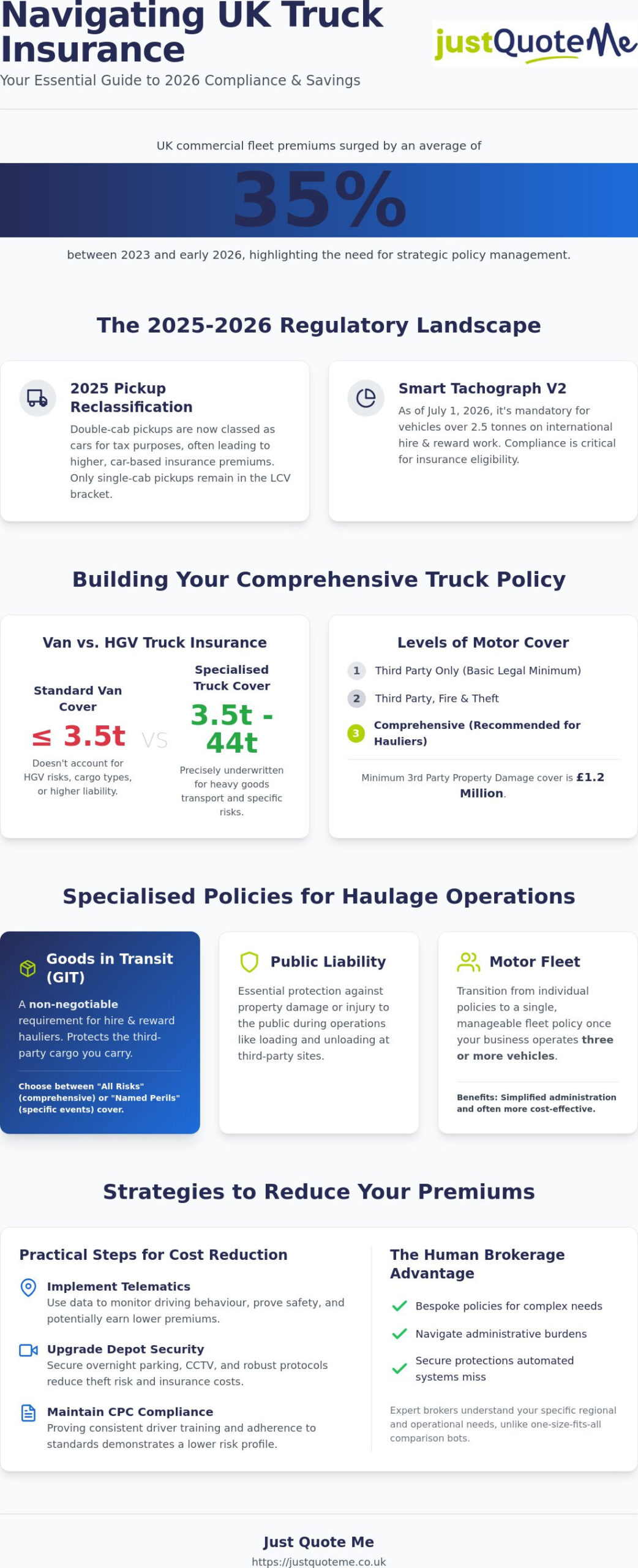
Did you know that UK commercial fleet premiums surged by 35% between 2023 and early 2026? While the wider market is finally showing signs of softening, many operators still find themselves buried under rising operational costs and a mountain of new red tape. We understand that managing a haulage business is difficult enough without worrying if your Truck Insurance actually covers the specific risks of your cargo or the latest 2026 legislative shifts.
You likely feel the pressure of the 2025 pickup truck tax changes and the July 2026 Smart Tachograph Version 2 requirements. This guide provides expert advice on securing the right policy types to ensure full legal compliance while driving down your annual premiums. We’ll explore the impact of the updated Direct Vision Standards, explain the new London Congestion Charge rules for electric vehicles, and show you how to find specialized Goods in Transit cover that fits your business perfectly.
Key Takeaways
- Learn the critical differences between standard van cover and specialised Truck Insurance to ensure your HGV is fully compliant with 2026 regulations.
- Discover why Goods in Transit (GIT) cover is a non-negotiable asset for hauliers and how to choose the right level of protection for high-value cargo.
- Identify the exact moment your business should transition from individual owner-driver policies to a more cost-effective and manageable motor fleet arrangement.
- Uncover practical strategies to lower your annual premiums, from implementing telematics technology to upgrading your depot security protocols.
- Understand the value of human-centric brokerage in navigating complex administrative burdens and securing bespoke protections that automated systems often miss.
What is Truck Insurance and Why is the 2026 Landscape Different?
Truck Insurance is a specialised commercial motor policy designed for vehicles ranging from 3.5 tonnes to 44 tonnes. While it shares some DNA with standard Vehicle Insurance in the UK, the risk profile is significantly higher. Standard van insurance policies usually stop at 3.5 tonnes and don’t account for the unique challenges of heavy goods transport. At Just Quote Me, we’ve spent 30 years helping hauliers in Staffordshire and the West Midlands understand that an HGV isn’t just a “large van”; it’s a high-value asset that requires precise underwriting to protect your livelihood.
The 2025 Pickup Reclassification: Cars vs Vans
The insurance landscape shifted dramatically following the April 2025 reclassification of double-cab and extended-cab pickups. Previously treated as light commercial vehicles (LCVs), these are now classified as cars for benefit-in-kind (BIK) and tax purposes. This change has a direct knock-on effect for your Truck Insurance costs. Insurers are now moving these vehicles into car-based risk categories, which often leads to higher premiums due to different loss-ratio calculations. Only single-cab pickups have remained firmly in the LCV bracket, providing a more stable cost base for businesses that don’t require the extra seating.
HGV and Haulage Specifics in 2026
Operating an HGV in 2026 requires strict adherence to new safety and monitoring standards. Since June 1, 2026, the Goods Vehicles (Testing, Drivers’ Hours and Tachographs etc.) (Amendment) Regulations have tightened compliance for international transport. If you use vehicles over 2.5 tonnes for hire and reward work abroad, you must now use Smart Tachograph Version 2 as of July 1, 2026. This tech-heavy environment means your insurance eligibility often hinges on your ability to prove driver CPC compliance and tachograph data retention.
Whether you’re moving “Own Goods” as a tradesperson or operating on a “Hire and Reward” basis as a professional haulier, the type of carriage dictates your premium. As your business grows, managing individual policies becomes an administrative burden. Just Quote Me for a simplified transition to motor fleet insurance once you reach three or more vehicles, consolidating your risk into one manageable renewal. This human-centric approach ensures you aren’t just another number in a database but a business with specific regional and operational needs.
Core Covers: Building a Comprehensive Truck Policy
Choosing the right level of Truck Insurance is a balancing act between managing overheads and protecting high-value assets. While Third Party, Fire and Theft provides a basic safety net, most professional hauliers opt for Comprehensive cover. This isn’t just about extra peace of mind; it’s a pragmatic response to a market where the legal minimum for third-party property damage is £1.2 million. Given that UK commercial fleet premiums rose by 35% between 2023 and 2026, securing a policy that includes accidental damage protects your balance sheet from sudden, catastrophic repair costs. Meeting your Operator Licensing requirements depends on maintaining a robust insurance profile that proves you can handle the financial risks of the road.
Goods in Transit and Marine Cargo
Goods in Transit (GIT) insurance is the protection of third-party property while under your control. It’s a non-negotiable requirement for any haulier working for hire and reward. You need to tailor your GIT limits specifically to the cargo you carry. General haulage might require standard limits, but moving hazardous materials or high-value electronics demands specialised underwriting. You’ll usually choose between “All Risks” cover, which protects against any damage not specifically excluded, or “Named Perils,” which only covers specific events like fire or theft. Most modern contracts require “All Risks” to ensure there are no gaps in protection during the logistics chain.
Liability Protection for Truck Owners
Operating a heavy vehicle involves risks that extend far beyond the driving seat. Public Liability Insurance is essential for protecting your business during loading and unloading operations at third-party sites. If a pallet slips or equipment causes property damage at a depot, this cover manages the resulting claims. If your operation grows to include a second driver, warehouse staff, or even a casual crew, Employers Liability Insurance is a strict legal requirement in the UK. Even logistics managers should consider Professional Indemnity to protect against clerical errors in routing or scheduling that lead to financial loss for a client. Consolidating these risks into bespoke insurance solutions ensures you don’t have overlapping or missing covers.
Finally, don’t overlook legal expenses and breakdown recovery. Heavy-duty vehicle recovery is notoriously expensive and requires specialised equipment. Including this in your policy prevents a single mechanical failure from grounding your entire operation. Legal expenses cover is equally vital, providing the financial backing needed to navigate complex road traffic disputes or contract disagreements that are common in the high-pressure haulage industry.
Specialised Policies: From Owner-Drivers to Large Fleets
Scaling a haulage business changes your risk profile as quickly as it changes your balance sheet. Most operators begin as owner-drivers, where a single vehicle serves as the heartbeat of the company. At this stage, your Truck Insurance must balance commercial necessity with the reality of being the sole operator. However, once you expand to three or more vehicles, managing individual policies becomes inefficient. This is the point where transitioning to motor fleet insurance offers significant advantages, consolidating your renewals and often reducing the total cost per vehicle. For growing businesses, “Any Driver” policies are the gold standard, providing the flexibility to swap crew members without the administrative delay of updating named driver lists.
Different sectors require highly specific protections that standard policies might overlook. If you operate refrigerated units, your cover must include breakdown of cooling equipment to protect against the loss of perishable goods. Similarly, skip lorries and tippers face unique hazards on construction sites and at waste centres. Securing Specialist HGV insurance ensures these mechanical risks and the associated liabilities are fully accounted for, preventing a single equipment failure from becoming a financial disaster.
Motor Trade and Haulage Synergy
Many hauliers in the West Midlands operate their own maintenance depots or engage in vehicle sales to keep their fleet fresh. This creates a crossover where your primary Truck Insurance might need to align with motor trade principles. You must also consider the protection of your physical premises. Your depot, tools, and diagnostic equipment require dedicated cover to ensure that a fire or break-in at your home base doesn’t ground your entire fleet. Additionally, managing sub-contractor risks is vital. If you use “owner-drivers” to handle overflow work, your policy should clearly define where your liability ends and theirs begins.
Specialist Construction Vehicles
In Staffordshire’s busy construction sector, transport trucks often work alongside heavy plant and machinery. We find that Builders Insurance and transport cover are frequently linked. If your trucks are regularly entering active sites, you may need to integrate Contractors All Risk Insurance to cover the vehicles and the materials they carry against site-specific perils. This holistic approach to risk management is what differentiates a standard policy from a bespoke brokerage solution. We focus on these nuances so you can concentrate on the logistics of the job.
How to Reduce Your Truck Insurance Premiums in 2026
While UK commercial fleet premiums rose by 35% between 2023 and early 2026, the market is finally showing signs of softening. Overall UK insurance rates declined by 8% in the first quarter of 2026, creating a window for hauliers to renegotiate their costs. To capitalise on this trend, you need to prove you’re a lower risk than the industry average. Implementing telematics and “black box” technology is the most effective way to do this. By providing real-time data on braking, cornering, and speed, you give insurers the evidence they need to justify lower rates for your Truck Insurance.
Physical security remains a top priority for underwriters. Storing your vehicles in a secure depot with CCTV and gated access significantly lowers your risk profile compared to street parking. If you’re an owner-driver, using secure overnight parking sites with accredited security standards can also prevent theft-related claims. Additionally, adjusting your voluntary excess is a quick way to lower your initial premium. While a higher excess means you’ll pay more in the event of a claim, it demonstrates a commitment to safe operation and reduces the insurer’s potential payout on minor incidents.
Driver Safety and Training
The age and experience of your drivers directly impact your overheads. While it’s tempting to hire younger drivers to fill staff shortages, those under 25 often carry much higher premiums. Managing your driver age profile and investing in advanced driving qualifications can lead to substantial discounts. Dashcams have also become essential tools; they provide indisputable evidence to mitigate fraudulent “crash for cash” claims, which are still a major concern on UK roads. A professional broker can negotiate bespoke rates by presenting your full risk management strategy, including these training and tech investments, to our network of insurers.
Policy Structuring for Savings
Consolidating your various protections into a single package is often more cost-effective than managing separate policies. By combining your vehicle cover with Public Liability and Employers Liability, you can often secure multi-policy discounts. It’s also vital to review your “Radius of Operation.” If your business primarily serves Staffordshire and the West Midlands, don’t pay for UK-wide or international cover you don’t use. Consolidating these into motor fleet insurance for three or more vehicles simplifies your admin and scales your savings.
Don’t fall into the trap of auto-renewing. Annual reviews with a human-centric advisor allow you to account for changes in your fleet, such as the 2026 EV congestion charge updates or new tachograph compliance tech. For a tailored approach that prioritises your bottom line, consider our bespoke brokerage services.
The Just Quote Me Advantage: Bespoke Brokerage vs Comparison Bots
Automated comparison engines are built for speed, but they often lack the nuance required for complex haulage risks. While a bot might find a low headline rate, it rarely understands the operational realities of a fleet operating out of the West Midlands. With over 30 years of experience based in Stone and Stafford, Just Quote Me provides a human-centric alternative. We don’t just process data; we identify the gaps in cover that automated systems frequently miss. These might include specific exclusions in Goods in Transit policies or inadequate property damage limits that don’t meet the current £1.2 million legal minimum.
Our philosophy is built on simplifying your administrative burden. Instead of navigating endless drop-down menus that don’t quite fit your HGV’s specifications, you get direct access to expert advisors. This personal support is vital for mid-term adjustments, such as adding a new driver or updating your vehicle list to comply with the July 2026 Smart Tachograph Version 2 requirements. We act as a steady hand in a complex market, ensuring your Truck Insurance remains robust even as regulations shift.
Local Expertise, National Reach
We serve a diverse range of businesses in Newcastle-under-Lyme, Stafford, and across the wider region. Our deep understanding of regional logistics and the construction sector allows us to tailor your protection to the specific routes and risks you face daily. Local business owners often prefer a broker they can call directly. They know they’ll speak to someone who understands the regional market rather than a call centre operative following a rigid script. This regional focus doesn’t limit our reach; we use our extensive network of top UK insurers to find competitive rates that a local generalist might overlook.
Next Steps for Your Truck Cover
Securing the right protection shouldn’t be a hurdle for your business. You can use our efficient online quote system for a fast turnaround, or choose a personalised phone consultation if your requirements are more complex. To speed up the process, have your vehicle registration details, V5 documents, and driver history ready for review. If you’re managing three or more vehicles, we can discuss consolidating your risk into motor fleet insurance to streamline your renewals and reduce costs.
Whether you need to integrate Public Liability Insurance or secure a bespoke haulier package, Get Your Free Business Insurance Quote now to see the Just Quote Me difference. We manage the complex administrative burdens so you can focus on keeping your fleet on the road.
Secure Your Fleet’s Future and Drive Down Costs
Navigating the 2026 haulage landscape requires more than just a standard policy; it demands a proactive approach to risk and compliance. By embracing Smart Tachograph technology and consolidating your vehicles into a fleet structure, you can protect your bottom line against rising operational costs. We’ve shown that the right Truck Insurance isn’t just a legal necessity; it’s a strategic asset that keeps your business moving safely across the UK. Whether you’re an owner-driver or managing a large fleet, staying ahead of legislative changes is the key to long-term success.
As an FCA-authorised firm with over 30 years of independent brokerage experience, Just Quote Me provides the specialized knowledge that automated comparison sites simply cannot match. We understand the regional nuances of Staffordshire and the West Midlands, offering a steady hand in an increasingly complex market. Our team is ready to manage the administrative burden so you can focus on the road ahead. Visit Just Quote Me today to see how we can simplify your professional life.
Get Your Free Business Insurance Quote now
Request a Call back for free Expert advice
Frequently Asked Questions
Do I need different insurance for a pickup truck used for business?
Yes, standard private van insurance won’t cover commercial activities. You need a specific commercial vehicle or light Truck Insurance policy that includes “carriage of own goods” or “hire and reward” depending on your specific work. This ensures you’re protected while visiting sites or delivering products to customers across the UK.
What is the difference between HGV and LGV insurance?
The difference lies primarily in the weight of the vehicle and the resulting risk profile. LGV (Light Goods Vehicle) usually refers to vehicles under 3.5 tonnes, while HGV (Heavy Goods Vehicle) covers everything over that limit, up to 44 tonnes. HGV policies require stricter underwriting due to the specialized licenses and safety regulations involved in operating heavy machinery.
How did the 2025 tax changes affect my pickup truck insurance?
The April 2025 reclassification of double-cab and extended-cab pickups as cars for tax purposes has shifted how many insurers categorize these vehicles. Because they’re now often treated as cars rather than light commercial vehicles, you may see changes in your premium rates. It’s vital to ensure your policy accurately reflects the new classification to avoid claims being voided.
Does truck insurance cover the goods I am carrying?
No, standard vehicle insurance typically protects the truck itself, not the items inside. You must add Goods in Transit (GIT) cover to protect third-party property while it’s under your control. This is a non-negotiable requirement for most hauliers and can be tailored to the specific value and nature of your cargo.
Can I get truck insurance for a driver under 25?
Yes, you can get cover for younger drivers, though it’s often more expensive due to the higher statistical risk. Many insurers will require these drivers to have a clean license and may impose a higher voluntary excess. We recommend using telematics to help prove their safety and potentially lower the associated costs over time.
What happens if I use my truck for personal use on weekends?
You must ensure your policy specifically includes “Social, Domestic and Pleasure” (SD&P) use alongside your commercial cover. Many commercial policies are “business use only,” meaning you wouldn’t be covered for a trip to the supermarket or a weekend away. Adding SD&P is usually straightforward but must be declared upfront to your broker.
Is public liability included in a standard truck insurance policy?
Public liability is usually an optional add-on rather than a standard feature of a motor-only policy. It’s essential for protecting your business against claims for property damage or injury caused during loading and unloading. We often bundle this into a comprehensive Truck Insurance package to ensure you have no gaps in protection.
How can I insure a fleet of trucks under one policy?
You can consolidate three or more vehicles into a single motor fleet policy. This simplifies your administration with a single renewal date and often provides a lower cost per vehicle than individual policies. It also offers the flexibility of “Any Driver” cover, which is perfect for growing haulage businesses that need to swap crew members quickly.
