
Does your current policy actually cover you if you’re carrying passengers for “hire or reward,” or are you driving toward a legal dead end? For many organizations, the line between social use and commercial transport is dangerously thin. It’s understandable if you feel overwhelmed by the technicalities of D1 licensing or the rising costs of protecting younger drivers. You want to ensure every passenger is safe and every journey is legal, but you don’t want to be bogged down by complex paperwork or high premiums.
This article provides the clarity you need to secure the right Minibus Insurance for your specific requirements. We’ll explain the legal differences between voluntary and commercial driving, how to navigate the latest road safety standards, and how to find bespoke cover that fits your budget. Getting the right cover shouldn’t be a headache. You can Just Quote Me to manage these administrative burdens, allowing you to focus on getting your group to their destination safely. From non-profit shuttle services to professional fleets, we’ll show you how to achieve total compliance and peace of mind.
Key Takeaways
- Understand why standard vehicle policies don’t offer enough protection for passenger transport and why specialist cover is essential.
- Identify whether your operations fall under “Hire and Reward” or if you qualify for non-profit permits like Section 19.
- Learn how vehicle security features and driver experience directly influence the final cost of your Minibus Insurance.
- Verify the specific licensing requirements for drivers who passed their tests after 1997 to ensure your team is legally entitled to drive.
- Discover how 30 years of brokerage experience can help you secure a bespoke policy that bundles your transport and liability needs.
What is Minibus Insurance and Why is it Essential?
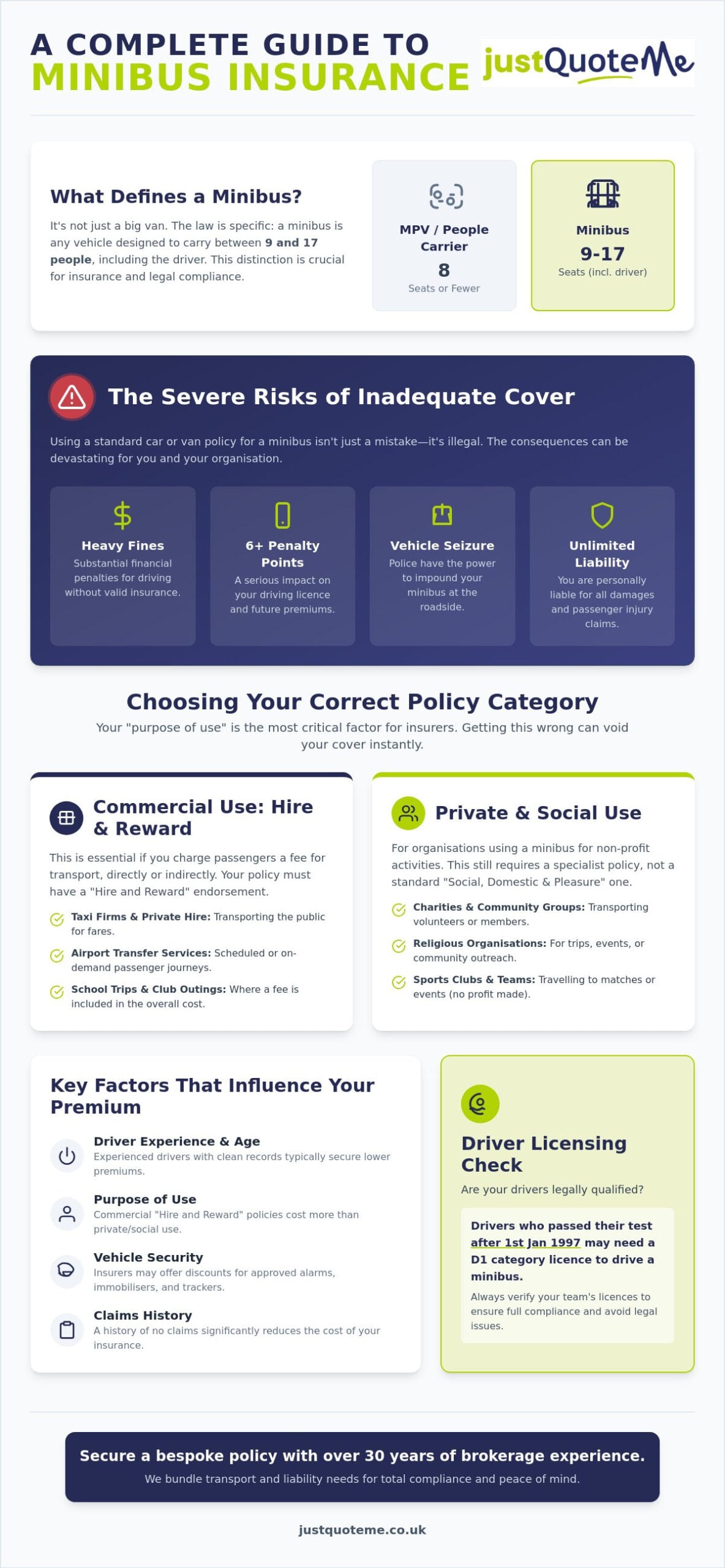
A minibus is defined as a vehicle specifically designed to carry between 9 and 17 people, including the driver. While these vehicles might resemble large vans or people carriers, the legal framework surrounding their operation is far more complex. Minibus Insurance is a specialist product because standard car or van policies simply aren’t built to handle the risks of high-occupancy transport. If you use a regular motor policy for a vehicle with 12 seats, you’re likely driving without valid cover, even if you’ve paid your premiums. Specialist policies are the only way to ensure you meet the strict requirements of UK road traffic laws.
UK legislation places a heavy duty of care on anyone transporting groups of passengers. You’re legally obligated to protect everyone on board against injury or loss resulting from an accident. Understanding Vehicle insurance principles helps clarify why this matters; specialized cover ensures that if a collision occurs, the policy is robust enough to manage multiple personal injury claims simultaneously. A central factor in choosing the right policy is “Hire and Reward.” This term applies if you’re charging passengers for the journey, whether that’s through a direct fare or an indirect payment like a school trip fee or a club membership. Without the correct “Hire and Reward” endorsement, your policy could be void from the moment you start the engine.
Minibus vs. MPV: Knowing the Difference
The distinction between a Multi-Purpose Vehicle (MPV) and a minibus is critical for both taxation and insurance. For insurance purposes, the 9-seat threshold is the definitive line. If your vehicle has 8 seats or fewer, it’s generally classified as an MPV and may fall under a standard car policy. However, once you reach 9 seats, the DVLA reclassifies the vehicle, triggering the need for a dedicated Minibus Insurance policy. This seat count includes the driver, so a vehicle with 8 passenger seats and 1 driver’s seat is legally a minibus.
The Legal Risks of Inadequate Cover
Operating a minibus with the wrong insurance carries severe consequences. If the police stop you and find your policy doesn’t cover your specific vehicle type or use case, you can face heavy fines and six penalty points on your licence. In some cases, the vehicle can be seized at the roadside. The financial risk is even greater; invalidated insurance means your provider won’t pay out for vehicle damage or, more critically, for passenger injuries. For organizations and businesses, this creates an enormous liability. Many groups choose to bundle their motor cover with Public Liability Insurance to provide a complete safety net for incidents that happen when passengers are boarding or alighting the vehicle.
Commercial vs. Private Minibus Insurance: Choosing Your Category
Selecting the right category for your policy is just as important as the vehicle itself. Insurers look closely at your “purpose of use” to determine your premium and level of risk. If you select a private policy but use the vehicle for commercial work, any claim you make will likely be rejected. Whether you’re a local sports club or a professional transport business, you must categorize your operations accurately to stay protected. For organizations managing multiple vehicles, opting for Motor Fleet Insurance is often the most efficient way to consolidate cover under a single policy.
Hire and Reward: The Commercial Standard
If you’re charging passengers for transport services, you’re operating under “Hire and Reward” rules. This category is the standard for taxi firms, airport transfer services, and private hire companies. Because professional drivers spend more time on the road and often work under tight schedules, insurers view them as a higher risk profile. To ensure you’re fully compliant with PSV operator licence requirements, you must match your policy to your specific commercial activity. Driving for profit without this specific endorsement isn’t just a policy breach; it’s a legal violation that can lead to your vehicle being impounded.
Professional transport providers like EC Minibus, who offer specialized services such as transfers to Southampton cruise terminals, must maintain these specific insurance standards to ensure both legal compliance and passenger protection.
Non-Profit and Social Use Policies
Charities, religious organizations, and community groups often have different needs. If you’re using a minibus for social purposes where no profit is made, you might fall under a non-profit policy. However, don’t assume a standard “Social, Domestic and Pleasure” (SD&P) car policy is enough. Most Minibus Insurance for non-profits still requires specific clauses to cover volunteers or employees driving for the organization’s goals. For schools, educational use policies are designed to cover trips and extracurricular activities, ensuring that both staff and students are protected during off-site journeys.
Your premium is directly affected by how often and where the vehicle is driven. A minibus used occasionally for weekend sports fixtures carries a different risk than one used daily for city-based school runs. Providing accurate mileage estimates and clear descriptions of your typical routes helps your broker find the best value. If you’re unsure which category your group falls into, it’s best to speak with a specialist broker who understands these nuances. Getting this right from the start prevents administrative headaches and ensures your Minibus Insurance provides the safety net your passengers deserve.
Factors That Influence Minibus Insurance Costs
The cost of your policy isn’t a random figure. It’s a calculated risk assessment based on your vehicle, your drivers, and even your location. For example, a newer minibus equipped with advanced safety assists and GPS tracking generally presents a lower risk than an older model without modern security features. While older vehicles might have a lower market value, they often lack the immobilisers and alarm systems that insurers look for. If you invest in high-quality security, you’re likely to see a positive impact on your Minibus Insurance premiums.
Location plays a major role in how insurers set their rates. Risk ratings in Staffordshire and the West Midlands are influenced by local claims data and regional traffic patterns. We use our regional expertise to explain these local nuances to insurers. This often allows us to secure better terms than national call centres that don’t understand the specific landscape of our area. Being based in Staffordshire gives us a distinct advantage in presenting your risk accurately to the UK’s top insurance providers.
Driver Profiles and Licensing Requirements
Driver age and experience are primary cost drivers. Most standard policies target drivers aged between 25 and 70, as this group is statistically less likely to be involved in accidents. If your organization relies on younger staff, you’ll likely face higher premiums due to the increased risk profile. The D1 entitlement on a driving licence is another critical factor. Drivers with a full D1 licence are much easier to insure for commercial use than those relying on restricted car licences. You also need to choose between “Any Driver” and “Named Driver” options. While “Any Driver” cover offers operational flexibility, naming specific, experienced drivers is a proven way to reduce your overall costs.
The Role of an Independent Insurance Broker
This is where the human element beats the algorithm. Online aggregators use a “one-size-fits-all” approach that often penalises specialist transport groups. Just Quote Me uses a 30-year legacy to access non-standard markets and a broad panel of top UK insurers. We don’t just accept the first price; we negotiate. This bespoke approach ensures your policy reflects your actual risk rather than a generic computer model. We can often find savings by bundling your cover with Motor Fleet Insurance if you operate more than one vehicle. Our experience allows us to navigate complex administrative burdens so you don’t have to, providing a steady hand in a fluctuating market.
Compliance Checklist: Licensing and Safety Regulations
Compliance is the foundation of a valid policy. Without it, your Minibus Insurance is just a piece of paper. You must verify that your drivers hold the correct entitlements before they ever get behind the wheel. For those who passed their car test after 1 January 1997, the D1 category isn’t automatic. They must pass a medical and a further driving test to legally operate a minibus with 9 to 16 passenger seats. Relying on “grandfather rights” for younger staff is a common mistake that leads to invalidated cover and potential legal prosecution.
Safety equipment is another non-negotiable area. Every minibus must carry an accessible fire extinguisher that meets British Standards and a fully stocked first aid kit. You must also verify that all seatbelts are in working order before every journey. If you’re unsure if your current setup meets these strict criteria, you should consult with our experts to ensure your organization is fully protected. Compliance isn’t just about ticking boxes; it’s about the safety of every person on board.
Section 19 Permits Explained
Charities and schools often operate in a grey area regarding passenger fees. A Section 19 permit allows non-profit bodies to transport their members or the local community for a fee, provided the service is not for profit. This permit is a vital compliance tool because it exempts you from needing a full PSV operator licence. However, your insurer needs to know this permit is in place. If you charge for a trip without either a PSV licence or a Section 19 permit, you’re technically operating an illegal service, which no standard Minibus Insurance will cover.
Standard Safety Requirements for Minibuses
Maintaining the vehicle is just as important as licensing. You must ensure the minibus has a valid MOT and undergoes regular safety inspections. Many insurers and local authorities recommend or require “10-week” or “12-week” safety checks, depending on the vehicle’s usage and age. You should keep a detailed safety log that records every inspection, repair, and tyre change. This documentation proves to your insurer that you’re a responsible operator, which can help maintain a lower risk profile and protect your no-claims bonus over the long term.
Why Choose Just Quote Me for Your Minibus Cover?
Just Quote Me is more than just a provider; we’re a Staffordshire based partner with a 30 year legacy in the insurance industry. Unlike nationwide brokers who treat every enquiry like a data point, we understand the specific needs of businesses in Newcastle-under-Lyme and Stafford. We offer a human centric alternative to automated systems. You’ll speak with expert advisors who know how to handle the complexities of Minibus Insurance without the frustration of a robot led call centre. Our team takes a pragmatic approach to your needs, ensuring you receive a policy that is both functional and cost effective.
Regional expertise is our marker of quality. We know the local West Midlands landscape and the specific risks associated with operating transport services in this area. This local knowledge allows us to present your case to insurers with a level of detail that larger, more impersonal competitors simply cannot match. We act as your trusted advisor, managing the administrative burdens so you can focus on your daily operations. Our goal is to provide a frictionless experience that leaves you feeling fully informed and secure in your choices.
Bespoke Solutions for Every Sector
Our expertise extends across various professional sectors. We regularly assist local sports clubs, schools, and care homes in finding policies that match their unique risk profiles. Many of our clients already trust us for their Builders Insurance or Tradesman Insurance, and we apply that same level of detail to transport cover. If your organization has grown, we can easily transition you to Fleet Insurance to simplify your admin and potentially lower your overall premiums. This ability to bundle different types of cover ensures that your entire business is protected under one steady hand.
Get Started with a Specialist Quote
We value your time. Our process is designed for efficiency and professional restraint. We don’t use hyperbolic marketing speak; we provide plain, honest communication. From the initial enquiry to supporting you through a claim, we act as a reliable partner in a fluctuating market. If an accident occurs, you won’t be left to deal with insurers alone. We manage the dialogue to ensure your operations resume as quickly as possible. Securing your passengers starts with a conversation. You can manage your administrative burdens today by following our simple directive to Just Quote Me.
Secure Your Journeys with Expert Support
Navigating the legalities of passenger transport doesn’t have to be a complex administrative burden. By ensuring your drivers hold the correct D1 entitlements and aligning your policy with the specific “Hire and Reward” needs of your organization, you establish a foundation of safety and compliance. We’ve explored how vehicle security and regional risk factors influence your costs; however, the most significant advantage comes from partnering with a specialist who understands these nuances. Specialist Minibus Insurance isn’t just a legal requirement; it’s a commitment to the safety of everyone on board.
With over 30 years of expert insurance experience as an FCA-authorised independent UK broker, Just Quote Me provides the steady hand you need. Our specialist knowledge of the Staffordshire and West Midlands market ensures your cover is as local as your service. You can Just Quote Me to simplify your administrative tasks and focus on the road ahead. Protecting your passengers is a serious responsibility, but with the right advisor, it’s one you can manage with total confidence.
Frequently Asked Questions
Can I drive a minibus on a standard UK car licence?
You can only drive a minibus on a standard car licence under very specific conditions. If you passed your test before 1 January 1997, you usually have “grandfather rights” for the D1 category with a 101 restriction. Those passing after this date must apply for a D1 licence unless they are volunteering for a non-commercial body, are over 21, and the vehicle weight is under 3.5 tonnes.
What is the difference between private and commercial minibus insurance?
The primary difference lies in whether you are charging passengers for the journey. Commercial policies cover “Hire and Reward” activities, such as taxi and airport transfer services provided by A Taxi 24/7, where profit is the goal. Private or non-profit Minibus Insurance is designed for schools, charities, or sports clubs that transport members for social purposes without financial gain or commercial intent.
Do I need a Section 19 permit for my charity minibus?
You need a Section 19 permit if your charity charges passengers to cover running costs but doesn’t aim to make a profit. This permit allows you to operate legally without a full Public Service Vehicle (PSV) operator licence. It’s a critical document for non-profit organisations that need to collect fares for maintenance or fuel while remaining compliant with UK transport laws.
How many seats qualify a vehicle as a minibus for insurance purposes?
A vehicle is classified as a minibus if it has between 9 and 17 seats, including the driver’s seat. If your vehicle has 8 seats or fewer, it is typically insured as a standard car or MPV. Accurate seat counts are vital because crossing the 9-seat threshold triggers different legal requirements and specialist policy terms that standard motor insurance doesn’t cover.
Is public liability insurance included in a minibus policy?
Public liability insurance isn’t always a standard feature, but it’s highly recommended for any group transporting the public. This cover protects your organisation if a passenger is injured while entering or exiting the vehicle, or if their property is damaged. Many groups choose to bundle this with their Minibus Insurance to create a comprehensive safety net for all their daily operations.
How can I reduce the cost of my minibus insurance premium?
You can lower your premiums by naming specific, experienced drivers instead of opting for an open “Any Driver” policy. Installing telematics, parking the vehicle in a secure, locked location overnight, and accurately estimating your annual mileage also help. Working with an independent broker allows you to access specialist markets that reward these safety measures with more competitive rates than comparison sites.
Does minibus insurance cover “Any Driver” over the age of 25?
An “Any Driver” clause only applies if you have specifically selected and paid for this option in your policy terms. While it offers flexibility for organisations with many volunteers, it is usually more expensive than a named driver policy. Most insurers set a minimum age of 25 for this cover to manage the risk associated with younger, less experienced drivers.
What happens if I use my minibus for “Hire and Reward” without the correct cover?
Using a vehicle for “Hire and Reward” without the correct endorsement will immediately invalidate your insurance policy. In the event of an accident, your insurer will refuse to pay for damages or personal injury claims, leaving you personally liable for all costs. You also risk police prosecution, which can result in heavy fines, penalty points, and the immediate seizure of your vehicle.
