by jqm | Sep 6, 2026 | Insurance
Would your current policy hold up if a split-second decision in a high-pressure environment led to a complex legal claim? Securing the right close protection insurance isn’t just a box-ticking exercise; it’s the foundation of your professional survival. You’ve likely noticed that many providers offer generic policies that fail to account for the specific nuances of your daily operations. Whether it’s the confusion over international versus domestic coverage limits or the frustration of paying high-risk premiums for cover that doesn’t actually fit, the administrative side of the job can feel as volatile as the field itself.
We understand that your focus should be on the safety of your principal, not on decoding insurance jargon. This 2026 guide helps you discover how to secure bespoke insurance that protects your professional reputation and financial stability in the high-stakes world of close protection. We’ll examine the impact of the April 2026 mandatory refresher training requirements and the vital role of valid first aid qualifications in maintaining your cover. By the end of this article, you’ll know exactly how to obtain comprehensive protection, including Professional Indemnity and Public Liability, so you can operate with genuine peace of mind in any environment.
Key Takeaways
- Understand why generic security policies often fail to cover the specific legal and physical risks unique to personal protection.
- Identify the “Big Three” essential covers and learn why “Use of Force” clauses are critical for your liability framework.
- Learn how to tailor your close protection insurance to match specific operational risks, from domestic celebrity details to international diplomatic taskings.
- Discover the advantages of using an independent broker with three decades of experience to access niche underwriters and specialist Lloyd’s syndicates.
- Prepare for your next renewal by reviewing current policy exclusions and gathering the operational data needed for a bespoke quote.
Understanding Close Protection Insurance: Why Specialist Cover is Vital
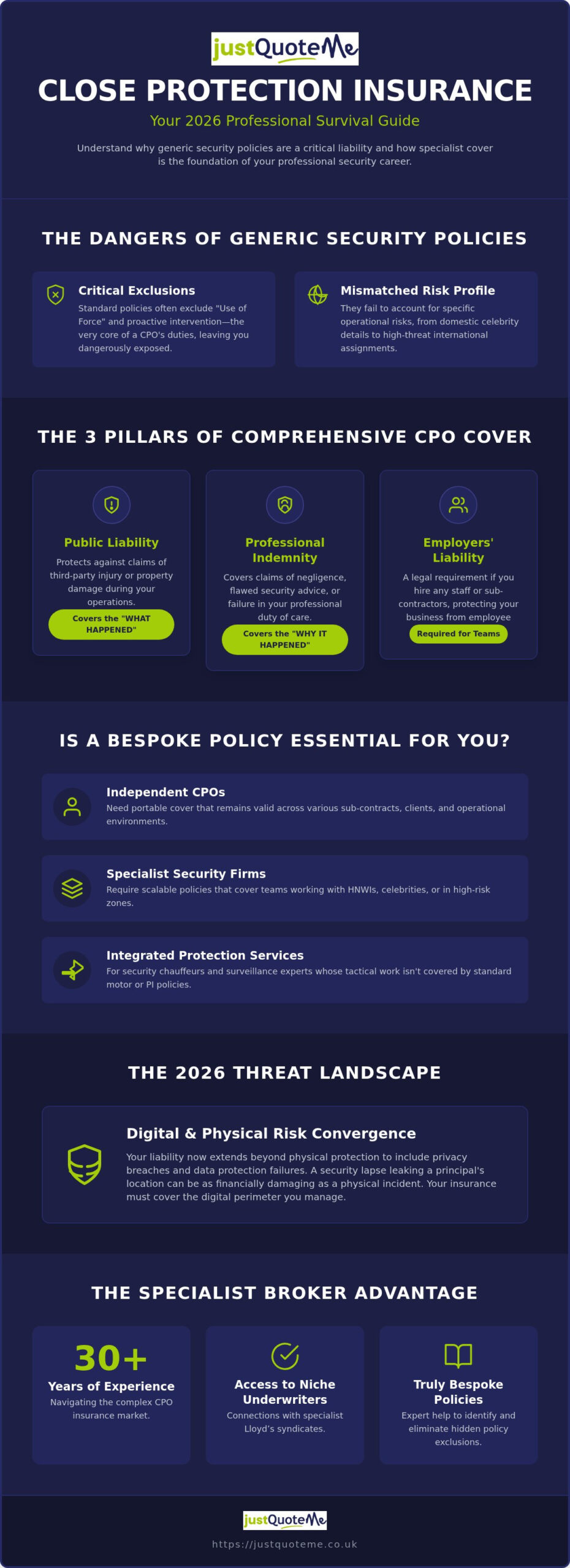
Close protection insurance functions as a multi-layered shield, specifically designed for the unique pressures of personal security. It’s a common mistake to assume that a standard security insurance policy for door supervision or static guarding offers enough protection. In reality, those generic policies often exclude the proactive intervention and high-stakes decision-making inherent in your role. While a door supervisor manages a venue, a Close Protection Officer (CPO) manages a life. This distinction is critical when a claim arises from a “use of force” incident or a breach of professional duty.
Beyond personal peace of mind, specialist cover is a commercial necessity. High-value corporate or private contracts almost always require proof of bespoke insurance before you’re even considered for a detail. If you enlist sub-contractors, you face specific legal requirements to ensure your policy extends to their actions. Understanding the Role of a Bodyguard in 2026 requires acknowledging that protection now covers a client’s legal and reputational standing just as much as their physical safety. Without the right framework, a single incident could bankrupt your business or end your career.
The Evolution of Protection Risks in 2026
The threat landscape has changed significantly, with 2026 seeing a complete convergence of digital and physical risks. Modern CPOs are no longer just “bodyguards” in the traditional sense; they’re providers of holistic lifestyle protection. This shift means your liability now includes potential privacy breaches or data protection failures. If a principal’s location is leaked through a security lapse, the financial and reputational fallout is immense. Your insurance must reflect these modern realities, covering the digital footprint you manage alongside the physical perimeter.
Who Needs a Bespoke Policy?
Bespoke policies aren’t just for large agencies. They’re essential for anyone operating in sensitive or high-risk environments. You need a tailored solution if you fall into these categories:
- Independent CPOs: Operatives working on a sub-contract basis need portable cover that remains valid across various contracts and clients.
- Specialist Security Firms: Agencies like Q-Winn Security managing teams for HNWIs or celebrities require policies that scale and cover specific high-risk activities.
- Integrated Protection Services: Security chauffeurs and surveillance experts often find that standard motor or PI policies don’t cover the tactical nature of their work.
Just Quote Me brings over 30 years of experience to this complex market. We act as a steady hand, ensuring your administrative burdens are managed so you can focus on the mission. Our team helps you identify hidden exclusions in generic policies that could leave you exposed during a critical incident.
Core Components of a Comprehensive CPO Policy
A robust close protection insurance policy is built on three essential pillars. These components don’t just protect your bank account; they validate your professional standing and reassure high-net-worth clients. In 2026, the complexity of these covers has increased as physical threats often intertwine with digital vulnerabilities. A failure to secure a digital perimeter can be just as damaging as a physical breach, and your policy must reflect this modern reality. Relying on a generic security policy leaves you exposed to gaps that specialist underwriters understand and address.
Public Liability vs. Professional Indemnity
Public Liability addresses physical incidents. If a third party is injured or property is damaged during a detail, this cover manages the legal costs and compensation. Conversely, Professional Indemnity Insurance protects you against claims of professional negligence. This includes failure in your Duty of Care in Executive Protection, such as providing flawed security advice or failing to prevent a predictable threat. While Public Liability covers the “what happened,” Professional Indemnity covers the “why it happened” regarding your professional judgment.
Employers Liability for Security Firms
If you hire sub-contractors or direct staff, Employers Liability Insurance is a legal requirement in the UK. It protects your business if an operative is injured or falls ill while working under your direction. Many CPOs mistakenly believe sub-contractors carry their own risk, but the legal reality often places the burden on the primary contractor. Having this cover in place is a non-negotiable part of managing a legitimate security team and protecting your firm from devastating injury claims.
One of the most critical elements for any CPO is the “Use of Force” clause. Standard liability policies often exclude intentional acts of violence. However, a specialist policy understands that reasonable force is sometimes necessary to protect a principal. Without this specific wording, you could find yourself personally liable for legal fees following a defensive intervention. We ensure these clauses are explicit, providing a steady hand when the administrative burden of a claim arises.
You should also consider Legal Expenses cover and Personal Accident protection. The former is vital for handling regulatory enquiries or criminal investigations that may follow an incident. The latter provides financial support if you are injured and unable to work. If you’re unsure about your current limits, you can speak with a specialist broker to identify any gaps in your framework. Personal Accident protection is equally important; in a high-risk sector, your ability to earn is tied to your physical health.
Tailoring Your Cover to the Operational Environment
Risk isn’t a static concept. The environment you operate in and the profile of your principal directly influence the scope of your close protection insurance. A CPO protecting a corporate executive in Birmingham faces different liabilities than one managing a diplomatic detail in a high-risk territory. Underwriters assess these variables with precision, meaning a generic policy often fails to address the specific hazards of your assignment. Accurately disclosing your operational activities is the only way to ensure your cover remains valid when you need it most.
Domestic UK Protection
Operating within the UK requires a deep understanding of the UK Security Industry Authority (SIA) regulatory framework. Your policy must align with current standards, including the mandatory refresher qualifications introduced on April 1, 2026. For domestic taskings, the primary focus is often on Public Liability. This protects you against third-party claims during transit or while managing crowds at public events. You can learn more about these fundamentals in our guide: What Is Public Liability Insurance? A Simple Guide for 2026. Ensuring your security insurance reflects your specific SIA-licensed activities is non-negotiable for compliance.
International and Maritime Considerations
Once you cross borders, the complexity of your risk profile shifts significantly. Standard policies usually have strict territory limits, often restricted to the UK or EU. If your tasking takes you to “Rest of World” locations, you need specific extensions to maintain protection. This is especially true for maritime security, where risks like piracy or international jurisdiction issues require specialist endorsements. International taskings also demand repatriation and emergency medical cover for the CPO. If an incident occurs in a remote or hostile environment, the cost of medical evacuation can be astronomical without the correct provision in your policy.
The profile of your client also dictates your risk rating. Celebrity protection often involves higher risks of intrusive fans, while corporate details might focus more on travel safety. If you’re operating in conflict zones or “High Risk” environments, you’ll need specialist underwriting for your close protection insurance. These environments are often excluded from standard business policies due to political volatility. Just Quote Me provides a human-centric approach, drawing on our regional expertise in Staffordshire to help you navigate these global complexities. Honest communication with your broker about these details prevents the devastating scenario of a claim rejection due to non-disclosure.
Why Using an Independent Broker is Essential for CPOs
Choosing an “off-the-shelf” insurance product is a gamble that few security professionals can afford. In a sector where risks are highly individualised, generic policies often contain restrictive clauses that only surface when you attempt to make a claim. This is where the value of an independent broker becomes clear. With over 30 years of experience in the Staffordshire and wider UK market, Just Quote Me understands that close protection insurance requires a precision fit. We don’t just sell policies; we build frameworks that protect your livelihood.
Our independence is your greatest asset. Unlike direct insurers who are limited to their own products, we have established relationships with specialist Lloyd’s syndicates and niche underwriters who understand the security industry. These markets aren’t accessible to the general public or through standard comparison sites. By tapping into these networks, we can secure cover for high-risk activities that mainstream providers simply won’t touch. If you ever need to make a claim, we act as your professional advocate. We handle the complex negotiations with insurers, ensuring your side of the story is heard and the process moves quickly.
Navigating the FCA and Regulatory Compliance
Professional standards shouldn’t be optional. Choosing an FCA-authorised firm like Just Quote Me ensures you receive advice based on transparency and integrity. We prioritise finding the right protection over simply chasing the lowest price, as a cheap policy is worthless if it fails during a crisis. Our team helps you stay compliant with evolving UK insurance laws, ensuring your documentation stands up to scrutiny from corporate clients or regulatory bodies. We manage the complex administrative burdens so you can stay focused on your principal’s safety.
The Human Element in a Digital World
Automated quote engines are designed for simple risks like home or car insurance. They aren’t equipped to assess the nuances of celebrity protection or international taskings. We believe in a human-centric approach that moves beyond algorithms. Our regional expertise in Newcastle-under-Lyme, Stone, and Stafford allows us to provide a level of service that impersonal national firms can’t match. This local knowledge, combined with 30 years of industry experience, makes us a steady hand in a complex market.
We offer personalised risk assessment consultations to understand your specific operational footprint. Whether you’re based in the West Midlands or operating globally, having a trusted advisor is invaluable. You can specialise your cover with an expert broker to ensure every aspect of your professional risk is accounted for. This pragmatic approach saves you time and provides the confidence needed to operate in sensitive environments.
Securing Your Professional Future: Next Steps
The final stage of securing your career involves moving from theory to implementation. You must audit your current operational footprint to ensure your close protection insurance remains aligned with your 2026 activities. Many CPOs discover too late that their policies contain “hidden” exclusions, such as restricted coverage for specific high-profile clients or domestic limits that fail to cover short-term international taskings. Reviewing your indemnity limits now prevents a catastrophic financial gap later, ensuring your professional reputation remains intact even if a complex claim arises.
Risk management is your most effective tool for controlling costs. By demonstrating robust operational procedures and maintaining up-to-date professional training, you present a lower risk profile to underwriters. For instance, holding a Level 3 First Aid qualification is now a prerequisite for the mandatory SIA refresher training introduced in April 2026. This commitment to professional standards doesn’t just improve safety; it makes you a more attractive prospect for niche insurers. Proving your expertise in these sensitive environments can lead to more competitive terms over the long term.
How to Prepare for Your Insurance Quote
Gathering the right information before speaking to a broker ensures you receive an accurate, bespoke quote. Follow these three steps to prepare:
- Step 1: Define your primary services. Be specific about whether your work involves physical protection, surveillance, or secure transit.
- Step 2: Determine your required limits of indemnity. Consider the requirements of your highest-value contracts. You may need specific levels of Professional Indemnity Insurance to satisfy corporate clients.
- Step 3: Contact a specialist broker. Reach out to an expert who understands the 2026 regulatory landscape to compare the market on your behalf.
Get the Expert Support You Need
Just Quote Me acts as more than just a service provider; we are a partner in your long-term professional growth. Our 30 years of experience in the UK security market allows us to navigate the complexities of security insurance with ease. We pride ourselves on a human-centric approach that replaces automated systems with honest, expert advice tailored to the West Midlands and Staffordshire. By managing the administrative burdens and complex paperwork, we allow you to focus on the mission at hand. Our straightforward process ensures you get the protection you need without unnecessary delays or jargon. Trusting a steady hand in this complex market provides the peace of mind required to operate at the highest level.
Protect Your Reputation with Specialist Cover
Operating in high-stakes security environments requires more than just technical skill; it demands a robust legal and financial safety net. As we have explored, a generic policy often fails to address the specific “Use of Force” clauses and professional indemnity risks inherent in your role. By aligning your close protection insurance with the latest 2026 regulatory standards, you ensure that your business remains resilient against both physical and digital threats. Whether you’re managing a domestic detail in Staffordshire or an international tasking, the right framework is your most valuable asset.
Just Quote Me brings over 30 years of experience as an FCA-authorised independent broker to help you navigate these complexities. We move beyond automated systems to provide straightforward, expert advice that puts your professional stability first. Don’t leave your livelihood to chance with an off-the-shelf product that doesn’t understand your unique operational footprint. Secure your professional future today and operate with the confidence that only a bespoke policy can provide. We’re here to manage the administrative burdens so you can stay focused on the mission.
Get Your Free Business Insurance Quote now
Request a Call back for free Expert advice
Frequently Asked Questions
Do I need Close Protection Insurance if I work as a sub-contractor?
Yes, independent operatives should carry their own close protection insurance to ensure personal liability is covered. While some primary contractors might suggest you’re under their umbrella, their policy often prioritises the firm’s interests over your individual legal defence. Having your own bespoke cover ensures you’re protected across multiple contracts and provides the proof of professional indemnity that high-end clients demand before awarding a detail.
Does standard Public Liability cover Close Protection activities?
Standard public liability often excludes the high-risk activities inherent in personal security. Most generic policies for small businesses specifically omit “use of force” or protection of individuals, leaving you exposed during a physical intervention. Specialist cover is specifically underwritten to include these scenarios. It bridges the gap between general property damage and the complex physical risks you face while safeguarding a principal in public or private spaces.
What is the difference between Security Guard insurance and Close Protection insurance?
Security guard insurance typically covers static roles like retail guarding or door supervision at licensed venues. In contrast, close protection insurance is designed for the mobile, proactive nature of personal safeguarding. The risk profile for a CPO involves different use-of-force legalities and professional advice liabilities that a static guard simply doesn’t encounter. Specialist policies ensure your cover matches the specific SIA category on your licence.
Can I get cover for Close Protection work outside of the UK?
You can obtain international cover, but it requires a specific extension to your policy. Standard UK policies usually limit operations to domestic soil or the European Union. If your tasking involves travel to the United States or higher-risk territories, you must disclose these locations to your broker. We can then arrange appropriate extensions for close protection insurance, including vital repatriation and emergency medical support for overseas taskings.
How much Professional Indemnity cover do I need as a CPO?
The amount of professional indemnity cover you need is usually dictated by your client’s contract requirements. While £1 million is a common baseline for independent operatives, corporate or diplomatic details often require limits of £5 million or £10 million. This cover is vital because it protects you against claims of negligent security advice or a breach of your duty of care that results in financial or reputational loss for your principal.
What happens if I need to make a claim on my Close Protection policy?
If an incident occurs, you should notify Just Quote Me immediately to begin the claims process. As your independent broker, we act as your advocate, managing the complex administrative burdens and communicating directly with the underwriters. We help you compile necessary evidence, such as incident logs and witness statements, to ensure the claim is handled efficiently. Fast reporting is particularly critical for any event involving physical intervention or potential legal action.
Is Employers Liability insurance mandatory for a small security team?
Employers liability is a legal mandate in the UK if you have any employees or use sub-contractors who work under your direct supervision. Even a small team of two or three operatives requires this cover to protect against claims of bodily injury or illness sustained while on duty. Operating without it can result in significant daily fines and leaves your business financially vulnerable if a team member is injured during a high-risk assignment.
Article by
Just Quote Me
JustQuoteMe Ltd is an independent UK insurance brokerage specialising in business and personal insurance solutions. With over 35 years of industry experience, the company provides tailored insurance cover for businesses, landlords, tradespeople, hospitality venues, fleets, and individuals across the UK. Known for its personal service, expert advice, and competitive premiums, JustQuoteMe Ltd works with leading insurers to deliver bespoke policies designed around each client’s unique needs. The company is authorised and regulated by the Financial Conduct Authority (FCA No. 586607) and has built a reputation for trusted, straightforward insurance guidance and long-term client relationships.

by jqm | Sep 5, 2026 | Insurance
Did you know that the UK events industry is now worth a staggering £68.7 billion? While that growth is exciting, the risks are just as substantial. By mid-June 2026, twenty independent festivals had already announced cancellations or postponements. For any organiser, the fear of losing everything to a single weather event or a legal claim is a heavy burden to carry. Securing the right events insurance isn’t just a box-ticking exercise; it’s the foundation of a successful, stress-free occasion.
We understand that the administrative side of planning can feel like a minefield. You’re likely juggling confusion over what the law requires versus what your venue demands, all while worrying about the financial fallout of an unexpected accident. This guide offers expert-led advice tailored to your specific risks and budget, giving you the clarity needed to protect your hard work. We’ll explore exactly which covers are essential, how to satisfy venue contracts, and how to manage your financial risks with confidence.
Key Takeaways
- Distinguish between legal mandates and the contractual requirements set by your venue to avoid critical gaps in your protection.
- Build a bespoke events insurance framework using a tailored menu of cover options designed for your specific risks and budget.
- Evaluate the cost-efficiency of one-off policies versus annual cover based on your event frequency throughout 2026.
- Learn to navigate indemnity limits by aligning your policy with the specific demands of your venue contracts and guest numbers.
- Discover the benefits of human-led advice and how an independent broker manages the complex administrative side of your insurance.
What is Events Insurance and Why is it Essential?
Events insurance is a bespoke package of protections designed to shield organisers from the financial fallout of accidents, damage, or legal claims. It isn’t a single policy but a combination of covers tailored to your specific occasion. As a form of Niche and specialist insurance, it addresses the unique risks that come with gathering people in a specific space for a limited time. Whether you’re hosting a small garden party or a national conference, having this safety net ensures that one mishap doesn’t lead to total financial ruin.
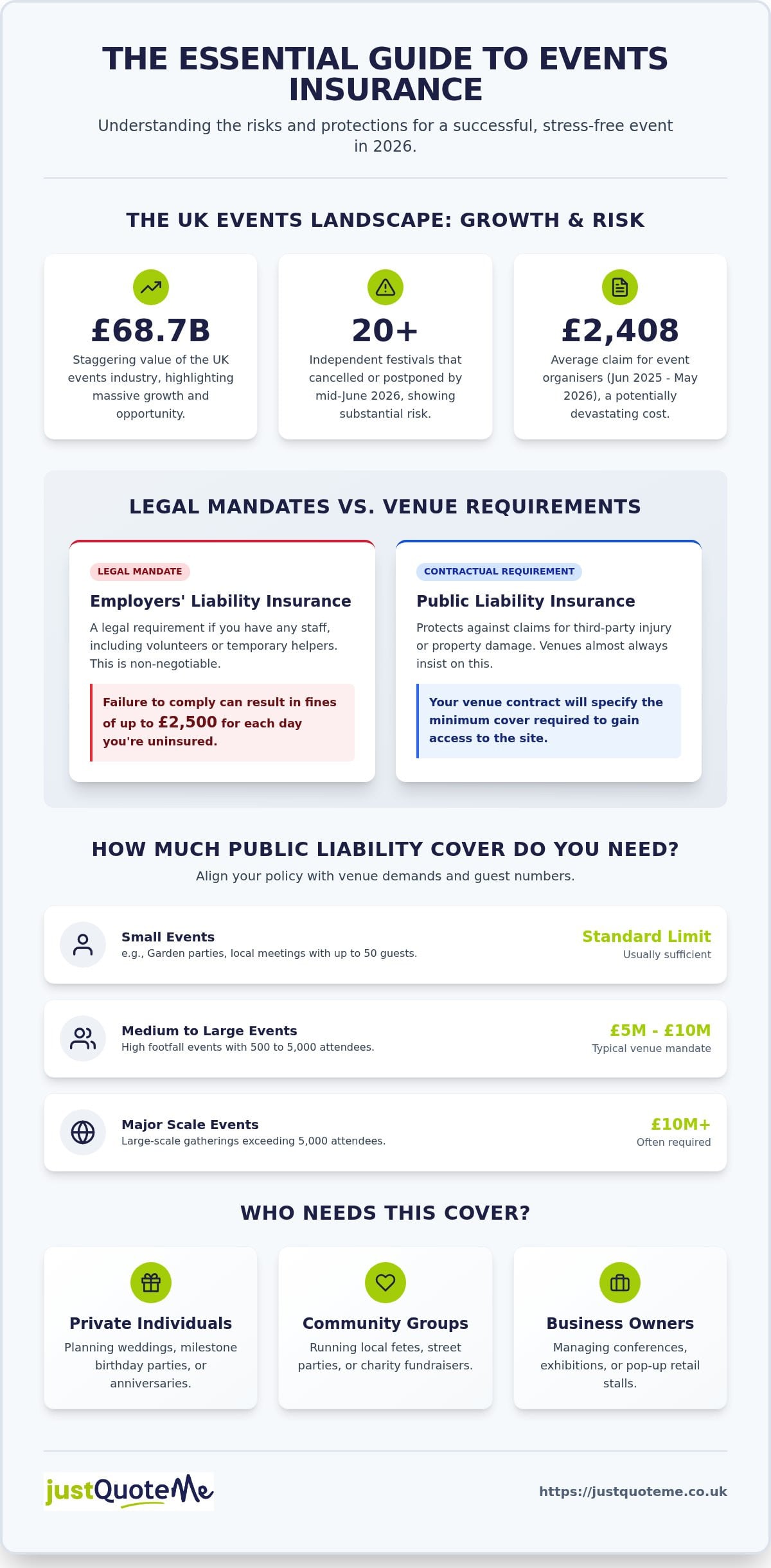
Understanding the difference between legal and contractual requirements is vital for any organiser. Employers Liability Insurance is a legal mandate if you have any staff, including volunteers or temporary helpers. Failing to have this cover can result in fines of up to £2,500 for each day you’re uninsured. Conversely, Public Liability Insurance is usually a contractual requirement. Venue owners almost always insist on seeing a valid insurance certificate before they’ll let you on-site. They need to know that if a guest is injured or the property is damaged, your policy will handle the costs rather than theirs.
The financial reality of event planning is that things can go wrong despite your best efforts. Data shows the average claim for event organisers between June 2025 and May 2026 was £2,408. While that might sound manageable for a large corporation, it can be devastating for a small community group or a private individual. Securing events insurance early in the planning process mitigates these risks, allowing you to focus on the logistics of the day rather than the “what-ifs.”
The Core Risks Covered by a Standard Policy
A standard policy focuses on three primary areas of concern that could otherwise derail your budget. It’s about protecting your liability and your assets simultaneously. Most policies include:
- Accidental injury: Coverage for legal fees and compensation if a guest or member of the public is injured during your event.
- Venue damage: Protection if you or your attendees accidentally damage the building, fixtures, or hired equipment.
- Theft of funds: Security against the loss of money or event funds through theft or accidental loss.
Who Needs This Cover?
If you’re responsible for the safety of others or the condition of a venue, you likely need protection. We help a wide range of organisers, including:
- Private individuals: Those planning significant life events like weddings, milestone birthday parties, or anniversaries.
- Community groups: Volunteers running local fetes, street parties, or charity fundraisers.
- Business owners: Professionals managing conferences, exhibitions, or pop-up retail stalls.
The complexity of these risks is why a human-led approach is so valuable. We manage the administrative burden so you don’t have to, ensuring your policy satisfies every venue requirement while staying within your budget. As you finalise your plans, you can discover Marquis Lane for luxury chauffeur services that ensure your guests or executives travel in style and comfort.
To further streamline your planning, using a tool like QRkite to generate QR codes for digital programs or guest check-ins can significantly reduce your physical paperwork and administrative load.
Essential Cover Types: Building Your Protection Framework
Think of events insurance as a menu rather than a fixed meal. While every organiser needs a base level of protection, the specific “ingredients” of your policy change depending on the nature of your gathering. A corporate conference in a city hotel faces different hazards than a regional sporting competition held on a public field. The key is ensuring you have the right insurance for your specific risks, rather than just a generic certificate that might fail you when a claim arises.
A sporting event might prioritise medical malpractice or participant injury cover, whereas a high-tech trade show will focus heavily on expensive AV equipment. Regardless of the format, public liability insurance remains the foundation. It provides the essential legal and financial buffer that allows you to operate in professional venues with confidence.
Public Liability: The Foundation of Every Event
This cover protects you against claims for third-party injury or property damage. Common incidents include a guest tripping over an unsecured cable or a heavy speaker cabinet falling and damaging a venue’s heritage flooring. While a standard limit might suffice for a local party with 50 guests, high-footfall events require more. For gatherings with 500 to 5,000 attendees, venues typically mandate a minimum of £5 million to £10 million in cover. Large-scale events exceeding 5,000 attendees often push these requirements beyond £10 million to account for the increased risk of a multi-person accident.
Employers’ Liability for Staff and Volunteers
If you use any staff to run your event, employers liability insurance is a legal requirement. It’s a common misconception that this only applies to full-time, paid employees. In the eyes of the law, volunteers, temporary helpers, and even students on work experience are often classified as employees. If a volunteer is injured while lifting heavy staging during the setup phase, you could be held liable. The legal minimum is £5 million, though most policies provide £10 million as standard. Operating without it is a serious risk; the government can issue fines of up to £2,500 for every single day you remain uninsured.
Event Equipment and Property Cover
Organisers are often responsible for thousands of pounds worth of hired-in equipment. This includes marquees, lighting rigs, stages, and sound systems. Standard liability doesn’t usually cover damage to items in your care, custody, or control. Securing the right events insurance ensures that hired-in equipment is protected against loss, theft, or accidental damage while on-site or in transit. If your event involves heavy lifting or earth-moving gear, you may also need to consider plant and machinery insurance to cover specific technical risks.
Managing these different layers of protection can be complex, but you don’t have to do it alone. You can speak with a specialist broker to ensure every gap is closed before your first guest arrives.
One-Off vs. Multiple Event Insurance: Choosing the Right Policy
Deciding between a single-event policy and annual cover depends almost entirely on your calendar. If you’re a professional organiser running a series of workshops or a business attending several trade shows, an annual policy is the pragmatic choice. It simplifies your administration by providing one renewal date and consistent protection across various UK venues. However, if you’re planning a unique celebration, one-off events insurance offers the flexibility to protect that specific window of time without the commitment of a year-long contract.
Cost-effectiveness is a major factor here. For those hosting more than three or four events a year, the total cost of individual policies often exceeds the price of a single annual premium. Professional organisers also benefit from the ability to handle variations in scale. A multi-event policy can be structured to cover different attendee numbers or venue types under one umbrella; this removes the need to re-apply for cover every time you book a new space.
Single Event Cover for Private Celebrations
For trainers, exhibitors, and frequent conference organisers, annual cover is a significant time-saver. Instead of managing dozens of individual certificates, you have one steady safety net. This is particularly useful when venues demand proof of insurance at short notice. Having a policy already in place allows you to secure bookings faster and focus on your event delivery rather than administrative paperwork. It provides a level of professional readiness that automated, single-transaction systems often struggle to match.
Specialist Cover for Stallholders and Performers
Street food vendors, market stallholders, and pop-up shop owners have specific needs that standard event policies might overlook. If you’re selling goods, product liability becomes just as important as public liability. This protects you if a customer is injured or falls ill due to a product you’ve sold at an event. For those with a more permanent physical presence, integrating this with shop insurance can provide a more comprehensive shield for your business assets, both on and off the event site.
Whether you’re a one-time host or a seasoned professional, we manage the complex administrative burdens so you don’t have to. Our 30 years of experience helps us identify which frequency and scale of cover actually fits your business model.
How Much Cover Do You Need? A Practical Planning Guide
Choosing the right level of indemnity isn’t a matter of guesswork; it’s a strategic calculation based on your audience size, activities, and contractual obligations. While it’s tempting to opt for the lowest possible limit to save on premiums, underinsurance can be a fatal mistake for your business or project. Your required level of events insurance is usually dictated by the parties you’re working with, specifically your venue and any local authorities involved in the licensing process.
Most UK venues mandate proof of public liability insurance before they’ll allow you to step on-site. If you’re using public land or council-owned spaces, the requirements are often even stricter. Local authorities frequently set higher minimums to account for the increased complexity of managing public spaces. Before you seek a quote, conduct a thorough risk assessment to identify potential “worst-case scenarios” that could lead to a multi-person claim.
Determining Your Public Liability Limits
While some small, private gatherings might find a £2 million limit acceptable, the industry standard has shifted. For small events with fewer than 500 attendees, venues typically require between £2 million and £5 million in cover. Medium-sized events with 500 to 5,000 guests usually see this requirement jump to a minimum of £5 million or £10 million. If you’re hosting a large-scale occasion with over 5,000 people, you’ll almost certainly need £10 million or more. Staffordshire venues, for instance, often have specific regional requirements for public land use that align with these higher tiers to ensure full protection against complex legal claims.
The Role of Cancellation and Adverse Weather Cover
If your event involves high-cost venues or significant non-refundable deposits, cancellation cover is essential. The 2026 season has already proven how volatile the industry can be; by mid-June, twenty independent UK festivals had already announced cancellations or postponements. This type of protection typically costs between 1% and 3% of your total event budget and covers unforeseen circumstances like venue damage or extreme weather. However, you must read the fine print. Cancellation cover specifically excludes commercial risks like “lack of interest” or poor ticket sales. It also frequently excludes pre-existing conditions or losses related to communicable diseases unless specified.
Getting your limits right the first time prevents last-minute administrative scrambles. You can get tailored advice on your indemnity levels from our team to ensure your policy meets every contractual demand without overstretching your budget.
Securing Bespoke Events Insurance with Just Quote Me
Securing events insurance through an independent broker offers a strategic advantage that direct insurers and automated platforms cannot replicate. While a direct insurer can only offer you their own products, we operate with an independent status. This means we scan a wide network of the UK’s leading insurers to find the underwriter best suited to your specific risks. With 30 years of industry experience, we’ve seen how the market has evolved, and we use that knowledge to ensure you aren’t just buying a policy, but a safety net that actually works when you need it.
Our human-led approach is designed to contrast with the faceless nature of online quote engines. We act as your trusted advisor, managing the complex administrative burdens so you can focus on the logistics of your occasion. This support doesn’t end once you’ve paid your premium. If your event scale changes or you need mid-term adjustments to your cover, we’re here to handle those updates quickly and professionally. We pride ourselves on being a steady hand in a complex market, providing reliability you can count on as an FCA-authorised firm.
Why an Independent Broker Beats an Online Algorithm
Comparison sites often prioritise the lowest price, but they frequently overlook the nuances of your specific event. This can lead to dangerous gaps in cover. By working with an independent broker, you gain access to a wider panel of insurers, many of whom don’t list their products on public comparison tools. This is essential for complex or high-risk events that require a more tailored approach than a standard algorithm can provide.
Our regional expertise is another key differentiator. Being Staffordshire-based with a national reach, we understand the specific requirements of venues across the West Midlands and beyond. We know what local authorities expect to see on an insurance certificate, which helps you avoid delays in securing your event licences. We combine this local knowledge with three decades of professional experience to deliver a service that is both personal and highly expert. When you need to protect your financial interests and satisfy venue requirements, Just Quote Me for a bespoke solution that manages the administrative burden for you.
Get Your Professional Event Quote Today
The transition from inquiring to being fully protected is designed to be fast and efficient. We understand that event organisers are often working against tight deadlines, so we’ve streamlined our process to provide bespoke protection without the wait. You can rely on our team to provide clear, straightforward advice that helps you make an informed choice for your budget and your risks. We manage the complex details so you don’t have to, ensuring your event is backed by a policy that satisfies every contractual demand.
Get Your Free Business Insurance Quote now
Request a Call back for free Expert advice
Securing Your Event’s Future with Expert Protection
Planning a successful occasion in 2026 requires balancing creative vision with pragmatic risk management. The right events insurance does more than satisfy a venue contract; it protects your financial investment against the unpredictable nature of live gatherings. From meeting the legal mandates of employers’ liability to calculating the necessary indemnity for a high-footfall festival, having a tailored policy ensures your hard work isn’t undone by a single accident or unforeseen weather event.
You don’t have to manage these administrative burdens alone. Just Quote Me provides a human-centric alternative to faceless algorithms. As an independent broker with access to top UK insurers and over 30 years of industry experience, we offer FCA-authorised expert advice that’s bespoke to your needs. Our team manages the complex details, from policy adjustments to underwriter negotiations, so you can focus on delivering an unforgettable experience. Get started with our expert team today and move forward with the confidence that your occasion is fully protected.
Get Your Free Business Insurance Quote now
Request a Call back for free Expert advice
Frequently Asked Questions
Is events insurance a legal requirement in the UK?
Employers liability is a legal mandate if you employ staff or volunteers, with a minimum legal requirement of £5 million cover. While public liability isn’t a universal law, it’s almost always a contractual requirement. Most UK venues won’t allow you to operate without a valid certificate. Failing to have the correct employers’ cover can lead to government fines of up to £2,500 for every day you remain uninsured.
Does events insurance cover my venue if I accidentally damage it?
Yes, protecting the venue against accidental damage is a core component of public liability. If you or your guests damage the building’s structure, fixtures, or flooring, your policy handles the repair costs and legal fees. Without this protection, you would be personally responsible for expensive restoration bills. Most venues set a minimum indemnity limit, often £5 million, to ensure their assets are fully protected during your hire period.
Can I get insurance for a one-day event?
Absolutely, one-off policies are a standard offering within the industry. These are designed for unique celebrations like weddings, anniversaries, or community fetes. A single-day policy typically covers the duration of the event plus the essential setup and breakdown days. This ensures you’re protected while heavy equipment is being moved or marquees are being erected, providing a cost-effective solution without the need for an annual commitment.
What is the difference between public liability and event insurance?
Public liability is a specific type of cover, whereas events insurance refers to the entire package of protections. While public liability focuses on third-party injury and property damage, a full event policy can include employers’ liability, equipment cover, and cancellation protection. Think of public liability as the foundation and the broader event policy as the complete structure tailored to your specific risks and budget requirements.
Does event insurance cover cancellation due to bad weather?
Cancellation and abandonment cover can be added to protect against adverse weather that makes the event impossible or dangerous to hold. This is particularly vital for outdoor festivals and winter gatherings. However, it’s important to remember that these policies don’t cover commercial failure. You won’t be protected if you cancel due to poor ticket sales or a lack of interest; the cause must be an unforeseen circumstance beyond your control.
Am I covered if a guest gets food poisoning from the catering?
Product liability, which is frequently bundled with your public liability cover, protects you against claims related to food and drink. If a guest falls ill because of the catering you’ve provided, this cover manages the legal and compensation costs. Even if you’re using external caterers who have their own insurance, as the organiser, you still face a secondary risk that requires your own professional safety net.
Do I need employers liability if my staff are all volunteers?
Yes, the law generally treats volunteers with the same status as paid employees regarding your duty of care. If a volunteer is injured while helping with your event, you can be held liable for their medical costs and loss of earnings. Having employers’ liability is a legal necessity in these cases. Operating without it puts your organisation at risk of significant daily fines and leaves your helpers without essential financial protection.
Article by
Just Quote Me
JustQuoteMe Ltd is an independent UK insurance brokerage specialising in business and personal insurance solutions. With over 35 years of industry experience, the company provides tailored insurance cover for businesses, landlords, tradespeople, hospitality venues, fleets, and individuals across the UK. Known for its personal service, expert advice, and competitive premiums, JustQuoteMe Ltd works with leading insurers to deliver bespoke policies designed around each client’s unique needs. The company is authorised and regulated by the Financial Conduct Authority (FCA No. 586607) and has built a reputation for trusted, straightforward insurance guidance and long-term client relationships.

by jqm | Sep 4, 2026 | Insurance
In 2026, treating your haulage cover as a simple box-ticking exercise is the fastest way to erode your profit margins. With the mandatory rollout of Smart Tachograph Version 2 for international transport and stricter Direct Vision Standards, securing HGV insurance UK is no longer just about finding the lowest number on a comparison site. You likely feel the pressure of rising premiums and the constant worry that a minor technicality could lead to a rejected claim. It’s a frustrating reality for many operators who want to keep their wheels turning without the administrative headache.
We’re here to help you regain control. This guide shows you how to master the complexities of specialist haulage cover by accessing expert advice and bespoke policies that actually protect your bottom line. You’ll learn how to navigate the latest regulatory shifts, leverage risk management to lower your rates, and find a partner who understands the nuances of multi-vehicle fleet management. We’ll break down everything from high-limit compliance to the benefits of working with specialist underwriters who value human expertise over automated systems. By the end, you’ll have a clear roadmap to securing reliable, high-limit cover that simplifies your business instead of complicating it.
Key Takeaways
- Understand why vehicles over 3.5 tonnes require specialised protection and how standard commercial van policies can leave your business exposed.
- Navigate the 2026 landscape for HGV insurance UK by choosing bespoke, broker-led cover that prioritises your specific operational risks over generic automated quotes.
- Access a wide network of industry-leading insurers not found on standard aggregators, leveraging decades of expertise to secure the most reliable terms.
- Implement proactive risk management and driver training protocols to demonstrate high standards to underwriters and reduce your annual premium costs.
- Reduce your administrative burden by partnering with a steady advisor who handles the complexities of policy management and compliance on your behalf.
Understanding HGV Insurance in the UK: More Than Just a Legal Requirement
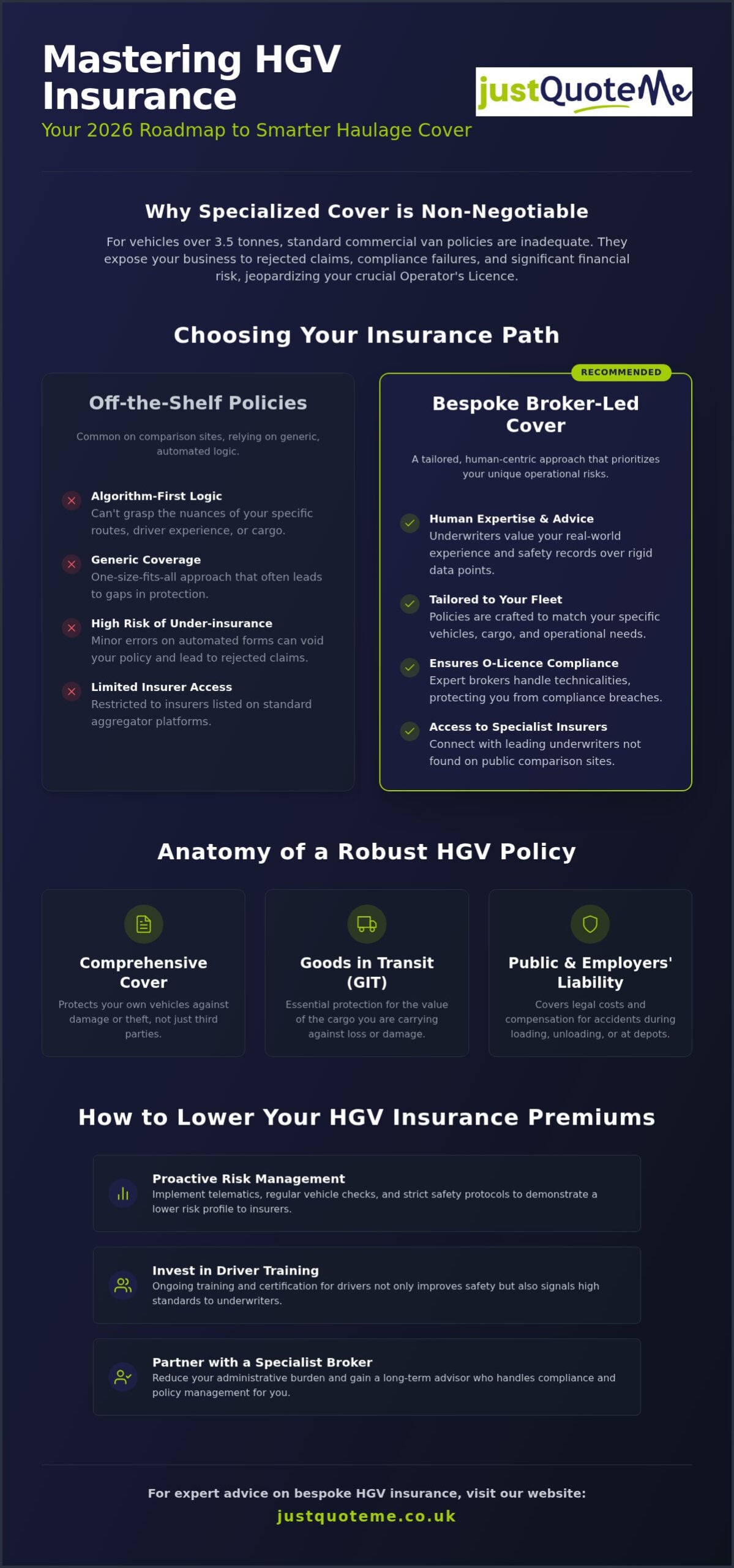
HGV insurance UK is a specialised protection package designed for vehicles with a gross weight exceeding 3.5 tonnes. While Understanding Vehicle Insurance basics is a good starting point, heavy goods vehicles operate under a completely different regulatory framework than standard cars or light vans. Standard commercial van insurance doesn’t have the capacity to handle the weight limits, longer stopping distances, or the intense regulatory scrutiny that comes with heavy haulage. If you try to use a standard policy for an HGV, you’ll likely find your claims rejected and your business exposed to massive financial risk.
Maintaining an Operator’s Licence (O-Licence) is non-negotiable for anyone running HGVs in the UK. A critical part of keeping that licence in good standing is proving you have adequate, compliant cover. Insurers don’t just look at your driving history; they look at your commitment to safety and maintenance. For example, international operators often look to specialized services like mécanique mobile Québec to maintain their fleet on-site, a practice that insurers globally recognize as a commitment to safety. If you fail to maintain proper cover, you risk losing your licence and your livelihood. It’s a strategic asset that keeps your wheels turning and ensures you remain on the right side of the DVSA.
The Core Components of a Haulage Policy
Modern haulage fleets are diverse, and your insurance must reflect the specific vehicles you operate. We provide bespoke solutions for a wide range of trucks and specialised units. A generic policy often fails to account for the unique risks associated with different vehicle types. Our coverage includes:
- Standard trucks: Flatbeds, box vans, lutons, and curtain-siders.
- Specialised vehicles: Tippers, cement mixers, and tankers.
- Temperature-controlled units: Refrigerated trucks that require specific cover for cooling system failure.
Whether you’re running a single 7.5t truck for local deliveries or a fleet of 44t articulated lorries for international logistics, each vehicle requires a policy tailored to its specific use case and risk profile.
Get Your Free Business Insurance Quote now
Request a Call back for free Expert advice
Comparing HGV Insurance Tiers: Bespoke vs. Off-the-Shelf
Comparison sites rely on algorithm-first logic. This works for standard cars but often fails when you’re securing HGV insurance UK. A generic form can’t distinguish between a truck doing local site deliveries and one doing long-haul motorway routes. Specialist underwriters look at the human element, such as your driver’s specific experience and your safety record. They understand that a haulier with 20 years of clean driving on specific routes is a lower risk than a rigid algorithm might suggest. By opting for a human-centric approach, you ensure your policy reflects the reality of your daily operations rather than a best-guess estimate.
The danger of under-insurance is a significant threat to your O-Licence. If you miss a minor detail on an automated form, you might save a small amount on your premium today but face a rejected claim tomorrow. Staying compliant with Goods Vehicle Operator Licensing requires an accurate representation of your business operations. Working with a human broker ensures these technicalities are handled correctly from the start. This protects you from technicalities that automated systems often overlook, giving you the confidence that your cover is actually valid when you need it most.
Owner-Driver Insurance vs. Fleet Policies
Independent operators often start with single-vehicle policies tailored to their specific niche. These provide the focused protection a one-person business needs without unnecessary extras. However, as your business expands, Fleet Insurance Solutions offer much better administrative efficiency by putting all vehicles under one renewal date. “Any Driver” policies are particularly popular for growing fleets. They allow any qualified driver over a certain age to operate any vehicle in the fleet. This flexibility is vital for maintaining delivery schedules and managing staff turnover without needing to update your insurer every time a new driver joins your team.
The Role of Excess and Voluntary Contributions
Your voluntary excess is a powerful lever for controlling costs. Increasing your excess will lower your annual premium, but it requires you to have enough cash on hand to cover those costs if an incident occurs. For high-mileage HGVs, the statistical likelihood of a minor claim is higher than for standard commercial vehicles. Balancing your risk retention with your monthly cash flow is a delicate calculation. Getting bespoke advice from a specialist ensures you don’t set an excess so high that a single accident disrupts your entire operation’s liquidity.
Get Your Free Business Insurance Quote now
Request a Call back for free Expert advice
Why Use an Independent Insurance Broker in 2026?
Just Quote Me acts as a steady hand in an increasingly volatile market. With over 30 years of industry experience, we understand that the haulage sector requires more than just a standard policy. One of the primary advantages of working with an independent broker is our access to a broad network of top UK insurers. Many of these specialist underwriters don’t list their products on comparison sites, preferring to work with trusted partners who can accurately assess a firm’s risk profile. This gives you access to rates and terms for HGV insurance UK that simply aren’t available to the general public.
When you’re dealing with a complex claim, the last thing you need is an automated bot or a scripted response from a national call centre. We provide personalised support throughout the entire claims process. You speak to real people who understand your business and are committed to resolving issues quickly. This human-centric approach is a core part of our service, ensuring you feel secure and informed at every stage. Reliability is our priority, and we focus on simplifying administrative processes so you can focus on your deliveries.
The Local Advantage: Staffordshire Expertise
Regional knowledge is a powerful tool in logistics. Our deep roots in Staffordshire mean we understand the specific challenges faced by hauliers in Newcastle-under-Lyme, Stone, and Stafford. Whether it’s the local road networks or the regional logistics hubs, this expertise allows us to provide more accurate advice than a distant national provider. If you’re looking for a Commercial Insurance Broker Staffordshire businesses can rely on, we offer a level of familiarity that large corporations can’t match. We also stay aligned with standards set by the Road Haulage Association, ensuring your business remains compliant with the latest industry best practices.
Bespoke Policy Administration
Administrative burdens can slow your business down. We manage the complex tasks so you don’t have to, including mid-term adjustments (MTAs) when you add new vehicles to your fleet. Navigating the regulatory shifts of 2026 requires precise, professional advice. FCA authorisation is the gold standard for UK insurance consumer protection. As an FCA-authorised firm, we ensure that every piece of advice we give is grounded in legal compliance and professional integrity. This level of oversight provides the reassurance you need when making critical choices about your haulage cover and risk management strategy.
Get Your Free Business Insurance Quote now
Request a Call back for free Expert advice
How to Lower Your HGV Insurance Premiums: Proactive Risk Management
Proactive risk management is the most effective way to secure lower rates for HGV insurance UK in 2026. Instead of reacting to premium hikes, successful operators build a profile that underwriters find attractive. This starts with a clear understanding of your fleet’s vulnerabilities. Security is a major factor. Vehicles stored in gated, CCTV-monitored depots or secure overnight locations carry significantly less risk than those parked on public roads. When you demonstrate a commitment to physical security, you provide insurers with the reassurance they need to offer more competitive terms. Additionally, choosing to pay your premiums annually rather than monthly can result in savings of up to 25%, providing an immediate boost to your cash flow.
Technology and Safety Integration
Advanced telematics and route-tracking software are no longer optional extras. They provide real-time data that proves your commitment to safe operation. Following the 1 July 2026 mandate for Smart Tachograph Version 2 in international transport, insurers are looking for firms that embrace data-driven compliance. Dashboard cameras are equally vital. They provide objective evidence during incident investigations, which helps accelerate claim resolution and protects your hard-earned No Claims Discount (NCD). Underwriters in 2026 view factory-fitted speed limiters and lane-departure warnings as essential risk-reduction tools that justify lower base premiums. By meeting the stricter 2026 Direct Vision Standard (DVS) requirements, you also signal to insurers that your fleet is equipped with the latest safety technology.
Driver Management and Recruitment
Your drivers are your biggest risk or your best asset. Hiring drivers with existing points or convictions can lead to immediate premium increases. Conversely, maintaining meticulous CPC (Certificate of Professional Competence) records shows a commitment to professional standards. The updated CPC categories introduced in January 2026 mean training is more rigorous than ever. Implementing a formal driver handbook that outlines safety protocols and emergency procedures further lowers your perceived risk. For those managing multiple vehicles, centralising your NCD through a fleet insurance policy can often lead to better long-term savings than managing individual discounts. We can help you build this profile through a bespoke risk assessment that highlights your safety investments to our panel of insurers.
Get Your Free Business Insurance Quote now
Request a Call back for free Expert advice
Securing Your Bespoke HGV Quote with Just Quote Me
Securing HGV insurance UK is the final step in protecting your haulage business from the regulatory and financial risks of 2026. We don’t just provide a policy; we act as a dedicated partner that manages the administrative burdens so you don’t have to. Our process is designed for efficiency and clarity. It begins with an initial consultation where we learn the specifics of your operation, from the types of cargo you carry to the routes your drivers frequent. Once we have a clear picture, we move into bespoke underwriter negotiation. We use our established relationships with a broad network of insurers to present your risk profile in the best possible light. This human-led approach often secures terms that automated systems simply cannot offer. For smaller operators in the construction sector, we also provide specialised Tradesman Insurance that scales with your business as you transition from light commercial vehicles to heavy trucks.
Comprehensive Protection for Hauliers
A truly robust insurance strategy looks beyond the vehicle itself. If you employ drivers, warehouse staff, or administrative teams, you must integrate Employers Liability Insurance to meet your legal obligations. We also provide Professional Indemnity cover for logistics consultants and managers who provide expert advice or supply chain coordination. Centralising these covers under one broker reduces your administrative workload and ensures there are no gaps in your protection. Our regional expertise in Staffordshire, specifically across Stone, Stafford, and Newcastle-under-Lyme, makes us the preferred choice for local business owners. We understand the regional logistics hubs and the local road networks, allowing us to provide advice that is both practical and authoritative.
Next Steps: Get Your Expert Quote
To ensure your quote process is as fast as possible, it’s helpful to gather your vehicle details, driver records, and claims history before getting in touch. Having this information ready allows us to move quickly into the negotiation phase with underwriters. We pride ourselves on being a human-centric alternative to the impersonal nature of online aggregators. If you prefer an expert conversation over filling out endless digital forms, our “Request a Call back” feature is the ideal solution. You’ll speak with a knowledgeable advisor who can answer your questions and guide you through the complexities of the 2026 insurance market. We offer a reliable, straightforward, and professional service that lets you focus on what you do best: keeping your fleet moving and your customers satisfied.
Get Your Free Business Insurance Quote now
Request a Call back for free Expert advice
Secure Your Haulage Future in 2026
Navigating the 2026 logistics landscape requires more than just meeting minimum legal standards. The mandatory shift toward Smart Tachograph Version 2 and stricter safety requirements means your HGV insurance UK must be as precise as your operations. Moving away from algorithm-driven aggregator sites toward bespoke, broker-led policies ensures you aren’t just covered on paper, but fully protected during a claim. Proactive risk management remains your strongest tool for keeping premiums affordable in a high-cost market.
Just Quote Me brings over 30 years of industry experience as an FCA-authorised independent broker to help you manage these complexities. We focus on the human side of insurance, providing regional expertise across Staffordshire and the West Midlands that national call centres can’t replicate. We’re here to take the administrative weight off your shoulders so you can focus on your fleet. Let’s work together to keep your business moving forward with confidence.
Get Your Free Business Insurance Quote now
Request a Call back for free Expert advice
Frequently Asked Questions
Is HGV insurance more expensive than standard van insurance?
Yes, HGV insurance is typically more expensive because the vehicles are heavier, carry higher-value cargo, and pose a greater risk on the road. Standard commercial van insurance covers vehicles up to 3.5 tonnes, whereas HGVs require specialised cover for their specific weight classes and regulatory requirements. Factors like longer stopping distances and the potential for greater damage in an accident contribute to the higher premium costs associated with heavy haulage operations.
What is the minimum level of HGV insurance I need by law in the UK?
The minimum legal requirement for HGV insurance UK is Third-Party Only (TPO) cover, as mandated by the Road Traffic Act 1988. This covers your liability for injury to others or damage to their property. However, most professional operators choose Comprehensive cover to protect their own assets. Additionally, if you employ any staff, you’re legally required to have Employers’ Liability Insurance to comply with UK law and protect your workforce from workplace injuries.
Can I include Goods in Transit cover within my HGV insurance policy?
You can certainly include Goods in Transit (GIT) cover as part of a bespoke haulage package. While standard vehicle insurance protects the truck, GIT specifically covers the cargo against theft, loss, or damage while it’s being moved. Many brokers recommend combining these covers to ensure there are no gaps in your protection; for instance, you can discover Cargo Insure Online to find specialized insurance for global logistics and trucking freight. It’s an essential component for any business responsible for delivering high-value or sensitive items to clients across the country.
Does HGV insurance cover me for driving in Europe in 2026?
Yes, HGV insurance can cover European driving, but you must ensure your policy includes specific territorial extensions for 2026. From 1 July 2026, all goods vehicles over 2.5 tonnes used for international transport must have a Smart Tachograph Version 2 fitted. Your insurer will likely require proof of this compliance before extending cover for cross-border operations. Always check your policy’s territorial limits to confirm you’re protected outside the UK before starting a journey.
How does a No Claims Discount (NCD) work for HGV fleets?
No Claims Discounts for fleets work differently than for individual vehicles. Instead of a discount per truck, insurers often look at the overall claims experience of the entire fleet. This is known as “Claims Experience Rated” insurance. Maintaining a low frequency of incidents across all vehicles allows a broker to negotiate a lower overall premium for the entire fleet. We help you manage this data to prove your safety record to specialist underwriters during renewals.
What information do I need to provide for an HGV insurance quote?
To get an accurate HGV insurance UK quote, you’ll need to provide your vehicle registration, gross vehicle weight, and details of any specialised equipment like tail lifts. You also need to share your drivers’ experience, ages, and any motoring convictions. Additionally, insurers require information about the goods you carry, your annual mileage, and your operating radius. Providing a full claims history for the last three to five years is also essential for securing the best rates.
Can I insure an HGV for personal use only?
While insuring an HGV for personal use is possible, it’s a highly specialised request that most standard commercial policies don’t cover. Personal use might include driving a horsebox or a vintage truck for non-commercial purposes. However, if the vehicle is over 3.5 tonnes, you still need to meet specific licensing and safety requirements. Most brokers focus on commercial haulage, so you’ll need to specify that no “hire or reward” work is being undertaken.
How do telematics systems affect my HGV insurance premiums?
Telematics systems significantly influence your premiums by providing objective data on driving behaviour. Insurers view the use of route-tracking and speed-monitoring software as a proactive approach to risk management. By demonstrating consistent safety standards and adherence to speed limits, you prove to underwriters that your fleet is a lower risk. In 2026, this data is increasingly used to reward safe operators with more competitive rates and faster claim resolutions after an incident.
Get Your Free Business Insurance Quote now
Request a Call back for free Expert advice
Article by
Just Quote Me
JustQuoteMe Ltd is an independent UK insurance brokerage specialising in business and personal insurance solutions. With over 35 years of industry experience, the company provides tailored insurance cover for businesses, landlords, tradespeople, hospitality venues, fleets, and individuals across the UK. Known for its personal service, expert advice, and competitive premiums, JustQuoteMe Ltd works with leading insurers to deliver bespoke policies designed around each client’s unique needs. The company is authorised and regulated by the Financial Conduct Authority (FCA No. 586607) and has built a reputation for trusted, straightforward insurance guidance and long-term client relationships.

by jqm | Sep 3, 2026 | Insurance
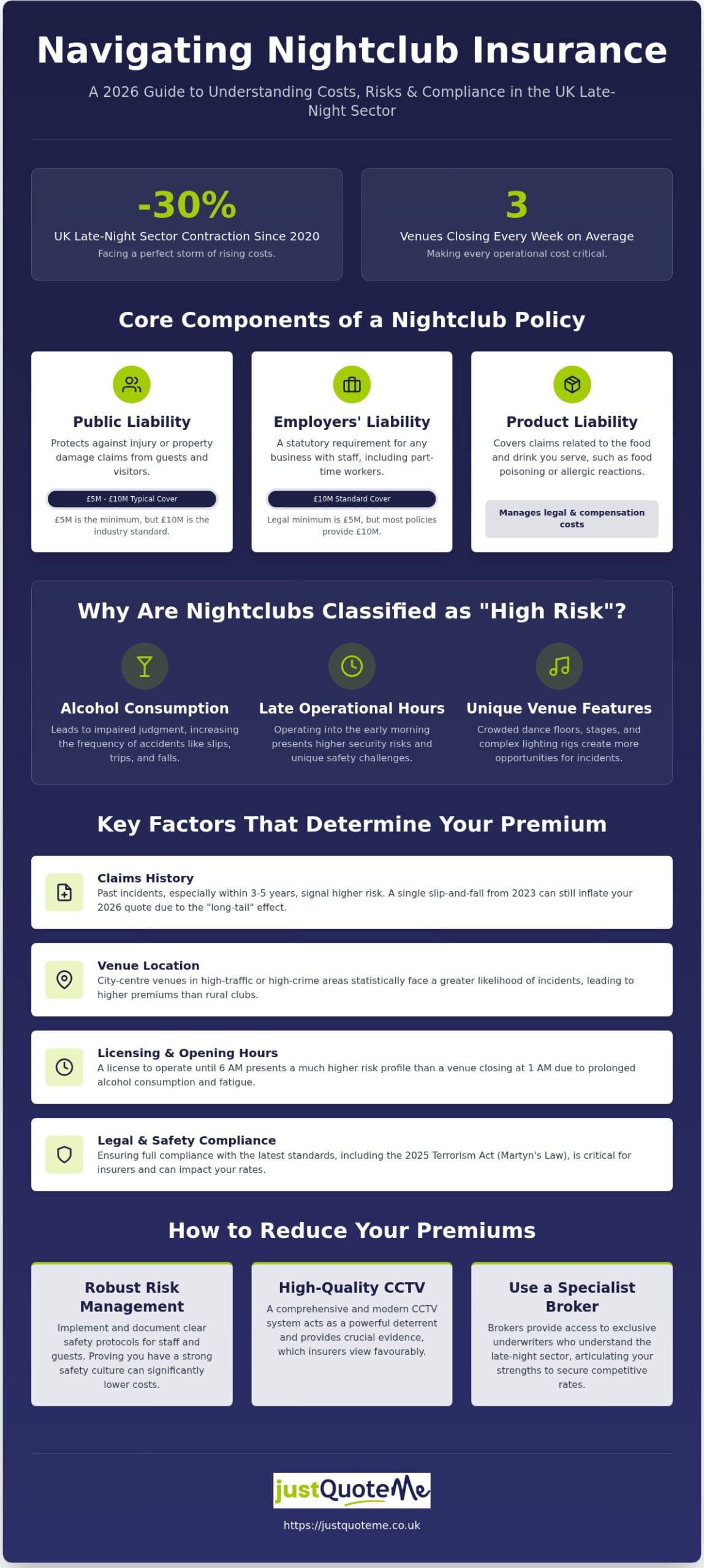
Did you know that the UK late-night sector has contracted by nearly 30% since 2020, with an average of three venues closing their doors every single week? If you operate a venue in 2026, you already know that the “perfect storm” of rising business rates and increased alcohol duties makes every penny count. It’s frustrating when you’re trying to provide a safe space for guests but find that nightclub liability insurance costs uk continue to climb, often because insurers view late-night venues as high-risk territory.
We understand that you’re looking for more than just a policy; you need a way to manage your overheads while staying fully compliant with complex laws like the 2025 Terrorism Act. This guide promises to demystify the factors that dictate your premiums and show you how a robust safety culture can actually drive your costs down. We will explore the mandatory cover levels for your staff, the impact of the new Martyn’s Law tiers, and practical strategies to secure competitive rates from specialist providers who actually understand the hospitality industry.
Key Takeaways
- Identify the statutory requirements for Employers’ Liability and why £5 million to £10 million is the industry standard for Public Liability cover.
- Discover how venue capacity and city-centre locations directly influence nightclub liability insurance costs uk and your overall risk assessment.
- Learn practical ways to reduce your annual premiums by implementing robust risk management protocols and high-quality CCTV systems.
- Understand the strategic advantage of using a specialist broker to access exclusive underwriters who understand the complexities of the late-night sector.
- Ensure your venue remains legally compliant with the latest 2026 safety standards, including the implementation of Martyn’s Law requirements.
Understanding Nightclub Liability Insurance in the UK
Nightclub liability insurance is the essential shield against third-party injury and property claims. It’s not a single policy but a multi-layered protection package designed to safeguard your business from the unique risks of the late-night economy. Unlike a standard shop or office policy, nightclub insurance accounts for the specific challenges of operating after dark. Liability insurance in this sector must be robust enough to handle high-footfall environments where the potential for accidents is significantly higher. Relying on generic cover often leaves operators vulnerable to gaps in protection. Understanding nightclub liability insurance costs uk starts with identifying the specific layers of risk your venue faces.
Standard business insurance often falls short because it doesn’t account for the volatility of a nightclub environment. Most general insurers avoid the late-night sector entirely. They view the combination of music, alcohol, and large crowds as an unpredictable liability. This makes it difficult to find cover through automated systems. You need a specialist who can articulate your safety protocols to underwriters. Just Quote Me provides this human-centric approach, ensuring your venue isn’t just another number on a spreadsheet. To secure your venue without the stress, Just Quote Me.
The Core Components of a Nightclub Policy
A comprehensive policy isn’t just about one type of risk. It’s a combination of different protections that work together to secure your financial future. Each component addresses a different stakeholder in your business.
- Public Liability: This protects you if a guest or visitor is injured or their property is damaged while on your premises. For most UK venues, licensing authorities expect a minimum of £5 million in cover, though £10 million is increasingly common.
- Employers’ Liability: This is a statutory requirement if you employ anyone, including part-time glass collectors, bar staff, or door security. The legal minimum is £5 million, but most policies provide £10 million as standard to ensure full compliance.
- Product Liability: This covers claims related to the food and drink you serve. If a customer suffers from food poisoning or an allergic reaction, this layer of the policy manages the resulting legal and compensation costs.
Why Nightclubs are Classified as “High Risk”
Insurers don’t view a nightclub the same way they view a café. The “high risk” classification is a major driver of nightclub liability insurance costs uk. Several factors contribute to this status:
- Alcohol Consumption: Increased alcohol intake can lead to impaired judgment among guests, which naturally raises the frequency of accidental slips, trips, and falls.
- Operational Hours: Operating into the early hours of the morning presents higher security risks and different safety challenges compared to daytime businesses.
- Venue Features: The presence of crowded dance floors, stages, and complex lighting rigs creates more opportunities for equipment-related incidents or crowd-control issues.
Managing these variables is where Just Quote Me excels. As an independent broker with over 30 years of experience, we help you navigate these classifications to find fair pricing from specialist underwriters who understand the hospitality sector’s nuances.
Key Factors Affecting Nightclub Liability Insurance Costs
Underwriters don’t just guess your premium. They look at hard data. Your nightclub liability insurance costs uk depend heavily on your specific operational footprint. Your claims history is a primary factor. If you’ve had incidents in the past three to five years, insurers see a pattern of risk. This “long-tail” effect means a single slip-and-fall from 2023 can still inflate your 2026 quote. Location also plays a part. A city-centre venue in a high-crime area faces higher premiums than a rural club because the statistical likelihood of an incident is simply higher.
Licensing conditions act as a roadmap for insurers. If your license allows you to stay open until 6 AM, your risk profile is vastly different from a venue closing at 1 AM. Longer hours mean more alcohol consumption and a higher chance of fatigue-related accidents. Understanding what essential business insurance covers is the first step in managing these variables. It helps you distinguish between legal obligations and the elective protections that keep your business solvent.
The Role of Venue Capacity and Turnover
Insurers use “headcount” as a primary rating factor. The more people you have in the building, the higher the mathematical probability of a claim. This is why your maximum capacity, as stated on your fire certificate, is so important. Projected annual turnover also matters. It’s used as a proxy for how busy you are. If you have seasonal peaks, like Christmas or Freshers’ Week, you should discuss these with a broker to ensure your cover is flexible. You can compare options with an expert to find a policy that scales with your business needs.
Operational Risks and Security Arrangements
Security is a double-edged sword for insurance. Having a high ratio of door staff to guests reduces the risk of violence, which insurers like. However, how you hire those staff matters. Using a contracted, SIA-approved security company often results in better rates because the security firm carries its own liability. If you employ them directly, you’re responsible for their actions under your own policy. Even the music you play can influence nightclub liability insurance costs uk. Certain genres or events are statistically linked to higher claim rates, and underwriters adjust their appetite accordingly. A clear, documented security plan is your best tool for negotiation.
Breaking Down the Bill: Public vs. Employers’ Liability
While we’ve discussed how capacity and location influence nightclub liability insurance costs uk, the specific split between Public and Employers’ Liability is the foundation of your quote. Public Liability is usually required by local licensing authorities at a £5 million limit, though many modern contracts and councils now push for £10 million. Employers’ Liability, however, is a non-negotiable legal duty. You must also account for “vicarious liability.” This legal principle means you are responsible for the actions of your staff during their working hours. If a member of your security team uses excessive force or a bartender’s negligence leads to a guest’s injury, the financial burden of the claim falls on your venue. When coordinating with external services for VIP events, such as when you check out Limo Time for luxury guest transport, always ensure that your liability agreements clearly define where the venue’s responsibility ends and the contractor’s begins.
Nightclubs are high-traffic areas where spills, broken glass, and low lighting create a high risk for slips and trips. These are the most common claims in the industry. Even if you aren’t at fault, the legal fees to defend a claim can be devastating. A robust Public Liability Insurance policy covers these defense costs. It ensures that a single fraudulent or exaggerated claim doesn’t drain your cash reserves. Insurers look for venues that have a clear policy for handling incidents, including logged floor checks and immediate cleaning of spillages, as these records are your first line of defense in court.
Employers’ Liability: Protecting Your Team
Understanding how these statutory requirements affect nightclub liability insurance costs uk is vital for accurate budgeting. Under the Employers’ Liability (Compulsory Insurance) Act 1969, almost every nightclub operator must have cover. It doesn’t matter if your staff are full-time, part-time, or casual glass collectors; they are all legally your employees. This even extends to some self-employed promoters or “trial” staff if they are under your direct supervision. Operating without valid Employers’ Liability Insurance can lead to fines of up to £2,500 for every single day you’re uninsured.
In the hospitality sector, this cover handles work-related injuries like back strains from heavy lifting or hearing damage from prolonged exposure to high decibel levels. It’s not just about accidents; it covers work-related illnesses too. Providing this protection is a mark of a professional operator. It gives your team the financial peace of mind that they’re looked after if something goes wrong on shift. Just Quote Me can help you navigate these legal requirements with a human-centric approach that avoids the confusion of automated systems.
How to Reduce Your Nightclub Insurance Premiums
While factors like capacity are fixed, your approach to safety is a variable you can control to influence nightclub liability insurance costs uk. Insurers aren’t just looking at your turnover; they’re looking for evidence that you’re a responsible operator. High-quality CCTV systems that cover all entry points and dance floors provide the visual evidence needed to shut down fraudulent claims quickly. Similarly, ID scanning technology doesn’t just prevent underage entry; it creates a digital audit trail that underwriters find reassuring. When you can prove exactly who was in your venue and when, you reduce the “unknown” variables that usually drive premiums higher.
Another practical lever is your voluntary excess. By agreeing to pay a higher amount toward any claim, you demonstrate a commitment to your own risk management and immediately lower your annual premium. It’s a calculated trade-off that works well for venues with a clean claims history. You can also use staff training records as a powerful negotiation tool. Documenting that every team member has completed fire safety, conflict resolution, and first aid training proves that your venue is run by professionals, not just casual workers.
Proactive Risk Mitigation Strategies
Meticulous record-keeping is your best defense against rising costs. The “Incident Log Book” should be more than a formality; it needs to be a detailed account of every minor occurrence, from a spilled drink to a refused entry. Transparency in your door policy also builds insurer confidence. Insurers view a well-documented safety policy as a sign of a lower-probability claim. This documentation acts as your shield during the annual renewal process, showing that you manage risks before they escalate into expensive legal battles.
The Value of Regular Safety Audits
Safety audits help you identify “blind spots” like poorly lit stairwells or loose floorboards before an incident occurs. Aligning with local authority schemes such as Best Bar None can also signal to insurers that you operate at a higher standard than the market average. If you use a third-party firm, ensure they have specialized Security Insurance to prevent their risks from bleeding into your policy. Regular reviews of your operational procedures keep your risk profile lean and your premiums competitive. To see how these improvements could lower your rates, get an expert review of your current cover.
Why Use a Specialist Broker for Nightclub Insurance?
Nightclubs are often classified as “hard-to-place” risks by standard insurance companies. This is where an independent broker becomes your most valuable asset. We have direct access to specialist underwriters who don’t deal with the general public. These experts understand the nuances of the late-night levy and the specific licensing laws that impact nightclub liability insurance costs uk. By working with an independent broker like Just Quote Me, you benefit from over 30 years of industry experience. We leverage our regional expertise across the West Midlands and Staffordshire to provide a personalized service that larger, impersonal competitors simply can’t match. We work for you, not the insurer, which means our loyalty lies in finding you the best possible protection at a fair price.
Bespoke Solutions vs. Online Calculators
Automated online systems are designed for standard, low-risk businesses like shops or offices. When you enter “nightclub” into a generic calculator, the algorithm often defaults to the highest possible risk rating, which leads to unnecessarily inflated quotes. A bespoke Nightclub Insurance policy avoids this “one-size-fits-all” trap. We take the time to understand your specific safety protocols, such as the ID scanning and staff training discussed earlier, to negotiate a price that reflects your actual risk level. Our human-centric approach means we talk directly to the people making the underwriting decisions, rather than relying on a rigid computer program that doesn’t understand the hospitality sector.
Ongoing Support and Claims Management
The value of a specialist broker doesn’t end once you’ve signed the policy. If you need to make a claim, we manage the entire administrative burden for you. We provide a steady hand during stressful situations, acting as the primary liaison between you and the insurer to ensure a fair resolution. As your business grows or your licensing hours change, we review your cover to ensure it stays relevant. This proactive management prevents expensive gaps in your protection and keeps your nightclub liability insurance costs uk as low as possible over the long term. We position ourselves as a partner who manages the complex administrative burdens so you can focus on running your venue. If you want to move away from automated systems and speak to a real person who understands your industry, you can Request a Call back for free Expert advice today.
Securing Your Venue’s Future
Managing a nightclub in 2026 involves balancing high operational costs with strict legal safety standards. We’ve explored how documenting your safety culture through CCTV, ID scanning, and staff training can directly influence nightclub liability insurance costs uk. Instead of settling for an automated quote that doesn’t understand the nuances of your specific venue, you can leverage professional expertise to find a policy that truly fits your risk profile. Proactive risk management isn’t just about reducing premiums; it’s about building a sustainable business that can withstand the pressures of a changing hospitality landscape.
Just Quote Me is an FCA-authorised independent broker with over 30 years of industry experience. We provide direct access to a broad network of top UK insurers, ensuring you receive bespoke cover rather than a generic package. Our human-centric approach manages the administrative burden so you can focus on providing a safe and vibrant experience for your guests. It’s about more than just compliance; it’s about peace of mind for your business and your team. When you’re ready to protect your investment with expert support, Get Your Free Business Insurance Quote now or Request a Call back for free Expert advice. We look forward to helping your venue thrive in a competitive market.
Frequently Asked Questions
Is nightclub liability insurance a legal requirement in the UK?
Employers’ Liability is a legal requirement for any club with staff, as mandated by the Employers’ Liability (Compulsory Insurance) Act 1969. While Public Liability isn’t a nationwide statutory law, your local licensing authority will almost certainly require it before granting your premises licence. Operating without these essential covers leaves you vulnerable to massive fines and immediate closure by local councils who prioritize public safety above all else.
Does my policy cover freelance security staff or bouncers?
Freelance security staff aren’t automatically covered by standard public liability. If you hire bouncers directly, they must be included on your Employers’ Liability policy. However, if you use a contracted security firm, they should carry their own specialist security insurance. You must verify their documents annually to ensure there are no gaps in protection that could leave your venue liable for their actions during a physical intervention.
What happens if I don’t have enough public liability cover?
If a claim exceeds your cover limit, your business is responsible for paying the remaining balance from its own assets. For instance, if you have £2 million in cover but a court awards £3 million for a serious injury, you must find that £1 million difference yourself. This often leads to insolvency. Most UK licensing boards now expect a minimum of £5 million to prevent such catastrophic financial failures.
Can I get insurance for one-off nightclub events?
Yes, you can secure specific cover for one-off events through specialized Events insurance. This is ideal for promoters who don’t own a permanent venue but need to satisfy the requirements of a host space. These policies provide short-term public liability and can include cover for equipment or event cancellation, ensuring you aren’t personally liable for accidents or financial losses during that specific night.
How much does nightclub insurance cost for a small venue?
Nightclub liability insurance costs uk for small venues vary based on your specific risk profile rather than a flat rate. Factors like your maximum capacity, the music genres played, and your claims history over the last five years dictate the final premium. Small venues with early closing times and no history of violence generally see lower rates than those operating into the early morning with high-energy dance events.
Will my premium go down if I have ID scanning technology?
Implementing ID scanning technology is a proven way to lower your insurance costs over time. Insurers value the digital audit trail it provides, as it helps prevent underage entry and assists in identifying individuals if an incident occurs. While it might not result in an immediate discount today, it significantly reduces the likelihood of successful claims, which keeps your long-term nightclub liability insurance costs uk competitive and stable.
Does nightclub insurance cover loss of licence?
Many specialist nightclub policies include “Loss of Licence” cover as an optional or integrated feature. This protects your business’s market value and income if your premises licence is suspended or revoked due to circumstances beyond your control. It doesn’t cover losses resulting from your own negligence or criminal activity, but it provides a vital safety net for regulatory challenges that could otherwise end your business’s ability to trade.
What is the difference between public liability and professional indemnity for clubs?
Public liability covers physical injury or property damage to guests, such as a slip on a wet dance floor. Professional indemnity is different as it protects against claims of professional negligence or bad advice. While every club needs public liability, professional indemnity is usually only necessary if you provide specialized services, like event planning or security consultancy, where a mistake in your professional advice could cause a client significant financial loss.
Article by
Just Quote Me
JustQuoteMe Ltd is an independent UK insurance brokerage specialising in business and personal insurance solutions. With over 35 years of industry experience, the company provides tailored insurance cover for businesses, landlords, tradespeople, hospitality venues, fleets, and individuals across the UK. Known for its personal service, expert advice, and competitive premiums, JustQuoteMe Ltd works with leading insurers to deliver bespoke policies designed around each client’s unique needs. The company is authorised and regulated by the Financial Conduct Authority (FCA No. 586607) and has built a reputation for trusted, straightforward insurance guidance and long-term client relationships.

by jqm | Sep 2, 2026 | Insurance
Did you know that 12% of UK retail businesses reported a significant insurance-related claim in 2025? For many shop owners, the reality of rising premium costs and the 5% year-on-year increase in shoplifting makes finding the right shop insurance feel like an uphill battle. It’s frustrating to deal with the confusion of legal requirements or the nagging fear that a claim might be rejected because of policy small print you didn’t quite understand. You need a solution that protects your livelihood without the administrative headache.
We understand that your business is unique, and a generic, automated policy rarely provides the security you deserve. This guide will help you discover how to protect your retail business with bespoke cover that handles everything from public liability to business interruption. We promise to simplify the complex and ensure you achieve full legal compliance while gaining expert support during the claims process. We will explore the latest 2026 FCA rule simplifications, clarify your mandatory obligations under the Employers’ Liability Act, and show you how to build a flexible policy that scales as your shop grows.
Key Takeaways
- Learn the legal essentials of shop insurance, including why Employers’ Liability is a non-negotiable requirement for any UK retailer with employees.
- Discover how to distinguish between standard business policies and bespoke retail cover to protect against specific risks like stock damage and business interruption.
- Explore niche-specific protections for boutiques and cafes that address unique challenges like high-value window displays and product liability.
- Gain practical insights into lowering your insurance costs by implementing robust risk assessments and physical security upgrades.
- Understand the benefits of partnering with an independent broker to secure expert, human-centric support that automated quote engines lack.
Understanding Shop Insurance: Why Your Retail Business Needs a Safety Net
Running a retail business in the UK involves balancing daily operations with long-term security. Shop insurance is more than a line item on your balance sheet; it’s a strategic safety net that protects your livelihood. This cover serves a dual role by ensuring legal compliance and providing the financial buffer needed for survival. A single incident, like a customer slipping on a wet floor or a break-in during the night, can trigger a ripple effect. Without the right protection, the legal fees and repair costs from one event could be enough to close your doors for good.
Generic business policies or standard home insurance often fail to address the specific needs of a high-street shop. These broad products might lack the depth required to cover high-value stock or the unique liability risks of constant footfall. Many savvy retailers opt for a structure similar to a Business Owner’s Policy (BOP), which integrates property and liability protections into a cohesive package. In 2026, with the FCA introducing more flexible digital rules for insurance providers, it’s easier than ever to find a policy that fits your specific niche rather than settling for a “one size fits all” solution.
Legal Obligations: Employers Liability and Beyond
If you employ anyone, employers liability insurance is a non-negotiable legal requirement. The Employers’ Liability (Compulsory Insurance) Act 1969 mandates that you hold at least £5 million in cover. This isn’t just for large corporations. It applies to independent boutiques with part-time staff and even family-run shops with seasonal help. Fines for non-compliance are severe, reaching up to £2,500 for each day you operate without a valid policy. We help Staffordshire retailers navigate these regulations to avoid penalties and ensure their team stays protected.
Protecting Your Reputation and Assets
Your shop’s reputation is built on trust, and public liability insurance is the essential shield for that trust. In a customer-facing environment, the risk of third-party injury or property damage is a daily reality. This cover provides peace of mind that you won’t be personally liable for expensive legal claims. Having a robust policy also serves as a vital signal to landlords and suppliers. Most commercial lease agreements in Newcastle-under-Lyme and Stafford require proof of liability cover before you can move in. By safeguarding the physical heart of your business, you ensure your premises remain a secure environment for both your staff and your customers.
The Anatomy of a Comprehensive Shop Insurance Policy
Building a robust shop insurance policy requires more than just picking a few options from a list. It’s about creating a cohesive structure where each element supports the others. While the previous section highlighted why you need cover, understanding the specific components ensures you aren’t paying for what you don’t need or leaving dangerous gaps in your protection. A standard policy typically bundles several key covers into one manageable package, often referred to as a comprehensive retail solution. This trend toward integrated digital protection is gaining traction globally; for example, platforms like insure.az demonstrate how online portals can simplify property and asset coverage for a variety of needs.
The foundation of any retail policy starts with public liability and employers liability. While public liability protects you if a customer is injured on your premises, employers liability is a legally required business insurance for anyone with a team. These two work together to shield your financial assets from legal claims that could otherwise bankrupt a small shop. Without this dual layer of protection, even a minor accident could result in devastating legal costs.
Safeguarding Your Inventory and Equipment
Distinguishing between stock and contents is vital for accurate valuation. Stock refers to the items you sell, while contents include your till systems and shelving. If you own a boutique in Stone, your stock levels likely fluctuate. You must account for seasonal peaks to avoid being underinsured during your busiest periods. To ensure your financial reporting remains accurate throughout these fluctuations, you can visit Mazuma for professional accountancy support. Many policies also include cover for shop front glass and goods in transit, protecting your assets from the moment they leave the supplier until they reach the customer.
Business interruption pays for lost income and ongoing bills like rent if you’re forced to close for repairs after a fire or flood. The key is choosing the right indemnity period. This is the timeframe your policy will support your recovery. We suggest a minimum of 12 months, though 24 months is safer for major refits. If you’re unsure about your specific risks, you can speak with a specialist broker to calculate your needs accurately.
Additional Options: Cyber and Legal Expenses
Modern shops rely on digital POS systems, making cyber insurance a critical addition for 2026. It protects you if customer data is breached or your payment systems are hacked. Additionally, legal expenses cover provides support for employment disputes or tax enquiries. You might also consider protection for money kept on the premises or cover against employee dishonesty, providing a final layer of security against internal and external threats.
Tailoring Cover for Your Specific Retail Niche
Retail isn’t a one-size-fits-all sector. A high-street boutique has different risks than a suburban deli. While a beginners’ guide to business insurance provides a good starting point, 2026 retailers need more granular detail. High-street boutiques deal with massive footfall and often have expensive, vulnerable window displays. Managing these risks requires precise shop insurance that covers accidental damage and glass breakage. For cafes and deli-shops, the focus shifts to food hygiene and product liability. It’s not just about the premises; it’s about what you serve to the public.
Some retail models cross into high-risk territory. If your retail brand includes late-night entertainment or physical security services, you’ll need specific nightclub insurance or security company insurance. Pop-up shops and market stalls also require flexibility. Short-term policies allow you to trade at events without committing to a full annual premium. This adaptability is essential for modern retailers who test new locations or seasonal markets.
The High Street Challenge: Premises and Public Access
Many UK retailers operate out of unique spaces. If you own the building, commercial property insurance is essential. This becomes more complex if there are residential flats above your shop or if you occupy a listed building. These scenarios require specialized underwriting to ensure the structure is protected against fire or subsidence while meeting strict heritage regulations. We help owners in Newcastle-under-Lyme and Stafford navigate these property nuances to ensure no part of the building is left vulnerable.
Specialist Sectors: From Pubs to Security
Some retail businesses are deeply traditional yet carry modern risks. For instance, thatched pub insurance requires an understanding of specialist materials and fire risks. Even service-based shops like hairdressers must adapt their shop insurance to include treatment liability for their clients. This level of detail is why working with an expert commercial insurance broker in Staffordshire is so valuable. We understand the local landscape in towns like Stafford and Stone, ensuring your specific niche is covered correctly from day one.
Practical Tips: How to Reduce Your Shop Insurance Premiums
Reducing the cost of your shop insurance doesn’t mean you have to compromise on the quality of your protection. In fact, the most effective way to lower premiums is by demonstrating to insurers that you’re a lower risk. This starts with a proactive approach to safety and security. While many retailers look for the lowest price, the “cheapest” option often contains hidden exclusions that can lead to expensive claim rejections later. A balanced policy provides the right level of cover at a price that reflects your commitment to risk management.
Risk Management for Retailers
Slips, trips, and falls are the most common public liability claims in retail. By conducting regular risk assessments and documenting floor checks, you create a paper trail that proves your commitment to safety. Staff training is another powerful tool. When your team knows how to handle spillages or manage crowds during sales, the likelihood of an accident drops significantly. Insurers often reward this diligence with lower liability premiums. Fire safety protocols, including regular alarm testing and clear exit routes, also play a crucial role in protecting your property and lowering building insurance costs.
Physical security is a major factor in premium calculation. Installing high-quality alarms, shutters, and CCTV systems can lead to a significant reduction in your annual costs. Research from early 2026 suggests that businesses implementing these proactive risk mitigation measures can see premium reductions of up to 15%. These upgrades protect your stock and act as a deterrent to the rising rates of shoplifting mentioned earlier in this guide. Investing in security doesn’t just lower your insurance bills; it protects your daily trade.
Optimising Your Policy Structure
Your policy should reflect the current state of your business. Over-insurance is a common mistake where retailers pay for cover they don’t need, such as stock levels that have long since decreased. Conversely, under-insurance is a dangerous gamble that can leave you out of pocket during a claim. Choosing a higher voluntary excess can lower your monthly payments, but you must ensure this amount remains affordable if you need to claim. We recommend annual policy reviews to adjust for changes in turnover or equipment.
Navigating these choices alone is difficult. An independent broker has the advantage of comparing the whole market to find competitive prices that automated systems often miss. With over 30 years of experience, we provide the human-centric advice needed to balance cost with comprehensive cover. To start saving on your premiums today, compare shop insurance quotes that fit your specific business needs.
Securing Bespoke Shop Insurance with Just Quote Me
Choosing the right shop insurance shouldn’t feel like a digital lottery. Many automated platforms prioritize speed over accuracy, leaving you with gaps in cover that only appear when you try to claim. Just Quote Me offers a human-centric alternative. With over 30 years of industry experience, we act as a steady hand in a complex market. We manage the administrative burdens so you can focus on your customers. Our status as an independent broker means we work for you, not the insurance companies. We compare options across a broad network to find the best value for your specific needs. This eliminates the frustration of dealing with rigid, automated systems that don’t understand the nuances of your trade.
Every business has its own set of risks. You might be a single high-street unit or part of a larger group that requires tradesman insurance alongside your retail cover. We specialize in creating tailored packages that address these complexities. Our access to a wide range of top UK insurers ensures competitive pricing without sacrificing the quality of your protection. Our support doesn’t end once you sign the policy. We provide ongoing assistance for mid-term adjustments and renewals, ensuring your cover always reflects your current operations and stock levels.
Get Started with Your Quote Today
We’ve designed our process to be as efficient as possible for busy shop owners. You don’t have time to fill out endless forms or wait on hold for hours. We provide direct access to professional advice, especially for non-standard risks that automated systems often reject. Our goal is to give you financial peace of mind and full legal compliance with minimal fuss. We handle the paperwork and the negotiations with insurers, acting as your partner throughout the life of your policy. Just Quote Me to simplify your administrative burdens and secure your future. Take the first step toward securing your shop insurance today.
Secure Your Retail Future Today
Protecting your high-street presence in 2026 requires more than a generic policy. Throughout this guide, we’ve explored how understanding your mandatory legal duties and implementing proactive risk management can significantly lower your overheads. Whether you’re managing a boutique in Stone or a busy deli in Stafford, the right shop insurance provides the financial safety net your hard work deserves. It’s about moving from a state of uncertainty to one of total business resilience.
Just Quote Me brings 30+ years of industry expertise to your doorstep. As an independent, FCA-authorised broker, we don’t rely on automated bots. Instead, we offer bespoke policies tailored to your specific retail niche, ensuring you never pay for cover you don’t need. We handle the complex administration and policy fine print so you can stay focused on serving your customers. Secure your retail business with expert guidance today and trade with the confidence that your livelihood is fully protected by professionals who understand your local market.
Get Your Free Business Insurance Quote now
Request a Call back for free Expert advice
Common Questions About Retail Protection
Is shop insurance a legal requirement in the UK?
Employers’ Liability insurance is the only component of shop insurance that is a strict legal requirement if you employ any staff. Under the Employers’ Liability (Compulsory Insurance) Act 1969, you must have at least £5 million in cover. While public liability and buildings cover aren’t mandated by UK law, most commercial landlords and local authorities will require proof of these before you can trade from a physical premises.
What is the difference between shop insurance and public liability insurance?
Public liability insurance is a specific type of protection, whereas shop insurance is a comprehensive package that includes multiple covers. Think of public liability as the shield against claims for injury or property damage from customers. A full shop policy goes much further by including protection for your stock, business interruption, and the building itself. We help you bundle these into one efficient contract that fits your specific retail niche.
Does my policy cover me for shoplifting and theft?
Most comprehensive policies provide cover for theft, but the specific terms depend on your security measures. Standard cover usually requires evidence of forcible or violent entry to the premises. However, many retailers add specific shoplifting extensions to their policy to account for losses during trading hours. It’s essential to check your policy small print regarding minimum security requirements like alarm systems or specific lock types to ensure your claim isn’t rejected.
How much does shop insurance cost on average?
The cost of shop insurance depends on your location, stock value, and security measures. Insurers calculate premiums based on the specific risks associated with your trade and premises. A high-end boutique in a city centre carries a different risk profile than a small village newsagent. We use our 30 years of industry experience to compare the whole market and find competitive prices that reflect your actual needs rather than using generic demographic assumptions.
Do I need insurance for a pop-up shop or market stall?
You absolutely need insurance for temporary trading, as you face the same liability risks as permanent retailers. Most pop-up organisers and market operators will insist on seeing proof of public liability cover before allowing you to set up. We provide flexible, short-term solutions that protect your stock and your legal liability without forcing you into a long-term annual commitment. This allows you to test new markets with full financial peace of mind.
What happens if I have a flat above my shop?
Having a residential flat above your shop changes your risk profile and requires a specialized commercial property policy. Insurers consider the increased risk of fire or water damage coming from the residential area. It’s vital to disclose this detail during your quote process to ensure your building cover remains valid. We specialize in these complex property arrangements, ensuring both the commercial and structural elements of your building are correctly protected.
Can I get insurance for a shop that is currently vacant?
You can secure insurance for a vacant shop, but it falls under unoccupied property terms. These policies focus on protecting the structure from vandalism, fire, and weather damage while the unit is empty. Be aware that insurers often set strict conditions for vacant units, such as regular site inspections and turning off the water supply. We help you navigate these requirements so your asset remains protected until you find a new tenant.
How do I make a claim on my shop insurance policy?
To make a claim, you should contact our expert advisors as soon as an incident occurs. We act as your advocate, handling the complex negotiations with the insurance underwriters so you don’t have to. You’ll need to provide evidence like photos of damage or a police crime reference number for thefts. Our human-centric approach ensures you receive personal support throughout the process, moving your claim from initial notification to a successful settlement quickly.
Article by
Just Quote Me
JustQuoteMe Ltd is an independent UK insurance brokerage specialising in business and personal insurance solutions. With over 35 years of industry experience, the company provides tailored insurance cover for businesses, landlords, tradespeople, hospitality venues, fleets, and individuals across the UK. Known for its personal service, expert advice, and competitive premiums, JustQuoteMe Ltd works with leading insurers to deliver bespoke policies designed around each client’s unique needs. The company is authorised and regulated by the Financial Conduct Authority (FCA No. 586607) and has built a reputation for trusted, straightforward insurance guidance and long-term client relationships.

by jqm | Sep 1, 2026 | Insurance
The cheapest policy on a comparison site often becomes the most expensive mistake your company will ever make. In 2026, the search for the best business insurance isn’t about finding the lowest premium; it’s about securing a safety net that actually holds when you need it most. You’ve likely felt the frustration of generic forms that don’t understand your specific trade, or the worry that a hidden exclusion might leave you exposed during a claim. It’s a common struggle for UK business owners who want to protect their livelihoods without being drained by unnecessary costs.
We understand that you want more than just a digital certificate. You need the peace of mind that comes from being legally compliant and the confidence that a human expert is ready to handle the administrative heavy lifting. This guide reveals how to move beyond automated algorithms to find bespoke coverage tailored to your industry’s unique vulnerabilities. We’ll explore how to identify your legal requirements, avoid the trap of generic policies, and explain why having a steady hand from an independent broker makes all the difference. To protect what you’ve built, Just Quote Me.
Key Takeaways
- Understand why the best business insurance isn’t simply the cheapest option, but a calculated balance of legal compliance and industry-specific risk mitigation.
- Discover why automated comparison sites often lead to hidden exclusions and why an independent broker provides a more reliable safety net for your company.
- Learn about the core pillars of protection, from Public Liability to Employers Liability, and how to tailor them to sectors like hospitality or construction.
- Identify the specific information you need to gather to secure a bespoke quote that fits your budget without sacrificing essential coverage.
- Gain a clear action plan for evaluating policy limits and excesses to ensure your business is fully protected against real-world claims.
Defining the Best Business Insurance for Your UK Company in 2026
The best business insurance isn’t a static product you pull off a shelf. In 2026, it’s defined by a precise intersection of legal compliance, specific risk mitigation, and long term cost efficiency. For many SMEs, the temptation to use a generic algorithm is high, yet a one-size-fits-all policy is often the most expensive mistake a business can make. These automated systems frequently miss the nuances of your daily operations, leaving you with expensive overlaps or, worse, critical gaps in your protection. A quick overview of the UK insurance market shows that while capacity is growing, the complexity of risks is also increasing. Bespoke business insurance is a policy built from the ground up to match a specific risk profile.
Legal Requirements vs. Optional Protections
Identifying what you must have versus what you should have is the first step toward efficiency. Employers Liability Insurance is a strict legal requirement for almost any UK business with staff, including contractors and casual workers. By law, you must carry at least £5 million in cover, though most insurers provide £10 million as a standard. Failing to meet this requirement can result in fines from the Health and Safety Executive of up to £2,500 for every single day you’re uninsured.
While Public Liability Insurance isn’t mandated by UK law, it’s considered an essential best practice. If a client or member of the public suffers an injury or property damage due to your business activities, the resulting legal fees and compensation could easily bankrupt an unprotected company. The best business insurance strategies treat these “optional” covers as foundational pillars rather than afterthoughts.
The 2026 Landscape: New Risks to Consider
The UK economic climate in 2026 presents unique challenges that didn’t exist a few years ago. Inflation has significantly increased the costs of materials and labour, which means many businesses are now underinsured on their Commercial Property Insurance. If your sum insured hasn’t been updated recently to reflect current rebuilding costs, you risk a “pro-rata” reduction in any claim payout.
Digital threats have also moved from the periphery to the centre of risk management. With 43% of UK businesses reporting a breach in the last year, Cyber Liability Insurance is no longer just for tech firms. Modern policies are shifting toward modular designs, allowing hybrid businesses to toggle protections as they scale. This flexibility ensures you don’t pay for office based risks if your team is largely remote, keeping your premiums aligned with your actual exposure.
The Essential Pillars of Comprehensive Commercial Protection
Building the best business insurance portfolio requires understanding that different risks require different anchors. While some covers are mandatory, others act as the structural support that keeps your business standing after a catastrophic event. Successful UK business policies are never accidental; they are a calculated assembly of covers that address both immediate liabilities and long term asset protection. Identifying these core pillars is the first step toward moving away from generic, high risk policies.
Liability Covers: Public, Product, and Employers
Liability insurance is the most significant segment of the UK market for a reason. It protects you from the financial fallout of legal claims. While Public Liability Insurance handles claims related to third party injury or property damage on your premises, it doesn’t cover everything. Manufacturers and retailers must also consider Product Liability. If a product you supply causes illness or injury after it leaves your hands, Product Liability is the specific protection that manages the legal defence and compensation costs.
Professional Indemnity is a separate but equally vital pillar for consultants and service providers. If a client suffers a financial loss because of your expert advice or a mistake in your work, this cover is essential. Claim scenarios in 2026 often involve high indemnity limits because legal costs have risen. A single slip and fall claim or a professional error can easily reach six or seven figures. Ensuring your limits are high enough to cover these “worst case” scenarios is a hallmark of a high quality policy. If you feel your current limits are lagging behind, it’s a good idea to speak with a specialist broker for a professional review.
Asset and Revenue Protection
Physical assets often represent your largest capital investment. Commercial Property Insurance covers the building itself and the equipment inside, but the truly best business insurance policies go a step further by including Business Interruption (BI) cover. Many businesses focus only on the cost of replacing a damaged roof or stolen tools. They forget that the real threat is the weeks or months of lost income while repairs take place.
BI cover replaces that lost revenue, ensuring you can still pay your staff and overheads even when you can’t trade. For those in the retail sector, Shop Insurance packages often integrate these protections into a single, manageable policy. For a broader perspective on how these pillars fit together, you can consult this guide to choosing business insurance from the Association of British Insurers. This structured approach ensures your business isn’t just insured, but truly protected against the specific realities of your sector.
Comparison: Direct Insurers, Aggregators, or Independent Brokers?
Choosing the right path to your policy is as important as the policy itself. Most UK business owners take one of three routes: buying directly from an insurer, using an automated aggregator, or partnering with an independent broker. While direct insurers offer brand familiarity, they limit your options to their specific underwriting appetite. Aggregators offer speed but often sacrifice the detail required to build the best business insurance for a professional company. Brokers provide the middle ground, combining a broad market search with expert scrutiny.
The Aggregator Trap: Why Price Isn’t Everything
Automated algorithms are designed for high volume, low complexity risks. They work well for a standard home office, but they often struggle with non standard requirements. If your business operates in a high risk sector, such as Nightclub Insurance or Thatched Pub insurance, a generic dropdown menu simply cannot capture the nuances of your property or operations.
The danger of selecting the lowest priced option on a comparison site is “under insurance.” You might save a small amount on your annual premium, but you face a massive financial shortfall during a claim because the algorithm missed a critical industry exclusion. These sites frequently struggle to identify specific legal requirements for niche sectors, leaving you vulnerable to fines or rejected claims. When you prioritise price over precision, the “cheap” policy often becomes the most expensive document you’ve ever signed.
The Broker Advantage: Bespoke Advice and Market Access
An FCA authorised broker acts as your professional advocate. At Just Quote Me, we use 30 years of industry experience to perform a comprehensive risk assessment that a computer script cannot replicate. We navigate a broad panel of top UK underwriters to find “broker only” rates that are never published on public comparison sites. This access allows us to secure the best business insurance pricing without cutting corners on your protection.
The true value of a broker appears during the claims process. Instead of navigating a faceless corporate call centre, you have a human point of contact who understands your history. We handle the administrative burdens and push for a fair resolution with the insurer, acting as a steady hand in a complex market. This human centric approach ensures you aren’t just a policy number; you’re a partner whose business continuity is our primary objective. Whether you need a simple adjustment or a total policy overhaul, having a single expert to call ensures your coverage remains efficient and compliant.
Industry-Specific Guidance: Finding the Best Fit for Your Sector
The best business insurance is never a generalist product. It’s a precise tool designed to handle the specific hazards of your trade. While a florist and a scaffolder both need liability cover, the underlying risk profiles are worlds apart. Generic insurers often lack the appetite for high risk sectors, leading to premiums that are either artificially high or riddled with restrictive exclusions that render the policy useless when a claim arises. This is why sector specific knowledge is the most valuable asset when brokering a policy. To see how these principles of specialist brokering are applied elsewhere, you can explore Business Insurance through MyGen Insurance Brokers.
In the building trades, your insurance needs to move as fast as your projects. Standard Builders Insurance covers the basics, but larger or more complex developments often require Contractors All Risk Insurance. This provides a comprehensive umbrella over the works in progress, your own plant, and hired in machinery. It ensures that if a site is vandalised or a storm destroys a half finished structure, your capital investment is protected.
Specialist trades, particularly those working at height, face even stricter scrutiny from underwriters. Many off the shelf policies include height limits that are often too low for modern construction needs. A bespoke policy through an independent broker ensures these limits are negotiated to match your actual operational reality, rather than a computer generated average. This level of detail prevents the “hidden exclusions” that frequently plague generic trade policies.
Hospitality and Niche Property Risks
The hospitality sector requires a nuanced approach to property and liability. For instance, Thatched Pub Insurance is a highly specialised field. The unique fire risks associated with thatch and the significant costs of traditional rebuilding materials mean you need a broker who can access specialist underwriters. Without this regional and sector specific expertise, you risk being significantly underinsured if the worst happens.
Higher risk venues have different priorities. Nightclub Insurance must address complex security requirements and late night liability issues that standard pub policies won’t touch. Meanwhile, those managing Hotels and Guest Houses need to balance property protection with guest liability and business interruption covers. Each of these sectors demands a tailored assembly of protections to ensure long term viability. To secure a policy that fits your specific trade, get an industry-specific quote from our expert team today.
Securing Your Bespoke Quote: A Practical Action Plan
Securing the best business insurance for your company is a strategic process that requires more than just a few clicks on a comparison site. You’ve already seen how generic policies leave gaps in your protection. Now, you need a clear roadmap to transition from a basic policy to a bespoke managed service. This plan ensures you aren’t just buying a certificate, but building a safety net that adapts as your business grows throughout 2026.
Preparation Checklist for 2026
This level of adaptability is essential as you invest in your brand identity with custom products from The CEO Creative, ensuring all physical assets are included in your insurance valuations.
Before you request a professional quote, gathering accurate data is essential for an efficient risk assessment. Insurers in 2026 require precision to offer the most competitive rates. You should prepare your accurate revenue projections and a detailed headcount of all employees, including any casual staff or contractors.
Beyond the basics, you must provide a full inventory of your physical assets. This includes specialised equipment and Plant and Machinery. Having your previous three to five years of claims history ready, along with documentation of your current risk management protocols, allows a broker to present your business in the best possible light to underwriters. This transparency often leads to better terms and lower excesses because it proves you’re a responsible risk.
Requesting Your Quote and Expert Consultation
While many competitors rely on AI chatbots to provide answers in seconds, these automated systems cannot replace a professional consultation. When you request a “Free Business Insurance Quote,” you’re doing more than just benchmarking your current costs. You’re starting a conversation with a human expert who can spot the industry specific exclusions that an algorithm might miss. Expert advice is the final safeguard that ensures your policy is truly the best business insurance for your specific needs.
Evaluating a quote requires looking far beyond the annual premium. You must scrutinise the limits of indemnity and both the voluntary and compulsory excesses. A low premium is often a mask for a high excess that could damage your cash flow during a claim. At Just Quote Me, we simplify this entire process. We manage the administrative burdens of your commercial contracts and perform annual reviews to ensure your cover keeps pace with your expansion. Transitioning your existing policies to a managed brokerage service provides a steady hand in a fluctuating market, giving you the freedom to focus on your operations while we handle the complexities of your protection.
Protecting Your Business Legacy in 2026
Finding the best business insurance isn’t just about ticking a box or choosing the first option on a comparison site. It’s about building a robust framework that protects your unique risks, from specialized plant machinery to complex liability needs. You’ve learned that a generic policy often hides exclusions that only surface when it’s too late. By prioritizing bespoke coverage and expert advocacy, you’re ensuring your company isn’t just surviving, but thriving in an evolving economic landscape.
As an FCA-authorised independent broker with 30+ years of UK industry experience, we specialize in simplifying the complex. We don’t just provide a policy; we provide a partnership that manages your administrative burdens. To see the difference that tailored coverage makes, start your journey toward better protection today. You can also request a call back for free expert advice to ensure your company remains fully compliant. We’re ready to help you build a more secure future.
Get Your Free Business Insurance Quote now
Request a Call back for free Expert advice
Frequently Asked Questions
What is the most important type of business insurance for a UK startup?
Public Liability is usually the first priority for startups as it covers legal costs if your business causes injury or property damage to a third party. However, if you’ve already hired your first employee, Employers’ Liability becomes a mandatory legal requirement immediately. Many tech or service based startups also find Professional Indemnity essential for meeting the contractual terms required by larger corporate clients during the onboarding process.
Is business insurance a legal requirement for sole traders?
While most insurance isn’t a legal requirement for sole traders without staff, it’s often a commercial necessity. You won’t be legally forced to have Public Liability, but you’ll find that many local authorities and private clients won’t allow you on site without proof of cover. If you employ anyone, even a temporary assistant, you must carry Employers’ Liability insurance to comply with UK law and avoid significant daily penalties.
How much does the best business insurance typically cost?
The cost of the best business insurance is determined by your specific risk profile rather than a flat industry rate. Factors such as your annual turnover, the nature of your trade, and your location in the UK all influence the premium. While a consultant might pay a few hundred pounds, a high risk construction firm will face higher costs. The goal is to find a policy that balances a competitive price with comprehensive indemnity limits.
Can I combine multiple covers into a single business insurance policy?
You can easily combine various protections into one “package” policy. This is common for retailers, office based firms, and hospitality businesses. By grouping Public Liability, Employers’ Liability, and Business Interruption cover under one renewal date, you reduce your administrative workload and often benefit from a multi cover discount. This integrated approach ensures there are no overlaps or gaps between different policies, providing a more seamless safety net for your operations.
What is the difference between a direct insurer and an insurance broker?
A direct insurer only sells their own specific products, meaning they can’t offer you a comparison or alternative if their criteria don’t fit your needs. An independent broker like Just Quote Me acts as your personal advisor, searching a broad panel of underwriters to find the most suitable terms. We provide a human centric service, helping you navigate complex jargon and acting as your advocate if you ever need to make a claim.
How often should I review my business insurance coverage?
You should review your coverage at least once a year, but significant business changes require an immediate check. If you’ve purchased new machinery, increased your staff numbers, or expanded your service offerings, your current limits might no longer be sufficient. Regular reviews prevent the danger of under insurance, which occurs when your policy payout doesn’t cover the full cost of a loss due to outdated asset valuations or revenue figures.
What happens if I don’t have the legally required Employers’ Liability insurance?
Failing to hold valid Employers’ Liability insurance is a serious breach of UK law that can result in fines of up to £2,500 for every single day you are uninsured. The Health and Safety Executive actively monitors compliance across all sectors. Beyond these statutory fines, your business would be held personally liable for any compensation claims arising from employee injuries or illnesses, which could lead to total financial ruin for an unprotected company.
Article by
Just Quote Me
JustQuoteMe Ltd is an independent UK insurance brokerage specialising in business and personal insurance solutions. With over 35 years of industry experience, the company provides tailored insurance cover for businesses, landlords, tradespeople, hospitality venues, fleets, and individuals across the UK. Known for its personal service, expert advice, and competitive premiums, JustQuoteMe Ltd works with leading insurers to deliver bespoke policies designed around each client’s unique needs. The company is authorised and regulated by the Financial Conduct Authority (FCA No. 586607) and has built a reputation for trusted, straightforward insurance guidance and long-term client relationships.

by jqm | Aug 31, 2026 | Insurance
Did you know that 58% of UK SMEs are currently operating without insurance for their three most significant risks? In a 2026 economy where public liability claims have risen by 10% year-on-year, finding the best public liability insurance uk is no longer just a box-ticking exercise; it’s a critical survival strategy. You’re likely feeling the pressure of rising premiums and worrying about those hidden exclusions that turn a cheap policy into a rejected claim. It’s frustrating when you just want to get on with your work without the constant fear of being under-insured or caught in a time-consuming application process.
This guide will show you how to cut through the noise of automated bots and find a policy that matches your specific trade risks while maintaining a frictionless quote process. We’ll explore why £5 million has become the new industry standard for commercial contracts; we’ll also examine how to meet your legal duties under the Insurance Act 2015. You’ll learn how to secure comprehensive, reliable cover that protects your reputation and your bottom line, ensuring you have the expert validation you need to trade with confidence.
Key Takeaways
- Learn how to balance indemnity limits and trade-specific exclusions to find the best public liability insurance uk for your unique business needs.
- Identify the essential policy components, such as contractual liability extensions, that distinguish comprehensive protection from basic, high-risk cover.
- Understand why independent brokers provide better value than comparison sites through access to specialist schemes and expert risk assessment.
- Discover the “fine print” traps and common exclusions that often lead to rejected claims in the UK’s current insurance market.
- Find out how a bespoke quote process can save you time while ensuring your business is never left under-insured.
What Defines the ‘Best’ Public Liability Insurance in the UK for 2026?
Public Liability (PL) insurance in 2026 is far more than a simple administrative requirement; it’s a vital safeguard against the financial volatility of a litigious business environment. This cover protects your business if a member of the public, a client, or a contractor suffers accidental injury or property damage because of your work. While many business owners focus purely on the lowest price, the best public liability insurance uk is actually a strategic balance between a sufficient limit of indemnity, transparent exclusions, and a competitive premium. It’s a bespoke shield designed to address your specific industry risks rather than a generic, off-the-shelf product.
Establishing the baseline for quality starts with regulation. Any provider you consider must be an FCA-authorised firm. This authorisation ensures the broker or insurer adheres to strict codes of conduct and financial standards, providing you with essential security. Working with an established broker like Just Quote Me offers the human-centric expertise needed to verify that your policy isn’t just a piece of paper, but a reliable commitment to your business’s continuity. Ultimately, the best policy is one that offers tailored protection for your specific industry risks.
The Core Purpose of Public Liability Cover
The primary function of this insurance is to handle the costs associated with third-party bodily injury and property damage claims. This includes not only the final compensation award but also the substantial legal defense costs that often accompany these cases. In 2026, legal fees can frequently exceed the actual settlement amount, making robust legal support a cornerstone of any quality policy. By understanding liability insurance as a broader framework of risk management, it becomes clear why public liability insurance is the non-negotiable foundation of a professional insurance portfolio.
Standard Limits of Indemnity in 2026
Choosing an appropriate limit of indemnity is a decision that requires careful thought. While £1 million or £2 million limits are still available, 2026 market trends show that £5 million has become the standard requirement for most commercial contracts and local authority tenders. For businesses working in high-risk sectors or within the public sector, a £10 million limit is increasingly common. This shift is largely driven by wage inflation and the rising costs of medical care, which have significantly increased the value of personal injury claims. If your cover doesn’t meet these contractual minimums, you risk losing valuable work or being left under-insured in the event of a major incident. The best public liability insurance uk for your trade will always align with the specific demands of your clients and the current economic reality.
Key Features to Look for in a Top-Tier Policy
Identifying the best public liability insurance uk requires looking past the monthly premium to the specific protections included. A high-quality policy includes “Contractual Liability” extensions as standard. These are vital for tradesmen who sign agreements with larger firms or local councils, as they ensure your cover aligns with the specific indemnity requirements of your clients. Cheap policies often strip these out to lower the price, leaving you personally liable for contract breaches. You should also look for integrated Product Liability insurance. Even if you don’t manufacture goods, simply supplying a faulty part or a defective piece of equipment can trigger a massive claim. Selecting the best public liability insurance uk means ensuring comprehensive small business public liability insurance bundles these elements to prevent dangerous gaps in your protection.
Legal expenses cover is another hallmark of a top-tier policy. It provides access to specialist legal teams who defend your business against meritless claims. In 2026, the complexity of legal proceedings means these costs can escalate rapidly. Having this as a standard inclusion, rather than an expensive add-on, is a key indicator of a superior provider. It ensures that your defense is handled by experts without draining your company’s cash flow.
Industry-Specific Extensions
Generic policies often contain restrictive clauses that exclude your most common risks. For builders, this might mean exclusions for “working at height” or the “use of heat” such as blowtorches and grinders. Without these extensions, your policy may fail when you need it most. Similarly, those in the security industry require “efficacy cover” to protect against claims arising from a failure to prevent a loss. Hospitality owners should seek specific restaurant insurance features, such as cover for food poisoning or guest property damage. Choosing a bespoke insurance solution ensures these nuances are addressed from day one.
Claims Handling Reputation
The true value of a policy is only revealed during a claim. The best insurers demonstrate a high claims-to-premiums ratio and a history of fair, efficient settlements. While automated platforms often leave you to deal with a faceless claims department, an independent broker acts as your personal advocate. We manage the administrative burden and push for a swift resolution, allowing you to focus on running your business. Researching an insurer’s reputation for support is just as important as comparing their limits of indemnity. A steady hand during a difficult claim can be the difference between business survival and closure.
Insurance Brokers vs. Comparison Sites: Which Offers the Best Value?
When searching for the best public liability insurance uk, many business owners gravitate toward automated comparison sites. These platforms offer immediate gratification and the appearance of a bargain, but they often function as blunt instruments in a complex market. An aggregator’s algorithm is designed to find the lowest price based on a generic set of data points; it isn’t built to understand the unique operational risks of your specific trade. In contrast, an independent broker provides a human-centric approach that prioritises the quality of your protection over the speed of the transaction.
Just Quote Me brings over 30 years of industry experience to this process. We understand that “value” isn’t just the number on your invoice. It’s the assurance that your policy will actually perform when a claim is filed. There’s a common misconception that brokers are more expensive because of their expertise, yet the reality is often the opposite. We have the authority to negotiate directly with a broad network of top UK underwriters, frequently accessing specialist schemes that aren’t listed on public search engines. This bespoke access allows us to strip away unnecessary “filler” cover, often resulting in a more competitive premium for a far superior product.
The Limitations of Comparison Sites
The primary danger of using an automated site is the “tick-box” trap. These generic forms often simplify complex risk details to fit a standard template. Under the Insurance Act 2015, you have a legal duty to make a “fair presentation of risk.” If an automated form misses a crucial detail about your business activities, your insurer could void the policy entirely, leaving you to face claims alone. Furthermore, these sites offer almost no post-purchase support. If you need to make a mid-term adjustment because your business has grown, you’re often left stuck in an endless loop of automated phone menus rather than speaking to a professional who knows your account.
The Broker Advantage: Expert Advice and Access
A broker acts as your personal advocate, ensuring you aren’t paying for cover you don’t need while validating that you aren’t dangerously under-insured. Our consultations involve a deep dive into your daily operations to identify specific vulnerabilities that a computer program would overlook. This level of scrutiny is why 58% of UK SMEs are currently under-insured; they simply haven’t had an expert review their risks. Whether you’re a sole trader or managing a large firm, our Business Insurance packages are built on a foundation of regional expertise and a commitment to your long-term security. We manage the administrative burdens and the technical jargon, so you can focus on your work with total peace of mind.
Avoiding the ‘Cheap Cover’ Trap: Why Claims Get Rejected
Many business owners equate the best public liability insurance uk with the lowest monthly cost. This is a dangerous assumption. In 2026, where over 64,000 public liability claims are recorded annually, a policy that fails at the moment of crisis is a total loss. The best public liability insurance uk isn’t defined by the premium you pay today, but by the payout you receive tomorrow. Cheap policies often contain restrictive “unattended vehicle” clauses within van and tools insurance sections that can void a claim if equipment is stolen while you aren’t physically in the vehicle. These hidden details are exactly what an automated comparison site will overlook.
The Insurance Act 2015 remains a cornerstone of the UK market. It mandates a “Duty of Fair Presentation,” requiring you to disclose every material fact about your business operations. If you use a generic online form that glosses over the nuances of your work, you risk breaching this duty. In 2026, insurers are using more sophisticated data to verify claims; any discrepancy in your original application can lead to a rejected settlement. It’s vital to speak with a human expert who can validate your risk profile before you sign.
A policy that doesn’t pay out is the most expensive one you can buy.
Common Pitfalls for Tradespeople
Tradespeople often face specific “Height Limit” and “Depth Limit” traps. If your policy covers work up to five metres and you sustain a claim at six metres, your insurer will likely walk away. This is why Contractors All Risk Insurance is a necessary companion to Public Liability for builders, as it covers the physical work and materials rather than just the third-party liability. Even your trade description matters. Describing yourself as a “handyman” when you primarily do “carpentry” can lead to a rejected claim because the risk profiles and associated premiums differ significantly. To avoid these errors, you can get a professional assessment of your trade risks.
Ensuring Your Policy is Claim-Ready
Being claim-ready requires more than just paying a premium. You must maintain accurate records, up-to-date risk assessments, and proof of any required certifications. As your business grows or pivots into new sectors, your cover must evolve alongside it. For foundational details on what this cover actually entails, refer to our guide on What Is Public Liability Insurance? A Simple Guide for 2026. Regularly updating your broker on changes to your turnover or staff numbers ensures your protection remains valid and comprehensive.
Securing Your Bespoke Quote with Just Quote Me
The journey from your initial inquiry to a final policy is designed to be entirely frictionless. We begin by understanding your daily operations, identifying the specific risks that a generic algorithm would miss. Once we’ve established your unique risk profile, we leverage our status as an independent broker to select the most appropriate underwriters from our extensive network. This ensures that the best public liability insurance uk for your business isn’t just the one with the lowest price, but the one that offers the most robust protection for your specific sector. We manage the technical details so you don’t have to.
Our independence is our greatest asset because it allows us to put your interests first. We aren’t tied to a single provider, which means we can shop the entire market to find the right fit. This is particularly crucial for high-risk or niche sectors. For example, accessing specialized policies for Nightclubs or Thatched Pubs requires a level of underwriter relationships that automated systems lack. With 30 years of industry experience, we know which insurers have the appetite for your specific risks and which ones offer the most reliable claims support. It’s about peace of mind.
Next Steps for Your Business
If you’re currently relying on a generic policy, the first step is a free expert consultation to audit your current cover. We’ll identify any dangerous gaps, such as the height or depth limits discussed in previous sections, and show you how to transition to a bespoke solution. This process is about moving beyond “good enough” to secure protection that actually performs when you need it. You can start this journey today by using our straightforward online system. Get Your Free Business Insurance Quote now and discover the difference that specialized, human-centric advice makes for your business’s future.
Future-Proofing Your Business Protection
Securing the best public liability insurance uk requires a shift in mindset from finding the lowest price to identifying the most resilient protection. We’ve examined how 2026 economic conditions make robust indemnity limits a commercial necessity; we also highlighted the specific extensions needed for high-risk trades. By moving away from generic, automated systems, you ensure your policy is built to withstand the scrutiny of a major claim.
Just Quote Me provides the expertise of an FCA-authorised firm with over 30 years of experience in the UK market. Our focus on bespoke solutions means your business won’t be left vulnerable to the “cheap cover” traps that lead to rejected claims. We manage the complex administrative burdens so you can focus on growth, backed by the security of a policy that truly fits your operations.
Get Your Free Business Insurance Quote now
Request a Call back for free Expert advice
Frequently Asked Questions
Is public liability insurance a legal requirement in the UK?
Public liability insurance is not a general legal requirement for most UK businesses. The main exception is for horse riding establishments under the Riding Establishments Act 1970. However, it’s often a contractual necessity. Many local authorities and private clients won’t hire you without seeing proof of cover. While not mandated by law, operating without it leaves your personal and business assets exposed to significant financial risk from third-party claims.
How much does the best public liability insurance cost in 2026?
The cost of the best public liability insurance uk varies based on your industry and risk level. In 2026, annual premiums for £2 million of cover typically range from £80 for low-risk consultants to £600 for higher-risk tradespeople. Your specific premium depends on factors like turnover, previous claims history, and the level of indemnity required. Upgrading from £2 million to £5 million usually adds 15% to 30% to the total cost.
What is the difference between public liability and employers’ liability insurance?
Public liability covers claims from third parties, such as clients or passersby, for accidental injury or property damage. Employers’ liability is a legal requirement if you have one or more employees. Under the Employers’ Liability Act 1969, you must have at least £5 million in cover to protect staff against work-related illness or injury. Most businesses bundle these together to ensure full protection for both the public and their workforce.
Can I get public liability insurance for a one-day event?
Yes, you can secure specialized cover for short-term needs through events insurance. This is ideal for organizers or exhibitors who only require protection for a single day or a weekend. If you are planning an occasion and hiring a professional service like Partineez Events for luxury styling, ensuring you have the right event insurance is a key part of the planning process. These policies provide the same level of indemnity as annual cover but are tailored to the specific duration of your function, ensuring you meet venue requirements without the commitment of a full yearly contract.
Does public liability insurance cover my own tools and equipment?
Standard public liability insurance does not cover your own property, tools, or equipment. Its primary purpose is to protect you against claims made by others. To protect your own assets, you need to add specific extensions such as plant and machinery insurance or van and tools insurance. These additions cover theft or damage to your essential gear, ensuring your business can continue operating even if your equipment is lost or stolen.
How do I know if my public liability limit is high enough?
Determining the correct limit depends on your contractual obligations and the potential scale of a claim. In 2026, £5 million has become the standard requirement for most local authority and commercial contracts. If you work in high-risk environments or public spaces, you should consider if a lower limit would cover legal fees and compensation for a major incident. Reviewing your specific trade risks with an expert broker helps validate your chosen indemnity level.
What happens if I don’t have public liability insurance?
Without this insurance, your business is personally liable for any compensation awards and legal defense costs. These expenses can easily reach tens of thousands of pounds, even for minor incidents. Beyond the financial risk, you’ll likely find it impossible to secure work with reputable clients or local councils. Many venues and professional bodies require proof of cover as a condition of entry, effectively locking uninsured businesses out of the market.
Can a broker really get me a better deal than a comparison site?
A broker often secures the best public liability insurance uk by accessing specialist schemes that aren’t available on automated comparison sites. We use our 30 years of experience to negotiate directly with underwriters, ensuring you don’t pay for unnecessary filler cover. Unlike aggregators, we provide human advocacy during the claims process and ensure your policy meets the “Duty of Fair Presentation.” This bespoke approach prevents the costly trap of being under-insured.
Article by
Just Quote Me
JustQuoteMe Ltd is an independent UK insurance brokerage specialising in business and personal insurance solutions. With over 35 years of industry experience, the company provides tailored insurance cover for businesses, landlords, tradespeople, hospitality venues, fleets, and individuals across the UK. Known for its personal service, expert advice, and competitive premiums, JustQuoteMe Ltd works with leading insurers to deliver bespoke policies designed around each client’s unique needs. The company is authorised and regulated by the Financial Conduct Authority (FCA No. 586607) and has built a reputation for trusted, straightforward insurance guidance and long-term client relationships.

by jqm | Aug 30, 2026 | Insurance
What if the very insurance policy you rely on to protect your home actually leaves you completely exposed the moment you welcome a paying guest? Many owners mistakenly believe their standard residential cover extends to their business, but the reality is that without specialist b&b insurance, you could face catastrophic financial losses from a single accident or legal claim. With the UK hospitality market projected to reach $70.09 billion in 2026 and inbound visits expected to hit 45.5 million, the risks of operating without professional protection have never been higher.
We understand that managing the administrative side of a guest house feels overwhelming, especially when you’re trying to balance domestic comfort with commercial regulations. It’s natural to feel anxious about liability claims or the impact of a sudden loss of income on your livelihood. This guide provides the clarity you need to safeguard your property and stay compliant with UK law. We’ll explore bespoke cover options, explain legal requirements like employers’ liability, and show you how to secure total peace of mind for both your personal assets and your business future.
Key Takeaways
- Learn why standard home policies are insufficient and how specialist b&b insurance provides the hybrid protection your guest house needs.
- Identify essential legal requirements, including Employers’ Liability, to ensure your business stays compliant with UK employment regulations.
- Discover how to protect against niche hospitality risks such as food-related product liability and the sudden loss of your alcohol licence.
- Explore actionable ways to lower your insurance costs by implementing smart security upgrades and rigorous safety protocols.
- Understand the value of a human-centric broker in securing off-market rates and bespoke coverage tailored to your specific property.
Why Standard Home Insurance Isn’t Enough for Your B&B
Running a bed and breakfast is a rewarding venture, but it represents a fundamental shift in how your property is viewed by underwriters. Standard home insurance is designed for private residential use, where risks are predictable and limited to family or occasional social visitors. Once you enter the hospitality industry, your risk profile changes entirely. Insurers view “paying guests” as a significant commercial exposure because their presence increases the likelihood of accidental damage, theft, and personal injury claims. Unlike friends or family, guests expect a professional standard of care, and your liability for their safety is legally much higher.
Most residential policies contain strict exclusions for business activities, meaning a standard provider will likely void a claim if an incident involves your guest house operations. In 2026, the legal distinction between a private lodger and a commercial guest is sharper than ever. While a lodger shares your home under a license to occupy, a B&B guest is a consumer of a professional service. This triggers a wide array of safety regulations and liability requirements that residential policies aren’t built to handle. Common pitfalls that lead to rejected claims include:
- Accidental damage: Damage caused specifically by paying guests is rarely covered under domestic plans.
- Public liability: Standard home insurance doesn’t cover injuries sustained by guests on your premises.
- Theft: Policies often exclude theft if there’s no evidence of forced entry, which is common in guest house settings.
The “Change of Use” Clause Explained
Insurers use “change of use” clauses to define the primary purpose of your property. If you transition from a private dwelling to a place of business without informing your provider, you’ve breached the insurance contract. This non-disclosure can lead to total policy cancellation. For owners of heritage or unique properties, accurate descriptions are vital. A standard algorithm might miss the nuances of a Grade II listed building, but a specialist hotel and guest house insurance policy ensures every architectural detail is protected under the correct commercial classification.
Protecting Your Personal Space and Business Assets
One of the biggest challenges for owners is separating their personal lives from their professional ones. Specialized b&b insurance solves this by offering a hybrid structure that protects both. It provides contents cover that distinguishes between your private belongings and business assets, such as guest linens or industrial kitchen equipment. Crucially, it also protects your private living quarters during business hours. b&b insurance acts as the bridge between landlord insurance and standard home cover. This ensures that whether a pipe bursts in your private bathroom or a guest suite, your entire property remains secure.
The Core Components of a Comprehensive B&B Policy
A robust b&b insurance policy isn’t a single product; it’s a collection of safeguards designed to protect different parts of your operation. While your property is your home, it’s also a commercial venue, which means you need specific layers of protection that go beyond residential limits. These components work together to ensure that a single accident or unforeseen event doesn’t lead to financial ruin.
Public Liability: Your Primary Shield
Public liability acts as your primary defense against claims from third parties. If a guest slips on a wet floor in the hallway or trips over a loose rug in the dining area, you could be held responsible for their medical costs and legal fees. Real-world incidents like these are common in high-traffic common areas. Many industry experts recommend a minimum of £2 million in cover to handle these potential costs. This is similar to requirements seen globally, where authorities often mandate special insurance to rent out your property to ensure guest safety is prioritized. You can find more details on how this works on our public liability insurance page.
Employers’ Liability for Small Teams
If you employ anyone, even on a casual basis, UK law is very clear. Employers’ liability is a legal requirement. This applies to part-time cleaners, seasonal breakfast staff, or even family members who aren’t on a formal contract. The consequences of non-compliance are severe. Operating without valid cover can result in a fine of up to £2,500 for every single day you’re uninsured. Our employers liability insurance section breaks down these legal obligations in detail to help you stay protected.
Beyond liability, your policy must address the physical and financial health of your business. Buildings and contents cover protects the physical structure and your inventory, from high-end mattresses to commercial kitchen equipment. Finally, business interruption cover serves as your financial safety net. If a fire or flood makes your guest house uninhabitable, this cover replaces the lost income you would have earned while the property is being repaired. Choosing a bespoke hospitality insurance policy ensures these components are weighted correctly for your specific property and risk level.
Specialist Protections for Unique Guest House Risks
Beyond the standard building and liability covers, guest house owners face specific operational challenges that generic policies often overlook. Whether you’re serving a locally sourced breakfast or hosting guests in a centuries-old manor, your insurance needs to account for these niche exposures. Implementing robust risk management practices is essential to identify these gaps before they result in a claim.
Catering and Food Safety Risks
The “breakfast” element of your b&b insurance isn’t just a marketing tool; it’s a potential legal liability. Product liability insurance is vital for any guest house that prepares food. Even a simple continental spread carries risks related to food poisoning or undisclosed allergens. If a guest suffers an allergic reaction to an unlabelled ingredient, the legal and compensatory costs can be staggering. Integrating strict food hygiene standards into your daily routine helps, but product liability provides the financial safety net if something goes wrong despite your best efforts.
Many owners also choose to offer an “honesty bar” or serve alcohol with evening meals. If your business model relies on these sales, loss of licence cover is indispensable. This protection compensates you for the loss of income or the reduction in property value if your alcohol permit is revoked through no fault of your own. It ensures that a regulatory hurdle doesn’t end your business’s profitability overnight.
Insurance for Thatched and Heritage B&Bs
If your property is a historic building or features a traditional thatched roof, you already know that standard insurers are often hesitant to offer cover. The unique fire risks associated with thatch and the high cost of specialist repairs for Grade II listed buildings require a bespoke approach. We draw on our experience in thatched pub insurance to help guest house owners find underwriters who understand these heritage risks. Specialist cover ensures that if a fire or structural issue occurs, you have access to the right craftsmen and materials to restore your property to its original state. For heritage properties requiring specific expertise, firms like Avon Peak Roofing Bristol can provide the necessary skills for intricate leadwork and slate repairs that insurers expect.
Finally, don’t overlook guest effects cover. While guests are usually responsible for their own travel insurance, providing a level of protection for their belongings while they’re on your premises builds significant trust. It covers theft or damage to guest property within the guest house, providing an extra layer of service that differentiates your business from larger, more impersonal hotels. Managing these specialist risks ensures your b&b insurance is as unique as the property you run.
Reducing your b&b insurance costs requires a shift from passive price comparison to active risk reduction. In a market where the UK hospitality sector is projected to grow to over $70 billion in 2026, underwriters are increasingly rewarding owners who demonstrate a commitment to safety through technology and rigorous documentation. You can secure more competitive rates by proving that your property is a lower risk than the industry average.
One of the most effective ways to influence your quote is through security upgrades. Installing high-definition CCTV in common areas and fitting smart locks on guest rooms provides a digital audit trail that traditional keys cannot match. These systems reduce the likelihood of unauthorized access and help resolve disputes quickly. Additionally, choosing the right excess level is a practical way to balance your monthly outgoings. While a higher voluntary excess lowers your premium, you must ensure it remains an amount you can comfortably afford if you need to make a claim. Bundling your various protections into a single bespoke policy is also more cost-effective than managing separate domestic and commercial covers.
Proactive Risk Management
Insurers look for evidence of a managed environment. This means staying on top of regular fire risk assessments and ensuring all electrical equipment undergoes annual PAT testing. Maintaining accurate guest registers and utilizing digital check-in systems also improves your risk profile by ensuring you always know exactly who is on the premises. A documented safety history can significantly lower annual premiums by providing insurers with clear evidence that you prioritize guest welfare and property maintenance. This proactive approach shows underwriters that you’re a responsible operator, which often unlocks “off-market” rates not available to the general public.
Evaluating Your Rebuild Costs
Under-insurance remains a critical threat to guest house owners, especially during periods of rising construction costs. Many owners base their building cover on the market value of their property, but insurance is concerned with the “reinstatement value”—the total cost to rebuild from scratch. If you’re under-insured, providers may apply the “condition of average,” which reduces your claim payout proportionally. Using professional appraisals to satisfy underwriter requirements ensures your cover is accurate and prevents you from overpaying for unnecessary protection or being left short during a disaster. To ensure you aren’t paying more than necessary for your protection, Just Quote Me on your next renewal for a tailored assessment of your needs.
Choosing a Bespoke Policy with Just Quote Me
While automated comparison sites offer speed, they often fail to grasp the nuances of the hospitality sector. A generic algorithm doesn’t understand the difference between a modern guest house and a 17th-century thatched property. Choosing the right b&b insurance requires a human-centric approach that balances domestic comfort with commercial liability. At Just Quote Me, we act as your advocate, navigating the complexities of the market so you can focus on your guests.
The Advantage of Independent Brokerage
As an independent broker, we aren’t tied to a single provider. This independence allows us to evaluate your specific guest house needs without bias. We compare the market on your behalf, looking beyond the headline price to find the best value-to-protection ratio. This often involves accessing “off-market” rates from a broad panel of top UK underwriters that aren’t available on standard comparison engines. By tailoring a policy to your unique risk profile, we ensure you aren’t paying for redundant cover. You can explore our specific hotel and guest house insurance options to see how we structure these bespoke solutions.
Expert Advice and Regional Knowledge
With over 30 years of industry experience, we have a deep understanding of the local landscape in Staffordshire and the West Midlands. Whether your property is in Newcastle-under-Lyme, Stone, or Stafford, we understand the regional factors that influence your risk. This local expertise allows us to provide more accurate advice than a distant, automated system. We don’t just sell you a policy; we develop a long-term partnership. We’re here for your annual renewals, policy adjustments as your business grows, and, most importantly, personalized claims support. If something goes wrong, you have a steady hand and a knowledgeable partner to manage the administrative burden and fight your corner.
Securing the Future of Your Guest House
Protecting your bed and breakfast in 2026 requires more than just a generic policy. It’s about understanding the unique risks of the hospitality sector and ensuring your personal home and business assets are correctly separated. By prioritizing essential covers like public liability and implementing proactive risk management, you can lower your premiums while staying fully compliant with UK law.
As an FCA Authorised Independent Broker with over 30 years of hospitality expertise, we simplify the complex administrative burden of b&b insurance. We provide the steady hand you need to navigate this market, offering access to off-market rates and personalized support that automated systems simply cannot match. Our team is dedicated to providing a human-centric alternative to the industry’s digital noise.
If you’re ready to protect your livelihood with a policy tailored to your specific property, we are here to help. Host with confidence knowing your assets are secure.
Get Your Free Business Insurance Quote now
Request a Call back for free Expert advice
Frequently Asked Questions
Is B&B insurance a legal requirement in the UK?
Employers’ liability insurance is the only component that is strictly a legal requirement if you employ any staff, including casual cleaners or seasonal help. While other covers like public liability aren’t mandated by law, they are often required by mortgage lenders and booking platforms. Operating without these protections leaves you personally liable for legal fees and compensation costs that could easily bankrupt a small business.
Does standard home insurance cover my bed and breakfast?
Standard home insurance doesn’t cover commercial activities or paying guests. Welcoming guests for profit changes your property’s risk profile, which usually voids a domestic policy immediately. You need specialized b&b insurance to bridge the gap between your private life and your business. This ensures that both your residential dwelling and your commercial hospitality operations are fully protected under one comprehensive, hybrid agreement.
How much does B&B insurance cost on average in 2026?
Premiums vary based on the number of guest rooms, your property’s location, and your previous claims history. Factors like building reinstatement values and chosen liability limits also play a significant role in determining the final price. Because every guest house is unique, we don’t provide generic averages. Instead, we offer bespoke quotes that reflect the actual risks of your specific operation and property type.
What is the difference between guest house insurance and hotel insurance?
The main difference lies in the scale of the operation and the owner’s living arrangements. Guest house insurance is tailored for smaller properties where the owner often lives on-site. Hotel insurance is designed for larger, commercial-only buildings that may feature extensive facilities like gyms, spas, or large-scale public restaurants. These larger venues, such as the nature-oriented Tanjung Inn, require higher liability limits and more complex business interruption structures than a typical B&B.
Do I need insurance if I only have one guest room?
Yes, you need protection even if you only host one guest at a time. A single accident involving a paying guest can lead to a substantial liability claim that a standard home policy will not cover. Specialized b&b insurance protects you from the moment a guest enters your property. It ensures your home remains secure and your personal finances stay protected regardless of your business’s size.
Can I get insurance for a B&B with a thatched roof?
You can certainly get cover, but it requires a specialist broker who understands heritage risks. Many high-street insurers refuse to cover thatched properties due to the perceived fire risk and the high cost of traditional repairs. We use our extensive experience with thatched buildings to find underwriters who provide comprehensive protection. This ensures your historic property is insured for its true rebuild value using authentic materials.
What happens if a guest sues me for food poisoning?
This situation is handled under the product liability section of your policy. Your insurer will manage the legal defense and cover any awarded compensation, provided you’ve maintained required food safety standards. This protection is vital for anyone serving food, as even a minor incident can result in a complex legal battle. It provides the financial security needed to keep your business running while the claim is resolved.
Article by
Just Quote Me
JustQuoteMe Ltd is an independent UK insurance brokerage specialising in business and personal insurance solutions. With over 35 years of industry experience, the company provides tailored insurance cover for businesses, landlords, tradespeople, hospitality venues, fleets, and individuals across the UK. Known for its personal service, expert advice, and competitive premiums, JustQuoteMe Ltd works with leading insurers to deliver bespoke policies designed around each client’s unique needs. The company is authorised and regulated by the Financial Conduct Authority (FCA No. 586607) and has built a reputation for trusted, straightforward insurance guidance and long-term client relationships.

by jqm | Aug 29, 2026 | Insurance
Did you know that 64% of UK SMEs currently operate without professional indemnity insurance? For a consultant, this statistic is particularly alarming because your entire business relies on the perceived value and accuracy of your advice. A single misunderstood clause or an alleged error in a project can lead to a costly legal dispute that puts your personal assets at risk. We know that trying to decode complex legal jargon while meeting strict contractual requirements often feels like an administrative headache you would rather avoid.
Securing the right professional indemnity insurance for consultants uk shouldn’t be a source of constant worry. You’ve spent years building your reputation; you need protection that’s as specialised as the expertise you provide. This 2026 guide offers a pragmatic look at protecting your consultancy against negligence claims and fulfilling the insurance requirements needed to win high-value contracts. We’ll explain how “claims-made” policies work and help you determine the exact level of cover required for your specific sector. You will gain the clarity needed to manage your risks and focus on delivering results for your clients with total peace of mind.
Key Takeaways
- Learn why the “Expert Duty of Care” places a higher legal responsibility on consultants for the financial impact of their professional advice.
- Discover the core protections offered by PI insurance, from defending against negligence claims to managing complex defamation risks.
- Understand the vital differences between intangible advice risks and physical damage to ensure you select the right professional indemnity insurance for consultants uk.
- Gain a clear framework for calculating your cover levels by balancing client contractual obligations against your potential maximum financial loss.
- Explore the advantages of using an expert broker to secure bespoke protection that accounts for the unique nuances of your specific consultancy sector.
Why Consultants Need Professional Indemnity Insurance in 2026
Consultants are hired for their expertise, but this specialized knowledge carries a significant legal burden. Professional Indemnity (PI) insurance covers legal costs and compensation payments if a client alleges that your advice or services caused them a financial loss. In the UK, this is often referred to as Professional liability insurance (PLI). It acts as a shield between your business assets and the high costs of legal disputes, providing a safety net when projects don’t go as planned.
The legal landscape for professionals is defined by an “Expert Duty of Care.” This principle means the law expects you to possess a higher level of skill and knowledge than a general business owner. If your advice falls short of these professional standards, you’re vulnerable to claims of negligence, misrepresentation, or inaccurate feasibility studies. Beyond the legal risks, holding professional indemnity insurance for consultants uk is a contractual reality. Most corporate and government entities won’t sign a contract without seeing proof of cover; it’s a prerequisite for doing business in the modern UK market.
The Financial Impact of Advice-Based Risks
A single miscalculation in a data report or a flawed strategic recommendation can ripple through a client’s organization, causing substantial third-party financial damage. For a UK consultant in 2026, the duty of care is a legal obligation to provide advice and services with the level of skill and care reasonably expected from a competent professional in your specific field. This obligation remains a constant factor even if your contract attempts to limit your total liability.
The true danger often lies in the cost of defense. Even if you are ultimately found not liable, the legal fees required to prove your innocence can be financially devastating. Professional indemnity insurance manages these administrative and financial burdens so you don’t have to face them alone. It covers everything from specialist solicitor fees to court costs, ensuring a single dispute doesn’t bankrupt your consultancy.
Who is Classified as a Consultant for Insurance Purposes?
Insurers look at the nature of your advice to determine your risk profile. While many roles fall under the “consultant” umbrella, specific sectors face unique challenges:
- Management and Business Consultants: Those providing strategic direction, operational restructuring, or efficiency advice.
- IT and Software Consultants: Professionals advising on infrastructure, cybersecurity, or large-scale software implementations where downtime equals lost revenue.
- Marketing, HR, and Education Consultants: Specialists providing industry-specific knowledge where errors could lead to regulatory fines, employment disputes, or brand damage.
Regardless of your specific niche, having tailored professional indemnity insurance for consultants uk ensures that your unique risks are covered without paying for unnecessary extras.
Core Coverage: What Does PI Insurance Protect Against?
Professional indemnity insurance for consultants uk provides a broad safety net that extends far beyond simple mistakes. At its heart is coverage for professional negligence. This triggers when an error or omission in your work leads to a tangible loss for your client. For instance, if a management consultant provides a financial model with a broken formula that results in a client over-investing, PI insurance covers the resulting claim and associated legal fees.
The policy also addresses civil liabilities like defamation. If a report you produce contains statements that damage a third party’s reputation, you could face libel or slander claims. Similarly, a breach of confidence occurs if you unintentionally share sensitive client data or trade secrets. These protections align with FCA requirements for PII, which emphasize the need for firms to have adequate resources to meet their professional liabilities and protect client interests.
Loss of documents is another critical feature often overlooked. If physical or digital files belonging to a client are lost, stolen, or damaged while in your care, the policy covers the costs of replacing or restoring them. While modern consultants often rely on cloud storage, the administrative burden and technical cost of reconstructing lost project data can be significant without insurance support.
Intellectual Property and Copyright Infringement
Consultancy presentations and reports often involve complex data and visual aids. Unintentional copyright infringement can happen if third-party images or proprietary data are used without the correct licensing. Your PI cover handles disputes over creative or strategic ownership, defending you against infringement claims. For those handling particularly large or sensitive datasets, it’s often wise to pair this with Cyber Insurance to address data breach response costs and digital extortion risks.
Negligent Misstatement and Misrepresentation
Negligent misstatement and misrepresentation are common pitfalls for advisors. These arise when a consultant over-promises specific results or misrepresents the benefits of a proposed strategy during the sales process. Even if the claim is meritless, legal defense costs are covered during the investigation phase. Maintaining accurate record-keeping is essential to support any insurance claim, as it provides the evidence needed to refute allegations of misconduct. If you aren’t sure which specific risks apply to your niche, you can speak with a specialist broker to refine your professional indemnity insurance for consultants uk and ensure no gaps remain.
Professional Indemnity vs. Public Liability: Key Differences for Consultants
Choosing the right professional indemnity insurance for consultants uk involves understanding exactly where one policy ends and another begins. While both protect your business, they address entirely different categories of risk. Professional Indemnity (PI) focuses on the “intangible” output of your work. This includes your strategic advice, technical designs, or professional services. If a client suffers a financial loss because your advice was flawed, PI is the policy that responds to the legal challenge.
In contrast, Public Liability (PL) insurance covers “tangible” risks. These are physical events involving injury to people or damage to physical property. To illustrate the difference, consider a management consultant. If they recommend a restructuring plan that fails and causes the client to lose £100,000, that is a PI claim. However, if that same consultant visits the client’s office and the client trips over their laptop cable, resulting in a broken wrist, that is a Public Liability claim. Most consultants require both to ensure comprehensive protection across all aspects of their operations.
When is Public Liability Essential for Consultants?
Even if your work is primarily desk-based, you likely interact with the physical world in ways that create liability. Public Liability is essential for consultants who work from client offices or visit third-party sites for meetings and audits. It is equally important if you host clients at your own business premises in Staffordshire or the West Midlands. A simple coffee spill over a client’s high-end laptop or a slip on a wet floor can lead to significant compensation claims. For detailed guidance on these physical risks, you can review our dedicated page on Public Liability Insurance.
The Concept of Civil Liability
Modern PI policies often use “Civil Liability” wording, which is a broader and more protective standard than older “Negligence Only” policies. While a negligence policy only triggers if you make an error, a civil liability policy covers any civil claim arising from your professional conduct, unless specifically excluded. This includes things like breach of contract or unintentional intellectual property theft. We always recommend Professional Indemnity Insurance with civil liability wording as the primary shield for advice-based work. It provides the widest possible safety net for your reputation and personal assets, ensuring that your professional indemnity insurance for consultants uk stays robust even in complex legal disputes.
Calculating Your Cover: How Much Indemnity Do You Really Need?
Determining the correct level of professional indemnity insurance for consultants uk starts with a thorough review of your client contracts. Most corporate or public sector agreements specify a minimum limit of cover, which typically ranges from £1 million to £5 million depending on the project’s scale. However, you shouldn’t rely solely on these contractual minimums. You also need to estimate your “Potential Maximum Loss.” This is the total financial damage a client could realistically suffer if your advice is entirely incorrect. If you’re providing strategic direction for a multi-million pound acquisition, a standard £1 million policy might leave you dangerously underinsured.
Retroactive dates are another vital consideration for any established advisor. Professional indemnity is a “claims-made” insurance, meaning the policy must be active when the claim is filed, not necessarily when the work was performed. A retroactive date ensures you stay protected for projects completed months or years before your current policy started. Without this specific provision, you could face a significant gap in cover that exposes your personal assets to historic errors. Most UK consultants opt for a standard limit of at least £2 million to remain competitive for larger tenders while maintaining a robust safety net.
Understanding “Any One Claim” vs “Aggregate” Limits
The structure of your limit is just as important as the total amount. An “Any One Claim” policy provides the full limit for every separate claim made during the policy year. If you have a £1 million limit and face two separate £800,000 claims, you’re covered for both. In contrast, an “Aggregate” limit is the total amount the insurer will pay for all claims combined in a year. If multiple disputes arise, an aggregate limit can be exhausted quickly, leaving you to pay any remaining costs out of pocket. You should consult with an expert to determine which structure fits your consultancy risk profile.
The Role of Run-Off Cover
Professional liability doesn’t end the day you stop trading or enter retirement. The UK legal system allows for a “long tail” of claims, meaning a client could allege negligence years after a project is finished. Run-off cover provides essential protection after you close your business, ensuring that if a historic error comes to light, you still have the financial backing to defend yourself. Managing the cost of run-off cover is much simpler through a specialist broker who can negotiate terms based on your tapering risks. If you’re unsure about your current liability levels, you can get a bespoke assessment from our team to ensure your protection is accurate and cost-effective.
Securing Bespoke Protection with a UK Insurance Broker
While automated quote engines promise speed, they often lack the professional nuance required for specialized consulting. “One-size-fits-all” online policies frequently fail consultants with unique niches because they don’t account for the specific legal and contractual complexities of your advice. Choosing an independent, FCA-authorised broker offers a human-centric alternative to these rigid systems. Expert advisors take the time to understand your sector, ensuring your professional indemnity insurance for consultants uk provides genuine security rather than just a certificate for your files.
Industry data shows that over 85% of all UK professional indemnity premium is placed through insurance brokers. This dominance exists because brokers can access a broad network of top UK insurers to find competitive, non-standard rates that direct insurers often ignore. In the “soft” market phase of 2026, where insurer competition is high, a specialist broker is essential for negotiating the most flexible terms and robust coverage levels for your specific risk profile. This expert-led approach handles the complex administrative burdens so you don’t have to.
Expert Advice vs. Automated Quote Engines
Automated systems rely on “tick-box” logic that can leave you dangerously exposed. This rigid approach often misses critical professional exposures, such as specific contractual liabilities or unique industry risks that don’t fit into a standard drop-down menu. Just Quote Me uses over 30 years of industry experience to identify these hidden gaps before they lead to a claim. If you need a Commercial Insurance Broker Staffordshire professionals can trust, our team provides the regional expertise and steady hand needed to navigate a complex market.
Streamlining Your Business Administration
Securing a policy is only the first step; managing it effectively is where the real value lies. We handle the administrative tasks of mid-term adjustments and policy renewals, ensuring your cover keeps pace as your consultancy evolves. If a dispute arises, we act as your advocate, managing the communication with underwriters and providing professional support throughout the claims process. This personalized service is a vital part of a comprehensive Business Insurance strategy. It ensures that when you face an administrative or legal challenge, you aren’t dealing with an automated phone line, but a dedicated partner who understands your business. To further enhance your professional success by optimizing business and investment performance, you can discover KHT Accounting & Wealth.
Providing expert advice in 2026 requires more than just industry knowledge; it demands a robust shield against the specific risks of your sector. We have addressed the “Expert Duty of Care” and the critical difference between intangible advice risks and physical property damage. Securing professional indemnity insurance for consultants uk isn’t just about ticking a box; it’s about ensuring your personal assets and professional reputation remain intact if a project goes off course.
As an FCA-authorised independent broker with over 30 years of industry experience, Just Quote Me provides a human-centric alternative to automated systems. We access a broad network of top UK insurers to find bespoke rates that reflect your unique consultancy niche. You don’t have to manage complex administrative burdens alone. Our team provides the expert-led support you need to secure the peace of mind you deserve.
Get Your Free Business Insurance Quote now
Request a Call back for free Expert advice
Frequently Asked Questions
Is professional indemnity insurance a legal requirement for UK consultants?
Professional indemnity insurance isn’t a legal requirement for most UK consultants in the same way that employers’ liability is. However, it’s often a mandatory requirement for members of professional bodies. Most corporate and government contracts won’t allow you to start work without proof of cover. It’s a commercial necessity that protects your personal assets from the high costs of negligence claims while ensuring you remain eligible for high-value tenders and corporate projects.
What is a retroactive date in professional indemnity insurance?
A retroactive date is the specific point in time from which your insurer agrees to cover your professional activities. Since professional indemnity insurance for consultants uk is written on a claims-made basis, you need this date to cover work completed before your current policy started. If you’ve been consulting for years but only started this policy today, you’ll need a retroactive date that goes back to your original start date to avoid dangerous coverage gaps.
Does professional indemnity insurance cover work done by subcontractors?
Most policies cover the work you do through subcontractors, but you must check the specific terms of your agreement. Usually, you are legally responsible for the advice or designs provided by anyone you hire to assist on a project. We recommend ensuring your subcontractors have their own professional indemnity insurance. This allows your insurer to pursue them for costs if their specific error leads to a claim against your consultancy, protecting your own claims history.
What happens if I forget to renew my professional indemnity insurance?
Forgetting to renew is a serious risk because professional indemnity operates on a claims-made basis. If your policy lapses, you lose protection for all work completed in the past, even if you had cover at the time. A claim must be notified while a policy is active to be valid. To avoid this, our team at Just Quote Me manages your renewals and provides professional support to ensure your protection remains continuous and robust.
Can I cancel my professional indemnity insurance if I stop consulting?
You can cancel your policy when you stop consulting, but doing so without run-off cover leaves you exposed to future claims. In the UK legal system, clients can often bring a claim several years after a project ends. Run-off cover provides a safety net for your past advice after you’ve retired or closed your business. It’s a pragmatic way to protect your savings and personal assets from the long tail of professional liability.
Is professional indemnity insurance tax-deductible for sole traders?
Yes, professional indemnity insurance is generally considered a wholly and exclusively business expense by HMRC. This means you can deduct the full cost of your premiums from your taxable income when filing your self-assessment. This tax efficiency helps offset the cost of maintaining high-quality professional indemnity insurance for consultants uk. To ensure you are claiming all eligible business costs correctly, especially if you provide your services through digital platforms, you can check out Fair View Accounting Services for guidance on selecting the right financial expert. Always keep your policy documents and payment receipts safe to support your annual tax returns.
Any One Claim means the full limit of indemnity is available for every separate claim made during the policy period. If you have a £1 million limit, the insurer will pay up to that amount for each individual dispute. In the Aggregate is different; it’s the total amount the insurer will pay for all claims combined in one year. Once that pot is empty, you’re responsible for any further legal costs or compensation payments yourself.
How do I make a claim on my professional indemnity policy?
You should notify your broker as soon as you become aware of a potential claim or a circumstance that might lead to one. Don’t wait for a formal legal letter to arrive. Early notification allows the insurer’s legal team to manage the situation before it escalates into a full dispute. At Just Quote Me, we act as your advocate throughout the process. We manage the complex administrative communications with underwriters so you don’t have to.
Article by
Just Quote Me
JustQuoteMe Ltd is an independent UK insurance brokerage specialising in business and personal insurance solutions. With over 35 years of industry experience, the company provides tailored insurance cover for businesses, landlords, tradespeople, hospitality venues, fleets, and individuals across the UK. Known for its personal service, expert advice, and competitive premiums, JustQuoteMe Ltd works with leading insurers to deliver bespoke policies designed around each client’s unique needs. The company is authorised and regulated by the Financial Conduct Authority (FCA No. 586607) and has built a reputation for trusted, straightforward insurance guidance and long-term client relationships.

by jqm | Aug 28, 2026 | Insurance
An estimated 14% of UK landlords, which accounts for around 400,000 individuals, currently operate without specialist insurance despite the significant risks involved. In a market where premiums have risen by 17% annually, finding a competitive landlord insurance quote uk has become a complex task that requires more than just a quick search on a comparison site. You’ve likely noticed that generic policies often ignore the nuances of your specific property or tenant type, leaving you frustrated by the fear of claim rejection.
We understand that your time is valuable and the 2026 rental market feels increasingly restrictive. This article provides a clear roadmap to securing bespoke cover that actually protects your investment without overstretching your budget. We’ll examine the impact of the Renters’ Rights Act on your risk profile, explain why the standard for liability is shifting to £5 million, and show why you should Just Quote Me for your next renewal to ensure you aren’t left under-insured by an automated system.
Key Takeaways
- Learn why standard residential policies are insufficient and how specialist cover protects against malicious damage and legal fees.
- Understand the key factors affecting your landlord insurance quote uk, including how tenant demographics and local crime statistics influence your premium.
- Discover the “Speed vs. Accuracy” trade-off and why independent brokers provide a more reliable alternative to automated comparison sites.
- Follow our checklist to gather essential information, such as accurate rebuild costs, to ensure your policy is valid when you need it most.
- Explore the streamlined process of expert review that balances competitive pricing with the bespoke protection your property requires.
Understanding Landlord Insurance Quotes: More Than Just a Number
A landlord insurance quote uk is far more than a simple expense to be minimized. It is a critical risk assessment that acknowledges the commercial nature of your property investment. Many new investors mistakenly believe that a standard residential policy provides enough cover. However, residential insurance is designed for owner-occupiers and fails to address the unique obligations defined by Landlord-tenant law. In 2026, the UK property market is more regulated than ever, making the distinction between personal and professional protection a matter of legal survival.
Why Standard Home Insurance Is Not Enough
The primary failure of standard home insurance in a rental context is the “change of use” clause. Once you accept rent, the property becomes a business asset. Standard insurers often view this as an undisclosed risk, which can lead to the immediate voiding of a policy during a claim. Specialist residential letting insurance provides the necessary public liability cover, which protects you if a tenant or visitor is injured on the premises. It also accounts for periods where the property might sit empty between tenancies, a scenario that standard home insurance usually limits to 30 days.
The Legal and Financial Risks of Underinsurance
Underinsurance is a growing threat in 2026. The “average clause” is a standard insurance term that many landlords overlook. If you insure your property for £200,000 but the actual rebuild cost is £400,000, the insurer may only pay out 50% of any claim, even for minor damage. Because building material and repair costs have risen by 17% annually, valuations from just a few years ago are likely inaccurate. You must ensure your rebuild figures are updated to reflect current market realities to avoid being left with a significant financial shortfall.
Generic quotes also frequently exclude malicious damage by tenants or legal expenses. With the Renters’ Rights Act shifting the landscape of evictions and tenancy agreements, legal disputes are becoming more complex and costly to resolve. An independent broker like Just Quote Me validates these risks on your behalf. We ensure your landlord insurance quote uk includes the specific legal protections required for the 2026 market, preventing a “cheap” policy from becoming an expensive mistake. Just Quote Me for your next renewal to ensure your investment is handled with the professional scrutiny it deserves.
Key Factors That Affect Your Landlord Insurance Premium
Location is a primary driver for any landlord insurance quote uk. Insurers look at postcode-specific crime data and environmental risks to determine your base rate. For instance, a terraced house in a high-crime urban area will naturally see a higher premium than a similar property in a rural setting. Building age also plays a massive role in 2026. Data shows that Victorian properties are 81% more expensive to insure than those built in the 1990s. This is often due to the higher cost of specialized repairs and traditional materials required for older structures.
Tenant Profiles and Occupancy Risks
Not all tenants are viewed equally by underwriters. Professional lets are generally seen as lower risk. Conversely, student housing or Houses in Multiple Occupation (HMOs) typically cost 20-40% more to insure. This reflects the increased wear and tear and higher turnover rates associated with these demographics. For landlords operating in this space, observing the standards of established providers like Easy Living Property Limited, who manage house shares in Swindon and Manchester, can provide a benchmark for the professional management that insurers often look for. If you house tenants via local authority placements, you must disclose this, as it changes the liability profile. Understanding how to get landlord insurance that matches your specific tenant demographic is vital for policy validity. Unoccupied periods of over 30 days also trigger higher premiums or restricted cover, as empty buildings are vulnerable to undetected leaks or vandalism.
The physical structure of your investment dictates your premium. Standard brick-and-tile builds are straightforward, but listed buildings or those with non-standard construction require bespoke handling. If you own a mixed-use building, you may need commercial property insurance rather than a standard residential landlord policy. For unique properties like traditional inns, specialized thatched pub insurance is necessary to cover the fire risks associated with reed or straw roofing.
Your past behavior as a policyholder influences future costs. A history of frequent claims, particularly for “escape of water” which averages £7,501 per payout, will lead to higher quotes. To manage these costs, consider adjusting your voluntary excess. Choosing a higher excess can significantly lower your annual premium. However, you must ensure you have the cash reserves to cover that amount if a disaster occurs. If you’re unsure which factors are weighing most heavily on your costs, you can speak with a specialist broker who can explain the nuances of the 2026 market.
Aggregators vs. Independent Brokers: Which Is Best for Your Quote?
When you search for a landlord insurance quote uk, you’re immediately met with two distinct paths: the high-speed world of automated comparison sites or the tailored expertise of an independent broker. While aggregators promise a quote in seconds, they often rely on a “one size fits all” approach. This speed comes at the cost of accuracy. These algorithms often fail to capture whether a policy aligns with the official government guidance for landlords, which details the strict legal obligations regarding property safety and tenant rights. A computer program simply cannot interrogate the nuances of your specific property portfolio the way a human expert can.
The Problem with Automated Price Comparison
The “cheapest” quote at the top of a comparison table is often a hollow victory. To achieve those low prices, automated systems frequently strip out essential covers like rent guarantee or legal expenses. Even more dangerous is the reliance on “assumed facts.” Many online forms pre-fill answers, assuming your property is in perfect repair or has no history of minor issues. If these assumptions are incorrect, your policy could be void when you attempt to claim. Choosing a policy based on a 30-second algorithm is a gamble that risks your entire investment. 30 years of industry experience provides a level of scrutiny that no software can replicate.
The Just Quote Me Advantage
Just Quote Me offers a human-centric alternative to the impersonal nature of direct insurers and aggregators. As an independent, Staffordshire-based team with national reach, we don’t just sell you a product; we provide a service. We have access to a broad panel of top UK underwriters, including “broker-only” rates that are never published on public comparison sites. This allows us to find competitive pricing without sacrificing the depth of your protection.
Our role is to manage the administrative burden and provide expert validation of your choices. We understand the professional sectors and the specific risks associated with different property types. Having a dedicated expert to manage your landlord insurance renewals means you aren’t just a policy number in a database. We act as your advocate, ensuring your cover remains robust as market conditions and regulations change. Just Quote Me for your next renewal and experience the difference that independent, professional advice makes to your peace of mind.
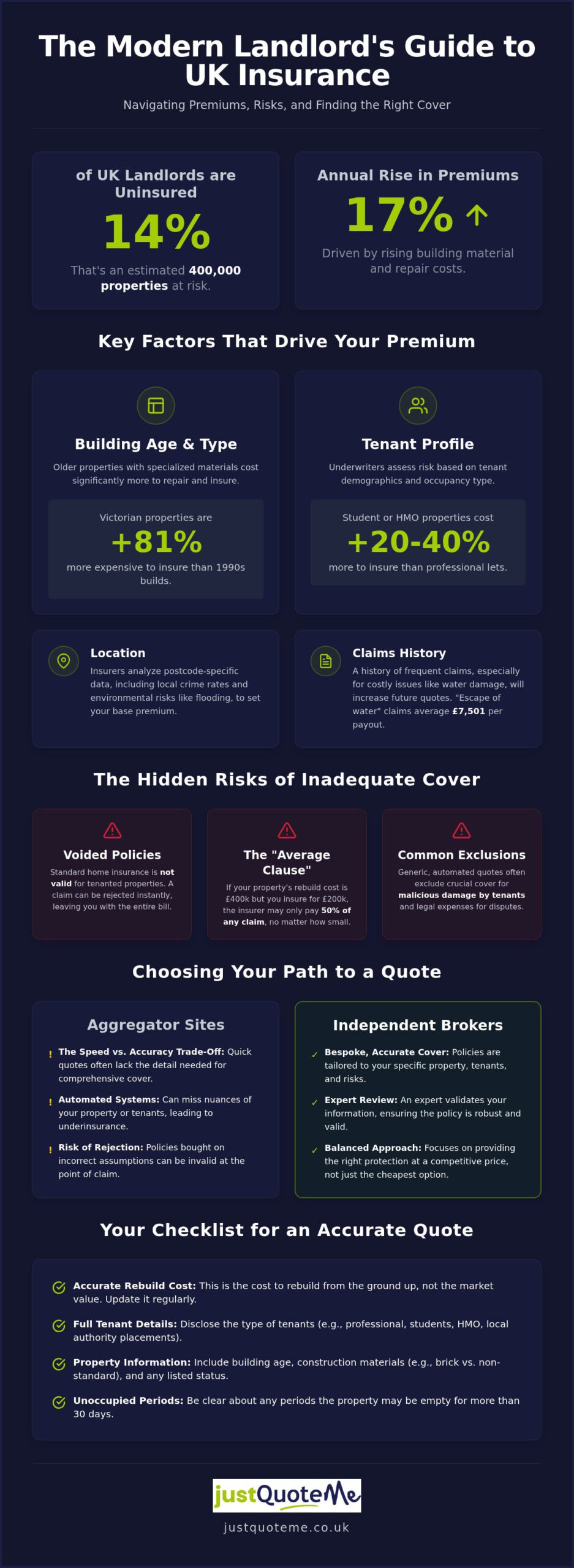
Preparation is the most effective way to ensure your landlord insurance quote uk is both accurate and valid. When you provide precise data, you eliminate the “assumed facts” that often lead to rejected claims. Many landlords make the mistake of using the market value of their property when seeking cover. However, insurers require the rebuild cost, which is the actual expense of labor and materials needed to reconstruct the building from scratch. This figure is often significantly different from what the property would sell for on the open market.
Property and Rebuild Details
To find an accurate rebuild figure, we recommend using the BCIS Rebuild Cost Calculator. This professional tool accounts for the current inflationary pressures in the UK construction industry. You must also identify any non-standard construction materials. If your property features timber frames, a thatched roof, or a flat roof covering more than 25% of the total area, these details must be disclosed. Similarly, if you’ve recently added structural renovations or extensions, have the square footage and cost of these improvements ready. These factors directly influence the “sum insured” and prevent the risk of the average clause reducing your payout.
Compliance and Liability Information
Your status as a responsible landlord is reflected in your safety documentation. Before requesting a quote, ensure your gas safety records and electrical installation condition reports (EICR) are up to date. If you’re managing a House in Multiple Occupation (HMO), you’ll need your specific license details to hand. Most policies include public liability insurance as standard, but you should verify if the limit meets the 2026 recommendation of £5 million. This protects you against the rising costs of legal claims if a tenant or visitor is injured on your property.
Finally, gather your administrative history. You’ll need your previous insurance schedule and a detailed record of any claims made over the last 3 to 5 years. If you employ anyone to assist with property maintenance, such as a regular cleaner or gardener, you must include employers liability insurance to remain legally compliant. Having this data organized allows us to skip the guesswork and move straight to securing your protection. To get started with a professional review of your requirements, get a bespoke quote from our expert team today.
How to Get Your Bespoke Landlord Insurance Quote Today
Securing a landlord insurance quote uk shouldn’t be a stressful administrative burden. We’ve refined our process to balance digital efficiency with the professional oversight that automated systems lack. By combining a streamlined data capture portal with a human-led review, we ensure your cover is both competitively priced and technically sound. This approach removes the guesswork and provides you with a policy that’s ready to perform if you ever need to make a claim.
Step 1: Just Quote Me Online
The process begins with our streamlined online portal. This tool is designed to capture the essential details about your property, tenant types, and required cover levels without the repetitive data entry found on multiple comparison sites. Once you submit your information, our system queries a broad network of top-tier UK insurers. Unlike generic aggregators, our portal is built to handle the nuances of the 2026 market. It flags specific risks that require a more tailored approach, ensuring that your initial data submission serves as a solid foundation for a bespoke policy.
Step 2: Expert Consultation and Finalisation
What happens after you submit your details is what truly sets us apart. A member of our Staffordshire-based team personally reviews your information. We don’t just rely on an algorithm to generate a final price. If your property has non-standard features or a complex tenant profile, we’ll often reach out to clarify specific details. This human intervention ensures that the final quote is transparent and comprehensive. We use this stage to help you customise your protection, whether that’s adding rent guarantee cover to mitigate the risks of the Renters’ Rights Act or including emergency home cover for rapid repairs.
Once the details are finalised, you receive a quote that’s been validated by an expert. Our role doesn’t end when the policy starts. We provide ongoing support, managing your mid-term adjustments and renewals so you don’t have to navigate the market alone every year. This professional, FCA-authorised advice provides the peace of mind that your investment is fully protected. Just Quote Me for your next renewal to secure a policy that actually stands up to professional scrutiny. We handle the complex administrative heavy lifting, allowing you to focus on the day-to-day management of your rental portfolio with total confidence.
Secure Your Property Investment with Expert Oversight
As an FCA-authorised independent broker, we access a broad network of top UK insurers to find bespoke cover that fits your specific risks. We manage the administrative burden so you can focus on your property management. Whether you’re insuring a single professional let or a mixed-use commercial unit, professional validation ensures your policy is more than just a piece of paper. You deserve the peace of mind that comes from working with a trusted advisor who understands your sector. Just Quote Me for your next renewal to ensure your investment remains protected against the unexpected.
Get Your Free Business Insurance Quote now
Request a Call back for free Expert advice
How much does landlord insurance cost in the UK for 2026?
Costs vary significantly based on property type and risk profile. The average cost for a standard policy in 2026 is approximately £285, but this increases for older Victorian properties or Houses in Multiple Occupation (HMOs). Basic buildings-only cover might start around £200, while comprehensive policies with rent guarantee often exceed £600. Factors like location and rebuild value are the primary drivers of the final price.
Can I get a landlord insurance quote for a property with multiple tenants?
Yes, you can secure a quote for properties with multiple tenants, commonly known as HMOs. These properties typically carry a 20% to 40% higher premium due to increased wear and tear and higher turnover rates. You must disclose the exact tenant demographic, such as students or professionals, to ensure your policy remains valid and provides the adequate liability protection required for communal living environments.
What is the difference between buildings and contents insurance for landlords?
Buildings insurance covers the physical structure and permanent fixtures, such as walls, roofs, and fitted kitchens, against risks like fire or flood. Contents insurance protects the items you provide for tenant use, including furniture, appliances, and carpets. While buildings cover is usually required by mortgage lenders, contents insurance is vital if you are letting a furnished property to avoid significant out-of-pocket replacement costs after a loss. If you are currently evaluating your property financing, you can discover Lee Tonks: Mortgage Guru for independent advice across the whole UK market.
Do I need employers liability insurance if I only have one rental property?
You are legally required to have employers liability insurance if you employ anyone to help manage or maintain your property. This applies even if you only have one rental unit and hire a regular cleaner, gardener, or maintenance person. Failure to have this cover can result in significant daily fines from the Health and Safety Executive, as it protects you against claims if an employee is injured.
Is landlord insurance a legal requirement in the UK?
How quickly can I get a landlord insurance quote from a broker?
You can receive an initial indication very quickly through our online portal, but a fully validated bespoke quote typically takes a few hours. This allows our Staffordshire-based team to review your specific risks and negotiate with our panel of underwriters. This human-led process ensures your cover is accurate, whereas automated systems might provide an instant price that misses critical protections your specific property requires.
What happens if my property becomes unoccupied for a long period?
Most standard policies limit unoccupancy to 30 or 60 days. If your property remains empty beyond this period, you must notify your broker to adjust your cover. Unoccupied buildings face higher risks of undetected leaks, squatting, or vandalism. We can arrange specialist unoccupied property terms that maintain protection while you are between tenancies or undergoing structural renovations, ensuring your investment remains secure during the transition.
Can I combine multiple properties into one landlord insurance quote?
Yes, combining multiple properties into a single portfolio policy is an efficient way to manage your insurance. This approach simplifies your administration by aligning renewal dates and often results in a discount from underwriters. Whether you own two properties or a large commercial portfolio, we can consolidate your requirements into one comprehensive landlord insurance quote uk that covers all your assets under a single, manageable schedule.
Article by
Just Quote Me
JustQuoteMe Ltd is an independent UK insurance brokerage specialising in business and personal insurance solutions. With over 35 years of industry experience, the company provides tailored insurance cover for businesses, landlords, tradespeople, hospitality venues, fleets, and individuals across the UK. Known for its personal service, expert advice, and competitive premiums, JustQuoteMe Ltd works with leading insurers to deliver bespoke policies designed around each client’s unique needs. The company is authorised and regulated by the Financial Conduct Authority (FCA No. 586607) and has built a reputation for trusted, straightforward insurance guidance and long-term client relationships.