
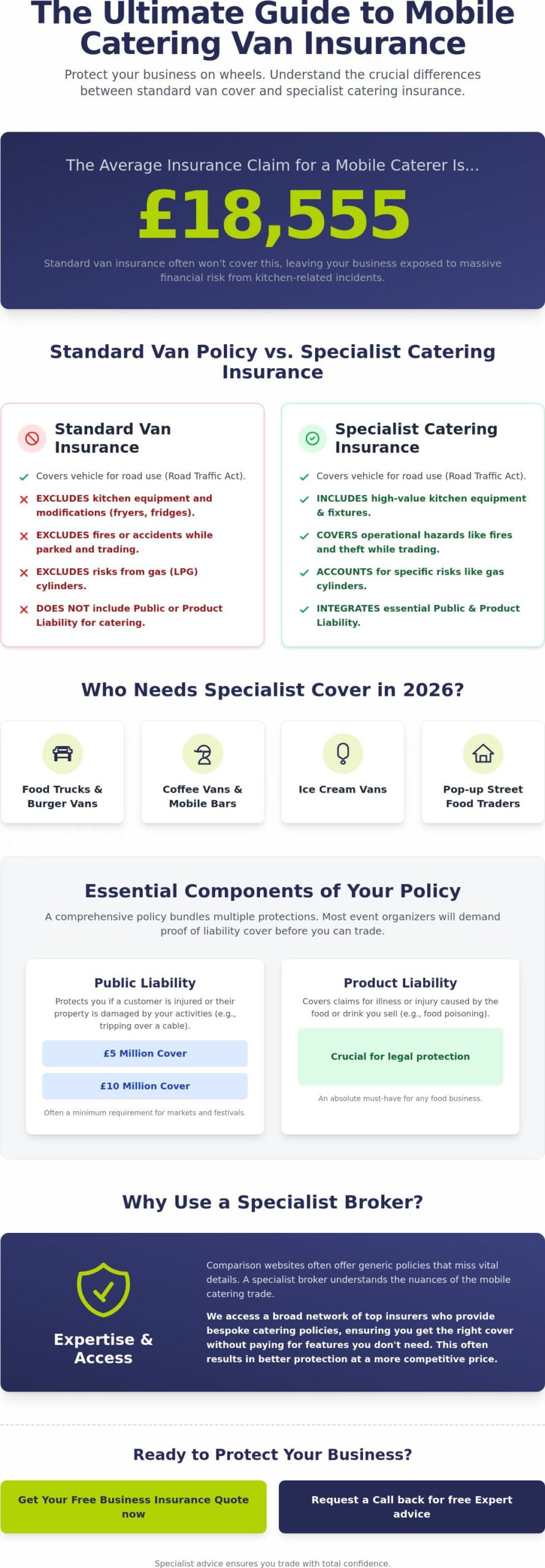
Did you know that the average insurance claim for a mobile caterer reached £18,555 between April 2025 and March 2026? For many business owners, trying to secure a mobile catering van insurance quote feels like a minefield of confusing jargon and hidden exclusions. It’s frustrating when you can’t tell if a standard motor policy covers your expensive kitchen equipment or if you’re leaving yourself vulnerable to a rejected claim. You want to focus on your food and your customers, not worry about whether your fine print covers a gas explosion or a stolen generator.
We understand that you need clear, straightforward answers rather than automated systems that don’t grasp the nuances of your trade. This expert guide simplifies the entire process, showing you how to secure the right protection for your food truck while avoiding the high premiums often charged to new ventures. We’ll break down the essential legal requirements for 2026, explain the vital difference between vehicle and kitchen cover, and show you how bespoke broker advice provides the peace of mind you deserve. By the end of this article, you’ll know exactly how to protect your investment and trade with total confidence.
Key Takeaways
- Understand why standard commercial vehicle policies leave your kitchen equipment and business liability exposed to significant financial risk.
- Identify the specific roles of Public and Product Liability insurance in protecting your venture from accidents and food-related legal claims.
- Discover the essential steps to secure a competitive mobile catering van insurance quote by focusing on accurate asset valuations and fire safety equipment.
- Learn the practical differences between insuring a motorized catering van and a towed trailer to ensure your specific setup is fully compliant.
- Find out how a specialist broker can access a broad network of top insurers that are often unavailable on standard comparison websites.
What is Mobile Catering Van Insurance and Why is it Essential?
Mobile catering van insurance is a specialized hybrid policy designed to address the unique risks of running a food business on wheels. Unlike standard commercial vehicle cover, this insurance bridges the gap between the Road Traffic Act requirements for driving and the complex liability needs of a professional kitchen. When you request a mobile catering van insurance quote, you aren’t just looking for vehicle protection; you’re securing a policy that understands the dual nature of your business. To understand the scale of this industry, it helps to look at the history and operational scope of What is a Mobile Catering Van, which functions as both a transport asset and a high-risk production environment.
Standard van insurance is fundamentally insufficient for caterers because it typically excludes the “kitchen risk.” A regular policy might cover a collision on the road, but it won’t pay out if a deep-fat fryer causes a fire while you’re parked at a festival. It also won’t cover the specialized modifications, such as stainless steel counters, refrigeration units, and extraction systems, which can cost tens of thousands of pounds. A dedicated catering policy protects the physical asset of the van while simultaneously covering the operational hazards of serving food to the public.
The Difference Between Van Insurance and Catering Insurance
The primary distinction lies in the scope of liability. Every vehicle on UK roads must have insurance that complies with the Road Traffic Act, but this only covers third-party injury or property damage during transit. It doesn’t address the risks associated with Liquid Petroleum Gas (LPG) cylinders, which are essential for most mobile kitchens but viewed as high-risk by standard insurers.
A specialist policy integrates Public Liability Insurance to protect you if a customer is injured by your equipment or trips over a cable. It also accounts for the high-value cooking equipment that “social and domestic” or “standard carriage of goods” policies often ignore. Without this specific wording, you risk a total loss if your vehicle is stolen or damaged, as insurers may void claims on the grounds of “undisclosed modifications.”
Who Needs This Cover in 2026?
The mobile food sector has diversified significantly, and insurance requirements have evolved to match. You need this specific protection if you operate any of the following:
- Food Trucks and Burger Vans: High-volume units using gas or electric cooking equipment.
- Coffee Vans and Mobile Bars: Specialist conversions with expensive espresso machines or pressurized keg systems.
- Ice Cream Vans: Vehicles with specialized refrigeration and “soft serve” machinery.
- Pop-up Street Food Traders: Even if you use a gazebo, your transport and equipment still require professional cover.
Trading at festivals, markets, or on public highways in 2026 requires more than just a 28-day council registration. Most event organizers and local authorities will demand proof of at least £5 million or £10 million in public liability cover before allowing you to trade. Securing a comprehensive mobile catering van insurance quote ensures you meet these legal and contractual obligations from day one.
Request a Call back for free Expert advice
Essential Cover Types for Your Catering Van Policy
When you look for a mobile catering van insurance quote, it’s vital to understand that a single policy usually bundles several distinct protections. These Essential Cover Types are dictated by both UK law and the specific operational risks of the food industry. You aren’t just insuring a vehicle; you’re protecting a workplace, a retail point, and a food production facility all at once. Failing to include the right components can leave you personally liable for claims that often reach into the tens of thousands of pounds.
Liability Protection: Public and Product
Liability is the most significant risk for any caterer. Public liability insurance is the foundation of your policy. It steps in if a member of the public is injured or their property is damaged because of your business activities. Common examples include a customer tripping over a generator cable or a hot oil spill causing a serious burn.
Product liability is equally critical in the modern food industry. This cover handles claims specifically related to the food and drink you serve, such as food poisoning or undisclosed allergen reactions. When selecting your limits, remember that most local councils and event organizers require a minimum of £5 million in cover, though £10 million is increasingly requested for major festivals and high-footfall city center pitches.
Protecting Your Assets: Van and Equipment
Your van is a mobile kitchen, and your insurance must reflect its true value. Standard motor policies rarely cover bespoke branding or high-end appliances like industrial espresso machines and commercial fryers. For total protection, look at van and tools insurance options that specifically include fixtures and fittings.
Comparing different options for a mobile catering van insurance quote involves more than just looking at the vehicle’s road value. You must account for the conversion costs and the stock you carry. Comprehensive cover is usually the best choice, as it protects your vehicle and expensive kitchen equipment against theft, fire, and accidental damage, ensuring you don’t face a total loss if the worst happens.
Legal and Financial Safeguards
If you employ anyone, employers’ liability insurance is a legal requirement. This applies even if you only hire part-time staff or seasonal help for summer festivals. Non-compliance can result in daily fines of up to £2,500. Beyond the legal basics, consider business interruption cover. If an accident takes your van off the road, this cover helps replace your lost income while repairs are underway, keeping your business afloat during the downtime. You can speak with a specialist advisor to tailor these limits to your specific trading locations and staff numbers.
Request a Call back for free Expert advice
Comparing Catering Van vs. Trailer vs. Pop-up Stall Insurance
Choosing the right physical setup for your business doesn’t just impact your menu; it fundamentally changes your risk profile. A motorized van is effectively a mobile commercial kitchen and a heavy goods vehicle rolled into one. Consequently, when you request a mobile catering van insurance quote, you’ll find the premiums reflect the engine and road risks that aren’t present with stationary setups. While motorized units offer the greatest mobility for moving between city centers and private events, they carry the highest liability burden because the vehicle itself is a potential source of accident or breakdown.
In contrast, catering trailers and pop-up stalls present different challenges. A trailer requires “towed-item” cover and relies on a separate vehicle for transport, which must be correctly insured for business use. Pop-up stalls focus almost entirely on liability and stock protection because there’s no engine or drivetrain involved. Each setup requires a specific policy structure to ensure you aren’t paying for cover you don’t need or, worse, leaving gaps in your protection that could lead to a rejected claim during a busy festival season.
Premium Factors for Motorized Units
For motorized food trucks, underwriters look closely at the vehicle’s mechanics. Engine size, vehicle age, and your estimated annual mileage are primary drivers of cost. However, the conversion itself is where many owners get caught out. Every modification, from the extraction fans to the reinforced flooring, must be declared. If you’ve spent £20,000 converting a standard transit van into a professional unit, that value needs to be reflected in the policy. Security measures like Thatcham-approved trackers and immobilisers can help lower costs, especially if you store the vehicle in a secure yard overnight.
Insurance Nuances for Towed Trailers
Towed trailers inhabit a unique insurance space. Your towing vehicle insurance might cover the trailer while it’s hitched and in transit, but it usually won’t provide liability cover once it’s unhitched and trading. This is a critical gap. You need a policy that covers the trailer as a standalone unit. For heavy-duty trailers with built-in industrial ovens or specialized generators, plant and machinery insurance can provide the extra layer of protection required for high-value equipment that standard policies might cap.
Some business owners use their vans for multiple purposes. If your vehicle doubles as a transport for construction materials during the week, you might require bespoke builders insurance alongside your catering cover. Always ensure your broker understands the full scope of your vehicle’s use to prevent complications. Getting a competitive mobile catering van insurance quote means being transparent about how and where you use your equipment to ensure the policy is fit for purpose.
Request a Call back for free Expert advice
How to Get a Competitive Mobile Catering Van Insurance Quote
Securing a competitive mobile catering van insurance quote requires more than just entering a few details into an online form. While some providers prioritize speed, focusing on accuracy ensures your policy is actually valid when you need it most. Underwriters look for indicators of a well managed business. For example, your Food Hygiene Rating isn’t just a badge for your customers; it’s a risk assessment tool. A rating of 4 or 5 suggests a lower probability of product liability claims, which can positively influence the trust an insurer places in your operation.
Safety equipment also plays a decisive role in your premium. Beyond standard extinguishers, installing a professional fire suppression system specifically designed for commercial kitchens can significantly reduce your risk profile. When you provide these details, you demonstrate a commitment to prevention that automated systems often overlook. You should also be prepared to discuss your driving history and named drivers. Restricting the policy to experienced drivers with clean records is one of the most effective ways to lower the cost of the motor element of your cover.
Information You Need to Have Ready
To make the process efficient, gather your documentation before starting. You’ll need your vehicle registration and V5C details to confirm the van’s age and specifications. Insurers also require an estimated annual turnover and precise staff numbers to calculate your employers’ liability insurance needs. Perhaps most importantly, ensure your gas and electrical safety certificates are current. A valid CP44 commercial gas safety certificate is often a non-negotiable condition of cover for any van using LPG appliances.
Tips for Lowering Your Premiums
There are several pragmatic ways to reduce your annual insurance costs without compromising on protection. Increasing your voluntary excess is a direct way to lower your premium, provided you can afford the out-of-pocket cost in the event of a claim. You can also look at consolidating your various protections into a single “Commercial Combined” policy. This approach is often more cost effective than buying separate motor, liability, and stock policies. Finally, investing in high-quality security such as steering locks or Thatcham-approved trackers provides the physical reassurance insurers need to offer better rates. If you want to ensure every detail of your setup is accounted for, you can start your application today with a specialist who understands the catering trade.
Request a Call back for free Expert advice
Why Choose Just Quote Me as Your Insurance Broker?
Selecting where to get your mobile catering van insurance quote is a decision that impacts your business long after the first premium is paid. While automated comparison sites prioritize speed, they often lack the depth required for complex food businesses. We bring over 30 years of industry experience to the table, acting as a steady hand in a market that can feel overwhelming. As an independent brokerage, we work for you, not the insurance company. This means our priority is finding the most robust protection at a competitive price, rather than simply pushing a standard product.
Accessing a mobile catering van insurance quote through a broker also gives you access to markets that aren’t available to the general public. We have built relationships with a broad network of top insurers that aggregators often miss. This includes specialist underwriters who only work through professional brokers to provide tailored solutions for specialist catering ventures. Our role is to manage the administrative burden so you can focus on managing your food and serving your customers.
The Broker Advantage vs. Online Aggregators
The main drawback of online aggregators is their “one-size-fits-all” approach. These systems are designed for standard risks, but a mobile kitchen is anything but standard. Policies bought through bots often fail at the claims stage because a critical detail, such as an LPG setup or a specific modification, wasn’t correctly disclosed or understood by the algorithm. We provide bespoke risk assessments for unique food concepts, ensuring every piece of high-value equipment is accounted for. If you need to make a mid-term adjustment, like adding a new staff member or changing your trading radius, you get human support from an expert who understands your sector.
Reliability and Trust in Staffordshire and Beyond
We take pride in being an FCA-authorised firm that offers personal service from our Stone-based office. While we serve clients across the UK, our roots in Staffordshire define our approach to customer care. You aren’t just a policy number; you’re a business owner with specific goals and challenges. Whether you operate a single coffee van or a fleet of street food trucks, we provide the pragmatic, honest communication you need to feel secure. We handle the fine print and the complex negotiations with insurers, providing peace of mind that your livelihood is protected by experts.
Request a Call back for free Expert advice
Secure Your Culinary Future on the Road
Building a successful mobile food business in 2026 requires more than a signature dish; it requires a robust foundation of professional protection. We’ve explored how essential it is to differentiate between your vehicle’s road risk and the specific liabilities of a working kitchen. By ensuring your gas safety certificates are current and your equipment valuations are accurate, you’re not just complying with the law; you’re safeguarding your entire investment against the unexpected.
Securing a competitive mobile catering van insurance quote is a straightforward process when you have the right partner. As an FCA Authorised Broker with 30+ years of industry experience, we offer bespoke policies from top UK insurers that provide far more security than a generic, automated policy. We manage the complex administrative details so you can focus on what you do best: serving great food to your customers. Partner with an insurance specialist today to ensure your business remains resilient and ready for every trading opportunity that comes your way.
Request a Call back for free Expert advice
Frequently Asked Questions
Do I need catering insurance if I only trade at weekends?
Yes, trading frequency doesn’t change the legal and financial risks you face. Even if you only operate at weekend markets, you still face potential claims for food poisoning or accidents. Most local authorities and private event organizers require proof of public liability insurance before you can trade on their land. A specialized policy ensures you aren’t personally liable for thousands of pounds in damages if an incident occurs during your limited trading hours.
What is the minimum public liability cover for a food truck?
While £1 million of cover is often the minimum available, it’s rarely enough for professional traders. Most UK councils and festival organizers now require a minimum of £5 million or £10 million in public liability cover. This higher limit protects you against more serious claims that involve multiple people or significant property damage. Always check your pitch agreement before finalizing your policy to ensure your limits meet their specific contractual requirements.
Does my policy cover my van if it breaks down on the way to an event?
Roadside assistance is typically an optional extra rather than a standard feature of a catering policy. If your van breaks down, you need specialist recovery because standard car recovery services often cannot handle the weight and dimensions of a converted catering unit. Adding breakdown cover to your policy ensures that you can get your kitchen back on the road quickly, minimizing the lost revenue from missing a lucrative pre-booked event.
Can I get insurance for a van I converted myself?
You can insure a self converted van, but the process requires thorough documentation to establish the vehicle’s value and safety. You must declare all modifications and provide valid gas and electrical safety certificates issued by qualified engineers. When you request a mobile catering van insurance quote for a DIY conversion, being transparent about the materials used and the installation process helps the insurer provide accurate cover that won’t be voided during a claim.
Is my stock covered if my fridge fails overnight?
Stock is only covered if you have specifically included “deterioration of stock” in your policy. This add-on protects you if your refrigerated or frozen goods are ruined due to a mechanical fault in the fridge or an unforeseen power failure. It’s a vital safeguard for businesses carrying high value ingredients. Without this specific wording, a simple fuse blow or equipment failure could result in hundreds of pounds of wasted stock and lost profits.
Does catering van insurance cover gas explosions?
Gas explosions are covered under the fire and liability sections of a specialist policy, provided you comply with all safety regulations. You must hold a valid CP44 commercial gas safety certificate for your LPG appliances and ensure they are serviced annually. If you fail to maintain your equipment or lack the necessary certification, your insurer is likely to reject any claim arising from a gas related incident, leaving you with the full repair costs.
How much does mobile catering insurance cost on average in 2026?
The cost of your policy depends on several variables, including the value of your equipment, your annual turnover, and where you store the vehicle overnight. Premiums are also influenced by your claims history and the specific types of food you serve. Since every setup is unique, the best approach is to request a mobile catering van insurance quote. This allows an expert to assess your specific risks and provide a competitive price for your business.
Do I need insurance for my staff if they are family members?
You generally need Employers’ Liability insurance if you have any staff, including family members. While there are some narrow exemptions for family run businesses that aren’t limited companies, these are complex and often leave gaps in protection. Carrying this cover ensures that your family members are financially protected if they suffer an injury or illness while working in the van. It also ensures you remain compliant with UK law, avoiding heavy daily fines.
Request a Call back for free Expert advice
