by jqm | Jul 24, 2026 | Insurance
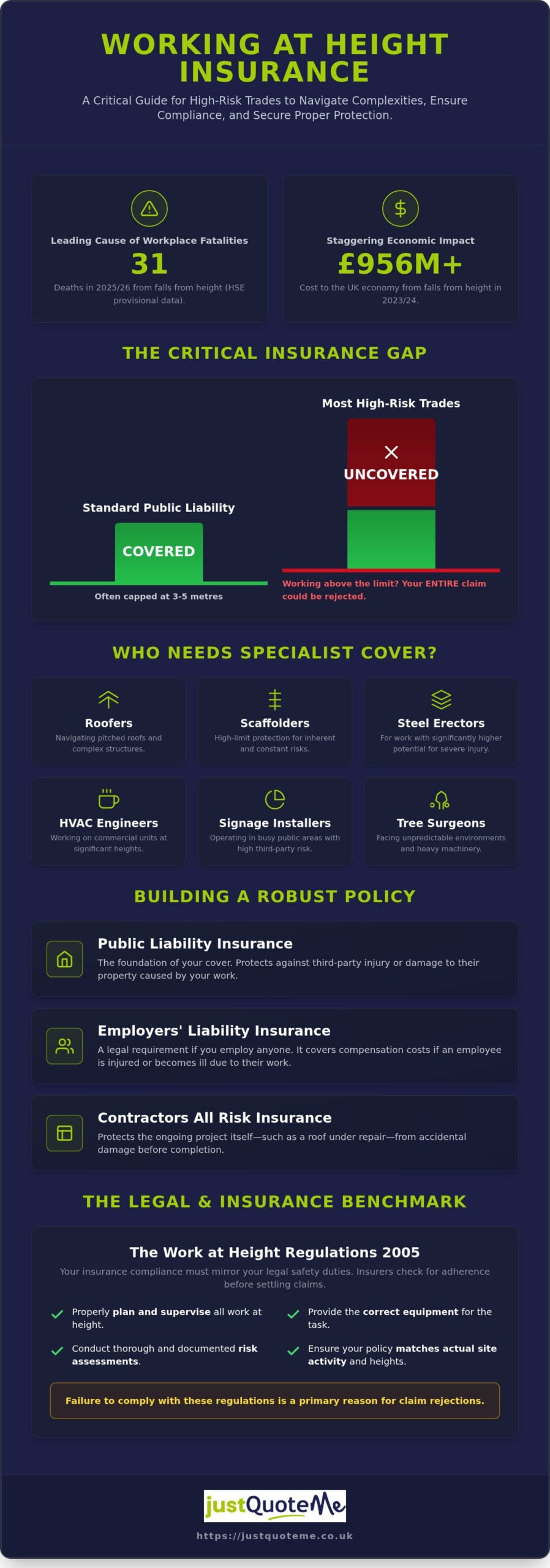
Fatalities from falls from height accounted for 25% of all workplace deaths in 2025/26, with 31 workers losing their lives. This statistic isn’t just a safety warning; it’s a major red flag for your business’s financial security. If your company doesn’t strictly adhere to the Work at Height Regulations 2005, your insurance for working at height regulations could be voided right when you need it most. Most tradespeople understand the physical risks of high-level work, but the fear of a rejected claim due to perceived negligence is a constant source of stress.
You shouldn’t have to guess whether your policy covers a specific ladder height or a complex scaffolding project. In this guide, you’ll learn how these regulations directly impact your insurance validity and how to keep your business protected. We’ll simplify the compliance process, explain the hierarchy of control, and ensure you have the right cover to meet HSE standards so you can focus on the job at hand with confidence. Our goal is to provide the clarity you need to manage high-risk tasks without the administrative burden or the worry of an invalid policy.
Key Takeaways
- Understand why the 2005 Regulations apply to any task where a fall could cause injury, regardless of the specific height or trade.
- Learn how to structure your Public Liability and Employers’ Liability policies to remain valid during high-risk site activities.
- Discover how following the HSE Hierarchy of Control can reduce your workplace risks and potentially lower your insurance premiums.
- Identify the common “Reasonable Precautions” clauses that can invalidate your insurance for working at height regulations if ignored.
- Find out how specialist brokers provide bespoke policy wording that accounts for your specific height limits and professional requirements.
Understanding UK Work at Height Regulations 2005
The Work at Height Regulations 2005 remain the cornerstone of Occupational safety and health for UK trades. Many business owners mistakenly believe these rules only apply to extreme heights or specific industries like construction. In reality, the law defines “working at height” as any activity where a person could fall a distance liable to cause personal injury. This includes working on a flat roof, using a ladder, or even standing near an opening in a floor. Whether you’re a roofer or a shopkeeper stacking high shelves, the same statutory duties apply to ensure every task is properly planned and supervised.
For insurers, these regulations serve as a critical benchmark for “reasonable care.” When you apply for insurance for working at height regulations, underwriters assume you’re operating within these legal boundaries. If an accident occurs and an investigation reveals a breach of these regulations, your insurer may argue that you failed to take reasonable precautions. This turns a standard claim into a legal and financial nightmare. Compliance isn’t just about avoiding HSE fines; it’s about protecting the very validity of your insurance policy.
Who is Covered by the Regulations?
The regulations cast a wide net. They apply to every employer, the self-employed, and any person who controls the work of others, such as a facilities manager or a building owner. These individuals are known as “duty holders.” Even if you hire casual workers or sub-contractors, you still hold a level of responsibility for the safety of the site. Minor tasks are often the most dangerous because they’re frequently overlooked. A quick five-minute job on a step-ladder is subject to the same planning requirements as a week-long scaffolding project. Neglecting these small tasks is a common way businesses find themselves in breach of the law.
The Intersection of Law and Liability Insurance
A breach of statutory duty can have a devastating impact on your Employers Liability Insurance or Public Liability policy. Insurers distinguish between “accidental” risks, which are covered, and “avoidable” risks caused by negligence. If you skip a risk assessment or use faulty equipment, the insurer might view the resulting fall as an avoidable event. For detailed support on navigating these complexities, you can access Specialist working at height insurance guidance to ensure your policy aligns with current HSE expectations. Don’t leave your coverage to chance by ignoring the finer points of the 2005 Regulations. Clear documentation and strict adherence to safety standards are your best defense against a rejected claim.
Essential Insurance Covers for High-Risk Height Work
High-level work carries risks that standard business policies often fail to address. When seeking insurance for working at height regulations, you must look beyond basic premiums to find cover that actually responds in an emergency. Public Liability Insurance is your first line of defense against third-party claims. If a tool falls from a scaffold and injures a passerby, or if a tile damages a neighboring roof, this cover handles the legal fees and compensation costs. Without it, a single mistake could bankrupt your business.
A common trap for tradespeople is the “height limit” clause. Standard policies might cap coverage at 10 or 15 meters. If you accept a contract for a four-story building or a tall chimney that exceeds this limit, your insurance is void for that entire project. You won’t just be underinsured; you’ll have no cover at all for that specific task. Always check your policy schedule for these restrictions before you step onto the site.
Public Liability vs. Employers’ Liability at Height
Falls from height are the primary cause of workplace deaths in the UK, accounting for 31 fatalities in 2025/26 alone. This makes Employers’ Liability Insurance a critical legal requirement for any business with staff or contractors. You must hold at least £5 million in cover to protect your business from staff injury claims. Failing to have this insurance can lead to fines of up to £2,500 for every single day you’re without cover. Adhering to The Work at Height Regulations 2005 is essential. Insurers view these rules as the minimum standard for safety; if an accident occurs and you’ve ignored these regulations, your policy might not pay out.
Professional Indemnity is equally important for safety consultants and scaffolding designers. If a design error causes a fall, standard liability cover won’t protect you from professional negligence claims. You need height-specific PI cover to ensure your advice or designs are fully backed by your insurer.
Specialist Add-ons and Endorsements
Specific projects require more than just liability cover. Contractors all risks insurance is vital for high-level builds, protecting the actual structure and materials from damage while the work is underway. You should also consider plant and machinery insurance for expensive equipment like cherry pickers, MEWPs, or owned scaffolding. For those in the building trade, understanding builders insurance essentials helps ensure every high-risk activity is accounted for. If you’re concerned about hidden height limits in your current policy, you can speak with a broker to clarify your coverage and ensure your business remains fully protected.
The Hierarchy of Control: Reducing Risk and Premiums
Insurance underwriters don’t just look at the industry you work in; they look at the specific steps you take to prevent a claim from ever happening. The “Hierarchy of Control” is a systematic approach to managing safety that directly influences your insurance for working at height regulations. By demonstrating a commitment to this hierarchy, you signal to insurers that your business is a lower risk, which can lead to more competitive premiums and more favorable terms. This methodology moves from the most effective level of protection to the least, and underwriters expect to see this logic applied to every project.
- Step 1: Avoid. The first priority is to eliminate the need to work at height. If you can use long-reach tools from the ground or assemble components before lifting them into place, you remove the risk entirely. Underwriters view avoidance as the ultimate risk management strategy.
- Step 2: Prevent. If work at height is unavoidable, you must use existing safe places of work or collective protection. This includes permanent guardrails or scaffolding that protects everyone on the site simultaneously.
- Step 3: Minimise. When collective protection isn’t enough, you must use equipment that reduces the distance and consequences of a fall. This often involves personal fall protection like safety nets or harnesses.
Following this structure is essential for compliance with HSE guidance on working at height. When a broker presents your business to an insurer, being able to document how you consistently apply these steps makes a significant difference in how your risk profile is perceived.
Risk Assessments as Insurance Documents
A risk assessment is more than a safety checklist; it’s a legal record of your “reasonable care.” If an accident occurs, your insurer will likely request these documents to verify that you were meeting your statutory duties. For 2026, a robust assessment must include the specific hazards of the site, the equipment selected, and the weather conditions. A competent person is someone who possesses the required combination of training, skills, experience, and knowledge to perform the specific task safely. Without a signature from such an individual, your risk assessment may carry little weight during a claim investigation.
Equipment Maintenance and Records
The Lifting Operations and Lifting Equipment Regulations (LOLER) require that all lifting equipment is fit for purpose and subject to regular thorough examinations. Keeping detailed inspection logs for ladders, scaffolding, and harnesses is vital for maintaining your coverage. If a piece of equipment fails and you cannot provide a recent inspection record, your insurer may argue negligence. Having comprehensive plant and machinery insurance complements your safety regime by covering the financial loss of damaged assets, but it doesn’t replace the need for strict maintenance logs. Consistent record-keeping is the bridge between a safe site and a valid insurance policy.
Why Falls at Height Insurance Claims Get Rejected
Insurance for working at height regulations is designed to provide a financial safety net, but that net only holds if you’ve followed the rules of the game. A common misconception is that having a policy automatically guarantees a payout following an accident. In reality, most commercial policies contain a “Reasonable Precautions” clause. This condition requires you to take all sensible steps to prevent injury or damage. If an investigation finds you ignored the hierarchy of control or failed to conduct a proper risk assessment, the insurer may argue you were “grossly negligent” and refuse the claim entirely.
Weather conditions also play a significant role in policy validity. If your team continues to work on scaffolding during high winds or icy conditions against HSE advice, you’re likely breaching your duty of care. Similarly, failing to provide or enforce the use of Personal Protective Equipment (PPE) can leave you exposed. While your Employers’ Liability Insurance is legally required to pay out to an injured employee, the insurer may later seek to recover those costs from you if they can prove you intentionally bypassed safety protocols.
Height Limits: The 10-Metre Trap
Many tradespeople discover too late that their standard policy includes a strict height limit, often set at 10 or 15 metres. This is known as the “10-metre trap” because it often covers a standard two-storey house but fails the moment you step onto a taller commercial building or a chimney. If an accident occurs at 11 metres on a 10-metre limited policy, the insurer has grounds to deny the entire claim. For those working on high-rise structures or as steeplejacks, a bespoke endorsement is essential to ensure your specific working environment is protected. You can find more detail on aligning your trade with the right cover in The Ultimate Guide to Builders Insurance in the UK.
The Danger of ‘Standard’ Aggregator Policies
Automated comparison sites are excellent for car insurance, but they often fail high-risk contractors. These “one size fits all” platforms rarely ask the nuanced questions required to identify industry-specific exclusions. A broker acts as a professional safeguard by identifying these hidden gaps and ensuring your policy wording matches the actual risks of your daily operations. They understand that a roofer in Staffordshire has different needs than a window cleaner in a city centre. To avoid the risk of a rejected claim, it’s always better to consult an expert broker who can tailor your coverage to your specific trade requirements.
Securing the Right Cover with Just Quote Me
Securing reliable insurance for working at height regulations requires more than just a quick search on a comparison site. Automated aggregators often miss the critical endorsements needed for high-risk trades, leaving you vulnerable to rejected claims. Just Quote Me acts as the human alternative, providing access to a broad network of top UK insurers and specialist underwriters who truly understand the risks of your industry. We don’t just sell policies; we build bespoke solutions that align perfectly with the Work at Height Regulations 2005, ensuring your cover remains valid even during the most demanding tasks.
For tradespeople in Stone, Staffordshire, and across the West Midlands, having a local partner offers a level of security that impersonal national firms cannot match. We combine our regional expertise with a pragmatic approach to safety and compliance. Our team manages the complex administrative burdens and policy documentation on your behalf, which allows you to focus on your projects without worrying about the fine print. We pride ourselves on being a steady hand in a complex market, offering straightforward advice that simplifies the insurance process.
Why Choose an Independent Broker?
Just Quote Me brings over 30 years of industry experience to every consultation. We’ve spent decades navigating the complexities of UK health and safety legislation, giving us the insight to spot hidden gaps in standard policies. We offer comprehensive business insurance solutions that go beyond the basics. Instead of relying on generic algorithms, we provide personalised risk assessments to ensure your height limits and liability requirements are accurately reflected in your policy wording. This tailored approach is your best defense against the “10-metre trap” and other common reasons for claim denial.
Get Started with Expert Advice
Our quote process is designed for maximum efficiency and clarity. We start by reviewing your current coverage to identify any potential weaknesses that could compromise your insurance for working at height regulations. This expert review ensures that your policy is not just a piece of paper, but a robust financial safeguard. Whether you are a sole trader or manage a large construction firm, we provide the professional restraint and expert guidance needed to protect your business. Don’t leave your compliance to chance when you can have a specialist broker manage the details for you.
Get Your Free Business Insurance Quote now
Take Control of Your High-Risk Protection
Compliance with the Work at Height Regulations 2005 is more than a legal box to tick; it’s the foundation of your business’s financial safety net. By following the hierarchy of control and maintaining meticulous inspection logs, you ensure that your insurance for working at height regulations remains fully valid when it matters most. Avoiding the common pitfalls of hidden height limits and generic policy exclusions is essential for any professional trade operating above ground level. These small details often make the difference between a successful claim and a devastating financial loss.
As an FCA Authorised and Regulated broker with over 30 years of experience, our Staffordshire-based expert team is here to help you navigate these complexities. We bridge the gap between strict legal requirements and practical, affordable coverage, acting as a human alternative to automated systems. You don’t have to manage these administrative burdens alone. Let us help you secure a policy that actually pays out in an accident, giving you the peace of mind to focus on your daily operations.
Secure your business with expert height-risk insurance today.
Get Your Free Business Insurance Quote now
Request a Call back for free Expert advice
Frequently Asked Questions
What is the maximum height I can work at without specialist insurance?
There is no universal height that triggers a need for specialist cover, but most standard policies include a fixed limit of 10 or 15 metres. If your project exceeds this distance, you must notify your broker to secure a specific endorsement. Working even a centimetre above your policy’s stated limit can completely invalidate your cover, leaving you personally liable for any damages or injuries that occur on-site.
Do the Work at Height Regulations apply to self-employed sole traders?
Yes, the Work at Height Regulations 2005 apply to self-employed sole traders just as they do to larger companies. If you are working at height where a fall could cause injury, you have a legal duty to plan the work properly and use the correct equipment. Maintaining high standards is vital because failing to comply can void your insurance for working at height regulations during a claim investigation.
Is Public Liability insurance enough for a roofing contractor?
Public Liability is essential for third-party damage, but it’s rarely enough for a professional roofing contractor. You also need Employers’ Liability if you use any staff, sub-contractors, or casual labour. Additionally, many roofers opt for Contractors All Risks to protect the building materials and works in progress from damage or theft while the project is active, ensuring every angle of the job is covered.
What happens if an employee falls and I don’t have Employers’ Liability insurance?
You face severe legal and financial consequences, including fines of up to £2,500 for every day you operate without the required cover. Beyond these statutory fines, you would be personally responsible for paying any compensation, legal fees, and medical costs arising from the employee’s injury. These costs often reach hundreds of thousands of pounds, which can easily bankrupt a small business or sole trader.
Does my insurance cover me if I use a ladder instead of scaffolding?
Your insurance covers you as long as you follow the hierarchy of control and HSE guidelines for equipment selection. Ladders should only be used for low-risk tasks of short duration where more stable equipment like scaffolding isn’t practical. If an accident occurs because you used a ladder for a high-risk, long-term task, an insurer might argue you failed to take reasonable precautions and deny the claim.
How can I lower my insurance premiums for high-risk height work?
Demonstrating a robust safety culture is the most effective way to lower your insurance costs over time. Providing proof of staff training, maintaining detailed equipment inspection logs, and consistently using collective protection shows underwriters that you are a lower risk. Using a specialist broker to present your risk profile accurately to insurers can also help secure more competitive rates than automated comparison sites.
Can an insurer refuse to pay if I didn’t complete a formal risk assessment?
Yes, insurers can refuse to pay claims if you cannot provide evidence of a formal risk assessment. Most policies include a clause requiring you to take all reasonable steps to prevent an accident. Without a documented assessment that identifies hazards and outlines control measures, the insurer may conclude that you breached your policy conditions by acting with negligence, making your insurance for working at height regulations ineffective.
Do I need special insurance for using a cherry picker or MEWP?
While your liability insurance covers the risks of operating the machinery, you need Plant and Machinery insurance to protect the equipment itself from damage or theft. You must also ensure the equipment has a valid LOLER inspection certificate. Using a cherry picker or MEWP without regular statutory inspections can lead to claim rejection if a mechanical failure causes a fall or injury on-site.
Article by
Just Quote Me
JustQuoteMe Ltd is an independent UK insurance brokerage specialising in business and personal insurance solutions. With over 35 years of industry experience, the company provides tailored insurance cover for businesses, landlords, tradespeople, hospitality venues, fleets, and individuals across the UK. Known for its personal service, expert advice, and competitive premiums, JustQuoteMe Ltd works with leading insurers to deliver bespoke policies designed around each client’s unique needs. The company is authorised and regulated by the Financial Conduct Authority (FCA No. 586607) and has built a reputation for trusted, straightforward insurance guidance and long-term client relationships.

by jqm | Jul 23, 2026 | Insurance
Did you know that falls from height remained the leading cause of workplace fatalities in 2025/26, accounting for 31 deaths according to provisional HSE data? It’s a sobering statistic that explains why finding the right Working At Height insurance often feels like an uphill struggle. You likely already know the frustration of seeing premiums climb or feeling confused by “height limits” that seem to change from one policy to the next. It’s stressful to work when you’re worried that a single compliance oversight or a misunderstood clause could lead to a rejected claim.
This expert guide helps you navigate the complexities of high-risk liability to secure tailored protection for your business. We’ll show you how to manage your specific risks while ensuring you remain fully compliant with the Work at Height Regulations 2005. We’ll break down exactly what “height” triggers specialist requirements and explain how to find affordable cover that offers total peace of mind, so you can focus on the job at hand without the administrative headache.
Key Takeaways
- Understand why standard Public Liability often falls short and how Working At Height insurance acts as a critical extension for high-risk trades.
- Learn why exceeding your policy’s specified height limit by even one metre can lead to a rejected claim and total loss of cover.
- Identify how to accurately assess your maximum working height and equipment needs to ensure your policy matches your actual site activity.
- Discover the specific insurance requirements for high-level trades like roofing, scaffolding, and commercial maintenance crews.
- Find out how to secure bespoke protection that ensures full compliance with the Work at Height Regulations 2005.
What is Working At Height Insurance and Why is it Essential?
Working At Height insurance isn’t a standalone policy you buy off a shelf. It’s a specialist extension designed to bridge the gap left by standard tradesman cover. Many business owners assume their basic Public Liability insurance covers every task they perform. However, many “off-the-shelf” policies contain restrictive height limits, often capping out at just 3 or 5 metres. If you’re working on a roof or scaffolding above these limits, your insurer might refuse to pay out entirely. This makes specialized Working At Height insurance a necessity rather than an optional extra.
The financial stakes are high. Falls from height cost the UK economy over £956 million in 2023/24 according to the No Falls Foundation. For a small business, a single claim without the right cover isn’t just a setback; it’s a potential bankruptcy. Beyond safety, having the correct documentation is vital for growth. Larger contractors and local authorities won’t let you on site without proof that your insurance specifically covers the heights you’ll be reaching. It’s about more than just a certificate; it’s about securing your company’s future contracts.
The Core Components of a Robust Policy
A reliable Working At Height policy combines several layers of protection. Public Liability remains the foundation, protecting against third-party injury or damage to property. If you employ anyone, Employers’ Liability insurance is a legal requirement. It’s essential because falls are the leading cause of fatal injuries in the workplace. You should also consider Contractors All Risk insurance. This protects the ongoing project itself, such as a roof under repair, from accidental damage before completion.
Legal Requirements: The Work at Height Regulations 2005
Your insurance compliance should mirror your legal safety compliance. Under the broader framework of UK Health and Safety Regulations, you have a statutory duty to ensure all work is properly planned and supervised. Insurers will often check if you’ve followed these rules before settling a claim. If you haven’t performed a risk assessment or provided the right equipment, you’re at risk of claim rejection. The Work at Height Regulations 2005 serve as the primary legal benchmark for safety and compliance for any UK business performing tasks off the ground.
Who Needs Specialist Cover for High-Level Work?
Many tradespeople assume that specialist cover is only for those working on skyscrapers or major infrastructure projects. In reality, the need for Working At Height insurance extends to any professional whose work involves a risk of falling a distance liable to cause personal injury. This includes a wide array of sectors, from traditional construction to niche maintenance roles. If your daily tasks involve ladders, scaffolding, or mobile elevating work platforms (MEWPs), you must verify that your policy actually accounts for these specific activities and the heights involved.
Construction and Maintenance Specialists
For scaffolders and steel erectors, the risks are inherent and constant. These trades require high-limit protection because the potential for severe injury or property damage is significantly higher than in ground-level work. Similarly, HVAC engineers and roofers often find themselves navigating complex structures or pitched roofs where a standard liability policy might contain restrictive clauses. It’s vital to review your builders insurance to ensure it doesn’t include a “height limit” that leaves you vulnerable during a commercial contract. If you’re unsure about your current limits, seeking bespoke insurance solutions can clarify your position and fill any gaps in your cover.
Niche High-Risk Sectors
Beyond the building site, several niche sectors face unique challenges. Tree surgeons and arborists, for instance, deal with unpredictable natural environments and heavy machinery at height, necessitating specialized liability terms. Signage installation and billboard maintenance teams often work in busy public areas, where the risk to third parties is just as significant as the risk to the worker. Even security firms installing CCTV systems or alarms often work at heights that exceed the standard 3-metre or 5-metre limits found in basic policies. These professionals must ensure their insurance reflects the reality of their on-site duties.
Telecommunications and solar panel engineers also fall into this high-risk category. As the UK continues its push toward greener energy solutions, the number of engineers working on residential and commercial rooftops has surged. These roles require a deep understanding of safety protocols, and consulting HSE’s Guide to Working at Height is an excellent way to align your operational safety with legal expectations. Even in the hospitality and events sector, stage builders and lighting technicians often operate at height to create complex structures, proving that Working At Height insurance is a cross-industry essential for modern businesses.
The Critical ‘Height Limit’ Clause: What You Must Know
Standard policies are often built for ground-level trades. They frequently include a “hidden” height limit, usually set at 10 metres. This is the single biggest reason claims fail in high-risk sectors. If you’re working at 11 metres on a policy capped at 10, you aren’t just “partially” covered; you’re often not covered at all. Insurance companies view these limits as absolute. Exceeding them by a single metre can void your entire Working At Height insurance claim, leaving you to face the full financial burden of any accident.
Choosing between limited and unlimited cover depends on your typical contract. Limited cover is more affordable but requires you to be precise about your maximum reach. You must measure from the ground to the highest point of your work, not just where your feet are standing. If your projects vary in scale, unlimited height cover offers the security of knowing you’re protected regardless of the building’s size. To ensure your business is never left exposed during a complex project, Just Quote Me.
Negotiating Limits with a Broker
Automated quote engines are designed for simple, low-risk scenarios. They often fail to capture the nuance of high-level work, leading to policy wording that doesn’t actually fit your business. With over 30 years of experience, an independent broker understands how to structure bespoke policies that reflect your actual site activities. You can adjust your cover as your business grows. If you take on a taller project next month, it’s a simple matter of updating your policy rather than starting from scratch.
The Impact of Risk Assessments on Premiums
Documented safety protocols are your best tool for reducing insurance costs. When you provide detailed method statements that align with international principles like OSHA Fall Protection Standards, you demonstrate a commitment to safety that underwriters value. This isn’t just about ticking boxes; it’s about proving you manage risk effectively. A broker uses your risk assessment to prove your competence to underwriters. This professional validation often leads to better terms and lower premiums for your Public Liability insurance. It’s a pragmatic way to lower overheads while maintaining high safety standards.
How to Choose the Right Policy for Your Trade
Selecting the right Working At Height insurance requires a pragmatic approach that matches your daily site reality. A generic policy often leaves dangerous gaps in cover that only become apparent when you try to make a claim. To avoid this, follow a structured process to evaluate your specific needs. First, identify your maximum working height across all current and upcoming contracts. Don’t just estimate; check your project specifications. A solar panel installer working on commercial warehouses needs significantly different limits than a residential decorator. Second, evaluate your equipment. Whether you use ladders, scaffolding, or cherry pickers, your insurer needs to know the exact methods you use to access your workspace.
Third, check for Contractors All Risk insurance requirements. Larger builds often mandate this to protect the project itself, including materials and temporary structures, from damage during construction. Finally, consult an independent broker. Specialist markets for high-risk trades are complex, and a broker can compare options that automated sites simply cannot access. These experts understand the nuances of regional trade requirements, ensuring your policy wording is ironclad and compliant with the latest safety standards.
Tailoring Cover to Your Equipment
Your choice of access equipment dictates your risk profile and your premium. If you operate heavy machinery, you must distinguish between owned and hired-in plant. Standard liability often excludes damage to the machines themselves. You can secure specific plant and machinery insurance to cover these expensive assets against theft or accidental damage. Special considerations also apply to niche methods like rope access or cradles. These activities require bespoke policy wording to ensure your Working At Height insurance remains valid during specialized maneuvers. Don’t assume your equipment is covered by default; always declare it clearly to your broker.
Additional Protections to Consider
Liability is only one part of the puzzle for a modern trade business. If you provide design advice, site surveys, or consultancy as part of your high-level work, you likely need Professional Indemnity insurance. This protects you if a design flaw or professional error leads to a client’s financial loss. For sole traders, personal accident cover is a vital safety net. If an injury at height prevents you from working for weeks or months, this provides essential financial support to cover your bills. Additionally, high-level equipment is costly and often targeted by thieves. Ensure your van and tools insurance is sufficient to replace specialized gear if it’s stolen from your vehicle or a secure site.
To get a policy that actually fits your trade and provides real security, compare specialist insurance quotes with an expert today.
Why Just Quote Me is the Trusted Partner for High-Risk Trades
Choosing an insurance partner is as critical as choosing your safety gear. With over 30 years of industry experience, we understand that high-risk trades require more than just a standard policy document. We’ve built our legacy as an independent UK broker by focusing on bespoke solutions for those who work where others won’t. You won’t deal with anonymous call centres or automated scripts here. Instead, you get direct access to expert advice from our teams in Stone and Stafford. This human-centric approach ensures your Working At Height insurance is handled by someone who actually understands the nuances of your specific trade.
Our independence is your greatest asset. We aren’t tied to a single provider; instead, we have access to a broad network of top UK insurers who specialise in high-risk construction. This panel allows us to find cover for complex scenarios that mainstream insurers often decline. We manage the complex administrative burdens and provide efficient claims support, so you can focus on your projects. If the worst happens, you have a steady hand to guide you through the process, ensuring your business remains resilient. Our team acts as your advocate, dealing with underwriters directly to resolve issues quickly and fairly.
The Advantage of an Independent Broker
We leverage our 30-year history to find competitive pricing without compromising the depth of your cover. While automated engines might offer a lower headline price, they often hide exclusions that leave you vulnerable. We focus on regional expertise, serving the whole UK from our heartland in Staffordshire and the West Midlands. This local knowledge allows us to provide a level of service that larger, impersonal competitors simply can’t match. Whether you need comprehensive tradesman insurance or a specific height extension, we tailor every policy to your unique risk profile. Our Stafford and Stone offices are staffed by professionals who know the local industry inside out.
Get Started with a Specialist Quote
Securing the right protection doesn’t have to be a slow or frustrating process. We’ve streamlined our system to move you quickly from inquiry to action. Our name is more than just a brand; it’s a commitment to efficiency. When you need to secure a new contract or renew your existing cover, Just Quote Me. We provide the expert guidance you need to navigate high-risk liability with confidence. You can start by following our simple process to Get Your Free Business Insurance Quote now. We’ll help you secure the tailored Working At Height insurance your business deserves, backed by three decades of specialist knowledge.
Protect Your Business with Expert High-Risk Cover
Securing the right Working At Height insurance is about more than just legal compliance; it’s about protecting the long-term longevity of your business and your professional reputation. We’ve explored how standard policy height limits can leave you dangerously exposed and why accurate equipment declarations are essential for ensuring a valid claim. By understanding these critical nuances, you move from a state of administrative uncertainty to one of total operational confidence on every site you visit.
As an FCA Authorised Independent Broker with over 30 years of industry experience, Just Quote Me specialises in these complex, bespoke high-risk liability requirements. We provide a pragmatic, human alternative to impersonal automated systems, ensuring your policy wording is as robust as your own on-site safety protocols. You don’t have to manage these complex burdens alone.
You can secure your business with our expertise today and let our specialists build the specific cover your trade demands. We’re here to ensure you can reach the heights your projects require with the peace of mind you deserve.
Frequently Asked Questions
What is the standard height limit for tradesman insurance?
Standard tradesman policies often cap height limits at 3 or 5 metres by default. Some mid-range policies might extend this to 10 metres, but it’s rarely a standard feature for every trade. You must check your policy schedule specifically for a “Height Limit” clause to avoid gaps. If your work exceeds these standard markers, you’ll need a specialist extension to ensure your liability remains valid during the project.
Is Working at Height insurance a legal requirement in the UK?
There’s no specific law requiring a product named “Working at Height insurance,” but Employers’ Liability is a legal necessity for any business with staff or subcontractors. Additionally, the Work at Height Regulations 2005 mandate that you manage risks effectively. Most commercial clients and local authorities will refuse to hire you unless you can prove your Public Liability specifically covers the heights you’re working at.
Does my policy cover me if I use a ladder instead of scaffolding?
Your cover depends on the equipment you declared when setting up the policy. Some insurers have strict “ladder exclusions” for certain heights, preferring the use of more stable access like scaffolding or MEWPs. If your risk assessment justifies a ladder and your policy doesn’t explicitly forbid it, you’re usually covered. Always ensure your equipment choice aligns with the safety protocols your insurer expects for your specific trade.
Can I get one-off insurance for a single high-level project?
Yes, it’s possible to secure short-term cover or a temporary extension to your existing annual policy for a specific project. This is a practical solution if you typically work at ground level but have secured a one-off contract for high-level maintenance or roofing. Contacting a broker is the fastest way to arrange this “top-up” cover without renegotiating your entire yearly premium or switching providers entirely.
What happens if I work above the height limit specified in my policy?
Working even one metre above your policy limit can lead to a total claim rejection. Insurers treat height limits as absolute conditions of the contract. If an accident occurs at 12 metres on a 10-metre limited policy, you’ll likely be responsible for all legal costs and compensation payments yourself. It’s a high-stakes risk that can easily lead to business bankruptcy if a major incident occurs.
Does working at height insurance cover my tools if they fall?
Working At Height insurance primarily focuses on liability for injury to people or damage to third-party property. While it covers you if a dropped tool hits a car or a pedestrian, it won’t pay to replace your own damaged equipment. For that, you need a specific tool insurance extension. This ensures that expensive high-level gear is protected against accidental damage or theft from the site or your vehicle.
How much does working at height insurance cost for a sole trader?
Costs vary based on your specific trade, the maximum heights you reach, and your previous claims history. A sole trader performing minor gutter repairs at 5 metres will pay a different rate than a roofer working at 15 metres. Because high-risk work is assessed on an individual basis, the most efficient way to find an accurate price is to request a tailored quote based on your actual contract needs.
Can a broker help if I’ve been refused cover elsewhere due to high-risk work?
Absolutely. Independent brokers have access to specialist underwriting panels that automated quote engines simply can’t reach. If a mainstream insurer has refused you due to “high-risk” activities like rope access or scaffolding, a specialist broker can often find a bespoke solution. They understand the nuances of the industry and can present your risk assessments to insurers to prove your competence and safety standards.
Article by
Just Quote Me
JustQuoteMe Ltd is an independent UK insurance brokerage specialising in business and personal insurance solutions. With over 35 years of industry experience, the company provides tailored insurance cover for businesses, landlords, tradespeople, hospitality venues, fleets, and individuals across the UK. Known for its personal service, expert advice, and competitive premiums, JustQuoteMe Ltd works with leading insurers to deliver bespoke policies designed around each client’s unique needs. The company is authorised and regulated by the Financial Conduct Authority (FCA No. 586607) and has built a reputation for trusted, straightforward insurance guidance and long-term client relationships.

by jqm | Jul 22, 2026 | Insurance
Would you really trust a faceless chatbot to protect your 2026 holiday when a single medical emergency abroad could cost more than the trip itself? It’s frustrating to sort through endless “budget” policies that hide critical exclusions in the fine print. You want the speed of a digital quote, but you need the certainty that your claim won’t be rejected when you’re thousands of miles from home. Securing reliable Online travel Cover shouldn’t feel like a gamble against an automated algorithm.
We agree that the insurance process should be as straightforward as it is secure. You deserve a solution that provides the efficiency of the modern web alongside the expert oversight of an established broker. You’ll discover how to secure the best protection for your 2026 adventures, balancing competitive costs with the high medical limits now required, such as the €30,000 Schengen visa minimum. We will explain how to decode complex policy terms, why human-led support remains vital, and exactly what to look for to ensure your medical emergencies are fully covered without the stress of administrative hurdles.
Key Takeaways
- Learn how to secure robust Online travel Cover that protects your finances against evolving health regulations and flight disruptions in 2026.
- Understand the critical differences between single-trip and annual multi-trip policies to choose the most cost-effective protection for your itinerary.
- Identify essential features beyond the initial premium, such as excess amounts and specialist cover for high-risk activities like winter sports or cruises.
- Discover why honest medical disclosure and thorough preparation are the foundation of a successful insurance claim.
- See how an independent broker provides access to bespoke travel policies and expert advice that automated comparison sites often miss.
What is Online Travel Cover and Why is it Essential?
Online travel Cover is a digital insurance contract designed to protect you from financial losses during your journey. It acts as a safety net for both domestic and international trips, covering everything from minor delays to life-altering medical emergencies. While insurance was once viewed as an optional extra, for travelers in 2026, it’s a fundamental requirement. The landscape of global travel has shifted, and your protection must evolve to match current risks.
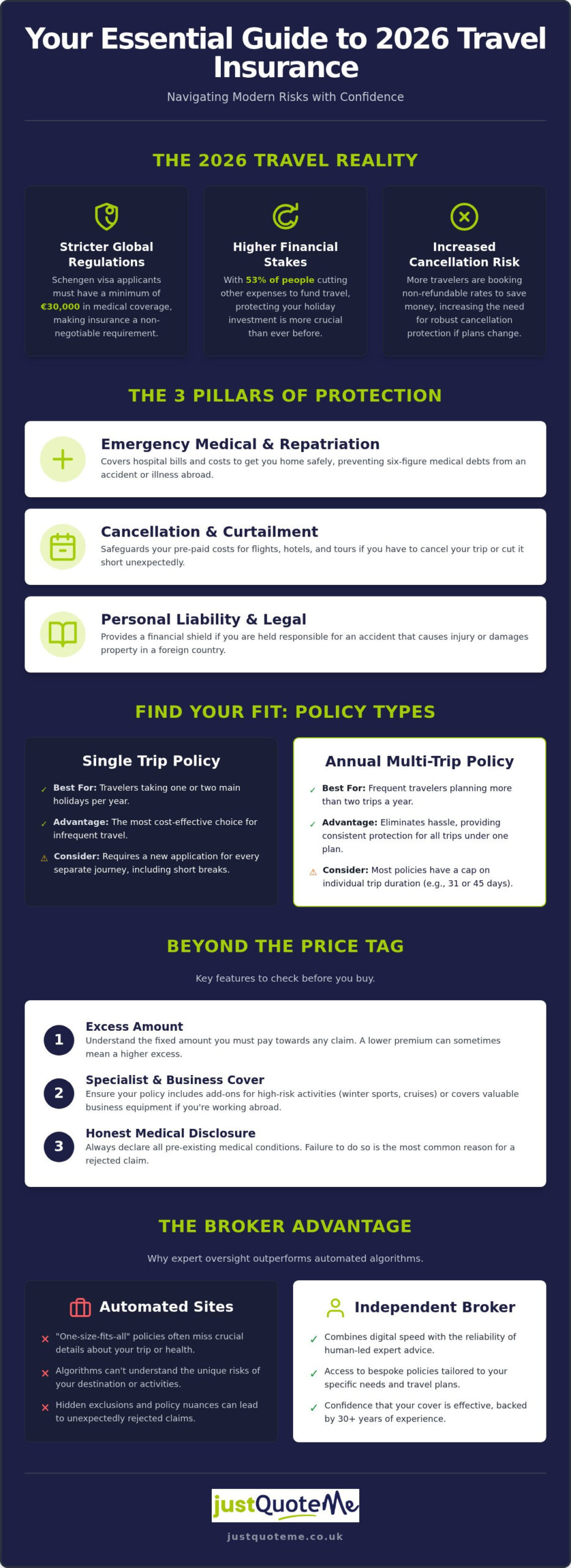
The necessity of modern coverage is driven by stricter global regulations. For instance, travelers applying for a Schengen visa in 2026 are required to hold medical insurance with a minimum coverage of €30,000. Beyond legal mandates, the financial stakes are higher than ever. With 53% of people cutting back on other expenses to fund their 2026 holidays, protecting that investment is vital. We are also seeing a shift where more travelers book non-refundable rates to save money, which increases the need for robust cancellation protection if plans change at the last minute.
The Core Components of Travel Protection
A reliable policy provides more than just a PDF for customs. You can find a Comprehensive overview of travel insurance that details the historical development of these products, but today’s travelers need to focus on three specific pillars. First, emergency medical expenses and repatriation coverage ensure you aren’t left with a six-figure bill if you fall ill abroad. Second, cancellation and curtailment safeguards protect your pre-paid costs if you have to cut a trip short. Finally, personal liability and legal expenses provide a shield if you are held responsible for an accident in a foreign jurisdiction.
Digital Convenience vs. Professional Security
Speed is the primary driver for most people seeking an Online travel Cover quote. You want to secure your protection in minutes so you can focus on your itinerary. However, there is a hidden danger in automated “one-size-fits-all” policies. These systems often overlook the nuances of your specific health history or the unique risks of your destination, leading to rejected claims later on.
This is where the role of an independent broker becomes invaluable. Just Quote Me simplifies the procurement process by combining digital speed with human-led reliability. As an FCA-authorised firm with over 30 years of experience, we ensure that your policy isn’t just fast to buy, but also effective when you need it. We bridge the gap between a faceless chatbot and a trusted advisor, giving UK residents the confidence that their 2026 adventures are backed by professional expertise rather than just a basic algorithm.
Choosing the Right Policy Type for Your 2026 Journey
Selecting the right Online travel Cover requires more than just picking the first option on a screen. You need a policy that aligns with your specific itinerary and travel frequency. For many, the choice begins with deciding between a single-trip policy and an annual multi-trip (AMT) plan. Getting this right at the start prevents you from being underinsured or overpaying for coverage you don’t actually need.
Single Trip vs. Annual Multi-Trip: The ROI Calculation
If you plan to travel more than twice a year, an annual policy usually offers better value. It eliminates the need to arrange new cover for every weekend break or business trip. However, you must be mindful of trip duration limits. Most AMT policies cap individual trips at 31 or 45 days. Frequent UK business travellers find these plans especially useful as they provide consistent protection without the administrative burden of multiple applications. For those only taking one major holiday, a single-trip policy is the more logical, cost-effective choice.
Bespoke Cover for Business and Specialised Travel
Business travel involves unique risks that standard leisure policies often ignore. If you’re carrying expensive laptops or professional equipment, you must verify that your policy covers business assets. Many professionals now combine their travel protection with public liability insurance when working abroad. This ensures you’re protected if you’re held liable for property damage or injury while conducting business. You can also look into group policies, which are an efficient way to cover entire teams or family units under a single schedule. You can find more NAIC information on travel insurance regarding how different policy types are regulated and what they typically include.
Specialist activities require even deeper scrutiny. If your 2026 plans include skiing in the Alps or a Caribbean cruise, you need specific add-ons. Cruises require “cabin confinement” and “missed port” coverage, while winter sports cover handles equipment hire and piste closures. For adventure seekers, ensure your medical evacuation limits are high. Experts recommend between $500,000 and $1 million for remote locations to ensure you aren’t left with a massive bill for an emergency airlift.
Honesty remains non-negotiable when using online screening tools to disclose pre-existing medical conditions. This is the only way to guarantee a claim will be paid. Whether you’re a backpacker on a gap year or an over-55 traveller, your Online travel Cover should be tailored to your age bracket to ensure medical limits are sufficient for your demographic. If you’re unsure which category fits your next trip, you can explore our tailored options to find a perfect match.
Beyond the Price Tag: Essential Features to Look For
Selecting the cheapest Online travel Cover might save you a few pounds upfront, but it often proves to be an expensive mistake during a crisis. Stripped-back policies frequently omit critical protections or carry such high deductibles that the insurance becomes almost useless for smaller claims. When you’re comparing quotes, you must look past the initial premium and scrutinise the actual depth of the policy. High savings claims from budget providers often mask significant gaps in your safety net.
The “Excess” is a primary area where low-cost providers hide the true price of their service. If your policy has a £250 excess per person, a family of four claiming for a cancelled excursion could lose £1,000 before the insurer pays a penny. A quality policy balances a manageable premium with an excess that won’t cripple your holiday budget. You should also verify that your provider offers a 24/7 emergency assistance helpline staffed by real people. In a medical crisis, you need immediate, expert coordination, not an automated response.
Check for Scheduled Airline Failure and End-User Insolvency cover. With the travel industry still experiencing volatility in 2026, these features protect you if your airline or accommodation provider goes bust before or during your trip. Without this, you could be left stranded or out of pocket for services that no longer exist.
Medical and Health Considerations
Medical costs abroad can escalate with terrifying speed. While some basic plans offer lower limits, £5 million is the industry-recommended minimum for international travel. This covers hospital stays, surgeries, and the astronomical cost of repatriation. Repatriation is the hidden expense of getting you home safely, often via a dedicated air ambulance, which can cost tens of thousands of pounds. Don’t rely solely on your Global Health Insurance Card (GHIC). While the GHIC provides access to state healthcare in many European countries, it doesn’t cover private medical care or the cost of flying you back to the UK. Private Online travel Cover is the only way to fill these dangerous gaps.
Possessions and Personal Belongings
Always check the “single item limit” within your baggage cover. Even if your total limit is £2,000, the policy might only pay out £250 for a single item like a high-end camera or smartphone. Most policies also exclude items left unattended in public places or rental cars, even if they were hidden from view. For tradespeople taking work vehicles or equipment across borders, standard travel policies are rarely sufficient. In these specific cases, securing specialist van and tools insurance is a smarter way to protect your livelihood while you are away from home.
How to Secure the Best Online Travel Insurance Quotes
The quality of your Online travel Cover depends entirely on the accuracy of the information you provide during the application. While it’s tempting to rush through a digital form to get to the payment screen, small errors in your data can lead to significant issues during a claim. Taking ten minutes to gather your trip dates, destination details, and a full medical history ensures that the quote you receive is both valid and comprehensive.
Honesty is the foundation of a successful insurance contract. If you fail to disclose a medical condition or misrepresent your destination, your underwriter may void the policy entirely. This leaves you personally liable for costs that could reach hundreds of thousands of pounds. Before you finalise any payment, you must review the Insurance Product Information Document (IPID). This summary provides a standardised overview of what is and isn’t covered, allowing you to verify that the policy meets your specific needs for 2026.
Steps to an Accurate Online Quote
- Step 1: Define your destination. Be precise about where you are going. Insurance for “Europe” is often cheaper, but if your trip includes a stopover in the USA or Canada, you must select “Worldwide” coverage to account for the significantly higher medical costs in those regions.
- Step 2: Declare all pre-existing conditions. To be eligible for a pre-existing conditions waiver, many insurers require you to purchase your policy within 14 to 21 days of your initial trip deposit. Use the online screening tool to list every condition, no matter how minor it seems.
Evaluating Underwriter Reputation
Don’t base your decision solely on the star rating of a sales platform. Look for the financial strength of the actual insurance provider to ensure they have the capital to pay out large claims. It’s also wise to read reviews specifically about the claims-handling process rather than just the ease of the initial purchase. A broker like Just Quote Me adds a layer of security here; we manage a panel of top UK insurers, selecting only those with proven track records for reliability and fairness.
For high-value trips or non-standard risks that automated systems might struggle to categorise, professional oversight is essential. We can help you navigate the nuances of complex policies to ensure you aren’t overpaying for unnecessary features. If you’re ready to protect your next journey with a policy you can trust, get your tailored travel quote today.
Why Use an Independent Broker for Your Travel Protection?
In an era where most insurance transactions are handled by faceless algorithms, the value of an independent broker has never been higher. While many digital platforms act as simple pass-through agents, Just Quote Me operates with a philosophy grounded in professional reliability and straightforward communication. Choosing the right Online travel Cover involves more than just clicking the lowest price; it requires a partner who understands the nuances of the market and can advocate for you if a claim arises.
Comparison sites often present a limited view of the market, focusing on high-volume, generic products. As an independent broker, we have access to bespoke policies and niche underwriters that aren’t always available on standard consumer portals. This is particularly important for travellers with complex requirements, such as those with specific medical histories or those embarking on high-value expeditions. Our local expertise, anchored by our Staffordshire offices in Stone and Stafford, allows us to provide a level of personalised service that national automated systems simply cannot match.
The Just Quote Me Advantage
With over 30 years of industry experience, we’ve navigated every shift in the insurance landscape. We provide a human-centric alternative to automated call centres, ensuring you speak to an expert who understands your concerns. This expertise isn’t limited to holiday protection; we offer streamlined administration across a broad range of sectors, from personal travel to specialised shop insurance and commercial cover. By consolidating your requirements with a trusted advisor, you reduce administrative friction and ensure there are no dangerous gaps in your overall protection strategy.
One of the most significant benefits of using a broker is claims advocacy. If something goes wrong during your 2026 trip, you aren’t left to fight a large insurer’s legal department on your own. We act as your representative, using our industry standing and technical knowledge to ensure your claim is handled fairly and efficiently. This peace of mind is the ultimate goal of any insurance policy.
Get Started with Your Quote
Securing your 2026 travel plans is designed to be a frictionless experience. Our online portal allows you to generate a quote quickly, but we remain available for a personalised consultation if your needs are more complex. Whether you are planning a single-trip getaway or need an annual policy for frequent business travel, we ensure the process is transparent and the coverage is robust. Don’t leave your protection to chance or a chatbot; choose a steady hand in a complex market.
Secure Your 2026 Adventures with Confidence
Choosing the right Online travel Cover for your 2026 journey is about more than just ticking a box on a checklist. It requires a strategic look at how your travel frequency impacts your return on investment and a careful evaluation of policy features like medical limits and excess amounts. By prioritising comprehensive protection over the lowest possible premium, you ensure that your holiday investment is shielded from the financial impact of cancellations or medical emergencies.
Just Quote Me provides a human-centric alternative to faceless automated portals. As an FCA-authorised firm with over 30 years of industry experience, we offer access to a bespoke UK underwriter panel that standard comparison sites often overlook. We manage the administrative complexities so you can focus on your itinerary. You can secure your 2026 travel plans with a partner who understands the nuances of the market. Don’t leave your peace of mind to chance; take the first step toward protected travel today.
Get Your Free Business Insurance Quote now
Request a Call back for free Expert advice
Frequently Asked Questions
Is online travel cover as good as buying through a high-street broker?
Yes, provided the digital platform is backed by an FCA-authorised firm like Just Quote Me. The digital process offers the speed you need, while our 30 years of industry experience ensures the policy is robust. It combines the efficiency of modern technology with the security and advocacy of a professional insurance broker.
What happens to my travel insurance if the FCDO advises against travel?
Most policies are voided if you choose to travel against FCDO advice. If the government changes its advice to “all but essential travel” after you have booked, you may be able to claim for cancellation costs. You should always check the specific wording in your policy summary to see how these changes affect your protection.
Do I need to declare minor medical conditions for a travel quote?
You must declare every medical condition, no matter how insignificant it seems to you. Failure to disclose even a minor issue can lead to a rejected claim for an unrelated major emergency later. Honest disclosure is the only way to guarantee your Online travel Cover remains valid and effective when you need it most.
Does online travel insurance cover me for cruise holidays automatically?
No, standard travel policies usually exclude cruise-specific risks. You need to select a cruise-specific rider to cover unique scenarios like cabin confinement, missed port departures, or emergency airlift transfers from a ship. Always verify this add-on is active before you pay for your policy to ensure you aren’t underinsured at sea.
How far in advance should I buy my online travel cover?
You should purchase your policy the moment you book your trip. This ensures you are protected against cancellation risks before your departure date. Buying Online travel Cover early also helps you meet the 14 to 21-day window many insurers require to grant waivers for pre-existing medical conditions.
Can I get travel insurance online if I am already abroad?
Most UK insurers require you to be in the country when the policy begins. If you have already left the UK, you will need to search for a specialist “already travelling” policy. These contracts are less common and often carry stricter terms or higher premiums than a standard pre-departure insurance agreement.
What is the difference between a GHIC card and travel insurance?
A GHIC card only provides access to state-provided healthcare in specific countries at the same cost as a local resident. It doesn’t cover private medical care, mountain rescue, or the astronomical cost of flying you back to the UK in an emergency. Travel insurance provides the comprehensive financial safety net that a GHIC card lacks.
How do I make a claim on my online travel policy?
Start by contacting your insurer’s 24/7 emergency assistance helpline as soon as an incident occurs. You will need to provide your policy number, original receipts, and any relevant police or medical reports. Keeping digital copies of all your documentation on your phone makes the submission process significantly faster and more efficient.
Article by
Just Quote Me
JustQuoteMe Ltd is an independent UK insurance brokerage specialising in business and personal insurance solutions. With over 35 years of industry experience, the company provides tailored insurance cover for businesses, landlords, tradespeople, hospitality venues, fleets, and individuals across the UK. Known for its personal service, expert advice, and competitive premiums, JustQuoteMe Ltd works with leading insurers to deliver bespoke policies designed around each client’s unique needs. The company is authorised and regulated by the Financial Conduct Authority (FCA No. 586607) and has built a reputation for trusted, straightforward insurance guidance and long-term client relationships.

by jqm | Jul 21, 2026 | Insurance
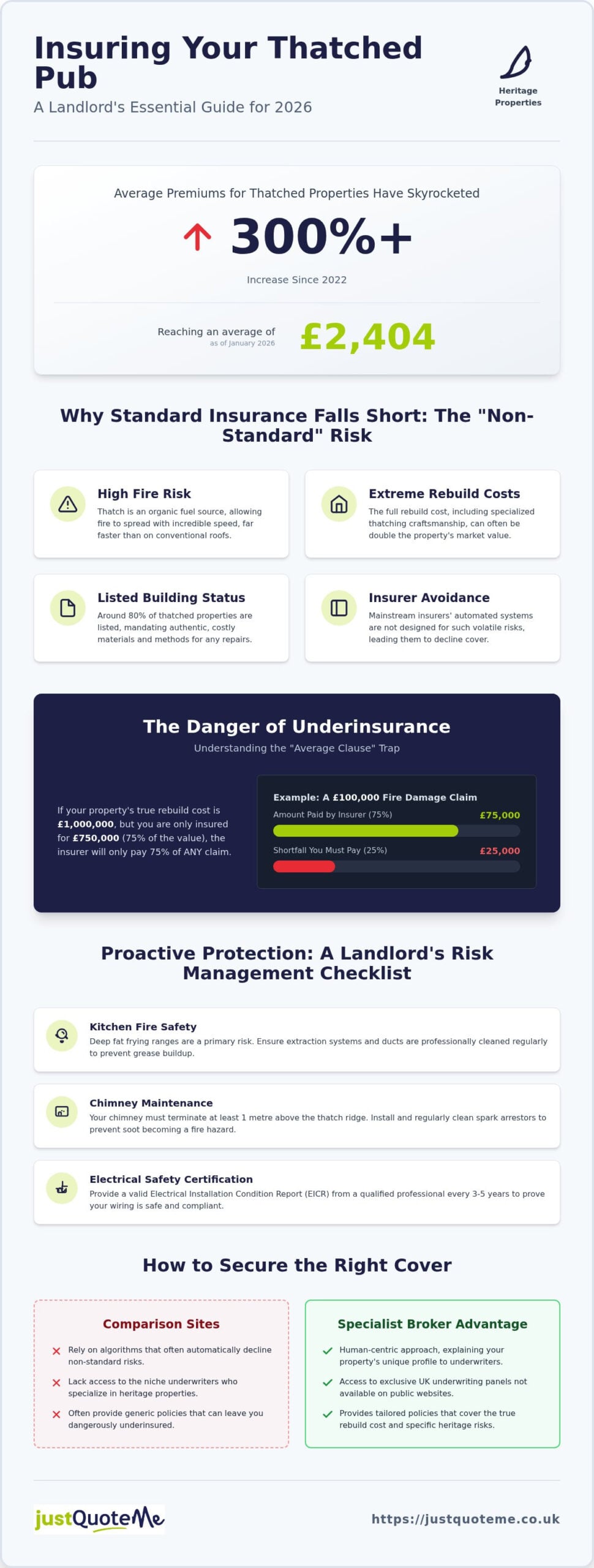
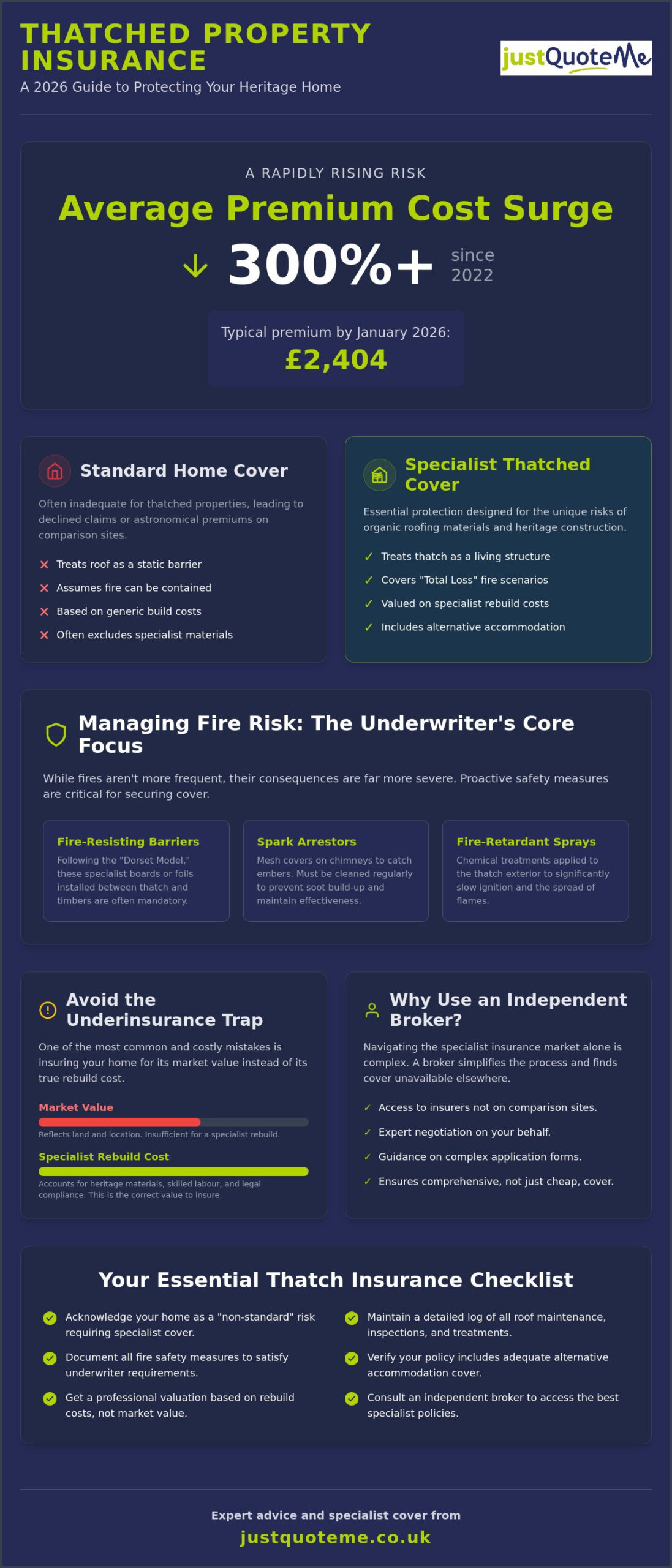
Did you know that average insurance premiums for thatched properties in the UK have surged by over 300% since 2022, reaching an average of £2,404 as of January 2026? For a landlord, this isn’t just a statistic; it’s a direct hit to your bottom line. We understand that finding reliable Thatched pubs insurance is becoming increasingly difficult as many standard insurers pull out of the market. You’re likely concerned about high costs, strict warranty conditions, and the fear that a claim might be rejected because of a minor technicality. It’s a stressful position to be in when you’re responsible for a precious piece of local heritage.
The good news is that you don’t have to manage these complex administrative burdens alone. This article explains how to secure comprehensive, competitive cover that accounts for the full rebuild cost of your thatch, which can often be double the property’s market value. We’ll show you how to master specialist risk management and stay compliant with the new 2026 fire safety regulations. You’ll learn how a tailored policy protects your staff and customers while giving you the peace of mind that comes from working with an FCA-authorised expert. Just Quote Me to simplify your protection and focus on what you do best: running a successful pub.
Key Takeaways
- Understand why mainstream insurers frequently decline thatched roofs and why these heritage properties require a specialist, non-standard approach to coverage.
- Identify the core perils underwriters focus on, including chimney maintenance and the specific risks associated with deep fat frying ranges.
- Learn how to secure Thatched pubs insurance that covers the unique craft of thatching alongside essential Public and Products Liability protection.
- Discover actionable steps from our risk management checklist to improve your property’s profile and potentially lower your insurance premiums.
- Gain access to specialist UK underwriting panels and bespoke quotes that are not available through automated comparison websites.
Why Thatched Pubs Insurance Requires a Specialist Approach in 2026
Most business owners assume a standard commercial policy will suffice until they face the reality of a thatched roof. In the eyes of an underwriter, a thatched pub represents a “non-standard” risk. This classification isn’t just about the roof material; it’s about the speed at which fire can spread and the extreme cost of restoration. Mainstream insurers often decline these risks because their automated systems aren’t designed to calculate the volatility of organic roofing materials. They prefer predictable, brick-and-tile structures where fire risks are easily quantified.
This is where a specialist broker becomes essential. With over 30 years of experience, Just Quote Me understands how to present your risk to niche underwriting panels that don’t appear on comparison sites. We focus on a human-centric approach, explaining the specifics of your property to underwriters rather than letting an algorithm make the decision. Standard pub policies are insufficient for thatched structures because they lack the specific clauses needed to cover specialized heritage craftsmanship and the unique fire risks inherent in traditional building methods.
The “Non-Standard” Risk Factor Explained
The type of material used in Thatching significantly influences your premium. Insurers distinguish between water reed, which is generally more durable, and wheat reed or long straw. These materials have different burn rates and maintenance requirements. Additionally, approximately 80% of thatched properties in the UK are listed buildings. This status means any repairs must use authentic materials and methods, which drives up rebuild costs far beyond standard market valuations. New fire safety regulations coming into force in April 2026 place even more emphasis on proactive risk management and sustainable heritage preservation. Your policy must reflect these legal shifts to ensure you remain fully compliant.
The Consequences of Underinsurance
Underinsurance is a growing threat in the hospitality sector. If your sum insured is lower than the actual cost to rebuild the property from scratch, insurers may apply the “Average Clause.” This means if you’re insured for only 75% of the total value, the insurer will only pay 75% of any claim, even for a minor fire. Because thatched pubs often have rebuild costs that are double their market value, a generic Commercial Property Insurance policy without a specialist valuation is a recipe for financial disaster. You need a policy that reflects the reality of 2026 construction costs and the scarcity of skilled thatchers. Securing accurate Thatched pubs insurance requires a broker who understands these nuances.
Managing the Core Perils: Fire, Chimneys, and Electrics
Fire remains the single most significant concern for any underwriter assessing a thatched property. Unlike a slate or tile roof, where a small fire might be contained, a thatched roof acts as a fuel source that allows flames to spread horizontally with incredible speed. For pub owners, this risk is amplified by the presence of commercial kitchens. Deep fat frying ranges are a particular focal point in policy wording. The accumulation of grease in extraction systems creates a high-intensity fire risk that can easily migrate to the roof timbers. If your business offers a full food menu, your premium will reflect the quality of your fire suppression systems and the frequency of your duct cleaning.
To mitigate these risks, insurers enforce strict physical requirements. One such standard is the 1-metre rule; your chimney must terminate at least one metre above the ridge of the thatch to ensure sparks are dispersed safely by the wind. Many underwriters also insist on the installation of spark arrestors, though these must be cleaned regularly to prevent soot buildup from becoming a secondary fire hazard. Using thermal imaging to check for heat transfer through chimney stacks is becoming a common request during the survey process.
Electrical Safety and Thatch Warranties
Electrical faults are a silent threat that often start in hard-to-reach areas. To maintain your cover, you must provide an Electrical Installation Condition Report (EICR) conducted by a qualified professional every three to five years. Insurers look for specific preventative measures, such as ensuring all wiring within the roof void is enclosed in fire-resistant metal conduit. This protects the cables from rodent damage and contains any heat generated by a short circuit. Installing linked smoke detectors within the thatch void itself is another proactive step that demonstrates a commitment to risk management.
Chimney Maintenance and Log Burner Risks
The charm of a roaring log fire is a major draw for customers, but it requires rigorous maintenance to remain insurable. Most Thatched pubs insurance providers mandate that chimneys are swept at least twice a year during the burning season. You must also be prepared to prove you only burn seasoned wood or approved smokeless fuels. Utilizing CCTV flue inspections or thermal imaging can identify cracks in the chimney lining before they lead to a disaster. If you’re unsure if your current setup meets these stringent criteria, you can consult with our team for a detailed review. Ensuring your flue is safe is a vital part of obtaining robust Pub and Bar Insurance for heritage buildings.
The Essential Components of a Comprehensive Thatched Policy
A robust policy for a thatched pub isn’t a one-size-fits-all document. It needs to account for the physical structure and the operational risks of a busy hospitality venue. Buildings insurance is the foundation of your cover. It must account for the full cost of heritage materials and the specialist labor required for traditional thatching. If you rely on a standard valuation, you’ll likely find yourself underinsured. Restoration requires master craftsmen whose fees and lead times are significantly higher than those of general contractors. When you secure Thatched pubs insurance, you’re investing in the survival of a historic landmark, not just a commercial building.
Beyond the physical roof, you have people and reputation to protect. Public and Products Liability covers accidents involving customers or issues with the food and drink you serve. This is vital for any business that interacts with the public daily. Additionally, Employers Liability is a non-negotiable legal requirement if you have even one part-time staff member. It protects you against claims arising from employee injuries or illnesses sustained while working. These components form a safety net that allows you to focus on your patrons rather than legal liabilities.
Public Liability for Hospitality
Managing a historic venue brings specific challenges that modern buildings don’t face. Low beams, uneven flagstone floors, and steep, narrow staircases are part of the charm, but they increase the risk of slips and trips. As we move through 2026, liability limits are trending higher because legal costs and compensation awards for injuries in heritage settings are rising. Your Public Liability Insurance must be sufficient to protect your business assets if a guest is injured on your premises. We ensure your policy accounts for these specific environmental risks so a single accident doesn’t jeopardize your future.
Business Interruption and Heritage Rebuilds
This is where most standard commercial policies fail thatched property owners. If a fire occurs, you’ll encounter the “Heritage Gap.” It isn’t just about the money; it’s about the time. Finding master thatchers and sourcing specific materials can take months of searching and planning. While a 12-month indemnity period might work for a modern pub, thatched properties often require 24-month or even 36-month periods. This ensures your business remains financially viable during a prolonged rebuild process. We also recommend including Loss of Licence cover. This protects your income if you lose your legal right to sell alcohol due to circumstances beyond your control, providing an extra layer of security for your livelihood.
Reducing Your Premiums: A Landlord’s Risk Management Checklist
Proactive risk management is your most powerful tool for negotiating lower premiums. Insurers don’t just look at the thatched roof; they look at the person managing it. By demonstrating a meticulous approach to safety, you can access more competitive rates for your Thatched pubs insurance. A central part of this is having an up-to-date Fire Risk Assessment (FRA). This document shouldn’t just sit in a drawer. It needs to be a living document that reflects current 2026 safety standards and shows underwriters you’ve addressed every potential hazard. Underwriters are far more likely to offer favorable terms to a landlord who can prove they are ahead of the regulatory curve.
Installing physical protections like Thatch Fireboard or Fire Barriers between the rafters and the thatch can significantly reduce your premium by slowing the spread of fire and protecting the building’s core structure. These passive fire protection measures are highly valued by specialist insurers because they provide an extra layer of defense that traditional methods lack. When you combine these physical upgrades with documented procedures, you create a compelling case for a lower-cost policy. It’s about shifting the narrative from a high-risk property to a well-managed heritage business.
Maintenance and Documentation
Consistency is key. We recommend keeping a “Thatch Log” that records every inspection, repair, and sweep. This should include certificates from members of the Master Thatchers Association, as their expertise is recognized as the industry gold standard. Showing that your fire extinguishers and blankets are serviced annually isn’t just a legal requirement; it’s proof of your reliability. If you can present a tidy folder of maintenance records, you remove the guesswork for the insurer. This transparency often leads to “no-claims” discounts and lower excesses on your Thatched pubs insurance policy because it proves the property is cared for by a professional.
Modern Security for Traditional Pubs
While the building is historic, your security shouldn’t be. Installing CCTV and alarm systems that meet insurer-approved standards protects your property from arson and theft. If your venue employs door staff for events or weekend trade, you should also consider how this integrates with your Security Insurance requirements. Additionally, ensure your policy includes Safe and Money cover to protect cash held on-site, which is a common target for burglary. A well-secured pub is a lower risk, and lower risk always equals better rates. To see how these improvements can impact your specific policy, speak with our specialist team for an expert assessment of your risk profile.
Securing Your Quote with Just Quote Me: The Broker Advantage
Standard comparison sites are built for standard risks. When you deal with a property as unique as a thatched public house, the automated logic of a computer algorithm often results in a “computer says no” response or an inflated premium that doesn’t reflect your actual risk management efforts. This is why you should Just Quote Me to gain access to specialist underwriting panels that simply don’t appear on mainstream platforms. We’ve spent over 30 years building relationships with niche UK insurers who understand the hospitality sector’s heritage requirements. Our team acts as your advocate, presenting the specific details of your property to ensure you aren’t penalized for the beauty of your building.
Our deep roots in Staffordshire and the West Midlands provide us with a unique perspective on the regional challenges faced by local landlords. We know that a thatched pub in a rural village requires a different approach than a modern bar in a city center. By choosing an independent, FCA-authorised broker, you’re opting for a human-centric service that prioritizes clarity over corporate jargon. We manage the complex administrative burdens and technical negotiations so you can focus on your staff and customers, confident that your livelihood is protected by a steady, experienced hand.
Tailored Solutions, Not Template Policies
We don’t believe in off-the-shelf products for non-standard risks. Every thatched property has a different story, from the age of the rafters to the specific type of reed used on the roof. Our experts negotiate bespoke terms based on your individual risk profile, often securing lower excesses or more flexible warranty conditions than you’d find elsewhere. This personalized approach extends to our claims support. If the worst happens, our team is here to guide you through the process, ensuring your heritage restoration stays on track. You can explore our wider Business Insurance options to see how we provide comprehensive protection across all commercial sectors.
Next Steps for Your Pub
Securing an accurate quote for Thatched pubs insurance requires a bit of preparation, but it pays off in the long run. Before you get in touch, try to have your latest Electrical Installation Condition Report (EICR), your Fire Risk Assessment, and an up-to-date rebuild valuation ready. While online forms are convenient for simple risks, we’ve found that a direct conversation is far more effective for thatched properties. It allows us to capture the nuances that a form might miss, leading to a more competitive and accurate quote. We’re committed to providing a frictionless experience that combines professional restraint with honest, straightforward communication.
Get Your Free Business Insurance Quote now
Request a Call back for free Expert advice
Protect Your Heritage with Expert Coverage
Owning a thatched public house is a commitment to preserving history, but it requires a strategic approach to insurance. By focusing on electrical safety, rigorous chimney maintenance, and accurate rebuild valuations, you can navigate the challenges of a hardening market. Securing the right Thatched pubs insurance ensures your business is protected against the unique fire risks and heritage restoration costs associated with traditional structures. You’ve worked hard to build your reputation; it’s vital that your policy reflects the true value of your property.
As an FCA-authorised independent broker with over 30 years of experience, we specialize in non-standard hospitality risks. We’ll help you access specialist UK insurers that don’t appear on comparison sites, providing bespoke terms that reflect your proactive safety measures. Don’t let complex administrative burdens or rising premiums threaten your livelihood. Just Quote Me to simplify your insurance and gain the peace of mind you deserve. We look forward to helping you secure the future of your business.
Get Your Free Business Insurance Quote now
Request a Call back for free Expert advice
Frequently Asked Questions
Is thatched pub insurance more expensive than standard pub insurance?
Yes, premiums are generally higher because the specialist materials and labor required for heritage restoration are significantly more costly than modern alternatives. While standard buildings use mass-produced tiles, a thatched roof requires organic materials and master craftsmanship, which increases the total sum insured. We work to mitigate these costs by highlighting your proactive maintenance to our specialist underwriting panels.
Do I need a specific type of fire alarm for a thatched roof?
Most insurers mandate a linked smoke detection system that includes sensors within the thatch void itself. This setup ensures that if heat or smoke is detected in the roof structure, alarms sound throughout the entire building immediately. It’s a critical safety requirement that provides the early warning necessary to prevent a localized incident from becoming a total loss.
Can I get insurance if my pub has a deep fat fryer and a thatched roof?
You can secure coverage for a pub with a deep fat fryer, but it requires strict adherence to extraction cleaning and fire suppression protocols. Insurers will look for evidence of professional duct cleaning and may specify the type of fire extinguishers required in the kitchen area. Managing these commercial kitchen risks is a standard part of a bespoke Thatched pubs insurance policy.
What is the “Average Clause” in thatched property insurance?
The Average Clause is a condition that reduces your claim payout if the property is found to be underinsured at the time of a loss. If you insure your building for only 75% of its actual rebuild value, the insurer is entitled to pay out only 75% of any claim, even for partial damage. This makes accurate, professional valuations essential for protecting your business assets.
Does my policy cover the cost of a specialist Master Thatcher?
A comprehensive policy should cover the fees of a Master Thatcher, provided your buildings insurance sum insured accurately reflects heritage labor rates. Because thatching is a specialist craft, these costs are significantly higher than general building work. We ensure your policy wording includes the necessary provisions to hire the right experts for any required restoration or repair work.
How often do I need to have my chimneys swept for insurance purposes?
Insurers typically require chimneys to be swept at least twice a year, usually once before the winter burning season and once during it. You must maintain a log of these sweeps and keep the certificates provided by the professional sweep as evidence for your insurer. Failure to document this maintenance can lead to a claim being rejected if a chimney fire occurs.
Is Employers Liability insurance legal required for my pub staff?
Employers Liability is a legal requirement for any business with employees, including part-time bar staff, cleaners, or seasonal workers. This cover protects you against claims if a member of your team is injured or falls ill as a result of their work. Even in a historic setting, you must maintain this protection to remain compliant with UK law and avoid heavy daily fines.
Can a broker help if I have been refused insurance elsewhere?
A specialist broker is your best resource if you’ve been declined by mainstream insurers or comparison sites. Automated systems often reject non-standard risks like thatch without considering the specific safety measures you’ve implemented. Just Quote Me uses a human-centric approach to manually review your risk profile and present it to niche underwriters who specialize in heritage hospitality venues.
Get Your Free Business Insurance Quote now
Request a Call back for free Expert advice
Article by
Just Quote Me
JustQuoteMe Ltd is an independent UK insurance brokerage specialising in business and personal insurance solutions. With over 35 years of industry experience, the company provides tailored insurance cover for businesses, landlords, tradespeople, hospitality venues, fleets, and individuals across the UK. Known for its personal service, expert advice, and competitive premiums, JustQuoteMe Ltd works with leading insurers to deliver bespoke policies designed around each client’s unique needs. The company is authorised and regulated by the Financial Conduct Authority (FCA No. 586607) and has built a reputation for trusted, straightforward insurance guidance and long-term client relationships.
by jqm | Jul 20, 2026 | Insurance
Did you know that the average cost of Thatched Property insurance has surged by over 300% since 2022? By January 2026, typical premiums reached £2,404, driven by rising material costs and a shrinking pool of specialist insurers willing to take on the risk. It is a staggering figure that leaves many heritage homeowners feeling penalised for simply preserving a piece of British history.
You likely already know how difficult it’s to find a provider who understands the difference between water reed and combed wheat, let alone one who offers fair terms. It’s exhausting to navigate confusing requirements for chimney linings and fire retardant sprays while worrying if your rebuild valuation is actually accurate. We promise to simplify this process by helping you master the complexities of specialist cover and manage your premium costs effectively. This guide provides a practical checklist to satisfy underwriters, explains the latest 2026 safety regulations, and shows you how an independent broker secures the comprehensive protection your home deserves.
Key Takeaways
- Understand why thatched homes are classified as non-standard risks and why it’s essential to have specialist cover to protect against total loss scenarios.
- Learn why underwriters focus on fire management and how documented safety measures can improve your eligibility for Thatched Property insurance.
- Discover how to value your heritage home based on specialized rebuild costs rather than market value to avoid the common underinsurance trap.
- Identify proven strategies to manage premium costs, including the importance of material choice and maintaining a detailed maintenance log.
- See how an independent broker simplifies the application process by negotiating directly with specialist insurers who aren’t on standard comparison sites.
What is Thatched Property Insurance and Why is it “Non-Standard”?
Thatched Property insurance is a specialist form of cover designed for homes where the primary roofing material is organic, such as water reed, long straw, or combed wheat reed. While a standard home insurance policy treats a roof as a static barrier, a thatch policy treats it as a living component of the building’s structure. These policies cover the unique risks associated with heritage materials that mainstream providers often avoid. Securing Thatched Property insurance ensures that your rebuild valuation reflects the true cost of specialist labour and materials rather than just generic construction rates.
Most high-street insurers decline these properties because they classify them as “non-standard” risks. The primary reason is the potential for a “total loss” claim. While a fire in a tiled home might be contained to one room, a fire in a thatched roof can spread rapidly through the layers of vegetation. The craft of Thatching creates a beautiful aesthetic, but the density of the material makes it incredibly difficult for fire services to extinguish once it takes hold. This statistical risk of a complete rebuild, rather than a simple repair, is why you need a dedicated policy rather than a generic one.
By 2026, regulatory compliance has become even more critical for heritage homeowners. With amendments to UK fire safety standards, such as those taking effect on September 30, 2026, and rising material costs, insurers now require proof that your property meets specific safety benchmarks. This includes both the physical structure and the contents within, which are often of higher value in historic homes and require separate, detailed assessment.
The Distinction Between Standard and Non-Standard Home Cover
Comparison sites operate on “tick-box” algorithms that don’t account for the nuances of organic roofing. They often fail thatched homeowners by either quoting astronomical premiums or providing “standard” cover that contains restrictive exclusions. Specialist underwriters, however, understand the materials. When you apply for Thatched Property insurance, they look at the age of the roof and the specific type of reed used. If your home is a Grade I or Grade II listed building, the insurance picture becomes even more complex. You aren’t just insuring a house; you’re insuring a legal obligation to rebuild using historically accurate materials and methods, which standard policies simply don’t cover.
Key Components of a Comprehensive Thatch Policy
A robust policy goes beyond simple fire protection. Alternative accommodation cover is vital because a thatch rebuild can take significantly longer than a modern home repair. You need to know you’ll have a place to live for months if the worst happens. Additionally, you should look for specialist thatch liability to protect against third-party risks and accidental damage cover tailored to heritage materials. For those who own commercial heritage properties, such as a local hostelry, securing Thatched Pub insurance involves even more rigorous risk assessments regarding kitchen safety, chimney maintenance, and public access.
Managing Fire Risk: The Core of Thatched House Insurance
Fire remains the primary concern for underwriters in 2026. While statistics show that thatched homes don’t catch fire more frequently than properties with slate or tile roofs, the consequences of an ignition are far more severe. A fire in a thatched roof is often deep-seated and incredibly difficult to extinguish, frequently leading to the high “total loss” risk mentioned earlier. For this reason, securing a specialist policy requires a proactive approach to risk management rather than just paying a premium.
The “Dorset Model” has emerged as the gold standard for thatch fire safety across the UK. Originally developed by local authorities in Dorset, these guidelines focus on structural measures to prevent fire spread. This includes installing fire-resisting barriers, such as specialist boards or foils, between the thatch and the roof timbers. Many insurers now insist on these standards for new builds or major renovations. Beyond structural changes, underwriters often require specific preventative tools to be maintained:
- Spark Arrestors: These mesh covers sit over the chimney pot to catch stray embers before they land on the dry thatch. They must be cleaned regularly to prevent soot build-up.
- Fire-Retardant Sprays: Chemical treatments applied to the external surface of the roof can significantly slow the ignition process and are a common requirement in modern Thatched Property insurance policies.
Chimney Safety and Multi-Fuel Burners
The most common cause of thatch fires is heat transfer through the chimney brickwork. Over time, mortar can degrade, allowing intense heat from multi-fuel burners to ignite the surrounding thatch layers. To mitigate this, many 2026 insurance policies mandate a CCTV chimney survey to confirm the integrity of the flue and lining. Additionally, underwriters look for a minimum chimney height, typically at least 1.8 metres above the ridge, to ensure sparks are carried safely away from the roof surface. Regular sweeping, often twice a year, is a non-negotiable policy condition.
Electrical Inspections and Fire Detection
Faulty wiring is a silent threat in older heritage homes. A valid Electrical Installation Condition Report (EICR), updated every five years, is now a standard requirement for Thatched Property insurance. In 2026, many providers also insist on interlinked smoke alarms specifically located in the loft space. These alarms ensure that if a fire starts within the roof structure, you’re alerted immediately. Interestingly, installing external floodlights can also help. While primarily for security, they provide better visibility for fire crews during a night-time emergency, which can lead to lower premiums from certain specialist insurers.
Avoiding the Underinsurance Trap: Valuing Your Heritage Home
One of the most common mistakes homeowners make when seeking Thatched Property insurance is confusing market value with rebuild cost. Your property’s market value reflects what a buyer might pay in the current climate. However, your insurance policy must reflect the actual cost of clearing the site and rebuilding the structure from scratch using identical materials. For a thatched home, these costs are significantly higher than for a standard brick and slate property. If your sum insured is too low, you fall into the underinsurance trap.
The scarcity of specialist labour is a major factor driving up these costs in 2026. Master thatchers are in high demand, and their expertise comes at a premium. Combine this with the rising price of materials like water reed or long straw, and it’s easy to see why a full roof replacement averaged approximately £20,000 in early 2026. If you underestimate these figures, insurers may apply the “Average Clause” during a claim. This means if you’ve only insured your home for 80% of its true rebuild value, the insurer can reduce your payout by 20%, even for a partial loss like minor storm damage.
Professional Appraisals vs. Online Calculators
Standard online calculators often fail heritage homeowners. They typically use generic data that doesn’t account for the unique requirements of organic roofing. For example, the cost of specialist scaffolding required for thatching work is often overlooked, yet it’s a significant expense. The Royal Institution of Chartered Surveyors (RICS) “Red Book Global Standards” provide the definitive framework for property valuation, but you need a surveyor who understands heritage assets specifically. At Just Quote Me, we help you identify surveyors with the right expertise to ensure your valuation is accurate and your cover is robust.
Specialist Cover for Thatched Pubs and Commercial Assets
Commercial properties face even greater complexities. If you run a business from a heritage building, you need thatched pub insurance that accounts for both the structure and the operational risks. A fire doesn’t just damage the building; it stops your income. This is why business interruption cover is essential for any commercial thatched asset. For mixed-use sites or larger estates, integrating your thatch cover into a broader Commercial Property Insurance policy ensures there are no gaps in protection. We handle the complex paperwork so you can focus on running your business with confidence.
Proven Strategies to Lower Your Thatched Insurance Premiums
Managing the costs of Thatched Property insurance doesn’t have to be an uphill battle. While premiums have risen significantly across the UK, you can take specific, documented steps to make your home more attractive to specialist underwriters. Insurance is ultimately a calculation of risk. If you can prove that you’re a proactive homeowner, you’ll find it much easier to negotiate better rates. It pays to be organized.
One of the most effective tools at your disposal is a “Thatch Log.” This is a comprehensive record of every professional intervention on your roof, from minor patching to full ridge replacement. When you provide an underwriter with a documented history of work carried out by a master thatcher, you remove the guesswork from their assessment. Similarly, the material of your roof plays a role. Water Reed is often viewed more favourably than Combed Wheat due to its superior durability and longer lifespan. If you’re planning a re-thatch, choosing more resilient materials can lead to long-term savings on your Thatched Property insurance.
Strategic financial choices also make a difference. Increasing your voluntary excess is a direct way to lower your annual premium. It signals to the insurer that you’re committed to the property’s upkeep and won’t be making small, frequent claims. However, the biggest advantage comes from working with an independent broker. We have access to specialist schemes and niche insurers that simply don’t appear on standard comparison websites. You can request a bespoke quote today to see how these exclusive schemes can reduce your costs.
Physical Protective Measures
Installing physical barriers is a high-impact way to lower risk. If you’re undergoing a re-thatch, consider adding fire-resisting barriers, often called thatch batts, between the rafters and the thatch. These can prevent a fire from reaching the structural timbers of your home. Additionally, using approved fire-retardant chemical treatments provides an extra layer of security. Don’t overlook your garden, either. Underwriters typically require that trees and overhanging branches are kept at a minimum distance of 1 metre from the thatch to prevent moisture build-up and fire spread.
Maintenance Schedules that Underwriters Love
Consistency is key when it comes to maintenance. Insurers often mandate an annual chimney sweep by a NACS-registered professional to prevent soot fires. You should also plan for a ridge replacement every 10 to 15 years, as this is the most vulnerable part of the roof. Keeping your claims history clean is exceptionally valuable in the thatch market. Unlike standard homes where a single claim might have a minor impact, a clean record for a thatched property is a powerful bargaining chip that proves your commitment to heritage preservation.
Why Use an Independent Broker for Thatched Property Insurance?
Choosing Thatched Property insurance isn’t a simple transaction. It’s a partnership. While comparison sites rely on rigid algorithms, the complexity of heritage homes requires a “human-in-the-loop” approach. An independent broker understands that your 18th-century cottage doesn’t fit into a standard risk category. We look beyond the surface to find a policy that covers the specific nuances of your home, ensuring that you aren’t left with generic cover that fails when you need it most.
With average premiums reaching £2,404 in January 2026, the market has become increasingly restrictive. This “hardening” market means fewer insurers are willing to take on the risk of organic roofing. Just Quote Me leverages over 30 years of industry experience to navigate these challenges. We negotiate directly with specialist underwriters who don’t list their products on public comparison platforms. This direct access allows us to secure comprehensive cover that balances robust protection with manageable costs, even as material prices continue to rise.
Our regional expertise in Staffordshire and the West Midlands gives us a unique perspective on local thatching styles and regional fire safety requirements. We don’t just provide a policy; we simplify the entire administrative burden. From verifying your 2026 chimney survey requirements to ensuring your electrical certifications meet current standards, we manage the complex paperwork so you don’t have to. This steady hand in a complex market ensures your heritage asset remains protected without the administrative headache.
Bespoke Solutions for Unique Properties
Many thatched homes serve as more than just primary residences. Whether you operate a holiday let, a B&B, or own an unoccupied heritage building, we provide tailored solutions that standard providers often decline. If you’re a landlord, integrating Residential Letting Insurance into your specialist thatch cover ensures your investment is fully protected against tenant-related risks and loss of rent. We also handle properties with other non-standard construction elements, such as timber frames or historic cob walls, which often further complicate the insurance picture for generalist brokers.
Expert Advice and a Stress-Free Quote Process
Completing a “Thatch Questionnaire” can be a daunting task. One wrong answer about your ridge maintenance or the height of your chimney can lead to an immediate rejection from automated systems. We provide professional guidance through this process, helping you avoid the pitfalls of “computer says no” insurance. Our goal is to provide a frictionless experience that prioritises your home’s security and your peace of mind. You can Get Your Free Business Insurance Quote now and let our experts handle the complexities for you.
Secure Your Heritage Home with Expert Protection
Preserving a thatched property is a commitment to history, but it doesn’t have to be a financial burden. By implementing proactive fire safety measures and keeping documented maintenance records, you can significantly influence the terms of your Thatched Property insurance. It’s essential to focus on accurate rebuild valuations to avoid the underinsurance trap, especially as material and specialist labour costs continue to rise in 2026.
Just Quote Me brings over 30 years of industry experience as an FCA Authorised Broker. We provide bespoke access to specialist heritage underwriting that’s often unavailable on standard comparison sites. Our team understands the nuances of organic roofing and the specific regulatory requirements of heritage assets. We manage the complex administrative details so you can enjoy the beauty of your home with complete peace of mind. To get started with a personalised approach, Request a Call back for free Expert advice today. Your home’s future is in safe hands.
Frequently Asked Questions
Is thatched roof insurance more expensive than standard home insurance?
Yes, premiums for thatched properties are typically higher than those for standard homes because insurers view them as a non-standard risk. This is primarily due to the total loss potential if a fire occurs. The cost also reflects the specialized materials and skilled labor required for repairs. Using a specialist broker for Thatched Property insurance helps you access niche markets that offer more competitive rates than generalist insurers.
Do I need a special survey to get thatched property insurance?
Most specialist insurers require specific documentation rather than a single general survey. You’ll likely need a recent Electrical Installation Condition Report (EICR) and a CCTV chimney survey to confirm the integrity of the flue. Underwriters also often ask for a Thatch Questionnaire completed by a master thatcher to assess the roof’s condition. These requirements ensure the property meets 2026 safety standards before cover is granted.
Does the type of thatch material affect my insurance premium?
The material used for your roof significantly impacts your premium and your eligibility for cover. Water reed is generally viewed most favorably by underwriters because of its durability and longer lifespan compared to combed wheat reed or long straw. Insurers consider the risk of rot and the frequency of necessary ridge replacements. Documenting your material type in a Thatch Log helps brokers negotiate better terms with specialist underwriters.
Can I have a wood-burning stove in a thatched property?
You can have a wood-burning stove, but it is the most scrutinised feature of a thatched home. Insurers usually mandate that the chimney is lined with a twin-wall insulated flue and reaches a minimum height above the thatch ridge. You’ll also need to install spark arrestors and follow strict temperature monitoring protocols. Failure to meet these specific 2026 policy conditions can void your fire cover entirely.
What is the “Dorset Model” in thatched insurance?
The Dorset Model is a set of building specifications designed to reduce fire risk in thatched properties. It involves installing a fire-resisting barrier, such as a specialist board or foil, between the thatch and the roof timbers. While originally a local initiative, it has become a national benchmark for safety. Many insurers offer better terms or lower premiums for properties that strictly adhere to these construction standards.
How often do I need to have my chimney swept for insurance purposes?
Most Thatched Property insurance policies require you to have your chimney swept at least twice a year if you use a wood-burning or multi-fuel stove. If you only use an open fire or gas, an annual sweep by a NACS-registered professional is often sufficient. You must keep all certificates and receipts as proof of maintenance, as insurers will request these documents in the event of a fire claim.
Will my insurance cover the cost of a master thatcher?
A comprehensive specialist policy will cover the costs of a master thatcher, provided your rebuild valuation is accurate. This is why you must insure for the rebuild cost rather than market value. Specialist policies account for the scarcity of skilled labor and the high cost of materials like water reed. We work with you to ensure your sum insured reflects these professional fees to avoid the underinsurance trap.
What happens if my thatched property is a listed building?
If your property is Grade I or Grade II listed, your insurance must cover the legal obligation to rebuild using historically accurate materials and methods. This significantly increases the rebuild cost compared to a non-listed property. Specialist insurers understand these heritage requirements and tailor their policies to include the additional time and expense required by conservation officers. We help navigate these complexities to ensure your legal obligations are fully protected.
Article by
Just Quote Me
JustQuoteMe Ltd is an independent UK insurance brokerage specialising in business and personal insurance solutions. With over 35 years of industry experience, the company provides tailored insurance cover for businesses, landlords, tradespeople, hospitality venues, fleets, and individuals across the UK. Known for its personal service, expert advice, and competitive premiums, JustQuoteMe Ltd works with leading insurers to deliver bespoke policies designed around each client’s unique needs. The company is authorised and regulated by the Financial Conduct Authority (FCA No. 586607) and has built a reputation for trusted, straightforward insurance guidance and long-term client relationships.

by jqm | Jul 19, 2026 | Insurance
With UK gym visits surging to 679 million in 2025, the physical and financial pressure on fitness facilities has reached an all-time high. It’s a reality that every owner understands; you’ve invested heavily in high-end equipment and community trust, but the fear of a high-payout liability claim or a sudden theft remains a constant background noise. Managing these risks shouldn’t feel like a workout in itself, yet the complexity of modern Gymnasium Insurance often leaves even the most experienced operators feeling uncertain about their actual level of cover.
We understand that you need clear, pragmatic solutions that ensure full legal compliance without overcomplicating your administrative workload. This article provides expert insights on securing bespoke, cost-effective protection tailored to the specific needs of your fitness centre. We’ll clarify the often-confusing distinction between gym cover and personal trainer requirements, while showing you how to protect your high-value equipment and revenue during unforeseen closures. By the end, you’ll have a straightforward roadmap to total peace of mind, allowing you to focus on your members’ performance rather than your policy’s fine print.
Key Takeaways
- Understand how the evolution of high-tech fitness equipment and biometric systems impacts your specific risk profile in 2026.
- Identify the core pillars of comprehensive Gymnasium Insurance, from mandatory Employers’ Liability to essential Public Liability protections.
- Navigate the specialist requirements for unstaffed 24/7 studios, including the necessary safety protocols for CCTV and automated external defibrillators.
- Learn how to leverage robust Health and Safety documentation to reduce your insurance premiums and maximise your business’s return on investment.
- See why partnering with an independent broker provides the human-centric expertise needed to navigate complex administrative burdens.
What is Gymnasium Insurance and Why is it Essential in 2026?
Gymnasium Insurance isn’t a one size fits all product. It’s a strategic framework of covers designed to protect fitness facilities against a broad spectrum of risks. While traditional business policies might cover a generic office or shop, they rarely account for the high intensity environment of a gym. By 2026, the industry has shifted toward high value digital equipment and sophisticated biometric access systems. These technologies introduce new liabilities, from expensive hardware breakdowns to sensitive data protection concerns. When your business relies on AI driven performance tracking and automated entry, a standard policy simply won’t suffice.
Relying on generic commercial insurance is often a mistake for gym owners. Most standard policies fail to provide the necessary limits for specialist equipment like high end treadmills, functional training rigs, or recovery tech. This is where the expertise of an independent broker becomes invaluable. We help you navigate these sector nuances to ensure you aren’t paying for redundant cover while leaving significant gaps in your protection. A bespoke approach ensures that your specific layout, equipment list, and member volume are all factored into your premium, providing a safety net that actually works when you need it.
The Legal Landscape for UK Fitness Businesses
The Health and Safety Executive (HSE) maintains strict expectations for gyms to ensure a safe environment for both staff and members. Beyond general safety protocols, Employers Liability Insurance is a legal requirement if you have trainers, cleaners, or even volunteers on site. This mandatory cover protects your business against claims from employees who suffer injury or illness due to their work. To ensure gym owners receive fair and transparent advice, the Financial Conduct Authority (FCA) regulates brokers, holding us to high standards of professional conduct and ensuring our advice remains in your best interest.
Protecting Your Investment Against Unforeseen Risks
A single major liability claim can be financially devastating for an uninsured fitness centre. Whether it’s a member injury or property damage, the costs often spiral into tens of thousands of pounds. A robust policy includes Commercial General Liability (CGL) components to handle these third party claims effectively. You also need to protect your material damage. This covers everything from the structural integrity of your premises to the weights and machines that drive your revenue. Understanding what is public liability insurance and how it integrates with your property cover is the first step toward securing your business’s future.
Core Components of a Comprehensive Gym Insurance Policy
Building a robust safety net for your fitness business requires more than a single certificate. A comprehensive policy for Gymnasium Insurance functions as a bundle of specific protections, each addressing a different facet of your operational risk. From the heavy lifting of liability claims to the technical nuances of equipment breakdown, your cover must be as versatile as the workouts your members perform. If you’re unsure which specific limits apply to your floor space, speaking with an independent advisor can clarify your requirements.
- Public Liability: Your primary defence against claims arising from member injuries or property damage.
- Employers’ Liability: A non-negotiable legal requirement for gyms with any form of staff.
- Commercial Property and Equipment: Protection for your cardio machines, free weights, and even your retail protein stock.
- Business Interruption: A vital safeguard that replaces lost membership income if an insured event, like a fire or flood, forces you to close temporarily.
Public Liability vs. Professional Indemnity
One of the most common points of confusion for gym owners is the difference between Public Liability and Professional Indemnity. Public Liability handles “slips and trips” on your premises. For example, if a member trips over a loose floor mat, this cover manages the legal costs and compensation. However, it doesn’t typically cover injuries resulting from bad advice. This is where professional indemnity insurance becomes essential. It protects you if a trainer provides a flawed workout plan that leads to a chronic injury. Following the IDEA Health & Fitness Association guidelines on risk management can help you implement safety protocols that reduce the likelihood of either claim occurring.
Employers’ Liability for Gym Staff and Contractors
If you employ anyone, the Employers’ Liability (Compulsory Insurance) Act 1969 makes this cover a legal necessity. This isn’t just for full-time employees; it often extends to freelance personal trainers or cleaners working under your direction. If a staff member is injured while spotting a lift or moving heavy equipment, you are liable for their safety. Failing to hold this cover can result in significant daily fines from the HSE. You can find more detail on the specific legal thresholds on our employers liability insurance page. Ensuring your contractors also carry their own separate policies is a smart move, but your primary policy remains the ultimate backstop for your facility.
Navigating Specialist Risks: 24/7 Access and Boutique Studios
The rise of unstaffed, 24-hour access facilities has transformed the fitness sector, yet it has also fundamentally rewritten the risk profile for Gymnasium Insurance. Operating without on-site supervision means your liability shifts from direct oversight to technical reliability. Insurers now look for specific, high-tech risk mitigation strategies that weren’t standard a decade ago. When your doors are open at 3:00 AM, your policy’s validity often hinges on the presence of functional CCTV, accessible panic buttons, and automated external defibrillators (AEDs). These tools are your silent partners in safety, providing a documented trail of events that protects your business from fraudulent or negligent claims.
Boutique studios present a different but equally complex set of challenges. Whether you’re running high-density HIIT classes or specialized Reformer Pilates sessions, the concentration of risk in a smaller footprint is significant. Many modern studios have also invested heavily in integrated audio-visual systems and smart lighting to enhance the member experience. Your ‘Material Damage’ cover must scale to reflect these high-tech assets. Standard commercial policies often treat gym equipment as generic ‘contents’, which can lead to significant shortfalls if your specialized AV rack or Pilates machines are damaged. Organizations like the IDEA Health & Fitness Association provide essential frameworks for these safety protocols, helping owners understand the industry-standard expectations for modern facility management.
Insurance Requirements for Unstaffed Gyms
For 24/7 facilities, insurers demand stringent security protocols that go beyond a simple lock and key. This typically includes remote monitoring systems and a robust member vetting process to ensure only authorised individuals gain entry. It’s also vital to display clear, prominent signage stating that members ‘train at their own risk’ during unstaffed hours. While this doesn’t absolve the business of all liability, it establishes a clear operational protocol that supports your legal standing during a claim investigation. High-quality remote monitoring can even help lower your premiums by demonstrating a proactive approach to member safety.
Cover for Specialised Fitness Equipment and Stock
Standard contents insurance is rarely sufficient for the high-intensity use seen in commercial gyms. Heavy lifting kit, resistance machines, and advanced cardio equipment require specific plant and machinery insurance to account for the unique wear and breakdown risks they face. Furthermore, modern gyms are increasingly becoming multi-functional spaces. If you sell supplements, branded apparel, or operate an on-site juice bar, your policy must include these stock items. Protecting your inventory is just as important as protecting your treadmills, as a single theft or fire could otherwise wipe out a significant secondary revenue stream.
Calculating Gymnasium Insurance Costs and Maximising ROI
Insurance premiums are never arbitrary. They represent a calculated assessment of the risks your facility presents to an underwriter. To get the best value from your Gymnasium Insurance, you need to understand the variables that drive these costs. While you can’t change your turnover or membership volume, you can influence how insurers perceive your management of those risks. A well managed facility with documented safety protocols will always command better rates than one with a reactive approach to maintenance and safety.
One critical area where gym owners often lose out is through under-insurance. When valuing your fit-out and equipment, it’s vital to use replacement costs rather than current market value. If you’ve spent significant capital on specialized flooring, lighting, and high end machines, ensure your policy reflects the full cost of rebuilding that environment from scratch. Failing to do so can lead to “average” being applied during a claim, where the insurer reduces your payout in proportion to the level of under-insurance. If you need help assessing your specific risk profile, you can speak with our expert team today.
Factors That Influence Your Gym Premium
Your postcode is one of the primary drivers of cost. High crime areas or regions prone to flooding will naturally attract higher premiums. The construction of your building also plays a role; modern, purpose built units are generally cheaper to insure than older, converted structures that might have outdated electrical systems. Your claim history is equally influential. A clean record over several years demonstrates a low risk profile, whereas frequent small claims suggest a lack of oversight. Additionally, the ratio of freelance trainers to PAYE staff changes your liability profile. While freelancers should have their own cover, your policy must still account for the overall volume of activity on your gym floor.
How to Reduce Your Gym Insurance Costs
The most effective way to lower your premiums is to prove you are a low risk client. Implementing rigorous equipment maintenance logs is a great start. When you can show a documented history of weekly inspections and prompt repairs, you demonstrate a proactive commitment to risk mitigation. Robust Health and Safety documentation, including clear Emergency Action Plans and staff training records, further reinforces this image. Finally, don’t rely on automated comparison sites that use generic algorithms. An independent broker can compare the whole market and negotiate bespoke terms that reflect your specific operation.
Ready to secure a policy that fits your budget and your business? Get Your Free Business Insurance Quote now.
Why Choose Just Quote Me for Your Gym Protection?
Selecting the right insurance partner is as critical as selecting the right location for your fitness centre. At Just Quote Me, we bring over 30 years of industry experience as an FCA authorised independent broker. We don’t believe in faceless algorithms or generic automated systems that treat every business like a data point. Instead, we offer a human-centric approach where you speak directly to a knowledgeable advisor who understands the specific pressures of running a gym. This personal touch ensures that your Gymnasium Insurance is built on a foundation of genuine understanding rather than a best guess from a computer program.
Our regional expertise in Staffordshire and the West Midlands provides a distinct advantage for local operators. We know the local market conditions and the specific risks associated with different postcodes in the area. By focusing on bespoke policies, we help you avoid paying for “unnecessary frills” that don’t apply to your specific setup. We strip away the jargon and the redundant covers, focusing entirely on the protections that matter most to your facility. This pragmatic attitude allows us to secure high quality cover while keeping your premiums as cost effective as possible.
Expert Advice Tailored to the UK Fitness Sector
Generic comparison sites often miss the subtle gaps in cover that can lead to rejected claims. We help you identify these hidden vulnerabilities, whether it’s an oversight in your professional indemnity limits or a lack of specific protection for your biometric access systems. As an independent broker, we aren’t tied to a single provider. We have access to a broad network of top tier UK insurers, allowing us to negotiate terms that aren’t available to the general public. If you are looking for localized support, our role as a commercial insurance broker staffordshire specialist ensures you receive advice that is relevant to your community and your business goals.
Seamless Claims Support and Administration
Managing the administrative burden of insurance can be a significant drain on your time. We take that weight off your shoulders by handling the setup, renewals, and any necessary mid-term adjustments as your gym grows. Our most vital role, however, begins when you need to make a claim. We act as your dedicated advocate throughout the entire process, liaising with the insurers to ensure a fair and prompt outcome. You don’t have to navigate the complexities of a claim alone; we are there to protect your interests and get your facility back to full operation as quickly as possible.
Ready to secure a policy that reflects the unique needs of your fitness centre? Request a Call back for free Expert advice.
Secure Your Fitness Centre’s Future Today
Protecting a modern fitness facility requires a proactive approach to Gymnasium Insurance that evolves alongside your business. By implementing robust health and safety protocols and ensuring your high-tech equipment is valued at full replacement cost, you move beyond simple legal compliance to true operational resilience. Whether you manage a boutique Pilates studio or a 24/7 unstaffed gym, the key to long-term success lies in identifying specific risk gaps before they become costly liabilities.
Just Quote Me acts as your trusted advisor, offering the steady hand needed to navigate the complexities of the UK insurance market. As an FCA-authorised independent broker with 30 years of experience, we provide expert advice and access to a broad network of top UK insurers. We handle the administrative burdens and advocate for your interests, ensuring you receive a bespoke policy without unnecessary costs. Protecting your investment is the smartest lift you’ll make for your business this year.
Get Your Free Business Insurance Quote now
Request a Call back for free Expert advice
Frequently Asked Questions
Is gymnasium insurance a legal requirement in the UK?
Employers’ Liability is a legal requirement under the Employers’ Liability (Compulsory Insurance) Act 1969 if you employ any staff, including part-time workers or cleaners. While Public Liability isn’t strictly mandated by UK law for every business, it’s virtually impossible to lease a commercial space or operate safely without it. Most landlords will insist on a minimum level of cover before you can open your doors to the public.
How much does public liability insurance cost for a gym?
The cost depends on several variables including your gym’s location, annual turnover, and the volume of members you serve. A small boutique studio will have different requirements than a large multi-site franchise. We recommend getting a bespoke quote to ensure you’re paying for the specific risks your facility faces rather than a generic estimate that might not provide adequate protection.
Do my freelance personal trainers need their own insurance?
Freelance personal trainers should always maintain their own individual insurance policies for public liability and professional indemnity. While your facility cover protects the premises and the equipment, it doesn’t typically cover the specific professional advice or one-on-one instruction provided by an independent contractor. You should keep copies of their current insurance certificates on file to ensure there are no gaps in protection during their sessions.
Can I get insurance for a 24-hour unstaffed gym?
Specialist Gymnasium Insurance is available for 24-hour unstaffed facilities, provided you meet specific security and safety criteria. Insurers will typically require integrated CCTV, remote monitoring, and accessible panic buttons to mitigate the risks of operating without on-site supervision. These measures demonstrate to underwriters that you’ve taken proactive steps to ensure member safety at all hours, even when no staff are present.
Does gym insurance cover equipment breakdown or just theft?
Standard policies usually cover theft and accidental damage, but mechanical breakdown often requires a specific add-on known as engineering insurance or plant and machinery cover. This protects your cardio and resistance machines against internal failure or electrical faults that aren’t caused by external damage. Including this in your policy ensures that a sudden equipment malfunction won’t result in a significant and unexpected repair bill for your business.
What is business interruption insurance for gyms and do I need it?
Business interruption insurance compensates you for lost membership revenue if an insured event, such as a fire or flood, forces your gym to close. It’s an essential safeguard for gyms that rely on consistent subscription income to meet their monthly overheads. This cover helps you pay your rent and maintain your business obligations while your facility is being repaired and brought back to operational status.
How do I value my gym equipment for insurance purposes?
You should value your equipment based on its current “New for Old” replacement cost. This means calculating exactly what it would cost to buy a brand new equivalent of each machine today, rather than what you originally paid or what it’s worth on the second-hand market. Keeping an up-to-date inventory with serial numbers and purchase dates will simplify the process if you ever need to make a claim for damaged or stolen items.
Can I pay my gymnasium insurance in monthly instalments?
Many providers offer the flexibility to pay your Gymnasium Insurance via monthly instalments through premium finance arrangements. This helps manage your business cash flow by spreading the annual cost into manageable payments throughout the year. We can discuss these finance options with you during the quoting process to find a payment structure that suits your specific budget and operational needs.
Article by
Just Quote Me
JustQuoteMe Ltd is an independent UK insurance brokerage specialising in business and personal insurance solutions. With over 35 years of industry experience, the company provides tailored insurance cover for businesses, landlords, tradespeople, hospitality venues, fleets, and individuals across the UK. Known for its personal service, expert advice, and competitive premiums, JustQuoteMe Ltd works with leading insurers to deliver bespoke policies designed around each client’s unique needs. The company is authorised and regulated by the Financial Conduct Authority (FCA No. 586607) and has built a reputation for trusted, straightforward insurance guidance and long-term client relationships.
by jqm | Jul 18, 2026 | Insurance
Does your current policy actually cover you if you’re carrying passengers for “hire or reward,” or are you driving toward a legal dead end? For many organizations, the line between social use and commercial transport is dangerously thin. It’s understandable if you feel overwhelmed by the technicalities of D1 licensing or the rising costs of protecting younger drivers. You want to ensure every passenger is safe and every journey is legal, but you don’t want to be bogged down by complex paperwork or high premiums.
This article provides the clarity you need to secure the right Minibus Insurance for your specific requirements. We’ll explain the legal differences between voluntary and commercial driving, how to navigate the latest road safety standards, and how to find bespoke cover that fits your budget. Getting the right cover shouldn’t be a headache. You can Just Quote Me to manage these administrative burdens, allowing you to focus on getting your group to their destination safely. From non-profit shuttle services to professional fleets, we’ll show you how to achieve total compliance and peace of mind.
Key Takeaways
- Understand why standard vehicle policies don’t offer enough protection for passenger transport and why specialist cover is essential.
- Identify whether your operations fall under “Hire and Reward” or if you qualify for non-profit permits like Section 19.
- Learn how vehicle security features and driver experience directly influence the final cost of your Minibus Insurance.
- Verify the specific licensing requirements for drivers who passed their tests after 1997 to ensure your team is legally entitled to drive.
- Discover how 30 years of brokerage experience can help you secure a bespoke policy that bundles your transport and liability needs.
What is Minibus Insurance and Why is it Essential?
A minibus is defined as a vehicle specifically designed to carry between 9 and 17 people, including the driver. While these vehicles might resemble large vans or people carriers, the legal framework surrounding their operation is far more complex. Minibus Insurance is a specialist product because standard car or van policies simply aren’t built to handle the risks of high-occupancy transport. If you use a regular motor policy for a vehicle with 12 seats, you’re likely driving without valid cover, even if you’ve paid your premiums. Specialist policies are the only way to ensure you meet the strict requirements of UK road traffic laws.
UK legislation places a heavy duty of care on anyone transporting groups of passengers. You’re legally obligated to protect everyone on board against injury or loss resulting from an accident. Understanding Vehicle insurance principles helps clarify why this matters; specialized cover ensures that if a collision occurs, the policy is robust enough to manage multiple personal injury claims simultaneously. A central factor in choosing the right policy is “Hire and Reward.” This term applies if you’re charging passengers for the journey, whether that’s through a direct fare or an indirect payment like a school trip fee or a club membership. Without the correct “Hire and Reward” endorsement, your policy could be void from the moment you start the engine.
Minibus vs. MPV: Knowing the Difference
The distinction between a Multi-Purpose Vehicle (MPV) and a minibus is critical for both taxation and insurance. For insurance purposes, the 9-seat threshold is the definitive line. If your vehicle has 8 seats or fewer, it’s generally classified as an MPV and may fall under a standard car policy. However, once you reach 9 seats, the DVLA reclassifies the vehicle, triggering the need for a dedicated Minibus Insurance policy. This seat count includes the driver, so a vehicle with 8 passenger seats and 1 driver’s seat is legally a minibus.
The Legal Risks of Inadequate Cover
Operating a minibus with the wrong insurance carries severe consequences. If the police stop you and find your policy doesn’t cover your specific vehicle type or use case, you can face heavy fines and six penalty points on your licence. In some cases, the vehicle can be seized at the roadside. The financial risk is even greater; invalidated insurance means your provider won’t pay out for vehicle damage or, more critically, for passenger injuries. For organizations and businesses, this creates an enormous liability. Many groups choose to bundle their motor cover with Public Liability Insurance to provide a complete safety net for incidents that happen when passengers are boarding or alighting the vehicle.
Commercial vs. Private Minibus Insurance: Choosing Your Category
Selecting the right category for your policy is just as important as the vehicle itself. Insurers look closely at your “purpose of use” to determine your premium and level of risk. If you select a private policy but use the vehicle for commercial work, any claim you make will likely be rejected. Whether you’re a local sports club or a professional transport business, you must categorize your operations accurately to stay protected. For organizations managing multiple vehicles, opting for Motor Fleet Insurance is often the most efficient way to consolidate cover under a single policy.
Hire and Reward: The Commercial Standard
If you’re charging passengers for transport services, you’re operating under “Hire and Reward” rules. This category is the standard for taxi firms, airport transfer services, and private hire companies. Because professional drivers spend more time on the road and often work under tight schedules, insurers view them as a higher risk profile. To ensure you’re fully compliant with PSV operator licence requirements, you must match your policy to your specific commercial activity. Driving for profit without this specific endorsement isn’t just a policy breach; it’s a legal violation that can lead to your vehicle being impounded.
Professional transport providers like EC Minibus, who offer specialized services such as transfers to Southampton cruise terminals, must maintain these specific insurance standards to ensure both legal compliance and passenger protection.
Non-Profit and Social Use Policies
Charities, religious organizations, and community groups often have different needs. If you’re using a minibus for social purposes where no profit is made, you might fall under a non-profit policy. However, don’t assume a standard “Social, Domestic and Pleasure” (SD&P) car policy is enough. Most Minibus Insurance for non-profits still requires specific clauses to cover volunteers or employees driving for the organization’s goals. For schools, educational use policies are designed to cover trips and extracurricular activities, ensuring that both staff and students are protected during off-site journeys.
Your premium is directly affected by how often and where the vehicle is driven. A minibus used occasionally for weekend sports fixtures carries a different risk than one used daily for city-based school runs. Providing accurate mileage estimates and clear descriptions of your typical routes helps your broker find the best value. If you’re unsure which category your group falls into, it’s best to speak with a specialist broker who understands these nuances. Getting this right from the start prevents administrative headaches and ensures your Minibus Insurance provides the safety net your passengers deserve.
Factors That Influence Minibus Insurance Costs
The cost of your policy isn’t a random figure. It’s a calculated risk assessment based on your vehicle, your drivers, and even your location. For example, a newer minibus equipped with advanced safety assists and GPS tracking generally presents a lower risk than an older model without modern security features. While older vehicles might have a lower market value, they often lack the immobilisers and alarm systems that insurers look for. If you invest in high-quality security, you’re likely to see a positive impact on your Minibus Insurance premiums.
Location plays a major role in how insurers set their rates. Risk ratings in Staffordshire and the West Midlands are influenced by local claims data and regional traffic patterns. We use our regional expertise to explain these local nuances to insurers. This often allows us to secure better terms than national call centres that don’t understand the specific landscape of our area. Being based in Staffordshire gives us a distinct advantage in presenting your risk accurately to the UK’s top insurance providers.
Driver Profiles and Licensing Requirements
Driver age and experience are primary cost drivers. Most standard policies target drivers aged between 25 and 70, as this group is statistically less likely to be involved in accidents. If your organization relies on younger staff, you’ll likely face higher premiums due to the increased risk profile. The D1 entitlement on a driving licence is another critical factor. Drivers with a full D1 licence are much easier to insure for commercial use than those relying on restricted car licences. You also need to choose between “Any Driver” and “Named Driver” options. While “Any Driver” cover offers operational flexibility, naming specific, experienced drivers is a proven way to reduce your overall costs.
The Role of an Independent Insurance Broker
This is where the human element beats the algorithm. Online aggregators use a “one-size-fits-all” approach that often penalises specialist transport groups. Just Quote Me uses a 30-year legacy to access non-standard markets and a broad panel of top UK insurers. We don’t just accept the first price; we negotiate. This bespoke approach ensures your policy reflects your actual risk rather than a generic computer model. We can often find savings by bundling your cover with Motor Fleet Insurance if you operate more than one vehicle. Our experience allows us to navigate complex administrative burdens so you don’t have to, providing a steady hand in a fluctuating market.
Compliance Checklist: Licensing and Safety Regulations
Compliance is the foundation of a valid policy. Without it, your Minibus Insurance is just a piece of paper. You must verify that your drivers hold the correct entitlements before they ever get behind the wheel. For those who passed their car test after 1 January 1997, the D1 category isn’t automatic. They must pass a medical and a further driving test to legally operate a minibus with 9 to 16 passenger seats. Relying on “grandfather rights” for younger staff is a common mistake that leads to invalidated cover and potential legal prosecution.
Safety equipment is another non-negotiable area. Every minibus must carry an accessible fire extinguisher that meets British Standards and a fully stocked first aid kit. You must also verify that all seatbelts are in working order before every journey. If you’re unsure if your current setup meets these strict criteria, you should consult with our experts to ensure your organization is fully protected. Compliance isn’t just about ticking boxes; it’s about the safety of every person on board.
Section 19 Permits Explained
Charities and schools often operate in a grey area regarding passenger fees. A Section 19 permit allows non-profit bodies to transport their members or the local community for a fee, provided the service is not for profit. This permit is a vital compliance tool because it exempts you from needing a full PSV operator licence. However, your insurer needs to know this permit is in place. If you charge for a trip without either a PSV licence or a Section 19 permit, you’re technically operating an illegal service, which no standard Minibus Insurance will cover.
Standard Safety Requirements for Minibuses
Maintaining the vehicle is just as important as licensing. You must ensure the minibus has a valid MOT and undergoes regular safety inspections. Many insurers and local authorities recommend or require “10-week” or “12-week” safety checks, depending on the vehicle’s usage and age. You should keep a detailed safety log that records every inspection, repair, and tyre change. This documentation proves to your insurer that you’re a responsible operator, which can help maintain a lower risk profile and protect your no-claims bonus over the long term.
Why Choose Just Quote Me for Your Minibus Cover?
Just Quote Me is more than just a provider; we’re a Staffordshire based partner with a 30 year legacy in the insurance industry. Unlike nationwide brokers who treat every enquiry like a data point, we understand the specific needs of businesses in Newcastle-under-Lyme and Stafford. We offer a human centric alternative to automated systems. You’ll speak with expert advisors who know how to handle the complexities of Minibus Insurance without the frustration of a robot led call centre. Our team takes a pragmatic approach to your needs, ensuring you receive a policy that is both functional and cost effective.
Regional expertise is our marker of quality. We know the local West Midlands landscape and the specific risks associated with operating transport services in this area. This local knowledge allows us to present your case to insurers with a level of detail that larger, more impersonal competitors simply cannot match. We act as your trusted advisor, managing the administrative burdens so you can focus on your daily operations. Our goal is to provide a frictionless experience that leaves you feeling fully informed and secure in your choices.
Bespoke Solutions for Every Sector
Our expertise extends across various professional sectors. We regularly assist local sports clubs, schools, and care homes in finding policies that match their unique risk profiles. Many of our clients already trust us for their Builders Insurance or Tradesman Insurance, and we apply that same level of detail to transport cover. If your organization has grown, we can easily transition you to Fleet Insurance to simplify your admin and potentially lower your overall premiums. This ability to bundle different types of cover ensures that your entire business is protected under one steady hand.
Get Started with a Specialist Quote
We value your time. Our process is designed for efficiency and professional restraint. We don’t use hyperbolic marketing speak; we provide plain, honest communication. From the initial enquiry to supporting you through a claim, we act as a reliable partner in a fluctuating market. If an accident occurs, you won’t be left to deal with insurers alone. We manage the dialogue to ensure your operations resume as quickly as possible. Securing your passengers starts with a conversation. You can manage your administrative burdens today by following our simple directive to Just Quote Me.
Secure Your Journeys with Expert Support
Navigating the legalities of passenger transport doesn’t have to be a complex administrative burden. By ensuring your drivers hold the correct D1 entitlements and aligning your policy with the specific “Hire and Reward” needs of your organization, you establish a foundation of safety and compliance. We’ve explored how vehicle security and regional risk factors influence your costs; however, the most significant advantage comes from partnering with a specialist who understands these nuances. Specialist Minibus Insurance isn’t just a legal requirement; it’s a commitment to the safety of everyone on board.
With over 30 years of expert insurance experience as an FCA-authorised independent UK broker, Just Quote Me provides the steady hand you need. Our specialist knowledge of the Staffordshire and West Midlands market ensures your cover is as local as your service. You can Just Quote Me to simplify your administrative tasks and focus on the road ahead. Protecting your passengers is a serious responsibility, but with the right advisor, it’s one you can manage with total confidence.
Frequently Asked Questions
Can I drive a minibus on a standard UK car licence?
You can only drive a minibus on a standard car licence under very specific conditions. If you passed your test before 1 January 1997, you usually have “grandfather rights” for the D1 category with a 101 restriction. Those passing after this date must apply for a D1 licence unless they are volunteering for a non-commercial body, are over 21, and the vehicle weight is under 3.5 tonnes.
What is the difference between private and commercial minibus insurance?
The primary difference lies in whether you are charging passengers for the journey. Commercial policies cover “Hire and Reward” activities, such as taxi and airport transfer services provided by A Taxi 24/7, where profit is the goal. Private or non-profit Minibus Insurance is designed for schools, charities, or sports clubs that transport members for social purposes without financial gain or commercial intent.
Do I need a Section 19 permit for my charity minibus?
You need a Section 19 permit if your charity charges passengers to cover running costs but doesn’t aim to make a profit. This permit allows you to operate legally without a full Public Service Vehicle (PSV) operator licence. It’s a critical document for non-profit organisations that need to collect fares for maintenance or fuel while remaining compliant with UK transport laws.
How many seats qualify a vehicle as a minibus for insurance purposes?
A vehicle is classified as a minibus if it has between 9 and 17 seats, including the driver’s seat. If your vehicle has 8 seats or fewer, it is typically insured as a standard car or MPV. Accurate seat counts are vital because crossing the 9-seat threshold triggers different legal requirements and specialist policy terms that standard motor insurance doesn’t cover.
Is public liability insurance included in a minibus policy?
Public liability insurance isn’t always a standard feature, but it’s highly recommended for any group transporting the public. This cover protects your organisation if a passenger is injured while entering or exiting the vehicle, or if their property is damaged. Many groups choose to bundle this with their Minibus Insurance to create a comprehensive safety net for all their daily operations.
How can I reduce the cost of my minibus insurance premium?
You can lower your premiums by naming specific, experienced drivers instead of opting for an open “Any Driver” policy. Installing telematics, parking the vehicle in a secure, locked location overnight, and accurately estimating your annual mileage also help. Working with an independent broker allows you to access specialist markets that reward these safety measures with more competitive rates than comparison sites.
Does minibus insurance cover “Any Driver” over the age of 25?
An “Any Driver” clause only applies if you have specifically selected and paid for this option in your policy terms. While it offers flexibility for organisations with many volunteers, it is usually more expensive than a named driver policy. Most insurers set a minimum age of 25 for this cover to manage the risk associated with younger, less experienced drivers.
What happens if I use my minibus for “Hire and Reward” without the correct cover?
Using a vehicle for “Hire and Reward” without the correct endorsement will immediately invalidate your insurance policy. In the event of an accident, your insurer will refuse to pay for damages or personal injury claims, leaving you personally liable for all costs. You also risk police prosecution, which can result in heavy fines, penalty points, and the immediate seizure of your vehicle.
Article by
Just Quote Me
JustQuoteMe Ltd is an independent UK insurance brokerage specialising in business and personal insurance solutions. With over 35 years of industry experience, the company provides tailored insurance cover for businesses, landlords, tradespeople, hospitality venues, fleets, and individuals across the UK. Known for its personal service, expert advice, and competitive premiums, JustQuoteMe Ltd works with leading insurers to deliver bespoke policies designed around each client’s unique needs. The company is authorised and regulated by the Financial Conduct Authority (FCA No. 586607) and has built a reputation for trusted, straightforward insurance guidance and long-term client relationships.

by jqm | Jul 17, 2026 | Insurance
If your sports club faced a £10 million liability claim tomorrow, would your committee members be personally liable for the shortfall? It’s a sobering thought for anyone volunteering their time to lead a local team. You shouldn’t have to risk your personal financial security just to support your community’s passion for sport. We know that running a club involves complex risks, and finding the right sports club insurance often feels like an exhausting administrative hurdle rather than a protective benefit.
We understand that the 2026 regulatory landscape can be difficult to navigate, especially with many National Governing Bodies now requiring a minimum of £10 million in public liability cover as standard. You need a solution that balances these strict requirements with affordable premiums that don’t drain your club’s budget. This article explains how to protect your committee, staff, and members with bespoke insurance tailored to your specific activities. We will break down the legal requirements for volunteers, the essentials of clubhouse maintenance cover, and how to ensure your policy satisfies every mandate for the 2026/27 season. You will gain a clear roadmap to securing your club’s future without the stress of complex paperwork or hidden costs.
Key Takeaways
- Understand how the legal “duty of care” makes your organisation responsible for the safety of participants, spectators, and the general public.
- Identify the essential coverage needed to close the “volunteer loophole” and protect non-paid staff under your Employers Liability policy.
- Learn how Trustees and Directors Indemnity acts as a vital shield for committee members, protecting personal assets from claims of mismanagement.
- Follow a practical step-by-step guide to auditing your club’s specific activities and property to secure bespoke sports club insurance.
- Discover why partnering with a specialist broker offers a more reliable, human-centric alternative to automated insurance quote engines.
What is Sports Club Insurance & Why is it Essential in 2026?
Sports club insurance isn’t just a single policy. It’s a strategic package of covers designed to protect your organization from liability, property damage, and financial loss. At its core, What is Insurance? It’s the transfer of risk from your club to a provider, ensuring that an unexpected accident doesn’t lead to total financial ruin. In 2026, this transfer is more critical than ever as legal and medical costs continue to climb.
Every club holds a “Duty of Care” toward anyone interacting with their activities. This means you’re legally responsible for the safety of participants, spectators, and the general public. If a spectator trips over a loose piece of equipment or a player is injured due to poor pitch maintenance, the club is often the first point of blame. Without robust protection, the financial burden of defending these claims falls directly on the club’s shoulders.
The legal environment in 2026 is increasingly litigious. Many National Governing Bodies (NGBs) have responded by tightening their affiliation rules. For example, some regional football associations now mandate a minimum of £10 million in public liability insurance for the 2026-27 season. While some “Association” policies offer basic cover as part of your affiliation, these are often generic. A bespoke policy ensures your specific risks, such as clubhouse bars, specialized equipment, or travel for away matches, are fully addressed.
Legal Requirements vs. Recommended Protection
Legal mandates often surprise committee members. Even if your club is run entirely by volunteers, you still have legal obligations. UK law requires employers liability insurance if you have any staff, which includes part-time workers and often volunteers in a legal context. The minimum legal requirement is £5 million, but the standard offering from most insurers has moved to £10 million to reflect the reality of modern claims. Additionally, most local authorities won’t allow you to hire their pitches or community halls without proof of significant public liability cover.
Who Needs This Cover?
This protection isn’t reserved for professional outfits or large leisure centres. It’s essential for any group that organises physical activity or manages a community space. This includes:
- Amateur football, cricket, and rugby teams playing in local leagues.
- Social clubs and community organisations with a sporting focus.
- Specialised groups like martial arts schools, gymnastics clubs, or dance studios where the risk of injury is naturally higher.
- Leagues and associations that oversee multiple teams or tournaments.
Whether you’re a small grassroots team or a large multi-sport complex, having the right sports club insurance ensures you can focus on the game rather than the paperwork.
Core Coverage: Protecting Your Assets and People
Building on the duty of care mentioned in the previous section, your sports club insurance must address specific operational risks. It’s not enough to have a generic policy. You need coverage that accounts for everyone from the star player to the person serving tea at halftime. Without these core protections, a single accident could lead to a claim that exceeds your club’s total assets.
Public Liability for Sports Clubs Explained
Imagine a spectator is hit by a stray ball during a match, or a visitor slips on a wet floor in your changing rooms. These scenarios lead to third-party injury claims that can reach hundreds of thousands of pounds. Public Liability Insurance provides the legal defence and compensation costs to handle these situations. For the 2026-27 season, many organisations like the East Riding FA now require a minimum indemnity of £10 million. It’s also vital to check if your policy includes product liability. If your club sells merchandise or food, you’re responsible for any illness or injury caused by those products.
Employers Liability: It Is Not Just for “Employees”
A common misconception is that clubs without a payroll don’t need Employers Liability Insurance. In reality, the legal definition of an “employee” often extends to volunteers, students on work placements, and helpers. If a volunteer is injured while performing duties for the club, they have the same right to claim as a paid member of staff. While the legal minimum is £5 million, most insurers provide £10 million as standard to ensure you’re fully protected against rising legal costs.
Personal accident cover provides a different layer of security. It pays out a fixed sum for specific injuries sustained during club activities, such as broken bones or permanent disablement. For instance, some 2026 rugby league policies offer up to £500 for broken bones and £50,000 for accidental death for those aged 16 and over. This isn’t about liability; it’s about supporting your members when they need it most. You should also consider the physical assets your club owns. From expensive maintenance machinery like lawnmowers to team kits and historical trophies, property cover ensures you can replace essential items if they’re stolen or damaged.
Ensuring every angle is covered requires a professional touch. You can explore tailored options to find a policy that fits your club’s unique setup.
Protecting the Committee: Trustees and Directors Indemnity
While previous sections focused on physical injuries and property damage, this layer of protection addresses the “brain” of your organisation. Many volunteers join a committee with a passion for the game, unaware that they could be held personally liable for the club’s administrative failures. In the UK, if your club isn’t incorporated, committee members are often treated as individuals in legal disputes. This means your personal bank account, car, or even your home could be at risk if the club is sued for mismanagement or financial errors. Comprehensive sports club insurance must include Directors and Officers (D&O) cover to prevent this nightmare scenario.
Trustees Indemnity, often referred to as D&O insurance, protects personal assets against claims of “wrongful acts.” These aren’t criminal deeds; they’re usually honest mistakes in club administration. Examples include a breach of trust, negligence in managing club funds, or errors in financial reporting that lead to a loss. If a disgruntled member or a third party alleges that the committee’s decisions caused them financial harm, this policy pays for your legal defence and any resulting settlements. Without it, you’re essentially volunteering your personal financial security along with your time.
Managing Personal Liability for Volunteers
A bespoke policy acts as a vital shield between your private life and your club duties. It ensures that legal challenges regarding how the club is run don’t spill over into your personal finances. If your club provides specific instruction, such as technical coaching or dietary advice, you also need to consider Professional Indemnity Insurance. This covers you if a member suffers a loss or injury because they followed professional advice provided by the club that turned out to be negligent.
Cyber Security for Modern Sports Clubs
In 2026, even the smallest local teams are digital entities. You likely hold sensitive member data, including addresses, medical records, and payment details. GDPR compliance remains a strict requirement, and the risk of a data breach is a reality for any group with an online presence. Small clubs are often seen as soft targets for phishing and payment fraud because they lack the sophisticated IT departments of larger corporations. Integrating Cyber Insurance into your package helps you manage the aftermath of a hack. It covers the costs of notifying members, recovering data, and defending against legal action from affected individuals. Protecting your digital assets is now just as important as maintaining your physical grounds.
A Step-by-Step Guide to Buying Sports Club Insurance
Buying sports club insurance requires a methodical approach to ensure you aren’t paying for cover you don’t need or, worse, leaving gaps in your protection. Start by auditing every activity your club undertakes. This includes match days, but also social events, ground maintenance, and travel to away fixtures. If you only insure for the 90 minutes on the pitch, you’re exposed during the other six days of the week.
Next, assess your physical assets. Do you own the clubhouse, or are you just responsible for the equipment stored inside? You also need to confirm specific National Governing Body (NGB) requirements. As we’ve seen with the East Riding FA’s 2026 mandates, these levels can change. Finally, gather your data. You’ll need accurate membership numbers, annual turnover figures, and a clear claims history from the last three to five years. This data allows a broker to find the most competitive rates for your specific risk level.
Specialist Risks: Clubhouses and Maintenance
If your club owns its premises, you need robust Commercial Property Insurance to guard against fire, flood, and vandalism. Maintenance carries its own set of dangers. If your volunteers use heavy equipment or perform floodlight repairs, you must account for these high-risk tasks. Specialized Plant & Machinery Insurance covers the tools that keep your grounds playable, while ensuring your liability cover extends to working at height. Don’t assume a general policy covers these niche activities; always check the fine print for exclusions regarding maintenance work.
Event Insurance for Tournaments and Fundraisers
Standard annual policies might not cover large-scale one-off events like summer tournaments or gala dinners. You may need specific event cover to handle the increased footfall and unique risks of fundraisers. If your club operates a bar or social hub, liquor liability is a non-negotiable addition. This protects the club if an alcohol-related incident occurs on the premises. For clubs with a permanent bar facility, Nightclub & Social Club Insurance provides the specific legal protections required for hospitality environments.
Avoid the trap of rigid, off-the-shelf packages that don’t reflect your club’s actual operations. You can get a tailored insurance quote that matches your specific risk profile and budget. Using an independent broker allows you to compare the entire market and find a policy that satisfies both your NGB and your committee’s peace of mind.
Why Just Quote Me is the Trusted Partner for UK Sports Clubs
Just Quote Me isn’t another faceless corporation or a rigid automated system. Since 1989, we’ve operated as an independent broker with a clear mission: to simplify the insurance process for organisations that serve our communities. We understand that committee members have better things to do than sit on hold with a call centre. When you contact us, you speak with an expert who understands the nuances of sports club insurance and the specific risks your team faces. Our personality is defined by a pragmatic attitude toward the industry, projecting the image of a partner who manages complex administrative burdens so you don’t have to.
Our 30-year heritage provides us with unique leverage in a crowded market. We’ve built long-standing relationships with a broad network of top UK insurers, allowing us to find coverage that fits your specific needs rather than forcing you into a generic box. As an FCA-authorised firm, we provide the authority of an established industry leader with the accessibility of a local provider. We pride ourselves on being a human-centric alternative to automated quote engines, offering a steady hand to help you through the 2026 regulatory changes.
Regional Expertise in Staffordshire and Beyond
We take pride in our deep roots in the local community. With a presence in Stone, Stafford, and Newcastle-under-Lyme, we have a thorough understanding of the West Midlands and Staffordshire sporting landscape. This regional focus is more than just a location; it’s a marker of quality. We know the specific requirements of local authorities when you hire their facilities or pitches. We also understand the regional risks associated with local grounds, from specialized property maintenance to the security of community-owned clubhouses.
This specialized knowledge allows us to secure terms that generalist brokers often overlook. Whether your club deals with complex risks like working at height for floodlight repairs or specialized property maintenance, our experience ensures these niche activities are fully covered. We use our regional expertise to differentiate our service from larger, more impersonal competitors, ensuring you get advice that’s relevant to your local area.
The Just Quote Me Difference
Choosing us means handing over the stress of risk management to professionals. We don’t just provide a policy; we provide a partnership. Our team offers transparent advice on exactly what you need to satisfy NGB mandates for the 2026/27 season, and just as importantly, what you don’t. We help you avoid the rising costs of public liability claims by ensuring your policy is structured correctly from the start. Our communication rhythm is fast-paced and logical, designed to move you from inquiry to protection without unnecessary detail.
We believe in a pragmatic approach to protection that balances cost with essential cover. Whether you’re managing a small grassroots football team or a large multi-sport complex, we find the bespoke solution that offers security without sacrificing value. Our goal is to ensure your committee feels fully informed and secure, allowing you to focus on the game itself. We manage the complex administrative burdens so the client does not have to, providing a personalized and frictionless experience.
Get Your Free Business Insurance Quote now
Request a Call back for free Expert advice
Secure Your Club’s Future Today
The safety of your players and the financial security of your committee shouldn’t be left to chance. The 2026 regulatory landscape demands higher indemnity limits and a more thorough understanding of volunteer liability. By auditing your specific activities and closing the “volunteer loophole,” you transform your cover from a basic requirement into a strategic shield for your organisation.
Just Quote Me brings over 30 years of industry experience to the table as an FCA authorised independent broker. We focus on the unique risks of your facility, whether you’re managing a clubhouse in Stone or a league in Newcastle-under-Lyme. We handle the complex administrative tasks so you can get back to the sport you love. Visit our homepage to see how we can protect your team.
Don’t wait for a claim to discover gaps in your protection. Just Quote Me today to ensure your sports club insurance provides the peace of mind your team deserves. Building a safer environment for your members starts with the right partner.
Get Your Free Business Insurance Quote now
Request a Call back for free Expert advice
Frequently Asked Questions
Is sports club insurance a legal requirement in the UK?
Employers’ Liability is a legal mandate if your club has any employees, which often includes part-time staff and volunteers. While Public Liability isn’t a universal statutory law, it’s a mandatory requirement for affiliation with most National Governing Bodies and for hiring local authority facilities. Operating without it leaves your committee members exposed to significant personal financial risk from third-party claims.
Do we need insurance if all our members are volunteers?
Yes, because you still hold a legal duty of care toward everyone involved in your activities. Volunteers are entitled to a safe environment; if they’re injured due to club negligence, they have the right to seek compensation. Public liability is also essential to protect the club against claims from spectators or the general public, regardless of whether your staff are paid or unpaid.
How much does public liability insurance for a sports club cost?
Premiums are calculated based on your specific risk profile, including membership numbers, the type of sport played, and your claims history. Because we offer bespoke sports club insurance, we avoid the rigid pricing of off-the-shelf packages. This approach ensures your club pays a fair rate that reflects your actual activities rather than a generic industry average that might include risks you don’t face.
Does sports insurance cover injuries to players during a match?
Standard liability policies often exclude injuries caused by one player to another during play, which is why specialized Personal Accident cover is vital. This provides fixed financial payouts for specific injuries such as broken bones, dental damage, or permanent disablement. It ensures that your members have a financial safety net regardless of who was at fault for the accident on the pitch.
What is Trustees’ Indemnity insurance and why do we need it?
This insurance protects the personal assets of your committee members against claims of mismanagement or “wrongful acts” in club administration. If your club is unincorporated, committee members can be held personally liable for financial errors or legal breaches. This cover acts as a shield, ensuring that a professional mistake at the club level doesn’t lead to personal financial ruin for your volunteers.
Are we covered for social events and fundraisers like BBQs or gala days?
Most annual policies cover standard club social activities, but high-risk events or those with a high footfall may require a specific extension. If you’re planning a gala day with external vendors or a BBQ involving alcohol, you should confirm this with your broker. We can tailor your sports club insurance to include these one-off fundraisers so your protection remains continuous throughout the year.
Can we get insurance if we don’t own our own grounds or clubhouse?
Yes, many clubs operate successfully by hiring local authority pitches or community centres. In these instances, your policy focuses on liability risks and the protection of your portable assets like kits, goals, and training equipment. Even without a building to insure, you still need robust liability cover to satisfy the requirements of the facility owners and to protect your members.
What happens if we have a claim—how does Just Quote Me help?
We act as your dedicated advocate and manage the entire claims process on your behalf. Instead of navigating complex insurer portals alone, you’ll work with an expert who understands your policy and your club’s history. We handle the administrative communication with underwriters to ensure a fair and efficient resolution, allowing your committee to stay focused on running the team.
Article by
Just Quote Me
JustQuoteMe Ltd is an independent UK insurance brokerage specialising in business and personal insurance solutions. With over 35 years of industry experience, the company provides tailored insurance cover for businesses, landlords, tradespeople, hospitality venues, fleets, and individuals across the UK. Known for its personal service, expert advice, and competitive premiums, JustQuoteMe Ltd works with leading insurers to deliver bespoke policies designed around each client’s unique needs. The company is authorised and regulated by the Financial Conduct Authority (FCA No. 586607) and has built a reputation for trusted, straightforward insurance guidance and long-term client relationships.
by jqm | Jul 16, 2026 | Insurance
Would your current insurance policy hold up if a routine transit for a high-net-worth client turned into a high-stakes security incident? You understand that close protection work is fundamentally different from standard security roles, yet many generalist brokers fail to grasp the high-risk nature of your environment. It’s frustrating to find that your Close Protection insurance contains hidden exclusions for hostile zones or lacks the necessary cover for the carriage of firearms just when you need it most.
We agree that your professional liability shouldn’t be left to chance or buried under layers of complex corporate jargon. This article will show you how to secure comprehensive, SIA-compliant cover that protects your career, your clients, and your reputation. You’ll discover the essential requirements for 2026, including the mandatory refresher training and Level 3 First Aid qualifications now required for licence renewals. We will also clarify the critical differences between personal and corporate liability to ensure you have total peace of mind on every contract. Just Quote Me simplifies this complex administrative process, acting as your trusted advisor so you can stay focused on the task at hand.
Key Takeaways
- Learn the critical distinction between generic bodyguard policies and specialist professional wording to ensure your cover meets high-end contract requirements.
- Understand how to balance Public Liability and Professional Indemnity to protect against both physical incidents and advice-based liability.
- Discover the specific endorsements needed for high-risk scenarios, including hostile environment work and the legal carriage of firearms.
- Master the process of verifying your ‘Statement of Fact’ to guarantee that your Close Protection insurance remains valid across all operational zones.
- Gain peace of mind by partnering with a trusted advisor who understands the nuances of the security industry and simplifies complex administrative tasks.
What is Close Protection Insurance and Why is it Critical?
Many people use the terms “bodyguard” and “Close Protection Officer” interchangeably, but in the insurance market, the distinction is vital. A bodyguard might imply a generic physical presence, whereas a What is a Close Protection Officer? is a trained professional managing complex, fluid risk environments. Close Protection insurance is a calibrated suite of protections designed specifically for these high-stakes scenarios. It goes beyond basic coverage to address the unique liabilities of executive protection, from threat mitigation to physical intervention.
Standard public liability insurance often fails the modern CPO. Most general policies exclude “deliberate acts” or high-risk security activities, leaving you exposed if a routine task requires physical force. For professionals working with high-net-worth (HNW) individuals or celebrities, specialist insurance is a prerequisite for securing contracts. These clients require proof that your policy understands the nuances of their lifestyle and the specific threats they face. Without it, you aren’t just risking a claim; you’re effectively locked out of the most lucrative sectors of the industry.
SIA Compliance and Legal Requirements for 2026
Staying compliant is a moving target. As of April 1, 2026, the SIA licence fee is £204, and the regulatory requirements have become more stringent. You now must complete mandatory refresher training at every three-year renewal. To even begin this training, you’re required to hold a valid Level 3 First Aid at Work (FAW) qualification. Your Close Protection insurance must align with these standards to remain valid. Operating without adequate professional indemnity insurance can lead to severe legal repercussions, especially if a client alleges that your security advice or risk assessment was negligent. Just Quote Me ensures your policy reflects these current UK standards, keeping your career on solid legal ground.
Individual Operatives vs. Security Firms
If you’re a contractor, don’t assume an agency’s policy provides total protection. While firms often carry security insurance to cover vicarious liability, they may still pursue individual operatives for costs if personal negligence is proven. Many CPOs choose to maintain their own “top-up” or primary policies to ensure they have dedicated legal defence funds. Relying solely on a client’s or agency’s policy is a dangerous gamble that can leave you personally liable for damages. Just Quote Me provides the specialized expertise needed to identify these gaps, offering a human-centric approach to complex risks that automated platforms simply can’t match.
Get Your Free Business Insurance Quote now
Request a Call back for free Expert advice
The Core Components of a Comprehensive CP Policy
A robust Close Protection insurance policy acts as a multi-layered shield. It doesn’t just tick boxes for Official UK Licensing Standards; it provides a financial safety net for the diverse risks encountered in the field. A professional policy isn’t a single product but a combination of several essential covers tailored to your specific role. Understanding how these components interact is the first step toward total career security.
Public Liability: Beyond the Basics
Standard Public Liability Insurance usually covers accidental slips and trips. In the world of close protection, however, you need cover that accounts for ‘use of force’. If you’re required to physically intervene to protect a client and a third party is injured, a generic policy might deny the claim. Specialist CP wording ensures you’re protected during these high-pressure moments. This cover also extends to property damage. Imagine you’re securing a perimeter at an HNW estate and a piece of expensive equipment or bespoke furniture is damaged. The repair bills for high-end assets can easily exceed an operative’s annual earnings, making this protection indispensable.
Professional Indemnity for Security Consultants
While liability covers the physical, Professional Indemnity Insurance covers your intellectual output. Senior operatives often provide detailed threat assessments or security planning. If a client believes your advice was negligent and led to a security breach, they may seek damages for financial or reputational loss. For high-profile individuals, a breach isn’t just a safety issue; it’s a massive PR crisis. PI is the most overlooked cover for senior CPOs, yet it’s vital for anyone moving into a consultancy or management capacity where risk assessments are the primary deliverable.
Beyond these, you must consider Employers’ Liability Insurance if you hire staff or use sub-contractors on a detail. It’s a legal necessity in the UK. Finally, Personal Accident and Medical Expenses cover provides a vital safety net for you. In a role where physical risk is a daily reality, ensuring you have financial support for medical costs or loss of income is essential. Building a policy with these components ensures your Close Protection insurance is fit for purpose. You can explore our specialized security options to see how these covers fit your specific operational profile.
Get Your Free Business Insurance Quote now
Request a Call back for free Expert advice
Navigating High-Risk and Specialized CP Scenarios
Operational environments for Close Protection Officers (CPOs) aren’t limited to the safe streets of London. As you move into Hostile Environment Close Protection (HECP) or maritime security, the risk profile changes drastically. Standard Close Protection insurance often includes strict territorial limits that stop at the UK border or exclude specific “red-listed” conflict zones. If you’re operating in high-risk regions, your policy must be explicitly extended to include repatriation and emergency evacuation clauses. This ensures you aren’t left stranded or facing ruinous medical bills if a situation deteriorates rapidly. Under the Private Security Industry Act 2001, the legal burden of care and liability is significant, making it essential that your cover follows you wherever the contract leads.
International and Hostile Zone Coverage
Working overseas requires a deep dive into your policy’s fine print. Many operatives discover too late that their cover doesn’t extend to “local labour,” such as drivers or fixers hired on the ground. If a local contractor’s action leads to a claim, your policy needs to clearly define who is covered and to what extent. You should also verify that your evacuation cover includes political risk as well as medical emergencies. Just Quote Me acts as your steady hand in these complex markets, ensuring every operational nuance is disclosed in your Statement of Fact to prevent claim denials based on geographic exclusions.
Specialist Risks: Firearms and K9 Units
Carriage of firearms is perhaps the most sensitive area of specialist cover. Most insurers won’t touch armed details without a specific “Carriage of Firearms” endorsement. This requires a rigorous disclosure of your training, the legal framework of the host country, and the specific rules of engagement. Similarly, if your detail utilizes K9 units for explosive detection or patrol, your liability extends to the actions of the animal. A handler is only as protected as their policy’s wording allows. You can find more detail on these specific endorsements through our Security Insurance page, where we break down the requirements for specialized teams.
Asset protection often goes hand-in-hand with person protection. When you’re tasked with securing high-value goods, jewelry, or sensitive data alongside a client, your insurance must reflect this dual responsibility. This is where a human-centric approach to insurance pays off. By discussing your specific contract requirements with a broker who understands the industry, you can avoid the hidden exclusions that automated systems often miss. We help you navigate these high-stakes scenarios with clarity and professional restraint, ensuring your reputation remains as protected as your clients.
Get Your Free Business Insurance Quote now
Request a Call back for free Expert advice
How to Choose the Right Close Protection Insurance
Selecting the right Close Protection insurance requires a tactical mindset similar to planning a security detail. You wouldn’t enter a high-risk zone without a reconnaissance report; you shouldn’t sign an insurance contract without a thorough audit of the terms. The process should be systematic, moving from a broad assessment of your needs to the fine print of your policy wording.
- Step 1: Conduct a thorough personal and operational risk assessment. This goes beyond your current contract. Consider the maximum potential loss you could face, including legal fees and compensation.
- Step 2: Verify the ‘Statement of Fact’. Ensure every risk is disclosed with absolute precision. Any undisclosed activity, such as a planned trip to a high-risk region, can void your cover entirely.
- Step 3: Compare policy exclusions as carefully as the premiums. A lower price often indicates broader exclusions, particularly regarding ‘use of force’ or specific territorial limits.
- Step 4: Check the insurer’s reputation for handling security-sector claims. A general insurer may lack the expertise to handle a complex claim involving professional negligence in a security context.
- Step 5: Review your limits of indemnity against your largest contract. High-net-worth clients often mandate specific minimum levels of cover, sometimes exceeding £5 million or £10 million.
Common Mistakes to Avoid When Quoting
Many operatives underestimate the ‘use of force’ risk in their declarations. They assume standard public liability insurance covers physical intervention, but this is rarely the case without specialist wording. Choosing ‘cheap’ over ‘comprehensive’ is another frequent error. The true cost of a rejected claim is far higher than any annual premium saving. You must also update your broker whenever your operational environment changes. A policy that covers you in London may not provide the same protection if your contract moves to a developing nation or involves higher-risk assets.
The Role of a Specialist Broker
Generic comparison sites fail the security industry because they rely on automated algorithms that don’t understand the nuances of close protection. A specialist broker provides access to exclusive Lloyds of London syndicates that specifically appetite security risks. This human-centric approach ensures your Close Protection insurance is bespoke rather than a generic template. You can secure specialist security cover that reflects your actual daily risks rather than a best-guess estimate. If you’re unsure how to align your policy with the new 2026 SIA standards, you should Request a Call back for free Expert advice to tailor your policy to your specific needs.
Get Your Free Business Insurance Quote now
Request a Call back for free Expert advice
Secure Your Career with Just Quote Me
Securing the right Close Protection insurance shouldn’t feel like a second job. At Just Quote Me, we’ve spent over 30 years refining our approach to bespoke UK business insurance. We know that in the security sector, your reputation is your most valuable asset. That’s why we don’t rely on automated, one-size-fits-all systems. Instead, we provide a human-centric service that addresses the specific, high-risk nature of your work. Our team acts as a steady hand, navigating the complex administrative burdens so you can stay focused on protecting your clients.
The 2026 security landscape is more regulated than ever. With the SIA’s updated requirements for refresher training and first aid now in full effect, your insurance must be as current as your licence. As an FCA-authorised broker, we provide guidance that’s tailored to these shifts. We ensure your policy isn’t just a piece of paper but a tactical asset that stands up to scrutiny during contract negotiations with HNW individuals or corporate entities. We’re here to make sure your cover is as professional as the service you provide.
Why CPOs Trust Our Expertise
While we have deep roots in the West Midlands and Staffordshire, our reach is national. We understand the nuances of the regional security market but have the leverage to access a panel of top UK security underwriters. This means we can find cover for risks that other brokers often find difficult to place, such as hostile environment work or the specialized needs of maritime security. We support you through the entire lifecycle of your policy. From the initial quote to the event of a claim, we’re there to advocate for you and simplify the process, ensuring you’re never left to manage a crisis alone.
Get Started Today
You don’t have time for endless paperwork or confusing jargon. Our goal is to get you on-site quicker with a policy that actually works. We handle the heavy lifting, from verifying your operational risks to ensuring your limits of indemnity match your largest contracts. We take pride in being a knowledgeable and approachable partner in a complex market. You can explore our broader range of Business Insurance options to see how we protect various professional sectors. When you’re ready to secure your career with Close Protection insurance that offers genuine peace of mind, we make it easy to take the next step.
Get Your Free Business Insurance Quote now
Request a Call back for free Expert advice
Secure Your Professional Reputation Today
Your role as a security professional requires constant vigilance and a proactive approach to evolving risks. We have covered how a tailored policy ensures SIA compliance for the 2026 landscape and why specialized endorsements for firearms or hostile zones are non-negotiable for high-end contracts. Don’t leave your career to the limitations of generic comparison sites that don’t understand the tactical nature of your work. Relying on standard wording can leave you exposed when your client needs you most.
Just Quote Me brings over 30 years of UK insurance expertise to your side. As an FCA-authorised and regulated broker, we provide access to a specialist security underwriting panel that understands the nuances of HNW and celebrity protection. We manage the administrative complexity so you can focus on your operational duties. It’s time to trade uncertainty for the confidence of a bespoke policy that reflects your daily reality. We are a human-centric partner in a complex market, ready to help you operate with total peace of mind.
Get Your Free Business Insurance Quote now
Request a Call back for free Expert advice
Frequently Asked Questions
Is Close Protection insurance a legal requirement for individual CPOs?
No, it isn’t a legal requirement for individual operatives in the same way car insurance is, but it’s a professional necessity. Almost all high-net-worth clients and security agencies mandate that you carry your own liability cover before awarding a contract. Without it, you are personally liable for legal costs and damages, which can be financially ruinous even if you’re eventually found not at fault.
Does my policy cover me for work outside of the United Kingdom?
Your policy can cover international work, but it isn’t always automatic. Standard policies often limit cover to the UK or EU, so you must notify your broker if you’re heading to higher-risk regions. Operating in a hostile environment without a specific territorial extension will void your cover. We help you disclose these operational areas correctly to ensure your protection follows you across borders.
What is the difference between Public Liability and Professional Indemnity for a bodyguard?
Public Liability protects you against claims of physical injury or property damage caused during your work. Professional Indemnity, however, covers you if a client suffers a loss because of your security advice or threat assessments. While PL is essential for the physical side of being a bodyguard, PI is vital for the consultancy and planning aspects that senior operatives provide to high-profile clients.
Am I covered if I have to use physical force to protect a client?
You are covered for physical intervention only if your Close Protection insurance includes a specific “use of force” endorsement. Most general liability policies exclude deliberate acts, which can leave a security professional exposed during a crisis. Specialist policies are designed to account for necessary physical contact, provided it is lawful and falls within the scope of your professional duties and training.
How much does Close Protection insurance typically cost in 2026?
The cost of your policy depends on your specific risk profile, contract types, and required indemnity limits. Because close protection involves higher risks than standard guarding, premiums are calculated based on factors like international travel and the profile of your clients. We recommend getting a bespoke quote to ensure you’re paying for the exact level of protection your specific security detail requires.
Does insurance cover the carriage of firearms in hostile environments?
Insurance for the carriage of firearms is a highly specialized endorsement that requires full disclosure of your training and the host nation’s laws. It is not a standard feature and must be negotiated with specialist underwriters who understand armed protection details. You’ll need to demonstrate that your use of firearms is legal and follows strict rules of engagement within the specific hostile environment.
What happens if my SIA licence expires while I have an active policy?
An expired SIA licence will likely invalidate your insurance for any activities that legally require a licence to perform. Most policies include a condition that you must remain fully compliant with official licensing standards. With the 2026 mandatory refresher training rules now in place, it’s essential to stay ahead of your renewal dates to avoid any gaps in your professional protection.
Can I get short-term cover for a specific one-off contract?
Short-term Close Protection insurance is available for operatives who only work on specific, one-off contracts throughout the year. This allows you to buy cover for a set duration, such as a single month, rather than committing to an annual policy. It’s a cost-effective solution for contractors who need to meet the insurance requirements of a high-value detail without the overhead of a full year’s premium.
Get Your Free Business Insurance Quote now
Request a Call back for free Expert advice
Article by
Just Quote Me
JustQuoteMe Ltd is an independent UK insurance brokerage specialising in business and personal insurance solutions. With over 35 years of industry experience, the company provides tailored insurance cover for businesses, landlords, tradespeople, hospitality venues, fleets, and individuals across the UK. Known for its personal service, expert advice, and competitive premiums, JustQuoteMe Ltd works with leading insurers to deliver bespoke policies designed around each client’s unique needs. The company is authorised and regulated by the Financial Conduct Authority (FCA No. 586607) and has built a reputation for trusted, straightforward insurance guidance and long-term client relationships.

by jqm | Jul 15, 2026 | Insurance
Could your standard home insurance policy be the biggest hidden risk to your business? Many hosts assume their existing cover extends to paying guests, but residential policies rarely account for the unique liabilities of the hospitality industry. Operating without specific bed and breakfast insurance leaves you exposed to expensive public liability claims and potential legal breaches that could shutter your doors. It’s a common point of confusion, but one that carries significant financial weight.
We know that running a guest house involves enough daily pressure without the added anxiety of deciphering complex policy wording. You want to focus on your guests while knowing your livelihood is secure. This guide explains how to protect your property and income with tailored cover that handles everything from guest injuries to business interruption. We also provide a clear overview of the 2026 mandatory national registration scheme and explain how a specialist broker can find the best market rates. You’ll learn how to secure full legal compliance and the peace of mind that comes with professional, expert-led protection.
Key Takeaways
- Learn why residential policies are insufficient for commercial hosting and how to avoid accidental coverage gaps that could invalidate your protection.
- Navigate your legal obligations regarding Employers’ Liability and the critical role of Public Liability in protecting your business from guest claims.
- Explore how tailored cover for buildings, contents, and business interruption secures both your physical assets and your future revenue.
- Understand the specific variables that determine the cost of your bed and breakfast insurance, from room capacity to regional risk factors.
- Discover the benefits of using an independent broker to access a broad network of top UK insurers for the most competitive and comprehensive rates.
Why Standard Home Insurance Isn’t Enough for Your B&B
Many owners treat their guest house as an extension of their private life, but your insurer sees things differently. The moment you accept payment for a room, your property transitions from a private residence to a commercial enterprise. Standard residential policies are built on the assumption of low-risk, private occupancy. They don’t account for the increased footfall, fire safety requirements, or legal liabilities that come with running a business. With the mandatory national registration scheme for short-term lets in England launching in Spring 2026, maintaining correct cover is no longer optional; it’s a requirement for your unique registration number.
If you don’t disclose your business activity, you risk a total claim rejection. Insurers call this “non-disclosure of material facts.” Whether a guest slips in the bath or a storm damages your roof, the discovery of an undeclared B&B operation gives the provider grounds to void your cover entirely. Securing bed and breakfast insurance solves this by creating a comprehensive hybrid. It protects the structural integrity of your home while providing the commercial-grade protection required for guest safety and business continuity.
The “Paying Guest” Clause Explained
In the insurance world, a “paying guest” is anyone who provides financial consideration for their stay. It doesn’t matter if you only host during the peak summer months or rent out a single spare room. Most standard policies explicitly exclude any loss or damage that occurs while the property is used for business. To stay protected, you must issue a “Change of Use” notification. Upgrading to a dedicated Hotel and Guest House insurance policy ensures your provider understands the exact nature of your risks.
Home vs. Business: Where the Lines Blur
Managing a B&B means your personal life and your professional life share the same four walls. This creates unique insurance challenges. You need to ensure your personal belongings are covered against theft or damage, while also protecting the high-value furniture and linens used by guests. Shared spaces like stairwells and dining rooms represent the highest liability risks. A robust bed and breakfast insurance policy includes Commercial General Liability (CGL) insurance to handle these overlaps. It ensures your family remains secure under the same roof while providing a professional safety net for your guests and your reputation. Just Quote Me to find a policy that effectively bridges the gap between your home and your business.
Essential Liability Covers: Protecting Guests, Staff, and Reputation
Liability is the most significant financial risk any hospitality business faces. While your property is your asset, your guests are your responsibility. In a high-traffic environment where visitors are unfamiliar with the layout, accidents happen easily. A comprehensive bed and breakfast insurance policy acts as a shield against the legal and financial fallout from these incidents.
Public Liability for B&B Owners
Public Liability is your primary defense against claims from the general public. In the context of a guest house, Public Liability provides financial protection if a visitor suffers an injury or property damage for which your business is held legally responsible. Common risks include slips on polished floorboards, trips on loose stair carpets, or accidental hot drink spills during breakfast service. We recommend a minimum limit of £2 million, though many owners opt for £5 million to ensure they are fully protected against high-value personal injury claims. Even a minor incident can lead to substantial legal fees and compensation costs that could bankrupt an uninsured business.
Employers’ Liability: Staying Legal
If you employ anyone to help run your B&B, you must have Employers Liability Insurance. This is a legal mandate in the UK, requiring a minimum cover of £5 million. This applies to full-time staff, part-time cleaners, and even seasonal help. The only common exception is for family-run businesses that aren’t incorporated as limited companies. However, if you’ve structured your guest house as a limited company, even family members count as employees in the eyes of the law. Failing to hold this cover can result in daily fines of up to £2,500. It’s often helpful to speak with a specialist broker to clarify your specific obligations under current 2026 regulations.
Beyond these core protections, you should consider Product Liability and Legal Expenses. Product Liability is vital if you serve food or provide amenities like toiletries. It covers you if a guest falls ill from a meal or suffers an allergic reaction to a provided product. Legal Expenses cover provides the funds needed to defend your business against various disputes, including contract disagreements or employment tribunals. Together, these layers of protection ensure that a single mistake or stroke of bad luck doesn’t end your hosting career. Bed and breakfast insurance isn’t just about ticking boxes; it’s about securing your reputation and your future.
Buildings, Contents, and Business Interruption: Safeguarding Your Assets
While liability covers the people, your property and its contents represent your most significant capital investment. Standard residential policies often fall short here, especially if your guest house is a listed building or features traditional construction. Specialist bed and breakfast insurance provides the specific cover needed for these unique structures, ensuring that a physical disaster doesn’t lead to a total financial collapse.
Protecting Your Property and Stock
When calculating your buildings cover, you must focus on the rebuild cost rather than the market value. Market prices fluctuate based on location and demand; the cost of labor and materials to reconstruct a stone or brick property is what matters to an insurer. This is particularly critical for those operating in specialized environments like Thatched Pub insurance contexts, where specialized craft skills and materials significantly drive up repair costs. You also need to protect your business contents, including high-value furniture, professional linens, and food stock. Be aware that many policies only cover theft if there is evidence of “forcible and violent entry.” If a guest leaves with a television or designer towels, a standard theft claim might be rejected unless you’ve secured specific extensions for guest-related losses.
The Importance of Business Interruption
Physical damage is only half the battle. If a fire or flood forces you to close for several months, the loss of bookings can be more damaging than the repair bill itself. This is where Business Interruption cover becomes essential. It replaces your lost income, ensuring you can still meet ongoing expenses like mortgages and staff wages while your doors are shut. For seasonal hospitality businesses, calculating the “Indemnity Period” is vital. You need to ensure the cover lasts long enough to see you through to the next peak booking window. Many owners underestimate how long repairs to specialist properties can take. A 12-month period might seem sufficient, but 24 or 36 months provides a much safer buffer for businesses that rely on specific peak seasons to remain profitable.
Finally, consider including cover for Guest Effects. While most visitors should carry their own travel insurance, providing a limited amount of cover for their lost or damaged items is a mark of a professional host. It helps preserve your reputation if a guest’s suitcase is damaged by a leak or accidental fire. Integrating these protections into your bed and breakfast insurance package ensures that both your physical assets and your future revenue remain secure. It’s about building a safety net that catches everything from a broken window to a season of lost revenue.
Calculating the Cost: What Influences Your B&B Insurance Premium?
Understanding the variables behind your premium helps you manage your overheads effectively. Insurers don’t just look at the size of your property; they analyze the level of exposure your business creates. A larger guest house with ten rooms naturally carries more risk than a two-room establishment, as the probability of an incident occurring increases with higher occupancy levels. Your bed and breakfast insurance rate is essentially a reflection of these combined risk factors.
Location remains a primary driver of cost. Properties situated in high-flood-risk areas or regions with higher than average crime rates will see this reflected in their quotes. However, your personal track record is equally important. A clean claims history over several years can secure a substantial No Claims Discount, significantly lowering your annual outlay. Insurers view a lack of previous claims as a primary indicator of a well-managed, low-risk business.
How to Lower Your Premium
You have direct control over several factors that influence your rate. Installing industry-standard security, such as five-lever mortice deadlocks on external doors and an approved alarm system, signals to insurers that you take asset protection seriously. Maintaining detailed health and safety records, including regular fire risk assessments and PAT testing for guest appliances, further demonstrates a proactive approach to risk management. You might also consider choosing a higher voluntary excess. By agreeing to pay a larger portion of a claim yourself, you reduce the insurer’s liability and can often secure a lower monthly or annual premium.
Factors Unique to Hospitality
The specific services you offer also shift the risk landscape. If you serve alcohol, your policy will need to reflect this, often incorporating elements similar to restaurant insurance to manage the increased liability associated with licensing. Additional activities like bike hire, boat rentals, or guided tours introduce new layers of risk that must be declared to ensure your cover remains valid.
In the modern market, even your digital reputation plays a role. Robust online reviews and a professional website suggest a well-managed operation, which some niche insurers view as a sign of lower operational risk. Because these factors vary so widely between properties, it’s vital to compare tailored insurance options that reflect your specific business model rather than relying on a generic policy. This ensures you aren’t paying for cover you don’t need while remaining fully protected for the services you do provide.
Choosing a Broker: Bespoke B&B Insurance with Just Quote Me
Selecting the right bed and breakfast insurance shouldn’t be another administrative burden on your already busy schedule. While automated comparison sites promise speed, they often lack the professional depth required to handle complex hospitality risks. Just Quote Me offers a human-led alternative. We leverage 30 years of industry experience to navigate the UK insurance market for you. Based in Stone, Staffordshire, we combine local accessibility with the authority of an established independent broker. We don’t just provide a quote; we provide a partnership that manages the complex paperwork so you can stay focused on your guests.
The Advantage of Independent Advice
A “one size fits all” approach is dangerous in the hospitality sector. Direct insurers only offer their own products, which might leave you with dangerous coverage gaps. As an independent broker, we have access to a panel of top UK insurers. This allows us to perform a competitive comparison that aggregators simply can’t match. We specialize in building bespoke Hotel and Guest House insurance packages that reflect your specific occupancy levels and service offerings. Whether you operate a traditional stone cottage or a modern boutique establishment, we ensure your policy is as unique as your business. If the worst happens and you need to make a claim, we act as your advocate, handling the negotiations to ensure a fair and efficient resolution.
Get Started with Just Quote Me
Our process is straightforward and designed for efficiency. We’ve stripped away the jargon to provide a frictionless experience from your first inquiry to the final policy documents. Every B&B has a different risk profile, and we take the time to understand yours through expert call backs and tailored assessments. This personalized service ensures you only pay for the specific cover your business requires, avoiding the wasted costs of irrelevant “bundle” products. We pride ourselves on being a steady hand in a complex market, offering the reliability you need to host with confidence.
Secure Your Hospitality Future Today
Running a successful guest house requires more than just excellent hospitality; it demands a solid foundation of legal and financial security. You’ve seen how standard residential policies fail to cover the unique risks of paying guests and how specialist liability and business interruption covers keep your doors open during unforeseen events. Maintaining the right bed and breakfast insurance is the most effective way to protect your livelihood and reputation in an increasingly regulated market.
As an FCA Authorised Broker with 30+ years of industry experience, Just Quote Me provides the expertise you need to navigate this complex landscape. We offer access to top UK insurers to ensure you receive a bespoke policy at a competitive rate. We manage the administrative details so you can focus on providing an exceptional guest experience. Take the first step toward comprehensive protection and long-term peace of mind by partnering with a specialist broker who understands your industry.
Get Your Free Business Insurance Quote now
Request a Call back for free Expert advice
Frequently Asked Questions
Do I need specific insurance for a B&B if I only have one guest room?
Yes, you require specialist cover even if you only rent out a single room on an occasional basis. Most residential home policies explicitly exclude business activities and paying guests, which means any claim could be rejected if your insurer discovers you are operating a hospitality business. Securing dedicated bed and breakfast insurance ensures you are protected against the unique liabilities that arise the moment you accept payment for a stay.
Is public liability insurance a legal requirement for B&Bs in the UK?
Public liability insurance is not a statutory legal requirement in the UK, but it is considered essential for any hospitality business. Most mortgage lenders and local authorities will insist on a minimum level of cover before you can legally operate or be included in local tourism directories. Without it, you are personally liable for legal fees and compensation if a guest is injured or their property is damaged while staying at your premises.
Does B&B insurance cover my own personal contents?
Yes, a tailored policy acts as a hybrid to cover both your professional equipment and your personal belongings. While standard commercial policies focus solely on business assets, a guest house policy is designed for live-in owners. It ensures that your private furniture, clothes, and electronics are protected alongside the linens and furniture used by your guests, providing comprehensive cover for your entire home under one single policy.
Can I get insurance for a guest house with a thatched roof?
You can certainly get insurance for a thatched guest house, though it requires a specialist approach due to the higher fire risk associated with the construction material. Standard insurers often avoid thatched properties, so using a broker with experience in non-standard buildings is vital. We can help you find a provider that understands the maintenance requirements and safety protocols necessary to secure robust cover for your heritage building.
What happens if a guest sues me for food poisoning?
Your policy’s Product Liability section will handle the legal defense and any resulting compensation if a guest sues for food poisoning. This protection is critical for any host serving breakfast or providing snacks. The insurer will investigate the claim and manage the costs of defending your business, ensuring that a single hygiene dispute or allergic reaction doesn’t lead to a devastating financial loss for your establishment.
How much does B&B insurance typically cost in 2026?
The cost of your premium depends on several variables including your location, the number of guest rooms, and your claims history. In 2026, factors such as updated fire safety regulations and the new national registration scheme also influence how insurers calculate risk. Because every establishment is unique, the most accurate way to determine your cost is to request a tailored quote that reflects your specific operational risks and occupancy levels.
Does my policy cover damage caused by guests?
Most bed and breakfast insurance policies include cover for accidental damage caused by guests, such as spills on carpets or broken fixtures. However, malicious damage or theft by guests often requires a specific extension and may only be covered if there is evidence of a police report. It’s important to check your policy wording to understand the exact level of protection provided for guest-related incidents and any applicable excesses.
What is the difference between guest house and hotel insurance?
The primary difference lies in the scale of the operation and the level of service provided. Guest house insurance is typically designed for smaller, owner-managed properties where the host often lives on-site. Hotel insurance accounts for larger staff numbers, complex facilities like spas or gyms, and higher guest turnover. Both provide similar core protections, but the specific limits and additional covers are scaled to match the complexity and size of the business.
Article by
Just Quote Me
JustQuoteMe Ltd is an independent UK insurance brokerage specialising in business and personal insurance solutions. With over 35 years of industry experience, the company provides tailored insurance cover for businesses, landlords, tradespeople, hospitality venues, fleets, and individuals across the UK. Known for its personal service, expert advice, and competitive premiums, JustQuoteMe Ltd works with leading insurers to deliver bespoke policies designed around each client’s unique needs. The company is authorised and regulated by the Financial Conduct Authority (FCA No. 586607) and has built a reputation for trusted, straightforward insurance guidance and long-term client relationships.