

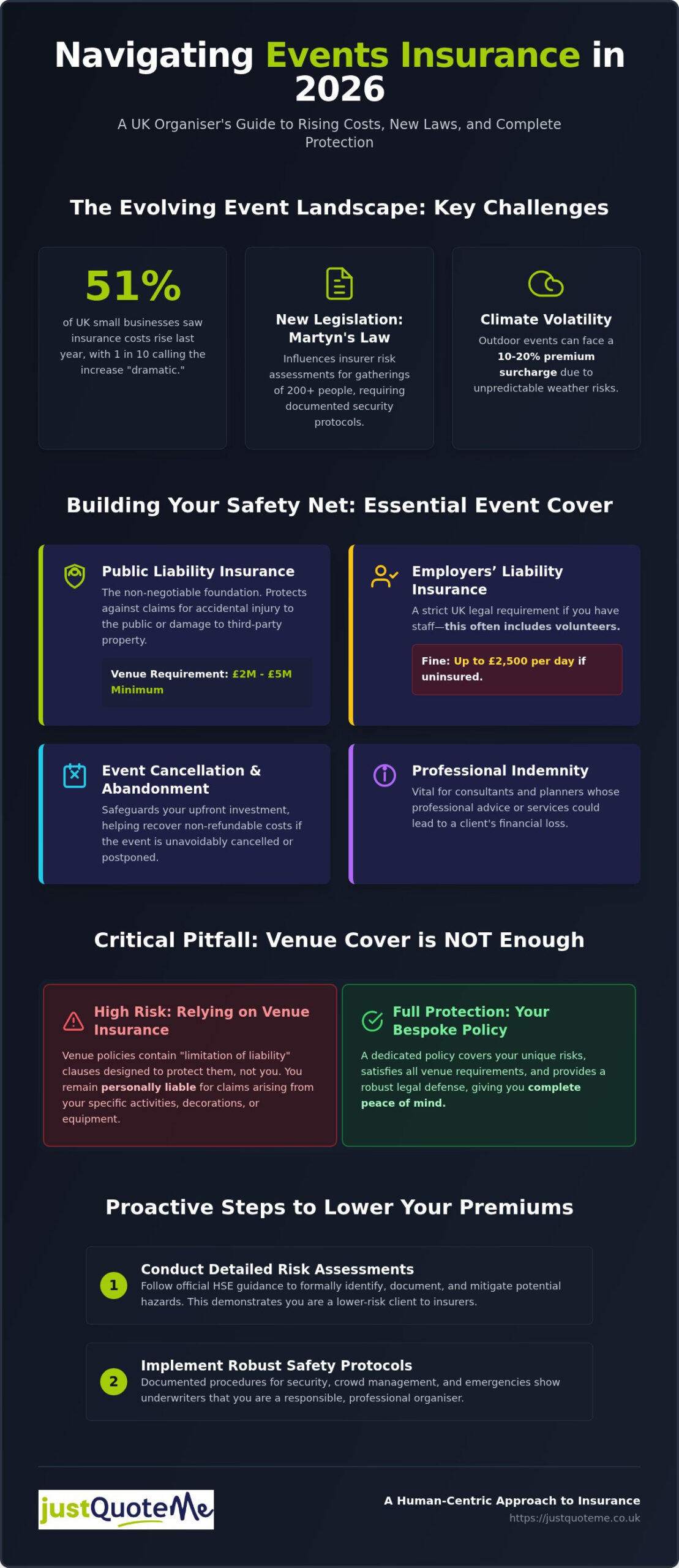
Did you know that 51% of UK small businesses reported an increase in their insurance costs last year, with one in ten describing the rise as dramatic? For event organisers in 2026, the stakes are even higher as the Terrorism (Protection of Premises) Act 2025, known as Martyn’s Law, begins to influence how insurers assess risk for gatherings of 200 people or more. Securing the right Events insurance is no longer just a box-ticking exercise; it’s a vital safeguard against the unpredictable nature of live experiences.
We understand that you’ve likely felt the pressure of meeting strict venue requirements for £5 million in public liability cover or felt lost in a sea of legal jargon. You want to focus on delivering a memorable experience, not worrying about financial ruin from a sudden cancellation or a weather-related disaster. This comprehensive guide provides a clear roadmap to protecting your investment and maintaining full legal compliance. We’ll examine the specific coverage you need to satisfy UK venues, explain how to manage modern security obligations, and show you why a human-centric approach to insurance beats an automated quote every time.
Key Takeaways
- Understand the crucial difference between venue-provided cover and bespoke Events insurance to ensure there are no gaps in your legal protection.
- Identify the mandatory legal requirements for public and employers’ liability that protect your staff, volunteers, and the public.
- Determine whether a single-event policy or an annual multi-event plan offers the best value for your specific 2026 event calendar.
- Discover how implementing detailed safety protocols and risk assessments can lead to more favourable insurance terms and lower premiums.
- Experience the benefits of a human-centric approach by partnering with a local broker who understands the West Midlands and Staffordshire event landscape.
What Is Events Insurance and Why Is It Essential in 2026?
Think of Events insurance as a multi-layered safety net designed to catch the financial fall when things go wrong during the planning or execution of a gathering. In the UK, these policies are governed by the Financial Conduct Authority (FCA), ensuring that the coverage you purchase meets rigorous standards of fairness and transparency. As we move through 2026, the necessity of this protection has never been clearer. Organisers now contend with climate volatility that can lead to a 10-20% premium surcharge for outdoor events, alongside a heavy reliance on digital infrastructure where a single technical glitch can halt an entire production.
The regulatory environment has also evolved significantly. The Terrorism (Protection of Premises) Act 2025, often called Martyn’s Law, now influences how insurers evaluate event safety. While full enforcement is a phased process, insurers in 2026 increasingly require documented risk assessments and security protocols before they will offer a quote. This shift moves Events insurance from a simple administrative task to a core component of your strategic planning and risk management.
The Core Risks Covered by a Standard Policy
A standard policy acts as a shield against three primary threats that could otherwise end a professional career or bankrupt a small organisation. First, it addresses accidental injury to attendees or physical damage to the venue. Second, it provides a recovery mechanism for financial losses caused by unavoidable cancellations, such as the sudden illness of a headline speaker or extreme weather events. Finally, it protects the physical assets you rely on, covering theft or damage to hired-in goods and essential event equipment like sound desks, lighting rigs, or staging.
Why Venue-Only Cover Is Rarely Enough
Relying on a venue’s own insurance is a common but dangerous mistake. Most venue contracts include strict “limitation of liability” clauses. These legal terms ensure the venue is protected, but they often leave the organiser personally responsible for third-party accidents occurring within the hired space. If a visitor is injured by your specific activities, decorations, or equipment, the venue’s policy won’t step in to help you defend a claim.
This is why public liability insurance is the foundation of any responsible organiser’s toolkit. By understanding public liability as a legal concept, you can better appreciate why most UK venues now mandate a minimum of £2 million in coverage, with many council-managed sites requiring £5 million. Without your own bespoke policy, you are essentially operating without a safety harness in an increasingly litigious environment where the organiser is the first point of contact for any legal dispute.
Key Components of Comprehensive Event Cover
Building a policy for your 2026 event is about layering protections that match your specific risk profile. While Public Liability is the non-negotiable starting point for any public gathering, a comprehensive Events insurance package goes much further to ensure you aren’t left exposed. A robust policy typically includes several core pillars:
- Public Liability: Protects against claims for accidental injury to the public or damage to third-party property.
- Event Cancellation and Abandonment: Safeguards your upfront investment, helping you recover non-refundable costs if the event cannot proceed.
- Professional Indemnity: Vital for consultants and planners whose professional advice could lead to a client’s financial loss.
To ensure your policy is valid and your premiums remain competitive, following Risk Assessment guidance from the HSE is essential. Demonstrating that you have identified and mitigated potential hazards makes you a much more attractive prospect for underwriters.
Legal Obligations: Employers’ Liability
In the UK, if you have anyone working under your direction, you likely need employers liability insurance. This is a strict legal requirement with a minimum limit of £5 million. Crucially, many organisers don’t realise that volunteers often count as employees under UK law. Failing to have this cover can result in fines of up to £2,500 for every day you are uninsured. It’s a risk that simply isn’t worth taking, as the legal costs of a single injury claim could easily exceed the total budget of a small event.
Specialist Add-ons for High-Risk Events
Modern events often involve complex logistics that require targeted extensions. For example, if your crew is involved in stage builds or rigging, you must account for working at height risks. Outdoor festivals and markets should consider adverse weather cover to protect against rain-soaked cancellations or wind-related safety closures. Additionally, as ticketing moves entirely online, cyber liability has become a priority for protecting attendee data and digital revenue streams. These add-ons ensure that your coverage is as bespoke as the event you are hosting.
If you’re unsure which specific components your gathering requires, you can speak with our team for a tailored review of your risk profile.
Choosing Your Policy: Single Event vs. Multi-Event Cover
Selecting the right structure for your Events insurance depends entirely on the rhythm of your calendar. While a community fete organiser might only need protection for a single Saturday in July, a professional planner managing a series of corporate launches or regional markets requires a more robust, permanent solution. Choosing correctly doesn’t just save money; it removes the administrative headache of reapplying for cover every time you book a venue.
One-Off Event Insurance: Pros and Cons
One-off policies are the go-to choice for specific, high-value dates like weddings, landmark birthday parties, or one-time charity fundraisers. The primary advantage is the lower upfront cost, as you only pay for the exact duration of your event. It’s a simple, accessible application process designed for non-professionals who don’t need year-round protection. However, the trade-off is a higher per-event premium. If you find yourself organising more than three gatherings a year, the costs of individual policies quickly stack up, often exceeding the price of a single annual plan.
Annual Event Insurance for Professionals
For those who make a living from live experiences, annual Events insurance provides continuous cover across multiple dates and locations. This is particularly efficient for business owners who already hold tradesman insurance for their day-to-day operations but frequently run promotional events or trade stands. An annual policy offers blanket cover for a diverse range of event types, meaning you don’t need to notify your broker every time a new booking arises. It ensures you are always contract-ready when a venue asks for proof of indemnity at short notice.
Finding the Break-Even Point
Calculating when to switch from single to annual cover is a matter of simple arithmetic. In the current 2026 market, the break-even point typically occurs when you host four or more events annually. Beyond this threshold, the administrative time spent managing separate policies usually outweighs any perceived savings. We recommend reviewing your projected 12-month schedule before committing. If your plans are fluid, an annual policy provides the flexibility to scale your activities without the constant fear of an insurance gap. It’s about buying time as much as it is about buying protection.
Risk Assessment: How to Lower Your Insurance Premiums
Insurers don’t just pull numbers out of thin air. They base your Events insurance premium on the likelihood of a claim. By demonstrating robust safety protocols, you provide evidence that your gathering is a low-risk venture. This proactive approach often leads to more competitive pricing and better terms. Detailed plans for fire safety and crowd control are essential. They show the underwriter that you’ve considered every possible scenario, from a kitchen fire to a sudden surge at the main stage.
Documenting your “duty of care” is your best defence against future legal action. If an attendee makes a claim months after the event, your contemporaneous records prove you took all reasonable steps to ensure their safety. Without this paper trail, defending a liability claim becomes significantly harder and more expensive. It’s about being prepared before the first guest even arrives.
The Essential Event Risk Assessment Checklist
Start with the basics. Identify common trip hazards like trailing cables or uneven flooring. Ensure all electrical equipment has valid PAT testing certificates. For outdoor Staffordshire events, weather contingency planning is vital. You need clear triggers for when high winds or heavy rain make a structure unsafe. Medical provision is another key factor. Having a dedicated first aid station and trained responders reduces the severity of potential incidents, which insurers view favourably.
Leveraging Professional Security
Hiring SIA-licensed staff is a powerful way to mitigate liability. These professionals are trained in conflict resolution and crowd dynamics, which prevents small issues from escalating into major claims. If your event involves hospitality, managing alcohol-related risks is paramount. Security teams help enforce “Challenge 25” policies and manage intoxicated guests before they cause damage or injury.
Ensure your security provider has their own security insurance in place. This prevents a “grey area” where you might be held liable for the actions of a contractor. Maintaining a detailed incident log is also a requirement for most policies. This log should record every intervention, no matter how minor, providing a clear timeline if a claim eventually arises. Accurate record-keeping is often the difference between a dismissed claim and a costly settlement.
To see how your safety measures impact your costs, get a bespoke quote from our expert team today.
Why a Local Staffordshire Broker Is Your Best Event Partner
While global ticketing platforms and automated comparison engines offer convenience, they often lack the regional nuance required for successful UK event planning. Securing Events insurance through a local broker provides a level of security that an algorithm simply cannot replicate. Just Quote Me stands as a human-centric alternative to faceless systems, offering 30 years of industry experience rooted in the West Midlands and Staffordshire. We act as a steady hand in a complex market, ensuring your specific risks are covered without the bloat of unnecessary premiums.
An independent broker acts as your advocate. We don’t just sell you a policy; we ensure you only pay for the specific cover your gathering requires. Whether you’re hosting a street food festival in a town centre or a corporate retreat in the countryside, our bespoke brokerage model identifies gaps that generic policies often miss. If the unthinkable happens and you need to make a claim, you won’t be directed to a generic call centre. You’ll have direct access to an independent expert who understands your business and manages the administrative burden on your behalf.
Expert Advice for Staffordshire Organisers
Navigating the specific requirements of local authorities in Stone, Stafford, or Newcastle-under-Lyme can be complex. Each council often has its own set of expectations regarding public liability limits and safety documentation. Our team understands these regional nuances, helping you meet local compliance standards without delay. We also recognise the unique risks associated with our area, from the logistical challenges of rural events to the security considerations of town-centre gatherings. Having a local office means we are available for face-to-face consultations, providing a steady hand in a complex market.
Get Your Bespoke Quote Today
Our goal is to simplify the administrative side of your planning process. By handling the complexities of policy wording and insurer negotiations, we free you up to focus on the creative and operational aspects of your event. The Just Quote Me promise is built on being professional, efficient, and straightforward. We provide the specialized knowledge you need to protect your reputation and your investment. Let us manage the paperwork so you can manage the experience.
Get Your Free Business Insurance Quote now
Securing Your Event’s Legacy and Financial Future
Organising a successful gathering in 2026 demands a proactive approach to risk. From meeting the strict public liability demands of local councils to navigating the security requirements of Martyn’s Law, your choice of Events insurance is the foundation of your professional reputation. We’ve explored how a robust risk assessment and the right policy structure can protect your investment while keeping premiums manageable.
Don’t leave your hard work to chance or a faceless automated system. Just Quote Me is an FCA-authorised independent broker with over 30 years of industry experience. Our human-centric team provides the expert advice you need to feel fully informed and secure in your choices. We manage the complex administrative burdens so you can focus on delivering an exceptional experience for your attendees.
Get Your Free Business Insurance Quote now
Request a Call back for free Expert advice
Your event deserves a partner that understands the Staffordshire landscape as well as you do. Let’s make your next project a secure success.
Frequently Asked Questions
Do I legally need insurance for a small community event?
You aren’t legally required to have insurance for every small gathering, but most UK venues and local councils won’t allow you to proceed without it. It acts as a safety net against claims for injury or property damage. Even for a small community fete, the financial risk of a single accident makes Events insurance a practical necessity for any responsible organiser.
What is the minimum level of Public Liability insurance for UK events?
Most private venues in the UK require a minimum of £2 million in Public Liability cover. However, if you’re using council-owned land or public spaces, the requirement frequently increases to £5 million. You should always verify the specific limit mentioned in your venue hire contract before purchasing a policy to ensure you meet their compliance standards.
Does event insurance cover cancellation due to bad weather?
Cancellation cover for bad weather is available but typically functions as a specific add-on for outdoor gatherings. It protects your investment if extreme conditions, such as high winds or flooding, make the event unsafe to continue. Because weather risks are higher for festivals or markets, insurers often apply a premium surcharge of 10% to 20% for these outdoor policies.
How far in advance should I buy my events insurance policy?
You should purchase your policy as soon as you sign a venue contract or pay non-refundable deposits to suppliers. Buying early ensures your cancellation and abandonment cover is active from the moment you are financially committed. Waiting until the week of the event leaves your initial investments unprotected against unforeseen circumstances that might occur during the planning phase.
Can I get insurance for a wedding or private party?
Yes, you can secure bespoke cover for weddings, landmark birthdays, and private celebrations. These one-off policies protect your financial deposits against supplier insolvency and provide essential liability cover if a guest is injured or the venue is damaged. It’s a straightforward way to gain peace of mind for high-value personal milestones without needing a complex annual business policy.
Does my venue insurance cover my exhibitors and performers?
Venue insurance generally only protects the property owner and their own employees. It doesn’t extend to your specific activities, exhibitors, or performers. As the organiser, you’re responsible for your own liability risks. You should also ensure that any third-party exhibitors or contractors have their own valid insurance to prevent a gap in protection for the overall event.
What happens if a volunteer gets injured at my event?
If a volunteer is injured, you’ll rely on your Employers’ Liability insurance to cover legal costs and compensation. Under UK law, volunteers are frequently classified the same as paid employees regarding health and safety. This makes holding a policy with a minimum £5 million limit a legal requirement for most organisers who use any form of help.
Is equipment hire covered under a standard event policy?
Standard policies focus on liability, so you often need a specific extension for equipment hire and hired-in goods. This ensures that expensive items like sound systems, lighting rigs, or marquees are protected against accidental damage, loss, or theft. Including this in your Events insurance package prevents you from being personally liable for the high replacement costs of professional event technology.
