

In 2026, simply renewing your fleet policy without a proactive strategy is effectively a voluntary tax on your business’s profit margins. We understand that rising premiums are putting immense pressure on UK firms, especially when you’re trying to manage the risks associated with younger drivers or the administrative headache of multiple claims across a large number of vehicles. If you’re wondering how to reduce fleet insurance costs while maintaining the level of protection your business needs, you aren’t alone. It’s a common challenge that requires more than just a quick comparison search; it demands a shift toward smarter risk management and expert negotiation.
This guide provides a clear roadmap to help you navigate the current market with confidence. You’ll discover actionable strategies, from leveraging telematics data to refining your driver training programmes, all designed to make your fleet more attractive to underwriters. We’ll also share professional brokerage insights that simplify the renewal process and ensure you aren’t overpaying for unnecessary coverage. It’s about finding a partner who manages the administrative burden so you can focus on your operations. Just Quote Me provides tailored advice that transforms your bottom line. By the end of this article, you’ll have the tools to improve your safety records and secure a more sustainable, cost-effective future for your fleet.
Key Takeaways
- Understand why Claims Cost Per Vehicle (CCPV) is the critical metric underwriters use to price your risk in 2026.
- Learn how to reduce fleet insurance costs by using telematics and dash cams to provide immediate evidence and improve driver safety standards.
- Identify strategies to eliminate attritional losses, those small, frequent claims that can significantly damage your firm’s profitability.
- Evaluate whether Named Driver or Any Driver policies offer the best balance of operational flexibility and premium savings for your specific fleet.
- Discover the advantage of using an independent broker to access bespoke, off-market rates that automated comparison sites often miss.
Understanding the Mechanics of Fleet Insurance Premiums in 2026
Fleet insurance simplifies your business operations by grouping three or more vehicles under a single policy. Whether you manage a handful of vans or a large logistics operation, this unified approach reduces paperwork and ensures every driver has the necessary legal protection. However, understanding how to reduce fleet insurance costs starts with knowing how underwriters view your risk. In 2026, the market is increasingly focused on technical metrics rather than just vehicle count.
The Shift Toward Data-Driven Underwriting
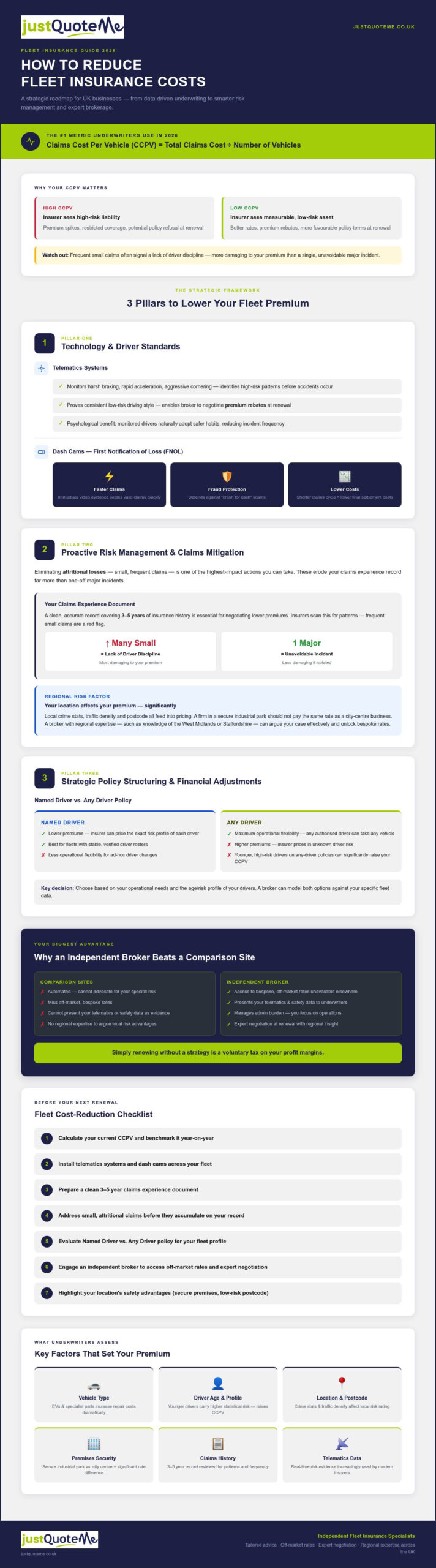
Modern fleet insurance providers no longer rely solely on historical data. They now use real-time insights to refine their pricing. To secure the best rates, you must present a clean, accurate “claims experience” document. This record shows your insurance history over the last three to five years. Insurers look for patterns; frequent small claims often signal a lack of driver discipline, which can be more damaging to your premium than a single, unavoidable major incident. CCPV is the total cost of claims divided by the number of vehicles in the fleet.
Regional Risk Factors: Staffordshire and the West Midlands
Your location plays a massive role in your premium calculation. In areas like Stafford or Newcastle-under-Lyme, insurers look at local crime statistics and traffic density to determine risk levels. High theft rates in specific postcodes can lead to “one-size-fits-all” price hikes from national providers who don’t understand the local landscape.
This is where regional expertise becomes a financial asset. A broker who understands the West Midlands risk profile can argue your case more effectively. They know that a firm based in a secure industrial park in Stone shouldn’t pay the same rate as a business in a high-traffic city centre. By highlighting these local safety advantages, you can find more ways how to reduce fleet insurance costs through a bespoke policy. Just Quote Me to find a policy that recognizes your specific regional advantages and business needs.
Pillar 1: Implementing Technology and Driver Standards
Technology provides the objective evidence underwriters need to justify lower rates. While traditional policies rely on historical averages, modern motor fleet insurance rewards businesses that actively monitor and manage their on-road risk. Implementing telematics and dash cams is one of the most effective ways how to reduce fleet insurance costs because it transforms your fleet from a statistical unknown into a measurable, low-risk asset.
Dash cams play a vital role in this strategy by providing “first notification of loss” (FNOL). They offer several key advantages for your business:
- Immediate video evidence to settle valid claims faster.
- Vigorous protection against fraudulent “crash for cash” scams.
- Significant reduction in the time a claim stays open, which lowers final settlement costs.
By shortening the claims cycle, you protect your claims experience record and prevent long-term premium hikes.
Telematics: Turning Data into Discounts
Telematics systems do far more than track location. By monitoring specific behaviours like harsh braking, rapid acceleration, and aggressive cornering, you can identify high-risk patterns before they result in an accident. Proving a consistent low-risk driving style allows your broker to negotiate premium rebates or better terms at renewal. There is also a psychological benefit; when drivers know their performance is being monitored, they naturally adopt safer habits. This data proves to insurers that you are a proactive partner in risk reduction.
Enforcing Minimum Driving Standards
Data is only useful if it’s backed by a robust Fleet Safety Policy. This document should clearly outline expectations, including a zero-tolerance approach to mobile phone use and speeding. For firms employing younger or less experienced drivers, regular training courses are essential. These programmes help mitigate the higher risks associated with new drivers and demonstrate to underwriters that you take safety seriously.
Automating your administrative checks also protects your business. Using software to conduct regular driving licence checks and monitor convictions ensures you never unknowingly employ an ineligible driver. This level of diligence builds “trust equity” with your insurer. It shows that your business isn’t just reacting to incidents but is actively preventing them. If you’re looking for a partner to help you interpret this data, you can speak with a specialist about structuring your safety policies. Implementing these standards is a proven method for how to reduce fleet insurance costs over time.
Pillar 2: Proactive Risk Management and Claims Mitigation
Managing a fleet involves more than just buying a policy; it requires a strategy to control the variables that drive prices up. While technology provides the data, your internal processes determine how that data is used to protect your bottom line. Proactive risk management is a cornerstone of how to reduce fleet insurance costs because it addresses the human and environmental factors that lead to claims before they escalate.
One of the most effective ways to control costs is by establishing a rapid internal claims reporting process. If a driver has an incident, the clock starts ticking on the final settlement cost. Reporting an accident within hours rather than days allows your broker to step in immediately, preventing third-party credit hire costs and legal fees from spiralling. You should also evaluate your voluntary excess. Increasing the amount your business pays toward a claim can lower your annual premium significantly, provided you maintain a cash buffer for these occasional costs.
The Hidden Costs of Minor Claims
Attritional losses are the small, frequent bumps, such as reversed mirrors or minor scrapes, that many businesses ignore until renewal time. While it’s tempting to claim for every repair, this approach often backfires when your policy comes up for review. Frequent small claims often signal poor management to an insurer, regardless of the total value. Every claim stays on your record for years, affecting your claims experience and reducing your attractiveness to new underwriters. Determining the “tipping point” where it’s cheaper to pay for a £400 repair out-of-pocket rather than losing a much larger premium discount is a vital financial skill for any fleet manager.
Physical Security Measures
Where and how you store your vehicles overnight directly impacts your risk profile. Insurers look favourably on businesses that use gated compounds, monitored CCTV, and high-quality immobilisers. In regional hubs across Staffordshire and the West Midlands, crime trends often target specific vehicle types, making these physical barriers even more essential. For many firms, the vehicle is merely a vessel for expensive equipment. Protecting these assets with specialised van and tools insurance ensures that a break-in doesn’t cripple your daily operations while keeping your main fleet policy clean. Combining secure storage with smart claims management is a practical way how to reduce fleet insurance costs without sacrificing essential protection.
Pillar 3: Strategic Policy Structuring and Financial Adjustments
The way you structure your policy is as important as the safety measures you implement on the road. Many UK firms overpay simply because their policy layout doesn’t reflect their current operational reality. If you’re looking for how to reduce fleet insurance costs, a thorough audit of your driver list and vehicle schedule is the most logical starting point. Start this process 60 to 90 days before your renewal date. This window gives your broker enough time to approach multiple underwriters and leverage your positive data for a better deal.
Choosing between “Named Driver” and “Any Driver” policies involves a direct trade-off between flexibility and cost. While an “Any Driver” policy offers the ultimate convenience, it forces insurers to price for the highest possible risk. Transitioning to a “fleet rated” policy for three or more vehicles is often more efficient than maintaining individual covers; it centralises your administration and allows for a more cohesive risk assessment. Don’t forget to prune your policy regularly. Paying to cover vehicles or drivers that are no longer active is a common but avoidable drain on your budget.
Optimising Your Driver List
Limiting your policy to “Any Driver Over 25” is one of the fastest ways to lower your premiums. Younger drivers statistically carry higher risk, and removing them from the general pool can see immediate financial benefits. For firms that must employ younger staff, naming them on specific vehicles rather than the entire fleet is a smarter strategy. Managing high-risk drivers with existing convictions requires a proactive approach; keeping them away from high-value or powerful vehicles can prevent your overall rate from spiking. You can find more details on structuring these options on our Motor Fleet Insurance page.
Consolidating Coverage for Better Rates
Underwriters often reward loyalty and broader business relationships. Bundling your fleet cover with other essential protections, such as Employers Liability or Public Liability Insurance, can unlock multi-policy discounts. This consolidation simplifies your administrative burden and gives your broker more weight when negotiating with insurers. To get the best results, follow these four steps:
- Audit your drivers to remove those no longer with the business.
- Review your excess levels to ensure they match your risk appetite.
- Consult an independent broker to discuss bespoke market access.
- Compare bespoke quotes rather than relying on automated renewals.
A strategic approach to your policy architecture is a proven method for how to reduce fleet insurance costs. You can request a review of your current policy structure to ensure it’s still fit for purpose and cost-effective.
Why an Independent Broker is Your Best Asset for Fleet Savings
Software and telematics are essential tools, but they don’t negotiate. Understanding how to reduce fleet insurance costs requires a partner who can interpret your safety data and present it effectively to an underwriter. Automated comparison sites often fail because they rely on generic algorithms that can’t account for the nuances of a well-managed UK fleet. They see a postcode or a claim history and apply a flat increase, whereas a bespoke brokerage looks at the context behind those numbers. We act as a human-centric alternative to these automated systems, managing the complex administrative burdens so you don’t have to.
Our established relationships with top UK insurers allow us to access “off-market” rates that are often unavailable through standard aggregators. This access is vital in a shifting 2026 market where standard premiums are rising. By positioning ourselves as your steady hand, we ensure that your renewal process is efficient and your claims are handled with professional restraint. We focus on specialized knowledge rather than generalist appeal, which is why we’re the preferred choice for firms that value reliability and clear communication.
Beyond the Online Quote
A complex fleet requires a tailored risk presentation to secure the best terms. If you’ve invested in dash cams or improved your driver standards as outlined in previous sections, those improvements must be “sold” to the underwriter to justify a lower rate. Just Quote Me brings 30+ years of industry experience to every negotiation. We don’t just pass on a quote; we argue your case. We know which insurers are currently looking for fleet business and which ones understand specific regional risks in the West Midlands. This proactive approach ensures your business is seen as a low-risk partner rather than just another policy number.
Get the Expert Support Your Business Deserves
Our approach is pragmatic and straightforward. We believe in plain, honest communication that simplifies the administrative headache of renewals and claims. As a local service provider with deep roots in Stone and Staffordshire, we offer a level of specialized knowledge that large, impersonal corporations simply can’t match. You can explore more about our regional approach in our Commercial Insurance Broker Staffordshire guide.
By acting as your steady hand during the claims and renewal process, we ensure you never pay more than necessary for essential protection. This is the final, and perhaps most important, piece of the puzzle in how to reduce fleet insurance costs. Combining your internal safety culture with our expert market access creates a sustainable roadmap for lower premiums. We’re here to provide immediate value through free quotes and expert consultations, ensuring your fleet remains a productive asset for your business.
Secure a More Cost-Effective Future for Your Fleet
Navigating the 2026 insurance market requires more than just a standard renewal process. By integrating the data-driven technology and safety standards we’ve explored, your business can actively influence its risk profile. Understanding how to reduce fleet insurance costs is a continuous process of refinement, from auditing your driver list to consolidating your coverage with a trusted partner. These proactive steps ensure your business remains resilient against rising market rates and complex claims scenarios.
Just Quote Me offers a human-centric alternative to impersonal automated systems. With 30+ years of industry experience as an independent UK broker based in Staffordshire, we provide the expert guidance needed to simplify complex administrative tasks. We manage the details so you don’t have to, ensuring your fleet protection is both robust and cost-effective. We’re here to help you move from information to action with straightforward, reliable advice that supports your business’s bottom line.
For those seeking a broader perspective on risk management, you can explore Insurance Advisory and Brokerage Services to see how comprehensive security and advisory solutions can further protect your company’s assets.
Get Your Free Business Insurance Quote now
Request a Call back for free Expert advice
Frequently Asked Questions
How many vehicles do I need to qualify for fleet insurance?
You typically need a minimum of three vehicles to qualify for a business fleet policy. This unified approach allows you to cover cars, vans, or HGVs under one renewal date. It’s often more cost-effective than managing individual policies for every vehicle. Some specialist insurers may offer mini-fleet options for two vehicles, but three is the standard industry threshold for most commercial providers looking to offer consolidated business rates.
Can I include different types of vehicles (cars, vans, HGVs) on one fleet policy?
Yes, you can include a diverse mix of vehicles such as cars, light commercial vans, and heavy goods vehicles on a single policy. This flexibility is a primary benefit of fleet cover, as it simplifies administrative tasks and ensures consistent protection across your entire operation. It also allows your broker to negotiate a better rate based on the total risk profile of your diverse transport assets rather than pricing each vehicle in isolation.
Does telematics really help reduce my fleet insurance premium?
Telematics helps lower premiums by providing underwriters with objective evidence of safe driving habits. When you can prove that your drivers avoid harsh braking and excessive speed, insurers view your business as a lower risk. This data-driven approach is a key strategy for how to reduce fleet insurance costs because it moves the pricing away from generic regional averages toward your specific, proven performance. It turns your safety data into a tangible financial asset.
What is the best way to manage young drivers on a fleet policy?
The most effective way to manage young drivers is to name them on specific, lower-powered vehicles rather than including them in an “Any Driver” pool. Restricting younger employees to vehicles fitted with telematics and dash cams also provides an extra layer of accountability. This targeted approach helps mitigate the higher premiums typically associated with less experienced staff while maintaining the operational flexibility your business requires for day-to-day tasks.
Is it cheaper to have a high excess on a fleet policy?
Opting for a higher voluntary excess will reduce your annual premium because you’re taking on more of the initial financial risk. However, it’s important to balance these upfront savings against the potential cost of multiple claims in a single year. You should ensure your business has sufficient cash flow to cover these higher excess payments if several minor incidents occur within a short timeframe, as this affects your total cost of ownership.
What happens if I don’t report a minor fleet accident to my insurer?
Failing to report a minor accident, even if you intend to pay for repairs out-of-pocket, can lead to your insurer rejecting future claims or cancelling your policy. Most contracts require you to disclose all incidents regardless of fault. Late reporting also allows third-party costs, such as credit hire fees, to escalate. This ultimately harms your claims experience record and increases your long-term insurance costs when your policy is reviewed at renewal.
How often should I review my fleet insurance policy?
You should review your policy at every annual renewal, but the preparation should begin at least two to three months before your current cover expires. This timeframe allows you to audit your driver list and update your vehicle schedule. Regular reviews ensure your policy still matches your operational needs and provides an opportunity to discuss how to reduce fleet insurance costs with your broker based on your latest safety data and risk management improvements.
Can an independent broker find better rates than a comparison site?
Independent brokers often secure better rates than comparison sites because they have access to bespoke schemes and specialist underwriters not available to the general public. Unlike automated algorithms, a broker can present the context of your risk management efforts directly to an insurer. This personalized negotiation often results in more competitive premiums and tailored coverage that better reflects the specific needs and safety standards of your business, providing a more reliable long-term solution.
