

Could the insurance protecting a landlord’s property leave the letting agency exposed? It can. If you’re asking what insurance does a letting agent require, the answer depends on the work you do, where in the UK you operate, whether you employ staff and whether you handle client money.
It’s easy to confuse landlord insurance with cover for the agency itself. Landlord insurance is designed for the property owner’s risks; it won’t automatically protect your business if a client alleges negligent advice, someone is injured during a viewing or an employee makes a claim. Client Money Protection is separate from insurance and may apply depending on where you operate and whether you hold client money.
This guide separates legal obligations from scheme, membership and contractual conditions, as well as cover that may be prudent for your operation. You’ll see how Employers’ Liability, Professional Indemnity and Public Liability can fit different agencies, and what to review before arranging or renewing cover. Just Quote Me is an FCA-authorised independent broker with over 30 years of industry experience, helping property businesses match insurance to their activities and contractual obligations.
Key Takeaways
- To assess what insurance does a letting agent require, distinguish legal duties from scheme rules, contract terms and prudent business protection.
- Match potential cover to your agency’s activities, including advice, property access, staffing and handling client money.
- Keep letting-agent cover separate from the landlord’s protection: an agency policy does not automatically insure the property or rental income.
- Before arranging or renewing cover, map your services, staff, premises, client money, contracts and data handling, then check current requirements for your UK jurisdiction.
- A specialist broker can help align insurance with your agency’s operations and contractual obligations.
What insurance does a UK letting agent require? Start with the three types of requirement
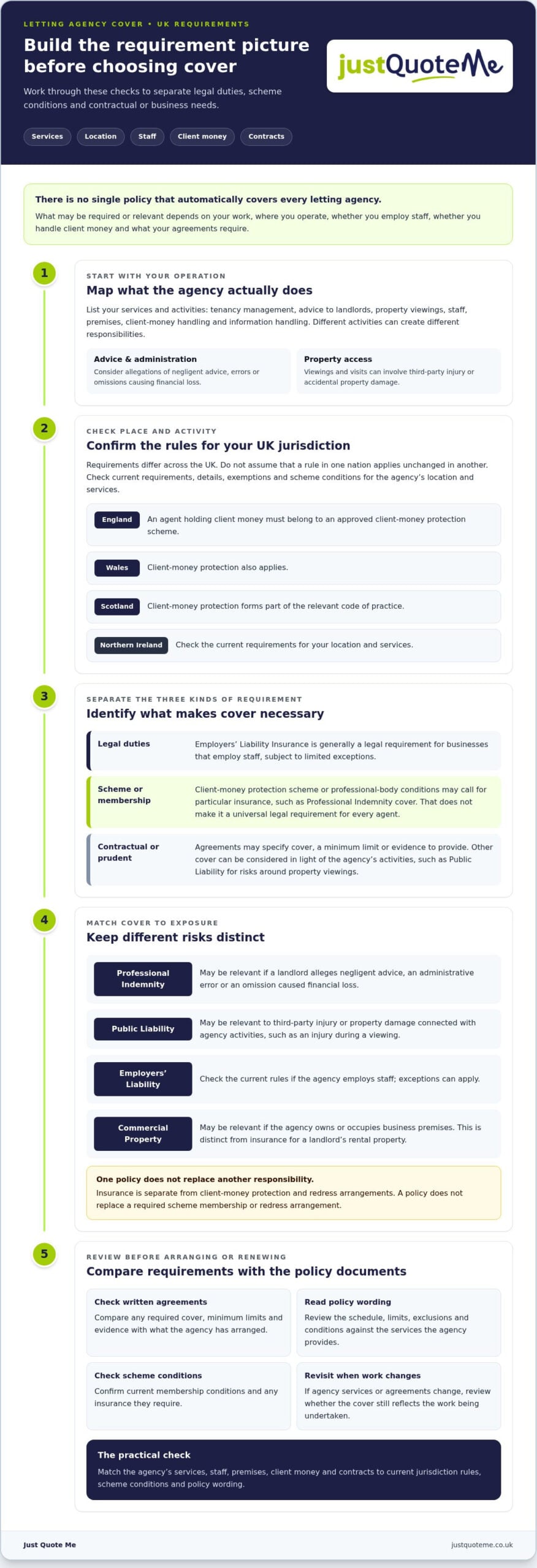
No single policy automatically covers every letting agency or every UK jurisdiction. The answer to what insurance does a letting agent require depends on its services, staff, premises, handling of client money and contractual commitments. A letting agent may find that different parts of its work create different responsibilities, so start by separating three kinds of requirement:
- Legal requirements: duties imposed by law. For example, Employers’ Liability Insurance is generally a legal requirement for businesses that employ staff, subject to limited exceptions.
- Scheme or membership requirements: conditions attached to a client-money protection scheme or professional-body membership. These may require particular insurance, such as Professional Indemnity cover, without making that cover a universal legal requirement for every agent.
- Contractual conditions and prudent protection: cover specified in an agreement, or protection selected to address risks arising from the agency’s work. Public Liability Insurance may be relevant to activities such as property viewings. Public Liability Insurance can be considered as part of a tailored business insurance review.
Insurance is not the same as client-money protection or a property redress arrangement. These are separate compliance matters. A policy may help respond to certain insured claims, subject to its terms, but it does not replace a required scheme membership or redress arrangement.
What can make insurance a legal or scheme requirement?
Location and activity both matter. In England, an agent holding client money must belong to an approved client-money protection scheme. The requirements differ across the UK: client-money protection also applies in Wales, while in Scotland it forms part of the relevant code of practice. Details, exemptions and scheme conditions can change, so check current rules separately for England, Wales, Scotland and Northern Ireland. Don’t assume a requirement in one nation applies unchanged in another.
Redress arrangements should also be checked as a separate obligation rather than treated as insurance. Confirm which rules apply to the agency’s location and services, and review any scheme’s current membership conditions. Those conditions may affect the cover the agency needs to maintain.
When can a contract or client require specific cover?
A landlord, property-management client or supplier may set insurance conditions in a written agreement. It could specify a type of cover, a minimum limit or evidence the agency must provide. These are contractual conditions, not automatically legal requirements. Read the wording carefully and compare it with the policy schedule, limits, exclusions and conditions. If the agency’s services or agreements change, review the cover so it continues to reflect the work being undertaken.
Which insurance policies can protect a letting agency’s day-to-day work?
The right cover depends on what your agency actually does. Managing tenancies, giving landlords advice, arranging viewings, employing staff and holding tenant information can each create different exposures. No policy should be assumed to cover every risk: check the wording, limits, exclusions and conditions against your agency’s activities.
When might professional indemnity or public liability be relevant?
Professional Indemnity Insurance may be relevant if a landlord alleges that negligent advice, an administrative error or an omission caused financial loss. For example, a client might claim that an agency failed to pass on important tenancy information or made an error while handling a management task. Whether a claim is covered depends on the policy’s terms and circumstances.
Public Liability Insurance addresses a different type of allegation: third-party injury or property damage connected with the agency’s activities. If a prospective tenant is injured during a viewing, or an agent accidentally damages a client’s property while attending a home, this cover may be relevant. It doesn’t replace Professional Indemnity Insurance, because an injury or damage claim differs from an allegation of professional error. Explore Professional Indemnity Insurance as part of assessing your agency’s professional risks.
These examples illustrate possible exposures, not guaranteed claims outcomes. Policy definitions, exclusions and limits vary, so read the documents carefully and consider how they apply to the services you provide.
Do staff, premises or tenant data change the insurance picture?
Yes. If your agency employs staff, Employers’ Liability Insurance is generally a legal requirement for almost all UK employers, although exceptions can apply. Check the current rules for your circumstances and jurisdiction. Employee numbers and working arrangements also help describe the agency’s operations when assessing insurance needs.
Consider your premises and information handling too. Commercial Property Insurance may be relevant if the agency owns or occupies business premises, with the appropriate cover depending on the property and what the business needs to protect. It’s distinct from insurance for a landlord’s rental property.
Letting agencies may store or process personal and financial information about landlords and tenants. Cyber Liability Insurance could be relevant to those operations, particularly where the business relies on digital systems to manage records or communicate with clients. Review what information you hold, how it is handled and the policy terms rather than assuming cyber cover responds to every data-related incident.
To make the assessment practical, list your services, staff arrangements, premises and data handling, then match each exposure to the cover under consideration. Just Quote Me can help you consider insurance options in light of your agency’s activities and contractual obligations.
Letting-agent insurance versus landlord insurance: what is the difference?
Letting-agent insurance protects the agency’s business risks. Landlord insurance is arranged for the property owner’s interests. They serve different purposes, and one policy shouldn’t be assumed to protect both parties. The agency’s cover won’t automatically insure a landlord’s building or rental income, while the landlord’s policy shouldn’t be treated as cover for the agent’s professional or operational liabilities.
Who insures the building, rental income and agency operations?
The key question is whose interest is being insured. A landlord may need cover relating to a rental property and their own financial exposure. The agency may need cover for its professional services, staff, premises or other business activities. The policyholder, insured parties and insured interests should reflect the actual arrangement. Review the policy documents and management agreement together so responsibilities are clear.
| Area | Letting agency | Property owner |
|---|---|---|
| Who arranges the cover? | The agency arranges insurance for its business risks. | The owner arranges insurance for their property interests. |
| What is insured? | Depending on the policy, the agency’s professional or operational exposures. | Depending on the policy, the rental property and the owner’s relevant interests. |
| Examples of exposure | Alleged errors in management or administration, or incidents connected with agency activities. | Risks associated with owning and letting the property, including the building or rental income where the policy provides for them. |
This distinction matters even when the agent handles much of the day-to-day work. The owner’s property insurance remains separate from insurance for the agency’s business. For property-owner cover, see Just Quote Me’s residential letting insurance.
How do property-management services affect cover?
An agency that only introduces tenants may have a different risk profile from one that collects rent, manages ongoing tenant communication or arranges maintenance. These activities describe the work the agency actually performs and should be disclosed accurately when arranging or renewing its business insurance. If the service changes, review the insurance details too.
For example, coordinating a repair involves different tasks from collecting rent or handling tenancy administration. Describing the agency’s full role helps assess relevant cover, but it doesn’t mean a policy will respond to every claim. The wording, exclusions and limits still determine what’s insured. Keeping the owner’s property arrangements distinct from the agency’s business cover makes it easier to identify gaps and avoid relying on the wrong policy when considering what insurance does a letting agent require.
How should a letting agent check insurance requirements before arranging cover?
A clear review starts with the agency’s actual work, not a standard package. To decide what insurance does a letting agent require, separate legal and scheme checks from the process of choosing insurance. Requirements can vary by UK nation and by whether the agency employs staff or handles client money, so verify the current rules that apply to your circumstances before relying on a policy to meet them.
What information should an agency prepare?
Use this checklist to build a practical picture of the business before arranging or renewing cover:
- Map your services. Record whether you find tenants, manage properties, collect rent, arrange maintenance or provide other services, along with the types of property you handle.
- Review staffing. Note your employees and working arrangements, then check current Employers’ Liability duties and any exceptions relevant to your business.
- Describe your premises. Identify business premises you own or occupy and the property or business assets you may need to insure.
- Set out client-money arrangements. Record whether you handle money belonging to landlords or tenants. Separately verify current client-money protection rules and scheme conditions for each relevant UK nation.
- Gather contracts and membership terms. Check agreements with landlords, suppliers and property-management clients, as well as any applicable scheme or professional-body requirements. Note insurance types, limits and evidence they specify.
- Review data handling. Consider the personal and financial information you store or process, and how your agency uses it.
This information helps distinguish what the agency must do under applicable law or scheme rules from cover selected to protect its business. Don’t assume that meeting one obligation automatically satisfies another.
How can a broker help assess the right cover?
A broker can use the agency’s declared activities and contractual conditions to help assess relevant policy options. Be accurate and specific: if you collect rent or arrange repairs as part of property management, include those tasks in the description of your work. Just Quote Me is a UK independent insurance broker with over 30 years of industry experience, offering tailored guidance for property-related businesses.
Before accepting or renewing a policy, read its definitions, exclusions, excesses, limits and claim-notification conditions. Check that the wording reflects the work you described, and compare any limits with written contract or scheme requirements. There isn’t one standard limit or policy that suits every agency, and cover remains subject to the policy terms.
If professional advice or administration is part of your work, explore Professional Indemnity Insurance options as part of your review.
Get tailored letting-agent insurance guidance from Just Quote Me
There isn’t one insurance answer for every agency. What insurance does a letting agent require depends on its UK jurisdiction, the services it provides, its staff and premises, how it handles client money, and the conditions in its contracts or scheme memberships. Keep those details together when reviewing cover, so the discussion reflects how your business operates rather than a generic agency profile.
What to expect when discussing cover
A useful insurance discussion starts with the practical details: whether you arrange tenancies, manage properties, collect rent or coordinate maintenance; whether you employ staff; what premises you use; and what written agreements or scheme rules say about cover. Sharing these details helps relate potential policy options to your actual activities and obligations.
Just Quote Me is a UK independent insurance broker with over 30 years of industry experience and FCA authorisation. Its tailored approach can help you consider relevant business insurance in light of your agency’s work and contractual requirements. The final cover depends on the policy wording and insurer’s terms, including definitions, exclusions, limits and conditions. Review those documents carefully before deciding whether the cover meets your needs.
Choose a practical next step
Prepare a short summary of your services, staffing, premises, client-money arrangements and contractual requirements. Then choose the route that suits you: start with an online quote, or request a callback if you’d prefer to discuss your questions.
Take the next step towards suitable agency cover
There’s no single answer to what insurance does a letting agent require. Your needs depend on the services you provide, your UK jurisdiction, staff and premises, client-money arrangements and any scheme or contract conditions. Keep legal and scheme checks separate from policy selection, and make sure the cover reflects your agency’s actual work. Landlord insurance is also distinct: it protects the property owner’s interests, not automatically the agency’s operations.
Just Quote Me is an FCA-authorised independent UK insurance brokerage with over 30 years of industry experience. Its tailored approach and access to a network of UK insurers can help you consider options that fit your business activities and contractual obligations. Prepare a summary of your services and requirements, then take a practical next step.
Get Your Free Business Insurance Quote now, or Request a Call back for free Expert advice. With a clear picture of your risks and obligations, you can move forward with greater confidence.
Frequently Asked Questions
What insurance is legally required for a letting agent in the UK?
There isn’t one insurance requirement that applies to every letting agent across the UK. Employers’ Liability Insurance is generally legally required for almost all employers, subject to limited exceptions. Client-money protection and property redress arrangements are separate from insurance, and their rules can differ between England, Wales, Scotland and Northern Ireland. Check current requirements for each relevant nation and your agency’s activities before treating a policy or scheme as legally mandatory.
Do letting agents need Professional Indemnity Insurance?
Professional Indemnity Insurance can be relevant if a client alleges that negligent advice, an error or an omission caused financial loss. Whether it’s required depends on the agency’s circumstances, any applicable scheme or membership conditions, contracts and current rules. Even if it isn’t mandatory for your agency, consider it in light of the services you provide. Review the policy definitions, exclusions and conditions, as the policy name alone doesn’t establish what’s covered.
Do letting agents need Public Liability Insurance?
Public Liability Insurance may be useful if agency activities could cause injury to a third party or damage their property. For example, an accident during a property viewing could lead to an injury allegation. This differs from Professional Indemnity Insurance, which relates to allegations such as negligent advice or errors causing financial loss. A client or contract may specify Public Liability cover, so consider your activities and review the policy terms and conditions.
Is client-money protection the same as insurance?
No. Client-money protection and insurance are separate arrangements. Whether your agency must join a client-money protection scheme depends on its location, activities and the current rules that apply. Insurance does not automatically satisfy a scheme requirement, and scheme membership doesn’t remove the need to assess the agency’s other business risks. Check the relevant nation’s current requirements and scheme conditions, particularly if your agency holds money for landlords or tenants.
Does a letting agent need Employers’ Liability Insurance?
Employers’ Liability Insurance is generally a legal requirement for almost all UK employers, so a letting agency that employs staff should check how the duty applies to its circumstances. Limited exceptions may apply, and staffing arrangements can affect the assessment. This cover is distinct from Public Liability and Professional Indemnity Insurance. Review the current requirements and any applicable exceptions, then make sure the policy reflects the agency’s employment arrangements.
Does a letting agent need landlord insurance?
A letting agent’s business insurance and a landlord’s insurance protect different interests. An agency policy doesn’t automatically insure the landlord’s building, rental income or other property-owner risks. The landlord should assess cover for their property and circumstances, while the agency considers its professional and operational exposures. If an agent manages a property, clearly describe those activities when arranging agency cover, but don’t assume either party’s policy automatically protects the other.
Are letting-agent insurance requirements the same across the UK?
Not necessarily. Insurance duties and related property-management rules may differ between England, Wales, Scotland and Northern Ireland. Client-money protection and redress arrangements should be checked separately for each nation where the agency operates. If your business works across borders, don’t assume that meeting requirements in one part of the UK covers all operations. Verify current legal duties, scheme rules and any relevant membership conditions for each area.
