

The headline limit is only one factor in whether employee theft is covered. Fidelity guarantee insurance for employee theft can protect a business against losses caused by an employee’s dishonest or fraudulent acts, but the policy wording sets the boundaries. Some insurers also make cover conditional on the firm’s accounts being independently certified or audited each year.
Look beyond the insured amount: the definition of theft, exclusions and deductible can all affect what the policy pays after a loss. A cover limit does not automatically mean every incident or every pound of loss is covered.
This guide explains how fidelity guarantee insurance terms work, what cover for employee theft, counterfeit money and stolen funds may mean, and how sums insured and deductibles apply. It also explains why employee dishonesty differs from external fraud, and what to consider when assessing cover for your business.
Key Takeaways
- Understand why policy definitions, conditions and exclusions can matter as much as the headline limit when employee dishonesty causes a loss.
- Learn how cover for counterfeit money and stolen cash or securities differs from protection against other types of fraud.
- See how a standalone bond or commercial crime policy may sit alongside professional indemnity cover, and what kinds of losses each is designed to address.
- Assess how the sum insured and deductible affect a claim, including why the limit structure matters for firms subject to specific cover requirements.
How are insurers altering their FGI cover?
Insurers define who is covered, what counts as theft and how claims must be reported. The policy wording determines whether a loss falls within the cover.
Employee Theft Cover Scope
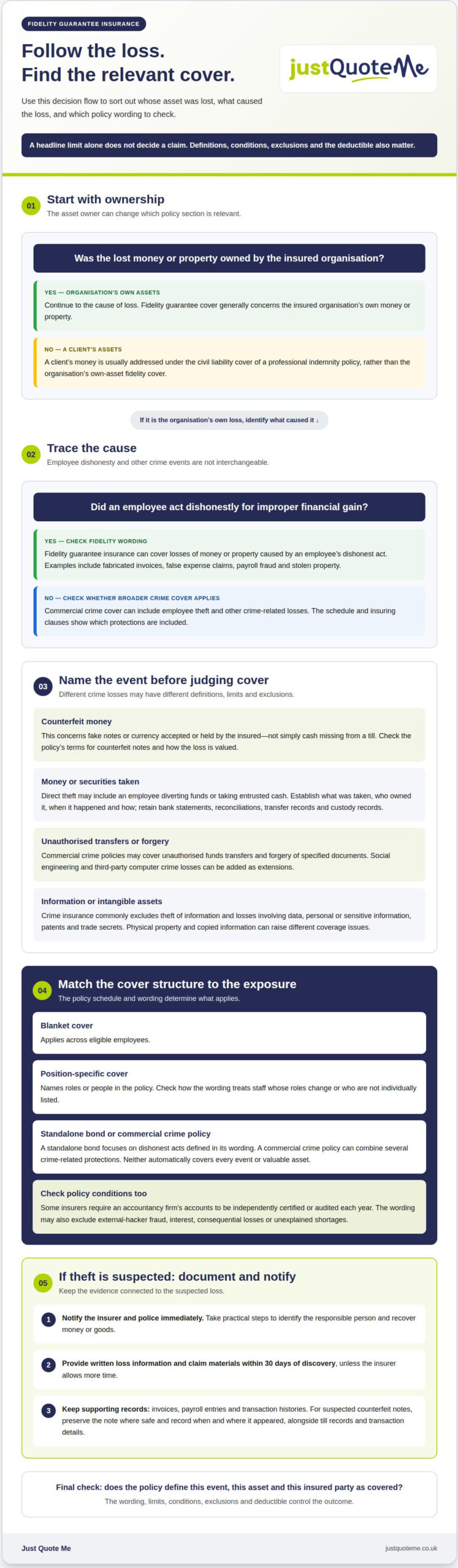
Fidelity guarantee insurance covers losses of money or property caused by an employee’s dishonest act for improper financial gain. Examples include fabricated invoices, false expense claims, payroll fraud and stolen property. It generally protects the organisation’s own assets; theft of a client’s money is usually addressed under the civil liability cover of a professional indemnity policy. Crime insurance is a broader category that can include employee theft and other crime-related losses.
Blanket and Position-Specific Cover
Blanket cover applies across eligible employees, while position-specific cover names roles or people in the policy. This distinction matters if a loss involves staff whose roles change or aren’t individually listed. Some insurers require an accountancy firm’s accounts to be independently certified or audited annually. For ACCA firms, revised regulations requiring cover for subcontractors took effect on 1 September 2023.
Claim Evidence and Notification Deadlines
After discovering possible theft, notify the insurer and police immediately, then take practical steps to identify the responsible person and recover money or goods. Insureds must provide specified written loss information and claim materials within 30 days of discovery, unless the insurer allows more time. Keep records such as invoices, payroll entries and transaction histories to explain the suspected loss. Policies may exclude external-hacker fraud, interest, consequential losses and unexplained shortages. The Insurance Act 2015 governs the duty of fair presentation for fidelity insurance placements in the UK, according to the UK legislation register. The Proceeds of Crime Act 2002 may impose obligations concerning suspected money laundering in claims involving criminal proceeds, according to the UK legislation register.
Counterfeit money and theft of money or securities
Fidelity guarantee insurance can protect an organisation’s own money, securities or property when an employee, partner, contractor or volunteer steals them. Crime policies may also cover counterfeit money, theft of cash and securities, unauthorised transfers and forgery of specified documents. These are distinct types of loss, so the wording determines which events qualify and what evidence supports a claim.
Counterfeit money cover concerns fake notes or other currency accepted or held by the insured, rather than cash simply missing from a till. If you find a suspected counterfeit note, preserve it where safe, record when and where it appeared, and keep the related till records and transaction details. These records can help establish whether the loss involved counterfeit currency, employee dishonesty or another cause. The policy may set specific terms for counterfeit notes and how the loss is valued.
Money and securities cover can respond to direct theft, such as an employee diverting funds or taking cash entrusted to them. A bookkeeper at an accountancy firm misappropriated more than £600,000 over eight years by transferring money from the firm’s and its clients’ accounts. The example also shows why ownership matters: fidelity cover concerns the insured’s own assets, while a client’s loss may engage a different policy section.
For a claim, establish what was taken, who owned it, when the loss occurred and how the suspected act happened. Bank statements, cash reconciliations, transfer records, custody logs and relevant correspondence can help document the loss. For securities, keep records identifying the holding and any unauthorised dealing. The policy’s definitions, limits and exclusions still control the outcome, including whether forgery or counterfeit money is covered. Considering cash theft, counterfeit notes and securities as separate scenarios helps identify gaps in the wording.
Standalone bonds and commercial crime policies
Fidelity guarantee cover may sit within a professional indemnity policy or be arranged separately. A standalone bond focuses on the dishonest acts defined in its wording, while a commercial crime policy can combine several crime-related protections. Both aim to address direct financial losses, but the events they cover and their limits differ. The policy schedule and insuring clauses show which arrangement applies.
Commercial crime cover can include employee theft, unauthorised funds transfers, counterfeit money, theft of money or securities, and forgery of specified documents. For example, a school CEO used company credit cards for personal expenses and diverted funds after school assets were sold, causing a £180,000 loss. That example illustrates why organisations consider more than cash theft when assessing potential crime exposures.
These policies do not automatically protect every valuable asset. Crime insurance commonly excludes theft of information and losses involving intangible items, including data, personal or sensitive information, patents and trade secrets. A stolen laptop may involve physical property, but copied customer records or misused trade secrets raise different coverage issues. The distinction depends on what was lost and the policy’s definitions.
Social engineering and third-party computer crime losses can be added to a crime insurance programme. These extensions address risks beyond a dishonest employee acting alone, such as a fraudulent instruction that prompts a funds transfer. Consider how the policy treats each event: identify the actor, the asset affected and how the funds or property were lost. Then compare the relevant clauses, limits and exclusions rather than assuming one crime policy covers every scenario. A separate fidelity bond may suit a focused employee-dishonesty exposure; a broader programme can address multiple forms of crime.
Fidelity Guarantee sums insured and deductibles
The sum insured sets the insurer’s maximum payment under the stated limit structure. A deductible is the amount the insured bears before the policy responds. For an ACCA member firm in public practice with more than one member of staff, fidelity guarantee insurance must provide at least £100,000 for any one claim. Aggregate-only cover does not meet this requirement.
Limits can apply per occurrence, in aggregate, or both. These terms affect how much cover remains available after a claim and whether multiple losses reduce the available total. A high headline limit may therefore work differently from a per-claim limit with a separate aggregate cap.
What does fidelity guarantee insurance cost in the UK? The price depends on the case and is given after a quote request; the limit, deductible and estimated exposure affect the premium. Insurers may adjust premiums when estimates are used. Any return premium cannot exceed 50 per cent of the premium paid on those estimates, and the insured must supply required particulars within one month after the insurance period expires.
To assess the right limit, consider the largest plausible fraudulent loss, the people and assets exposed, and whether the limit applies per claim or across the policy period. Then weigh the deductible against the amount the organisation could absorb itself. A lower deductible can leave less of each covered loss with the insured, while a higher deductible transfers more initial cost to the organisation. For ACCA firms, the £100,000 any-one-claim minimum is a baseline, not a measure of every firm’s exposure. The policy schedule and wording determine how limits and deductibles apply together.
Just Quote Me
Just Quote Me helps businesses review their insurance needs when employee dishonesty raises questions about existing protection. Fidelity guarantee insurance has its own definitions, limits and exclusions, so it should not be treated as interchangeable with professional indemnity or employers’ liability cover. A broker can help explain how these different policies relate to your wider business risks.
That distinction matters when a suspected theft involves the firm’s money, a client’s funds or another type of loss. The policy wording, the person responsible and the asset affected all influence which cover may respond. Just Quote Me can help you consider relevant business insurance, including professional indemnity and employers’ liability, without assuming either policy replaces fidelity protection.
For a practical discussion, gather the policy schedule and wording, a summary of the suspected loss, and details of the people and funds involved. This information gives the broker useful context about your business and the cover you already hold. If the concern relates to client money, professional indemnity may be relevant; if it concerns employee-related business risks, review the wider insurance programme too.
Just Quote Me provides tailored insurance solutions for businesses in different sectors. The right next step depends on the issue you’re trying to resolve and the protection your business needs. A clear summary of your circumstances helps keep the discussion focused on relevant options rather than a generic policy description.
Frequently Asked Questions
What are the requirements for FGI cover?
Requirements depend on the policy and any professional rules that apply. ACCA member firms in public practice with more than one member of staff need at least £100,000 for any one claim. Insurers may also require annual independent certification or audit of the firm’s accounts. Other conditions can address employee references, transaction authorisation and reporting procedures, so the schedule and policy wording matter.
What is Crime Insurance?
Crime insurance covers specified direct losses caused by dishonest or fraudulent acts. Depending on its wording, it can include employee theft, unauthorised funds transfers, counterfeit money, theft of securities and forgery of named documents. It may be arranged as a standalone policy or programme. For example, a business concerned about both internal theft and fraudulent transfer instructions can consider whether its policy addresses both risks.
What is fidelity guarantee insurance for employee theft in the UK?
In the UK, fidelity guarantee insurance for employee theft protects an organisation against specified losses caused by dishonest acts committed by people within the policy’s definition of an insured employee. The wording sets the required intent, covered property and claim conditions. A company director, for example, may only meet the definition if employed under a contract of service and controlling no more than 5 per cent of the specified issued share capital.
What types of employee theft and dishonesty does fidelity guarantee insurance cover?
Examples can include fabricated supplier invoices, false overtime records, inflated expense claims, payroll manipulation, fraudulent tax refunds, vendor fraud and stolen business property. A dishonest employee might redirect a payment to an account they control, while another might submit invented expenses. Whether either event qualifies depends on the policy’s definition of theft, evidence of improper financial gain and any applicable exclusions.
How much fidelity guarantee insurance cover should a UK business buy?
Set the limit against the largest plausible loss, considering who can access money, payment systems and valuable property. An ACCA member firm in public practice with more than one staff member must hold at least £100,000 for any one claim. That requirement is a minimum for those firms, not a general target for every business. Also consider whether claims reduce an aggregate limit.
What information do UK insurers require when applying for fidelity guarantee insurance?
Insurers need information to assess an organisation’s exposure and controls. Be ready to describe your business, the staff roles that handle money or goods, and how financial transactions are authorised and reviewed. Applications may also use estimated figures to calculate premiums. Where estimates apply, the insured must provide the required particulars within one month after the insurance period expires.
