

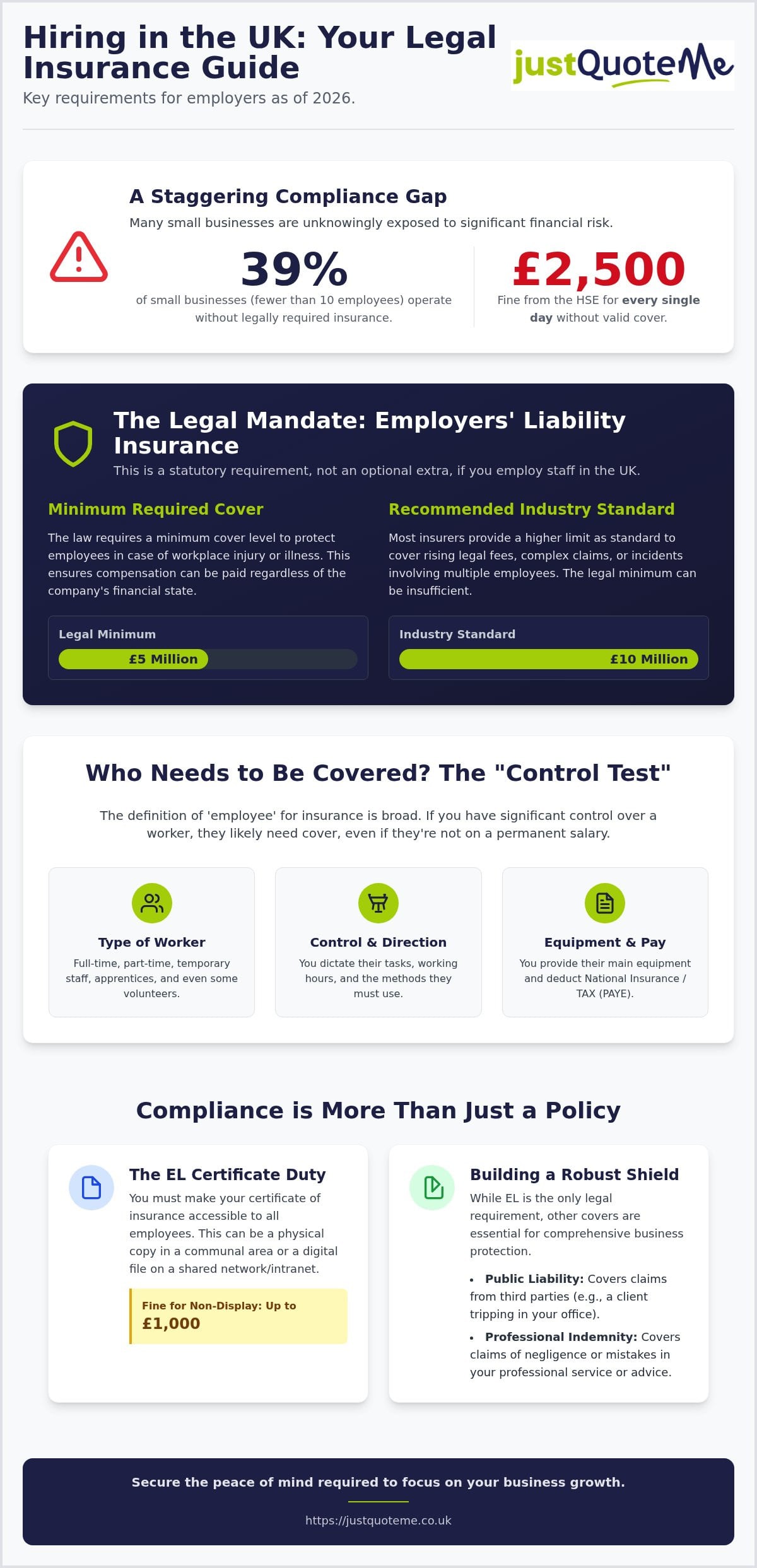
Did you know that as of January 2026, an estimated 39% of small businesses with fewer than ten employees are operating without the insurance they are legally required to hold? It’s a staggering figure when you consider the Health and Safety Executive (HSE) can issue fines of up to £2,500 for every single day you’re not properly covered. When you’re asking “what insurance do i legally need to employ someone uk”, you aren’t just looking for a policy; you’re looking to protect your livelihood from avoidable legal risks.
We understand that hiring your first team member is a proud moment that shouldn’t be overshadowed by the stress of regulatory compliance. It’s natural to feel overwhelmed by industry jargon or the nuances of employee versus contractor status. Our goal is to provide the pragmatic clarity you need to move forward with confidence. We’ll show you exactly how to meet your statutory mandates while protecting your company against employee injury claims.
In this 2026 guide, we’ll break down the mandatory £5 million Employers’ Liability cover, explain how to avoid the £1,000 fine for certificate errors, and help you secure the peace of mind required to focus on your business growth.
Key Takeaways
- Understand the statutory requirement for Employers’ Liability insurance, which mandates a minimum of £5 million in cover for almost all UK businesses.
- Identify what insurance do i legally need to employ someone uk to avoid HSE fines of £2,500 for every day you operate without valid cover.
- Clarify the legal distinction between employees, contractors, and volunteers to ensure every member of your team is protected according to 2026 regulations.
- Explore how adding Public Liability or Professional Indemnity insurance provides essential protection beyond the basic legal minimums.
- Learn the practical steps for conducting a risk assessment and choosing a bespoke policy that simplifies your administrative burden.
The Legal Mandate: Understanding Employers’ Liability Insurance in 2026
Employers’ Liability (EL) insurance is the legal shield against staff injury or illness claims. If you’re asking what insurance do i legally need to employ someone uk, the answer starts with this specific cover. It’s a statutory requirement, not an optional extra. The Employers’ Liability (Compulsory Insurance) Act 1969 mandates that almost every business hiring staff in the UK must hold a valid policy. This law applies the moment you take on your first employee, whether they’re full-time, part-time, or even an apprentice.
Under 2026 regulations, the law requires a minimum cover level of £5 million. While this is the legal floor, it’s rarely the industry standard. Most reputable brokers provide £10 million as a base level of protection. This higher limit accounts for the rising costs of legal fees, medical assessments, and long-term settlement figures. Relying on the bare legal minimum can leave your business vulnerable if a single incident involves multiple claimants or complex health complications. Securing Employers Liability Insurance ensures you meet your legal duties while providing a realistic safety net for your operations.
The Legal Requirement for the EL Certificate
Securing a policy is only half the battle when determining what insurance do i legally need to employ someone uk. You also have a legal duty to display your certificate of insurance so your staff can easily read it. In 2026, the Health and Safety Executive (HSE) permits digital displays. You can host the certificate on a company intranet or a shared network folder, provided every employee knows where to find it. If you prefer a traditional approach, a physical copy in a staff room or communal area works perfectly. You must also keep an archive of expired certificates. Claims for industrial diseases often emerge decades after an individual has left your employment—even if they were only with your firm for a short duration through Blue Recruitment Personnel—and you’ll need to prove cover was in place at the time of the alleged exposure.
Why the Law Exists: Protecting Both Parties
The legal mandate creates a vital safety net for the entire UK workforce. For employees, it guarantees they receive fair compensation for injuries caused by workplace negligence, regardless of your company’s bank balance. For you, the employer, it’s a shield against personal bankruptcy. Without this cover, a single significant claim could easily lead to the total loss of your business assets and personal savings. The HSE enforces these rules through regular spot checks and investigations. Their role is to ensure that the financial burden of workplace accidents never falls solely on the individual worker or an uninsured business owner.
Determining Your Legal Status: Who Counts as an Employee?
Defining who is technically an employee is often where business owners get caught out. The legal requirement for cover isn’t just for those on a permanent salary; it extends to part-time workers, temporary staff, and even some volunteers. When asking what insurance do i legally need to employ someone uk, the answer depends heavily on the “Control Test” used by regulators. If you decide when they work, provide the equipment they use, deduct National Insurance from their pay, and direct how tasks are completed, the law generally views them as an employee. Even if they’re self-employed for tax reasons, they can still be classified as an employee for insurance purposes.
HMRC and the HSE often use different criteria than your accountant might for standard tax filing. According to official government guidance, you must have Employers’ Liability insurance if you have a contract of service or apprenticeship with anyone. This includes oral or implied contracts. If someone is working under your supervision and direction, you likely have a legal duty to protect them. To ensure you’re fully compliant with these 2026 standards, you can request a review of your business structure from an experienced broker.
Are You Exempt? The Family Business Rule
There are very few exemptions to the EL mandate. A notable one is a family business that only employs close relatives, such as a spouse, parent, or sibling. However, this exemption is fragile. If your business is incorporated as a Limited company, the family exemption usually doesn’t apply; the company is a separate legal entity and must protect its directors and staff. Hiring a single person who isn’t a close family member immediately triggers the requirement for full cover. If you’re still questioning what insurance do i legally need to employ someone uk for a small family-run team, remember that incorporation changes the rules entirely. Relying on an exemption that no longer applies can lead to those devastating £2,500 daily fines mentioned earlier.
Subcontractors and Labour-Only Staff
The distinction between subcontractors is a common source of confusion. Bona-fide subcontractors generally work under their own direction, use their own tools, and carry their own insurance. In contrast, labour-only subcontractors work as part of your core team. Because you provide the materials, set the hours, and supervise their specific tasks, the law treats them as employees for insurance purposes. You must include these individuals on your Employers Liability Insurance policy to stay compliant. Failing to distinguish between these two groups is a frequent reason for HSE penalties during audits. It’s always safer to assume cover is needed if you’re directing the work on-site or paying them an hourly rate rather than a fixed fee for a finished project.
The Consequences of Non-Compliance: Fines and Regulatory Penalties
Operating without the correct cover is a high-stakes gamble that few businesses survive. When you ask what insurance do i legally need to employ someone uk, it’s often to avoid the severe penalties enforced by the Health and Safety Executive (HSE). The headline figure is daunting: you can be fined up to £2,500 for every single day you employ staff without the legal requirement for Employers’ Liability (EL) insurance. For a small business, even a week-long lapse in cover could result in a £17,500 penalty, which is enough to cripple most startups before they’ve even gained momentum.
Beyond the daily penalty for a lack of cover, there’s a specific administrative fine of up to £1,000 for failing to display your EL certificate or refusing to show it to an inspector. The HSE conducts regular spot checks, often triggered by a minor workplace accident or even an anonymous tip-off. A prosecution for non-compliance doesn’t just result in an immediate financial loss; it creates a public record that can permanently damage your business reputation. This makes it significantly harder to secure future contracts, attract top talent, or maintain healthy credit lines with lenders.
Historical Claims and Late Compliance
You cannot backdate insurance to cover a period when you were uninsured. Insurers maintain meticulous records of continuous cover, and any gap is a red flag during an audit. This is particularly dangerous for “long-tail” claims. These are illnesses or injuries, such as repetitive strain or industrial deafness, that may only manifest years after the person has left your employment. If you were uninsured during the period of exposure, you’ll be personally liable for the full settlement and legal fees, regardless of how much time has passed since the individual worked for you.
Personal Liability for Company Directors
Many business owners mistakenly believe that the “limited liability” of a company protects their personal assets from HSE fines. However, if a director is found to have been personally negligent or wilfully ignored the law regarding mandatory cover, they can be held personally responsible. This is where the intersection of EL and Directors and Officers Insurance becomes critical. While D&O insurance helps protect your personal assets from legal costs and awards related to management decisions, it doesn’t excuse a failure to meet statutory obligations. Maintaining a valid EL policy is the only way to ensure corporate compliance and safeguard your personal financial future. It’s the foundation of any responsible growth strategy.
Building a Robust Shield: Recommended Covers Beyond the Legal Minimum
While Employers’ Liability is the only statutory answer to what insurance do i legally need to employ someone uk, relying solely on the bare legal minimum is often a mistake. Your team doesn’t just face internal risks; their actions can impact third parties, clients, and your digital assets. Creating a comprehensive protection plan ensures that a mistake by a staff member doesn’t result in a financial catastrophe that your mandatory policy won’t cover.
For service-based businesses, Professional Indemnity Insurance is a critical addition. If an employee provides faulty advice or a design error that causes a client financial loss, this policy manages the legal costs and compensation. Similarly, as staff handle more sensitive customer data, Cyber Insurance protects against the fallout of data breaches or ransomware attacks. These aren’t legally mandated, but they’re vital for maintaining modern business stability.
Public Liability: Protecting the Public
Distinguishing between staff injury and third-party damage is a vital step in your risk management. While EL covers your team, Public Liability Insurance protects you if an employee accidentally injures a customer or damages their property. Most commercial clients and local authorities won’t even sign a contract unless you can prove you have this cover in place. It’s the industry standard for professional credibility. You can find more detail in our simple guide to Public Liability for a clearer picture of how these policies interact.
Specialist Cover for Specific Trades
Every industry has unique demands that a generic policy might miss. Tradespeople often require tools and equipment cover to protect the gear their staff uses daily on-site. For those in the construction sector, Builders Insurance often bundles these essentials together, providing a more efficient way to manage multiple risks. Office-based firms, by contrast, might focus more on contents and business interruption. Tailoring your cover to your specific sector is the most pragmatic way to ensure you aren’t paying for irrelevant protection while leaving major gaps in your shield.
Ready to build a policy that fits your unique business needs? Get a bespoke insurance quote today to ensure your team and your assets are fully protected.
Securing Your Business: How to Choose the Right Employer Policy
Choosing the right policy is the final step in answering what insurance do i legally need to employ someone uk. It requires a logical, staged approach to ensure no gaps remain in your protection. Start by conducting a full risk assessment of your employees’ daily duties. A staff member working from a home office presents entirely different risks than a labour-only subcontractor on a high-risk construction site. Understanding these nuances allows you to tailor your cover rather than paying for a generic policy that might not fully protect your specific operations.
Once you understand your risks, decide whether a standalone EL policy or a comprehensive package suits your business model. Bundling Employers Liability Insurance with other essential covers like Public Liability often reduces administrative overhead. It’s a pragmatic way to manage your requirements. Always verify that your policy limits meet both the legal minimum and any specific contractual requirements from your clients. In 2026, many commercial contracts require £10 million in cover, even though the legal floor remains £5 million. Consulting an FCA-authorised broker ensures you compare the market effectively and secure a policy that satisfies every stakeholder.
The Benefits of Using an Independent Broker
Independent brokers provide access to specialist underwriters that are often unavailable on automated comparison sites. This is vital if your business has a complex employment structure or operates in a niche sector. Unlike automated systems, a broker offers a human-centric alternative. They provide expert advice based on 30 years of industry experience. This personalised service ensures your policy is bespoke to your needs, protecting you from the “one-size-fits-all” trap that often leads to underinsurance. They handle the complex administrative burdens, leaving you free to focus on scaling your business.
Getting Your Quote Today
To secure your cover quickly, have your PAYE reference number and accurate staff numbers ready. In 2026, the speed of getting insured has reached a point where you can transition from an inquiry to full cover in a single afternoon. Having this information prepared allows for a frictionless experience. Taking this step today removes the fear of HSE intervention and replaces it with the confidence of full legal compliance. It’s the most straightforward way to protect your team and your company’s financial future.
Get Your Free Business Insurance Quote now
Protecting Your Business for 2026 and Beyond
Securing your workforce is a significant milestone for any UK business. By now, you should have a clear understanding of what insurance do i legally need to employ someone uk to maintain full compliance. While the statutory £5 million Employers’ Liability cover is your legal baseline, it’s vital to consider whether your specific trade requires higher limits or additional protections like Public Liability. Ensuring you’ve correctly identified everyone under your direction and control is the only way to avoid regulatory penalties and safeguard your personal assets.
As an FCA-authorised independent broker with over 30 years of UK insurance experience, Just Quote Me provides the steady hand you need in a complex market. We specialise in crafting bespoke policies tailored to your specific industry, ensuring you never pay for cover you don’t need while closing dangerous gaps in your protection. You’ve built a business worth protecting; now, let’s make sure it has the robust shield it deserves to flourish.
Get Your Free Business Insurance Quote now
Request a Call back for free Expert advice
We’re here to help you navigate the complexities of 2026 regulations with confidence and clarity.
Frequently Asked Questions
Is Employers’ Liability insurance legally required for one employee?
Yes, Employers’ Liability (EL) insurance is legally mandatory the moment you hire your first employee. This applies whether they’re full-time, part-time, or an apprentice. The law doesn’t distinguish between a small startup and a large corporation in this regard. The Employers’ Liability (Compulsory Insurance) Act 1969 requires you to have a policy in place to protect your workers from the very first day they start working under your direction or control.
What is the fine for not having Employers’ Liability insurance in the UK?
You can be fined up to £2,500 for every single day you operate without the correct cover. This is enforced by the Health and Safety Executive (HSE). Additionally, you face a separate fine of up to £1,000 if you fail to display your insurance certificate or refuse to make it available to inspectors. These penalties accumulate quickly, making the cost of non-compliance significantly higher than the annual premium for a standard policy.
Do I need insurance for freelancers or subcontractors?
It depends on the nature of your working relationship rather than the person’s tax status. If you provide the equipment and direct how tasks are finished, they are likely employees for insurance. When asking what insurance do i legally need to employ someone uk, you must include labour-only subcontractors in your policy. Bona-fide subcontractors who use their own tools and insurance usually don’t require cover from you, but you should always verify their status first.
Are family-run businesses exempt from Employers’ Liability insurance?
Most family-run businesses are only exempt if they are not incorporated as a Limited company and only employ close family members. This includes spouses, parents, siblings, or children. However, as soon as you hire a single person who isn’t a close relative, or if you incorporate your business, the legal requirement for Employers’ Liability insurance immediately applies. Most modern family businesses in the UK operate as Limited companies, meaning they must hold valid cover by law.
Can I display my Employers’ Liability certificate digitally?
Yes, you can display your certificate digitally as long as your staff have easy access to it during their working hours. In 2026, it’s common practice to host the document on a company intranet, a shared network folder, or via a dedicated employee portal. You must ensure all workers know where to find it. If digital access isn’t available to everyone, you should still display a physical copy in a communal area for full compliance.
What happens if an employee makes a claim and I don’t have insurance?
If an employee makes a claim while you’re uninsured, you’ll be personally responsible for paying any compensation and legal fees. Without an insurer to handle the costs, a single significant injury claim can lead to the total loss of your business and personal assets. You’ll also face prosecution from the HSE, resulting in heavy daily fines and a public record of non-compliance that can damage your reputation with future clients and lenders.
How much Employers’ Liability cover do I legally need?
The legal minimum level of cover required by the Employers’ Liability (Compulsory Insurance) Act 1969 is £5 million. However, most insurance providers in 2026 offer £10 million as the standard level of cover. This higher limit is recommended to account for the rising costs of legal representation and medical settlements. Many commercial contracts and local authority tenders will also stipulate a minimum of £10 million before they allow you to begin work on a project.
Does Employers’ Liability cover me as a sole trader with no staff?
No, Employers’ Liability insurance is specifically designed to protect employees. If you’re a sole trader with no staff, you don’t have a legal obligation to hold this cover. However, when you search for what insurance do i legally need to employ someone uk, remember that hiring even one casual helper triggers the mandate. Until then, you should focus on Public Liability insurance to protect yourself against claims from third parties for injury or property damage.
