

What if the “All Risk” in your policy title is actually a misnomer that leaves your most expensive plant exposed? It’s a question many UK firms face when staring at the fine print of a JCT 2024 contract. Securing contractors all risk insurance shouldn’t feel like a gamble, yet the terminology often creates more confusion than clarity for busy project managers. We know you’re under pressure to meet strict tender requirements while keeping overheads under control.
You likely agree that the paperwork involved in modern construction feels increasingly heavy, especially when a single oversight in your coverage could halt a multi-million pound project. This guide simplifies the process by explaining exactly how to align your protection with your contractual obligations for the 2026 market. We’ll show you how to safeguard your business against the physical loss of materials and equipment, ensuring your site remains a productive environment rather than a financial liability.
We’ve designed this overview to give you a clear understanding of CAR’s specific scope, how it differs from public liability, and how to protect your assets from the first day on-site. We’ll break down the core components of coverage and the common exclusions you need to watch out for to stay fully compliant.
Key Takeaways
- Understand why “All Risk” terminology is vital for protecting your physical works and site materials from unforeseen damage during a build.
- Clarify the fundamental differences between contractors all risk insurance and public liability to ensure you have both asset and liability protection.
- Learn how to navigate UK contractual obligations, including the specific role of “Joint Names” policies for developers and main contractors.
- Master the process of calculating an accurate “Sum Insured” to avoid underinsurance and secure the full financial value of your project.
- Identify whether an annual policy or a single-project arrangement offers the most efficient and cost-effective protection for your business.
What is Contractors All Risk Insurance?
Contractors all risk insurance is a specialised policy designed to protect construction projects from the moment ground is broken until the final handover. Unlike standard business cover, it’s a project-specific solution that shields the physical works, materials, and equipment from unforeseen damage. In the UK market, you’ll frequently hear brokers and insurers refer to this as “Contract Works” insurance. Both terms describe the same essential protection: a safety net for the financial investment poured into a build.
This policy acts as a comprehensive umbrella. It covers the cost of repairing or replacing work that’s been damaged by events like fire, flood, vandalism, or theft. Whether you’re a main contractor managing a £2.5 million residential development or a subcontractor on a smaller site, this insurance ensures that a single incident doesn’t bankrupt the project. It keeps the build moving by providing the funds needed to rectify site damage without depleting your profit margins or stalling the schedule.
The “All Risk” Misnomer: What It Really Means
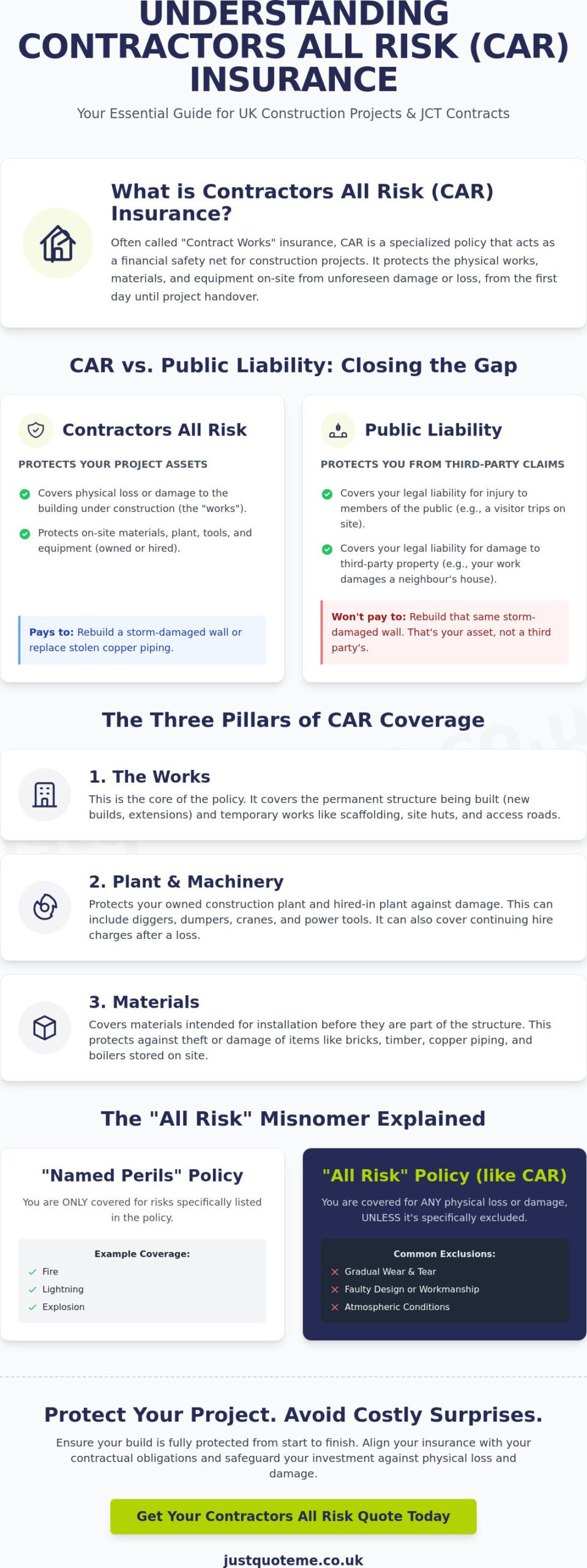
The term “All Risk” is a standard industry label, but it doesn’t mean every conceivable disaster is covered. It’s a specific policy structure. In a “Named Perils” policy, you’re only covered for what’s explicitly listed, such as fire or lightning. With contractors all risk insurance, the logic is reversed: you’re covered for every physical loss or damage unless the policy specifically excludes it. Common exclusions include gradual wear and tear, atmospheric conditions, or existing defects in design and materials. You aren’t buying a “blank cheque” for every site mishap, but you are getting the broadest form of protection available in the construction sector.
Why a Standard Public Liability Policy Isn’t Enough
Many tradespeople assume their public liability insurance provides total protection, but that’s a risky misconception. Public liability is designed to cover your legal responsibility for third-party injuries or damage to someone else’s property. It won’t pay to rebuild a wall that collapses due to a storm or replace £15,000 worth of copper piping stolen overnight. This creates a significant financial exposure for the contractor. The “Gap” is the total physical value of the works in progress at any given time. Without specific cover for the contract works, you’re personally liable for the costs of rebuilding what’s already been completed if a disaster strikes before the client takes possession. Using contractors all risk insurance ensures that the bricks, mortar, and labour already invested are protected against loss.
What Does Contractors All Risk Insurance Cover?
A contractors all risk insurance policy provides a comprehensive shield for the physical assets of a construction project. It’s designed to protect the financial investment tied up in a site from the moment ground is broken until the final handover. This coverage is essential because construction sites are inherently high-risk environments where a single incident can derail a project’s budget. It offers peace of mind by ensuring that the cost of damage to the building or equipment doesn’t fall solely on your shoulders.
The Three Pillars: Works, Plant, and Materials
The “Works” forms the core of the policy. It covers the actual structure under construction, including new builds, extensions, and refurbishments. If a £250,000 timber frame is destroyed by fire mid-build, the policy covers the cost of clearing the site and starting again. This protection also extends to temporary structures such as site offices, scaffolding, and perimeter fencing that are vital for the project’s completion.
- Plant and Machinery: Coverage includes owned or hired-in equipment such as diggers, mixers, and specialist tools. If you’re liable for “hired-in plant” charges after an accident, the policy can cover these ongoing costs.
- Materials: This protects items like bricks, timber, and boilers while they’re on-site or awaiting installation. With the cost of raw materials remaining volatile in 2026, protecting your inventory against site-wide losses is a smart move.
Common Perils Covered in a CAR Policy
Policies typically operate on an “all-risk” basis, meaning anything not specifically excluded is covered. Fire, lightning, and explosions are standard inclusions. We also see frequent claims for flood and storm damage, which can be devastating for open-air sites during the unpredictable UK winter. Theft and vandalism are major concerns; industry data from late 2025 indicated a 14% rise in plant theft across urban developments. A robust contractors all risk insurance policy ensures these criminal acts don’t result in total financial loss.
Standard Exclusions You Must Know
Insurance isn’t a catch-all for every possible problem on a site. You won’t be covered for faulty design or professional negligence. These specific risks require professional indemnity insurance to protect against errors in planning or technical advice. Other common exclusions include:
- Wear and Tear: Gradual deterioration, rust, or mechanical breakdown due to age or poor maintenance isn’t covered.
- Cessation of Work: If a project is abandoned or work stops for more than 30 consecutive days, insurers often restrict or suspend coverage.
- Inventory Shortages: You can’t claim for “disappearing” stock discovered during a routine audit without clear evidence of theft or a specific incident.
Contractors All Risk vs Public Liability: The Key Differences
Understanding the distinction between these two policies is vital for any UK construction firm. While they often appear on the same certificate, they serve entirely different purposes. Public Liability insurance is designed to protect your business against claims made by third parties for injury or property damage. In contrast, contractors all risk insurance focuses on the physical assets of the project, covering the cost of repair or replacement for the work itself.
The fundamental shift here is from liability protection to asset protection. If a passer-by trips over a cable, your Public Liability policy handles the legal fees and compensation. However, if a storm destroys the timber frame of a house mid-build, the passer-by isn’t affected, but your business faces a massive financial loss. Without a CAR policy, you’d have to fund the rebuild out of your own pocket. Most insurers now offer these as a “Contractors Combined” package to ensure there’s no gap in your project security. This wrap-around approach simplifies the claims process and often reduces the total premium cost.
Who is Protected? Third Parties vs. The Project
Public Liability covers the “other guy.” This includes neighbours, delivery drivers, or members of the public. It doesn’t cover your own work or your staff. For your employees, UK law requires employers liability insurance to cover workplace injuries. Meanwhile, CAR protects the “project” itself. This includes the bricks, mortar, and permanent materials, as well as temporary works like scaffolding or site huts. It ensures the contract value remains protected from start to finish.
Claim Scenarios: Which Policy Triggers?
Seeing how these policies react in real-world situations helps clarify the boundaries. Here are three common UK site scenarios:
- Scenario A: A masonry wall collapses outward during a gale and crushes a parked car on the street. This triggers Public Liability because a third party suffered property damage. Understanding exactly how these claims are handled is covered in detail in our guide to public liability insurance for builders UK.
- Scenario B: The same wall collapses inward, destroying £12,000 worth of newly installed high-spec flooring and kitchen units. Since this is damage to the “works,” contractors all risk insurance covers the replacement costs.
- Scenario C: Expensive power tools are stolen from a locked van overnight. This is usually covered under the plant and equipment section of a CAR policy or a dedicated van and tools insurance policy.
By combining these covers, you create a robust safety net. It means that whether the damage is to a person, a neighbour’s house, or the very building you’re trying to finish, the financial strain doesn’t fall on your company’s shoulders. We find that 85% of professional contractors prefer a bundled policy to avoid the administrative headache of managing separate renewal dates.
Who Needs CAR Insurance and Contractual Obligations
In the UK construction industry, the responsibility for arranging contractors all risk insurance is determined by the specific terms of the build contract. While the main contractor manages the daily site operations, the property developer, often referred to as the “Employer,” holds the ultimate financial interest in the project. Identifying who carries the risk at each stage is vital to avoid double-insuring or, worse, leaving a gap where no cover exists.
JCT Contracts and Insurance Requirements
The Joint Contracts Tribunal (JCT) provides the standard framework for approximately 70% of UK construction projects. Within these documents, Clause 6.7 dictates how the works must be insured. There are three primary options you need to understand:
- Clause 6.7.1 (Option A): This requires the contractor to take out and maintain a “Joint Names” policy for new buildings.
- Clause 6.7.2 (Option B): This places the obligation on the Employer (the developer) to arrange the insurance for new builds.
- Clause 6.7.3 (Option C): Used for work on existing structures. The Employer must insure the existing building and the new works under a Joint Names policy.
A “Joint Names” agreement is a specific UK legal requirement where both the contractor and the employer are named on the policy. This arrangement includes a “Waiver of Subrogation.” This means the insurance company gives up its right to sue one party to recover costs if they caused a loss that affected the other. It prevents internal legal disputes that could stall a project for months.
Property Developers and Owner-Builders
If you are funding a project, you cannot rely solely on the contractor’s word. Property developers often insist on being the policyholder to ensure premiums are paid and the cover remains active. For self-build projects or major home extensions, it is a common mistake to assume standard home insurance is sufficient. Most residential policies in the UK specifically exclude structural alterations or unoccupied sites.
Sub-contractors also face unique risks. While the “works” might be covered under the main contractors all risk insurance policy, their own plant, hired-in equipment, and hand tools usually aren’t. Each firm on-site should verify if they need a standalone policy to protect their specific assets from theft or damage. For self-employed tradespeople operating as sole traders, ensuring your personal business assets are fully covered is equally critical, and our guide to sole trader insurance for UK self-employed professionals explains how to align your cover with client contract requirements. Understanding the full scope of your trade coverage is essential, and our ultimate guide to builders insurance in the UK can help you identify the right combination of policies for your specific trade.
Once a project reaches practical completion, the CAR policy typically ends. At this point, the risk shifts from a “work in progress” to a finished asset. You should then transition the cover to commercial property insurance to protect the building against long-term risks like fire, flood, or escape of water.
Don’t leave your contractual obligations to chance. Get a tailored CAR insurance quote from our UK specialists today.
Securing the Right CAR Policy for Your Construction Project
Calculating the “Sum Insured” is the most critical step in setting up your policy. You can’t simply use the contract value and hope for the best. To avoid the “Average Clause,” where insurers reduce payouts if you’re under-insured, you must account for the total reinstatement cost. This includes the full contract price, the value of any materials supplied by the employer, and professional fees like architects or surveyors, which usually add 10% to 15% to the total. You also need to factor in debris removal and site clearance costs. If a site is leveled by fire, the cost to clear the plot before rebuilding starts can be substantial.
Annual vs. Single Project Cover
Choosing between an annual or single-project policy depends on your business model and the scale of your work. Annual policies are the go-to choice for builders who manage multiple smaller or mid-sized jobs simultaneously. It’s an efficient way to ensure continuous protection without the administrative burden of declaring every new site. You simply set a maximum contract limit and an annual turnover estimate.
Single project policies are better for high-value, one-off developments or complex builds that last several years. These policies provide a clean trail of cover for lenders and stakeholders. If a project runs over schedule, which happened to 25% of UK construction projects in 2023, you must notify your broker immediately. We can often arrange pro-rata extensions to keep you protected until the practical completion certificate is signed.
Why Just Quote Me for Your Construction Insurance?
We’ve spent 30 years refining our expertise in the UK construction sector. We don’t rely on faceless algorithms to decide your premium. Based in Newcastle-under-Lyme, we have a deep understanding of the West Midlands market and the specific risks local contractors face. Our team accesses a panel of the UK’s leading insurers to build bespoke contractors all risk insurance packages that fit your specific trade.
We act as your independent advocate. If your project involves high-depth excavations or complex “Joint Names” requirements under JCT contracts, we do the heavy lifting to find a provider that accepts those risks at a competitive rate. Our goal is to make the process straightforward so you can focus on the build. Ready to protect your next project? Just Quote Me for a tailored consultation.
- Check that the “Maintenance Period” or “Defects Liability Period” matches your contract terms.
- Verify that the limit for hired-in plant covers the maximum value of equipment on-site at any one time.
- Ensure the policy includes cover for “Off-site Storage” if you’re pre-ordering expensive materials.
- Confirm that the contractors all risk insurance includes cover for transit of materials to the site.
- Double-check that any specific “Conditions Precedent,” such as site security or fire safety requirements, are achievable for your team.
Protect Your Project and Your Profit Margins
Navigating site risks in 2026 requires more than just basic liability cover. The UK construction industry faces evolving contractual requirements and fluctuating material costs that make comprehensive protection essential. A robust contractors all risk insurance policy secures your work in progress, hired-in plant, and owned equipment against damage or theft. It bridges the critical gap left by standard public liability, ensuring your business meets JCT or NEC contract standards without delay. By protecting the physical assets of a build, you’re safeguarding the financial stability of your entire firm.
JustQuoteMe brings over 30 years of industry experience to your search for the right policy. As an FCA Authorised Broker, we provide direct access to top UK underwriters, skipping the automated algorithms for a more personal, human-centric approach. We understand the nuances of various trades and specialise in tailoring coverage that fits your specific project scope. We’ll do the heavy lifting to find the most efficient solution for your business.
Don’t leave your next project to chance. Get a bespoke Contractors All Risk quote today and build with total confidence.
Frequently Asked Questions
Is Contractors All Risk insurance a legal requirement in the UK?
No, contractors all risk insurance isn’t a legal requirement under UK law like Employers’ Liability is. However, it’s almost always a contractual requirement for any project managed under JCT or NEC terms. Most professional developers and local authorities won’t allow a contractor on site without proof of this cover because it protects the financial investment of the entire build.
What is the difference between Contract Works and Contractors All Risk?
Contractors all risk insurance is a comprehensive package, whereas Contract Works is just one specific component of that package. Think of CAR as the umbrella policy that bundles together Contract Works, public liability, and plant cover. While Contract Works focuses on the physical structure and materials, the “All Risk” element ensures you’re protected against a broader range of site-related perils.
Does Contractors All Risk cover hired-in plant and machinery?
Yes, most policies include or offer an extension for hired-in plant and machinery. This is essential because standard hire agreements from companies like HSS or Sunbelt Rentals make you liable for the full replacement cost if equipment is stolen or damaged. The policy typically covers the repair costs and any ongoing hire charges you’re legally obligated to pay while the machine is out of action.
Who is responsible for taking out the CAR policy in a JCT contract?
The responsible party depends on whether you’re using JCT Insurance Option A, B, or C. Under Option A, the contractor takes out the policy for new builds. Option C usually requires the employer to arrange cover for work on existing structures. You must check your specific contract particulars to see which box is ticked, as 15% of project disputes stem from incorrect insurance arrangements.
Can I get Contractors All Risk for a residential renovation?
You can definitely secure this cover for residential projects, and it’s a smart move for homeowners and builders alike. Standard home insurance often becomes void once major structural work begins, leaving a gap in protection. A tailored renovation policy ensures that both the existing house and the new extension are protected against fire, flood, or collapse throughout the duration of the build.
What does “Joint Names” mean in a construction insurance policy?
Joint Names means the policy is issued to two or more parties, usually the contractor and the employer, so they both have equal rights to claim. This setup is crucial because it stops the insurer from using “subrogation” to sue one party for damage caused to the other. It creates a “no-blame” environment that ensures the project budget stays intact even if an accident occurs on site.
Does CAR insurance cover damage caused by a sub-contractor?
Yes, the policy covers damage to the contract works regardless of which trade caused the incident. If a plumber accidentally floods a floor or an electrician starts a small fire, the policy pays to rectify the damage to the works. While the insurer might look to the sub-contractor’s own public liability policy for third-party damages, the CAR policy ensures the main project can continue without financial delay.
How much does Contractors All Risk insurance cost in 2026?
Premiums for 2026 are influenced by the 4.2% rise in construction output prices recorded by the ONS in recent years. While we don’t fix prices, industry benchmarks show that a basic policy for a £100,000 project often starts in the region of £450 to £600. Your final quote depends on your claims history, the specific site security measures you have in place, and the total value of the contract materials. For a broader view of how tool theft and rising costs are affecting tradespeople across the industry, our comprehensive builders insurance guide for 2026 covers the key trends and coverage strategies you need to know.
