

As a sole trader, your business assets and personal savings are legally identical, which means a single on-site mishap can put your personal finances directly on the line. While securing public liability insurance for self employed professionals is not a statutory legal requirement in the UK, winning commercial contracts and building credibility with clients almost always demands it.
You shouldn’t have to spend valuable working hours deciphering complex paperwork, guessing whether a project requires a £1 million, £2 million, or £5 million indemnity limit, or worrying that hidden exclusions might void a property damage claim. You simply need reliable protection that reflects your specific trade without paying for irrelevant add-ons. In this 2026 guide, you’ll discover how to assess your actual on-site exposures, satisfy commercial tender standards, and secure bespoke cover through an FCA-authorised independent broker.
Here is your straightforward roadmap to choosing the right policy, safeguarding your personal assets, and operating with total confidence.
Key Takeaways
- Understand how public liability insurance for self employed professionals shields your personal assets from expensive third-party injury and accidental property damage claims.
- Learn how to select the right indemnity limit, from £1 million up to £10 million, to satisfy strict commercial tender requirements and contract terms.
- Identify common exclusions, such as faulty workmanship or damage to items directly being worked upon, so you can avoid unexpected claim disputes.
- Follow a practical step-by-step checklist to accurately declare all your trade activities and prevent accidental non-disclosure.
- Discover the advantages of arranging tailored cover through an FCA-authorised independent broker with access to top UK underwriting panels.
What Is Public Liability Insurance for the Self-Employed?
Operating as a sole trader or independent contractor brings complete autonomy, but it also carries direct legal exposure. Broadly defined, liability insurance establishes a financial barrier between your business actions and third-party losses. For solo operators, standard public liability insurance steps in when an external party alleges that your commercial activities caused them accidental bodily injury or damaged their possessions.
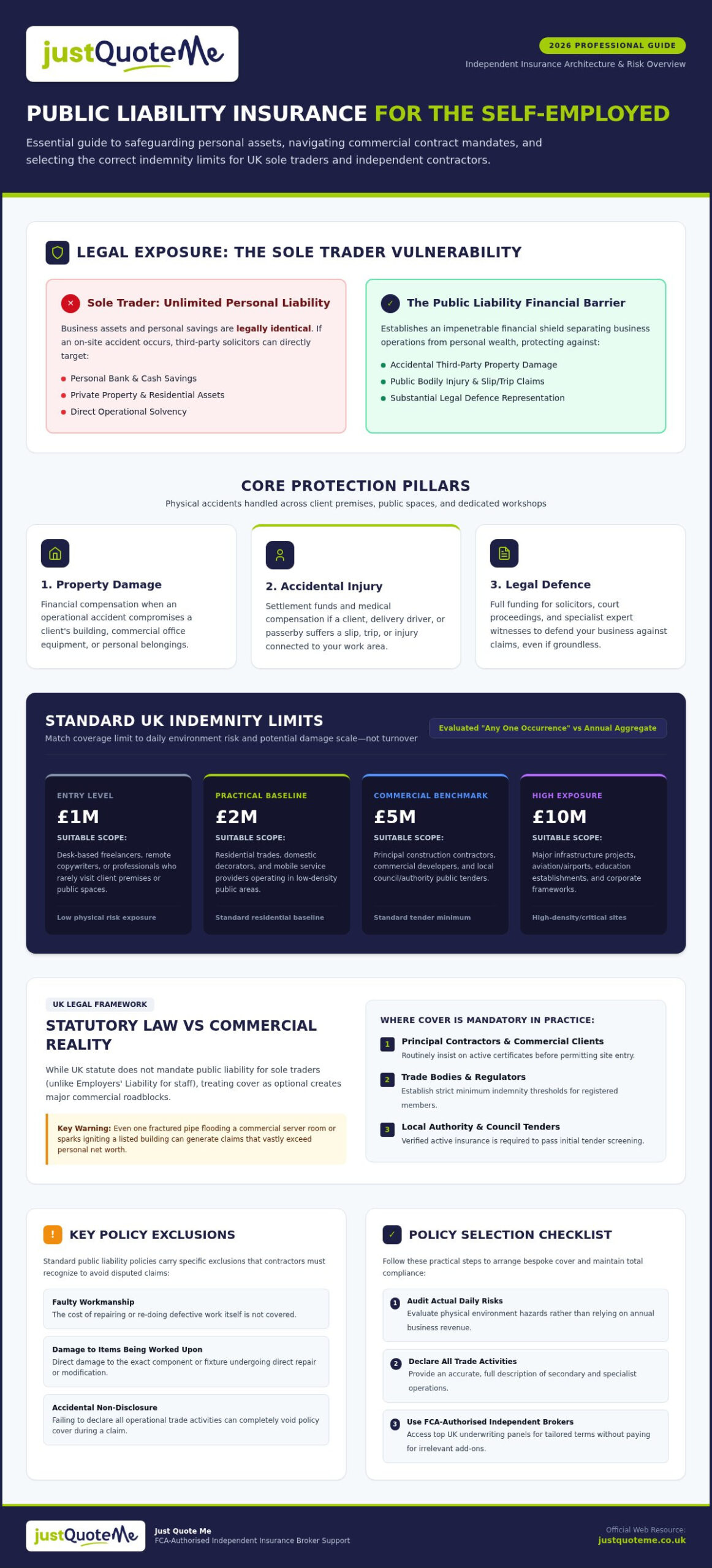
Unlike limited company directors who benefit from separate corporate entity status, self-employed sole traders share unlimited personal liability with their enterprise. If a visiting client trips over your equipment or you accidentally damage high-value fixtures while working on-site, claimant solicitors can target your personal savings or private property to settle the dispute. A robust policy covers not only the final compensation award or negotiated settlement, but also the substantial legal defence fees required to dispute contested claims.
Core Incidents Covered Under Self-Employed Public Liability
Public liability insurance for self employed professionals responds to everyday physical accidents across diverse work environments, including client premises, public spaces, and dedicated home workshops. Key incidents handled by these policies include:
- Third-party property damage: Financial protection if an accident during your operations compromises a client’s building, office equipment, or personal belongings.
- Public accidental injury: Settlement funds and medical compensation if a client, delivery driver, or passing bystander suffers a slip, trip, or physical injury connected to your immediate workspace.
- Legal defence representation: Complete funding for solicitors, court proceedings, and specialist expert witnesses to defend your business against disputed claims, even if an allegation proves groundless.
Legal Status vs Contractual Obligations in the UK
UK statute does not legally mandate public liability cover for sole traders in the same way the law enforces employers’ liability for staff. Even so, treating it as optional is a commercial mistake. Principal contractors, commercial clients, and estate managers routinely insist on seeing an active certificate before permitting you on-site. Trade bodies and industry regulators frequently establish minimum indemnity thresholds for registered members. Similarly, securing local council tenders or corporate frameworks requires verified cover, making public liability insurance for self employed trades and consultants a mandatory operational requirement in practice.
Evaluating Coverage Levels: How Much Indemnity Do You Need?
Selecting the right level of indemnity is rarely tied to your annual turnover. Size doesn’t dictate risk. Instead, your coverage limit must match the potential scale of damage in your daily work environment. If a fractured pipe floods a commercial server room or sparks ignite a listed building, the repair costs can quickly overwhelm basic coverage. When evaluating public liability insurance for self employed business owners, you must also check whether limits apply on an “any one occurrence” basis or as an annual aggregate total, which caps the insurer’s total payout across all claims in a single year.
Standard Indemnity Tiers Explained
Indemnity limits define the maximum financial settlement an insurer pays toward an approved claim. UK commercial policies generally align around four main thresholds:
- £1 million limit: Often considered an entry-level tier. This limit typically suits desk-based freelancers, remote copywriters, or professionals who rarely visit client premises or interact with the public.
- £2 million limit: The practical baseline for residential trades, domestic decorators, and mobile service providers operating in low-density public areas.
- £5 million limit: Widely treated as the benchmark requirement for principal construction contractors, commercial developers, and local authority tenders.
- £10 million limit: Routinely demanded for major infrastructure projects, working on airports, education establishments, or active railway corridors.
Securing the right public liability insurance limit guarantees that your certificate satisfies client procurement demands on day one without leaving you exposed to catastrophic losses.
Factors Influencing Your Required Level of Protection
To pinpoint the ideal indemnity tier for your trade, assess three practical factors before binding a policy:
- Surrounding property density: Working near delicate IT networks, high-end residential interiors, or expensive plant machinery requires higher cover limits than operating in an unfinished warehouse.
- Public footfall: Busy retail spaces, pedestrian precincts, and shared commercial premises carry elevated slip, trip, and falling-object risks.
- Contractual stipulations: Always inspect client service agreements before agreeing to site terms. Signing a contract requiring £5 million while carrying £2 million leaves you in breach of contract and personally liable for any shortfall.
If you need help determining how your contracts align with underwriter limits, the team at Just Quote Me can review your operational risks to pinpoint an indemnity tier that keeps your business competitive and fully protected.
Key Policy Exclusions and Common Claim Scenarios
A commercial liability policy serves as an essential safety net, but it doesn’t cover every operational setback. Underwriters design these policies specifically around sudden, accidental third-party losses rather than commercial disputes or business errors. Most claim disputes arise not because an accident was unprovoked, but because the policyholder assumed public liability acted as a blanket warranty for all trade activities.
What Standard Policies Do Not Cover
Public liability insurance for self employed workers maintains clear boundaries regarding what constitutes a valid third-party loss. Standard agreements routinely exclude:
- Defective workmanship: Insurers will not pay to rectify sub-standard craft or replace faulty parts you installed. If a plumber fits a pipe poorly, the policy won’t pay to refit the joint; it only triggers if water escapes and ruins the client’s downstairs ceiling.
- Damage to property worked upon: Direct physical damage caused to the exact fixture, vehicle, or item you are actively modifying or cleaning is commonly excluded unless a specific extension is endorsed.
- Injury to helpers or staff: If you take on temporary assistants or labour-only subcontractors, UK law mandates standalone employers liability insurance to manage bodily injury claims.
- Professional advice errors: Pure financial loss stemming from negligent consulting, architectural designs, or calculations requires dedicated professional indemnity cover.
- Own tools and materials: Your ladders, power tools, and materials in transit are excluded; they demand separate equipment protections.
Real-World Scenarios That Lead to Rejected Claims
Insurers insert strict warranties into policy schedules that require complete compliance. Breaching these operational conditions gives underwriters clear grounds to decline indemnity:
- Hot work conditions: Using blowtorches, angle grinders, or heat guns typically mandates a documented permit system, active fire extinguishers on hand, and a continuous 60-minute fire watch after finishing. Skipping the watch voids fire damage claims.
- Height and depth thresholds: Many standard policies impose strict operational ceilings, such as a 10-metre cap. If you undertake jobs exceeding these limits without reviewing working at height requirements and securing underwriter approval, coverage fails.
- Delayed notification: If a client mentions property damage and you attempt informal repairs without alerting your broker, underwriters can reject subsequent claims due to prejudiced investigation timelines.
Step-by-Step Buying Guide: Selecting the Right Policy
Buying business cover shouldn’t mean guessing which online form checkboxes fit your daily work. Automated price comparison engines often force varied, real-world trades into broad commercial categories. That approach risks leaving critical tasks uninsured. To secure reliable public liability insurance for self employed professionals, you need a methodical approach that aligns your policy schedule with your actual operational liabilities.
Defining Your Business Activities and Risk Profile
Insurers assess your risk strictly on the business activities declared at inception. Omissions can lead to costly claim repudiations. Take these practical steps before requesting underwriting terms:
- Audit every task you perform: If you are primarily an electrician but occasionally handle minor carpentry or plastering to finish a job, you must disclose those secondary trades. Underwriters will not cover incidents arising from undeclared activities.
- Note hazardous equipment and settings: Document whether you operate heavy plant, apply heat, or work within sensitive environments like schools, hospitals, or industrial facilities.
- Select trade-specific policy wording: Explore specialist cover options built specifically for registered tradesman insurance needs, ensuring your schedule matches the physical hazards of your work.
Bundling Essential Covers for Comprehensive Protection
Solo operators rarely face liability in isolation. Packaging complementary protections onto a single policy schedule eliminates administrative headaches, aligns your renewal dates, and closes dangerous coverage gaps:
- Tools and equipment: Add cover for your hand tools and power kits against on-site theft, transit damage, or break-ins.
- Commercial legal expenses: Fund professional representation to pursue unpaid invoices, resolve contractual arguments with main contractors, or handle HMRC tax investigations.
- Contract works: If you work on larger structural projects, review integrated builders insurance arrangements that protect unfinished physical works, temporary buildings, and site materials from fire, storm, or malicious damage.
Before binding your policy, compare mandatory policy excess levels and flexible direct debit options to keep cash flow predictable. If your operations cross multiple disciplines or involve complex on-site conditions, let an independent specialist negotiate terms with underwriters on your behalf. Explore tailored business insurance solutions to ensure your cover matches your real-world contracts from day one.
Why Arrange Your Self-Employed Cover Through Just Quote Me
Securing commercial protection shouldn’t feel like wrestling with an algorithm. Established in 1989 and based in Stone, Staffordshire, Just Quote Me Ltd brings over 30 years of independent brokering experience to sole traders and independent contractors across the UK. Instead of restricting your choices to the underwriting appetite of a single insurer, an independent broker benchmarks your operational risks across a wide panel of leading UK underwriters to secure bespoke terms tailored to your trade.
Independent Broker Advice vs Automated Comparison Tools
Automated price comparison portals rely on generic tick-boxes that frequently overlook the realities of modern sole trader operations. Working with an FCA-authorised broker delivers clear, human-led advantages:
- Policy wording scrutiny: Experienced brokers inspect the fine print, identifying restrictive height clauses, unreasonable tool warranties, or hazardous location exclusions before you purchase.
- Multi-disciplinary flexibility: If your self-employed work evolves into secondary revenue streams or specialist services, your broker negotiates bespoke policy endorsements that keep every activity covered.
- Direct ongoing advocacy: Avoid overseas call centres and automated phone trees. You deal directly with dedicated professionals for mid-term contract changes, annual reviews, and active claims advocacy.
Human-led placement bridges the gap between complex legal policy wording and your day-to-day trade. Having an experienced team handle your paperwork frees up your schedule to focus on delivering work and growing your client base.
Securing Your Tailored Sole Trader Protection Today
Don’t leave your personal finances exposed to accidental on-site damage or third-party injury claims. Aligning your public liability insurance for self employed operations with your live contracts takes just minutes with an established broker on your side.
Ready to protect your livelihood with policy wording that truly fits your business? Get Your Free Business Insurance Quote now to explore competitive terms across top UK underwriters, or Request a Call back for free Expert advice from an experienced specialist today.
Protect Your Trade and Secure Your Business Future
Running a solo enterprise is demanding enough without the lingering anxiety of uninsured claims. Securing the right public liability insurance for self employed operations isn’t just about obtaining a digital certificate; it’s about protecting your personal assets, qualifying for higher-value contracts, and safeguarding your professional reputation against sudden on-site mishaps.
Whether your projects require a baseline tier or a £5 million tender threshold, match your policy limits directly to your daily working risks rather than rough turnover estimates. At Just Quote Me, we bring over 30 years of independent insurance brokerage experience across the UK to sole traders and contractors. As an FCA-authorised firm with direct access to top UK commercial insurance underwriters, we negotiate bespoke policy designs built specifically around your trade disciplines and contract obligations.
Don’t leave your livelihood to chance or rigid algorithms. Speak with our independent UK broking team to arrange dependable cover, and get back to growing your business with total peace of mind.
Frequently Asked Questions
Is public liability insurance legally required for self-employed workers in the UK?
No, UK law does not statutory mandate this cover for sole traders. Unlike employers’ liability cover, which is a legal requirement if you hire staff, public liability is optional under criminal law. However, commercial clients, main contractors, and local authorities almost universally make active cover a mandatory contractual condition before granting site access.
How much public liability cover should a self-employed tradesman carry?
Most domestic trades carry between £1 million and £2 million to manage everyday property damage exposures. If you tender for commercial projects, subcontract on active construction sites, or bid for public authority work, you will typically need at least £5 million to satisfy procurement criteria. High-hazard environments like transport hubs can require up to £10 million.
Does public liability insurance cover my own tools and equipment?
No, standard public liability insurance for self employed professionals strictly covers third-party damage and public injury. It provides no financial protection if your own drills, hand tools, or materials are stolen from a vehicle or broken on-site. You must add dedicated tools and equipment cover to your schedule to protect those physical assets.
Can self-employed individuals claim public liability insurance as a business expense?
Yes, HMRC considers business insurance premiums an allowable commercial expense. Because the policy exists solely for trade purposes, you can deduct the full premium cost from your gross turnover when calculating taxable trading profits on your annual Self Assessment return, effectively reducing your overall tax liability.
What is the difference between public liability and professional indemnity insurance?
Public liability handles physical events, such as accidental injury to a bystander or dropping tools onto a client’s polished floor. Professional indemnity protects against purely financial losses resulting from negligent professional advice, incorrect design specifications, or flawed consulting work. Many freelance contractors who advise and implement work carry both policies simultaneously.
Does my policy cover me if I work from a home office or visit client houses?
Yes, valid policies cover both mobile work at client premises and domestic operations, provided you declare these working habits to your broker. If a delivery courier trips over stock inside your home hallway or you damage property while visiting a customer, underwriters respond. Always confirm that business visitors to your home are included.
What happens if a self-employed contractor causes damage without insurance?
Sole traders operate without limited liability protection, meaning there is no legal separation between commercial debts and private wealth. If you cause significant structural damage or severe bodily injury without an active policy, the claimant can pursue you through civil court. A successful judgment exposes your personal savings, vehicles, and residential property to cover the damages.
