

Could a trainee be treated as an employee for employers’ liability purposes, even when a training provider is involved? It’s a reasonable question, especially when the role combines workplace duties with formal learning. The label alone may not tell you what your insurance needs to cover, which is why employers liability for apprentices and trainees deserves a closer look.
Most UK employers are legally required to have employers’ liability insurance, and apprentices are included in the relevant legislation. But the details of a trainee’s working arrangement and the wording of your policy still matter. A training provider’s involvement doesn’t automatically settle where workplace responsibilities sit.
This guide explains which details of the role to consider, what to review in your policy and insurance records, and how employer responsibilities differ from those of a training provider. It also covers practical steps to take before an apprentice or trainee starts, so you can make more informed decisions about cover and workplace safety.
Key Takeaways
- For employers liability for apprentices and trainees, look beyond the role’s title and consider the actual working arrangement.
- Compare apprenticeships, paid training and work-experience placements by recording duties, supervision and how the placement is structured.
- Review your policy wording and insurance records against the work the apprentice or trainee will do, and resolve any uncertainty before they start.
- Separate your responsibilities as the workplace employer from the training provider’s role, and check authoritative guidance where legal requirements are unclear.
- Use a clear review process: document the arrangement, check current rules, examine your cover and address any gaps.
Employers’ Liability for Apprentices and Trainees: Why Their Status Matters
Will your employers’ liability insurance respond if an apprentice or trainee is injured or becomes ill through their work? That’s the practical concern behind employers liability for apprentices and trainees. The answer can depend on the person’s working arrangement, the applicable legal requirements and the wording of your policy. Calling someone a trainee, or involving a training provider, doesn’t settle the question by itself.
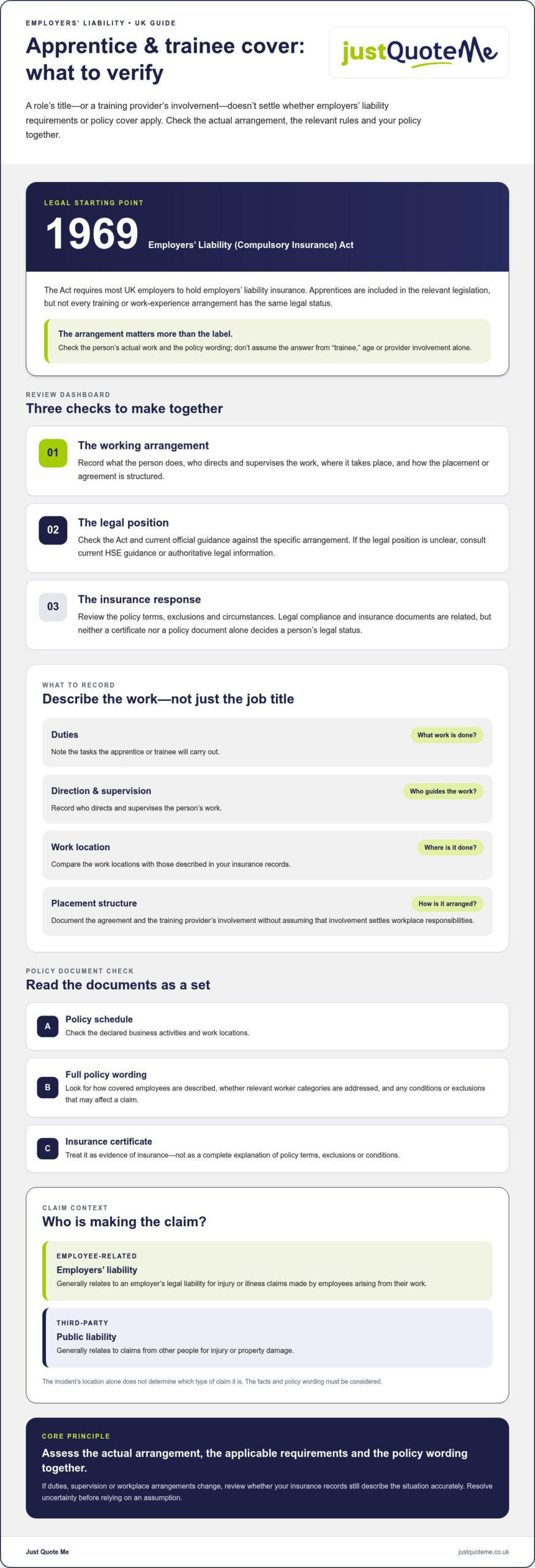
Employers’ liability insurance is generally intended to cover an employer’s legal liability for injury or illness claims made by employees arising from their work. Whether a particular claim falls within cover depends on the policy terms, exclusions and circumstances. It’s different from public liability insurance, which generally relates to claims from third parties for injury or property damage. In short: employers’ liability concerns employee-related claims; public liability concerns claims from other people.
What does employers’ liability insurance generally relate to?
The distinction matters because an incident’s location doesn’t determine which type of claim it is. For example, if an apprentice is hurt while carrying out workplace duties, the employer should consider the employers’ liability policy and the person’s status. If a visitor is injured during the same incident, that may raise a different insurance question. These examples don’t determine whether a claim is covered; the policy wording and facts must be considered.
Review the schedule and wording for the activities, people and circumstances described by the policy, rather than relying on the insurance name alone. Just Quote Me’s employers’ liability insurance information can help you understand the cover in the context of your business. If the arrangement is unusual or the wording is unclear, seek an explanation before relying on an assumption.
Does calling someone a trainee change the insurance question?
A label is only one part of the picture. The Employers’ Liability (Compulsory Insurance) Act 1969 refers to employees working under a contract of service or apprenticeship, but not every training or work-experience arrangement is necessarily identical. Consider what the person actually does, who directs and supervises their work, where they carry it out, and how the placement or agreement is structured. Those details help frame the legal and policy questions without assuming the answer.
An apprenticeship combines employment and structured learning, though arrangements vary. The general Apprenticeship overview offers background, but it can’t determine an individual’s status under UK law or a specific insurance policy. A trainee may also have duties that resemble an employee’s, or may take part in a short placement with a different structure. Don’t decide cover based only on a job title, age or the presence of a training provider.
Instead, record the arrangement and compare it with the policy wording. If the role, supervision or workplace duties change, review whether your insurance records still describe the situation accurately. This gives you a clearer basis for checking applicable requirements and discussing any uncertainty with an insurance broker or seeking authoritative legal guidance.
UK Rules and Policy Wording: What Employers Should Check
The legal starting point is the Employers’ Liability (Compulsory Insurance) Act 1969. It requires most UK employers to hold employers’ liability insurance, and an apprenticeship arrangement can bring the Act into consideration. That does not mean every placement or training arrangement has the same legal status. The details matter, as do any statutory exceptions and the current wording of your policy.
For employers liability for apprentices and trainees, separate two questions: what the law requires for your particular arrangement, and how your insurer’s policy responds to a claim. Don’t rely on a general description of apprentices or trainees to answer either one. Where the legal position is uncertain, consult current guidance from the Health and Safety Executive (HSE) or authoritative legal information. Avoid relying on an exemption or a cover limit unless you’ve checked it against a current authoritative source.
Which UK legal points need careful verification?
Check the Act and current official guidance against the actual arrangement, including whether the person is engaged under an apprenticeship or another type of placement. Consider whether relevant HSE guidance addresses the specific issue you’re reviewing. If the circumstances don’t fit a straightforward employment arrangement, don’t assume that the same rules apply automatically. Record what you’ve checked and seek appropriate advice if the legal position remains unclear.
Legal compliance and insurance documentation are related, but they aren’t interchangeable. A certificate is evidence of insurance; it doesn’t explain every term, exclusion or condition that may affect a claim. Equally, a policy document doesn’t decide a person’s legal status by itself. Assess the arrangement, the relevant law and the policy together rather than treating any one document as the complete answer.
What should the policy documents say about workforce cover?
Read the policy schedule alongside the full wording and certificate. Check how the insurer describes covered employees and whether apprentices, trainees or other relevant worker categories are addressed. Review the declared business activities and work locations, then note any conditions that relate to the work the person will actually perform. A mismatch is a prompt to clarify the records, not proof on its own that a claim would or wouldn’t be covered.
Keep a simple record of the review, including the placement agreement, role description and any relevant correspondence with your insurer or broker. If an apprentice works across different sites or takes on duties beyond the original plan, compare those changes with the declared activities and locations. The facts of an incident, the policy wording and any applicable exclusions all affect how a claim is considered.
Just Quote Me can help you make sense of employers’ liability insurance in light of your business circumstances and policy documents. If you’d like help understanding the wording, speak with Just Quote Me about your insurance questions.
Apprentices, Trainees and Work Experience: Compare the Arrangements
An apprenticeship, a paid trainee role and a short work-experience placement can look similar at the workplace, but their arrangements may differ. For employers liability for apprentices and trainees, compare what has actually been agreed with what the person does day to day. Payment and job titles are useful details, but they don’t replace reviewing the circumstances, applicable law and policy wording.
Identical job titles don’t guarantee identical treatment under an insurance policy. Use the comparison below to identify questions to investigate, not to presume whether a person is covered.
| Arrangement | Workplace duties | Supervision | Questions to verify |
|---|---|---|---|
| Apprentice | May combine practical work with structured learning under an apprenticeship arrangement. | Establish who assigns and oversees workplace tasks, and how training is supported. | What does the apprenticeship agreement say? How does the policy describe employees or apprentices? |
| Paid trainee | May carry out regular work while learning or developing skills; duties depend on the role. | Identify who directs the work and monitors the trainee’s activities. | What are the terms of the arrangement? Do the declared activities and workforce details reflect the role? |
| Short-term work-experience placement | May involve observation, supervised tasks or other activities set for the placement. | Clarify who provides day-to-day oversight at the workplace and what the placement provider does. | What does the placement agreement say about duties, supervision and the parties involved? |
How might an employed apprentice differ from a placement student?
An apprentice may work under an apprenticeship arrangement that combines workplace duties and learning. A placement student may attend a workplace as part of an educational programme, with different terms and aims. Don’t infer legal status from these descriptions alone. Record the agreement, the tasks expected and whether workplace managers or education staff direct and supervise the person’s daily activities. Then check how the actual arrangement relates to current legal requirements and the policy.
What changes when a training provider is involved?
A provider’s involvement doesn’t, by itself, establish which insurance arrangements apply to the employer. Read the training or placement agreement alongside the role description and policy documents. Note who sets tasks, provides supervision, and manages changes to the placement. The agreement can clarify the parties’ stated roles, but legal responsibilities and insurance consequences depend on the circumstances, applicable law and policy terms.
For example, a placement might begin with observation and later include practical tasks. That change is a reason to revisit the written arrangement and check whether the description of duties remains accurate. Keep relevant records together so you can explain the setup clearly when reviewing the policy or discussing it with a broker. A broker can help interpret policy wording in light of your circumstances, but the documents and facts remain central to assessing how cover may respond.
Use the comparison as a starting point, then record the details that distinguish your arrangement. Reviewing employers’ liability insurance alongside those details can help you identify what needs clarification before the placement begins or the role changes.
A Practical Employers’ Liability Review Before an Apprentice Starts
A short, documented review before the start date helps you compare the planned role with your insurance records. For employers liability for apprentices and trainees, work through the arrangement, duties, policy and any unanswered questions in sequence. This won’t decide legal status on its own, but it gives you a clear factual basis for checking applicable requirements and discussing the cover.
What details should an employer gather first?
Start with the documents that describe the arrangement, such as an employment or apprenticeship agreement, or a work-experience placement agreement. Record the planned start date, role, expected duties, work locations and who will supervise day-to-day activity. Note how any training provider is involved and what the written arrangement says about each party’s role.
Keep the record focused on details relevant to the role and insurance review. You don’t need to collect unrelated personal information to describe the work arrangement. If duties or locations are still being finalised, identify what remains undecided and update the record once those details are agreed.
How should employers review cover and records?
Compare your notes with the policy schedule, full wording, certificate and declared business activities. Look for relevant descriptions of the workforce, work undertaken and locations. If the documents don’t clearly reflect the planned arrangement, avoid assuming how a claim would be treated. Ask for an explanation of the wording from your broker or insurer, and obtain legal guidance if the person’s status or a statutory requirement remains uncertain.
Use this sequence to keep the review practical:
- Record the arrangement. Keep the relevant agreement, role details, start date, work locations and supervision arrangements together.
- Check the duties. Describe the work the apprentice will actually perform, including any planned changes from observation or training to practical tasks.
- Review the insurance documents. Compare the facts with the schedule, wording, certificate and declared activities. Note any unclear terms or apparent differences.
- Resolve open questions. Seek an explanation of policy wording where needed, and consult authoritative UK guidance, including relevant Health and Safety Executive material, for legal or safety questions.
Keep a dated note of what you reviewed, the questions raised and any explanation or decision received. Retain it with the relevant insurance records. This creates a useful reference if the arrangement changes or you need to revisit the review; it isn’t a substitute for the policy or legal advice.
Review the records again if the apprentice takes on different duties, moves to another workplace, changes supervisor, or follows a revised training or placement arrangement. A change doesn’t automatically mean the cover is inadequate, but it may alter the facts against which the policy should be considered. Record the update and check whether your declarations still reflect the work.
If your review raises questions about how your business circumstances relate to the policy wording, Just Quote Me can help explain tailored employers’ liability insurance options. Discuss employers’ liability cover for your business.
Arrange Employers’ Liability Cover with Clear, Tailored Advice
Before deciding whether your arrangements are in order, follow a clear sequence: establish the apprentice’s or trainee’s working arrangement, check the current rules that apply, compare the details with your policy and address anything unclear. This helps you make a considered decision about employers liability for apprentices and trainees without assuming that a job title alone determines the answer.
What can a broker help an employer clarify?
An insurance broker can help relate your business activities and workforce arrangements to the policy wording. For example, the discussion may cover the apprentice’s duties, work locations and the terms of the training arrangement, alongside the descriptions and conditions in your insurance documents. That context can make policy language easier to understand, but it doesn’t guarantee how an insurer would respond to a future claim.
Just Quote Me is an independent, FCA-authorised UK insurance broker with more than 30 years of industry experience. Its advice is tailored to the employer’s circumstances and relevant policy wording. If you’re reviewing employers’ liability insurance, having the role and agreement details to hand can help make the conversation focused and useful.
What are the next steps for employers?
Prepare a concise summary before requesting a quote or speaking with an adviser. Include the role, expected duties, work locations, supervision arrangements and the relevant apprenticeship, employment or placement documents. Note any details that are still being agreed, and be ready to explain how the person’s work fits your business activities. Clear information helps an insurance discussion reflect the arrangement you intend to put in place.
Then use the information to work through the decision path:
- Establish the arrangement. Identify how the role is structured and which written documents describe it.
- Check current rules. Use authoritative UK guidance for questions about legal requirements or exceptions that may apply.
- Review the policy. Compare the arrangement with the schedule, wording and relevant insurance records.
- Address gaps or uncertainty. Seek an explanation where the policy language or its application to the role isn’t clear.
Keep your records up to date if the apprentice’s duties, workplace or training arrangements change. A review won’t replace legal advice or determine a claim outcome, but it can help you make informed decisions and discuss your circumstances clearly. Just Quote Me can help explain tailored insurance options so you can consider the next step with greater clarity.
Get Your Free Business Insurance Quote now
Request a Call back for free Expert advice
Take the Next Step with Confidence
Bringing an apprentice or trainee into your business is an opportunity to develop skills and strengthen your team. A clear record of the working arrangement can also make insurance discussions more focused. Use it to consider employers liability for apprentices and trainees in the context of the actual duties, locations and policy wording, rather than relying on assumptions about a role’s title.
If you’re ready to explore your options, prepare the relevant role and training details and start a tailored insurance discussion. Just Quote Me can help you consider employers’ liability cover in light of your business circumstances, without promising a particular claim outcome.
Get Your Free Business Insurance Quote now
Prefer to discuss your circumstances first? Request a Call back for free Expert advice.
Frequently Asked Questions
Are apprentices covered by employers’ liability insurance in the UK?
Apprentices are expressly included in the Employers’ Liability (Compulsory Insurance) Act 1969’s definition of an employee when working under a contract of apprenticeship. Most UK employers must hold employers’ liability insurance, but the arrangement and any applicable exception still matter. For employers liability for apprentices and trainees, check the current legal position and your policy rather than assuming a particular claim will be covered. Policy wording and the facts determine how cover responds.
Do I need employers’ liability insurance for an unpaid trainee?
Unpaid status alone doesn’t settle whether employers’ liability insurance is required or how a policy applies. For example, an unpaid trainee who regularly follows your instructions and performs work may have a different arrangement from someone attending briefly to observe. Keep the agreement, duties and supervision details, then check the legal position and policy wording. If you’re unsure whether the arrangement creates relevant responsibilities, use current authoritative UK guidance or seek advice.
Does employers’ liability insurance cover work-experience students?
It depends on the student’s arrangement, the circumstances and the policy terms. A school placement involving observation may differ from one where a student carries out practical tasks as part of the workplace routine. Before the placement starts, record what activities are planned and who will supervise them. Review the placement documents against your policy, and don’t treat a short duration or educational purpose as proof of cover or an exemption.
Can an apprenticeship provider’s insurance replace an employer’s cover?
Don’t assume that a provider’s insurance replaces cover the employer may need. The provider’s policy and your own insurance arrangements can have different purposes, terms and insured parties. Read the apprenticeship agreement to understand each party’s stated role, then consider your obligations under current law and the wording of your policy. If the agreement refers to insurance, identify exactly what it says, and clarify any uncertainty before relying on it.
What happens if an apprentice is injured at work?
First, respond to the immediate situation and follow your workplace procedures for getting appropriate help and recording the incident. Make a factual note of what happened, when and where, who was present, and the work being carried out. Preserve relevant records, such as the task instructions and training information. Then review your policy’s claims-notification process and follow its requirements. Don’t speculate about responsibility; ask your insurer or broker how to proceed.
Do I need to tell my insurer when I take on an apprentice?
Check your policy’s requirements and make sure the information you’ve given your insurer accurately reflects your workforce and business activities. For instance, taking on an apprentice may involve new duties, a different work location or training arrangements that weren’t part of your previous description. If you’re unclear whether an update is needed, contact your insurer or broker with the role details and ask for guidance. Keep a record of the response with your policy documents.
