

Could a building be insured correctly by describing only its address? Not if it houses residents above a shop, café or other business. The insurance considerations for mixed-use property depend on how each part is used, who occupies it and who is responsible for the building and its contents.
It’s understandable to wonder whether one policy can cover both residential and commercial activity, or whether a tenant’s business could affect protection for the whole property. A specialist mixed-use policy may bring cover together, but the right arrangement depends on the property and insurer assessment. Policy wording matters, and cover isn’t automatic.
This guide explains how residential and commercial use can shape building, contents and liability cover. You’ll learn what details insurers need, including information about business activities, occupants, shared areas and lease responsibilities, and what to review with an insurance adviser. With a clear picture of the property’s current use and ownership, you can make more informed decisions about suitable protection.
Key Takeaways
- Insurance considerations for mixed-use property start with identifying every residential and commercial use in the building.
- Separate the building from contents owned by you, residents or commercial tenants, then consider relevant landlord and commercial property cover.
- Compare policy options by checking how clearly they describe occupancies, responsibilities and renewal arrangements.
- Before arranging or renewing cover, gather details about the layout, occupants, business activities, ownership and shared areas.
- Tell insurers about changes such as a new tenant or a change of use, and use broker advice to present the property’s risks clearly.
What counts as a mixed-use property, and why does its insurance need closer attention?
A mixed-use property combines residential accommodation with one or more commercial activities in the same building or site. It differs from a purely residential or commercial premises because people may live in part of it while another part is used to run a business. The broad idea is reflected in Mixed-use development, but for insurance, the building’s precise layout and use matter.
Flats above a shop are a familiar example. Others include offices with residential units, a home next to business premises, or a building where a commercial unit and rented accommodation share an entrance or facilities. The key insurance considerations for mixed-use property go beyond its appearance: insurers may look at who occupies each area, what happens there, who owns it and how spaces are shared.
Which buildings are commonly treated as mixed-use?
A shop with flats above it is mixed-use, as is an office building with homes within the same development. A property can also combine a residence with a separate business space on the same site. These examples show why physical layout is only part of the picture: two buildings with similar floor plans may have different uses and occupants.
Insurers may assess each arrangement differently. A separate commercial entrance, shared corridors, or facilities used by both residents and business visitors can affect how the premises are described. The number and arrangement of units also help explain how people move through the property. Give a clear account of the whole building, rather than describing only the part you own or occupy.
Why the property’s actual use matters
Occupancy changes the risk picture. Residents may be present throughout the day, while customers, staff or suppliers visit the commercial area at particular times. A business’s activities can also differ from those of a neighbouring unit, so “shop” or “office” alone may not explain what takes place. Insurers use details like these to assess the property and decide what terms may apply.
Describe the building as it is currently used, including any shared areas and the people who use them. If a commercial unit has changed purpose, a new tenant has moved in, or part of the building is now occupied as a home, the information used for insurance may need review. An outdated description can leave uncertainty about how an exposure is treated.
There isn’t one layout or occupancy pattern that tells you exactly how cover will respond. The policy wording sets out how the insured property and its different exposures are treated, while the insurer’s assessment reflects the information provided. Clear, current details make it easier to understand the arrangement and identify questions to discuss before cover is arranged or renewed.
Which insurance covers should owners consider for mixed-use property?
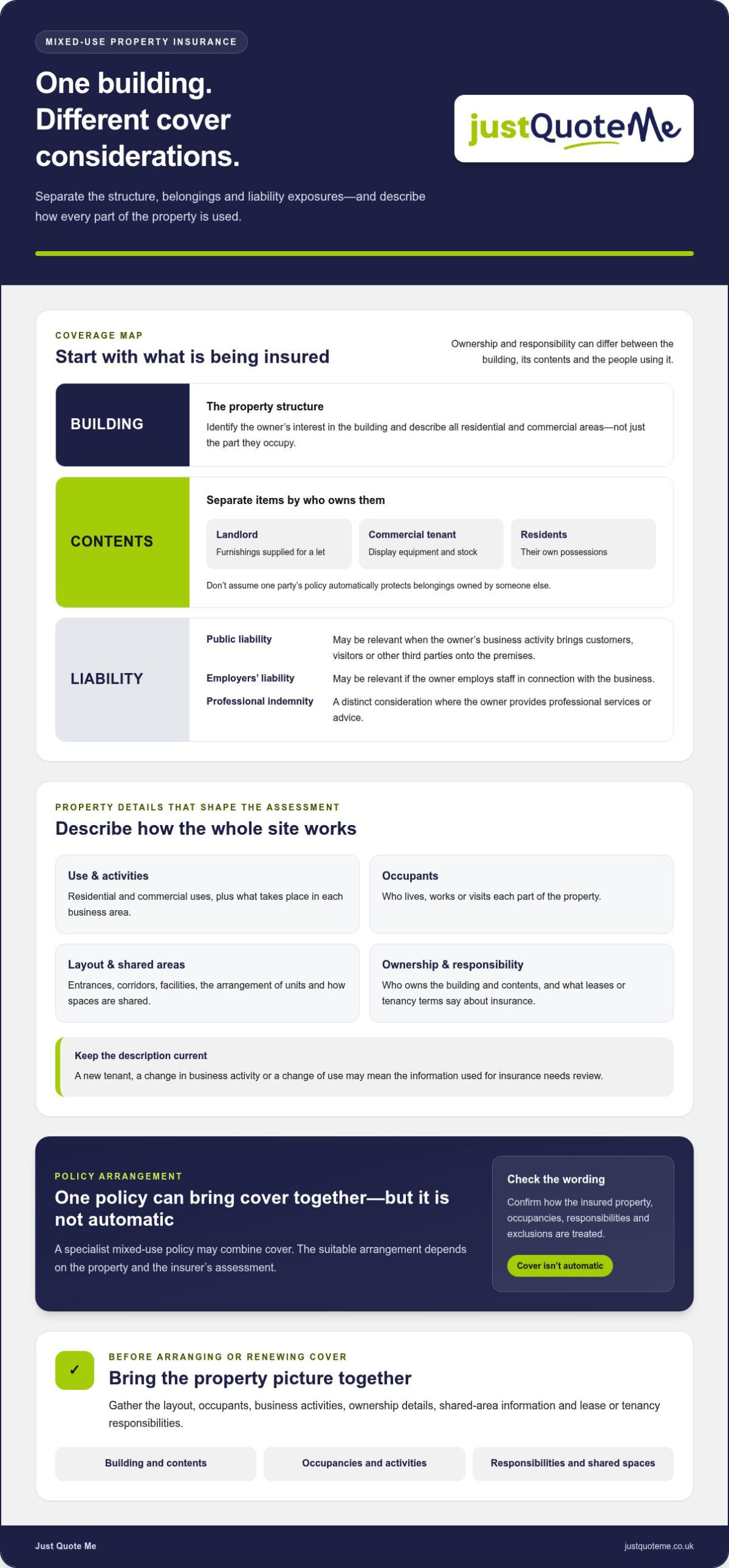
Start by separating the building from the items kept inside it. The owner may have an interest in the structure, while residents and commercial tenants may own their own furniture, equipment, stock or other contents. A landlord’s belongings, such as furnishings supplied for a let, are different again. Who owns each item and what the tenancy or lease says can help clarify whose insurance arrangements need to address it.
Commercial property insurance and landlord insurance are relevant categories for mixed-use owners, but neither label guarantees that every part of a building or every occupant’s belongings are covered. The property’s layout, activities and ownership arrangements all matter. Insurers assess the information provided, and the policy wording explains what the particular arrangement covers and excludes.
Buildings, contents, and rental exposure
Building cover concerns the property itself, while contents cover relates to items within it. For example, a landlord might own the building and supply furniture in a flat, while the shop tenant owns its display equipment and stock. Residents may have their own possessions to insure. Avoid assuming that one party’s policy automatically protects items belonging to another.
Rental arrangements also matter. Review the lease or tenancy terms to understand who is responsible for arranging insurance and which property or interests are included. If the owner lets residential units and a commercial space, make sure the information given to insurers reflects both uses. Any rental-related protection should be understood through the policy wording, rather than assumed from the property’s landlord status.
Liability cover and business activities
Liability is a separate consideration from damage to the building or contents. Public liability may be relevant where the owner’s business activity brings customers, visitors or other third parties onto the premises, and an incident could involve injury or damage to their property. The activity, areas used and responsibilities involved help shape the assessment. For more detail on this cover, see the public liability insurance guide.
Employers’ liability may also be relevant if the owner employs staff in connection with the business. Professional indemnity is a distinct consideration where the owner provides professional services or advice. These covers address different exposures, so don’t treat one as a substitute for another. The owner’s role, activities and responsibilities should guide the discussion, with the applicable terms set out in the policy wording.
To make the insurance considerations for mixed-use property easier to assess, map out who owns the building and contents, who occupies each area, and what activities take place there. Then compare those details with the proposed cover and wording. This gives you a clearer basis for discussing suitable commercial property, landlord and liability arrangements without assuming that a standard policy automatically fits the whole property.
One policy or separate policies: how should owners compare mixed-use insurance?
There isn’t a universal answer to whether a mixed-use building should be covered under one arrangement or several. The practical test is whether the documents clearly reflect the property’s uses, the parties’ responsibilities and the insurer’s accepted terms. A single arrangement may bring information together, while separate policies may reflect distinct ownership or business responsibilities. Neither structure is automatically broader or more suitable.
Compare the documents themselves, not just their labels. Check whether the schedule describes each residential and commercial part, and whether the wording addresses the actual occupancy and activities. Pay particular attention to shared entrances, corridors or facilities, and to which party is responsible for arranging cover. These details help you understand how the proposed arrangement treats the whole property.
What to compare in a combined insurance arrangement
For a combined arrangement, check that the schedule identifies the residential and commercial uses accurately. Review the policy definitions, exclusions and conditions to understand how those uses are treated. Look for clear descriptions of shared spaces and owner responsibilities, rather than assuming that naming the address means every activity is included. Insurer acceptance of the risk and the wording determine the actual position.
| Comparison point | Questions to raise |
|---|---|
| Occupancy description | Are the residential units and commercial activities described accurately? |
| Shared areas | How are entrances, corridors or facilities used by different occupants treated? |
| Responsibilities | Do the documents make clear which owner, landlord or business is responsible for each arrangement? |
| Renewal administration | Can you review the relevant uses and responsibilities together at renewal? |
Use the questions as a comparison framework, not as assumptions about what a policy includes. A clear schedule is helpful, but it doesn’t replace reading the full wording. Check how exclusions and conditions apply to the circumstances you’ve disclosed, and make sure you understand any differences between the schedule and the policy documents.
When separate arrangements may need consideration
Separate policies may enter the discussion where ownership, tenancy or business responsibilities are divided. For example, a freeholder, a commercial tenant and residential leaseholders may have different interests in the same building. Separate documents can reflect those distinctions, but they should still be reviewed together so responsibilities and property descriptions are consistent and understandable.
Renewal administration is another practical point. With multiple policies, note each renewal date and review changes in use or responsibility across the documents. With a combined arrangement, check that every part of the property remains accurately described. In either case, explain the building’s setup to an adviser so the options can be compared against insurer terms. For context on the building-cover category, see commercial property insurance.
These are central insurance considerations for mixed-use property, but the right structure depends on the building and insurer assessment. Compare clarity, not simply the number of policies. Definitions, exclusions, conditions and the insurer’s acceptance determine how the cover applies.
What information should you prepare before arranging or renewing cover?
A clear, current picture of the property makes it easier to discuss suitable insurance with an adviser. Gather details for the whole building, not only the part you occupy or manage. This helps describe the different uses, ownership arrangements and responsibilities accurately, and gives you a practical basis for reviewing the insurer’s schedule and policy wording.
Describe every part of the property’s use
Start with a simple floor plan or written layout, then note how each area is used. Record who occupies it, what activities take place there and whether people share access or facilities. Include vacant space and storage areas too. The aim is to give a straightforward account of the property as it stands, rather than rely on a broad label such as “shop with flats”.
- Map the layout. Identify residential, commercial, shared, vacant and storage areas. Note entrances, corridors and facilities used by more than one occupant.
- Record occupancy. List the residential units and commercial tenants, and describe how each area is occupied. Include any changes to access or occupancy since the last review.
- Summarise business activities. Describe what each commercial tenant does on the premises. Be specific about the activity and how the space is used, rather than relying on a general business category.
- Clarify ownership and responsibilities. Note who owns the building, landlord-provided contents, residents’ belongings and business equipment. Keep relevant lease or tenancy information together so responsibilities are easier to explain.
- Gather property and policy records. Have existing schedules and policy documents to hand, along with available rebuilding information and other relevant property details. Use the records you have; don’t assume a market value represents the cost of rebuilding.
Review changes before renewal or a new tenancy
Insurance information can become outdated as the building changes. A new commercial tenant, a vacant unit becoming occupied, altered business activity or a change in how shared spaces are used may affect the details insurers need. Review the information when circumstances change and before renewal, so the account of the property reflects its current use.
Keep copies of policy documents, schedules, property information and relevant tenancy or lease details together. When you receive updated documents, compare the schedule with the information you provided and read the wording for the terms, conditions and exclusions that apply. Raise any unclear descriptions with your adviser before relying on an assumption about how an area or activity is treated.
These practical steps help make insurance considerations for mixed-use property easier to explain and review. For tailored help organising the building’s different occupancies and responsibilities, Request a Call back for free Expert advice.
How can a broker help arrange insurance for a mixed-use property?
A broker can help turn a complicated building description into a clear insurance discussion. For a property with homes and business premises, that means setting out how each area is used, who occupies it, what activities take place and how ownership and responsibilities are divided. The clearer the picture, the easier it is to compare the available insurer terms against the owner’s circumstances.
Just Quote Me is an independent, FCA-authorised UK insurance broker with over 30 years of industry experience. Its role is to help owners present the property’s different occupancies to insurers and understand how proposed terms relate to the risks described. The insurer assesses the information and policy wording sets out the cover, conditions and exclusions. No arrangement should be treated as automatic.
What tailored insurance advice can clarify
An adviser can help organise details about the building, tenancy agreements, shared areas and commercial activities before approaching insurers. This can highlight where responsibilities sit and which points need careful explanation. The discussion may involve commercial property, landlord and liability cover categories, depending on the owner’s role and the property’s circumstances. For broader landlord cover considerations, see the landlord insurance guide.
Advice is most useful when it connects the owner’s situation with the terms insurers are prepared to offer. For example, an owner might need to explain that one part of a building is let as residential accommodation while another is occupied by a business, and that a shared entrance serves both. A broker can help present those details clearly, then help the owner review how the resulting schedule and wording describe the risk.
This doesn’t remove the need to check the documents. Read the proposed terms and make sure the property’s uses and responsibilities are represented accurately. If something is unclear, raise it during the arrangement or renewal discussion so you can understand the insurer’s position before deciding how to proceed.
Get a quote or discuss your circumstances
Preparing a mixed-use insurance review doesn’t have to mean working through every detail alone. Bring together the property information, existing policy documents and details of any changes, then use that material to start a focused discussion. Tailored advice can help make the options easier to understand while keeping the decision grounded in the insurer’s assessment and policy terms.
If you’re ready to take the next step, Get Your Free Business Insurance Quote now. You can also Request a Call back for free Expert advice to discuss your circumstances. Both options can help you move from a general review of the insurance considerations for mixed-use property to a more informed conversation about your building and its uses.
Make your next insurance review count
Your next step is to treat the property’s insurance as something to revisit whenever its use, occupancy or ownership changes. Keep a clear record of those changes and use it to guide a timely review, rather than waiting until renewal to discover that the information no longer reflects the building. That simple habit can make future decisions more considered.
The insurance considerations for mixed-use property are specific to each building, so focus on whether the arrangement reflects your circumstances and whether you understand the insurer’s terms. If you’re ready to discuss your options, Get Your Free Business Insurance Quote now.
A clear conversation is a practical first step towards making a confident decision about your property’s protection.
Frequently Asked Questions
Is mixed-use property insurance a legal requirement in the UK?
There’s no general legal requirement for every owner to insure a mixed-use building, but a mortgage agreement, lease or other contract may require particular insurance. Separate legal obligations can also apply to specific activities or responsibilities, so property insurance isn’t the only consideration. Review the terms that apply to your ownership and occupancy arrangements, and get appropriate advice if you’re unsure what they require.
Can a mixed-use building be insured while part of it is unoccupied?
It may be possible, but the insurer’s terms determine whether and how an unoccupied area is treated. Tell your insurer or adviser which part is empty, why it’s vacant and how long you expect it to remain so. Check the policy wording for any conditions or exclusions linked to vacancy, and ask how a change in occupancy should be recorded before relying on existing terms.
Does insurance cover a mixed-use property during renovation?
Not necessarily. Renovation work can change the property’s circumstances, so explain the planned work before it starts, including which areas will be affected and whether the building will remain occupied. The insurer’s assessment and policy wording determine how the work is treated. Don’t assume existing terms apply unchanged, especially if the project alters the building or affects how residents, tenants or visitors use it.
Are tenants’ contents covered by a landlord’s mixed-use property insurance?
Usually, a landlord’s cover is intended to address the landlord’s own insured interests, not automatically every tenant’s personal possessions or business stock. For example, a resident’s furniture and a shop tenant’s equipment may belong to those tenants rather than the landlord. Check the policy wording and tenancy or lease arrangements to understand what is insured. Tenants should establish how their own belongings are protected.
Does mixed-use property insurance cover lost rental income after damage?
Some policies may include cover for rental income lost after insured damage, but it isn’t automatic. The wording will set out the circumstances that qualify, any conditions and the relevant limits or exclusions. Check how the policy treats each rented part of the building, particularly if residential and commercial units have different tenancy arrangements. Ask your adviser to clarify any terms you’re unsure about.
Do I need to tell my insurer if a commercial tenant changes their business?
Yes, tell your insurer or adviser if a tenant’s business activity changes. A unit changing from a quiet office to food preparation, for example, may present a different risk profile. Share what the new business does and when the change is due to take effect, then review any updated documents. The insurer decides how the revised activity affects its assessment and policy terms.
