
What if a single piece of professional advice you gave today could cost you your entire business’s future five years down the line? Most UK professionals pride themselves on their expertise, yet the constant worry about potential legal fees or a client lawsuit over a simple misunderstanding is a heavy burden to carry. It’s why Professional Indemnity Insurance is no longer just an optional extra; it’s a fundamental pillar of a secure business strategy in 2026.
We understand that insurance jargon often creates more confusion than clarity. You might be struggling to distinguish between your various liability covers or feel overwhelmed by the technical difference between “claims-made” and “occurrence” wording. This guide is designed to strip away the complexity. We’ll help you master the essentials of professional protection so you can feel confident that your specific risks are covered and your reputation remains intact.
In the following sections, we’ll break down your legal obligations, explain the latest regulatory requirements, and show you how to secure a policy that works as hard as you do. By the end of this guide, you’ll have a clear path toward protecting your financial future with the help of an independent, specialised expert who understands the nuances of your professional sector.
Key Takeaways
- Master the fundamental definition of Professional Indemnity Insurance and learn how it shields your expertise from the financial impact of negligence claims.
- Explore the specific protections offered, including cover for errors in your work and omissions in the professional advice you provide.
- Use our “Advice vs. Action” framework to quickly identify when you need indemnity cover versus standard public liability protection.
- Learn how to accurately calculate your necessary coverage limits based on your unique professional risks and specific client contract requirements.
- Understand the advantage of partnering with an independent broker to access a broader range of insurers and secure a more competitive, tailored quote.
What is Professional Indemnity Insurance & Why Is It Essential in 2026?
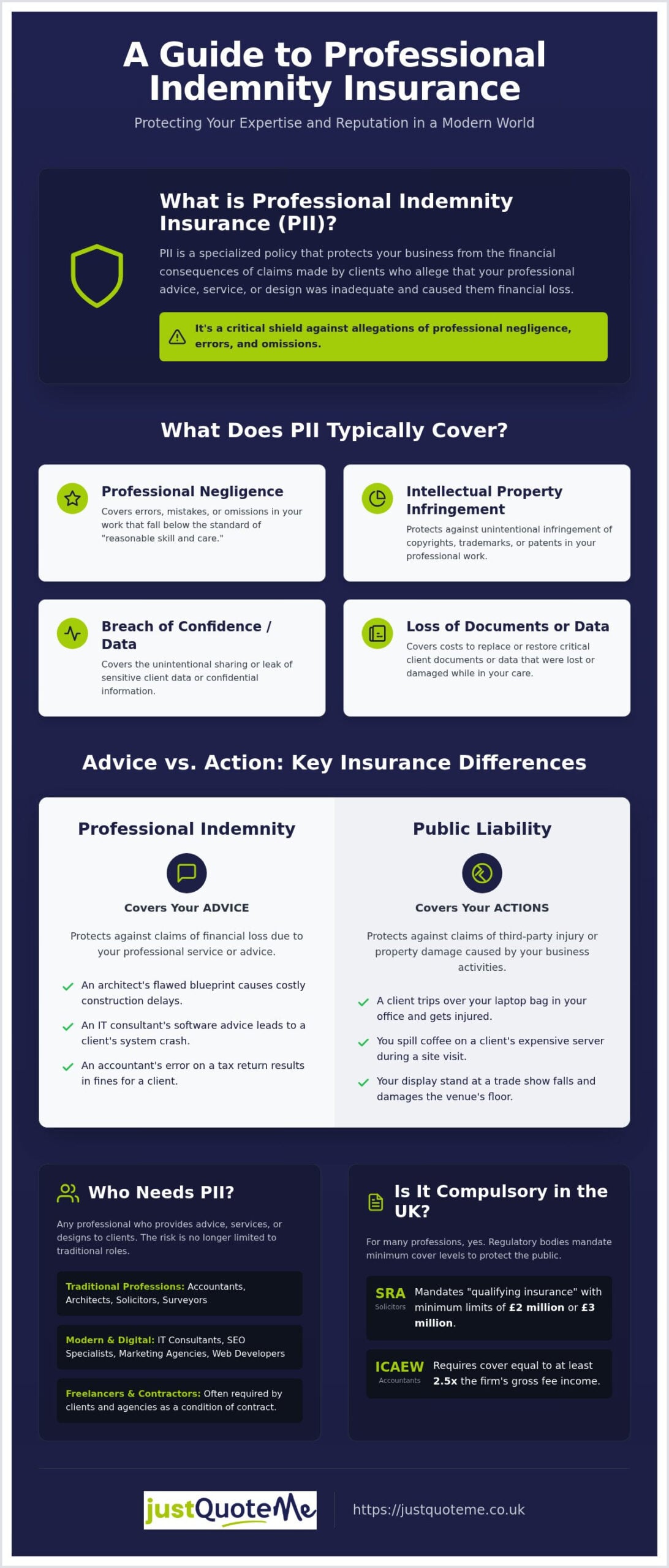
At its core, What is Professional Indemnity Insurance? It’s a specialised policy designed to protect your business if a client claims that your professional advice or service was inadequate and caused them a financial loss. While many view it as a safety net for errors, it’s actually a vital reputation-management tool. In 2026, the professional landscape is more litigious than ever, and a single allegation of negligence can be devastating without the right backing.
There’s a critical legal distinction between a simple mistake and professional negligence. UK law holds experts to a standard of “reasonable skill and care.” A mistake might be a minor typo in a report, but negligence occurs when your work falls below the standard expected of a competent peer in your field. If that failure results in a client losing money, you’re legally liable for the damages. Professional Indemnity Insurance steps in to cover your legal defence costs and any compensation awarded, ensuring your business stays afloat during a dispute.
The shift toward digital consultancy has introduced new risks that didn’t exist a decade ago. Automated advice, algorithmic errors, and remote project management mean that the potential for “bad advice” has scaled significantly. Most commercial contracts in 2026 now specify a minimum indemnity limit, often starting at £1 million, making this cover a prerequisite for winning and maintaining new business partnerships.
Who Needs Professional Indemnity Cover?
It’s not just for the traditional professions like architects, surveyors, or accountants. Modern sectors are now high-risk areas. IT consultants, SEO specialists, and marketing agencies are frequently held accountable for the performance and ROI of their digital strategies. Additionally, freelancers working under IR35 regulations often find that recruitment agencies or end-clients mandate PII as a condition of their contract to ensure there’s a financial buffer if a project fails to meet specific deliverables.
Is Professional Indemnity Insurance Compulsory in the UK?
For many, the answer is yes. Regulatory bodies set strict rules to protect the public. For instance, the Solicitors Regulation Authority (SRA) mandates that firms carry “qualifying insurance” with minimum limits of £2 million or £3 million. Similarly, the ICAEW requires its chartered accountants to have cover equal to at least 2.5 times their gross fee income. For businesses looking to optimize their professional costs, you can explore Professional Service Fees for Accounting and Compliance as part of your broader financial planning. Even if your industry doesn’t have a governing body that mandates it, operating without cover leaves your personal and business assets exposed to the full weight of a legal claim.
Get Your Free Business Insurance Quote now
Request a Call back for free Expert advice
What Does Professional Indemnity Insurance Cover?
Professional Indemnity Insurance provides a robust shield against the specific financial fallout of professional failure. While we established in Section 1 why you need it, understanding exactly what triggers a claim is vital for managing your risk. Most policies focus on “errors and omissions,” which covers the costs if you give incorrect advice or fail to perform a task to the expected standard. For instance, if an IT consultant provides a software recommendation that causes a client’s system to crash, the resulting financial loss is covered under this policy.
Beyond simple mistakes, your cover addresses broader legal issues like defamation. If you unintentionally make a disparaging remark about a third party in a professional report or email, you could face libel or slander claims. The policy also addresses the unintentional sharing of sensitive client data, known as a breach of confidence. While this overlaps with some cyber insurance protections, PII specifically handles the professional error aspect of the data leak. It also covers the physical or digital loss of documents, providing the funds necessary to replace or restore critical client information, such as property deeds or technical blueprints, that were in your care.
Breach of Professional Duty and Intellectual Property
Intellectual property disputes are a growing concern for modern creatives and consultants. Professional Indemnity Insurance protects you against unintentional copyright infringement or trademark issues, such as accidentally using a protected image in a marketing campaign without a proper license. A Breach of Duty occurs when a surveyor fails to identify structural subsidence in a property report, violating the standard of care expected in their professional contract. Most policies handle these “Breach of Duty” claims by focusing on the contractual promise of expertise you make to your clients.
Legal Defence Costs and Compensation
The most immediate benefit of a policy is the provision of expert legal representation. Even if a claim against you is entirely baseless, the cost of proving your innocence in court can be staggering. Small businesses often find that legal fees alone lead to bankruptcy before a verdict is even reached. PII covers these defence costs from the outset. It also covers the final settlement or award if you are found liable. Adhering to FCA requirements for PII ensures that your firm has the financial resilience to survive these disputes. This protection is critical because a single complex case can involve months of specialist legal work, costing tens of thousands of pounds before a settlement is even discussed.
If you are unsure which specific risks apply to your trade, it’s often best to speak with a specialist broker who can audit your contract requirements and identify potential gaps in your cover.
Get Your Free Business Insurance Quote now
Request a Call back for free Expert advice
Professional Indemnity vs. Public Liability: Key Differences Explained
Understanding the boundary between different liability covers is essential for any UK business owner. A helpful way to distinguish them is the “Advice vs. Action” framework. Public Liability Insurance protects you against physical actions that lead to injury or property damage. In contrast, Professional Indemnity Insurance covers the intellectual output of your business, such as advice, designs, or data handling. Most UK businesses need a bespoke combination of both to ensure they aren’t left exposed by a “grey area” claim.
Consider Scenario A: A client visits your office for a consultation. They trip over your laptop cable, fall, and break their wrist. This is a physical accident resulting in injury, which falls squarely under Public Liability. Now, consider Scenario B: You provide that same client with a detailed financial or technical report. Due to an error in your calculations, the client makes a poor investment and loses £50,000. There is no physical injury, but the financial damage is significant. This second scenario is exactly what Professional Indemnity is designed to handle. Relying on one to cover the other is a common mistake that can lead to rejected claims.
Complementary Covers: Employers Liability and Cyber Insurance
While PII and Public Liability form your core protection, other risks require specific attention. If you have any employees, including part-time staff or contractors, Employers Liability Insurance is a legal requirement in the UK. Modern digital businesses also face overlaps between PII and Cyber Liability. While PII covers the professional error leading to a data breach, Cyber Insurance focuses on the recovery costs, such as hardware restoration and ransomware negotiations. For tradesmen, a “combined liability” policy is often the most efficient way to manage these administrative burdens under one roof.
Professional Indemnity for Specific Industries
Your industry dictates your risk profile. A generic policy might leave dangerous gaps if it doesn’t account for sector-specific challenges. For example, construction professionals often require specialised cover found within Builders Insurance, where PII protects against design flaws or faulty architectural advice. Similarly, IT and media professionals need policies that account for software bugs or unintentional copyright infringement. Tailoring your cover ensures you aren’t paying for irrelevant protections while remaining fully shielded against your actual professional liabilities.
Get Your Free Business Insurance Quote now
Request a Call back for free Expert advice
Calculating Your Coverage: How Much PII Do You Need?
Determining the right level of Professional Indemnity Insurance isn’t as simple as picking a round number from a dropdown menu. You must evaluate the maximum financial damage your advice or service could potentially cause a client. If you’re an architect on a multi-million pound project, a basic limit is likely insufficient. Many UK clients now mandate specific minimums in their service agreements. For example, SRA rules require law firms to hold at least £2 million or £3 million depending on their structure, while ICAEW members must calculate cover based on 2.5 times their gross fee income.
Professional Indemnity Insurance operates on a “claims-made” basis. This means your policy must be active at the time the claim is brought against you, regardless of when the original work was performed. If you did the work in 2024 but the client sues in 2026, you need a 2026 policy to respond. Your premium is influenced by your annual turnover, the inherent risk of your industry, and your history of past claims. Data from 2026 shows that doubling your indemnity limit often only increases your premium by 30-50%, providing significantly more protection for a relatively small additional investment.
The Importance of Run-Off Cover
Liability doesn’t vanish the moment you stop trading or retire. Professional negligence claims can surface years after a project’s completion. This is where run-off cover becomes essential. Under the UK statute of limitations, clients generally have up to six years to bring a claim for breach of contract or negligence. Run-off cover ensures that your personal assets remain protected from these legacy claims long after you’ve closed your doors, preventing a single past error from jeopardising your retirement fund.
Retroactive Dates and Policy Continuity
When you switch insurers, pay close attention to the retroactive date. This is the specific date from which your insurer agrees to cover your past work. Maintaining policy continuity is critical. Any gap in your insurance history could leave you entirely exposed for work completed during that period. To ensure your business is fully protected, you should consult with an independent broker who can review your previous policy dates and ensure a seamless transition between providers without losing your historical protection.
Get Your Free Business Insurance Quote now
Request a Call back for free Expert advice
Finding the Best Professional Indemnity Quote with Just Quote Me
Generic comparison sites often rely on automated algorithms that miss the subtle nuances of specialised professional risks. When you choose Just Quote Me, you’re opting for a human-centric alternative that prioritises your specific business needs. As an independent, FCA-authorised broker with over 30 years of experience, we provide access to a broad network of top UK insurers. This independence means we work for you, not the insurance companies. It allows us to source competitive, bespoke pricing that matches your exact risk profile without the limitations of a single provider’s criteria.
We understand that Professional Indemnity Insurance is a critical investment in your reputation. Our team manages the complex administrative burdens and technical jargon so you don’t have to. We’ve spent three decades refining our service delivery to be fast-paced and logical, ensuring you feel fully informed and secure in your choices. Unlike automated platforms that often push users toward one-size-fits-all policies, we take the time to understand your professional obligations and contractual requirements. This personalised approach ensures you aren’t paying for unnecessary extras while remaining fully shielded against your actual liabilities.
The Local Expertise Advantage
Our roots are firmly planted in Stone, Staffordshire, with deep ties to the business communities in Newcastle-under-Lyme, Stafford, and the wider West Midlands. This regional knowledge is a significant advantage when assessing risks for local UK businesses. We understand the specific economic landscape and the unique challenges facing professionals in our area. For more information on how we support businesses in our region, you can explore our Commercial Insurance Broker Staffordshire guide. This local insight ensures your Professional Indemnity Insurance is as relevant as it is robust.
Get Protected Today
A common objection we hear is that setting up professional cover is too complicated or time-consuming. We’ve designed our process to remove that friction entirely. Our independent team handles the heavy lifting, from auditing your current policy to identifying potential gaps in your history. We believe that securing a tailored quote should be a straightforward, reassuring experience rather than a bureaucratic hurdle. You don’t have to navigate the complexities of the 2026 insurance market alone when you have a steady, expert hand to guide you.
Get Your Free Business Insurance Quote now
Request a Call back for free Expert advice
Securing Your Professional Legacy in 2026
Protecting your business against negligence claims is about more than just legal compliance; it’s about safeguarding your reputation and financial stability. We’ve explored how identifying your “Advice vs. Action” risks and calculating your coverage based on worst-case scenarios creates a resilient foundation. Professional Indemnity Insurance isn’t just a policy; it’s a strategic tool that allows you to focus on your expertise while we manage the complex administrative details for you.
With over 30 years of industry experience, Just Quote Me provides the steady hand you need in an increasingly litigious market. As an FCA-authorised independent broker, we offer bespoke cover tailored to your specific trade, ensuring you never pay for protection you don’t need. You can trust our team to simplify the insurance process so you can move your business forward with confidence. Partner with Just Quote Me today to ensure your hard work remains protected for years to come.
Get Your Free Business Insurance Quote now
Request a Call back for free Expert advice
Frequently Asked Questions
What is the difference between Professional Indemnity and Public Liability?
The primary difference lies in the nature of the claim. Public liability handles physical accidents, such as a visitor tripping in your office or accidental damage to their property. In contrast, Professional Indemnity Insurance covers financial losses resulting from your professional advice, designs, or services. If a mistake in your report costs a client money, PII is the policy that responds. Most UK businesses choose a combination of both to ensure full protection against physical and intellectual risks.
Is Professional Indemnity Insurance a legal requirement in the UK?
Professional indemnity isn’t a universal legal requirement in the UK, unlike employers’ liability. However, it’s compulsory for many professions regulated by bodies such as the SRA for solicitors or the ICAEW for accountants. Even if not mandated by law, most B2B contracts in 2026 require a minimum level of cover before you can begin work. Operating without it leaves your business assets entirely exposed to the high costs of legal litigation and potential compensation awards.
What is “Claims-Made” insurance wording?
Most Professional Indemnity Insurance policies are written on a “claims-made” basis. This means the policy must be active at the time the claim is actually made against you, rather than when the work was originally carried out. If you performed a service three years ago but receive a claim today, your current policy provides the cover. This makes maintaining continuous protection essential, as any gap in your insurance history could invalidate your protection for all past projects.
How much does Professional Indemnity Insurance cost for a small business?
The cost varies based on your industry, annual turnover, and the level of cover required. A sole trader with low risk might pay a relatively modest premium, while a small architectural or IT firm with higher exposure will naturally pay more. Factors like your past claims history and specific contractual requirements also influence the final quote. We recommend speaking with an independent broker to access a broad network of insurers for the most competitive pricing.
Do I need Professional Indemnity Insurance if I am a sole trader?
Yes, sole traders are often at higher personal risk because there’s no limited company structure to shield their personal assets. If a client sues you for professional negligence, your personal savings and property could be at stake. Whether you’re a freelance consultant or a specialised designer, having professional indemnity ensures you have expert legal representation and the funds to pay compensation without facing personal bankruptcy. It also helps you secure contracts with larger organisations; for those looking to further protect their individual wealth, you can explore Personal Tax Services with Davis & Co LLP.
What happens if I retire? Do I still need Professional Indemnity cover?
You still need cover after you retire or stop trading because claims can surface years later. This is known as run-off cover. Under the UK statute of limitations, clients generally have six years to bring a claim for professional negligence. Run-off insurance protects you during this period, ensuring that a mistake made during your final years of work doesn’t jeopardise your retirement funds or personal estate long after you’ve closed the business.
Does PII cover me for work I did in the past?
Yes, PII can cover past work as long as you have a retroactive date on your policy that precedes the work in question. This date marks the point from which your insurer agrees to cover your professional activities. It’s vital to ensure this date is maintained when you switch providers. Any gap in cover could result in losing protection for all work completed before the new policy started, leaving you personally liable for legacy claims.
