

Can your private-car discount follow you onto a commercial vehicle policy? It may, but the no claims bonus for commercial vehicle insurance isn’t automatically the same as a private-car bonus. Recognition depends on the insurer, so assuming your discount will transfer could leave you with an inaccurate quote.
It helps to separate your no-claims bonus from your wider claims history. A bonus records qualifying claim-free insurance years, while your claims history gives insurers a broader picture of previous incidents. With several vehicles or drivers, the details can become more complex, particularly if you’re considering fleet cover.
This guide explains how insurers may assess private and commercial no-claims records, how claims could affect a bonus, and what evidence may help support your history. You’ll also learn what information to gather before requesting a quote, including previous policy documents and, where relevant, confirmation of company-vehicle claims experience. Just Quote Me is an independent UK insurance broker with over 30 years of industry experience, and can help present your vehicle, driver and claims details clearly as you compare tailored cover options.
Key Takeaways
- No claims bonus for commercial vehicle insurance depends on insurer criteria and policy terms, so private-car NCB recognition isn’t automatic.
- An existing NCB and a broader claim-free driving history are different; insurers may assess them separately.
- Single-vehicle, fleet and motor trade cover can consider claims experience differently, making the policy structure important.
- Gather your current and previous policy details, vehicle-use information and claims history before requesting a quote.
- A broker can help organise your vehicle, business-use and claims details for comparison across tailored insurance options.
What does no claims bonus mean for commercial vehicle insurance?
Recognition of a no-claims bonus for commercial vehicle insurance depends on the insurer and the policy terms. A no-claims bonus (NCB), sometimes called a no-claims discount, is a policy-related reward for a qualifying period without claims. It may affect the premium, but it isn’t a complete account of someone’s driving or insurance history, and its treatment can differ between commercial policies.
Commercial cover is shaped by how a vehicle is used, what type of vehicle it is and how the policy is arranged. A van used for business deliveries, for example, may be assessed differently from a privately used car. Insurers may also distinguish between cover for one vehicle and cover arranged for several vehicles. For businesses insuring multiple vehicles, motor fleet insurance is a relevant option, but its claims assessment may not work like an individual vehicle’s NCB.
Is a private car no-claims bonus the same as commercial NCB?
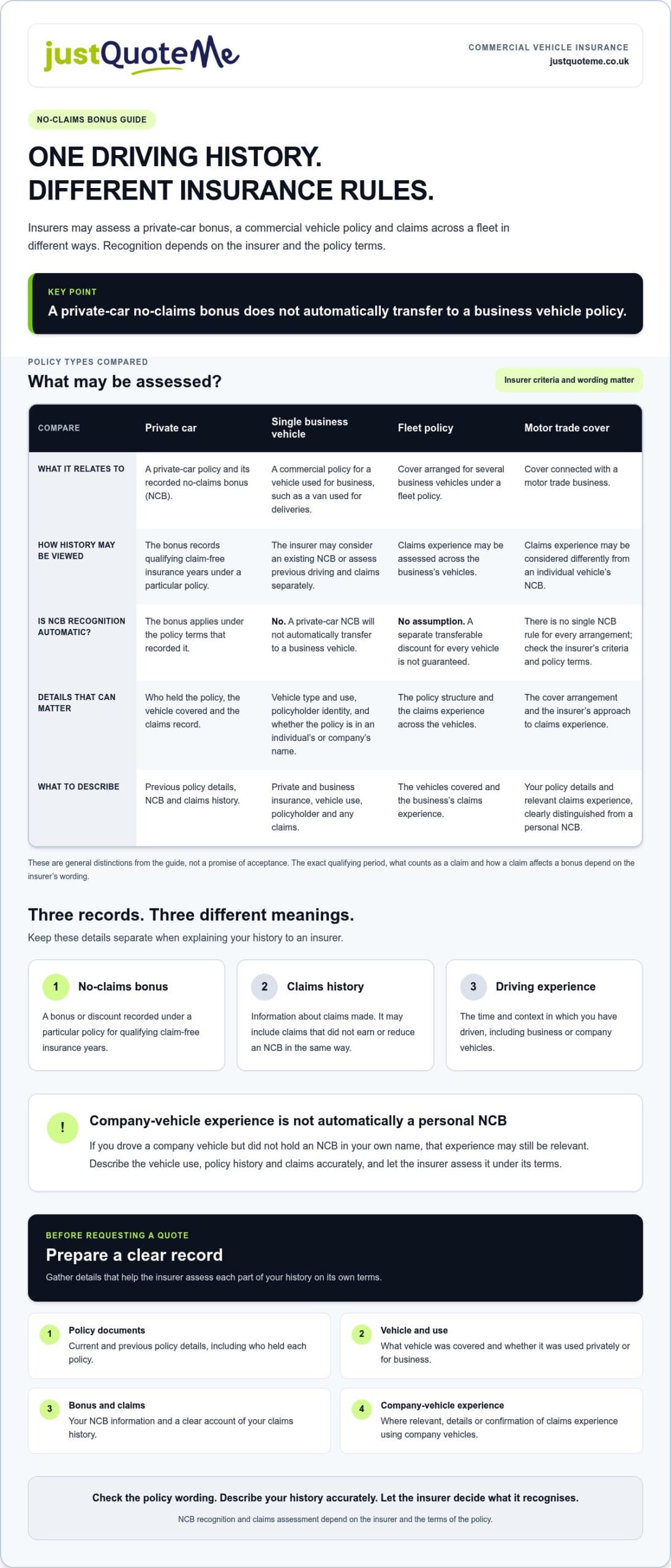
No. Private and commercial policies can have different eligibility and recognition rules, so a private car NCB won’t automatically transfer to a van or another business vehicle. An insurer may consider a private NCB under its own criteria, or assess your previous driving and claims history separately. Treat these as related but distinct pieces of information when preparing for a quote.
What does an insurer mean by a claims-free period?
Generally, it means a qualifying period of insurance during which the policyholder has not made a claim that affects their NCB. The exact period, what counts as a qualifying claim and how a claim changes the bonus depend on the insurer’s wording. Don’t assume every claim has the same effect, or that every insurer applies the same rules. Review the relevant policy documents for the terms that apply.
It also helps to separate three things when describing your history:
- NCB: a bonus or discount recorded under a particular policy.
- Claims history: information about claims made, which may include claims that did not earn or reduce an NCB in the same way.
- Driving experience: the time and context in which you’ve driven, including business or company vehicles.
These details can provide different information to an insurer. If you drove a company vehicle and don’t hold an NCB in your own name, your experience may still be relevant, but it shouldn’t be presented as a personal bonus. Give a clear account of the vehicle use, policy history and any claims, then let the insurer assess them under its terms.
Can you transfer a no-claims bonus to a commercial vehicle policy?
Sometimes an insurer may recognise an existing no-claims bonus on a commercial vehicle policy, but acceptance isn’t guaranteed. Each insurer sets its own criteria. A private car NCB, a van policy and a policy held in a business’s name may not be treated alike, so the answer depends on the details and the terms of the cover being quoted.
It’s also useful to distinguish transferring an NCB from having an insurer consider your wider record. A bonus is attached to a qualifying insurance history under a policy; previous claim-free driving can be relevant even if there’s no transferable bonus in your name. For example, a driver who has used a company vehicle may be able to describe that experience, but it shouldn’t be presented as a personal NCB unless an insurer recognises it as such.
Can private car NCB be used for a business van?
This is an insurer-specific question, not a universal yes or no. The change from private to business use, the vehicle being insured and the identity of the policyholder can all affect how an insurer assesses the history. Provide accurate details of both private and business insurance, including who held each policy and what vehicles it covered. The insurer can then assess the information against its acceptance criteria.
Changing the policyholder can matter too. A bonus earned by an individual may not be treated in the same way if the new policy is arranged in a company’s name. Don’t assume that changing the vehicle or its use leaves the NCB unaffected. Check the relevant policy wording and make sure the quote information describes the arrangement correctly.
Does a commercial fleet policy build NCB for every vehicle?
Not necessarily. A fleet policy may assess claims experience across the business’s vehicles rather than applying an individual NCB to each one, but the approach depends on the policy and insurer. Don’t assume that every vehicle or driver earns a separate transferable discount. Businesses insuring several vehicles can explore motor fleet insurance as a route to tailored cover.
In short, never assume an NCB carries across without checking the policy terms. The Competition and Markets Authority’s GOV.UK reminder on No Claims Bonus Requirements provides useful context on NCB information. For a commercial quote, focus on giving a clear account of the policyholder, vehicle use, existing bonus and claims history. That helps insurers assess each part on its own terms.
Commercial vehicle NCB, fleet history and motor trade cover compared
The way claims experience is assessed can depend on whether you insure one business vehicle, several vehicles under a fleet policy, or vehicles in connection with a motor trade business. There isn’t one NCB rule for every arrangement. The table shows the kinds of details that may matter, but insurers’ criteria and policy wording determine how each is treated.
| Cover type | Policy structure | Claims history considered | Potentially relevant information |
|---|---|---|---|
| Single commercial vehicle | Cover arranged for an individual business vehicle. | The insurer may assess the policyholder’s eligible NCB and wider claims or driving history. | Vehicle details, business use, policyholder and previous insurance history. |
| Fleet cover | Several vehicles insured under a fleet arrangement. | The insurer may consider the fleet’s overall claims experience; treatment varies by policy. | Vehicle and driver details, business use and relevant fleet claims information. |
| Motor trade cover | Cover for risks connected with a motor trade business. | The insurer’s approach to claims history and any NCB differs by policy and acceptance criteria. | Business activities, vehicle use and available policy or claims history. |
Single commercial vehicle versus fleet insurance
Insuring one van for business use is a different arrangement from covering several vehicles together. With a fleet policy, an insurer may assess the business’s collective claims experience rather than apply an individual NCB to each vehicle. If your business runs multiple vehicles, motor fleet insurance is a relevant option to explore. Give a complete account of vehicles, drivers, use and claims so the insurer can assess the arrangement accurately.
How motor trade insurance can differ
Motor trade cover is designed around a distinct business context, so its claims-history assessment shouldn’t be assumed to work like private car or single-van insurance. Personal NCB may be considered only if the insurer’s criteria allow it; it isn’t automatically applicable. Describe the business and vehicle use clearly, and provide relevant history for the insurer to assess under the policy terms.
The right comparison goes beyond the headline premium. Check how the cover fits your business, what its terms say about NCB or claims experience, and whether the insurer’s assessment reflects your circumstances. A lower quoted premium may not be the best fit if the policy structure or cover doesn’t suit how your vehicles are used. That’s especially important when comparing the no claims bonus for commercial vehicle insurance across different types of policy.
What information should you prepare before requesting a commercial vehicle quote?
A clear information pack makes it easier to describe your vehicles, business use and insurance history consistently. For a quote involving a no claims bonus for commercial vehicle insurance, separate the details you can gather now from evidence an insurer may later request. Evidence rules vary, so don’t assume a particular document or format is compulsory for every quote.
Use this preparation sequence:
- 1. Note the policyholder and business details. Record who needs the cover, such as you personally or your business, and have the relevant business information to hand.
- 2. List the vehicles and how they’re used. Gather vehicle details and describe their work use clearly, such as carrying tools or making business deliveries. Include all vehicles if you’re seeking fleet cover.
- 3. Review current and previous policy details. Note the insurer, policy dates, policyholder and vehicle covered. Check policy documents for the NCB wording and the claims-free period recorded.
- 4. Write down your claims history. Provide a clear account of claims and relevant policy changes. Don’t assume that every claim removes NCB; the policy wording explains how claims are treated.
- 5. Keep potentially useful records together. Renewal documents, policy schedules and insurer correspondence may help explain your history. Insurers decide what evidence they accept and whether they need it in a particular format.
Which records may help explain your insurance history?
Documents that show policy dates, the named policyholder, vehicle details or recorded NCB can help you give a consistent account. Previous insurer correspondence may also clarify changes or claims. These records are useful preparation, not a universal list of mandatory proof. Acceptance and format requirements depend on the insurer, so distinguish what you have available from what an insurer specifically asks you to provide.
How to compare quotes beyond the NCB figure
An indicated NCB or discount is only one part of a quote. Compare the cover against the way your business actually uses its vehicles, and review the policy terms as well as the premium.
- Does the cover reflect the stated vehicle and business use?
- Are the excesses manageable for your circumstances?
- Are any exclusions relevant to your work or vehicle use?
- How does the policy describe NCB and the treatment of claims?
Accurate, complete details make comparisons more meaningful. If vehicle use, policyholder information or claims history is missing or inconsistent, the quote may not reflect the arrangement you need. Just Quote Me can help organise these details for comparison across tailored commercial vehicle options. Start preparing for a commercial vehicle quote with Just Quote Me.
How a broker can help you explore commercial vehicle insurance options
Commercial vehicle quotes can involve more than an NCB figure. A broker can help organise your vehicle details, business use, drivers and insurance history so insurers receive a clear, consistent picture. This is particularly useful if your history includes both private and business policies, or if the cover is for several vehicles.
As an independent UK insurance broker, Just Quote Me works with a network of insurers to explore tailored cover options. Insurers set their own criteria for recognising a no claims bonus for commercial vehicle insurance, so a broker can help present your information clearly without promising that a particular bonus will be accepted or produce a specific outcome. Comparing the policy terms alongside the quote helps you assess how well each option fits your business.
When fleet insurance may suit a business
If your business uses several vehicles, it may be worth exploring cover arranged under a fleet policy. The way claims experience is assessed can differ from single-vehicle cover, and NCB treatment depends on the insurer and policy terms. Explore fleet insurance as an option for insuring multiple business vehicles, and compare the structure and terms against your requirements.
Take the next step with clear, complete information
Before requesting a quote, bring together the details that help explain your circumstances:
- Vehicles: which vehicles need cover and how they’re used for work.
- Drivers: who will drive them and any relevant driving-history details.
- Insurance history: current and previous policy information, NCB records and a clear account of claims or policy changes.
- Business use: the activities the vehicles support, described as accurately as possible.
Insurers may have different evidence requirements, so keep useful records to hand and provide any further evidence in the format requested. Complete information makes it easier to compare options on their terms, rather than focusing only on the size of a stated discount.
Ready to explore cover? Get Your Free Business Insurance Quote now.
If you’d prefer to discuss your circumstances, Request a Call back for free Expert advice.
Make your next commercial vehicle quote count
The key point is simple: no claims bonus for commercial vehicle insurance is assessed under insurer-specific criteria, so a private-car bonus won’t automatically carry across. Your NCB is also different from your wider claims and driving history, which may still help explain your experience.
Before comparing quotes, gather details of your vehicles, business use, drivers and previous policies. Then compare the cover itself, including its terms, excesses and exclusions, rather than choosing on the headline discount alone. For businesses with several vehicles, fleet cover may be worth exploring, but NCB treatment still depends on the insurer and policy.
Just Quote Me is an independent, FCA-authorised UK insurance broker with over 30 years of industry experience. Its network of UK insurers helps it explore tailored options and present your vehicle and claims-history details clearly, without assuming a particular bonus will be accepted.
Ready to take the next step? Get Your Free Business Insurance Quote now and explore cover options for your business. With clear information prepared, you can compare with confidence and find an option that fits your needs.
Frequently Asked Questions
Can I transfer my private car no-claims bonus to commercial vehicle insurance?
Possibly, but it depends on the commercial insurer’s criteria and isn’t automatic. The insurer may consider the bonus, the vehicle being insured, its business use and who held the previous policy. Share your private policy details accurately, but keep your NCB separate from your wider driving and claims history. The insurer will decide how each part is treated under its terms.
Does a commercial van insurance policy build no-claims bonus?
A commercial van policy may build an NCB if its terms provide for one and you complete a qualifying claims-free period. Eligibility and how the bonus is recorded depend on the insurer and policy. Check the policy wording rather than assuming every commercial van policy works like private car cover. Keep renewal records so you can explain your insurance history when seeking another quote.
Can I use my no-claims bonus on a fleet insurance policy?
Possibly, but a personal NCB isn’t automatically applied to fleet cover. Fleet policies may assess the claims experience of the vehicles insured together, while treatment of an individual’s NCB depends on the insurer and policy terms. Give accurate information about the fleet, drivers and claims history. This helps the insurer assess the arrangement without assuming each vehicle earns an individual bonus.
What happens to my commercial vehicle no-claims bonus after a claim?
The effect depends on the policy wording and how the insurer treats that type of claim. A claim may affect the bonus, but don’t assume every claim removes it or changes it in the same way. Check your policy documents for the NCB terms and ask the insurer to explain how the claim has been recorded. Keep the response with your policy records for future quotes.
How do I prove my no-claims bonus for commercial vehicle insurance?
Start with documents from your current or previous insurer that show your policy details and recorded bonus. Renewal or cancellation notices, policy schedules and insurer correspondence may help explain your history. The evidence accepted and any required format vary by insurer, so these records aren’t guaranteed proof for every application. Keep them available and provide the specific information requested for your quote.
Is no-claims bonus the same as a claims history?
No. An NCB is a bonus or discount recorded under a policy for a qualifying claims-free period. Claims history is a broader record of claims, while driving experience can include time spent driving a company vehicle. Insurers may consider these details separately. If you don’t have an NCB in your own name, explain your previous driving and insurance history accurately rather than describing it as a personal bonus.
