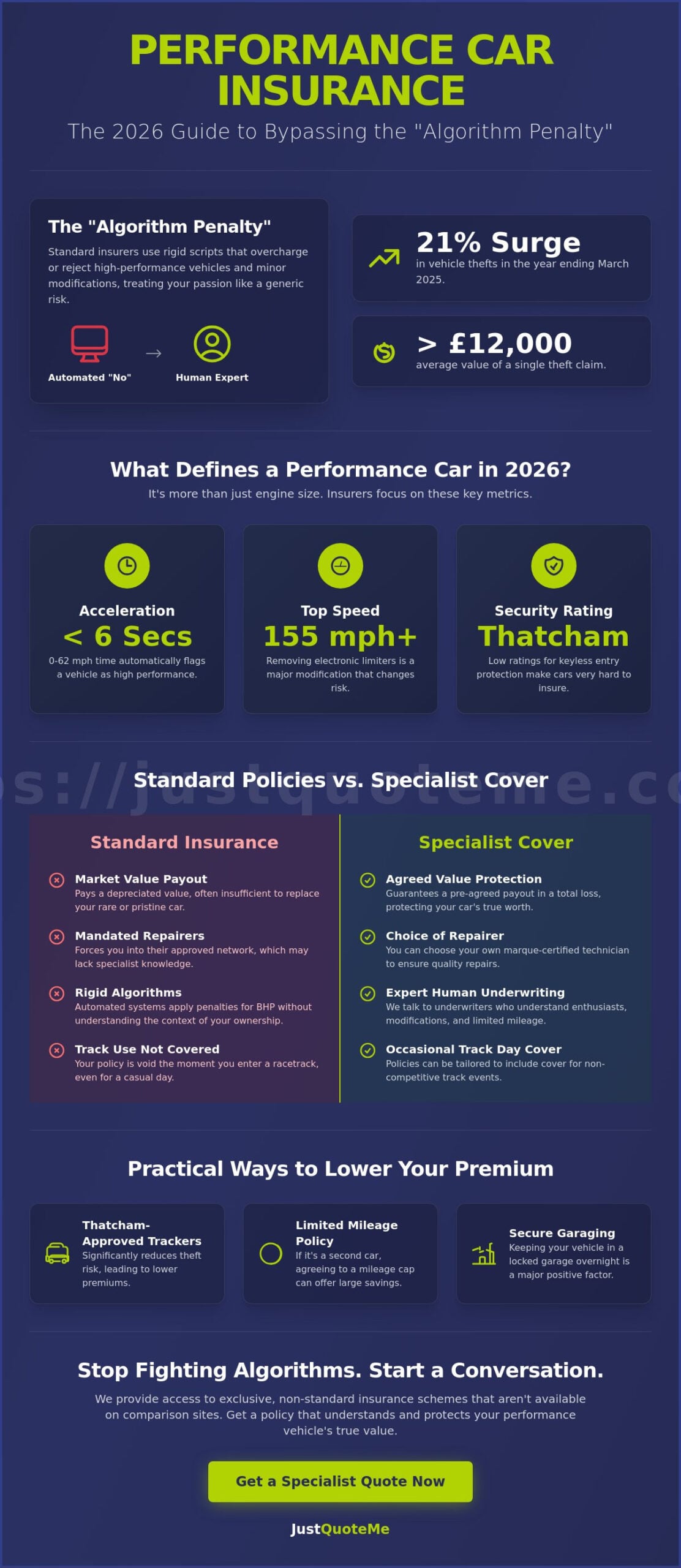
Why should a rigid computer script decide the value of your passion based on a single BHP figure? If you drive a high-performance vehicle in 2026, you’ve likely encountered the “algorithm penalty” where standard insurers overcharge for engine size or reject you for minor modifications. We agree that it’s frustrating to be treated like a generic risk, especially when vehicle thefts surged by 21% in the year ending March 2025 and the average value of a single theft claim has risen to over £12,000. Securing performance car insurance shouldn’t feel like a battle against a faceless machine that doesn’t understand your car’s true worth.
This guide promises to show you how to bypass these rigid systems to find specialist schemes that offer agreed value protection and cover for occasional track use. We’ll preview the essential 2026 updates, including the shift in the Expensive Car Supplement threshold to £50,000 for zero-emission vehicles and the impact of Euro 7 standards arriving on November 29, 2026. With group 50 supercar premiums often exceeding £5,145 in central London, it’s time to move beyond the automated “no” of the big insurers and find a policy that fits your specific needs.
Key Takeaways
Understand how 2026 performance classifications for BHP and torque can push high-end family saloons into expensive insurance groups.
Learn why standard automated systems often overcharge for performance car insurance and how specialist brokers avoid these algorithm penalties.
Discover the benefits of specialist cover, such as the ability to choose your own marque-certified repairer and securing agreed value protection.
Identify practical security upgrades, like Faraday pouches and Thatcham-approved trackers, that can significantly lower your annual premiums.
Access exclusive, non-standard insurance schemes that aren’t available on comparison sites to ensure your vehicle is fully protected.
What is Classed as a Performance Car in 2026?
The definition of a performance vehicle has shifted significantly. In 2026, it’s no longer enough to look at engine displacement alone. While a 2.0-litre engine once suggested a standard saloon, modern turbocharging and hybrid assistance mean that same capacity can now produce upwards of 400 BHP. To understand what is a performance car in the eyes of a modern underwriter, we must look at a combination of power-to-weight ratios, insurance group ratings between 30 and 50, and the specific technology under the bonnet. Standard insurers often struggle to categorise a vehicle that looks like a family car but possesses the acceleration of a mid-90s supercar. This creates the “Super-Saloon” trap, where owners of cars like the BMW M5 or Audi RS6 are hit with massive premiums because an algorithm sees a four-door car with 600 BHP and defaults to the highest possible risk category.
The Performance Metrics That Matter to Insurers
Insurers prioritising performance car insurance risk profiles focus on three core numbers. First is the 0-62 mph acceleration time. Any car hitting that mark in under 6 seconds is automatically flagged as high performance. Second is the top speed. While many German cars are electronically limited to 155 mph, insurers view the removal of this limiter as a major modification that changes the risk entirely. Finally, Thatcham security ratings are more critical than ever. With vehicle thefts in England and Wales having surged by 21% in the year ending March 2025, a car with a high BHP but a low Thatcham rating for keyless entry protection will be almost impossible to cover through standard channels.
High-Performance EVs and Hybrids
2026 marks a turning point for performance electric vehicles (EVs). With the Expensive Car Supplement threshold for zero-emission vehicles rising to £50,000 on April 1, 2026, many high-end EVs now sit in a complex tax and insurance bracket. Insurers are particularly wary of the instant torque provided by cars like the Porsche Taycan or Tesla Model S. The inclusion of “Ludicrous” or “Plaid” modes isn’t just a marketing feature; it’s a specific risk factor that specialists must underwrite manually. Furthermore, the high cost of battery replacement in a total-loss claim means that even a minor accident in a performance EV can lead to a write-off. This is why specialist performance car insurance is essential for EV owners who want to ensure their battery and specialist aerodynamic components are covered at their true replacement value.
If you’re finding that automated sites don’t understand your car’s true specification, it’s time to speak to a human expert. We don’t rely on rigid scripts to decide your premium.
Get Your Free Business Insurance Quote now.
Request a Call back for free Expert advice.
Why Standard Car Insurance Fails Performance Owners
Most mainstream insurers use broad-brush logic when calculating performance car insurance premiums. If your vehicle has a high-BHP engine, the automated systems often apply a significant penalty without considering the context of your ownership. They don’t account for whether you store the car in a climate-controlled garage or if you only drive it 2,000 miles a year. This rigid, binary approach is Why insuring performance cars is different; it requires a level of human nuance that a computer script simply cannot provide.
The financial risk for standard insurers is also driven by rising repair costs. Performance vehicles often feature specialist carbon-fibre bodywork or active aerodynamic components that require specific technicians and expensive parts. Because these models are highly desirable to organised criminal groups, generic companies often default to a flat refusal or an astronomical quote. At Just Quote Me, we bypass these scripts to negotiate bespoke terms directly with underwriters who understand the enthusiast market.
The Problem with Market Value Settlements
Standard policies usually pay out based on “Market Value” at the time of a claim. For a rare or pristine performance car, this figure is often insufficient to replace the vehicle. If your car is a future classic or has undergone significant restoration, you need an “Agreed Value” policy. This ensures that in the event of a total loss, you receive a pre-determined sum that reflects the car’s true worth, rather than a depreciated figure pulled from a generic trade guide. We work with you to verify the condition of your vehicle to secure these higher settlement figures.
Modification Rejection: The Mainstream Dealbreaker
Mainstream sites often cancel policies or refuse cover if they discover a simple ECU remap or an upgraded exhaust system. They view any change from factory specification as an unacceptable increase in risk. However, a specialist broker knows the difference between a performance upgrade and a dangerous modification. We ensure your changes are “accepted” rather than just “declared,” providing you with total peace of mind. If you are an enthusiast who spends time working on your own vehicles, you might also find value in our guide to Specialist Motor Trade Insurance. For those operating a business that buys, sells, or repairs performance vehicles, our comprehensive motor trade insurance guide for 2026 covers everything from MID obligations to protecting customers’ vehicles on your premises.
You can explore our range of tailored insurance products to see how we help drivers protect their high-value investments with a personal touch.
Get Your Free Business Insurance Quote now.
Request a Call back for free Expert advice.
Comparing Specialist Performance Cover vs. Standard Policies
Standard insurers usually promote “Comprehensive” cover as the ultimate protection. However, for a high-performance vehicle, this label often hides significant gaps. Standard policies default to market value settlements, whereas specialist performance car insurance prioritises “Agreed Value.” This distinction is vital because a market value calculation doesn’t reflect the true cost of replacing a pristine Porsche or a limited-edition Ferrari. If your car is damaged, a standard insurer might insist on using their “approved” repair network. These garages are often high-volume centres that lack the specialist jigs or diagnostic software required for high-performance marques. We ensure your policy includes a “Choice of Repairer” clause, allowing you to send your vehicle to a technician you trust.
Usage patterns also dictate your premium. If your car is a “weekend” vehicle, we can secure limited mileage discounts that reflect its reduced time on the road. Unlike standard policies that exclude any form of circuit use, specialist schemes can include occasional track day cover. This provides protection while you explore the car’s limits in a controlled environment. Understanding these ways to potentially lower your insurance costs is essential for managing the total cost of ownership in 2026. With the daily Congestion Charge in London rising to £18 as of January 2, 2026, and fuel duty set to rise on September 1, 2026, every saving on your premium counts.
Specialist Benefits You Won’t Find on Comparison Sites
One of the biggest advantages of a specialist policy is like-for-like replacement of modified parts. If your aftermarket carbon-fibre splitter is damaged, a specialist insurer replaces it with the same component, rather than a factory-standard plastic version. Additionally, many of our clients enjoy European road trips. Our policies often include full continental cover as standard, which is important for rallies or alpine tours. For those with a collection of high-performance vehicles, a bespoke Fleet Car Insurance policy often provides better value and less paperwork than individual covers.
The Multi-Car and Business Use Factor
It’s a common myth that performance cars can’t be used for business. If you use your vehicle for client visits or travelling between sites, we can arrange “Class 1” business use. This is a common requirement for consultants who also hold Professional Indemnity Insurance and want their vehicle to reflect their professional status. We can often bundle your daily driver and your performance car into a single multi-car policy, simplifying your admin while maintaining the high level of protection your performance vehicle requires.
Get Your Free Business Insurance Quote now.
Request a Call back for free Expert advice.
Practical Ways to Reduce Your Performance Car Insurance Premium
Reducing your performance car insurance premium requires a proactive approach to risk management. It isn’t just about finding the cheapest quote; it’s about proving to underwriters that you’re a lower-than-average risk. With vehicle thefts in England and Wales having surged by 21% in the year ending March 2025, security is the most significant lever you can pull. Modern 2026 security goes beyond a simple alarm. Insurers now look for AI-monitored trackers that can detect unauthorised movement in real-time. Since keyless theft accounted for 98% of stolen vehicles located by recovery companies in July 2023, simple steps like using Faraday pouches can have a direct impact on your quote.
Thatcham-approved S5 or S7 trackers with 24/7 monitoring
Ghost immobilisers or physical steering locks to deter relay attacks
Professional-grade Faraday boxes for overnight key storage
Beyond hardware, your driving credentials matter. Completing an advanced driving qualification with the Institute of Advanced Motorists (IAM) or RoSPA demonstrates a level of competence that automated algorithms often ignore. Similarly, joining a marque-specific owner’s club can unlock specialist schemes. These clubs often have pre-negotiated rates with brokers because their members are statistically more likely to maintain their vehicles to a high standard. This human-centric approach to risk is why we prefer manual underwriting over rigid computer scripts.
The Impact of Storage and Location
Where you keep your car overnight is a critical factor. A locked, brick-built garage is the gold standard, but even a secure driveway with retractable bollards can lower your rate. We understand the specific risks in the West Midlands and Staffordshire. If you’re based in Stafford or Newcastle-under-Lyme, our local knowledge allows us to present your risk to underwriters more effectively than a national call centre could. We know which postcodes have higher recovery rates and which areas require extra physical security to satisfy specialist insurers.
Policy Structuring for Lower Costs
You can also lower costs by adjusting your policy structure. Increasing your voluntary excess is a direct way to reduce the annual premium for your performance car insurance, provided you can afford the upfront cost in the event of a claim. If you only drive your car during the summer months, a “laid-up” policy provides fire and theft cover while the vehicle is SORN, which is significantly cheaper than a full road policy. While telematics or “black box” insurance is often associated with young drivers, some performance specialists now offer “pay-per-mile” schemes for weekend cars. This allows you to maintain comprehensive cover while only paying for the exact distance you travel.
To find a policy that rewards your security efforts, you can get a tailored quote from our expert team today.
Get Your Free Business Insurance Quote now.
Request a Call back for free Expert advice.
Why Choose Just Quote Me for Your Performance Insurance?
Choosing the right partner for your performance car insurance is about more than just finding a policy; it’s about finding an advocate who understands the machine in your garage. With 30 years of expertise in the UK specialist motor market, Just Quote Me has built relationships with underwriters that the general public simply cannot access. While the average cost of comprehensive car insurance in the UK stands at approximately £726 as of January 2026, owners of high-performance vehicles face a much more volatile market. We specialise in placing risks that automated systems often reject, whether that’s due to a high-BHP engine or a specific modification list.
Our roots in Staffordshire and the West Midlands give us a unique perspective on local risk factors. We don’t just see a postcode; we see the secure garaging and proactive security measures you’ve taken to protect your investment. This local knowledge is vital as we move through 2026, especially with the temporary 5p reduction in fuel duty beginning to phase out from September 1, 2026. We help you manage the total cost of ownership by ensuring your premium reflects your actual risk, not a generic regional average calculated by a computer script.
The Personal Touch of an Independent Broker
Talking to a human expert is always more efficient than navigating a 50-page online form that doesn’t have a box for your specific turbocharger or carbon-fibre trim. Our “no-nonsense” approach means we get straight to the point, saving you time and frustration. We don’t hide behind corporate jargon. If you need to make a claim, we act as your advocate, not just a middleman. We handle the heavy lifting with the insurer so you don’t have to, ensuring that repairs are carried out to the highest standards by marque specialists who respect your vehicle’s integrity.
Get Your Bespoke Quote Today
Securing a tailored quote is a straightforward process. To help us find the best possible scheme for your vehicle, please have your V5 logbook, a full list of modifications, and your security specifications ready. Whether you’re preparing for the new Euro 7 emissions standards taking effect on November 29, 2026, or simply want better protection for your daily driver, we provide the steady hand you need. The Just Quote Me promise is built on reliability, efficiency, and expert protection that respects the true value of your performance car.
Get Your Free Business Insurance Quote now.
Request a Call back for free Expert advice.
Secure Your Vehicle’s Future Today
Navigating the 2026 insurance market doesn’t have to be a struggle against rigid computer scripts. You’ve seen how the Expensive Car Supplement threshold for zero-emission vehicles rose to £50,000 on April 1, 2026, and how Euro 7 standards arriving in November 2026 will further complicate vehicle values. It’s clear that a standard policy often falls short for a high-performance car. By focusing on agreed value protection and specialist repairer choice, you can ensure your investment is fully protected against the 21% surge in vehicle thefts recorded in the year ending March 2025.
Finding the right performance car insurance is about balancing comprehensive cover with a premium that reflects your actual driving habits. As an FCA Authorised Independent Broker, we pride ourselves on being a steady hand in a complex market. You can explore our bespoke insurance solutions to find a policy that fits your specific needs. We’re here to do the heavy lifting so you can get back to enjoying the drive with total peace of mind.
Get Your Free Business Insurance Quote now.
Request a Call back for free Expert advice.
Frequently Asked Questions
Is performance car insurance more expensive for young drivers?
Yes, premiums for younger drivers are significantly higher due to the increased risk of high-speed accidents. For a 20-year-old driver, annual quotes for a group 50 supercar can exceed £42,000. Specialist brokers can sometimes mitigate these costs by looking at advanced driving qualifications or restricted mileage, but the base risk remains high for inexperienced drivers in high-BHP vehicles.
What counts as a “modification” for insurance purposes?
Any change from the manufacturer’s original factory specification is a modification. This includes performance upgrades like ECU remapping and exhaust changes, as well as cosmetic alterations like aftermarket alloy wheels or body kits. You must declare every change to ensure your performance car insurance remains valid, as undeclared modifications are a leading cause of rejected claims.
Can I get performance car insurance with points on my licence?
You can still secure cover with points, but mainstream insurers often default to a rejection for drivers with multiple convictions. We work with specialist underwriters who look at the specific nature of your offences, such as SP30s or TS10s. By providing context to the risk, we can often find a bespoke scheme that accepts your licence history without an astronomical premium increase.
Does performance car insurance cover track days at Silverstone or Donington?
Standard policies almost always exclude circuit use, but specialist performance policies can include cover for specific track days. You usually need to notify your broker in advance to arrange a temporary extension for venues like Silverstone or Donington. This provides accidental damage protection while you are on the track, which is essential given the high speeds involved.
What is “Agreed Value” and why is it better for sports cars?
Agreed Value is a fixed settlement figure pre-determined by you and the insurer. This is superior to “Market Value” because it ignores generic trade guides that might undervalue a pristine or rare vehicle. If your car is a future classic or has a documented restoration history, an agreed value ensures you receive its true worth in the event of a total loss.
Will my premium go down if I only drive 3,000 miles a year?
Yes, limited mileage is one of the most effective ways to lower your costs. If you restrict your driving to 3,000 miles a year, you are statistically less likely to be involved in an accident. Specialist insurers offer significant discounts for “weekend” cars, provided you have a separate daily vehicle and can provide proof of your odometer readings during the policy term.
How does a performance EV like a Tesla compare to a petrol car for insurance?
Performance EVs often attract higher premiums due to their instant torque and the high cost of battery repairs. With the Expensive Car Supplement threshold for zero-emission vehicles rising to £50,000 on April 1, 2026, many high-end EVs now sit in complex insurance brackets. Specialist underwriting is required to account for unique features like “Plaid” mode and specialist aerodynamic bodywork.
Do I need a specific type of tracker for my high-performance vehicle?
Most specialist insurers now mandate a Thatcham-approved S5 or S7 tracker. With keyless theft accounting for 98% of stolen vehicles recovered in July 2023, a standard factory alarm is no longer sufficient. An S5 tracker includes driver identification tags, which provides the highest level of protection against the relay attacks that are common in high-value vehicle thefts.
Get Your Free Business Insurance Quote now.
Request a Call back for free Expert advice.
Article by
Just Quote Me
JustQuoteMe Ltd is an independent UK insurance brokerage specialising in business and personal insurance solutions. With over 35 years of industry experience, the company provides tailored insurance cover for businesses, landlords, tradespeople, hospitality venues, fleets, and individuals across the UK. Known for its personal service, expert advice, and competitive premiums, JustQuoteMe Ltd works with leading insurers to deliver bespoke policies designed around each client’s unique needs. The company is authorised and regulated by the Financial Conduct Authority (FCA No. 586607) and has built a reputation for trusted, straightforward insurance guidance and long-term client relationships.
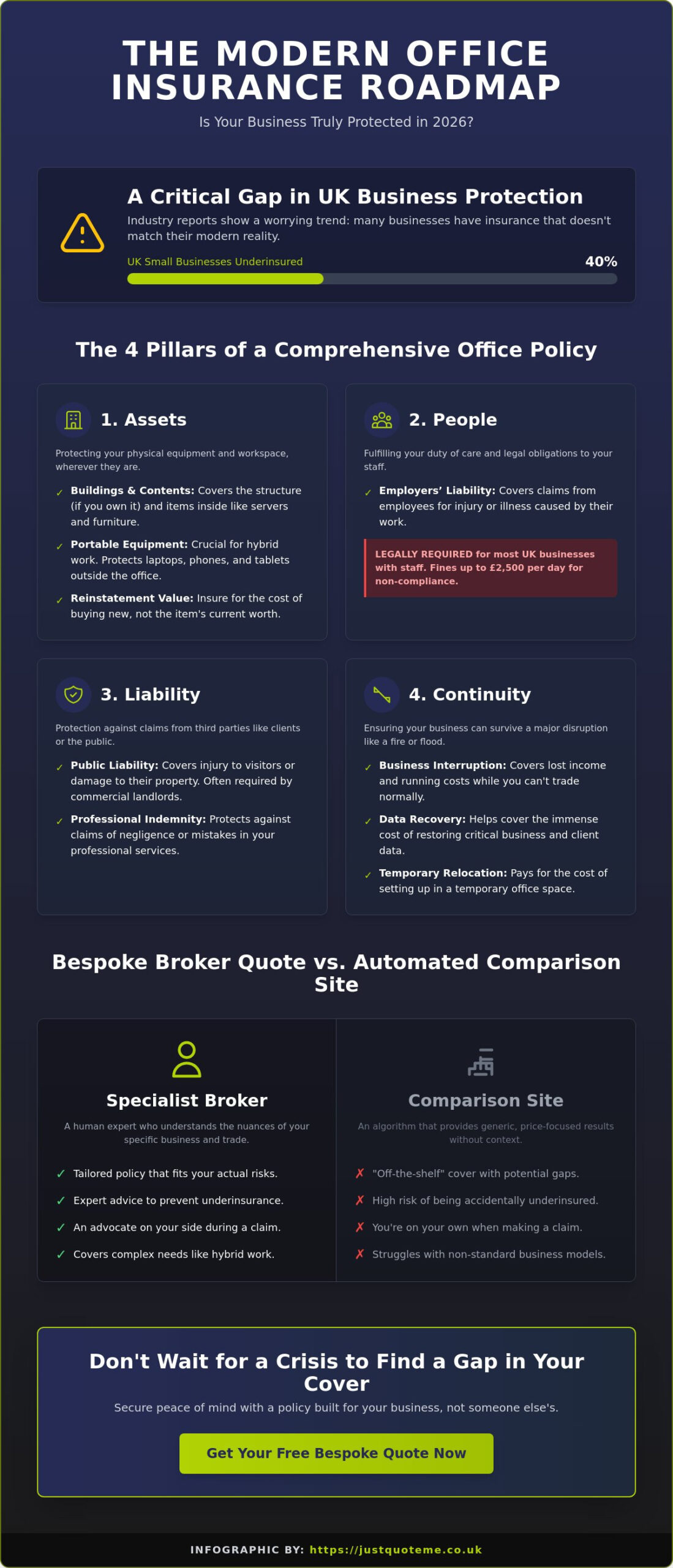
What if your office insurance is protecting a version of your business that no longer exists? In 2024, industry reports suggested that approximately 40% of UK small businesses were underinsured, often because their policies failed to keep pace with new equipment or hybrid working patterns. You likely agree that securing cover often feels like a frustrating maze of confusing jargon and automated comparison sites that don’t understand the nuances of your specific trade. It’s a time-consuming process that leaves many owners worried they’ll be left exposed when a claim for fire, theft, or accidental damage actually occurs.
This guide provides a clear, professional roadmap to securing a bespoke policy for 2026. We promise to help you navigate the legal requirements while ensuring your equipment and employees are fully protected without paying for unnecessary extras. You’ll learn how to move away from generic cover and gain the peace of mind that comes with having a specialist broker in your corner. We’ll break down the essential components of modern coverage and show you how to get a business insurance quote that actually fits your business risks.
Get Your Free Business Insurance Quote now.
Request a Call back for free Expert advice.
Key Takeaways
Learn how the “Core Four” components work together to protect your assets, people, and business continuity in a single policy.
Identify why your physical workspace, whether at home or in a traditional suite, completely changes the type of office insurance you actually need.
Discover how to conduct a simple risk audit to uncover hidden costs like specialist software and data recovery that standard policies often overlook.
Understand why a bespoke quote from a specialist broker provides more reliable protection than automated comparison sites that don’t know your trade.
Find out how to bridge the dangerous gap between generic “off-the-shelf” coverage and the actual risks faced by a modern hybrid business.
Understanding Office Insurance in 2026: More Than Just Four Walls
In 2026, the concept of an “office” has moved far beyond a fixed desk and a filing cabinet. Modern office insurance functions as a multi-layered package of protections designed to safeguard your physical assets, your legal liabilities, and your operational continuity. Whether you operate from a traditional high-street suite or a flexible co-working hub, your policy must reflect the reality of how you work. Standard “off-the-shelf” policies often fail modern hybrid businesses because they assume all your equipment stays under one roof 24/7. As the UK insurance market continues to adapt to these shifts, it’s vital to recognize that this cover isn’t just for building owners. Tenants need protection for their contents and public liabilities just as much as landlords need to secure the bricks and mortar. Both need cover.
Why UK Businesses Need Dedicated Office Cover
Generic business insurance often lacks the granular detail required for office-based trades. If a burst pipe floods your server room or a fire destroys your high-spec workstations, the financial hit goes beyond just hardware. Business continuity is the real concern. A 2024 report by the British Insurance Brokers’ Association (BIBA) suggested that many SMEs underestimate the cost of data recovery and temporary relocation. Dedicated cover ensures you aren’t just getting a cheque for a new laptop; you’re getting the support needed to stay operational. Having a human broker means you have an advocate who understands these risks, rather than an algorithm that treats every business the same. This is particularly important for firms handling sensitive client data, where a simple hardware replacement won’t cover the professional fallout of a physical loss.
Legal vs. Optional: What is Mandatory?
Understanding what you must have versus what is sensible to have is the first step toward a bespoke policy. Under the 1969 Employers’ Liability (Compulsory Insurance) Act, most UK businesses with staff are legally required to hold Employers’ Liability Insurance. Failing to comply can result in fines of up to £2,500 per day. Beyond this legal floor, your commercial landlord might contractually require you to hold specific levels of public liability cover. Just Quote Me specialises in building office insurance policies that tick these legal boxes while layering on optional protections that actually matter to your trade, ensuring you don’t pay for “filler” you’ll never use. It’s about smart protection.
Get Your Free Business Insurance Quote now.
Request a Call back for free Expert advice.
The Core Components of a Comprehensive Office Policy
Every effective office insurance policy is built on four pillars: Assets, People, Liability, and Continuity. These components don’t work in isolation; they create a safety net that catches your business when things go wrong. While it’s tempting to hunt for the lowest premium, the “cheapest” option rarely provides the “best” outcome when you’re actually filing a claim. In 2024, industry data indicated that underinsurance remains a major hurdle for UK SMEs, often because they chose price over precision. This is where an independent broker adds value, selecting the right mix of cover so you aren’t paying for fluff. It’s about getting the right protection at the right price.
Protecting Your Physical Assets: Buildings and Contents
Your workspace consists of the structure and the items within it. If you own the premises, commercial property insurance protects the “bricks and mortar” against risks like fire or subsidence. If you’re a tenant, your focus shifts to contents. This covers everything from your ergonomic chairs to your high-end server racks. However, in 2026, work isn’t confined to the desk. You must ensure your policy includes “portable equipment” cover. This protects laptops, tablets, and phones used by staff at home or while visiting clients. Without this specific addition, a stolen laptop on a train might not be covered by a standard office insurance policy. Always value your contents at the “reinstatement” cost, which is the price of replacing items with brand new equivalents rather than their current second-hand value.
Liability Protection: Public, Employers, and Professional
Liability is about protecting your business from the cost of legal claims. A broker will always check your employers liability insurance first. Under UK law, Employers’ Liability (EL) insurance is mandatory for almost every business with staff, providing at least £5 million in cover to handle claims from employees who are injured or become ill because of work. Next is public liability insurance. In an office setting, this covers accidents like a visitor tripping over a loose data cable or a coffee spill damaging a client’s expensive equipment. Finally, if you provide advice or design services, professional indemnity insurance is vital. It defends you against claims of negligence or errors that cause a client financial loss. Balancing these risks requires a specialist eye, so you might want to speak with a broker to ensure your safety net is watertight.
Get Your Free Business Insurance Quote now.
Request a Call back for free Expert advice.
Tailoring Your Policy: Home Office, Co-working, or Traditional Suite?
Your workspace’s physical address is the single biggest factor in determining your risk profile. Many entrepreneurs assume their existing domestic policies provide a safety net; however, this is a dangerous misconception. Standard household cover usually excludes business activities and high-value professional equipment. According to ONS data from 2023, 44% of UK workers reported some form of hybrid working, yet many still operate without informing their home insurers. If you’re renting a traditional suite, your first step should be a thorough review of your lease agreement. Landlords frequently mandate specific levels of office insurance, often requiring public liability limits of at least £5 million to protect the building’s common areas.
The Home Office Shift: Bridging the Gap
Most standard home insurance policies explicitly exclude business equipment and third-party liability for business visitors. If a client trips on a loose rug during a consultation at your house, your domestic insurer will likely reject the claim. You must seek a “business use” extension or a standalone home-office policy to stay protected. It’s also vital to consider different types of business insurance that apply specifically to remote workers. A risk assessment for home-based employees is just as necessary as one for a central hub to ensure you meet your duty of care obligations under the Health and Safety at Work Act 1974. Key considerations for home setups include:
Liability for clients or couriers visiting your home premises.
Cover for expensive technology that exceeds standard domestic policy limits.
Business interruption cover if a home fire or flood stops you from working.
Co-working and Managed Hubs: Who Insures What?
In a co-working environment, the lines of responsibility often get blurred. While the hub owner typically insures the building’s structure and their own furniture, they’re almost never responsible for your technology or data. Shared Wi-Fi networks in these spaces present a significant security risk. A 2024 study by the Department for Science, Innovation and Technology found that 50% of UK businesses experienced a cyber breach in the previous 12 months. This makes cyber insurance an essential add-on for anyone hot-desking. Additionally, “bring your own device” (BYOD) policies in shared spaces mean your laptops are at higher risk of theft or accidental damage. You need to ensure your office insurance includes “all risks” cover for equipment away from your primary premises.
Get Your Free Business Insurance Quote now.
Request a Call back for free Expert advice.
Risk Assessment: How Much Office Cover Do You Really Need?
Determining the correct level of office insurance starts with a cold, hard look at your balance sheet. You aren’t just insuring the price you paid for your equipment; you’re insuring the cost of replacing it all tomorrow at today’s market rates. Many owners fall into the trap of underestimating their exposure by forgetting about “silent” assets like bespoke software licenses or the data entry hours required to rebuild a lost database. A 2024 survey by the British Insurance Brokers’ Association (BIBA) found that 1 in 5 small businesses would struggle to survive a major uninsured loss. To avoid this, you need a structured risk assessment that looks beyond the hardware. You can find more detail on digital risks in our Cyber Liability Insurance Guide.
Calculating Content Value and Reinstatement Costs
Always calculate your contents cover based on “new for old” reinstatement costs. If your office flooded today, you wouldn’t want the depreciated value of a three-year-old laptop; you’d need the cash for a brand-new model to get back to work. Keep a digital asset register that includes every workstation, ergonomic chair, and coffee machine. Don’t forget “tenants improvements.” If you’ve spent money on custom glass partitions or high-spec LED lighting in a rented suite, these are your responsibility to insure, not the landlord’s. Having an accurate total prevents the “Condition of Average” clause from reducing your payout during a claim.
Evaluating the “Silent” Risks: Data and Interruption
Hardware is often the cheapest thing to replace. The real financial killer is “Business Interruption,” which is a standard addition to a robust office insurance policy. This cover pays your fixed costs, including staff salaries and rent, while you’re unable to trade due to a fire or flood. To calculate this, look at your gross profit and add your standing charges over a 12 or 24-month indemnity period. If your office also serves as a showroom or point of sale, you might find our Shop Insurance Guide useful for managing retail-specific risks. Ensuring these figures are accurate is the only way to guarantee your business doesn’t fold during a long recovery phase. If you’re unsure about your valuations, it’s best to get professional advice before signing your policy.
Get Your Free Business Insurance Quote now.
Request a Call back for free Expert advice.
Beyond the Algorithm: Why a Bespoke Broker Quote Beats Comparison Sites
Comparison sites often treat office insurance as a commodity, similar to a car or home policy. They lure you in with the promise of speed and peripheral rewards like cinema tickets or toys, but these platforms usually prioritize volume over the quality of the contract. When you’re protecting a business, you aren’t just buying a piece of paper; you’re securing a legal promise of support. Automated engines frequently miss the nuances of your specific trade, especially in the West Midlands market where local risks and property types vary significantly. Relying on an algorithm means you’re betting your business continuity on a generic form that doesn’t know the difference between a high-street recruitment firm and a home-based tech startup.
The Problem with Faceless Insurance Algorithms
The “quick” online forms found on major comparison engines are designed for speed, not accuracy. A single misunderstood question about your building’s construction or your security measures can lead to a rejected claim later. In 2024, industry data suggested that “non-disclosure” remains a leading cause for claim disputes in the UK. A bot won’t stop to ask you for clarification on your “tenants improvements” or your specific data storage protocols. It simply gives you a price based on the data you provided, however flawed that data might be. The actual cost of an unpaid claim far outweighs any small saving made on a “cheap” premium. Professional risk assessment is the only way to identify the hidden gaps that leave your assets exposed. Businesses across the region can benefit from working with a commercial insurance broker in Staffordshire who provides human-centric advice and direct underwriter access rather than relying on automated algorithms.
The Just Quote Me Advantage
Just Quote Me brings over 30 years of experience to the UK insurance market, offering a level of human oversight that an algorithm can’t replicate. We have established relationships with specialist underwriters who don’t even list their products on comparison sites. This gives you access to more robust, tailored cover that reflects the true risks of your office. If you need to make a claim, you won’t be stuck in an automated phone queue; you’ll have a real person in your corner who understands your business. We believe in a straightforward, no-nonsense approach that puts your protection first. We do the heavy lifting so you don’t have to, ensuring your workspace is secure for 2026 and beyond.
Get Your Free Business Insurance Quote now.
Request a Call back for free Expert advice.
Secure Your Business Continuity Today
Securing your workspace shouldn’t be a source of constant stress. We’ve explored how a bespoke approach ensures your workspace is protected against the specific risks of 2026. By focusing on reinstatement costs and precise liability limits, you move away from the “set and forget” mentality that leaves so many UK firms exposed. A tailored office insurance policy is more than just a legal requirement; it’s a strategic safety net for your equipment, data, and employees.
Just Quote Me brings 30+ years of industry experience to every client relationship. As an FCA authorised independent broker, we provide specialist UK-based expert support that faceless algorithms can’t replicate. We pride ourselves on a straightforward, no-nonsense service that prioritizes your protection over cinema tickets or rewards. Don’t leave your business continuity to a generic comparison engine. You can get a specialist quote today and benefit from our three decades of expertise. We do the heavy lifting so you don’t have to.
Get Your Free Business Insurance Quote now.
Request a Call back for free Expert advice.
Frequently Asked Questions
Do I need office insurance if I work from home?
Yes, you need dedicated cover because most domestic insurers exclude business-related claims. If a professional visitor is injured at your home or a fire destroys your work kit, your standard household policy won’t pay out. You should seek a “business use” extension or a standalone office insurance policy to protect your livelihood. This ensures your equipment and liability are fully secure while you work from your home base.
Is employers’ liability insurance compulsory for office-based businesses?
Yes, Employers’ Liability (EL) insurance is a legal requirement for almost all businesses with staff under the 1969 Act. You must hold a minimum of £5 million in cover to protect against claims from employees who fall ill or are injured at work. Failing to comply can lead to a daily fine of £2,500 from the Health and Safety Executive. It’s the only mandatory cover for most office firms with at least one employee.
Does office insurance cover employee theft or fraud?
Standard policies don’t usually include this by default, but you can add Fidelity Guarantee or “Commercial Crime” cover. This protects your business from financial losses resulting from employee fraud or theft of money and property. It’s particularly important for firms that handle high volumes of client transactions or have access to sensitive financial accounts. Adding this layer ensures your business isn’t crippled by internal dishonesty or sophisticated scams.
What is business interruption insurance and do I need it?
Business interruption insurance covers your lost income and fixed costs if a disaster like a fire or flood prevents you from working. It pays for staff salaries, rent, and the cost of relocating to a temporary office while yours is repaired. Without it, many firms struggle to survive the months of downtime following a major incident. It’s often the most critical part of a recovery plan for any office-based business.
Can I get office insurance for a co-working space?
You can certainly get office insurance tailored for co-working environments and managed hubs. While the hub owner usually covers the building’s structure, they don’t protect your specific technology, data, or public liability. A bespoke policy for shared spaces ensures your laptops and sensitive client information are covered while you’re hot-desking. It effectively bridges the gap between the building owner’s responsibilities and your own business risks.
How much does office insurance cost in the UK?
The cost depends on your specific trade, location, and the total value of your assets. A 2024 report by NimbleFins noted that while basic liability starts at a relatively low annual rate, a comprehensive office package is priced according to your specific risk profile. Factors like your annual turnover and the number of employees you have will influence the final premium. A specialist broker can help find a competitive rate that fits. To understand how 2026 market conditions affect your pricing, it’s worth reviewing how to approach a bespoke business insurance quote with an expert who can navigate current rate changes on your behalf.
Does office insurance cover my laptops when I am visiting clients?
Your laptops are only covered if your policy includes “All Risks” or “Portable Equipment” protection as an add-on. Standard contents cover is usually restricted to the physical office premises. If you regularly visit clients or travel for work, you must ensure your kit is protected against theft or accidental damage while in transit. This is a common oversight that leads to rejected claims for mobile workers and hybrid teams.
What happens if my office is based in a listed building?
You must inform your broker if your office is in a listed building to ensure you have specialist buildings cover. Listed properties require specific restoration materials and artisan skills that are far more expensive than modern rebuilds. A standard policy won’t account for these heritage requirements, leaving you with a massive financial gap during a claim. Specialist cover ensures you meet all legal preservation standards during a repair or rebuild.
Get Your Free Business Insurance Quote now.
Request a Call back for free Expert advice.
Article by
Just Quote Me
JustQuoteMe Ltd is an independent UK insurance brokerage specialising in business and personal insurance solutions. With over 35 years of industry experience, the company provides tailored insurance cover for businesses, landlords, tradespeople, hospitality venues, fleets, and individuals across the UK. Known for its personal service, expert advice, and competitive premiums, JustQuoteMe Ltd works with leading insurers to deliver bespoke policies designed around each client’s unique needs. The company is authorised and regulated by the Financial Conduct Authority (FCA No. 586607) and has built a reputation for trusted, straightforward insurance guidance and long-term client relationships.
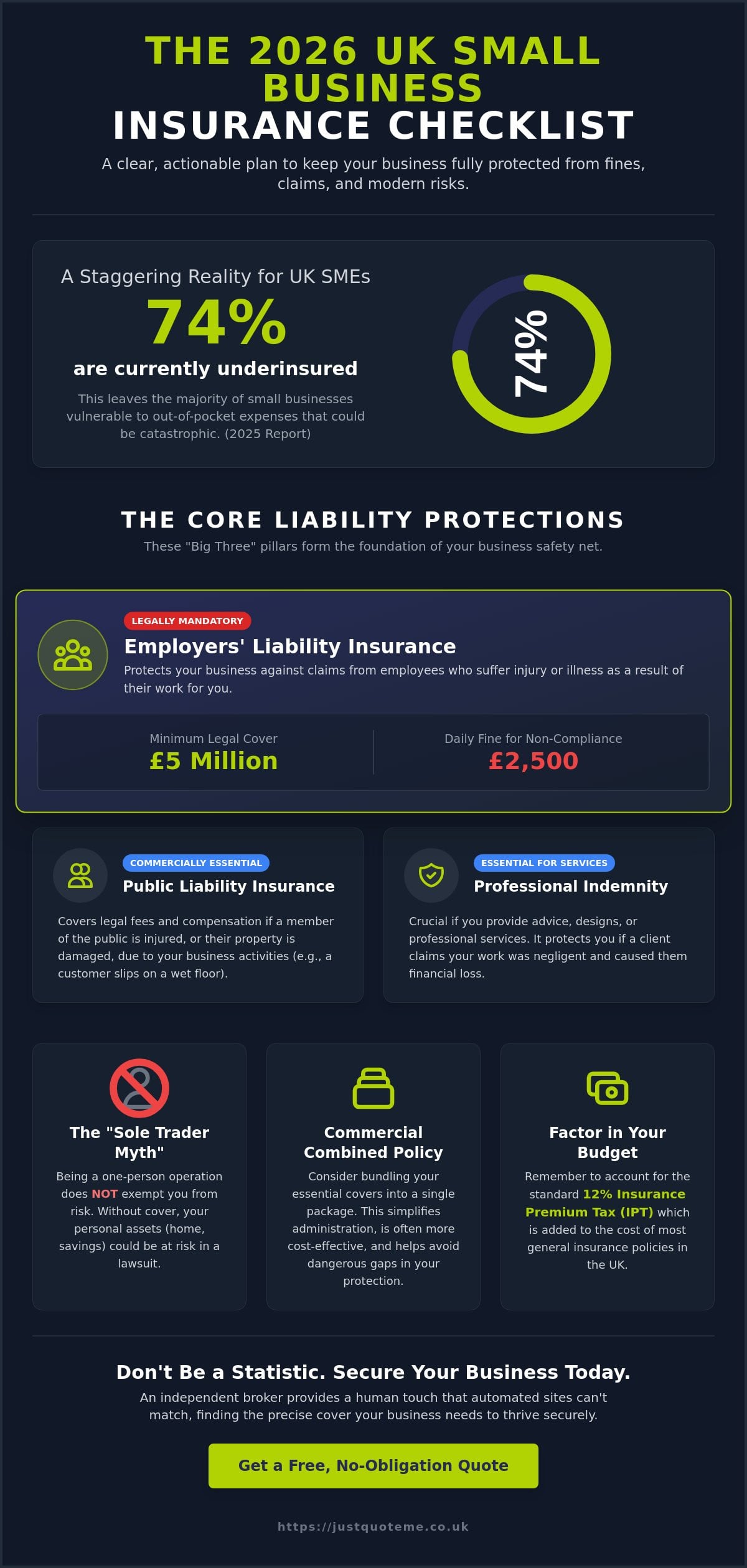
Did you know that a 2025 report revealed 74% of UK small and medium-sized enterprises are currently underinsured? It is a staggering figure that highlights just how easy it is to miss a critical detail when you are busy running a company. We understand that the distinction between mandatory legal requirements and recommended covers often feels intentionally confusing. You want to protect your assets, but the fear of a rejected claim or a £2,500 daily fine for non-compliance can make the search for coverage feel like a minefield.
You deserve a straightforward way to secure your future. This guide provides a definitive checklist for small business insurance uk in 2026, moving beyond generic algorithms to offer a tailored look at what your specific trade requires. We will break down the £5 million legal minimums for employers’ liability, explain how the 12% standard Insurance Premium Tax affects your budget, and show you exactly how to build a robust safety net that stands up to scrutiny. By the end of this article, you will have a clear, actionable plan to keep your business fully protected.
Key Takeaways
Identify the specific legal requirements for your staff to avoid heavy daily fines and stay compliant with UK law.
Build a comprehensive small business insurance uk checklist that balances essential liability covers with modern protections like cyber security.
Learn how to conduct a simple risk assessment tailored to your specific sector and daily business interactions.
Discover the key information you need to provide for a quote that offers real protection rather than just the lowest price.
Understand the difference between mandatory and recommended covers to ensure your personal and business assets remain secure.
Small Business Insurance in the UK: Why It Matters in 2026
Small business insurance uk isn’t a one-size-fits-all product you buy off a shelf. Think of it as a bespoke safety net, woven from different strands of liability and asset protection tailored to your unique trade. In 2026, the landscape of risk has shifted significantly. While physical incidents like a customer tripping over a cable are still common, digital threats and complex supply chain liabilities have become primary concerns for every high street shop and home-based consultant alike.
Operating without this safety net carries severe financial weight. If a claim is made against you, the costs aren’t just the final settlement; you’ll face legal fees that can escalate rapidly. According to 2025 data, approximately 74% of UK SMEs are currently underinsured, leaving them vulnerable to sudden out-of-pocket expenses that can bankrupt a growing company. This vulnerability is explained well in this UK Insurance Market Overview, which highlights how the industry adapts to these growing economic pressures. Beyond civil claims, failing to meet legal requirements, such as employers’ liability, can result in fines of up to £2,500 for every single day you operate without cover.
We often encounter the “Sole Trader Myth” among new entrepreneurs. This is the dangerous belief that being a one-person operation or working from a home office exempts you from significant risk. It’s simply not true. Without the right protection, your personal assets, including your home and savings, could be at risk if a client sues for professional negligence or an accidental injury occurs on your premises. Professional cover draws a clear line between your business liabilities and your personal life.
The Role of an Independent Insurance Broker
We’ve spent over 30 years acting as a steady hand for business owners across the country. Unlike a direct insurer that only sells its own limited products, an independent broker acts as your advocate. We have access to a vast network of underwriters, meaning we can shop around to find the exact cover you need at the right price. It’s a human-centric approach that avoids the faceless, automated algorithms of big comparison sites. We provide a personal touch that ensures your policy actually works when you need to make a claim.
Understanding the 2026 Regulatory Environment
The regulatory environment in 2026 is strictly governed by the Financial Conduct Authority (FCA), which ensures you are treated fairly and that insurers remain solvent. Recent trends show that generic, “off-the-shelf” policies are increasingly failing to keep up with modern business needs. Whether you require public liability insurance or professional indemnity insurance, a bespoke approach is now the standard for those who want real security. It’s about precision; your policy should reflect the specific risks of your daily activities, not a generic industry average.
Get Your Free Business Insurance Quote now.
Request a Call back for free Expert advice.
The Essential 2026 Small Business Insurance Checklist
Building your protection starts with the “Big Three”. These are the primary pillars of small business insurance uk that every owner should evaluate before they open their doors. While you can purchase these covers individually, we often recommend a “Commercial Combined” policy. This approach bundles your liabilities and asset protections into a single, efficient package, which simplifies your administration and ensures there are no overlapping gaps in your coverage.
Core Liability Protections
Public Liability Insurance acts as your first line of defence. It’s designed to cover legal fees and compensation costs if a member of the public is injured or their property is damaged because of your business activities. If you provide advice, designs, or professional services, Professional Indemnity Insurance is non-negotiable. It protects you if a client claims your work was negligent or caused them a significant financial loss. Finally, you must consider Mandatory Business Insurance requirements. If you employ anyone, Employers’ Liability Insurance is a legal necessity in the UK, carrying a minimum cover requirement of £5 million.
Protecting Your Digital and Physical Assets
In 2026, your data is often as valuable as your physical stock. The 2025 Cyber Security Breaches Survey revealed that only 45% of UK businesses have invested in Cyber Liability Insurance, yet digital threats remain a top risk for SMEs. A robust policy helps you manage the fallout from data breaches and ransomware attacks. For physical premises, Shop Insurance or commercial property cover protects your building and its contents from fire, theft, or flood. If your business operates from a dedicated workspace, a comprehensive office insurance policy ensures your equipment, employees, and premises are fully protected against risks that generic covers often overlook. If your business is mobile, ensuring you have van and tools insurance is vital to keep you on the road and working if your equipment is stolen or damaged.
Don’t forget the niche items that keep your specific trade running. For construction and agricultural sectors, plant and machinery insurance covers the heavy equipment that general policies often exclude. If you sell physical goods, you should also ensure your package includes Product Liability to cover injuries caused by items you’ve supplied. Finding the right balance between these various covers doesn’t have to be a headache when you work with a specialist UK broker who understands your industry inside out.
Get Your Free Business Insurance Quote now.
Request a Call back for free Expert advice.
Legal Requirements vs. Commercial Sense: What Is Mandatory?
Understanding the difference between a legal obligation and a commercial necessity is the first step in streamlining your small business insurance uk costs. While many covers are highly recommended, the UK government only mandates a few specific types by law. However, don’t let the word “optional” fool you. In many sectors, failing to hold “non-mandatory” cover like public liability will simply mean you can’t win contracts or join professional trade bodies. You should view your insurance as a dual-purpose tool: one part keeps you out of court, and the other part keeps you in business.
Employers’ Liability: The Legal Must-Have
If you have even one employee, you must hold Employers’ Liability Insurance. The law defines an employee broadly; it includes full-time staff, part-time workers, volunteers, and even students on work placements. Under the 1969 Act, you’re legally required to have at least £5 million in cover, though most insurers provide £10 million as a standard. The consequences of skipping this are severe. The Health and Safety Executive (HSE) can fine your business up to £2,500 for every single day you’re not properly insured. You can verify your specific requirements through a UK government-backed guide to business insurance to ensure your startup remains compliant from day one.
Industry-Specific Mandatory Covers
Some trades face additional legal or regulatory hurdles. If your business involves handling customer vehicles, commercial motor insurance is a strict legal requirement. Similarly, if you work in the private security sector, holding Security Insurance is often a prerequisite for SIA licensing and client trust. For regulated professionals like solicitors or accountants, Professional Indemnity Insurance isn’t just a good idea; it’s a mandatory requirement set by regulatory bodies. These organisations often specify minimum cover levels, such as £2 million or £3 million, to protect the public and ensure professional standards are met.
Then there’s “commercial sense.” You might not be legally required to have public liability insurance, but try working for a local authority or a large corporation without it. They’ll almost certainly demand proof of cover, often at a £5 million or £10 million limit, before you can even step onto their site. In these cases, the mandate is contractual rather than legal, but the result is the same: no insurance, no business. Protecting your personal and business assets means looking beyond what the law requires and considering what your clients expect.
Get Your Free Business Insurance Quote now.
Request a Call back for free Expert advice.
Assessing Your Risk Profile: A Sector-by-Sector Guide
Risk isn’t a generic concept that applies equally to every shop or office. It’s highly localized and trade-specific. A small cafe in Stone faces daily risks related to hot spills and food hygiene, whereas a builder in Staffordshire deals with structural liabilities and site safety. To understand your small business insurance uk needs, you must conduct a basic risk assessment. This doesn’t need to be a complex document, but it does require you to answer three fundamental questions:
Who do I interact with? If you have physical contact with the public, your liability needs are high. If you only deal with digital clients, professional indemnity is your priority.
What assets do I own? Consider everything from your building and stock to your laptops and customer data.
Where do I work? Risks change whether you are based in a fixed shop, a home office, or moving between different construction sites.
Construction, Trades, and Manual Labour
Manual trades require a more rugged form of protection that accounts for the physical nature of the work. For many, Tradesman Insurance serves as the foundation, but it often needs to be supplemented with specialist extensions. If your work involves working at height, your policy must explicitly cover the increased risk of falls and falling objects, as standard policies often have height limits. We also recommend Contractors All Risk Insurance for those managing larger projects. This covers the work in progress, such as a half-finished extension, against fire, theft, or vandalism. Don’t overlook your physical tools; plant and machinery insurance is essential for protecting the heavy-duty gear that keeps your business operational.
Retail, Hospitality, and Professional Services
The hospitality sector faces a completely different set of challenges. For instance, Thatched Pubs require specialist fire risk assessments and bespoke coverage due to their unique construction materials. Similarly, Nightclubs deal with high-volume public interaction and late-night security risks that require a steady hand to insure correctly. If you run Hotels and Guest Houses, your focus shifts toward guest safety and business interruption cover. For Restaurants, food hygiene and public safety are the primary concerns. Beyond the frontline, management teams should consider Directors and Officers Insurance to protect against personal liability for corporate decisions made on behalf of the company.
Each sector has “hidden” risks that a generic online form might miss. This is where a specialist broker adds value by identifying the gaps before they become expensive problems. You can speak to our team today to ensure your risk profile is accurately mapped and your business is fully protected.
Get Your Free Business Insurance Quote now.
Request a Call back for free Expert advice.
How to Get the Best Small Business Insurance Quote
Securing the right small business insurance uk package shouldn’t be a race to the bottom on price. While automated comparison engines promise a quote in minutes, they often rely on generic assumptions that leave your specific risks exposed. To get an accurate, reliable quote, you need to have your business data ready. This includes your projected annual turnover, exact staff numbers, and a detailed description of your daily activities. Precision at this stage prevents the “cheapest” policy from becoming the most expensive mistake you ever make when a claim is eventually rejected due to inaccurate information.
We believe in the value of an independent broker over a faceless algorithm. A broker doesn’t just look at one restricted panel; they compare the whole market to find a bespoke fit for your trade. This personal touch is essential in 2026, as business risks become more complex and digital threats rise. We act as your advocate, ensuring that the fine print actually supports your business rather than hiding exclusions that could lead to financial ruin. Reliability is our priority, and it starts with a quote that reflects the reality of your operations.
Avoiding Common Quoting Mistakes
One of the most frequent errors we see is underestimating turnover or staff numbers to save on premiums. If you underestimate your figures by a significant margin, such as 25%, an insurer may apply the “principle of average” and only pay out a fraction of your claim. You must also disclose all previous claims and any high-risk activities, such as working with heat or at extreme heights. Our brand name, Just Quote Me, is more than a catchy phrase; it’s a promise of efficiency and honesty. We do the heavy lifting to ensure your data is presented correctly to underwriters from the start.
Next Steps for Your Business Protection
You now have a comprehensive checklist to manage the 2026 insurance landscape. From the legal mandates of employers’ liability to the commercial necessity of professional indemnity, the path to protection is clear. Don’t wait for a disaster to strike before reviewing your coverage. A proactive approach today saves your assets, your reputation, and your peace of mind tomorrow. Whether you are a sole trader or a growing firm with a fleet of vehicles, expert advice is only a click away.
Get Your Free Business Insurance Quote now.
Request a Call back for free Expert advice.
Securing Your Business Future Today
You now have the tools to navigate the complexities of small business insurance uk with confidence. By prioritizing legal mandates like employers’ liability and mapping out your sector-specific risks, you’ve moved ahead of the 74% of SMEs currently operating with insufficient cover. Protecting your assets isn’t just about ticking boxes; it’s about building a foundation that allows you to focus on growth without the constant fear of a rejected claim.
As an FCA Authorised and Regulated independent brokerage, we bring over 30 years of industry experience to your side. We don’t rely on automated algorithms; we provide a personal touch and direct access to top UK insurers to ensure your policy is truly bespoke. You can partner with an expert advisor who understands the nuances of your trade and does the heavy lifting for you. Take the final step in your protection plan today. We are here to make the process simple, quick, and reliable.
Get Your Free Business Insurance Quote now.
Request a Call back for free Expert advice.
Frequently Asked Questions
What is the most important insurance for a small business in the UK?
Employers’ liability insurance is the most critical cover because it is a legal requirement for almost every business with staff. Following this, public liability is essential for any firm that interacts with the public or visits client sites. These two protections form the core of most small business insurance uk packages, shielding you from both government fines and significant compensation claims.
How much does small business insurance cost on average in 2026?
While premiums depend on your specific trade, average public liability insurance costs around £118 per year. For employers’ liability, low-risk office roles start at approximately £60 annually, while manual labor roles can exceed £200 per employee. These figures include the 12% standard Insurance Premium Tax. Your final cost is determined by your turnover, staff numbers, and previous claims history.
Is public liability insurance a legal requirement for UK sole traders?
No, public liability insurance is not mandated by UK law for sole traders. However, it is often a contractual requirement; most clients and local authorities will refuse to hire you unless you provide proof of cover. It serves as a vital safety net that protects your personal assets if a third party suffers an injury or property damage due to your work activities.
Can I run a business from home without specialist insurance?
You can, but your standard residential home insurance likely excludes business use, equipment, and professional visitors. If a client trips in your hallway or your business stock is damaged in a fire, a standard home policy will probably reject the claim. You need a specific home-based small business insurance uk policy or a tailored extension to ensure your professional risks are fully covered.
What happens if I don’t have employers’ liability insurance?
The Health and Safety Executive can fine your business up to £2,500 for every single day you operate without the correct cover. Beyond these daily penalties, you would be personally liable for all legal fees and compensation if an employee is injured or falls ill because of their work. This applies to full-time staff, part-time workers, and even volunteers or students on placement.
How do I know if I need professional indemnity insurance?
You need professional indemnity insurance if your business provides advice, designs, or professional services to clients. This cover protects you if a client claims your work was negligent or caused them a financial loss. Many regulatory bodies, such as those for accountants and solicitors, mandate minimum cover levels of at least £2 million to maintain your professional standing.
Are insurance premiums tax-deductible for UK small businesses?
Yes, business insurance premiums are generally considered an allowable expense by HMRC. You can deduct the cost of your premiums from your turnover when calculating your taxable profit, which reduces your overall tax bill. This applies to all standard commercial covers, including public liability, professional indemnity, and office insurance for your business premises.
Can I change my business insurance policy mid-term?
Yes, you can update your policy at any time to reflect changes in your business, such as hiring new staff or moving premises. It is vital to inform your broker of these changes immediately to ensure your cover remains valid. Adjusting your policy mid-term prevents you from becoming underinsured, which currently affects approximately 74% of UK small and medium-sized enterprises.
Get Your Free Business Insurance Quote now.
Request a Call back for free Expert advice.
Article by
Just Quote Me
JustQuoteMe Ltd is an independent UK insurance brokerage specialising in business and personal insurance solutions. With over 35 years of industry experience, the company provides tailored insurance cover for businesses, landlords, tradespeople, hospitality venues, fleets, and individuals across the UK. Known for its personal service, expert advice, and competitive premiums, JustQuoteMe Ltd works with leading insurers to deliver bespoke policies designed around each client’s unique needs. The company is authorised and regulated by the Financial Conduct Authority (FCA No. 586607) and has built a reputation for trusted, straightforward insurance guidance and long-term client relationships.
On a Tuesday in October 2025, a skilled UK carpenter lost out on a £50,000 renovation contract simply because his public liability limit didn’t meet the client’s mandatory £5 million threshold. It’s a harsh reality that many self-employed professionals face when their sole trader insurance isn’t aligned with their growth. You likely started your business to focus on your craft, not to spend hours wrestling with automated quote engines that fail to understand the nuances of your specific trade. It’s frustrating to feel like a number in an algorithm, especially when you’re worried about being underinsured during a claim.
We believe securing your business should be straightforward and reassuring. This guide will help you master the complexities of self-employed cover, ensuring you have the confidence to sign big contracts and the knowledge to lower your premiums without sacrificing essential protection. We’ll provide a clear list of must-have covers and explain the vital differences between Public Liability and Professional Indemnity so you can stop guessing and start growing.
Get Your Free Business Insurance Quote now.
Request a Call back for free Expert advice
Key Takeaways
Understand why modern UK marketplaces and clients now demand proof of coverage as a prerequisite for winning new contracts in 2026.
Learn how to identify the right balance between Public Liability, Professional Indemnity, and Employers’ Liability within your sole trader insurance package.
Discover how to tailor your policy with trade-specific add-ons, ensuring your tools, stock, and income are protected without paying for unnecessary cover.
Differentiate between legal mandates and contractual obligations to better understand your risks and professional requirements.
Find out why a personal consultation with a UK-based broker offers a more reliable safety net than automated, “one-size-fits-all” insurance algorithms.
What is Sole Trader Insurance and Why is it Essential in 2026?
Sole trader insurance is a bespoke bundle of covers tailored specifically to the needs of the self-employed. It isn’t a single, rigid policy, but a collection of protections designed to safeguard your livelihood. In the current UK insurance market, the demand for these policies has surged as the number of independent contractors continues to grow. By 2026, the expectation of professionalism has shifted. Clients and marketplaces no longer view insurance as an optional extra; they see it as a non-negotiable prerequisite for doing business.
The distinction between your personal life and your business is non-existent when you work for yourself. If a legal claim arises, your personal savings, vehicle, and even your home could be used to settle court-ordered debts. A standard “one-size-fits-all” policy often fails to address specific trade risks, leaving dangerous gaps that could bankrupt an unprotected individual. You need sole trader insurance that reflects your actual daily activities, whether you’re a consultant visiting corporate offices or a tradesperson working in private homes.
The Business Case for Being Insured
Insurance acts as a professional badge of trust for your brand. It signals to potential clients that you take your responsibilities seriously and have the financial backing to rectify mistakes. Many large-scale contracts now stipulate high indemnity requirements, often starting at £2 million or £5 million. Without the right cover, you’re effectively locked out of these lucrative opportunities. Sole trader insurance is the primary shield for personal assets.
Insurance as a Requirement for UK Marketplaces
Digital platforms such as Checkatrade and Upwork have tightened their verification processes significantly. These marketplaces now use automated systems to monitor policy expiry dates. If you fail to provide active documentation, you risk immediate account suspension, which can halt your lead generation overnight. Maintaining a valid public liability insurance policy is now a core part of digital business identity. It proves you’re a verified professional who is safe to hire and work with. Having sole trader insurance in place ensures you stay visible and active in these competitive spaces.
Get Your Free Business Insurance Quote now.
Request a Call back for free Expert advice.
The Core Pillars of Protection: PL, PI, and EL Explained
Every UK business owner faces a unique set of risks, but three specific policies form the foundation of most portfolios. Choosing the right sole trader insurance isn’t just about ticking boxes; it’s about identifying which risks could actually end your career. Health and Safety Executive (HSE) statistics for 2022/23 showed 135 workplace fatalities, highlighting why essential business insurance coverages are a non-negotiable part of your setup. Ignoring these core layers can lead to personal liability for claims that often reach six figures, potentially leading to bankruptcy if you’re not protected.
Public Liability: Protecting Against the Unforeseen
Public liability (PL) covers you if your work causes injury to a third party or damages their property. If you’re a tradesman, a dropped tool could crack a client’s expensive floor tiles or cause a serious injury. For those in construction, public liability insurance for builders uk is often a contractual requirement before you can even enter a site. Without it, a single legal claim for a trip over a loose cable could easily exceed £10,000 in legal fees alone. It’s the most common priority for anyone who interacts with clients or the public.
Professional Indemnity: For the Advice-Givers
If your business revolves around your expertise, professional indemnity (PI) is your priority. This policy covers you if a client suffers a financial loss because of your advice, design, or service. An accountant making a tax error or a consultant providing flawed strategy could face massive negligence claims. Having professional indemnity insurance protects your bank balance and your hard-earned reputation when a mistake occurs. It ensures that a simple human error doesn’t result in total financial ruin for your business.
Employers’ Liability: When “Sole” Doesn’t Mean “Alone”
Don’t let the name “sole trader” fool you. If you hire a student for work experience or use casual labor, the law usually requires employers liability insurance. The HSE can fine you £2,500 for every single day you’re uninsured. It’s vital to distinguish between a bona-fide subcontractor, who brings their own insurance, and an employee under your direct control. Just Quote Me helps you identify these legal traps early so you don’t face unexpected penalties from the government.
Our specialists understand that every trade has different needs. You can easily bundle these covers into a bespoke sole trader insurance policy that grows with your business. Our team takes the guesswork out of the process, ensuring you only pay for the protection you actually need.
Get Your Free Business Insurance Quote now
Request a Call back for free Expert advice
Tailoring Your Cover: Trade-Specific Insurance Needs
Every sole trader insurance policy should be as unique as the business it protects. A graphic designer working from a home studio in Bristol faces entirely different risks compared to a plumber attending emergency call-outs in London. While the designer focuses on professional negligence or data loss, the plumber must account for water damage, high-value equipment theft, and physical accidents. A “one size fits all” approach often leaves dangerous gaps in your protection.
Add-on covers provide the actual safety net for your daily operations. Business interruption insurance is a vital example; if a fire destroys your workshop, it covers lost income while you rebuild. Stock cover protects the physical goods you sell, which is essential as UK supply chain costs rose by approximately 10% in 2024. While some covers are optional, you must understand legally required business insurance, such as employers’ liability if you hire a temporary assistant or apprentice.
In 2026, the risks are more complex than ever. Digital professionals face sophisticated AI-driven phishing attacks, while physical trades deal with persistent tool theft. Industry data shows that tool theft in the UK occurs roughly every 12 minutes, making specialized cover a necessity rather than a luxury. We act as your trusted advisor to identify hidden risks, such as “goods in transit” or “own plant” requirements, that you might have overlooked while focusing on your craft.
Tradespeople and Construction Specialists
Site access often depends on having the right builders insurance. Without proof of cover, many prime contractors won’t let you through the gates. You also need to protect your mobile assets with van and tools insurance, as standard van policies rarely cover your equipment. For larger projects, contractors all risk insurance covers the work in progress, materials, and hired-in plant against fire, flood, or vandalism. If you want a comprehensive overview of the protections available to you, our tradesman insurance buying guide for UK trades in 2026 walks you through every essential cover in detail.
Consultants and Digital Professionals
Data is your most valuable asset. A single breach can cost thousands in fines and lost reputation, making cyber insurance a non-negotiable for anyone handling client data or using cloud-based systems. Your hardware is your office; high-end laptops, cameras, and specialist hardware need specific cover that extends beyond the home. However, professional indemnity insurance remains your primary shield, protecting you against claims of intellectual property infringement or errors in your professional advice.
Get Your Free Business Insurance Quote now.
Request a Call back for free Expert advice.
Legal Requirements vs. Contractual Obligations: What is Mandatory?
Many new business owners assume that if the law doesn’t demand a policy, they don’t need it. While you won’t face a police fine for lacking general sole trader insurance in the same way you would for driving without cover, the commercial reality is different. Operating without protection often feels like driving a car without a steering wheel; you might start the journey, but you won’t get very far before hitting a barrier. Most UK sole traders find that while the government stays out of their business, their clients certainly won’t.
When Insurance Becomes Legally Mandatory
UK legislation identifies a few non-negotiable areas where cover is a legal necessity. Employers’ Liability is the only major business insurance mandated by UK law for those with staff. Under the Employers’ Liability (Compulsory Insurance) Act 1969, you must have at least £5 million in cover if you employ anyone, including part-time staff, students, or apprentices. Failing to display a valid certificate or maintain cover can result in Health and Safety Executive (HSE) fines of up to £2,500 for every single day you are uninsured. If you use a vehicle for your trade, the Road Traffic Act 1988 also requires specific commercial motor insurance rather than a standard social and domestic policy.
The Financial Conduct Authority (FCA) regulates how these policies are sold, ensuring you have clear rights as a policyholder. This means your sole trader insurance isn’t just a box-ticking exercise. It’s a regulated safety net that keeps your business running when things go wrong.
The Power of the Contract
For most UK freelancers and tradespeople, the “requirement” comes from the client rather than the government. Whether you’re bidding for a project with Staffordshire County Council or signing a lease for a small workshop in Cannock, you’ll encounter indemnity clauses. These legal agreements shift the financial risk onto you. If you cannot prove you have public liability insurance, most professional clients will simply refuse to sign the contract.
Large firms and local authorities typically demand a minimum of £2 million or £5 million in public liability cover before you can even step onto their site. It’s a standard gatekeeping mechanism. If you lose your cover mid-project, it often triggers an immediate breach of contract clause. This allows the client to terminate your services without notice, leaving you with unpaid invoices and a damaged reputation. Staying insured is the only way to remain commercially viable in a competitive market.
If you’re unsure which contractual limits your business needs to meet, we can help you find the right level of protection.
Get Your Free Business Insurance Quote now
Request a Call back for free Expert advice
The Broker Advantage: Why “Just Quote Me” Beats the Algorithm
Algorithms prioritize speed over accuracy. While an automated quote engine might return a price in seconds, it often misses the fine print that matters most during a claim. Just Quote Me operates differently. We’ve spent over 30 years working within the Staffordshire and West Midlands markets since our establishment in 1990, giving us a deep understanding of local business needs and regional risks.
When you speak to a UK-based broker, you aren’t just a data point in a database. You get a human advocate who ensures your sole trader insurance is actually fit for purpose. If you ever need to make a claim, we stand in your corner to manage the insurer negotiations. This removes the stress of dealing with faceless call centres and ensures you receive the payout you’re entitled to without unnecessary delays.
Bespoke vs. Off-the-Shelf Policies
Off-the-shelf policies assume every business follows a standard template. This “one-size-fits-all” approach often leads to sole traders overpaying for coverage they don’t need or being left under-protected in critical areas. Our approach is built on bespoke solutions. We examine your specific daily operations, tools, and client contracts to build a policy that fits your exact profile.
Because we maintain strong relationships with a broad network of top UK insurers, we can secure competitive pricing that matches the quality of the cover. Whether you require tradesman insurance or specialized liability, we find the right balance for your budget. We don’t believe in generic forms; we believe in protection that works when you need it most.
Securing Your Future Today
Protecting your livelihood shouldn’t be a complicated task. We focus on making the quoting process fast, professional, and straightforward. You shouldn’t have to guess if you’re covered for a specific high-value contract or a new piece of equipment. We provide the clarity needed to operate with confidence in 2026 and beyond.
Securing reliable sole trader insurance today means you can focus on growing your business while we handle the technical risks. Our team is ready to provide the professional and financial peace of mind you deserve through a simple, human-led consultation. We take the weight off your shoulders by doing the heavy lifting in the insurance market for you.
Get Your Free Business Insurance Quote now.
Request a Call back for free Expert advice
Secure Your Business Future Today
Operating as a solo professional in 2026 requires a proactive approach to risk management. You’ve now seen how core pillars like public liability and professional indemnity protect your assets, while trade-specific cover ensures your policy fits your unique daily operations. Relying on generic algorithms often leaves UK businesses vulnerable to gaps that a specialist eye would easily spot. Securing the right sole trader insurance shouldn’t be a source of stress; it’s a strategic move that protects your livelihood and satisfies your contractual obligations.
Just Quote Me provides the human-centric alternative you need. With over 30 years of industry experience, our UK-based expert support team handles the complexities of the market so you don’t have to. We’re an FCA Authorised independent broker dedicated to finding you comprehensive protection without the corporate jargon. Whether you’re meeting mandatory legal requirements or satisfying a new client contract, we make the process straightforward and efficient. We take the heavy lifting out of insurance so you can focus on growing your business with confidence.
Get Your Free Business Insurance Quote now or Request a Call back for free Expert advice.
We look forward to helping you build a more resilient business today.
Frequently Asked Questions
Is sole trader insurance a legal requirement in the UK?
No, sole trader insurance isn’t a legal requirement for most UK businesses unless you employ staff. If you have even one employee, the Employers’ Liability (Compulsory Insurance) Act 1969 makes it mandatory to hold at least £5 million in cover. Many trade bodies or client contracts will also require you to have public liability or professional indemnity insurance before you can start work on their premises.
How much does sole trader insurance cost on average in 2026?
The cost of your policy depends on your specific trade, turnover, and the level of risk involved in your daily tasks. While prices fluctuate based on market conditions, industry data from 2025 suggests basic public liability for low-risk trades can start from under £100 per year. High-risk sectors like roofing or scaffolding naturally attract higher premiums due to the increased chance of a claim being filed.
Can I run my business from home using my standard home insurance?
Standard home insurance policies usually don’t cover business activities, stock, or equipment kept at your residence. If a client visits your home and trips on a rug, your personal policy likely won’t pay out for the injury claim. You must inform your home insurer about your business or take out a dedicated sole trader insurance policy to ensure you’re fully protected against professional risks.
What is the difference between sole trader insurance and limited company insurance?
The main difference lies in your legal liability and how the policy is structured to protect your personal assets. As a sole trader, you and your business are one legal entity, meaning your personal property is at risk if you’re sued for damages. Limited company insurance protects the company as a separate legal entity, though both policy types offer similar core protections like public liability and professional indemnity to cover your work.
Does sole trader insurance cover my tools if they are stolen from my van?
Your tools aren’t automatically covered by a standard public liability policy and require a specific “Tools in Transit” add-on. Most insurers require your van to have specific security features, such as an alarm or deadlocks, for the cover to remain valid. Check your policy wording for “overnight theft” exclusions, as many providers won’t pay out if tools are stolen while the vehicle is parked outside your home after 9 PM.
How much Public Liability cover do I actually need (1m, 2m, or 5m)?
Your required level of cover is usually dictated by your clients or trade associations rather than a set rule. While £1 million is often the entry-level amount, many UK local authorities and large corporate clients insist on a minimum of £5 million public liability cover before you can enter a site. It’s best to check your specific contract requirements to avoid being barred from lucrative projects because your cover is too low.
What happens if I forget to renew my sole trader insurance?
If your policy expires, you’re immediately left without any financial protection against claims or property damage. This creates a “coverage gap” that can make it harder or more expensive to secure sole trader insurance in the future. We recommend setting up an annual reminder or choosing an auto-renewal option to ensure your business stays compliant and protected every day of the year.
Can I change my level of cover as my business grows throughout the year?
Yes, you can adjust your policy at any time to reflect changes in your turnover, staff numbers, or the services you offer. It’s vital to update us if you take on bigger contracts that require higher indemnity limits or if you purchase expensive new equipment. This flexibility ensures you only pay for the protection you need while maintaining the right level of cover for your current business size.
Get Your Free Business Insurance Quote now.
Request a Call back for free Expert advice.
Article by
Just Quote Me
JustQuoteMe Ltd is an independent UK insurance brokerage specialising in business and personal insurance solutions. With over 35 years of industry experience, the company provides tailored insurance cover for businesses, landlords, tradespeople, hospitality venues, fleets, and individuals across the UK. Known for its personal service, expert advice, and competitive premiums, JustQuoteMe Ltd works with leading insurers to deliver bespoke policies designed around each client’s unique needs. The company is authorised and regulated by the Financial Conduct Authority (FCA No. 586607) and has built a reputation for trusted, straightforward insurance guidance and long-term client relationships.
Last Tuesday, a logistics manager in Leeds spent six hours cross-referencing 18 different renewal dates for a mixed fleet of cars and vans. It’s a frustrating reality for many UK firms where administrative tasks eat into valuable growth time. If you’re managing more than two vehicles, juggling separate policies for each isn’t just inefficient; it’s likely costing your business more than necessary in missed bulk discounts. Securing bespoke fleet car insurance is the most effective way to regain control of your schedule and your budget.
We understand that finding the right balance often feels like a moving target, especially when you’re balancing the high costs of younger drivers with the complexity of varied vehicle types. You shouldn’t have to choose between comprehensive protection and your bottom line. This 2026 guide explains how to consolidate your motor administration into one manageable renewal date, reduce premiums through proactive risk management, and secure bespoke coverage that fits your unique operational needs. We’ll show you how to gain the driver flexibility your business requires while lowering your total insurance spend.
Get Your Free Business Insurance Quote now.
Request a Call back for free Expert advice.
Key Takeaways
Consolidate your vehicle management into a single renewal date to eliminate the stress and time-waste of multiple policy deadlines.
Learn how to tailor your fleet car insurance with specific coverage levels and driver options that protect your business and your bottom line.
Discover the flexibility of mixed fleet policies that allow you to insure cars, vans, and HGVs under one bespoke, manageable umbrella.
Uncover how telematics and proactive driver training can be used as powerful tools to significantly reduce your annual insurance premiums.
Understand why expert advice from an independent broker provides more secure, trade-specific protection than generic online algorithms.
What is Fleet Car Insurance and How Does it Benefit Your Business?
Managing a growing company is demanding, and tracking individual expiry dates for every car or van shouldn’t be part of your daily routine. Fleet car insurance simplifies your operations by grouping multiple vehicles under one single policy with a unified renewal date. It’s a pragmatic solution for any company that operates more than a couple of vehicles. To understand the foundational structure of these policies, it’s helpful to look at What is Fleet Car Insurance and how it differs from standard private cover in terms of liability and usage.
The transition from individual policies to a fleet setup ends the administrative nightmare of staggered renewals. Instead of juggling ten different documents and payment schedules, you handle one. This consolidation eliminates the risk of missing a payment and accidentally leaving a vehicle uninsured. Insurers also apply bulk discounts that aren’t available on the consumer market. Typically, insuring a fleet of five vehicles can be 15% to 20% cheaper than managing five separate policies, directly improving your bottom line.
Flexibility is another core advantage as your business scales. If you hire a new salesperson or purchase an extra delivery van mid-term, you simply add them to the existing schedule. Most providers offer pro-rata adjustments; you only pay for the cover you use for the remainder of the policy year. This “any driver” or “named driver” flexibility allows your staff to swap vehicles without the need to call a broker every time someone picks up a different set of keys.
Why Businesses Switch from Individual Motor Policies
Many Staffordshire SMEs face “renewal fatigue” as their vehicle count grows. Managing staggered dates often leads to administrative errors where a vehicle might slip through the cracks. For 2026 UK businesses, the “Mini-Fleet” threshold is defined as a policy covering a minimum of two or three vehicles, providing a scalable entry point for small businesses. By switching, you remove the burden of tracking multiple No Claims Bonuses across different providers and centralise your risk management.
The 2026 Landscape: EVs and Modern Fleet Management
The rapid adoption of electric vehicles (EVs) has shifted how we look at fleet risk. In 2026, specialized cover is essential to address unique risks like battery liability and damage to charging infrastructure. Modern policies now include protections for cable trip hazards and cyber-related faults in vehicle software. It’s vital to secure motor fleet insurance that accounts for these technological shifts. This ensures your transition to a greener fleet doesn’t leave you exposed to modern technical failures or specialist repair costs.
Get Your Free Business Insurance Quote now.
Request a Call back for free Expert advice.
How Fleet Insurance Works: Coverage Types and Driver Options
Understanding the mechanics of fleet car insurance is the first step toward reducing business overheads. At its core, a fleet policy consolidates multiple vehicles under one renewal date, but the level of protection you choose dictates your financial resilience. Most UK insurers offer three distinct tiers. Third Party Only (TPO) meets the minimum legal requirement under the Road Traffic Act 1988, covering damage to other people and their property. Third Party, Fire and Theft (TPFT) adds a layer of security against arson or vehicle crime. For most businesses, Fully Comprehensive is the logical choice; it covers your own vehicles regardless of who is at fault in an accident.
To get the most out of your policy, you need to understand How Fleet Insurance Works in a commercial setting. Beyond basic coverage, compliance is a major factor. Every vehicle on your policy must be registered on the Motor Insurance Database (MID). Since the 2011 Continuous Insurance Enforcement (CIE) regulations, the police use the MID to identify uninsured vehicles instantly. Keeping this database updated is a legal obligation for the policyholder, and failing to do so can lead to fixed penalties or vehicle impoundment.
A growing concern for modern businesses is the “Grey Fleet” risk. This refers to employees using their personal cars for business trips. While it seems cost-effective, personal insurance policies often exclude business use. If an employee has an accident while driving for work, your business could be held liable for damages. Integrating these vehicles into a formal fleet structure or ensuring strict proof of business-use extensions is vital for risk management. If you are unsure about your current liabilities, you can speak with a specialist broker to identify gaps in your coverage.
Any Driver vs. Named Driver: Finding the Balance
Choosing how you assign drivers is a direct lever for your premium costs. “Any Driver” policies offer total flexibility, allowing any staff member to hop into any vehicle at a moment’s notice. This is perfect for rapid-response trades, but it comes with a higher price tag. Insurers often set age thresholds, such as “Any Driver over 21” or “Any Driver over 25,” to mitigate risk. If you have high-value vehicles or younger apprentices, using “Named Driver” restrictions for those specific cases can significantly lower your annual spend.
Essential Add-ons for Business Continuity
Standard fleet car insurance handles the accident, but add-ons handle the business fallout. Fleet breakdown cover is essential for service-based companies where a stationary vehicle means lost revenue. For those carrying equipment or stock, Goods in Transit (GIT) cover protects the cargo within the vehicle from theft or damage. If your business relies heavily on trade vehicles, you should also consider van and tools insurance to protect the expensive equipment that stays in the vehicle overnight.
Get Your Free Business Insurance Quote now.
Request a Call back for free Expert advice.
Qualifying for a Fleet Policy: Size, Vehicles, and Drivers
Transitioning from individual policies to fleet car insurance usually starts when a business operates 2 or more vehicles. This entry point allows small enterprises to consolidate their administration and benefit from bulk pricing. Insurers require these vehicles to be owned or leased by the company or its directors to establish a clear insurable interest. It’s a pragmatic way to manage risk; if the business doesn’t hold the title or the lease, the policy won’t cover the asset.
Driver eligibility remains a cornerstone of the qualification process. Most UK brokers look for drivers who are at least 21 years old, though many competitive policies set the bar at 25 to reduce premium costs. A clean driving record is vital. Insurers typically review the last 3 to 5 years of claims history for every named driver. Following standards like those outlined in the IRS Fleet Management Program can help businesses establish rigorous internal safety protocols, which often leads to better terms from underwriters who value proactive risk management.
Mini-Fleet vs. Large Fleet Qualifications
Mini-fleet options cater specifically to small businesses with 2 to 5 vehicles. These policies offer the flexibility of a larger corporate plan without the complex reporting requirements. As a business grows to 50 or even 500 units, the policy transitions into a large fleet category with more bespoke terms. In 2026, a mixed fleet is defined as a single insurance contract that integrates various vehicle weights and purposes, from electric pool cars to 44-tonne HGVs, under one unified renewal date.
Mixed Vehicle Types: From Executive Cars to Delivery Vans
Insurers weigh risks differently across vehicle classes. A director’s executive saloon carries a different risk profile than a high-mileage delivery van operating in urban centres. Managing this transition means moving away from fragmented personal car use toward a dedicated motor fleet insurance structure. For those operating in the automotive sector, such as garages or showrooms, specialized motor trade insurance quotes are often more appropriate than a standard fleet policy, as they cover vehicles not owned by the business. If you operate a garage, dealership, or any automotive business and want a comprehensive overview of your obligations and options, the ultimate guide to motor trade insurance in the UK for 2026 covers everything from MID obligations to bespoke policy structures for modern trade operations. Similarly, if your fleet includes high-value or modified vehicles, understanding the requirements for performance car insurance can help you secure agreed value protection and specialist coverage that standard fleet algorithms routinely overlook.
Vehicle Ownership: Must be registered to the business or a director.
Minimum Size: Usually 2 vehicles, though some specialists start at 3.
Driver Age: Preferred minimum of 25 for “any driver” policies.
Usage: Must be for business purposes or social, domestic, and pleasure for employees.
Get Your Free Business Insurance Quote now.
Request a Call back for free Expert advice.
Reducing Premiums: Proactive Risk Management and Telematics
Controlling the cost of fleet car insurance isn’t just about shopping around at renewal time. It’s about demonstrating to underwriters that your business is a lower risk than the industry average. Proactive risk management yields tangible financial rewards that go straight to your bottom line. By taking a “no-nonsense” approach to safety, you show insurers that you’re a partner worth investing in.
One of the most effective ways to lower your annual bill is by adjusting your voluntary excess. Established businesses with healthy cash flow often choose to increase their excess from a standard £250 to £1,000 or higher. This shift can lower annual premiums by 15% or more; the insurer takes on less risk for minor incidents, and you benefit from the immediate discount. It’s a pragmatic choice for companies that have confidence in their drivers.
Managing your No Claims Discount (NCD) works differently on a fleet policy. Most insurers provide a “Fleet Rated” premium based on the claims experience of the entire group rather than individual NCDs for each driver. Keeping a clean collective record is vital. Implementing safety incentives, such as small monthly bonuses for drivers who maintain high safety scores, often costs less than the premium hike following a single at-fault accident.
Implementing Telematics and Modern Tracking
Telematics and dashcams have moved from optional extras to essential tools for premium reduction. By 2026, Usage-Based Insurance (UBI) has become the standard for smaller fleets. This model calculates premiums based on actual mileage and driving style. Real-time monitoring helps reduce accident frequency by up to 30% by identifying harsh braking or speeding before they lead to collisions. It’s about using data to coach better habits.
GPS data is equally valuable during the claims process. In complex “he said, she said” scenarios, telematics provides indisputable proof of speed and location. This data allows your broker to prove non-fault quickly, protecting your claims history and preventing costly legal disputes that can drag on for months.
Managing the Motor Insurance Database (MID)
Keeping the Motor Insurance Database (MID) updated is a legal requirement in the UK. Failure to register a new vehicle or remove an old one can result in a £300 fixed penalty fine or even vehicle seizure. It’s an administrative burden that many business owners struggle to manage alone. Accuracy is paramount to avoid unnecessary police interest and potential fines.
A specialist broker handles this heavy lifting for you, ensuring your records are accurate and compliant. This level of oversight is a key part of a broader risk strategy, much like ensuring you have the correct employers liability insurance to protect your staff. Integrated management ensures there are no gaps in your business protection, leaving you free to focus on operations.
Choosing the Right Fleet Policy with Just Quote Me
Selecting the right insurance partner determines how quickly your business recovers after a road incident. Online comparison sites rely on rigid algorithms that often miss the specific nuances of your trade. These “one size fits all” models lead to many UK firms being underinsured, leaving them vulnerable to unexpected costs. Just Quote Me operates differently. We leverage 30 years of industry knowledge to ensure your fleet car insurance is built around your actual operations, not a generic template.
Independent Brokerage vs. Faceless Algorithms
Algorithms cannot understand why a courier firm in Stone needs different terms than a plumbing contractor in Newcastle-under-Lyme. We provide a personal touch that automated systems lack. Our team takes the time to understand your vehicle usage patterns and driver profiles. This bespoke approach often uncovers savings that automated platforms overlook. When things go wrong, you won’t be trapped in an endless loop of automated phone menus. You’ll have a human expert at the end of the phone, providing direct support from our Staffordshire base. This local expertise is vital for West Midlands firms that value reliability and clear, honest communication.
Your Next Steps to Fleet Efficiency
Securing a better deal requires a small amount of preparation. To get the most accurate quote for your motor fleet insurance, you should gather specific data regarding your current setup. Our experts look for hidden risks, such as restrictive driver age limits or inadequate goods-in-transit limits, to ensure you aren’t paying for cover you don’t need or missing cover you do. Please have the following ready:
Full vehicle registration details and current annual mileage.
Confirmed Claims Experience (CCE) for at least the last three years.
Details of any drivers with convictions or specific medical conditions.
An overview of your typical radius of operation and goods carried.
Our consultation process focuses on streamlining your administration and reducing your total cost of risk. Whether you are based in Stafford or the wider West Midlands, we make the transition simple and transparent. We do the heavy lifting so you can focus on running your business. It’s about more than just a policy; it’s about a partnership that protects your bottom line.
Get Your Free Business Insurance Quote now.
Request a Call back for free Expert advice.
Secure Your Business Fleet for 2026 and Beyond
Managing a commercial fleet requires more than just basic coverage; it demands a strategic approach to risk. By implementing telematics and choosing a policy that scales with your growth, you can effectively lower premiums and reduce administrative burdens. Selecting the right fleet car insurance ensures your business stays mobile while protecting your bottom line from unexpected liabilities. At Just Quote Me, we bring over 30 years of independent brokerage experience to the table. As an FCA authorised and regulated partner, we leverage our broad network of top UK insurers to find the specific protection your vehicles need.
We believe in a straightforward, no-nonsense approach to business protection. Our experts handle the complex market comparisons so you don’t have to spend hours on paperwork. Whether you’re running a small local delivery service or a national logistics operation, we provide the steady hand and local expertise required to keep your drivers safe and your costs predictable. Take the first step toward a more efficient insurance strategy today.
Get Your Free Business Insurance Quote now.
Request a Call back for free Expert advice.
We look forward to helping you protect your business assets with confidence and ease at Just Quote Me.
Frequently Asked Questions
How many vehicles do I need to qualify for fleet car insurance?
You typically need a minimum of two vehicles to qualify for fleet car insurance. While some specialist providers require a fleet of five or more, many UK insurers now offer mini-fleet policies for small businesses starting with just two cars or vans. This allows you to consolidate your renewals into a single date, reducing administrative time by approximately 50% for busy business owners.
Is fleet insurance cheaper than individual car insurance policies?
Fleet insurance is often cheaper than managing multiple individual policies because insurers provide bulk discounts for grouped risks. By placing all your vehicles under one policy, you can often save between 10% and 25% on your total annual premiums compared to insuring every vehicle on a standalone basis. It’s an efficient way to lower your overheads while ensuring every vehicle has the same high level of protection.
Can I include different types of vehicles, like vans and cars, on one fleet policy?
You can absolutely include a mix of vehicle types, including cars, vans, and even HGVs, on a single fleet car insurance policy. This mixed fleet approach is a core benefit for businesses with diverse transport needs, as it keeps all your documentation in one place. It simplifies your paperwork and ensures that every business asset, from the director’s saloon to the site delivery van, has consistent coverage levels.
What is an “Any Driver” fleet policy and how does it work?
An Any Driver policy allows any employee to drive any vehicle in your fleet as long as they have your permission and a valid licence. This provides maximum flexibility for businesses where staff frequently swap vehicles or work on rotating shifts. While this option often carries a higher premium than named driver policies, it removes the need to notify your broker every time a different staff member gets behind the wheel.
Will my personal No Claims Discount (NCD) count towards a fleet policy?
Most insurers won’t directly transfer a personal No Claims Discount to a fleet policy because fleets operate on a collective Fleet Rated basis. However, some specialist providers will take your personal driving history into account to offer a more competitive introductory rate. Once the policy is active, you’ll build a collective fleet claims experience rather than individual NCDs for each specific driver.
What happens if a driver has an accident on a fleet insurance policy?
If a driver has an accident, your fleet policy covers the claim, but the incident will affect your overall fleet claims experience at renewal. Unlike individual policies where only one person’s discount is affected, a claim on a fleet policy can potentially increase the premium for the entire group of vehicles. We suggest implementing a robust driver safety programme to keep your claims frequency low and your premiums stable.
Are there age restrictions for drivers on a business fleet policy?
Most business fleet policies have age restrictions, typically requiring drivers to be over 21 or 25 years old. While it’s possible to insure drivers aged 18 to 20, this usually results in a much higher excess and increased premium costs. Insurers view younger drivers as a higher risk, so many businesses restrict their fleet access to staff with at least three years of driving experience.
Does fleet car insurance cover personal use for employees?
Fleet insurance can cover personal use for employees if you specify Social, Domestic and Pleasure use when we set up your policy. This is a common requirement for company car schemes where vehicles are part of a staff benefits package. You must ensure your policy documents clearly state that private use is permitted to avoid any issues with HMRC or potential claim denials during non-work hours.
Get Your Free Business Insurance Quote now.
Request a Call back for free Expert advice.
Article by
Just Quote Me
JustQuoteMe Ltd is an independent UK insurance brokerage specialising in business and personal insurance solutions. With over 35 years of industry experience, the company provides tailored insurance cover for businesses, landlords, tradespeople, hospitality venues, fleets, and individuals across the UK. Known for its personal service, expert advice, and competitive premiums, JustQuoteMe Ltd works with leading insurers to deliver bespoke policies designed around each client’s unique needs. The company is authorised and regulated by the Financial Conduct Authority (FCA No. 586607) and has built a reputation for trusted, straightforward insurance guidance and long-term client relationships.
Did you know that your private bank account, your family home, and your personal savings are all at risk the moment you accept a seat at the boardroom table? It’s a sobering reality for UK leaders. You likely agree that the legal environment has become more hostile; for instance, the Insolvency Service reported 1,208 director disqualifications in the 2023-24 financial year, proving why directors and officers insurance is no longer optional. We understand the pressure you face to lead with confidence while managing the strict requirements of the Companies Act 2006.
This guide will show you how to shield your personal wealth and fulfill your legal duties with comprehensive cover. You’ll learn how to choose the right policy levels for 2026 and how to attract high-quality board members by offering them genuine security. We’ll break down the complex regulations and provide a clear path to securing your professional future.
Get Your Free Business Insurance Quote now.
Request a Call back for free Expert advice.
Key Takeaways
Understand the critical distinction between corporate liability and your personal assets to ensure your private wealth remains protected.
Learn how the UK Companies Act 2006 impacts your role and why statutory breaches can lead to personal bankruptcy without the right cover.
Navigate the specific layers of protection—Side A, B, and C—to cover everything from legal defence fees to corporate reimbursement.
Discover why directors and officers insurance is a vital tool for attracting and retaining high-calibre leadership in a competitive UK market.
Gain practical advice on securing a bespoke policy through a specialist broker rather than relying on standard automated quotes.
What is Directors and Officers (D&O) Insurance?
Directors and officers insurance is a specialized policy that protects your personal wealth and assets from being used to pay for legal defense costs or compensation claims if you’re held personally responsible for mistakes made while running a business. It’s a common misconception that the “Limited” status of a UK company provides a total safety net for its leaders. While shareholders are protected from the business’s debts, directors have specific statutory duties under the Companies Act 2006. If you breach these duties, your personal assets, including your home and savings, are at risk.
The 2026 regulatory environment in the UK has made this protection more vital than ever. Since the full implementation of the Sustainability Disclosure Requirements (SDR) and the increased scrutiny on AI governance, management teams face a higher volume of personal litigation. Modern Directors and officers liability insurance provides the financial backing needed to defend against claims from shareholders, employees, or government bodies like the Health and Safety Executive (HSE).
The Core Concept: Protecting the Individual
At its heart, directors and officers insurance is about the individual, not the entity. If a claim is made against the company, other policies might trigger. However, if a claimant names you specifically in a lawsuit, D&O is often the only thing standing between your bank account and a legal bill. It covers the costs of legal representation and any settlements or awards granted to the claimant.
Coverage typically focuses on “wrongful acts.” In the insurance world, this includes errors, omissions, neglect, or a breach of duty. For example, if a director fails to disclose a conflict of interest or makes an ill-advised financial decision that leads to a loss for shareholders, they could be sued for negligence. This policy ensures that professional mistakes don’t lead to personal financial ruin.
Management Liability vs. D&O: What is the difference?
You’ll often hear D&O mentioned alongside “Management Liability.” It’s best to think of Management Liability as a bundle of protections, with D&O acting as the primary pillar. A full suite usually includes three distinct parts:
Directors and Officers (D&O): Protects the individuals themselves.
Corporate Legal Liability (CLL): Protects the company entity against claims of wrongful acts.
Employment Practices Liability (EPL): Covers the business against claims from employees regarding unfair dismissal, harassment, or discrimination.
While a small firm might start with just D&O, most UK businesses now opt for the full suite to close the gaps between management errors and staff-related disputes. It’s also important to distinguish this from professional indemnity insurance, which covers the services you provide to clients, rather than how you manage the company. If your business has employees, you likely already have employers liability insurance, but that won’t protect you from a personal lawsuit alleging a breach of fiduciary duty.
Get Your Free Business Insurance Quote now.
Request a Call back for free Expert advice.
The Legal Stakes: Why UK Directors Need Protection
Leading a UK company brings significant responsibility and, more importantly, personal exposure. The Companies Act 2006 codified the conduct expected of every board member. These aren’t just suggestions; they’re statutory requirements that, if breached, pierce the corporate veil. While the company has limited liability, the directors do not. This means your personal assets, including your home and savings, are vulnerable if you’re accused of a “wrongful act.” This Forbes guide to D&O insurance explains how these risks affect management at every level.
Statutory Duties Under the Companies Act 2006
The Act outlines seven specific duties. Three of the most critical for management liability include:
Duty to promote the success of the company: You must act in good faith to benefit the members (shareholders) as a whole, considering long-term consequences and employee interests.
Duty to exercise reasonable care, skill, and diligence: You’re judged against both a “reasonable person” and your own specific knowledge or experience.
Duty to avoid conflicts of interest: You must not put yourself in a position where your personal interests conflict with the company’s, and you cannot accept benefits from third parties.
Modern management also faces the rise of “adverse news events.” A data breach, a public environmental failure, or a social media scandal can tank a share price and trigger immediate directors and officers insurance claims from disgruntled stakeholders.
Common Claimants: Who can sue a Director?
Threats don’t just come from within. Shareholders and investors are the most common claimants, usually alleging that financial mismanagement led to losses. Regulators such as the Health and Safety Executive (HSE) or the Financial Conduct Authority (FCA) can also bring actions that carry heavy penalties. Employees frequently name individual directors in claims regarding unfair dismissal, harassment, or discrimination. While employers liability insurance is a legal requirement for the business, it doesn’t always protect the individual manager from personal litigation. Finally, during insolvency, liquidators or creditors can sue directors for “wrongful trading” if they didn’t stop trading when they knew the company couldn’t avoid liquidation.
The reality of an unsuccessful defence is grim. In the 2023/24 financial year, the Insolvency Service obtained 831 director disqualifications. Disqualification can last up to 15 years. Beyond being barred from the boardroom, you face unlimited fines and, in the most serious cases of negligence or fraud, prison sentences. Finding the right bespoke coverage ensures you have the financial muscle to fight these claims and protect your future.
Get Your Free Business Insurance Quote now.
Request a Call back for free Expert advice.
What Does D&O Insurance Actually Cover?
Directors and officers insurance acts as a financial safety net for the individuals making high-stakes decisions. It doesn’t just pay out for final judgements; it covers the heavy legal fees that mount up long before a case reaches court. In the UK, legal defence costs often outpace actual settlements. A complex regulatory investigation can easily reach six figures in legal fees alone before a single penny of compensation is paid. This policy ensures that personal wealth isn’t drained by the cost of proving your innocence.
Side A, B, and C: The Three Pillars of a Policy
Most policies are structured into three distinct layers of protection. This tiered approach ensures both the individual and the company stay financially stable during a claim.
Side A: This is personal protection. It triggers when the company is legally unable or financially insolvent and cannot pay the director’s legal costs. It protects your personal home and savings from being used to satisfy a claim.
Side B: This is the most common claim type. It reimburses the company after it has paid to defend or indemnify its directors, protecting the corporate balance sheet.
Side C: Also known as entity cover, this protects the company itself when it is named as a co-defendant. This is particularly relevant for securities-related disputes or claims against the business entity.
D&O vs. Professional Indemnity vs. Cyber Insurance
A common mistake is assuming that Professional Indemnity is enough. It isn’t. PI covers mistakes in the professional services or advice you provide to clients. In contrast, directors and officers insurance covers management errors, such as breach of duty, neglect, or misleading statements. If a data breach occurs, cyber insurance handles the technical recovery and notification costs. However, D&O covers the directors if shareholders sue them for failing to implement proper security protocols.
According to the Association of British Insurers guide to D&O insurance, these policies also provide vital support for investigation costs. This includes responding to dawn raids by the Competition and Markets Authority or inquiries from the Financial Conduct Authority (FCA). Having an expert legal team ready to respond to a surprise regulatory visit is a major benefit for UK businesses.
What is Excluded?
Insurance isn’t a license to act recklessly. Policies won’t cover deliberate criminal acts, proven fraud, or claims involving personal profit gained dishonestly. Most policies also exclude “Prior Acts,” which are claims based on incidents that happened before the policy’s retroactive start date. Standard D&O policies don’t cover bodily injury or property damage. Those risks are managed through your Public Liability policy.
Get Your Free Business Insurance Quote now.
Request a Call back for free Expert advice.
Does Your Business Need D&O Cover?
Many UK business owners mistakenly believe that the “limited” in Private Limited Company protects their personal bank accounts from every legal threat. It doesn’t. If a claim is made against you personally for a “wrongful act,” your personal assets are on the line. In 2024, the Insolvency Service disqualified 2,827 directors for various misconduct issues, proving that regulatory oversight isn’t reserved for global corporations. Whether you’re a founder-led startup or an established firm, the risk is real.
Talent attraction is another critical factor for growing companies. High-calibre directors rarely accept a board position without seeing proof of directors and officers insurance. They understand that even a groundless accusation requires a costly legal defence. If you’re looking to scale or bring in outside expertise, having this policy in place is a basic requirement. It shows you’re a professional outfit that takes its governance and its people seriously.
D&O for Private Limited Companies (SMEs)
Small businesses often face higher risks because they lack the massive legal departments found in PLC environments. Common triggers for SME claims include health and safety breaches, tax disputes with HMRC, and creditor claims following insolvency. While you might already have Shop Insurance to protect your physical premises and stock, it won’t cover your personal liability as a director. One mistake in financial reporting or a single health and safety oversight can end a small business and the director’s livelihood simultaneously. You need a policy that steps in when the company’s structure isn’t enough to shield you. To ensure you have every essential cover in place alongside your D&O policy, review our small business insurance UK checklist for 2026. If your team works from a physical location, it’s equally important to ensure your workspace is fully protected with the right office insurance for UK businesses in 2026, covering your equipment and premises against fire, theft, and accidental damage.
Protection for Charities and Trustees
Trustees of UK charities hold significant legal responsibility. They can be held personally liable for a “breach of trust,” even if they’re unpaid volunteers. The Charity Commission for England and Wales makes it clear that trustees must act with reasonable care and skill. If a charity loses funds due to a perceived lack of oversight, the trustees might have to repay those funds from their own pockets. Charity Trustee Indemnity insurance provides the necessary safety net. It ensures that dedicated people can continue to volunteer their time without the constant fear of risking their family homes. We provide professional insurance solutions that cater to these specific needs.
Get Your Free Business Insurance Quote now.
Request a Call back for free Expert advice.
How to Secure the Right D&O Policy in the UK
Securing robust directors and officers insurance requires a clear understanding of your business’s specific risk profile. You can’t rely on a generic policy to protect your personal assets when legal challenges arise. The process involves more than just picking a number; it requires a strategic look at your company’s governance and financial stability. By focusing on the right metrics, you ensure that your coverage is both cost-effective and comprehensive.
What Determines Your Premium?
Insurance providers don’t use a single fixed rate for management protection. Instead, they evaluate several risk factors to calculate your annual cost. Your company turnover is a primary driver. A firm with a £20 million turnover presents a different liability scale than a local startup. Insurers also scrutinize your industry sector. High-regulation environments, such as financial services or healthcare, often see higher premiums due to the increased frequency of regulatory investigations.
Your financial health is equally critical. Since many claims against directors stem from insolvency or financial mismanagement, insurers will review your latest balance sheets. A strong balance sheet often leads to more competitive rates. Consider these key factors that influence the final price:
Level of indemnity: Most UK SMEs start with £1 million in coverage, but firms with external investors or larger boards often opt for £2 million or £5 million limits.
Claims history: A clean record over the last five years helps keep costs down, while previous notifications can lead to higher excesses.
Number of directors: The more individuals covered under the policy, the higher the potential for a claim notification.
Getting Your Bespoke Quote
Relying on a generic algorithm to protect your personal livelihood is a significant risk. Automated systems often miss the nuances of your specific trade, leading to gaps in coverage or inflated premiums. An independent broker provides a human touch that software cannot replicate. With 30 years of experience in the Staffordshire insurance market, we understand the local business landscape and the pressures facing UK directors.
Working with an independent expert gives you access to a wider panel of top UK insurers, including names like Aviva, AXA, and Allianz. We negotiate on your behalf to find the most favourable terms. Just Quote Me simplifies the complex D&O application process by stripping away jargon and matching your specific risk profile with the right underwriter. This tailored approach ensures your directors and officers insurance provides the safety net you expect without paying for unnecessary extras. For a broader view of all the covers your business should have in place, see our ultimate small business insurance UK guide for 2026.
Get Your Free Business Insurance Quote now: https://justquoteme.co.uk/online-business-or-personal-insurance-quote/
Request a Call back for free Expert advice: https://justquoteme.co.uk/contact/
Protecting Your Leadership in 2026 and Beyond
Running a UK company carries significant personal risk. Under the Companies Act 2006, directors face over 200 statutory duties; a single oversight can lead to personal liability. You shouldn’t leave your personal assets exposed to legal claims or regulatory investigations. Securing robust directors and officers insurance ensures you can lead with confidence, knowing your defense costs and settlements are covered.
JustQuoteMe makes this process straightforward. As an FCA Authorised independent broker with over 30 years of industry experience, we provide direct access to top UK insurance underwriters. We understand the nuances of the local market and help you navigate complex policy terms without the corporate jargon. Whether you’re a small startup or an established firm, we’ll find the right fit for your specific needs. Don’t wait for a legal claim to arrive before checking your level of protection. Take a proactive step today to secure your professional future.
Get Your Free Business Insurance Quote now
Request a Call back for free Expert advice
Frequently Asked Questions
Is Directors and Officers insurance a legal requirement in the UK?
No, directors and officers insurance isn’t a legal requirement in the UK. Unlike Employers’ Liability insurance, which is mandated by the Employers’ Liability (Compulsory Insurance) Act 1969, D&O is optional. However, most UK directors won’t accept a board position without it because they face personal financial liability under the Companies Act 2006. It’s a vital tool for protecting your personal assets from claims made by shareholders, employees, or regulators.
Does D&O insurance cover the company or just the individuals?
It primarily protects the individuals, but it can extend to the company. Standard policies include Side A cover for directors’ personal assets and Side B to reimburse the company if it indemnifies those directors. Some policies also include Side C, also known as Entity Cover, which protects the business itself against specific legal claims. This structure ensures that both the leadership team and the business finances remain secure during a dispute.
What is the difference between D&O and Professional Indemnity insurance?
Professional Indemnity covers errors in your work or advice, while directors and officers insurance covers your management decisions. If a client sues you for a technical mistake in a project, that’s a PI claim. If a shareholder or regulator sues you for how you run the business or a breach of fiduciary duty, that falls under your D&O policy. Both are essential for comprehensive protection but they address very different risks.
Can a director be sued even after they have left the company?
Yes, you can be sued for actions taken while you were a director, even years after you’ve resigned. The Limitation Act 1980 generally allows for claims to be brought within six years of the incident. This is why many retiring directors purchase run-off cover, which provides protection for a set period after they leave the business. It ensures that a past management decision doesn’t come back to haunt your retirement years later.
How much D&O insurance does a small UK business typically need?
Most small UK businesses start with a limit of £250,000, though £1 million is a common benchmark for companies with several employees or external investors. Your required level of cover depends on your industry, turnover, and the complexity of your contracts. A specialist broker can help you determine the right amount to ensure your personal assets aren’t at risk. We provide tailored advice to help you find a limit that fits your specific business profile.
Does D&O insurance cover claims relating to COVID-19 or future pandemics?
Yes, D&O insurance generally covers claims related to management decisions made during a pandemic, such as health and safety failures or financial mismanagement. Since the 2020 lockdowns, some insurers have added specific exclusions or stricter terms for new policies. It’s vital to check your policy wording to see how it handles large-scale business disruptions. Our team can review your documents to ensure you have the protection you need for future public health crises.
What happens if our company becomes insolvent?
If your company becomes insolvent, the D&O policy becomes your most critical line of defence. Liquidators can sue directors personally for wrongful trading or misfeasance under the Insolvency Act 1986. Your policy provides the legal representation needed to defend these claims, which is essential when the company no longer has the funds to protect you. Without this cover, you might have to pay for expensive legal battles out of your own pocket.
Is D&O insurance tax-deductible for the business?
Yes, D&O insurance is typically a tax-deductible business expense for UK limited companies. HMRC usually views these premiums as a legitimate business cost rather than a benefit in kind for the individual directors. This means the company can deduct the cost from its annual turnover before calculating Corporation Tax. It’s a cost-effective way to manage management risks while ensuring the leadership team feels confident in their roles.
Get Your Free Business Insurance Quote now.
Request a Call back for free Expert advice.
Article by
Just Quote Me
JustQuoteMe Ltd is an independent UK insurance brokerage specialising in business and personal insurance solutions. With over 35 years of industry experience, the company provides tailored insurance cover for businesses, landlords, tradespeople, hospitality venues, fleets, and individuals across the UK. Known for its personal service, expert advice, and competitive premiums, JustQuoteMe Ltd works with leading insurers to deliver bespoke policies designed around each client’s unique needs. The company is authorised and regulated by the Financial Conduct Authority (FCA No. 586607) and has built a reputation for trusted, straightforward insurance guidance and long-term client relationships.
Recent data from the Building Cost Information Service (BCIS) reveals that 80% of UK commercial properties are currently under-insured. This means four out of five business owners risk a pro-rata claim rejection during a commercial property insurance dispute if disaster strikes. It’s a stressful reality, especially as construction costs are projected to rise by 3.5% through 2026. You likely feel the pressure of rising premiums and the confusion of where your responsibility ends and your landlord’s begins. We agree that securing your livelihood shouldn’t be this complicated.
This guide empowers you to master your coverage with expert insights from a leading UK independent broker. We promise to clear the fog around buildings versus contents cover and provide a reliable framework to calculate your correct sum insured. You’ll gain the confidence that your specific trade, whether it’s hospitality or retail, is fully protected against modern risks. We will explore the essential steps to future-proof your assets and avoid the pitfalls of under-insurance in an inflationary market.
Get Your Free Business Insurance Quote now.
Request a Call back for free Expert advice.
Key Takeaways
Understand how rising material costs and new building regulations have shifted the landscape for commercial property insurance in 2026.
Learn to identify core “FLEXA” perils and ensure your assets are protected against increasing UK environmental risks like flash flooding and subsidence.
Clarify the “Bricks vs. Bits” rule to determine whether you or your landlord are legally responsible for insuring the building structure under an FRI lease.
Discover why insuring for market value instead of rebuild cost is a critical mistake that could trigger the “Average Clause” and reduce your claim payout.
Find out how using an independent broker provides access to specialist markets and bespoke policy wording that standard comparison sites cannot offer.
What is Commercial Property Insurance and Why is it Essential in 2026?
Commercial property insurance is a specialized policy designed to protect your business’s physical assets. It covers the bricks and mortar of your building along with everything you keep inside it. This insurance provides a vital financial safety net against unpredictable risks like fire, flood, and theft. To understand the foundational concepts of how these policies categorize risks, you can read more about What is Property Insurance? and how it differs from other types of coverage.
In 2026, the landscape for UK business owners has changed. Construction material costs rose by roughly 40% between 2021 and 2025, meaning many older policies no longer cover the actual cost of a full rebuild. New regulations like the Building Safety Act have also introduced stricter requirements for premises maintenance and safety. If your commercial property insurance hasn’t been updated to reflect these 2026 realities, you could find yourself facing a massive shortfall during a claim.
The cost of staying uninsured is often terminal for a small business. A single burst pipe in a retail unit can cause over £15,000 in stock damage and structural repairs. An electrical fire in a workshop can easily exceed £50,000 in equipment loss alone. Without a robust policy, these incidents often lead to immediate bankruptcy. It is also a mistake to rely on a standard home insurance policy if you run a business from your residence. Most residential insurers will void a claim instantly if they discover the property was used for commercial activities without their knowledge.
The Two Pillars: Buildings vs. Contents Cover
Buildings insurance protects the physical structure of your property. This includes the roof, walls, and permanent installations like fitted kitchens or flooring. It is designed to cover the cost of repair or a total rebuild after a catastrophic event. Contents insurance safeguards your stock, furniture, and specialist machinery. It even covers third-party goods that you might be holding in trust for customers. In every policy, the Sum Insured is the maximum amount an insurer will pay for a total loss, so it must be calculated accurately based on current market rates.
Is it a Legal Requirement?
While commercial property insurance isn’t a statutory law like Employers Liability Insurance, it’s rarely optional in practice. If you have a mortgage on your premises, your lender will insist on buildings cover as a contractual requirement to protect their investment. The Financial Conduct Authority (FCA) regulates how these products are sold, ensuring that brokers provide clear and honest advice. To ensure your business has a complete protection overview, you should also look into our Public Liability Insurance options to cover your interactions with clients and the general public.
Get Your Free Business Insurance Quote now.
Request a Call back for free Expert advice.
What Does a Comprehensive Commercial Policy Cover?
A standard commercial property insurance policy provides a safety net for your physical assets, but the level of protection depends on the specific perils included. Most basic policies cover “FLEXA” events: Fire, Lightning, Explosion, Earthquake, and Aircraft. While these represent catastrophic risks, they’re only the starting point for a robust insurance strategy. To ensure your business isn’t left vulnerable, you should Calculate Your Rebuild Value using professional standards to avoid the trap of underinsurance during a total loss claim.
Environmental risks are a growing concern for UK business owners. With the Environment Agency noting that record-breaking rainfall in 2024 has increased the risk of flash flooding, standard cover must be scrutinised. Subsidence is another critical factor, particularly in areas with clay-heavy soil or old mining works. A comprehensive policy accounts for these shifts in the landscape, providing the funds needed for structural repairs or site stabilisation.
Theft and vandalism coverage is designed to handle more than just missing stock. It addresses the physical damage caused by forced entry, such as smashed doors or damaged security shutters. For high-traffic businesses, adding “Accidental Damage” is often a smart move. This “all-risks” extension covers mishaps that don’t fall under standard perils, such as a vehicle hitting your building or a burst pipe damaging internal fixtures.
Critical Add-ons for Business Continuity
Property damage is often followed by a period where you cannot trade. Business Interruption cover is essential here; it replaces lost income and covers fixed costs like payroll while your premises are being repaired. For those in the retail sector, Shop Insurance packages often include specific protections for glass frontages and external signage. These assets are frequently targeted by vandals or damaged by weather, and replacing bespoke branding can be surprisingly expensive.
The Intersection with Liability and Cyber
It’s helpful to remember that property insurance covers the “where,” while liability covers the “who.” If a storm damages your roof and a falling tile injures a passerby, you will likely face a Public Liability claim alongside your property repairs. Modern businesses also face digital risks that physical cover can’t solve. If a fire destroys your on-site servers, you’ll need Cyber Insurance to help recover lost data and manage the resulting breach notifications. Pairing these covers ensures that a single physical event doesn’t lead to a total business collapse.
If you’re unsure which extensions your specific trade requires, it’s often best to speak with a specialist broker who understands the local risks in your area.
Get Your Free Business Insurance Quote now.
Request a Call back for free Expert advice.
Who is Responsible? Landlord vs. Tenant Obligations
Understanding who pays for what in a commercial lease can be a headache. The general rule follows a “Bricks vs. Bits” logic. Landlords typically insure the bricks (the structure) while tenants look after the bits (contents and improvements). For a broader look at standard coverage types, this Association of British Insurers overview explains the basics of fire, flood, and theft protection.
Most UK commercial agreements are Full Repairing and Insuring (FRI) leases. In these cases, the tenant takes on the financial burden of repairs and building insurance premiums. Even though the landlord selects the commercial property insurance policy to protect their asset, they’ll usually recharge the cost to you via a service charge or insurance rent. You should always check your lease to confirm exactly which costs you’re expected to cover.
Landlord Responsibilities
Landlords must protect their investment and their income. If a fire makes the building unusable, Loss of Rent cover keeps cash flowing while repairs happen. Property Owners Liability is equally vital. If a roof tile falls and hits a passerby, the landlord is usually the one facing the claim. For those with mixed portfolios, such as flats above shops, Residential Letting Insurance provides the specific cover needed for the domestic quarters. Owners of hospitality venues face unique risks, so checking specialized hotel and guest house insurance is a smart move to manage complex guest liabilities.
Tenant Responsibilities
Tenants often wrongly assume the landlord’s policy covers everything inside the four walls. It doesn’t. Your stock, machinery, and office tech are your responsibility. If you’ve spent £50,000 on a high-end mezzanine or shop fit-out, you must declare these tenant improvements to your insurer. Standard building policies won’t cover your bespoke lighting or custom flooring. For mobile professionals, Van and Tools insurance protects assets when they leave the premises. Don’t forget the glass. Many UK leases state the tenant is responsible for the shopfront windows, even if they don’t own the building structure itself.
Getting the right commercial property insurance depends on the specific wording of your lease. Whether you’re the one owning the building or the one running the business inside it, clarity on these obligations prevents expensive gaps in cover.
Get Your Free Business Insurance Quote now.
Request a Call back for free Expert advice.
How to Calculate Your Rebuild Value and Avoid Under-Insurance
Your property’s market value has almost nothing to do with your commercial property insurance requirements. While a retail unit in a prime London location might sell for millions, the cost to rebuild it if it burns down could be significantly lower. Conversely, an old warehouse in a less expensive area might have a low market value but cost a fortune to reconstruct using modern safety standards. You must insure for the full reinstatement cost. This includes the price of materials, labour, and specific site requirements. If you base your cover on what you paid for the building, you’re likely making a costly mistake.
Most policies include an “Average Clause.” This is a penalty for under-insurance that many owners overlook. If you insure your building for £750,000 but the true rebuild cost is £1 million, you’re 25% under-insured. If you suffer a fire causing £100,000 of damage, the insurer will only pay £75,000. You’re left to find the remaining £25,000 yourself. This applies to every claim, no matter how small. It’s a standard industry practice designed to ensure premiums reflect the actual risk held by the insurer.
Don’t just look at bricks and mortar. You need to account for architects, surveyors, and legal fees. Debris removal alone can cost thousands, especially if hazardous materials like asbestos are present. A RICS-certified surveyor provides the most accurate figure. Relying on a “best guess” in 2026 is a high-risk strategy that often leads to financial gaps. Professional valuations give you a robust defense if an insurer ever questions your sum insured during a claim. It’s always better to compare commercial property insurance rates with an accurate valuation in hand.
The Impact of Inflation on Sums Insured
Construction costs in 2026 are vastly different from 2020 prices. Labour shortages and material price hikes mean building a project now costs roughly 30% more than it did five years ago. We recommend index linking your policy. This ensures your cover increases in line with inflation automatically. Owners of specialist properties, such as those needing Thatched Pubs insurance, face even higher specialist labour costs that must be reviewed every twelve months.
Risk Assessment for Premium Reduction
Proactive risk management lowers your commercial property insurance costs. Installing Grade 3 alarm systems or CCTV can lead to immediate premium discounts. Your fire risk assessment is also vital. If you haven’t updated your fire protocols according to current UK regulations, your insurer might dispute a claim. Premises with high-value stock should also consider specific Security Insurance to bridge any gaps in their standard building cover.
Get Your Free Business Insurance Quote now.
Request a Call back for free Expert advice.
Why Use an Independent Broker Like Just Quote Me?
Finding the right commercial property insurance shouldn’t feel like a gamble. While comparison sites offer speed, they often lack the depth needed for complex UK business assets. Most “off-the-shelf” policies use rigid algorithms that struggle with anything outside of a standard office block. This is where an independent broker adds real value. We have access to specialist, broker-only markets that don’t list on public sites. These insurers often provide more competitive rates because they trust a broker’s professional risk assessment over a generic online form.
Bespoke policy wording is another critical advantage. A one-size-fits-all approach is dangerous for high-risk sectors. For instance, the requirements for Nightclubs involve specific public liability and property damage nuances that a standard policy might miss. Similarly, our tailored cover for Restaurants accounts for specialized kitchen equipment and specific fire safety protocols. We ensure your policy actually covers what you own, rather than leaving you with expensive gaps in your protection. Hospitality venue owners should also explore our dedicated pub and bar insurance guide, which covers the unique licensing requirements and specialist risks facing UK landlords in 2026.
If the worst happens and you need to claim, we act as your personal advocate. Dealing with loss adjusters is a technical and often stressful process. We handle those difficult conversations for you, ensuring your claim is processed fairly and quickly. Our Staffordshire-based team provides a personal touch that automated call centres cannot match. You get a dedicated human advisor who understands your local market and your specific business goals.
Navigating Complex Risks with Expert Advice
We specialize in “difficult to place” risks that other providers turn away. This includes unoccupied buildings or properties used for high-hazard trades. If your premises have been empty for more than 30 consecutive days, standard cover usually lapses. We find specialist solutions to keep you protected. You can also streamline your overheads by bundling your property cover with Professional Indemnity, which often triggers a multi-policy discount. This approach simplifies your renewals and ensures all your liabilities are managed under one roof.
Request a Call back for free Expert advice
Get Your Free Quote Today
The process of securing a bespoke quote is designed to be efficient. To get started, you’ll need a few key details ready. This includes an accurate rebuild value (often based on BCIS data), details of your physical security such as BS3621 compliant locks, and a minimum of three years of claims history. Having this information helps us negotiate the best possible terms with our panel of insurers. We don’t believe in long, drawn-out applications; we focus on getting you the right cover at the right price as quickly as possible.
Get Your Free Business Insurance Quote now
Secure Your Business Assets for the Years Ahead
Protecting your physical premises in 2026 requires a proactive approach to risk management. You’ve now seen how accurate rebuild valuations prevent the common trap of under-insurance and why clear boundaries between landlord and tenant duties are vital for legal clarity. Securing commercial property insurance shouldn’t be a source of stress for UK business owners. Just Quote Me brings over 30 years of industry experience to the table. As an FCA-authorised independent broker, we provide access to a broad network of top UK insurers to find the right fit for your specific trade. We believe in a straightforward, no-nonsense service that puts your protection first. Our specialists are ready to help you navigate the complexities of the current market with ease and confidence. We handle the heavy lifting so you can focus on running your business.
Get Your Free Business Insurance Quote now
Request a Call back for free Expert advice
Take the first step toward comprehensive protection today; we’re here to make the process as simple as possible.
Frequently Asked Questions
Is commercial property insurance a legal requirement in the UK?
Commercial property insurance isn’t a legal requirement under UK law, unlike the mandatory Employers Liability cover required by the 1969 Act. However, you’ll find it’s almost always a contractual necessity. Lenders and landlords typically mandate buildings insurance within their agreements to protect their financial interests. If you have a mortgage or a lease, you’re likely obligated to keep the property insured to its full reinstatement value.
Does commercial property insurance cover my stock?
Yes, but your policy only covers stock if you specifically include Contents and Stock protection. Standard buildings cover excludes inventory, so you must declare the total value of your goods to ensure protection against theft, fire, or water damage. For instance, a wholesaler holding £100,000 in inventory needs this specific addition to avoid a total loss during a flood or break-in. It’s vital to update these values regularly.
What is the Average Clause in commercial insurance?
The Average Clause is a rule where insurers reduce a claim payout by the same percentage that a property is under-insured. If a surveyor values your building at £1 million but you’ve only insured it for £500,000, you’re 50% under-insured. Consequently, the insurer will only pay 50% of any claim, even for minor damage. This means a £20,000 repair bill would only result in a £10,000 payout from your provider.
Are tenants responsible for commercial property insurance?
Responsibility for insurance costs depends entirely on your specific lease agreement. Under a Full Repairing and Insuring (FRI) lease, which is common in many UK commercial tenancies, the tenant is responsible for the insurance costs. While the landlord usually arranges the policy to ensure their asset is protected, they’ll recharge the premium to you. Always check your contract to see if you’re paying this “insurance rent” directly to the landlord.
Does it cover damage from floods?
Most standard commercial property insurance policies include flood damage, but terms vary based on your location’s risk profile. If the Environment Agency identifies your business area as a high-risk zone, you might face a higher excess or require a specialist policy. You should always check your policy wording with a broker to confirm you’re protected. Some businesses may need bespoke terms if they’ve had previous flood claims within the last five years.
Can I get insurance for a home-based business property?
Standard home insurance usually excludes business activities, meaning your professional equipment and stock aren’t covered. If you run a business from home, you’ll need a specific “working from home” extension or a dedicated small business policy. This provides the necessary cover for your kit and any liability for clients visiting your premises. Without this specialist cover, a business-related incident could potentially invalidate your entire domestic insurance policy.
Get Your Free Business Insurance Quote now.
Request a Call back for free Expert advice.
Article by
Just Quote Me
JustQuoteMe Ltd is an independent UK insurance brokerage specialising in business and personal insurance solutions. With over 35 years of industry experience, the company provides tailored insurance cover for businesses, landlords, tradespeople, hospitality venues, fleets, and individuals across the UK. Known for its personal service, expert advice, and competitive premiums, JustQuoteMe Ltd works with leading insurers to deliver bespoke policies designed around each client’s unique needs. The company is authorised and regulated by the Financial Conduct Authority (FCA No. 586607) and has built a reputation for trusted, straightforward insurance guidance and long-term client relationships.
Would you still feel secure in your living room if you knew a single line of fine print could invalidate your entire claim? With UK property premiums projected to rise by an average of 12% throughout 2026 due to extreme weather trends and material inflation, finding the right home insurance has never felt more like a minefield. You’ve likely noticed that your renewal quote is higher than last year, yet the actual level of cover remains a mystery hidden behind industry jargon and complex terms.
We agree that securing your home shouldn’t feel like a gamble against a faceless corporation. This guide promises to help you unpick these complexities to find the perfect balance of comprehensive protection and competitive pricing. We’ll show you how to accurately value your belongings to avoid the trap of underinsurance, identify which add-ons are truly essential, and explain why a specialist broker offers a personal touch that an automated algorithm simply can’t provide. By the end, you’ll have the confidence to choose a policy that stands up when you need it most.
Get Your Free Business Insurance Quote now.
Request a Call back for free Expert advice.
Key Takeaways
Understand how the 2026 landscape of inflation and climate change has reshaped UK premiums and why comprehensive protection is more critical than ever.
Master the “tipping the house upside down” rule to accurately categorise your assets and ensure both your structure and belongings are fully insured.
Discover why standard home insurance policies often fall short for high-value or non-standard properties and how bespoke underwriting provides a necessary safety net.
Identify the true value of policy add-ons, such as accidental damage and personal possessions cover, to protect your tech and jewellery outside the home.
Learn why a specialist broker offers a distinct advantage over comparison sites by providing direct access to top UK underwriters and tailored advice.
Understanding Home Insurance in 2026: Why Comprehensive Cover Matters
Home insurance acts as a critical financial safety net designed to protect your property and personal possessions from unexpected disasters. By 2026, the UK insurance landscape has shifted significantly. Data from industry analysts indicates that average premiums rose by approximately 11% between 2024 and 2025. This spike is largely driven by the increasing frequency of extreme weather events and the inflated cost of building materials. Gaining a foundational Understanding Home Insurance is the first step in ensuring you don’t end up underinsured when a crisis hits.
Many homeowners fall into the trap of selecting the lowest premium available on automated comparison sites. These “cheap” policies often carry high compulsory excesses and exclude essential coverages like accidental damage or home emergency assistance. When a claim arises, these budget options frequently result in thousands of pounds in out-of-pocket expenses. An independent broker helps you avoid these pitfalls. We filter through the noise of the crowded UK market to find genuine value rather than just a low price tag.
The Core Purpose of Your Policy
A standard policy protects you against specific “perils” that could otherwise cause total financial ruin. These typically include fire, flood, theft, and subsidence. Beyond the bricks and mortar, your policy should include legal liability cover. This protects you if a visitor is injured on your property and brings a compensation claim against you. Home insurance is a contract of indemnity that secures both the physical structure of your house and the continuity of your daily lifestyle.
Buildings Cover: Protects the structure, including walls, roof, and permanent fixtures.
Contents Cover: Protects your furniture, electronics, and personal items.
Public Liability: Covers legal costs if someone is injured on your premises.
Is Home Insurance a Legal Requirement?
UK law doesn’t strictly mandate home insurance in the same way it requires motor insurance. However, if you have a mortgage, your lender will almost certainly require buildings insurance as a non-negotiable condition of the loan. They need to know their investment is protected. Choosing to be “self-insured” is a massive risk. By early 2026, the average rebuild cost for a standard three-bedroom home in many UK regions has climbed past £280,000, a figure most households cannot cover out of pocket.
Renters often assume they don’t need protection because the landlord handles the building. This is a common mistake. While residential letting insurance covers the landlord’s interests, it won’t replace your laptop, furniture, or clothes if there is a fire or burglary. Every resident needs a tailored plan to safeguard their specific assets.
Get Your Free Business Insurance Quote now.
Request a Call back for free Expert advice.
Buildings vs. Contents Insurance: A Detailed Comparison
Understanding the difference between buildings and contents cover is the first step toward securing the right home insurance. A simple way to distinguish between them is the “tipping the house upside down” rule. Imagine you could lift your property and shake it. Anything that falls out, such as your sofa, television, or curtains, falls under contents insurance. Anything that stays attached, like the roof, walls, and fitted kitchen cabinets, requires buildings insurance. This distinction is vital because it determines how you calculate your total cover and ensures no assets are left vulnerable.
Many UK homeowners choose a combined policy for convenience and cost-effectiveness. The primary benefit is the single excess. If a major event like a flood damages both your flooring and your furniture, you only pay one excess fee rather than two. It also ensures seamless claim handling, as you only deal with one insurer. When you Compare Home Insurance Quotes, look for these bundled options to simplify your administration. Confusion often arises with “fixtures.” Generally, if an item is plumbed in or bolted down, it’s part of the building. This includes laminate flooring and bathroom suites.
Buildings Insurance Essentials
This cover protects the physical structure of your home. It includes the roof, walls, windows, and permanent fixtures. Standard policies also extend to outbuildings like sheds and garages, as well as boundary walls, fences, and gates. You are also covered for underground pipes and cables that provide services to the property. If your property is used for both living and business, you might need Commercial Property Insurance to ensure the entire structure is legally protected. Most mortgage lenders require buildings cover as a condition of the loan to protect their investment.
Contents Insurance Deep-Dive
Contents insurance covers your personal belongings. This includes furniture, electronics, clothing, and high-value items like jewellery. Most modern policies offer “new-for-old” cover, meaning the insurer replaces a damaged item with a brand-new equivalent. In contrast, “indemnity” policies deduct value for wear and tear, which can leave you short if you need to replace an expensive item. According to the Association of British Insurers, UK households are frequently underinsured by up to 20%. You must calculate your “sum insured” accurately by walking through every room and estimating the replacement cost of every item. This prevents the underinsurance trap where a claim is only partially paid out. If you feel overwhelmed by the calculations, seeking professional home insurance advice can provide the clarity you need.
Get Your Free Business Insurance Quote now.
Request a Call back for free Expert advice.
Standard Policies vs. Specialist Cover: Which Level Do You Need?
Choosing between a standard policy and specialist cover depends entirely on your property’s specific risk profile. Most off-the-shelf home insurance products are built for mass-market, modern brick houses. They use rigid algorithms to set coverage limits. If your home’s rebuild cost exceeds £1.5 million, or if the structure includes non-standard materials like timber frames or flint, these automated systems often underestimate the true cost of a claim. You need bespoke underwriting to ensure you aren’t left with a massive financial shortfall after a disaster.
Specialist Property Risks
Thatched properties require a different approach to risk management. Fire is the primary concern, but the cost of specialist materials and traditional craftsmanship is what often surprises owners. We apply the same depth of knowledge here as we do with thatched pub insurance, where understanding the nuances of reed and straw is essential. Listed buildings add another layer of complexity. Owners have a legal obligation under UK law to restore the property using original techniques and materials. A standard policy won’t always cover the premium prices charged by heritage-approved contractors.
Bespoke Solutions for Modern Living
Modern lifestyle changes have blurred the lines between domestic and professional spaces. By 2026, the “home office” is often a sophisticated business hub. While your home insurance might cover a basic laptop, it likely won’t protect £15,000 worth of specialized professional equipment or stock kept on-site. If you provide professional services from your residence, you should also look into professional indemnity insurance to protect your business reputation and finances.
Short-term lets: Using platforms like Airbnb for more than 90 days a year can invalidate standard policies.
High-value contents: Standard limits for “single items” often cap at £2,500, which is insufficient for high-end tech or jewellery.
Unoccupied properties: If your home stays empty for over 30 consecutive days, most standard cover ceases.
We take a pragmatic approach to these challenges. We don’t believe in one-size-fits-all solutions. Instead, we focus on tailored protection that reflects how you actually live and work in 2026. This saves you time and ensures your most valuable asset is actually protected when it matters most. Our goal is to provide clarity so you can make an informed decision without the stress of deciphering industry jargon.
Get Your Free Business Insurance Quote now.
Request a Call back for free Expert advice.
Navigating the Hidden Extras: Add-ons and Common Exclusions
Standard home insurance policies provide a solid foundation, but they often leave gaps that only become apparent during a crisis. Accidental damage is one of the most popular add-ons, covering those “oops” moments like a foot through the loft ceiling or a red wine spill on a cream carpet. While it increases your premium, the cost is often negligible compared to the £2,000 price tag of replacing high-end flooring or electronics. If your household includes children or pets, this extra layer of protection is usually a sensible investment.
Personal possessions cover is equally vital for modern life. It extends your protection to items you take outside the house, such as smartphones, laptops, and jewellery. Most standard home insurance policies only cover these items while they are physically inside the building. In 2026, with the average person carrying over £1,200 worth of tech daily, this add-on ensures you aren’t left out of pocket if you’re targeted by theft or lose an item while commuting.
Home Emergency Cover: This provides 24/7 access to qualified tradespeople for urgent issues like boiler failures or burst pipes. It typically covers call-out charges and basic repairs up to a set limit, often £500 or £1,000.
Legal Expenses: This offers a steady hand if you face a boundary dispute, identity theft, or an employment tribunal. It covers the cost of professional legal representation which would otherwise be unaffordable for most individuals.
The “Small Print” You Cannot Ignore
You must understand what your policy won’t cover to avoid a rejected claim. Standard exclusions always include wear and tear, gradual deterioration, and damage caused by a lack of maintenance. If your roof leaks because you ignored slipped tiles for three years, your insurer will likely refuse the payout. Most policies also trigger the “Unoccupied Home” rule if you leave the property empty for more than 30 consecutive days. If you’re planning an extended holiday, you must notify your broker to arrange specialist cover.
Security requirements are another common stumbling block. Your policy documents will specify the types of locks and alarms required to validate your cover. If you claimed to have five-lever mortice deadlocks but a burglar enters through a simpler mechanism, the insurer may reduce or void your claim entirely. Always double-check that your physical security matches the descriptions in your policy schedule.
Avoiding Underinsurance
The “Average Clause” is a technicality that catches many homeowners off guard. If you insure your contents for £40,000 but a loss adjuster determines the true value is £50,000, you are 20% underinsured. Consequently, the insurer can reduce any payout by 20%, even for small claims. In 2026, rebuilding costs have surged due to a 12% increase in raw material prices and specialized labour shortages. The sum insured must reflect the cost to rebuild from scratch, not the market value. This ensures that even if a total loss occurs, you have the funds to reconstruct your home to its original standard.
If you’re unsure whether your current level of cover is sufficient, it’s best to speak with a specialist who can review your requirements.
Request a Call back for free Expert advice
Get Your Free Business Insurance Quote now
Securing the Best Home Insurance Quote: The Broker Advantage
Price comparison websites often fail the specialist homeowner because they rely on rigid, automated algorithms. These systems are designed for “standard” risks and frequently struggle with properties that have unique features, such as thatched roofs, timber frames, or extensive flat roofing. If your home falls outside these narrow parameters, an algorithm might generate an inflated premium or, worse, provide a policy that contains restrictive exclusions. JustQuoteMe offers a human-centric alternative, using 30 years of industry experience to find the right home insurance without the guesswork.
Our team maintains direct access to top UK underwriters, including specialist markets that don’t appear on standard search engines. This allows us to negotiate bespoke terms based on your actual circumstances rather than a computer-generated profile. We also act as your advocate during the claims process. If the unthinkable happens, you won’t be left dealing with a faceless call centre; we manage the communication with the insurer to ensure your claim is handled fairly and efficiently.
How to Prepare for Your Quote
To get an accurate home insurance quote, start by calculating your rebuild cost using the Building Cost Information Service (BCIS) tools. Don’t confuse this with the market value of your property. You should also list security features like BS3621 mortice deadlocks or approved alarm systems, as these can lower premiums. Specify high-value items such as jewellery or art valued over £2,500 to ensure they are fully covered. Landlords seeking a similar level of personal service for their portfolios can explore Residential Letting Insurance to protect their investments.
The Power of Expert Advice
A broker identifies critical gaps in cover that an algorithm would miss, such as “trace and access” limits or matching sets clauses. We help you tailor your voluntary excess to balance your monthly premium with what you can realistically afford to pay in the event of a claim. This professional oversight ensures you aren’t paying for unnecessary add-ons while remaining protected against major liabilities. For those who run a business from home, understanding Public Liability Insurance is also vital to ensure your professional activities don’t leave you vulnerable.
Get Your Free Business Insurance Quote now.
Request a Call back for free Expert advice
Take Control of Your Property Protection
Navigating the 2026 property market requires more than just a basic policy. You’ve now seen how distinguishing between buildings and contents cover serves as the foundation for total protection. Identifying hidden exclusions early ensures your future claims won’t face unnecessary hurdles. Finding the right home insurance shouldn’t feel like a chore or a gamble with faceless automated algorithms. It’s about securing peace of mind through clarity and expert oversight.
JustQuoteMe brings over 30 years of insurance industry experience to your search. As an FCA-authorised independent broker, we provide direct access to the most reputable UK insurer networks. We focus on straightforward, no-nonsense advice that cuts through technical jargon. You deserve a policy tailored to your specific lifestyle, not a generic solution that leaves you vulnerable. Our team is here to handle the heavy lifting so you can focus on enjoying your home.
Protecting your assets is a vital step in securing your financial future, and we’re ready to help you get it right.
Frequently Asked Questions
Is home insurance mandatory for homeowners in the UK?
Home insurance isn’t a legal requirement in the UK, but it’s almost always a mandatory condition of your mortgage contract. Lenders require buildings insurance to protect their financial interest in the property until the loan is repaid. If you own your home outright, the choice is yours, though going without cover leaves you liable for the full cost of any structural damage or loss.
What is the difference between buildings and contents insurance?
Buildings insurance protects the physical structure of your home and its permanent fixtures, such as the roof, walls, and fitted kitchens. Contents insurance covers your personal belongings that aren’t part of the building’s structure, like furniture, clothes, and electronics. A simple way to distinguish them is to imagine turning your house upside down; anything that falls out is generally covered by contents insurance.
How much home insurance cover do I actually need?
You should base your buildings cover on the rebuild cost provided by the Royal Institution of Chartered Surveyors (RICS) rather than the property’s market price. For contents, you need enough cover to replace every item in your home with a brand-new equivalent. Many UK households underestimate their contents value by over £20,000, so it’s vital to conduct a room-by-room inventory to ensure your home insurance remains adequate.
Does home insurance cover my laptop and phone while I am out of the house?
Your standard policy won’t automatically cover gadgets outside the home unless you’ve added specific personal possessions cover to your plan. This optional add-on typically protects items like laptops, mobile phones, and jewellery against theft or accidental damage anywhere in the UK. Most insurers set a single item limit, often around £1,500, so you must specify high-value items individually to ensure they’re fully protected.
What happens if I work from home—does it affect my insurance?
Working from a home office for clerical tasks usually won’t change your premium, but you must inform your provider to ensure your home insurance remains valid. If you have clients visiting the premises or you store business stock worth more than £2,500, you might need a specialist policy. Failing to disclose business activities can lead to rejected claims, even for incidents unrelated to your work.
Why has my home insurance premium increased in 2026?
Premiums in 2026 reflect a 10% rise in subsidence claims following recent dry summers and the ongoing 12% Insurance Premium Tax. Supply chain issues have also pushed the cost of building materials up by 15% since 2024, meaning insurers must pay more for repairs. We help you navigate these market shifts by comparing specialist providers to find the most competitive rates available.
What is an “excess” and how does it affect my policy?
The excess is your agreed contribution to a claim, consisting of both a compulsory amount set by the insurer and a voluntary amount chosen by you. If you set a higher voluntary excess of £250 or £500, your annual premium will usually decrease because you’re taking on more of the risk. You just need to be certain you can afford to pay the total combined excess if you ever need to make a claim.
Can I get insurance for a thatched or listed building through a standard broker?
Thatched and listed buildings require specialist policies because standard insurers often lack the data to price these unique risks accurately. These properties carry higher fire risks and require expensive, traditional materials for repairs, which standard policies don’t cover. As specialist brokers, we understand the nuances of Grade II listed status and can source bespoke cover that recognises the true value of your heritage home.
Get Your Free Business Insurance Quote now.
Request a Call back for free Expert advice.
Article by
Just Quote Me
JustQuoteMe Ltd is an independent UK insurance brokerage specialising in business and personal insurance solutions. With over 35 years of industry experience, the company provides tailored insurance cover for businesses, landlords, tradespeople, hospitality venues, fleets, and individuals across the UK. Known for its personal service, expert advice, and competitive premiums, JustQuoteMe Ltd works with leading insurers to deliver bespoke policies designed around each client’s unique needs. The company is authorised and regulated by the Financial Conduct Authority (FCA No. 586607) and has built a reputation for trusted, straightforward insurance guidance and long-term client relationships.
Last Tuesday, a site manager named Dave discovered that a minor trip hazard on his project had escalated into a £75,000 legal claim against his firm. You likely already feel the pressure of rising premiums and the constant worry that your public liability insurance for builders uk might fail you due to complex fine print. It’s a common frustration for tradespeople who just want to get the job done without being bogged down by industry jargon. We understand that your focus should be on the build, not on deciphering fifty pages of technical terms.
This guide ensures you master the essentials to protect your livelihood and secure the high-value contracts your firm deserves. You’ll learn how to satisfy strict local authority tenders while ensuring your tools, plant, and reputation are fully covered. We’ve simplified the process, moving from FCA-authorised advice to practical steps for managing your 2026 costs. By the end of this article, you’ll have a clear roadmap to a policy that actually works when you need it most.
Get Your Free Business Insurance Quote now
Request a Call back for free Expert advice
Key Takeaways
Discover why public liability insurance for builders uk is the essential foundation for protecting your business against accidental injury and third-party property damage claims.
Learn how to calculate the right level of cover—from £1 million up to £10 million—to ensure you remain eligible for lucrative local authority and commercial contracts.
Identify critical policy exclusions, such as “Heat Work” and height restrictions, to ensure your coverage remains valid during high-risk construction tasks.
Understand why a specialist broker offers a more robust safety net than automated comparison sites by identifying hidden gaps in complex building trade risks.
Master the essentials of 2026 policy requirements to secure your firm’s professional reputation and avoid the rising costs of legal pitfalls.
Understanding Public Liability Insurance for UK Builders in 2026
For any construction professional, public liability insurance for builders uk represents the most critical component of a risk management strategy. This specific type of cover protects your business if a third party, such as a client, a delivery driver, or a member of the public, suffers an injury or property damage due to your work. In the high-risk environment of a UK building site, the potential for accidents is constant. Understanding Public Liability involves recognising your duty of care to ensure that your activities don’t cause harm to others.
This policy serves as the foundation of a comprehensive builders insurance portfolio. While you might be focused on the quality of your brickwork or the precision of your joinery, the Health and Safety Executive (HSE) focuses on site safety standards. According to HSE statistics for 2023/24, there were 51 fatal injuries to workers in the UK construction sector. The HSE sets rigorous benchmarks through the Construction (Design and Management) Regulations 2015, which remain the gold standard for site safety in 2026. Failing to meet these standards doesn’t just invite fines; it increases the likelihood of a liability claim that could end your career.
Is Public Liability Insurance a Legal Requirement for Builders?
The UK government doesn’t legally mandate public liability insurance in the same way it requires Employers Liability insurance under the 1969 Act. However, it’s a commercial necessity. Most local authorities, main contractors, and private homeowners won’t allow you to set foot on a site without proof of valid cover. If you’re a sole trader, you’re personally responsible for any damages awarded against you. Without a liability safety net, a single court case could result in the loss of your home or personal savings. For most tradesmen, public liability insurance for builders uk is the difference between a minor setback and total financial ruin. If you operate as a self-employed professional, understanding your full range of obligations is essential — our guide to sole trader insurance covers everything you need to know about protecting your business in 2026.
How Public Liability Differs from Personal Accident Cover
It’s easy to confuse different types of protection, but the distinction is clear. Public liability insurance acts as a shield against third-party property damage and bodily injury claims arising from your work. It doesn’t pay out if you fall off a ladder and break your own leg. For that, you need personal accident cover. You likely need both to ensure full business continuity. Public liability looks outward to protect your reputation and assets from external claims, while personal accident cover looks inward to support your income if you’re unable to work.
Get Your Free Business Insurance Quote now.
Request a Call back for free Expert advice.
What Does Builders Public Liability Insurance Actually Cover?
At its heart, public liability insurance for builders uk acts as a financial safety net. It protects your business if a third party suffers an injury or property damage because of your work. While you focus on the build, this policy handles the potential for six-figure claims that could otherwise bankrupt a small firm. Most policies also include “Products Liability” as standard. This is vital because it covers you if a defect in the materials you’ve installed, such as a faulty pipe fitting that bursts months after the job is finished, causes damage to a client’s home.
Bodily Injury and Public Safety on Site
Construction sites are inherently risky environments. A stray piece of timber or a tool left on a walkway can lead to a serious trip and fall. If a delivery driver or a member of the public is injured by falling debris, your policy covers their medical costs and loss of earnings. This cover applies to anyone who isn’t an employee, including pedestrians walking past your scaffolding or a client visiting for a progress update. You’ll need to follow safety protocols, as many insurers include specific clauses regarding “Signage and Hoarding” to ensure you’ve taken reasonable steps to prevent unauthorized access to the site.
Property Damage: Beyond the Building Site
Damage isn’t always confined to the area you’re currently working on. Vibrations from heavy machinery can cause cracks in a neighbor’s wall, or a sudden storm could cause water ingress through an unfinished roof. When Calculating Your Risk, remember that standard policies usually exclude “Care, Custody, and Control.” This means the insurance covers the neighbor’s house or the customer’s existing furniture, but it won’t pay for damage to the specific part of the property you are actually working on at that moment. Accidental damage to underground services is another common headache. Striking a water main or a fiber optic cable can lead to repair bills in the thousands, which your policy provides the necessary cover for, provided you’ve followed standard site survey procedures.
Legal fees are a major part of any claim. Even if a claim against you is groundless, hiring a solicitor to defend your business is expensive. A robust policy for public liability insurance for builders uk covers these legal defense costs, which often exceed the actual compensation amount. This ensures you have professional representation without draining your cash flow. If you’re unsure about the specifics of your project, it’s worth looking at specialist liability options to ensure you aren’t leaving gaps in your protection.
Get Your Free Business Insurance Quote now.
Request a Call back for free Expert advice.
Calculating Your Risk: How Much Public Liability Cover Do You Really Need?
Choosing the right indemnity limit isn’t just a tick-box exercise; it’s a strategic business decision that protects your future. Most insurers offer standard tiers starting at £1 million, moving up to £2 million, £5 million, and £10 million. While a £1 million policy might satisfy the basic legal requirements for a small domestic handyman, it’s often insufficient for established firms in 2026. High inflation has driven up the costs of materials and legal fees significantly over the last few years. A claim that cost £800,000 in 2021 could easily exceed £1.3 million today. Opting for a “cheap” policy with a low limit might save you a few pounds on your monthly premium, but it can leave you personally liable for any shortfall in a claim.
Several factors dictate your premium costs. Your annual turnover is a primary indicator of risk, as higher revenue usually correlates with more active sites and increased exposure. Your trade type also plays a massive role. If you use sub-contractors, insurers will look closely at whether they carry their own public liability insurance for builders uk. If they don’t, your policy must cover their actions, which significantly increases your premium. Being transparent about your business structure ensures you don’t face rejected claims later. Self-employed builders should also review their broader coverage needs — a comprehensive sole trader insurance guide can help you identify the full range of policies required to keep your business protected as it grows.
Contractual Requirements for Tenders
If you’re aiming for government or local council projects, you’ll find that a £5 million limit is the standard entry requirement. These entities won’t even look at your bid if your cover falls short. You should also look for an “Indemnity to Principal” clause. This ensures that if a claim is made against the client due to your negligence, your policy covers them too. As your business moves from small domestic extensions to larger commercial builds, you must scale your public liability insurance for builders uk to match the contract values and client expectations.
Assessing High-Risk Trade Factors
Risk profiles vary wildly across the construction sector. Roofers and demolition specialists naturally pay higher premiums than painters or decorators because the potential for catastrophic damage is greater. A major factor is the risk associated with working at height, where even a dropped tool can cause life-changing injuries or severe property damage. It’s vital to be honest about your activities to ensure your policy remains valid. You should review your indemnity limit annually to ensure it matches the value of your largest current contract. For a broader view of the covers every tradesperson should consider, our tradesman insurance buying guide walks you through the essential protections required to stay legally compliant and financially secure in 2026.
Get Your Free Business Insurance Quote now.
Request a Call back for free Expert advice.
Avoiding Claim Rejection: Common Exclusions and Policy Fine Print
Buying public liability insurance for builders uk is only half the battle. You also need to understand the conditions that could lead an insurer to reject your claim. Many builders assume they’re covered for every mishap on-site, but the fine print often contains specific “conditions precedent” that you must follow. If you ignore these, you’re essentially paying for a policy that won’t pay out when you need it most.
The “Heat Work” exclusion is one of the most frequent causes of rejected claims. If you’re using blowtorches, welding equipment, or angle grinders, your policy likely requires specific safety measures. This often includes having a dedicated fire extinguisher within reach and conducting a “fire watch” for at least 30 minutes after the work finishes. Failing to document this process can void your cover if a fire breaks out later that evening.
Height and depth restrictions are equally critical. A standard policy might limit you to working at heights of 10 metres or depths of 2 metres. If you take on a project involving a four-storey scaffolding rig or deep trenching without a specific rider, you aren’t covered. Always check your schedule before starting a new contract that pushes these boundaries.
You must also distinguish between physical damage and professional errors. Public liability covers you if you drop a brick on a car or a visitor trips over your cabling. It doesn’t usually cover financial losses caused by poor advice or design errors. For that, you need professional indemnity insurance to protect against claims of negligence in your professional services.
Unvetted Sub-contractors: If you hire “Bona-Fide” sub-contractors, you must ensure they have their own insurance with the same indemnity limits as yours. If they don’t, and an accident occurs, your insurer might refuse to step in.
Reasonable Precautions: Most policies require you to take “all reasonable steps” to prevent injury or damage. This means following HSE guidelines and keeping a clean site isn’t just good practice; it’s a policy requirement.
Specific Construction Exclusions to Watch For
Standard policies typically exclude hazardous materials like asbestos or silica unless you’ve paid for a specialist extension. You should also look closely at the “Defective Workmanship” clause. While your insurance covers the damage your mistake caused, it won’t pay to fix the mistake itself. For example, if a faulty pipe leaks, the policy pays for the water damage to the floor, but it won’t pay the plumber to reinstall the pipe correctly. To protect work-in-progress against fire, theft, or storm damage, you should consider contractors all risk insurance as a vital secondary layer.
The Role of Employers Liability in Your Policy
If you employ anyone, employers liability insurance is a legal requirement under the 1969 Act. Even if you only hire casual labour for a week or take on an apprentice, you must have this cover in place. The law requires a minimum of £5 million in cover, though most policies provide £10 million as standard. This integrates with your public liability to form a complete tradesman package, ensuring that both the public and your workforce are protected. Managing this liability starts with keeping an accurate register of everyone on your site, regardless of their employment status.
Don’t leave your livelihood to chance by guessing which exclusions apply to your trade. Speak to a specialist broker to ensure your policy matches the reality of your daily work.
Get Your Free Business Insurance Quote now.
Request a Call back for free Expert advice.
Why Independent Brokerage Beats Comparison Sites for Construction Insurance
Comparison websites are designed for high-volume, low-complexity products like car or home insurance. They rely on rigid algorithms that often fail to grasp the nuances of the building trade. When you buy public liability insurance for builders uk through an automated platform, you risk purchasing a generic policy that contains hidden exclusions. These platforms don’t ask about the specific nature of your structural work or the unique risks of your next site.
A specialist broker identifies critical gaps that software misses. Many standard policies include a 10-metre height limit or a 2-metre depth restriction as default. If your project exceeds these limits, your cover is effectively void. At Just Quote Me, we use our 30 years of UK construction insurance expertise to spot these pitfalls before you sign. We move beyond the “one-size-fits-all” model, transitioning you from a mere policyholder to a partner who receives ongoing professional support.
Expert Oversight: We review the fine print to ensure height and depth limits match your actual workload.
Human Advocacy: If you need to make a claim, you speak to a person who understands your business, not a call centre script.
Tailored Risk Assessment: We account for specific trade activities that algorithms often categorise incorrectly.
Bespoke Coverage vs. Generic Policies
Generic policies often leave out essential protections that keep a business solvent during a crisis. We focus on building a comprehensive shield by tailoring your policy to include plant and machinery insurance or specialized tool cover. This ensures that whether you own your equipment or hire it in, you aren’t left with a massive bill following a site theft.
Our local knowledge in Staffordshire and the West Midlands provides a distinct advantage. We understand the regional site-specific risks and the local supply chains, allowing us to offer advice that is grounded in reality. Having a human advocate during the claims process means we fight your corner, ensuring insurers settle valid claims quickly so you can get back to the job site.
Getting Your Bespoke Quote Today
Securing public liability insurance for builders uk shouldn’t be a bureaucratic headache. Our process is simple and no-nonsense. We start with a conversation to understand your turnover, employee count, and typical contract size. From there, we access our broad network of top-tier UK insurers to find competitive pricing that doesn’t sacrifice the quality of your protection.
We do the heavy lifting by comparing specialist markets that aren’t available on standard comparison sites. This gives you access to better rates and more robust policy wording. Reliability is our hallmark; we aim to provide the certainty you need to step onto any site with confidence.
Get Your Free Business Insurance Quote now.
Request a Call back for free Expert advice.
Protect Your Trade With Expert Construction Cover
Navigating the complexities of public liability insurance for builders uk doesn’t have to be a burden on your business. You’ve seen how critical it is to look beyond the initial premium and understand your specific policy exclusions. Relying on generic comparison sites often leaves gaps that lead to rejected claims when you need support the most. By choosing a bespoke approach, you ensure your cover matches the actual risks you face on-site every day. JustQuoteMe brings over 30 years of industry experience to the table as an FCA-authorised independent broker. We don’t rely on faceless algorithms; we provide tailored solutions that fit the unique scale of your building firm. Securing the right protection means you can focus on your projects with total confidence. Our team understands the nuances of the UK construction sector, ensuring your policy remains compliant with the latest 2026 regulations. We’re here to handle the technical details so you can get back to work.
Get Your Free Business Insurance Quote now
Request a Call back for free Expert advice
Take the stress out of your insurance today and build your future on a solid foundation.
Frequently Asked Questions
Is public liability insurance for builders a legal requirement in the UK?
Public liability insurance isn’t a legal requirement under UK law, unlike employers’ liability insurance which is mandatory if you have staff. However, most trade bodies like the Federation of Master Builders require it for membership. You’ll also find that 95% of local authorities and commercial clients won’t let you start work without seeing a valid certificate. It’s a commercial necessity that protects your business from devastating compensation claims.
How much does public liability insurance for builders cost in 2026?
Premiums for public liability insurance for builders uk typically start from around £120 per year for sole traders, but your specific price depends on several risk factors. In 2026, insurers calculate costs based on your annual turnover, the number of staff you employ, and your previous claims history. A builder handling £500,000 extensions will pay more than a handyman doing minor repairs. Getting a tailored quote is the only way to see an accurate figure.
Does builders public liability insurance cover my own tools and equipment?
Standard public liability insurance doesn’t cover your own tools or plant equipment; it only protects you against third-party injury or property damage. If a brick falls and smashes a neighbour’s conservatory, you’re covered, but if your van is broken into, you aren’t. You need to add specific “tools and equipment” cover to your policy to protect your gear. Most UK insurers offer this as a straightforward add-on during the quote process.
Am I covered if a sub-contractor causes damage on my site?
You’re generally covered for labour-only sub-contractors because they’re treated as employees under your direction. However, bona-fide sub-contractors who provide their own materials and tools must carry their own insurance. You should always check their insurance certificates before they start work on your site. If a bona-fide sub-contractor causes a major fire and their insurance has lapsed, the legal claim could still land on your desk, so proper vetting is essential.
What is the difference between public liability and professional indemnity for builders?
Public liability covers physical accidents like trips, falls, or property damage, while professional indemnity covers financial losses caused by your professional advice or designs. If you accidentally burst a water pipe, that’s a public liability claim. If you provide a structural design that’s flawed and causes a building to subside six months later, that’s a professional indemnity issue. Many modern builders now take both to ensure they’re protected from every angle.
What happens if I work without public liability insurance?
Working without insurance means you’re personally liable for all legal costs and compensation awards, which can easily exceed £50,000 for a single injury. You also risk losing out on 80% of potential contracts, as most savvy homeowners and all main contractors demand proof of cover. One small mistake could lead to bankruptcy or the loss of your home if you’re a sole trader. It’s a risk that simply isn’t worth taking for any professional.
Can I get public liability insurance for a single building project?
You can purchase short-term public liability insurance for a single project, but it’s often more expensive than an annual policy in the long run. These policies are designed for one-off builds or renovations that might last three to six months. If you’re planning to work on multiple jobs throughout the year, a standard annual policy offers better value and ensures you don’t have gaps in your protection between different contracts.
Does my insurance cover work on high-rise buildings or deep excavations?
Standard policies usually have height limits of 10 metres and depth limits of 2 metres, so you must declare any work exceeding these boundaries. If you’re working on high-rise blocks or deep basement excavations, you’ll need a bespoke policy with those specific limits increased. Failing to disclose these details to your broker can void your policy entirely. We’ll help you find specialist cover that matches the exact scale and risk of your specific construction projects.
Get Your Free Business Insurance Quote now.
Request a Call back for free Expert advice.
Article by
Just Quote Me
JustQuoteMe Ltd is an independent UK insurance brokerage specialising in business and personal insurance solutions. With over 35 years of industry experience, the company provides tailored insurance cover for businesses, landlords, tradespeople, hospitality venues, fleets, and individuals across the UK. Known for its personal service, expert advice, and competitive premiums, JustQuoteMe Ltd works with leading insurers to deliver bespoke policies designed around each client’s unique needs. The company is authorised and regulated by the Financial Conduct Authority (FCA No. 586607) and has built a reputation for trusted, straightforward insurance guidance and long-term client relationships.
Would you rather save £45 on your annual premium today or lose £150,000 on a claim that gets rejected tomorrow? It’s a gamble many homeowners take without realising. With UK household premiums jumping 19% in the 12 months to January 2024, the search for a competitive home insurance quote has never felt more urgent. However, the lowest price often hides restrictive gaps that leave your most valuable assets at risk. We’ll show you how to secure a quote that offers genuine protection without overpaying for unnecessary extras.
You likely feel the frustration of rising costs and the headache of deciphering complex policy wording. We agree that insurance should be straightforward, not a test of your patience. This guide provides the tools to approach the 2026 market with confidence. You’ll learn the critical difference between rebuild costs and market values, how to avoid the trap of under-insuring high-value items, and how to cut through the noise of time-consuming forms to find real value.
Get Your Free Business Insurance Quote now.
Request a Call back for free Expert advice.
Key Takeaways
Understand the vital difference between estimated and binding figures to ensure your protection is legally valid and reliable.
Learn how to accurately calculate rebuild costs and contents value to avoid the financial risks associated with under-insurance.
Discover why independent brokers often provide access to bespoke, “offline” rates that comparison websites typically overlook.
Identify five practical steps to lower your home insurance quote, from enhancing physical security to optimising your voluntary excess.
Find out how 30 years of local UK brokerage expertise can help you secure a tailored policy that simplifies the entire insurance process.
Understanding Your Home Insurance Quote: Accuracy vs. Speed
In 2026, a home insurance quote is far more than a simple price tag. It acts as a sophisticated data snapshot that reflects your property’s specific risk profile against a backdrop of evolving economic factors. Many homeowners mistake an initial estimate for a final price. An estimated quote is a non-binding figure based on general data, while a binding quote is a formal legal offer from an underwriter. Accuracy at the start prevents the frustration of seeing a premium jump by 20% once you reach the final checkout page.
The Financial Conduct Authority (FCA) plays a vital role in this process. Since the implementation of the Consumer Duty in July 2023, insurers are legally required to provide “fair value” and transparent pricing. This means quotes must be clear and avoid hidden traps. However, the responsibility for providing correct details still rests with you. Understanding the foundations of coverage is the first step. For a broader look at the history and types of protection available, you might ask, What is home insurance? At its most basic level, it is a contract of indemnity designed to return your financial position to where it was before a loss occurred.
Choosing the cheapest option often feels like a win, but it frequently leads to the most expensive claims. Low-cost policies often carry high compulsory excesses or exclude essential cover like accidental damage. If a quote seems significantly lower than the market average, it usually indicates a gap in protection that you’ll only discover when it’s too late.
The Hidden Risks of “Quick” Automated Quotes
Algorithms prioritise speed, which means they often overlook specialist property details like non-standard roof materials or local subsidence history. Automated systems frequently use “default values” for contents cover, often setting them at £50,000 regardless of your actual needs. Under-insurance occurs when your policy cover limit is lower than the actual cost to rebuild your home or replace your belongings, which often results in insurers reducing claim payouts by the same percentage of the shortfall. If you’re insured for 50% of the value, they may only pay 50% of the claim.
Why 2026 is a Turning Point for UK Premiums
The insurance market in 2026 faces unique pressures. Building Cost Information Service (BCIS) data shows that material costs and labour shortages have kept rebuild prices high. Furthermore, climate trends have shifted risk assessments. In areas like Staffordshire, increased rainfall intensity has forced insurers to use more granular flood mapping for properties near the River Trent. Insurers now use real-time data-driven profiling, meaning your home insurance quote is influenced by everything from local crime statistics to your credit score. Accuracy is no longer optional; it’s the only way to ensure your policy actually works when you need it. For a comprehensive overview of how to navigate these market changes, our home insurance comparison guide for 2026 walks you through every key consideration in detail.
Get Your Free Business Insurance Quote now.
Request a Call back for free Expert advice.
Calculating Your Coverage: Buildings, Contents, and Combined
Accurate data is the foundation of a reliable home insurance quote. Guesswork often leads to two outcomes: paying for cover you don’t need or, more dangerously, being underinsured when you need to claim. To get it right, you must separate your property into its structural components and the items kept inside it. Start by calculating your rebuild cost rather than your house’s market value. This ensures your home insurance quote reflects the true cost of protection without inflating premiums based on land prices.
Buildings Insurance: Rebuild Cost vs. Market Value
The price you paid for your home has nothing to do with your insurance quote. Market value includes land value and local demand, but your policy only covers the cost of bricks, mortar, and labour. According to 2024 industry data, rebuild costs can fluctuate wildly based on material availability. Listed status, thatched roofs, or specialist stone masonry significantly increase these costs because they require artisan skills. If you are a landlord protecting a rental property, you should look into residential letting insurance to ensure your specific legal and structural risks are covered.
Contents Insurance: Valuing Your World
Valuing your possessions requires a methodical room-by-room walkthrough. Open every cupboard and don’t forget the contents of your shed or loft. Most UK households underestimate their belongings by over £10,000. When calculating this figure, distinguish between “New for Old” and “Indemnity” cover. New for Old replaces a damaged five-year-old television with a brand-new equivalent. Indemnity cover only pays the current depreciated value, which could leave you short.
Pay close attention to single article limits. Most standard policies cap payouts for individual items at around £1,500 or £2,000. If you own a high-value watch or expensive bicycle, you must declare these separately. If you run a business from your spare room, your standard home policy might not cover your professional equipment or liabilities. In these cases, you might also need professional indemnity insurance to protect your livelihood.
Combining your buildings and contents insurance under one provider is often the most efficient route. Most insurers offer a discount of 10% to 15% for combined policies. This also simplifies the claims process; if a pipe bursts and damages both the floor and your rugs, you only deal with one company and pay one excess. If you’re unsure about your specific needs, our team can help you find tailored coverage that fits your property perfectly.
Get Your Free Business Insurance Quote now.
Request a Call back for free Expert advice
Comparison Sites vs. Independent Brokers: Choosing Your Path
Most homeowners start their search for a home insurance quote on a price comparison website. These platforms process millions of queries every year, offering speed and a broad overview of the market. They’re excellent for standard properties with no claims history. However, these sites rely on rigid algorithms. They often prioritize the lowest premium over the most robust coverage. This can lead to “under-insurance,” where you save £50 on your annual premium but find yourself thousands of pounds short during a major claim. Understanding how to effectively compare your options is essential; our detailed home insurance comparison guide explains exactly what to look for when evaluating policies side by side.
Independent brokers operate differently. We have direct lines to underwriters, allowing us to access “offline” or bespoke rates that never reach the public portals. While an algorithm treats you as a data point, a broker treats you as a client. This personal touch means we can explain the context of a risk to an insurer, often securing cover that a computer would automatically reject. We focus on the fine print so you don’t have to.
When an Algorithm Isn’t Enough
Standard insurance software struggles with “non-standard” risks. If your home has a timber frame, a flat roof covering more than 25% of the surface, or a history of subsidence, automated systems often decline the risk or inflate the price. Properties in high-risk flood zones or those with a history of frequent claims also face hurdles. Specialist knowledge is essential in these cases. For instance, the detailed risk assessment required for thatched pub insurance mirrors the care needed for thatched residential homes. We understand the specific fire safety and maintenance standards insurers demand, ensuring your home insurance quote is both accurate and valid.
The Broker Advantage for Staffordshire Residents
Local knowledge is a powerful tool in the insurance market. We understand the specific property types found in Stafford, Stone, and Newcastle-under-Lyme. Whether it’s a Victorian terrace in a former mining area or a modern build in a new development, we know which insurers have an appetite for our local geography. This insight allows us to negotiate directly with underwriters to secure better terms. Beyond the initial quote, a broker acts as your advocate. If you need to make a claim, you won’t be stuck in a generic phone queue. You’ll speak to a team that understands your policy and will fight to ensure you receive a fair settlement.
Get Your Free Business Insurance Quote now
Request a Call back for free Expert advice
5 Steps to Lower Your Home Insurance Quote Without Losing Cover
Reducing the cost of your home insurance quote doesn’t require stripping away essential protection. By making informed adjustments to how you manage your policy and secure your property, you can see significant savings on your annual premium. Small changes in your approach to risk management often lead to the most sustainable price reductions.
Security Upgrades That Pay for Themselves
Insurers prioritize homes that present a lower risk of theft. Installing locks that meet BS3621 standards is often a baseline requirement; failing to have these can void your theft cover entirely. Beyond traditional hardware, smart home technology is changing the landscape of risk management. Devices like water leak sensors can prevent thousands of pounds in damage from burst pipes, while smart alarms provide real-time alerts to your smartphone. For those with high-value assets or unique requirements, consulting with experts in security insurance ensures your physical protections align with your policy obligations.
Refining Your Policy Details
Reviewing what you actually need helps trim unnecessary costs. Accidental damage cover is a popular add-on, but if you don’t have children or pets, the extra 15% to 25% added to your premium might not be economical. Similarly, personal possessions cover protects items like laptops or jewellery outside the home, yet you should check if these are already covered by a high-value bank account or a separate travel policy. When setting your excess, remember that your total payout deduction consists of a compulsory amount set by the insurer and a voluntary amount you choose to increase or decrease. Raising your voluntary excess usually lowers your premium, but you must ensure you can afford the combined total if you need to claim.
Pay Annually: Paying for your cover in one lump sum is almost always cheaper than monthly instalments. Most UK insurers charge interest on monthly payments, with APRs often ranging from 11% to 19.9%, effectively turning your insurance into a high-interest loan.
Protect Your No Claims Discount (NCD): A five-year NCD can reduce your premium by 50% or more. Paying a small fee to protect this discount is a wise investment, as it allows you to make a claim without losing the years of credit you’ve built up.
Avoid the Auto-Renewal Trap: While the FCA introduced rules in January 2022 to prevent “price walking” (charging existing customers more than new ones), it doesn’t guarantee your renewal price is the most competitive. Always shop around 21 days before your policy expires to find the best home insurance quote.
Taking control of these variables ensures you aren’t paying for “filler” coverage while maintaining a robust safety net. If you need help identifying which discounts apply to your specific situation, you can compare options with a specialist broker.
Get Your Free Business Insurance Quote now.
Request a Call back for free Expert advice.
Getting Your Bespoke Quote with Just Quote Me
Securing an accurate home insurance quote shouldn’t feel like a gamble with an automated algorithm. We’ve spent 30 years building our reputation as independent brokers in Stone and Stafford, providing a human touch that comparison sites simply can’t replicate. Our local expertise means we understand the specific property risks across Staffordshire and the wider UK, from traditional builds to modern developments. We’ve spent three decades helping homeowners protect their most valuable assets by focusing on the details that matter.
Many of our clients are business owners who initially came to us for commercial cover. We’ve successfully bridged the gap between business and personal insurance, offering a streamlined experience for those who need to protect both their livelihoods and their homes. We don’t just tick boxes; we account for unique risks such as home offices, high-value equipment, or non-standard construction. Our process ensures your home insurance quote reflects the actual replacement cost and liability needs of your specific situation, rather than a generic estimate.
We’ve always prioritised comprehensive protection over finding the cheapest possible price. A cut-price policy often contains hidden exclusions that only surface when you try to make a claim. We focus on value, ensuring that if the worst happens, your policy actually performs. Our team evaluates policy wording from a broad range of insurers to find the right balance of robust coverage and competitive premiums.
A Personal Approach to Personal Insurance
We provide no-nonsense advice from UK-based experts who understand the nuances of the current market. You won’t be stuck in a loop with a chatbot. Instead, you get direct access to a broad network of top UK insurers. This personal touch is why 95% of our clients appreciate our straightforward communication. If you also run a company from home, you might find our public liability insurance guide helpful for understanding how to separate your professional and personal liabilities.
Ready to Protect Your Home?
Getting started is simple. Our online quote form is designed to be quick and efficient, asking only the essential questions needed to build your profile. Despite our digital tools, we remain deeply rooted in our Staffordshire community, operating with the same integrity we had when we started 30 years ago. You can move forward with confidence knowing we’re fully FCA-authorised and committed to your financial security. We’ll do the heavy lifting so you don’t have to.
Get Your Free Business Insurance Quote now
Request a Call back for free Expert advice
Take Control of Your Home Protection Today
Securing the right protection for your home in 2026 requires more than a fast search. Prioritizing accuracy over speed is the only way to ensure a claim isn’t rejected when it matters most. By using RICS-standard rebuild costs and creating detailed inventory lists, you’ll avoid the common trap of underinsurance. Choosing a specialist over a generic comparison site provides access to bespoke solutions for non-standard properties that automated algorithms often miss.
Just Quote Me brings 30+ years of independent brokerage experience to your doorstep. As FCA-authorised and UK-based experts, we understand that every property is unique. We do the heavy lifting to find coverage that actually fits your life. Whether you’re looking for a reliable home insurance quote or need help with a complex property, our team is ready to assist. It’s time to trade automated guesswork for professional certainty.
What information do I need to get a home insurance quote?
To get an accurate home insurance quote, you’ll need your property’s build year, construction materials, and details of all door and window locks. You should also have an estimate of your contents’ total replacement value and your claims history from the last 5 years. Providing precise details ensures your policy remains valid and protects you from potential disputes if you need to make a claim.
Is buildings insurance a legal requirement in the UK?
Buildings insurance isn’t a legal requirement in the UK, but most mortgage lenders make it a mandatory condition of your loan agreement. If you own your home outright, you aren’t legally forced to have it, though 98% of UK owner-occupiers choose to protect their property against structural damage. It’s a vital safety net that covers the cost of repairing or rebuilding your home’s physical structure.
Does my home insurance quote cover me for working from home?
Most standard policies cover clerical work from home, but you must inform your insurer if you have business visitors or hold stock on-site. According to the Association of British Insurers (ABI), pure office work rarely affects your premium. However, a tailored home insurance quote is necessary if you’ve converted a garage into a dedicated workshop or studio to ensure your equipment is fully protected.
What is the difference between rebuild cost and market value?
The rebuild cost is the amount needed to reconstruct your home from scratch, whereas the market value is what it would sell for on the open market. Rebuild costs are typically lower than market values because they don’t include the price of the land. You can use the Building Cost Information Service (BCIS) calculator to find an accurate figure for your specific property type and location.
Can I get a home insurance quote if my property has a flat roof?
You can get a quote for a flat-roofed property, but you must specify what percentage of the roof is flat. Many insurers consider a roof “flat” if its pitch is less than 10 degrees. If more than 25% of your roof is flat, you might need a specialist provider to ensure you’re covered against common issues like pooling water or structural leaks.
How much can I save by increasing my voluntary excess?
Increasing your voluntary excess from £100 to £250 can often reduce your annual premium by 10% to 15% depending on the provider. While this lowers your monthly costs, you must ensure you can afford the total excess if you claim. Your total excess is the sum of both the compulsory amount set by the insurer and your chosen voluntary amount, so check these figures carefully.
What happens if I underestimate the value of my contents?
Underestimating your contents leads to “underinsurance,” which allows insurers to reduce your payout proportionally via the “average clause.” If you insure £20,000 of goods but actually own £40,000 worth, the insurer might only pay 50% of any claim you make. Conduct a room-by-room inventory to ensure your valuation reflects the true cost of replacing everything at 2026 prices.
Does a home insurance quote include flood cover by default?
Most standard UK policies include flood cover as a default feature, though properties in high-risk zones may face higher excesses or specific exclusions. Since 2016, the Flood Re scheme has helped over 350,000 households in flood-prone areas access more affordable premiums. Always check your policy summary to confirm your level of protection against surface water, groundwater, or river flooding before you sign.
Get Your Free Business Insurance Quote now.
Request a Call back for free Expert advice
Article by
Just Quote Me
JustQuoteMe Ltd is an independent UK insurance brokerage specialising in business and personal insurance solutions. With over 35 years of industry experience, the company provides tailored insurance cover for businesses, landlords, tradespeople, hospitality venues, fleets, and individuals across the UK. Known for its personal service, expert advice, and competitive premiums, JustQuoteMe Ltd works with leading insurers to deliver bespoke policies designed around each client’s unique needs. The company is authorised and regulated by the Financial Conduct Authority (FCA No. 586607) and has built a reputation for trusted, straightforward insurance guidance and long-term client relationships.